



Abstract
Aims and Objectives/Purpose/Research Questions:
How does learning a second language influence native language processing? The present study examined whether knowledge of Spanish – a language that marks grammatical gender – influences lexical processing in English – a language that does not mark grammatical gender.
Design/Methodology/Approach:
Three groups of adult English native speakers were tested: monolinguals; emergent bilinguals with high exposure to Spanish; and emergent bilinguals with low exposure to Spanish. Participants engaged in an associative learning task in English where they learned to associate names of inanimate objects with proper names. For half of the pairs, the grammatical gender of the noun’s Spanish translation matched the gender of the proper name (e.g. corn-Patrick). For half of the pairs, the grammatical gender of the noun’s Spanish translation mismatched the gender of the proper noun (e.g. beach-William).
Data and Analysis:
Fifty-six participants were tested − 21 monolingual speakers of English, 18 emergent bilinguals with high exposure to Spanish, and 17 emergent bilinguals with low exposure to Spanish. Data were analyzed using mixed analyses of variance.
Findings/Conclusions:
High-Spanish-exposure bilinguals (but not monolinguals or low-Spanish-exposure bilinguals) were less accurate at retrieving proper names for gender-incongruent than for gender-congruent pairs.
Originality:
The methodological approach used in this paper is especially well-suited to testing activation of grammatical gender in languages like English, which do not grammaticize gender.
Significance/Implications:
The findings of this study indicate that second-language morphosyntactic information is activated during native-language lexical processing, even when the second language is acquired later in life. This is particularly significant, considering well-known limitations in explicit knowledge of grammatical gender distinctions in the late-acquired second language.
Introduction
In Spanish, unlike in English, all nouns (inanimate and animate) must be morphologically coded for gender. When a speaker of a gender-based language accesses the lexical information associated with a noun, the information related to grammatical gender is activated, since the corresponding agreement markers on other sentential elements such as determiners and adjectives depend on the gender of the noun (e.g. van Berkum, 1997). In fact, grammatical gender is so embedded into the language network, that when a native speaker of a language that marks grammatical gender learns a second language (L2), the gender information in the native language (L1) can influence performance in the second language (e.g. Boroditsky & Schmidt, 2000; Lemhöfer, Spalek & Schriefers, 2008). The present study asked whether the reverse was also true. Does acquiring a second language that marks grammatical gender influence processing in a native language that does not mark grammatical gender?
Although classic models of speech production construe selection of grammatical–gender information to be an aspect of sentence processing (Levelt, Roelofs & Meyer, 1999; Roelofs, 1992), there is evidence to suggest that grammatical gender information may be activated whenever a noun is activated, even when the noun occurs in isolation (e.g. Cubelli, Lotto, Paolieri, Girelli & Job, 2005). Studies of how grammatical gender is processed in bilinguals have revealed distinct sets of findings. While some studies find that grammatical–gender information is language-specific in bilinguals (e.g. Costa, Kovacic, Frank & Caramazza, 2003; Kousta, Vinson & Vigliocco, 2008), others suggest a degree of interactivity between a bilingual’s two languages when it comes to grammatical gender (Bordag & Pechmann, 2007; Lemhöfer, Spalek & Schriefers, 2008; Paolieri et al., 2010). Lack of cross-linguistic interactions for grammatical–gender information was demonstrated by Kousta, Vinson and Vigliocco (2008), who found that bilingual speakers of English and Italian show language-specific grammatical–gender behaviors in an error-induction naming task. Further, using a picture-naming paradigm, Costa et al. (2003) found that bilinguals and monolinguals demonstrated comparable levels of performance when naming pictures whose names were gender-congruent vs. gender-incongruent in bilinguals’ two languages. Conversely, also using picture-naming tasks, Bordag and Pechmann (2007), Lemhöfer, Spalek and Schriefers (2008), and Paolieri et al. (2010) showed gender congruency effects in bilingual speakers where pictures that shared gender across the two languages were named faster than pictures that did not share grammatical gender. Similar gender-congruency effects were also observed on other tasks, like a translation task (e.g. Salamoura & Williams, 2007).
Therefore, the degree to which grammatical-gender information is processed in parallel for a bilingual’s two languages is still not certain. Moreover, nearly all the studies that have examined cross-linguistic activation patterns for grammatical gender in bilinguals have done so by examining bilinguals’ productions in a language that does encode grammatical gender (e.g. Bordag & Pechmann, 2007; Lemhöfer, Spalek & Schriefers, 2008; Paolieri et al., 2010; but see Boroditsky & Schmidt, 2000; Ganuschchak, Verdonschot & Schiller, 2011). Therefore, it remains unclear whether bilinguals activate non-target-language grammatical gender categories when processing a target language that does not grammaticize gender. This question is especially interesting to consider when the target language is the native language. In both Boroditsky and Schmidt (2000) and Ganuschchak, Verdonschot and Schiller (2011), bilinguals whose native language grammaticized grammatical gender were shown to activate grammatical gender categories when processing English, their second language. In that regard, these two studies converge with the vast majority of previous studies on cross-linguistic activation of grammatical gender in bilinguals (e.g. Bordag & Pechmann, 2007; Boroditsky & Schmidt, 2000; Costa et al., 2003; Lemhöfer, Spalek & Schriefers, 2008; Paolieri, 2010; but see Kurinski & Sera, 2011) that have tested the influence of native-language knowledge on second-language processing. This direction of testing is sufficient to establish cross-linguistic interactions in the bilingual lexical system (e.g. Dijkstra & Van Heuven, 2002; Jared & Kroll, 2001; Marian & Spivey, 2003), and that the activated information in the L1 during L2 processing includes grammatical gender (e.g. Lemhöfer, Schriefers & Hanique, 2010; Salamoura & Williams, 2007). However, testing the interactivity of grammatical gender in one direction of influence only (from the native to the second language) is problematic, because it leaves open a theoretical possibility that grammatical gender is permeable to cross-linguistic interactions only when the lexical system in the second language is unstable, and thus, vulnerable to influences from the stronger native language.
Learning and using grammatical gender distinctions is more difficult in an individual’s second language than in their native language (e.g. Dewaele & Véronique, 2001; Guillelmon & Grosjean, 2001; Holmes & Dejean de la Bâtie, 1999; Lew-Williams & Fernald, 2010; Scherag, Demuth, Rösler, Neville & Röder, 2004). For example, Lew-Williams and Fernald (2010) showed that adults who acquired grammatical gender distinctions through exposure to a second language later in life failed to capitalize on grammatical gender cues during on-line L2 processing. In further evidence of asymmetries in grammatical–gender activation across bilinguals’ L1 vs. L2, Lemhöfer, Spalek and Schriefers (2008) found that the impact of L1 gender information on L2 comprehension was strongest for the L2 nouns that had the weakest representations. Therefore, while native-language grammatical gender categories can affect second-language processing, the opposite does not have to be the case. The question asked in the present study was whether grammatical gender distinctions learned through exposure to Spanish as a second language would influence English lexical processing in native speakers of English. Finding an effect of L2 on L1 would reduce the possibility that cross-linguistic grammatical–gender effects observed in previous studies were an outcome of a fragile L2 lexical network that was thus more vulnerable to L1 influences. Instead, it would suggest true interactivity between a bilingual’s two languages for grammatical–gender information that is not contingent on the strength of lexical representations in the L2 vs. the L1.
How does one examine activation of grammatical gender in a language like English, which does not grammaticize gender? There are at least two equally viable options – a priming approach and a learning approach. In both approaches, two English nouns that are either congruent or incongruent in grammatical gender in the non-target language are paired at exposure. The difference between the two approaches lies largely in the dependent variable. In priming paradigms, the dependent variable of interest is typically Reaction Time, and the prediction would be faster response times for the target noun (whose translation equivalent is congruent in grammatical gender with the translation equivalent of the prime). In associative learning paradigms, the dependent variable of interest is typically accuracy, and the prediction would be more accurate retention of the target noun (whose translation equivalent is congruent in grammatical gender with the translation equivalent of its paired associate). In the present study, we chose to use an associative learning task to index activation of Spanish grammatical gender during English lexical processing, because it was reasoned that if gender–congruency effects were observed in the accuracy data that would constitute very strong evidence of L2 influences on L1 processing indeed.
The specific associative learning task chosen for the current study was developed by Boroditsky and Schmidt (2000). In the Boroditsky and Schmidt (2000) study, participants were presented with object name/proper name pairs during the learning phase, and were asked to indicate the gender of the proper name that was paired with the object name during the testing phase. The task was presented entirely in English to monolingual speakers of English, as well as to native speakers of Spanish and of German. The findings were that monolingual native speakers of English were not affected by the grammatical–gender congruency. However, both the Spanish and the German L1 speakers remembered the gender of the proper names better when these were congruent with the grammatical gender of the object names in their respective L1s. Therefore, the task revealed reliable effects of L1 grammatical gender on L2 lexical processing, and was thus well-suited to asking whether the reverse was true as well.
Unlike the original paradigm developed by Boroditsky and Schmidt (2000), where participants were explicitly probed for the gender of the proper name at testing, we asked participants to retrieve the actual proper names at testing. This made the gender-congruency manipulation more covert, thus enabling us to examine whether L2 grammatical gender categories were activated during L1 processing in a more implicit manner. Further, by asking participants to retrieve proper names at testing, the task became code-able with respect to objective correctness parameters. This in turn enabled us to examine the effects of L2 grammatical gender categories on lexical performance in the L1. If L2 grammatical gender information is activated during the L1 lexical learning task, then bilinguals would be expected to perform better on gender-congruent pairs than on gender-incongruent pairs. A further objective of this study was to examine whether the degree to which bilinguals were exposed to Spanish at the time of the study would be related to the strength of grammatical–gender effects in the data. We tested two groups of emergent L2 learners of Spanish who matched on the age at which they began acquiring Spanish as well as on the objective measure of Spanish receptive vocabulary knowledge, but who differed in the extent to which they were exposed to Spanish. It was hypothesized that exposure to Spanish would be a critical factor in engendering L2 influences on L1 processing, since higher exposure to Spanish would increase the exposure to the grammatical–gender information.
Method
Participants
The sample included 21 English-speaking monolingual adults. The participants included in the monolingual sample had no significant exposure to any foreign language, as ensured by only selecting participants who rated their L2 proficiency as less than 2 on the scale from zero (no knowledge) to 10 (native-like knowledge), and who indicated no exposure to a language other than English on a daily basis. These participants had never been exposed to any second language that grammaticizes gender.
The sample of bilinguals included 35 participants. Of these, 18 were placed in the low-Spanish-exposure group and 17 were placed in the high-Spanish exposure group. The division of bilinguals into exposure groups was based on ratings of current exposure to Spanish in the participants’ daily lives. Participants in the high-exposure group reported higher levels of daily exposure to Spanish than the low-exposure group, t (34) = 17.83, p < 0.05. The groups were evenly matched on other demographic characteristics, including age and years of education. The two groups were also comparable with regards to their performance on the English vocabulary and phonological memory measures, and did not differ in their nonverbal IQ. Further, the two groups did not differ in their performance on the Test de Vocabulario en Imágenes. Moreover, the two groups of bilinguals did not differ from the monolingual speakers of English on any of the demographic characteristics, or in performance on English vocabulary and phonological memory measures (see Table 1 for the descriptive data characterizing the three groups of participants).
Monolingual and bilingual participant characteristics (means and SD values).
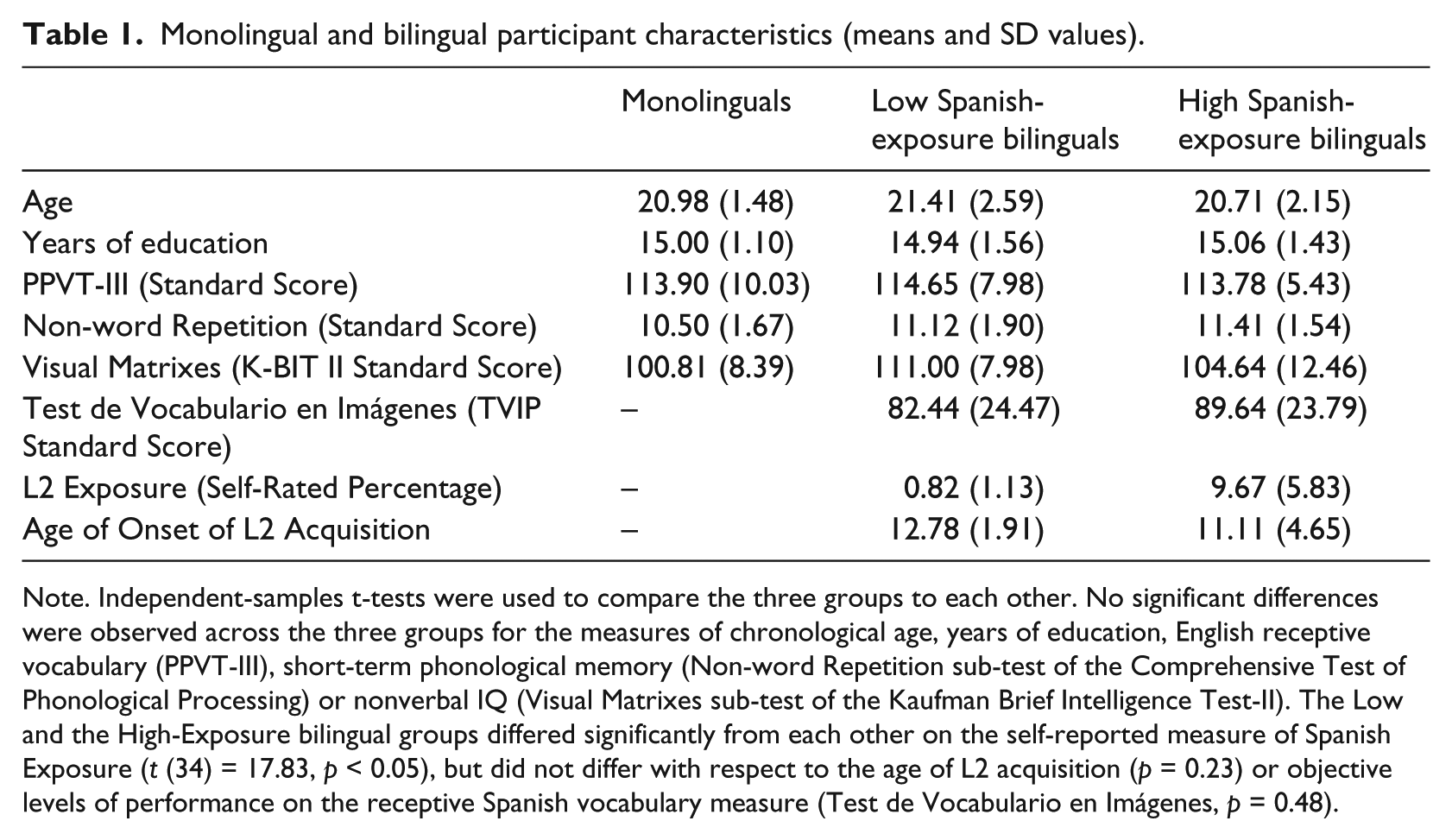
Note. Independent-samples t-tests were used to compare the three groups to each other. No significant differences were observed across the three groups for the measures of chronological age, years of education, English receptive vocabulary (PPVT-III), short-term phonological memory (Non-word Repetition sub-test of the Comprehensive Test of Phonological Processing) or nonverbal IQ (Visual Matrixes sub-test of the Kaufman Brief Intelligence Test-II). The Low and the High-Exposure bilingual groups differed significantly from each other on the self-reported measure of Spanish Exposure (t (34) = 17.83, p < 0.05), but did not differ with respect to the age of L2 acquisition (p = 0.23) or objective levels of performance on the receptive Spanish vocabulary measure (Test de Vocabulario en Imágenes, p = 0.48).
Materials
Stimuli
Stimuli included two lists of 22 English one-syllable nouns referring to inanimate objects (list A and list B). In each list, 11 items had Spanish translation equivalents that carried masculine gender (e.g. corn – maíz), and 11 had Spanish translation equivalents that carried feminine gender (e.g. moon – luna). The lists were matched for frequency of use in both English and Spanish, and for measures of concreteness, familiarity, and imageability. Each inanimate noun was paired with one of 22 masculine or 22 feminine proper nouns/names. The procedure for selecting proper names was as follows: 182 names were chosen from a list of “Top Baby Names” (www.familyeducation.com). These 182 names were then rated by a group of native English speakers on frequency of exposure. The raters were asked to judge the frequency of each name on the scale from one to ten. They were also asked to judge whether each name was characteristically masculine or feminine (by circling “boy” or “girl” next to each name). The names with highest frequency were chosen, and were then assigned to either list A or list B based on length and the judged frequency of use. Across the two lists, the names were balanced in length and frequency of use.
Each name was paired with a noun, and care was taken to ensure that proper names and nouns were phonologically dissimilar. As a result of this procedure, 22 congruent pairs were created (e.g. where a noun whose Spanish translation equivalent was grammatically-masculine was paired with a male name, e.g., corn – Patrick) and 22 incongruent pairs (e.g. where a noun whose Spanish translation was grammatically-feminine was paired with a male name, e.g. beach – William). Lists were then counterbalanced (swapping the 22 names that were paired with incongruent stimuli for the 22 names that were paired with congruent stimuli) to ensure that the name/noun pairings themselves did not affect the rate of retention. Half of each participant group was tested on the original stimulus set and the other half on the counterbalanced stimulus set. All stimuli were presented in English on a computer screen, with the inanimate noun on the left side of the screen, and the proper name on the right side of the screen.
Procedure
During the learning phase, participants were presented with 44 stimulus pairs (e.g. cloud | Julia) and asked to memorize them to the best of their ability. Each stimulus pair was presented visually on the computer screen for 5 seconds, with an inter-stimulus interval (ISI) of 500 milliseconds. The stimulus presentation sequence was randomized for each participant. The subsequent test phase followed immediately after the learning phase. Participants were presented with inanimate nouns in a random order, and were asked to type the proper names that were associated with each noun during learning. The testing phase was self-paced, and participants pressed the enter key to initiate the next trial.
This stimulus set and the procedure were piloted with Spanish–English bilinguals, who were native speakers of Spanish and spoke English as their second language. The piloting procedure was undertaken to ensure that the designed stimuli would induce the grammatical gender effects in native speakers of Spanish. Twelve native speakers of Spanish participated in the piloting of the stimuli. The data from this group showed a congruency effect, with gender-congruent proper names retrieved more successfully at testing (M = 0.30, SD = 0.19) than gender-incongruent proper names (M = 0.22, SD = 0.17), t (11) = 2.72, p < 0.05.
At the end of the session, standardized language and intelligence tests were administered to each participant, including a receptive vocabulary test in English (Peabody Picture Vocabulary Test – III), a nonverbal IQ test (Kaufman Brief Intelligence Test – Visual Matrices Subtest), and a phonological short-term memory test (Comprehensive Test of Phonological Processing – Non-word Repetition Subtest). A measure of Spanish receptive vocabulary was administered to the bilingual speakers (Test de Vocabulario en Imágenes).
Coding and analyses
Participants’ responses during the test phase were scored for accuracy. Mean accuracy was determined by averaging the number of correctly-retrieved proper names in the gender-congruent condition and in the gender-incongruent condition. Accuracy data were analyzed using a 2 x 3 mixed ANOVA, with gender congruency (gender-congruent vs. gender-incongruent) as a within-subjects independent variable, and language experience (monolingual group, low-Spanish-exposure group, and high-Spanish-exposure group) as a between-subjects independent variable. Significant interactions were followed-up by simple comparisons where appropriate.
Results
Overall analyses
A 2 x 3 mixed ANOVA with gender congruency as a within-subjects independent variable and language experience group as a between-subjects independent variable yielded an interaction between group and congruency, F (2, 53) = 3.76, p = 0.05, ηp2 = 0.10. The main effects of congruency, F (1, 53) = 1.86, p = 0.18 and of group, F (2, 53) = 0.31, p = 0.74 were not significant. See Figure 1 for the visual representation of this result.
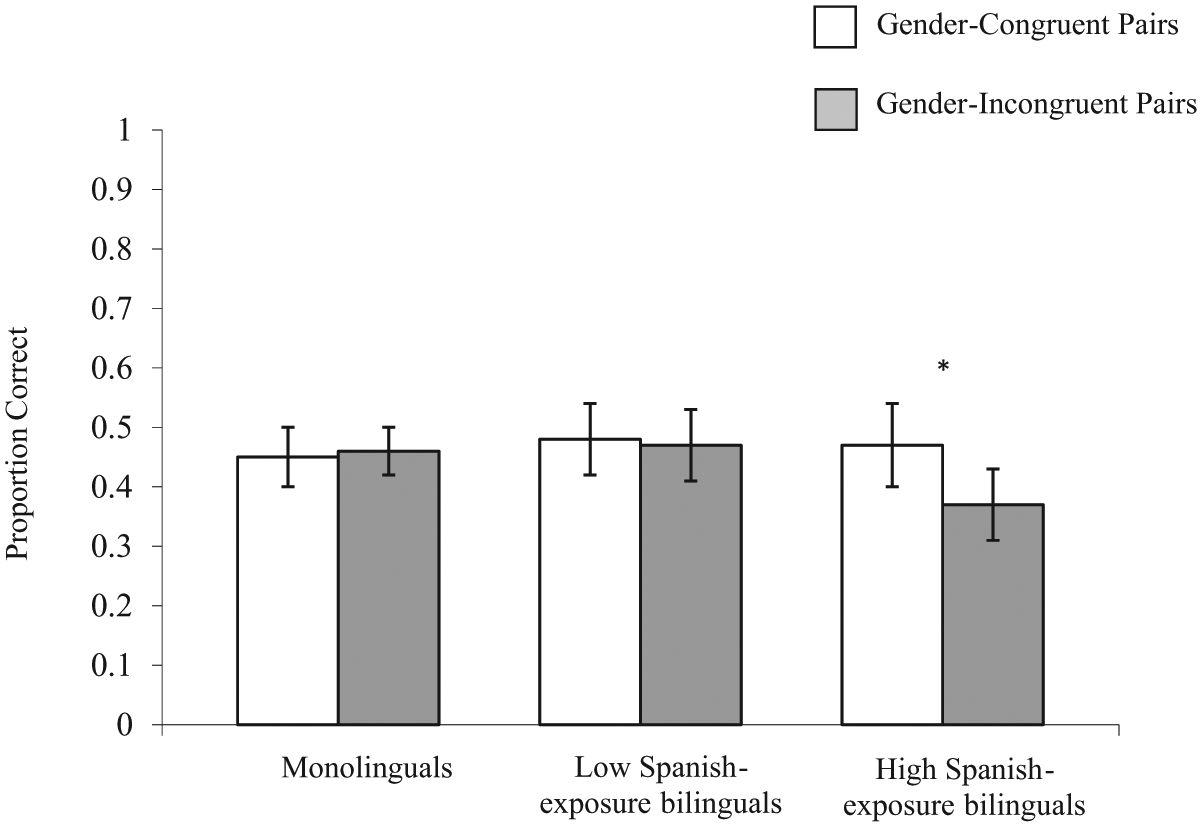
Accuracy levels (proportion correct) on gender-congruent and gender-incongruent pairs for the three groups of participants (monolinguals, low Spanish-exposure bilinguals, and high Spanish-exposure bilinguals).
Congruency effects in each group
Paired-samples t-tests were used to contrast accuracy of performance in gender-congruent vs. gender-incongruent condition in each of the three groups of participants. These analyses revealed that in monolingual speakers, there were no congruency effects in the data, t (21) = 0.31, p = 0.76, and participants were equally accurate at retrieving gender-congruent (M = 0.45, SE = 0.05) and gender-incongruent (M = 0.46, SE = 0.04) proper names.
Paired-samples t-tests performed on the data from the low-Spanish-exposure bilingual group revealed a pattern of performance that was remarkably similar to the pattern observed in the monolingual group. That is, there were no congruency effects, t (16) = 0.17, p = 0.87, and participants were equally accurate at retrieving gender-congruent (M = 0.48, SE = 0.06) and gender-incongruent (M = 0.47, SE = 0.06) proper names.
A different pattern of results was revealed in the high-Spanish-exposure bilingual group. Here, there was a significant effect of gender-congruency, t (27) = 2.11, p < 0.05, and participants were more accurate at retrieving gender-congruent proper names (M = 0.47, SE = 0.07) than gender-incongruent (M = 0.37, SE = 0.06) proper names. This suggests that high-exposure emergent bilinguals were sensitive to grammatical gender information in Spanish, even when processing English (their native language that does not encode grammatical gender).
Discussion
In the present study we used an associative learning task to examine whether grammatical–gender distinctions in the second language would influence native-language lexical processing in bilinguals. Participants learned to associate inanimate nouns with proper names. For half of the stimuli, the grammatical gender of the Spanish translation of the English noun matched the gender of the proper name, while for half of the stimuli, the two mismatched. The hypothesis was that if L2 grammatical gender information were activated during L1 lexical processing, then bilinguals (but not monolinguals) should perform better on gender-congruent pairs than on gender-incongruent pairs. That is, grammatical gender would serve to constrain learning in bilingual speakers of English and Spanish but not in monolingual speakers of English. The findings of this study obviate gender-congruency effects in emergent bilinguals, but only in the high-exposure group. That is, only the high-exposure group demonstrated higher accuracy on the gender-congruent than on the gender-incongruent pairs, while the monolingual and the low-exposure groups showed identical levels of accuracy for gender-congruent and gender-incongruent pairs. These findings suggest that acquisition of grammatical–gender categories through exposure to a second language can influence native-language lexical processing. How precisely does this effect arise?
Previous studies of how grammatical–gender information is processed in bilinguals have diverged in their conclusions. While some studies found that native-language grammatical–gender distinctions influenced lexical processing in the bilinguals’ L2 (Bordag & Pechmann, 2007; Paolieri et al., 2010; Salamoura & Williams, 2007), others found that grammatical–gender distinctions were quite autonomous for the bilinguals’ two languages (e.g. Costa et al., 2003; Kousta, Vinson & Vigliocco, 2008). One possibility for the distinct patterns of findings (besides the obvious differences in methodologies used and languages spoken) is that the disparate levels of L2 knowledge tapped by the different studies influenced the degree to which cross-linguistic influences could be observed. That is, it may be that the L1 influences on L2 processing are stronger for bilinguals whose L2 proficiency is particularly weak (e.g. Lemhöfer, Spalek & Schriefers, 2008). Such an explanation would suggest that the interactivity of grammatical–gender information across a bilingual’s two languages is limited to cases where the L2 lexical representations are especially vulnerable. In the present study, we examined the influence of grammatical–gender information acquired through exposure to the second language on bilinguals’ native-language processing. By flipping the direction in which the cross-linguistic interactions were explored, the issue of target-language proficiency was sidestepped: All three groups of participants in the current study were native speakers of English, who showed identical levels of performance on measures of English vocabulary and phonological memory. Therefore, any influences of L2 on L1 processing observed in the present study would be unlikely to be driven by the low levels of L1 proficiency. Instead, performance differences on gender-congruent vs. gender-incongruent pairs in bilinguals were most likely driven by automatic activation of L2 grammatical–gender information during L1 lexical processing. However, that is not the only explanation for the present data.
When Boroditsky and Schmidt (2000) first used the associative learning paradigm that was utilized in the present study, and found that L2 paired associates learning was affected by L1 grammatical-gender distinctions, they interpreted their findings to suggest that grammatical gender can influence conceptual (i.e. non-linguistic) representations of inanimate nouns in an individual’s cognitive system. A similar conclusion was reached by Kurinski and Sera (2011) who used a voice assignment task to test how native speakers of English in the process of acquiring Spanish categorized inanimate objects. They found that grammatical gender began influencing categorization performance in L2 learners of Spanish after 10 weeks of Spanish exposure. Kurinski and Sera interpreted these findings to suggest that learning a second language later in life can modulate categorization performance. The level at which grammatical–gender effects operate on complex cognitive tasks continues to be debated (e.g. Vigliocco, Vinson, Paganelli & Dworzynski, 2005), and it is certainly feasible that grammatical gender does influence conceptual non-linguistic representations (e.g. Sera et al., 2002). Therefore, it is possible that the findings of the present study also reflect non-linguistic processes, where exposure to grammatical gender in the L2 modified the conceptual representations of inanimate objects in native speakers of English, making them more feminine or more masculine.
The findings in the present study suggest that in bilinguals, L2 grammatical gender information is activated during L1 lexical processing. Whatever the level at which this activation takes place (lexical or conceptual), the simple presence of the effect suggests that acquisition of a second language can influence lexical processing in the native language. However, this finding must be qualified, in that the effect of L2 grammatical gender categories on L1 processing was observed only in the group of emergent bilinguals who were robustly exposed to their second language at the time of the experiment. Conversely, emergent bilinguals (who boasted similar off-line L2 vocabulary skills but lower L2 exposure levels) did not show any gender-congruency effects. This suggests that knowledge of a second language can affect native-language processing, but only when the bilingual speaker experiences robust exposure to the L2. Given that acquiring grammatical gender distinctions in a second language is a difficult task, especially when the native language does not mark grammatical gender (e.g. Dewaele & Véronique, 2001; Guillelmon & Grosjean, 2001; Holmes & Dejean de la Bâtie, 1999; Lew-Williams & Fernald, 2010; Scherag et al., 2004), these findings are quite provocative. Even when the second language is less proficient than the native language, and is acquired fairly late in life, the grammatical distinctions marked in the second language can influence lexical-level processes in the native language.
Footnotes
Acknowledgements
The authors would like to thank all the members of the Language Acquisition and Bilingualism Laboratory for their helpful suggestions on this work.
Declaration of Conflicting Interests
The author(s) declared no potential conflicts of interest with respect to the research, authorship, and/or publication of this article.
Funding
The author(s) disclosed receipt of the following financial support for the research, authorship, and/or publication of this article: This research was supported by NIDCD R03 DC010465 and R01 DC011750 to Margarita Kaushanskaya.