




Abstract
Aims and Objectives/Purpose/Research Questions:
We asked whether the second-language (L2) learning effects on cognition are affected by properties of the native language (L1) by further examining the effects of grammatical gender on categorization in native speakers of Hungarian, which unlike previously-studied L1s, has no grammatical gender.
Design/Methodology/Approach:
Hungarian speakers taking an introductory Spanish course participated in two tasks repeatedly during two semesters. One task examined their acquisition of the target nouns and their grammatical gender. The other examined their categorization of pictured objects by using voice assignments.
Data and Analysis:
A group of 74 beginning Spanish learners participated. Data was analyzed with parametric statistical tests of significance. First we analyzed the results on the language task to examine progress on acquisition of grammatical gender. Then we analyzed the results on the categorization task to determine if learning grammatical gender affected it. Finally, we examined the relationship between knowledge of grammatical gender and categorization by analyzing the categorization performance after 30 weeks of instruction by those who showed high versus low knowledge of grammatical gender.
Findings/Conclusions:
Similarly to Kurinski and Sera (2011), we began observing changes in categorization after 10 weeks of instruction. Results provide additional evidence that learning a second language in adulthood influences categorization. Unlike previous findings, however, Hungarian learners were more successful at acquiring Spanish grammatical gender than the English speakers previously studied.
Originality:
Investigating the effects of grammatical gender on categorization in L2 learners whose native language is completely genderless offered a naturally occurring ‘manipulation’ of a relevant factor – the properties of L1 – critical to this line of research.
Significance/Implications:
The findings provide additional supporting evidence that human cognition can be influenced by learning a language in adulthood. Given that the language effects occurred earlier and were much stronger than those from previous work, we believe that properties of one’s native language may affect acquisition and subsequently the magnitude of language’s effect on cognition.
Introduction
Several recent experiments in which adults have been taught a linguistic distinction indicate that learning that distinction can lead to cognitive changes (e.g. Özgen & Davies, 2002; Özgen, 2004); other studies suggest that this does not always happen (e.g. Everett, 2005). The cognitive changes have been documented within two major linguistic domains – the lexicon and grammatical categories. The value of these studies is that they report cognitive change directly as a function of language learning. Some recent studies have conducted cross-linguistic comparisons between speakers of different languages (e.g. Kurinski & Sera, 2011; Phillips & Boroditsky, 2003), but few of these studies examine the effects of second language learning on cognition. An overview of these studies is presented below with the intention of demonstrating various perspectives regarding this phenomenon. Some of them demonstrate that a particular linguistic distinction can be learned, and subsequently be shown to affect categorization. Other studies suggest that the ability to learn particular distinctions as an adult is more limited, and might be constrained by the nature of the native language.
Color is a domain in which L2 learning has been shown to influence categorization. Languages of the world do not segment the color continuum identically. Some languages have only two color terms whereas others have five, eleven, twelve, etc. Several empirical studies suggest that such diversity of color terminology affects speakers’ color perception (e.g. Özgen & Davies, 1998; Roberson, Davies & Davidoff, 2000). For example, Özgen and Davies (2002) and Özgen (2004) report that human perception can be modified through language learning in adults. The results of these experiments demonstrated that adult learners were able to acquire new color categories, and such training indeed influenced their color perception. This is an important finding because, as Özgen and Davies (2002) emphasize, ‘this increases the plausibility that similar mechanisms may be involved during language learning, giving rise to relativistic effects’ (p. 477).
However, some recent evidence suggests that not all linguistic distinctions can be as easily learned by adults. An example would be numerical terms. Counting systems of human languages also vary. Some languages have a very limited lexical inventory of number words. Does such deficiency impact speakers’ numerical cognition? To answer this intriguing question, a few recent studies have been carried out in some remote world communities. Everett (2005) who lived with his family in the Piraha community for a number of years, learned their language, and extensively studied their culture, discusses an interesting fact about the Piraha in his recent work. Everett and his wife attempted to teach Piraha adults to count to ten in Portuguese every day for eight months. The learners were very motivated, because they needed to be able to determine if the Portuguese traders were taking advantage of them when they engaged in non-barter business. Everett (2005) summarizes his efforts as follows: After eight months of daily efforts, without ever needing to call them to come for class (all meetings were started by them with much enthusiasm), the people concluded that they could not learn this material, and classes were abandoned. Not one learned to count to ten, and not one learned to add 3+1 or even 1+1. (p. 626)
The researcher also affirms that the Piraha language does not have color terms, lacks embedding and the perfect tenses, has a very simple kinship system, and a very small phonemic inventory. Given all this, the author believes that some cultural constraints affect grammar and cognition in the Piraha. However, one may hypothesize that the number learning might not have occurred because of an ineffective teaching method. Gordon (2004) is convinced that absence of numerals in this language influences its speakers’ cognition, and therefore results in their inability to conceptualize basic mathematical operations. This raises the possibility that the properties of the already-learned first language may affect the learnability of the contrasts in the second language. However, because in these cases both the domains (color versus numbers) and the native language structures vary, we cannot determine how the native language structure affects subsequent language learning and cognition. For this reason, we focus on cognitive effects of the L2 grammatical gender, which provides a fertile ground for this research.
Grammatical gender is another realm that has drawn a great deal of attention in recent decades. Since this grammatical category does not exist in all languages, it enables researchers working on the relationship between language and thought to examine its effects on cognition. Does learning a grammatical gender in a second language influence speakers’ object categorization? In a highly cited study, Phillips and Boroditsky (2003) designed the following experiment: two groups of native English speakers learned two kinds of nouns (soupative and oosative) in Gambuzi – an invented language. The subjects learned names for a set of 20 people and objects, which were preceded either by sou or by oos. The soupative/oosative division always matched natural gender of the people illustrated on the drawings. For one group of subjects all the females were in the soupative category and all the males were in the oosative category, while the other group learned the opposite distribution. The objects were placed either in the soupative or in the oosative set. Those inanimate objects that were presented for the first group of subjects in the soupative set appeared in the oosative set for the second group of subjects. When the object–name pairs were memorized, the respondents were asked to describe the unlabeled objects with adjectives. It must be noted that depending on the subject group (first or second), the same objects were attributed opposite characteristics (female or male-like) because for one group they appeared in a group with females while for the other group – with males. Therefore, the influence of culture on conceptual gender 1 categorization of inanimate objects was ruled out. The authors concluded that grammatical gender shaped people’s perception.
Kurinski and Sera (2011) examined how the acquisition of Spanish grammatical gender influences categorization in native English-speaking adults by conducting a longitudinal study with adults learning Spanish. The main objective was to find out whether learning the grammatical gender of Spanish affects adult native English speakers’ attribution of feminine and masculine genders to inanimate objects. College students enrolled in beginning Spanish courses participated in two tasks repeatedly (in one task – 3 times; in another task – 4 times) throughout one academic year. One task examined their acquisition of grammatical gender. The other examined their categorization of inanimate objects. The researchers began to observe changes in participants’ grammatical gender acquisition and in categorization after ten weeks of Spanish instruction. Results indicate that learning a second language as an adult can change the way one categorizes objects. However, the effect of Spanish grammatical gender was more limited in Spanish learners than in native Spanish speakers; it was not observed for all kinds of objects nor did it increase with learners’ proficiency, suggesting that native English-speaking adults learning Spanish reach a plateau beyond which changes in categorization do not occur.
In the current longitudinal study we examine how properties of the first language might influence the effects of second language learning on categorization, by investigating the effects of grammatical gender on categorization in second language learners whose native language is completely genderless. We chose the Hungarian language because similarly to English it does not have a grammatical gender category for nouns and adjectives. In addition, unlike English that has feminine and masculine singular pronouns (e.g. he/she, his/hers, him/her) to mark natural gender 2 distinctions, Hungarian does not have a gender category whatsoever, and therefore provides a naturally occurring manipulation of a relevant factor – the properties of L1 – critical to this line of research. It is possible that properties of one’s native language may affect what they can learn in their second language. The differences between English and Hungarian gender systems (a presence of natural gender distinctions in English versus its lacking in Hungarian) may influence acquisition of this category in Spanish by the speakers of these two languages, which in turn may affect categorizational patterns.
Hungarian language is genderless
Some world languages lack grammatical gender. Koski and Mihalyfy (1990) point out that English, Swedish, Estonian, Finish, and Hungarian languages lack the grammatical distinction between genders. A number of authors have noted that Hungarian has no grammatical gender. According to Hall (1966): ‘[t]he Hungarian noun is not characterized by grammatical gender or other types of noun-classes, nor by case-forms of the Indo-European type’ (p. 25). Nagy and Patti (2006) affirm that since the grammatical gender category does not exist, Hungarian nouns and modifiers cannot be categorized as feminine, masculine and neuter. The natural gender (e.g. nouns that refer to males and females such as boy and girl) does not have an effect on the selection of determiners and adjectives in Hungarian. Moreover, personal pronouns for males and females are the same (e.g. ő = he/she and ők = they). Pete (2000) emphasizes that there is no inherent distinction between natural genders in Hungarian. Due to the lack of gender markers in Hungarian, the differences between lexemes referring to males and females must be analyzed on the level of lexical gender 3 (as cited in Nagy & Patty, 2006, p. 182).
While in Hungarian there is no grammatical gender category, lexical gender distinctions do exist (Vasvári, 2011). According to Pete (2000), some examples include: ‘widower/widow’, ‘hero/heroine’, ‘god/goddess’. Other male/female noun pairs do not show any morphological connection (e.g. ‘father/mother’, ‘bull/cow’) (p. 108). It should be noted that lexical gender distinctions also exist for professions. As Vasvári (2011) points out, ‘Hungarian has richly developed lexical gender with compounds’ (p. 21): orvos (doctor) versus orvos-nő (doctor-woman) or női orvos (female doctor); tanár (teacher) versus tanár-nő (teacher-woman) or női tanár (female teacher), etc.
All in all, the Hungarian language absolutely lacks gender markings while English marks gender for singular subject and object pronouns. Therefore, Hungarian is more ‘genderless’ than English.
Method
The current study followed the method used by Kurinski and Sera (2011). We tested the acquisition of grammatical gender, and its effects on categorization in adult native speakers of Hungarian who were enrolled in introductory Spanish courses at Budapest University of Technology and Economics over the course of one academic year. Their initial bias to categorize inanimate objects according to Spanish grammatical gender was tested in a baseline condition before they were exposed to Spanish. The baseline data for the categorization task were obtained during the first week of the first semester, and are included in the statistical analyses as Time 1 (after 0 weeks of instruction). It was essential to collect the baseline data (voice assignments) before the students were exposed to Spanish, in order to compare it with potential changes in categorization. We subsequently examined how their baseline judgments (initial bias) changed as they learned Spanish grammatical gender of the stimuli items at 3 time points approximately 10 weeks apart (Time 2 data were collected after 10 weeks of instruction, Time 3 data were collected after 20 weeks, and Time 4 data were collected after 30 weeks of instruction). The participants’ acquisition of the target nouns was examined over the same period of time. If learning Spanish grammatical gender affected their categorization of objects, we expected to find more gender-consistent judgments over time in comparison to their judgments in the first (i.e. the baseline) time point.
Similarly to Kurinski and Sera (2011), we examined whether the effect of learning grammatical gender on conceptual gender was stronger for certain categories (e.g. feminine artificial, feminine natural, masculine artificial, masculine natural), as previous studies have shown that people tend to associate natural objects with females and artificial objects with males (Mullen, 1990; Ortner, 1974; Sera, Berge & Del Castillo Pintado, 1994). We wanted to see if the effects of learning a grammatical gender system might be limited to pre-existing associations that people have about inanimate objects. Therefore, we included items that might have matched their past associations (grammatically feminine nouns whose referents are natural/not man-made; and grammatically masculine nouns whose referents are artificial/man-made) and items that might not have matched their past associations (grammatically feminine artificial items and grammatically masculine natural items). All these test items were originally used in Kurinski and Sera (2011). In summary, we included different kinds of categories in order to examine whether grammatical gender effects (if they exist) affect concepts by advancing them further in the same direction of original biases, or if they can alter the course of these biases.
Participants
A group of 74 beginning Spanish learners participated in this study. All of them were native Hungarian speakers who took 2 consecutive elementary Spanish courses at Budapest University of Technology and Economics, where they were pursuing engineering and technological careers. The participants were true beginners in their early 20s. It was a mixed group of male and female students: 43 females and 31 males.
Experimental tasks
We used the same experimental tasks as in Kurinski and Sera (2011). The beginners participated in two tasks repeatedly throughout the academic year. The language task of determiner and lexical knowledge assessed Hungarian speakers’ acquisition of Spanish grammatical gender by examining their knowledge of Spanish determiners and nouns. The voice assignment task looked at their categorization of inanimate objects as masculine or feminine over time. In this task the students attributed feminine or masculine voices to a pictured object. To minimize a possibility of priming by language, the participants always completed the categorization task before the language task in each session of data collection. The data-collection sessions took place in their Spanish classes.
The language task of determiner and lexical knowledge
Materials
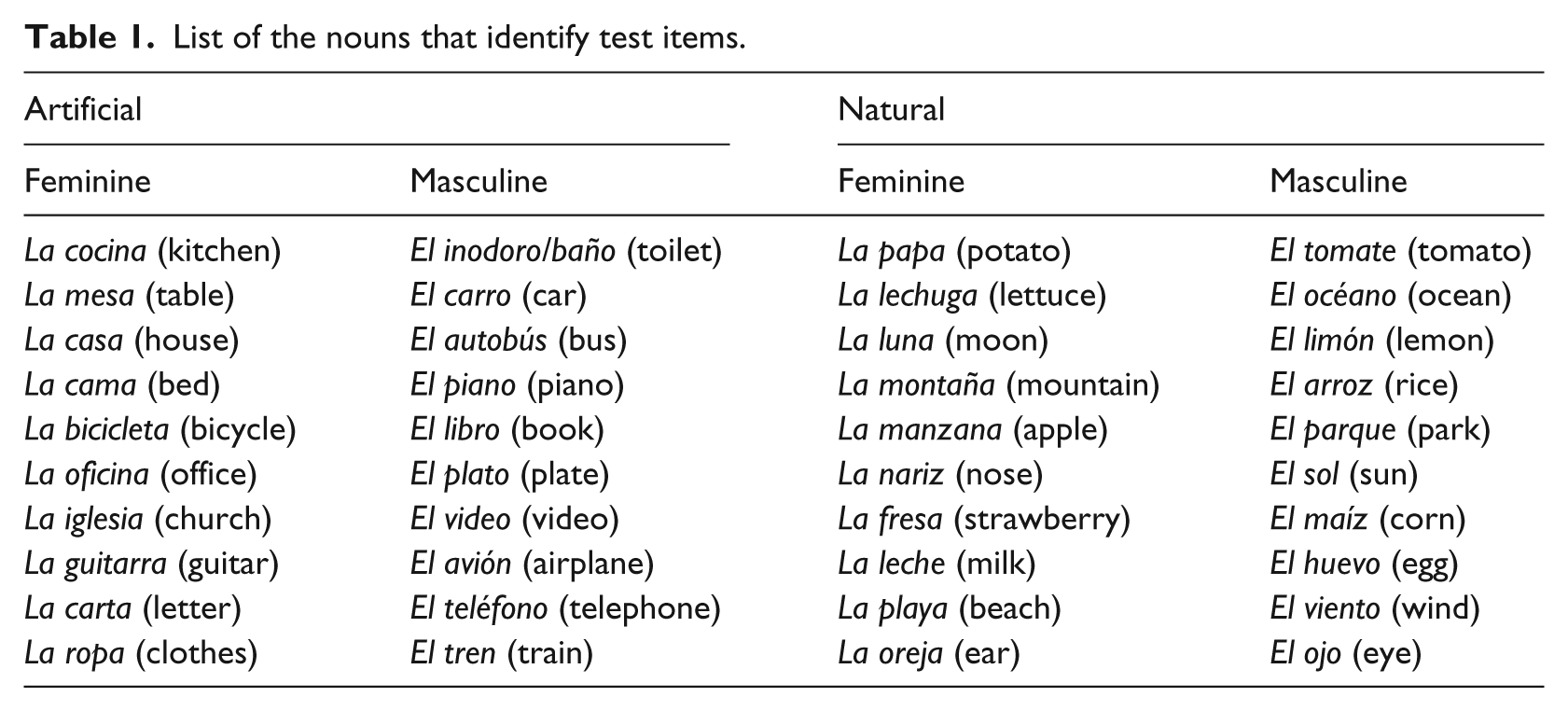
48 pictured items were used as stimuli in both tasks (Figure 1 depicts six sample pictures). All nouns were chosen from the Spanish textbook that was used in the beginning Spanish courses. These materials had been successfully used in a pilot study with English speakers, which showed that these pictures elicited the target nouns. In the determiner and lexical knowledge test the respondents were shown the same pictures as in the voice-assignment task – 40 test and 8 control items (see Table 1, Table 2, and Figure 1). The test items comprised of 10 naturally-occurring items that are represented by grammatically feminine nouns in Spanish, 10 naturally-occurring items that are represented by grammatically masculine nouns, 10 man-made items that are represented by grammatically feminine nouns, and 10 man-made items that are represented by grammatically masculine nouns. The students were exposed to the experimental items in their textbooks during the study, which should have led to their acquisition. The materials used in this study were the same as in Kurinski and Sera (2011).

Examples of pictures (black and white copies of the original color pictures).
List of the nouns that identify test items.
List of nouns identifying control items – people.

The participants provided Spanish words for the depicted objects (including the articles because usually Spanish articles carry the noun’s gender). The instructions were translated into Hungarian (see Appendix A). Below is the English translation of the instructions: Please label each picture in Spanish. For example, if you see a picture of ice-cream, you will write ‘el helado’ or if you see a picture of a hamburger, you will write ‘la hamburguesa’ in the spaces provided for these items. Please make sure that picture numbers correspond to the numbers on your answer sheet. Do not worry about spelling.
Categorization task: assigning men’s and women’s voices to picture
Materials
The participants received a six-page handout with the same 48 pictures as were used in the determiner and lexical knowledge task. They were asked to assign man’s or woman’s voices to each picture. The instructions were also translated into Hungarian in order to ensure that the participants were clear about the assignment (See Appendix A for the Hungarian instructions). Below is the English translation of the instructions: We are thinking about making a new movie in which some everyday objects come to life and sing and dance. You will see a series of pictures of these objects and will need to determine whether each pictured object should have a man’s/boy’s voice or a woman’s/girl’s voice. If you decide that an object should have a woman’s voice, please write ‘woman’s’ in a space provided for this object on your answer sheet. Similarly, if you decide that an object should have a man’s voice, please write ‘man’s’ in a space provided for this object on your answer sheet. Please make sure that picture numbers correspond to the numbers on your answer sheet.
Design
The design of the study followed the design of Kurinski and Sera (2011). The respondents participated in the voice-assignment task four times throughout two semesters, and in the determiner and lexical knowledge task three times. The first data collection session took place during the first week of classes before the students were introduced to the concept of Spanish grammatical gender. It was a voice assignment task, which did not require any knowledge of Spanish. These data served as a baseline measure of their initial biases in their categorization of inanimate objects. In the second, third, and fourth rounds of data collection the respondents participated in both tasks. All rounds were scheduled approximately every ten weeks of instruction. The same pictures were used in all data-collection sessions so that we could examine any potential changes in the learners’ categorization of these objects as they were learning the grammatical gender of the target nouns.
Results and discussion
We first report the longitudinal results on the language task in order to analyze the participants’ progress on the acquisition of Spanish grammatical gender of the target nouns. Then we will present the longitudinal results on the categorization task to examine if learning grammatical gender affected their categorization. Finally, we directly examined the relationship between knowledge of grammatical gender and categorization, by analyzing the subjects’ performance on a categorization task (after 30 weeks of instruction and across four times) by those who showed high versus low knowledge of Spanish grammatical gender. Also, in each section we compare these results with those of the native English speakers studied by Kurinski and Sera (2011).
Results for the language task of determiner and lexical knowledge
The first analyses focused on the Hungarians’ acquisition of Spanish grammatical gender over two semesters. The percentage of times the participants correctly identified the Spanish nouns and articles was calculated and submitted to an ANOVA, which had the following four factors: Time (after 10, 20 or 30 weeks of instruction) × Grammatical Gender (feminine or masculine) × Category (people, natural, or artificial) × Part of Speech (article or noun). All factors were within-subjects. A main effect of Time was found: (F (2,146) = 267.5, p < .0001). According to the post-hoc analyses (Tukey’s HSD, p <.01), at every round of data collection (weeks 10, 20, and 30) the participants’ performance was better than at the previous round, and these differences were statistically significant. This means that they steadily progressed at their acquisition of the target nouns and their grammatical gender. A main effect of Category also emerged: (F (2, 146) = 348.07, p < .0001). The differences in performance on each object category were statistically significant (Tukey’s HSD, p <.01). Performance was best on learning nouns and determiners for people, followed by artificial items, followed by natural ones. We also found a main effect of Gender (F (1, 73) = 21.76, p < .0001) with performance being better on masculine than feminine items. Finally, a main effect of Part of speech emerged indicating that they learned articles more accurately than nouns (F (1, 73) = 183.47, p < .0001).
Four significant 2-way interactions were also found: (1) Time × Category (F (4,292) = 31.73, p < .0001); (2) Time × Part of Speech (F (2,146) = 44.36, p < .0001); (3) Category × Gender (F (2,146) = 4.82, p < 0.0088); and (4) Category × Part of Speech (F (2,146) = 5.547, p = .0044). Importantly, these four 2-way interactions are exactly the same as those found by Kurinski and Sera (2011). Post-hoc analyses (Tukey’s HSD, p <.01) showed that all the differences observed in these 2-way interactions were statistically reliable. Since the factors involved in the 2-way interactions were also part of reliable 3-way interactions, we describe the 2-way interactions in the context of the 3-way interactions. Two 3-way interactions were found significant: Time × Category × Part of Speech (F (4,292) = 7.96, p < .0001); and Category × Gender × Part of Speech (F (2,146) = 26.33, p < .0001). (Tukey’s HSD, p <.01) revealed that the only non-significant difference in performance was on grammatically-feminine entities (articles and nouns) in the artificial category. The 3-way interaction among Time, Category, and Part of Speech indicated that performance improved reliably at each time point for each part of speech and category except in the case of articles for the category People, the performance on which was high at the first round (week 0) and thus did not improve after that (Tukey’s HSD, p < .01 in all cases). Post hoc analyses on the 3-way interaction among Category, Part of Speech and Gender showed that the learners produced both feminine and masculine articles for people very well, with no reliable difference between the genders. For the nouns referring to artificial objects, the learners were better at producing the masculine articles, and for the nouns representing naturally-occurring objects they were better at producing feminine than masculine articles. This is consistent with the bias previously shown in English speakers to associate artificial objects with males and natural objects with females (Tukey’s HSD, p < .01). We also found that the beginners were better able to learn the masculine (vs. the feminine) nouns only for the People and Natural categories. The reason for this is not clear. It is possible that there were other factors associated with some of these nouns that made them easier to learn, such as they were easier to ‘hear’ or they were more frequently used in class or in the textbook.
The means illustrating the interactions appear in Figures 2 and 3.
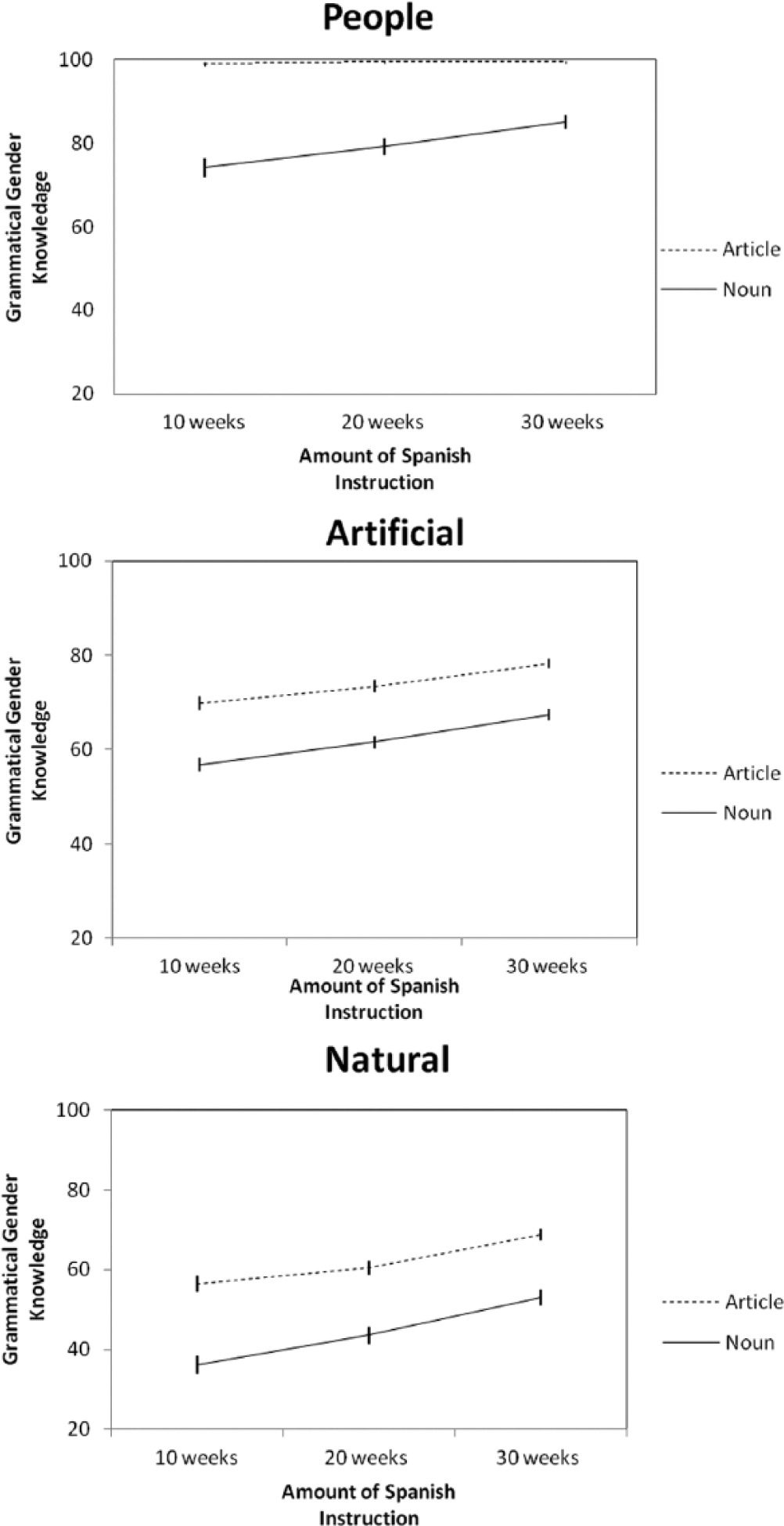
The means making up the Time × Category × Part of Speech interaction in the grammatical gender acquisition task. The vertical bars represent +/− 1 standard error of each mean.
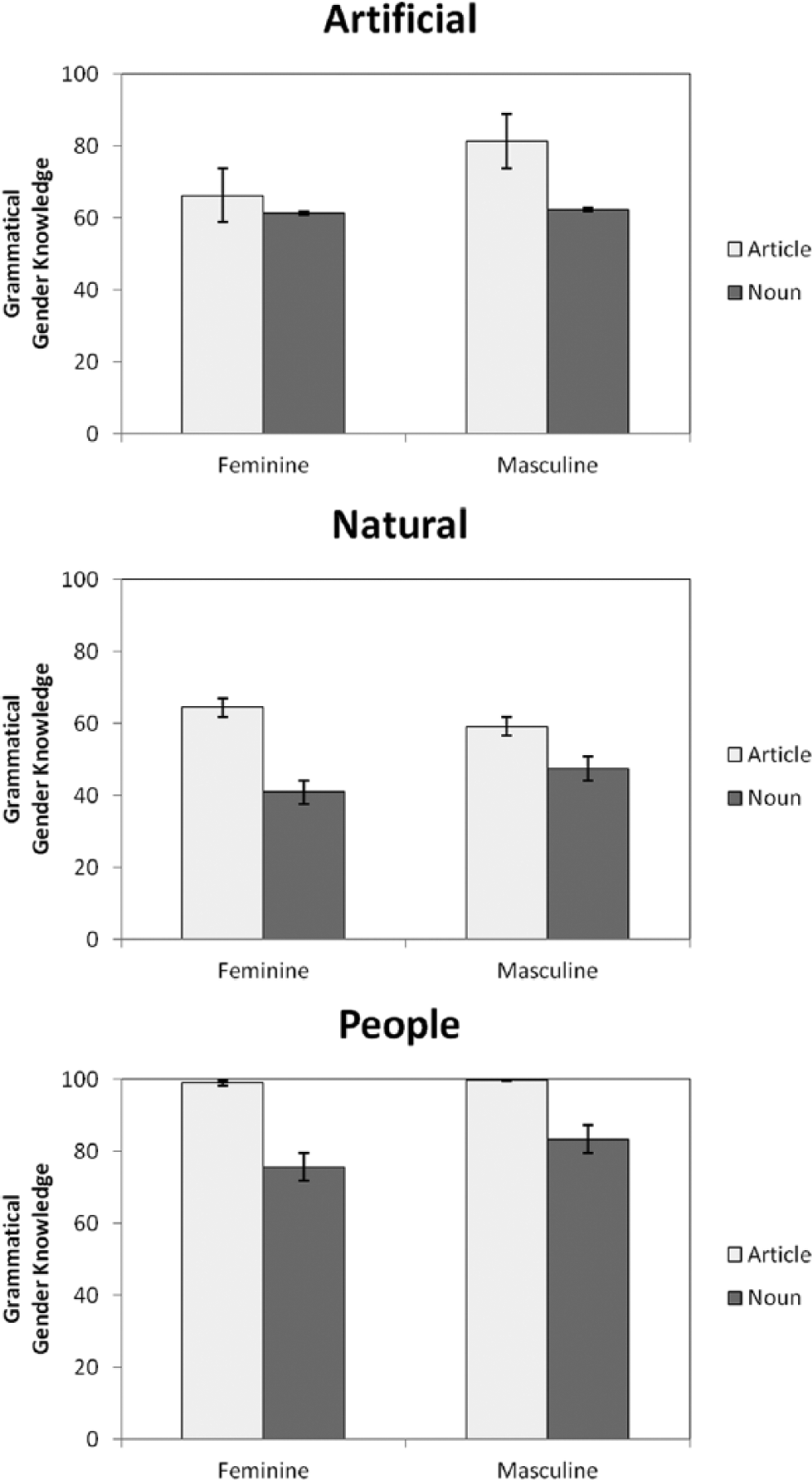
The means making up the Category × Gender × Part of Speech interaction in the grammatical gender acquisition task. The vertical bars represent +/− 1 standard error of each mean.
Similarly to Kurinski and Sera (2011) the best performance was observed on items in the People category while the worst performance was observed on items in the Natural category. Another similarity is that in both studies the respondents knew better grammatically-masculine than feminine entities. However, in contrast to Kurinski and Sera (2011), a main effect of Part of Speech emerged in the present study. Native Hungarian speakers performed consistently better on articles than on nouns. This was observed at every round of data collection: at 10, 20, and 30 weeks. This finding may suggest that unlike English speakers, who tend to learn nouns referring to objects earlier than their grammatical gender carried by corresponding articles, Hungarian speakers acquire grammatical gender of the nouns before they memorize the actual lexical items. Recall that Hungarian has no grammatical gender categories whatsoever, unlike English that has subject and object pronouns that code natural gender. Thus, these results suggest that it might be easier for an L2 learner to learn a language that marks grammatical gender if their L1 does not have this category. So it may be easier to start from scratch than to re-organize an already learned contrast.
Results from the categorization task
We analyzed the pattern of voice assignments with an ANOVA, which included the following factors: Time (1, 2, 3, 4), Gender (feminine, masculine); and Category (natural, artificial).These factors were within subjects. The dependent variable was the percentage of gender-consistent voice assignments that corresponded to Spanish grammatical gender. We found three main effects: Time (F (3,219) = 75.22, p < .0001); Category (F (1, 73) = 72.39, p < .0001); and Gender (F (1, 73) = 6.22, p = .008). At every round of data collection (except at Time 0/baseline) the participants’ performance was more consistent with Spanish grammatical gender than the previous round, and the improvements between adjacent rounds were all statistically significant (Tukey’s HSD, p <.01). Across 4 times, the performance was more gender-consistent on stimuli items representing artificial masculine objects. Similarly to English native speakers (Kurinski & Sera, 2011), the voice assignments of the Hungarian learners of Spanish were more gender-consistent with time. Likewise, across all 4 times the learners’ voice assignments for artificial entities were more gender-consistent than for natural ones. In addition, their judgments were more in line with Spanish grammatical gender for grammatically masculine entities as opposed to the grammatically feminine ones. However, Kurinski and Sera (2011) found that English speakers’ categorization of inanimate objects differed significantly from their baseline data after 20 weeks of classroom instruction (Kurinski & Sera, 2011), and the present findings suggest that Hungarian speakers acquire Spanish grammatical gender faster, and consequently show an earlier effect of gender on categorization (after 10 weeks of exposure to Spanish at Time 2).
We also found three 2-way significant interactions: Time × Category (F (3,219) = 4.31, p = .0074); Time × Gender (F (3,219) = 4.88, p = .0034); and Category × Gender (F (1,73) = 22.66, p < 0.0001). The only non-significant difference in performance was observed between feminine and masculine items at week 30. All other differences were statistically reliable in these 3-way interactions. Given that these interactions are included in a 3-way significant interaction found in this ANOVA, we will now turn to its analysis.
A 3-way interaction Time × Category × Gender (F (3,219) = 6.08, p = 0.0007) emerged, (Tukey’s HSD, p <.01) (see Figure 4). Post hoc analyses (Tukey’s HSD, p < .01) indicated that for feminine natural items there were reliably more grammatically-consistent voice assignments at each time point except between 10 and 20 weeks. For natural masculine items, there was no reliable difference between 0 and 10 weeks, but the voice assignments at each subsequent time point were reliably better than the previous one. For the artificial feminine items there was a reliable increase in grammatically-consistent assignments at each time point, but for masculine items there was only an increase in consistent assignments between 0 weeks (baseline) and the other later time points.
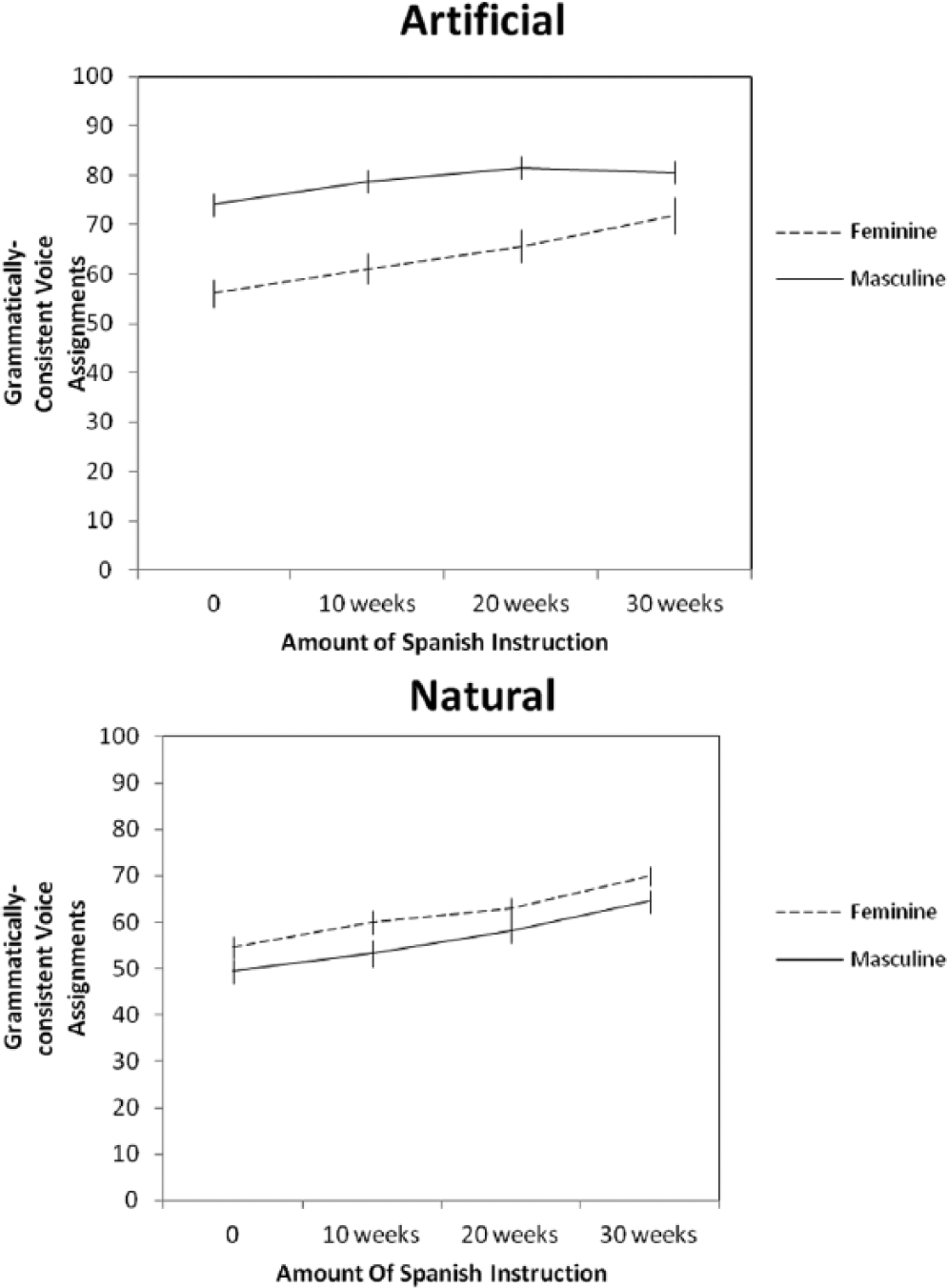
The mean percentage of grammatically-consistent voice assignments for the artificial and natural categories for feminine and masculine grammatical genders over time in the categorization task. The vertical bars represent +/− 1 standard error of each mean.
Grammatical gender knowledge and categorization (high and low performers)
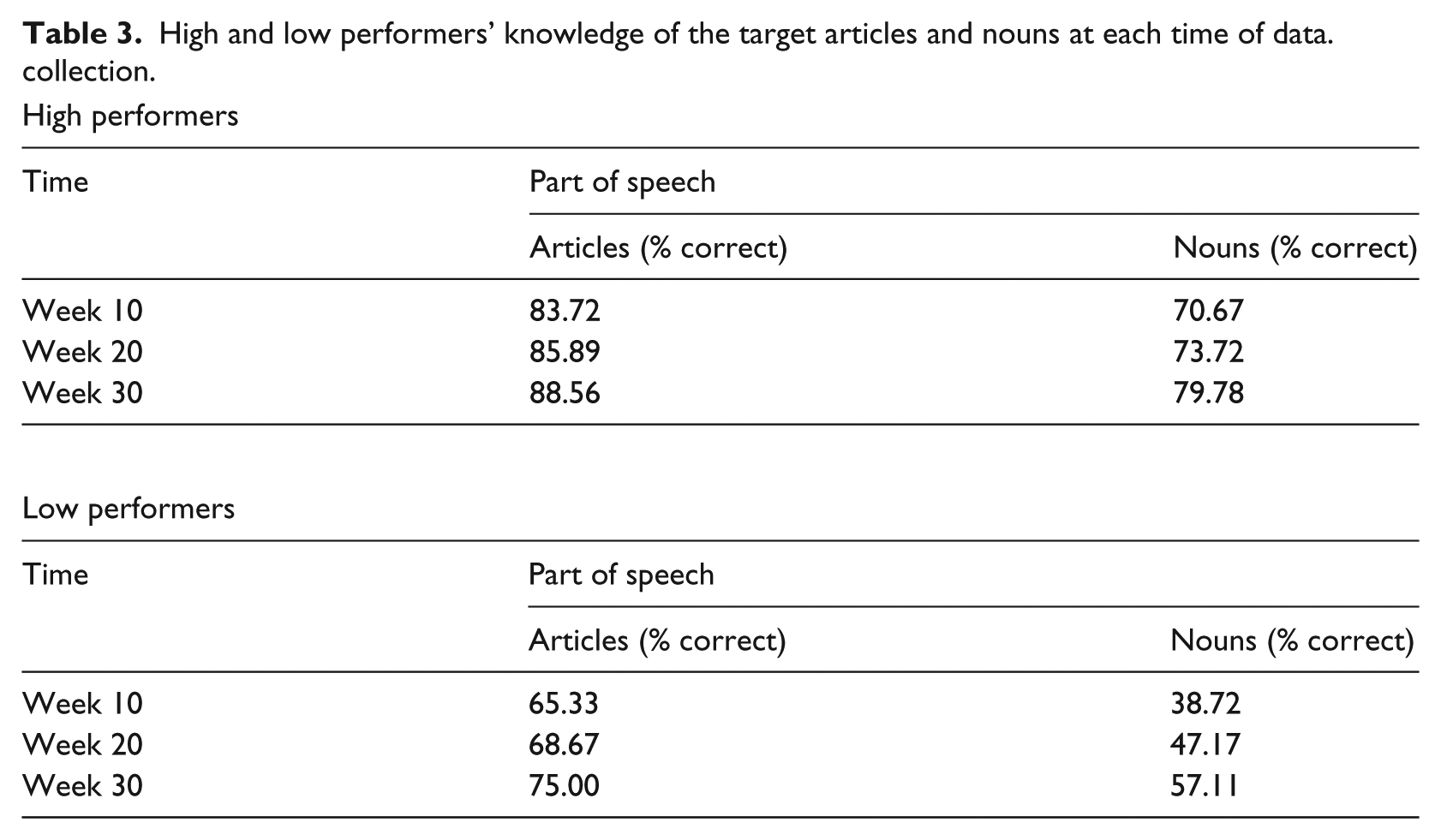
In order to further examine the relationship between Spanish grammatical gender acquisition and categorization in Hungarian native speakers, we identified the 15 highest and 15 lowest performers on the determiner and lexical knowledge test at Time 4 (30 weeks) and looked at their performance across 3 time points (weeks 10, 20, and 30). The cutoff score for the high performers was greater than 74% and for the low performers lower than 60%. The means for each group are presented in Table 3.
High and low performers’ knowledge of the target articles and nouns at each time of data. collection.
Then we analyzed their voice assignments across 4 times at weeks 0, 10, 20, and 30 (see Figure 5). This repeated measures ANOVA included the following factors: Group (high versus low-performing students); Time (1, 2, 3, 4); Category (natural, artificial); and Gender (feminine, masculine). The dependent variable was the percentage of gender-consistent voice assignments. We found 3 main effects: Time (F (3,84) = 24.28, p < .0001); Category (F (1, 28) = 25.021, p < .001); and Group (F (1, 28) = 61.889, p < .001). A 2-way significant interaction Time × Group (F (3, 84) = 7.99, p = .0001) also emerged.
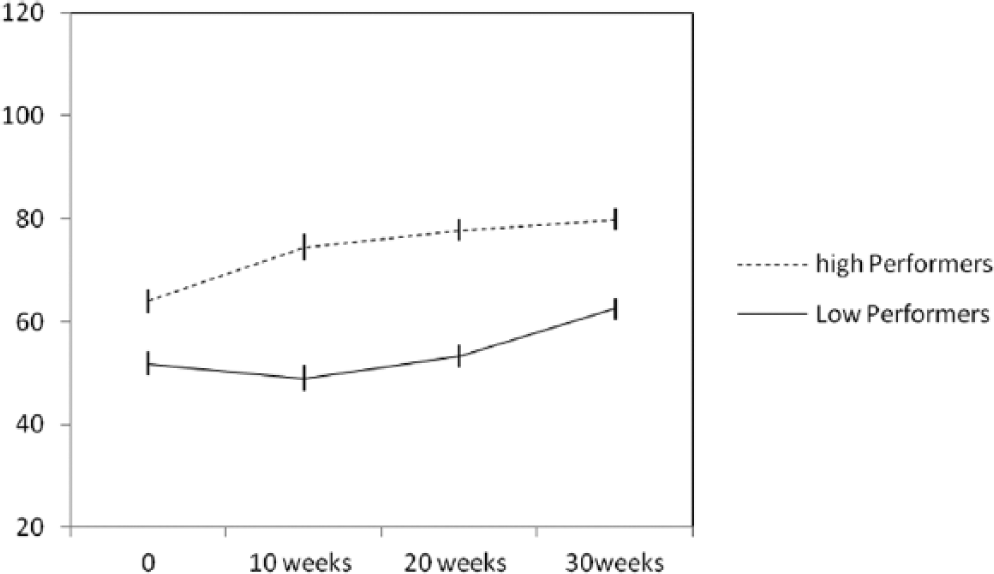
Grammatically-consistent voice assignment for the two groups across 4 times. The vertical bars represent +/− 1 standard error of each mean.
Because the low and high performers appear to be different at baseline, they seem to start with different biases. To eliminate the difference that they start with, we subtracted their initial bias (the number of grammatically-consistent voice assignments at the baseline) from grammatically-consistent judgments at subsequent time points. By subtracting their initial bias from subsequent judgments, the remainder reflects the additional amount of influence that learning of grammatical gender caused. This way both groups were assigned a starting point of 0 gender-consistent judgments. Then, the high performers’ adjusted means were 15% at Time 2, 16% at Time 3, and 17% at Time 4. The low performers’ adjusted means were 0, -1, and 5% at Times 2, 3, and 4 accordingly. After subtracting the initial bias from subsequent scores, we conducted another ANOVA that examined the gains made. The main question was whether after taking out the initial difference between the groups (unexplained bias), we would still find a difference between the groups after each learned grammatical gender. This ANOVA revealed main effects of Time with (F (3, 84) = 93.464, p < .0001), Gender: F (1, 28) = 14.685, p = .001), and Category: (F (1, 28) = 88.466, p < .001). We also found the following significant 2-way interactions: Time × Category with (F (3, 84) = 79.774, p = < .0001); Time × Gender: (F (3, 84) = 11.854, p = .00011); and Category × Gender: (F (1, 28) = 156.374, p < .0001). A 3-way interaction Time × Category × Gender was also reliable: (F (3, 84) = 122.905, p < .00001). So even though the high and low performers did not start at the same point, the nature of the effects for each group was largely the same. Given that these effects are the same as those previously reported (see ANOVA 2 results from the categorization task) we will not discuss them further, however, we did observe, a 2-way interaction between Time and Group: (F (3, 84) = 41.236, p < .001). Post hoc analyses for the Time × Group interaction (Tukey’s HSD, p <.01) indicated that the high performers’ main gain was between Time 1 (baseline) and Time 2 (week 10), whereas for the low performers most of the gain occurred between Time 3 (week 20) and 4 (week 30). The post hoc analyses also revealed that the group differences were reliably different at each round of data collection, except for the baseline (Time 0) when the difference was forced to 0 in order to remove the initial bias from the impact of learning. These results show that the high performers learned Spanish gender of the target nouns faster, and it influenced their categorization earlier as well.
These differences between high and low performers, who were native Hungarian speakers, contrasted with those from native English speakers reported by Kurinski and Sera (2011). Kurinski and Sera (2011) reported that the beginners started out at approximately 54% of grammatically-consistent voice assignments (baseline). After 30 weeks of Spanish classroom instruction their accuracy was at 60%, while grammatically-consistent judgments of advanced learners (graduate students and university-level instructors of Spanish) and native Spanish speakers were 61% and 78% respectively. As Figure 5 illustrates, the results of low-performing Hungarian speakers are very similar to those found in English-speaking beginners. Nevertheless, the high-performing Hungarian speakers started out at the level of the advanced learners, whose first language was English, and at week 30 the consistency of their grammatical judgments was at the level of native Spanish speakers. This finding suggests that learners’ first language influences the degree of conceptual changes triggered by their second language. Overall, our current results corroborate our previous finding, i.e. they show the effects of grammatical gender on categorization in adult second language learners. However, they also suggest that the effects of second language learning on categorization are influenced by the learners’ native language.
To explore whether there were particular differences in the acquisition of Spanish gender by the low and high performers, we re-analyzed their performance on the task of determiner and lexical knowledge with Group (High or Low performers) as an additional factor. The factors were Time (2, 3, 4), Category (People, Natural, Artificial), Gender (Feminine, Masculine), Part of Speech (Article, Noun), and Group (High performers, Low performers). The results from these analyses showed the same pattern of acquisition in high and low performers, the only difference being that the low performers acquired Spanish grammatical gender more slowly than the high performers.
Conclusion
We began by asking whether the second-language (L2) learning effects on cognition are affected by properties of the native language (L1). Our main objective was to replicate and extend the body of existing research on language–thought relations in late bilinguals, and to further examine the effects of grammatical gender on categorization in second language learners. We chose to study Hungarian native speakers because their native language does not have a grammatical gender category. Every ten weeks over one year we examined how the native Hungarian speakers learned Spanish grammatical gender of the target nouns. They also completed a voice-assignment task every 10 weeks of Spanish classroom instruction. They had to assign female and male voices to inanimate objects. Baseline data were collected prior to their exposure to Spanish.
Our results support several earlier findings. Similarly to Kurinski and Sera (2011), the best acquisition of grammatical gender was observed for nouns that refer to people, who have a natural gender. These findings also support Berta’s observations (1997) that Hungarian learners easily acquire Spanish grammatical gender for animates. Our findings were also similar to Kurinski and Sera (2011) in that we found that the best performance within inanimate objects was observed for masculine nouns that refer to artificial objects, and within nouns that refer to naturally-occurring objects the respondents performed better on the grammatically-feminine nouns. Perhaps Hungarian native speakers (similarly to English speakers – e.g. Mullen, 1990; Ortner, 1974; Sera, Berge & Del Castillo Pintado, 1994) have a predisposition to associate natural with feminine and artificial with masculine kinds, which makes learning the grammatical gender for these nouns easier for them. Another possibility is that the masculine grammatical gender is preferred by default due to its unmarked status (Kurinski & Sera, 2011). More empirical evidence is needed to provide more insight into this phenomenon.
Unlike the native English speakers studied by Kurinski and Sera (2011), however, Hungarian speakers learned the target nouns and their grammatical gender faster and more successfully than their English counterparts. The results of our study show that they learned grammatical gender for both animate and inanimate stimuli quickly and accurately. Native Hungarian speakers acquired articles better and faster than nouns unlike the English speakers described in Kurinski and Sera (2011). While English speakers appeared to learn lexical items for inanimate entities without corresponding articles carrying their grammatical gender, the Hungarians’ performance on articles was consistently better than on nouns. Perhaps more attention was drawn to a completely new feature – grammatical gender and the students were more focused on its acquisition. Or maybe there was less interference from their native Hungarian. For English speakers ‘grammatical’ gender is closely tied to biological gender. English speakers have to override or ‘unlearn’ those associations in order to learn Spanish grammatical gender because it extends to inanimate entities as well. For Hungarian learners of Spanish, there is no previous linguistic association to ‘unlearn’. While in English the pronouns differentiate between the sexes (e.g. he/she, him/her, his/hers), in Hungarian there is no such distinction. The subject pronoun o (she/he) is unisex. It may be easier to learn a new concept as opposed to restructuring already existing representations. This may explain why Hungarians made more progress learning Spanish grammatical gender of the target nouns than native English speakers.
Another way that our findings are consistent with previous work involves how the participants categorized objects after they learned Spanish grammatical gender. Similarly to Kurinski and Sera (2011), we found effects of L2’s grammatical gender on categorization, and these effects were consistently stronger for artificial masculine entities. By replicating the finding in another country with a different student population and different experimenters, this finding offers converging evidence of language effects on cognition for second language learners.
The current findings, however, differ from those of Kurinski and Sera (2011) as well.
Hungarian speakers showed the effects of Spanish grammatical gender on categorization earlier than the English speakers. The fact that the acquisition was documented earlier and gender effects revealed themselves earlier supports the argument that Spanish grammatical gender triggered the changes in categorization.
The current findings also showed that the effects of grammatical gender were greater in native Hungarian than in English speakers. Conceptual changes demonstrated on the categorization task by the beginning high-performing Hungarians were stronger than those found in advanced learners of Spanish, who were native English speakers in Kurinski and Sera (2011). For this reason, we do not believe that the differences between the native English and Hungarian speakers can be explained by simply saying that the Hungarian speakers were smarter or received better instruction. The Hungarian speakers did not know Spanish grammatical gender better than the advanced learners from the USA, who were graduate students and university-level instructors in Spanish (Kurinski & Sera, 2011). The effects of gender on categorization found in advanced Spanish learners, who had studied Spanish for several years, were not nearly as large as those found in native Spanish speakers nor among the Hungarian speakers in the current study. According to Kurinski and Sera (2011), the results from the beginners and advanced groups did not differ significantly from each other overall (60.05% versus 61.63%, respectively). So we believe that the observed differences between native English and Hungarian speakers are due to the mechanisms underlying their process of learning Spanish grammatical gender, which in turn affects their categorization of inanimate objects. The differences between the English and Hungarian gender systems (a complete lack of gender in Hungarian and a partial existence in English) might have affected acquisition and subsequent categorization. We acknowledge, however that there may be other differences between Hungarian and English speakers, and those should be explored by future work.
In sum, this study contributes empirical evidence to the body of existing research on language–thought relations in adult language learners. Our findings show changes in object categorizationby Hungarian learners of Spanish. We believe that these changes were triggered by the acquisition of Spanish grammatical gender. This is especially apparent because the strongest effects were observed in the object categories for which grammatical gender was acquired the best. The findings from Hungarian learners offer supporting evidence that human cognition can be influenced by learning a language in adulthood. Given that the language effects occurred earlier and were much stronger in Hungarian speakers than in English speakers (Kurinski & Sera, 2011), we believe that properties of one’s native language may affect the process of acquisition and the magnitude of its effects on cognition. The Hungarian language is less gendered than English and possibly because of that Hungarian speakers are more predisposed to be influenced by Spanish grammatical gender than English speakers.
Footnotes
Appendix A
Acknowledgements
The authors would like to thank colleagues from Budapest University of Technology and Economics for their assistance with data collection and processing, and Professor David Robinson and his graduate students Zhengyi Li and Uchechukwu Nwoke from St. Cloud State University for help with the statistical analyses.
Declaration of Conflicting Interests
The author(s) declared no potential conflicts of interest with respect to the research, authorship, and/or publication of this article.
Funding
The author(s) disclosed receipt of the following financial support for the research study reported in this article: This research was supported in part by a New Researcher Award from St. Cloud State University to Elena Kurinski.