




Abstract
Aims and objectives:
We examined the bi-directional interaction of first language (L1) and second language (L2) word use patterns by asking whether L2 patterns of word use can be acquired with intensive exposure in a laboratory setting, and whether this early stage of L2 learning would impact L1 performance.
Methodology:
In two experiments, native speakers of English first labeled drinking vessels in English, then received intensive training on L2 Russian naming patterns for the objects, and, lastly, labeled the objects in English again.
Data and analysis:
Data were collected from eight different training groups with 14–15 participants each plus a control group with 14 participants who did not learn L2 Russian.
Findings/conclusions:
Trained participants successfully acquired L2 Russian patterns of word use regardless of specific training condition. However, they showed significantly less consistency in L1 English post-test labeling than the control group.
Originality:
Neither full acquisition of L2 patterns nor their simultaneous impact on L1 choices has been previously demonstrated.
Significance/implications:
These outcomes suggest that acquisition of target-like L2 word use can be facilitated by intensive exposure to word-referent mappings. However, even in the early stages of L2 learning, a L2 influence may be manifested in the L1 as a destabilization of word-to-referent mappings, suggesting continuous dynamic interaction between the two languages.
Keywords
Using the words of a second language (L2) like a native speaker entails more than just learning the word forms of a language, because even roughly equivalent words are often not direct translations. For example, although Russian stakan is translated into English as glass, English speakers usually apply glass only to containers made of glass while Russian speakers apply stakan to any tall, cylindrical drinking vessel without handles. Conversely, Russian chashka is translated as cup, but chashka is restricted to tea- and coffee-cup-like vessels, whereas English cup encompasses paper and plastic cups, children’s sippy cups, and so on (objects called stakan in Russian). Shape, function, and material all are relevant to drinking vessel lexical distinctions in both languages, but material carries more weight in English and shape and function does in Russian (Pavlenko & Malt, 2011).
In order to use L2 words like monolingual native speakers while still maintaining first language (L1) patterns of use, bilinguals would have to represent the paired words with overlapping but distinct ways of connecting meaning elements 1 to the word forms (Ameel, Storms, Malt, & Sloman, 2005; Jared, Poh, & Pavio, 2013; Pavlenko, 2009; van Hell & de Groot, 1998). Is this possible? The answer may depend on the nature of the bilingual lexical network. Once an initial L2 entry is created with some imported meaning from the L1, refinement and maintenance of meaning in the two languages may proceed independently, such that native-like L1 and L2 could both be achieved under optimal conditions. Alternatively, cross-language interconnections in the lexical network (e.g., Francis, 2005) may mean that shaping meanings in one language changes meanings in the other language, making fully monolingual-like word use in both languages unlikely. In the current research, we use a laboratory learning paradigm to help shed light on what constrains acquisition of target-like L2 word use. We also investigate whether early stages of L2 word learning influence L1 word use. Together, these aims address the dynamic interaction between a bilingual’s two languages.
The challenge of second language word learning
Even immersed L2 learners only slowly, if ever, reshape their initial L2 word meanings toward those of target-language speakers (Malt & Sloman, 2003). If shaping of meaning proceeds relatively independently once an initial L2 entry is established, the explanation may lie in non-optimal input and learning conditions. Bilinguals have fewer opportunities compared to monolinguals to experience the word–object mappings of a language (Gollan, Montoya, Fennema-Notestine, & Morris, 2005). They may also rarely receive corrective feedback, and long intervals between word occurrences may make it hard to abstract native patterns of use. Furthermore, given a default assumption of translation equivalence, they may lack sensitivity to input they do get, while the use of the L1 alongside L2 may reinforce the presumption of translation equivalences.
A different potential source of difficulty concerns the nature of the lexical network. Continued L1 use may exert an on-going pull against reshaping L2 word form-to-meaning mappings due to interconnections within the lexical network. If stakan and glass are linked to one another for a Russian-English bilingual, then using stakan in L1 contexts may continue to reinforce the connection of stakan features, such as PLASTIC or PAPER, to English glass because activation of one word also activates connections to the other. The use of both languages on a daily basis, sometimes within the same sentence, may make building distinct representations in the two languages especially difficult (Wolff & Ventura, 2009).
Given these two possibilities, the first aim of the current studies was to help evaluate the contribution of each by seeing whether intensive exposure to L2 word-referent mappings enables the acquisition of L2 patterns.
The impact of L2 learning on L1 word use
The other side of the coin is how L2 learning impacts L1 word use. Bilinguals arriving in a L2 environment after mid-adolescence come with adult-like knowledge of common L1 words (Ameel, Malt, & Storms, 2008) and well-entrenched semantic representations (Hernandez, Li, & MacWhinney, 2005). Sub-optimal learning conditions are not, therefore, a candidate for explaining L1 difficulties after late L2 immersion. However, reduced L1 input after L2 immersion may decrease the accessibility of some L1 words in memory (e.g., Linck, Kroll, & Sunderman, 2009; Schmid, 2011). The immersed L2 user may also hear some non-native L1 word uses from non-native speakers of the L1.
A different type of explanation again concerns dynamic interconnections in the lexical network. As L2 exposure and learning takes place, updating feature-to-word form connection strengths may impact both languages (see Malt, Li, Pavlenko, Zhu, & Ameel, 2015). Just as retrieval and use of L1 words may affect L2 representations, retrieval and use of a L2 word may cause reactivation of associated L1 words and changes to their meanings (Ameel et al., 2005; Pavlenko & Malt, 2011; Wolff & Ventura, 2009). Successful refinement of L2 word meanings may result in inevitable changes to the L1.
Given these two possibilities, the second aim of the current studies was to help identify the contribution of each by evaluating whether initial learning of L2 word use patterns under conditions designed to foster L2 mastery would impact L1 performance.
Overview of studies
In two experiments, native English speakers were taught the use of five Russian words for drinking vessels, including two (stakan and chashka) that differ in their range of applicability from their closest English translations (glass and cup). L2 input limitations were minimized in that participants were given intensive exposure to the target Russian name for each object. L1 retrieval difficulties were eliminated in that all L1 responses were forced choices among presented options. Before and after L2 Russian learning, participants labeled the same objects in L1 English. Control participants provided L1 English labeling data without exposure to Russian.
If difficulty in acquiring native-like L2 word usage while simultaneously maintaining native-like L1 usage results entirely from sub-optimal input and learning situations, then with intensive L2 input and only a brief period of L2 use, plus provision of L1 word options, participants should be able to master the L2 usage and show no change to L1 use. On the other hand, if interconnections between the two languages’ representations in the lexical network make separation of the patterns difficult, acquisition of the L2 patterns may be impossible despite favorable input conditions, or if achieved, the acquisition may alter L1 performance.
Each experiment also manipulated two aspects of the learning conditions to further examine how input variations may affect acquisition. All experimental groups rapidly mastered the correct Russian naming patterns with few differences among them. Thus, we focus here on the implications of this general outcome and its impact on L1 performance, rather than on effects of the specific learning conditions.
Experiment 1
Participants viewed pictures of drinking vessels and learned their Russian names. Four phases – an English pre-test, Russian training, Russian testing, and an English post-test – allowed assessment of English performance as well as acquisition of Russian usage. Learning variables were chosen for relevance to conditions of classroom learning conditions. Participants were given information about standard dictionary translations between the English and Russian words, as is typical in classroom instruction. Also, half of the participants received corrective feedback during Russian training while half did not, and half viewed the objects blocked by Russian name (facilitating noticing commonalities) while half viewed them interleaved (facilitating contrasting the names) (see Carvalho & Goldstone, 2014, 2015). These variants of exposure are all potentially implementable in a classroom setting. Control participants performed the English pre-test and post-test with a filler task in between.
Method
Participants
Participants were 73 native English speaking undergraduates at Lehigh University. They had had some classroom exposure to another language (typically Spanish), but did not use one regularly. None knew Russian, allowing full control of their exposure to the to-be-learned words. The control and feedback absent/blocked presentation conditions had 14 participants each; the remaining three conditions had 15 each.
Materials
A short language history questionnaire was used to obtain information regarding the participant’s age and sex, knowledge of languages other than English, and relative use of English versus another language in daily life.
Photographs of drinking vessels from Pavlenko and Malt (2011) were used. The vessels were made from varied materials (Styrofoam, glass, plastic, etc.) and designed to hold varied beverages (tea, coffee, alcohol, cold beverages, etc.). Participants were trained using 45 of Pavlenko and Malt’s 60 pictures, including all those most commonly called chashka (n = 11), kruzhka (n = 9), fuzher (n = 4), and riumka (n = 6) by functionally monolingual speakers of Russian in Pavlenko and Malt’s (2011) data, plus a portion (n = 15) of items most commonly called stakan. (Eight of Pavlenko and Malt’s 23 stakan items were eliminated so that participants would be unable to use frequency information in their judgments.) Of the 35 objects in the training set that received a name of stakan, chashka, or kruzhka, only 15 received the name that would be expected based on a standard dictionary translation of stakan as glass, chashka as cup, and kruzhka as mug (with discrepancies primarily concerning stakan/glass and chashka/cup). Thus, the Russian categories diverged substantially from English ones, as described earlier. The remaining 10 objects received specialized Russian names, riumka and fuzher (applying to vessels distinguished from glass only by modifiers in English: shot glass and wine glass), so the task required splitting three English lexical categories across five Russian ones. See Figure 1 for sample stimuli; see Pavlenko and Malt (2011) for additional examples.
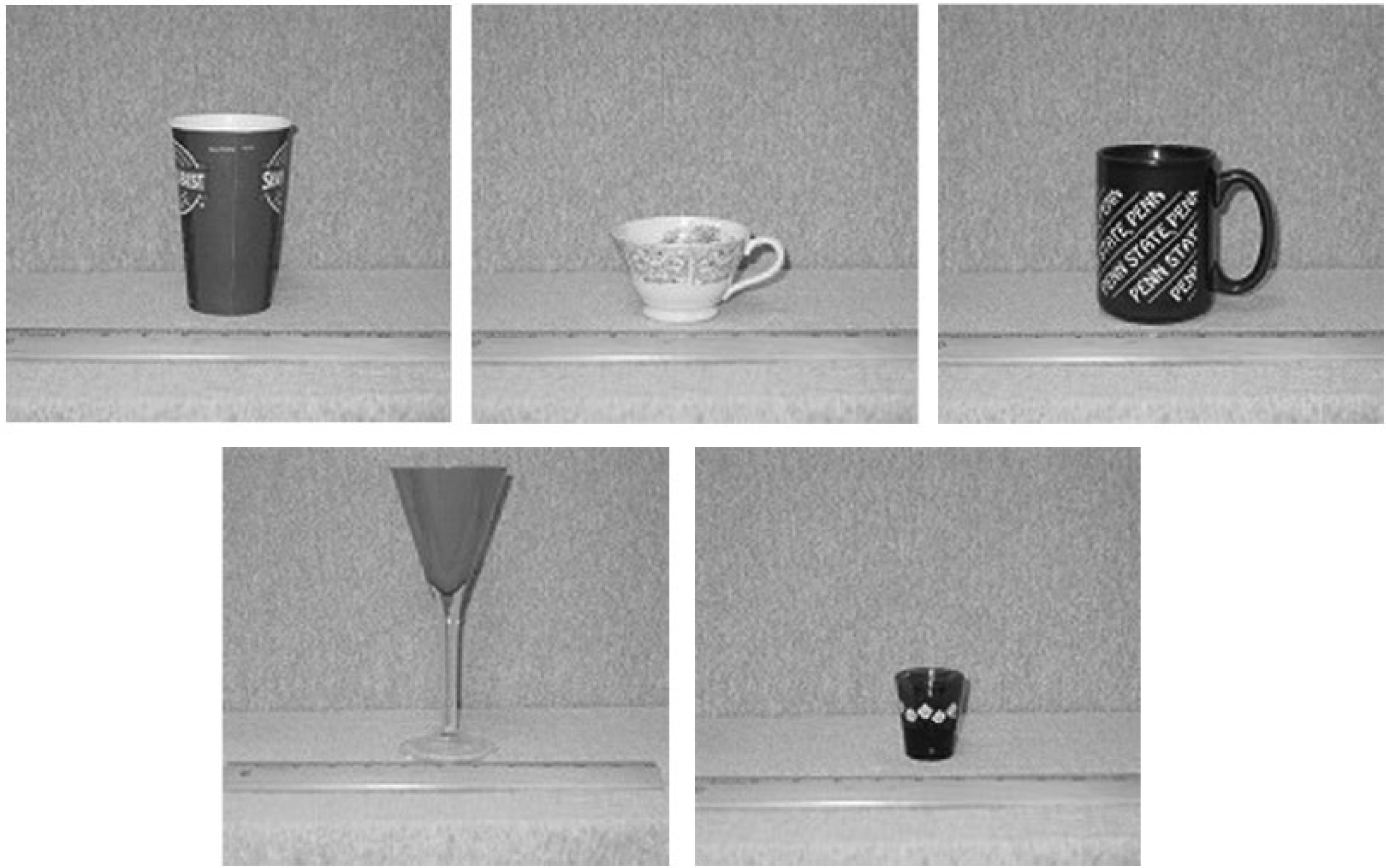
Examples of stimuli. Row 1, left to right: stakan, chashka, and kruzhka. Row 2, left to right: fuzher and riumka. (Photos were in color in the experiment.)
To provide a test set, additional drinking vessels likely to be called chashka, stakan, kruzhka, riumka, or fuzher were photographed in a similar manner. The Russian name for each was confirmed by monolingual Russian speakers in Russia (n = 11), who were contacted and responded through the internet. Each photo was accompanied by the Russian translation of “What is this object? It’s a ….” and a response box. Objects selected for the test set had a minimum name consensus from seven of the 11 Russian speakers (64%) and included a wide range of typicality for each name. The final 35 test items consisted of 10 chashka, 13 stakan, 10 kruzhka, 1 fuzher, and 1 riumka. For the objects called stakan and chashka, only 11 out of 23 objects received the name that would be predicted if stakan/glass and chashka/cup were treated as direct translations, ensuring that correct names could not be predicted by directly equating Russian with English names.
Procedure
Experimental conditions
Each participant filled out the language history questionnaire and was then seated at a computer. The experiment was conducted using E-Prime version 2.0 (Schneider, Eschmann, & Zuccolotto, 2002).
English pre-test phase
Participants were told that they would see pictures of common objects and label these objects as cup, mug, or glass by pressing a key labeled “c,” “m,” or “g,” respectively. This forced-choice procedure kept the English portions of the experiment parallel to the Russian portions and ensured that on post-test, retrieval difficulty was not a factor in determining responses. Participants viewed the 80 training and test photographs randomly intermixed.
Russian training phase
Participants then were asked to imagine that they would be studying abroad in Russia and needed to begin learning Russian. To simulate typical classroom conditions, participants were given dictionary translations for these objects, that is, they were told that stakan is translated as glass, chashka as cup, and kruzhka as mug. They were also told that they would see objects named riumka and fuzher but that these names do not have good English translations. Participants were not explicitly told that the translations were not exact matches.
Participants then saw the picture of each object from the training set for three seconds, labeled with its Russian name. Images were approximately 5 inches × 6 inches and viewed from about 20 inches. Half of the participants saw the exemplars of each lexical category blocked (i.e., all examples of stakan, followed by all examples of kruzhka, etc.) with the block order differing across participants. Half saw exemplars of the categories randomly interleaved. After seeing each photo once, participants were asked to label them with the appropriate Russian name by selecting a key labeled as c, s, k, r, or f in the central part of the keyboard. (A notecard taped to the monitor reminded participants what each label stood for.) All participants saw objects in a random order during this stage. Half of the participants with blocked training and half with interleaved training were given feedback after each decision by being told either “Correct! The correct answer was chashka,” or “Incorrect. The correct answer was chashka.” The other half received no feedback. Training runs (presentation plus test) were repeated until the participant reached 90% or better accuracy on a single run.
Russian test phase
Once the 90% criterion was met, participants moved to the test phase. They were again asked to label pictures as chashka, stakan, kruzhka, riumka, or fuzher by selecting a labeled key. The pictures in the test phase included all of the test objects they had seen in the English pre-test phase but which they had not been trained on, as well as about half (23 of 45) from the training set. (Training items were reduced to limit the session length.)
English post-test phase
Participants then saw every item from both the training and testing sets again and were asked to press a key to choose cup, mug, or glass as its English name.
Control condition
Control participants completed the same English pre-test and post-test phases but were not exposed to any Russian language learning. After the language history questionnaire and English pre-test, they engaged in filler activities designed to take approximately the same amount of time as the experimental training and testing runs (based on pilot testing), but without eliciting labels. The tasks consisted of three minutes of speeded same–different judgments on paired pictures from the training and testing sets, 50 simple math problems, and then three more minutes of same–different judgments. Lastly, participants completed the English post-test.
Results
Analyses focused on whether participants could both master the L2 usage and show no change to L1 use, or whether this would be impossible despite favorable conditions. A 2 (feedback: present or absent) by 2 (presentation: blocked or interleaved) between-subjects analysis of variance (ANOVA) was used for all analyses among the four experimental groups. To compare control group performance to the four experimental groups, a one-way ANOVA with all five groups was conducted. Data in the form of percentages were subjected to an arcsine transformation before analysis.
Russian learning performance
Test performance was scored with 1 point for every novel object given the same name that the monolingual speakers of Russian had (see the Materials section). Scores were converted to a percent correct out of 35 novel objects. Participants in all four conditions performed with high levels of accuracy (see Table 1). There was no significant main effect of feedback or presentation, and no interaction, all ps = .40 or greater.
Mean % correct (and s.d.) on Russian test items, Experiment 1.

It is not entirely surprising that participants performed well on test items, given that they were required to be at 90% accuracy on training items before proceeding to the test. However, participants could have memorized training object–name pairings and not been able to use this knowledge to accurately predict names of test items. Contrary to this possibility, their high performance indicates that they were effectively able to generalize their acquired knowledge. Items scored as incorrect tended to be those for which monolingual agreement in the pre-test was low, meaning that the choice of name was not clear-cut for native speakers.
What may be more surprising is the ease with which they reached the learning criterion during the training trials, given training on five names distributed across 45 objects that had many overlapping properties. Participants in all four conditions took no more than three to four training runs on average (for about 14 minutes of training) to reach the criterion (see Table 2). (There was a significant effect of presentation order on number of trials to criterion, with participants in the interleaved conditions needing slightly fewer trials, F(1, 55) = 8.10, p < .01, but no effect of feedback and no interaction, ps > .10.)
Mean number of training runs (and s.d.) to criterion, Experiment 1.

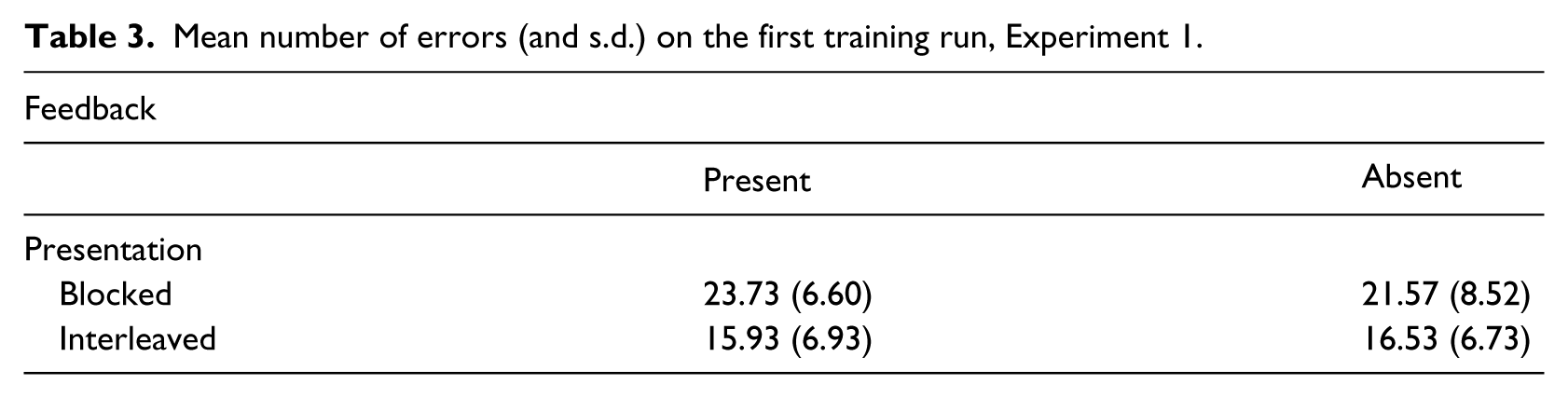
To verify that the training phase did present a challenge to participants, we examined the number of errors on the first round of Russian labeling. Errors were substantial in the first run, constituting about 35–53% of the 45 trials across conditions (see Table 3). This finding indicates that the correct Russian distribution of names to objects was not self-evident for English speakers. (There was a significant effect of presentation order, F(1, 55) = 8.12, p < .01, with participants in the interleaved conditions making somewhat fewer errors, but no effect of feedback, p > .5, and no interaction, p = .2.) In short, participants were able to learn Russian lexical categories in all four conditions within three to four training runs on average, despite the fact that two key categories (stakan and chashka) were misaligned with participants’ pre-existing English lexical categories and participants were not given explicit information to this effect.
Mean number of errors (and s.d.) on the first training run, Experiment 1.
English pre-test/post-test labeling consistency
L2 lexical learning at times causes shifts in L1 word usage (e.g., Cook, 2003; Malt et al., 2015; Pavlenko & Malt, 2011; Wolff & Ventura, 2009). Thus, in principle, one might look for English shifts in the current paradigm. However, the particular words involved here work against rapid implementation of such shifts. Learning stakan and chashka requires loosening constraints on English glass and tightening those on cup (because non-glass things called cup in English must be excluded from chashka and put into stakan, which is otherwise more similar to English glass). To impose the Russian lexical boundaries on English, the objects that are the most typical of English cup, such as paper cups and plastic cups (Pavlenko & Malt, 2011), would have to be called glass instead. Given that they are the most closely linked to English cup of all the exemplars, and given their incompatibility with the English glass label with respect to its implication about material, such changes are not likely to occur with brief exposure to Russian. Indeed, initial inspection of the data did not reveal a clear pattern of shifting in this direction.
However, a pre-cursor to consistent shifts in lexical boundaries may be a period of destabilization (Pavlenko, 2014) in which L1 name choices are less confident and consistent. Supporting this notion, Caskey-Sirmons and Hickerson (1977) found reduced consistency in use of L1 color terms by bilingual speakers from five different L1 backgrounds compared to monolingual speakers of the same languages. More recently, Malt et al. (2015) found reduced name agreement for common household objects in L1 Mandarin among English-immersed Mandarin-English bilinguals, compared to monolinguals. Thus, we focus here on L1 name consistency from pre-test to post-test as a potential pre-cursor to L1 lexical category shifts.
English consistency in name choice between pre- and post-tests was measured by comparing the label each participant chose for each object at pre-test versus post-test. Each object received a score of 1 if the choice matched, and totals were converted to the percent consistent (out of 80, the total number of objects labeled; see Table 4). There was a significant effect of condition, F(4, 68) = 4.77, p = .002, with a planned comparison indicating that the control group was significantly more consistent than the experimental groups, t (68) = 4.03 p < .001. However, there were no significant differences among the four experimental groups (all ps > .12).
Mean % consistent English responses (and s.d.) for all items, Experiment 1.
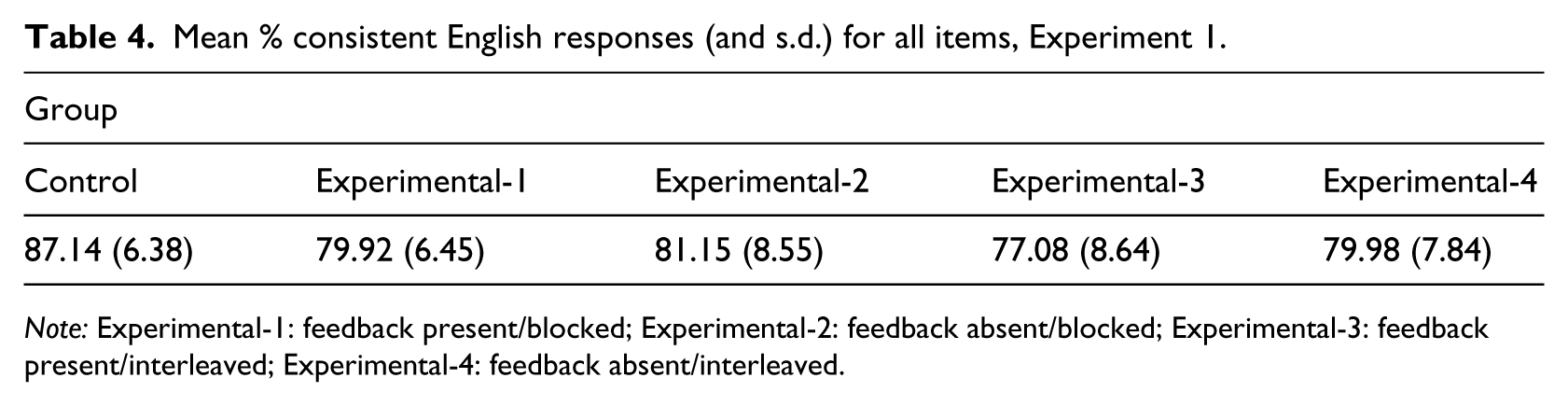
Note: Experimental-1: feedback present/blocked; Experimental-2: feedback absent/blocked; Experimental-3: feedback present/interleaved; Experimental-4: feedback absent/interleaved.
A parallel analysis was conducted with item set as an additional variable. In this analysis, the 45 training items were separated from the 35 test items (see Table 5). Again, there was a significant effect of learning condition, F (4, 68) = 3.92, p < .01. There was also a significant effect of item set, F(1, 68) = 37.24, p < .001, with training items showing less consistency than test items. (The interaction between learning condition and item set was not significant, F(4, 68) = 1.9, n.s.) Training items had been exposed in conjunction with Russian names twice per training run (once in the presentation part and once in the test part), and participants went through three to four of these training runs, on average. The test items had only been seen once and without an experimenter-given Russian name. Thus, repeated exposure to the Russian naming pattern during training may have enhanced the uncertainty that participants felt for English name choice to training items.
Mean % consistent English responses (and s.d.) for training items only, Experiment 1.
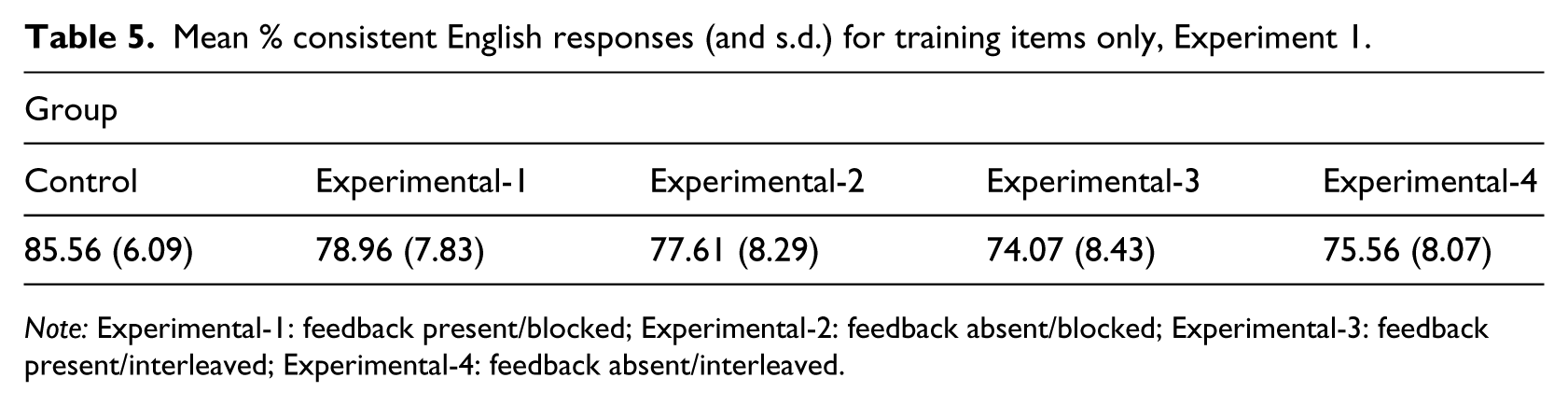
Note: Experimental-1: feedback present/blocked; Experimental-2: feedback absent/blocked; Experimental-3: feedback present/interleaved; Experimental-4: feedback absent/interleaved.
One alternative explanation for the differences between groups must be considered. Although the filler tasks of the control condition took approximately the same amount of time as the experimental training runs in pilot testing, there was a difference in the elapsed time between the English pre-test and post-test across the five groups, F(4, 68) = 13.29, p < .001, with the control group spending significantly fewer minutes (x̅ = 8.52, s.d. = 0.51) than the others (x̅ = 15.85, s.d. = 4.59), t(68) = 6.49, p < .001. However, an additional consideration argues against amount of time passing as explaining the consistency differences among groups. Experimental participants’ range (5.60–28.47 minutes elapsed) exceeded that of control participants (7.84–13.05), and there was also a sizeable range in their individual consistency scores (60.00–93.75). Despite the variability in both measures, the amount of time participants in the experimental groups spent between the two rounds of English labeling was not significantly correlated with their consistency scores, r = –.16, p = .24, indicating that elapsed time per se does not cause a change in consistency.
Discussion
This experiment created learning conditions highly favorable to acquiring L2 lexical patterns by providing intensive exposure to a small number of L2 words paired with exemplars of each word as determined by native-speaker data. Under these conditions, we found that participants learned the appropriate L2 word uses after a short training period and were able to successfully generalize them. Specifics of the learning presentation made little difference. 2 These data provide evidence that entrenched L1 lexical categories do not inevitably prevent misaligned L2 categories from being mastered, and they suggest that input limits contribute to non-target behavior in real-world learning.
However, participants did show reduced consistency in their English labeling for the trained items in a post-test, compared to controls. This outcome suggests that when L2 lexical categories not fully consistent with L1 categories are acquired, the differing usage patterns may affect the original L1 word–object associations through cross-language connections. This reduced L1 consistency in word use may reflect a period of destabilization that precedes a reshaping of L1 lexical category boundaries.
Experiment 2
Experiment 2 replicated and extended Experiment 1. Learning variables were chosen for relevance to conditions of L2 exposure outside of the classroom. Participants were not given dictionary translation equivalents for Russian words. Half the participants were given the more general information that the Russian and English lexical patterns differ, as some immersed learners may eventually realize, and half were not. Also, half repeated English-language labeling trials between Russian training runs, similar to those L2 speakers who continue to use L1 at home, while half did not. Again, in light of minimal obtained effects of the learning variables, we focus here on overall performance in L2 and its potential effect on L1 performance.
Method
Participants
Participants were 56 native English-speaking undergraduates at Lehigh University, with 14 participants in each of the four experimental conditions. They had classroom exposure to another language but none used one regularly, and none knew Russian. Because the pre-test and post-test phases were identical to Experiment 1, the 14 participants who served as the Experiment 1 control group also served as the control group here.
Materials
The questionnaire and photos from Experiment 1 were used.
Procedure
The procedure was identical to that of Experiment 1 except as discussed below.
Experimental conditions
English pre-test phase
This phase was the same as in Experiment 1.
Russian training phase
As noted above, initial instructions did not mention relations between specific English-Russian word pairs. However, half of the participants were given the general metalinguistic information that Russian words often are not exactly equivalent to English words. All participants then saw the 45 photographs from the training set labeled with their Russian names, presented in random order (there was no blocked condition). After seeing the photographs, participants pressed a key to label each one; no participants received feedback. After each round of Russian exposure, half of the participants then labeled the 45 training objects again in English. Participants in the Russian-only training conditions completed a short filler task consisting of viewing each training picture again and making a height judgment (deciding if each object was more or less than 4 inches tall). This task was designed to give participants the same amount of exposure to each object as participants in the mixed-language condition while not requiring a linguistic judgment or decision in either language. A complete training run was thus made up of viewing the labeled photographs, labeling them in Russian themselves, and completing the English labeling or the filler task. All participants completed training runs until reaching 90% accuracy on Russian labeling.
Russian test phase and English post-test phase
These phases were identical to those of Experiment 1.
Control condition
The control condition described in Experiment 1 also served as the control condition for Experiment 2.
Results
A 2 (metalinguistic information about differences between the languages: present versus absent) by 2 (language training: mixed-language versus Russian-only) fully between-subjects ANOVA was used for all analyses among the experimental groups. To compare control performance to the four experimental groups, a one-way ANOVA with five groups was conducted. Data in the form of percentages were subjected to an arcsine transformation before analysis, as in Experiment 1.
Russian learning performance
Accuracy of Russian labeling in the test phase was measured as in Experiment 1. Errors on the first training run averaged about 36–42% of trials, indicating that the initial learning situation did pose a challenge. As in Experiment 1, despite this challenge, participants across all four conditions generalized the Russian pattern with high levels of accuracy (see Table 6), and with errors appearing mainly on items for which there was lower monolingual agreement. For this measure, there was no main effect of metalinguistic information nor of language training, and no interaction, all ps > .40. Other measures also suggested that learning conditions had little impact on ability to learn: there was no main effect of metalinguistic information or language training, and no interaction, for either number of training runs needed to meet the criterion for advancing (all ps > .4) or number of errors on the first training run (all ps > .2).
Mean % correct (and s.d.) on Russian test items, Experiment 2.

In short, participants again were able to learn the Russian lexical categories without great difficulty, regardless of learning condition. Participants who were not alerted to the lack of complete equivalence performed as well as those who were, suggesting that all groups were able to surmount any initial assumptions about equivalence. These data re-confirm that under supportive learning conditions (having intensive exposure to word-to-object mappings for a relatively small number of words), people can master a L2 pattern of word usage that does not match that of their L1.
English pre-test/post-test consistency
English consistency scores across all items were obtained as described for Experiment 1 (see Table 7). There was a significant effect of condition, F (4, 65) = 3.94, p < .01, with a planned comparison indicating that the control group was significantly more consistent than the experimental groups, t (65) = 3.42, p = .001. (Among the experimental groups, there was also a marginal effect of language during training, with those receiving repeated English trials mixed with Russian training being marginally more consistent, F (1, 52) = 3.91, p = 0.053).
Mean % consistent English responses (and s.d.) for all items, Experiment 2.
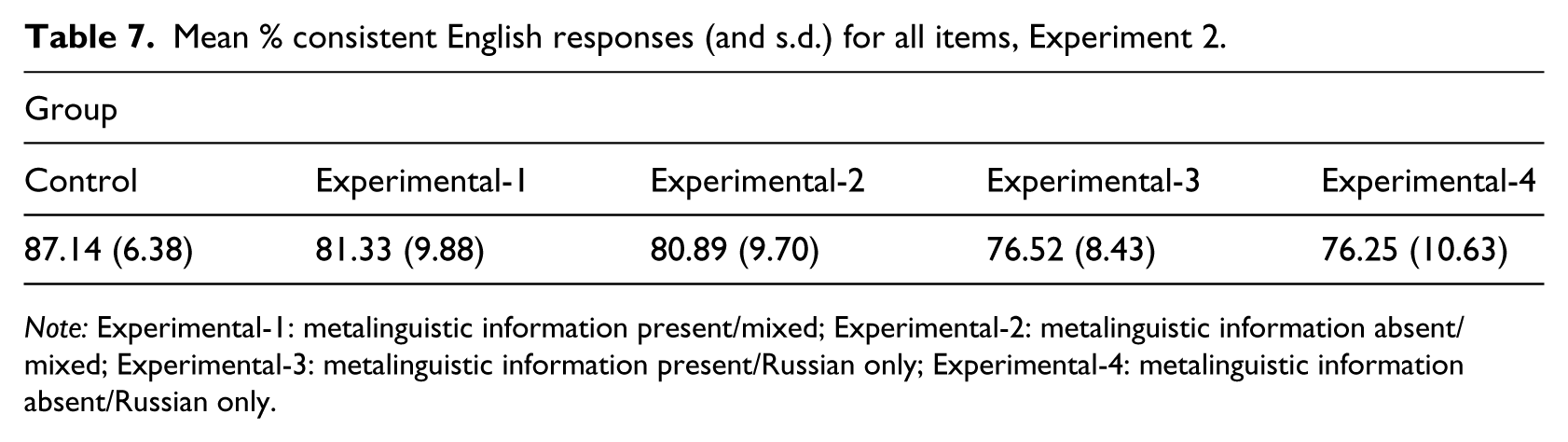
Note: Experimental-1: metalinguistic information present/mixed; Experimental-2: metalinguistic information absent/mixed; Experimental-3: metalinguistic information present/Russian only; Experimental-4: metalinguistic information absent/Russian only.
As in Experiment 1, a parallel analysis was conducted separating the 45 training items from the 35 test items, since the training items are the ones that participants in the experimental conditions had thought of in terms of the Russian names most often (see Table 8). There was a significant effect of learning condition, F(4, 65) = 3.75 and a significant effect of item set, F(1, 65) = 12.82, p = .001, reflecting less consistency for the training set than the test set, as in Experiment 1. The interaction between learning condition and item set was not significant, F(4, 65) = .61, n.s.
Mean % consistent English responses (and s.d.) for training items only, Experiment 2.
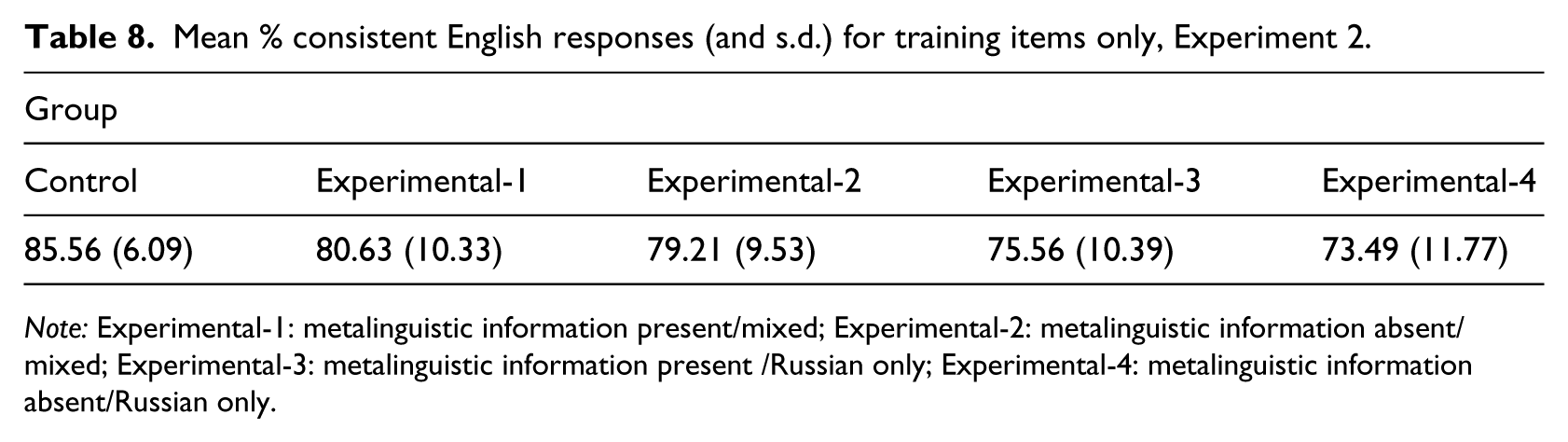
Note: Experimental-1: metalinguistic information present/mixed; Experimental-2: metalinguistic information absent/mixed; Experimental-3: metalinguistic information present /Russian only; Experimental-4: metalinguistic information absent/Russian only.
Again, there were significant differences in the amount of time spent between the English pre-test and post-test labeling, F(4, 65) = 10.43, p < 0.001, with a planned comparison indicating that the control group spent significantly fewer minutes (x̅ = 8.52, s.d. 0.51) than did the experimental groups (x̅ = 17.65, s.d. 5.46), t (65) = 6.22, p < 0.001. As in Experiment 1, however, this difference does not appear to explain the consistency difference. Experimental participants’ range (6.39–32.18) exceeded that of control participants (7.84–13.05), but the number of minutes they spent between the two rounds of English labeling was not significantly correlated with their consistency scores (range = 53.75–92.50), r = 0.008, p = 0.95.
Discussion
This experiment replicated the successful learning of L2 naming patterns that are misaligned with L1 patterns and extended it by demonstrating this learning under different conditions. This result verifies that, in sufficiently supportive contexts, L2 word use patterns can be mastered even when discrepant from L1. However, again, even the relatively brief exposure to L2 created an effect on the L1 in that English labeling became less consistent after exposure to the intensive Russian training, compared to a control group without Russian training. This result is consistent with an initial destabilization of L1 patterns under the influence of the L2, which may be a pre-cursor to more explicitly manifested shifts in L1 word use with continued L2 exposure (Pavlenko, 2014).
General discussion
Mounting evidence indicates that when a person speaks two languages, patterns of word use from one language influence those of the other (e.g., Cook, 2003; Malt et al., 2015; Pavlenko & Malt, 2011; Wolff & Ventura, 2009). In the case of difficulty mastering native-like L2 patterns, one explanation may be sub-optimal input and learning conditions. Another is that with continued use of the L1, dynamic interconnections within the bilingual lexical network work against reshaping the L2 word form-to-meaning mappings. For the other direction – the L2 influences on L1 – use of the L2 may cause difficulty accessing L1 words, and there may be exposure to non-native L1 uses by non-native speakers. Again, another possibility concerns the nature of interconnections within the lexical network. Shaping L2 word form-to-meaning mappings toward native-like may exert an effect on the L1 mappings.
In two experiments, we found that acquisition of native-like L2 mappings was possible under favorable conditions. However, this acquisition had consequences for the L1. Participants’ L1 judgments of whether a familiar drinking vessel should be called cup, glass, or mug were more inconsistent after training on the L2 Russian naming patterns than for a control group that did not receive this training. This effect arose despite the brief exposure to Russian (averaging less than 20 minutes for training plus test in both studies). Together, these findings suggest that with suitable input, L2 patterns divergent from the L1 can be mastered, but it may not be possible to do so without an influence on the L1. That is, favorable input and learning conditions can bring learners closer to target-like behavior, but the nature of interconnections within the lexical network may make cross-language influence inevitable. In general, our study is consistent with other arguments for the highly dynamic and interactive nature of bilingual representations and processing (Li, 2014; Schmid, Köpke, & de Bot, 2013). The impact of short-term L2 training on L1 naming behavior speaks to the idea that the L1 is more permeable than previously thought.
Implications for L2 word learning
Classroom instruction in L2 vocabulary most often entails exposure to translation “equivalents,” such as stakan-glass and chashka-cup. Such exposure will lead to inaccurate uses of the L2 words when full equivalence to L1 word meanings is lacking. Sometimes the instruction is augmented with pictures of prototypical examples of the word, but they still cannot fully convey the range of usage or clarify the nature of a partial equivalence. Learning from reading might help, but because referents are usually not depicted visually, the L2 learner may simply make inaccurate L1-based assumptions about the nature of the intended referent. Immersion is a better means of acquiring the appropriate experience with word-referent mappings (Malt & Sloman, 2003; Zinszer, Malt, Ameel, & Li, 2014), but accumulating the necessary experience to converge on native-like usage is slow (Malt & Sloman, 2003). Developing ways of providing exposure to extensive sets of word-referent pairing in classroom settings may be a more effective route to acquisition of target-like L2 word use. This sort of training will require identifying discrepancies between patterns of use for important words in the L1 and L2, as well as implementing methods for efficient exposure (e.g., using virtual learning tools; Lan, Fang, Legault, & Li, 2015).
Implications for L2 influence on the L1
With successful L2 learning may come some L2 influence on the L1. The emergence of destabilization in L1 naming patterns following brief exposure to L2 training is novel to the current research. Malt et al.’s (2015) data, which show reduced agreement in L1 name choice for objects among Chinese-English bilinguals, came from participants who had been immersed in English for a minimum of a year. Caskey-Sirmon and Hickerson’s (1977) study showing reduced L1 consistency for color naming also examined long-term bilinguals. Our finding here is after much briefer exposure.
This finding is, however, compatible with a few pieces of unpublished data. Zinszer and Li (2010) trained English speakers on pseudo-Chinese names for objects, where the Chinese usage patterns differed from English. Trained participants produced some improbable English naming errors on post-test. For instance, four out of 10 participants renamed a desk as table, and three out of 10 renamed a brush as comb, suggesting some L1 confusion induced by the pseudo-Chinese patterns (where English pairs desk and table, and brush and comb, each shared a pseudo-Chinese label). Kaiali (2009) trained native English speakers on the use of Arabic causative verbs. The closest Arabic equivalent to cause is used more narrowly than the English word and the closest equivalent to enable is used more broadly. The English speakers’ subsequent use of cause versus enable was altered in the direction of the Arabic pattern after one training session.
Of course, the influence that is seen after a short laboratory training period may not be of long duration. Our participants presumably return to English immersion on leaving the laboratory. Without on-going competition from Russian input, they may rapidly restore the connections between English words and elements of meaning to their previous states. However, some evidence suggestive of longer duration effects comes from the Zinzser and Li (2010) results, where the English naming post-test was administered a minimum of two days after the training session. Other studies are systematically evaluating the retention of laboratory trained lexical representations (e.g., Lan et al., 2014). Of interest ultimately will be to understand the real-world temporal parameters in cases where a bilingual switches from the L2 at work to the L1 at home each evening, or from the L2 most of the time to the L1 on trips back to the mother country.
Interpreting L2 influence
It might be suggested that the post-test English performance emerges from on-line processes, such as priming or competition/interference, rather than representational effects. Such reasoning is especially tempting if the influence of L2 learning on L1 choices is relatively short-lived. However, in the current experiments, participants never had to retrieve or produce words on their own because all Russian and English word options were presented to participants. For English, there were only three (cup, glass, and mug). Effects on English choices are unlikely to be due to difficulty (or facilitation) in retrieving or producing any relevant English word.
If L2 knowledge did, nevertheless, influence an initial activation of L1 English words, which in turn influenced the response, this process is still compatible with the idea that L2 learning alters connections between elements of meaning and words. Oppenheim, Dell, and Schwartz’s (2010) model of semantic blocking (whereby production of a word is slowed after production of related words) relies entirely on dynamic updating of connections between semantic features and word forms over trials. In this model, there is no distinction between “on-line” and representation-based effects. Again, of greater theoretical relevance is how long the duration of the effects is and how easily they are altered by the current language context.
How L1–L2 semantic relations impact the L2 influence
Given the particular semantic relations between the Russian and English terms used here (as discussed earlier), along with the limited time and context of exposure, it is unlikely that Russian could cause substantial changes to uses of English words, such as calling non-glass objects glass. In such cases, reduced consistency in choosing among L1 words may be the main manifestation of L2 influence. Contributing to destabilization here might be the facts that our learning task required splitting three English lexical categories across five Russian ones and that the languages differentially weight shape, function, and material in making the distinctions. In future studies, it will be important to identify how such variables link to the appearance of L2 influence on the L1.
Conclusion
A bilingual’s two languages appear to be constantly in dynamic interaction. We examined this interaction in the context of word use patterns. The data suggest that acquisition of target-like L2 word use can be facilitated by intensive exposure to word-referent mappings. However, the data also suggest that even early stages of L2 learning may destabilize L1 word choices.
Footnotes
Funding
The author(s) disclosed receipt of the following financial support for the research, authorship, and/or publication of this article: This material is based on work supported by the National Science Foundation under Grant No. 1057885 to Barbara Malt and Ping Li. Any opinions, findings, and conclusions or recommendations expressed in this material are those of the author(s) and do not necessarily reflect the views of the National Science Foundation.