



Abstract
Aims and Objectives/Purpose/Research Questions:
This study investigated the acquisition of Spanish Differential Object Marking (DOM) by bilingual and monolingual Spanish teenagers, evaluating to which extent their knowledge of DOM can be explained by different theories of acquisition.
Design/Methodology/Approach:
Two experiments with bilingual and monolingual Spanish teenagers (ages 10 to 15) were conducted. The experiments included an Elicited Production Completion Task, in which a space was to either be filled with an object marker or left blank, and a Context-Matching Acceptability Judgment Task.
Data and Analysis:
54 subjects (44 bilinguals and 10 monolinguals) were tested. For both tasks, there were 6 conditions testing different syntactic–semantic features that trigger DOM (test items n = 42 in each task). The data were analysed with linear regressions and repeated measures analyses of variance.
Findings/Conclusions:
This study’s results show that bilingual teenagers do not demonstrate significant differences from age-matched monolinguals in their competence regarding the syntactic–semantic properties of DOM. Both groups are below ceiling in showing evidence of knowledge about all the syntactic–semantic features involved in DOM, indicating the possibility of a significant delay beyond childhood in their acquisition.
Originality:
There are few previous studies on the acquisition of DOM, and none which consider the full range of features and specific population considered here. Work by Montrul focuses on the animacy feature, while Guijarro-Fuentes considers the full range of features, but for adult L2 learners of Spanish.
Significance/Implications:
This study shows that the Interface Vulnerability Hypothesis, the Feature Reassembly Hypothesis, the Full Access/Full Transfer Hypothesis and the Interpretability Hypothesis have limitations in explaining its results. Instead, a feature-based approach is proposed in which the specification of features beyond animacy raises difficulties for the acquisition of DOM until late childhood.
Introduction
This paper examines knowledge of English–Spanish bilinguals about the grammatical properties of direct object noun phrases marked by a ‘to’ in Spanish (a type of Differential Object Marking also referred to as personal a in Spanish). Differential Object Marking (henceforth DOM) in Spanish depends upon a range of syntactic/semantic features (e.g. object animacy/specificity, subject animacy/agentivity and predicate semantics; see e.g. Torrego, 1998; Zagona, 2002). This study investigates whether the acquisition of these features, which have been argued to be interpretable features (e.g. Torrego, 1998), raises problems for child bilingual learners tested as teenagers, in comparison to age-matched monolinguals, regarding their knowledge about DOM. A main contribution of the paper then is to show to which extent either English–Spanish bilinguals or age-matched monolinguals tested as teenagers demonstrate evidence of delays in the acquisition of the syntax–semantics features of DOM in Spanish.
Recently, different universal grammar (UG) accounts of second language acquisition have argued for dissimilar views of parameter resetting in L2 acquisition, depending on the capacity of interlanguage grammars to attain new values for interpretable and uninterpretable features. One such account is the Interpretability Hypothesis (IH) (e.g. Hawkins & Hattori, 2006; Tsimpli & Dimitrakopoulou, 2007), which maintains that L2 parameter (re)setting is limited to L1 interpretable feature values, and does not extend to uninterpretable features absent in the L1. Namely, under the IH only uninterpretable features instantiated within the L1 and new interpretable features remain available. Uninterpretable features (e.g. structural case, agreement features on Tense, or Extended Projection Principle (EPP) features which trigger overt movement) have been argued to no longer be available to adult L2 learners if they are absent in their L1, due to critical period constraints, and despite availability of L2 input/lexicon that shows the effects of these features in the L2. This amounts to an adult inability to reset parameters, at least when they are contingent on the acquisition of new uninterpretable features. Regarding the role of uninterpretable features, the IH contends that the underlying syntax of L2 grammars is destined to remain like the L1 grammar, with only surface adjustments regarding the effects of uninterpretable features. In other words, L1 and L2 grammars are hypothesized to be inevitably distinct, to the extent to which the L1 and L2-particular grammars are different regarding their distribution of uninterpretable features. Nevertheless, it is assumed that adult L2 learners can acquire only via domain-general learning the L2 morpho-phonological forms and surface rules that are distinct from the L1 regarding the specification of uninterpretable features (e.g. overt wh-movement in the case of Japanese learners of L2 English). Under the IH, the latter assumption would explain partial L2 successes, while ubiquitous L2 variability would endure, precisely because underlying L2 representations are non-target-like regarding uninterpretable features.
Following an alternative involving access to both uninterpretable and interpretable features, Lardiere (2008, 2009) has proposed what came to be referred to as the Feature Reassembly Hypothesis. Under this approach, acquiring an L2 grammar is not just a question of whether features are still available for selection from a universal inventory, but it also hinges on how features are assembled and mapped to lexical items, taking into consideration particular language-specific conditions under which they are phonologically realized. Two languages can select the same formal features such that a native speaker of language A acquiring language B would not need to ‘reset’ the parameters corresponding to them. However, how a particular feature is assembled and the conditions of its expression in each of the two languages may be quite different. That is, in addition to acquiring any new features, the learning task would then consist of appropriately re-configuring or re-assembling formal and semantic feature bundles in the L2 lexicon in ways that are distinct from the L1 lexicon and determining the specific conditions under which properties of these features may or may not be morpho-phonologically expressed. For instance, Lardiere (2009) examines plural marking in English, Mandarin Chinese and Korean, evaluating Chierchia’s (1998) Nominal Mapping Parameter. She considers the possibility that there is a ‘plural feature’ that is selected by languages differently and can be either interpretable or uninterpretable depending on the linguistic environment.
In another account of deficits or variability in L2 competence in comparison to monolingual competence in the target L2, it has been argued that L2 deficits do not hinge on uninterpretable features as claimed by the IH, but rather emerge from interface vulnerabilities, namely interpretable features relevant to the syntax–semantics/syntax–pragmatics interface (e.g. Belletti, Bennati, & Sorace, 2007; Sorace, 2011; Sorace & Filiaci, 2006; Tsimpli & Sorace, 2006; White, 2009). Under this so-called Interface Vulnerability Hypothesis, it is argued that linguistic features which are interface-conditioned (see also Chomsky, 2007) may be universally more difficult to acquire: (a) they would cause delays in normal child acquisition (e.g. Grinstead, 2010; Platzack, 2001; Serratrice, Sorace, & Paoli, 2004); (b) they would be a source of prolonged delays, if not permanent interference, for childhood bilingual acquisition (e.g. Müller & Hulk, 2001, p. 1; Paradis & Navarro, 2003, p. 386; Serratrice at al., 2004, p. 194; Serratrice, Sorace, Filiaci, & Baldo, 2012, p. 725); and (c) they would constitute a primary locus for non-pathological attrition/incomplete acquisition (e.g. Montrul, 2008, 2011; Tsimpli, Sorace, Heycock, & Filiaci, 2004) in the grammar of bilinguals. Therefore, it would be expected that interfaces would pose acquisition/learnability problems for L1, L2 and bilingual speakers alike. Under the Interface Vulnerability Hypothesis, L1 transfer alone, even if coupled with inaccessibility to (some) morphosyntactic features, cannot explain all L2 variability or deficits. For instance, different interactions of L1 transfer and/or inaccessibility to features as the primary source of L2 variability/deficits predict that L2 learners whose L1 instantiates the same features for a given property should not display significant variation for those features in the L2 (but see Beck, 1998). However, it has been demonstrated that L2 learners with L1s providing them with features that are the same in the L2 also show various degrees of variability/deficit for properties associated with those features, especially when such features involve interfaces (e.g. Guijarro-Fuentes & Rothman, 2012; Sorace & Filiaci, 2006). Conversely, if interface properties are simply more difficult for all L2 learners, then this fact can account for much L2 variability/deficits, especially if they cannot be accounted as the result of L1 transfer alone.
Contrary to the partial deficit approaches above, the Full Access/Full Transfer hypothesis (FA/FT) maintains that all L2 parameter values – involving interpretable and uninterpretable features – can be successfully set (see e.g. Epstein et al., 1996; Schwartz & Sprouse, 1996, 2000; White, 2003 ; Campos-Dintrans et al., 2014; Hettiarachchi & Pires, 2015, although there are differences among these approaches regarding the role of transfer). Such a position does not diminish the significance of observable L1/L2 differences, but suggests that inaccessibility to UG is not the source of the problem. The logical problem of (first) language acquisition – convergence on grammatical knowledge that is not exemplified in available input – is overcome via UG, which fills the apparent gap between input and the knowledge inevitably attained in L1 steady-state grammars. Full Access approaches argue that adult L2 learners can overcome a similar logical problem in L2 acquisition, given their full access to UG.
The present study weighs in on the proposals above, examining knowledge of direct object marking in Spanish by childhood bilinguals tested as teenagers, arguably an age period when all the properties of their two grammars would have attained their steady state corresponding to an adult grammar. In particular, this study investigated the acquisition of the Spanish personal a (differential object marking/DOM) by a group of childhood Spanish–English bilinguals (n = 20; ages 10–14 years) all raised in the UK, compared to Spanish monolinguals (n = 20; ages 12–15 years) tested in Andalusia, Spain. The acquisition of the grammatical properties of Spanish DOM is an ideal domain to test the aforementioned hypotheses, because the conditions determining whether or not personal a is selected relate to interpretable features which may be under-determined in the input, even though monolingual Spanish children show evidence of acquiring properties of personal a around the age of 3 years (Rodriguez-Mondoñedo, 2008). The present study returns to this issue in the next section.
The organization of the paper is as follows. Section 2 provides a linguistic description of the properties of personal a, adopting recent minimalist analyses (Torrego, 1998, 2002; Zagona, 2002). Section 3 presents the research questions and section 4 reviews briefly previous related studies on the bilingual acquisition of DOM. Sections 5 and 6 present the design of this study and an evaluation of its results. The final section summarizes the main findings and their implications for the different approaches to L2 acquisition mentioned above, namely the Interpretability Hypothesis, the Interface Vulnerability Hypothesis, the Feature Reassembly Hypothesis and the Full Access/Full Transfer Hypothesis.
Linguistic phenomena: Differential Object Marking in Spanish
The Spanish language, like many other languages (e.g. Hindi and Yiddish), marks direct objects with a preposition, i.e. personal a, under some conditions. [+animate] and [+specific] direct objects are marked with the personal a as shown in (1):
(1) Busco a la secretaria.
‘I am looking for the (specific) secretary’ 1
The marking of these direct objects is a case of the phenomenon called DOM (Aissen, 2003; Leonetti, 2008; Torrego, 1998, 2002). All remaining direct objects (namely, [+animate, -specific] (2); [-animate, +specific] (3) and [-animate, -specific] (4)) are not marked with a:
(2) Busco una secretaria.
‘I am looking for any secretary’
(3) Ayer visité el hospital.
‘Yesterday I visited the hospital’
(4) Ayer visité un museo.
‘Yesterday I visited a (non-specific) museum’
Nevertheless, other cases show that marking of the direct object is not always systematic. Firstly, non-specific negative quantifiers (such as nadie ‘nobody’) (Leonetti, 2008) always require personal a, as shown in (5):
(5) No vio a nadie.
‘S/he did not see anybody’
Secondly, in order to disambiguate the meaning of a sentence (see e.g. Montrul, 2004; Rodríguez-Mondoñedo, 2008), inanimate direct objects are marked with the personal a if the subject is also inanimate (6):
(6) La calma precede a la tormenta.
‘The calm comes before [DOM] the storm’
Thirdly, with some animals as direct objects, personal a may be used as long as it is [+specific], although this use is optional:
(7) Juan mató (a) su perro. 2
‘John killed his dog’
According to Torrego (1998, 2002), agentivity of the subject and the semantics of the predicate also determine when direct objects are marked with personal a in Spanish. 3 Personal a is taken to be required with stative and activity verbs that take an agent as subject as in (8a), unlike (8b). 4
(8) a. El paciente reclamaba a una enfermera.
‘The patient demanded a nurse’
b. *La situación reclamaba a una enfermera.
‘The situation demanded a nurse’
In (8a) the object of the transitive verb is overtly marked by a because the subject of reclamar ‘demand’ is agentive; (8b) is ungrammatical because here the subject is not agentive.
Torrego further argues that one of the factors that determines the use of a is the semantics of the predicate. Considering the entire vP event, 5 accomplishments and achievements indicate an end in time (telic), whereas states and activities do not (atelic). Objects of predicates classified as accomplishments and achievements are therefore telic (e.g. emborrachar ‘make drunk’), and require the object of the transitive predicate to be marked with a regardless of whether the subject of the predicate is [+/-human] (9a)–(9b). 6
(9) a. Pedro emborrachó a los invitados.
‘Pedro got the guests drunk’
b. El vino emborrachó a varios invitados.
‘The wine got several guests drunk’
In contrast, in the case of stative and activity predicates personal a is required only when the subject is [+human] as shown in (10a) and (10b) below (Torrego, 1998). 7
(10) a. Inés conoce a varios artistas. 8
‘Inés knows various artists’
b. La Academia de Bellas Artes 9 conoce varios artistas.
‘The Academy of Fine Arts knows various artists.’
To sum up, there are at least four conditions that determine DOM in Spanish: (i) animacy of the object; (ii) specificity of the object; (iii) agentivity (or at least [+human] feature) of the subject; and (iv) semantics of the predicate. Putting aside some of the special cases mentioned above, this study proposes the following scenario for the distribution of personal a, along the lines of Torrego (1998, 2002):
(11) Distribution of DOM in Spanish:

Adopting Torrego’s analysis (1998, 2002), personal a is an instance of marked accusative case, or inherent case, encoded distinctively in the vP in Spanish. Consider the sentence structure illustrated in (12) for transitive verbs which encodes the majority of Spanish direct objects:
(12) 
It can be assumed that DOM-marked direct objects with a move outside the VP in the overt syntax, whereas unmarked direct objects can check accusative case inside the VP in the direct object position. Following Torrego’s analysis, it is further assumed that ν has a D-feature, since it is this feature which can attract the marked direct object to be raised overtly (i.e. this feature needs to be checked – or valued and deleted – and this forces the raising). 10 Namely, a D/EPP feature triggers raising of the DP to spec, vP; once the DP is raised, case is licenced in the outer specifier position of vP. 11 Torrego (1998, p. 25) also assumes that personal a adds its own D-feature and can be treated as an additional functional category, although the latter is not directly represented in the analysis in (12). She further claims that objects marked with a actually have structural in addition to inherent case, while unmarked accusative objects only have structural case.12, 13 What is relevant for the purposes of the present paper is that DOM-marked objects carry different interpretable features than unmarked objects (whereas the empirical effects of overt movement linked to a D/EPP in (12) are not being tested in the experimental study considered here).
Thus, the overt marking of accusative objects in Spanish is not ‘free’; following Torrego’s analysis, the animacy and specificity of the object, also linked to the D-feature on ν, yield the restricted interpretation of DOM-objects, besides being linked to object raising and the creation of two specifiers. Ultimately, overt DOM-marking can also be tied to the agentivity and aspectual semantics of the predicates selected by v. 14 Under Torrego’s analysis, structural accusative case for direct objects is assigned by the functional category of vP (formerly AgrOP), which in turn is regulated by uninterpretable features. In contrast, marked (inherent) accusative case is a lexical case regulated by interpretable features (i.e. animacy, specificity and semantics of the predicate). Comparing English and Spanish, both languages possess structural accusative case. However, direct objects in English are not marked with semantically restricted DOM, taken to be the representation of a type of inherent case.
Previous studies on the acquisition of Differential Object Marking in Spanish
To the current authors’ knowledge, little research exists on the acquisition of DOM by bilingual children. Montrul (2004) considered data from a story-telling task in which she analysed the realization of DOM with animate objects by adult heritage Mexican Spanish speakers in the US. Her results indicated that heritage speakers showed variable use of DOM, which she attributed to interface delays, and signs that morphosyntactic transfer or convergence with English would be observed with animate NPs. Montrul and Walker (2013) compared child and Spanish heritage speakers in the US to Mexican Spanish monolinguals, but they considered only the distinction between the features animate vs. inanimate in the production of DOM, in a story-telling and a picture-description task.
Guijarro-Fuentes and Marinis (2011) analysed the linguistic performance of the same group of English–Spanish bilingual children tested here (age range 10–14). They considered the results of a Completion Task, targeting different aspects of the distribution of personal a, to discuss the possible role played by factors such as quality and quantity of input in the distribution of personal a. Bilingual children’s performance was compared to a group of monolingual Spanish children of similar age (age range 12–15). According to their main results, bilingual children were in general less accurate than monolingual children in the use of the personal a in the Completion Task; however, the bilinguals showed a similar pattern of errors regardless of their level of bilingualism. Guijarro-Fuentes and Marinis argued that the subjects’ performance in the task did not seem to be related to any of the external factors they considered. More generally, they also claimed that phenomena involving the syntax–semantics interface are vulnerable in bilingual children irrespective of the level of bilingualism and some of the aforementioned external factors.
Guijarro-Fuentes (2012) used personal a to examine the acquisition of interpretable features by adult English learners of L2 Spanish. Forty-nine English learners of L2 Spanish of three different proficiency levels (mean age 24.5 years, SD = 3.4) and sixteen monolingual Spanish controls (mean age 26.5 years, SD = 10.3) participated in a Completion Task and an Acceptability Judgment Task similar to the ones reported in the present study. The results showed that L2 learners of all proficiency levels performed differently from native speakers. The L2 learners had acquired some features, but showed delays in others. However, both uninterpretable and interpretable features posed problems for the learners, providing evidence against the Interpretability Hypothesis. Guijarro-Fuentes (2012) argued that Lardiere’s Feature Reassembly Hypothesis best explained the observed results. The current study relates to Guijarro-Fuentes (2012) by using a similar methodology on a different population of speakers.
The study reported here investigates experimental data on bilingual acquisition by a group of teenagers (age 10–14), with the goal to contribute further to debates on ultimate attainment in bilingual acquisition. This study presents the findings from an experiment involving an Acceptability Judgment Task and considers new research questions and implications for the acquisition theories reviewed earlier. In the Discussion section the results of the study presented here are also compared with some of the results from the studies of L2 acquisition of DOM reviewed above.
Research questions and predictions
With this linguistic analysis in mind, the present study addresses the following research questions:
- Do Spanish/English bilinguals raised in an environment in which Spanish is not the dominant language show competence regarding the grammatical properties of DOM that is comparable to monolingual speakers? Based on the results of Guijarro-Fuentes and Marinis (2011), which involved a Completion Task (Elicited Production Task) experiment, this study predicts that they do not.
- Are there differences in the competence of bilinguals regarding their acquisition of the different properties of DOM?
- Do both bilingual and monolingual teenagers (age range 10–15) show evidence of attaining full competence regarding the properties of DOM, by considering elicited production and grammaticality judgment tasks?
- What do the experimental results reveal regarding the evaluation of different hypotheses about the acquisition of syntactic and semantic features by bilinguals? The Interface Vulnerability Hypothesis would predict that bilinguals would perform worse on conditions involving syntax–semantics interface features than on those which do not. The Interpretability Hypothesis would predict that bilinguals would perform worse on conditions involving uninterpretable features than on those which do not. In contrast, according to the Full Access/Full Transfer Hypothesis, there would be no factor intrinsically preventing the bilinguals from attaining knowledge equivalent to the monolinguals. For the Feature Reassembly Hypothesis, there would be no expected problem in the bilinguals’ performance, if the features involved do not undergo some type of feature reassembly between an L1 and an L2.
Present study
Participants
Forty-four English–Spanish bilingual children and 10 monolingual Spanish children participated in this study. The bilingual children were recruited from different schools in the London city area and come from families of Spanish immigrant origin, mostly from Galicia and Andalusia. The monolingual children were recruited from a secondary school in Andalusia. The bilingual children had a mean age of 12.5 (range: 10–14, 15 SD = 1.4), and were slightly younger than the monolingual children, who had a mean age of 13.6 (range: 12–15, SD = 1.2) (t (52) = 2.295, p < 0.05).
All children completed two written placement tests in Spanish, which consisted of the vocabulary and cloze sections of a Spanish proficiency test standardized for adults (Diplomas de Español como Lengua Extranjera (DELE)). Although the DELE was primarily designed for non-native speakers, it was used by both groups of participants in this study in order to provide an objective, standardized measure of proficiency in Spanish. The results showed that the monolingual children had a slightly higher proficiency score (mean accuracy: 79%, range: 68–88, SD = 6.1) compared to the bilingual children (mean accuracy: 72.8%, range: 46–90, SD = 9.9), and this difference was approaching significance (t (52) = 1.892, p = 0.06).
Additionally, all participants completed two experimental tasks (which are described next) together with an ethno-linguistic questionnaire that addresses the external aspects of bilingualism. 16 The responses from the ethno-linguistic questionnaire reflect how the children’s bilingualism developed outside and inside their home, and how it is currently sustained (at the time of the experiments). Parents of these children have created distinct opportunities to foster the bilingualism of their children (e.g. formal education). In some cases the one-parent one-language model has been used, whereas in others both parents speak Spanish at home.
The ethno-linguistic questionnaire elicited information about linguistic and demographic variables together with information regarding exposure to languages at home, at social events and at schools. The language use variable from the questionnaire was represented on a 5-point scale: where 5 = only English; 4 = mostly English; 3 = equal amounts of English and Spanish; 2 = mostly Spanish; and 1 = only Spanish. Parents were also asked to indicate how many years of formal education their children had in each language. Table 1 summarizes some results from the ethno-linguistic questionnaire for the bilingual children.
Results from the ethno-linguistic questionnaire for the bilingual (UK) children.
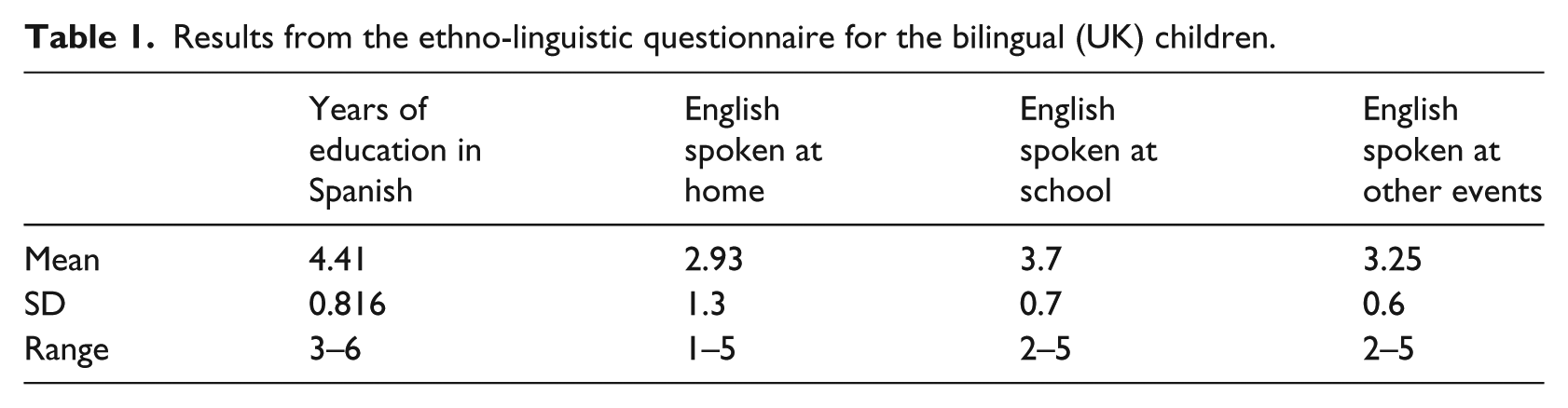
As far as input at home is concerned, 7 children spoke only Spanish at home, 10 spoke mainly Spanish, 11 spoke both Spanish and English, 11 spoke mainly English and 5 spoke only English. At school, 1 child spoke mostly Spanish, 16 spoke Spanish and English more or less equally, 22 spoke mainly English, and 5 only English. In other events, 3 children spoke mainly Spanish, 28 spoke both languages equally, 12 spoke mainly English, and 1 child spoke only English.
Despite the differences between subjects in terms of their responses to the ethno-linguistic questionnaire, statistical tests revealed no correlations between performance in the experimental conditions and years of education in Spanish, amount of English spoken at home, amount of English spoken at school, or amount of English spoken at other events. Therefore, this study did not subdivide the subjects into smaller groups based on the results of the ethno-linguistic questionnaire. For the same reason, this study refers to its non-monolingual subjects as bilinguals rather than heritage speakers. Even though heritage speakers are often distinguished from other types of childhood bilinguals in the acquisition literature, these two groups of childhood bilinguals a priori do not need to be treated differently in terms of their acquisition of grammatical phenomena. In this respect, the lack of a variable effect of amount of exposure to Spanish relative to English indicates that the heritage status of the group of bilinguals considered here is not, in the case of the current study, a primary factor in the acquisition of personal a, whereas their overall status as English–Spanish bilinguals will be shown in this study’s results to have a partial effect on their knowledge about DOM, in comparison to age-matched Spanish monolinguals. Thus, the bilinguals tested here are treated as childhood bilinguals broadly, rather than heritage bilinguals specifically.
Experimental tasks and stimuli
To test the children’s knowledge of the distribution of personal a, the experiment we carried out involved an Acceptability Judgment Task, to complement the Completion Task used in Guijarro-Fuentes and Marinis (2011), which is summarized below and will be used for the sake of comparison.
Completion Task (Guijarro-Fuentes & Marinis, 2011)
The Completion Task in Guijarro-Fuentes and Marinis (2011) consisted of 48 sentences ranging over 6 conditions (all the aforementioned properties from Section 2) as displayed in Table 2 below. The same conditions were used in the Acceptability Judgment Task that is part of the experiment reported here.
Experimental conditions of the Completion Task.
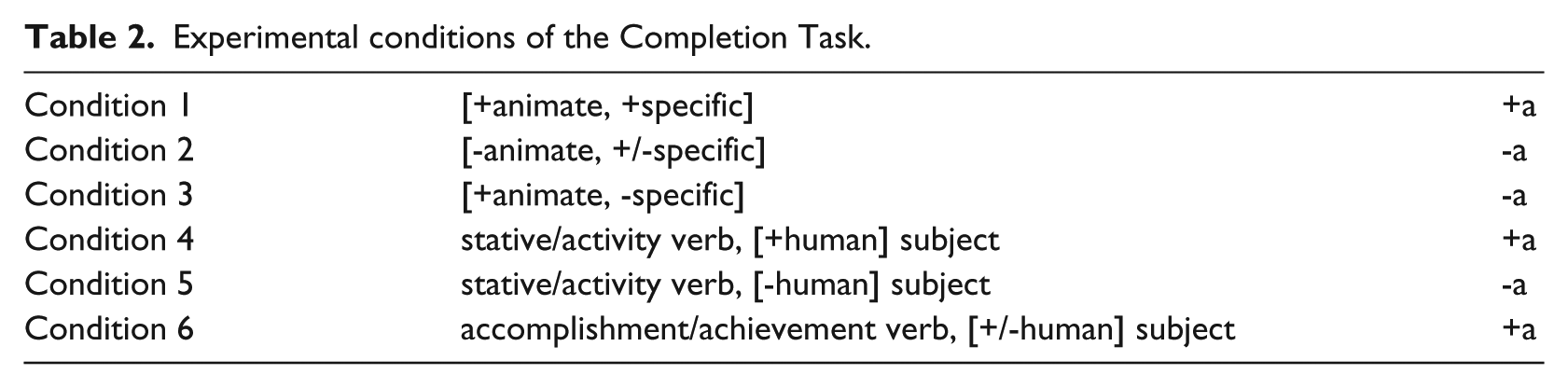
There were 6 items each for conditions 1–5 and 12 for condition 6 (6 with +human subject and 6 with –human subject) (n = 42). In addition, there was a control condition (i.e. distractors, n = 6) that did not involve the use of the preposition a. The distractor items tested different aspects of Spanish, such as the use of function words (e.g. articles and conjunctions). For conditions 4, 5 and 6 the inherent aspectual class of the verb was distinguished on the basis of the features [+/-telic], [+/-stative] and [+/-punctual] (e.g. accomplishment and activity predicates are both [-stative] and [+telic]). In each of the sentences there was a gap, and participants were asked to fill in each gap with one word or leave the gap empty. Examples (13) and (14) are sample items for this task.
(13) Juan persigue ------ los presos que se han fugado de la cárcel. (a is obligatory)
‘Juan chases ----- the prisoners that have run away from the prison’
(14) La universidad necesita ---- estudiantes extranjeros para cubrir las plazas libres. (a is blocked)
‘The university needs ----- foreign students in order to cover all free vacancies’
Participants were provided with a vocabulary list, and were allowed to ask the experimenter questions about vocabulary they were unfamiliar with. Participants were allowed to take as much time as they needed to complete the task (as was also the case for the Acceptability Judgment Task); nevertheless, all participants completed it within 45 minutes. In order to avoid any comprehension problems as to what participants were expected to do, instructions were given verbally in English by their teacher and in writing (and in the case of the Spanish monolingual children the instructions were given in Spanish in the same manner). Participants were asked to read each sentence and fill in the gaps with the first word which came to their mind, and they were not allowed to change or modify their answers.
Current experiment: Acceptability Judgment Task
In the Acceptability Judgment Task, participants were asked to evaluate test sentences such as (15) and (16) below, preceded by a short background story.
(15) Pedro no tiene tiempo para hacer las tareas de la casa, pues trabaja más de 40 horas a la semana. Un día, Pedro le pregunta a su madre sobre su mujer de la limpieza:
Pedro does not have time to do the housework because he works more than 40 hours a week. One day, Pedro asks his mother about her cleaner.
Test sentence:
Busco tu mujer de la limpieza, ¿sabes dónde vive Luisa ahora? (not acceptable)
I’m looking for your cleaner. Do you know where Luisa lives now?
(16) Theo está de vacaciones en el Canadá. Me escribe un mensaje diciéndome lo que hizo apenas llegó. Dice:
Theo is on holiday in Canada. He wrote a text message telling me what he did when he arrived. He said:
Test sentence:
Ayer visité el Museo de Arte Contemporáneo. (acceptable)
Yesterday I visited the Museum of Contemporary Art.
The background story provided the appropriate context that made the experimental sentences grammatical or ungrammatical. The rationale for using contexts before test items is based on the fact that, although some of the features related to the use of personal a are lexical semantic features (e.g. animacy) and can be identified in the experimental sentences alone, others can only be determined precisely on the basis of the discourse context (e.g. specificity). Six conditions (the same experimental conditions as in the Completion Task – see above) were used in this task. 42 experimental items were created, 6 each for conditions 1–5 and 12 for condition 6 (6 with +human subject and 6 with –human subject). There were two versions of each experimental item, one acceptable and one not acceptable (they varied only regarding whether DOM was used in the test sentence). Two different test lists were created, each list including only one of the two versions of each experimental item. Participants completed only one list so that each participant encountered only one version of each experimental item.
Each participant received one booklet containing two examples for the task which did not involve the use of DOM and 42 experimental sentences. They had to judge the acceptability of the sentences on a scale from 1 to 4 (1 = sounds very bad, 2 = sounds relatively bad, 3 = sounds relatively good and 4 = sounds very good). A category ‘I don’t know’ (identified as 100) was included, which participants could use if they were not sure about the acceptability of the sentence. As in the Completion Task, verbal and written instructions were given, in English for the bilingual group and Spanish for the control group. Participants were asked to judge the acceptability of the sentences based on their first intuition, and not to go back and change their answers later. There was no time limit for the task.
Results
Turning to the results of the Acceptability Judgment (AJ) Experiment, Table 3 shows the mean accuracy (as a percentage), standard deviation, and range for each of the six conditions for monolinguals and bilinguals.
Mean, standard deviation and range of overall accuracy in AJ task.

The overall accuracy (for all six conditions combined) was also calculated for each subject. According to a U-test (jittered to avoid ties), the median overall accuracy for bilinguals was not significantly different from the median overall accuracy for monolinguals (W = 290, p = 0.123). In other words, there was no main effect of group on median overall accuracy.
Pairwise comparisons also revealed no significant effect of group on median accuracy for any of the six conditions, despite the fact that the monolinguals showed higher accuracy rate than the bilinguals in three of the six conditions. In addition, monolingual subjects did not consistently outperform bilingual subjects: they were more accurate than bilingual subjects in C1, C2, and C4, but less accurate in the other three conditions, although none of these differences were shown to be significant. Notice that the three conditions in which the monolinguals seemed to perform better do not have a unifying common feature, although two of them (C1 and C4) required the use of personal a.
Linear regression on the accuracy data with condition as a within-subjects variable showed a significant main effect of condition (F(5,318) = 4.319, p < 0.001), suggesting that some conditions were more difficult than others. However, the linear regression showed no significant interaction between group and condition (df = 5, p = 0.2466), providing additional indication that no condition was treated differentially by monolinguals and bilinguals.
The overall results of this experiment indicate that the bilinguals had equivalent performance to the monolinguals in the AJ task. However, both monolingual and bilingual teenagers showed an overall pattern of variability in their judgments of the different conditions, and in at least three of the conditions their performance was below or close to chance (C3, C5 and C6).
A comparison was carried out between the performance of the monolingual teenagers on the AJ task, and the performance of a group of monolingual adults on the same task, which was reported in Guijarro-Fuentes (2012). According to a U-test (jittered to avoid ties), the median overall accuracy for adult monolinguals was significantly higher than the median overall accuracy for teenage monolinguals (w = 141, p < 0.01). This suggests that there are long term delays in the acquisition of the relevant features by monolinguals, such that teenage monolinguals pattern similarly to teenage bilinguals, but differently from adult monolinguals.
These results were also compared to the Completion Task that was carried out with the same groups of teenage subjects in Guijarro-Fuentes and Marinis (2011). A repeated measures analysis of variance (ANOVA) revealed a main effect of group in the Completion Task in Guijarro-Fuentes and Marinis’ study, showing that bilingual subjects were significantly less accurate than monolingual subjects regarding their elicited production. There was also a main effect of condition, but there was no significant interaction between group and condition, indicating that although bilingual subjects were less accurate than monolingual subjects, the two groups showed a similar pattern of performance in each of the experimental conditions.
A comparison between the current experiment and the Completion Task indicates that both monolinguals and bilinguals showed better accuracy in the Completion Task than in the Acceptability Judgment task, except for condition C5. However, in the Completion Task both monolinguals and bilinguals still performed below chance in condition C5 (-a; stative/activity verb, [-human] subject). The monolinguals’ performance was below a mean of 65 in two other conditions (C3 and C4), whereas the bilinguals’ performance was below a mean of 68 in three other conditions (C3, C4 and C6). This variable outcome indicates that both tasks raised various difficulties for the two subject groups.
In addition, within the Completion Task, bilingual children were in general less accurate than monolingual children in the use of the personal a (Guijarro-Fuentes & Marinis, 2011, p. 239: ‘A repeated measures ANOVA with the factors “group” as between-subjects variable and “sentence type” as within-subjects variable showed a main effect for “group” – F(1, 51) = 6.547, p = 0.01.’). This indicates a difference in group performance, between the Acceptability Judgment Task presented here and the Elicited Production Task (the Completion Task). That is, bilingual subjects were significantly less accurate than monolingual subjects regarding their elicited production, differently from their acceptability judgments, in which the present study found no significant difference between the two groups.
General discussion and conclusions
The results from the AJ task indicate that the bilingual subjects show no significant difference from the monolingual speakers regarding their assessment of the syntax–semantics properties of DOM. More specifically, the bilinguals show a pattern of grammaticality judgments that is not significantly different from the monolinguals regarding any of the conditions we tested. The discussion below returns to the fact that monolingual and bilingual subjects showed similar difficulty in successfully carrying out the AJ task, which may be indicative of a possible acquisition delay for both groups.
The AJ results suggest that the bilingual teenagers can attain a level of competence regarding syntax–semantics interface properties of DOM equivalent to age-matched monolinguals. This claim would be consistent with Tsimpli and Sorace’s (2006) approach to Interface Vulnerability – these authors established a differentiation between internal interfaces (syntax–semantics) vs. external interfaces (syntax–pragmatics). Considering that the DOM features tested by the current study correspond to internal interface properties, interface vulnerability in Tsimpli and Sorace’s terms should not prevent bilingual learners from attaining the relevant competence regarding DOM.
The equivalent overall lack of difference between bilinguals and monolinguals would also be compatible with the Interpretability Hypothesis (IH) (Hawkins & Hattori 2006; Tsimpli & Dimitrakopoulou, 2007), under the assumption that the features represented by Spanish DOM are (semantic interface) interpretable features, and should not raise significant difficulties for bilingual learners, compared to monolinguals.
However, at least two aspects of the current study’s results have additional consequences for theories of acquisition. First, both monolingual and bilingual teenagers showed difficulty with the acceptability task, compared to the adult monolinguals that were tested in Guijarro-Fuentes (2012). In addition, some conditions were more difficult than others for both monolingual and bilingual subjects. In particular, the IH cannot explain these results, given the fact that all six conditions involve only interpretable feature distinctions – something other than interpretability distinctions must be invoked to account for the varying levels of accuracy in the different conditions.
Montrul (2011, pp. 601–602) raises the possibility that the properties involved in DOM actually invoke multiple interfaces, including not only the syntactic–semantic interface but also the discourse–pragmatics interface, raising difficulties for both heritage and adult L2 learners. She supported this proposal partially with evidence from Montrul and Bowles (2009) that English–Mexican Spanish heritage speakers (age range 18–30) showed a high rate of DOM omission in cases of [+animate] objects (at least 10% for advanced heritage speakers, compared to virtually no omission for native speakers), and showed grammaticality judgment scores that were very different from native speakers. However, Montrul and Bowles only distinguished between [+animate] and [-animate] objects, and did not control in their test conditions for other interpretable features that affect the realization of DOM. A multiple interfaces deficit approach might account for lingering problems in heritage bilingual and advanced L2 grammars, but it is not clear how it would explain why monolingual teenagers should also show a protracted pattern of development (or at least in terms of their performance), as the current study’s experimental results show. In addition, the multiple interfaces approach does not provide a direct explanation for why both monolingual and bilingual learners’ competence should vary across the current study’s six different DOM test conditions.
In addition, whereas all the conditions tested in the current study can be argued to involve the syntax–semantics interface, it is less clear whether these conditions appealed directly to features from multiple interfaces. 17 Conditions C1 and C3 were the only ones that arguably could depend partially on a syntax–discourse interface feature, in that the [+specific] vs. [-specific] distinction determines the realization of DOM. However, these two conditions did not show a common distinctive pattern of success or failure on the part of either the monolingual or bilingual subjects.
Therefore, although the Interface Vulnerability Hypothesis and the Interpretability Hypothesis may be able to explain some aspects of the results, neither is sufficient to explain all of the observed results. In turning to the Full Access/Full Transfer Hypothesis and the Feature Reassembly Hypothesis, FA/FT suggests that when bilinguals perform differently than monolinguals, it is not due to the unavailability of aspects of UG, but rather to some other phenomenon. On the one hand, extralinguistic factors, such as level of exposure to Spanish, do not seem to have a significant effect on performance in this case, given the lack of significant difference between the teenage bilinguals and age-matched monolinguals and also the fact that even the teenage monolinguals showed significant differences from adult monolinguals. On the other hand, if the perspective of Full Access approaches that access to UG is not a limitation here is maintained, it is necessary to explain what would lead to limitations in test performance of both teenage bilinguals and monolinguals.
If the Feature Reassembly Hypothesis (e.g. Lardiere, 2008) in the case of the bilingual results is considered, the challenging task for the bilingual/L2 learner is to reassemble in their L2 a set of (interpretable or uninterpretable) features that is assembled in a different configuration in the L1. Therefore, deficit in L2 acquisition success can be accounted for by the fact that different features appear in distinct domains between the L1 and the L2. Nevertheless, the Feature Reassembly Hypothesis would also not explain why the monolinguals show non-ceiling performance across the board, and show higher difficulty with some of the conditions (similarly to the bilinguals).
In sum, whereas part of the results presented here may be compatible with one or more of the theoretical approaches considered above, none of them provides a direct explanation regarding the factors that lead to the difficulties shown by both monolingual and bilingual teenagers, regarding the different features that trigger DOM.
In fact, part of the motivation for the similar performance of monolinguals and bilinguals may be the fact that monolinguals did not perform near ceiling, suggesting that even the monolingual subjects had not attained target-like knowledge about the properties of DOM, when the results of the Completion Task and especially the AJ task are considered. It has been observed that the acquisition of other aspects of grammar may be similarly delayed – for example, Pérez-Leroux (1998) argues that children acquire Spanish subjunctive morphology early, but do not completely master mood selection until around age 6. This may be a similar case – all the subjects have clearly acquired the morphological form and syntactic properties of personal a, but they have not yet reached target-like knowledge about all syntactic–semantic features of DOM tested in the current study’s six conditions. Although there is evidence that the relevant feature combinations are successfully used by children, it may be the case that there is a delay in the acquisition of those feature combinations in DOM, both by monolingual and bilingual children. However, given that the subjects tested here had a much older age range than the ones tested by Pérez-Leroux (1998), it remains to be determined what other factors may have affected the performance of both monolingual and bilingual teenagers (e.g. Pires & Rothman 2009 consider language change as a possible source of explanation for monolingual acquisition delay beyond childhood).
The current study’s results regarding monolingual teenagers contrast with the results in Rodriguez-Mondoñedo (2008), who argued that monolingual Spanish children master the use of personal a by around the age of 3 years. However, Rodriguez-Mondoñedo analysed naturalistic child production data from the CHILDES database, rather than elicited production data or grammaticality judgments. He also only examined syntactic structures in which DOM would be obligatory or disallowed, ignoring cases of optionality that were possible among the conditions tested in the current study, which can be considered as not representing true errors. In addition, the cases of use of DOM found in early child data by Rodriguez-Mondoñedo may not target all the syntactic–semantic features tested in the current study’s six conditions. Therefore, the wider range of DOM features tested here may be responsible for the difference in the results of both studies, in addition to the nature of the experimental tasks involved. It is possible to reconcile Rodriguez-Mondoñedo’s and the current study’s results if it is considered that at least monolingual subjects may provide early childhood evidence of mastering core syntactic–semantic properties of DOM (for instance, a [+animate] feature requirement, as further considered below), although both monolinguals and bilinguals show evidence of significant delay (into adolescence) in the acquisition of the full-fledged syntactic–semantic properties of DOM, as shown here by both the Completion Task and AJ results from bilingual and monolingual teenagers.
When considering the results of the Completion Task (reported in Guijarro-Fuentes & Marinis, 2011), it is also found that neither bilingual nor monolingual teenagers provided evidence of being at ceiling, similar to the AJ Task used in the current study. Nevertheless, the AJ results still contrast with the Completion Task results (an Elicited Production Task), in which monolinguals were significantly more accurate than bilinguals. This contrast may be due to task effects, in that the monolinguals showed stronger performance in the Completion Task than in the AJ task, regarding five of the six DOM conditions. A similar observation can be made about the bilinguals, when the results of both tasks are compared, since the bilinguals also showed better performance in the Completion Task, with accuracy above a mean of 67 in conditions C1, C2 and C6, whereas their accuracy in the same conditions in the AJ only reached a mean below 58. These results indicate that the AJ seemed to be more difficult overall than the Completion Task. This is a somewhat counterintuitive result, given that production tasks were expected to be more difficult than corresponding grammaticality judgment tasks. However, the comparison between the two types of tasks is not straightforward. If the personal a is not very salient, subjects may pay little attention to its presence or absence in a grammaticality judgment task, whereas the Completion Task was a targeted Elicited Production Task in which the subjects had their attention directly drawn to the need to determine whether the specific position in which personal a was expected had to be inserted, which may have contributed to the overall higher success of the subjects in that task compared to the AJ.
However, there are other ways in which the current study’s findings confirm and expand upon those of Guijarro-Fuentes and Marinis (2011). First, there was no significant interaction between group and condition either in the Completion Task or in the Acceptability Judgment Task, meaning that the two groups had comparable patterns of performance across conditions, in an inter-group comparison for each task. In addition, C1 and C2, the two conditions that canonically linked the [+animate] and [-animate] features to DOM and lack thereof respectively, were consistently among the three that showed the best performance from both groups, in the two tasks. However, in C3, DOM is blocked despite the [+animate] feature, as the result of the [-specific] feature specification. Possibly due to this override of the [+animate] feature as a source of DOM, C3 is among the two conditions that show the lowest expected accuracy in both tasks, on the part of both monolingual and bilingual teenagers. This highlights the possible role played by animacy as the primary feature that subjects are sensitive to for the realization of DOM across tasks, whereas other features determining DOM may raise difficulty for the monolinguals and bilinguals investigated here. If it is assumed that both groups gave prominence to the role of animacy in licensing DOM, this would have led them to incorrectly reject C3 without DOM because it carries the feature [+animate]. As a confirmation of this hypothesis, C5, the other one of the two conditions that show the lowest accuracy scores for both groups in both tasks, is also a condition in which DOM is blocked (by the use of a state/activity predicate with a [-human] subject), despite the fact that the object in the different test items is [+animate].
As the results of the current study are further considered, a consistently higher performance on both C1 [+a; +animate] and C2 [-a; -animate] across task lends further support to the argument that animacy is a primary factor controlling DOM in Spanish. Subjects conclude with a high degree of confidence that personal a should be present when they encounter an animate object, and absent when they see an inanimate object, without having to consider other features.
Before concluding, it is relevant to note that the strong role played by animacy in the licensing of DOM can also be observed in the performance of the monolingual children tested by Montrul and Sánchez-Walker (2013), although they controlled only for the role of [+/-animacy] in their analysis of DOM realization in the production tasks they considered. The Mexican monolingual children they tested correctly produced (or omitted) DOM in at least 90% of their production, in the story-telling task those authors used, distinguishing between [+animate] and [-animate] objects (although that performance decreased to 83.9% with animate objects in their picture description task). Although their child group also consisted of older children and teenagers (mean age 11.0 years, SD = 3.4), Montrul and Sánchez-Walker did not analyse evidence regarding the role of the other features determining DOM considered here. 18 Whereas a direct comparison with that study is not possible in view of the distinct nature of the experimental tasks in both studies, one possibility is that the performance by monolingual children tested by Montrul and Sánchez-Walker would also not show the same strong evidence of sensitivity to all features affecting DOM, if they were tested regarding all these features, as was done for the monolingual and bilingual groups considered here.
In sum, the current study’s results support the hypothesis that whereas animacy plays a primary role in the acquisition of DOM, it would be the specification of other features (or their conflict with animacy in triggering or blocking DOM) that raises acquisition difficulties by both monolingual and bilingual children until a later age, extending into the early teenage years.
Footnotes
Funding
This research received no specific grant from any funding agency in the public, commercial, or not-for-profit sectors.