




Abstract
Aims and research questions:
This paper presents a new study addressing the issue of cross-linguistic influence in acquisition of referring expressions. The main research question is how to predict directionality of this influence in a dual language development.
Methodology:
The method is an elicited production task. We consider the phenomenon of direct object referring choices, i.e. noun, pronoun and null element, in a ‘null-object’–‘overt-object’ language pair (Ukrainian and English).
Data and Analysis:
Participants of the experiment are 4–6-year-old Ukrainian–English bilinguals (N20) and Ukrainian monolinguals (N21). The data are analyzed in the statistical program R, utilizing the R-library function lme4. The results are presented as odds ratios (ORs) of each direct object type.
Findings:
Our data reveal that while there is no significant difference in Ukrainian object types in most of the age groups, there is a considerable amount of null object usage in English at the ages of four to five.
Originality:
The innovative nature of this study lies in: (i) the consideration of a licit object omission at a later stage of language development (from 4 to 6 years of age); (ii) the examination of an under-investigated language combination (i.e. English and Ukrainian); and (iii) the innovative approach to linguistic data analysis (e.g. comparing OR values).
Implications:
Our findings suggest that the directionality of influence in dual language acquisition depends on the developmental stage, language-specific means of syntax–pragmatics interaction, and extra-linguistic input-related factors. At the early stages of development, the null-object language is likely to influence the overt-object language, especially under conditions of limited exposure to the latter.
Introduction
The general issue of referring/referential expressions (either subjects or objects) has been raised in various previous studies of bilingual acquisition (see e.g. Allen, 2000; Müller & Hulk, 2001; Pirvulescu, Pérez-Leroux, Roberge, Strik, & Thomas, 2014; Sorace, Serratrice, Filiaci, & Baldo, 2009; Yip & Matthews, 2000; Zwanziger, Allen, & Genesee, 2005). It is well known that bilingual children learning a pair of languages with contrasting referring options may be in danger of ‘over-applying’ language-specific rules, which might yield cross-linguistic influence. What is less known, however, is how to predict the directionality of this influence in a dual language development, although many recent studies have addressed this question in regard to various other linguistic phenomena (e.g. Kang, 2013; Kupisch, 2007; Nicoladis, 2012). To contribute to this line of research, in this paper, we examine Ukrainian–English bilingual acquisition of a phenomenon which we define as the choice of direct object types (DOT).
Ukrainian differs from English in the range of possible argument types that are allowed by the grammar. An argument (e.g. an object of the verb) can be either a noun phrase, pronoun, or ‘null’/omitted element. In any language, the identity of the person or entity to which the argument refers is usually recovered from the discourse, e.g. when the referring element has already been mentioned in a previous context. However, the language-specific syntactic options might differ. For instance, He ate it [overt subject and object] is a perfectly well-formed sentence in English, but __ Ate__ [null subject and object] is unacceptable. This is not the case in Ukrainian, where both options are available in certain contexts (see below in (1)). Assuming that language is the combination of form and meaning, null elements present a challenging situation for learners: they need to map a phonologically unpronounced form to a fully specified referential meaning. The task is even more complex for bilingual children learning Ukrainian and English simultaneously. They have to learn about discourse–pragmatic correlates of DOT use, select an appropriate morphological form, place direct objects in the right syntactic position, and omit elements in the contexts in which omissions are appropriate in Ukrainian, but not in English.
The research questions of this study are formulated around the general objective of establishing the nature of inter-language influences between English and Ukrainian with a focus on the realization of direct objects in speech and their representation in the mind of the same individual – the bilingual child. Will bilingual children with Ukrainian as their heritage language transfer abridged responses to English, creating potential conversational misunderstanding, or will they always use full sentences in both languages? What is the source of possible ‘confusion’: limited language knowledge in general, ignorance of particular principles of syntax–pragmatics (i.e. structure–context) interaction, or structural language-specific complexity/variability?
New experimental data from bilingual children who are older than those in many previous studies allow us to address these questions and to test previous hypotheses about the directionality of language influence, which could be either unidirectional or bidirectional. In order to achieve our goals, we use advanced statistical methods, i.e. generalized linear mixed models, allowing us to compare bilingual (2L1) and monolingual (L1) Ukrainian data and to identify the main factors influencing children’s responses. We also compare English 2L1 data to English L1 data from a previous study that used a similar experimental task (Pirvulescu et al., 2014).
This paper is structured as follows. First, we describe some relevant language properties of Ukrainian and English, and then we review previous studies on related topics. Next, based on known facts and previously suggested hypotheses, we formulate our specific questions and predictions. The main part of the paper is devoted to the experiment conducted with bilingual and monolingual children. The statistical analysis of results and their discussion conclude the paper.
Language properties: comparing DOT in Ukrainian and English
The main focus of this study is the realization of direct object types in two types of contexts in Ukrainian and English (exemplified below in (1) and (2)). These two languages differ in some important aspects: e.g. availability of various alternative structures and discourse-related omissions, representation of discourse–pragmatic principles in syntax, and a range of morphological forms, and they are briefly discussed below.
Syntactic properties
Ukrainian allows both word-order rearrangements and discourse-related omissions in some contexts, as shown in points (1)a–e below, with glosses/translations in g–k. English has a ‘fixed’ subject–verb–object (SVO) structure and typically does not allow omissions, as shown in (1)g, j, and l (but see Culy (1996) about some contexts where argument drop is possible). Note also that Ukrainian exhibits subject–object symmetry and does not allow object-only omissions, as shown in (1)f.
(1) What did Peter do
However, in some communicative situations, as in (2), when the direct object is not mentioned in the previous context (i.e. question), both languages employ only one structure with an overt direct object.
(2) What did Peter do? – Object is unspecified/not given/not mentioned
Vin rozbyv
he broke vase
‘He broke
Thus, the syntax of Ukrainian and English overlaps to some extent in the use of SVO structures, but Ukrainian allows a much wider range of possible syntactic constructions (e.g. V, SOV and others) than English.
Direct object morphology
Ukrainian is a morphologically rich, but article-less language. The noun phrases (NP) usually contains a noun with an optional determiner (e.g. demonstrative/possessive pronoun) or an adjective (see (3)).
(3) Učora ja zakinčyla čytaty (moju / cju) cikavu knyžku.
yesterday I finished to read (my / this) interesting book
‘Yesterday I finished reading my/this interesting book.’
The Accusative case marking in Ukrainian, similarly to other cases, depends on declension type, gender, and number of the noun. Pronouns also decline depending on gender and number, e.g. both animate and inanimate third-person singular pronouns retain a gender distinction between masculine/neuter and feminine in Accusative, as shown in Table 1. Ukrainian pronominal elements are not clitics, but they often appear in pre-verbal position in a sentence.
Third person pronouns in Nominative and Accusative.

English, on the other hand, has no case marking on the NPs (see ‘book’ in (3)); the pronominal system still keeps distinct forms for Accusative plural (‘they’ vs. ‘them’) and also for animate/human masculine and feminine singular (see ‘him’ and ‘her’ above). Inanimate objects usually do not have gender in English, and they are always represented by the same pronoun ‘it’ in both Nominative and Accusative.
Discourse–pragmatic principles
The use of certain constructions or possible answers to questions depends largely on the previous context and various pragmatic properties of the sentence elements involved. It is widely accepted that the main pragmatic principles are universal, e.g. Given-before-New (Gropen, Pinker, Hollander, Goldberg, & Wilson, 1989) or the Theory of Mind (De Villiers, 2007). However, their representation can be language-specific. For example, Huang (1984) offered a dichotomic classification of ‘discourse-oriented’ and ‘sentence-oriented’ languages. The first group includes languages like Chinese that allow discourse-related argument omissions; while the second group is represented by English, in which arguments are usually overt. Slavic languages (e.g. Ukrainian) have not been considered in this dichotomy, but they also rely on the discourse context to a great extent: arguments given or known from immediate discourse can be omitted (see e.g. Mykhaylyk, Rodina, & Anderssen, 2013; Shevelov, 1993). Furthermore, Ukrainian is also different from Dutch/German in that it exhibits an intriguing subject–object symmetry in omission patterns (see above in (1f)), while in German, a null object can co-occur with an overt subject (cf. with examples from Müller & Hulk, 2001).
Previous research
Bilingual acquisition of direct object types
The specific topic of this study has received limited attention in previous research. Although there is a large body of literature dealing with reference realization in child speech (e.g. Allen, 2000; Costa, Lobo, & Silva, 2012; Gavarró, Torrens, & Wexler, 2010; Grüter, 2006; Jakubowicz, Müller, Riemer, & Rigaut, 1997; Pérez-Leroux, Pirvulescu, & Roberge, 2008; Valian, 1991), many of these studies present spontaneous data from very young monolingual (L1) children and focus exclusively on either subject referents or on erroneous object clitic omissions in Romance languages. Studies focusing on bilingual child acquisition of various types of direct objects are scarce, and those relevant to our study are summarized in Table 2.
Recent studies on bilingual acquisition of arguments.

We can see that the majority of these studies show more object omissions in a language that typically does not allow this option (i.e. English) under influence of another language (e.g. Chinese). The Italian–English pair from Sorace et al. (2009) and Serratrice, Sorace, and Paoli (2004) is the only exception in our list, as it shows the children’s preference for overt subject pronouns and no overuse of null objects. However, in contrast to Chinese–English or Germanic–Romance language pairs in other studies, null objects are not allowed in either Italian or English, and only null subjects are considered a phenomenon that belongs to the syntax–pragmatics interface. In addition, in Sorace et al. (2009), the children are older (6–7-year-olds) than in other studies in Table 2, and the results present comprehension patterns, while the other studies consider young children’s production.
The most recent paper by Pirvulescu et al. (2014) seems to be the most relevant for our research questions, as it also uses an elicited production task and considers a more extended age range of learners (3–5-year-olds). Nonetheless, the French–English language pair does not allow us to make any conclusion about the directionality of influence, since neither French nor English are object-drop languages, and hence, the authors suggest that the detected relatively high rates of omissions in both languages are due to the ‘bilingual effect’. We will discuss implications of this and other previous hypotheses (Table 2) below, in the section ‘Present Study’.
L1 English
It is widely assumed that object omissions are not acceptable in adult English, and if they are found in child speech, they are considered to be developmental errors. The L1 data are, nonetheless, scarce and a bit contradictory. For instance, Valian (1991) and Wang, Lillo-Martin, Best, and Levitt (1992) find that object omission rates in English-speaking children (at various ages from 1 to 4) are consistently below 10%. On the other hand, the experimental data collected by Pérez-Leroux et al. (2008) presents different patterns. It appears that 2–5-year-olds omit objects between 25% and 40% of the time in the non-individuated condition (as answers to the question ‘What did x do?’), but the omission rates in the individuated condition (as answers to the question ‘What did x do with y?’) decrease considerably with age: 35%–2%. In a recent study by the same team (Pirvulescu et al. 2014) the second question that is supposed to trigger use of object pronouns was also answered with many instances of omissions: 12%–14% of omissions for 3–5-year-olds. It is likely that the results depend on the methodology used in the data collection and the discourse context, but in any case, they suggest that L1 English children mostly overcome ‘optional direct object errors’ by the age of six.
L1 Slavic languages
To the best of our knowledge, there are only a limited number of publications that deal with some aspects of object realization in languages that permit omissions, such as Ukrainian, Russian, or Polish (i.e. Gordishevsky & Avrutin, 2004; Mykhaylyk, 2013; Mykhaylyk et al., 2013; Tryzna, 2009).
Acquisition of Ukrainian has received very limited attention thus far. The development of the syntactic system in Ukrainian has been discussed in Mykhaylyk (2012, 2013) and Mykhaylyk et al. (2013). These studies show that children are able to place direct objects in various positions (i.e. post-verbal and pre-verbal) depending on the semantic/pragmatic contexts (e.g. specific, partitive or given) from the age of three, and they become mostly adult-like by the age of five or six. Mykhaylyk et al. (2013) provide some data with omissions of direct and indirect objects in ditransitive constructions. It appeared that while the adults omit only some arguments in an experimental setting (17%), the children use this option much more often even at the age of five or six (around 60% of the time). Nonetheless, similarly to the adults, the children produced one-object responses in a pragmatically appropriate way in the majority of cases: i.e. 80–87% of omitted arguments were given/previously mentioned. These authors thus suggest that the children could produce short utterances with only as much information as is needed, since this syntactic option is allowed in adult grammar.
The most relevant study on Russian, another discourse-oriented Slavic language, is Gordishevsky & Avrutin (2004). These authors analyze longitudinal data from six Russian children (1;08–2;06) and show that with respect to object omission within the younger group (ages 1;09–2;00), 24% of productions were non-adult-like, while within the older group (ages 2;00–2;06) only 11% of productions were non-adult-like. These authors conclude that Russian-speaking children are capable of taking into consideration contextual information from very early on, but that they might show non-adult behavior because of lack of knowledge about certain pragmatic principles.
Omissions of direct objects in L1 Polish have been examined in Tryzna (2009). The results of a data elicitation experiment, conducted with 53 children at the ages of 2;9–5;10, show that the omission rate of direct objects is initially high (60%), but decreases to 22% of the responses in the oldest group. The author attributes the object omissions to a discourse linking mechanism to which the child defaults in case of any uncertainty.
To summarize, these studies confirm that the direct object can be expressed as a null/omitted element both in adult and child Slavic languages in those contexts where the object referent is specified (which is a non-theoretical term for given or mentioned in a previous discourse elements).
Use of Ukrainian pronouns by L1 and 2L1 children
The only study that compares Ukrainian–English acquisition of direct objects to L1 Ukrainian data is Mykhaylyk (2013). Although the paper focuses on the issues of word order, it also mentions that bilingual children differ from monolingual children and adults in the use of pronouns, which were one of the options in the given contexts. As summarized in Table 3 (from Mykhaylyk, 2013, p. 114), 5-year-old bilinguals use only 10% of pronouns out of all direct objects in the considered contexts, which is lower than the rate of monolinguals and adults (19%).
Use of object pronouns, % (pronouns/all direct objects).

The author suggested that it is possible that the bilingual children avoid using pronominal direct objects in Ukrainian because of their morpho-syntactic complexity (see Table 1). However, this limited dataset does not allow us to make any convincing conclusions, and thus more research is needed.
Present study
Approaches and research questions
The innovative nature of this study lies in: (i) the consideration of a licit object omission at a later stage of language development (from 4 to 6 years of age); and (ii) the examination of an under-investigated language combination (i.e. English and Ukrainian).
More specifically, this study provides a different perspective on the relatively well-known issue of omissions in child speech. While many previous studies consider omissions to be developmental errors at early stages of language acquisition, in this research, we investigate null objects that could be a legitimate option in some grammars, and therefore require the integration of various skills in production and comprehension. From this perspective, object omissions are not always erroneous, and, in some respects, their valid use in appropriate contexts is evidence of successful linguistic and cognitive development, assuming that both main syntactic rules and pragmatic principles are already acquired at the age of 5–6.
In bilingual acquisition of two conflicting grammars, the children’s task is even more complex, i.e. they have to realize that in one language (e.g. English) null objects are prohibited, while in another language (e.g. Ukrainian) they are allowed in some, but not all contexts. While the English skills of Ukrainian–English bilinguals born in the US develop rather quickly after they begin formal education in school (after the age of five), their knowledge of Ukrainian will depend on a number of factors, both linguistic and extra-linguistic (see e.g. Chumak-Horbatsch & Garg, 2006; Mykhaylyk, 2013). In this study we consider which of these factors influence the DOT realization to a greater extent: linguistic (e.g. context–structure interaction) or extra-linguistic (e.g. age or language environment), using an advanced method of data analysis (i.e. statistical modeling).
Collecting and analyzing experimental evidence from an under-studied language combination advances the ‘state-of the-art’ of the field by producing both novel empirical data and by refining a theoretical model of language(s) interaction in the bilingual mind. The proposed approach allows us to contribute to the intense debate on directionality of inter-language influence, which has preoccupied the field of bilingualism for over a decade since Döpke (1998), Müller (1998), Hulk and Müller (2000), and Yip and Matthews (2000): which of two languages has a stronger influence in bilingual acquisition? In this paper, we address the following main questions related to this general issue:
(4) a. How do bilingual children match discourse-pragmatic principles with language-specific rules, e.g. in the use of object omissions?
b. Do their DOT choices differ from those used by monolingual children?
c. If there is a difference, what is the directionality of cross-linguistic influence in bilingual language development?
Hypotheses
Four main hypotheses may be proposed on the basis of previous studies of similar phenomena in various language pairs. We define them using the terms employed in each of the respective studies:
(5) H1 – The Dominant Language Hypothesis (Yip & Matthews, 2000);
H2 –The Cross-Linguistic Influence Hypothesis (Hulk & Müller, 2000; Müller & Hulk, 2001);
H3 – The Interface Hypothesis (Sorace et al., 2009; Sorace, 2011);
H4 – The Bilingual Effect Hypothesis (Pirvulescu et al., 2014)
H1 considers extra-linguistic/social factors and predicts that there will be individual or small group differences between bilingual children, and that their use of null or overt objects will reflect patterns of the dominant language applied to the weaker language, as defined by the language exposure and patterns of use, also known as ‘language input’ or ‘extra-linguistic factors’ (see P1 in (6)).
H2 and H3 both focus on vulnerability at the syntax–pragmatics interface. H2 or The Cross-Linguistic Influence Hypothesis (Müller & Hulk, 2001, based on previous work by Döpke (1998) and Müller (1998)) claims that a syntactic overlap and location at the syntax–pragmatic interface are necessary for the language influence to occur. H3 or The Interface Hypothesis was developed later based on similar ideas, and took varying forms in the subsequent studies (see an overview in Sorace, 2011). In our research, we attempt to verify the basic ideas proposed in previous studies for various, mostly Germanic–Romance, language pairs with a new experimental approach. We realize, however, that the original hypotheses were based on certain assumptions and syntactic analyses which might not be applicable to a typologically/syntactically different language from the Slavic group, and thus we leave aside some theoretical details and focus on empirical evidence provided in previous research (Table 2). Considering known facts, H2 and H3 seem to make divergent predictions for the phenomenon under investigation. H2 predicts that Ukrainian will influence English, leading to ungrammatical object omissions in English, similar to the Germanic–Romance pair in studies by Müller & Hulk (see P2 in (6)). H3, on the other hand, predicts that English will influence Ukrainian and will trigger an increased use of overt objects, similar to the English–Italian pair in studies by Sorace and colleagues (see P3 in (6)).
The last hypothesis, H4, emphasizes a bilingual effect based on the retention of a default null object representation and predicts that both languages (i.e. Ukrainian and English) will exhibit more omissions in 2L1 than in L1 acquisition, as in the English–French pair from Pirvulescu et al. (2014) (see P4 in (6)). The summary of the main predictions is given below.
(6) P1 – Individual/small group differences in DOT and omission patterns
P2 – Ukrainian influences English (e.g. ungrammatical omissions)
P3 – English influences Ukrainian (e.g. fewer omissions)
P4 – More omissions in both languages
Method
Participants
Participants in the study included 20 bilingual English–Ukrainian children (3;11–6;11), compared to 21 monolingual Ukrainian children (3;10–6;07) matched by age in three groups, as summarized in Table 4.
Bilingual and monolingual children by age groups.
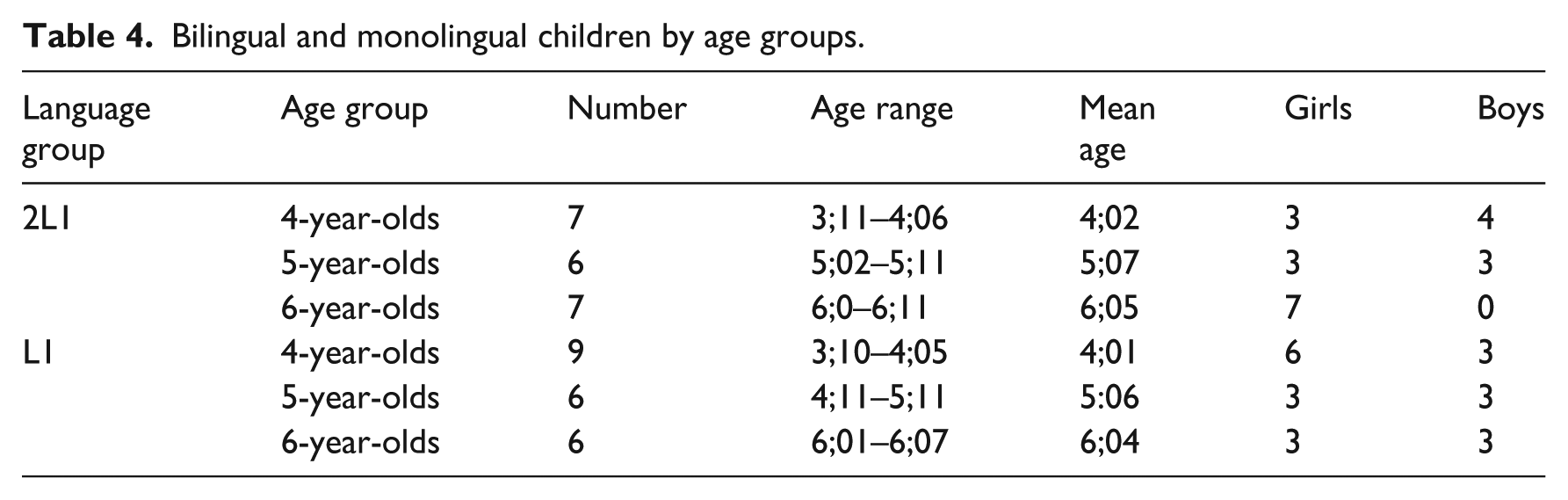
The bilingual children were recruited at the Ukrainian Holy Family School in Lindenhurst, NY, USA. The monolingual children were tested in Ternopil’, Ukraine (these child data as well as adult results are described in more detail in another paper – Mykhaylyk & Sopata 2015). All the bilingual children were born in the USA in families of Ukrainian origin, and, thus, Ukrainian can be considered their heritage or family language. English is also occasionally used at home and with friends. Before the age of five, some children attended Ukrainian daycare, others attended English daycare, and some children attended both. Since the age of five, all the children started public schools with English education and a Saturday school with Ukrainian education (see more individual information on the bilinguals collected from parents’ and teachers’ questionnaires in the Appendix Table 10).
Material and stimuli
The experiment was designed as an elicited production picture description task. The participants were shown a series of 24 pictures on a computer screen, which represented two experimental conditions depending on the question type: C1, with an unspecified/not mentioned direct object (DO); and C2, with a specified/mentioned animate or inanimate DO. The experimental design is summarized in Table 5.
Experimental conditions (visual context and verbal stimuli).
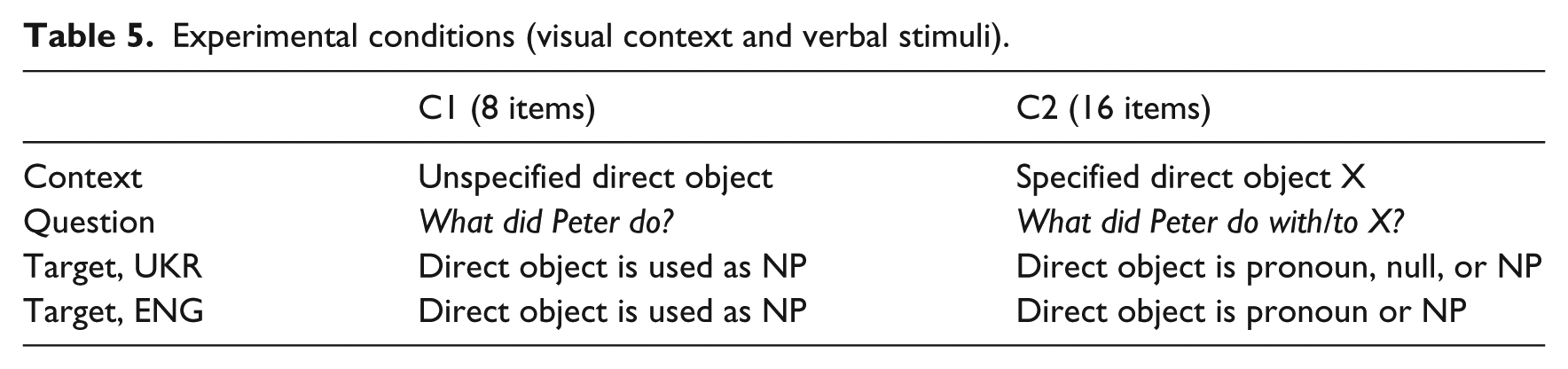
The words used in the test material were selected according to certain morphological and syntactic properties, with a focus on Ukrainian grammar (see the list in the Appendix Table 11). The verb forms are the same in each trial: past tense; masculine; perfective; and monotransitive. All triggered direct objects should be in the Accusative case and could be either full NPs or pronouns. There were 8 animate NPs and 16 inanimate NPs, and their gender and number properties were equally distributed between masculine, neuter, feminine, or plural (6 of each). It should be noted that the only strong prediction regarding the target response concerns the unspecified condition C1: the direct object in this context should be the full NP in both languages. Condition C2, on the other hand, could trigger more variable replies, including pronouns, null objects, or NPs in Ukrainian and pronouns or NPs in English (see examples in (7) and (8)).
Procedure
The experiment proceeded as follows. The experimenter set up the computer in front of the participant and introduced the main character, Peter, and the puppet, Dragon. Next, the participant was given a few training items, which also served as proficiency tests for 2L1 children (which they all passed). The experimenter would start the conversation about the picture, and then the puppet would ask one of the questions: ‘What did Peter do?’; ‘What did Peter do with the object?’; or ‘What did Peter do to the person?’. The testing followed the same procedure with 24 pictures in a pseudo-randomized order. The Ukrainian and English variants were given with at least a week-long interval, and their order was randomized as well. The stimuli are exemplified below in Figure 1 and Figure 2 (the English variant is the translation of Ukrainian examples given in bold).
(7) C1: Unspecified DO
Puppet: Ščo zrobyv Petryk?
what did Peter
Responses: a. Vin / Petryk pomyv vikno. Possible in Ukrainian
he / Peter washed window
b. (Vin) pomyv vikno Possible in Ukrainian
he washed window
c. *Pomyv. Not possible in either language
washed
d. *(Vin) pomyv joho. Not possible in either language
(he) washed it.
‘
(8) C2: Specified DO
Puppet: Ščo Petryk zrobyv kotovi?
what Peter did cat.DAT
Responses: a. Vin joho pomyv. Possible in Ukrainian
He him washed
b. Vin pomyv joho / kota. Possible in Ukrainian
he washed him / cat
c. Pomyv joho / kota. Possible in Ukrainian
washed him / cat
d. Pomyv. Possible in Ukrainian
Washed
e. *joho pomyv. Not possible in either language
him washed
f. *Vin pomyv. Not possible in either language
he washed

C1 picture stimuli.
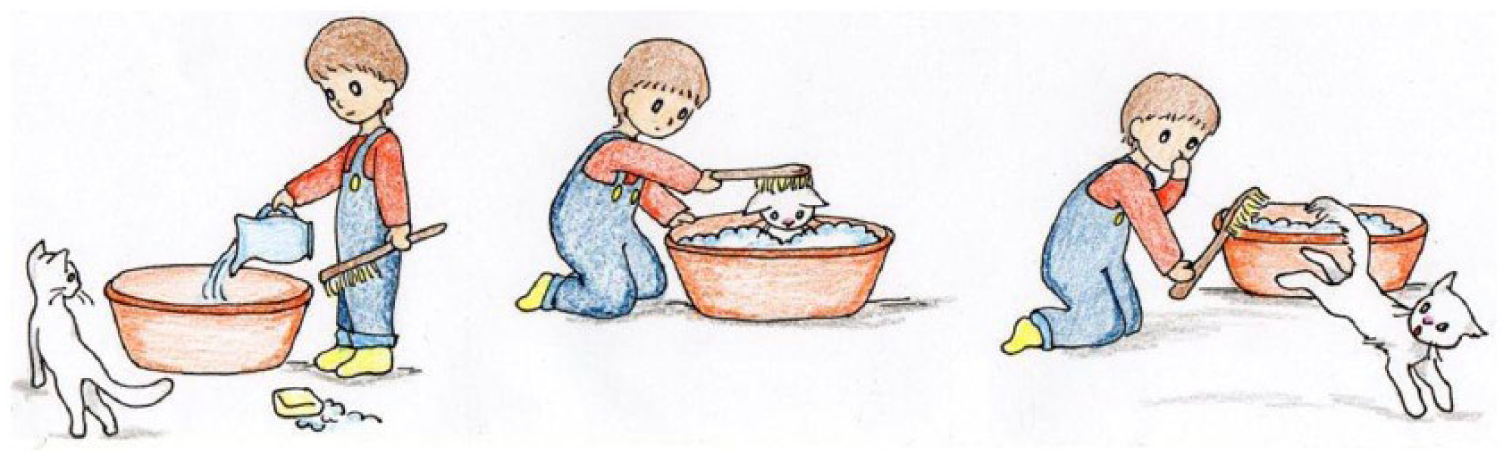
C2 picture stimuli.
The participants’ responses were audio-recorded and later transcribed by a bilingual research assistant. Only relevant utterances, i.e. those that included obligatorily transitive verbs, were coded for the purpose of this study, while others were considered ‘not available’ (NA). The coding categories are the following: full NP direct object (e.g. ‘window’), direct object pronoun (‘him’), or null direct object (e.g. ‘washed ø’).
Statistical analyses
Direct object types in the children’s responses are first analyzed descriptively, presenting the numbers of items and rates of DOTs per language and age group. On a more advanced level, they are examined separately for each of the three dichotomous DOT categorizations: i.e. NPs vs. pronouns and null objects; pronouns vs. NPs and null objects; and null objects vs. NPs and pronouns. For example, the number of null objects is treated as a binomial dependent variable in a generalized linear mixed model, which is comparable to logistic regression (Baayen, 2008; Kleinbaum & Klein, 2010). The main factors in this model are: Child group (monolinguals or bilinguals); Language (Ukrainian or English); Context (C1 or C2); and Age group (4, 5, or 6), with all two-way interactions included. The statistical model also contains child ID and question ID (i.e. item) as random effect factors. The results are presented as odds ratios (ORs) of each direct object type. If, for example, null objects are more frequent in C2 items compared to C1 items, the OR will be greater than one; and vice versa, an OR < 1 means that null objects are less frequent in C2 compared to C1.
The data are analyzed in the statistical program R (R Development Core Team, 2012), utilizing the R-library function lme4 (Bates, Maechler, & Bolker, 2013). Due to multiple testing, we control the familywise error rate by considering only those p-values that are less than 0.01 as significant.
Results
Descriptive statistics
The L1 children produced 477 relevant responses, while 27 questions were not answered at all or received structures without transitive verbs. The 2L1 children had 450 relevant responses in Ukrainian and 415 in English. They did not give appropriate answers for 65 questions in English and 30 questions in Ukrainian. The large number of missed responses in English is mostly due to the comparatively poor performance of 4-year-olds, who could not give expected answers to 34 questions.
The distribution of all responses in Ukrainian, given in Table 6, shows a clear contrast between the use of NPs, pronouns and null objects in two conditions. In the unspecified condition, both monolingual and bilingual children use mostly NPs (from 68% to 96%), as predicted, while in the specified condition, their responses include high rates of null objects (from 20% to 68%) and pronouns (from 14% to 66%). The English responses by bilingual children seem to have a wider distribution that depends on age, but they still show the same general tendency: the majority of responses in the unspecified contexts are NPs (50–87%), while in the specified contexts, the children use high rates of pronouns (29–77%). The contrast between 4-year-olds and 6-year-olds deserves a more detailed analysis since only the oldest group of bilinguals is target-like in English (0–1% of omissions), while the youngest bilinguals overuse null objects at 30–32% in both contexts. We will return to these data in the following subsections in which we consider various factors (e.g. context, language, age, etc.) that might influence the choice of DOT as a pronoun or null. To avoid long descriptions of numbers obtained in the analysis, we leave aside the NP results in those cases where their patterns are similar in all groups.
Direct object types, % (N).

Effects of context
The generalized linear mixed models confirm the effect of context for the total Ukrainian data. We used the following model for the null objects (and similar for the pronouns): ‘Nulls~ Context+ Age+ Child_group+ Language+ Context*Age+ Context*Child_group+ Context*Language+ Age*Child_group+ Age*Language+ the random effects of child and question ID’. ORs for context C2 vs. C1 were computed for each combination of age, child group and language with incorporation of interactions between these variables. The results confirm that the proportion of pronouns and null objects in Ukrainian, both for monolinguals and bilinguals, is significantly higher for the specified questions compared to the unspecified questions in all three age groups. As shown in Table 7, all p-values are less than 0.0075.
Odds ratios (OR) for context, specified (C2) vs. unspecified (C1).
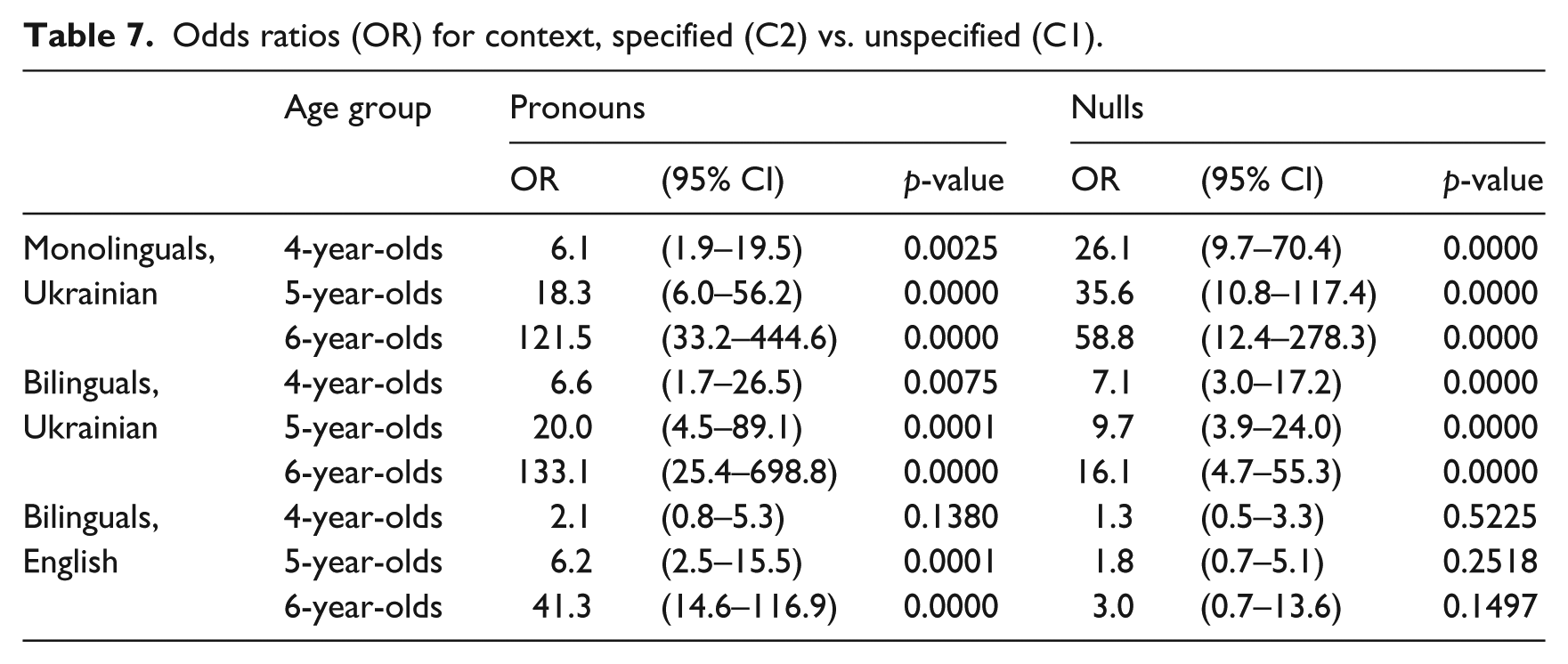
On the other hand, there is no effect of context on the use of null objects in English responses. Although the youngest bilinguals omit some objects in English, they do it in the both conditions without an obvious difference, as shown in Table 7 (e.g. p = 0.5225 for 4-year-olds). The use of pronouns in English depends on age: the older 5–6-year-olds use more pronouns correctly in the specified contexts (p < 0.0000), while the youngest 4-year-olds use pronouns at the same rates in both conditions (p = 0.1380).
Combination of various factors influencing DOT
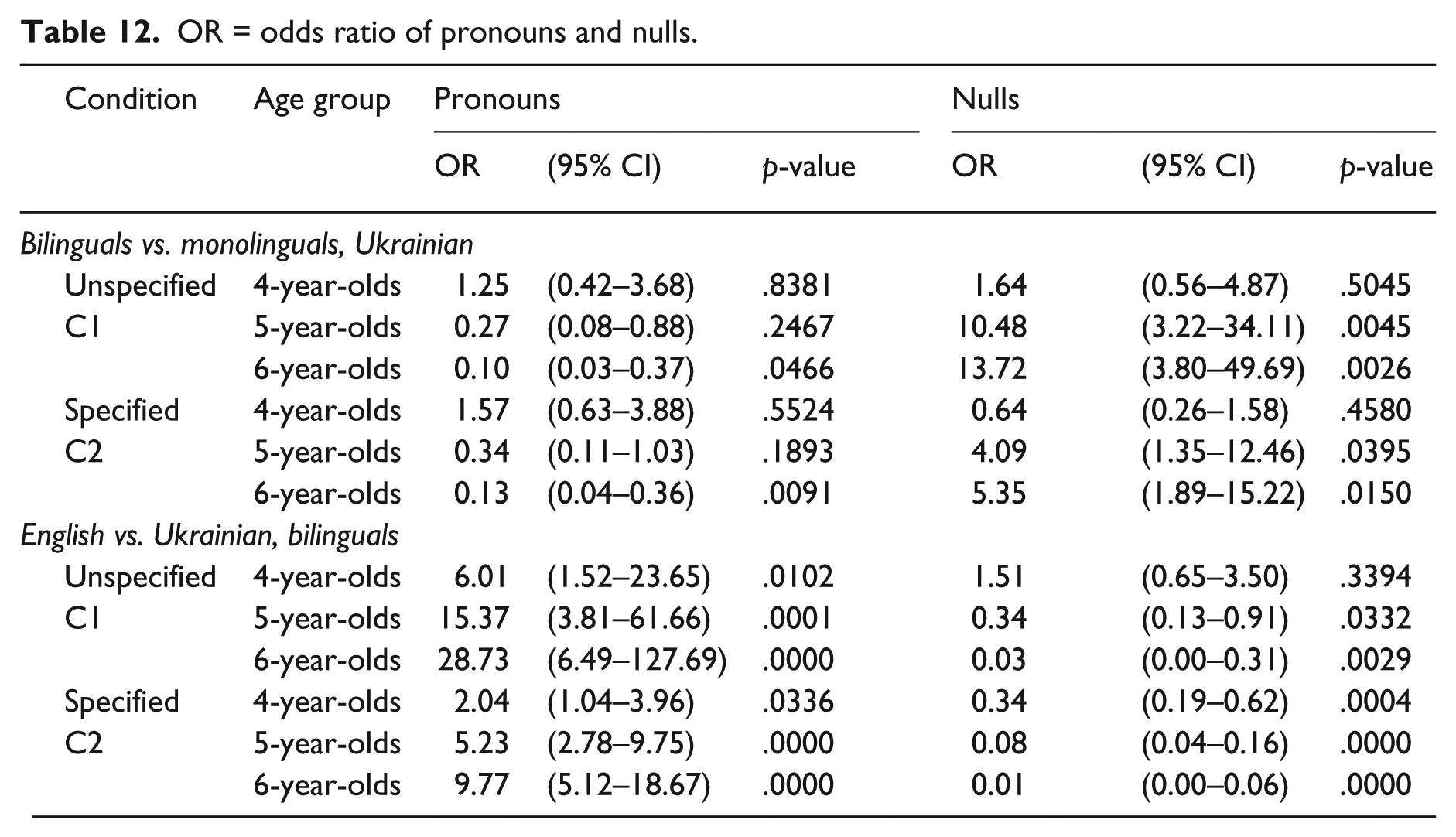
Odds ratios (OR) for each of the three direct object types are presented as bars in Figure 3, where the exact numbers are given in the Appendix Table 12.

Odds ratios (ORs) for bilinguals vs. monolinguals and English vs. Ukrainian.
In Figure 3, the comparison between bilinguals and monolinguals is restricted to the Ukrainian answers to the questions. The model for the null objects (similar for NPs and pronouns) is the same as in Table 7, but without the variable Language. ORs for bilinguals vs. the reference group of monolinguals are presented as bars, and they are the result of several refits of the model when changing the reference groups in the age and context variables. Figure 3 also contains the ORs for English vs. the reference group Ukrainian restricted to the bilingual children. The model is similar to that in Table 7, but without the variable ‘Child_group’.
First, we present the Ukrainian responses of monolingual and bilingual children shown on the left of Figure 3. The analysis reveals that the bilingual 5- and 6-year-olds use significantly more null objects than the monolinguals in the unspecified condition. However, when we look at the actual numbers in Table 6, the set of considered items is in fact minimal: 3 vs. 1 for 6-year-olds and 11 vs. 3 for 5-year-olds. There is also a similar tendency in the specified condition, but we consider it non-significant since the p-value is greater than 0.01. Therefore, the only noteworthy significant difference in the specified condition is that the 6-year-old bilinguals use fewer pronouns than the monolinguals.
Next, let us look at the bilingual responses in English and Ukrainian in Figure 3 on the right. In the unspecified condition, the youngest and the oldest children use significantly fewer NPs in English than in Ukrainian. The difference in the use of pronouns seems to increase by age for both unspecified DOs (OR = 6, 15, and 29) and specified DOs (OR = 2, 5 and 10); see also the Appendix Table 12. The bilingual children use more pronouns in English than in Ukrainian, and this tendency seems to get stronger as they grow older. A similar developmental trend is found in the specified condition when it comes to the use of omissions. However, its directionality is opposite to that of pronoun development: the use of null objects decreases with age, i.e. the odds ratios are 0.34, 0.08, and 0.01 for the age groups 4, 5, and 6, respectively.
Other factors
The choice of DOT in bilingual acquisition might also depend on various non-linguistic factors unified under the term of ‘Input’: e.g. parents’ languages, school/daycare education in English and/or Ukrainian, older siblings’ language, friends’ languages, etc. Presumably, these factors create a general environment where one language becomes ‘dominant’ and another one is ‘less preferred’ in everyday communication. We verified whether any of these factors plays a significant role for the three bilingual age groups by using the data collected in the parental–teacher questionnaire (see Appendix Table 10). It appeared that the only facet that does matter in our dataset is the existence of older siblings in the family.
As shown in Table 8, the English vs. Ukrainian part of Figure 3 is reanalyzed separately for children with older siblings and children without older siblings. The bilingual children with older siblings use significantly fewer null objects in English than in Ukrainian (except for 4-year-olds in the unspecified condition). In fact, the decreasing use of structures with omissions in English with age is confirmed by the OR ratios in both unspecified and specified contexts: 0.55, 0.04, 0.01 and 0.12, 0.01, < 0.01, respectively. The use of pronouns in English compared to Ukrainian follows the opposite tendency; the rates increase with age: p < 0.000 for 5–6-year-olds.
OR = odds ratio of pronouns and nulls in English vs. Ukrainian among bilingual children with or without older siblings.

Table 8 presents the statistical analysis of the data of bilingual children with and without older siblings. We can see that the significance levels in this table differ for these two groups of children, especially in regard to the use of null objects. The decreasing trend of the ratios starts at a later age for children without older siblings: e.g. OR = 0.1 and 0.02 for 5- and 6-year-olds in the specified context.
To conclude, both the discourse context and the language input should be taken into account while analyzing the bilingual data and attempting to explain the developmental trends of direct object choices.
Discussion
In this section, we answer the main research questions stated in (4) and evaluate previous hypotheses and predictions defined in (5) and (6) against our experimental results.
Discourse–pragmatic principles in bilingual development
The first general question addressed in our research concerns the role of discourse/pragmatics in the choice of DOT: how do bilingual children match discourse-pragmatic principles with the language-specific rules, e.g. in the use of object omissions? The Ukrainian results presented above indicate that the Ukrainian–English bilingual children follow the same patterns in the DOT choice as the monolingual Ukrainian children. Table 7 clearly shows that both the 2L1 and L1 data exhibit significant effects of context on the use of pronouns and null objects. These two direct object types can be used only in specified contexts, when the person or object is mentioned/given in the question. It appears that the children know about the discourse–pragmatic concept of givenness and are able to apply it in the right contexts in Ukrainian (similar to Mykhaylyk et al., 2013). Crucially, the bilingual children also use considerable rates of omissions in the specified condition (e.g. 49–66% in Table 6) even though their other language – English – does not have this option.
The English results of the 2L1 children depend on the context in a different way. First, there is no significant effect of condition on the use of null objects (since this DOT is not an option in English); and second, only the older 5–6-year-old children use different rates of pronouns depending on the context (see Table 7). The youngest 4-year-old children use similar rates of pronouns in both specified and unspecified conditions, although they should not use them at all when answering the question ‘What did Peter do?’ There could be three possible explanations for this non-target behavior: (1) lack of pragmatic knowledge; (2) specifics of the picture-description task; or (3) language-specific properties. The lack of pragmatic knowledge is unlikely to show up in only one language; since these children correctly use significantly fewer pronouns in the unspecified contexts than in specified contexts in Ukrainian, they should know about the use of pronouns in English as well. The second explanation should also be applicable to both languages: if the children decide that the visual specificity equals or overcomes linguistic specificity, they might refer to some objects using pronouns and possibly pointing to the picture even when the referent of this object is not mentioned in the question. However, it is puzzling why this strategy was not used in Ukrainian. The last suggestion regarding the role of language-specific properties in the high rates of pronouns in the unspecified condition has to be investigated further. It is possible that the 4-year-old children prefer to use the ‘easy’ gender-less pronoun ‘it’, in those cases when they are not sure about the English noun expected in a certain context.
Therefore, to briefly summarize the answer to the first question, the bilingual children have enough knowledge about language-specific discourse–pragmatic rules since they consistently use more null objects in specified contexts than in unspecified contexts in Ukrainian; while, the misuse of English pronouns in the unspecified context is likely to have a different explanation.
Bilinguals vs. monolinguals: DOT choices
The second research question addresses possible 2L1–L1 differences: do DOT choices of bilingual children differ from those used by monolingual Ukrainian children? In general, the direct object types used by the 4–6-year-old bilingual children in Ukrainian are the same as those used by their monolingual peers in Ukraine: NPs; pronouns; and null objects. Their distribution across condition and age is also quite similar. Although the statistical analysis presented in Figure 3 reveals that the bilingual 5- and 6-year-olds use more omissions than the monolinguals in the unspecified condition, the actual numbers are so low (e.g. 3 vs. 1 item for 6-year-olds) that we prefer to take these results with some caution. The only significant difference that is supported with a considerable dataset is found in the specified condition: the 6-year-old bilinguals use fewer pronouns than the monolinguals (30%(31) vs. 66%(59) in Table 6). Note also that these results go in line with the results from Mykhaylyk (2013): it is possible that older bilingual Ukrainian–English children are aware of morpho-syntactic complexity of Ukrainian pronouns, and start avoiding them. However, we did not find any morphological errors in used pronominals, and thus more research is needed to verify this suggestion.
The English results, summarized in Table 6, present different patterns: only the 6-year-olds seem to be adult-like in that they do not omit direct objects, while the 4- and 5-year-olds allow certain rates of omissions both in the specified and unspecified conditions. We compare these rates to the L1 English data available from previous studies and see that omissions can be found even in monolingual production. For instance, Pérez-Leroux et al. (2008), who used a similar experimental design with unspecified direct objects (they call this condition ‘non-individuated’: What did x do?), show that 3–4-year-old L1 English children have 25% of omissions and 4–5-year-olds have 32% of omissions in their responses. These numbers are surprisingly similar to those obtained in our study, e.g. the same 32% for 4-year-olds. Our specified condition can be compared to the pronominal condition (What did x do with y?) in Pirvulescu et al. (2014): 4-year-olds omit 13% of direct objects (cf. 30% in our study) and 5-year-olds have 14% of omissions (cf. 21% in our study). Based on these numbers, we can conclude that the bilingual Ukrainian–English children use more null objects in specified contexts than the monolingual English children typically do, but the unspecified condition might be problematic for both L1 and 2L1 young learners. Since the specified contexts in Ukrainian trigger omissions even in adult speech, it can be suggested that Ukrainian influences English in bilingual development up to the age of five.
To summarize, the Ukrainian grammar of bilingual children is very similar to the monolingual grammar, and even though it might show some variability (e.g. in the use of pronouns), there is no ‘bilingual impairment’ with regard to the choice of DOT. English grammar, on the other hand, requires more research, since previous studies suggest that there could be some 2L1–L1 similarities worth consideration.
Directionality of influence and previous hypotheses
The third question concerns specifically inter-language influence: if there is a 2L1–L1 difference, what is the directionality of bilingual language development? Taking a first look at the descriptive statistics summarized in Table 6, we could assume that there are many differences between the language and age groups in the use of NPs, pronouns or null objects. However, as we explain above in our answers to the first two questions, not all of them are noteworthy at this stage of research. The more rigorous statistical analysis summarized in Figure 3 and Table 7 enables us to identify the most significant trends in bilingual development and their dependence on linguistic and extra-linguistic factors.
First, the results suggest that the bilingual children as a group operate with two grammars in their language learning: Ukrainian and English, confirmed by the highly significant levels of English–Ukrainian difference in Figure 3 for most of the age groups. Note, however, that we pay special attention only to pronouns and null objects because NP selection should not differ in the two languages. We can also leave aside omissions by the 6-year-olds since they are mostly target-like both in Ukrainian and English. What is the most problematic is the behavior of the youngest 4-year-olds in the unspecified condition in the both languages: the rates of null objects and pronouns are not significantly different, and it might signify that the children do not distinguish two languages at this stage. Although the actual numbers of null objects differ (i.e. 9 (18%) for Ukrainian and 14 (32%) for English in Table 6), there is no evidence for any inter-language transfer since omissions are not a pragmatically licit option in the unspecified context in any of the languages, and thus these results could support the Bilingual Effect Hypothesis.
However, before supporting any account of the non-target bilingual grammar, we propose to evaluate the null-responses together with other DOTs: as shown in Figure 3 and Table 6, the same children in the same condition use significantly fewer NPs in English than in Ukrainian (50% vs. 82%) and prefer to use pronouns in English (18% vs. 0%). This might mean that these young bilingual children have a limited vocabulary in English and whenever they do not know a certain noun (not mentioned by the experimenter), they either skip it or replace it by the pronoun ‘it’. Note, that even older 5- and 6-year-old bilinguals use the same strategy: their rates of pragmatically odd pronouns in English are significantly higher than the rates of pronouns in Ukrainian, i.e. 23% vs. 7% at the age of five and 13% vs. 0% at the age of six (Table 6 and Figure 3). It is possible, however, that at this older stage, the children’s knowledge of English becomes stronger, and their use of pronouns and null objects can be explained by other means: e.g. they pay more attention to visual specificity and assume that the hearer shares their knowledge about the object, which, in addition, they could see in a previous testing session in Ukrainian. In those cases, the children might license linguistically new/not-given/unspecified direct objects as known, visually specified elements and mark them with pronouns or null objects (see relevant findings in Matthews, Lieven, Theakston, & Tomasello, 2006; Serratrice, 2008). We plan to verify this suggestion in another experiment explicitly targeting visual vs. linguistic specificity and possibly extending the time space between testing sessions in each of the two languages.
The influence of Ukrainian on English is most evident in the specified condition. Recall that the question ‘What did Peter do with X?’ cannot be answered with the verb-only option in English, but subject/object omissions are allowed in Ukrainian. Thus, the high rates of null objects in the English results and their distinct distribution compared to L1 English (e.g. from Pirvulescu et al., 2014) suggest that Ukrainian influences English in the bilingual grammar. Table 6 with the English results shows that the 4-year-olds use 30% of null objects and the 5-year-olds use 21% of null objects, which is more than 13–14% in Pirvulescu et al. (2014). These results confirm the Cross-linguistic Influence Hypothesis, restated as follows: if a phenomenon belongs to the syntax–pragmatics/discourse interface, and there is a certain structural overlap, the influence from a language with more options on a language with fewer options is expected. Even though this hypothesis was proposed for much younger 2–3-year-old bilinguals acquiring a different language pair, it appears that our data from 4–5-year-old Ukrainian–English bilinguals acquiring direct object types show the same directionality of transfer in some contexts.
The influence of the ‘overt-object’ language English on the ‘null-object’ language Ukrainian, on the other hand, appears to be weaker than it would be expected based on previous studies supporting the Interface Hypothesis (cf. Sorace et al., 2009). Since the English–Italian bilinguals in the aforementioned paper are older than our participants, it is possible that the directionality of the influence changes at the later stages of bilingual development, as a sign of attrition in a language with limited input (see e.g. Kang, 2013). And it is likely that this language will be Ukrainian rather than English for our Ukrainian–English bilinguals living in the USA.
As our statistical analysis reveals (see Table 8), the non-linguistic factors related to language exposure do influence the bilingual children’s choices of DOT. We created various models with such factors as the language of education, communication with friends and older siblings. It appeared, however, that the only factor that matters is ‘older siblings’: i.e. if a bilingual child has an older sister or brother, his/her responses to the experimenter’s questions are more target-like in English. As shown in Table 8, the bilingual children with older siblings use significantly fewer omissions in English than in Ukrainian (except for the 4-year-olds in the unspecified condition). The parental questionnaires show that while Ukrainian is the typical language of child–parent communication, conversations among siblings are conducted both in Ukrainian and English. Hence, younger children in such families receive more English input and possibly have more extended vocabularies in their two languages. Does this mean that our data support the Dominant Language Hypothesis? At this point, we are not ready to give a firm answer to this question. The young Ukrainian–English bilinguals are often dominant in Ukrainian until they start school/daycare with English-medium education, and while our results show that the older siblings change their language use with regard to the choice of DOT, we are not sure that this change correlates with language dominance as a whole. An additional complex testing of various linguistic skills and language practices, along the lines of Silva-Corvalan and Treffers-Daller (2015), should be undertaken in order to confirm our current suggestions.
Conclusions
To summarize, we present our main findings in Table 9, emphasizing that the clearest results were obtained with regard to the influence of Ukrainian on English at the age of 4–5 in the specified contexts (H2–P2). We also did not find any influence of English on Ukrainian at the tested developmental stages (H3–P3). The other two hypotheses require further verification. It is possible that the youngest bilinguals either do not distinguish English from Ukrainian in terms of DOTs (H4–P4) or they are dominant in Ukrainian (H1–P1), but there could be other explanations as well. For instance, the youngest bilinguals could simply have a limited vocabulary in English and use any means from the both available grammars to ‘repair this deficiency’: either null objects, as in Ukrainian, or the ‘easy’ pronoun ‘it’ from English.
Evaluation of previous hypotheses.

The detailed statistical analysis of the data collected on the same task given to 4-6-year-old 2L1 Ukrainian–English and L1 Ukrainian children reveals that while there is no significant difference between object types in L1 and 2L1 Ukrainian in most age groups, there is a considerable amount of non-target-like null object usage in English at some developmental stages. Apparently, the bilingual Ukrainian–English children prefer to use more ‘economical’ reduced structures in specified contexts in both languages, even though it might hinder full understanding of their responses in English. We also conclude that while experiments with controlled linguistic factors, such as context, are crucial, the role of input and extra-linguistic factors should not be underestimated in research on bilingual acquisition.
Footnotes
Appendix
OR = odds ratio of pronouns and nulls.
| Condition | Age group | Pronouns | Nulls | |||||
|---|---|---|---|---|---|---|---|---|
| OR | (95% CI) | p-value | OR | (95% CI) | p-value | |||
| Bilinguals vs. monolinguals, Ukrainian | ||||||||
| Unspecified | 4-year-olds | 1.25 | (0.42–3.68) | .8381 | 1.64 | (0.56–4.87) | .5045 | |
| C1 | 5-year-olds | 0.27 | (0.08–0.88) | .2467 | 10.48 | (3.22–34.11) | .0045 | |
| 6-year-olds | 0.10 | (0.03–0.37) | .0466 | 13.72 | (3.80–49.69) | .0026 | ||
| Specified | 4-year-olds | 1.57 | (0.63–3.88) | .5524 | 0.64 | (0.26–1.58) | .4580 | |
| C2 | 5-year-olds | 0.34 | (0.11–1.03) | .1893 | 4.09 | (1.35–12.46) | .0395 | |
| 6-year-olds | 0.13 | (0.04–0.36) | .0091 | 5.35 | (1.89–15.22) | .0150 | ||
| English vs. Ukrainian, bilinguals | ||||||||
| Unspecified | 4-year-olds | 6.01 | (1.52–23.65) | .0102 | 1.51 | (0.65–3.50) | .3394 | |
| C1 | 5-year-olds | 15.37 | (3.81–61.66) | .0001 | 0.34 | (0.13–0.91) | .0332 | |
| 6-year-olds | 28.73 | (6.49–127.69) | .0000 | 0.03 | (0.00–0.31) | .0029 | ||
| Specified | 4-year-olds | 2.04 | (1.04–3.96) | .0336 | 0.34 | (0.19–0.62) | .0004 | |
| C2 | 5-year-olds | 5.23 | (2.78–9.75) | .0000 | 0.08 | (0.04–0.16) | .0000 | |
| 6-year-olds | 9.77 | (5.12–18.67) | .0000 | 0.01 | (0.00–0.06) | .0000 | ||
Funding
This research received no specific grant from any funding agency in the public, commercial, or not-for-profit sectors.