




Abstract
Aims and Objectives:
The main goal of the present study is to investigate effects of crosslinguistic influence in third language acquisition by simultaneous bilinguals. We address the following research questions: Do both languages contribute to crosslinguistic influence in third language acquisition, or is one of them chosen as the sole source of influence? Is crosslinguistic influence always from the typologically more similar language? Is crosslinguistic influence always facilitative, or can it also be non-facilitative?
Methodology:
The paper reports on a grammaticality judgment task with two word order conditions, both related to verb movement (verb-second in Norwegian and subject-auxiliary inversion in English).
Data and Analysis:
An experiment was carried out with three groups of 11-14-year-old participants, Norwegian-Russian bilinguals (n=22), Norwegian-speaking monolinguals (n=46), and Russian-speaking monolinguals (n=31). The data were analyzed using a generalized linear mixed effects logistic regression allowing us to estimate the effects of condition (Adv-V, Aux-S), language (Norwegian, Norwegian-Russian, Russian) and their interaction on the correctness of judgments.
Findings:
The analysis reveals that while L1 Norwegian children over-accept ungrammatical sentences in English with a word order that reflects verb movement (V2), bilingual Norwegian-Russian children notice these errors significantly more often, just like L1 Russians. At the same time, the bilinguals score lower than L1 Russian children on grammatical trials, suggesting the presence of non-facilitative influence from Norwegian.
Originality:
This study argues for the Linguistic Proximity Model, which proposes incremental property-by-property learning and allows for both facilitative and non-facilitative influence from one or both of the previously acquired languages.
Significance:
The Linguistic Proximity Model and supporting experimental data contribute to existing models in third language acquisition by indicating that not just typological proximity but also structural similarity at an abstract level should be considered an important factor in third language acquisition.
Keywords
In recent years, there has been increasing interest in L3 acquisition (L3A) in formal approaches to language, with numerous studies investigating a variety of language combinations (e.g. Bardel & Falk, 2007, 2012; Berkes & Flynn, 2012; Dias & Santos, 2011; Flynn, Foley & Vinnitskaya, 2004; Hermas, 2015; Jin, 2009; Leung, 2003; Montrul, Rothman & Cabrielli Amaro, 2010; Rothman, 2011, 2015; Slabakova & Garcia Mayo, 2015).
Generative L3A has inherited a number of key questions from L2 acquisition (L2A), including the issue of full/partial/no transfer at the initial state of acquisition. However, unlike L2A, L3A occurs in the presence of two potential sources of crosslinguistic influence (CLI) on a subsequently acquired language. The key question in this respect is whether both of the previously learned languages affect L3A, or whether one of the languages is chosen as the primary or sole source of CLI. In the former case, it is typically assumed that the source of influence is determined on a property-by-property basis (e.g. Berkes & Flynn, 2012; Flynn et al., 2004). In the latter case, transfer may be assumed to happen in one fell swoop (e.g. Leung, 1998, 2003; Rothman, 2011, 2015). Several factors have been argued to affect the choice of language for CLI, including order of acquisition (e.g. Bardel & Falk, 2007; Jin, 2009; Na Ranong & Leung, 2009) and typological proximity (either perceived psychotypological proximity or similarity at the structural level, e.g. De Angelis, 2007; Foote, 2009; Leung, 1998, 2003; Rothman & Cabrielli Amaro, 2010).
In this paper we discuss some previous models of L3A, starting with those arguing that either the L1 or the L2 has a privileged status with respect to CLI. We then consider models that focus on the role of structural factors, the Cumulative Enhancement Model (CEM; Berkes & Flynn, 2012; Flynn et al., 2004) and typology-based models such as the Interlanguage Transfer Hypothesis (ITH; Leung, 1998, 2003) and the Typological Primacy Model (TPM; Rothman, 2011, 2015). We especially focus on typology-based models, since, in our view, they are currently the most promising and also the most relevant ones to compare to our own model, the Linguistic Proximity Model (LPM). We report on an experimental study examining L3A of English in a bilingual (2L1) Norwegian-Russian context. We investigate how previous knowledge of two typologically distant languages, Norwegian and Russian, can affect the L3A of a language that shows certain structural similarities with both previously acquired languages. The behavior of Norwegian-Russian bilinguals is compared to that of age-matched Norwegian and Russian L2 learners of English. The results of the study show that despite the typological similarity between Norwegian and English, the behavior of the bilinguals differs significantly from that of the monolinguals, suggesting CLI from both previously learned languages. The results and their implications are discussed in light of the LPM and previous models of L3A.
Theoretical underpinnings of L3A
Previous hypotheses and empirical evidence
Order of acquisition
One of the possible scenarios in L3A is transfer from the L1, indicating that the learner’s native language is the main source of influence. No model of absolute L1 transfer in L3A has been proposed, yet several studies have found evidence of L1 influence (Hermas, 2014; Jin, 2009; Lozano, 2003; Na Ranong & Leung, 2009). For example, Hermas (2014) finds that L1 Arabic is the source of both facilitative and non-facilitative transfer for advanced L2 French adults in the initial stages of L3 English (in two different constructions). Furthermore, Jin (2009) observes a non-facilitative effect of L1 Chinese on L3 Norwegian, despite the presence of an advanced L2 English grammar which instantiates the target feature. Other studies find influence from the L2, which has led to the L2 Status Factor model, according to which the L2 is a privileged source of transfer, especially at early stages (Bardel & Falk, 2007, 2012). This model is supported by experimental evidence suggesting that implicit linguistic competence and explicit metalinguistic knowledge are neurolinguistically distinct and have different memory sources (Paradis, 2004, 2009), the former being sustained by procedural memory and the latter by declarative memory (Ullmann, 2001). Thus, while an L1 grammar is implicitly acquired and sustained by procedural memory, an L2 grammar is typically based on explicit knowledge and sustained by declarative memory. And since an L3 grammar is learned in the same way as an L2 grammar, transfer will occur between the two languages that are both stored in declarative memory. Evidence for the L2 Status Factor has generally been found in studies of English and other Germanic languages, typically focusing on word order phenomena (Bardel & Falk, 2007; Falk & Bardel, 2011).
The Cumulative Enhancement Model
In contrast to the L2 Status Factor, the CEM argues that L3 syntactic transfer is selective and comes from either the L1 or the L2, e.g. Flynn et al. (2004). According to the CEM, language acquisition is gradual and cumulative, and any prior language can either enhance subsequent language acquisition or have no effect. This means that non-facilitative transfer should not occur. Evidence for this model comes from a study examining the production of restrictive relative clauses in L1 Kazakh / L2 Russian / L3 English, where L3 English matches L2 Russian, but not L1 Kazakh. These learners are compared to L1 Japanese and L1 Spanish learners of L2 English, the former language patterning with Kazakh and the latter with Russian with respect to the relevant structure. The results reveal transfer from L1 Spanish for the L2 learners and from L2 Russian for the trilinguals, in both cases providing facilitating influence.
Typology-based models
There is a long tradition in L3A arguing for a privileged role of typological proximity for CLI (e.g. the overview in De Angelis, 2007). While many of these studies have been concerned with the acquisition of the lexicon (e.g. Cenoz, 2003), Leung (1998, 2003) extends this idea to the domain of morphosyntax, proposing what is referred to as the ITH (a term coined by Jin, 2009). The ITH invokes Kellerman’s (1979, 1983) idea of psychotypology, i.e. the language learner’s perception of the properties of the source and target languages as close vs distant and core vs non-core. According to this idea, transfer is predicted to affect close and core properties. Furthermore, referring to the Full Transfer Full Access hypothesis of Schwartz and Sprouse (1996), Leung proposed the idea of full transfer at the initial state of L3A from the most (psycho)typologically close language. The ITH thus argues that ‘the Ln initial state is the steady state of a previously acquired (inter)language which is typologically closest to Ln’ (Leung, 2003, p. 199).
A number of subsequent studies have tested the effect of typology in a variety of L3 populations. For example, Foote (2009) focuses on the role of typology in L3 transfer and disentangles the two predictors, L2 status and typology, by comparing the acquisition of the contrast in aspectual meaning in Romance past tenses in three groups of learners, L1 English / L2 Romance / L3 Romance, L1 Romance / L2 English / L3 Romance, and L1 English / L2 Romance, with a mean exposure to the L2 of 12 years and to the L3 of five years. The results of the study support the ITH, showing that language typology is the principal predictor for CLI.
Rothman (2011) proposes the same basic hypothesis (wholesale initial transfer from the typologically closest language), referring to it as the TPM. Rothman (2013, 2015) elaborates on the mechanisms that allow the parser to evaluate typological/structural proximity, suggesting that the choice of the source of transfer is based on similarity in lexicon, phonology, morphology and, finally, surface syntactic structures (Rothman, 2013, p. 7). This list is meant to be implicationally hierarchical, representing cues that are more available or salient to the parser early in the L3 process. It is argued that after conducting the comparison, the parser chooses which of the two languages is typologically/structurally closer to the L3 and then transfers the complete grammar of this language to the L3 in one fell swoop.
Another important notion introduced by Rothman is that of initial stages. Since the choice of the transfer source depends on the comparison between certain structural properties of the L3 and the two previously learned languages, transfer cannot occur at the initial state, before any exposure to the L3. Instead, the learner needs to have some basic experience with the L3 before the parser can make the decision. This short period of time is referred to as the initial stages in Rothman (2011, 2013, 2015). However, it is not clear how the initial stages should be identified in terms of extent of exposure, and according to Gonzales Alonso & Rothman (this issue), this would not even be a fruitful endeavor. Instead, the initial stages are argued to be ‘the period in which structurally driven wholesale transfer from the L1 or the L2 takes place’ (Gonzales Alonso & Rothman, this issue). Thus, the TPM argues for a special status of the initial stages, and in fact, unlike all other models that we are aware of, the TPM does not make predictions for later stages of L3A (except developmental stages that derive directly from the initial stages, cf. Gonzales Alonso & Rothman, this issue).
Evidence in support of the TPM is primarily based on experiments carried out during the first months or weeks of instruction, typically with speakers of English and a Romance language learning another Romance language as an L3, e.g. Rothman & Cabrelli Amaro (2010). These studies consistently show that the L3 learners transfer from the previously learned Romance language (either the L1 or the L2), even in cases where this leads to a non-target-consistent result and transferring from English would have been facilitative. Support for the TPM is also found in studies investigating L3 acquisition by simultaneous bilinguals, comparing them to successive bilinguals (Giancaspro, Halloran & Iverson, 2015; Iverson, 2009). Both studies test the acquisition of L3 Brazilian Portuguese by L1/L2/2L1 speakers of English and Spanish, revealing transfer from Spanish, irrespective of its status as L1, L2 or bilingual first language. We return to the TPM and the role of typological similarity at early stages of L3A in the discussion section.
The Linguistic Proximity Model
The most problematic issue for typology-based models is the reported existence of CLI from the typologically more distant language, e.g. Jin (2009) showing influence from L1 Chinese (instead of L2 English) into L3 Norwegian, or Hermas (2014), showing influence from L1 Arabic (instead of L2 French) into L3 English. The CEM, on the other hand, cannot explain findings of non-facilitative influence in L3A, e.g. Rothman and Cabrelli Amaro (2010), showing transfer from L2 Spanish into L3 French for the null subject property. In this section, we propose a new model of L3A that argues for CLI from both previously learned languages, the LPM. In the next section, we also provide new empirical evidence from a study designed to test the predictions of the CEM, typology-based models, and the LPM.
The LPM builds on what we consider to be the positive aspects of the CEM and the TPM, viz that certain similarities between the three languages play a major role, not the order of acquisition. However, instead of arguing that general typological proximity is the decisive factor, we claim that similarity of abstract linguistic properties is the main cause of CLI from previously learned languages. The model allows for both facilitative and non-facilitative influence. Furthermore, based on recent evidence that the languages of a multilingual individual are not completely separate (see Slabakova, this issue), we contend that all previously learned languages are available throughout the L3 learning process. Much current work on executive control in bilinguals (e.g. Bialystok, 2011) also shows that the language not in use remains active and must typically be inhibited when speaking the other language. Our approach is also in line with much early work on crosslinguistic influence, cf. the notion combined CLI in De Angelis (2007, p. 21), which refers to a situation where ‘two or more languages interact with one another and concur in influencing the target language.’ Thus, we formulate the LPM as follows:
This means that bilinguals learning an L3 (whether they have two first languages or an L1 plus L2) should benefit from both of the languages they know. Conversely, they may also experience non-facilitative influence from either language. Furthermore, the LPM predicts different learning patterns for different linguistic phenomena. The source of CLI with respect to a particular property is based on structural similarities between the L3 and one (or both) of the previously acquired languages, rather than overall typological proximity between one of them and the L3. Obviously, this kind of CLI may take place only if the learner is able to parse the Ln input and identify abstract linguistic properties.
Unlike typology-based models, the LPM does not assume the idea of complete transfer of one of the previously acquired grammars early on in L3A, excluding any influence from the other language at this stage. In our view, some clear empirical evidence would be needed to justify such a process, but as far as we are aware, no such evidence has been provided. Rothman (2015, p. 184) motivates wholesale transfer at the initial stages of L3A in terms of cognitive economy and argues that ‘if transfer is essentially reflexive to avoid redundancy in acquisition and thereby lessen the cognitive burden of an additional grammar, it should then obtain as early and completely as possible to be maximally useful towards these fundamental goals’. However, the notion of economy is purely conceptual, and in our view, one could also propose a view of economy which would favor incremental learning. For example, it might be argued to be more economical to have a wait-and-see approach to language transfer, performing it on a small part of grammar when and where there is sufficient evidence indicating that this is a relevant move. This would reduce the amount of effort required to unlearn incorrectly transferred properties.
Thus, the LPM argues that all previously learned languages remain active and that learners are sensitive to micro-variation across all three grammars. In this way, the LPM is compatible with the micro-cue model of Westergaard (2009, 2014) for first language acquisition, which argues that young children are able to make fine distinctions in syntax and information structure from early on. This model is currently being extended to multilingual contexts, the main hypothesis being that only small and simple rules may transfer (cf. Amaral & Roeper, 2014). This is also in agreement with the Scalpel model (Slabakova, this issue), which considers the language acquisition capacity (for the L1 as well as subsequently acquired languages) to be a sharp instrument, capable of making clear and fine distinctions. Summarizing, the LPM argues for the following:
In the course of L3A, learners have access to all previously acquired linguistic knowledge. Acquisition is cumulative, and no part of previous linguistic competence is blocked at any stage of the process.
CLI occurs property-by-property, based on similarity or overlap between the grammars, not necessarily identity.
Facilitative influence is based on structural similarity: Learners parse L3 input and make predictions by consulting previously acquired grammars.
Non-facilitative influence occurs when learners misanalyze L3 input (and/or have not had sufficient L3 input), and mistakenly assume that a property is shared between the L3 and either or both of the previously acquired languages.
Our study
Research questions and predictions
The present study investigates crosslinguistic effects in the acquisition of L3 English by 2L1 Norwegian-Russian speakers as compared to monolingual Norwegian (L1Nor) and monolingual Russian (L1Rus) controls. While Norwegian and English are both Germanic languages that are lexically and structurally close, Russian, being a Slavic language, is more distant from English both with respect to vocabulary and morphosyntax.
The linguistic phenomena we consider are related to verb-second (V2) word order in Norwegian and the corresponding residual V2 property of English, generally referred to as subject-auxiliary inversion. According to standard accounts of V2 (e.g. Vikner, 1995), this word order is the result of finite verb movement to the second position of the clause, most often assumed to be the C(omplementizer) position or some other head in the left periphery (e.g. Westergaard, 2008). While earlier versions of English had certain V2 properties, this word order has generally been lost in declaratives and only survives as a rule inverting subjects and auxiliaries in questions (e.g. Roberts, 1996; Westergaard, 2007). This means that present-day English has non-V2 in declaratives and is thus like Russian in this respect, with finite verbs appearing below sentence adverbs (Adv-V). 1 Norwegian displays V-Adv word order, due to verb movement across the adverb to second position. The word order of wh-questions, on the other hand, highlights structural similarity between English and Norwegian as opposed to Russian. Specifically, English and Norwegian exhibit inversion of the subject and the finite verb, while Russian generally does not. 2 The differences between the three languages are illustrated in (1)-(2).
(1) ENG = RUS ≠ NOR Emma Emma Emma spiser (2) ENG = NOR ≠ RUS What Hva Čto eta malen’kaja devočka
Previous investigation of these constructions in L2 English is discussed in Westergaard (2003), based on data from L1 Norwegian 12-13-year-olds (sixth and seventh graders), who had been exposed to English in a classroom setting from the age of six. The Adv-V word order was found to be problematic for these learners, who regularly transferred verb movement from Norwegian (only 17% accuracy in sixth grade, increasing to 58% in seventh grade). At the same time, these learners showed target-like performance with subject-auxiliary inversion in questions (93% and 92% in sixth and seventh grade respectively). We are not aware of previous studies investigating L2 acquisition of these word order phenomena by L1 Russians.
We address the following research questions:
Do both languages contribute to CLI in L3 acquisition, or is one of them chosen as the sole source of influence?
Is CLI always from the typologically more similar language?
Is CLI always facilitative, or can it be non-facilitative as well?
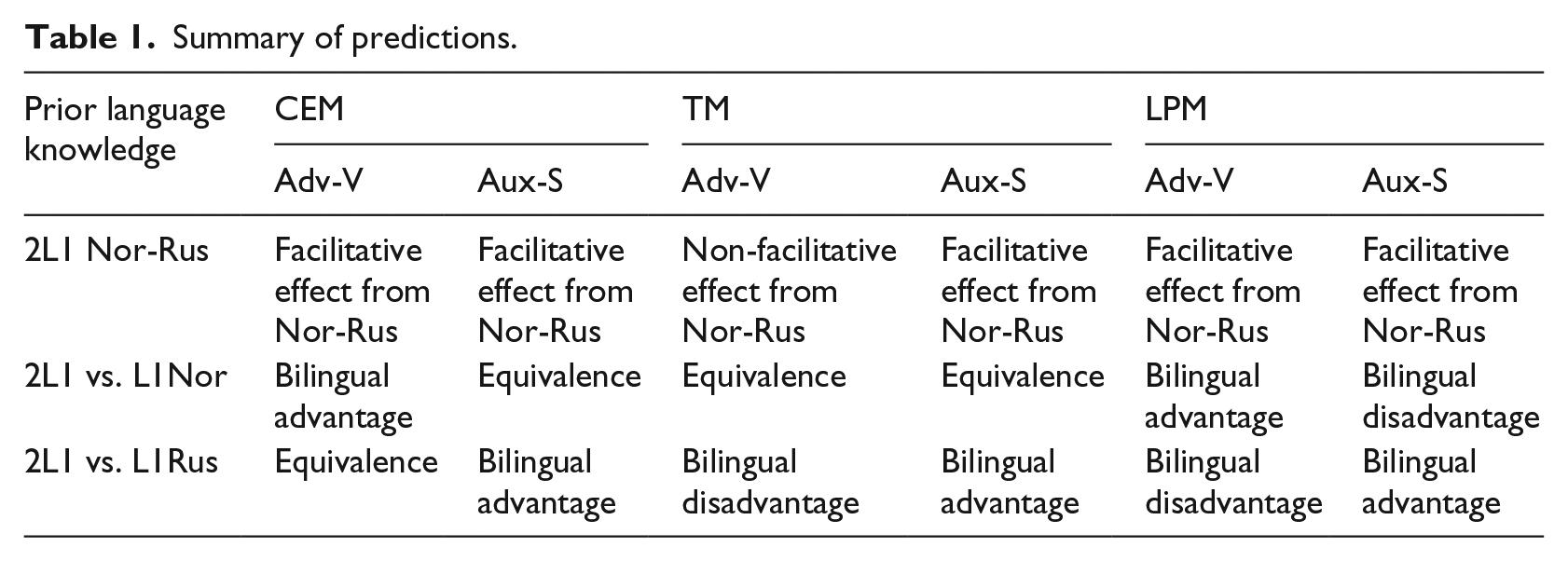
In light of the LPM, we predict CLI to occur from both previously acquired languages. More specifically, the model makes the following predictions: 3
Monolingual Russians (L1Rus) are predicted to perform at ceiling, due to word order similarity between their L1 and L2.
Monolingual Norwegians (L1Nor) are expected to transfer verb movement, due to influence from the V2 property.
Bilinguals (2L1) are predicted to outperform L1Nor, due to access to Russian. However, they may score lower than L1Rus, due to non-facilitative influence from Norwegian.
L1Nor are predicted to perform at ceiling, due to facilitative transfer of verb movement.
L1Rus are expected to have difficulties, due to non-facilitative influence from Russian.
2L1 are predicted to outperform L1Rus, due to access to Norwegian. However, they may score lower than L1Nor, due to non-facilitative influence from Russian.
Let us now consider the predictions of the CEM and typology-based models with respect to the current study. According to the CEM, bilinguals should benefit from both languages, and non-facilitative influence should not occur. In other words, 2L1 Norwegian-Russian bilinguals are expected to perform on a par with L1Rus in the first condition (Adv-V) and with Nor in second condition (Aux-S). On the other hand, typology-based models predict that 2L1 bilinguals would pattern with L1 Nor on both conditions, since Norwegian is typologically closer to English than Russian. The predictions of the LPM, the CEM and typology-based models (referred to as TM here) are summarized in Table 1. 4
Summary of predictions.
Participants
We recruited 110 secondary school students in sixth and seventh grade, age range 11-14. The participants belonged to three groups: Norwegian-Russian bilinguals (n=22), Norwegian-speaking monolinguals (n=46), and Russian-speaking monolinguals (n=31); see Table 2. The Norwegian-Russian bilinguals and the Norwegian monolinguals were recruited in Norway (Tromsø and Oslo), while the Russian monolinguals lived in Russia (Moscow). All the children had studied English since grade 1 (age six). The 2L1 children attended the same public schools as the L1Nor and had received exactly the same exposure to English. The participants were selected from a large pool based on the results of a short vocabulary test, consisting of a subset of the BPVS-II (1997). Only children who scored 60% or more were included in the dataset.
Participants’ demographics and vocabulary scores (VS).

Materials and procedure
We conducted a grammaticality judgment task with two conditions, declaratives with adverbs and questions with auxiliaries, illustrated in Table 3. Each condition included 12 test sentences, six grammatical and six ungrammatical; see examples (3)-(4). The stimuli further involved 24 filler sentences with both grammatical and ungrammatical word order.
(3) a. Susan often eats sweets. b. *Susan eats often sweets. (4) a. What will the little girl read? b. *What the little girl will read?
Experimental conditions.

The 48 experimental items were randomized and presented as a PowerPoint presentation, which was timed and involved both visual and audio stimuli (see Appendix 1, Table 4). A native speaker of American English pre-recorded the sentences with a natural declarative or interrogative prosodic contour. The children heard each sentence once and had to mark it as either grammatical or ungrammatical on a scoring sheet. The presentation was preceded by a training session. The bilingual children were tested in small groups or individually, while the monolinguals were tested in classrooms in larger groups. 5 All children received exactly the same stimuli regardless of the type of setting.
Results
Overall results
The overall correctness scores for the two conditions are illustrated in Figure 1.
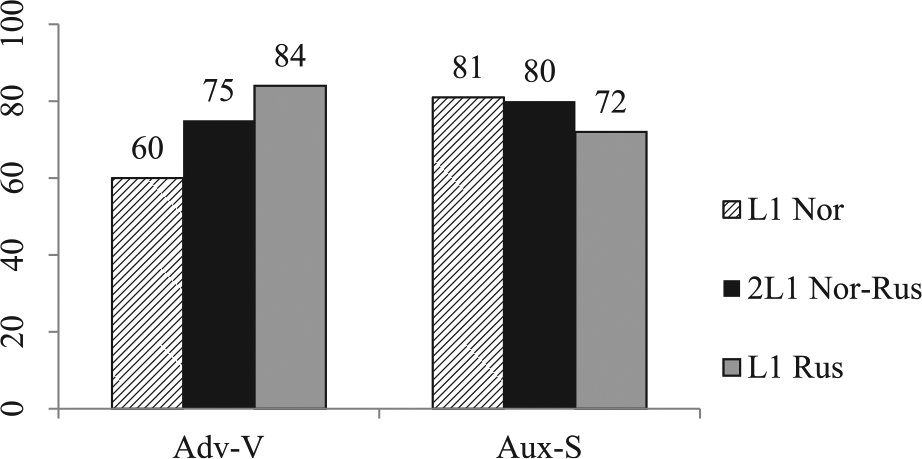
Percentage of correct responses in two conditions: Adv-V and Aux-S.
We fitted a generalized linear mixed effects logistic regression (e.g. Jaeger, 2008; Quené & van der Bergh, 2008) to estimate the effects of condition (Adv-V, Aux-S), language (Norwegian, Norwegian-Russian, Russian) and their interaction on the correctness of judgments
The results showed a significant main effect of language in the Adv-V condition: Both the L1Rus group and the 2L1 group performed significantly better than the L1Nor group (B = 1.47,SE = 0.32, Z= 4.57, p < .001 and B = 0.84, SE = 0.32, Z= 2.68, p < .05, respectively). In the Aux-S condition, language was not a significant predictor of accuracy; see Appendix 2, Table 5. As illustrated in Figure 1, the overall scores are high both for bilinguals and L1Nor (80% and 81% respectively). L1Rus children scored slightly lower (72%), but this difference is not significant.
Grammatical vs ungrammatical sentences
In addition to the omnibus model, we fitted two generalized linear mixed-effects models where grammatical and ungrammatical sentences were analyzed separately (the predictors were the same as in the omnibus model: language and condition as well as their interaction). Maximal random effects were included. We used the multicomp package (Hothorn et al., 2008) for the post-hoc multiple comparisons. The outputs of the two models are presented in Tables 6 and 7 (Appendix 2), and the output of the multiple comparisons tests are summarized in Table 8 (Appendix 2).
We first consider adverb placement/verb movement in declaratives. As illustrated in Figure 2, when presented with grammatical Adv-V sentences (e.g. Emma often eats sweets), the L1Rus children scored significantly higher than the L1Nor: 83% vs 55%, (B = 1.69, SE = 0.46,Z= 3.65, p < .01). The 2L1children scored higher than the L1Nor children, but lower than the L1Rus (65%). The difference between the L1Rus and the 2L1 children approaches significance (B = 1.17, SE = 0.48, Z = 2.48, p = 0.07). The difference between the L1Nor and the bilingual children is not significant.
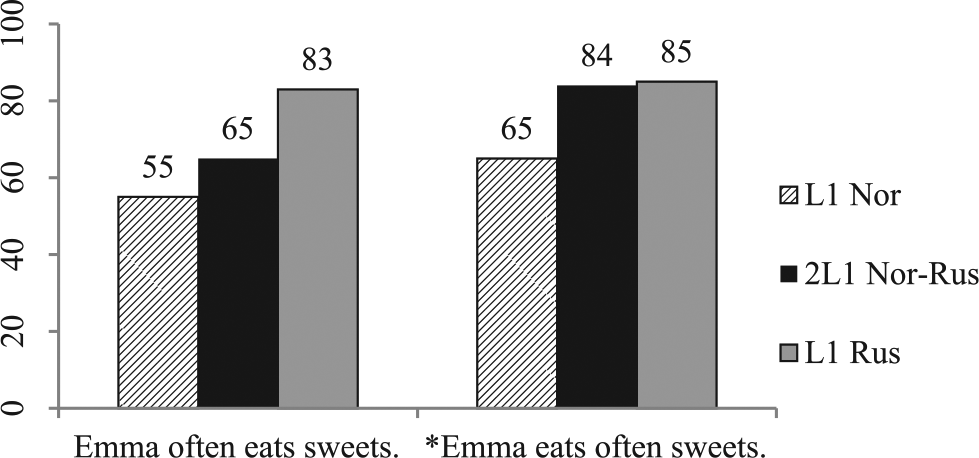
Percentage of correct responses in grammatical (Adv-V) and ungrammatical (V-Adv) sentences.
For ungrammatical trials (e.g. *Emma eats often sweets), the accuracy rates of the 2L1 children matched those of the L1Rus participants (84% vs 85%). Both groups scored significantly higher than the L1Nor group, 84% vs 65% (B = 1.27, SE = 0.43, Z= 2.96, p < .05) and 85% vs. 65% (B = 1.33, SE = 0.36, Z= 3.66, p < .01), while the difference between the L1Rus and 2L1 children is not significant (see Table 8 in Appendix 2) 7 .
We then consider subject-auxiliary inversion. Recall that the omnibus model didn’t reveal any significant differences between the groups in this condition. The additional models confirmed this result. As illustrated in Figure 3, all groups had high scores in the ungrammatical trials (78%-80%). In grammatical sentences, the L1Rus participants scored slightly lower (67%), but the contrasts between the groups are not significant (see Appendix 2, Table 8).
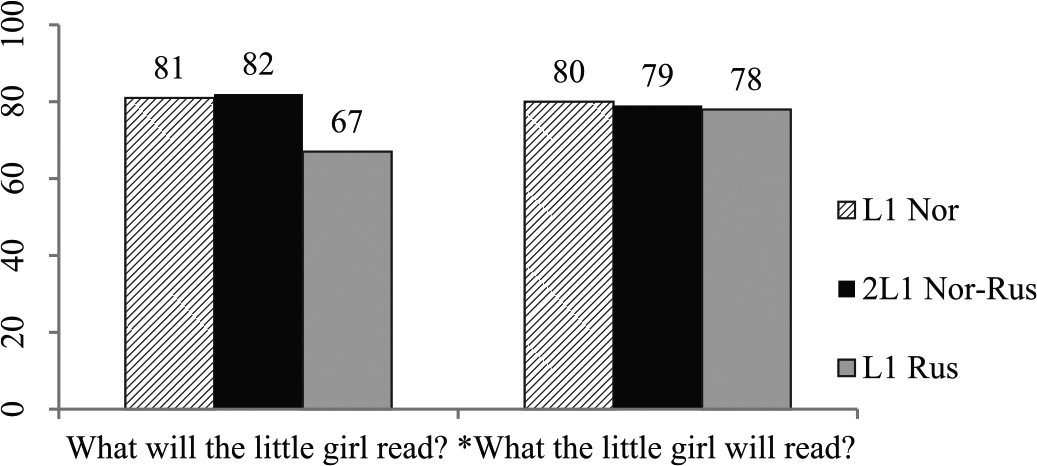
Percentage of correct responses in grammatical (Aux-S) and ungrammatical (S-Aux) sentences.
To sum up, the analysis revealed significant differences between the three groups of participants in condition 1 (Adv-V). L1Rus performed significantly better than L1Nor overall and on grammatical and ungrammatical trials examined separately. 2L1 speakers scored significantly higher than L1Nor speakers overall and in particular with respect to the judgment of ungrammatical sentences. On grammatical trials, their performance was not significantly different from that of L1Nor. There was no significant difference between 2L1 and L1Rus overall and on the judgment of ungrammatical sentences. However, there was a marginally significant difference between these two groups on the grammatical sentences (2L1 scored lower). In condition 2 (Aux-S) no significant differences were observed between the three groups of participants. All three groups performed at ceiling overall and in grammatical and ungrammatical trials examined separately.
Discussion
Our experimental data suggest that the 2L1 speakers experienced a significant facilitating effect of Russian in their L3 English, although Russian belongs to a different typological group than English and Norwegian. This effect is all the more remarkable given that Russian is the minority language for the bilinguals in this study. Let us consider this result in some more detail in relation to the predictions we formulated based on the LPM (repeated here for convenience):
L1Rus are predicted to perform at ceiling, due to word order similarity between their L1 and L2.
L1Nor are expected to transfer verb movement, due to influence from the V2 property.
2L1 are predicted to outperform L1Nor, due to access to Russian. However, they may score lower than L1Rus, due to non-facilitative influence from Norwegian.
L1Nor are predicted to perform at ceiling, due to facilitative transfer of verb movement.
L1Rus are expected to have difficulties, due to non-facilitative influence from Russian.
2L1 are predicted to outperform L1Rus, due to access to Norwegian. However, they may score lower than L1Nor, due to non-facilitative influence from Russian.
The results from the acquisition of Adv-V word order in declaratives indicate a significant facilitative influence of Russian: there are high accuracy rates for L1Rus children as well as the bilinguals, and both groups outperform L1Nor (see Figure 1). The fact that L1Nor score significantly lower than the L1Rus suggests that these learners transfer verb movement (V2) from their L1Nor. The score of the bilinguals is in between the two control groups, suggesting both facilitative and non-facilitative influence (from Russian and Norwegian respectively). At the same time, further evidence from the 2L1 learners’ judgment of grammatical and ungrammatical sentences reveals an interesting contrast: While their judgment of ungrammatical sentences is nearly target-like and significantly better than that of L1Nor (84% vs 65% respectively), their judgment of grammatical structures is significantly lower than that of the L1Rus group and reaches only 65% accuracy (see Figure 2). This indicates that a non-facilitative effect of Norwegian is present at this developmental stage for the 2L1 participants. Thus, all our predictions for condition 1 are borne out.
For subject-auxiliary inversion, the 2L1 speakers as well as the L1Nor speakers have high scores (80% and 81%), and while the L1Rus speakers, as expected, score somewhat lower (72%), this difference is not significant (see Figure 1). The fact that we did not find 2L1 outperforming L1Rus speakers on inversion (as we predicted) might be attributed to the proficiency level of the participants. That is, the learners seem to have already acquired subject-auxiliary inversion in English, and any non-facilitative effect of Russian is no longer present. Disappointing as that may be (for our model), the fact that a property of the L3 has already been learned does not constitute a problem for the LPM (or any other model, for that matter).
Our findings have a number of implications for theories of L3A. First, we do not find support for typology-based models, since there is strong evidence of a facilitating effect of Adv-V word order from Russian. Thus, the typological proximity between Norwegian and English was overridden by facilitative CLI from Russian, which exhibits structural similarity with English in this condition. Second, with respect to the CEM, we do find a facilitating effect of one of the languages, in that the 2L1 children clearly benefit from Russian. However, non-facilitative influence from Norwegian can be detected in the judgment of grammatical sentences, which goes against the predictions of the CEM.
The results of our study are consistent with the LPM, which assumes combined CLI of the previously learned languages on L3A and allows for both facilitative and non-facilitative effects. However, one part of our results remains unaccounted for, namely the observed contrast between the judgments of grammatical and ungrammatical sentences by the bilinguals, who tended to reject both the ungrammatical and the grammatical sentences in English (Adv-V and V-Adv). We would like to speculate that this could be due to what we may refer to as the ‘double filter effect’: Let us assume that all speakers have a grammaticality filter that is activated in cases where one has to process and judge linguistic data; L2 learners will have a single filter and L3 learners a double filter. A sentence is analyzed by a speaker’s grammar before a judgment about its grammaticality is made. In the case of bilingual speakers, at a stage when the L3 interlanguage is still unstable, the grammars of both previously acquired languages will be consulted. Thus, each sentence presented to an L3 learner must pass the filter of both previously acquired grammars in order to be judged as grammatical. In the case of adverb placement, the 2L1 speakers would have received intuitions from their Norwegian grammar that Adv-V word order is ungrammatical, and thus incorrectly rejected a high number of such sentences. At the same time, they would have received intuitions about the ill-formedness of V-Adv from their Russian grammar and again overwhelmingly rejected them. Thus, the double filter resulted in 2L1 participants to a large extent rejecting both grammatical and ungrammatical sentences and thus being right more often with ungrammatical ones. Such an effect should not occur in L2 acquisition, where learners have only one previously acquired language and thus a single filter. At this point we do not have empirical data to further specify the mechanisms underlying the double-filter effect, and we must leave this issue for future research.
Another relevant issue is the learners’ proficiency in the L3. As mentioned above, it is evident that similarity at an abstract structural level can only be established in the presence of sufficient exposure and subsequent ability to parse the L3 input. Until such exposure is obtained, we find it likely that learners may rely on more superficial heuristics, e.g. comparison at the lexical or phonological levels (Rothman, 2013). Thus, in a situation where one of the previously learned languages bears close surface resemblance to the L3, we may see substantially more influence from that language at the earliest stages of acquisition. This may account for the results reported by Rothman and Cabrelli Amaro (2010); Iverson (2009), etc. We expect that as exposure to the L3 grows, the role of overall typological proximity should decrease, while the role of more abstract structural similarities should increase.
To sum up, the results of our study support the hypothesis that both previously learned languages remain active and influence subsequent L3 acquisition. Furthermore, they suggest that CLI can be both facilitative and non-facilitative. We have argued that the crucial factor in establishing the direction of CLI is linguistic proximity at an abstract level. We acknowledge that superficial heuristics may play a role at the earliest stages of L3A when the learner has not yet obtained sufficient input from the L3 to discern similarities at a more abstract level. Nevertheless, we maintain that as the exposure to an L3 grows, CLI should become more dependent on abstract structural proximity.
Conclusion
This paper argues for a new model of L3A, the LPM, according to which CLI occurs when a certain linguistic property receives supporting evidence from one or both of the previously acquired languages, regardless of the order of acquisition or general typological grouping. According to the LPM, all previously acquired languages remain active throughout the learning process, and CLI takes place on a property-by-property basis. Furthermore, this influence may be both facilitative and non-facilitative. The model has been tested in a bilingual setting, 2L1 Norwegian-Russian / L3 English, focusing on two word order phenomena related to verb movement: adverb placement in declaratives and subject-auxiliary inversion in questions. With respect to the first property, English patterns with Russian (Adv-V), while English is similar to Norwegian with respect to the second property (Aux-S). Our hypothesis is supported by the results of a grammaticality judgment task: While L1Nor children over-accept ungrammatical sentences in English with a word order that is equivalent to Norwegian V2 (V-Adv), 2L1 Norwegian-Russian children notice these errors significantly more often, which we argue is due to facilitating influence of Russian. At the same time, 2L1 score lower than L1Rus children on grammatical trials, suggesting the presence of non-facilitative influence from Norwegian. Thus, we conclude that the results of our study can be better captured by the LPM than by other existing models. Our findings indicate that not just typological proximity but also structural similarity at an abstract level should be considered an important factor in L3A.
Footnotes
Appendix 1
Overview of test items.

| Subject | Verb | Auxiliary | Adverb (frequency) | |
|---|---|---|---|---|
| 1. | Susan | eat | will | Often |
| 2. | Emma | drink | Can | always |
| 3. | Nina | cook | Rarely | |
| 4. | Peter | read | Usually | |
| 5. | Jonny | tell | Sometimes | |
| 6. | Danny | ask | Never |
Appendix 2
We fitted three generalized mixed effect models in order to estimate the effect of language group (L1 Nor, 2L1 Nor-Rus, L1 Rus) and condition (Adv-V, Aux-S), as well as their interaction, on the correctness of judgment. In the first model, we considered the participants’ judgments of all sentences. The second model evaluated the judgments of grammatical sentences. The third model considered the judgments of ungrammatical sentences. Tables 5-7 summarize the fixed effects of the three models. We report estimates, standard errors (in parenthesis), odd ratios, z values and Pr(>|z|).
Table 8 presents details of the post-hoc multiple comparisons (R multcomp, Hothorn et al., 2008) for Models 1-3. We report estimates, standard errors (in parenthesis), and significance codes for Pr(>|z|).
Declaration of Conflicting Interests
The author(s) declared no potential conflicts of interest with respect to the research, authorship, and/or publication of this article.
Funding
The author(s) disclosed receipt of the following financial support for the research, authorship, and/or publication of this article: This research was partly supported by a grant from the Norwegian Directorate for Education and Training as part the program Kompetanse for mangfold, as well as the Research Council of Norway through its Centers of Excellence funding scheme, project number 223265.