




Abstract
Purpose:
This study provides a comparative-theoretic account of code-switching in Azeri-Farsi-English multilingual communities in the USA and Iran. The salient differences between the grammars of these communities, I claim, reside in the relative ‘value’ each community places on the two relational constraints: POWER and SOLIDARITY.
Approach:
I follow Bhatt and Bolonyai’s (2011) optimality-theoretic framework for the analysis of inter-community variation.
Data and analysis:
The data are drawn from over 15 hours of audio-recorded natural conversations among Azeri-Farsi-English multilingual speakers in Iran and the USA. The recordings were transcribed and coded for the five meta-pragmatic constraints of FAITH, FACE, SOLIDARITY, POWER and PERSPECTIVE proposed by Bhatt and Bolonyai.
Findings and conclusions:
The results reveal that despite overwhelming similarities in Azeri communities in the USA and Iran, the difference in their sociolinguistic grammars are significant, resulting from the interaction of SOLIDARTY and POWER. Crucially, in the diaspora context, SOLIDARITY outranks POWER, but in the indigenous context POWER outranks SOLIDARITY. I argue that this ranking difference between the two sociolinguistic grammars pertains to the practices that offer the profit of distinction (Bourdieu, 1991): in the diaspora context it is the solidarity function, accomplished by switching to Azeri and/or avoiding POWER switches, whereas in the indigenous context it is the differentiation function, in terms of status/power, accomplished through switching to English/Farsi.
Originality:
A rather favorable consequence of the approach to code-switching I have adopted is that it allows us to capture the precise micro-discursive changes that are effected by mobility and displacement.
Implications:
The theoretical approach followed in this study has implications for a sociolinguistic theory of mobility; that changes in sociolinguistic behavior under movement (diaspora) are, in fact, predictable: I argue that the enhancement of the value of solidarity vis-à-vis power as a result of migration is a predictable sociolinguistic behavior similar to other diasporic communal activities.
Keywords
Introduction
This study presents a comparative-theoretic account of the patterns of linguistic choices, focusing on code-switching (CS), in Azeri multilingual communities in the USA and Iran. This understudied and under-theorized minority community offers a unique sociolinguistic opportunity to examine how its members navigate and negotiate its linguistic resources—Azeri, Farsi, English—locally (indigenous [Iranian] contexts) and non-locally (diaspora [US] contexts). The starting point of such an inquiry is to determine whether, and to what extent, the sociolinguistic grammars of this community in the diaspora and indigenous contexts vary, in terms of the patterns of CS.
CS, as a common characteristic of bilingual/multilingual language use, has been the focus of many sociolinguistic studies (e.g., Auer, 1995, 1998; Backus, 2015; Bhatt, 2008; Blom & Gumperz, 1972; Bolonyai, 2005; Gumperz, 1982; Heller, 1992, 1995; Li, 1994, 2002; Myers-Scotton, 1993a; Myers-Scotton & Bolonyai, 2001). 1 These studies take either a macro-discursive, socio-functional perspective (Gumperz, 1982; Heller, 1995; Myers-Scotton, 1993a; Rampton, 1995) or a micro-discursive, conversation-analytic perspective (Auer, 1998; Li, 1994). I take an approach to CS, following Bhatt and Bolonyai (2011) (hereafter, B&B), that attempts to integrate these two perspectives to offer a principled account of CS, following the insights of optimality theory (hereafter, OT; Prince & Smolensky, 2004). In their model, B&B propose five general sociolinguistic principles/constraints, the interaction and optimal satisfaction of which yield the observed patterns of CS. Following the logic of OT, they hypothesize ‘that a “particular” bilingual grammar is a set of hierarchically ranked conflicting universal constraints’ (p. 535). In this model, the principles/constraints are universal, but their hierarchical ranking can vary within different communities; i.e., the different rankings of the constraints in different communities account for the variation in their respective grammars of bilingual language use. This optimality-theoretic insight of sociolinguistic-grammatical variation is what I will examine closely in this paper to answer my research questions: (i) in what specific ways is the sociolinguistic grammar of the diaspora community different from the sociolinguistic grammar of indigenous community; and (ii) what accounts for the difference in the sociolinguistic grammars of the Azeri community in two different contexts. These research questions are empirically motivated by several recent studies that show that sociolinguistic grammars of local, indigenous communities vary systematically from those of displaced, transplanted communities (cf. Bhatt & Bolonyai, 2011; Cramer, 2015; Evensen, 2014; Karimzad, 2014; Lee, 2015; Stillwell, 2014). These studies have revealed a particular pattern in the sociolinguistic grammars of bilingual/multilingual communities with respect to the relative ‘value’ each community places on the two relational constraints of POWER and SOLIDARITY. More specifically, in the studies conducted in diaspora, [e.g., the Hungarian-English community in the USA (Bhatt & Bolonyai, 2011); the Spanish-English community in the USA (Evensen, 2014); the Azeri-Farsi-English community in the USA (Karimzad, 2014); and the Korean-English community in the USA (Lee, 2015)], SOLIDARITY appears to have relatively more ‘value’ vis-à-vis POWER in these communities, i.e., SOLIDARITY outranks POWER in their sociolinguistic grammars. However, in indigenous contexts, [e.g., the Kashmiri-Hindi-English community in India (Bhatt & Bolonyai, 2011) and the Catalan-Spanish community in Spain (Stillwell, 2014)], POWER outranks SOLIDARITY. Also, Cramer (2015) applies the B&B model to a bidialectal rural community in North Carolina, and the findings also exhibit a similar pattern to the indigenous contexts. These studies suggest that there might be systematic differences between diaspora and indigenous contexts; however, drawing robust generalizations regarding the impact of mobility and displacement on the sociolinguistic behaviors of bilingual/multilinguals requires comparable data coming from similar speakers living in these two contexts. It is this gap that the current study attempts to fill.
The two communities under study are similar in terms of age, gender and social class, and the main difference between them is the experience of migration of the diaspora community, which is not shared with the members of the indigenous community. Thus, the use of the term community throughout this paper is more in line with the notion of community of practice (Bucholtz, 1999; Eckert, 2006)—selecting only those participants from diaspora and indigenous populations ‘who engage on an ongoing basis in some common endeavor’ and who have ‘shared experience over time, and a commitment to shared understanding’ (Eckert, 2006, p. 683).
The structure of the paper is as follows. I will provide an overview of (1) B&B’s Optimal grammar of bilingual language use and their methodology for analyzing CS and determining inter-community variation with respect to patterns of CS and (2) Azeri-Farsi-English multilingual speakers and the relative social value of each of the languages they speak. Next, I will explain the methodology utilized in this study, focusing on the data collection and coding processes followed by the data analysis section. Finally, I will discuss the findings of this study and their implications for the study of bilingual/multilingual language use and the sociolinguistic theory of mobility and displacement.
Optimality-theoretic approach
The B&B model uses five general principles/constraints that are generalizations of various functions assigned to CS in previous studies. These principles encompass different views that have attempted to explain the functions of and motivations for CS, majorly socio-functional and conversation-analytic models. B&B claim that their model can be applied universally in all speech communities to account for the output form selected amongst the potential candidates to convey the optimal socio-pragmatic meaning, given the five socio-cognitive constraints. The universal principles/constraints proposed by B&B are the Principle of Interpretive Faithfulness (FAITH); the Principle of Symbolic Domination (POWER); the Principle of Social Concurrence (SOLIDARITY); the Principle of Face Management (FACE); and the Principle of Perspective Taking (PERSPECTIVE).
According to B&B, the Principle of Interpretive Faithfulness (FAITH) concerns the fact that social actors switch to another language to convey their intended meaning more economically and faithfully. The Principle of Symbolic Domination (POWER) refers to social actors’ ‘switch to the language that is best positioned to index or construct power, status, authority, social distance, and/or difference between self and other(s)’ (p. 528). Social actors’ switch to the language that enables them to create solidarity, intimacy, and affiliation is defined under the Principle of Social Concurrence (SOLIDARITY). The Principle of Face Management (FACE) is at work when social actors switch to a different language so as to ‘maximize effective maintenance of “face” or public image of self in relation to others’ (p. 531). This contains how social actors code-switch to manage their interpersonal relations with respect to their own face needs or those of others. Finally, the Principle of Perspective Taking (PERSPECTIVE) focuses on the discursive aspects of CS and posits that ‘actors switch to a language that is best positioned to signal what is assumed to be currently salient point of view and socio-cognitive orientation in discourse’ (p. 533).
The focus in B&B’s approach is on functional CS, i.e., the switches that perform certain social and/or interactional functions. Language users are considered rational actors who have a continuum of less marked to more marked code choices at their disposal to choose from so as to achieve certain goals (Myers-Scotton, 1993a). Language users ‘assess the potential costs and rewards of all alternative choices, and make their decisions, typically unconsciously’ (Myers-Scotton, 1993a, p. 75). The knowledge of the unmarked code(s) of speakers and/or conversations plays a crucial role in the coding and analysis process using the B&B model.
The computation process of the optimal output within B&B’s optimality-theoretic framework is done through functions GEN (Generator), EVAL (Evaluator) and CON (Constraints). As illustrated in Figure 1, the linguistic items from two (or more) lexicons (e.g., lexicons of Language X and Language Y) provide the input for function GEN.
3
This function mixes the linguistic elements and generates a potential set of output candidates [e.g., minimally Candidate1 (monolingual choice) and Candidate2 (code-mixed choice)]. These candidates are then evaluated by function EVAL, which consists of a set of community-specific rankings of the universal constraints on CS provided by function CON. That is, function CON provides function EVAL with the universal constraints, and function EVAL evaluates the candidates based on the relative ranking of the constraints in a particular community (e.g., X-Y bilingual community). Finally, function EVAL, via a process of computational derivation (shown in Tableaux 1), selects the optimal output amongst all the potential competing candidates generated by function GEN. For instance, in a given context, if function GEN generates Candidate1 monolingually in Language X, the SOLIDARITY code, and Candidate2 bilingually (the code-mixed choice), which helps convey the meaning more faithfully in this context; and if the community-specific ranking of function EVAL specifies that FAITH outranks SOLIDARITY in this bilingual community, function EVAL will then select Candidate2 as the optimal surface output to satisfy the higher-ranked constraint FAITH at the expense of violating the lower-ranked constraint SOLIDARITY. As illustrated in Tableau 1, the evaluation process of the two candidates begins algorithmically from left to right, moving from the most dominant constraint to the least dominant constraint. Candidate1 violates the higher-ranked constraint FAITH, which is considered fatal (indicated with *!). Candidate2, on the other hand, violates the lower-ranked constraint SOLIDARITY, yet satisfies the higher-ranked constraint FAITH. The violation of the lower-ranked constraint SOLIDARITY is not lethal and thus the output of this constraint does not change the optimal candidate, which is shown by the shaded area. As a result, Candidate2 is selected as the optimal output form—indicated by  —and Candidate1 is considered as ‘sub-optimal’.
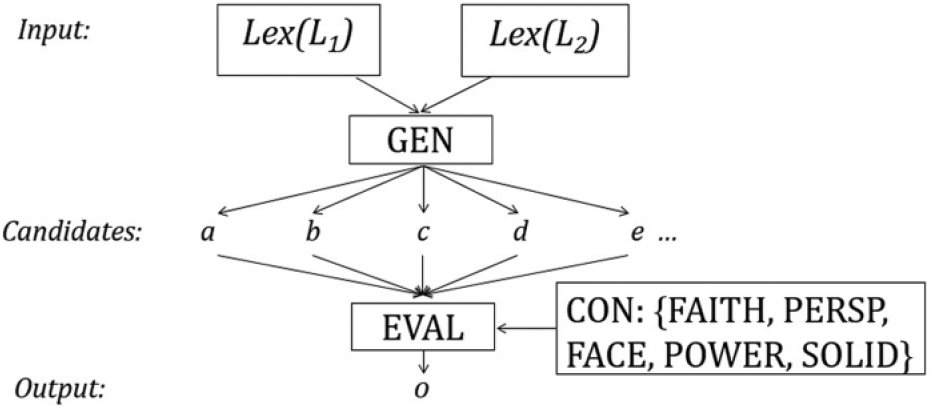
An optimality-theoretic model of bilingual grammar. 2
Interaction of FAITH and SOLID (FAITH>>SOLID).

Given the potential conflict between the five universal constraints and their violability, as illustrated in the example above, B&B maintain ‘that a “particular” bilingual grammar is a set of hierarchically ranked conflicting universal constraints’ (p. 535). They provide empirical instances of Kashmiri-Hindi-English and Hungarian-English CS to demonstrate that the optimal grammar in each of these bilingual/multilingual communities ranks these universal constraints differently. They argue that such difference in rankings of the universal constraints accounts for the inter-community variability in patterns of CS.
B&B’s study then provides a methodological framework for the analysis of the variation in patterns of CS in different communities (explained in detail in the Methodology section). Following B&B’s model, the hypothesis in the present study is that the variation in patterns of language use in the two contexts should be evident in how the diaspora community of Azeri-Farsi-English multilinguals ranks the five universal constraints differently compared to the indigenous community. In other words, the difference in bilingual behaviors in the two communities is a result of the difference in constraint rankings among them. In the following section, I provide a brief overview of Azeri multilingual speakers and the relative social value of their linguistic resources.
Azeri-Farsi-English multilinguals
Azerbaijani (Azeri) is a Turkic language, which is spoken primarily in the Republic of Azerbaijan and northwest Iran. After Farsi (Persian), which is the first language of around 53% of Iranians, Azeri is the mother tongue of approximately 23% of the total population of Iran (Mehryar, 2000). The only official language of Iran is Farsi, which is the dominant language of education, mass media and administration, and has a high national prestige (Bani-Shoraka, 2008). Therefore, the majority of the people in Azeri-speaking regions in Iran also speak Farsi as a second language.
As a result of globalization and the profits speaking the global language brings about, there has been a great tendency among Iranians in the past two decades to learn and speak English. Given the ineffective education system of Iran regarding language instruction (Feizmohammadpour, 1999), there has been an enormous growth in the number of private schools that offer English as a Foreign Language (EFL) courses. The ability to speak English, as a cultural capital (Bourdieu, 1991), not only offers prestige—i.e., symbolic capital—and job opportunities—i.e., economic capital—to these speakers, but it also paves the way for their migration, especially educational migration (Karimzad, in press). Given the value English offers to these speakers, it has the most symbolic power (Bourdieu, 1991) amongst Azeri-Farsi-English multilinguals; whereas Farsi, as the language of education and media, has relatively less symbolic power compared to English but more power compared to Azeri, which is the in-group solidarity language.
In the following sections, I will (1) describe the participants of the study as well as the data collection and coding procedures and (2) provide excerpts from the data to exemplify how the optimality-theoretic analysis was accomplished. Following the Methodology and Data analysis sections, I will discuss the findings of the study and how they can be explained.
Methodology
Data collection
The data for this study are drawn from over 15 hours of audio-recording of natural conversations in two contexts: indigenous and diaspora. The recordings in the indigenous context took place at different friendly gatherings in Tabriz, the largest Azeri-speaking city in Iran. The recordings of the diaspora community were done in two different places in the USA: communities in the mid-west and the east coast. During audio-recording, the investigator was present and was sometimes involved in the conversations so as to maximize the naturalness of the conversations. However, the turns taken by the investigator in the conversations were not included in the analysis.
The participants in the indigenous context were 17 speakers—10 males and 7 females. Their ages ranged from 20 to 29, and they were either university students or university graduates who were working or preparing to apply for graduate school either in Iran or abroad at the time of recording. In the diaspora context, 12 speakers (10 males and two females) took part in this study. All of the participants were Azeri-Farsi-English multilinguals who had migrated to the USA within the past five years. Similar to the indigenous community, they were all in their 20s and were either students or university graduates working/seeking jobs. They were all recorded in different groups at different times, depending on their familiarity with each other. That is, the members of each group who were recorded were already friends and no member had statusful power (Myers-Scotton, 1988) over the others. Statusful power, according Myers-Scotton, refers to the degree to which a participant has control over the other participant(s). The importance of avoiding the inclusion of such participants in this study is in the fact that a participant with a statusful power may affect the power dynamics of the conversations and thus impact the sociolinguistic behaviors of the participants. The recordings took place during friendly gatherings in restaurants, cafes, parks and home settings. 4
The participants were selected in a way that the two communities under study would be comparable with respect to age, gender and social status; the only meaningful difference between the two communities would be the context, i.e., diaspora versus indigenous. More specifically, it is the experience of mobility and migration of the participants of the diaspora community, as mentioned earlier, that distinguishes them from those of the indigenous community.
Coding and analysis process
The audio-recordings were transcribed and coded, taking into account the broader ethnographic information as well as the immediate contexts of the conversations. More specifically, the transcriptions were coded for the following:
the unmarked/preferred language of the interlocutors (Myers-Scotton, 1993a);
the unmarked code of the conversation;
the type of switch, i.e., intra-sentential versus inter-sentential;
the language from which the switch occurred, i.e., the Matrix language (Myers-Scotton, 1993b);
the language to which the switch occurred;
the constraints interaction and satisfaction: which of the five principles/constraints proposed by B&B was being satisfied, i.e., the function of the switch, and which constraint(s) was/were being violated. 5
The coding of the data was done based on the ethnographic and contextual information as well as the definitions of the principles proposed by the framework used in this study. More specifically, the unmarked code of a particular participant was determined based on the language used by him/her during the majority of the conversation. Similarly, the unmarked code of a conversation was determined based on the use of a particular language by the interlocutors during the majority of the interaction. Moreover, the matrix language was considered to be the one within which the switch was embedded. The type of switch was determined based on whether the switch was a complete sentence or a phrase/word within the matrix language. Finally, based on the contextual and ethnographic information/emic perspective, the most prominent social or interactional function (B&B’s five socio-pragmatic principles) a particular switch performed was considered as the constraint being satisfied, and then the particular function(s) a non-switch would have performed in the same context—i.e., which of the five principles would have been satisfied if the switch had not occurred and the utterance was monolingual—was/were coded as the violated constraint(s). 6
Following the coding process, an OT analysis was carried out in order to determine the optimal sociolinguistic grammars of the two communities. As mentioned earlier, within the B&B framework, optimal sociolinguistic grammar of bilingual/multilingual language use is understood in terms of the hierarchical ranking of a set of universal meta-principals of CS, which are (1) violable and (2) in potential conflict with each other. At the beginning stage of the OT analysis, these constraints are assumed to be unranked with respect to each other. However, in a given linguistic data of CS, the interaction of relevant constraints is compared; if (a) constraint(s) is/are violated, it is/they are demoted vis-à-vis the constraint that is satisfied. Such data-driven analysis continues until a particular ranking pattern emerges. If the CS data do not reveal the interaction of any particular constraints, these constraints are left unranked with respect to each other. The final hierarchical ranking is considered to be the optimal sociolinguistic grammar of that particular community. 7
Data analysis
In this section, I will present different excerpts from the diaspora community to instantiate the interaction of the constraints as well as how the sociolinguistic grammar of the community was determined. Following that, I will present an example from the indigenous community that illustrates the difference between the grammars of the two communities.
Diaspora community
Excerpt 1: SOLID >> POWER
There are three participants in this excerpt. 8 Salar (S) and his friends, Farhad and the investigator, have arrived in New York City after a long drive the day before. Farhad has just introduced Salar and the investigator to his cousin Reza (R). Having grown up in Tehran, Reza’s unmarked code is Farsi while the others’ preferred code is Azeri. The topic of the conversation is Salar and his friends’ long road trip to NYC. Specifically, Reza is comparing their trip to his previous experience driving to Florida. See the Appendix for transcription conventions.
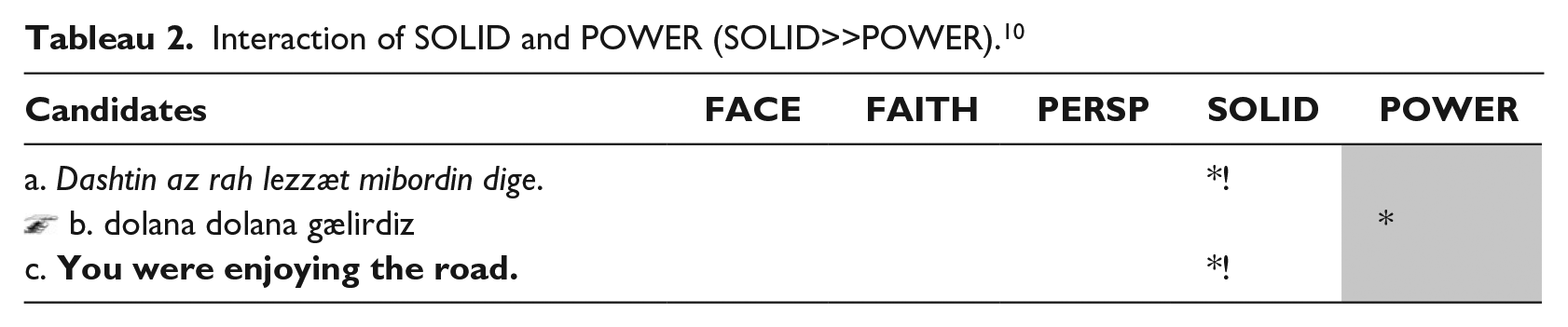
1. R: eyne Florida-e dige, ma hæm 3,4 e sob rah oftadim, ye kælle umædim dige (.) vay næstadim. ‘It’s like a Florida trip, we left at 3 or 4 a.m. and drove nonstop, didn’t stop.’ 2. S: biz axi odzur ye kalle gælmirdıx(.) biz [ela ‘We didn’t drive that nonstop. We were’ 3. R:→ [dolana dolana gælirdiz ‘You were enjoying the road.’ 4. F: Bu iki dæyqædæn bir saxlırdi (.) shashlanırdi. (hahaha) ‘He was stopping every 2 minutes to pee.’ (hahaha) 5. S: (2.0) mænim koliyælærim ishæ tüshmüshdi (.) biyol (1.0) ba: neyniyim eybela su itsirdıx. ‘My kidneys were working too much, so, well what should I have done? We were drinking so much water.’ 6. R: Hala, Tæbriz dæ næxæbær? ‘So, what’s going on in Tabriz ((their hometown))?’
The switch that is of interest in this excerpt occurs in line 3, in which Reza, whose preferred code is Farsi, switches to Azeri. By doing so, he is aligning with the unmarked code of the other interlocutors and indexing in-group identity. 9 Such utilization of CS as a way of indexing similarity and identity affiliation between the self and the other(s) is discussed under the Principle of Social Concurrence (SOLIDARITY). Thus, amongst the three candidates shown in Tableau 2, the only candidate that satisfies the higher-ranked constraint SOLIDARITY is (b). This piece of data instantiates that when POWER and SOLIDARITY are in conflict, it is SOLIDARITY that is satisfied, i.e., SOLID>>POWER.
Interaction of SOLID and POWER (SOLID>>POWER). 10
Excerpt 2: FAITH >> SOLID
This excerpt concerns the interaction of FAITH and SOLIDARITY. The participants are two graduate students: Payam (P) and Ehsan (E). Payam is talking to Ehsan and the investigator about an Iranian woman studying at their university who he thinks is very beautiful. In order to convince the other interlocutors that she really is beautiful, he narrates a story:
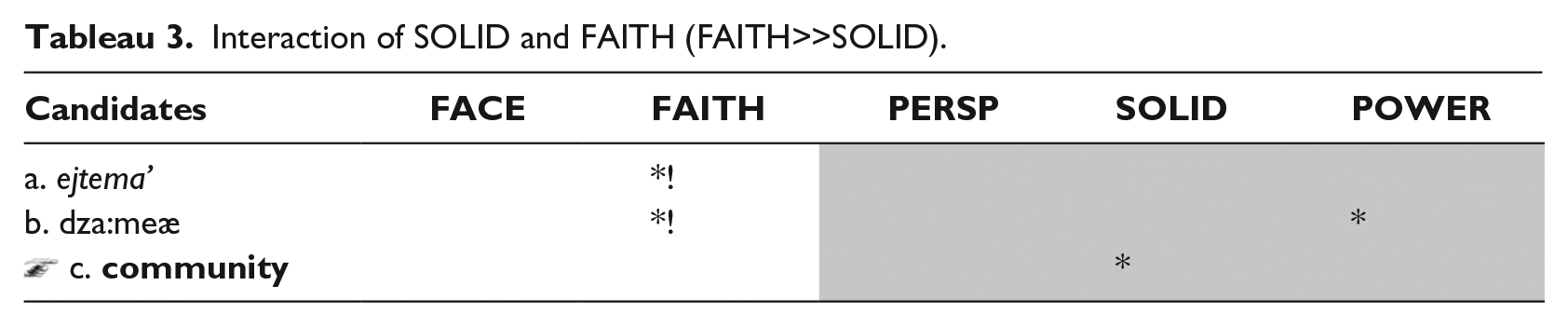
1. P: Agha mæn, getsæn termi:di, bidana tsini vardi, bidana kilasda hæmkilasımızıdı (.) oghlan(.) sora,→ birseri khosh o besh elædıx, tanıdıx (.) dza:m(eæ-miz) ‘It was last semester, there was this Chinese guy, we were classmates in one class. A boy, then, once we greeted, we recognized each other, our 2. E: xo:b? ‘So? ((backchannel))’ 3. P: Dedi bir qiz di (1.0) dedi oqæ::d göytsæhdi(.) bizæ dedi ha, oqæ::d göytsæhdi. ‘It’s a girl. He said, she is sooo beautiful. He told us, she’s sooo beautiful.’
Payam starts his narrative in Azeri, the unmarked language of all the interlocutors, and then switches to English intra-sententially and uses the word community. The incomplete utterance of dza:meæ, meaning ‘society/community’ and then the self-repair—understood in terms of PERSP—through switching to English indicates that the speaker is aware that the Azeri word—which is borrowed from Arabic through Farsi—cannot convey the same meaning as ‘community’ in this context. That is, the Azeri (or Farsi) word connotes a broader meaning of the word community than what Payam has in his mind, since he is referring to a particular ‘community of practice’ (e.g., the community of the electrical engineering graduate students in a particular university). Therefore, he notices that amongst all the potential choices he has, illustrated in Tableau 3, the Azeri word would not be the optimal candidate for him to achieve his goal. Thus, in order to convey this conceptual meaning in the most economical and faithful way, he switches to English—a FAITH switch. The switch to English, therefore, satisfies FAITH, which is ranked relatively higher, and violates the lower-ranked SOLIDARITY. This example provides clue for the following ranking: FAITH>>SOLID>>POWER.
Interaction of SOLID and FAITH (FAITH>>SOLID).
Excerpt 3: PERSP >> SOLID
Salar (S) and the investigator have been visiting NYC and staying at Ali (A) and Farid’s (F) home for almost a week. Salar was already talking about going back home on Tuesday since he needed to move into a new apartment on Friday. Ali and Farid were trying to convince him to stay for one more week, telling him that he could ask his roommate to do the moving for him. However, Salar insisted on his earlier plans and turned them down. At this point, Salar starts texting back and forth with someone and does not pay attention to what they are saying anymore. Ali and Farid start to tease him by guessing what he is writing in the texts, assuming that he is texting a woman and implying that it is not because of moving but because of this woman that Salar wants to go back earlier.
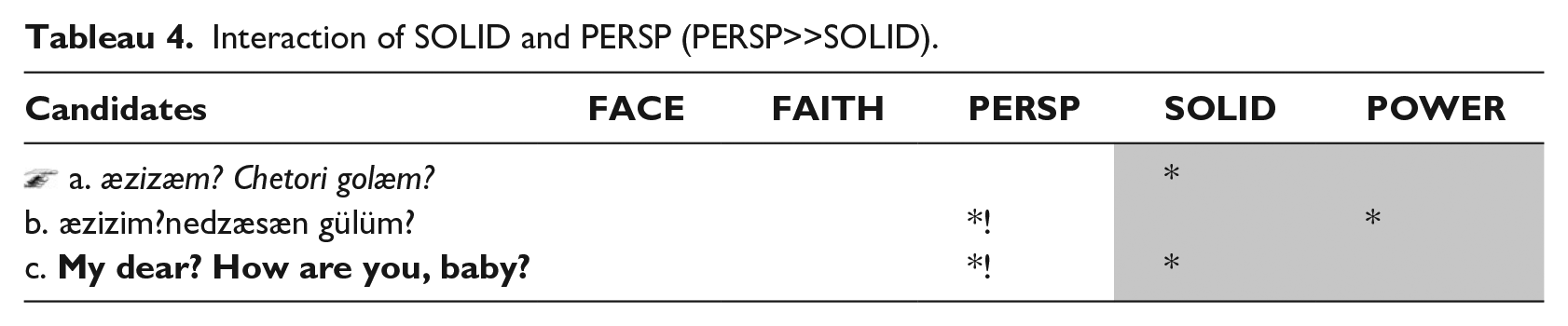
1. A: Sms vırır ishiz olmasın. ‘He’s texting, don’t disturb him.’ 2. F: Sms-læsh sæn. ‘You send your texts’ 3. A:→ ‘æzizæm? Chetori golæm?’ indi diyir. ‘Delæm vasæt ye zærre shode.’ ‘“My dear? How are you, baby?”, he is writing now. “I miss you so much.”’ 4. F: ‘Golæm, goh khordæm mæno bebækhsh.’ ‘“My dear, I ate shit (my bad! I regret my mistake) forgive me.”’ 5. A: (1.0) ‘Seshænbe miyam’. (hahaha) ‘“I’m coming back on Tuesday.” (hahaha)’ 6. S: O ‘Take it and read that shit (my messages).’
An important cultural reality to be noted is that many young Azeri men and women prefer to speak Farsi to their girlfriends/boyfriends or spouses, since they consider it to be more ‘romantic’. The common attitude by these speakers towards Azeri is that it is ‘rougher’ than Farsi. However, the reason for this is probably the fact that Azeri speakers in Iran are almost never exposed to the discourses of love and romance through Azeri, since the language of media and movies is Farsi. Bearing this in mind, we see that in line 3, Ali who was speaking Azeri earlier, switches to Farsi to hypothetically quote what Salar is writing in his texts, which is what Farid also does in line 4. These shifts in footing (Goffman, 1979)—which are done through the animation of the voice (Bakhtin, 1981) of this particular type of people—index a cultural chronotope (Agha, 2007; Bakhtin, 1981) regarding how romantic relationships work in this community. Such shifts in footing and voicing are analyzed as PERSPECTIVE switches in the B&B model. In this example, the Farsi candidate, Tableau 4(a), contributes to the maximization of perspectivity while the other possible candidates, (b) and (c), do not. This switch then violates the lower-ranked SOLIDARITY but satisfies PERSPECTIVE, which outranks SOLIDARITY. At the end of this stage of the analysis, the hierarchical ranking that has emerged is {PERSP, FAITH}>>SOLID>>POWER.
Interaction of SOLID and PERSP (PERSP>>SOLID).
Excerpt 4: FAITH >> PERSP
Arash (A) and Farid (F) are talking about different schools in the USA and their admission requirements. Arash was telling a story about an Iranian boy who was crazy about getting into Harvard University and had spent five years of his life preparing the admission requirements to enter the Finance Program there. However, despite all his efforts, his application was rejected. Farid thinks that getting into Harvard would be possible by either donating money to the school or having a parent with a high social status. He narrates someone’s opinion from an online forum about the requirements for getting admitted to Harvard.
1. F: O qævvati ki istir Harvad da oxiyæ (.) 5 il dæ zæhmæt qoyur, o ‘That asshole who wants to study in Harvard, and devotes 5 years to it, if he makes a
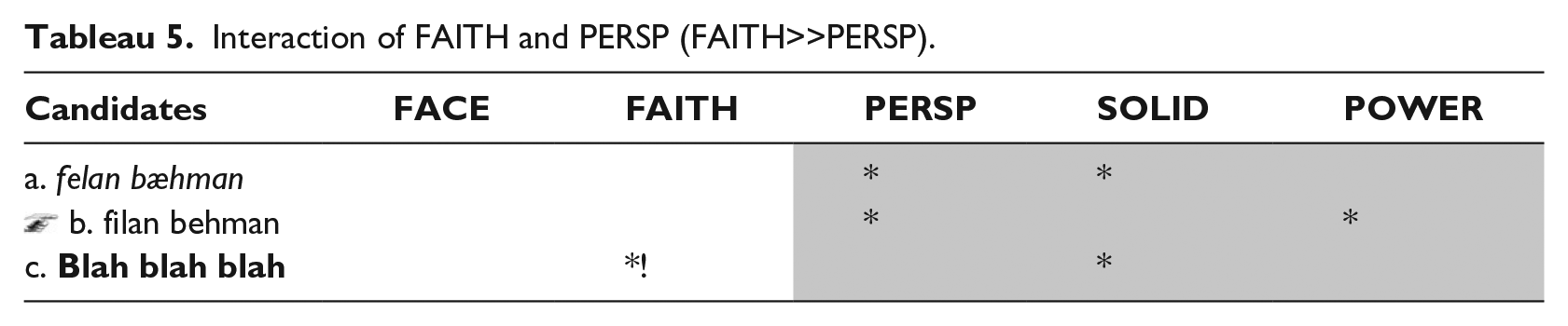
Speaking Azeri, his unmarked choice, Farid switches to English to quote what some person thinks about the requirements for entering Harvard. The function of this switch is similar to the example in the previous excerpt; i.e., a change in voicing to maximize perspectivity. However, within the PERSPECTIVE switch, he switched back to Azeri and used the expression filan behman [candidate (b) in Tableau 5]. 11 This expression—which roughly means ‘this or that, this person or that person’ and to some extent connotes both the English blah blah blah and so and so—is not only used when one does not want to get into details about what or who, but it is also used as a filler in story-telling. The closest English equivalents, however, fail to capture all of the functions of filan behman and do not carry the same cultural nuance. This is because certain discourse conventions of story-telling as a genre are extremely culture specific and may not correspond directly to those of other languages and cultures. Such switches to convey culture-specific nuances are analyzed as FAITH switches within the B&B model. Although the switch back to the solidarity code in this extract violates PERSPECTIVE, which outranks SOLIDARITY, the motivation for this switch is not to satisfy SOLIDARITY but rather to satisfy the higher-ranked constraint FAITH. By the end of this part of the analysis, the ranking that has been developed is FAITH>>PERSP>>SOLID>>POWER.
Interaction of FAITH and PERSP (FAITH>>PERSP).
Excerpt 5: FACE >> FAITH
The final excerpt for the diaspora community illustrates the interaction of FAITH and FACE. Payam and Ehsan are talking about what they find attractive in women. Ehsan (E) is a very ‘polite’ person and usually avoids using taboo words. His friends would sometimes joke with him about how he does not know any swear words. Given his ‘politeness’, Ehsan appears not to be comfortable discussing this issue.
1. E: mænæ fæqæt o estayl e (.) bejoz (.) bejoz ghiyafeye zaheri va bujur sheylær, bæzi va:x qızlar æyæ chox xoshgil olanda ha, hesh, mænæ hesh, mænæ chox jazzabiyat-dæn tüshüllæ (.) chün va:qeæn shayæd zehnim dærk elir ki o ‘For me the style, except, except the appearance and stuff like that (are important), sometimes if the girls are too beautiful, for me, for me, they lose their attractiveness because maybe my mind actually understands that she
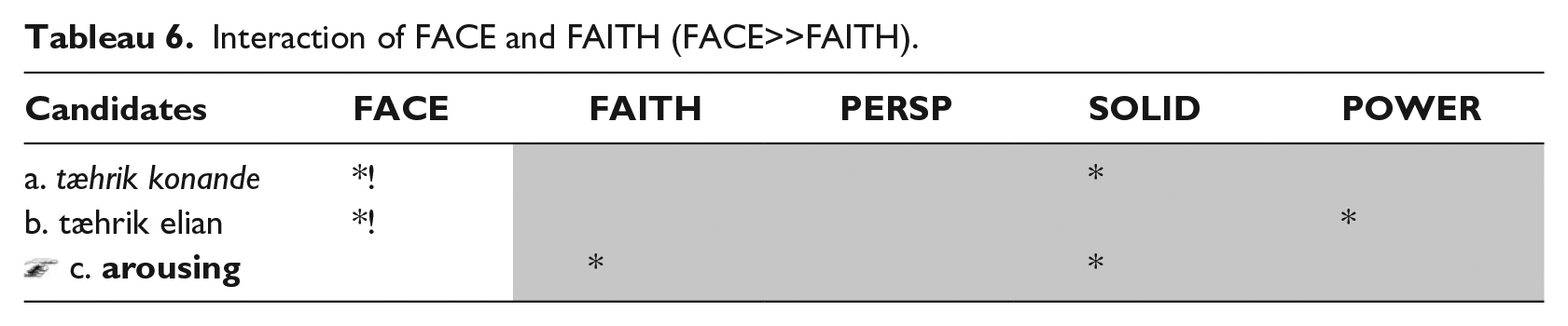
The switch that is of interest in this section occurs at the end of Ehsan’s turn. Ehsan starts talking about this issue in Azeri, his unmarked code. However, finding explicit expression of his ideas face-threatening, he switches to English intra-sententially and uses the word arousing, candidate (c) in Tableau 6. The use of this word per se may not be a politeness strategy for native speakers of English and may even sound bizarre. In addition, it creates some ambiguity and vagueness regarding what he intends to communicate, which in Gricean terms would be a violation of Manner Maxim (Grice, 1975) and within the B&B framework, it is considered as a violation of FAITH. I argue that, regardless of the function of the word for the native speakers, and how faithfully it conveys the meaning, Ehsan is considering switching to a language other than the solidary code while talking about taboo concepts as a strategy to mitigate face-threatening acts. Hence, this switch from the ‘we code’ to a relatively distant code to save face satisfies FACE at the expense of the violation of FAITH. Taking into account the interaction of these two constraints, the final hierarchical ranking, i.e., the optimal sociolinguistic grammar of the diaspora community, can be concluded to be FACE>>FAITH>>PERSP>>SOLID>>POWER.
Interaction of FACE and FAITH (FACE>>FAITH).
Indigenous community
The examples above instantiated the process through which the sociolinguistic grammar of the diaspora community of Azeri-Farsi-English multilinguals was determined. The same procedure was utilized to determine the grammar of the indigenous community. However, for reasons of brevity (word limit), I refrain from presenting examples illustrating the interaction of all the constraints for this community, and only focus on the interaction of constraints that revealed a resolution different from the diaspora community. That is, the analysis yielded that the grammar of the indigenous community is overwhelmingly similar to the diaspora community in terms of the interaction of FACE, FAITH and PERSPECTIVE, and the only salient difference between the two grammars has to do with the relatively greater value this community places on POWER vis-à-vis SOLIDARITY compared to the diaspora community. The final constraints ranking for this community is as follows:
FACE>>FAITH>>PERSP>>POWER>>SOLID
The following example illustrates the interaction of POWER and SOLIDARITY in this community, which is different from that of the diaspora community.
Excerpt 6: POWER >> SOLID
In this example, three participants are present: Ali; Tina, Ali’s wife; and Reza. The participants are all in their late 20s and have known each other since their undergraduate studies. They are all multilingual speakers of Azeri, Farsi and English. The unmarked code for the conversation is Azeri; however, Tina, who speaks Azeri to Reza and the investigator, speaks Farsi to her husband from time to time since, as mentioned earlier, Farsi is the preferred code for romance. Ali, Reza and the investigator are close friends and are having a reunion after several years and are catching up. Tina and Ali are talking about the fact that, after all these years, Ali still remembers the investigator’s phone number since he used to make jokes about how ‘catchy and good’ his phone number was. 12 Line 1 is the last turn Tina had before Ali, Reza and the investigator started to dominate the conversation for approximately nine minutes. This conversation comes to an end in line 2. The speakers in this excerpt are Tina (T), Ali (A) and the investigator (I).
1. T: Hesh babasının shumaræsin hifz dæyir ba. ‘He doesn’t even know his father’s phone number by heart.’ ((Approximately 9 minutes later)) 2. A: Pæs belæ. ((Signals the end of the conversation)) ‘So, that’s it.’ 3. I: belæ! ‘That’s it.’ 4.→ T: mæn æge mozaheme jæm’e dustitunæm [bedune [tarof pashæm beræm. ‘If I am disturbing your friendly gathering, feel free to ask me to leave.’ 5. A: [golæm, [in che hærfie, næ baba: ‘Honey, why are you saying this?’ 6. I: [yox baba! ‘Not at all!’ 7. T: Ehsas mikonæm injuri [moæzzæbin. ‘I feel you are uncomfortable.’ 8. A: [næ:, khahesh miko [næm ‘No, you are welcome.’ 9. I: [Niyæ? ‘Why?’ 10. T: ha: Ali belæ rahat danıshar ödzürsi sizinæn. Indi elæbir ki… ‘Ali usually speaks so comfortably with you. Now it seems like…’
The switch that is of interest in this excerpt takes place in line 4. Tina, who was speaking Azeri—the solidarity code and the unmarked code of the conversation—in the previous turns (line 1) switches to Farsi in line 4. As she mentions, she feels that her husband and his friends are not speaking comfortably at her presence. I argue that by switching from the solidarity code to Farsi, a relatively distant code and a marked choice in this conversation, she is maximizing her social distance from the others. This act of switching to a different code to index distance from others is defined within the POWER constraint in the B&B model. Thus, as illustrated in Tableau 7, the switch to Farsi in (b) satisfies POWER, a higher-ranked constraint, and violates SOLIDARITY. Once she is convinced by the interlocutors that her presence is welcomed, she switches back to the solidarity code in line 10. 13
Interaction of SOLID and POWER (POWER>>SOLID).
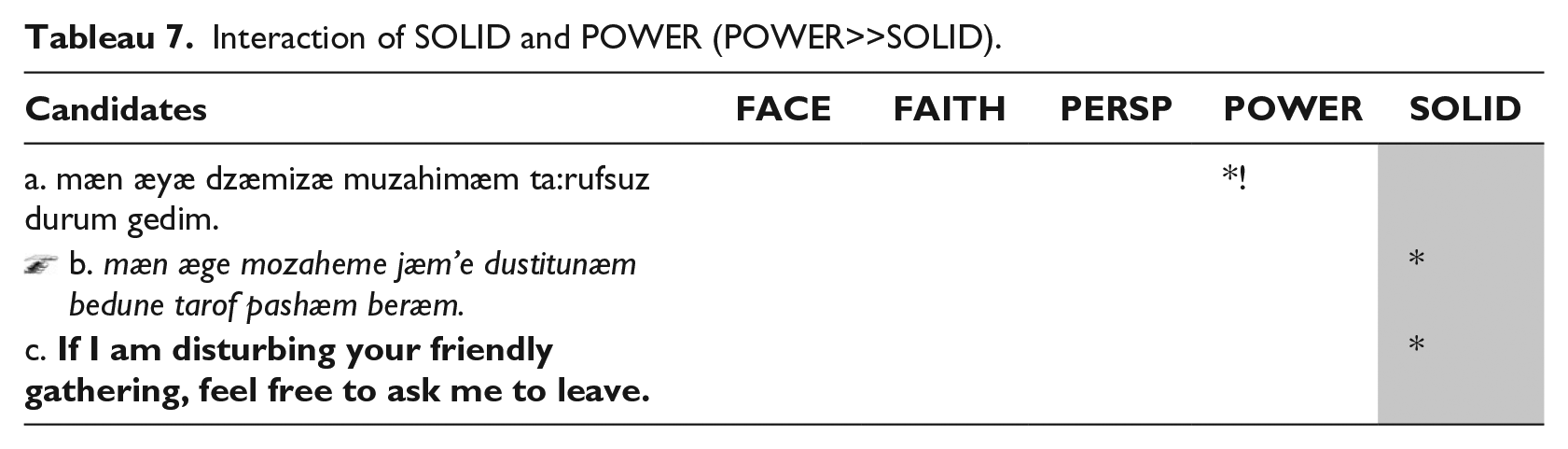
In some cases, the computation of the optimal choice might lead to two (or more) candidates that all satisfy the higher-ranked constraint and thus are potential output forms, as illustrated in Tableau 7 by candidates (b) and (c). These candidates have a gradient relationship with each other, which concerns the relative value of the codes vis-à-vis a particular constraint. For instance, as mentioned earlier, English has relatively more symbolic power than Farsi even though they both are considered to index power. In such cases, optimization by itself fails to select the ultimate output form. I argue that along with optimization a rationalization process is also at work in which the speakers, as rational actors, do a cost–benefit analysis before they select a more expensive or less expensive choice, depending on the outcome they are seeking to achieve (cf. Coleman & Fararo, 1992; Elster, 1994; Myers-Scotton & Bolonyai, 2001). This, however, does not affect the hierarchical ranking of the constraints in this community and thus has no influence on the results of this study.
Results and discussion
The results of the analysis revealed the following grammars for the two communities.
The grammar of the indigenous community: FACE>>FAITH>>PERSP>>
The grammar of the diaspora community: FACE>>FAITH>>PERSP>>
The data revealed no instances violating these rankings in any of the communities; i.e., when particular constraints were in conflict, the higher-ranked constraints were satisfied all the time. As predicted by B&B, the variation in the sociolinguistic grammars of these two communities is revealed to be a function of how they rank the five meta-sociolinguistic constraints differently. More specifically, the analysis provides evidence that the grammars of the two communities are overwhelmingly similar, in terms of interaction of FAITH, FACE and PERSPECTIVE, and, descriptively, the only salient difference between them has to do with the relative ‘value’ each community places on the two relational constraints: POWER and SOLIDARITY. The results of this study showed that POWER in the indigenous context has relatively more value than SOLIDARITY, while for the Azeri-Farsi-English multilinguals who have migrated to diasporic contexts, it is SOLIDARITY that has relatively more value.
Such effect of mobility of people and of linguistic resources on the multilingual language use, revealed by the analysis done in this study, appears to be also noticeable for Ehsan, one of the members of the diaspora community:
There [in Iran] when people switched to English, there were two reasons, the first reason was that ummmm technical things, there were no equivalents… That is the case here [the U.S.] too. Eh, the other reason was that, you know, it is not a really good reason but, well, unfortunately, it was the case in Iran and I cannot neglect it. Many of the people who spoke English, at least people around me, you’d see sometimes that their goal was to show off and sound classy. Eh, but here, here it seems that our understandings have changed completely. And the words we want to use have changed too.
In his narrative about why he codeswitches, this member of the Azeri-Farsi-English community in diaspora touches upon how mobility has impacted his language choice. Specifically, he highlights the function of CS to index prestige—or what we refer to as POWER—in the indigenous context, which changes upon moving to diasporic contexts. It is evident that even though the members of these communities may not be consciously aware of all the functions of CS and the conventions for their use—i.e., what this study has found about the grammars of language use in these two communities—they are partially aware of the most salient differences.
The results of this analysis are in fact similar to the findings of B&B and other recent studies that have adopted this optimality-theoretic model focusing on different communities. That is, as mentioned earlier, in the studies conducted in diaspora, SOLIDARITY outranks POWER, whereas in indigenous contexts, POWER has been reported to have a relatively a higher value than SOLIDARITY. The difference, however, is that, unlike the findings of this study, the analyses in none of these studies focusing on bilingual/multilingual communities nor Cramer’s (2015) study of CS in a bi-dialectal community using the B&B model have revealed a total domination order with respect to the ranking of the constraints.
I argue that the variation in the two community grammars—vis-à-vis POWER and SOLIDARITY—has to do with the particular practice that offers the profit of distinction (Bourdieu, 1991). Distinction, for Bourdieu, concerns enhancing ‘one’s symbolic position within a field’, and a profit of distinction is his/her attempt ‘to be noticed, validated, respected, [and/or] admired’ (Albright & Luke, 2008, p. 41). The profit of distinction can be secured when the speakers ‘are able to exploit the system of differences to their advantage’ through the linguistic capital they possess (Bourdieu, 1991, p. 18). I argue that in indigenous contexts, the type of practice that secures the profit of distinction is the ‘differentiation function’, in terms of status/power, which is accomplished through switching to English or Farsi. This is because in the indigenous context, the solidarity code, Azeri, is the unmarked language of the majority, and thus the linguistic resources that provide such sense of markedness are the languages that offer symbolic power, i.e., English and Farsi. However, given the fact that in the diaspora context this community is in minority and the power code(s) do not offer a sense of markedness, the profit of distinction in this community is gained through solidarity. That is, in the diaspora community, it is the solidarity function (indexing in-group identity)—accomplished through switching to Azeri or avoiding POWER switches—that offers the profit of distinction. 14 Such attempt to gain ‘communal capital’ (cf. Bourdieu’s (1986) notion of social capital) can be said to be a sociolinguistic strategy by these multilinguals to break their marginality in diaspora. Safran (1991) claims that the members of diasporic communities have a belief that they would never be accepted as a member of the host country and thus develop their own cultural and social needs; they may therefore get involved in certain communal activities that are mostly enabled by solidarity. I argue that the prominence of solidarity is not only reinforced by communal activities in diasporic communities, but it is also evident in their intra-community patterns of language use.
The results of this study have implications for the understanding of the impact of mobility on language use. Blommaert (2010, pp. 4–5) argues that mobility, of people and of linguistic resources, may result in unexpected patterns of language use. This unexpectedness, according to Blommaert, is due to the fact that such mobility brings about ‘translocal’ and ‘deterritorialized’ patterns of language use that displace ‘sedentary’ and ‘territorialized’ patterns. Instead, I argue that some aspects of such language use are indeed predictable even in the globalizing context of migration, displacement and dislocation. That is, linguistic behaviors of the diasporic communities illustrated in this study—i.e., the enhancement of the value of solidarity vis-à-vis power as a result of migration—can be regarded as a sociolinguistic strategy, similar to the other diasporic communal activities, to break marginality and gain communal capital in diaspora.
The results of this study also revealed that although B&B’s optimality-theoretic framework managed to account for the majority of the CS data, there were instances in which optimization per se could not fully predict the attested output. More specifically, there were instances in which the computation of the optimal output led to more than one optimal candidate (see Tableau 7) and failed to select a single—attested—optimal output. I hypothesized that the reason for this resides in the gradient relationship among the codes; that is, for instance, English and Farsi are both POWER codes relative to Azeri, yet the former carries more symbolic power than the latter. Such a gradient relationship between the codes indexing symbolic power results in more than one optimal output in the switches that are motivated by POWER and/or FACE constraints. Given the scope of the present study, however, I refrain from discussing this issue in more depth and only present it as a hypothesis that there is a rationalization process at work—along with the optimization process—in which the speakers, as rational actors, carry out a cost–benefit analysis in terms of their individual wants, desires and beliefs (cf. Coleman & Fararo, 1992; Elster, 1994; Myers-Scotton & Bolonyai, 2001) prior to selecting a more expensive or less expensive choice. However, further investigation is required to determine how rationalization can be incorporated into this optimality-theoretic framework so as to increase its predictability of the surface forms of CS data.
Footnotes
Appendix
Transcription conventions:
Regular font: Azeri
Italics Farsi
(()) Transcriber’s comments
→ Indicates where the switch of interest occurs
( ) English translation within brackets is added by the author for clarification
[ With utterances by different speakers, indicates a point of overlap onset
(X) Inaudible word, (XXX) inaudible passage of speech
(hahaha) Laughter
(.) Micro-pause
Larger font size Angry tone
Acknowledgements
I would like to express my gratitude to Rakesh Bhatt for his invaluable feedback and continued support without which this paper would not have been possible. Also, I would like to thank Marina Terkourafi and James Yoon as well as the members of the Language and Society Discussion group at the University of Illinois for their valuable comments on the earlier versions of this paper. Finally, I am thankful to the two anonymous reviewers for their helpful comments. All remaining errors are mine.
Declaration of Conflicting Interests
The author(s) declared no potential conflicts of interest with respect to the research, authorship, and/or publication of this article.
Funding
The author(s) received no financial support for the research, authorship, and/or publication of this article.