



Abstract
Purpose:
Research on the language of heritage speakers has shown that in situations of societal bilingualism the functionally restricted language evidences the simplification of some grammatical domains. A frequent question is whether this stage of grammatical simplification is due to incomplete or interrupted acquisition in the early years of a bilingual’s life, or a result of processes of attrition of acquired knowledge of the underused language. This article considers the issue of incompleteness through an examination of the relationship between bilingual children’s developing grammars and the more or less changed bilingual systems of adult second and third generation immigrants (“heritage speakers”) in the USA.
Methodology:
The issue of incompleteness is examined in two corpora: (1) Recordings of 50 Spanish-English adult Mexican-American bilinguals; and (2) Longitudinal data obtained during the first six years of life of two Spanish-English bilingual siblings.
Data analysis:
Qualitative and quantitative analyses of the grammar of subjects, verbal clitics, and verb tenses of the Spanish of the bilinguals under study.
Findings:
The outcome of reduced exposure and production of a minority language in simultaneous bilingual acquisition reflects the incomplete acquisition by age 6;0 of some aspects of the input language. The bilingual siblings’ unequal control of the minority language is shown to parallel the range of proficiencies identified across the adult heritage speakers.
Significance:
Some linguists argue that heritage speakers’ grammars are less restrictive or “different” in some respects but not incomplete. In contrast, this article demonstrates that at least some of the reduced grammars of heritage speakers result from a halted process of acquisition in the early years of life. Furthermore, while difference is not an explanatory construct, incomplete acquisition due to interrupted development caused by restricted exposure and production offers an explanation for the range of proficiencies attested among adult heritage speakers.
Keywords
Theoretical preliminaries
Research on the language of heritage speakers has shown that in situations of societal bilingualism the functionally restricted language evidences, among other phenomena, the simplification of some grammatical domains (Montrul, 2009; Silva-Corvalán, 1996; Zentella, 1997, among many). In this context, a frequent question is whether this stage of grammatical simplification is due to incomplete or interrupted acquisition in the early years of a bilingual’s life, or a result of processes of attrition or loss of acquired knowledge of the underused language (Cuza, 2010; Montrul, 2005; Polinsky, 2011)
The notion of “incomplete acquisition” has recently been criticized. The argument is either that the concept itself to refer to the language of heritage speakers is flawed, or that the term is not adequate to describe the grammars of these bilingual speakers (e.g. Otheguy, 2013; Otheguy & Zentella, 2012; Putnam & Sánchez, 2013). In contrast, this article will show that the outcome of reduced exposure and production of a minority language in simultaneous bilingual acquisition indeed reflects the incomplete acquisition by age 6;0 of some aspects of the input language. I consider that acquisition has not been completed when a grammatical domain lacks aspects, elements or features present in the learner’s input language (Meisel, 2014). Less exposure to the minority language and fewer opportunities for use of this language, lead to more differences between the speech of a second or third generation speaker and that of their parents or other first generation immigrants who have offered the language input to the succeeding generations.
This paper considers the issue of incompleteness through an examination of the relationship between bilingual children’s developing grammars and the more or less changed bilingual systems of adult second and third generation immigrants (“heritage speakers”, HSs) in the USA. I look at the grammar of subjects, verbal clitics, and verb tenses in two corpora consisting of recordings of the following sociolinguistic conversations:
Corpus ELA: 50 Spanish-English adult bilinguals, all Mexican-Americans living in the eastern section of greater Los Angeles (Silva-Corvalán, 1996).
A corpus of longitudinal data obtained during the first six years of life of two Spanish-English bilingual siblings (Silva-Corvalán, 2014).
I show that it is possible to identify parallels between the children’s language characteristics and those of the adult bilinguals. This finding lends support to the idea that at least some of the reduced grammars of heritage speakers appear to result from a halted process of acquisition and development in the early years of life rather than attrition or loss of knowledge acquired in childhood. Furthermore, given that the siblings’ input in Spanish is not attrited or reduced, the results suggest that some of the changes that have been identified across generations of bilinguals develop naturally in the acquisition of the heritage language, seemingly regardless of the type of input.
Importantly, my findings should be interpreted with reference to an English-Spanish bilingual community characterized by the shift from Spanish to the socially-dominant language, English, across generations but also by some degree of maintenance thanks to continuous contact with newly arrived Spanish speakers. This sociolinguistic situation gives rise to considerable variation across speakers, captured in the term “bilingual continuum.”
The data
The data from the adults has been selected from recordings of 50 men and women of different ages classified into three immigrant groups according to the length of time that the speakers’ families have lived in the USA (Silva-Corvalán, 1996).
Group 1 includes speakers born in Mexico, who immigrated to the US after the age of 11. Group 2 encompasses speakers born in the US or who have immigrated from Mexico before the age of six. Group 3 also comprises speakers born in the US; in addition, at least one parent responds to the definition of those in Group 2.
The separation into three discrete groups does not correlate directly with three discrete groups in terms of Spanish oral language proficiency. Indeed, because of their social histories, and even though everyone in the sample acquired Spanish from birth, some speakers across groups 2 and 3, the HSs, have similar levels of higher or lower proficiency in Spanish. Overall, however, groups 2 and 3 represent a continuum of less to more distance from the grammars of Group 1.
I have examined bilingual acquisition primarily in a corpus of data obtained during the first six years of life of two English–Spanish developing bilingual siblings, my grandsons Nico and Brennan (see Silva-Corvalán, 2014, for further details). Nico and Brennan acquired greater proficiency in English and use this language significantly more than Spanish. They grew up in a dual-language home: the mother speaks to them exclusively in English; the father used Spanish with Nico almost exclusively until the child was three-and-a-half years old, but use of Spanish decreased from that age on. Brennan, who is two years and nine months younger than Nico, thus heard relatively less Spanish from his father, but in child-directed speech the father used Spanish almost exclusively with Brennan as well, until he was about 3;0 years old. I spoke with the children almost exclusively in Spanish; they used English very infrequently with me. The children spoke almost only English with each other, occasionally responded in English to their father before age 3;0, but addressed him in English more and more frequently after this age.
I observed and recorded the siblings regularly using Spanish, English, or both in a variety of natural and uncontrolled discourse contexts and with different interlocutors, and kept detailed diary notes to age 3;0 for Nico. Diaries and recordings also include adults’ speech addressed to the children.
The children’s degree of proficiency in English by age 6;0 is comparable to that of monolinguals. By contrast, their developing proficiency in Spanish is unequal. I suggest that this inequality results from differences in the amount of Spanish language input and production, more reduced for the younger sibling.
Overall, Nico was exposed to Spanish about one-third of his waking time; Brennan, less than one-third (about 25%). From about age 4;0, exposure to and use of Spanish are further reduced for both children to at most a quarter of the time. It is indeed remarkable that with such limited input the children are able to develop conversational proficiency in Spanish.
Subject realization
We may expect grammatical subjects in Spanish to be vulnerable to English influence, especially so since Spanish is the weaker language and offers options constrained by semantic and pragmatic factors (cf. Müller & Hulk, 2001). The learnability question for the child should be easier for English, which presents a highly regular model of overt, preverbal subjects, but harder for Spanish, since the child needs to learn the semantic and discourse-pragmatic constraints that regulate the expression of subjects.
Studies applying a variationist methodology have shown that the variable expression of a pronominal subject is responsive to cognitive, semantic, and discourse factors (Shin, 2014; Travis & Torres Cacoullos, 2012, among many). An overt subject is required under two conditions: (1) when it is focal, either because it is new information or the focus of contrast, and (2) when it is needed to identify its referent. Overt subjects are favored probabilistically by a number of variables, including subject switch reference (Example 1); verbs in the first person singular; verbs of volition, of saying or speaking, and of mental processes (e.g. pensar ‘think’, creer ‘believe’).
(1) (a) Tu hermano quería saber (b) si (yo) enseño en USC. [yo “I” is “optional”] (a) “Your brother wanted to know (b) if [I] teach at USC.” (2) (a) Pepe es un escritor muy conocido. (b) Es mi vecino. (a) “Pepe is a well-known writer. (b) [He]’s my neighbor.”
Discontinuity of reference favors the expression of the subject. Continuity of reference (or coreferentiality), as in 2a and 2b, has consistently been shown to disfavor overt subjects. On average, in various Spanish dialects over 40% of non-coreferential pronominal subjects are overt, while only about 25% of coreferential subjects are expressed (Shin & Smith Cairns, 2012). 1
Researchers incorporate quantification to find out similarities and differences in subject expression rates across individuals and across dialects. The assumption is that in a large corpus of data the various factors that constrain subject expression become neutralized and so overall percentages of overt subjects may reveal different stages of acquisition, dialectal differences, and possible processes of change.
Spanish varieties differ with respect to the rate of subject expression. In the siblings’ case, the average percentage for the Santiago (Chile) variety, 38% (Cifuentes, 1980–81), is of interest because this is the variety spoken by their family.
I have examined about 5000 declarative utterances containing a verb that had or could have had a subject. The utterances were coded for several factors, but I discuss only coreferentiality here. The siblings’ use of subjects in English does not differ from what is typical for monolinguals. Subjects are expressed as expected. In what follows I focus only on Spanish.
Quantitative results by age 1;11 indicate that the siblings realize at a very early age that the null subject is grammatical in Spanish but ungrammatical in English: they express pronominal subjects in English over 86% of the time, while in Spanish the rate of expression is below 18% (Silva-Corvalán, 2014). But use of subjects in Spanish appears to be affected as exposure to English increases and exposure to and production of Spanish become more reduced.
The results in Table 1 appear to confirm the hypothesis that a lower amount of exposure to the weaker language makes a child more susceptible to influence from English. 2 Brennan uses a much higher proportion of overt subjects than his brother from early on. Beyond age 4;0, the older child also increases the percentage of use of pronouns.
Subject pronoun realization in Spanish at ages 2;0–2;11, 3;0–3;11 and 4;0–6;0.

The increase in the speech of Brennan and Nico suggests that as English patterns become more entrenched, they may subconsciously replicate the [subject + verb] pattern of English onto Spanish. But Brennan surpasses his brother’s rate of expression by 27 percentage points between the ages of 4;0 and 6;0, thus showing a more intense effect from reduced exposure to Spanish.
It is of course possible that the increased rate of overt subjects might be justified. But the contexts where a subject is clearly new information or required to identify a referent in the children’s data are very rare, so these factors could not explain the increased rate of overt subjects. Thus, I compute overt and null subjects by a frequent objective factor, subject reference (see examples 1 and 2 above).
The frequent expression of coreferential subjects not justified by another favoring factor, as in Example 3, is interpreted as redundant by native speakers. Example 3 is selected from Brennan’s data. It includes five finite verbs, three of which could have had a non-overt subject, but Brennan expresses all five subjects.
(3) Brennan, 4;1: [Talking about making a robot when he grows up] B: Y mi robot, y mi robot, va a, a ser muy, muy bueno. Sabes que cuando (a) yo dijo “para atrás” y no es parte de mi familia, él, dijo él (b) “para atrás” y atrás, tan, tan atrás porque outer space y “B: And my robot, my robot’s gonna, gonna be very, very good. You know when (a) I say ‘back’ and is not part of my family, he, (b) he said ‘back’ and
The subjects in examples 3(a) and 3(b) may be validated for various reasons, but the third person subjects in (c), (d), and (e) are not validated by the discourse context: they are activated, coreferential, non-contrastive, and unnecessary to identify their referent.
Interestingly, an informal survey of 14 adult speakers, nine from Spain and five from South America, did not indicate overall agreement about which subject pronouns should be expressed in a text I asked them to consider. It is no surprise, then, that the so-called syntax-pragmatic interface is vulnerable and open to change. The child does not receive a consistent input that would facilitate learning subjective discourse-pragmatic conditioning factors in situations of reduced language exposure.
A quantitative analysis of coreferentiality in the last age period, when the siblings evidence the highest rates of subject pronouns, shows that the coreferentiality constraint was weak in Nico’s speech, and absent in Brennan’s (see Table 2). Nico expresses coreferential subjects more frequently than the 25% average in adult speech, but he replicates the monolingual trend by expressing switch reference subjects even more frequently. Brennan evidences absence of this constraint: he does not differentiate coreferential from non-coreferential subjects with respect to frequency of expression; the difference between these subjects is not significant. 3
Subject pronoun realization by coreferentiality (4;0–6;0).
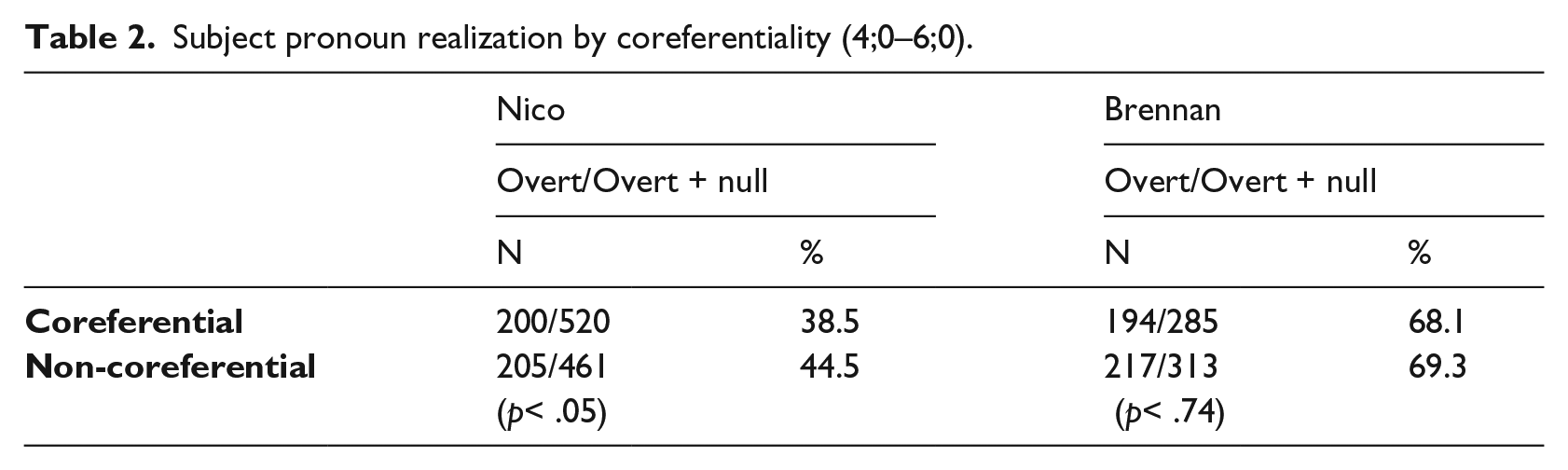
In sum, the simultaneous acquisition of a non-null-subject and a null-subject language does not affect the acquisition of subjects in either language at the earliest age stage. But after age 3;0 Brennan’s rates of subject expression diverge further from those reported for monolinguals, and for balanced bilingual children. A possible mechanism accounting for the high rate of pronouns is the child’s copying of the English [subject pronoun + verb] string.
I identified a somewhat similar increase of subject pronouns in the data from some of the adult bilinguals: 32% of subject pronouns in data from A9 in Group 1; 42% in data from L28 from Group 2; and 38% in data from H48 from Group 3 (Silva-Corvalán, 1996). I noted then that the categorical restrictions on subject expression remained intact in second and third generation immigrants, but there was a decrease in the strength of the coreferentiality constraint, as is the case for the siblings, and especially for Brennan (see Shin & Otheguy, 2009, for the decrease of sensitivity to continuity of reference in New York Spanish).
Table 3 shows that the adult bilinguals maintain the difference between same reference and switch reference subjects, but this difference is not statistically significant for the Group 3 speaker. Furthermore, the percentage of coreferential subjects increases steadily from the Group 1 speaker to the Group 2 and the Group 3 speaker. The rate of expressed coreferential subjects in the speech of the Group 3 speaker is 12 points higher than that of A9 (Group 1) and seven points higher than that of L28 in Group 2.
Nominal and pronominal subject realization by coreferentiality (adult bilinguals).
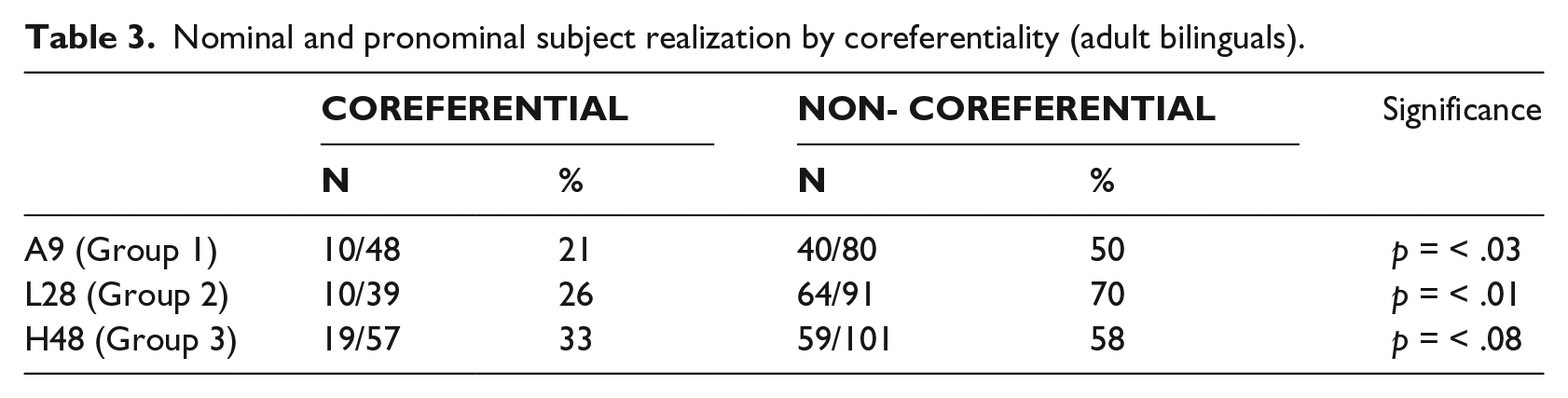
Brennan and Nico’s linguistic behavior is comparable to that of the Los Angeles bilingual adults, even though they have been exposed to a different variety of Spanish. Nico differentiates coreferential from non-coreferential subjects like the HSs in groups 1 and 2; Brennan is closer to the speaker in Group 3.
Clitics in bilingualism
Spanish clitics are unstressed pronominal elements also referred to as “verb clitics,” because they must occur either before or after a host verb. Clitics constitute a complex system encompassing phonological, morphological, syntactic and semantic properties. The set of clitics in Latin American Spanish includes first person singular me; second singular te; third person unmarked for number and case se; third person dative singular and plural le, les; third person accusative singular and plural: feminine la, las, masculine lo, los, and neuter lo (to refer to non-entities); first person plural unmarked for case nos. Third person dative and accusative clitics are co-indexed with the object (object-related), me, te, and nos may be co-indexed with the object or with the subject (subject-related). Se is subject-related in reflexive and reciprocal clauses. Reflexive constructions include true reflexives and a number of other types of “reflexives” with se-unaccusative or se-intensifier (Cuervo & Pérez Leroux, 2015), 4 some “optionally” and others obligatorily reflexive (lexical reflexives). There is also a “spurious se” which stands for le or les in clitic clusters. Examples 4 to 8 illustrate some of these clitic functions.
Subject-related
(4) (Éli) sei quemó la mano. “Hei sei burnt his hand.” (5) ¡No tei mojes! not yourselfi wet “Don’t get wet!” (6) Pepei quiere subirsei al árbol. Pepei wants to-climb-sei to-the tree.
Object-related
(7) Tek vieron a tik ayer. youk saw-they a-acc mark tik yesterday “They saw youk yesterday.” (8) Lei traje el librok. > Sei lok traje. [spurious se] to-heri brought-I the bookk to-heri itk brought-I “I brought heri the book.” “I brought itk to heri.”
In addition to contrasts by person, gender and case, there are position constraints: clitics must be preverbal with tensed verbs, and postverbal with infinitives, gerunds and participles. The internal ordering of clitics in clusters is also fixed: se must be in initial position, followed by any other clitics ordered by person: second, first, third person. When clitics refer to an argument of an infinitive or a present participle in a verbal periphrasis with a finite (semi)-auxiliary verb, they may variably occur after the lexical verb or before the finite auxiliary. This is the only variable context for clitic placement in Spanish.
Previous studies on the acquisition of clitics
The complexity of the clitic system poses a significant learning problem to children. Despite this complexity, studies of the acquisition of clitics by monolingual and bilingual children in Spain (Cuervo & Pérez-Leroux, 2015; Domínguez, 2003; Ezeizabarrena, 1997) show that clitics appear before the age of 2;0 and are used productively with few, mostly morphological errors (e.g. singular for plural clitic, masculine for feminine clitic), no position errors with single clitics and rarely with clitic clusters. Domínguez reports a few cases of lo when no clitic is required, and a few cases of “ungrammatical” clitic-doubling, that is, the object and the clitic are used in the same sentence. 5 Cuervo and Pérez-Leroux study the acquisition of clitic clusters by two Spanish monolinguals to age 3;0 and note that clusters are productive from age 2;0. These authors’ Table 4 shows the total number of clusters realized from 2;1 to 3;0 and the types of errors per child. The percentage of errors is 14.60% (20/137) for one child, and 9.38% (9/96) for the other. Omission errors are more frequent than feature and internal ordering errors: 14 of 29 errors correspond to omissions (48.28%). Cuervo and Pérez-Leroux conclude that children produce clusters “with extremely low error rates” (p. 163) and “that before the age of 3 children have fully acquired the syntactic and morphological operations responsible for multiple cliticization” (pp. 163–164).
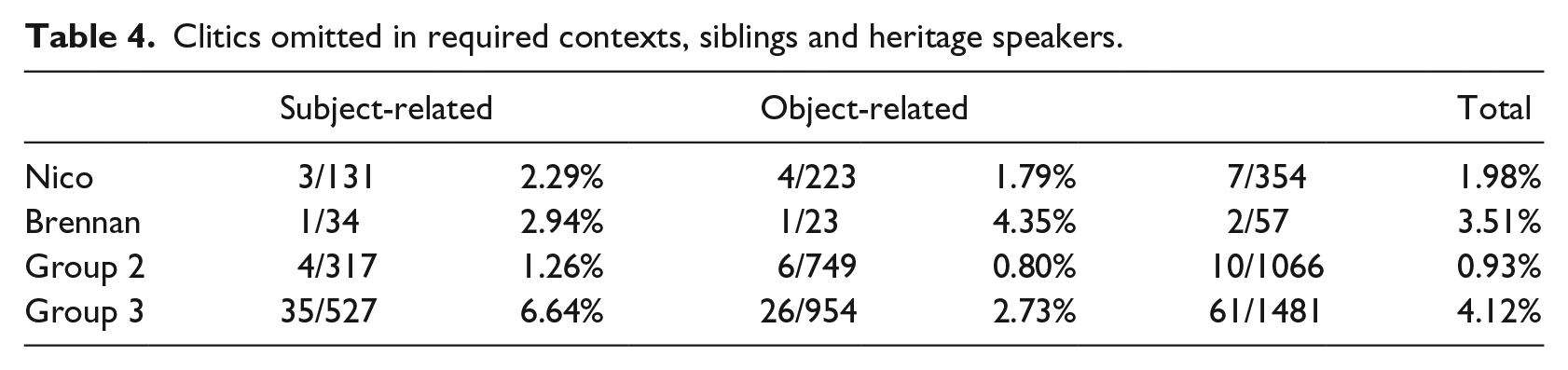
Clitics omitted in required contexts, siblings and heritage speakers.
From these few studies of Spanish clitic acquisition with non-elicited data, I conclude that clitics have been acquired by age 3;0, but the system is not completely stabilized in the grammars of either monolinguals or bilinguals. In production, children do better with single clitics, but not so well yet with clitic clusters (14.60% is not an extremely low error rate). A similar situation of instability characterizes the speech of the siblings and adult bilinguals focus of this article.
Realization of clitics by child and adult bilinguals
I examined the siblings’ spontaneous data between the ages of 4;0 and 6;4 and coded the utterances with realized clitics and those where clitics should have been used. This resulted in a total of 544 sentences, 358 for Nico from ages 5;0 to 5;11, and 184 for Brennan from ages 4;1 to 6;4. 6 Brennan produced 125 clitic contexts from 4;1 to 4;5, but I did not include these in the counts that follow because the objective was to examine clitics at a time close to the children’s start of their first grade, when exposure to English increases.
As reported for monolinguals, the siblings’ data also evidence some errors. In Nico’s data, there is one case of lo instead of la to refer to la serpiente “the snake,” seven sentences with a missing clitic, and four with overproduced clitics. The total percentage of clitic errors in his data is 3.35% (12/358), well below the percentage reported for monolinguals at a younger age, and 1.98% omission errors. 7 It may be assumed, therefore, that there is a process of stabilization of the grammar of clitics beyond age 3;0 if input and production are not hampered, but Nico has not reached complete acquisition by age 6;0. The overproduced clitics are all subject-related; three correspond to constructions that frequently occur with an intensifier reflexive clitic; for instance, with verbs of consumption (Example 9), but a clitic is not validated when this type of verb is used with a non-specific object, as Nico does in Example 10. The fourth case of overproduction is with the verb temblar “tremble” (Example 11). That this is the only lexical error is remarkable given the idiosincratic reflexives typical of Spanish, such as quebrarse “break” and romperse “tear,” which Nico uses correctly.
(9) Nico, 5;10: Yoi mei lok voy a comer todok. Ii mei-Refl itk go to eat everythingk “I’m going to eat it all.” (10) Nico, 5,10: Sí, siempre yo ~me como mucho.
8
yes, always I mei-Refl eat much. “Yes, I always eat a lot.” (11) Nico, 5;5: Esto también ~se va a temblar. “This also se is going to shake.”
The seven omissions do not follow a clear pattern: two omissions of an accusative clitic (nos “us,” los “them”), two of the dative clitic le “to her/him,” and one each of a reflexive with a reciprocal construction, an inchoative reflexive, and a lexical reflexive with an inchoative meaning. Examples 12 to 14 illustrate. Note that los (Example 12) and se (Example 14) are omitted in clitic clusters, but Nico produces clusters correctly most of the time (see Example 9 above).
(12) Nico, 5;10: Mira, se ~ “Look, [hei] sei ate themk all.” (13) Nico, 5;7: Él y Amanda ~ (14) Nico, 5;6: ~ [sei] to-mey fell a little of thesei, of the pasta. “A bit of these, of the pasta fell down.”
Between the ages of 5;0 and 6;4, Brennan produces only 59 contexts for the study of clitics, with a total percentage of clitic errors of 6.78% (4/59), about three percentage points higher than Nico’s. 9 Like his brother, he has not reached complete stabilization of clitic usage by age 6;0. Brennan overproduces the clitic se twice with the same verb, poner “put,” which he uses mistakenly in the inchoative reflexive form ponerse “become, begin” (among many other possible translations) in Example 15 (see also Example 13 above). He omits two clitics: me with a lexical reflexive (resbalarse “slip”), and le with pegar “hit” (Example 16). This verb belongs to a group of verbs that can be used with two complements (Juan lei pegó un puñete a Pepei “Juan hit a punch to Pepe”), although frequently used only with a single complement (Juan lei pegó a Pepei “John hit Pepe”). It is, thus, an ambiguous type of structure, since when expressing only the “goal” (an indirect object), the child may wrongly consider it the “patient” (a direct object), which as such does not require a clitic co-referent.
(15) Brennan, 6;4: El perro ~ (16) Brennan, 5;5: Él “He hit my dad here with his elbow.”
In sum, by age 6;4 the children show full proficiency in clitic placement, gender (with only one exception) and case. The errors concern mainly clitic omissions, 56.25% of total errors, and overproduction of subject-related clitics, 37.50%. This latter type of error is understandable given the idiosyncratic nature of lexical reflexives, illustrated in an unaccusative construction (Example 17) with a non-reflexive type verb, hervir “boil,” and (Example 18), with quemar(se) “burn (itself)” in an unaccusative/middle construction with se.
(17) El arroz hirvió. “The rice boiled.” (18) El arroz se quemó. “The ricei sei-Refl burned.”
There are similarities between the children’s use of clitics and the adults’ use in Groups 2 and 3. For the study of clitics I analyzed data from 20 adult speakers, who represent various degrees of Spanish and English proficiency (Silva-Corvalán, 1996). Regarding the omission of clitics, in a subset sample of 13 speakers in Groups 2 and 3, of a total of 2822 contexts for the occurrence of an obligatory clitic, 71 are missing (2.52%). Six speakers in Group 1 produced all required clitics. Table 4 summarizes omissions of object-related and subject-related clitics in the siblings’ data and in the data from five speakers in Group 2 and eight speakers in Group 3. 10
Regarding clitic omissions, Group 2 speakers’ behavior is close to that of Group 1, but Group 3 speakers evidence much higher percentages of omissions, closer to Brennan’s percentages, while Nico appears to be in between the two groups. The instability of the clitic system by age 6;0 is thus shown to be also a feature of the speech of some adult heritage speakers.
The verb system
The Spanish verb system includes forms labelled preterite, pluperfect, future, imperfect subjunctive, etc. that are normally used to convey tense, aspect and mood (TMA) distinctions. In this section, I consider the perfective-imperfective (preterite-imperfect) aspectual opposition, and the indicative-subjunctive mood opposition in data from the siblings and from some of the adult bilinguals. To determine if a verb form is used according to the norms of first immigrant adult generation I consider obligatory contexts and discourse tasks which favor one or another form.
Obligatory syntactic contexts include those that impose consecutio temporum constraints in a number of subordinate clauses including adverbial clauses that refer to unrealized situations. For instance, a pluperfect subjunctive in the protasis limits the choice of verb form in the apodosis to pluperfect subjunctive or indicative or to conditional perfect; clauses introduced by antes que “before” or después que “after” require the use of a subjunctive form.
Spanish distinguishes perfective and imperfective aspect in the past. Very simply stated, the preterite conveys the perfective aspect meaning of completed event/situation and implies change, while the imperfect conveys the imperfective meaning of absence of a specific beginning or end point and implies stativity or continuity. Thus, the preterite is required in perfective discourse contexts when the beginning and/or the end of a situation is in focus, a reading that is obtained, for instance, with some punctual adverbial expressions (at 5 o’clock), with complements that force an interpretation of the situation as singular and perfective (see Example 19), etc.
(19) Compró un libro / una casa / un auto. “He bought a book / a house / a car.”
The imperfect is required in imperfective environments, most frequently when informing the time and location of an event. For instance, orientation clauses in narratives are coded in the imperfect (Example 20), but narrative abstracts, action clauses and statements which orient or evaluate the narrative events
(20) Estábamos jugando con una pelota [Imp, orientation] y alguien me pateó [Pret, action] y me hizo una herida grande [Pret, action]. Eso fue terrible [Pret, overall evaluation].
Mood may be defined briefly as the grammaticalization of the speaker’s subjective attitude toward the degree of assertiveness or certainty of the situation encoded in language. Tenses in the indicative mood communicate assertiveness and factuality. Subjunctive tenses refer to non-experienced and hypothetical situations; they are used mainly in subordinate clauses, which adds to the cognitive complexity of these tenses. Predictably, subjunctive tenses will be more difficult to acquire.
Silva-Corvalán (2014, Ch. 7) shows that in English no differences are observed between the siblings and English-speaking monolingual children. In Spanish, by contrast, the siblings evidence some off-target behavior. Most of the simple indicative mood tenses are not problematic. The siblings are able to talk about the present, the past and the immediate future with little difficulties. But the less frequent and more complex tenses that refer to non-experienced and hypothetical situations were either unstable or not acquired by the age of six . Reduction in exposure to Spanish led to not learning or weakening the on-line command of compound and irrealis tenses, as shown in examples 21 and 22. 11
(21) Nico, 5;6: Porque él quería que la gente mala encontrara-ImpSub [on target] pedazos de él para que ellos ~ “Because he wanted the bad people to find pieces of him so that they (22) Brennan, 5;4: ~No cuando ya “Not when [I]
Table 5 presents information about the verb tenses used by the children during the last age period studied. Besides Nico and Brennan, this table includes two Mexican-American children: Daisy and Mike. Daisy is from a Spanish-only home; her English is at an incipient stage. Mike speaks both Spanish and English at home, but he is dominant in English. The data reported in Table 5 are based on recordings done when all the children except Brennan were attending kindergarten; Brennan was in preschool. For purposes of comparison across the children, Table 5 includes data corresponding to the same age range: 5;0 to 6;0. The table also includes an adult from Group (G) 1, S2 (female, 25 years old) to facilitate reference to an unreduced verb system, an adult from Group 2, V21 (female, 16 years old), and one from Group 3, A46 (female, 30 years old). V21 and A46 were exposed to Spanish and English from birth, but have from an early age preferred to speak English. The information in this table is based on a minimum of three hours of recording of each speaker.
Spanish TMA usage compared across bilingual children, a (near) monolingual child (5;0-6;0), and three adults.

Imp: imperfect; Ind: indicative; Periphr: periphrastic; Pres: present; Pret: preterite; Sub: subjunctive.
Note:
“+” tense form is used according to the norms of general spoken Spanish.
“*”closed list of stative verbs used with imperfect morphology in preterite-perfective contexts.
“@” some preterites instead of imperfects.
“0” form has failed to occur in a high number of obligatory contexts.
Table 5 shows visually that the simpler and more frequent tenses are used in the same manner by all the speakers in the table. Differences among the children and adults correlate with home language and consequent amount of exposure to Spanish. Daisy, who speaks only Spanish at home and attends an English kindergarten, is the only one who uses preterite, imperfect, and present subjunctive as S2 does, and she is beginning to use the imperfect subjunctive. She is also the only child who uses stative verbs with preterite morphology consistently in perfective contexts. Mike, Brennan and A46 additionally evidence unstable preterite morphology. Mike, Brennan and the adults in Groups 2 and 3 do not use imperfect subjunctive. Brennan and the bilingual adults do not use the present subjunctive either. Note that Mike, Nico and V21 use one more tense than Brennan and A46, the present perfect (he visto “I’ve seen”).
Not only the amount but also the quality of the input received by the children is largely responsible for the patterns observed. Toddlers and preschool children talk more frequently about concrete situations in their immediate environment, they are read or told stories about past events, they talk about what they will do rather than what they would do, and they are given affirmative and negative commands. Children soon acquire the tenses and discourse rules associated with these tasks: they are more frequent and they are also cognitively simpler. These tenses are not a source of difficulty for any of the children.
By age 5;0 to 6;0, then, when bilingual US-born children start kindergarten, they have not yet acquired the complete system of tense, mood, and aspect in Spanish. It is also noteworthy that at this age the English-dominant bilingual children with more reduced exposure to Spanish at home display the same interesting use of the imperfect instead of the preterite (Example 23) with a closed list of stative verbs (ser “to be,” estar “to be,” tener “to have,” haber “there to be,” and poder “can”), just as adult bilinguals in Groups 2 and 3 (marked with * on Table 5), even though at least Nico and Brennan are not exposed to this bilingual variety of Spanish.
(23) Nico, 2;8.15: Estaba pateando la pelota a un hombre y alguien pateó la pelota a mi pierna y (a) fue-Pret un awi grande y (b) eso ~ “He was kicking the ball to a man and someone kicked the ball to my leg and (a) it was-Pret a big booboo and (b) that
It is remarkable that despite reduced exposure to Spanish, however, Nico has developed a tense system which is very close to that of Daisy. Brennan, on the other hand, has developed a system that is almost the same as that of the Group 3 speaker. 12
Further similarities
Further similarities between the siblings and second and third immigrant generation adult bilinguals may be identified. This is interesting because the children had very rarely, if at all, been exposed to the speech of these speakers.
For instance, the children, just as adults, are lexical innovators. They adapt English nouns and verbs to Spanish morphology and use them quite naturally (e.g. lipo from lip “labio,” pular from pull “tirar”). They also equate word combinations in English with parallel combinations in Spanish but assign to these the meaning of the English idiomatic combination (e.g. no puedo esperar “I can’t wait” gets the meaning of “to be very eager for X,” a new form-function in Spanish). These idiomatic combinations are also attested in the Spanish of adult bilinguals.
Conversely, some off-target syntactic constructions are transitory and no longer attested beyond the age of four years and one month; in particular, the placement of adjectives before the noun (verde hoja “green leaf”), preposition stranding (¿Qué es esto para? “What is this for?”), and copies of the English genitive (Kiko’s escuela). 13 In this regard, the siblings’ grammars are closer to those of second generation rather than third generation speakers, whose syntax shows more evidence of convergence with English. I find no evidence of a new mixed language. Structural copies that violate the typological patterns of Spanish constitute qualitative changes that are perceptually salient (e.g. the realization of complementizers, negation, question formation, auxiliary verbs; cf. Hickey, 2010). Therefore, the divergent structures are in time discarded, because the bilingual children either self-correct or are corrected by adults.
Discussion and conclusion
I have discussed some concrete connections between bilingual acquisition in the early years and some aspects of the grammars of adult heritage speakers; in particular, the increased production of overt subject pronouns; object clitic omissions; and a reduced TMA system.
Both children and adults evidence an increased rate of subject pronouns accompanied by a decrease in the strength of the coreferentiality constraint. This characterizes speakers in Group 3 in Los Angeles, but the decrease of sensitivity to continuity of reference is also attested in a large sample of Group 2 speakers in New York (Shin & Otheguy, 2009). This suggests that the weakening of the coreferentiality constraint results from reduced exposure to Spanish in a situation of intense contact with a dominant language (see endnote 2).
I have shown that by age 6;0 the children’s use of clitics shows similar patterns of instability as those attested in the speech of adult HSs. In regard to clitic omissions, overall quite rare, Group 2 speakers’ behavior is close to that of Group 1, who produce all required clitics, but Group 3 speakers evidence a higher percentage of omissions, similar to Brennan’s percentage, while Nico appears to be in between Groups 2 and 3. Reduced exposure to Spanish is thus closely related to the occurrence of clitic omissions.
Lessened exposure is also responsible for the absence of some tenses in the siblings’ Spanish and in one more US-born bilingual child. It is clear that by age 5;0 to 6;0, the children, including a near Spanish monolingual child, have not yet acquired the adult system of tense, mood, and aspect in Spanish. Some features of the children’s TMA system are also characteristic of that of the adult heritage speakers. Notably, the absence of subjunctive and compound tenses, and the use of the imperfect instead of the preterite with stative verbs are features that attest to a halted process of development rather than attrition of knowledge. This interpretation agrees with Polinsky’s (2011, p. 320) statement that the incomplete acquisition of a feature can be assumed “if a child and an adult deviate from the baseline in the same way.”
The parallels identified between the siblings’ linguistic behavior and that of adult heritage speakers have two implications: first, they imply that some aspects of the heritage language of adults are the outcome of an interrupted process of acquisition of this language between the ages of 3;0 and 5;0, when more intensive exposure to the L2 reduces exposure to the heritage language and diminishes the opportunities to use it; 14 and second, given that the siblings’ input in Spanish is not attrited or reduced, the results suggest that some of the changes that have been identified across generations of bilinguals (e.g. by Gutiérrez, 2003; Lynch, 1999; Silva-Corvalán, 1996; Zentella, 1997) develop naturally in the acquisition of the heritage language in childhood, regardless of whether the innovative features occur in the input or not.
The hindered process of acquisition and development of Spanish underlies incompletely or partially acquired grammatical domains (Montrul, 2008; Polinsky, 2006). I do not argue that adult HSs have acquired the entire system of their heritage language incompletely, or that they do not have communicative competence in this language (although those at the lower ends of the bilingual continuum may not, see Silva-Corvalán, 1996), but that some HSs, including many at the higher ends of the continuum, evidence some reduced or incompletely acquired grammatical aspects compared with these (unreduced) aspects in the grammars of their adult models in the preceding generation.
Some linguists argue that in heritage speakers’ grammars variability between expected and non-expected forms reflects “complete acquisition,” that their grammars are less restrictive or “different” in some respects but not incomplete, and that the notion of “incompleteness” should be dismissed (Carreira & Potowski, 2011; Otheguy & Zentella, 2012; Pascual y Cabo & Gómez Soler, 2015; Putnam & Sánchez, 2013, among others). The notion of “difference” requires a point of comparison to be able to say in what respect a language variety X is different from Y, and in addition it should be necessary to explain what language features differentiate X from Y. This is normal practice in dialectology. 15 The notion of “incompleteness” as an outcome also requires a comparison with what is “complete.” Thus, if some domains of the grammars of X (Group 1) are “complete,” then in comparison with these grammars the absence of required subjunctive forms, the omission of clitics in required contexts, and the weaker sensitivity to correferential constraints in Y are an indication of difference but also incompleteness with respect to X. 16 Finally, while difference is not an explanatory construct, incomplete acquisition due to interrupted development caused by restricted exposure and production of Y offers an explanation for the range of proficiencies attested among adult heritage speakers.
Footnotes
Declaration of Conflicting Interests
The author(s) declared no potential conflicts of interest with respect to the research, authorship, and/or publication of this article.
Funding
The author(s) received no financial support for the research, authorship, and/or publication of this article.