




Abstract
Research questions:
Are emergent bilinguals sensitive to register variation in their use of communication strategies? What strategies do LX speakers, in casu Spanish speakers of English, use as a function of situational context? What role do individual differences play?
Methodology:
This within-speaker study compares Spanish second-language English speakers’ communication strategy use in an informal, peer-to-peer conversation and a formal interview.
Data and analysis:
The 15 hours of informal and 9.5 hours of formal speech from the Nijmegen Corpus of Spanish English were coded for 19 different communication strategies.
Findings/conclusions:
Overall, speakers prefer self-reliant strategies, which allow them to continue communication without their interlocutor’s help. Of the self-reliant strategies, least effort strategies such as code-switching are used more often in informal speech, whereas relatively more effortful strategies (e.g. reformulations) are used more in informal speech, when the need to be unambiguously understood is felt as more important. Individual differences played a role: some speakers were more affected by a change in formality than others.
Originality:
Sensitivity to register variation has not yet been studied within communicative strategy use.
Implications:
General principles of communication govern speakers’ strategy selection, notably the protection of positive face and the least effort and cooperative principles.
Introduction
When speakers (occasionally) experience communication hurdles, or when they anticipate that their interlocutor(s) will experience them, they can use strategies to keep communication flowing. In spontaneous spoken discourse, people use floor-holding devices, such as hesitations or reformulations, while searching for an adequate term or maintaining the flow of the communication (cf. Bongaerts & Poulisse, 1989; Dörnyei, 1995; Tang, 2015). Communication strategies can be particularly useful for emergent bilinguals when they want to tackle or overcome linguistic problems. In general, LX speakers (i.e., speakers using a language other than the first language (L1)) struggle more often with ‘how to say it’ than native speakers, and communication strategies may help to prevent communication breakdown and to keep the conversation going. In example (1), for instance, in an informal conversation in English, with a Dutch interlocutor, a Spanish future telecommunications engineer cannot come up with the word antennas in English, and instead utters ‘these things that you use to communicate with other people’ and ‘it’s parabolic and thing’. He also uses the Spanish word for antennas and he says ‘I do not remember’.
(1) (Male speaker M10 in the informal conversation; lines 78–94
1
) DUtch participant and what is telecommunication? SPanish participant eh [breath] communication is like eh mobin- mobile telecommunications and engineer hm DU [breath] oh ok SP engineering DU so you mn- you are you are making fn- programs for the phone or something SP yeah yeah [breath] and the people who design the for example [click] [breath] I do not remember this things that you use to communicate with other people eh it is parabolic and and thing DU waves or something ah waves are the the medium [breath] DU hm SP ann- [in Spanish:] antenas? DU [in Dutch:] antennes? SP antenn- DU yeah yeah yeah SP eh the people who desin- design antennas eh are comn- eh teln- hm telecommunication DU oh ok
In this paper, we investigate whether the use of communication strategies by emergent bilinguals is influenced by the situational context: does the perception of the formality of the situation lead them to choose different communication strategies?
In general, a shift in formality causes native speakers to use a different register. Accordingly, are LX speakers, when they are faced with communication hurdles, capable of making a change in register when they are confronted with a shift in formality? In Second Language Acquisition (SLA) research, register is often used interchangeably with the terms ‘style’ and ‘sociolinguistic competence’. No attempt is made here to give full discussion of these concepts (see Biber & Conrad, 2009, and Lee, 2001, for a thorough discussion). Register is used here to mean variable expression in relation to the situational context.
Many scholars agree that mastery of register variation is a late feature in the acquisition process. Novice second-language (L2) language users are monostylistic, and typically use only one register variant categorically. It is only at a later stage that they start to master the alternation between two variants (for an overview, see Dewaele, 2004). According to Valdman (2003, p. 76), the norms for prestigious speech are usually too complex for inexperienced speakers, because these norms require finer discriminations at the phonological level and more specific constraints at the grammatical level. According to Valdman, it is the informal norm that most inexperienced L2 users use. Dewaele (2007), Mougeon, Rehner, and Nadasdi (2004) and Tarone and Swain (1995), on the other hand, state that it is usually the formal variant (‘academic style’) that predominates, because it is the style that most L2 users learnt at school. There are, however, also studies that indicate that LX speakers, like native speakers, are able to linguistically shape their assessment of a difference in the sociocultural context. Bilger and Tyne (2007) and Tyne (2009), for instance, found that also less proficient learners of French showed stylistic variation and that this variation generally shows similar patterns to those of the more proficient group.
Most of these studies focus on sets of lexical, phonological or grammatical features (e.g. the deletion of /l/ in French pronouns, the omission of ne in French negation, see Howard, Mougeon, & Dewaele, 2013, for an overview). How emergent bilinguals deal with communication hurdles in different situational contexts has not yet been studied, and yet, the question is relevant: if the situational context impacts on how LX speakers express themselves communicatively, then this may have consequences for their communicative effectiveness. More specifically, the main objective of the present paper is to compare communication strategy use by Spanish L2 speakers of English between a formal and an informal situational context.
Communication strategies
Communication strategies can be defined as ‘every potentially intentional attempt to cope with any language-related problem of which the speaker is aware during the course of communication’ (Dörnyei & Scott, 1997, p. 179). Within the SLA paradigm, scholars focus on problems caused by (temporary) gaps in speakers’ linguistic knowledge in order to ultimately help L2 learners develop their ‘strategic competence’ (see also Nakatani, 2005, for a discussion of several definitions). For the speakers in SLA studies and for the SLA scholars who study them, the objective is language acquisition, which is why data are usually collected in classroom settings, or similar learning contexts. Such settings impose a particular social environment with very specific social roles, social relations and communicative purposes (Mauranen, 2011). As a consequence, findings might not be generalizable to situational contexts outside the classroom.
More recently, scholars within the English as a lingua franca (ELF) paradigm have focused on communication strategies as instruments to prevent (potential) communication problems (Kaur, 2010; Mauranen, 2006; Seidlhofer, 2010). The ELF approach is interaction oriented, often inspired by Conversation Analysis methodology or ethnomethodology (see Björkman, 2014). The ELF scholars’ qualitative approach provides in-depth insights into the interactional moves interlocutors make when preventing or resolving miscommunication (Kaur, 2010, 2011; Mauranen, 2006, 2011; Seidlhofer, 2010) and how they use communication strategies (Björkman, 2011, 2014). However, quantitative analysis of communication strategy use that allows comparative statistical investigations has rarely been done within the ELF paradigm.
To our knowledge, no comparative studies have been carried out to investigate the influence of the situational context on speakers’ communication strategy use. This paper presents a comparative study of Spanish LX speakers of English, in which we contrast informal, peer-to-peer conversations with formal interviews.
We will investigate the Spanish speakers’ use of communication strategies in order to answer three main research questions: (1) Which strategies are used most often? (2) Do speakers use certain communication strategies more often in a formal context and other strategies in an informal context? (3) Is there variability in the effect of formality on individual speakers’ communication strategy use?
We adopt Dörnyei and Scott’s definition of a strategy (see above). Speakers have a wide range of communication strategies at their disposal and SLA researchers have proposed various taxonomies to group related strategies together (see Dörnyei & Scott, 1997, for an overview). Dörnyei and Scott propose a threefold division of direct, indirect and interactional strategies. Direct strategies provide an alternative means of overcoming the problem and getting the meaning across (e.g. circumlocutions). Indirect strategies facilitate the conveyance of meaning indirectly by creating the conditions for achieving mutual understanding at times of difficulty (e.g. fillers). They may prevent breakdowns and keep the communication channel open. We group direct and indirect strategies together as self-reliant strategies, in that the speaker opts to solve the problem him or herself.
In interactional strategies, the participants carry out trouble-shooting exchanges cooperatively (e.g. clarification requests) (Dörnyei & Scott, 1997). The speaker depends on the cooperation of the interlocutor in interactional strategies.
Our third group of strategies is not clustered as such by Dörnyei and Scott (1997). It is formed by uncertainty strategies, in which the speaker sends a message of (temporary) incapacity to produce or perceive language, or shows no intention of coming to a solution for the communication problem. Speakers either abandon the production of the message altogether or merely verbally reveal having linguistic difficulties (e.g. indicating linguistic difficulty).
An overview of the strategies is shown in Table 1. For definitions of all communication strategies included in our study and examples, see the Appendix.
Division of communication strategies into three categories: self-reliant, interactional and uncertainty strategies (based on Dörnyei and Scott, 1997).

As mentioned above, our third research question revolves around individual differences in the effect of the situational context on speakers’ communication strategy use. Littlemore (2001) called attention to the fact that speakers may show individual preferences for certain strategies. Howard et al. (2013) also suggest that personality differences impact on the awareness of register. We will investigate the same speakers in different situational contexts and quantify the individual variation in the choice of communication strategy in two situations.
Method
Data: The Nijmegen Corpus of Spanish English
Our study is based on the Nijmegen Corpus of Spanish English (NCSE; Kouwenhoven, Ernestus, & Van Mulken, 2018). This corpus is set up for research purposes and holds recordings of one-on-one communication in English between 34 Spanish speakers (17 female, 17 male, age range from 19 to 25 years (M = 21.44 years, SD = 1.48 years) and a Dutch confederate in an informal, peer-to-peer conversation, and with another Dutch confederate in a formal interview. All Spanish participants replied to a call in which volunteers were asked to participate in a research project. This call was in Spanish, as were all other communications with the Spanish participants. The call did not mention that the recordings would be in English in order to avoid self-selection by participants based on their interest in English.
The NCSE takes an intermediate position between ELF corpora (see Mauranen, Hynninen, & Ranta, 2010; Seidlhofer, 2010) and SLA corpora (see Gilquin, De Cock, & Granger, 2010). The speakers were not L2 learners but used their L2 for communicative purposes, as in ELF corpora. The goal of the interaction was not to learn the target language but to achieve interpersonal interaction (cf. Le Pichon, De Swart, Vorsterman, & Van den Bergh, 2010). The situational context was held constant, as in SLA corpora. Consequently, the NCSE has its own methodological advantages.
The two confederates, a 23-year-old male and a 24-year-old female, were both undergraduate students and native speakers of Dutch. The design of the corpus was such that the participant and the confederate were of the same sex in the informal part and of opposite sexes in the formal part.
The corpus was recorded in the laboratory of the Grupo de Tecnología del Habla at the Escuela Técnica Superior de Ingenieros de Telecomunicación of the Universidad Politécnica de Madrid. All recordings were made in a sound-attenuated room. All participants engaged in the informal part of the recordings before the formal part. The Spanish participants were led to believe that the confederate in the informal part of the recording was just another ‘regular’ participant. We thus created a context in which the Spanish participant and the Dutch confederate were peers. Approximately 10 minutes before the Spanish participant was expected to arrive, the Dutch confederate went to the meeting point and waited for the project leader, as did the Spanish participant. At the agreed time, the project leader introduced himself to both, introduced them to each other and asked them to wait outside while he made some final preparations. The confederate was instructed to use this time to start up a conversation in order to break the ice.
The informal recordings lasted 40–50 minutes. Most conversations started with the interlocutors continuing to introduce themselves: they spoke about their education and daily lives. Quite quickly the conversations turned to other topics, such as the city of Madrid, football, travel and the crisis in Spain. When the conversation seemed to come to an end, the project leader returned to the recording room with a name guessing game. The interlocutors were instructed to, alternately, pick a card that had the name of a public figure (from music, cinema, politics, sports, etc.) on it. They were to describe this celebrity to their interlocutor, who had to guess the name on the card.
After the informal recordings, the Spanish participant received written instructions, in English, about the second part of the recordings. These explained that a formal interview would be recorded as part of a graduation project for a journalism master’s degree about the crisis situation in Spain and Europe. The interview, held by the second confederate, was closed after approximately 25 minutes. The formal character of the interview was made clear in several ways. Firstly, the camera was overtly present. Secondly, the interview was conducted by a person previously unknown to the Spanish participant. Thirdly, the second confederate was of the opposite sex to that of the Spanish participant. Fourthly, the second confederate used formal language so as to also elicit formal speech from the Spanish participant (e.g. speaking clearly and not too fast, avoiding hesitations and laughter and paying attention to their word choice). In addition, the second confederate used plural pronouns (for example ‘we would like to know…’ rather than ‘I would like to know…’) in order to emphasize the idea that more people were going to watch the materials. Lastly, the second confederate and the Spanish participant wore formal clothing items, like a jacket, which they were asked to bring to the recordings.
An experienced teacher of Cambridge English for Speakers of Other Languages (ESOL)/International English Language Testing System (IELTS) exam courses assessed the English proficiency levels of the Spanish speakers at the A1/B2 level of the Common European Framework for Languages (CEFR), and the speakers can therefore be considered low-proficiency users of English. Also, Howard et al. (2013) point out the need for studies that include low-proficiency users of a language to study register awareness.
After the recordings, the Spanish speakers rated the communication in both situational contexts as natural, and the interviews as more formal than the peer-to-peer conversations.
All 15 hours of informal and 9.5 hours of formal speech were divided into short stretches, usually confined by natural pauses, and orthographically transcribed. Because the stretches are of a mean length of approximately 2 seconds, the orthographic transcription is well aligned with the speech signal, which facilitates finding a lexical item in this acoustic signal. Moreover, the short chunks of orthographically transcribed speech, in combination with a good pronunciation dictionary and phone models, can be used to automatically generate phonetic transcriptions.
These short stretches will be referred to as chunks in the remainder of the present paper. The Spanish speakers produced 55,910 chunks in total, with a mean duration of 1.59 seconds, and containing 4.22 words on average.
Coding
Dörnyei and Scott’s (1997, pp. 188–194) present an inventory of 33 communication strategies, based on a comprehensive review of 20 years of communication strategy research. We based our coding scheme on this inventory.
Since we focused on verbal communication only, strategies such as ‘mime’ were left out of consideration. Then, the communication strategies that require the speakers’ retrospective comments for identification (e.g. ‘message reduction’, ‘omission’, ‘replacement’, ‘use of similar sounding words’ and ‘feigning understanding’) were also left out, since we had no access to the speakers’ comments.
We were also reluctant to include ‘over-explicitness’ and ‘mumbling’. Dörnyei and Scott (1997) define over-explicitness as using more words to achieve a certain goal than would be considered ‘normal’ in a native context. Since it is difficult to define what is normal in a given situation, and since we wanted to avoid evaluating the L2 speakers against native norms, over-explicitness was not taken into account. As for ‘mumbling’, there were only a few occurrences of incomprehensible speech in the NCSE, which renders this strategy redundant.
Next, we merged closely related strategies together, since distinguishing between them would either overcomplicate the analyses or be uninformative. ‘Word-coinage’, ‘foreignizing’ and ‘literal translation’ were combined into ‘foreignizing’, which entailed the direct application of L2 characteristics on L1 words. We clustered ‘restructuring’, ‘self-repair’, ‘self-rephrasing’ and ‘retrieval’ into ‘reformulation’, which covers a speaker’s search for an alternative that he or she considers satisfactory.
We noticed that the discrimination between strategies is sometimes difficult. First of all, not all insertions of fillers, circumlocutions or all-purpose words are related to language problems. Speakers, either native or LX, may use them routinely for different purposes. Therefore, we only included fillers, circumlocutions or all-purpose words that are likely to result from language-related problems. We thus did not take all instances of an item into account. To give an example, the word ‘like’ is nowadays a very frequent filler among certain groups of speakers of English. The word may fulfil all kinds of functions (e.g. Andersen, 2000; Buchstaller, 2001). We only took those occurrences of ‘like’ into account that seemed plausible to be inserted because of word finding problems (see example (2) below and the example in the Appendix).
Further, in order to distinguish ‘indirect appeals for help’ from ‘indicating linguistic difficulties’, we decided to count as an indirect appeal only the clauses that end in a turn offer. If a speaker maintains the floor after using the strategy, we considered it to be an indication of linguistic difficulty.
The selection and combination of strategies from Dörnyei and Scott (1997) led to a first coding scheme with 16 strategies. We then proceeded with an iterative-inductive process to fine-tune the coding scheme. Two researchers separately coded the transcriptions of three informal and two formal recordings (4773 chunks) from the NCSE and discussed their results after each transcription. Overall, there was strong agreement (κ > .7), and the cases of disagreement were resolved after discussion. We defined three strategies that were not in Dörnyei and Scott’s (1997) list, but that both coders considered relevant additions: ‘repetition for emphasis purposes’ (e.g. ‘the empire state building is high, high, high’; see also Björkman, 2011), ‘exemplification’ (the use of concrete examples or quotations to indicate more complex concepts) (e.g. ‘when you come to the next green, go or red, stop’; see also Nakatani, 2005) and ‘signalling overall insecurity’, which we defined as the indication of an overall concern about one’s own capabilities in English (e.g. ‘my English is not so good’; as opposed to the strategy ‘indicating linguistic difficulty’, which is local and has to do with an immediate language problem; see also Van Mulken & Hendriks, 2014).
The final coding scheme consisted of 19 communication strategies. Definitions and examples from the NCSE of all 19 strategies can be found in the Appendix.
The first author of the present article coded the remaining recordings. For each of the 55,910 chunks in the NCSE, he indicated which communication strategies were present. Chunks could contain multiple strategies. Some of the strategies stretched over multiple chunks (especially circumlocution and reformulation). If this was the case, only the chunk in which a strategy was initiated was taken into account in the quantitative analyses, so that the occurrence of a certain strategy was not overestimated.
Statistical analyses
We analysed the impact of the formality of the situational context on communication strategy use by fitting logistic linear mixed effects models with the binomial link function, one for each individual strategy. The dependent variable in these models was the presence or absence of the strategy in a chunk. In our models we tested for fixed effects of formality, as our predictor of interest, and of gender and chunk length 2 (i.e. the number of words in a chunk) as fixed control variables. We included speaker as a random factor.
We investigated the effect of formality on each individual speaker, by testing for random slopes of formality by the speaker. This random slope reflects the sensitivity of the individual speakers to the effect of formality. If the fixed effect of formality shows that, for the group of speakers as a whole, informal chunks are more probable to hold a certain strategy than formal chunks, inspection of the random slopes for individual speakers may reveal that this effect is stronger for one speaker than for another. Moreover, when a fixed effect of formality is absent, there can still be individual variation: one speaker may be more likely to use a particular strategy in informal speech, whereas another speaker may be more likely to use the same strategy in a formal situational context.
Inclusion of formality as both a fixed factor and a random slope also has a methodological advantage. Not including a random slope for formality may lead to type-1 errors, since we may falsely observe an effect of formality for the group of speakers as a whole, which in reality is caused by only a small number of speakers. To test the significance of the random slope for formality, we performed likelihood ratio tests comparing models with and without the random slope.
In the statistical models reported below, we only included fixed and random predictors and random slopes that were significant.
Results
Frequencies of use of communication strategies
The Spanish speakers used one or more communication strategies in 15.8% of all chunks (8853 of 55,910). There was large variation in the frequency of use of each strategy, as shown in Figure 1. Ten communication strategies were used less than two times per recording, on average. These include all interactional strategies, and three of the four uncertainty strategies.
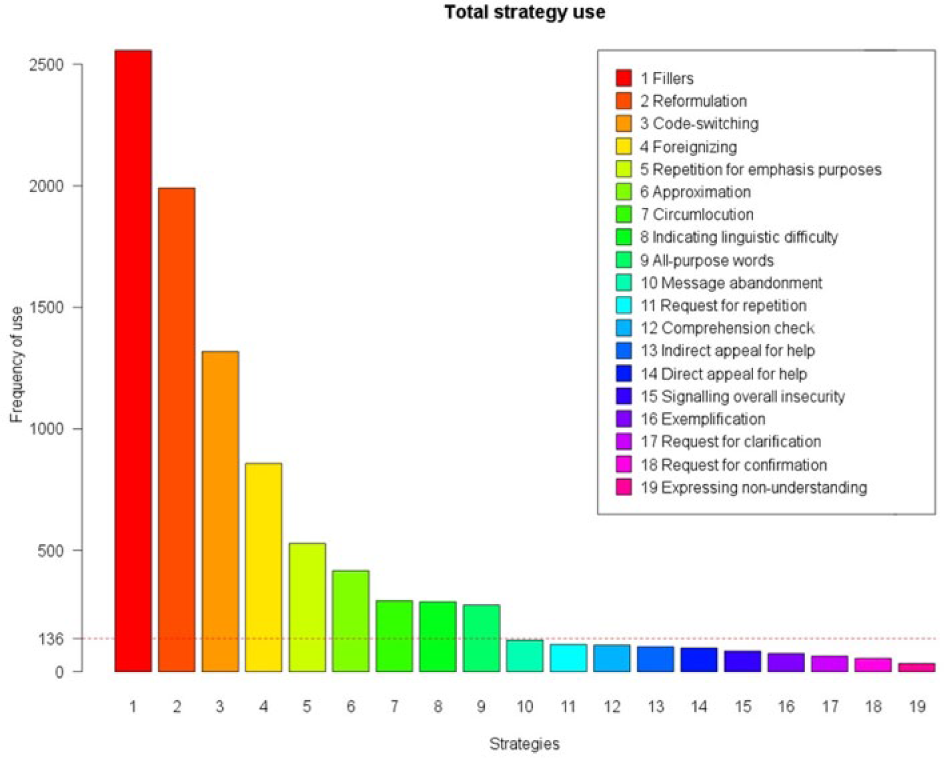
Frequencies of use in the Nijmegen Corpus of Spanish English of all 19 strategies in the coding scheme. The dotted line indicates the average use of a strategy of two times per recording.
Nine communication strategies were used more frequently than two times per recording on average. Eight of them were direct strategies (for examples taken from the NCSE, see the Appendix): reformulation, code-switching, foreignizing, approximation, circumlocution, all-purpose words, repetition for emphasis purposes and the use of fillers. One uncertainty strategy, the indication of an immediate linguistic difficulty, was also used more frequently than two times per recording on average.
Except for a new variable called ‘overall communication strategy use’, which expressed the presence of any of the 19 strategies in a particular chunk, we only examined the impact of the situational context on the use of each of the nine most often frequently used communication strategies. This leads to a total of 10 separate variables for which we fitted linear mixed effects models. We set our α-level at .005 to correct for multiple comparisons.
The influence of situational context on overall communication strategy use
We found no simple fixed effect of formality on overall communication strategy use, but the random slope for formality by speaker was significant: half of the speakers used more strategies in formal speech and the other half used more strategies in informal speech. The size of the effect also varied considerably between individual speakers: some speakers were more affected by the change in formality than others.
Unsurprisingly, longer chunks were more likely to include a strategy. This effect was significant (p < .001) in each of the models described in this section. Since chunk length was merely a control variable, it will not be discussed separately for the remaining models except when it showed an interaction with another predictor.
For overall communication strategy use, we found an interaction between chunk length and formality: the effect of chunk length was larger in the informal than in the formal situational context (z(55,908) = 3.46, p < .001), which reveals that a long chunk in informal speech is more likely to contain a communication strategy than a long chunk in the formal situational context.
The influence of situational context on individual strategies
A summary of the results for the effect of formality on the use of the nine most frequent individual strategies can be found in Table 2.
Results for the effect of formality on the use of the nine most frequent communication strategies; z-scores for the simple fixed effect of formality and χ2-values for the likelihood ratio tests to compare models with and without a random slope for formality by speaker (n.s. means ‘not significant’).

Fillers
We found no simple fixed effect of formality on the use of filler words (e.g. like, I mean, you know), but the random slope for formality by speaker was significant: about half of the Spanish speakers in the NCSE used more fillers during the formal interview, whereas the others used more fillers in the informal conversation.
We also found an interaction effect of formality and chunk length on the use of fillers (z(55,906) = 6.72, p < .001): longer chunks are more likely to contain one or more filler words in the informal than in the formal situational context. In example (2), the Spanish speaker explains that after school (he uses the foreignized form ‘career’) he wants to go abroad to a film academy. He uses the filler ‘like’ on several occasions to gain time to explain that he wants to pursue his cinematographic dreams.
(2) (Male speaker M14 in the informal conversation; lines 57–66)
SP I think when I finish eh the career I will I will try to go London or somewhere with a good academy [breath] DU ok hm SP and study there some years but eh the problem is eh it is like eh kind risky DU ok SP so to in the cinema world I mean if [breath] DU hm SP eh it is like be a bit eh [laughter] how to say [breath] naive but eh I I want to try to naive
An interaction was also found between gender and chunk length: the effect of chunk length was smaller for male speakers than for female speakers (z(55,906) = –3.06, p < .005). When female speakers produced longer chunks, they were more likely to contain one or more filler words than when male speakers produced longer chunks. In example (3), the Spanish female speaker offers to take the Dutch partner sightseeing and uses fillers.
(3) (Female speaker F11 in the informal conversation; lines 220–223)
SP so if you want I can give you my mobile phone if you want to I do not know to know something or something like that DU like a tour? SP ˆyes DU oh that would be nice SP maybe if we we have t\- if you have time and you do not know what to do or something
Reformulation
A fixed effect of formality showed that reformulation occurred more often in the formal situational context, in 4.22% (869 of 20,572) of the chunks, against 3.10% (1096 of 35,338) of the chunks in the informal situational context. For example, in the formal interview, the Dutch speaker invites the Spanish interviewee to introduce himself. The Spanish speaker replaces soccer by football and young people by kids as if he autocorrects himself.
(4) (Male speaker M8 in the formal interview; lines 10–16)
SP eh I I work in a golf club eh giving soccer lessons this sounds so strange because is a golf club and I give soccer football lessons [breath] DU hm SP but is what I do [breath] to to young people to to kids DU ok interesting
Code-switching
We found a fixed effect of formality on the number of code-switches, which were more frequent in the informal than in the formal situational context. Of all informal chunks, 2.68% (947 of 35,338) contained at least one code-switch, whereas this was the case for 1.73% (356 of 20,572) of the formal chunks. There was significant variability in the effect of formality for individual speakers, but all showed more code-switching in the informal situational context, with the exception of three speakers who showed virtually no effect of formality. In example (5), the Spanish speaker explains that he wants to work as a consultant in an enterprise. The Spanish word resembles the English word, and therefore this code-switch works as an efficient solution.
(5) (Male speaker M1 in the informal conversation; lines 357–362)
SP eh I would like to be a a consultor consultor in a a enterprise [breath] but I would like to [breath] to to work in New York or in L LA DU in New York? nice
Foreignizing
Foreignized words were produced more frequently during the formal interview (in 1.87% of the chunks; 384 of 20,572) than during the informal conversation (in 1.29% of the chunks; 456 of 35,338). The size of the effect of formality differed significantly per speaker, but all speakers used more foreignizing in the formal than in the informal situational context, except for one speaker who showed virtually no effect of formality, and one speaker who showed an effect in the opposite direction. Example (6) is taken from a formal interview, where the Dutch participant is interviewing the Spanish participant about the economic crisis in Spain. The Spanish speaker uses the word ‘matriculation’, the Spanish word for ‘tuition’, but he pronounces it in an English way ending in /ˈleɪʃən/. He Anglicizes a Spanish academic term for which he finds it difficult to find a formal English equivalent.
(6) (Male speaker M17 in the formal interview; lines 160–166)
DU and we also hear there is there is cuts on education [breath] eh students have to pay more [breath] SP yeah DU for their education SP yeah DU how do you feel about that? SP well I feel bad because it affects directly for to me [breath] and DU hm SP my matriculation will cost next year more than the double than this year
Foreignizing and code-switching are closely related: code-switching is the relatively cognitively effortless insertion of a L1 lexical item, while foreignizing involves some cognitive effort by the speaker to make the lexical item more L2-like. We investigated how these two strategies interacted by fitting a linear mixed effects model that predicts the presence of foreignizing based on the fixed factors ‘presence of code-switching’ and formality. We found fixed effects of formality (z(55,906) = –5.00, p < .001, β = –0.35), confirming the influence of formality on the use of foreignizing, and of ‘code-switch present’ (z(55,906) = 3.61, p < .001, β = 0.93), which shows that when a chunk contained a code-switch, it was also more likely to contain a foreignized word. However, most importantly, there was also a significant interaction between the factors code-switching and formality (z(55,906) = –3.35, p < .005, β = –1.46). We took a closer look at this interaction with two separate linear mixed effects models: one for formal and one for informal speech. This revealed that when a code-switch was present in a chunk, the probability of a foreignized word also being present was only higher in the formal situational context (z(20,570) = 3.33, p < .005) but not in the informal situational context (z(20,570) = –1.30, p > .01). In other words, while a code-switch often seems to suffice in the speakers’ eyes to prevent or overcome communication difficulties during the informal conversation, they often do not consider it sufficient during the formal interview, in which speakers are more likely to also add foreignized words.
Repetition for emphasis purposes
Adding emphasis by repeating a word occurred more often in informal speech, in 1.22% (432 of 35,338) of the chunks, than in formal speech, in 0.46% (94 of 20,572) of the chunks. The speakers varied significantly in their sensitivity to formality, but all speakers showed a formality effect in the same direction, except for one speaker, who seemed to show a small effect in the opposite direction. Example (7) shows a typical example in which the speaker in the informal conversation stresses how much he admires the English pronunciation of the Dutch interlocutor.
(7) (Male speaker M1 in the informal conversation; lines 253–256)
SP your pronunciation is not it is very very very very very as that of English DU [start laughter] ok [end laughter] SP Spanish pronunciation is very bad [breath] I do not like my pronunciation DU [laughter] you have to practice English SP [laughter]
Approximation
We found no fixed effect of formality on the use of approximations, but the random slope for formality by speaker was significant. All but seven speakers used more approximations in the formal situational context. Three speakers showed virtually no effect of formality and four speakers showed relatively small effects in the opposite direction. Example (8) shows a typical example of a Spanish speaker who cannot come up with the word ‘circle’ in the formal interview, and simply says ‘round’. The interlocutor knows exactly what he means, and fills in the correct word.
(8) (Male speaker M3 in the formal interview; lines 512–525)
SP if the econon\- if the media say that a crisis has gone by and the economy is getting better I think that the people will buy like more food and clothes and whatever so the shops will hire more and more people and the people with employment will buy more things and it is like a DU ok SP round DU a circle SP a circle DU yeah
All-purpose words
A fixed effect of formality on the use of all-purpose words was found: in the formal situational context, 0.78% (161 of 20,572) of the chunks contained an all-purpose word, against 0.29% (102 of 35,338) of the informal chunks. The random slope for formality by speaker was also significant: all speakers used more all-purpose words in the formal interview than in the informal conversation, except for one speaker who showed virtually no effect of formality. Example (9) illustrates how a speaker in the formal interview throws in the same all-purpose words (‘the stuff that happened’) when he wants to explain how he participated in the social uprisings in Spain.
(9) (Male speaker M14 in the formal interview; lines 79–86)
SP personally I have to say before before everything that I am really really sceptic with the actual government DU ok SP and I do not like it at all at all you know [breath] I was eh I participated very actively with all the stuff that happens DU no SP last year actually if an\- almost one year from now the stuff that happened in Sol square [breath] with the movement the s\- the [breath] social movement
General discussion
The present paper reports on a comparative study of communication strategy use by Spanish speakers of English between an informal, peer-to-peer conversation and a formal interview. It complements previous SLA work since we investigated the impact of situational context on communication strategy use in settings that are not aimed at language acquisition. It complements ELF studies since we systematically investigated LX users of English communicating with other LX users of English, in casu Spanish users of English communicating with Dutch users of English. It also complements bilingualism research, since we investigated the impact of register sensitivity in LX interaction. We were interested in language users instead of language learners, and we took a quantitative, comparative perspective in order to discover generalizable patterns that may teach us whether LX speakers of English are sensitive to register change in their use of communication strategies. We formulated three related research questions: (1) Which strategies are used most often? (2) Do speakers use certain communication strategies more often in a formal situational context and other strategies in an informal situational context? (3) Is there variability in the effect of formality on individual speakers’ strategy use?
The Spanish speakers of English used communication strategies in almost 16% of all chunks they produced, and they employed some strategies much more frequently than others. Inspection of the frequencies of use of 19 strategies shows that the Spanish users of English in the NCSE rarely used interactional communication strategies but preferred direct and indirect communication strategies, which we dubbed self-reliant strategies. The speaker may consider these self-reliant strategies as more efficient, because they allow him or her to keep the floor, and he or she may think that it is faster to solve the problem alone than in interaction. It may also be the case that our participants did not use more interactional strategies because they were not really familiar with each other (neither in the formal nor in the informal part of the recording). It is not inconceivable that they would have used them more if they had been close friends, or family related. Surely, our manipulation of formality did not touch the extremes of the formality dichotomy.
An alternative explanation revolves around face-management. It seems as though Spanish speakers are concerned with their positive face (Brown and Levinson, 1987): as long as they are able to continue communication on their own, they may be viewed as competent language users, whereas asking for assistance, emphasizing one’s own weakness or leaving a message unfinished, is harmful to the image of a competent speaker. Self-reliant strategies (e.g., circumlocutions, code-switches and approximations) allow a speaker to maintain the flow of communication and are therefore beneficial to the speaker’s positive face. When a speaker uses one of the interactional strategies, this may be viewed of as face threatening, since it reveals that the speaker (temporarily) fails to perform as a competent language user and requires assistance.
In this light, it may seem surprising that the indication of linguistic difficulty was among the most frequently used strategies. Using an uncertainty strategy can also be considered as a threat to the speaker’s positive face, since the speaker conveys a message of (temporary) incapacity to produce or perceive language. A closer look at the data, however, revealed that indicating linguistic difficulty may be seen as a strategy to gain some time and often fulfils a function that is similar to that of filler words. In example (10), for instance, an indication of linguistic difficulty is immediately followed by a circumlocution.
(10) (Male speaker M15 in the informal conversation; line 118) SP I do not know in English how it is called […] eh the exam you have to take before attending university
Yet another explanation is that communication strategies that do not allow speakers to effectively communicate their intended messages are generally largely absent from ELF interactions, since in real-life goal-oriented communication speakers simply cannot afford to abandon messages (see, e.g., Björkman, 2014). However, while this may explain the frequent use of direct strategies, it does not explain why speakers do not ask for help, since asking questions engages interlocutors in a process of co-construction of meaning, which can be very effective.
With regard to our second research question, we compared communication strategy use in informal, peer-to-peer conversations with communication strategy use in formal interviews. There was no overall difference in communication strategy use between the two situations, but there was an interaction between chunk length and formality. The interaction shows that especially in informal speech, a longer chunk is more likely to contain a communication strategy than a shorter chunk. These strategies include inserting hesitation markers (e.g., eh) or filler words, for which we also found an interaction between chunk length and formality (cf. Tang, 2015, who found an interaction between proficiency and the use of fillers).
Seven of the nine most frequent communication strategies were linked to formality. Two strategies were used more often in the informal than in the formal situational context: code-switches and repetition for emphasis purposes. This is in line with Dewaele (2001), who also found that LX speakers use fewer code-switches in formal situations than in informal situations. Code-switches and repetition for emphasis purposes are least effort strategies, and could be detrimental to their interlocutor’s understanding of the message: relatively effortless strategies may hamper effective communication. In informal situational contexts, the need to be exact and fully understood may be less stringent, for example when speakers are engaged in small talk, or it may be considered acceptable when the interlocutor needs to ask for clarification of a communication strategy, given the more interactive nature of the communication. There are less cognitive resources needed to control the output. Code-switching is the ‘lazy option’ (Dewaele, 2001, p. 84).
Other strategies were used more often in formal than in informal speech. These include reformulations, foreignizing and the use of all-purpose words. For approximations, we found no fixed effect of formality, but the individual speakers’ slopes for formality suggest a trend towards a similar effect of formality: most speakers used more approximations in formal than in informal speech. All-purpose words and approximations are L2 alternatives for target lexical items, and therefore can be considered more helpful to the interlocutor than code-switches. This applies to an even larger extent to foreignizing and reformulation. Consequently, we found that in formal situational contexts, in which the focus is relatively more on information exchange than on relational or situational issues, speakers use more communication strategies that invoke more cognitive control (cf. Dewaele, 2001).
In conclusion, our findings suggest that L2 speakers take account of the situational context and choose communication strategies based on the need for explicit information exchange. These findings contribute to earlier findings based on the same corpus (Kouwenhoven et al., 2018) showing that the speakers also took the situational context into account in how much they laughed (five times more often in the informal than in the formal parts of the recordings) and in how often they produced overlapping speech (four times as often in the informal than in the formal recordings).To answer to our third research question, we investigated whether individual speakers differed in the extent to which their communication strategy use was influenced by the formality of the situation. We found that the effect of formality varied significantly among individual speakers for six of the seven strategies for which we found formality effects. It seems only logical that these individual differences result from differences in, for instance, personality, personal style, learning history and proficiency. The only strategy that showed no individual variation in the effect of formality was reformulation. In contrast, while there was no simple fixed effect of formality on the use of filler words and approximations for the group of speakers as a whole, the individual speakers’ slopes did reveal variation among speakers in the effect of formality. The individual slopes for approximations revealed a rather consistent pattern, showing that approximations were used more often during the formal interview by almost all speakers.
The speaker-dependent slopes for fillers revealed a more diffuse picture: about half of the speakers used more fillers in informal speech, whereas the other half used more fillers in formal speech. This may be explained by a difference in the function that filler words may have for different speakers (Aijmer, 2004; Götz, 2013; Hasselgren, 2002) or by speakers’ individual speaking styles, which they possibly also show in their L1 (Olynyk, d’Anglejan, & Sankoff, 1987; Tang, 2015). For instance, the functions of the filler word like are manifold (e.g., Tagliamonte, 2011) and subtle functional differences in the occurrences of like in our data are conceivable: for some speakers, like may have mainly served pure time-gaining purposes, as in (11), whereas other speakers not only gained time and kept the communication channel open, but also enhanced the informal character of their speech, as in (12).
(11) (Male speaker M4 in the informal conversation; lines 502–505) SP but then if you want to study everything related to I do not know how to say to like eh words like (12) (Female speaker F10 in the informal conversation; lines 148–150) SP so eh like there is always like half an hour that it the club is empty but then it hm gets like really full like really fast
Furthermore, there may be gender differences in the use of fillers, as revealed by the interaction between gender and chunk length: the difference between short and long chunks in the occurrence of filler words is larger for female than for male speakers. A future, qualitative analysis of the use of fillers in the NCSE may unveil patterns in the use of fillers that our quantitative approach did not uncover.
Our study used a combination of qualitative annotation (or human annotation) and quantitative methods for large corpus analysis. We believe that this combination increases the impact and trustworthiness of our findings and goes beyond local descriptions of communicative processes. We acknowledge that we set up (slightly) controlled speech situations in order to produce generalizable findings. The informal conversations that we recorded may not have been at the extreme of the informal–formal continuum, but they were clearly more informal than the formal interviews.
Future research may also focus on the non-verbal aspects of communication strategies. Gullberg (1998) claims that verbal communication strategies are usually combined with gestural communication strategies as a way to enhance communicative effectiveness, but that gestures may also be used as stand-alone communication strategies. If speakers are more driven by the need to communicate their intended message in the formal situation, then it is probable that they gesture more in formal speech than in informal speech, since gestures can provide the interlocutor with additional information. Yet, speakers may gesture less, if they consider such behaviour inappropriate in a formal compared to an informal situational context. Analyses of non-verbal communication strategies may be carried out based on the data in the NCSE, which includes video recordings of all situational contexts.
Future studies may also investigate the effect of the speaker’s language proficiency on communication strategy use. In the present study we did not include proficiency, since the proficiency levels of the Spanish speakers in the NCSE are divided rather unequally over a limited number of CEFR proficiency scores (see Kouwenhoven et al., 2018). All speakers used communication strategies, but further investigations are necessary to grasp how proficiency impacts communication strategy use and whether there is an interaction between proficiency and situational variation.
All in all, we conclude that LX users of English are sensitive to change in the situational context and vary their use of communication strategies accordingly. They may have individual preferences for the particular use of a strategy to express register awareness.
Footnotes
Appendix
Definitions with examples of all 19 communication strategies in this study taken from the NCSE. The three communication strategies marked with * were induced from the NCSE; the remaining 16 are based on Dörnyei and Scott (1997). Every example is followed between brackets by the location of the example in the corpus: the code consists of a letter indicating the speaker’s gender (male versus female), the speaker’s number, a letter indicating the communication situation (informal versus formal) and by the lines in the orthographic transcription.

| Communication strategy | Definition | Example |
|---|---|---|
|
|
||
| All-purpose words | Extending a general, ‘empty’ lexical item to contexts where specific words are lacking | it is also really difficult to to make new companies in Spain […] that could be a good point if they if they helped eh to make faster |
| Approximation | Using a single alternative lexical item, such as a superordinate or a related term, which shares semantic features with the target word or structure | it was a a |
| Circumlocution | Illustrating or describing (using more than one word) the properties of the target object or action | so we were to a […] |
| Code-switching | Including L1 words in L2 speech; either single words or whole chunks | it is a |
| Exemplification* | Expressing an abstract message in a concrete way with an example or an instance of the abstract message | well if you jump […] always there is a a security man |
| Fillers | Using gambits (actual words, not ‘eh’, ‘hm’, etc.) to fill pauses / to stall / to gain time | I because I saw like / in a tv I saw |
| Foreignizing | Creating a L2 word from a L1 word by applying (supposed) L2 phonology/morphology to it | they have the hm absolute |
| Reformulation | Repeating/rephrasing (parts of) the message until reaching a satisfactory result | ah Madonna yes |
| Repetition for emphasis purposes* | Repeating a lexical item because alternatives are lacking, in order to add emphasis or intensify | no eh this university is close […] but the others university it is |
|
|
||
| Comprehension check | Asking questions to check that the interlocutor can follow | a *cana / do not you know what a *cana is? / is a a beer / a little beer |
| Direct appeal for help | Turning to the interlocutor for assistance by asking an explicit question concerning a gap in one’s L2 knowledge | tv series or |
| Indirect appeal for help | Trying to elicit help from the interlocutor indirectly, for instance with a rising intonation | no because eh the the players hm |
| Request for clarification | Requesting the interlocutor to explain an unclear / unfamiliar utterance (for instance with a rising intonation) | DU: when you you know the word but you cannot come up with it SP: eh DU: I could not figure out his name (M6_I_660–5) |
| Request for confirmation | Requesting confirmation that one heard or understood something correctly (for instance with a rising intonation) | |
| Request for repetition | Requesting repetition when not hearing or understanding something properly | |
|
|
||
| Expressing non-understanding | Expressing that something is not properly understood | eh |
| Indicating linguistic difficulty | Using verbal marking phrases before or after a strategy to signal that the word or structure does not carry the intended meaning perfectly in the L2 code | there have been some |
| Message abandonment | Abandoning an intended plan without having reached a satisfactory alternative | the new government ha\- has done eh a lot of eh laws new laws in in different fields eh in they are |
| Signalling overall insecurity* | Apologizing (in general) for inadequate proficiency in English | |
L1: first language; L2: second language.
Declaration of Conflicting Interests
The author(s) declared no potential conflicts of interest with respect to the research, authorship, and/or publication of this article.
Funding
The author(s) received no financial support for the research, authorship, and/or publication of this article.