




Abstract
Aims and objectives:
A vast body of research has dealt with negation processing. There are many differences between negations across languages, which could influence negation processing in bilingual speakers. However, bilingual negation processing has rarely been experimentally investigated. This study aims at exploring whether highly proficient Croatian-English bilinguals are able to adequately adopt English negations, and whether linguistic cues from both languages have similar effect on negation processing.
Methodology:
A sentence–picture verification task was used to investigate the processing of affirmative sentences, sentential and constituent negations, Croatian negative concord and English sentences with negated subject.
Data and analysis:
2 (language) × 4 (sentence type) × 2 (congruency) ANOVA with repeated measures was used to analyze the data.
Findings:
The results showed that the effect of language was not significant, except in the case of constituent negations which were processed faster in English. There was a significant difference between the processing of affirmative and negative sentences, as affirmatives were processed faster than negatives in both languages. Constituent negations in both languages were processed slower compared with other types of negations.
Originality:
The results suggest that strong linguistic cues, such as word order and quantifiers, influence negation processing in both languages, resulting in differences between different types of negations. The results are discussed in the light of two existing models of negation and sentence processing. A new model, as a combination of these two models, is proposed.
Implications:
The fact that there was no significant difference in negation processing between the bilinguals’ two languages supports the view that highly proficient successive bilinguals are able to adequately adopt negations in both their languages.
Negation processing
Negation occurs in every known language. A vast body of research has shown that negations are more complex to process than affirmatives in young adults (e.g. Budiu & Anderson, 2005; Carpenter & Just, 1975; Cheng & Huang, 1980; Clark & Chase, 1972; Ćoso & Bogunović, 2016; Just & Carpenter, 1971; Just & Carpenter, 1976; Kaup, 2001, 2006; Kaup, Lüdtke, & Zwaan, 2005, 2006; Kaup, Yaxley, Madden, Zwaan, & Lüdtke, 2007a; Kaup, Zwaan, & Lüdtke, 2007b; Lea & Mulligan, 2001; Margolin & Hover, 2011; Tian & Brecheny, 2015), as well as older adults (e.g. Margolin, 2015; Margolin & Abrams, 2009). However, negation processing in bilingual speakers has rarely been experimentally investigated (e.g. Hasegawa, Carpenter, & Just, 2002).
The existing models of sentence processing explain the differences between the processing of affirmative and negative sentences. One of the first models suggests that negation changes the focus of information in the sentence, which results in lower availability (MacDonald & Just, 1989; Paterson, Sanford, Moxey, & Dawydiak, 1998). Research has shown that, in certain conditions, negation increases information retention (Giora, Balaban, Fein, & Alkabets, 2005; Giora, Heruti, Metuki, & Fein, 2009). According to the early propositional view (Carpenter & Just 1975; Clark & Chase 1972), negations are represented as two propositions (one positive and the other negated), while affirmative sentences are represented as only one proposition. Propositions are made from all the basic elements in a sentence and can be described as concepts that give meaning to the sentence. Sentences with more propositions are harder to process, which consequently makes negation processing more complex than processing of affirmative sentences. Kintsch (1988, 1998), on the other hand, argues that affirmatives are not necessarily one-proposition sentences, as a list of propositions is created during sentence comprehension. When the reading process is completed, all propositions are edited in a network of propositions. This network is described as raw material for creating mental representations as combinations of text and knowledge about the world (Kintsch, 1988). During negation processing, positive propositions are embedded under the negation marker.
One of the most cited experiential models of negation processing is the two-step model (e.g. Kaup et al., 2005, 2006; Kaup et al., 2007a, 2007b), derived from the Situational model of sentence comprehension (van Dijk & Kintsch, 1983; Zwaan & Radvansky, 1998). The Situational model explains sentence comprehension not only through syntactic and semantic structures, but also in terms of mental models created from a situation described in a sentence. The model proposes that sentences are processed as situational representations. For example, the sentence The egg is in the refrigerator will elicit a situational model of a whole egg, while the sentence The egg is in the pan will elicit a model of a poached egg (Zwaan, Stanfield, & Yaxley, 2002). In the case of negations, the sentence There was an eagle in the sky will not elicit the same situational model as the sentence There was an eagle in the nest (Zwaan & Madden, 2005). Still, sentences There was an eagle in the sky and There was not an eagle in the sky will elicit the same model. In the first example, a model of an eagle with its wings stretched out will be created, unlike the second sentence, where a model of an eagle with its wings drawn in will be created. During comprehension, pieces of information well incorporated in a situational model are easier to comprehend, and therefore need less processing time. The two-step model suggests that in the first step of negation processing the affirmative model is created, and in the second step this model is negated. Thus, negation is incorporated in the second step of the process. This can be illustrated by the sentence Doors are not open (Kaup, Lüdtke, & Zwaan, 2006), which is first processed as Doors are open, and then negated in the second step, representing the real state. When reaction times between this sentence and the affirmative version with the same meaning (Doors are closed) are compared, the first will take more time to process.
Previous research has shown that other linguistic factors might influence negation processing as well. For example, Kaup et al. (2007a) found that definite negations are processed faster compared with indefinite negations, suggesting that word order and negation type could affect the creation of a situational model from the sentence. Ćoso and Bogunović (2016) recently found a significant difference in the processing of same-polarity sentences with first-order quantifiers. Negative concord sentences with null quantifiers were processed faster and more accurately than sentences with disproportional and non-universal quantifiers. These studies suggest that different linguistic cues could also play an important role in negation processing, in addition to the described two-step processing. The Competition model (Bates & MacWhinney, 1987) defines linguistic cues as linguistic components from all linguistic levels. They can be morphological cues, word order or semantic knowledge about the relations between objects in a sentence. The model also assumes that strong syntactic and semantic cues can affect sentence processing, and result in lower reaction time and higher accuracy (Li & MacWhinney, 2012). As already mentioned, there are different types of negations across languages and a number of potential linguistic cues that could influence negation processing. Research on negation processing in bilingual speakers could shield some light on the potential differences in processing patterns between a bilingual’s two languages.
Negation processing in L2
Research on negation processing in second language (L2) is generally motivated by the fact that negation is a universal phenomenon, and the fact that negation processing is more complex than processing of affirmative sentences. Hasegawa, Carpenter, and Just’s (2002) fMRI study on L2 negation processing involved Japanese-English bilinguals, and was aimed at detecting cortical activity depending on the difficulty of the task, with manipulation of both affirmative/negative sentences and language. The results showed that the same cortical areas activated during L1 and L2 processing. Also, no significant difference was found between the processing of L1 and L2 affirmative sentences. However, more cortical activation was observed during L2 negation processing compared with L1, suggesting that L2 negations are more difficult to process.
Most studies on negation processing rely on research on language transfer. Language transfer or cross-linguistic influence refers to a mutual influence of language rules between two or more languages, and usually occurs during language learning (second, foreign, and hereditary) and bilingual language processing. It generally denotes transfer of first language (native language) rules to L2 sentences, or their interrelation (MacWhinney, 2004; Odlin, 1989). Transfer can be positive (supportive) or negative (interfering), depending on similarities and differences between the languages, and can occur on every linguistic level (Odlin, 2003). According to Odlin (2003), the main reason behind this phenomenon is the similarity between the languages, which is why language transfer is more likely to occur in the case of related languages, while distant languages will experience less transfer. Kellerman (1977, 1992) introduces the term psychotypology, which denotes the subjective experience of two languages, and can differ from the objective relatedness between them. Consequently, linguistic structures that are perceived as universal are more likely to be transferred than structures that are language specific.
The Unified competition model (MacWhinney, 2008) also differentiates between positive and negative language transfer. The model assumes that positive transfer occurs when linguistic forms between two languages are compliant and facilitate L2 learning and usage. In contrast, if there is a significant difference between L1 and L2 negative transfer will occur, which will make L2 learning and usage more difficult. According to the Unified competition model, transfer will occur whenever one language is stronger than the other (MacWhinney, 2008), due to simultaneous activation of both languages during language processing (Tokowicz & MacWhinney, 2005). It is assumed that the strength and validity of L1 cues play an important role in language transfer, because of the attempt to implement them during L2 processing. In other words, the role of different cues in language transfer depends on their strength. Cues can refer to any syntactic, semantic, pragmatic or contextual information in the sentence. For example, in the sentence Grass is eating a horse, there is an obvious semantic (and contextual) cue that tells us that the sentence is incorrect, and should instead say that A horse is eating grass. The impact and consequences of language transfer are evident in various aspects of language and language processing, including the processing of syntactic patterns, language comprehension and interpretation (MacWhinney, 2004, 2008). As in other aspects of language, negative transfer will not necessarily occur in the process of accessing negations from another language. Still, transfer of negations was observed when successive bilinguals used Croatian negative concord (Macan & Kolaković, 2008; Vrljić, 2011), which will be described in the following section.
Negations in Croatian as L1 and L2
Negative concord is perhaps the most interesting type of negation in the investigation of language processing in Croatian speakers. Negative concord refers to sentences with two negations resulting in negative meaning (Wouden, 1993, 1994). Some languages allow, and sometimes require, the use of negative concord in standard language. In others, such forms are rarely found—either as an exception or grammatical error. In English and German only one negated word is allowed in a sentence with negative meaning. Thus, negative concord is not a standard form (e.g. Cheshire, 1998). In contrast, all Slavic languages, including Croatian, allow negative concord (Menac, 1953; Zovko Dinković, 2013). In Croatian, negative concord is mostly formed by negation of a universal quantifier. If a quantifier (e.g. every) is negated as a null quantifier (e.g. none), the verb must match the polarity of the null quantifier. Moreover, if a sentence contains a null quantifier, all undefined parts of the sentence must follow their negated form (Zovko Dinković, 2013). For example, negation of the quantifier svaki (Eng. every) into the null quantifier nijedan (Eng. no, none) in the sentence “Svaki auto je crven” (Eng. “Every car is red”), forms negative concord where both the verb and the null quantifier are negated, semantically resulting in the following negation: “Nijedan auto nije crven” (Eng. “No car is (not) red.”).
No experimental data on language transfer has been found for Croatian, but some studies indicate that negative concord is perceived as difficult when learning Croatian as a foreign language. Alujević Jukić & Brešan (2010) found transfer of negations in Italian learners of Croatian as L2. Transfer occurred on the syntactic level, probably due to the differences in word order between Italian and Croatian. Sentences with negative concord seem to be more difficult to learn for German learners of Croatian as well (Macan & Kolaković, 2008; Vrljić, 2011). Errors mostly occur because German language rules do not allow negative concord, and only one negative marker without a negated quantifier is sufficient to negate a sentence. As a result of language transfer, the students mostly omitted either the negative quantifier or the negated verb. According to the Unified competition model, such transfer of negations occurs because of the dominant linguistic cues from L1. In this case, only one negative marker is used to negate the whole sentence—the null quantifier or the verb. As the learning process advances, L1 linguistic cues become less dominant, and second grade students will not make mistakes in simple tasks. However, transfer will occur in more complex tasks, where L1 cues still override L2 rules. Macan and Kolaković (2008) emphasize the importance of further research on the processing of negative concord, because it represents an interesting example of language transfer that is partly resistant to the influence of L2 knowledge.
Present study
To our knowledge, negation processing in Croatian bilinguals has not been experimentally investigated. Bilingual negation processing has generally been rather neglected. As previously mentioned, negation, negative concord in particular, has a specific role in language transfer. Also, negation processing presumably includes different stages (de Swart, 2009), which could interfere with the results of the study. Therefore, highly proficient Croatian-English bilinguals seem to be an adequate sample for the investigation of negation processing in bilingual speakers.
Successive bilingualism is a type of bilingualism where L2 is learned well after L1. This usually means that second language learning started after the age of three, or even later in life, for example in school (Hržica, Padovan, & Kovačević, 2011). Croatian university students studying English language and literature can be seen as successive bilinguals: they are highly proficient in English, they use English daily, and they started learning English years after their L1. In reaction time experiments, grown-up participants generally perform better in tasks that require making quick decisions compared with young children (MacWhinney, 1992). Therefore, grown-up successive bilinguals are considered to be an adequate sample in the investigation of bilingual mechanisms using behavioral tasks.
The first goal of this study is to investigate whether or not language plays a significant role in negation processing in highly proficient Croatian-English bilinguals. According to some theories, successive bilinguals can adopt semantic and syntactic structures of their second language and achieve native-like proficiency just as well as early L2 learners. If so, no significant difference between the two languages should occur. A study by Wen and Schwartz (2014) showed that the processing of different aspects of negation in Chinese did not significantly differ between native speakers and advanced L2 speakers. Thus, it is expected that reaction times and accuracy of answers for Croatian and English pairs of sentences will be similar, despite the already described grammatical differences between the two languages.
The second goal of the study is to explore the potential within-language differences in reaction time and accuracy of answers between affirmative and negative sentences, and detect the cues that might be responsible for those differences. Research has shown that different types of negations elicit different reaction times and accuracy rates (e.g. Kaup, Yaxley, Madden, Zwaan, & Lüdtke, 2007a), which could be ascribed to linguistic cues (Ćoso & Bogunovic, 2016). As described earlier, linguistic cues occur on all linguistic levels. In this study, quantifiers that form negations will be examined. If successive bilinguals are able to adopt semantic and syntactic cues as successfully as native speakers and early L2 learners, these cues should affect both languages similarly. In that case, a difference between the processing of Croatian negative concord and English sentences with negated verb is expected, as a result of the fact that the strength of a negated quantifier and negated verb as cues is not clear. Transfer from negative concord into sentences with negated verb could occur as a facilitating factor in negation processing.
Method
Participants
The target sample consisted of 30 participants; 22 were female and eight were male. All participants were students of English language and literature (Master’s level) as a part of a double major at the University of Rijeka. The participants were native speakers of Croatian, aged 22–24. Three participants were excluded from further analysis because of long reaction times which exceeded 5000 ms, and low accuracy rates (<4). The participants volunteered to take part in the experiment and they were not reimbursed for their participation. None of the participants reported any problems in language processing or neurological disorders. Also, they all had good or corrected vision. They have been learning English for 15–16 years; since elementary school (age six or seven) and throughout high school. They all had Bachelor’s degree in English. As students of English, they all use English on a daily basis, in their lectures, exams, communication with their lecturers, etc. With all this in mind, they can be treated as a group of proficient speakers of English as a second language. Since students from other courses were not included in the study, it was assumed that the potential differences in proficiency levels would not be significant. For this reason, and due to the goal of this study, proficiency was not additionally assessed.
Materials
Sentences
The experiment was divided into two parts; the only difference was the language in which the sentences were presented (English or Croatian). There were four types of sentences, each given randomly in 16 repetitions: affirmative sentences (A), negative concord (NC), sentential negation (SN), and constituent negation (CN). As negative concord in English is not grammatically correct, it was replaced by sentences with negated subject (NSub) in the English version of the experiment. There were two reasons behind this decision. First, the position of NSub at the beginning of the sentence corresponds to Croatian null quantifier. Second, in the case of Croatian negative concord the quantity of the subject is negated by the null quantifier, but the entire sentence must be negated by the verb. At the same time, English NSub primarily negates the subject, but it has a larger scope which results in the negation of the entire sentence. Therefore, NSub sentences seemed appropriate for comparison with Croatian negative concord. Examples are given in Table 1. The sentences differed with respect to the symbols mentioned, as well as their position in relation to other symbols (above or below).
Example of sentences used in experiment, English and Croatian version.

Pictures
Twenty basic symbols were used to create pictures for the experiment: heart, star, arrow, triangle, cube, square, round, asterisk, trapeze, roller, rhombus, ellipse, exclamation mark, pyramid, question mark, point item, cross, cylinder, plus and percentage. In every picture, three identical symbols were placed above or below another three symbols. Both upper/lower position and relation to other symbols were randomly selected. Pictures were created in Microsoft Office PowerPoint, and saved in .png version. All pictures were black and white, and were not filled with color.
Procedure
The experiment was divided into two parts, English and Croatian. Half of the participants were presented with the English part first, while the other half was first given the Croatian part. Each experimental task consisted of 72 sentence–picture pairs: 8 in a test trial, and 64 experimental pairs.
The investigation took place at the Laboratory for Experimental Psychology, at the Faculty of Arts and Humanities, University of Rijeka. The participants were instructed to read a sentence presented on the computer screen. After reading the sentence (affirmative or negative), they were told to press both buttons on the response box. Then, a blank white screen was shown for 750 ms, followed by a picture that either matched (congruent pair) or did not match the sentence (incongruent pair). The participants were instructed to decide whether the presented pair was congruent or incongruent, and respond as quickly and as accurately as possible by pressing the appropriate key on the response box (blue or red). The key for the correct answer was randomized for each participant. Feedback was given only when the answer was incorrect (duration 300 ms). The purpose of feedback was to make the participants aware of their accuracy rate so they can improve their performance in further estimation. After the presentation of each pair, a fixation mark appeared on the screen (+) for 500 ms to draw the participants’ attention to the center of the screen and prepare them for the next trial. The whole procedure lasted about 20–30 minutes, with a 10-minute break between the two parts of the experiment. E-prime 2.0 was used to measure reaction time in milliseconds and accuracy of answers.
Design and analysis
A 2 × 4 × 2 between-subjects experimental design was used. Independent variables were language (two levels: English and Croatian), type of sentence (four levels: affirmative sentence (A), negative concord (NC)/sentences with negated subject (NSub), sentential negation (SN) and constituent negation (CN)) and congruency (two levels: congruent and incongruent). Dependent variables were reaction time (RT) and accuracy of answers.
To analyze the effect of language and sentence type on reaction time, 2 (language) × 4 (sentence type) × 2 (congruency) analysis of variance (ANOVA) with repeated measurements on all three independent variables was used. The data were analyzed with the STATISTICA7 software. Incorrect answers were excluded from the analysis of RT, while the analysis of accuracy included all answers. Three participants were excluded from subsequent analysis; one because all answers for constituent negation were incorrect, and the other two due to extreme outliers (RT >8000 ms). This criterion for outliers was set above 8000 ms because the values fell outside two standard deviations of the participants’ answers in both constituent negation conditions.
Results
Reaction time
ANOVA showed no effect of language on reaction time, F(1, 26) = .09, MSE = 1112344.29, p = .773, as reaction times for Croatian and English sentences were similar. A significant effect of sentence on reaction time was found, F(3, 78) = 43.11, MSE = 497522.94, p < .001. Newman–Keuls post hoc test showed that affirmative sentences were processed faster than negations at the p < .001 level. Constituent negations were processed significantly slower than other types of negations, p < .001. No significant difference was found between negative concord/negated subject and sentential negations, p = .365. Finally, sentence–picture congruency did not show significant effect on reaction time, F(1, 26) = 0.35, MSE = 474326.02, p = .561. In other words, there was no significant difference between congruent and incongruent pairs.
Interaction between language and sentence type was significant, F(3, 78) = 2.75, MSE = 289546.86, p = .048. The first post hoc analysis was conducted to identify the potential differences in Croatian–English sentence pairs. Newman–Keuls post hoc test showed that English constituent negations are processed faster than Croatian constituent negations, p < .007 (Figure 1). There was no difference between Croatian and English affirmative sentences, p = .563; sentential negation, p = .510; and between Croatian negative concord and English sentences with negated subject, p = .705.
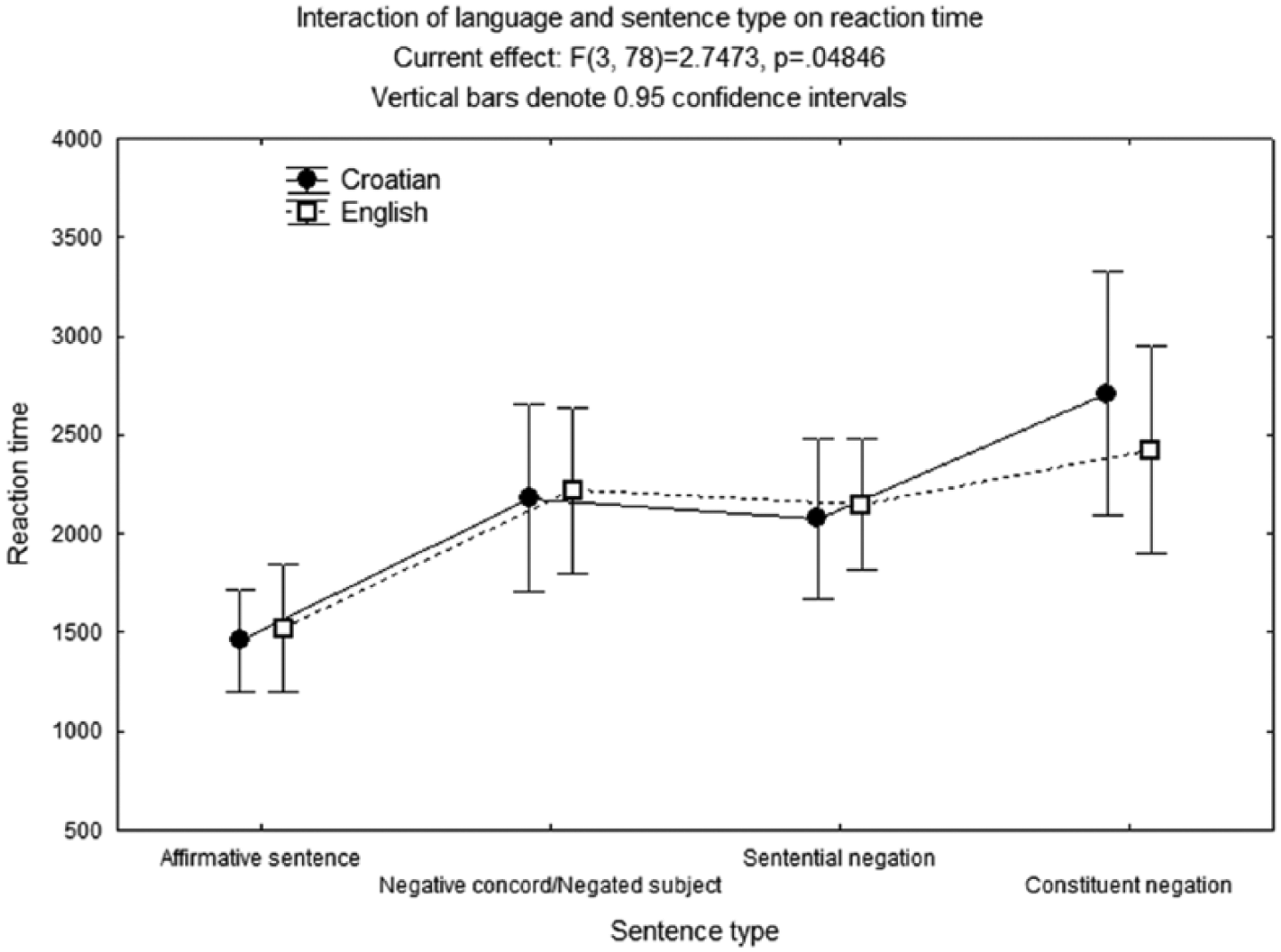
Interaction of language and sentence type.
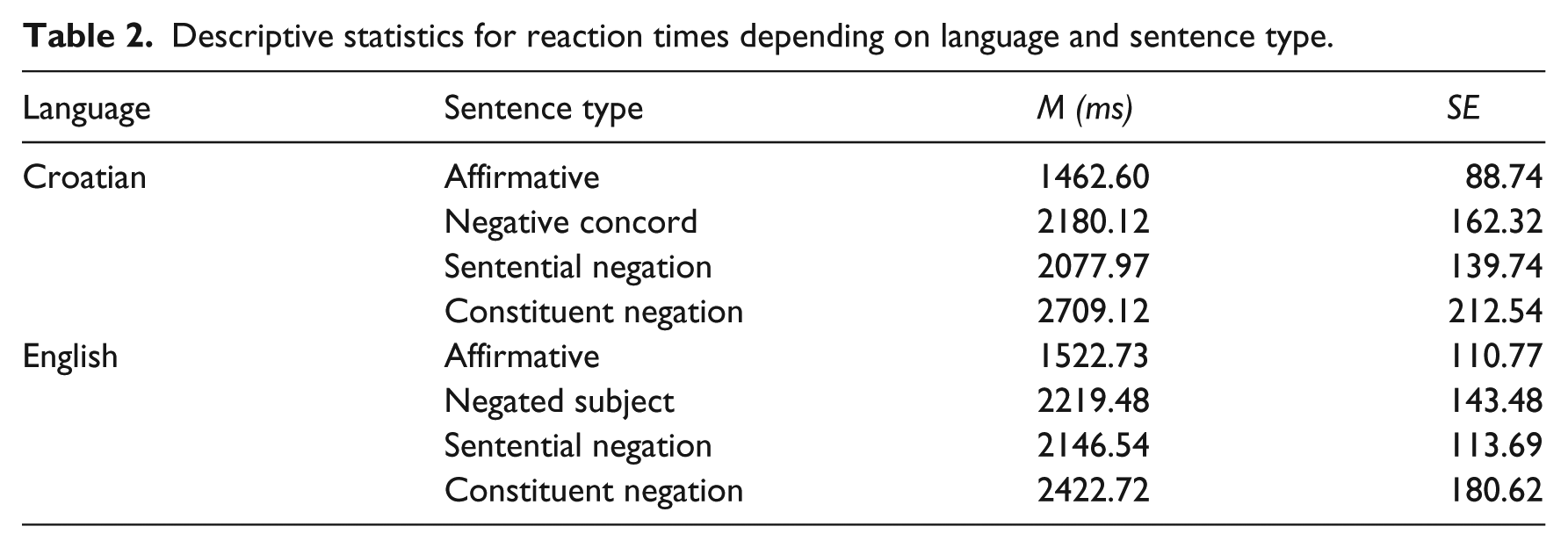
The potential differences between the sentences in both languages were also examined, and a similar pattern was observed. Croatian affirmative sentences were processed faster than negative concord, p < .001, sentential negation, p < .001, and constituent negation, p < .001. There was no difference between Croatian negative concord and sentential negations, p = .588, but Croatian constituent negations required more processing time compared with the other two types of negations, p < .001. Similarly, English affirmative sentences were processed faster than sentences with negated subject, p < .001, sentential negation, p < .001 and constituent negation, p < .001. There was no difference between English sentences with negated subject and sentential negations, p = .762. Still, English constituent negations required more processing time than English sentential negation, p = .045, but not in the case of English sentences with negated subject, p = .053. Similar reaction time patterns in relation to sentence type for both languages are shown in Figure 1 and Table 2.
Descriptive statistics for reaction times depending on language and sentence type.
There was also a significant interaction between sentence type and congruency, F(3, 78) = 6.98, MSE = 316585.38, p < .001. Newman–Keuls post hoc test revealed a significant difference between congruent and incongruent affirmative pairs, p = .024, with congruent pairs requiring less processing time. In the case of constituent negations, incongruent pairs were processed faster than congruent pairs, p < .001. In sentential negations, p = .562, and negative concord/negated subject, p = .704, no significant difference depending on congruency was found. Interaction between language and congruency was not significant, F(1, 26) = 0.12, MSE = 208622.29, p = .728, as well as interaction between language, sentence type and congruency, F(3, 78) = 1.07, MSE = 154513.58, p = .369.
Accuracy
Accuracy of answers was also analyzed with repeated measures ANOVA, but this time all answers, correct and incorrect, were analyzed. There was no significant effect of language on accuracy, F(1, 26) = 1.39, MSE = 301, p = .249. On the other hand, the effect of sentence type was significant, F(3, 78) = 48.82, MSE = 133, p < .001. Newman–Keuls post hoc test showed that all negations were processed less accurately than affirmative sentences, p < .001. Also, there was a significant difference in accuracy of answers between different types of negations: sentential negations were processed less accurately than negative concord/negated subject sentences, p < .001, and constituent negations, p = .007. At the same time, constituent negations were processed less accurately compared with negative concord/negated subject sentences, p < .001 (Table 3). Congruency also had a significant effect on accuracy, F(1, 26) = 17.31, MSE = 217, p < .001, with higher accuracy rates for incongruent pairs. There was no significant interaction between language and sentence type, F(3, 78) = 1.32, MSE = 101, p = .274. Interaction between language and accuracy was also not significant, F(1, 26) = 0.04, MSE = 132, p = .836, as well as interaction between language, sentence type and congruency, F(3, 78) = 1.49, MSE = 81, p = .225.
Descriptive statistics for accuracy of answers depending on language and sentence type.

Finally, there was a significant interaction between sentence type and congruency on accuracy of answers, F(3, 78) = 7.69, MSE = 126, p < .001. Newman–Keuls post hoc test showed no difference between congruent and incongruent affirmative pairs, p = .593, as well as between congruent and incongruent negative concord/negated subject pairs, p = .348. On the other hand, a significant difference was found in sentential, p = .027, and constituent negations, p < .001, depending on congruency, with incongruent pairs having higher accuracy rates.
Discussion
The first goal of this study was to investigate whether or not language plays a significant role in Croatian-English bilinguals’ negation processing. The results are in line with previous research, which has shown that there is no significant difference in the processing of different aspects of negation in advanced L2 learners and native speakers (Wen & Schwartz, 2014). The results of the present study revealed that there was no significant difference between L1 and L2 processing in both affirmative and negative sentences. As illustrated in Figure 1, comparison between Croatian and English affirmatives, as well as negations from both languages, shows similar reaction times and accuracy rates. The fact that no differences in reaction time and accuracy were found between the two languages, along with the fact that there was no time–accuracy trade off, confirms that successive bilinguals are able to successfully adopt semantic and syntactic structures at a native-like proficiency level. Comparison between the processing of Croatian negative concord and English sentences with negated subject revealed a very interesting finding. Although these two types of sentences are syntactically very different, their reaction times and accuracy rates were similar, following the same pattern observed in other types of negations. For example, negative concord and sentences with negated subject had similar reaction times as sentential negations, but they elicited higher accuracy. The effect of language was observed only in the case of constituent negations—they were processed faster in English than in Croatian. This finding could be explained by the different nature of negations in the two languages. In English, subject can be negated with the first word in the sentence (e.g. No star is above an arrow, None of the stars are above arrows or Not every star is above an arrow). In Croatian, on the other hand, if the subject is negated, the verb must be negated as well. Constituent negation is an exception to this rule, but it not frequently used. According to the Competition model (Bates & MacWhinney, 1987, 1989), the position of a word in the sentence can be a significant linguistic cue that leads the processing. As a result, negation of the first word could be more familiar in English than in Croatian, which would consequently facilitate language processing (the facilitating role of language cues is explained later in the text and illustrated in Figure 2).
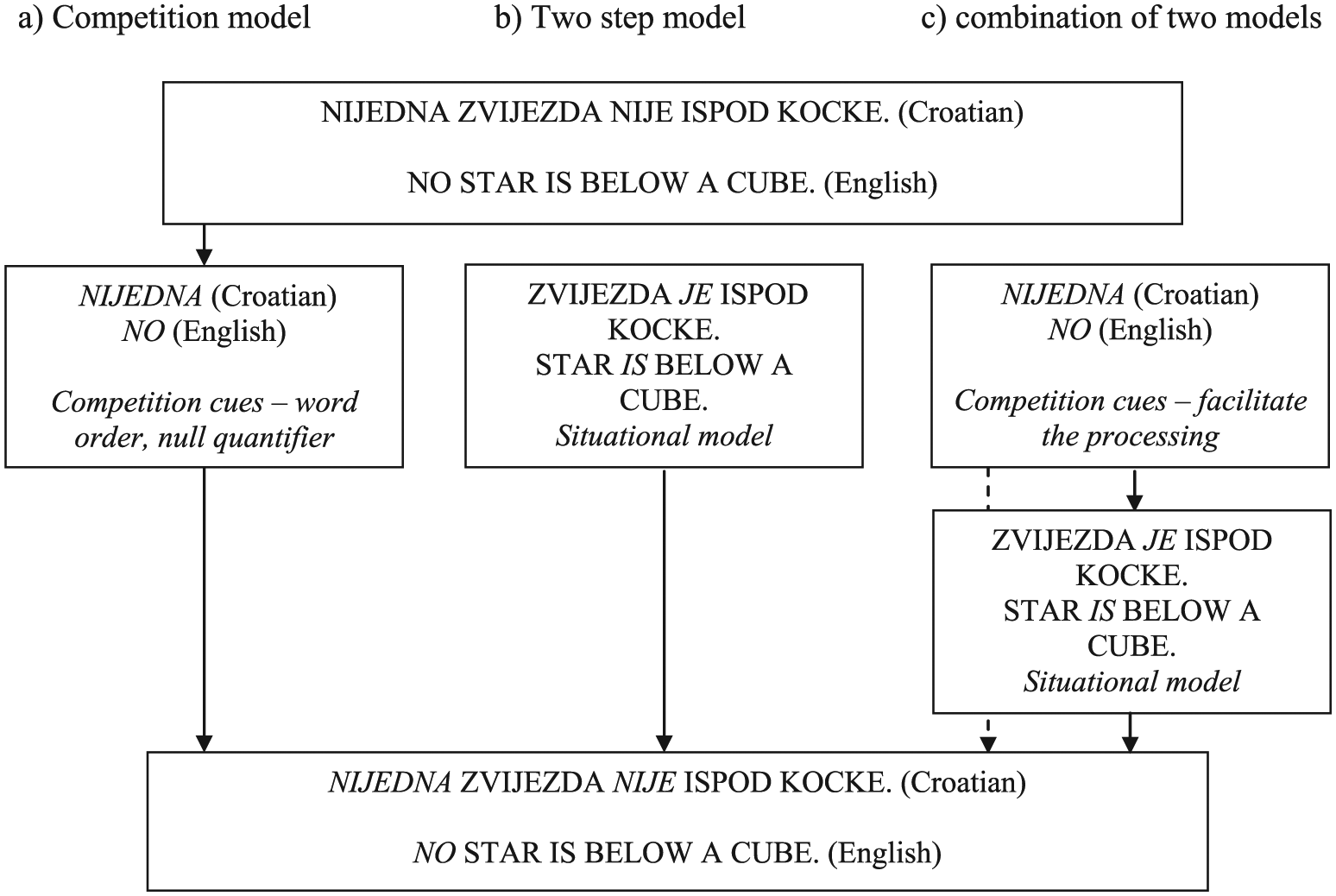
The two existing models of sentence comprehension (e.g. Kaup et al., 2005, 2006; Bates & MacWhinney, 1989) and the proposed new model.
The results are also in line with the two-step model of negation processing (e.g. Kaup et al., 2005, 2006; Kaup et al., 2007a, 2007b). All negative sentences, both Croatian and English, elicited longer reaction time compared with affirmatives. This would mean that the sentence Hearts are not above an arrow is first processed as Hearts are above an arrow, after which the situational model is negated. The described two steps of negation processing would logically need more processing time than the one-step processing of affirmatives. Further support for this model comes from the analysis of accuracy of answers—as predicted, sentential and constituent negations had higher accuracy for incongruent pairs compared with congruent pairs (in the case of affirmative sentences it was the other way around). It can be assumed that in sentential and constituent negations, an affirmative model is created in the first step of negation processing. When paired with an incongruent picture, this affirmative model actually matches the picture. In contrast, in congruent negation–picture pairs, the negation does not match the picture in the first step of negation processing, thus taking more processing time. In other words, it appears that sentences that match with the first situational model are processed faster.
Even though the results generally support the two-step model of negation processing, there are still issues that need to be further explained, such as the observed differences in the processing of different types of negations. As previous research has indicated (e.g. Ćoso & Bogunović, 2016; Kaup et al., 2007a), the differences in negation processing may not be ascribed only to the two-step processing, as described by Kaup et al. (2005, 2007a). The role of different linguistic cues could also be significant. Bates and MacWhinney (1987, 1989) defined cues as linguistic information on any linguistic level—syntactic, semantic, pragmatic, morphological or contextual. Thus, negations with different quantifiers (similar in both languages) seemed appropriate for cue manipulation. Consequently, the second goal of the present study was to identify linguistic cues responsible for potential differences between the processing of different types of negation in Croatian and English. Different types of negation elicited different reaction times as well as different accuracy rates, which could be due to linguistic cues. If successive bilinguals are able to adopt semantic and syntactic structures as successfully as early L2 learners, these cues should act similarly in both languages. In that case, the difference that might occur between the processing of Croatian negative concord and English sentences with negated verb could be ascribed to the fact that the strengths of negated quantifier and negated verb as cues are not clear. The results of this study are in line with the assumption that similar linguistic cues act similarly in different languages, at least in the case of highly proficient bilinguals. Although it appears that they are able to successfully adopt the semantic and syntactic structure of English negations, the results revealed significant differences in reaction times and accuracy of answers for different types of negations in both languages. It can be argued that the processing of negations requires the described two steps, but it also depends on various linguistic cues, which can either speed up or slow down the process. Affirmative sentences were processed faster and more accurately compared with all types of negation, which confirms the predictions of the two-step model (e.g. Kaup et al., 2005, 2007a). However, the observed differences between negations clearly indicate that the processing of negations must have been affected by other factors as well.
As already mentioned, it seems that competition cues (Bates & MacWhinney, 1987; MacWhinney, 1997, 2008) could have a significant role in negation processing. Sentential negations are among most common negations in both Croatian and English. As frequency of occurrence facilitates language processing, it could be assumed that sentential negation would be the least demanding in terms of language processing. However, this study did not confirm this view, as sentential negations were processed with the same reaction time as other types of negation, but it elicited lower accuracy rates compared with Croatian negative concord and English sentences with negated subject (probably due to the speed–accuracy trade off). The observed differences indicate that Croatian negative concord and English sentences with negated subject are easier to process, which could be ascribed to strong cues that facilitate language processing. One possibility is that the position in the sentence was the facilitating factor (Bates & MacWhinney, 1987). In the case of Croatian negative concord, the null quantifier is not a negative marker (Zeijlstra, 2004; Zovko-Dinković, 2013), but it is a strong cue for negated verb in addition (the null quantifier cannot stand alone). In this study, the null quantifier was placed at the beginning of the sentence. When it comes to English sentences with negated subject, negation as the first verb in the sentence could have acted as a strong cue in the second step of negation processing. Another possible explanation could be that strong linguistic transfer from Croatian negative concord into English sentences with negated subject was a cue which facilitated the processing. If transfer did occur, then the null quantifier would have acted as a cue for both types of negations and it may have facilitated language processing by emphasizing the necessity of the second step. However, in order to draw any clear-cut conclusions, negation processing in Croatian-English bilinguals should be further investigated, preferably with bilingual speakers with different levels of L2 proficiency and perhaps different neuroscientific methodology.
When it comes to constituent negations, research has shown that they generally elicit lower accuracy of answers because the quantifier some can be processed in two different ways: pragmatically and logically (Bott & Noveck, 2004; Noveck, 2001; Noveck & Sperber, 2007). Still, the fact that they generally take longer to process than other types of negation has not been fully explained. It could be assumed that the quantifier, as a semantic cue, leads the processing of constituent negations. In this case, additional processing of the relative disproportionate quantifier some, which does not provide precise information about quantity, would be necessary. The two suggested models of negation processing are illustrated in Figure 2.
The two-step model may be adequate for explaining the differences in reaction times and accuracy rates between affirmative and negative sentences, but it cannot account for the differences between different types of negations. At the same time, the Competition model can explain the differences between negations, but does not explain the differences between affirmative and negative sentences. Because of that, it seems that the proposed combination of these two models could offer a full explanation of negation processing. Figure 2 shows the first draft of the model, explaining Croatian negative concord and English sentences with negated subject, where the null quantifier and word order probably facilitated the second step of negation processing. It must be emphasized that linguistic cues do not always facilitate the processing. They could in fact slow it down, as in the case of constituent negations, where the relative disproportional quantifier (with unspecified quantity) may indicate the necessity of re-addressing the quantity, which results in longer processing time, compared with other negations.
The observed differences between negations could also be interpreted within the framework of propositional models of negation processing. According to the propositional view, negations make at least two propositions compared with affirmatives. For example, the constituent negation in the sentence Not every star is above an arrow might (beside affirmative and negative propositions) also create propositions with varying number of stars above an arrow. This sentence could create several propositions, for example One star is above an arrow, Two stars are above an arrow or All stars are above an arrow. Greater number of propositions could result in longer reaction time for this type of negation.
Although the results are highly indicative, further research is needed to examine the adequacy of the proposed model. There was no data on native speakers of English that could confirm that Croatian-English bilinguals and native English speakers process different types of English negations similarly. Because the two languages treat negative concord differently, it would be interesting to investigate negation processing in Croatian speakers with different levels of proficiency in English. Also, an investigation including learners of Croatian as L2 could shed some light on how Croatian negations are processed by non-native speakers. With more data, it would be possible to determine the extent to which word order affects negation processing, and whether language transfer from Croatian negative concord to English sentences with negated subject occurs. Research investigating Croatian negations in learners of Croatian as L2 has shown that negations are adopted in steps, and that speakers with higher proficiency answered more accurately compared with less proficient speakers (Macan & Kolaković, 2008; Vrljić, 2011). Thus, it could be speculated that developmental differences would occur during negation processing in Croatian and English, and that these differences would be related to L2 proficiency level. This would suggest that a part of language processing, at least in the case of negations, can be fully adopted by proficient L2 speakers, and even depend on L2 cues, as was proposed for constituent negations. Also, it can be speculated that greater differences would be observed in English-Croatian speakers during the comprehension of negative concord. Due to the fact that this structure is not allowed in English, it can be assumed that less proficient learners of Croatian might interpret the negative universal quantifier as a misleading cue in negation processing, and, as a result, negative concord sentences would be processed as double negative or with higher reaction time. On the other hand, in proficient learners of Croatian the negative universal quantifier could act as a facilitating cue in negative sentence processing.
Conclusion
The results showed there was no significant difference in the processing of similar (paired) negations in Croatian and English, which implies that highly proficient Croatian-English bilinguals are able to fully adopt syntactic and semantic structures of negations in both languages. As suggested by the two-step model, negations are processed in two stages, which explains why both Croatian and English affirmatives were processed significantly faster and more accurately compared with negations. Furthermore, different reaction times and accuracy rates are reported for different types of negations, but these differences followed the same pattern in both languages. To be more precise, Croatian negative concord and English sentences with negated subject were processed more accurately than other negations and faster than constituent negations. This could be due to strong linguistic cues, such as word order and the null quantifier, which facilitated negation processing. The importance of the cues can be seen in the case of constituent negations, where the relative disproportional quantifier in both languages could have led to re-checking of quantity during the processing. A combination of the two-step model and the Competition model is proposed in order to provide a full explanation of negation processing.
Footnotes
Declaration of conflicting interests
The author(s) declared no potential conflicts of interest with respect to the research, authorship, and/or publication of this article.
Funding
The author(s) received no financial support for the research, authorship, and/or publication of this article.