



Abstract
Aims and Objectives/Purpose/Research Questions:
Receptive multilingualism (RM), a mode of multilingual communication in which speakers of different languages use their own native language to communicate and still understand each other, is considered to be a relatively under-investigated area in multilingual research. This paper examines features of Turkish–Azerbaijani RM and, focusing on a hearer-based analysis, looks into strategies applied for achieving understanding in the receptive multilingual communication (RMC).
Design/Methodology/Approach:
The study is carried out within the conceptual framework of RM.
Data and Analysis:
Authentic data obtained from oral communication between an Azerbaijani and a Turkish native speaker are analyzed and a post-interview was conducted with the participants in order to investigate to what extent they were able to understand each other in the RMC and what strategies they applied to achieve understanding.
Findings/Conclusions:
The study reveals that the Turkish and Azerbaijani participants could communicate with each other in RM mode without much difficulty thanks to the typological proximity of their languages. In a few instances in which lack of understanding occurred, the participants were found to apply strategies such as asking questions for clarification, conveying confirmation, repeating, rephrasing, resorting to their lexical and world knowledge as well as utilizing the let-it-pass strategy.
Originality and Significance/Implications:
The significance of the study is twofold: first, it demonstrates that RMC between Turkish and Azerbaijani can be utilized as an alternative to lingua franca communication; and second, the study expands the taxonomy of hearer-based strategies in RMC.
Introduction
In multilingual contexts, there are three main ways for speakers of different languages to communicate with each other: one of the speakers speaks the language of the other; a language other than those of the speakers is chosen as a lingua franca; or speakers of two different languages each use their own language to communicate. This study focuses on this third form of communication, which is referred to as receptive multilingualism (RM). RM is “a mode of multilingual communication in which interactants employ a language and/or a language variety different from their partner’s and still understand each other without the help of any additional lingua franca” (Rehbein, ten Thije & Verschik, 2012, p. 248). Though this mode of multilingual communication is considered to be a relatively neglected area of linguistic research (Braunmüller, 2007), in fact, RM manifests itself in a variety of regions in the world among people living on the border regions such as Spain and Portugal (Jensen, 1989), Slovakia and Czech (Budovicova, 1987) and Dutch and German (Roelans & Ten Thije, 2006), and also among immigrants in contact with a different community language (Herkenrath, 2012).
This paper aims to identify features of RM in Turkish and Azerbaijani. Being typologically close languages, they should benefit the emergence of RM. More specifically, the study presents a hearer-based analysis of Turkish–Azerbaijani RM and looks into the strategies used by the hearer to understand the interaction in receptive multilingual communication (RMC). In RMC, interlocutors take turns and each of them performs alternately as a speaker and a hearer: in the role of the speaker, interlocutors use their native language(s), while in the role of the hearer they have to comprehend a foreign language. Therefore, understanding or lack of it can only be indicated by the hearers’ responses (Rehbein & Kameyama, 2003; Rehbein, ten Thije, & Verschik, 2012).
The organization of the paper is as follows. First, the main concepts of RM are introduced. Second, some linguistics properties of Turkish and Azerbaijani that are relevant for the aims of this study are described. Third, analysis and discussion of the data are presented.
Receptive multilingualism
Receptive multilingualism was first introduced by Hickerson, Turner, and Hickerson (1952), who investigated the degree to which speakers of different Iroquois dialects were able to understand one another. Since that time the main goal of RM research has been to describe the process of achieving understanding and to determine the actual extent of understanding across speakers of various languages and/or dialects, based on the receptive competence of individuals (Braunmüller & Zeevaert, 2001; Gooskens & Van Bezooijen, 2006; Haugen, 1966). Several linguistic and non-linguistic conditions are suggested to determine success in RMC. One of the essential pre-conditions for successful RMC is that the typological distance of the languages involved should be relatively small (Van Bezooijen & Gooskens, 2007). House and Rehbein (2004) suggest that typological proximity is a parameter that triggers RMC, since interlocutors, particularly in the case of cognate languages, can gain a passive command of the other’s language relatively easily. Beerkens (2010), on the other hand, emphasizes that not only the number of cognates but also the extent of similarity in word order and grammar determines the typological distance between languages and contributes to facilitating or hindering understanding. In addition to typological proximity, understanding in RMC is enhanced if interlocutors have common cultural backgrounds (Braunmüller, 2007). Aside from these linguistic and socio-cultural aspects, equality in socio-political status of the two languages is also known to benefit the emergence of RMC (Braunmüller, 2007; House, 2003) if different, “the inequality of status will in most cases lead to the speakers of the lower status language adapting to the speakers of the language with the higher status”, making RMC hardly possible (Clyne, 1991, p. 26). Last but not least it is highly likely for RMC to succeed if the speakers estimate that the two languages are similar, based on the linguistic material available to them. This helps speakers determine whether the receptive competencies of the speakers are high enough to ensure mutual understanding.
In RM research, interlocutors are known to use four particular discourse strategies to help them achieve mutual understanding (Beerkens, 2010; House, 2002; Koole & ten Thije, 1994). The first is the ‘let-it-pass’ strategy, the participants’ tendency to ignore incomprehensible utterances and to focus more on the general content. The second strategy is posing counter-questions in cases of lack of understanding or confusion. This mainly involves asking clarifying questions. The third, at the beginning of the discourse, interlocutors may get prepared for the topic by planning their speech and activating topic-relevant keywords and concepts. This strategy implies that interlocutors look up or may even learn keywords in the other language about the to-be-discussed topic which prepares them for discourse (Braunmüller, 2007). Finally, a back-channeling strategy refers to hearers’ verbal and non-verbal responses, signaling whether understanding occurred or not. These strategies are not always easy to identify in the course of the interaction; however, they may be revealed in post-interviews.
Turkish and Azerbaijani: Common linguistic features
The languages involved in this study are Turkish and Azerbaijani, which are both members of the Oghuz branch of Turkic, belonging to the Uralic and Altaic language family (Comrie, 1992; Menges, 1968). Historically and linguistically, among the Turkic languages, Turkish and Azerbaijani are the most closely related, which leads one to expect a high potential for mutual intelligibility. Speakers of these languages are indeed able to comprehend each other to a certain extent (Ercilasun, 1997; Sağın-Şimşek & König, 2012).
Turkish and Azerbaijani show numerous parallelisms. To start with morphological features, both languages are agglutinating, indicating grammatical functions by adding various suffixes to an initial stem with supplementary meanings (Kornfilt, 1997; Öztopçu, 1993). Verbs are richly inflected with suffixes marking person, number, tense, aspect, modality, voice, negation and interrogation; and nouns and pronouns are inflected for number, case and possession. As for the syntax, while subject–object–verb (SOV) word order is a typical characteristic of Turkic languages (Greenberg, 1966; Kornfilt, 1987), for various communicative intentions other word orders are used and, moreover, these appear to be used more frequently than the canonical SOV order (Erdal, 1999; Erguvanlı, 1984). In addition to these similarities in morphology and syntax, a common phonological feature is the application of vowel harmony, according to which the vowels of suffixes must harmonize with the preceding vowels. The lexical properties of Turkish and Azerbaijani are very similar (Ercilasun, 1997). Turkish, more than the other Turkic languages, is regarded as the descendant of Ottoman Turkish, which was basically Turkish in structure but heavily loaded with Arabic and Persian vocabulary (Kornfilt, 1997). Azerbaijani, on the other hand, due to the historical changes it has passed through, experienced quite different language change processes, borrowing vocabulary from Persian, Arabic, and Russian (Erden, 1985). In addition to the common linguistic features of both languages, good social relations between Turkey and Azerbaijan for various educational, political and/or economic reasons are also contributing to exposure to each other’s languages and particularly to the emergence of RMC.
The present study
This paper aims to look into features of Turkish and Azerbaijani RMC and identify strategies utilized by the hearer to achieve mutual understanding. To this end, authentic data were obtained from a conversation between an Azerbaijani and a Turkish native speaker. The Azerbaijani participant, Lale, is a 21-year-old university student enrolled at an English medium university and has been studying there for seven months. The Turkish participant, Didem, is a 34-year-old instructor at a Turkish university. The participants met for the first time. The interlocutors, both, stated that they had minimal knowledge about the other’s language: their receptive competence had been developed by following TV series and/or movies broadcasted in the other language. The oral communication, lasting for 47 minutes and consisting of 752 utterances, was recorded and transcribed using the computer program EXMARaLDA (Schmidt & Wörner, 2005). After the recording, a post-interview was conducted with the interlocutors in order to learn more about instances of misunderstanding and the strategies applied by the hearer to achieve understanding.
Analysis of the instances of understandings and misunderstandings
The transcribed data consisted of 752 utterances, 357 of which were produced by the Turkish participant and 395 by the Azerbaijani participant. We defined an utterance as a complete meaningful communicative unit, which might be a single word, a phrase, a clause or even an interjection. The data analysis revealed that Lale, the Azerbaijani participant, reacted to her Turkish interlocutor giving relevant responses and/or comments in all cases. Relying on her accurate responses to the utterances initiated by the Turkish interlocutor, we can infer that no lack or misunderstanding occurred in the data. The only discourse strategy observed in her data was the back-channeling strategy in the form of verbal and non-verbal responses to the speakers’ utterances to confirm her understanding. The Turkish participant, Didem, on the other hand, experienced some difficulties, which were apparent in twelve of her responses to the utterances initiated by her Azerbaijani interlocutor. The excerpts below illustrate several typical instances in which the Turkish participant misunderstood something and also exemplify the strategies applied in order to achieve understanding.
Excerpt 1
The topic of Excerpt 1 concerns Lale’s decision to be enrolled in Middle East Technical University in Ankara (METU).
(E1). [1].

[2].

[3].

[4].

[5].

The conversation was initiated by Didem asking Lale why she had chosen METU for her education. Lale’s quick reply shows that she, as the hearer, assessed the situation and Didem’s speech action with ease, perceived the meaning of the question with no difficulty, and managed to start her own speech action immediately. In her reply, Lale used an Azerbaijani word qohumlarım (my relatives), a lexical element that does not exist in Turkish, and, therefore, it was unknown to Didem. Qohum-lar-ım consists of the root qohum (relative), the plural marker -lAr and the first person singular possessive marker - IM. The plural and possessive morphemes are common to both Turkish and Azerbaijani. Didem’s counter-question asking the meaning of the word makes it clear that the morphological similarities did not help her understand the utterance, and the lexical element qohumlarım (my relatives) blocked her understanding. It seems Didem perceived this word as essential for continuation of the conversation, that is why she interrupted Lale’s speech to ask for clarification. Didem’s lack of understanding was repaired by Lale’s restatement Yani əqrəbalarım (I mean, my relatives). This was clear enough for Didem as the phonetic similarity between the Azerbaijani word əqrəba (relative), a synonym for qohum, and the Turkish word akraba (relative) was quite helpful for achieving understanding of the meaning of qohum.
As it is evident from Excerpt 1, understanding might have been blocked for the Turkish interlocutor when a lexical element that does not exist in Turkish was used. The post-interview conducted with Didem helps us pinpoint the strategies she used to achieve understanding. When Didem was asked why she found this word important and why she asked for clarification, she indicated that initially she thought she had understood the utterance due to the common grammatical morphemes. Thus, she first used the let-it-pass strategy and did not interrupt Lale’s speech. However, in due course she realized that the unknown word qohum (relative) was essential for understanding. She pointed out that she had supposed that the word might mean either relatives or friends. Hence, she asked for clarification to learn the meaning of the word. During the post-interview Didem was also asked how much she understood Lale’s utterance ahtarış ələdim ve başa düştüm ki ODTÜ Türkiyenin en yahşi universitelerinden biridir (and searched for a university and I learned that METU is one of the best universities in Turkey). Although the lexical elements ahtarış ələmek (to understand) and başa düşmek (to think and decide) do not have direct equivalences in Turkish, Didem did not feel the need to ask about them. She replied that she actually did not know their exact meanings but thought that these phrases were not essential and that the rest of Lale’s utterance carried enough information. Thus, she was satisfied with the gist she had got and did not feel the need to question each lexical element. This tendency is in line with the argumentation that in RM full comprehensive understanding is not always required to grasp the intention of the interlocutor (Braunmüller, 2007). This example shows that close typological distance, especially common morpho-syntactic properties between Turkish and Azerbaijani helps understanding to a certain extent and that the decision whether to let the interaction flow or to ask for clarification is hearer-dependent.
Excerpt 2
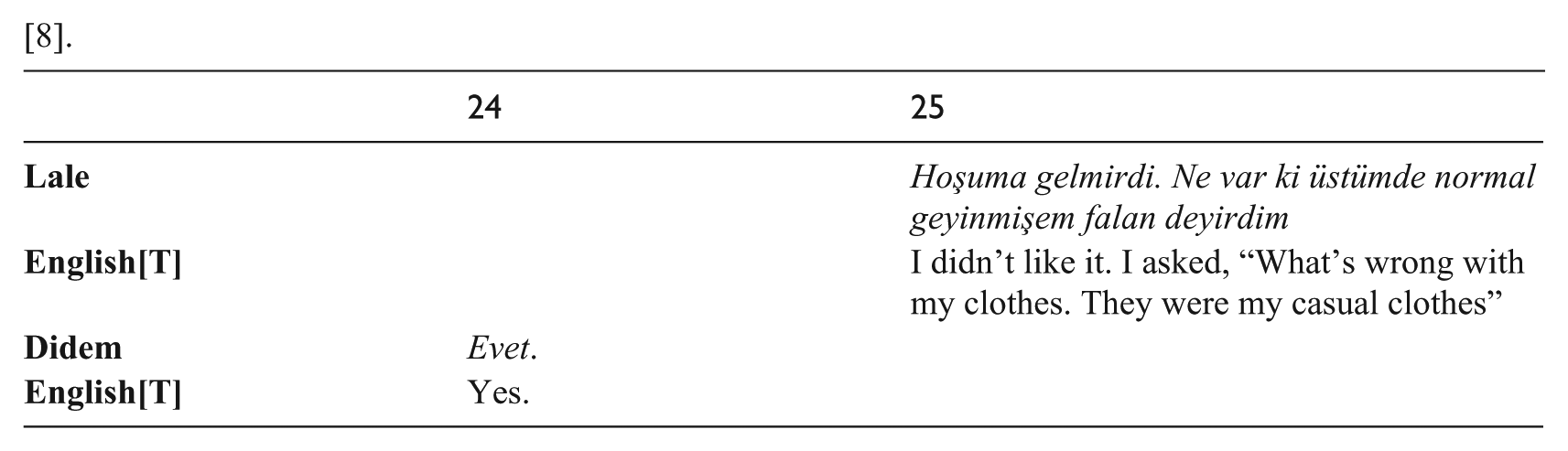
In Excerpt 2, Didem and Lale talk about women’s clothing style in Azerbaijan.
[1].

[2].

[3].

[4].

[5].

[6].

[7].

[8].
[9].

[10].

[11].

[12].
[13].
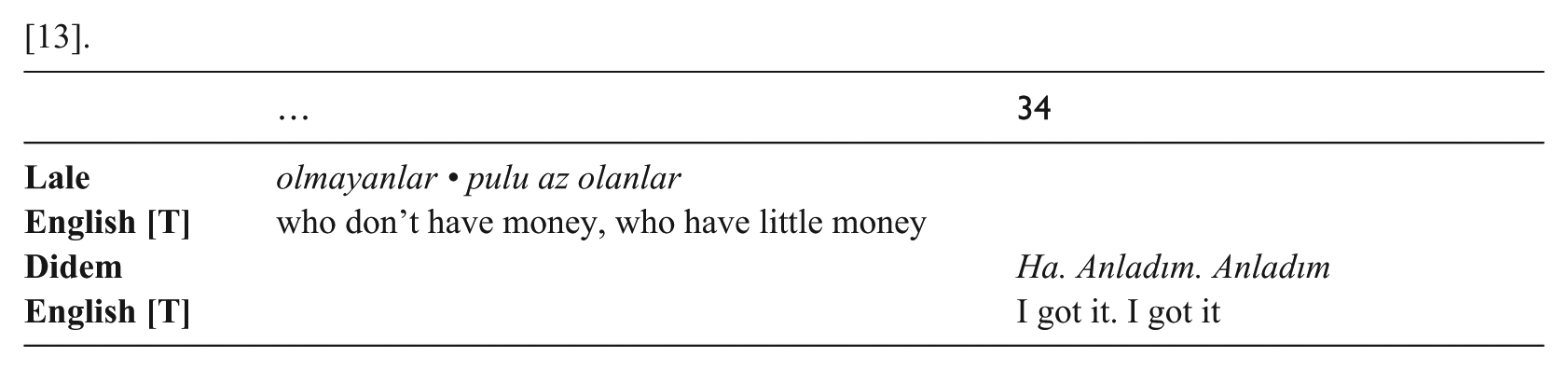
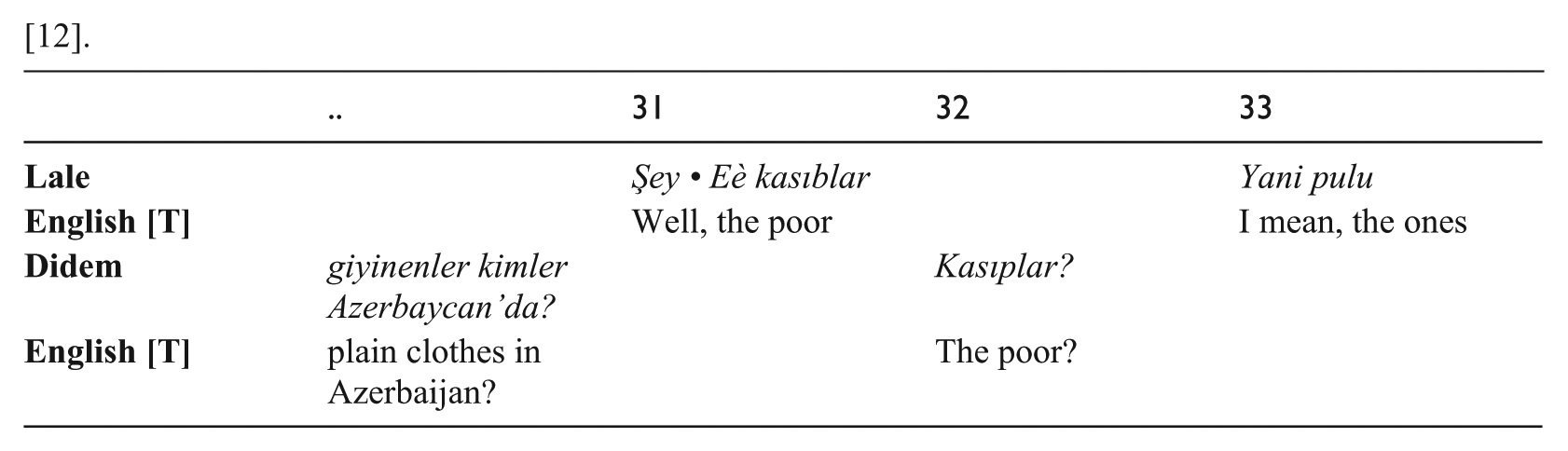
The conversation was opened by Didem’s question Siz bayanlar her zaman böyle şık mı giyinirsiniz Azerbeycan’da? (Do you, women in Azerbaijan, always dress so chic in this way?), which at the same time functioned as a compliment for Azerbaijani women. Lale comprehended the question and the compliment quite straightforwardly and started providing explanations for why her dress style was too plain, in contrast to other Azerbaijani women. Didem interrupted and reformulated Lale’s utterance as Çok şık değildin yani? (Do you mean, you were not that chic?), with a rising intonation. This counter-question, rather than indicating a lack of understanding, may be interpreted as a sign of request for confirmation whether her understanding was correct. Use of this strategy made Lale realize the need for a confirmation and she paraphrased her utterance. The interaction then continued smoothly without any difficulty in understanding on both parts until right before the end of the fragment when Didem asked, Peki böyle sade giyinenler kimler Azerbaycan’da? (Then who wears simple clothes in Azerbaijan?). When Lale replied as Şey, kasıblar (Well, the poor), Didem’s repeating the word kasıblar (the poor) with a rising intonation instantiated a strategy signaling the lack of understanding and requesting clarification. With Lale’s further explanation, Yani pulu olmayanlar, pulu az olanlar (The ones who do not have any money, the ones who have little money), Didem understood the meaning of the word and verbally confirmed that she had comprehended the meaning.
This fragment, like the previous one, shows that the Turkish speaker’s understanding of Azerbaijani largely depends on understanding lexical items. Whenever a core lexical element, a word which is essential to understand the speaker’s utterance and the context, is not understood, communication is interrupted for the hearer until the speaker repairs the misunderstanding with a restatement or an explanation of the difficult lexical element.
Excerpt 3
In Excerpt 3, the interlocutors speak about the forthcoming summer holiday and final exams.
[1].

[2].

[3].

[4].
[5].

[6].

[7].
[8].

[9].

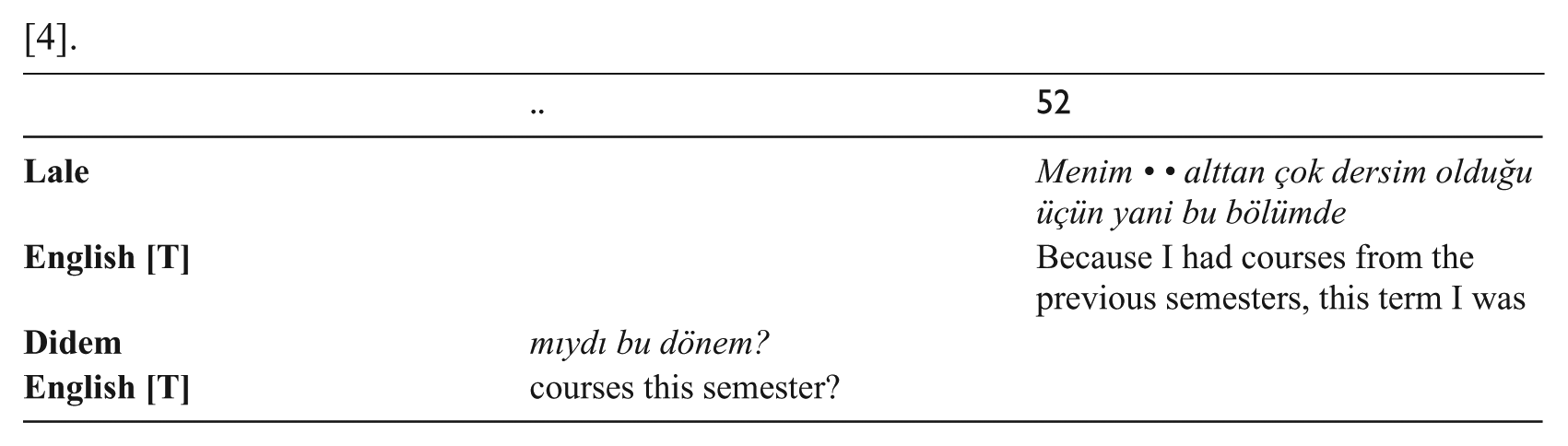
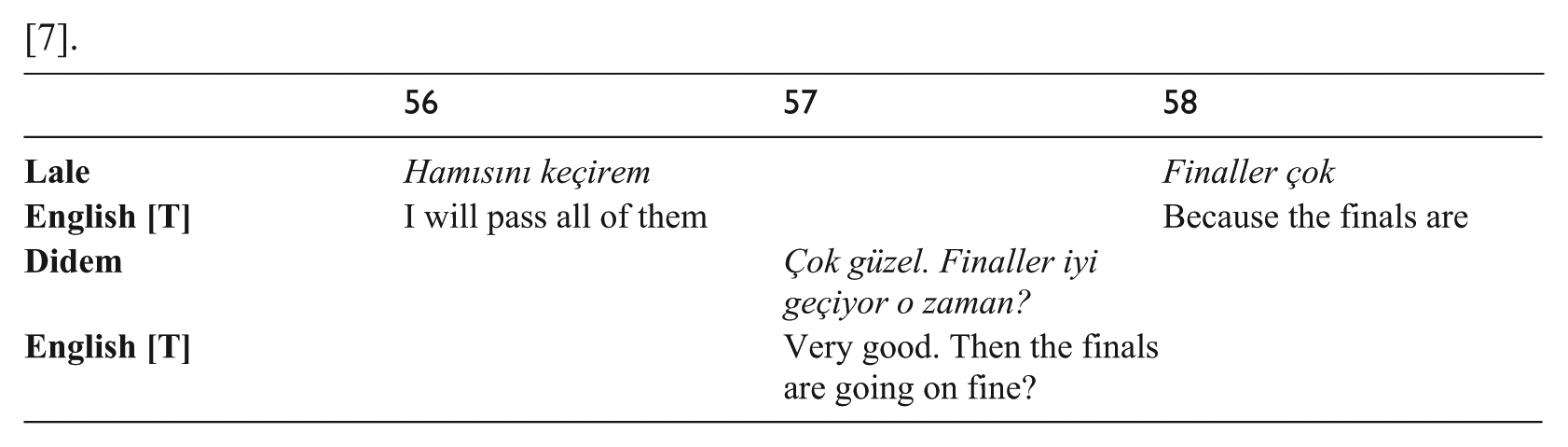
In the first three score areas, the interlocutors talked about Kemer, a tourist region in southern Turkey. To Lale’s statement Görmedim (I did not see it), Didem replied with astonishment and suggested that Lale should see Kemer. Lale’s response İmtahanlar gurtarsaydı gederdim dincelemeye (If we could finish the finals, I would go there) shifted the topic from Kemer to the final exams. After this utterance, Didem inserted a noticeable pause of three seconds but then accepted the topic shift and asked about the final exams. The interaction went on without any trouble until score area 59. When Lale replied Finaller çok super olduğu için, proyektten de yakhi bal alırık (Because the finals are going excellent, we took good grades from the projects), Didem contributed by saying, O da iyiymiş (It is good, too). This utterance does not actually provide any clues about whether she understood Lale or not. However, the very sudden topic-shift with her utterance Bu dönem bu Practice Teaching dersini aldın mı sen? (Did you take the Practice Teaching course this semester?) could be interpreted as a sign of lack of understanding and resorting to the let-it-pass strategy. This presupposition was discussed with Didem in the post-interview, and she confirmed that she had not understood that utterance and, therefore, preferred to change the topic. Further, Didem was also asked about the pause she had produced in score area 4. She clarified that Lale’s utterance, İmtahanlar gurtarsaydı gederdim dincelemeye (If we could finish the finals, I would go there) had stunned her for a while since the collocation does not exist in Turkish in the form in which it appeared in Lale’s utterance. Didem stated that she subconsciously had started to analyze the elements of this ‘strange collocation’. Since the word imtahan (exam) is an Arabic originated word also existing in Turkish and gurtarmak is phonologically similar to the Turkish word kurtarmak (to save), she activated imtahan (exam)-related contexts and based on the positively marked semantics of the verb kurtarmak (to save), she comprehended the meaning of the collocation. Thus, in this case, it is possible to infer that Didem used activation of her linguistic and world knowledge as a strategy to manage RMC.
Discussion and conclusion
This study has revealed a number of findings concerning the use of RM as a form of communication among Turkish–Azerbaijani speakers. It has confirmed the assumption that speakers of Turkish and Azerbaijani can understand each other without much difficulty, as it fulfills the condition of typological proximity (House & Rehbein, 2004; Van Bezooijen & Gooskens, 2007). The data exemplify that successful understanding can be reached due to the many common morpho-syntactic elements and common cognate words. These help speakers to establish common ground, which in turn ensures mutual understanding. Failures in understanding occurred in some cases in which unknown lexical items were used. In such situations, the hearer used the strategy to pose counter-questions for clarification, which was early acknowledged by Beerkens (2010). In addition, repetitions and rephrases were utilized by the interlocutors in cases of lack of understanding. Relying on the participants’ responses obtained through the post-interview, we have shown that the interlocutors actively resorted to their lexical and world knowledge to overcome occasional lack of understanding. Finally, the data have confirmed the claim of House (2002) that not each and every problem in understanding is verbalized instantaneously: learners may adopt the let-it-pass strategy, when they assume that the continuing interaction will clarify the problem.
All the above-mentioned strategies observed in the data of the present study put emphasis on to the active role of the hearer in RMC. It is the hearer who controls the flow of RMC and who selectively applies discourse strategies relevant for this mode of communication to maintain mutual understanding. As the data demonstrated, the hearer comprehends the speaker’s speech actions and activates his/her own knowledge while at the same time assessing the speaker’s speech actions. Based on the hearer’s evaluation of all these contributions on the part of the speaker and the context, the hearer understands the utterances and in turn initiates his/her own speaking action.
Previous research has demonstrated that RMC has been successfully functioning as an alternative communication mode within the borders of the European Union. It is reported to work in governmental discourse and is considered to be an “explicitly agreed on” communication mode (Beerkens, 2010). It is also used in the informal civil society discourse as one of the optimal modes for communication within the European Union (Ribbert & ten Thije, 2007; Zeevaert & ten Thije, 2007). The present study investigating the possibility of RMC between Turkish and Azerbaijani participants has provided further evidence that RMC can also be used effectively as an alternative to a lingua franca among speakers of Turkic languages (see also Öztopçu, 1993; Sağın Şimşek, 2014). Owing to the process of mobility and cultural commonalities of Turkic peoples, human flow between Turkic republics has been increasing dramatically. Therefore, the importance of RMC as an effective mode of communication should be promoted at governmental and civil levels. Furthermore, at the individual level, the study highlights users’ awareness of RMC and calls upon their conscious use of strategies that might enhance mutual understanding.
Last but not least, concerning the limitations of the present study, generalizability of the results is an issue since the analysis is based on a single conversation between an Azeri and Turkish participant. While, in general, the one conversation can stand for all conversations between speakers of these languages, there are some aspects specific to this study. First of all, the sociolinguistic status of the languages under investigation is not equal, with Turkish being a more prestigious and popular language in the Turkic communities (Bal, 2004). Second, the data were collected in Turkey where the Azerbaijani participant was enrolled as a student and thus, has been in close contact with Turkish, which presumably helped her improve her receptive skills in Turkish. For these reasons, the interlocutors’ knowledge of the other language might be asymmetrical and might have an impact on the results. Therefore, we believe that further research on RMC between the speakers of Turkish and Azerbaijani in different communicational contexts would be useful to validate the data.
Footnotes
Declaration of conflicting interests
The author(s) declared no potential conflicts of interest with respect to the research, authorship, and/or publication of this article.
Funding
The author(s) disclosed receipt of the following financial support for the research, authorship, and/or publication of this article:The collection of the data for this study was supported by The Scientific and technological Research Council of Turkey (110K432).