



Abstract
Aims and Objectives:
The current study’s aim was to test the ambiguity and dominance theories of transfer by examining compound noun production and comprehension by bilinguals acquiring Spanish and Japanese, as the word order of nominal compounds in these languages is always reversed, making them grammatically and theoretically unambiguous.
Methodology:
Ten Spanish-Japanese bilingual preschoolers completed production and comprehension elicitation tasks.
Data and Analysis:
The research subjects’ reversal rates were compared with those of age- and vocabulary-matched Japanese monolinguals.
Findings/Conclusions:
The results demonstrate that transfers occur from Spanish to Japanese in both production and comprehension, and that there are no dominance effects on the degree of cross-linguistic influence.
Originality:
There have been no previous studies on cross-linguistic transfer in Spanish-Japanese bilingual children.
Significance/Implications:
Transfer and directionality are not affected by relative vocabulary level; the concept of dominance should be (re)considered carefully especially for young bilinguals whose language inputs are greatly imbalanced and variable. Moreover, what is considered grammatically unambiguous by adults may be ambiguous for children acquiring such knowledge bilingually, which raises the need to consider structures in both languages as affecting the acquisition of language in young bilinguals.
Keywords
Introduction
Bilingual acquisition and transfers
Bilingual children can distinguish their two languages, which develop separately from early on (De Houwer, 1990). However, the languages are not completely independent of each other. Bilingual children’s early utterances demonstrate interaction between their two languages, for instance at the syntactic level (Döpke, 1998; Hulk, 1997; Hulk & Müller, 2000; Paradis & Navarro, 2003; Serratrice, Sorace, & Paoli, 2004), phonological level (Kehoe, Lleo, & Rakow 2004; Paradis, 2001), and morphological level (Nicoladis, 2002, 2003).
Dominance of one language is considered in many studies of cross-linguistic transfer along with the resulting structures (Döpke, 1998; Foroodi-Nejad & Paradis, 2009; Nicoladis, 1999; Paradis, 2001), as bilingual children are generally more proficient in one language (Genesee, Nicoladis, & Paradis, 1995). For instance, in Yip and Matthews (2000), a Chinese-English bilingual, Chinese-dominant child produced English sentences with head-final relative clauses, a Chinese construction. Döpke (1998) studied English-dominant German–English children and found that their German verb phrases were influenced by transfer from English, while English verb phrases were unaffected by German. Nicoladis (2003) studied reversal of deverbal compounds by French-English bilingual children and found a correlation between vocabulary size in each language and reversal rate in each language. These studies suggest that transfer occurs from a ‘stronger’ to a ‘weaker’ language.
However, other studies (Hulk & Müller, 2000; Nicoladis, 1999, 2002) reject the dominance theory, on which there is no consensus. Hulk and Müller (2000) found no effect of language dominance in object drop or root-finiteness among Dutch-French and German-Italian children.
The locus of cross-linguistic structure is another area of interest in bilingual research. Structural overlaps and ambiguity exist when a child’s languages use similar structures for a given meaning, but language A only has one form to express it while language B has two; in this situation, the direction of transfer is hypothesized to go from A to B (Hulk & Müller, 2000; Müller, 1998; Müller & Hulk, 2001). For instance, Döpke (1998) found transfer from English to German in overlapping verb phrase structures: one of two such structures in German was enhanced by the sole overlapping English structure. Paradis and Navarro (2003) found that Spanish-English bilingual children produced more overt subjects, which English requires and Spanish optionally omits, than monolingual Spanish children.
Some studies suggest that evidence of transfer tends to be observed in children acquiring structurally similar languages, as structural overlap is likely to exist between those languages. That is to say, between languages with less linguistic proximity, transfer is unlikely to occur. For example, Paradis and Genesee (1996) and Hulk and Müller (2000) did not find evidence of cross-linguistic influences in the acquisition of obligatory finiteness among bilingual children, as the language pairs they studied were Romance-Germanic.
However, a few reports question the necessity of ambiguous structure as the condition for transfer in the first place. For instance, Nicoladis (2002) reports transfers in compound nouns in both French and English production by bilingual children, even though there is no structural ambiguity. In addition, Yip and Matthews (2000) found that Cantonese-English bilingual children made reversals in nominal positioning in relative clauses, despite the fact that relative clauses are exclusively pre-nominal in Cantonese and exclusively post-nominal in English. In a similar vein, some studies even suggest that ambiguity does not necessarily cause transfer. For example, a study of children’s word order in adjectival phrases reported by Nicoladis (1999) found the subjects to be highly accurate in both French and English, even though such phrases pose structural ambiguity.
Although there is no general consensus on the specific causes and loci of transfers, when cross-linguistic structures do exist, they may reflect the fact that there are structures considered similar by children acquiring them, as well as the child’s cognitive ability to detect such similarities. It is worth investigating such ability in children acquiring a pair of substantially different languages.
Transfers in nominal phrases and compound nouns in previous studies
Noun–adjective order and noun positioning in compound nouns are the forms most systematically and comparably investigated, using elicitation tasks. Nicoladis (2002) found some evidence for transfers in the structures of compound nouns produced by French-English bilinguals. The ordering of nouns in compound nouns in English and French are always opposite, English being right-headed and French left-headed, and thus pose no ambiguity. She used sets of elicitation tasks with pictures of things that needed two nouns to express, such as ‘flower chair’, which is a chair with flower patterns. The tasks tested bilingual children’s comprehension and production. Transfer was only seen in production, bilingual children reversed English compounds more than monolinguals, and the reversal rates in English and French were similar. These findings contradict both ambiguity theory and directionality theory, despite the fact that there was no ambiguity in the input.
Nicoladis (2006) focused on Adj+N ordering by English and French bilinguals. English allows this order one way, Adj+N, whereas French allows it both ways. Thus, this provided an opportunity to test structural ambiguity/structural overlaps. Bilinguals reversed more prenominal adjectives and nouns in both French and English than monolinguals, even though ambiguity theory supposes unidirectional influence from English: greater production of English-type word order in French only by bilinguals. She reasons that this is because bilingual children overgeneralized the French word order as left-headed and English as right-headed as a result of trying to develop clearer rules for both languages. Foroodi-Nejad and Paradis (2009) adopted the Nicoladis (2002) method, testing ambiguity and dominance theories in cross-linguistic structures by Persian-English bilingual children. Both English- and Persian-dominant bilingual children produced more right-headed compounds in Persian than Persian monolinguals and more left-headed compounds in English than the English-dominant group. Persian compounding rules allow both directions of head, with a left-headed default, while English only allows right-headed. Ambiguity theory would predict right-headed order to be emphasized by the English rule. This is actually what happened. However, language dominance also seemed to play a role; since ambiguity theory suggests transfers to be unidirectional, there should be no transfer in English, but there were some reversals in English, but bilingual children with higher knowledge of English produced fewer such reversals.
It is still worth exploring other language combination with this compound noun task. In particular, the fact that in most languages canonical word order of adjective and noun usually parallels word positioning within the compound noun construction (Nicoladis, 2002, 2006) is also beneficial when considering observed reverse positioning phenomena in other nominal constructions.
Word order inversions in nominal phrases by a Spanish-Japanese bilingual child
Probably because English is the first foreign language a vast majority of Japanese children learn at school, Japanese-English is an extensively studied combination in early bilingual acquisition studies involving Japanese. Looking at other, understudied combinations with Japanese may provide new insight into these issues. As described by Kutsuki (2004), Spanish-Japanese bilingual children occasionally make the following errors, (1a) and (2a), in ostensibly Japanese conversation.
(1) ‘This is A’s bread’
(1a) kore wa
jp-This jp-is(coplula) ns-bread jp-of ns-child’s name 1
(1b) kore wa
jp-This jp-is(copula) ns-child’s name jp-of jp-bread
(1c) Esto es el
sp-This sp-is(coupla) sp-art sp-bread sp-of ns-child’s name
(2)
(2a)
jp-pillow jp-small (jp-get me)
(2b)
jp-small jp-pillow jp-acc part (jp-get me)
(2c) (tráeme) la
(sp-get me) sp-part sp-pillow sp-small / sp-small sp-pillow
In the examples given above, (1a) is erroneous because Japanese particles come before their modified nouns, as in (1b). The word order of the noun and adjective in (2a) is erroneous for a similar reason; the word order in (2b) is correct in Japanese. This reversal of the head and modifier word order in nominal phrases is probably due to the influence of the related plausible Spanish structure, as in (1c) and (2c), and also to the fact that as seen, in (1a), the Japanese possessive particle no overlaps (see (1b)) with the Spanish de (see (1c)). However, even though the Noun+Particle+Noun structure overlaps between Japanese and Spanish (i.e., expresses the same meaning in both languages), there should be no ambiguity, as no allows only the head noun to be the second noun (placed after the particle), and the de construction does the opposite. In addition, the word order of Adjective+Noun constructions should not be transferred from Spanish to Japanese due to its unambiguity; Spanish has two possible orders, as in (2c), while Japanese has only one, as in (2b). Therefore, the transfers observed in (1a) and (2a) cannot be explained by ambiguity theory.
Moreover, such reversal phenomena are not attributable to incomplete knowledge or the flawed acquisition of the word order.
Clancy (1985) argues that the basic Modifier–Head construction in Japanese is acquired similarly for adjectival and nominal constructions, likely explaining the absence of any report of erroneous NP word order in Japanese acquisition literature. Because of this strong N+no+N order, overproduction of no in adjectival modification (Adj+no+N) is common, as discussed for monolingual Japanese children in Iwadate (1992) and Imai (1987).
Similarly, Nicoladis’s (2006) results for English and French monolingual children’s spontaneous speech show that it is rare for monolingual children to make mistakes in adjective–noun word order, which like in Japanese, are acquired easily by monolingual children.
Given such assumptions, the errors in (1a) and (2a) can be taken as structures possibly affected by influence from Spanish to Japanese; I propose that Head–Modifier word order in young Spanish-Japanese bilinguals shows such an influence.
N+N compounds in Japanese and Spanish
Across different languages there exist different kinds of N+N compounds: endocentric, exocentric, and appositional (Spencer, 1991). A compound is endocentric when the meaning of the compound is a hyponym of the head element, for example blackboard. It is exocentric when there is no head and the combination of the words conveys an idiomatic meaning, such as in pickpocket. It is appositional when it is a simple conjunction of two elements, as in mother–child. Because of parallelism between word order within the adjectival phrase and head and modifier positioning in endocentric compound nouns, our focus (like that of Nicoladis (2002) and Foroodi-Nejad and Paradis (2009)) is on these. Also, it is easier to express the meanings of this type with pictures than for other types.
Japanese N+N compound nouns
Japanese compound nouns are predominantly right-headed (Kageyama, 1993) and are quite productive. Below, (3a) and (3b) are examples of right-headed endocentric compound nouns (modifiers are placed before head nouns).
(3a) ha-burasi
tooth-brush
‘toothbrush’
(3b) ichigo-keeki
strawberry-cake
‘strawberry cake’
Spanish N+N compound nouns
Spanish also allows compound nouns, but productivity is generally quite low. N+N compound nouns are said to be not as ‘syntactic’ as N+de+N or N+Adj combinations; however, when they combine to form endocentric compound nouns, the head noun is always the first noun (Kornfeld, 2009), such as that shown in (4a) and (4b).
(4a) coche cama
car bed
‘sleeping car’
(4b) piso piloto
condo model
‘model unit’ (of an apartment)
Head positioning of compound nouns between the languages is clearly opposite, providing a perfect opportunity to test interaction between the languages in the form of cross-linguistic structures produced by bilinguals.
Hypotheses
In this study, two hypotheses were tested. The first is ambiguity theory. Since the two languages have clearly opposite compound noun structures, there should be no confusion, and thus the rate of noun placement reversals should be no different for bilinguals and monolinguals. To test this, this study compared bilingual and monolingual reversal rates in Japanese compound noun production and comprehension tasks. Since there are very few or no monolingual Spanish speakers in Japan, no comparison was available for reversals in Spanish tasks. Since there is no confusion of structures, reversal rates within Japanese compound nouns by bilinguals were hypothesized to be higher than by monolinguals.
The second hypothesis deals with dominance theory, that is, language dominance and direction of transfer, which it has been argued goes from a stronger to a weaker language. To investigate the effects of relative language strength, reversal rates were compared among language groups including monolingual Japanese and bilingual groups with varying language levels. It was hypothesized that if relative dominance played a role in the direction of transfer, the reversal rate in Japanese tasks would be higher in bilinguals with higher Spanish ability, and in Spanish tasks in bilinguals with higher Japanese ability.
Method
Participants
Two groups of preschool children participated: Japanese monolinguals and Spanish-Japanese bilinguals. Children were tested individually at their nursery schools or at their homes. Only children whose parents agreed to participation after explanation of their rights participated, and only those judged by their parents and/or teachers to have no developmental difficulties were included in the final data set.
Ultimately, 10 bilingual children participated (four girls, six boys), all of whom could be categorized as early sequential bilinguals. In this study, all of the bilingual children’s parents were from Peru and were native speakers of Spanish. Children at Japanese nursery schools whose parents are foreigners working in Japan are generally highly immersed in mainstream Japanese culture and language from very early on. Many spend as long as almost10 hours a day at nursery school hearing and using Japanese. Unlike socially privileged languages such as English, essentially no day-care or child-rearing services are available in Spanish; therefore, there are few or no Spanish monolingual children living in Japan.
A total of 32 monolingual children participated. To match the language level of monolingual and bilingual children for comparison, the PPVT (Peabody Picture Vocabulary Test) (Dunn & Dunn, 1981) was translated into Spanish and Japanese, and 10 of the monolinguals were matched for their Japanese score with the bilingual children as closely as possible; they formed the monolingual group (five girls, five boys). The average age for this group was 4;3 (51.00 months, SD = 3.66), and for the bilingual group, 4;1 years (49.99 months, SD = 3.18). The results of t-tests comparing the groups showed no significant difference in age or Japanese PPVT scores.
Bilingual groups based on language dominance
The effect of language dominance on transfer was also tested in the current study. There are multiple aspects of language dominance and a number of different measures for it. For instance, Genesee, Nicoladis, and Paradis (1995) found that word types and MMUs (multi-morphemic utterances) obtained through observation were the most valid and objective measures for the classification of language dominance in young children. Furthermore, in Foroodi-Nejad and Paradis (2009), language use at home and fluency ratings of the minority language were used in addition to receptive vocabulary scores to determine dominance. While I acknowledge the importance of degrees of productive fluency and language exposure, the current study relied on the relative receptive vocabularies in the two languages as a measure of dominance. Testing the receptive vocabularies of both languages using the PPVT was the most convenient option, given the limited time allowed for testing each child at the nursery schools. There are multiple accounts suggesting that the PPVT is a valid linguistic measure. For instance, PPVTs were used by Nicoladis (2006) for determining relative dominance, and PPVT scores were found to be correlated with scores in the words and sentences forms of the MacArthur-Bates Communicative Development Inventory (CDI) (Vagh, Pan, & Mancilla-Martinez, 2009), a parental report of children’s productive vocabulary. Furthermore, CDI scores have been tested and found to be related to observed (i.e., productive) words (Dale, 1991; Fenson et al., 1994; Ogura, Yamashita, & Murase, 1998).
The bilingual group was divided into two groups, each consisting of five children—the Japanese-dominant bilingual group (M = 50.85 months, SD = 3.49) and the balanced bilingual group (M = 48.60, SD = 1.12)—according to their relative strength in the two languages (there were only two groups since no child had better Spanish than Japanese). Those in the balanced group had equal PPVT scores in both languages (M, Spanish = 13.80, SD = 3.03; M, Japanese = 13.80, SD = 3.03), while those in the Japanese-dominant group had higher scores on the Japanese PPVT (M = 20.40, SD = 3.91) than the Spanish one (M = 14.60, SD = 2.07). No child scored higher in Spanish than in Japanese. There was no significant difference in age (t(8) = 2.13, NS) or Spanish PPVT between the two bilingual groups (t(8) = .48, NS), but the difference was significant for Japanese scores (t(8) = 2.98, p = .05). Japanese PPVT scores also revealed no significant difference among groups (F(2,17) = 54.45, NS) (M (monolingual) = 17.10, M (Japanese-dominant bilingual) = 20.40, M (balanced bilingual) = 13.80).
Materials
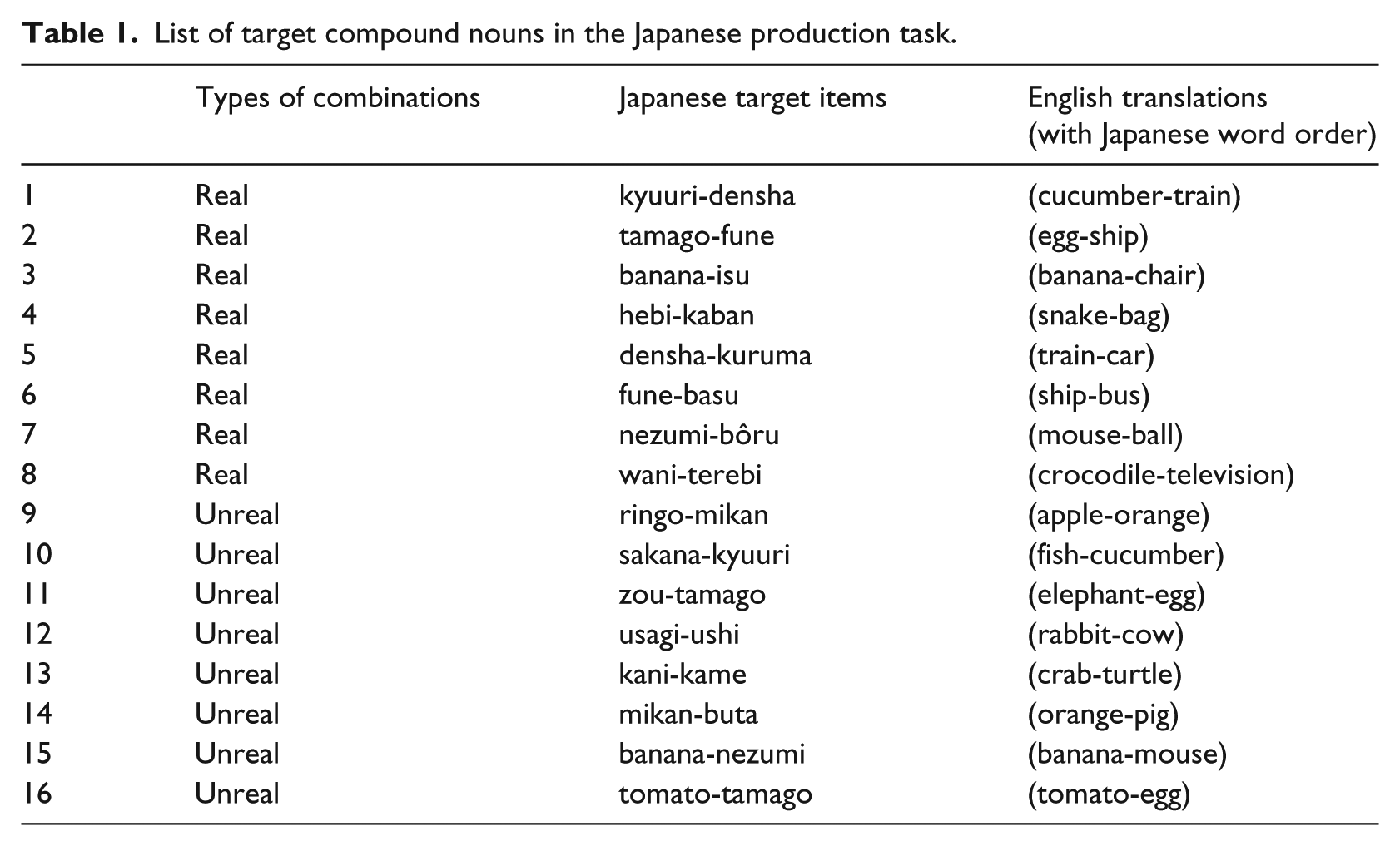
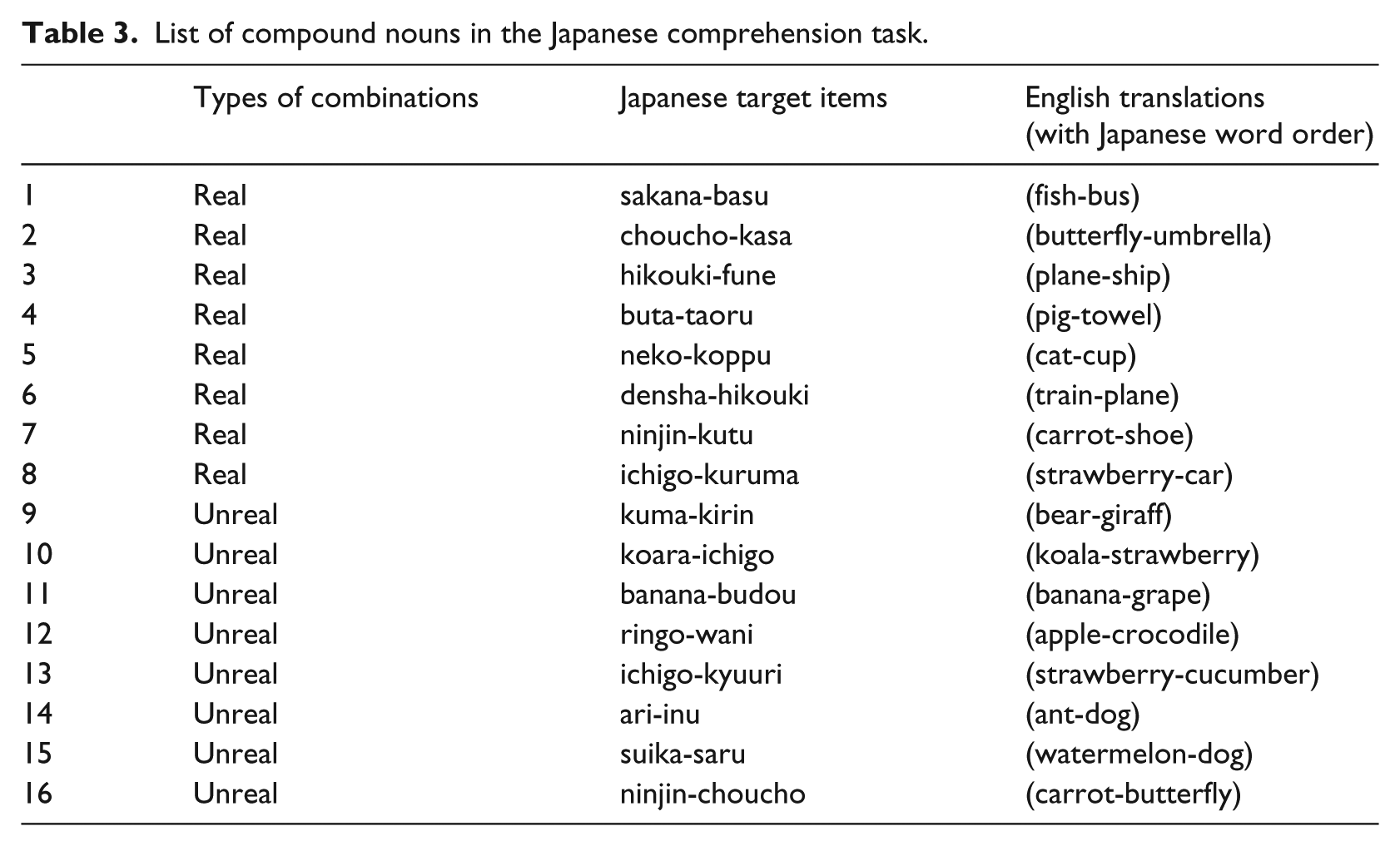
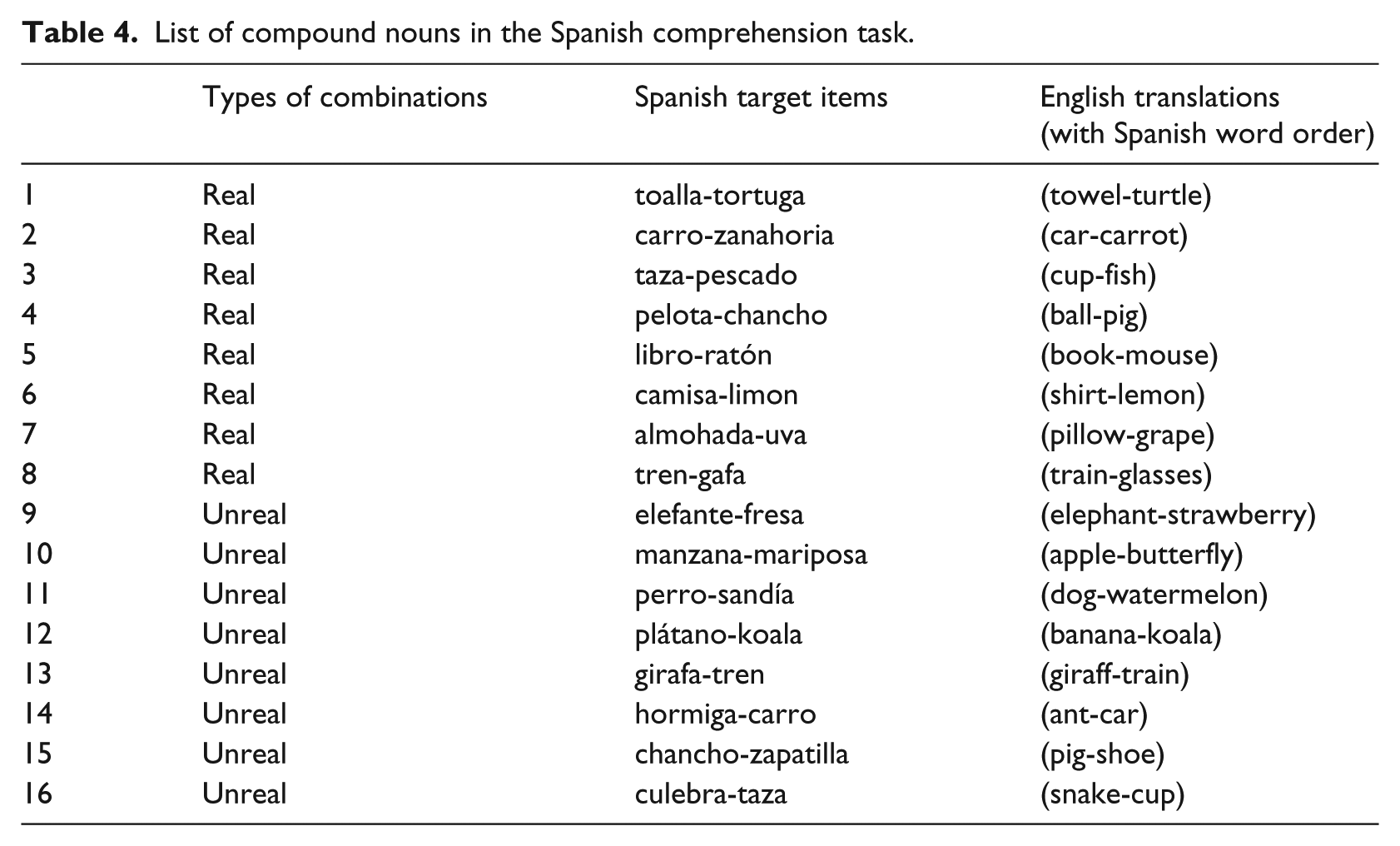
I composed 64 novel compounds consisting of nouns easy enough for preschoolers. To ensure their appropriateness, nouns were selected from the list of Japanese CDIs (Ogura & Watamaki, 2004) that 70% of typically developing Japanese-speaking children are expected to know; I chose words thought to be culturally independent (that have clear equivalents in young Spanish-speaking children’s vocabulary). The Spanish combinations were checked by a native Spanish speaker from Peru.
Half the compound nouns were used in the production task (see Tables 1 and 2), and the other half in the comprehension task (see Tables 3 and 4). Each task comprised two different combinations: one ‘real’ and one ‘unreal’. ‘Real’ combinations are numbered 1–8 in the tables; they are the combinations where patterns are applied to artificial objects, such as cups and balls, that can have patterns representing other things on them, for instance, a flower-patterned cup, in contrast to living or organic objects, such as animals, fruits, and vegetables, that cannot (so such patterns on living objects make them ‘unreal’). Although no such distinction was made in past studies, unreal combinations are hypothetically much more difficult for children, since they have never seen such things before and are not used to such constructions. Including these unreal combinations, I expected to be able to separate responses induced by previous exposure to similar combination (real combinations) from those produced by children using their own understanding of word order (unreal combinations).
List of target compound nouns in the Japanese production task.
List of target compound nouns in the Spanish production task.

List of compound nouns in the Japanese comprehension task.
List of compound nouns in the Spanish comprehension task.
Procedures
The Spanish test and tasks were administered by either the child’s mother or another native Spanish speaker from Peru. The experimenter gave precise instructions on what to do and not to do to ensure homogeneity of procedures. The bilingual children were administered three kinds of tasks in the two languages: (1) the Japanese and Spanish PPVTs; (2) Japanese and Spanish novel compound noun production tasks; and (3) Japanese and Spanish novel compound comprehension tasks. Since I wished to measure actual ability in both languages, and not linguistic age, I translated the American English version of the PPVT set B into Japanese and Spanish to gain a comparable set of vocabulary items. The Japanese and Spanish sets were administered separately, on different days within a few days of each other. Each language session took approximately 20–30 minutes. The PPVT was done before the comprehension and production tasks and the order of the two tasks within a session was counterbalanced.
All the monolingual children were tested by the Japanese native speaker (the author) at nursery school and were given only the Japanese parts of the three tasks, namely (1) the Japanese PPVT, (2) a Japanese novel compound noun production task, and (3) a Japanese novel compound noun comprehension task. They were given only one session, which took approximately 20–30 minutes. Like the Spanish session, the PPVT was done before the comprehension and production tasks and the order of the comprehension and production tasks were counterbalanced.
In the production tasks of the two languages, children were shown a set of items depicting one of the nouns on the first page (Figure 1(a)) and asked to name them to make sure that they knew the label; then, they were asked to do the same for the items on the next page (Figure 1(b)). The third page depicted either of the two previous items with the patterns of the other items (Figure 1(c)) in order to elicit compound production. The orders of the two items were randomized across the first two pages. Firstly, the experimenter taught the target compound noun structure; then, the children did four practice trials before the real trial session. During practice, the experimenter introduced the task by saying ‘Let’s play some funny things. See these pictures, these are <noun 1>, aren’t they? Let’s see the next page, see, there are <noun 2> here. Let’s see the next page, oh, look, the two things are put together! What do you think this is?’ If the child did not say the target compound structure, the experimenter taught them the target structure by saying ‘This is <compound noun>, because it is <noun 1 or 2> with <noun 2 or 1> on it’. The experimenters for each language were instructed to pronounce the compounds in such a way that the words sounded as if they were single words.
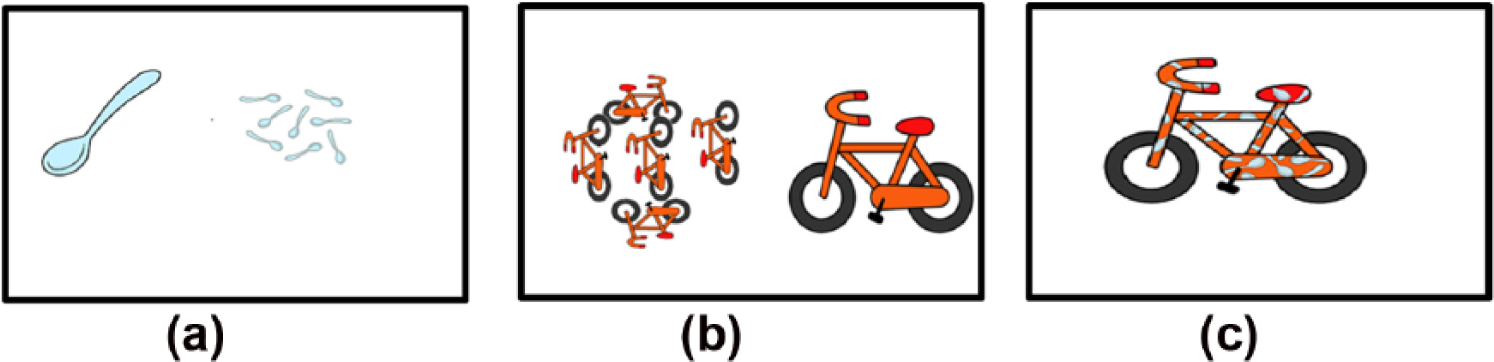
Example pictures of objects in the compound production task.
In the comprehension task of the two languages, as in the production task, children were shown the two items (Figures 2(a) and (b)) on the first two pages and asked to name them to ensure they knew the words. Then, they were shown a set of quadrats (Figure 2(c)) with frames depicting, respectively, (1) items related to one noun, (2) items related to the other noun, (3) items combined in a reversed way, and (4) the target combination. The experimenter asked the children ‘Which one of these you think is <compound word>?’ and the children pointed at one of the four. Quadrat positions were randomized. As in the comprehension task, four compound nouns were done as practice before the real trials. Before the real session, two training sessions were given (like in the production tasks) to teach the children the rules of combination.

Example of items in a comprehension task.
Results
Overall, vocabulary sizes for bilingual children were higher in Japanese (M = 17.10, SD = 4.79) than in Spanish (M = 14.20 (2.49)) (t(9) = 2.69, p < .05). To find any effect of language dominance, bilingual children were divided into two groups by language level: balanced (n = 5) and Japanese dominant (n = 5). Means and SDs for Spanish and Japanese words for each group were as follows: balanced bilinguals (mean Spanish score = 13.80, SD = 3.03, mean Japanese score = 13.80, SD = 3.03) and Japanese-dominant bilinguals (mean Spanish = 14.20, SD = 2.49, mean Japanese = 17.19, SD = 4.79). For comparison, monolingual data (mean Japanese = 17.10, SD = 4.86) were also used in Japanese tasks.
Reversal rates were compared using a 2 × 2 [Language group × Combination type] analysis of variance (ANOVA), with Combination type as a repeated variable.
Japanese tasks
Reversal rates were compared across the three language groups. Under dominance theory, those with greater Spanish vocabulary should be affected more, and thus we should see a higher reversal rate in Japanese tasks. However, in this study it was only possible to have two bilingual groups, the Japanese dominant and balanced bilingual groups, as there was no bilingual group with a greater Spanish vocabulary than Japanese vocabulary. Therefore, there should not be a significant difference in the rate of reversal between the two bilingual groups, because Spanish was not the stronger language for either of the two bilingual groups. Under ambiguity theory, rates should not differ between monolingual and bilingual data. The actual results are as follows.
Japanese production task
Reversal rates across groups are shown in Figure 3. The main effect of task type was significant (F(1, 17) = 14.99, p < .01): overall, the reversal rate of the real task (M = 24.72, SD = 24.72) was significantly higher than that of the unreal task (M = 15.71, SD = 13.96). There was also a significant main effect of language group (F(2,17) = 4.81, p < .01). The average reversal rates for each group were as follows: M (Japanese monolinguals) = 11.30, SD = 14.96, M (Japanese dominant bilinguals) = 28.40, SD = 13.00, M (Balanced bilinguals) = 30.00, SD = 13.00). The multiple comparison revealed that compared with Japanese monolinguals, both bilingual groups showed significantly greater reversals (both ps < .10), but showed no significant difference between the bilingual groups. There was a significant interaction of combination type and language group (F(2,12) = 4.95, p < .05). Significant language group differences were found only in real combination tasks; the reversal rate by monolinguals (M = 11.25, SD = 14.95) was lower than both bilingual groups—Japanese-dominant (M = 38.89, SD = 9.37) and balanced (M = 37.50, SD = 20.00), which showed there was no difference between them.

Compound noun reversal rates in the Japanese production task by language group.
Taken together, these results show that both bilingual groups reversed more on real-type tasks than monolinguals.
Japanese comprehension task
Reversal rates on the Japanese comprehension task are shown in Figure 4 There was no significant main effect of task type or interaction of task type and language group (F(1,17) = 3.40, p > .05; F(2,17) = 1.75, p > .05). Only a main effect of language group was found to be significant (F(2,17) = 5.80, p < .05); the rate for monolinguals was lower (M = 31.25, SD = 19.92) than for Japanese-dominant (M = 47.98, SD = 18.05) and balanced bilinguals (M = 46.75, SD = 11.95) (ps < .05) and there was no difference between bilingual groups.

Compound noun reversal rates in the Japanese comprehension task by language group.
In summary, for the Japanese comprehension task, bilinguals reversed more in both real and unreal tasks than monolinguals, and at the same rate between the two bilinguals groups.
Spanish tasks
The influence of Japanese was determined by comparing reversal rates in Spanish tasks by the two bilingual groups, since no Spanish monolingual children were included. If there is a dominance effect on direction of transfer, I will expect those with greater Japanese ability to be affected by the Japanese word order, and thus a greater reversal rate in the Spanish tasks than those with less Japanese ability. With no Spanish monolinguals for comparison, the locus of cross-linguistic constructions cannot be determined for certain, but comparing the two groups I have may provide suggestions.
Spanish production task
The reversal rates in the Spanish production tasks are shown in Figure 5. Only the main effect of combination type was found to be significant (F(1,8) = 10.03, p < .05): the unreal combination reversal rate (M = 73.48, SD = 8.86) was higher than for real combinations (M = 63.95, SD = 13.50; p < .05). No group difference was found (F(1,8) = .40, NS); M = 66.67, SD = 14.30 for Japanese-dominant bilinguals, M = 70.76, SD = 6. 58 for balanced bilinguals.
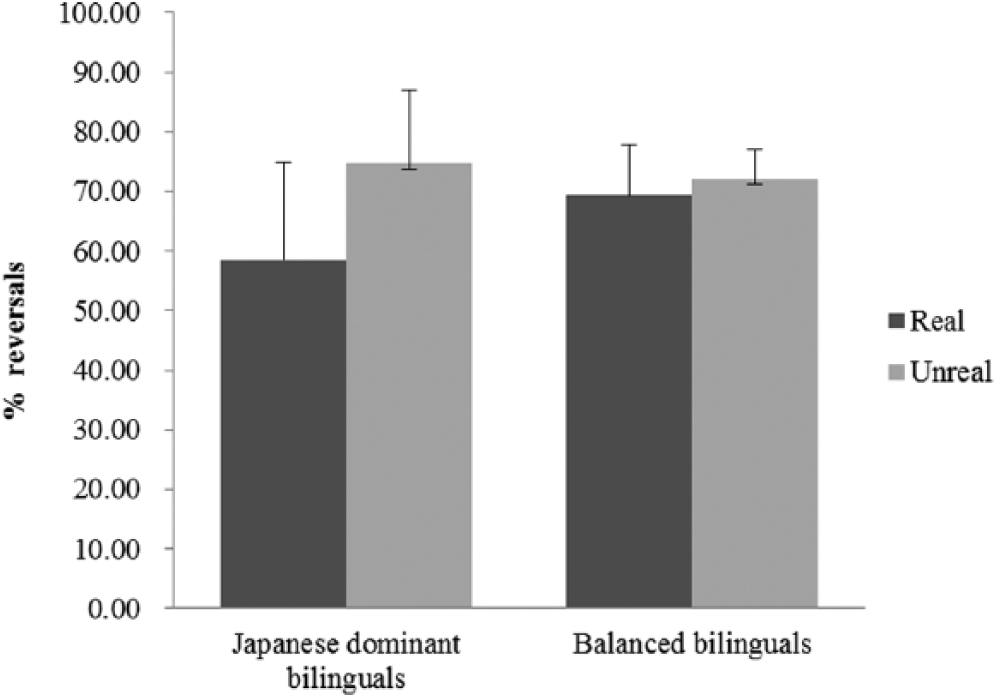
Compound noun reversal rates in the Spanish production task by two bilingual groups.
Thus, overall, the two bilingual groups had similar reversal rates in the Spanish production task, and the rate was higher for unreal combinations.
Spanish comprehension task
Reversal rates in the Spanish comprehension tasks are shown in Figure 6. Only the main effect of combination type was significant (F(1,8) = 18.98, p < .01): unreal tasks (M = 65.20, SD = 3.10) were reversed more than real tasks (M = 55.90, SD = 1.80). No significant language group difference was found (F(1,8) = .21, NS) with M = 59.46, SD = 7.08 for Japanese-dominant bilinguals and M = 61.61, SD = 8.47 for balanced bilinguals.

Compound noun reversal rates in the Spanish comprehension task by two bilingual groups.
Thus, here, bilinguals reversed unreal tasks more than real tasks and there was no intra-bilingual group difference.
For both language tasks, no difference in reversal rates by language ability was found.
Summary of results of each task
In the Japanese production task, bilinguals reversed significantly more often than monolinguals, especially with real objects. No difference was found between bilingual groups. As expected, there was no difference in the influence of Spanish to Japanese, because Spanish was not stronger than Japanese for either group, but cross-linguistic influence from Spanish was found. The two bilingual groups produced greater reversal rates in the Japanese tasks than Japanese monolinguals.
There were differences in reversal rates between unreal and real tasks. I expected the real type to reflect the influence of children’s actual experience hearing such word combinations, as they represent patterns of things, while the unreal ones would instead rely more on children’s ability to construct the combinations. Influence existed from Spanish to Japanese in compound noun production, especially producing real word combinations.
In the Japanese comprehension task, bilinguals reversed more than monolinguals, with no difference in rate between bilingual groups or object types. Therefore, in comprehending Japanese compound nouns, there was no dominance effect, but there was cross-linguistic influence from Spanish.
In the Spanish tasks, there was no difference between bilingual groups in reversal rates, which were higher for unreal objects.
Discussion and conclusion
The present findings do not clearly support either the ambiguity theory or the dominance theory, and my opinions on cross-linguistic influence from Japanese to Spanish must remain speculative without Spanish monolingual data. However, the fact that in Japanese compound tasks bilingual reversals were much higher than monolingual ones shows cross-linguistic influence even in such unambiguous structures, in both production and comprehension.
This finding aligns with cross-linguistic influences found in unambiguous compound noun structures produced by French-English bilinguals in Nicoladis (2002). Foroodi-Nejad and Paradis (2009) similarly found bidirectional cross-linguistic influence on compound nouns, which could be ambiguous, in Persian-English bilinguals. Alongside the current results, these findings imply that the nature of the loci of ambiguity causing cross-linguistic structures to occur needs to be reconsidered.
As explained in the introduction, it is supposed that monolingual children generally acquire the word orders of adjectival and nominal phrases without much difficulty, and it is also assumed that as the ordering of head and modifier in compound nouns parallels the canonical word order of Adj+Noun in most languages, monolingual children should not have much difficulty constructing compound nouns. In the case of bilingual children, this process may be less straightforward. We should consider how this might be so.
I would like to suggest that Spanish-Japanese children might have generalized the fact that both Spanish and Japanese have two ways of ordering heads and modifiers, based on their experiences of hearing nominal and adjectival phrases.
According to standard descriptions, the Spanish adjectival phrase has two ways of combining heads and modifiers, and the Japanese adjectival phrase only one. However, children hear such phrases as (5) in everyday Japanese conversation. This is an example of the very common colloquial omission of the copula in Japanese (the brackets indicate the omission). Japanese monolingual children are unlikely to be confused by this because of the strong canonical word order of the nominal phrase, as already explained. However, if the child is also acquiring a language that allows this ordering, it may become much harder to reject this option. This is probably what is at play in the variable ordering of compound nouns by Spanish-Japanese bilingual children. The bilingual children know that the canonical word orders in the two languages are opposite, yet may think the other option is sometimes possible in both languages.
The present findings do not support the ambiguity theory in a strict sense, yet the present interpretation suggests a transfer-like phenomenon; in the mind of Spanish and Japanese bilingual children, right-headedness in Japanese and left-headedness in Spanish are canonical and extremely strong, such that the weaker options in Japanese/Spanish can be influenced by them. This phenomenon resembles the basic mechanism of transfer in ambiguous structures.
(5) neko (ha) kawaii ne
jp-cat (jp-copula) jp-adj jp-sentence final part
‘The cat (is) cute’
The current study could not accurately examine any effect of dominance on direction of transfer. The only difference in dominance existed in the Japanese levels of the bilingual groups and there was no Spanish monolingual group for comparison. The tentative analysis of the dominance effect of Japanese on Spanish, however, demonstrates the possibility that there was no dominant effect for this particular noun compound structure from Japanese to Spanish.
This is in line with existing research that suggests no dominance effect on transfer (Müller & Hulk, 2001) and is also in line with Nicoladis (1999, 2002), who used similar tasks to the present study and suggest no effect of French ability on the rate of reversals in English compound nouns.
The question then arises as to whether or not the number of words a child knows in one language really reflects the vulnerability or firmness of a certain structure in the language to that of the other language. When the inputs of the two languages are balanced, the vocabulary levels may reflect both the degree of exposure to and immersion in the two languages, which may also reflect grammatical levels and strengths. In the case of the inputs, when the situation reflects the current one, the relationships between these aspects of language may not be as straightforward as one might think. In fact, Foroodi-Nejad et al. (2009) demonstrated that the dominance of transfer is not always determined by the relative vocabulary sizes, emphasizing the effect of the social status of the language. In Foroodi-Nejad et al. (2009), the dominance effect was only found in the mainstream language (English) to the minority language (Persian), but no dominance effect was observed in Persian to English. In the current study, the relative vocabulary levels of the mainstream language, Japanese, in the two bilingual groups were different, but no differential effect was found, which could appear to deviate from the idea of Foroodi-Nejad et al. (2009). Nonetheless, this difference in the results may be caused by the bilingual groups used for comparison. Foroodi-Nejad et al. (2009) used two bilingual groups with very different relative linguistic abilities, namely Persian-dominant and English-dominant bilinguals, while the bilingual groups used in the current study were Japanese dominant and balanced bilinguals, with only very small differences in Japanese ability. Therefore, I suggest that if there had been a group with a relatively greater Spanish ability, the results may have been closer to those of the previous study.
Based on these accounts, I would like to argue that the dominance effect may involve more than just relative lexical knowledge. Defining language dominance and proficiency in bilingual children has always been problematic. Genesee, Nicoladis, and Paradis (1995) discussed the idiosyncratic and inconsistent use of dominance measures in bilingual acquisition research. They found that word types and MMUs were valid empirical bases for classifying dominance. As stated earlier in the Method section, receptive vocabulary scores have been found to be related to the number of word types produced in observations. The vocabulary knowledge measured by the PPVT in the current study can therefore indicate a child’s ability to produce different words, but not their morphological complexity. Morphological and grammatical complexity are necessary for the child to produce more complex sentences with more complex constructions, which leads to greater fluency in formulating thoughts in a particular language. A child may have a smaller vocabulary in one language, but be more morphologically or grammatically proficient in another. For instance, Kutsuki (2004) reported instances of a Spanish-Japanese bilingual child inverting the Modifier-Head word orders Adj+Noun and Noun+no (Japanese possessive article)+Noun in Japanese utterances, even though the child’s Spanish was still at the one-word stage. The child’s Japanese vocabulary clearly exceeded her Spanish vocabulary, yet the word order was affected by Spanish grammar. This demonstrates an instance of a weaker language affecting a stronger language. The inputs of the two languages are very variable and imbalanced for bilingual children like this girl and many other children born and raised in minority language homes in Japan. Once they enter nursery, the vocabulary inputs in the mainstream language quickly exceed those of the minority language. In such a linguistic situation, the grammar of the minority language is present in the mind of the child and may manifest itself in his utterances in the mainstream language, in which he may have greater vocabulary. Therefore, accessibility to vocabulary knowledge of a language may not accurately represent the strength of the influence of its grammar on the other language. Such variation should be included in considerations of dominance.
In addition, the relative exposure to each language and the amount of time that the child uses it should be considered. The dominant use of and exposure to Japanese may play a greater role in transfer than the relative vocabulary size; the children’s paradigms for ordering two nouns may have been influenced more by Japanese syntax than the number of words they know in each language. This possibility may also explain the very high reversal rates found in the Spanish tasks by both bilingual groups.
Cross-linguistic structures in production and comprehension
Unlike other studies on cross-linguistic structures, I used both comprehension and production tasks with different object types, real and unreal. According to Nicoladis (2006), transfer is an epiphenomenon of production, and processing of production and comprehension are different. In production tasks, as in the present study and in Nicoladis (2002) and (2003), a series of pictures were shown and the child was asked how s/he would express it in one word or in an adjectival phrase (Nicoladis, 2006). This required the child to choose which language’s morphosyntactic frame to use, and this is where the error occurs, resulting in cross-linguistic transfer. In contrast, in the comprehension-type task, no cross-linguistic transfer should occur, as there is no choice of morphosyntactic frame involved; the words are combined and said by the experimenter. Nicoladis (2002) found that in production tasks, bilinguals reversed more often than English monolinguals, while there was no statistical difference in the rate of reversal in comprehension.
However, in the current study, the bilingual groups produced higher rates of reversal in both production and comprehension tasks in Japanese; this indicates that cross-linguistic transfer may occur in comprehension as well.
Theoretically, the way the stimuli are presented in a comprehension task should not cause the children to switch or choose between the morphosyntactic frames of two languages because they did not have to combine words by themselves. Nonetheless, the characteristics of the tasks used in the present study may have caused them to do so. In Nicoladis (2002, 2003), the stimuli for the comprehension task consisted of three or four pictures. For instance, in Nicoladis (2003) the stimuli consisted of four pictures; for ‘sun bag’, the first picture depicted a sun, the second a bag, the third a sun surrounded by bags, and the fourth a bag with small suns drawn on it (the target stimulus). Here we find a major and possibly significant difference between previous studies and the current study in the way the pictures were put together. The present study included two pictures of two items ‘combined’, as seen in Figures 2(c)-b and (c)-c for ‘ball-fish’ and ‘fish-ball’, respectively, while in the previous studies only one of the choices was a ‘combined’ object. Because unrealistic targets such as ‘ball-fish’ were included as targets in the present study, children could not reject them immediately as unrealistic but instead had to carefully examine both possibilities. When doing so, if the target word was ‘ball-fish’, the child would first have to think how the two combined stimuli can be expressed as compound nouns, then choose the option that matches the target. Although this is a comprehension task, comparing two extremely similar combinations may cause a burden for the still-developing working memory of the child, and the task is much more difficult if the child assumes that there are two ways of ordering in both languages.
Task type difference: Real and unreal
I supposed that real combinations would be more experience-based than unreal ones and therefore that unnatural combinations would be much more difficult, as children would have to depend on their own word order knowledge. In fact, except in the Japanese production task, reversal rates were higher for unreal tasks. The fact that Japanese production task rates were higher for real combinations could reflect trouble choosing the right morphosyntactic frame when saying the words. As proposed by Nicoladis (2006), when bilingual children produce words, the two competitive morphosyntactic frames of the two languages are activated in the mind of the child, who chooses one of the two to meet situational linguistic needs. It may be that the two frames are not activated equally strongly, depending on the type of vocabulary. Here, objects depicted by ‘real’ combinations were types of objects that could exist in the real world and that the children were likely to have heard and said (either those compounds or others like them) in both their languages. Thus, when children were trying to combine two nouns to create compound nouns, the Spanish morphosyntactic frame may have been activated more strongly than it should have been.
In comprehension tasks, in contrast, the child chose one of the quadrats to match the combination said by the experimenter. Although children should have been ready to put the words in the correct word order or syntactic frame, hearing two different words and remembering their order may have caused a greater mnemonic cognitive load. In particular, children knew that nonsense or unreal combinations might also appear, and could not ignore them on the basis of experience. In a way, therefore, the real–unreal distinction in comprehension tasks may not have functioned as expected. However, the distinct results between production and comprehension may still partially support the differential interaction of two languages between the two modes of language processing.
The largest limitations of the study were the sample size of the bilingual children, which made it impossible to have two bilingual groups with very different language abilities, and the lack of Spanish monolingual children. Nonetheless, this is the first systematic experimental study on young Spanish-Japanese bilingual children in Japan, and its results will undoubtedly contribute toward the scientific research on bilingual acquisition, despite its shortcomings.
In summary, the current results suggest that cross-linguistic transfer can exist in unambiguous structures in both production and comprehension. They also indicate the possibility that the directionality of transfer is not influenced by relative vocabulary knowledge. The results of the present study suggest that very young bilingual children whose exposure to two languages is imbalanced consider structures to be overlapping in a way that is very different from the way in which adults think. Furthermore, conventional measures of language dominance may not sufficiently explain the languages’ mutual influence on this demographic.
The elements of language that can and cannot be ambiguous and the factors that make one language more dominant and influential than another will have to be considered carefully from the perspectives of bilingual children.
Footnotes
Acknowledgements
The author thanks all the children and parents who participated in this study, and expresses deep gratitude as well to the teachers who made all the necessary arrangements, making the current research possible.
Declaration of conflicting interests
The author(s) declared no potential conflicts of interest with respect to the research, authorship, and/or publication of this article.
Funding
The author(s) disclosed receipt of the following financial support for the research, authorship, and/or publication of this article: This study was partly supported by KAKENHI (Grant-in-Aid for Scientific Research (C))JP 15K01784.