



Abstract
Aims and Research Questions:
This paper describes the repetitive prefix in Agul (Lezgic, East Caucasian), focusing on the grammaticalization path of this morpheme. The main question to be addressed is the hypothesis that the prefix has been copied from the closely related Lezgian language.
Approach, Data and Analysis:
Firstly, I provide a detailed description of the morphology and semantics of the repetitive prefix (‘again’, ‘back’) in comparison to the system of locative prefixes in Agul, showing that despite the formal similarity with the ‘
Findings/Conclusions:
While the relation of the meaning ‘behind’ to ‘again’ is cross-linguistically common, the development of a special repetitive prefix in Agul is only attested in the two southern dialects, whose speakers have been in long-term contact with Lezgian – a language that possesses a productive repetitive prefix/infix. It is thus natural to assume that the Agul prefix has a contact-induced origin. I also show that this is not the only grammatical phenomenon of southern Agul that has been influenced by Lezgian.
Originality and Significance:
The morphological properties and functions of the repetitive prefix in Agul have not been described in detail before. The conclusion that this prefix is a morphological copy is remarkable, because Lezgian is one of the two languages most closely genetically related to Agul, and also because the borrowing of the prefix has led to the emergence of affixal ‘etymological doublets’ in Agul.
Limitations:
It remains to be investigated to what extent ‘
Keywords
Introduction
The last decade has seen a rise of interest towards contact-induced phenomena, including morphological borrowing (see e.g. Gardani, 2008; Gardani, Arkadiev, & Amiridze, 2015; Johanson & Robbeets, 2012; Matras & Sakel, 2007; Stolz, Vanhove, Otsuka, & Urdze, 2012; Wiemer, Hansen, & Wälchli, 2012). Whereas the most discussed cases of contact morphology involve borrowing from a socially dominant but genetically unrelated language, the occurrence of similar phenomena among distantly or even closely related languages cannot be excluded (on the latter, see in particular Epps, Huehnergard, & Pat-El, 2013). The aim of this paper is to present evidence for a contact-induced development belonging to the ‘closely related’ end of the continuum, namely the rise of the repetitive prefix in Agul under the influence of Lezgian, a dominant language of the area where southern dialects of Agul are spoken.
Both Agul and Lezgian belong to the Lezgic branch of the East Caucasian (Nakh-Daghestanian) family. Agul is one of the minor languages of Russia. It is spoken in about 20 mountain villages in southern Daghestan, and by those resettled on the lowlands; according to the 2010 census, there are altogether circa 29,300 speakers of Agul in Russia. Administratively, the Agul villages in the mountains are divided between the Agulskiy district and the Kurakhskiy district. There are five Agul villages in the north-eastern part of the Kurakhskiy district, which is mainly inhabited by Lezgians. From a dialectal point of view, one of the Agul villages of the Kurakhskiy district, namely Khpyuk (Huppuq’) represents a distinct dialect, while the four other villages (Usug, Kvardal, Khveredzh and Ukuz) together with the two neighbouring villages of the Agulskiy district (Richa and Bedyuk) belong to the Keren dialect of Agul. The Agul dialects spoken in the Agulskiy district include the Central (or Tpig) dialect, and the Tsirkhe, Burkikhan and Fite dialects spoken in one village each, and also the Qushan dialect, which is hardly intelligible to speakers of other varieties.
Lezgian is spoken in a much more vast territory than Agul, including several districts of southern Daghestan and also several districts of northern Azerbaijan; the total number of speakers, according to Ethnologue, amounts to almost 650,000. 1 In the Kurakhskiy district, where the Agul-Lezgian linguistic border can be drawn, the Kurakh dialect of Lezgian is spoken. The Keren Agul villages of the district as well as Khpyuk have been in tight contact with the Lezgian-speaking villages Gelkhen, Ursun and Shimikhyur for a long time (see Figure 1 for a map of the area around the border between the two districts). Most speakers of the southern Agul dialects have a good command of Lezgian, which is the dominant language of the area and has a relatively high prestige, since the main road to the lowlands goes through the Lezgian territory, Lezgian is spoken in the administrative centre of the district (Kurakh) and shopping mainly takes place in Kurakh and Kasumkent, another big Lezgian village that is the centre of the next district on the way to the lowlands. In the second half of the 20th century, Lezgian was even taught in schools as a ‘mother tongue’ for some time, and intermarriages with Lezgian women continue to be frequent.
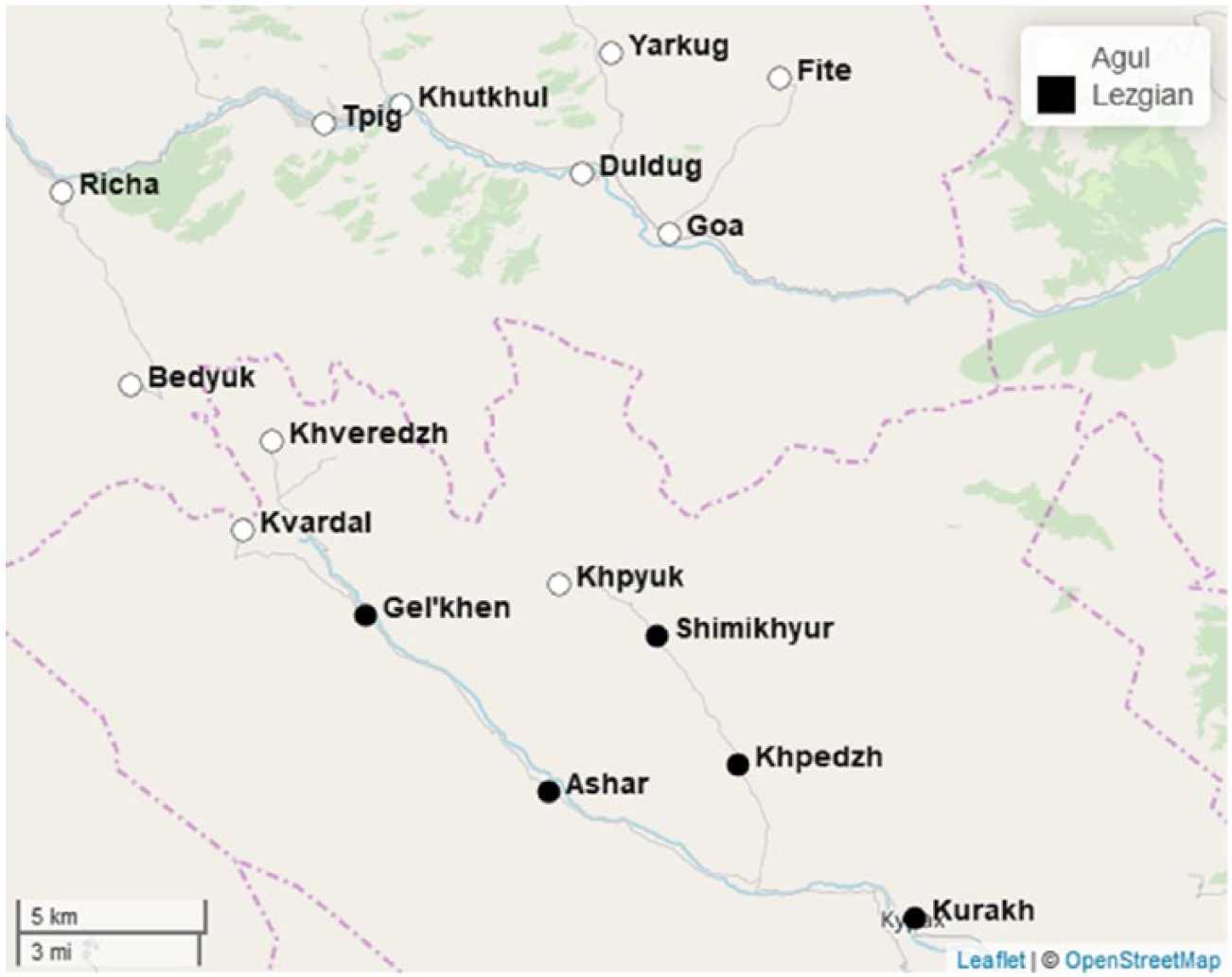
South of the Agulskiy district and north-east of the Kurakhskiy district. 2
Other neighbours of the Aguls in the mountains are the Dargins (Dargwa) to the north and the Tabasarans to the east. Whereas Dargwa forms a separate branch of the East Caucasian family, Tabasaran and Lezgian are the languages most closely related to Agul; together the three comprise the East Lezgic subgroup of the Lezgic branch. Like East Caucasian languages in general, the East Lezgic languages have ergative case alignment, head-final word order with a basic subject–verb/subject–object–verb (SV/SOV) pattern, rich case systems and elaborate verbal paradigms. In particular, the case system typically includes a series of locative forms, comprising two slots: the localization suffix encodes the position of the figure with respect to the landmark, while the orientation suffix (which may be null) points at the direction of movement, or the absence of motion (see Daniel & Ganenkov, 2009; Kibrik, 2003 for details). Another important feature of the Lezgic languages is the use of prefixal morphemes, in particular locative preverbs, whose system is in some respect symmetric to that of the nominal locative forms.
The present paper focuses on one of the prefixes attested in Agul, which has a restricted distribution across the dialects – the repetitive prefix q(V)- meaning ‘again’, or ‘back’ in the case of motion or transfer, for example q-agune ‘saw again’ from agune ‘saw’, or qa-tin ‘give back!’ from tin ‘give!’. In the next section, the system of verbal prefixes of Agul will be briefly described. The two subsequent sections will discuss the morphological properties and the functions of the repetitive prefix in more detail. I will then turn to the hypothesis about the origin of the Agul repetitive prefix as a morphological copy from Lezgian. The final section presents the conclusion and directions for future study.
Although the existence of the repetitive prefix in southern Agul dialects has been previously acknowledged, for example by Magometov (1970, pp. 163–164), and its probable contact-induced nature was mentioned by Sulejmanov (1993, p. 162), Maisak and Merdanova (2002, pp. 260–261) and Maisak and Ganenkov (2016, p. 3590), no detailed description of this marker has been provided so far. The present account is mainly based on data from the Huppuq’ dialect (spoken in the village of Khpyuk), in particular on a corpus of spontaneous oral narratives from Huppuq’ and other Agul dialects, which was collected in the 2000s as part of the Agul Documentation Project. 3
Verbal prefixes in Agul
In this section, I will show that within the system of verbal prefixation in Agul, the repetitive prefix occupies a special position, being paradigmatically distinct from the other prefixes and possessing its own morphological slot.
There are three sets of prefixal morphemes in Agul: locative prefixes (which include two series of markers), negative prefixes (two morphemes) and the repetitive prefix, which will be the main focus of the paper. While the locative prefixes are clearly derivational and the negative prefixes are clearly inflectional, the repetitive marker is somewhat intermediate on the derivation–inflection continuum. All the prefixes of the Huppuq’ dialect (the main allomorphs only) are listed in Table 1.
Verbal prefixes in Huppuq’ Agul.

Locative prefixes
Although locative prefixes (also known as ‘preverbs’) are not found in all the branches of the East Caucasian family, they are certainly one of the hallmarks of the Lezgic branch. Every Lezgic language possesses a set of locative prefixes, some of which have the same form and meaning as locative case markers. It is thus plausible to assume that (some of) the locative prefixes and (some of) the locative case forms have a common historical origin in locative adverbs. In one morphosyntactic context, namely as postpositional nominal modifiers, such adverbs fused with nominals, finally becoming suffixes; in another configuration, preverbal locative markers ended up as bound prefixes (see also Haspelmath, 1993, p. 169). At least the following locative prefixes can be traced back to the Proto-Lezgic stage, according to Alekseev (1985, pp. 117–121): *al- ‘on, above’; *ʔ- ‘inside’; *h- ‘in front’; *k- ‘in contact’; *ʟː- ‘under’; *ɬːʷ- ‘near’; *s- ‘down, below’; *q- ‘behind’; *qˤ- ‘between, in a mass’; *qː- ‘out’ (see also Schulze, 1982, pp. 264–266). For the subsequent discussion, it is important to note that the prefix *q- ‘behind’ is also found among these ancient locative morphemes.
Among the Lezgic languages, Agul possesses one of the richest systems of locative prefixation, comprising two series of markers and two slots for them. The first slot is reserved for localization markers that specify a particular spatial domain where a figure is located. In the Huppuq’ dialect, there are seven localization prefixes, which express meanings such as ‘inside (a container)’, ‘in front of’, ‘behind’, ‘on a horizontal surface’, etc. – see the full list in Table 1. Prefixes of the second slot, which is closer to the verb root, mark orientation and indicate whether a figure moves in a particular direction, or rests at a spatial domain defined by the localization marker. There are four orientation markers, which distinguish between the lative (‘motion towards’) versus elative (‘motion from’) meanings on one hand, and ‘motion upwards’ versus ‘motion downwards’, on the other. The second slot may be left empty, though, so there are verbs with only a localization prefix and no orientation prefix. The absence of the orientation markers usually triggers the lative reading with dynamic verbs, and the essive reading (‘no motion’) with statives (‘to be’ and ‘to remain’).
Prefixal verbs can be derived both from roots that are also used without locative prefixes and from ‘bound’ roots that do not occur outside prefixal derivatives. The two stative roots ‘to be, be located’ and ‘to still be, remain’ belong to the latter type: with each of the two roots seven different verbs can be formed, which differ only with respect to the localization prefix, for example aa ‘is inside (a container)’, ʕaa ‘is inside (a substance)’, aldea ‘is on’, haa ‘is in front’, etc., and amea ‘remains inside (a container)’, ʕamea ‘remains inside (a substance)’, almea ‘remains on’, hamea ‘remains in front’, etc. Other bound roots with many prefixal derivatives include -arx- ‘to get to, find oneself in’, -uč’- ‘to get into (with effort), climb’, -aq- ‘to pour, scatter’, -ik’- ‘to put (with effort), thrust’, -ix- ‘to put’, -dark- ‘to turn, spin’, among others. On the other hand, verb roots ʕʷ- ‘to go/come’ or du(ʔ)- ‘to pull, drag’ occur without prefixes as well, compare forms of the unprefixed verb duaa ‘pulls, drags’ and its prefixed derivatives ʔa-ča-dʷaa ‘pulls into (a container)’, ʕa-ča-dʷaa ‘pulls into (a mass or liquid)’, al-ča-dʷaa ‘pulls on (e.g. clothes)’, ʔatːʷaa (< *ʔ-atː-dʷaa) ‘pulls from inside’, ʔa-ʁa-dʷaa ‘pulls up from inside’, ʔa-da-dʷaa ‘pulls down from inside’, etc.
These bound verb roots are attested with the largest number of derivatives. Given the seven localization prefixes and the five possible fillers for the orientation slot (including the absence of a marker), we can expect to have as many as 35 derivatives from one verb root. However, locative prefixation is not that productive: the combinability of prefixes with verbal roots is restricted, and there are no verb roots for which all of the 35 logically possible combinations with locative prefixes exist (combinations including the ‘
Some prefixal derivatives with the root -ix- ‘to put’.
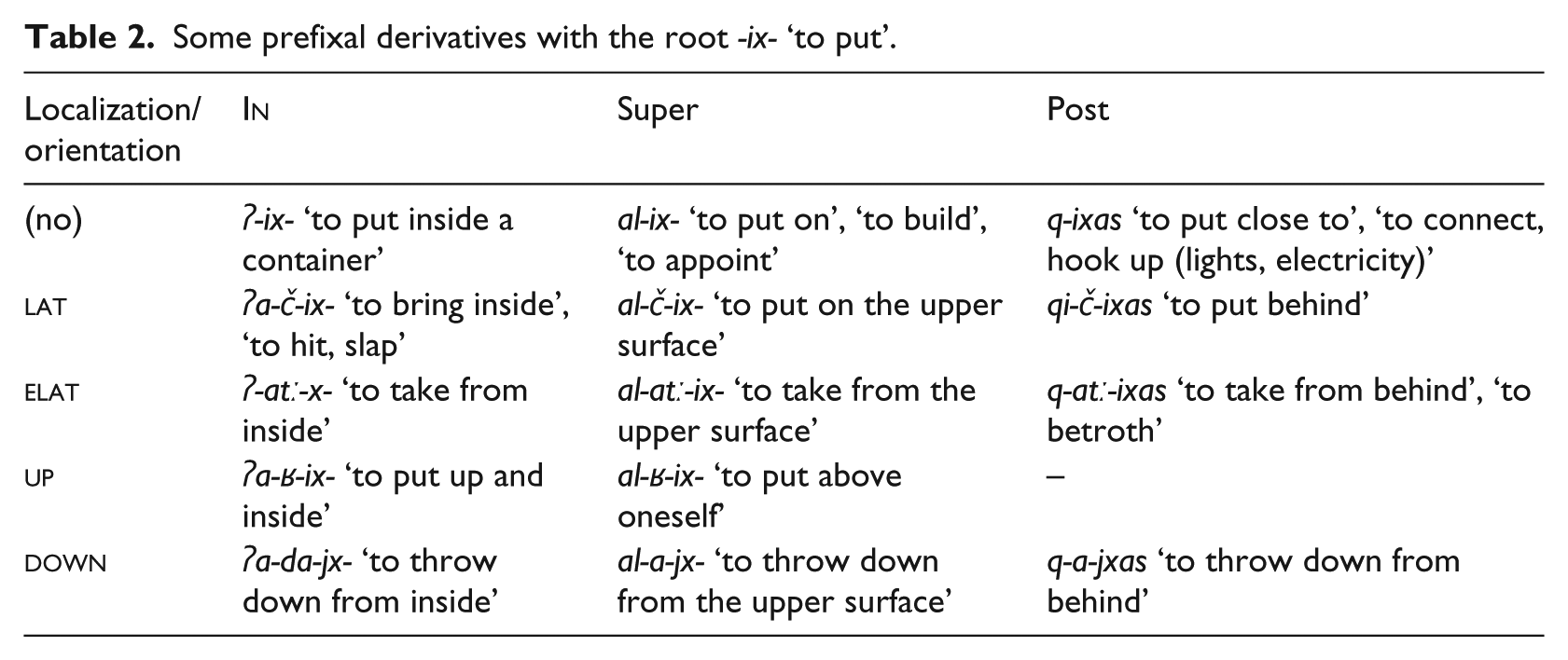
Locative preverbs in Agul do not change the aspectual characteristics of the verb – thus, Agul, as with most other languages of the family, does not belong to the ‘club’ of Caucasian languages that employ prefixation as a perfectivizing aspectual device (see Arkadiev, 2015, for a detailed treatment of the latter phenomenon). At the same time, many prefixal verbs in Agul have idiomatic meanings, with the underlying locative metaphor more or less clear in most cases. Some examples of this kind can be seen in Table 2, for example ʔa-č-ix- with the literal meaning ‘to put inside’ can also refer to hitting, and q-ixas with the localization prefix ‘
(1) za-l sa idemi alčarx.u-ne I- ‘I met a man.’ (2) zun wa-q quχ.a-dawa I you- ‘I don’t believe you.’
Indeed, the historical affinity of verbal prefixes and nominal locative cases is still clear on a synchronic level (even despite the semantic changes in prefixed verbs), due to a frequent congruence between the two sets of markers: verbs with a particular locative prefix typically go together with dependent noun phrases with the same localization marker. Thus, in (3) the prefixal combination ‘
(3) amma te ruš (…)
but ʡazab.i-
suffering- ‘But your daughter… won’t get out of trouble.’ (4) me t’ubal ruš.a-
‘When (he) stretches the ring to the girl…’
For further details on locative prefixation in the Huppuq’ dialect, see Maisak and Merdanova (2002) and Maisak and Ganenkov (2016, pp. 3585–3588). In other Agul dialects, there is some variation in the number of affixes and their form, as well as in the number of slots. For example, in most dialects, there is an opposition between the localizations kː- ‘below a landmark’ (
Negative prefixes
There are two ways of expressing verbal negation in Agul. In synthetic forms negation is marked prefixally, while in periphrastic forms, negative forms of postpositional auxiliaries (a copula or an existential verb) are employed. Most finite forms in Agul are originally periphrastic, even though the auxiliary tends to become morphologized to the extent that it is almost indistinguishable from an affix in some cases. The synthetic forms that make use of the prefixal negation strategy are mostly non-finite (converbs, participles, infinitive, action nominal), but also include a couple of non-indicative forms.
The negative prefix d- (da- before consonant-initial roots) is used with most of the forms, the only exception being the imperative. As common in East Caucasian languages, the negative imperative (usually known as the prohibitive) is not morphologically parallel to the imperative proper, but is derived from a different stem and employs a special negation marker. In Agul, the prohibitive marker is m- (ma- before consonant-initial roots). Both d- and m- are ancient negative morphemes that can be safely reconstructed for the Proto-Lezgic stage (Alekseev, 1985, pp. 100–101), and even deeper chronological levels (Nikolayev & Starostin, 1994, p. 404, 797). These morphemes are used in all Agul dialects and are unrestrictedly productive.
Examples (5)–(8) illustrate the negative equivalents of some of the synthetic forms in Agul. The infinitive in (5) and the perfective converb in (6) are non-finite forms. The jussive in (7) is a finite non-indicative form that functions as an optative and a third-person imperative. Unlike all of the forms mentioned above, the second-person imperative in (8a) and its negative counterpart in (8b) are morphologically non-parallel, as the latter is derived from the imperfective stem (although semantically it is not imperfective).
(5) a. aʁ.a-s b. d-aʁ.a-s say. ‘to say’ ‘not to say’ (6) a. up.u-na b. d-up.u-na say. ‘having said’ ‘not having said’ (7) a. up.u-raj b. d-up.u-raj say. ‘let him say!’ ‘let him not say!’ (8) a. up b. m-aʁ.a say. ‘say!’ ‘don’t say!’
It is worth mentioning that negative prefixes in Lezgic languages, including Agul, tend to occur infixally, especially if a verb stem contains a locative prefix. Example (9) from the Keren dialect (Usug village) illustrates this position of the prohibitive prefix with the verb ʁarx- ‘to lie down, sleep’. The Huppuq’ dialect is exceptional in that negative prefixes almost always precede locative prefixes; there are only sporadic examples of the inverse situation. Given that in all other Agul dialects the infixation of negation is normal, the ‘externalization’ of negative morphemes in the Huppuq’ dialect should be regarded as a comparatively recent innovation.
(9) ač’.a χul.du ʁa‹m›arx.a ravine(
‘Don’t spend the night on the bottom of a ravine.’ (Maisak, 2014, pp. 118–119, originally from Šaumjan, 1941)
Repetitive prefix
The third set of prefixal morphemes in Agul is represented by the repetitive prefix q(V)- with the basic meaning ‘again, repeatedly’. The morphological peculiarities of this marker, including its allomorphs and their distribution, will be described in the Morphology of the repetitive prefix section, and we will have a closer look at its functions in the Semantics of the repetitive prefix section. Unlike the locative prefixes and the negation prefix that are common to all Agul dialects, and to some extent even to other Lezgic languages, the repetitive prefix is only attested in two southern Agul dialects, namely the Huppuq’ dialect and the Keren dialect. A preliminary example of a verb with a repetitive prefix was given in the Introduction; see also a minimal pair in (10), illustrating the basic (repetitive proper) meaning.
(10) a. aʁ.a-s b. q-aʁ.a-s say. ‘to say’ ‘to say again, to tell more’
In contrast to the locative prefixes, the repetitive is almost unrestrictedly productive: it can co-occur with most verbal stems, including those that already have locative prefixes. In the Huppuq’ dialect, the repetitive is external to locative prefixes, while negation markers occupy the most leftward position: see a template in (11) and a natural example (12) where the prefixes follow exactly this order. The temporal converb in -guna is used here to indicate a reason (‘because he does not leave’, ‘because he does not come off’), the verb stem is al-atː-arx- derived from a root arx- ‘to appear, get, find oneself somewhere’ by means of locative prefixes al- ‘
(11) (12) da-q-l-atː-arx.a-guna, hal eχir čara
a-dawa…
‘As he doesn’t leave (them) in peace, there is no way out…’ (13) ruš ma-q-aʁ.a za-s daghter ‘Don’t call me daughter any more.’
In the Keren dialect, as already pointed out above, negative prefixes tend to occur infixally and locative prefixes are normally external to negation. The behaviour of the repetitive is similar, as it usually occurs closer to the root than the locative prefixes, as the following corpus examples from the villages of Bedyuk (14, 15) and Khveredzh (16) show.
(14) med kː-etː-q-uč’.a-a ilan again { ‘The snake gets out (from below) again.’ (15) a-ʁ-qu-b.aˤ-j-e gi-sa-as wartː { ‘(He) climbs back up from there.’ (16) sara wa-q qu-ča-q-arx.a-f a-daa more you- ‘There is no one who can keep up with you.’
When negative prefixes are also present, they are internal to the repetitive. In (17) from Usug, both markers are prefixal and follow the ‘repetitive > negative’ order; in (18) from Bedyuk, the prohibitive marker is infixal, while the repetitive is placed between the stem and the locative prefixes.
(17) χˤur.i-s-tːi qa-da-w.aˤ-s kːan-x.u-ne village- ‘(He) didn’t want to return to the village.’ (18) sara za-q qu-ča-q-ada‹m›ark.a wun more I- ‘Don’t you approach me again.’
In contrast to verbs with localization prefixes, verbs with the repetitive do not show any special association with dependent noun phrases marked by particular locative case markers. Historically, however, the repetitive does have a connection to the system of locative preverbs, as will be shown in the next section.
Morphology of the repetitive prefix
Allomorphy
Just as for the locative and the negative prefixes, the repetitive marker has several allomorphs: to put it simply, the monoconsonantal variant q- occurs with vowel-initial stems, while other variants of the prefix including a vowel (qa-, qu-, qi-) mostly occur with consonant-initial stems. In more accurate terms, the variants of the repetitive prefix are partly phonetically and partly lexically conditioned. In particular:
q- appears before stems in /a/ (although sometimes before stems in other vowels as well), see (10);
qa- appears before stems in /i/, /u/, /e/ and in consonants (including the unpronounced glottal stop of the localization prefix ‘
qu- is used with the imperfective stems of motion verbs ʕʷas ‘to go/come’ and χas ‘to bring/take’, with the suppletive imperative qu-jaχ ‘go away (again)!’ and with the verb hatas ‘to send’ (see (21));
qi- is used with the suppletive imperative qi-šaw ‘come (again)!’.
(19) qa-fac.u-ne ‘seized again’ (20) qa-uχ.a-s ‘to drink again’ (21) qu-hat.a-s-e ‘will send back’
Productivity and frequency
Unlike locative prefixes, the repetitive marker is unrestrictedly productive and can co-occur with any verbal stem, including those that already have locative prefixes. An exception is statives, which form a small subclass of verbs with a reduced paradigm: some statives, for example verbs with locative prefixes derived from the roots ‘to be, be located’ and ‘to still be, remain’, do not co-occur with the repetitive prefix at all. Among non-locative statives, however, there are those that allow the repetitive derivation, compare qa-kːandea ‘wants again’ (< kːandea ‘wants again’) or qa-itːaa ‘is ill again’ (< itːaa ‘is ill’). On the whole, Haspelmath’s (1993, p. 174) claim about the repetitive prefix in Lezgian is equally applicable to its Agul counterpart: it is ‘so regular that it could even be considered an inflectional category of the verb’ (for more details on the Lezgian repetitive, see the Repetitive prefix: inherited or copied? section). On the inflection/derivation continuum, the repetitive can be placed between the locative prefixes (clearly derivational) and the negative ones (clearly inflectional).
The token frequency of ‘repetitive verbs’, that is, verbs with the repetitive prefix, is quite high. In the corpus of Huppuq’ texts, containing circa 92,000 words, there are 2037 tokens of repetitive verbs. The total number of non-stative verb forms in the corpus is around 25,000, so about every 12th non-stative verb form bears the repetitive prefix. On the whole, there are about 120 different repetitive verbs in the texts. A list of the top 23 verbs with more than 10 occurrences in the corpus is given in Table 3; for those verb stems that include a locative prefix, the gloss for this prefix is given with the translation. Note that, although the perfective stem of the verb ‘come’ is ad- (e.g. adine ‘came’), with the repetitive it occurs in the form aj- (e.g. q-ajine / q-ajne ‘came back, came again’).
Top list of verb stems that co-occur with the repetitive prefix.

In can be easily seen from the table that the most frequent repetitive derivatives belong to the class of motion verbs; thus, repetitive verbs from the three verb stems – ‘come’, ‘go away’ and ‘go/come’ – account for more than 50% of all tokens. Another frequent triple is ‘bring’, ‘carry away’ and ‘bring/carry away’, with about 10% of all occurrences. These two triples are interesting in that each of them corresponds to two verb lexemes: in Huppuq’ Agul, deictic motion verbs ‘come’ and ‘go away’ have one and the same suppletive stem in the imperfective (while being distinct in the perfective and the imperative), and the same is true of the two deictic causative verbs of motion ‘bring’ and ‘carry away’. Moreover, while the imperfective for ‘bring/carry away’ is a separate non-derived stem χ-, ‘bring’ and ‘carry away’ are derived from ‘come’ and ‘go away’ by means of a preposed element faj- (> fa-). The latter is originally a converb of the stative verb faa describing temporary possession (‘have with oneself, have at hand’); hence, ‘bring’ and ‘carry away’ are historically combinations with the literal meaning ‘having at hand, come’ and ‘having at hand, go away’ (see (22)). With these derived verb stems, the repetitive prefix occurs infixally: however, ‘bring again’ and ‘carry away again’ rather seem to be derived not from already morphologized combinations for ‘bring’ and ‘carry away’, but from the original combination of faj- (> fa-) with the repetitive verbs ‘come again’ and ‘go away again’ – see (23).
(22) a. faj-ne / faj.i-ne / fajd.i-ne (< *fa-j ad.i-ne) bring. ‘brought’ b. fajš.u-ne (< *fa-j uš.u-ne) carry. ‘carried away’ (23) a. fa‹q›aj-ne / faj‹q›aj-ne / faj‹q›aj.i-ne (< *fa-j q-aj.i-ne) < ‘brought back, brought again’ b. fa‹q›š.u-ne (< *faj q-uš.u-ne) < ‘carried away again, took back’
From a functional perspective, the close association between motion verbs and the repetitive prefix is quite natural (see also Wälchli, 2006, pp. 91, 97). As will be shown in more detail below, one of the regular interpretations of this prefix is ‘back, backwards’, which is a salient notion in the description of the path of a moving figure (historically, moreover, this stage might have been even the initial one in the grammaticalization process).
Repetitive versus ‘post’ localization
One thing that strikes the eye while looking at the list of locative prefixes is the formal similarity between the localization prefix ‘
(24) a. q-ix.a-s ‘to put behind, lean against’ b. qa-(ʔ-)ix.a-s ‘to put inside again’
The second observation deals with the fact that repetitive verbs and ‘
(25) a. qá-ʁut’.a-s ‘to stand leaning one’s back (on something)’ b. qa-ʁút’.a-s ‘to stand up again’
Finally, the two prefixes can co-occur in one and the same verb: any locative verb with a ‘ (26) qa-q-arx.a-s < q-arx.a-s ‘to fall behind again’ ‘to fall behind’
Semantics of the repetitive prefix
Following Haspelmath’s (1993) description of a similar verb prefix in Lezgian, I have labelled the Agul morpheme q- ‘repetitive’, because its basic and most regular meaning is that of repetition: ‘do again’ (see (19) and (20) above, and also the two sentential corpus examples, (27) and (28), below). The repetitive meaning seems to be available to any repetitive verb, even if it can express any other meanings (contributed by the prefix) as well.
(27) qa-du.u-ne ʡu-d-pu sefer.i penǯeg ‘We pulled his coat for the second time.’ (28) χab q-agʷ.a-j-e mi-s ʡemk’ again ‘Then she has a dream again.’
In a broader perspective, however, the Agul prefix belongs to a family of ‘refactive’ meanings, of which the repetitive proper is not the only one. This section will illustrate the other meanings, with examples from the Huppuq’ text corpus and with the terminological labels drawn from insightful works by Lichtenberk (1991), Wälchli (2006) and especially Stojnova (2013).
With motion verbs, the verb ‘give’ and some others, the
(29) q-aj-ne χul.a-s, uq’.u-ne ustːul.i-q… ‘We came back home, sat at the table…’ (30) me ʁʷan-ar fa‹q›š.u-na me-wur.i qa-jc’.a-j-e…
me baw.a-l-di=na sus.a-l-di
(The main hero sends jewels to his family with the merchants.) ‘They take the jewels (back to the village), and give them (back) to his mother and wife.’
The
(31) ti qa-ix.a-a za-s pul reqː.ü-ʔ (I sent that woman some sheep wool.) ‘She sends me (in her turn) the money.’ (32) mi=ra sa-d q-ala-daʁ.u-ne gi-l-as (She – bang! – struck the man with a stick,) ‘and he struck her back.’
The
(33) aχpːa če dad=ra qa-k’.i-ne, itːar-x.u-na then our. (Soon after telling about her mother’s death.) ‘Then our father fell ill and also died.’ (34) sara fi q-aʁ.a zu wa-s, sara fi.tːi-k-as more what
qa-raχ.a zu wa-s, ʜa-j-dewa za-s
‘What else can I tell you, about what else can I speak, I don’t know.’
The
(35) χab x.u-či šuw=ra q-al-č-arx.u-ne back become.
itːa-jde
be.ill- (Telling about troubles in her life) ‘Besides, I got a husband who was ill.’ (36) me χaǯalat=ra qa-x.a-j-e šuw.a-s (The man returned and saw that his wife is gone: apart from other things) ‘the husband also had to go through this suffering.’
The
(37) waʔ, suwar, me qːenfet-ar qa-gunt’-q’.a-s, xe-s no Suwar
te idemi-s c’.a-jde šeʔ kːan-du…
(After the candies fell and scattered all over the ground, she said:) ‘No, Suwar, we have to gather all these candies again, we need something to give to that man’… (38) aruc.u-na – aruc.u-na qa-ǯik’.a-j-dewa jac-ar look.for. (The oxen were lost in the mountains. They are searching for one, two, three days.) ‘They keep searching but they cannot find the oxen.’
There are also other semantic nuances that can be contributed by the repetitive prefix, including ‘continue doing’ (39), ‘do to completion’ (40) or ‘already’ (41), although these do not appear systematically.
(39) ha-ge aχpːa qa-qatːq’.a-s-e zun… ‘I will later continue telling about that…’ (40) ha-le=ra qa-ʕut’, qːučma p.u-naa, ha-le=ra qa-ʕut’… {You’ve eaten a lot.} ‘Eat up this one, my friend, eat it up, – he said.’ (41) jeri-d-pu is qa-x.u-naje-f-e sara. seven- ‘Seven years have passed already’ {since she died}.
Finally, repetitive derivatives from two frequent verbs with a very general meaning display idiomatic restitutive meaning (in addition to the regular repetitive one). The repetitive verb qa-xas derived from xas ‘to become’ can mean ‘to get better, recover’ (also ‘to become again’), while the repetitive verb q-aq’as derived from aq’as ‘to do, make’ is used as a transitive verb ‘to heal, cure, repair’ (also ‘to do again’). Note that such idiomaticity is not unique for Agul, as the same meanings of the repetitive from ‘to become’ and ‘to do’ are also attested in Lezgian and in the West Caucasian language Adyghe (Wälchli, 2006, pp. 95–96).
Thus, the repetitive prefix, instantiating a grammatical category in its own right, is highly integrated into the verbal system of (southern varieties of) Agul. It is unrestrictedly productive, exhibits high token frequency and displays a broad range of interpretations determined by the context and the particular verb lexeme. At the same time, there are reasons to suspect that this highly grammaticalized affix is a newcomer in the language and appeared as a result of language contact.
Repetitive prefix: Inherited or copied?
Although the systems of locative prefixes are very similar across the Agul dialects (especially concerning the localization markers), only two dialects spoken in the south of the Agul-speaking area make use of the repetitive prefix. In this section, I will argue that such areal distribution is not coincidental, but must reflect a direct influence on the part of Lezgian, a dominant language of the area where the two southern Agul dialects are spoken.
Lezgian seems to be the only other Lezgic language in which a specialized repetitive morpheme exists with a similar form and function. According to the description of Standard Lezgian by Haspelmath (1993, pp. 176–177), the repetitive marker expresses the meaning ‘again’, and represents ‘a productive verbal category that can in principle be formed from any verb’. As a prefix, it occurs in the form q- (qi-) or χ- (χu-, χü-), which are both restricted to a few verbs each. A more productive way of deriving repetitive verbs is by means of an infixal allomorph -χ- (after the first vowel of the verb). There is also a periphrastic repetitive construction with the auxiliary verb quwun ‘to do again’, which is the repetitive of awun ‘to do’ (e.g. kilig quwun ‘to look again’, lit. ‘look do-again’). The latter construction is unrestrictedly productive in Standard Lezgian (see also Mejlanova, 1970, p. 130); however, in the dialects prefixal/infixal repetitive derivatives are much more common than the periphrastic pattern (see Mejlanova, 1964, pp. 161–162; Ganieva, 2007, pp. 107–108, 2008, pp. 114–115, 2011, p. 109).
Some examples of the Lezgian repetitive verbs are provided in (42); see also Haspelmath (1993, pp. 174–176) and Moor (1985, pp. 95–103) for details on the morphological derivation. Note that the citation form of Lezgian verbs is the masdar (action noun) in -un.
(42) a. q-uwun ‘to do again’ < awun ‘to do’ q-lahun ‘to say again’ < luhun ‘to say’ q-fin ‘to go away’ < fin ‘to go’ qi-jaʁun ‘to hit again’ < jaʁun ‘to hit’ b. χ-gun ‘to give again’ < gun ‘to give’ χu-taχun ‘to take back’ < tuχun ‘to carry’ c. a‹χ›kun ‘to see again’ < akun ‘to see’ ki‹χ›ligun ‘to look again’ < kiligun ‘to look’
The range of meanings expressed by the repetitive verbs in Lezgian is virtually the same as in Agul: the basic meaning is the repetitive proper (‘again’), with motion verbs and with ‘give’ the prefix adds the reditive meaning ‘backwards’, and some repetitive verbs display non-compositional meaning (e.g. ‘to heal’ alongside the regular ‘to become again’ from the verb xun ‘to be, become’). For a sentential example including two repetitive verbs, see (43).
(43) Am χta-na wiči-n čka.da-l a‹χ›cuq’-na. she ‘She came back and sat down on her seat again.’ (Haspelmath, 1993, p. 176)
The distribution of the repetitive prefix across the Lezgian dialects does not seem to be areally restricted: it is attested in all three major dialectal groups of Lezgian, including the Yarkin and the Kurakh dialects of the Kyura group (Mejlanova, 1964, pp. 97–98, 161–162), the Akhty and the Dokuzpara dialects of the Samur group (Mejlanova, 1964, pp. 216–217, 302) and the Yarghun dialect of the Quba group (A. Babaliyeva, personal correspondence, 4 July 2017). There is some variation among the dialects as to the existing and/or most productive variants of the prefix, but on the whole the repetitive seems to go back to the earliest stages of the Lezgian language, if not to the Proto-Lezgian (not to be confused with Proto-Lezgic, which is the ancestor of all the languages of the Lezgic branch).
It is most likely that the Lezgian repetitive is the result of semantic and morphological evolution of the locative prefix expressing ‘
Thus, in Lezgian the markers of the ‘
In Agul, the situation is different, as there is no reason to assume the proto-language origin of the repetitive marker, given its restricted distribution across the dialects. Contrary to Lezgian, in Agul both the repetitive and the (similar, but not totally identical) ‘
Evidence in support of the contact-induced development of the Agul repetitive also comes from other phenomena in southern Agul dialects that appear to have a Lezgian origin. I will briefly describe three such cases, discussed previously by Ganenkov and Maisak (2008). The first case is nominal plural marking. While the singular in Agul is unmarked, the plural is expressed by means of suffixes. With nouns ending in a consonant, the plural marker -ar is employed in all the dialects, for example dad-ar ‘fathers’ (< dad ‘father’) or jac-ar ‘oxen’ (< jac ‘ox’). With nouns ending in a vowel, most dialects employ the plural marker -bur (-wur, -wr), for example geda-bur ‘boys’ (< geda ‘boy’) or dagi-bur ‘donkeys’ (< dagi ‘donkey’). However, in the Keren dialect, as well as in Huppuq’, the latter suffix is only used with demonstratives (e.g. me-wur ‘these’, te-wur ‘those’, etc.), while nouns ending in a vowel mark plural by means of a suffix -jar, for example gada-jar ‘boys’ (< gada ‘boy’) or degi-jar ‘donkeys’ (< degi ‘donkey’). Given that in Lezgian -jar is the only plural allomorph after vowels, the southern Agul plural marker -jar can be safely assumed to be a Lezgian borrowing.
Another example comes from the system of locative markers. As I mentioned previously in the Verbal prefixes in Agul section, in the Huppuq’ dialect the two localizations kː- ‘
The Keren dialect of Agul is not uniform in this respect, as in two villages the ‘
One more instance where Lezgian influence can be heavily suspected (although only in the Keren dialect), concerns the absolutive versus ergative opposition in personal pronouns. Whereas nouns in Agul distinguish between these two cases, the first- and the second-person pronouns lack it, for example zun ‘I (
Interestingly, precisely grammatical copies from Lezgian (structural or both material and structural) are most easily identified in Agul. On the phonological level, for example, the Agul consonant system remains more complex than that of Lezgian, in that it possesses a series of post-uvular (pharyngeal, epyglottal) phonemes. Some contact influence can be suspected in the Huppuq’ dialect, though, as it is the only dialect of Agul that has lost the prosodic feature of pharyngealization (peaking on vowels or uvulars). In Lezgian, this feature has also been lost completely in most dialects, while it is preserved, although to varying degrees, in all Agul idioms besides the Huppuq’ one. As far as the lexicon is concerned, there is no extensive borrowing from Lezgian (especially as compared to the massive inflow of loan words from Russian). Lezgian words or phrases can be spotted in conversation in Agul, but mostly when the topic of conversation is events involving Lezgians, or when Lezgian speech is being quoted. In addition, loans from Lezgian are hard to identify, as the two languages share many cognates that are phonologically very similar if not identical (especially as regards noun roots).
Conclusions: The path for the Agul repetitive
In the Morphology of the repetitive prefix and Semantics of the repetitive prefix sections, I have described the morphological and semantic properties of the prefix q(V)- in Agul. Paradigmatically, this prefix belongs to a separate set of prefixal morphemes of the verb, being opposed to a set of locative prefixes and a set of negative prefixes. Unlike the locative prefixes, the repetitive is unrestrictedly productive, so it is very close to an inflectional marker: repetitive verbs can be derived from any (non-stative) verb. The following meanings of the
repetitive proper – ‘one-time repetition of an event’ (with the same participants);
additive – ‘repetition of an event of the same type’ (with different participants);
consecutive – ‘an event is added to a series of events’;
responsive – ‘an action is produced in response to a previous action’;
restitutive – ‘reversion of an earlier event by which an earlier state is restituted’.
There is an obvious phonetic (and also semantic, cf. ‘behind’ and ‘back’) affinity between the repetitive prefix and one of the locative prefixes, namely q(V)- encoding the ‘
At the same time, in other Agul dialects, as well as most other languages of the Lezgic branch, no special repetitive prefix is attested, although the association of the ‘
As such, the connection between the meanings ‘back’ and ‘again’ is cross-linguistically common, seen in comparison with the polysemy of the Latin and Romance (and also English) prefix re- or a widely spread grammaticalization path from ‘return, go back’ to ‘do again’ (Heine & Kuteva, 2002, pp. 259–260; Maisak, 2005, pp. 246–247; Stojnova, 2013, pp. 180–184). This is why, even though in (southern) Agul the two prefixes (repetitive q- and ‘
Thus, the most plausible historical scenario for the repetitive in southern Agul dialects is that this prefix emerged as a morphological copy from Lezgian. The two cognate morphemes q- ‘
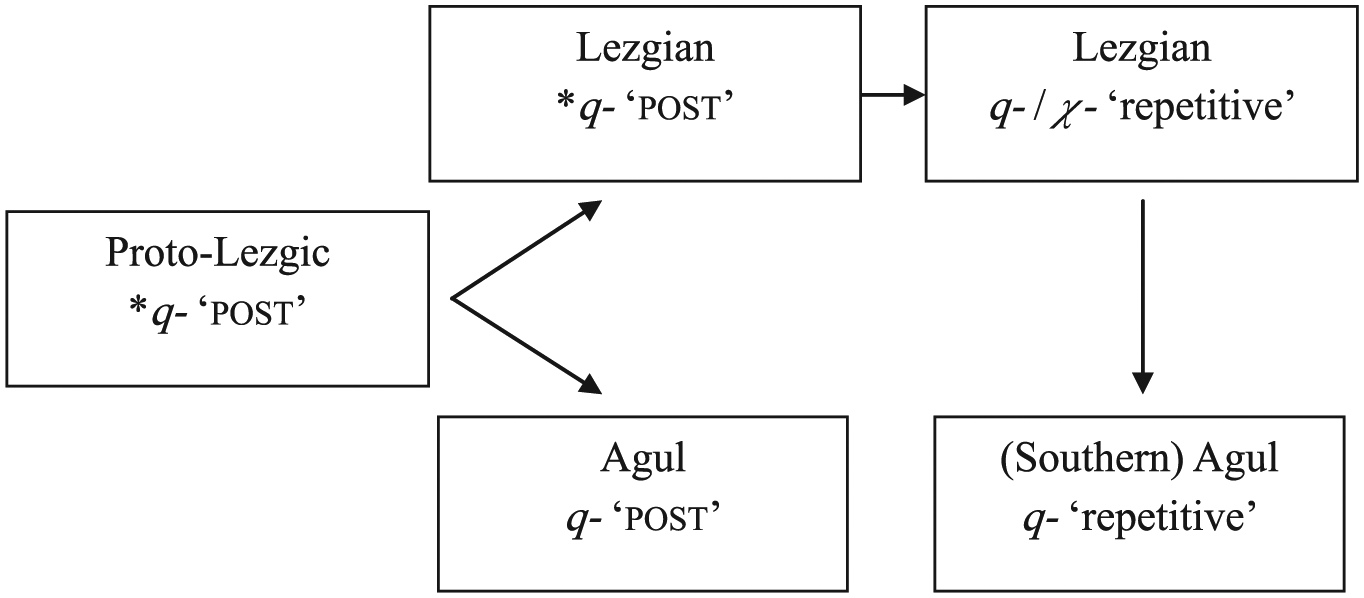
Diachronic scenario for the Agul repetitive prefix.
The category of repetitive in Agul can be regarded as intermediate between derivation and inflection: the formation of repetitive verbs is almost unrestrictedly (although not 100%) productive, and the meaning provided by the prefix is almost fully regular (although several interpretations are available alongside the core meaning ‘again’, or ‘back’ in reference to motion). The borrowing of such a semi-derivational prefix is in line with the common expectation that derivational affixes are more easily replicable than inflectional affixes (Weinreich, 1953, pp. 31–33), and a more recent finding that ‘inherent inflection, i.e. the inflectional categories which are more similar to derivation, such as aspect, tense, mood, gender, number and inherent cases… is borrowed far more frequently than contextual inflection, i.e. person and structural cases’ (Gardani, 2008, p. 84).
In terms of grammatical borrowing typology, the transfer of the repetitive prefix from Lezgian to Agul would be a case of ‘global copying’ (involving both form and function) in the terms of Johanson (1999), or MAT[ter] borrowing as opposed to PAT[tern] borrowing in the terms of Sakel (2007). Similar kinds of replication in the prefixal system have been reported in the literature: for example, some Slavic and Baltic spatial/aspectual prefixes were ‘globally’ copied to a number of Romani varieties, Istroromanian and also the Finno-Ugric language Livonian (Arkadiev, 2005, p. 2015: 232–257, To appear). In the case of such closely related languages as Agul and Lezgian, the borrowing process has probably been facilitated by their structural similarity, in particular in the system of verbal prefixation.
As pointed out by one of the anonymous reviewers of this paper, one cannot exclude the possibility that what we are dealing with here is not a direct borrowing of a Lezgian repetitive prefix, but rather a contact-induced grammaticalization (or rather ‘regrammaticalization’) in Heine and Kuteva’s (2003) terms. It might be the case that the Agul repetitive prefix is in fact a native Agul morpheme, namely the locative ‘
With a lack of historical evidence, however, it becomes difficult if not impossible to verify these two alternative hypotheses. At some point, a new morpheme appears in southern Agul dialects, which may be either a borrowed one (Lezgian q- ‘repetitive’ > Agul q- ‘repetitive’), or a native one, influenced by the semantics of a homophonous Lezgian prefix (Agul q- ‘
Footnotes
Acknowledgements
The present paper is partly based on my unpublished joint talks with Dmitry Ganenkov and Solmaz Merdanova (Ganenkov & Maisak, 2008; Maisak & Merdanova, 2011), both of whom I wish to thank for long-term collaboration within the Agul Documentation Project and fruitful discussions. I am also very grateful to the anonymous reviewer for insightful comments and suggestions, and to Samira Verhees for her help with the map (Figure 1) and with the English of this paper.
Abbreviations
Aspectual stems of verbs and oblique stems of nouns are separated by dots. Unmarked values (absolutive, singular) are not glossed. In the verb, the ‘localization + orientation’ prefixal combinations are enclosed in figure brackets. The transcription and/or glosses of examples taken from works of other authors have been slightly modified for unification reasons.
Declaration of conflicting interests
The author(s) declared no potential conflicts of interest with respect to the research, authorship, and/or publication of this article.
Funding
The author(s) disclosed receipt of the following financial support for the research, authorship, and/or publication of this article: The current stage of research resulting in this paper has been funded by the Russian Academic Excellence Project ‘5-100’.