



Abstract
Aims and objectives/purpose/research questions:
I investigate variation and change in heritage languages, focusing on descendants of 19th-/early 20th-century North Germanic immigrant languages in America. A battery of predictors (e.g. token frequency, language attitude) are compared against a baseline grammar, something often framed in terms of ‘transfer’, ‘incomplete acquisition’ and ‘attrition’. I examine which particular changes have been attributed to which factors.
Design/methodology/approach, data and analysis:
I synthesise and draw new conclusions from previous research on heritage Scandinavian.
Findings/Conclusions:
Relevant factors belong to two main categories: those favouring maintenance and those more likely to trigger change. Factors that support maintenance are structural ones (typically syntax, phonology and morphology), frequency of use and external factors. Factors that contribute to change are articulation, language attitudes and a series of cognitive aspects: incomplete acquisition and attrition, transfer and convergence, processing, memory, complexity and overgeneralisation.
Originality:
I undertake a comparative synthesis of patterns of change and non-change from baseline varieties.
Significance and implications:
This opens a door to investigating how factors correlate, what causal connections can be found and what levels of language are affected by what factors.
Introduction
I review key factors contributing to variation and change – or maintenance – in Scandinavian heritage languages in North America. 1 The focus is on heritage Danish, Norwegian and Swedish, all widely researched as witnessed by collected volumes such as Page and Putnam (2015), Johannessen and Salmons (2015) and the WILA workshop series. Heritage Icelandic, also widely researched, is included in this study due to its genetic and socio-historical connections. While all these languages are typologically and genetically very similar, we also find interesting historical differences. Focusing on closely related languages may help us tease apart what factors contribute to maintenance and change.
A heritage language is a minority language learned in the family that exists alongside a majority language. It is usually the first language that is learnt, but it often ends up as a non-dominant language (Benmamoun, Montrul, & Polinsky, 2013a, 2013b; Rothman, 2009). This definition includes heritage languages (traditional and modern) as well as native languages in colonised settings. Traditional heritage immigrant languages include languages brought by European immigrants to America in the 18th and especially from the19th century onwards until World War I, as well as modern ones where immigration happens today. Both groups have a ‘hearth’ language elsewhere. Speakers of traditional heritage languages are often not fully literate in them.
It is commonly observed that heritage languages (traditional and modern) have undergone changes and differ from ‘baseline’ varieties. The homeland language is generally used as baseline, that is, the language of monolingual speakers from overseas, sometimes a century or more ago (with traditional heritage speakers). Although the social and linguistic context of homeland languages are very different, a baseline language makes comparison possible: to investigate what has changed and, equally interesting, what has not. It is therefore used by many scholars, including Polinsky (2008, 2011) and Rothman (2007) and here.
Other evidence can be used for comparison, such as that of first or second language learners. This can contribute to understanding whether or to what extent factors influencing heritage language grammars are the same as those involved in other types of bilingualism or acquisition. Rothman (2007), Montrul (2010, 2013) and Polinsky (2011), among others, employ such comparisons.
We cannot assume that today’s heritage speakers have personally developed traits that are different from the baseline. Such differences may have developed in earlier generations, which means that the input they have been subjected to may be very different.
Countless studies show that modern heritage languages also change, see Benmamoun et al. (2013a, 2013b), or work by Pieter Muysken, Suzanne Aalberse, Francesca Moro (this volume) and Jason Rothman. It would be interesting to see if the changes in the two types of heritage languages, that is, older heritage languages as opposed to modern heritage languages, have the same direction and type. Present research on heritage Scandinavian cannot yet answer this question, both because there is still much to do on traditional heritage languages, and because there is little research on modern heritage Scandinavian to date (Håkansson, 1995, is an exception). Comparative studies get us closer to how language operates cognitively in the individual and the society.
This paper is structured according to levels of linguistic structure (lexicon, phonology, morphology, syntax and semantics), and for each, findings from previous studies illustrate factors the authors have given as a likely cause for a described phenomenon. According to the studies under discussion, factors of change are articulation and a series of cognitive aspects: incomplete acquisition and attrition, transfer and convergence, processing, memory, complexity and overgeneralisation. 2 Linguistic levels that favour maintenance are syntax, morphology and phonology, related to which token frequency plays an important role. Language attitudes (Section The role of attitudes) may play a role for both maintenance and change on individual levels, but they do not influence language shift, which depends more on other factors, such as horizontal and vertical ties (see Section Immigration and institutions in America for details).
The section Scandinavian immigration and heritage languages gives background information on North Germanic immigration to the USA and Canada as well as its heritage speakers. The section Language variation and change reviews variation and change at different linguistic levels based on existing research, while the section Factors influencing variation and change discusses factors contributing to variation and change. Concluding remarks are given at the end.
Scandinavian immigration and heritage speakers
To provide some insight into the situation of today’s speakers and of North Germanic heritage languages, this section presents key background information.
Immigration and institutions in America
While it has been argued that Norwegians first immigrated to America in 1825 in search of religious freedom (Østrem, 2015), later waves of migration pursued socio-economic opportunity (Thorsnæs, 2014). By 1920, more than 800,000 people had immigrated to North America from Norway (Myhre, 2015), often through chain migration (Østrem, 2015). Only Ireland had a higher rate of emigration. Norwegian immigrants preferred the rural prairie. According to the 1940 census, for instance, seven out of eight early immigrants were from the countryside, and half of the Norwegians at the time still inhabited towns of fewer than 2500 (Haugen, 1953, pp. 30–31). Such community structures would likely support language maintenance.
Norwegians built key institutions that promoted ‘horizontal ties’ (Lucht, Frey, & Salmons, 2011; Salmons, 2005a, 2005b): churches, hospitals, old people’s homes, Norwegian-language schools and newspapers and colleges, such as Luther College (Decorah, Iowa) and St. Olaf College (Northfield, Minnesota), as against ‘vertical ties’, that is, those between local and central authorities.
Even today, in these towns, the main church is still typically of Norwegian design, with Norwegian names on most graves. In retirement homes, names of inhabitants reveal their Norwegian background, as do decorative elements inside private homes and institutions. The last generation of heritage Norwegian speakers is now old, as are heritage Swedish and heritage Icelandic speakers.
Swedish migrants in North America number more than a million, and they too tend to be predominantly rural (Johannessen & Salmons, 2015, p. 12). Hasselmo (1974, p. 14) reports that most Swedish immigrants before 1890 had an agricultural background and were looking for land, mainly in the Upper Midwest. Swedish immigrants also built institutions; new congregations were founded, along with countless Swedish associations, choirs and newspapers (Hasselmo, 1974, pp. 23–29; Larsson, Tingsell, & Andréasson, 2015, pp. 359–360).
Conversely, Icelandic immigrants were fewer in number, totalling no more than 14,000 in Canada, and immigration generally began later, notably in 1875. They were clustered on land near Lake Winnipeg, which was reserved for Icelanders alone. They set up their own government in the colony, with a constitution and elections, and had their own schools and newspapers. The early colony was mostly rural. As they were amongst the first immigrants to inhabit the area, incoming foreign farm workers often had to learn Icelandic to get by (Arnbjörnsdóttir, 2006, pp. 26–34, 2015, pp. 74–77; Johannessen & Salmons, 2015, pp. 9–10).
Danish immigration differed from these other patterns. Kjær and Larsen (1972) describe it as much smaller than the Norwegian and Swedish contexts, with no more than 275,000 for the period 1840–1914. Migrating Danes were typically urbanites, and immigrants from cities preferred New York and other conurbations. Very few settled in groups or formed communities. Furthermore, a substantial proportion were mobile, unmarried men, who later married non-Danish women (Kjær & Larsen, 1972, p. 47; Kühl, 2015). Today, very few Danish heritage speakers remain in North America. While the church had a unifying effect in Norwegian and Swedish settlements, the Danish church split, one (Grundtvigian) valuing keeping Danish culture and language, the other (Inner Mission) finding it important to assimilate. The 17,000 Mormons who emigrated from Denmark were not interested in language maintenance, as English was their religious language.
Current Scandinavian heritage speakers – facts and attitudes
Present heritage speakers of Norwegian, who will receive the main focus here, are typically between second- and fifth-generation immigrants living in rural areas in small, stable communities. Many have little education and are (retired) farmers. They typically knew no English until they started school, which was a traumatic experience for some. However, younger children were often exposed to English through their older siblings (Rødvand, 2017, p. 111). The majority cannot read or write Norwegian, and English is dominant in that it is the language they speak and read daily. Most of these heritage speakers are typically around 80 years old. 3
Heritage Norwegian is easy to understand for Norwegians from Norway. It has undergone some koinéisation (Hjelde, 2015; Johannessen & Laake, 2012, 2017), often reflecting input from those dialects spoken in rural Eastern Norway (Johannessen & Laake, 2012, 2015). However, lack of exposure to modern Norwegian can make it difficult for them to understand researchers with an urban dialect, forcing researchers to accommodate to the heritage language (Johannessen & Salmons, 2012).
Speakers are generally proud of their Norwegian ancestry, often declaring themselves ‘100% Norwegian’ (meaning that both parents have Norwegian heritage). One question in our interviews is whether they are Norwegian or American. Many look puzzled by the question and answer, ‘Norwegian, of course!’ The role of attitudes is discussed in the section The role of attitudes, where it is concluded that attitudes are not relevant for language shift (contra some of the classic literature on language attitudes, such as Fishman 1991 and Trudgill & Tzavaras 1983), but attitudes can influence some levels of language, such as lexicon and phonetics.
Even though these heritage speakers label themselves Norwegian, they did not pass on the language to their children. This cannot be due to negative personal attitudes towards the language, but due to Americanisation efforts, and the fact that children were sent to English-speaking schools. It could also be a result of their own negative experiences starting school without knowing English, or they might have wanted a better future for their children. I have asked speakers about this, but they do not know why their children do not speak Norwegian. The answer is the same for whether their spouses are Norwegian speakers or not. It seems that they did not give language much thought. As one speaker wrote to me recently: ‘Little did we know that what we considered insignificant would someday be part of a wide-ranging study of the Norwegian language.’
Language variation and change
Having introduced the heritage speakers and their present and past history in the section Scandinavian immigration and heritage speakers, let us turn to examples from recent research on their linguistic production. They illustrate variation and change at different linguistic levels, and form the basis for hypotheses of causal factors discussed in the literature and reviewed here.
Changes in syntax
Until recently, little attention was paid to syntactic variation and change in heritage Norwegian in the literature, which might reflect its stability. For instance, Johannessen and Laake (2015) studied a series of different constructions amongst Norwegian heritage speakers and found that the syntax is basically in place far more than the lexicon.
However, more recently word order has been in focus: in subordinate clauses (Larsson & Johannessen, 2015a, 2015b; Taranrød, 2013), in main clauses (Eide & Hjelde, 2015; Johannessen, 2015b) and possessive pronouns (Westergaard & Anderssen, 2015). 4 These authors used the American Corpus of American Norwegian (CANS) (Johannessen, 2015a), or informants in that corpus, and unpublished, modern heritage Swedish recordings. CANS contains (searchable) transcriptions of recordings from informal interviews and conversations between informants made since 2010, with participants from the core areas of heritage Norwegian in the Upper Midwest (Wisconsin, Minnesota, North Dakota).
If syntactic changes could be explained in terms of transfer, 5 like the lexicon, we would expect direct influence from English syntax, but this is not found. Larsson and Johannessen (2015a, 2015b) illustrate this with embedded clause word order. The baseline (European Scandinavian) relative clause word order Adv–V is illustrated in (1). 6
(1)
a. genseren [som
shirt.
‘the shirt that doesn’t fit’
b. * genseren [som
shirt.
‘the shirt that doesn’t fit’
In heritage Norwegian, on the other hand, Adv–V and V–Adv is extremely variable (at a rate of ~50%) (see Taranrød, 2011). Intra-speaker variation is also evident in the corpus, as in (2).
(2)
a. …var mye melk der [som
was much milk there that was not used
‘Was a lot of milk there that wasn’t used.’
b. … [som
who not take more money
‘Who don’t take out more money.’
(Westby_WI_02gm, from Taranrød, 2011, p. 51)
Johannessen and Larsson (2015a, 2015b) discuss possible causes: (1) influence by English (‘transfer’); (2) generalised V2 (verb second) from main clauses; (3) incomplete acquisition; and (4) attrition.
If transfer from English were involved, one would expect similar constructions to English negative clauses, but this was not found. (Only linguistic predictors were explored, not stylistic constraints.) Heritage Scandinavian shows no evidence of constructions like do-support with negation (a man who didn’t work there), as in (2) above. There is no syntactic difference between auxiliaries and main verbs (a man who could not work there versus *a man who worked not there) in heritage Norwegian, as in (2a), containing a negated auxiliary, and (3), with a negated lexical verb.
(3) Det var mange ord der [som vi
there were many words there that we use not
‘There were many words there which we use not.’
(Westby_WI_03gk)
A second possibility is that word order variation is caused by overgeneralisation of the Scandinavian V2 pattern. While these languages have V2 main clause word order, English does not, as in the first line and the translation in (4).
(4)
Vi
we use always butter on potato.
‘We always use butter on the potatoes.’
If the main clause word order in (4) were generalised to subordinate clauses, the generalisation should have applied across the board. However, embedded questions are not generalised to main clause word order. Main clause questions, (5a), have V–Subject order, while heritage (and European) Scandinavian embedded questions have Subject–V order, (5b).
(5)
a.
how would we get there
‘How would we get there?’
b. (Heritage Scandinavian)
Å vi frågade [
and we asked how we would get to Björklund’s Rug
‘And we asked how we would get to Björklund’s rug.’
(Theodor)
Larsson and Johannessen (2015a, 2015b) conclude that there is no process of V2 generalisation.
They then consider whether incomplete acquisition may be a factor, investigating the clause structure in European Norwegian. Based on evidence from child acquisition, Westergaard and Bentzen (2007, p. 285) posit several stages of syntactic development, where embedded word order is most difficult, not mastered until school age. Larsson and Johannessen argue that the change must have happened this way: Heritage learners did not fully master the embedded order by the time they went to school. School minimises exposure to heritage language, and there is therefore less exposure to constructions like embedded clauses. Relative clauses with adverbs are generally infrequent, meaning that total exposure to relative clauses is low. Heritage children, therefore, never reached a stable final stage. 7
Individual attrition seemed not to be a factor, since the many relevant speakers were otherwise fluent and target-like.
Arnbjörnsdóttir, Thráinsson, and Nowenstein (to appear) study main clause word order in North American Icelandic, using grammaticality judgements. While nearly half of the speakers have a clear V2 preference, almost half show variation between V2 and V3 or preference for V3. They find evidence that the amount and nature of exposure to English during the period of acquisition plays a role in the acquisition of V2, suggesting that a factor for this variation is incomplete acquisition. This is also a feature in heritage Swedish. Hedblom (1978) studies the Hanebo dialect of Sweden spoken by twin sisters, third generation, in Illinois, based on recordings from the 1960s and 1970s. Hedblom gives examples (6a, b) below, which illustrate English influence (1978, p. 67).
(6)
a. När det var is på vintern
when it was ice on winter.
‘When it was ice in winter, he shod her (the mare).’ (Target:… skodde han na)
(Hedblom, 1978, pp. 28, 66)
I never do it
‘I never do it.’ (Target: Jag gör aldrig det)
(Hedblom, 1978, pp. 42, 66)
Main clause verb placement is also investigated by Eide and Hjelde (2015), who test a hypothesis of a positive correlation between V2 and finiteness morphology. They find some correlation, that is, some speakers do not distinguish finiteness, and some do not have V2 consistently (Eide & Hjelde, 2015, pp. 85, 89), but the categories must be more nuanced to account for systematic variation in different syntactic categories. They focus on one speaker, as does a study by Johannessen (2015b). Word orders diverging from the baseline are very similar across these studies. Both find that V2 is better preserved with short than with long topics. I assume that non-target word order in one informant is attrition due to lack of use over many years (see Stolberg & Münch, 2010, for a German parallel).
Kühl and Heegård Petersen (2016, to appear) discuss main clause word order in North American Danish, based on recordings from the 1960s and 1980s of 64 speakers, 49 immigrants from Denmark and 15 born in the USA. The general word order for Danish in Denmark, XVS (=V2), is resilient. However, they find XSV (= V3) in 8% of all main clauses (2016, p. 169). This is surprising compared with results for Norwegian (Eide & Hjelde, 2015; Johannessen, 2015b), as they find that, at least for adverbial constituents, heavy constituents do not trigger more non-target word order, and that fronted non-subject constituents actually favour the European word order. It is debatable whether the results are comparable, however. 8 They find no sociolinguistic or demographic correlations with gender or time spent in the USA.
If sentences begin with an English lexical item, XSV word order is frequent: almost 60% of clauses with an initial element in English have this order, versus only 4% of others. Further, if the topic is accompanied by an anaphoric particle, the chance of non-target XSV word order is low (only 1.7%), as against 6.5% if the fronted constituent is without the particle, as in (7).
(7)
Og efter nogle år
and after some years then came they back again
‘And after some years they came back again.’ (Kühl & Heegård Petersen, to appear)
In European Norwegian, possessive pronouns can be prenominal or postnominal, both used in all dialects, but with dialect and pragmatic differences in distribution. Westergaard and Anderssen (2015) compare possessives in bilingual children in Norway with heritage Norwegian speakers in the USA. A first hypothesis would be that heritage Norwegian speakers use the preposed possessive more frequently, as transfer from English. However, heritage speakers use the postnominal possessive construction more than speakers in Norway. This is unexpected given that it is more syntactically complex than the prenominal possessive, and more different from English. Westergaaard and Anderssen suggest that the overall token frequency of the postnominal possessive protects it from change. This accords with van Coetsem (2000, p. 106) and Weinreich (1953, p. 57), who see frequency as promoting stability.
Johannessen and Larsson (2015) discuss gender agreement in Norwegian noun phrases, using CANS. Although many speakers have target-like use of gender, they argue for more non-target agreement the more complex a noun phrase is, concluding that linear complexity (and memory) is a relevant factor in variation and change. Lohndal and Westergaard (2016) also discuss gender using the same material, looking for a reduction from a three-gender to a two-gender system, which they do not find. However, they do find overgeneralisations of the masculine in some syntactic contexts, which they attribute to attrition. Gender in heritage Norwegian has also been investigated by Rødvand (2017), who uses two experiments to elicit pronouns showing gender. There was much individual variation and informants had to be grouped into different categories in order to generalise results. Relicts of the original three-gender system existed for virtually all speakers, and the definite suffix was used in a target-like manner by all (Rødvand, 2017, p. 130). Hedblom (1978, p. 60) documents some variation in gender assignment and agreement in the dialect spoken in Illinois, such as ett ‘a.
Hedblom (1978) notes some changes in reflexives in the Swedish Hanebo dialect. It is not systematically investigated, but reflexive possessives seem to have been substituted by pronominal possessives, as in (8).
(8) Han tog
he took his old roller
‘He took his old roller.’
(Target: ‘Han tog sin gamla vält’ or even more dialectal: ‘Han tog gammelvälten sin’.) (Hedblom, 1978, p. 62)
Hedblom (1978, p. 63) states explicitly that sin has, just like in American Swedish generally, been replaced by hans, hennes and deras/deres (also Hasselmo, 1974, p. 218).
Putnam and Arnbjörnsdóttir (2015, pp. 203–223) show that long-distance binding has disappeared in North American Icelandic, but remain open as to why. They suggest a combination of incomplete acquisition and lack of sustained frequency of input and usage.
Winford (2003, p. 97) claims that syntax very rarely gets borrowed. The data here support this. Changes in heritage Scandinavian syntax are not simply a case of borrowing or transfer. Even when we find patterns that superficially look like English, as in subordinate clauses and main clauses, we would have to explain why only some orders are transferred from English. For example, we would need to show why the English word order in main clauses is only used when the clause-initial topic is long and heavy. Without an account for the lack of English-like word order, transfer (or borrowing) has no explanatory value.
This section has shown that the following factors are relevant for syntax by the cited authors: overgeneralisation (analogy); incomplete acquisition; attrition; frequency and linear complexity; and memory. A factor that has not been argued convincingly to have an effect on syntax is transfer (with the exception of the more lexical substitution of anaphors with pronouns). Other factors that have not been mentioned in the syntactic context by researchers are external ones, such as the make-up of societal ties, attitudes, prestige and identity.
Lexical changes
Lexical changes are abundant in any contact setting, cf. Sapir (1949 [1921], p. 193): ‘The simplest kind of influence that one language may exert on another is the “borrowing” of words.’ New words in heritage Scandinavian were noted by Pastor Duus (1855-1858 [1947]) and in letters by laypeople from the 1850s onward (Øverland & Kjærheim, 1992). Lexical studies of heritage Norwegian started with Flom (1901, 1926) and Flaten (1901) and have continued into the 20th century (Haugen, 1953; Hjelde, 1992) and the 21st century (Johannessen & Laake, 2012, 2017; Grimstad, Lohndal, & Åfarli, 2014, and many others), for Danish since Kjær and Larsen (1972, 1987) and Swedish since Hedblom (1978). Many of the loanwords mentioned in these and other works have been stable for more than a hundred years.
Johannessen and Laake (2012, 2017) divide loan words into three kinds as follows.
1) Those referring to things not known in the home country (car, tractor and college), that is, simple transfer.
2) Loan words that replace existing words (ditch for grøft and expect for vente). These could be explained in terms of processing (the words are salient in use in the dominant language), but also by sociolinguistic factors, such as group or network identification and identity construction. van Coetsem (2000, p. 68), citing Hockett (1958, pp. 404–407), Weinreich (1953, p. 79) and Labov (1972, p. 36ff.), maintains that prestige or a positive orientation towards the community, equated with self-identification, are central motivations for transfer.
3) Words that keep the same form, but take new meanings, as in veg ‘way’ for måte, and gå, changed from ‘walk’ to ‘travel in other ways than by foot’, cf. English go. The same words are also found in heritage Swedish and Danish (e.g. Kühl, 2015; Larsson et al., 2015.) This type, ‘loan-shifting’ in the terminology of Clyne (2003), is explained in terms of convergence by Matras (2009), attributed to language processing and cognitive load.
We see that the explanations differ depending on loan type, from transfer due to practical needs (new items) to language processing (lessening the burden of different meanings for the same phonological word), and even to identity (group identification, e.g. using the same words as some important group or network) and attitudes.
Phonetic and phonological changes
Phonological variation and change are well documented in heritage languages. For instance, Benmamoun et al. (2013a, p. 137) report on work on Armenian in the USA conducted by Godson (2004), where speakers kept the original Armenian vowel system, but three of the five vowels changed in quality towards English, suggesting transfer.
Iceland is a country with a strong prescriptive tradition. When in the 1950s the phonological phenomenon Flámæli (a derogatory term meaning ‘slanted speech’, in which two sets of front vowels merged) started and even spread, official efforts and stigmatisation soon almost eradicated it. In North American Icelandic, however, it spread without the normative attitudes that existed at home (Arnbjörnsdóttir, 2015, pp. 89–90).
Hjelde (1992) studied the Trøndsk heritage dialect of Norwegian, using material recorded in the Upper Midwest. He found that this heritage dialect has lost the feature [+round] in the realisation of /y/, yielding forms like [bɪ:] for by ‘town’ and [mɪ:] for mye ‘much’. However, there is still a slight difference between the innovative [ɪ] variant and the old /i/ phoneme, giving minimal pairs like [mɪ:] mye ‘much’ and [mi:] mi ‘my’ (Hjelde, 1992, p. 42).
Hjelde (1992, p. 44) notes that /r/ has also undergone change, from an alveolar to an approximant /ɻ/, although not necessarily for all words and phonological contexts. He characterises both phenomena as interference from English, while stressing that /r/ changes for other reasons, too. In European Norwegian this phoneme has gone from alveolar (like in Italian) to uvular (like in French) in many dialects, and this change is still spreading. A main factor is suggested to be group identification, another the articulatory difficulty attached to the alveolar sound, making it vulnerable to interference. The phonological system remains. Hjelde, then, suggests three factors for variation and change: sociolinguistics (group identification), articulation and interference (transfer).
Heegård Petersen (to appear) examines 15 phonological phenomena of the Danish Thy dialect in the speakers of a former Danish settlement in South Dakota, recorded between 1970 and 1980. Anticipating dialect convergence, he finds instead two clear groups of speakers: group 1, born in South Dakota, is more dialectal, while group 2, speakers born in Denmark, is less dialectal (reflecting the regional variant spoken in Denmark at the time of emigration). The speakers have not kept the same features. The amount of inter-individual variation and lack of consistency make it clear that there is no ‘founder effect’, but there is phonological individuation instead. 10 Heegård Petersen cites Trudgill (2008, p. 253), who argues that prolonged dialect contact always leads to dialect mixture. In South Dakota, it may not have had time to develop. Domain loss started early in North American Danish, to the extent that Norwegian congregations took over Danish ones, because there were so few Danes.
Hedblom (1978) finds that phonology is among the most resistant areas of the dialect in these heritage Swedish third-generation speakers (p. 77; see also Benmamoun et al., 2013a). Both the quality and quantity of the sounds have been kept, as has the prosody. This section shows that the resistance to change is high for phonology, although phonetic changes can occur and so influence the system.
Morphology
Morphological changes are rarer than lexical ones (van Coetsem, 2000, p. 116). Hjelde (1992) looked for interference or transfer in heritage Norwegian, but found only two certain occurrences of English morphemes, used only once each (a plural -s on and a progressive -ing form). More recently (2015), he examined changes in a Midwestern Norwegian dialect, with data from speakers born as far back as 1849 and as recently as 1961. Some morphological levelling in the past tense suffix and dative case suggest incomplete koinéisation. With over 160 years since Norwegians started settling in this area, this is a long time for koinéisation, otherwise often reported to take three generations, ca. 60 years. While one reason for the delay of this process may have been that new immigrants kept coming from Norway over a long period of time, Hjelde suggests that the strong family ties and loyalty towards roots and family were crucial in this slow development (Hjelde, 2015, p. 295), cf. ‘horizontal ties’ (see the section Immigration and institutions in America).
Loanword inflection has been a focus for many researchers (from Haugen 1953, to Riksem, to appear). Riksem (to appear: §6) finds nearly 1000 English nouns used in heritage Norwegian conversations from CANS. Of these, 10% have plural -s. The rest are morphologically integrated into Norwegian. The number of words with -s is so much higher than reported in older literature that it must reflect a change in heritage Norwegian.
For Swedish, Hedblom (1978) notes numerous changes from the original Hanebo dialect in his informants from the three-gender system towards a two-gender system, including changes in the pronouns han ‘he’, hon ‘she’, den ‘it.
Semantic changes
Matras (2009) suggests that lexical items in two languages would converge if they are otherwise similar phonologically. This has clearly happened at the lexical level in North Germanic heritage languages, for example in heritage Icelandic, where vanta ‘need’ has been relexified to vanta ‘want’, based on phonological similarity (Arnbjörnsdóttir, 2015, pp. 85–86). Similarly, Johannessen and Laake (2017) show that a verb like Norwegian gå ‘walk’ gets a new meaning ‘go’ in America, and we saw (see the section Lexical changes) that Norwegian veg changed from ‘road’ to metaphorical ‘way’, like English.
Factors influencing variation and change
As we have seen, heritage language variation and change involves many interacting factors, from linguistic-internal constraints on structure to psycholinguistic factors (including language processing and memory) and sociolinguistic factors (relating to bilingualism, identity construction and group identification). The study of heritage languages can help us understand their language maintenance, change and variation.
Observations about variation and change
Modern contact linguistics traces at least to Haugen (1953) and Weinreich (1953), but heritage language linguistics is fairly new; Benmamoun et al. (2013a) often serves as a reference point. Unanswered questions include the following. What level of language is affected by what kind of factor? Can attrition happen to any part of language? Does it happen in a certain order? Many factors have been suggested here.
For lexical changes we have seen explanations in terms of language processing mechanisms, in terms of sociolinguistic factors such as group identification and, of course, the need for naming new concepts (see, for instance, van Coetsem, 2000). Matras (2007, p. 48) and many others hold that nouns are more borrowable than verbs, perhaps because verbs are more syntactically and morphologically complex. Although quantifying borrowed items is difficult, it is not evident that this constraint holds for heritage Norwegian, as many examples in the section Lexical changes are verbs.
Changes in phonetics and phonology have been argued to result from articulatory difficulties, sociolinguistics and interference or transfer. Phonology is most stable, given its inherent, or constitutional (based on structuredness), stability in a recipient language (van Coetsem, 2000, p. 116), and Benmamoun et al. (2013a, p. 153) hold that it is the best-preserved area of heritage grammar. Matras (2007, pp. 36–37) deals with borrowability, giving three ways in which the phonemic system can change. No phoneme borrowings in Scandinavian languages have been reported, but there have been changes in the realisations of speech sounds. The section Phonetic and phonological changes provides examples of merger, so clearly phonemic change is possible (Arnbjörnsdóttir, 2015, pp. 89–90; Hjelde, 1992, pp. 42, 44).
Few morphological changes are reported, perhaps due to speakers’ loyalty to roots and family (Hjelde, 2015), while an official standard may contribute to changes (Hedblom, 1978). In the morphology–syntax interface changes have been attributed to complexity and overgeneralisation (Johannessen & Larsson, 2015; Lohndal & Westergaard, 2016). van Coetsem (2000, p. 16) sees functors and primary vocabulary that vary along a paradigmatic axis as having maximal stability, meaning that morphological transfer should be rare. Benmamoun et al. (2013a, p. 142) maintain that morphological divergence is more pronounced in the nominal than in the verbal domain. This cannot be properly tested in an interesting way for Scandinavian, since there is more nominal morphology, with separate marking for number, gender, definiteness and even case, as against finiteness and tense in the verbal morphology. Nominal morphology is more complex and therefore has more things that can ‘go wrong’. Benmamoun et al. (2013a, p. 142) also report that research shows tense morphology to be unaffected. This is not the case for Scandinavian verb morphology, as we saw in the section Morphology. Furthermore, they see morphology as the ‘weakest link’ in heritage languages (2013, p. 142), which is not necessarily true with respect to Scandinavian.
For syntactic variation and change, Matras (2007, p. 43) holds two- or three-gender systems to be relatively stable. This is also the overall impression from research cited in the section Morphology, despite variation (Johannessen & Larsson, 2015; Lohndal & Westergaard, 2016; Rødvand, 2017). He also mentions that the most common change to possessive constructions is word order, often drawing on existing flexibility, exactly what Westergaard and Anderssen (2015) found. The borrowing of plural markers reported by Riksem (to appear) is supported by Matras (2007, p. 43), who reports them to be easily borrowable, given that they meet the criteria for semantic transparency often noted.
Factors contributing to syntactic change seem to include incomplete acquisition (tied to the age of acquisition and input) (Larsson & Johannessen, 2015a, 2015b), frequency of a construction (Westergaard & Anderssen, 2015), loss of finiteness distinctions (Eide & Hjelde, 2015, p. 85), linear complexity (Johannessen & Larsson, 2015) and attrition based on lack of usage (see the section Changes in syntax). Benmamoun et al. (2013a, p. 148) indicate, however, that syntax is more resilient than the inflectional domain. This is not necessarily true for Scandinavian. The research they report from Swedish (Håkansson, 1995) on V2 word order differs from results reported in the section Changes in syntax. On the other hand, Håkansson’s subjects were all Swedish-born and had lived abroad for some time, thus different from our heritage speakers. Clearly, different background and different conditions play a role for the acquisition and attrition of language. Benmamoun et al. (2013a, p. 149) state that heritage speakers have problems with processing syntactic dependencies (binding of anaphors). Not much has been done on this, although Hedblom (1978) and Putnam and Arnbjörnsdóttir (2015) give examples of anaphoric relations that have been lost. The latter are uncertain about the reasons for this change. One could investigate whether the linear complexity factor mentioned for gender agreement in the noun phrase could have the same kind of explanation as this.
Studies argue (Köpke & Schmid, 2004; Stolberg & Münch, 2010) that attrition results from lack of use. Attrition can also be caused by complexity related to cognitive load and memory, which in turn may be related to age or cognitive problems. Although today’s heritage speakers are elderly, one assumes that those who serve as language consultants do not have (severe) cognitive decline. However, bringing tests for diagnosing dementia and cognitive impairment into fieldwork with heritage speakers already lacking in confidence would be a delicate matter.
The role of attitudes
Let us consider whether positive attitudes to heritage culture help maintain heritage language against shift. As described in the section Current Scandinavian heritage speakers – Facts and attitudes, all the speakers I have worked with are positive about their heritage. We have, however, also talked to many other non-Norwegian-speaking heritage Norwegians in the same communities, and they are very happy about their Norwegian ancestry, too. Golden and Lanza (2015) discuss identity construction amongst heritage Norwegians, and find that those whose Norwegian language is faltering place more emphasis on artefacts and cultural traditions. There does not seem to be a correlation between identity and knowledge of the heritage language, as also noted by Litty, Evans, and Salmons (2015, p. 201) for Wisconsin German.
There is much variation in proficiency among speakers. However, they generally have a positive attitude to their heritage language and culture, which indicates that attitudes in the individual are not decisive for fluency of a language, or even keeping a language at all. This is supported by previous studies. Salmons (2005a, 2005b) and Lucht, Frey, and Salmons (2011) show that language shift depends on external factors, especially when strong vertical ties, such as a centralised board of education or national religious institutions, displace horizontal ties, among local institutions, such as schools and churches. The existence of religious communities that have kept their heritage language, such as Pennsylvania Dutch, shows that if the horizontal ties are strong, the general trend of shift can be resisted. In such cases there must be a very strong group attitude towards language preservation.
Still, as researchers we have not met all those people who used to speak Norwegian and do not anymore. According to US census data there were 200,000 Norwegian mother tongue speakers in 1970, while in 2000, 55,000 had Norwegian as a home language (see Fishman, 1991, p. 47; also Johannessen & Salmons, 2015a, p. 6). The declining number indicates that hundreds of thousands, if not millions, over the years have made a conscious or unconscious decision to discontinue the heritage language for themselves and their children. We do not know why, although there was a strong push for ‘Americanisation’ around the Second World War, when many of our informants were children, and which meant that being an American and speaking English were important in the USA (cf. Section Current Scandinavian heritage speakers – Facts and attitudes).
Nagy (this volume) comes to the same conclusion for heritage speakers in Toronto. Other conditions need to be in place for the attitudes to have practical linguistic consequences. Karatsareas (this volume) lays out relevant conditions concerning Cypriot Greeks in London: existing attitudinal systems can be transplanted from old, traditional geographical and social contexts to new ones. Attitudes are preserved in the same social institutions that preserve attitudes in the original geographical and social context. Negative attitudes in transplanted communities target both traditionally stigmatised variants and new variants that develop. While Scandinavian heritage languages belong to the traditional heritage type, the languages described by Nagy and Karatsareas are modern heritage languages. The traditional Scandinavian group have little left by way of inherited attitudes they might have had towards different kinds of their language (Icelandic being a possible exception, see Arnbjörnsdóttir, 2015, p. 76; although Arnbjörnsdóttir, 2015, pp. 89–90 also shows that some norms do not survive in the new world, see the section Phonetic and phonological changes). The attitudes they have are towards the language and their heritage culture as such. In this they may differ from modern groups of heritage speakers, but in both cases attitudes have not proved to be sufficient for change or preservation.
Still, attitudes can play a role in lexical transfer or borrowing (Hockett, 1958; van Coetsem, 2000; Weinreich, 1953). The research reviewed here supports this, and suggests that phonetic changes would be partly linked to attitudes. Figure 1 summarises the factors reviewed.
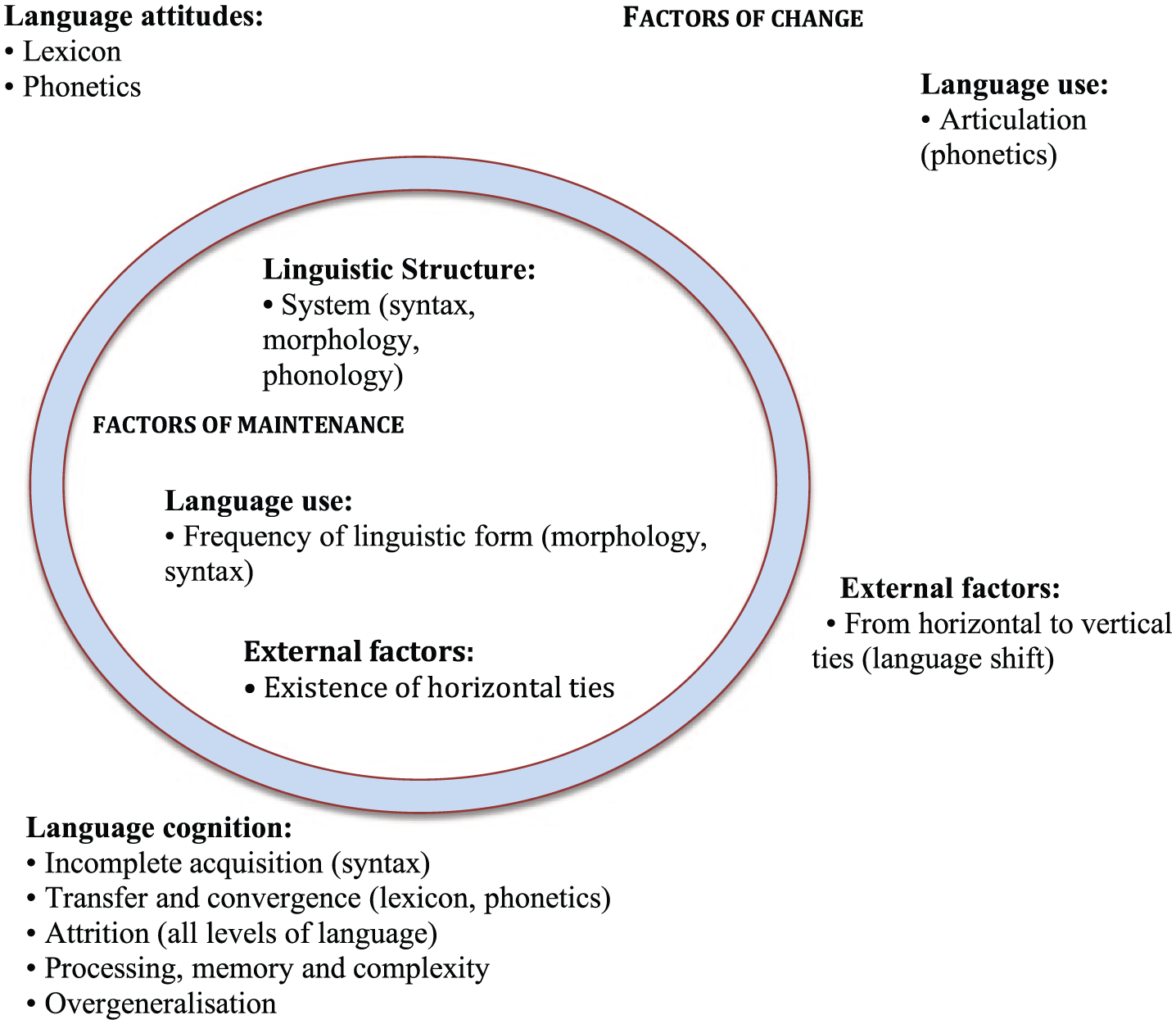
Factors for maintenance (inside the circle) and change (outside the circle).
Figure 1 presents a tentative picture of factors relevant for heritage language maintenance and change. Variation is a result of the factors at play and their relative weight will determine whether the result is maintenance, change or ongoing variation.
Conclusion
I have investigated factors relevant for variation, maintenance and change in heritage languages. My focus on Scandinavian heritage languages in America has the advantage that the languages studied and the social settings are similar (with the exception of Danes, who were less rural than other groups), enabling better comparisons.
The factors depicted in Figure 1 belong to two main categories: those favouring maintenance (inside the circle) and those that can trigger change (outside). Factors of change are articulation, language attitudes and a series of cognitive aspects: incomplete acquisition and attrition; transfer and convergence; processing; memory; complexity; and overgeneralisation. Factors of maintenance are linguistic systems (in syntax, morphology and phonology) and token frequency. Attitudes may play a role for both maintenance and change of individual language levels, but do not influence language shift. This latter depends on external factors: horizontal and vertical ties.
Heritage language research combines studies of language structure, language processing and language external conditions, and relates all this to studies of first and second language acquisition. It is therefore ideal for learning more about the relevance of factors that influence linguistic development. There is still very much that is not known about the interplay between the factors and their effect on the different levels of language.
Footnotes
Acknowledgements
I would like to thank the editors Anita Auer, Jonathan Kasstan and especially Joe Salmons as well as two anonymous reviewers for very valuable comments and insightful suggestions.
Declaration of Conflicting Interests
The author(s) declared no potential conflicts of interest with respect to the research, authorship, and/or publication of this article.
Funding
The author(s) disclosed receipt of the following financial support for the research, authorship, and/or publication of this article: This work was partly supported by the Research Council of Norway through its Centre of Excellence funding scheme (project number 223265).