



Abstract
Aims and objectives/purpose/research questions:
In early childhood and older adulthood, bilinguals generally demonstrate better performance on executive function tasks than their monolingual counterparts, but in the young adult population, these differences are infrequently observed. However, few studies have examined these effects in the adolescent population, so the trajectory of these changes is unclear. The objective of the study was to compare performance on a modified flanker task for monolingual and bilingual adolescents, a time when the executive functions are still developing.
Design/methodology/approach:
The flanker task was adapted by including a rule-switching component and contained three blocks: (1) rule; (2) flanker; and (3) mixed. In the rule block, a single red or blue arrow (indicated by light grey or medium grey in Figure 1) denoted a response rule; for example, a blue arrow signaled pressing the button indicating the direction the arrow was pointing but a red arrow signaled pressing the button indicating the opposite direction. The flanker block was a standard flanker task consisting of congruent and incongruent trials. The mixed block manipulated both congruency and rule conditions.
Data and analysis:
Mean reaction times and accuracy from 33 monolingual and 32 bilingual adolescents were analyzed using a repeated-measures analysis of variance with language group as the between-subjects variable and congruency and/or rule-type as the within-subjects variable depending on the block.
Findings/conclusions:
Bilingual adolescents outperformed monolingual adolescents but only on the block that was most similar to the standard flanker task. The blocks with the rule-switching component yielded equivalent performance.
Originality:
Unlike previous studies, the current study adapted a simple executive control task to require greater attentional resources by manipulating task demands.
Significance/implications:
Our findings add to the growing body of literature examining bilingualism and executive control in the adolescent population and fill in the gap in our understanding of the lifespan trajectory of these effects.
There is rapid development of executive functions during the early years of school (Zelazo et al., 2003), but maturation of these processes is not achieved until adolescence and early adulthood (Best & Miller, 2010; Davidson, Amso, Anderson, & Diamond, 2006; Luna, Garver, Urban, Lazar, & Sweeney, 2004). Post-mortem brains have revealed that the prefrontal and parietal cortex continue to undergo changes during puberty and adolescence (Huttenlocher, 1979), so it is not surprising that the executive functions that rely on these brain structures also develop in adolescence. Because of major physiological, hormonal, structural, and psychological changes (Blakemore & Choudhury, 2006; Carlson, Zelazo, & Faja, 2013), adolescence is a key time for development. Best, Miller, and Jones (2009) noted that there is a plethora of research on executive function in children and young adults, but little research on the factors that impact executive function during middle childhood and adolescence, despite previous research linking executive function to academic achievement in late childhood (Best, Miller, & Naglieri, 2011; van der Sluis, de Jong, & van der Leij, 2007).
One factor that impacts executive function is bilingualism, with better performance on tasks for bilinguals than monolinguals (see Bialystok, 2017, for a review). Previous research has shown that even when only a single language is required, bilinguals activate the lexicons from both of their languages in parallel (Kroll, Dussias, Bogulski, & Valdes Kroff, 2012). Given this joint activation, the bilingual language system must manage language selection by directing attention to the target language while ignoring interference from the competing language, presumably through the recruitment of general attention mechanisms (Bialystok, 2015). Hence, the unique experience of bilinguals in managing attention to two jointly activated languages provides training in selective attention, a crucial element of the executive function.
In the majority of studies with children, the effect of bilingualism on cognitive performance has been examined using tasks that primarily involve inhibition or task-switching (see Adesope et al., 2010 for a meta-analysis; see Barac, Bialystok, Castro, & Sanchez, 2014 for a review). One task that has been used extensively in this research is the flanker task. Participants are asked to respond to the direction of a middle arrow that is surrounded by flanking arrows pointing either in the same (congruent trial) or opposite direction (incongruent trial) as the target arrow. The difference in response time or accuracy between the incongruent and congruent trials is the flanker effect; a smaller flanker effect indicates enhanced ability to suppress the inappropriate response. Overall, bilingual children perform this task faster or more accurately than their monolingual peers on the incongruent trial and show a smaller flanker effect (Poarch & Bialystok, 2015; Yang, Yang & Lust, 2011; Yoshida, Tran, Benitez, & Kuwabara, 2011).
In contrast to children, studies with young adults performing the flanker task have produced mixed results, showing either better performance by bilinguals (e.g., Costa, Hernández, & Sebastián-Gallés, 2008; Emmorey, Luk, Pyers, & Bialystok, 2008; Luk, de Sa, & Bialystok, 2011; Yang & Yang, 2016) or no behavioral differences between groups (Abutalebi et al., 2012; Kousaie & Phillips, 2012; Paap & Greenberg, 2013). Several researchers have suggested that since the executive function system is at peak efficiency in young adulthood, language group differences are subtle and most likely to emerge in more taxing conditions (Bialystok, Craik, & Luk, 2012; Costa et al., 2008). Evidence for group differences only on the most demanding conditions has been reported in studies with young adults using a flanker task (Bialystok, 2006; Costa, Hernández, Costa-Faidella, & Sebastián-Gallés, 2009), visual search task (Friesen, Latman, Calvo, & Bialystok, 2015), or switching task (Prior & McWhinney, 2010; Qu, Low, Zhang, Li, & Zelazo, 2015). For example, Costa et al. (2009) manipulated the proportion of congruent and incongruent trials on the flanker task and found reliable language group differences in conditions where the number of congruent and incongruent trials was equivalent, since the subsequent trial is less predictable but not on conditions for which one trial type was predominant.
Bialystok, Martin, and Viswanathan (2005) used the Simon task to trace processing differences between monolinguals and bilinguals across the lifespan by testing four age groups: children, young adults, middle-aged adults, and older adults. The Simon task is based on stimulus–response conflict and creates congruent and incongruent trials by manipulating the position of the response key in terms of the stimulus cue. For children, middle-aged adults, and older adults, bilinguals performed faster and more efficiently than comparable monolinguals, but for young adults, there were no language group differences.
To explain the variation in results found for different age groups, more complete evidence is required regarding language group differences in executive function during adolescence when these processes are still developing. Does the developing system of adolescents more closely resemble that of children or of young adults in terms of the influence of bilingualism on performance? Filling in this gap will contribute to the understanding of the trajectory of executive functioning across the lifespan and provide more detailed information about factors affecting cognitive processing in adolescence.
A few studies have investigated the role of bilingualism on executive function during adolescence. Christoffels, de Haan, Steenbergen, van den Wildenberg, and Colzato (2015) compared Dutch high-school students who were studying in an immersed bilingual environment (Dutch and English) to those studying exclusively in English on a global–local switching task. Participants were presented with a rectangle composed of smaller rectangles or squares, or a square composed of smaller rectangles or squares, and made judgments about the global or local shape. The dependent variables were switch costs, calculated as the additional time needed for switch trials than repeat trials in a mixed block, and the global precedence effect (GPE), calculated as the additional time needed to respond to local compared with global trials. Both smaller switch costs and smaller GPE were found for the bilingually educated group than for those who were instructed in English only. The authors concluded that adolescents educated in a dual-language environment had a different attentional scope than those educated in a single-language environment and that this difference led to better performance on an executive function task requiring selective attention. Furthermore, in three studies, Krizman and colleagues (Krizman, Marian, Shook, Skoe, & Kraus, 2012; Krizman, Skoe, & Kraus, 2016; Krizman, Skoe, Marian, & Kraus, 2014) investigated sustained selective attention using the Integrated Visual and Auditory Continuous Performance Test. The stimuli were 1s or 2s that were presented either visually or auditorily and participants were asked to press a button if the stimulus was a 2 and not respond if it was a 1. Bilinguals were more accurate than monolinguals in discriminating between the stimuli and monitoring for the correct target information, providing evidence for processing differences between monolingual and bilingual adolescents in attending to sensory information.
The purpose of the present study was to clarify the developmental trajectory of bilingual effects on cognition by including a population that is typically understudied and where executive functions are still emerging. The theoretical motivation and arguments for this research have been described in detail elsewhere (Bialystok, 2017). Executive function tasks are simple and often result in ceiling accuracy and fast reaction time (RT; <500 ms), making it statistically unlikely that there will be group differences in performance. Therefore, the present study adapted a standard flanker task to include conditions requiring greater attentional resources and demands in a rule-switching component. The current study adds to the growing body of literature on bilingualism and cognitive performance in the adolescent population by including a task that manipulates task demands. It was hypothesized that adolescent bilinguals would perform better than their monolingual counterparts when these two variables were mixed within the same block, creating high task demands, as found in research with children, but that the effects may be diminished when these variables were manipulated individually, creating simpler conditions, as found in research with young adults.
Method
Participants
Seventy-five participants were recruited (Mage = 15.85 years, SD = 0.91) from two private schools. Both schools advertise high SAT scores and high annual tuition fees, with school populations having high socioeconomic status. The Language and Social Background Questionnaire (LSBQ; Anderson, Mak, Keyvani Chahi, & Bialystok, 2018) was used to measure language experience and social background. Three bilinguals were removed for inadequate proficiency in both languages (proficiency less than 60% in speaking and understanding) and two monolinguals were removed for having some proficiency in another language (proficiency greater than 25% in speaking and understanding). One further bilingual was removed due to outlying performance on the flanker task that was two standard deviations greater than the group mean. Outliers that were two standard deviations above or below the standardized norms on the Shipley composite score were also removed, leading to the exclusion of four bilingual participants. Hence, the final sample consisted of 33 English monolinguals (Mage = 16.30 years, SD = 0.73) and 32 bilinguals (Mage = 15.72 years, SD = 0.68). Bilinguals were proficient in English and one of the following languages: Bengali (1); Cantonese (5); French (5); Greek (1); Korean (1); Mandarin (12); Portuguese (1); Spanish (5); and Vietnamese (1). All bilinguals acquired their second language before the age of 7.
Materials and task
Shipley Institute of Living Scale – Vocabulary and blocks subtests (Zachary, 1986)
The vocabulary and blocks subtests were used as standardized measures of verbal and nonverbal reasoning and were administered according to the manual. In the vocabulary subtest, participants are required to select which of four words most closely matched the meaning of the target word. In the blocks subtest, participants are shown an abstract pattern with a missing component and participants select the segment from multiple options that complete the pattern. Participants are given 10 minutes to complete each subtest. The vocabulary subtest was always administered first. Standardized scores were converted from raw scores using age-based norming tables (µ = 100, SD = 15).
Modified flanker task
A rule-switching component was added to the standard flanker task to increase difficulty. The task was programmed using E-Prime v. 2.0 (Psychology Software Tools, Pittsburg, PA, USA) and presented on a Dell Latitude E6500 15.5 inch laptop computer that was approximately 60 cm away from the participant. The task consisted of three conditions presented as separate blocks: the rule block; flanker block; and mixed block (see Figure 1).
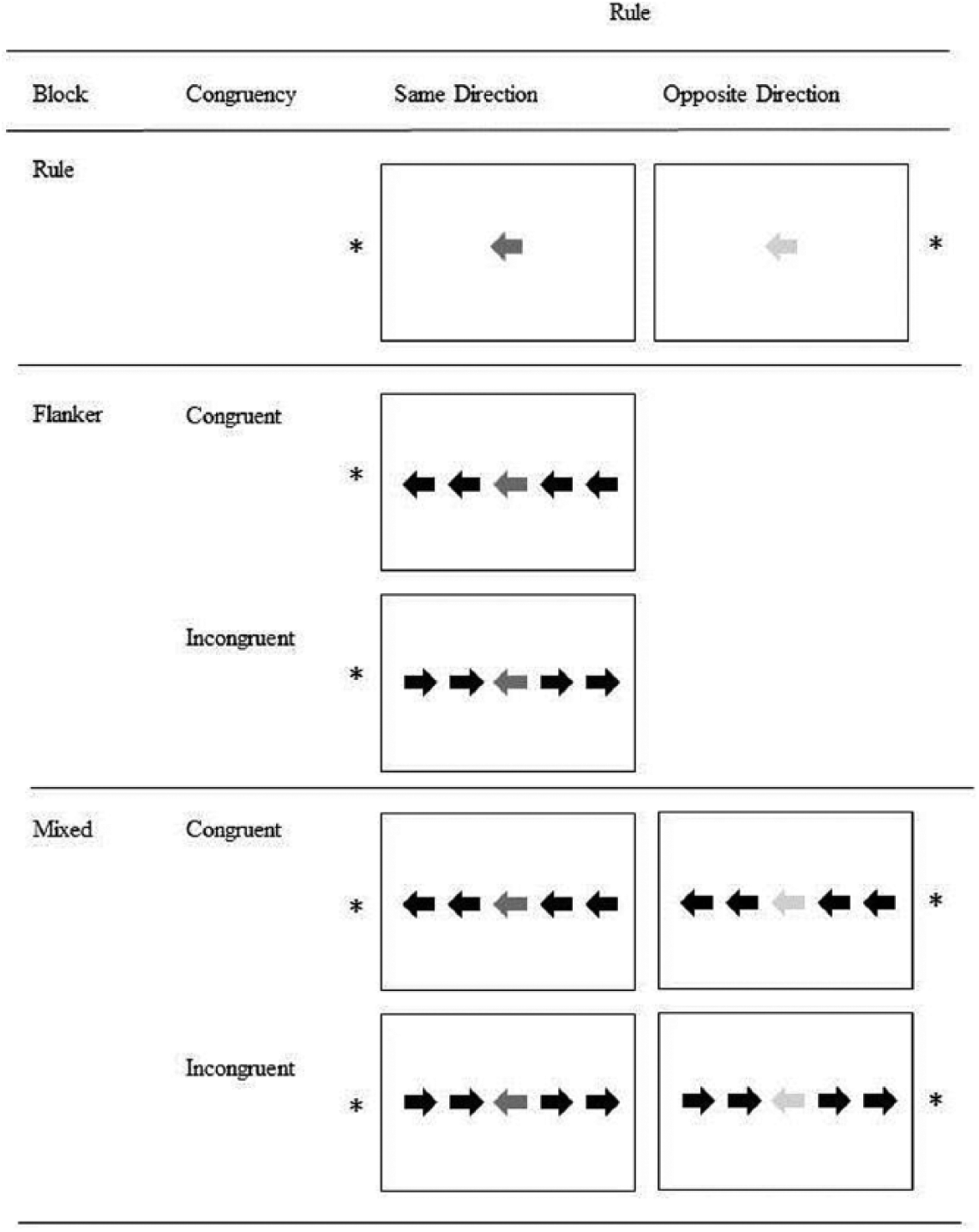
Experimental conditions of the modified flanker task. The asterisk denotes the side of the correct response.
In the rule block, a fixation cross was presented at the center of the screen for 200 ms followed by a red or blue arrow (indicated by light grey or medium grey in Figure 1). Participants were asked to indicate the direction the arrow was pointing by using the left- or right-hand mouse key. The color of the arrow indicated the response rule: if the arrow was blue, then click on the mouse pointing in the same direction as the arrow; if the arrow was red, then click on the mouse pointing in the opposite direction as the arrow. The rule block contained 48 trials, including 24 same-direction and 24 opposite-direction trials presented randomly. The stimulus remained on the screen until response or 2000 ms elapsed. The rule block assessed the participant’s ability to perform two conflicting tasks.
In the flanker block, participants saw a fixation cross for 200 ms followed by a central arrow surrounded by flanking arrows pointing in the same (congruent) or opposite direction (incongruent) as the middle arrow. The flanker block, with 36 congruent and 36 incongruent trials, was analogous to the congruent–incongruent mixed block of a traditional flanker task. The trial ended once a participant made a response or 2000 ms elapsed. The purpose of the flanker block was to assess the participant’s ability to filter out distracting flanking arrows while maintaining attention to the target central arrow.
In the mixed block, both rule and congruency were manipulated, producing four conditions: congruent–same direction; incongruent–same direction; congruent–opposite direction; and incongruent–opposite direction. There were 18 trials for each condition for a total of 72 trials. The stimulus remained on the screen until the participant made a response or 2000 ms elapsed. 1 The mixed block assessed cognitive processes involved in selective attention, inhibition, and rule-switching.
Participants were given instructions and practice with feedback before each block. Color–response associations for the rule blocks were counterbalanced across participants.
Results
Background measures
Monolinguals and bilinguals did not differ in mothers’ education, F(1, 63) = 2.74, p = .10, ηp2 = .042, fathers’ education, F(1, 61) = 2.40, p = .13, ηp2 = .038, or Shipley composite score, F(1, 56) = 2.24, p = .14, ηp2 = .039. See Table 1 for the mean scores of each background measure by language group.
Background demographic and language information by language group.

Modified flanker task
RTs less than 200 ms were removed from the analysis because these trials are too fast to capture the cognitive processes of interest (Luce, 1986). Table 2 reports the mean accuracy rate of each condition by language group.
Accuracy rates (out of 100%) on the modified flanker task by language group.

Rule block
Mean RTs are plotted in Figure 2(a). A two-way analysis of variance (ANOVA) for rule and language group on response times for correct trials was performed. There was a marginal effect of rule, F(1, 63) = 3.27, p = .075, η2 p = .049, but no main effect of language group or language group by rule interaction, ps > .18. Similar analyses were conducted on accuracy rates, which yielded no main effect of language group, rule, or language group by rule interaction, all ps > .28.

Mean reaction times by language groups for (a) the rule block, (b) the flanker block, and (c) the mixed block.
Flanker block (standard flanker task)
Correct RTs were subjected to a two-way ANOVA for congruency as the within-subjects factor and language group as the between-subjects factor. There was a main effect of language group, F(1, 63) = 5.36, p = .024, η2 p = .078, and a language group by congruency interaction, F(1, 63) = 4.18, p = .045, η2 p = .062 (Figure 2(b)). Bilinguals produced faster responses than monolinguals on the incongruent, p = .008, but not the congruent condition, p = .094. There was also a main effect of congruency, F(1, 63) = 94.30, p < .0001, η2 p = .60, in which the congruent condition produced faster response times than the incongruent condition.
Similar analyses were performed on the accuracy rates. Only a main effect of congruency was found, F(1, 63) = 30.45, p < .0001, η2 p = .33, such that the congruent condition was performed more accurately than the incongruent condition. Neither the main effect of language group nor the language group by congruency interaction was significant, ps > .79.
Mixed block
A three-way ANOVA for congruency, rule, and language group was performed on correct RTs. A main effect of rule emerged, F(1, 63) = 6.78, p = .012, η2 p = .097, with the same direction rule producing faster response times than the opposite direction rule (Figure 2(c)). The effect of language group was marginally significant, F(1, 63) = 2.90, p = .094, η2 p = .044. There was no effect of congruency, F(1, 63) = 1.58, p = .21, η2 p = .025, and no interaction effects, all ps > .43.
Analyses on accuracy rates were also subjected to a three-way ANOVA. Only a main effect of congruency emerged, F(1, 63) = 6.43, p = .014, η2 p = .093, such that the congruent trials were more accurate than the incongruent trials. No other main effects or interactions reached significance, all ps > .26.
Discussion
The present study compared the performance of monolingual and bilingual adolescents on a modified version of the flanker task. To avoid ceiling, the task was made more difficult by introducing a rule-switching component in which the color of the central arrow determined whether responses were to indicate the same or the opposite direction to which it was pointing. Thus, there were three blocks: rule-switching; standard flanker task that manipulated congruency; and mixed block that combined both rule and congruency. There were three main findings. Firstly, in the standard flanker task (flanker block), bilinguals were faster than monolinguals on the incongruent trials. Secondly, the groups performed essentially equivalently on the rule and mixed block conditions that included a rule-switching component, although the bilinguals were faster in the congruent condition with the reversed rule in the mixed block. Thirdly, in the mixed block, the effect of the rule switch over-rode the congruency effects typically found for this task, although the congruence difference did appear in the accuracy scores. Note that group differences in RTs need to be interpreted with caution due to the lack of a baseline measure.
Consider first the flanker block, the condition closest to a standard flanker task. The task requires selective attention to respond to the direction of the target arrow while ignoring the competing flanking arrows. The usual result is that incongruent trials are slower than congruent trials, creating a flanker effect. In studies comparing monolingual and bilingual children (e.g., Poarch & Bialystok, 2015; Yang et al., 2011) and some studies of young adults (Costa et al., 2008; Luk, et al., 2011; Marzecová, Asanowicz, Krivá, & Wodniecka, 2013; Yang & Yang, 2016), bilinguals performed better on the more demanding incongruent trials and showed a smaller flanker effect. Consistent with this research, the bilingual adolescents in the present study recorded significantly faster times for incongruent trials and therefore a smaller flanker effect than monolingual adolescents. This finding showing better performance by bilinguals on a simple executive function task more closely matches results from the children’s literature where bilinguals outperform monolinguals than it does results from the adult literature where group differences are rare.
In the rule and mixed blocks, the rule-switching component adds substantial cognitive demands in terms of working memory to hold the color rule in mind, monitor rule switches across trials, and inhibit the response to the indicated side for the reverse trials. In both blocks that included rule-switching, RTs were approximately 200 ms longer than in the standard condition. This means that the demands of the rule switch are much greater than the demands of incongruency in the standard flanker task. In both blocks that included the rule switch components, there were few performance differences between monolinguals and bilinguals. If one considers the role of inhibition in performing these conditions, then the results are in line with the children’s literature where no differences between groups are reported on measures that require simple response inhibition, such as the Day/Night task (Martin-Rhee & Bialystok, 2008), gift delay task (Barac, Moreno, & Bialystok, 2016; Carlson & Meltzoff, 2008), or impulse control (Carlson & Meltzoff, 2008). On tasks that require withholding or delaying a dominant or prepotent response, bilinguals show no benefit. Similarly, Blumenfeld and Marian (2014) compared the Stroop task, which requires stimulus–stimulus inhibition, to the Simon task, which involves stimulus–response inhibition, and found group differences only on the task that had perceptual conflict within the stimulus itself rather than across the stimulus and response. Therefore, the effect of the rule-switching component and possibly its need for inhibition introduced a processing requirement that is no more well-developed in bilinguals.
Finally, the effect of the additional cognitive load from rule-switching in the mixed block erased the usual effects of congruency, a change that was found for both language groups. This is surprising; congruency effects are robust. Yet in the present study, the rule-switching demands eradicated both congruency effects and language group differences. A clearer understanding of the processes required by the rule conditions would be essential to fully explain these results.
An additional complication with the mixed block is that certain trial types engage both facilitation and conflict (i.e., the opposite direction incongruent condition) where the flanking arrows provide useful information about the correct target direction. Thus, the net difficulty of these conditions is not easy to determine, and this factor may also have obscured possible effects of bilingualism. An alternative explanation may lie within the paradigm itself. Other paradigms, such as the AX-CPT task (Morales, Gómez-Ariza & Bajo, 2013) or ANT task (Costa et al., 2008; Yang, et al., 2011), have produced behavioral differences between monolinguals and bilinguals. Both these tasks provide a cue prior to the onset of the stimulus, so bilinguals may have had enough time to disengage their attention from the misleading cue and re-orient their attention to the relevant information. In several studies, bilinguals were shown to be more rapid at disengaging attention from previous trial information than monolinguals (Blumenfeld & Marian, 2011; Colzato et al., 2008; Grundy, Chung-Fat-Yim, Friesen, Mak, & Bialystok, 2017). The mixed block in the current paradigm is unusual because it requires a rule to be reversed; the simultaneous presentation of the conflicting cue and flanking arrows may have elicited similar levels of disengagement in both groups. Hence, in contrast to the young adult literature where more effortful processing and task demands often yield group differences, this situation may not extend to monolingual and bilingual adolescents either because their executive functions are still developing or because the manipulation in this case did not produce a sufficiently clear hierarchy of difficulty. Yet, even in this unconventional version of the flanker task, the bilinguals were trending toward faster performance across all trials of the mixed block compared to monolinguals.
In summary, bilingual adolescents showed higher levels of executive functioning than did their monolingual peers on the standard flanker task, a result also found with children. However, the hypothesis that simply making the task more difficult by increasing the processing demands by adding two color-based rules was not supported. The primary processes recruited in the rule condition were likely working memory, shifting, and inhibition, and even though bilinguals were numerically faster than monolinguals in these conditions, the difference was not significant. It is necessary, therefore, to reconsider why some tasks and some studies lead to language group differences and others do not. The notion that a determining variable in this regard is task difficulty may be too simplistic. Instead, the presence or absence of language group differences may depend more directly on the nature of the processing required rather than the degree to which it is effortful. The standard flanker task requires selective attention in the face of distracting alternatives. The present study shows that this difference extends into adolescence. In contrast, the additional processes required by the rule condition lead to equivalent performance between the groups. Just as studies of response inhibition in children have shown no difference between language groups, so too the rule condition in the present study shows no difference between language groups in adolescents.
Brain structure and cognitive processing are still developing in adolescence, with some arguing that the development of the frontal lobes is not complete until the early 20s (Stuss, 1992; St. James-Robert, 1979). Like children, bilingual adolescents are advancing more rapidly than monolinguals in this development. Presumably, as this development stabilizes and peak cognitive performance is achieved by everyone, differences in performance on these tasks attributable to experiences such as bilingualism will disappear (cf., Paap & Greenberg, 2013). Bilingualism has been associated with improved attentional abilities. The present study adds to this growing literature by showing these effects in the adolescent population. The findings support the argument raised by Bialystok et al. (2005) that the effect of bilingualism is most apparent when the executive control network is still developing and a developmental boost is necessitated, as is the case in adolescence.
Footnotes
Acknowledgements
The authors thank Lorinda Mak for designing the task, Lauren Bergman for organizing the data, and Kathy Liu for assisting with data collection.
Declaration of Conflicting Interests
The author(s) declared no potential conflicts of interest with respect to the research, authorship, and/or publication of this article.
Funding
The author(s) disclosed receipt of the following financial support for the research, authorship, and/or publication of this article: This work was supported by the US National Institutes of Health to E.B (grant R01HD052523).
