



Abstract
Aims and objectives/purpose/research questions:
The degree of overlap across languages in bilingual semantic memory has been debated in the cognitive bilingual literature for decades. This paper focuses on theory and recent evidence addressing the questions of whether translation-equivalent words in a bilingual person’s two languages access common core-meaning representations and whether long-standing semantic/conceptual associations among words are language-general or language-specific.
Design/methodology/approach:
We explain a theoretical approach to this problem and review recent evidence that addresses it. The empirical work cited used primarily memory tasks in which the languages of the word stimuli or responses changed from encoding to test.
Data and analysis:
Several studies are reviewed. In most cases, data were analyzed using an analysis of variance.
Findings/conclusions:
Robust between-language priming was observed for concrete nouns, abstract nouns, verbs, and adjectives using a variety of specific tasks, indicating that the semantic representations of translation equivalents overlap. The reduction in priming relative to within-language conditions could be explained in some cases by repetition of language-specific processes in the within-language conditions. Results of repetition-priming and false-memory experiments that involved semantic associations showed that category–exemplar, noun–verb, antonym, and other semantic relationships are shared across languages in a common semantic system.
Originality:
Many of the results are interpreted with respect to questions that have not been addressed in previous work.
Significance/implications:
The nature of semantic system integration is important for understanding bilingual cognition. Episodic memory tasks can be a useful way to study the organization of core-meaning representations in bilinguals, and indicate that these representations are shared across languages. However, these procedures do not capture other aspects of semantic representation that may differ across languages.
Across a lifetime, humans can learn or understand innumerable ideas or concepts. Semantic representations can be considered to be concepts that are represented by particular words, phrases, sentences, or other language units. Thus, semantic representations are representations of the meanings of words, phrases, sentences, or other language units and are defined by the mapping of these language units onto the conceptual system. Thus, it is assumed that the mapping of word forms to their meanings entails associations between distinct levels of representation in most models of bilingual lexical representation and processing, for example, the bilingual interactive activation model (Dijkstra & Van Heuven, 2002), the inhibitory control model (Green, 1998), the revised hierarchical model (Kroll & Stewart, 1994), and the distributed features model (Van Hell & de Groot, 1998). This article focuses on the semantic representations of individual words, which are considered here to be conceptual representations that correspond to the meanings of particular words.
A central question about bilingual semantic representations is the degree to which they are integrated across languages. The purpose of this paper is to review evidence from the bilingual episodic memory literature that addresses the question of the degree to which translation-equivalent words in a bilingual’s two languages share common semantic representations or common semantic associations. I will present recent evidence from studies on repetition priming and explicit memory that lead to the conclusion that there is a single semantic system accessed by both languages, shared semantic representations for translation-equivalent words, and shared semantic associations. (More comprehensive reviews of the earlier literature on semantic/conceptual integration across languages can be found in de Groot, 1992; Francis, 1999, 2005.) The focus here is on words that are exact translation equivalents in the two languages, with some comments on cases of words that are not exact translation equivalents.
In distributed models of semantic/conceptual representation, each word is associated with many conceptual “features.” The nature of these features varies across models. In some single-language models, the concept is a specific pattern of activation across a set of features, but the features do not individually represent particular aspects of meaning (e.g., Kawamoto, 1993). In other models, each feature corresponds to a particular aspect of meaning (e.g., McRae, De Sa, & Seidenbert, 1997; Plaut & Shallice, 1993). The bilingual distributed features model (Van Hell & de Groot, 1998) remains neutral on the nature of individual features, but posits that semantic representations of translation-equivalent words have overlapping sets of features.
Here, as in the bilingual distributed features model and many single-language models, the semantic representation of words in bilinguals is treated in a distributed manner, in that each word form is associated with many semantic or conceptual features. As in some single-language models (McRae et al., 1997; Plaut & Shallice, 1993), each feature is considered to correspond to a particular aspect of meaning, for example, a defining aspect of the meaning, a referential property, or a connotation. The features may in turn have distributed representations across units that are not individually meaningful. Thus, different subsets of features encompass different aspects of meaning. One set, which I denote here as the core-meaning representation, is a conjunction of fundamental semantic features that together uniquely identify the word concept. As the review to follow will show, core meanings seem to be critical to identifying and producing words, to the encoding of new memories, and to the retrieval of these memories after some time has passed (i.e., long-term episodic memory). Other subsets of features representing connotations, cultural imagery, schemas, category boundaries, thematic role assignments, and any other important aspects of a word’s meaning may impact on-line language processing and everyday communication.
The primary focus of this article is on core meanings of individual words and their semantic associations and the questions of whether and to what extent translation equivalents have shared core-meaning representations and whether long-standing semantic associations are shared across languages. However, cross-linguistic overlap in mental representations of other semantic features is also briefly discussed. This review explains evidence from studies on repetition priming and explicit memory that show shared semantic representations and shared semantic associations for translation equivalents in a bilingual’s two languages.
Evidence for shared word meaning representations in bilingual semantic memory
Several methods have been used to investigate the extent to which translation equivalents have shared or overlapping core-meaning representations. Several recent studies reviewed in the following sections have involved measures of repetition priming, a change in speed, accuracy, or bias based on prior experience, which is a form of implicit memory (Gabrieli, 1998). A typical repetition priming protocol with word stimuli involves two stages. In the encoding phase, a participant performs a cognitive task with a set of target words. In the test phase, the participant performs the same task or another cognitive task with a set of words that includes both the target words and new words not presented at encoding. The measure of priming is the difference in performance at test between repeated and new words. For example, the repeated words are processed with greater speed or accuracy or are more likely to be generated as responses in an open-ended task.
Repetition priming has been used in single-language studies to determine whether different tasks or task variants, typically involving words or pictures of objects, involve some of the same processes or mental representations (e.g., Franks, Bilbrey, Lien, & McNamara, 2000; Monsell, Matthews, & Miller, 1992; Thompson-Schill & Gabrieli, 1999). This approach is based on the principle of transfer-appropriate processing (Morris, Bransford, & Franks, 1977; Roediger & Blaxton, 1987), the idea that the degree of transfer in memory will depend on the extent to which common processes are engaged at encoding and test. Priming that remains even when the language changes from encoding to test is known as cross-language or between-language priming and is taken as evidence for shared representation at the semantic or conceptual level.
It is important to make two distinctions here. Firstly, for this type of repetition priming, the retention interval between the encoding and test occurrences of each item is usually several minutes filled with numerous intervening items/trials, and it is therefore considered an episodic memory phenomenon. This is different from several types of immediate “semantic priming,” which is thought to reflect on-line processing and only occurs when there are no intervening items between presentations of the prime and target words. While the latter phenomenon also informs the nature of bilingual conceptual representation, it has been reviewed elsewhere (Altarriba & Basnight-Brown, 2007; Francis, 1999, 2005).
The second distinction that is important in the repetition priming literature is between conceptual and non-conceptual forms of repetition priming (e.g., Gabrieli, 1998). Conceptual priming depends primarily on the repetition of word meanings, whereas non-conceptual priming depends primarily on non-conceptual factors, such as perceptual, orthographic, or phonological factors. Conceptual priming exhibits robust levels-of-processing effects and transfers across modalities and stimulus formats, whereas non-conceptual priming does not.
Non-conceptual forms of repetition priming, such as those involving lexical decision and word-fragment completion tasks, do not transfer across languages unless the words are cognates (see Francis, 1999; 2005, for reviews of these studies). Lexical decision is simply classifying letter sequences as words or non-words, and it is speeded with repetition. In the word-fragment completion task, participants attempt to identify incomplete words with several letters missing, and performance is more accurate when the word has been encountered at encoding. Under normal circumstances, these tasks would not be expected to exhibit priming across non-cognate translation equivalents, because they do not require access to word meanings. However, if the level of semantic processing is ramped up, even non-conceptual repetition-priming tasks can show some transfer across languages. Specifically, one study in this area showed priming between languages for word-fragment completion when the encoding task was highly conceptual in nature (Smith, 1991); when the task required inferring key words from meaningful contexts, priming transferred across languages. For example, the phrase organ circulated blood in English made it easier to identify the French words sang (blood) and cœur (heart) in the word-fragment completion task.
Conceptual repetition priming across languages
Greater transfer across languages is observed when both encoding and test tasks are conceptual in nature. As explained in the following paragraphs, conceptual repetition priming has been examined within and between languages in bilinguals for concrete nouns, abstract nouns, verbs, and adjectives using a variety of tasks. The results of these studies are summarized in Table 1. These studies have involved four types of priming tasks, semantic-classification priming, category–exemplar generation priming, verb generation priming, and antonym generation priming, all of which exhibit substantial cross-language priming effects.
Summary of studies showing conceptual repetition priming between languages.
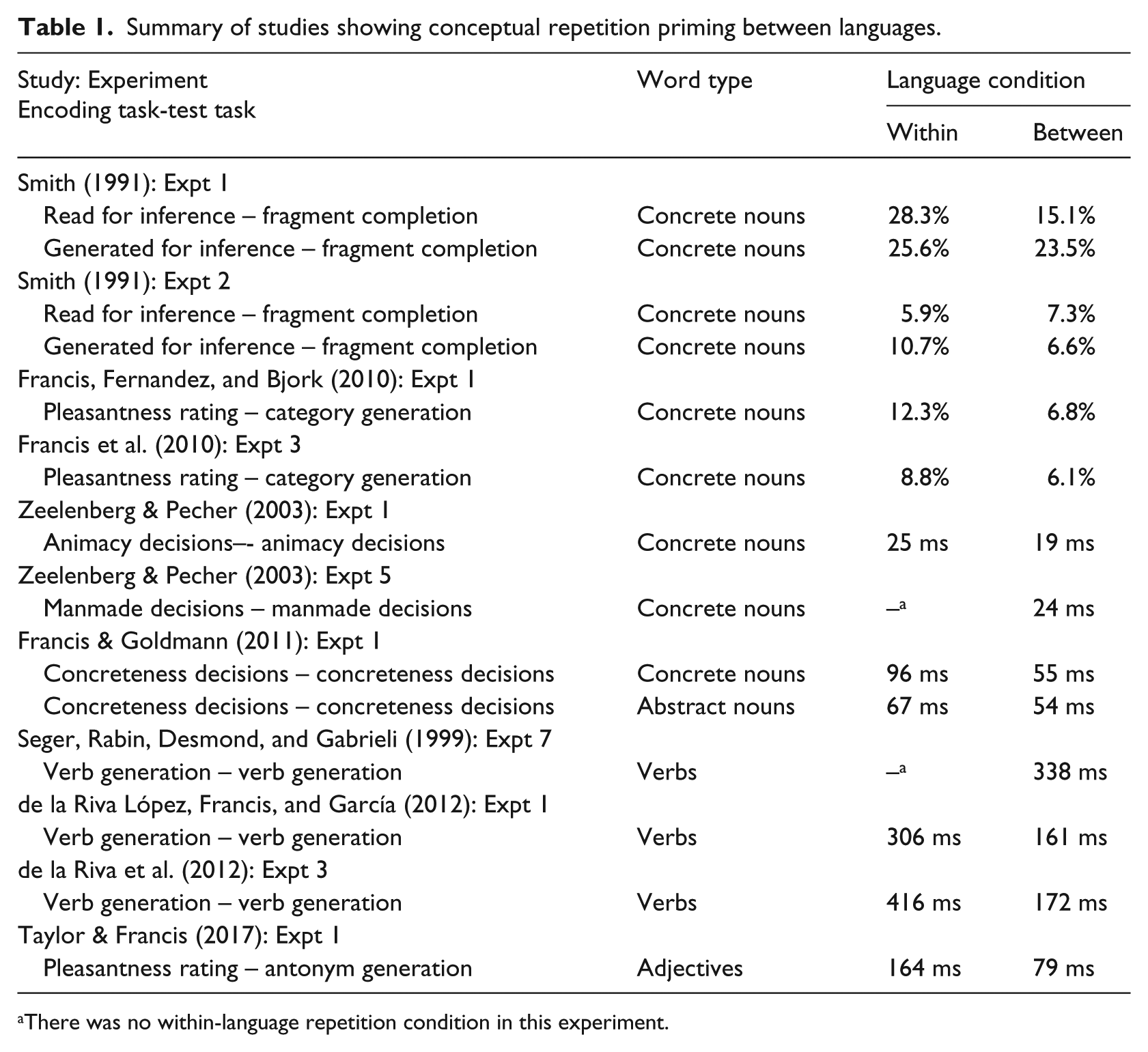
There was no within-language repetition condition in this experiment.
In the semantic-classification priming paradigm, participants make semantic classifications of words at encoding, for example deciding whether the word is concrete or abstract in meaning, or whether the word has a pleasant or unpleasant meaning. Typically, the same decision is made at test, and the measure of priming is reduction in response times for repeated relative to new words. Repetition priming between languages was substantial for animacy and manmade–not manmade classifications of concrete nouns (Zeelenberg & Pecher, 2003) and for concrete–abstract classifications of concrete and abstract nouns (Francis & Goldmann, 2011). For example, classifying advice as abstract at encoding makes a person faster to classify its Spanish equivalent consejo as abstract at test than a comparable Spanish word whose English equivalent had not been presented at encoding.
In the category–exemplar generation priming paradigm, words from different semantic categories, such as animals, fruit, furniture, and clothing, are presented at encoding, but they are randomly intermixed and no superordinate category labels are provided. At test, the superordinate category names are presented for the first time, and participants are asked to generate the first several exemplars that come to mind. The measure of priming is the bias to generate target words that were presented at encoding more often than target words that were not presented at encoding, which is computed as the difference in proportions of target words generated. Repetition priming between languages in category–exemplar generation was substantial in a study that used primarily concrete nouns as stimuli (Francis et al., 2010). For example, rating the Spanish word fresa on pleasantness at encoding made it more likely that its translation equivalent strawberry would be produced at test in response to the cue fruit.
In the verb generation task, nouns are presented as cues, and the task is to generate an appropriate action word, or verb. For example, the noun scissors typically elicits the verb response cut. For the verb generation priming paradigm, this task is performed at both encoding and test. The measure of priming is the reduction in response times for repeated relative to new noun–verb pairs. Repetition priming between languages in verb generation was substantial (de la Riva López, Francis, & García, 2012; Seger et al., 1999). For example, generating the verb cut to the cue scissors at encoding made participants faster to produce its Spanish translation equivalent cortar to the cue tijeras (“scissors”) at test.
In the antonym generation task, target adjectives are presented at encoding for semantic processing. At test, the antonyms to the target words are presented as cues, and the participant is to produce the antonym of each cue word as quickly and accurately as possible. The measure of priming is the reduction in response times for antonyms encountered at encoding relative to new antonyms. Repetition priming between languages in antonym generation was substantial in a study that used adjectives as stimulus words (Taylor & Francis, 2017). For example, rating the word grande on pleasantness at encoding speeded the generation of its translation equivalent large as an antonym to small at test.
Taken together, these studies demonstrate robust cross-language transfer for concrete nouns, abstract nouns, verbs, and adjectives and therefore provide strong evidence for overlap in word meaning representations for these word classes. However, priming across languages alone does not reveal whether the overlap is partial or complete. There must be a comparison to a within-language repetition condition. In most studies of conceptual repetition priming, priming effects in between-language conditions were attenuated relative to priming in within-language conditions (de la Riva López et al., 2012; Francis & Goldmann, 2011; Francis et al., 2010; Smith 1991; Taylor & Francis, 2017). This phenomenon naturally leads researchers to ask whether the reduction in priming that occurs when the language changes from encoding to test is evidence for the existence of non-overlapping features at the semantic or conceptual level. Alternatively, could it simply be that in within-language conditions, repetition of language-specific processes or language-specific representations of orthographic or phonological word forms also contribute to the priming effect. Two studies included conditions meant to determine which explanation better accounted for the data.
In the study of category–exemplar generation mentioned above (Francis et al., 2010), Experiment 2 included a levels-of-processing manipulation (Craik & Lockhart, 1972) to determine why a language change reduced repetition priming. Specifically, in a shallow, non-semantic encoding task, participants were to count the number of vowels in each word, and in a deep, semantic encoding task, participants rated the pleasantness of each word. Shallow processing led to substantial priming in same-language but not different-language conditions. The reduction in priming when the language changed was of the same magnitude in shallow and deep encoding conditions. Therefore, the additional priming observed for within-language conditions relative to between-language conditions, in both deep and shallow priming, could be explained by the repetition of language-specific word forms. Because stimuli were presented visually in the encoding phase and responses were spoken at test, we concluded that the language-specific forms involved were amodal in nature, possibly at the modality-general lemma level of representation, a level incorporated in some single-language and bilingual models of lexical representation and processing (e.g., Dell & O’Seaghdha, 1992; Green, 1998; Levelt, Roelofs, & Meyer, 1999).
A different strategy was used to determine why a language change reduced repetition priming in verb generation (de la Riva et al., 2012). In Experiment 3, we decomposed the processes of verb generation into noun comprehension (i.e., accessing the noun concept), appropriate verb-concept selection, and verb production (from the verb concept). Because noun comprehension and verb production require language-specific processes, we reasoned that verb-concept selection was the only process that was entirely semantic in nature and could be the basis of the transfer across languages that was observed. Encoding conditions involving partial repetitions were designed to selectively facilitate each of the three processes. To facilitate noun comprehension, participants translated the noun cue from the target language to the other language; to facilitate verb-concept selection, participants performed the verb generation task in the non-target language; and to facilitate verb production, participants translated the target verb from the non-target language to the target language. An identical repetition condition meant to facilitate all three processes was also included. The sum of the priming effects from the three partial repetition conditions added up to the magnitude of the priming effect obtained with identical repetition of the verb generation task. This pattern of effects indicates that additional priming observed in within-language relative to between-language conditions in verb generation could be explained by the repetition of language-specific verb production processes.
In summary, conceptual repetition priming transfers across languages to translation equivalents, whether they are concrete nouns, abstract nouns, verbs, or adjectives, thus providing evidence for overlap in semantic representations. There is also good evidence that the reduction in priming across languages relative to priming within a language is due to within-language priming of language-specific representations or processes that are not semantic in nature. Together, these findings suggest that translation equivalents have complete overlap in core-meaning representations.
Other relevant repetition-priming results
While not exactly considered conceptual repetition priming, there are other bilingual repetition priming results that would logically require access to a shared concept for priming to occur. These effects involve picture naming and word translation tasks. Picture naming is a task that requires identification of an object and producing its name based on the concept (e.g., Smith & Magee, 1980). Word translation is a task that, at least for early and proficient bilinguals, requires the comprehension of a word in one language and production of the corresponding word in another language (e.g., Potter, So, Von Eckardt, & Feldman, 1984). As will be explained in the following paragraphs, repetition priming effects involving picture naming and word translation provide further evidence that translation equivalents share core-meaning representations.
Firstly, naming a picture in one language facilitates naming the same picture in another language several minutes later (Francis, Augustini, & Sáenz, 2003; Francis, Corral, Jones, & Sáenz, 2008; Francis & Sáenz, 2007; Hernandez & Reyes, 2002). This effect lasts for at least one week (Francis & Sáenz, 2007). One could argue that the facilitation could be based on perceptual processes alone, but the between-language repetition-priming effect persists even when the particular pictured exemplar changes (Francis et al., 2008), for example, if the first and second pictures are of different kinds of dogs.
Secondly, picture naming primes later translation. Naming a picture facilitates later translation when responses are given in the same language (Francis et al., 2003; Francis et al., 2011; for translation only from the more proficient to the less proficient language in Sholl, Sankaranarayanan, and Kroll, 1995). For example, naming a picture of a dog in English facilitates translating perro to dog. This repetition priming effect is based on common processes involved in producing the word based on its concept. It cannot be based on repeated articulation of the phonology, because no facilitation is observed in production of homophones (Wheeldon & Monsell, 1992).
Thirdly, translation primes later picture naming. Translating a word from one language to another facilitates later picture naming when the translation and picture naming responses are in the same language (Francis, Camacho, & Lara, 2014; Francis & Sáenz, 2007; Francis et al., 2003; Francis et al., 2008). For example, translating perro to dog would facilitate naming a picture of a dog in English. This effect lasts for at least one week (Francis & Sáenz, 2007) and is found even if the word is translated within a sentence context (Francis et al., 2014). Further confidence that this effect and the repetition priming for picture naming between languages involve repetition of a common concept is that these effects add up to the effect obtained when picture naming is repeated in the same language (Francis et al., 2003; Francis et al., 2008).
Fourthly, translating a word from one language to another can prime translation in other directions. In bilinguals, translating a word in one direction facilitates later translation in the opposite direction (Francis, Tokowicz, & Kroll, 2014). Translating a word from one language to a second language also facilitates translating from the that language to a third language in trilinguals (Francis & Gallard, 2005). For example, translating dog to perro facilitates later translation of dog to its French equivalent chien. This priming is based on repetition of comprehension processes. Similarly, translating a word from one language to a second facilitates translating from a third language to that second language (Francis & Gallard, 2005). For example, translating perro to chien facilitates translating dog to chien. This priming is based on repetition of production processes. Additional evidence that these trilingual effects involve access to a common concept is that the facilitation effects obtained in these two conditions add up to the facilitation effect obtained with identical translation repetition (Francis & Gallard, 2005).
The repetition priming or transfer effects observed among these picture naming and translation tasks with different language combinations all indicate access to conceptual representations that are shared by translation equivalents. The priming occurs because of the repetition of common word comprehension processes that end in conceptual access or common word production processes that are initiated from the concept (Francis, 2014). A shared core-meaning representation is necessary for the additive patterns of repetition-priming effects observed for object identification and word production in picture naming (Francis et al., 2003; Francis et al., 2008) and for word comprehension and production processes in translation (Francis & Gallard, 2005; Francis et al., 2011).
Evidence for shared semantic associations in bilingual semantic memory
We can also ask whether long-standing semantic associations are shared across languages in a language-general semantic system. Semantic associations are associations among words that are related in meaning. Some examples of semantic associations include category–exemplar relationships, such as fruit–strawberry; object–action relationships, such as scissors–cut; and antonym relationships, such as large–small.
Semantic associations can be distinguished in theory from lexical associations that are based on co-occurrence, such as bread–butter or combined meaning, such as rocking-chair or brain-freeze. Because co-occurrence frequencies for pairs of words that do not have a strong semantic relationship can differ across cultures and languages, these lexical associations are not necessarily shared across languages. For example, the English word bread and the Spanish word pan are translation equivalents. In English, butter is a strong associate of bread, but in Mexican Spanish, mantequilla is not a strong associate of pan. On the other hand, one likely associate of pan is dulce, but sweet is unlikely to be generated as an associate to bread in English. Pan dulce is likely unitized because it refers to a particular range of sweet baked goods. Of course some associations are based on both related meaning and co-occurrence and might therefore have some shared and some separate components. Semantic associations can also be distinguished from the contextual associations between words and the situations in which they are encountered, such as sentence or linguistic context, modality, information sources, tasks, and spatial or temporal contexts. Such associations are made to information outside of the conceptual system.
Associate generation studies
Bilingual performance on associate generation tasks has often been cited to reason about bilingual semantic representations. Two early studies of associate generation in bilinguals showed that bilinguals generated different associates in their two languages (Kolers, 1963; Taylor, 1976). Both authors claimed that the low agreement between the sets of associates generated in the two languages was evidence for separate semantic systems. However, as other researchers have pointed out (Dalrymple-Alford & Aamiry, 1970; Van Hell & de Groot, 1998), there was no condition in which the task was repeated in the same language for comparison, so it was unknown how much associations would vary within a language. In studies that included within-language repetition conditions, bilinguals had less consistency across than within languages (Dalrymple-Alford & Aamiry, 1970; Van Hell & de Groot, 1998). Dalrymple-Alford and Aamiry (1970) suggested that bilinguals are more likely to give different associates to translation equivalents because of differences in referential and connotative meanings, and Van Hell and de Groot (1998) attributed this effect to non-overlapping features of semantic representations across languages. These explanations could be correct simultaneously if the non-overlapping features were the referential and connotative meanings.
The similarity of associations generated in two different languages relative to twice in the same language was greater for concrete words than for abstract words, greater for nouns than for verbs, and greater for cognates than for non-cognates (Van Hell & de Groot, 1998). These results were interpreted as showing a greater degree of conceptual overlap for concrete words, nouns, and cognates relative to abstract words, verbs, and non-cognates, respectively. As noted previously, it is possible that language-specific semantic features other than the core-meaning influence the associates generated. It is also possible that the associates generated are not all semantic in nature. Because the co-occurrence frequencies of words vary across different languages, the differential agreement across word types may reflect differences in the rates of generating lexical-level rather than semantic associations. Thus, the research based on associate generation is inconclusive with respect to core-meaning integration across languages. More fruitful methods for examining the sharing of semantic associations are associative priming and elicitation of false memories, as the following sections explain.
Repetition priming for semantic associations
Four studies have shown that repetition priming for semantic associations transfers across languages, providing evidence that in bilinguals, semantic associations are shared across languages. Repetition priming in category–exemplar generation transferred across languages in two experiments when word meanings were processed at encoding (Francis et al., 2010). For example, rating the pleasantness of the Spanish word fresa made its translation equivalent strawberry more likely to be produced in response to the cue fruit. This result indicates that category–exemplar associations are shared across languages.
Priming in verb generation transferred across languages in three experiments across two independent studies (de la Riva López et al., 2012; Seger et al., 1999). For example, generating the verb cut to the cue scissors made participants faster at producing its translation equivalent cortar to the cue tijeras. This result indicates that object–action associations are shared across languages. Finally, priming in antonym generation transferred across languages in one experiment when word meanings were processed at encoding (Taylor & Francis, 2017). For example, rating the pleasantness of the word grande speeded the generation of its translation equivalent large as an antonym to small. This result indicates that antonym associations are shared across languages. Together, these results indicate that category–exemplar, noun–verb, and antonym relationships are shared across languages in a common semantic system. These associations appear to be made among the core-meaning representations of the words involved.
False memories for semantic associates
Four studies examined the transfer of meaning-based false memories across languages in bilinguals using the Deese–Roediger–McDermott paradigm (Roediger & McDermott, 1995), in which participants studied lists of words that were semantically associated to a critical lure word that was not presented. False memories are indicated when the critical lure word is falsely recalled (i.e., a semantic intrusion) or falsely recognized in a later test. The false memory for the critical item is thought to arise because of its semantic associations with the presented items. One way this could happen within the view of semantic representation presented in the introduction is that when the semantic features of all the associated items are encoded, enough semantic features of the critical lure are encoded that it creates the illusion that the critical lure concept was also presented. The transfer of this effect across languages in bilinguals would provide evidence that semantic representations and semantic associations are shared across languages.
Indeed, all four studies showed that this effect transfers across languages. Specifically, when the list items were studied in one language and recalled in another, the translation of the critical lure was often reported, and these between-language semantic intrusions occurred at a higher rate than when recall was in the same language as the original list (Marmolejo, Diliberto-Macaluso, & Altarriba, 2009). The reason for the higher critical lure intrusion rate in between-language conditions may be that if the lure came to mind in the same-language condition, a lack of memory for the phonological word form could be used to determine that it was not presented and should not be reported. In contrast, in the between-language condition, none of the words recalled would have a phonological match in memory, so a lack of memory for the phonological word form would not be diagnostic. In the same study, a similar pattern was found on a final recognition test in which false alarms to critical lures were more likely when the test was in a different language than when it was in the same language (Marmolejo et al., 2009). One explanation for the greater false alarm rate for critical lures across languages is that within a language, it would be more salient that there was no memory trace for the non-semantic characteristics of the critical lure word, so it would be easier to reject it. In yet another study, when participants had to indicate on a recognition test whether each item had been encountered before in either language, the rate of false alarms to the critical lure was higher than for non-studied lures and did not depend on whether the item had been studied in the same or a different language (Kawasaki & Yama, 2003).
Even on a recognition test in which participants were to respond Yes only for items that had been studied in the same language as the test item, in one study, false alarms to critical lures were as high between languages as within a language (Cabeza & Lennarston, 2005) and, in the other, false alarm rates to critical lures were lower between languages than within a language (Sahlin, Harding, & Seamon, 2005). In these last two cases, to make a false alarm to a different-language critical lure, one would have to both falsely recognize the concept and fail to remember the language of the list to which it was semantically related. Also, if a participant remembered the language of the related studied words, they could have inferred the language of the non-presented critical lure and rejected it on that basis. For these two reasons, these two studies may have underestimated the true level of transfer of false memories across languages. It is remarkable that between-language false alarms occurred at all. Together, these four studies indicate strong transfer of semantic false memories across languages, indicating that the semantic system and semantic associations are shared across languages.
Limits on shared semantic representations
Some caveats are warranted in order to avoid an oversimplified characterization of bilingual semantic memory. Firstly, the word stimuli were typically selected to be relatively unambiguous in translation and the focus was on core meanings and strong associates. In the following paragraphs, we address how ambiguous words might be represented in such a system and why some semantic features other than the core meaning might differ across languages, even within a bilingual individual.
Ambiguous words
In the studies reviewed here, efforts were made to choose word stimuli that had only one meaning or had one dominant meaning in both languages. However, many words or word forms in a language have multiple meanings. Polysemous words have multiple related meanings or senses, and word forms that are homophones or homographs are associated with multiple unrelated meanings. In many cases, when a word has multiple meanings, not all meanings are shared across languages. Extrapolating from the logic presented here, we speculate that when a word has more than one core meaning, there are multiple core-meaning representations that may be shared with different words in another language.
For example, the English word trunk can be the compartment in the back of a car, part of a tree, or part of an elephant’s body. These three meanings would be translated into Spanish as cajuela, tronco, and trompa, respectively. The core-meaning representation corresponding to the car compartment would be shared by trunk and cajuela, the core meaning corresponding to a part of a tree would be shared by trunk and tronco, and the core meaning corresponding to the elephant part would be shared by trunk and trompa. Thus, the semantic system can accommodate multiple mappings of meanings to word forms.
Other semantic features
Clearly, we must also acknowledge some limits on shared semantic representation because of differences in how the words are used in different languages/cultures. Firstly, translation equivalents may differ in connotative meeting. For example, the English word ambitious and the Spanish word ambicioso both describe a person who sets lofty goals and is determined to achieve them. However, while the English word ambitious has positive connotations that the person works hard to achieve the goals, the Spanish translation equivalent ambicioso has negative connotations that the person is willing to betray or step over others in order to get ahead. Secondly, category boundaries for related concepts may differ across languages (Ameel, Malt, Storms, & Van Assche, 2009).
Thirdly, the imagery elicited by translation equivalents may differ – for example, sandwich to a monolingual speaker of American English or a speaker of Australian English and equivalents bocadillo for a monolingual speaker of Spanish in Spain or lonche for a speaker of Mexican Spanish likely evoke images of four different varieties of sandwiches. This phenomenon, termed cultural imagery, is thought not to be so much a language phenomenon per se, but rather a cultural or geographical phenomenon. For a bilingual person, the images are also likely differentiated to the extent that the person is bicultural or multi-cultural, but perhaps to a lesser degree. If a person were to learn a new language without exposure to the culture(s) in which it is typically spoken, he or she might not have distinct images across languages. The cross-linguistic similarity of the imagery associated with a word concept likely depends on how strongly the concept is tied to culture or geography. Note that imagery can vary even among monolingual speakers within a culture or geographic region by age, gender, and other person characteristics.
Finally, schemas associated with translation equivalents may have different features for cultural reasons. For example, one feature of a restaurant schema in the USA would be that the server brings the bill to the table once it is clear that the diners are not planning to order more food or beverages; this is done for the convenience of the diners to pay whenever they are ready. In the restaurante schema in Mexico or in Spain, this feature would be replaced with asking the server for the bill; this is necessary because it is considered rude for a server to deliver the bill before a diner asks, because it implies that the server wants the diner to leave soon. These differences in schemas can easily cause cross-cultural misunderstandings.
In the mind of an individual bilingual and bicultural person, these distinct connotations, category boundaries, images, or schemas may be more similar than for monolingual and mono-cultural speakers of each language, a phenomenon termed convergence (e.g., Ameel et al., 2009). In early stages of second language learning, learners might assume that the second language words have the same range of meaning, the same connotations, and the same category boundaries as their translation equivalents in the first language. With greater experience, they learn to make distinctions in usage and eventually activate connotations and imagery closer to those of a native speaker.
If these aspects of semantics are not shared by translation equivalents, how then might they be represented? Representations of word meanings may have different sets of features for different types of information. One set of features might represent the core meaning and others would represent connotations, information on category boundaries, or link to cultural imagery. These non-core features might be linked in a language-specific manner to word forms or to language tags, or they could be linked to cultural context, which of course includes language.
Conclusion
Research involving procedures to measure conceptual repetition priming across languages provides evidence that translation equivalents have shared core-meaning representations in a language-general semantic/conceptual system. Research using associative repetition priming and elicitation of semantically based false memories across languages provide evidences that semantic associations generalize across languages, but non-semantic associations may not generalize across languages. Further research will be needed to better understand semantic representations for ambiguous words and limits on semantic overlap for semantic features other than the core meaning.
Footnotes
Declaration of conflicting interests
The author(s) declared no potential conflicts of interest with respect to the research, authorship, and/or publication of this article.
Funding
The author(s) received no financial support for the research, authorship, and/or publication of this article.