




Abstract
Purpose:
As bilingual students often achieve lower scores than monolinguals in single-language vocabulary assessments, a deficit-oriented view of bilingualism is widespread in educational institutions. This study examined whether this alleged difference remains when the conceptual vocabulary scores of bilingual primary students are considered, and when home language and literacy activities are taken into account.
Methods:
Extensive expressive vocabulary measures were administered in both the environmental language (German) and the heritage language (Turkish) to simultaneous and sequential bilingual students, and to their monolingual peers. Their parents provided information about the frequency of home language and literacy activities.
Data:
The study included 302 students (5;9–10;9 years). 83 were simultaneous bilingual, 55 sequential bilingual and 164 monolingual. Comparisons on vocabulary were conducted via separate multiple regression analyses with frequency of home language and literacy activities as a control variable.
Findings:
In single-language vocabulary scores of the environmental language, simultaneous and sequential bilingual students scored lower than monolinguals. In contrast, and most importantly, there were no differences between either bilingual group and monolinguals with regard to conceptual vocabulary and the relationship between conceptual vocabulary and frequency of home language and literacy activities. Controlling for frequency of home language and literacy activities did not change these findings.
Originality:
This study compared the expressive single-language and conceptual vocabulary scores of simultaneous and sequential bilinguals with the scores of monolinguals in a large sample of primary students, for the first time additionally controlling for home language and literacy activities, with the German and Turkish languages.
Implications:
Because bilingual students have the same conceptual vocabulary scores as monolinguals, lower single-language vocabulary scores do not reflect a language deficiency.
Keywords
In schools, the criticism is often expressed that the vocabulary of students who speak a language other than the language of instruction is deficient, which results in a deficit-oriented view of bilingualism (Otheguy, García, & Reid, 2015). Due to the well-known relationship between vocabulary and the home learning environment, one might suspect that the language support in bilingual families is different to that of monolingual families. However, in this context, one should bear in mind that the vocabulary of bilinguals and their home language support is distributed over two or more languages. Therefore, we investigate whether bilingual primary students’ vocabulary size across all their languages (conceptual vocabulary) is still smaller compared to the one language vocabulary of monolinguals. Furthermore, we address the question of the relationship between conceptual vocabulary and home language and literacy activities (HLLA).
A large vocabulary size supports learning in general and learning to read in particular (Joshi, 2006; Moser, Berweger, & Stamm, 2005). For bilingual students, the vocabulary abilities in all their languages (i.e. heritage language and environmental language) are critical to their academic and reading success (Edele & Stanat, 2016; Lewis, Sandilos, Hammer, Sawyer, & Méndez, 2016). To increase academic success, teachers need to assess the vocabulary competencies of their students.
However, it is highly challenging to assess vocabulary competencies in bilingual students. They may know some words in one language but not in the other (i.e. singlets) and some words in both languages (i.e. translation equivalents or doublets; Oller, Pearson, & Cobo-Lewis, 2007). Still, in schools, especially during testing, usually only the environmental language is considered (Otheguy et al., 2015; Wei, 2011). As a consequence, bilingual students cannot demonstrate their entire language knowledge and, thus, score lower than monolinguals in single-language measures (Oller et al., 2007; Otheguy et al., 2015).
In contrast, conceptual scoring (or synonymously composite scoring) takes into account all languages of bilingual students, counting the total number of available lexical concepts in any of their languages. Pearson, Fernandez, and Oller (1993) argued that conceptual vocabulary scores of bilinguals are the counterpart of monolingual vocabulary (Oller & Pearson, 2010). Thus, conceptual scoring has been recommended because it can better display the vocabulary knowledge of bilingual students (Bedore, Peña, García, & Cortez, 2005; de Villiers, 2015).
Other important factors influencing vocabulary are HLLA. To our knowledge, no study has yet compared the relationship between HLLA and conceptual vocabulary scores in mono- and bilingual primary students or examined the effect of HLLA on conceptual vocabulary. However, such a study is needed in order to interpret vocabulary scores correctly. Thus, the present study compares single-language vocabulary scores and conceptual vocabulary scores in mono- and bilingual students, controlling for the effects of HLLA, and comparing the relationship of HLLA and vocabulary within a large sample of primary students.
Comparison of monolingual and bilingual expressive vocabulary
Usually, researchers differentiate between two types of bilingualism. Simultaneous bilingual children are regularly exposed to different languages at the same time, from the very beginning of language acquisition onset. In contrast, sequential bilingual children learn one language first, commonly in their family, and then a second language later, for example in schools (Grosjean, 2010). Researchers disagree on the age of language onset that separates the two types of bilingualism (Grosjean, 2010; Paradis & Blom, 2016). However, Hammer et al. (2014) found in their review that most researchers used the age of three years, that is, children are considered to be simultaneous bilingual when they began to learn both languages before age three, and children are considered to be sequential bilingual when they began to learn their second language after age three. The type of bilingualism thus estimates the amount of exposure to the different languages, which influences vocabulary (Hammer et al., 2014; Thordardottir, 2017; Unsworth, 2016).
Below, we review research comparing expressive vocabulary between simultaneous and sequential bilingual primary students and monolinguals, first in single-language vocabulary and second in conceptual vocabulary.
In single-language vocabulary measures, simultaneous bilingual students have consistently shown smaller vocabularies in each language compared to monolinguals (Cobo-Lewis, Pearson, Eilers, & Umbel, 2010; Gross, Buac, & Kaushanskaya, 2014; Klassert, Gagarina, & Kauschke, 2014; Montanari, Abel, Graßer, & Tschudinovski, 2018). The same has been found for sequential bilingual students (Cobo-Lewis et al., 2010; Engel de Abreu, Baldassi, Puglisi, & Befi-Lopes, 2013; Gross et al., 2014). Studies comparing simultaneous and sequential bilingual students found mixed results. While in two studies, simultaneous bilingual students had larger vocabularies in the environmental language than sequential bilingual students (Cobo-Lewis et al., 2010; Gross et al., 2014), Thordardottir (2017) found no differences, either in the first or in the third grade.
There are fewer studies about the conceptual vocabulary scores of monolingual and bilingual primary students. With regard to simultaneous bilinguals, the results are rather inconclusive, given that they performed poorer in one study (Gross et al., 2014), were equal in a second study (Montanari et al., 2018) and scored better in a third study (Klassert et al., 2014). However, sequential bilingual students achieved consistently lower conceptual vocabulary scores than monolinguals (Engel de Abreu et al., 2013; Gross et al., 2014; Hemsley, Holm, & Dodd, 2010). Only one study compared simultaneous and sequential bilingual students to each other and found them to have equal conceptual vocabulary scores (Gross et al., 2014).
To summarize, previous studies showed that bilingual primary students did indeed have a smaller vocabulary in the environmental language than monolingual students, but the results remain highly inconclusive regarding their conceptual vocabulary scores. The question of whether bilingual and monolingual primary students have comparable conceptual vocabulary scores remains open. Thus, our study addresses this gap by comparing the vocabulary scores in two languages in a large sample of primary students.
Influence of the home language and literacy activities
A well-known relationship in younger children is that both monolingual (Hart & Risley, 1995; Huttenlocher, Haigth, Fryk, Seltzer, & Lyons, 1991) and bilingual children (Pearson, Fernandez, Lewedeg, & Oller, 1997) show larger vocabularies when they interact more frequently with their parents (Hoff, 2006). An important feature of these interactions between parents and their children are HLLA, such as parent–child book reading or storytelling, in all the languages spoken at home.
Most of the evidence for a positive effect of HLLA on vocabulary comes from studies with monolingual preschoolers (Niklas, Tayler, & Schneider, 2015; Sénéchal, Pagan, Lever, & Ouellette, 2008). Across a range of different cultural backgrounds, studies showed that HLLA of parents with their children were similar (Hood, Conlon, & Andrews, 2008) and, in all cultures, of fairly high frequency (Park, 2008). Moreover, across different cultures, HLLA and children’s language and literacy outcomes showed similar positive relationships (Hood et al., 2008; Park, 2008). HLLA predicted vocabulary, which in turn had an impact on early reading and spelling competencies (Hood et al., 2008; Sénéchal & LeFevre, 2002) and educational outcomes in preschool and primary school (Sylva, Melhuish, Sammons, & Siraj-Blatchford, 2008). This influence was even stronger and theoretically more sound than the influences of socio-economic status and parental education (Kim, Im, & Kwon, 2015; Sylva, Melhuish, Sammons, Siraj-Blatchford, & Taggart, 2004; Weinert, Ebert, Lockl, & Kuger, 2012).
With regard to HLLA in older children, the results of studies are contradictory. When monolingual primary students engage in HLLA with their parents, Hart et al. (2009) found HLLA to be predictive for vocabulary, while Sylva et al. (2008) did not find such an influence. Studies with bilingual primary students are also contradictory. There is evidence for a positive influence on expressive vocabulary (Altun, Tantekin Erden, & Snow, 2018; Duursma et al., 2007). However, other studies showed that the strength of the association between vocabulary and HLLA was strong in preschool but decreased to nonsignificance in primary grades in both the heritage language (Willard, Agache, Jäkel, Glück, & Leyendecker, 2015) and the environmental language (Sénéchal & LeFevre, 2014).
To summarize, while there is a large amount of research with younger children, less is known about the impact of HLLA on vocabulary in primary students. Furthermore, to our knowledge, the influences of HLLA on the conceptual vocabulary scores of bilingual students have not been addressed yet. Therefore, our study addresses this gap by asking the parents of mono- and bilingual primary students about the frequency of their HLLA in any language and analysing its influence on both single-language and conceptual vocabulary scores.
Purpose of the study
Our research questions are (a) whether bilingual primary students still have smaller vocabularies when the conceptual scores of their vocabulary are compared to monolinguals’ one language score, and (b) whether the results of this comparison are affected when we control for the influence of HLLA on single-language and conceptual vocabulary scores. We also compare the relationship between HLLA and vocabulary scores between monolinguals and bilinguals. In line with previous research, we expect that in the single-language measure of the environmental language, monolinguals will outperform simultaneous and sequential bilinguals, and that simultaneous bilinguals will outperform sequential bilinguals. In contrast, we expect conceptual vocabulary scores to be equal for monolingual and bilingual primary students. Furthermore, when HLLA is taken into account, we assume that monolingual students still outperform bilingual students regarding environmental vocabulary scores, while their conceptual vocabulary scores are still equal. Finally, we predict that the relation between HLLA and conceptual vocabulary will be identical for monolinguals and bilinguals.
Methods
Participants
A total of 302 monolingual and bilingual primary students (45% male) from grades one to four (age M = 96.39 months, SD = 15.51) were drawn from a larger implementation project in eleven primary schools in an urban area in western Germany. Information letters in Turkish (heritage language) and German (environmental language) were distributed in schools to obtain the parents’ informed consent. Cognitive abilities were examined by the nonverbal basic intelligence test scale 1 (CFT 1-R; Weiß & Osterland, 2012). Students with T < 30 and students with an exposure to German of less than 12 months were excluded from the sample. Background characteristics on gender, age, languages, age of onset, and frequency of HLLA were assessed through a detailed parent questionnaire (see Table 1). We assigned bilingual students who were exposed to the environmental language before age three to the simultaneous bilingual group and after age three to the sequential bilingual group. According to parent report, 164 students were monolingual German-speaking, 83 were simultaneous Turkish-German bilingual and 55 were sequential Turkish-German bilingual. No significant group differences were found for gender, χ2(2) = 2.81, p = .245, or age, F(2, 299) = 0.20, p = .818, but were found for frequency of HLLA, F(2, 299) = 7.76, p < .001. Post-hoc tests (Bonferroni-adjusted) revealed that only sequential bilinguals had significantly lower HLLA scores than monolinguals (d = 0.62, p < .001).
Sample background characteristics.

Note: Means (standard deviations in parentheses) for age and home language and literacy activities (HLLA).
Procedure
Trained bilingual native speakers of both German and Turkish conducted the assessments. For bilingual students, tests took place in two individual sessions (first German, second Turkish) of approximately 45 minutes in a quiet room in the school. During testing, the instructors exclusively used the language of assessment. If students responded in the other language, they were reminded to use the language of assessment. Monolingual German-speaking students completed only the German vocabulary tests in one session.
Measures
Expressive vocabulary
We intended to assess a wide variability in German and Turkish vocabulary competencies of mono- and bilingual children. Because we assumed lower vocabulary scores in the environmental language for bilingual students and thus floor effects in age-appropriate vocabulary tests, we used two standardized vocabulary tests for each language. One was age-appropriate and the other was designed for younger students, containing basal and high-frequency words.
The age-appropriate German vocabulary test was the computer version of the vocabulary and word finding test for 6- to 10-year-olds in its long form (WWT 6-10; Glück, 2011), a picture naming test with 95 pictures (26 nouns, 23 verbs, 23 adjectives and 23 category nouns), with an internal consistency of α = .91. If students fulfilled the stop criterion in the age-appropriate test (less than three out of four practice items could be named correctly), they only completed the easier test.
The second and easier German vocabulary test was the active vocabulary test for 3- to 5-year-old children (AWST-R; Kiese-Himmel, 2005), a picture naming test with 75 pictures (51 nouns, 24 verbs), with an internal consistency of α = .88. If students fulfilled the stop criterion in the AWST-R (none of the first 10 items could be named correctly), they were excluded from the sample.
To measure Turkish expressive vocabulary, the bilingual students completed Turkish versions of both tests. The WWT 6-10 was already available in a Turkish version. The AWST-R was forward-translated for the purpose of our study by a bilingual native speaker and backward-translated into German by another blinded bilingual native speaker. According to the judgement of both translators, the target items were lexically and culturally appropriate for Turkish-German bilingual students growing up in Germany. Word frequencies of the items of the German and Turkish versions of both tests did not differ significantly (p = .967 for the WWT 6-10 and p = .521 for the AWST-R).
The single-German and single-Turkish vocabulary scores each consisted of the summed AWST-R and the WWT 6-10 raw scores with consideration of three duplicate items (peel, knit, pull), which were only counted once. Thus, the maximum scores of single-German and single-Turkish vocabulary were each 167 points (75 items of AWST-R + 95 items of WWT 6-10 - 3 duplicate items).
For bilingual students, we built a conceptual vocabulary score by adding the German and the Turkish scores, but counted translation equivalents (i.e. pictures correctly named in both languages) only once. For example, if a child knew the word “kemer” (belt) in Turkish but not the translation equivalent in German “Gürtel” (belt), the conceptual score for this item was 1. If he or she could express both concepts “kemer” and “Gürtel”, the conceptual score for this item was also 1. Although the conceptual score is actually a combination of two language scores, we determined the one language vocabulary score of monolinguals as their conceptual score. Thus, the maximum score of conceptual vocabulary was also 167 points.
Home language and literacy activities
The HLLA were assessed through a parent questionnaire concerning the frequency with which parents engaged with their students in nine activities in any language. Three items were traditional literacy activities (i.e. reading, storytelling and language games). Because there was a risk that these traditional items were not age-appropriate for primary students (Hood et al., 2008), we provided six more demanding language activities inspired by Wild, Hollmann, Quasthoff, Krah, and Otterpohl (2012), that is, planning activities, talking about books or stories, talking about films or TV series, explaining, reasoning and exchanging opinions). The frequency of these activities was assessed on a six-point scale ranging from 1 (less than every two weeks) to 6 (several times a day).
To obtain a total HLLA score, each item was weighted according to how much variance it explained in a principal component analysis (Bergold, Wirthwein, Rost, & Steinmayr, 2017). Item loadings ranged from .36 for reading to .71 for talking about books or stories. The resulting first unrotated principal component explained 32% of variance and served as the total HLLA score (z-standardized factor-scores, ranging from -3.37 to 2.44, reliability of α = .72).
Analyses
We used SPSS 24 for all statistical analysis. Missing data in the nine HLLA items were imputed using the SPSS multiple imputation procedure. Twenty complete datasets were included in the analyses and the results were pooled, as recommended by Baraldi and Enders (2010). After calculating descriptive statistics and correlational analyses, we ran separate one-way analyses of variance (ANOVAs) to investigate differences between the different language acquisition type groups regarding the three outcome variables (raw scores of single-German vocabulary, single-Turkish vocabulary and conceptual vocabulary). Furthermore, separate multiple regression analyses were conducted for single-German vocabulary and conceptual vocabulary as outcome variables. In order to compare vocabulary scores of simultaneous and sequential bilinguals with monolingual scores, the variable language acquisition type was dummy-coded and included as two predictors (sequential bilingual and simultaneous bilingual) in the regression model with monolinguals as the reference category. The two interaction terms with HLLA (Seq × HLLA and Sim × HLLA) were also included to investigate potential differential relations.
Results
Expressive vocabulary of monolinguals, simultaneous bilinguals and sequential bilinguals
Regarding our first research question, we compared the expressive vocabulary scores of simultaneous and sequential bilinguals to monolinguals. This comparison was done first for single-German vocabulary scores and single-Turkish vocabulary scores, and second for the conceptual vocabulary scores. The scores reported are raw scores. Means and SDs for each vocabulary score and each type of language acquisition are provided in Table 2. The single-German vocabulary scores between monolinguals and simultaneous and sequential bilinguals were compared by a one-way ANOVA, yielding a significant main effect for language acquisition type, F(2, 299) = 44.38, p < .001, η2 = .229. Post-hoc tests (Bonferroni-adjusted) revealed both simultaneous and sequential bilinguals to have significantly lower single-German scores than monolinguals (d = 0.97 for simultaneous and d = 1.31 for sequential bilinguals, both p < .001), while not differing significantly from each other (d = −0.24, p = .417).Regarding single-Turkish vocabulary scores, an independent sample t-test comparing simultaneous and sequential bilinguals showed a significant difference, t(136) = 2.38, p = .019, d = 0.41, with sequential bilinguals outperforming simultaneous bilinguals.
Vocabulary raw scores of single-German, single-Turkish and conceptual vocabulary for monolingual, simultaneous and sequential bilinguals.

Note: Means (standard deviations in parentheses). For all scores there was a possible maximum score of 167.
Most importantly, when conceptual vocabulary scores of bilinguals were compared to the one language score of monolinguals we could not find any significant differences, either in an ANOVA, F(2, 299) = 1.62, p = .200, η2 = .011, or in independent sample t-tests, t(245) = 1.52, p = .131, d = 0.20, for simultaneous bilinguals versus monolinguals, t(217) = 1.41, p = .161, d = 0.22, for sequential bilinguals versus monolinguals, and t(136) = 0.03, p = .973, d = 0.01, for simultaneous bilinguals versus sequential bilinguals.
Controlling for home language and literacy activities and differential relationships
The bivariate Pearson correlation coefficients between frequency of HLLA and vocabulary scores are presented in Table 3. HLLA only correlated significantly with German vocabulary scores in monolinguals, r(162) = .30, p < .001, suggesting that monolingual students who received more frequent home language and literacy support had higher German vocabulary scores. All other correlations were not significant.Our second research question was whether vocabulary scores still differ between monolinguals and simultaneous and sequential bilinguals after HLLA is taken into account. We report the results of the multiple regression analyses concerning single-German vocabulary scores first and concerning conceptual vocabulary scores second.
Pearson correlations between frequency of home language and literacy activities (HLLA) and vocabulary scores.
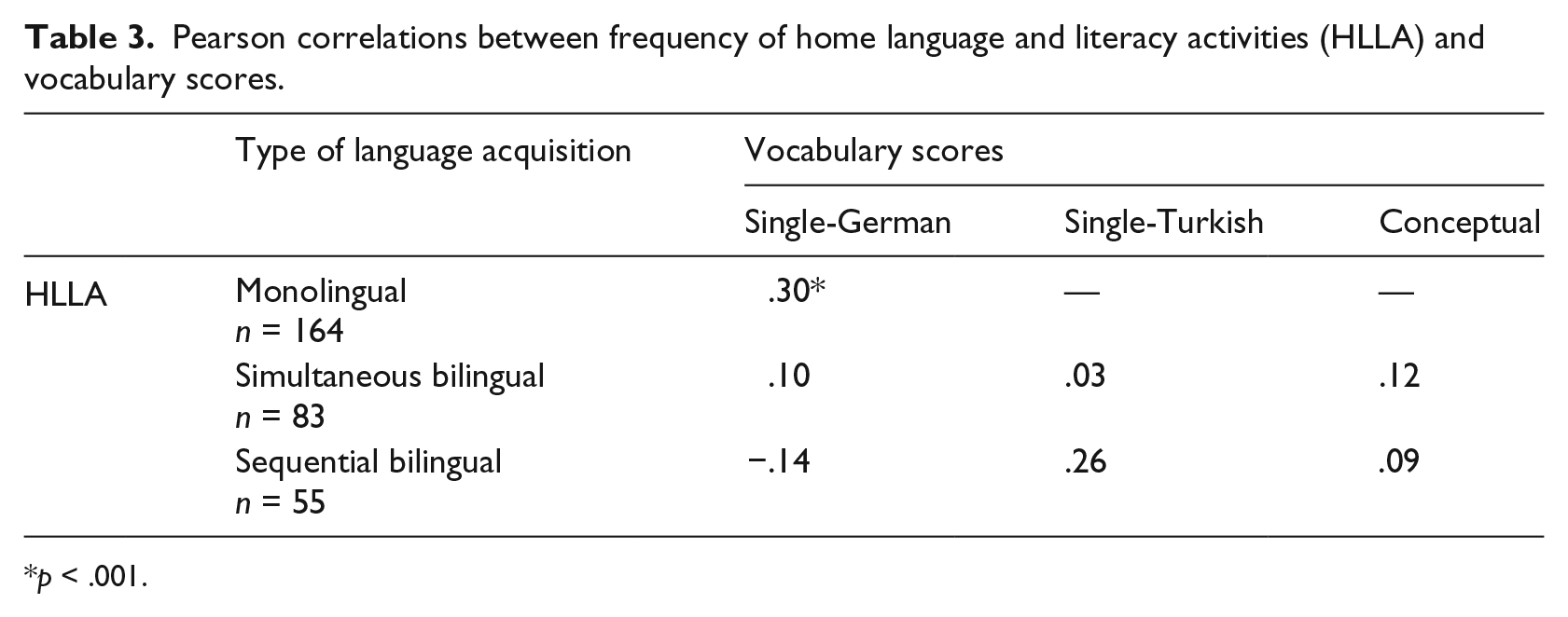
p < .001.
The correlations between HLLA and vocabulary scores in Table 3 indicated possible differential relationships between the frequency of HLLA and vocabulary scores among monolinguals and simultaneous and sequential bilinguals. To test for significant differences in the slopes of the three types of language acquisition, the interaction terms were included in multiple regression analyses. HLLA was entered as a control variable and the two dummy-coded variables for simultaneous and sequential bilinguals were added as predictors to investigate whether type of language acquisition was still a significant predictor after HLLA had been taken into consideration. Finally, the interaction terms were entered to examine whether the slopes of the relationship between HLLA and the vocabulary scores of simultaneous and sequential bilinguals differed from that of monolinguals.
The results of the single-German vocabulary scores are presented in Table 4. The model explained 27% of variance, R2 = .267, F(5, 296) = 21.53, p < .001, f2 = .36. The control-variable HLLA was a significant predictor for German vocabulary scores in monolinguals. Both bilingual groups scored significantly lower than monolinguals when HLLA was accounted for. In comparison to monolinguals, simultaneous bilinguals scored 36.71 points lower and sequential bilinguals 27.08 points lower. The interaction between the dummy-coded variable for simultaneous bilinguals and HLLA was not significant (p = .222). This indicates that the relationship between HLLA and single-German vocabulary scores in simultaneous bilinguals did not differ from that in monolinguals. The interaction between the dummy-coded variable for sequential bilinguals and HLLA, however, was significant (p = .015), indicating a differential relation between frequency of HLLA and German vocabulary scores between monolingual and sequential bilingual students. While German vocabulary scores increased among monolingual students when parents performed HLLA more frequently, the German vocabulary scores did not change in sequential bilingual students with increasing frequency of HLLA (see nonsignificant correlation in Table 3).Next, an analogous multiple regression analysis was run with conceptual vocabulary scores as the dependent variable. The results are presented in Table 5. For conceptual vocabulary scores, the model explained 6% of variance, R2 = .061, F(5, 296) = 3.87, p = .003, f2 = .06. HLLA was a significant predictor (p < .001) for German vocabulary scores in monolinguals (reference category), indicating that more frequent HLLA positively predicted their German vocabulary scores. Simultaneous and sequential bilinguals did not differ from monolinguals (p = .467 for sequential bilinguals and p = .263 for simultaneous bilinguals). Thus, the conceptual vocabulary scores of simultaneous and sequential bilinguals did not differ from monolingual scores when HLLA was accounted for. Neither of the two interaction terms of sequential and simultaneous bilinguals and HLLA were significant. This indicates that the relationship between HLLA and conceptual vocabulary scores did not differ from the relationship found in monolinguals, in either simultaneous or sequential bilinguals.
Comparison of sequential and simultaneous bilinguals with monolinguals (reference category) regarding single-German vocabulary with consideration of home language and literacy activities (HLLA) and the relationship of HLLA and single-German vocabulary.
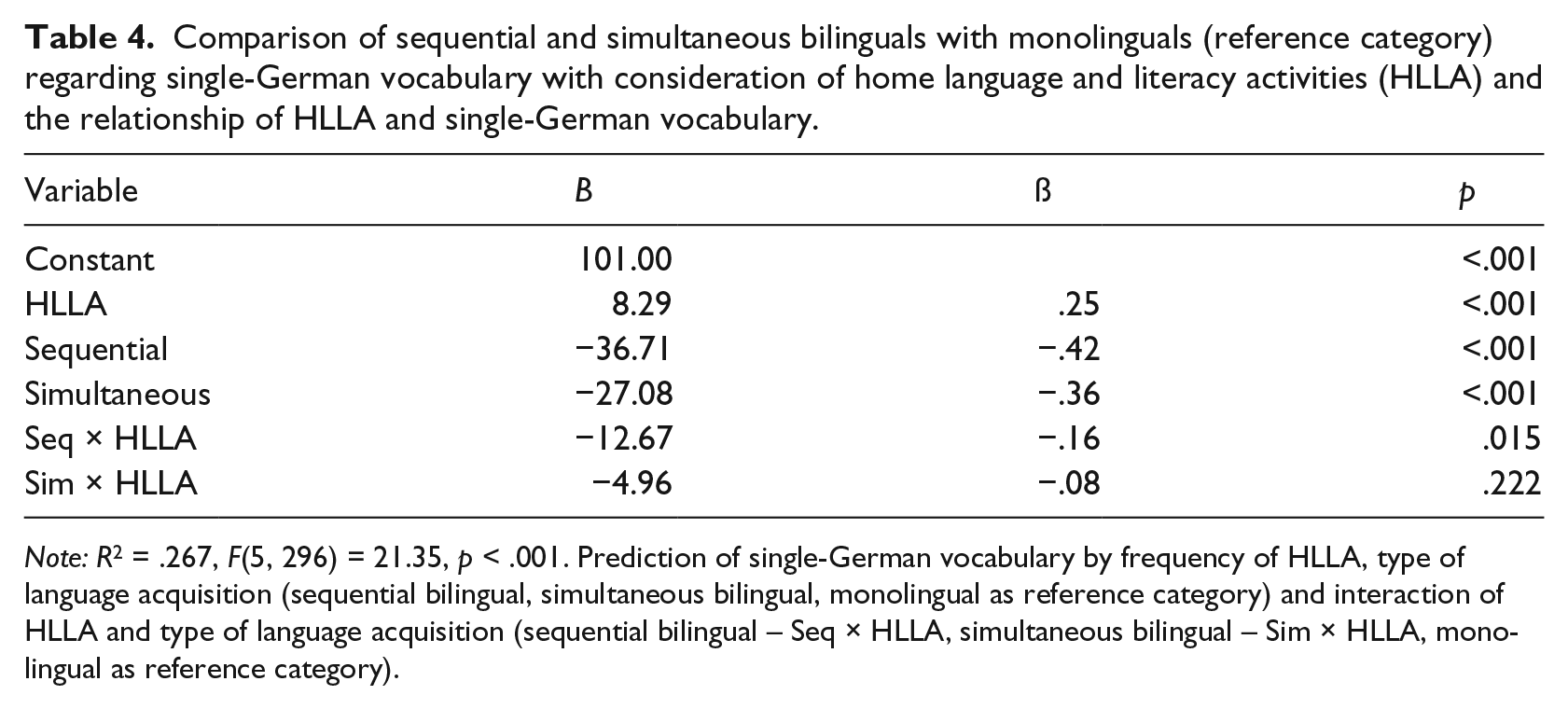
Note: R2 = .267, F(5, 296) = 21.35, p < .001. Prediction of single-German vocabulary by frequency of HLLA, type of language acquisition (sequential bilingual, simultaneous bilingual, monolingual as reference category) and interaction of HLLA and type of language acquisition (sequential bilingual – Seq × HLLA, simultaneous bilingual – Sim × HLLA, monolingual as reference category).
Comparison of sequential and simultaneous bilinguals with monolinguals (reference category) regarding conceptual vocabulary with consideration of home language and literacy activities (HLLA) and the relationship of HLLA and conceptual vocabulary.

Note: R2 = .061, F(5, 296) = 3.87, p = .003. Prediction of conceptual vocabulary by frequency of HLLA, type of language acquisition (sequential bilingual, simultaneous bilingual, monolingual as reference category) and interaction of HLLA and type of language acquisition (sequential bilingual – Seq × HLLA, simultaneous bilingual – Sim × HLLA, monolingual as reference category).
Discussion
In this study, we investigated whether bilinguals have still smaller vocabulary sizes when their conceptual vocabulary scores are compared to the one language vocabulary score of monolinguals, and when the influence of HLLA on vocabulary scores is statistically controlled. Furthermore, we compared the relationship between HLLA and vocabulary scores among the three types of language acquisition. The results indicated that conceptual vocabulary scores of bilinguals are equal to monolinguals’ vocabulary scores. Controlling the influence of HLLA did not change the results. Furthermore, the relationship between HLLA and conceptual vocabulary scores of bilinguals was similar to that found in monolinguals.
Single-language versus conceptual scoring
We compared single- and conceptual vocabulary scores of mono- and bilingual primary students. We replicated the well-documented gap in expressive single-language vocabulary of the environmental language between mono- and bilingual primary students. This finding is not surprising, because the single vocabulary is only a fraction of a bilingual child’s overall vocabulary.
However, when we compared the conceptual vocabulary scores, mono- and bilingual students no longer differed from each other. This means that with conceptual scoring, monolingual, simultaneous bilingual and sequential bilingual students had equal vocabulary scores. Our results replicate the findings of Pearson et al. (1993) on simultaneous bilingual toddlers and Montanari et al. (2018) on simultaneous bilingual primary students. To our knowledge, our study is the first to show this finding in a large sample of primary students, differentiating between participants of three types of language acquisition.
This result stresses the risk of underestimation and misjudgement of the vocabulary competencies of bilingual students when single-language measures and norms based on monolingual students are used (Bedore et al., 2005; David & Wei, 2005). In interpreting these lower test results, teachers need to remember that the overall conceptual vocabulary of bilingual students is not deficient but rather equal to monolingual students.
On the other hand, it is not our intention to deny that single-language testing of the environmental language is meaningful in educational institutions. After all, students – monolingual and bilingual – should have equal opportunities for academic success, for which understanding and speaking the instructional (i.e. environmental) language is a necessary condition. Hence, teachers still need to assess the vocabulary competencies in the environmental language. However, our results emphasize that a single-language measure does not allow conclusions to be drawn about the overall vocabulary proficiency of bilinguals (Oller & Pearson, 2010). Our results suggest abandoning a deficit-oriented view of single-language competencies in favour of a resource-oriented view of bilingualism.
Against our hypothesis, simultaneous and sequential bilingual learners did not differ in their single-language scores in the environmental language. This result is consistent with Thordardottir (2017), who found that sequential bilingual third graders caught up with simultaneous bilinguals in expressive vocabulary, because their vocabulary growth slopes are steeper than those of simultaneous bilinguals.
Home language and literacy activities and expressive vocabulary
Regarding our second research question, we tested whether these differences and similarities hold when HLLA were statistically controlled. We found that our results did not change, for either the environmental language vocabulary or the conceptual vocabulary. This indicates that the type of language acquisition has an impact on environmental vocabulary scores, but not on conceptual vocabulary scores, and this circumstance is not altered by the frequency of HLLA. Our findings may help to better understand the influencing factors on bilingual vocabulary acquisition at primary school age.
An interesting finding in our sample is the significantly differential relation of environmental vocabulary and frequency of HLLA between monolinguals and sequential bilinguals. While the correlation is significant in monolinguals, it is not significant in sequential bilinguals, indicating that environmental vocabulary does not grow in sequential bilingual students with increasing frequency of HLLA. An explanation might be that HLLA in sequential bilinguals could partly have been conducted in the heritage language. Our result that the interaction (HLLA × Seq) in conceptual vocabulary was no longer significant supports this hypothesis. If HLLA in sequential bilinguals were conducted exclusively in the heritage language (i.e. in cross-linguistic relation), but not in the environmental language, a negative correlation would appear, because the HLLA in the heritage language would come at the expense of exposure to the environmental language (Quiroz, Snow, & Zhao, 2010). This could be shown in other studies that indeed found negative relationships between frequency of HLLA and vocabulary, when these relations were cross-linguistic (Farver, Xu, Lonigan, & Eppe, 2013; Lewis et al., 2016; Quiroz et al., 2010; Willard et al., 2015). The relationship between HLLA and students’ vocabulary outcomes seems to be language-specific (Farver et al., 2013; Hoff, Burridge, Ribot, & Giguere, 2018). This means that the relationship with vocabulary in the environmental language is positive when HLLA are conducted in the environmental language and negative when HLLA are conducted in the heritage language (Farver et al., 2013). Our results are in line with this interpretation, but further studies directly comparing cross-linguistic effects of HLLA are needed.
However, we stress that this result does not imply that parents should stop their HLLA in the heritage language. The heritage language input at home is crucial in order to support and retain the heritage language skills. Nor should parents perform HLLA in the environmental language, as the environmental language can best be supported through native speakers (Hoff, Rumiche, Burridge, Ribot, & Welsh, 2014).
Another unexpected finding is the absence of a significant correlation between HLLA and conceptual vocabulary scores among simultaneous and sequential bilinguals. A possible explanation might be the age of the students. Monolingual, and especially bilingual primary students, learn vocabulary from a variety of people besides their parents (Sénéchal & LeFevre, 2014), for example, from teachers, peers and siblings. The impact of HLLA may therefore decrease noticeably from infancy to primary school age. This explanation is in line with Willard et al. (2015) who also did not find a correlation between receptive vocabulary and home literacy activities in bilingual fourth graders.
Limitations and strengths
We did not collect data on the languages that were spoken during the different HLLA and were therefore unable to analyse the direct influence of input languages on the vocabulary of the same and the crossed language.
Despite this limitation, the current study provides insight into expressive vocabulary in a broad range of 167 items per language that varied widely in difficulty level. Thus, we were able to assess a wide variance in expressive vocabulary skills in the environmental and in the heritage language of bilingual students.
Footnotes
Declaration of conflicting interests
The author(s) declared no potential conflicts of interest with respect to the research, authorship and publication of this article.
Funding
The author(s) disclosed receipt of the following financial support for the research, authorship, and/or publication of this article: This study was supported by the German Federal Ministry of Education and Research, funding code 01JI1501C. Responsibility for the contents of this publication rests with the authors.
