



Abstract
Aims and Objectives/Purposes/Research Questions:
Studies on incomplete first language (L1) acquisition emphasize restricted input, the low prestige of heritage/immigrant/minority languages, and age of acquisition as significant factors contributing to changes in L1. However, it is not always clear whether it is possible to distinguish results of incomplete acquisition and contact-induced language change. This article deals with two Yiddish–Lithuanian bilinguals who acquired both languages at home (recorded in 2010 and 2011). The focus of the article is the absence of the Yiddish past tense auxiliary in both informants and the replacement of Yiddish discourse-pragmatic words by their Lithuanian or English equivalents in the speech of the second informant.
Design/Methodology/Approach:
Qualitative analysis of the speech of two Yiddish–Lithuanian bilinguals.
Data and Analysis:
Two sets of recordings analyzed for the past tense use and other features mentioned in Yiddish attrition studies.
Findings/Conclusions:
Restricted input is to be considered as a factor in any case. However, it is argued that phenomena reported in the heritage language literature are often the same as in the contact linguistic literature: impact on non-core morphosyntax, prosody, and word order are usually mentioned as primary candidates of contact-induced structural change. Based on purely linguistic phenomena, it is not possible to distinguish between the results of acquisition under the conditions of limited input and in other contact situations where limited input is not necessarily the case. Many features of the informants’ Yiddish are a result of Lithuanian impact.
Originality:
Yiddish–Lithuanian early bilingualism is extremely rare nowadays. The data and analysis contribute to a general understanding of the interplay between contact-induced language change and limited input.
Significance/Implications:
Unlike what is often presumed, it is not always possible to make comparisons to monolinguals or balanced bilinguals because monolingual speakers of Yiddish do not exist.
Introduction
In the last two decades among scholars of first language acquisition, interest has increased toward such phenomena as incomplete first language (L1) acquisition and L1 attrition (e.g., Montrul, 2008, 2010; Pires & Rothman, 2009; Polinsky & Kagan, 2007). The understanding of bilingual language acquisition has become more refined as new empirical data have emerged, and the view that a bilingual is not a sum of two monolinguals has prevailed among researchers (Auer, 2007; Backus, 1999; Cook, 1999, p. 187 on monolingual bias; Jørgensen, 2008, pp. 119–120 on the evolution of views on multilingualism). Incomplete L1 acquisition (both as a consequence of limited input and as a sociopsychological phenomenon) and L1 attrition are different in their essence: incomplete acquisition means that a feature was never acquired, and attrition means that it had been acquired but then lost (Schmid, 2004). However, it is not easy to distinguish between the two when, for instance, a language is acquired under conditions of restricted input but then the acquired version becomes subject to attrition.
Importantly, it has become obvious that the situation of speakers who have limited input in their L1 (typically immigrants or members of autochthonous minorities groups) differs from other cases of bilingual acquisition and use. A whole new discipline, autonomous from second-language acquisition (SLA), albeit somewhat related (see Valdés, 2000), has emerged around the key concept of heritage languages speaker (HLS) and aspects of heritage language (HL) acquisition, use, and teaching (with the Heritage Language Journal as a forum). HLSs are defined as “people raised in a home where one language is spoken who subsequently switch to another dominant language” (Polinsky & Kagan, 2007, p. 368). HLSs have varying degrees of proficiency in their HL. Varieties of HLs often display impact from second language (L2) (the majority language, that is, the ambient language of the host society).
At the same time, L2 > L1 impact is also a subject of contact linguistics research. Thus, another question arises: whether and how incomplete acquisition of the L1 by HLSs can be distinguished from contact-induced language change in their L1. As the literature in contact linguistics suggests, a language may significantly change on all levels and become rather different from the pre-contact variety (for an overview, see Aikhenvald, 2007), and new generations of speakers acquire the new variety. Features attributed to contact-induced restructuring and change—for instance, borrowing, substitution, and loss—are often present in descriptions of incomplete L1 acquisition and attrition. Are we talking then about (a) completely different things, (b) partly overlapping things, or (c) identical things that just have distinct labels in distinct research paradigms?
I believe that it is hard to consider effects of limited input and contact-induced restructuring and change to be two completely unrelated phenomena. Therefore, I believe that the two latter propositions are more likely. At this stage, it is probably impossible to answer this question but, nevertheless, the problem has to be formulated. The current article, based on evidence from the speech of two users of Lithuanian Yiddish, a quickly disappearing variety, is an attempt to point out this and other theoretical and methodological considerations about possible connections between incomplete L1 acquisition in HLs and language contact phenomena.
The features chosen for analysis are (a) the systematic deletion of the past tense auxiliary (and usage of bare participle forms, that is,. er gelejent “he read” instead of er hot gelejent); and (b) substitution of Yiddish discourse-pragmatic words (DPWs) with their Lithuanian equivalents. Yiddish in Lithuania as L1 is spoken literally by a handful of people, and the input in the language is indeed rather limited. Thus, one may be tempted to ascribe these phenomena to limited input in HL acquisition: deletion/substitution of features is often associated with language attrition or limited input. Yet, as it will be demonstrated, the deletion of the past tense auxiliary in particular is not unknown in contact linguistics research. The same is true of DPWs (see discussion and references in Verschik, 2014b).
This article is organized as follows: first, theoretical considerations are presented to outline the relation between incomplete L1 acquisition and contact-induced language change. In the third section, a brief overview on the sociolinguistic situation of Lithuanian Yiddish is given, and the informants and their speech are described. In the fourth section, two cases, the deletion of the past tense auxiliary and the substitution of DPWs are discussed. Finally, preliminary conclusions and questions for future research follow.
Theoretical considerations
Working and communicating with a handful of Lithuanian Yiddish speakers has inspired me to think about correlations between limited input in HL acquisition and contact-induced language change. Because the informants in this and another study (Verschik, 2014a) have acquired and used Yiddish in the situation of drastically limited input (i.e., not even as a community language but as a family language only), it appeared necessary to turn to case studies of incomplete L1 acquisition (Montrul, 2008; Polinsky & Kagan, 2007). Literature on incomplete acquisition of Yiddish in particular is extremely scarce; I am aware of only one study, that by Levine (2000). I will further discuss whether his conclusions about Yiddish-speakers in the United States are valid for the present case. Also, investigations of Lithuanian–Yiddish language contacts are few in number and concentrate on Lithuanian lexical loans in local varieties of Yiddish (Lemchenas, 1970; Lemkhen, 1995; for an overview, see Jacobs, 2001). There are no studies of Lithuanian–Yiddish bilingualism that bear a modern contact linguistics research framework (see Verschik, 2014a, 2014b for details). From reading the literature on HLSs and incomplete L1 acquisition, five questions and theoretical considerations, listed and discussed below (1–5), have emerged.
(1) Comparing multilinguals to monolinguals
To what extent can multilingual speakers (of any kind, that is, late, early, simultaneous, and balanced multilinguals or those with a clear dominant language) be compared to monolinguals?
Within the SLA paradigm, there are voices against the treatment of monolingual native speakers as a point of reference for research of non-first language acquisition and use (e.g., Cook, 2006; Pavlenko, 2002). First, it is not clear who that hypothetical native speaker should be: a blue-collar worker, a writer, a young adult, a middle-aged person, or someone else. Second, competence is but one aspect of “native speakerhood” in multilinguals, often at conflict with other criteria such as self-identification, origin, and chronology of acquisition. Third, having only one language system is cognitively different from having more than one system, even if the second (third, etc.) system has not (yet) developed to the level of the first one. This is because a language user in whose cognition the systems under consideration are located, voluntarily or not, but inevitably, starts drawing parallels, comparing and matching the two (or more) systems (see Matras 2009, pp. 9–40 and especially pp. 38–40 on emergence of multilingual repertoire).
In contact linguistics, the question of monolingual bias has been discussed in the literature (for a comprehensive outline see Auer, 2007), and monolingual varieties are used as a point of reference—not as a norm but rather for a better assessment of contact-induced language change. Dogruöz and Backus (2009), for example, look at Netherlands Turkish and Turkey Turkish. According to them, Netherlands Turkish is not “deficient” or “incomplete” Turkish. Neither is Estonia’s Russian a merely “incomplete” or “degenerated” Russian, although some structures and collocations may sound ungrammatical from the point of view of a monolingual Russian living in Russia. Rothman (2007) and Pires and Rothman (2009) have argued that competence divergence may be conditioned because of exposure to different dialects while features present in standard varieties may be lacking in diasporic varieties (cf. inflected infinitives in European Portuguese and Brazilian Portuguese). Dialectal difference is extremely relevant for Yiddish because Standard Yiddish is a relatively young phenomenon and even during the inter-war period, the golden era of secular Yiddishism, it was nobody’s sole variety.
In other words, comparison to monolingual speakers has its methodological limitations in all three research paradigms (SLA, contact linguistics, and incomplete L1 acquisition). In some instances, however, such a comparison can prove impossible simply because of the lack of monolingual speakers of a given variety, as in the case of Yiddish.
(2) HLS and other types of bilinguals
To what extent can HLS speakers be compared to balanced bilinguals of a similar background?
Comparison to balanced bilingual speakers of the same age, cognitive development, and social background appears more appropriate than comparison to monolinguals (even of a roughly similar background) (Montrul & Bowles, 2009, p. 363). Drawing parallels with bilinguals is desirable but, unfortunately, not always achievable if the number of speakers of a variety in question is constantly decreasing or, as in the present case, the variety is used in individual families rather than in communities.
The question of language pairs is also relevant. Even if we were to find balanced English–Yiddish bilinguals in the United States and assuming that they were of the same background (despite the fact that the sociolinguistic history of Yiddish in the United States and Lithuania differs tremendously) and had a similar fluency in Yiddish, the dominant languages, English and Lithuanian, are utterly different in many respects: the spread in the world; the prestige; and also in terms of typological characteristics. English is analytic with little inflectional morphology while Lithuanian is fusional with rich inflectional morphology. As I will argue in the next theoretical consideration, the structural characteristics of the dominant language (defined as dominant in both sociolinguistic terms and proficiency) are also relevant to the discussion here.
(3) Contact-induced language change and language change as a result of limited input
How can contact-induced language change be separated from change as the result of limited input and, consequently, from incomplete acquisition?
In a different context, writing about contacts of Russian in the post-Soviet space, I argued that it is not only about divergence (that is, how and why a given variety has become different from the mainstream or monolingual variety of Russia’s Russian) but also about convergence towards another variety (Verschik, 2010). Applying to the case of incomplete acquisition, this means that it is not just limited input in language A that we should focus upon but also bilingualism in A (e.g., in our case, Yiddish) and a particular language B (e.g., Lithuanian), which means impact of B (Lithuanian). As will be shown, the same kinds of changes in L1 are described in different linguistic frameworks (HLs, L1 attrition, and contact linguistics).
(4) Category loss
What is the nature of category loss and/or simplification in the case of limited input? How can these be defined?
The metaphor of loss/deletion is present in the definition of incomplete L1 acquisition as a type of language loss (as defined in Montrul, 2008; see also Pires & Rothman, 2009, p. 4). I will return to this definition below. Heritage speakers are reported to have a reduced gender system (Polinsky, 2008, on Russian) and case system (Isurin & Ivanova-Sullivan, 2008, on Russian) as compared to respective monolingual varieties.
However, speaking of languages such as English, gender and overt case have disappeared. Case is also absent in some other Germanic languages (for instance, Dutch). Contact varieties of Polish have two genders instead of the three in Standard Polish (Jacobs, 1990). In northeastern dialects of Yiddish, the disappearance of neuter gave rise to a complicated system with true masculine and true feminine and a series of so-called intermediate genders (Jacobs, 1990). In the same dialect group, dative and accusative have practically merged into one case (Jacobs, 2001; Wolf, 1969). These developments occurred in Yiddish when intergenerational transmission and reproduction of the language was not threatened. Loss and restructuring of categories have been reported in many contact varieties (Clyne, 2003, pp. 118–120). Evidence of deletion and increasing analyticity and what is sometimes labeled as “simplification” need not be indicative of incomplete acquisition, and this is why a link to extra-linguistic factors is crucial. Among these extra-linguistic factors are the conditions of acquisition and use, as well as self-identification, which proved significant in Levine’s (2000) study, where the informants had ambiguous feelings about Yiddish.
(5) Complex nature of input in non-monolinguals
It is often tacitly implied in the literature that there is a certain L1 and L2 or, in slightly different terms, majority and minority languages, and a member of minority acquires L2 (a sociolinguistically dominant language) while L1 is undergoing changes. However, it appears to me as a rather schematic view. One has to ask what the nature of input in multilingual speakers is. This also concerns HLSs: what is the nature of input in L1/HL, in addition to being limited?
Johanson (2002a) has made an important observation that in a language contact situation the second and subsequent generations receive a more complex input than merely a monolingual variety of their parents’ language A and a monolingual variety of a majority language B. In a situation where nobody is monolingual in Yiddish and where the parents and even grandparents were not monolingual either, at least two factors are present: (a) limited input in terms of frequency, quantity, and variety of Yiddish that is itself undergoing change because of widespread multilingualism; and (b) a massive reduction in the number of speakers within the speech community. Thus, what language features can be attributed to the quantity of the input (fewer speakers, fewer registers, fewer possibilities to use the language, and so on) and, on the other hand, to the quality of input (that is, non-monolingual Yiddish)?
To summarize, the answer to question (1) is more or less clear: monolinguals cannot be used as a yardstick in multilingualism research, and one should be careful when referring to monolingual speech because bilingualism is not a sum of two separate monolingualisms. Question (2) is a logical continuation of (1). The situation of Yiddish in Lithuania is perhaps unique; it is difficult to find a similar situation of Yiddish–X bilingualism elsewhere. Nevertheless, it is desirable to compare the situation of Yiddish in Lithuania to incomplete acquisition of Yiddish elsewhere because these comparisons will certainly provide insights. However, extra-linguistic differences and differences in the linguistic structures described above will probably have an impact on the outcome (see Verschik (2014a, 2014b), for comparison between Levine (2000) and the Yiddish–Lithuanian bilingual situation).
As for questions (3), (4), and (5), I do not have a clear-cut answer. In what follows, I refer to these topics in the context of the particular case of Yiddish–Lithuanian bilingualism and limited input in Yiddish.
Thus, from a theoretical point of view, Yiddish–Lithuanian bilingualism illustrates the difficulties in distinguishing between the results of contact-induced language change in the situation of asymmetrical bilingualism in a very tiny group of speakers and between the results of limited input.
Data, informants, and their speech
Sociolinguistics of Yiddish in Lithuania
The minority-language status of Yiddish in Lithuania dates back several centuries. Starting from the fourteenth century, the first Grand Duchy of Lithuania and then so-called ethnographic Lithuania was home to a substantial Jewish population. It was a place of traditional Jewish learning and later a locus for trends such as Zionism, Bundism (Jewish workers’ political movement), and Yiddishism. To the best of my knowledge, no systematic account exists on proficiency in Lithuanian among Jews prior to Lithuanian independence in 1918. Yiddish was most often the first language, and knowledge of Lithuanian varied depending on, for example, personal needs, occupation, and relations with Lithuanian neighbors. Jews were the largest minority group in Lithuania, constituting seven percent of the population before WWII (120,000 persons). From 1918, a language with a former low standing received the status of the sole state language and, for Jews, proficiency in Standard Lithuanian (not just communicative ability in any variety of Lithuanian) became highly desirable. As described in several studies (Atamukas, 1998, p. 149; Mendelsohn, 1983, pp. 234–235), proficiency in Lithuanian dramatically increased, and there were signs of internalization (adoption of if not outright shift to) of Lithuanian (i.e., creating a Jewish voice in Lithuanian via press, artistic expression, etc; see Verschik, 2010). In the 1920s, very few Jews attended Lithuanian-medium schools but, by the middle of the 1930s, the number of students in Lithuanian-language schools had increased at the expense of Hebrew and Yiddish-medium schools (Atamukas, 1998, p. 149). In 1940, Lithuania was occupied and annexed by the Soviet Union, and in 1941 it was occupied by Nazi Germany. The majority of the Jewish population was killed during the Holocaust. Under the second Soviet occupation (1944–1991), Jewish/Yiddish education was not allowed for the tiny remaining group of Jews. For various reasons that are outside the scope of the current article, Yiddish was usually not transmitted to subsequent generations, and a shift to Lithuanian or Russian occurred during the post-war years.
After the collapse of the Soviet Union, some Jews left Lithuania for Israel or the United States, but a small group expressed no wish to leave. Currently, about 4000 Jews live in Lithuania, most of them in the two biggest urban centers, Vilnius and Kaunas. Unfortunately, official statistics do not provide figures for proficiency in Yiddish; however, a handful of Yiddish-speakers—mostly elderly—are still around. I have been familiar with some of them for more than a decade. Their varieties of Lithuanian Yiddish, although not considered here, are relevant as a point of reference. Yiddish courses provided by Vilnius University and the Summer Program in the Yiddish Language, Literature and Culture (where I have been teaching since its establishment in 1998) have attracted both Jewish and non-Jewish students not only from Lithuania but from around the world. Some have been extremely successful and acquired impressive skills in Yiddish. However, such learners and users of Yiddish are not the subject of the present study.
The informants
As is clear from the previous section, there are very few remaining speakers of Yiddish in Lithuania today, and acquisition of Yiddish as L1 or, more precisely, as one of the L1s in bilingual L1 acquisition is very infrequent. Unfortunately, nothing has been written about Lithuanian–Yiddish bilingualism and, thus, any data that can be obtained are valuable.
My informants in this study, both males, were born and raised in Lithuania and currently live in Vilnius. At the time of writing, I have known them for five or six years. The younger informant (I1) was also my informant in an earlier study (Verschik, 2014a). Usually we communicate both in Yiddish and in Lithuanian. With the older informant (I2) I have been using Lithuanian, but once I learned that he has some skills in Yiddish, I decided to record his speech.
The I1 is in his early twenties. His parents were born in Vilnius, but his grandparents come from Plungė (Plungjan in Yiddish), a town in Žemaitija in the northwest of Lithuania. Yiddish is spoken by all members of the family; both Yiddish and Lithuanian are spoken at home. I1 has an older brother, who has his own family and speaks Yiddish to his daughter. For I1, Yiddish constitutes an important component of Jewish identity. Neither he nor his relatives are religious but one may say that the tradition of secular Yiddishism, once prominent in Lithuania, lives on in the family. In addition to Yiddish and Lithuanian, I1 is conversant in Russian (according to him, learned rather from the street than under a formal instruction) and in English. He graduated from the only Jewish school in Lithuania, where Lithuanian is the language of instruction and Hebrew is taught as a subject. I1 is not fluent in Hebrew but is able to read it. He has no literacy in Yiddish. I asked him whether he has proficiency in the Žemaitijan variety of Lithuanian. I1 denied any proficiency but mentioned that his parents are fluent in it and use it when visiting the area. He is able to understand the variety and enjoys to hear it spoken.
The I2 is in his early fifties. He was born and educated in Kaunas and currently lives in Vilnius. His elderly father is a Lithuanian Jew, still living in Kaunas; the mother was born in Belarus and moved to Lithuania after WWII. Both parents used slightly different varieties of northeastern Yiddish. According to I2, they also used Russian with each other and the children. His father is fully fluent in Lithuanian and his mother learned the language. I2 has an older brother, who emigrated from Lithuania to Israel in the 1990s. Both brothers attended a Lithuanian-medium school and speak Lithuanian to each other. I have no information about whether the siblings started using Lithuanian at school age or even earlier. Kaunas is a city with an overwhelming Lithuanian majority. After WWII Lithuanian rather than Russian was the preferred language among the remaining Jews in Kaunas; therefore, I assume the language was certainly not unknown to I2 and his brother before their entry to school. I2 reports some proficiency in English, a language he learned at school and later at medical university. As we shall see, his English, albeit not very fluent and not exactly idiomatic, has had some impact on his Yiddish speech. Currently, I2 speaks Yiddish to his father and Lithuanian with his family. One of his children, a young adult, has studied Yiddish at the Summer Program, but she does not speak the language at home.
For the current study, I recorded I1 for half an hour in summer 2011, and I am also using my earlier recording of I1, made in summer 2010 (one hour). I2 was recorded for approximately one hour in 2011. As I am familiar with the informants and interact with them more or less regularly during the Summer Program, I have also had a chance to observe their interaction in daily life.
It has to be stressed that, whatever their level of proficiency in Yiddish may be, my informants identify themselves as speakers of Yiddish and as multilinguals. As I1 put it in a rather straightforward manner, in a idiše mišpoxe me darf redn af idiš “in a Jewish family one has to speak Yiddish.” This circumstance is important because it makes the informants utterly different from those in Levine’s (2000) study of mostly second-generation speakers of Yiddish residents in the United States, where speakers were reluctant to speak Yiddish because of a general stigmatization of immigrant languages and internalized negative attitudes towards Yiddish in particular.
The speech of the informants: overall characteristics
Before turning to the case studies, I will provide a brief description of the informants’ speech. The focus will be on the following aspects: (a) regional traits (in case of I1, Zameter Yiddish, a variety once spoken in Žemaitija; in case of I2, general northeastern Yiddish (NEY) features (for an overview of Yiddish varieties in Lithuania see Mark, 1951; Jacobs, 2005, p. 60); (b) “non-target” features in Yiddish (some of them with a parallel in Lithuanian); and (c) comparison with the features reported by Levine (2000) in incomplete acquisition of Yiddish in the United States.
The I1 speaks Yiddish fluently: his utterances are well-formed, and there are few hesitations. His speech exhibits Zameter Yiddish features in phonology (some diphthongs, distribution of s and š) and general NEY features in morphology, such as the lack of the neuter gender (Jacobs, 1990) and case syncretism (the merger of dative and accusative, Wolf, 1969). I will return to case and gender in discussion of Levine’s (2000) list of non-target features. Occasional switches to Lithuanian cannot, in my view, be considered as evidence of incomplete acquisition: first, code-switching is a hallmark of Jewish speech in Lithuania (elderly speakers switch as well); and second, code-switching as such may be a norm in a multilingual community.
On the other hand, I1 has Lithuanian-like intonation and Lithuanian-like progressive palatalization in consonant groups before front vowels: š’v’es’t’er “sister” instead of švester, geb’l’ibn “remained” instead of geblibn. Thus, the features in phonology and prosody have a clear Lithuanian prototype.
In morphosyntax, I1 often departs from the normal Yiddish word order, especially in negative sentences: ix nit vejs zejer “I don’t know for sure,” instead of the usual Yiddish word order (in all regional varieties) ix vejs nit zejer. Verb-second (V2) position in the main clause is not always consistent: dortn mir redn af litviš “we speak Lithuanian there” instead of dortn redn mir af litviš (in all regional varieties). On the one hand, it is possible to consider the features in question not as a result of transfer (or, in a different terminology, copying, see Johanson, 2002a) from the dominant language but as a development toward less marked word order (free word order being less marked than V2). As Thomason (2001, p. 279) suggests, universally unmarked features are easier to acquire and are predicted to occur more commonly. On the other hand, however, changes in word-order and non-core morphosyntax, together with an impact in phonology, are characteristic of one of the intermediate stages of contact-induced change in language maintenance (Thomason & Kaufman, 1991, pp. 74–75). Therefore, the question remains open whether the changes in word order are a result of Lithuanian impact because, first, in Lithuanian negative sentences the negative particle precedes the negated component: aš nežinau (literally, I not know) “I don’t know” and, second, the word order is relatively free and Lithuanian does not have a V2 rule.
The most striking feature in I1’s speech is the lack of past tense auxiliary: er gelernt “he learned,” cf. er hot gelernt; zej aroušgekumen “they came out,” cf. zej zajnen arojsgekumen. This will be dealt with in the “Past tense auxiliary deletion” subsection.
The I2’s speech is less fluent: it is marked with hesitations and self-repair. At times, he has Lithuanian intonation as well. Regional NEY features in phonetics are not consistent since standard features occur as well: consider the realization of š in the NEY pronunciation of mentsn “people” (Standard mentšn) but the Standard pronunciation of švester “sister” (instead of expected NEY svester). The realization of diphthongs varies as well: grejser “big” (Standard grojser) but Standard ojsgebojt “built” (NEY ujsgebujt). Gender and case appear to be more complicated issues; clearly, no neuter gender appears, but an overall impression is that gender assignment is less consistent than in the case of I1. With very few exceptions, in general Yiddish nouns lack overt case marking in Standard Yiddish and in regional varieties. Case is marked on definite articles and agreeing adjectives (der tate “the father,” nominative case singular, mit dem tatn “with the father” dative case singular), and for this reason I would for now refrain from postulating the erosion of case systems, despite the fact that it is often discussed in the HL literature (see Montrul, 2010, pp. 6–9 for a summary on HL morphosyntax and syntax).
Exactly as I1, I2 departs from the usual Yiddish word order: ix nit zog “I am not saying,” cf. ix zog nit; zejer grejse gelt darfst “(you) need really big money,” cf. darfst zejer grejse (Standard Yiddish: grojse) gelt.
Also I2’s speech demonstrates a complete lack of past tense auxiliary: ven geven krizis, bank gezogt “when there was the crisis, the bank said,” cf. ven s’iz geven der krizis, hot der bank gezogt; Rusland nit gehat gelt un di transportne kompanje zix farmaxt “Russia lacked the money and the traffic company closed,” cf. hot nit gehat “had not” and hot zix farmaxt “closed.”
Interestingly, there is a whole list of non-target features that are present in I2’s but not in I1’s Yiddish. The following are examples: Occasional non-target past participles in irregular verbs: gehabn instead of gehat “had,” avekgefort instead of avekgeforn “left.” Lack of copula in existential sentences in most instances: mame [iz] ba mir a dokter “my mother is a physician;” it is also possible in Lithuanian: mano motina [yra] gydytoja “my mother is a physician.” Lack of future tense auxiliary. In Yiddish, the marking of future tense is analytical, consisting of an appropriate form of the auxiliary veln and the infinitive: ix vel lejenen “I will read.” der zejde vet zogn “the grandfather will tell,” for example. Deletion of the auxiliary veln would make understanding difficult at times because it causes the infinitive to follow the subject immediately: ix [vel] do nit lebn “I will not live here;” D. [vet] redn mit tatn “D. will speak with the father.” I have not encountered this feature of missing the marking of future by the auxiliary in any other Yiddish-speakers in Lithuania. In present tense, singular forms appear for both third person singular (3SG) and third person plural (3PL): zej ken “they can, they know” instead of zej kenen, cf. 3SG er/zi/es ken “he/she/it can, knows;” ale mentsn hot “all people have” instead of ale mentsn hobn, cf. jeder mentš hot “every person has.” Note that in Lithuanian 3SG = 3PL: jis/ji/jie/jos sako “he/she/they MASC/FEM [masculine/feminine] says/say,” jis/ji/jie/jos yra “he/she/they MASC/FEM is/are.” Deletion of some prepositions or replacement by their English equivalents. In the following utterance, no preposition is present: ix red [fun/vegn/iber] a klejninke kompanje “I am speaking about a small company.” Given that I2 has, as he renders it, “school English” only, the following instance is remarkable: from has replaced the Yiddish fun throughout in the separative function: di transport gejt Replacement of Yiddish conjunctions either by their English or Lithuanian equivalents:
Now let us look at the list of features provided by Levine (2000, pp. 38, 39–40, 43, 47, 50–52, 73). The comparison between his and my informants is presented in Table 1.
Informants’ speech in Levine (2000) and the present study.
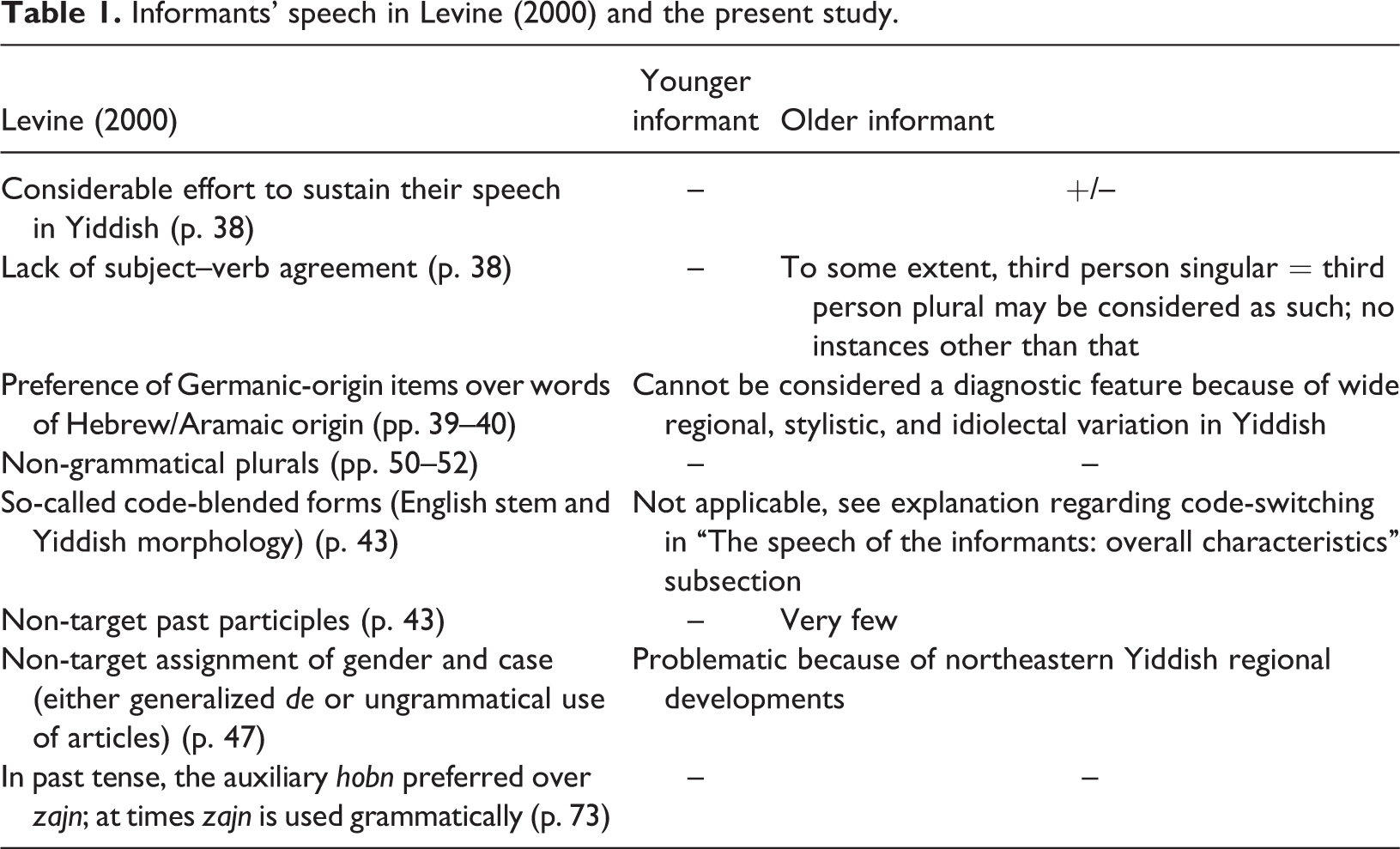
As is demonstrated in Table 1, only some features appear in the speech of my informants. Lack of subject–verb agreement appears in I2’s speech in third person only where the Lithuanian prototype exists. Notably, Levine (2000) reports a confusion of auxiliaries and the spread of hobn “have” and does not mention the lack of any auxiliary. In sum, there is little similarity between the features.
Case studies
The case studies to be considered below (past tense auxiliary deletion and borrowing of DPWs) have been chosen for the following reasons. First, the lack of the past tense auxiliary in the speech of both informants is a striking feature; it stands out immediately as one hears them speak Yiddish. At the same time, in Lithuanian, the language acquired simultaneously with Yiddish and most frequently used by both informants, the auxiliary is optional in present perfect. Thus, it remains to be seen whether this is just a simplification in the circumstances of limited input or whether other explanations can be provided. Second, borrowing of DPWs has been widely discussed in the contact linguistics literature. For several reasons (to be discussed in the “Borrowing of DPWs” subsection) DPWs appear to be a frequent candidate for borrowing/copying.
Past tense auxiliary deletion
Yiddish has two past tenses: past and past perfect. The latter belongs mostly to written registers and is seldom used in everyday speech. The focus here will be on the former. Past tense in Yiddish has the structure “auxiliary + past participle,” which is more or less isomorphic to German Perfekt, for instance, Standard Yiddish zi hot gešpilt mid dem kind “she played with the child.” It covers both the meaning of simple past and present perfect. Like in German, there are two auxiliaries, zajn “to be” and hobn “to have.” Some 20 intransitive verbs require the auxiliary zajn, and all other verbs require hobn: er iz gegangen “he went/has gone,” zi hot farkojft di dire “she (has) sold the flat.” All verbs that form past tense with zajn are irregular, whereas hobn takes both regular and irregular verbs. The rules of the auxiliary choice are very much like in German.
In the NEY area, the generalization of hobn to all contexts has been attested (Mark, 1951, p. 457; see also Jacobs, 2005, p. 70). However, NEY is a group of varieties once spoken over a vast territory (the Baltic countries, Belarus, Northern Ukraine, and some areas in Poland) rather than one variety and, according to Mark (1951) and other scholars, at least three varieties of Yiddish in ethnographic Lithuania existed: Suvalker Yiddish; Stam-Litvish Yiddish (that is, Yiddish of Lithuania proper); and Zameter Yiddish (the variety spoken by I1). Mark did not link the overgeneralization of hobn to any particular location. I am fairly familiar with most Northern varieties of NEY and have never encountered this feature; during my contacts with the elderly speakers of Yiddish in Lithuania (Zameter Yiddish and Stam-Litvish Yiddish) I have not attested this either.
In itself, overgeneralization of hobn is not extraordinary. First, think of languages such as English where only one auxiliary to have has been retained in present perfect. Thus, this could happen in varieties of NEY without any external reason. Second, the literature on the acquisition of German as L1, a language closely related to Yiddish, reports overuse of haben “to have” in young children (Mills, 1986; Wittek & Tomasello, 2002). The reasons are twofold: (a) the complexity of the rule for learners in the first years of language acquisition (e.g., it is necessary to choose the auxiliary and to form the past participle, while keeping in mind that some participles are irregular (Wittek & Tomasello, 2002, p. 568)); and (b) the higher frequency of haben in adult German speech. Opinions vary on when children completely master the complex rule; some scholars believe that it occurs relatively late (for references, see Mills, 1986). If the same patterns are true for the acquisition of Yiddish, then one can assume that the informants in Levine’s (2000) study had stopped actively using (or even hearing) Yiddish before the rule was mastered. Mills (1986) and Wittek and Tomasello (2002) do not mention the auxiliary omission; neither does Levine (2000). Levine (2000, pp. 80–83) extensively quotes the famous study by Leopold ([1939–1949] 1970) on his daughter’s German–English bilingualism because the auxiliary confusion is attested there as well. Significantly, German in the United States at that period of time was stigmatized and, according to Levine, this might be one reason why the child failed to acquire the rule in full.
Some recent studies on bilingual acquisition where one of the languages is German (for instance Salustri, 2002–2003) do report auxiliary omission in German. Salustri found that in monolingual German children the ratio of bare participles ranges between 55 and 99.5 percent; the same tendency is attested also in bilingual children’s German.
For the language learners, extensive use of bare participles may be due to the fact that bare participles are frequent in colloquial speech in formulae such as: erledigt! “(I’ve) done (it)!”, verstanden? “(have you) understood?” Although their use is restricted, they may be frequent in the input. 1
Together with auxiliary confusion, Levine (2000, p. 43) mentions non-target participles. As summarized in Table 1, I1 produced no non-target participles. Complicated cases where an irregular participle is formed from a prefixed verb were handled perfectly: oušgelernt “learnt by heart,” aroušgegangen “went/gone out,” and so forth. This holds both for the earlier recording I did for my previous study (Verschik, 2014a) and for the current article.
The I2 has occasional non-target participles such as avekgefort “departed, left” instead of avekgeforn, but in another context he produces the target version of the same participle; there is thus variation in the language of the same speaker. On the whole, I2 uses target participles from irregular verbs: gekrogn “got,” gevorn “became,” and farnumen zix “dealt with.” Evidence from I1’s interview implies that the two things, the handling of the auxiliary and the participle formation, are not necessarily connected.
In a one-hour interview with each informant, the past tense auxiliary zajn “to be” appeared only once in I1’s speech and twice in I2’s speech in the phrase s’iz geven “it’s been.” I believe the phrase was reproduced as an unanalyzed unit: the subject and the verb here are contracted (the full form is es iz “it is”) and the collocation is frequent in Yiddish.
Tables 2 and 3 summarize participle use by I1 and I2, respectively. In Table 2, data from both interviews with I1 (in 2010 and 2011) are included (all participles are target-like).
Participles in the older informant’s speech.
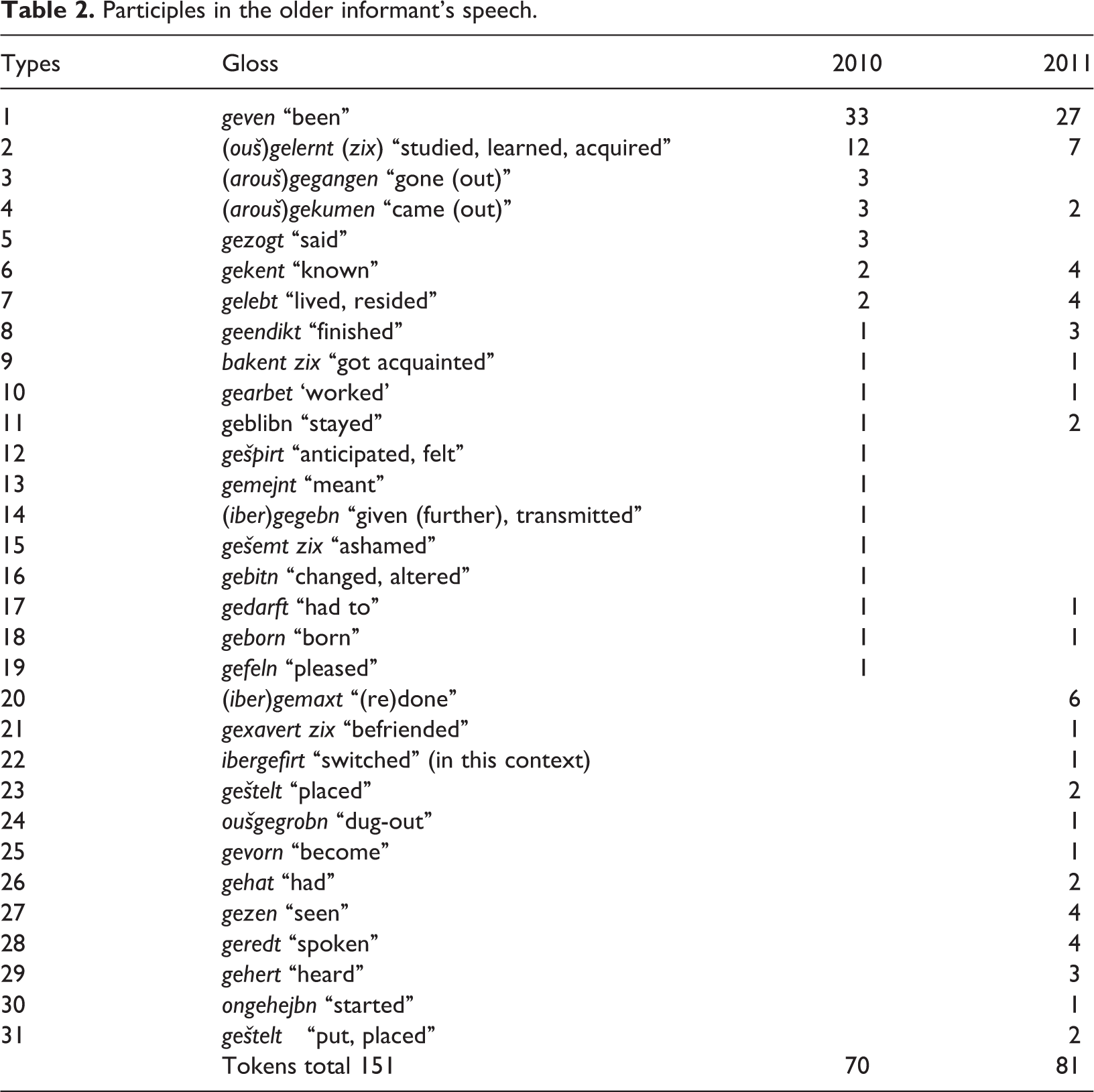
Participles in the older informant’s speech.
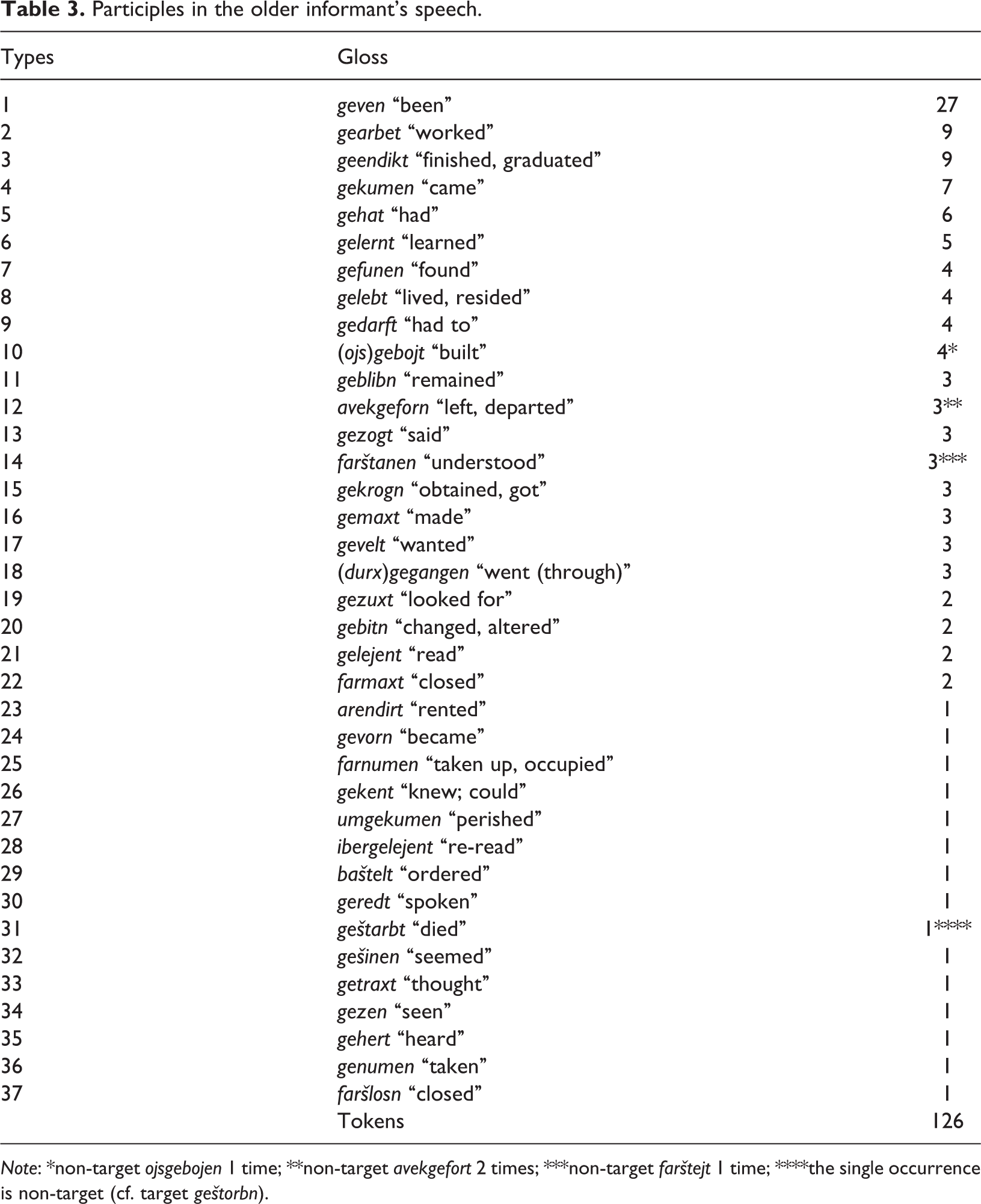
Note: *non-target ojsgebojen 1 time; **non-target avekgefort 2 times; ***non-target farštejt 1 time; ****the single occurrence is non-target (cf. target geštorbn).
As shown in the beginning of this subsection, evidence on monolingual and bilingual acquisition of German Perfekt and of incomplete acquisition of German/Yiddish differ: some find confusion of the auxiliaries, as well as ungrammatical participles (Levine, 2000; Wittek & Tomasello, 2002); some report auxiliary deletion in monolingual and bilingual acquisition of German (Salustri, 2002–2003). Thus, there is no uniform pattern, and the question remains open as to why in some cases we encounter confusion of auxiliaries (or overgeneralization of the most frequently used auxiliary) and the deletion of auxiliary in others.
Unfortunately, I have no information about the kinds of varieties the parents of the informants speak and when exactly auxiliary deletion occurred. It is reasonable to suggest that I1’s parents, a post-war generation, had a kind of limited input in the sense of the quality and the quantity (fewer registers, i.e., no literacy, and fewer opportunities to use the language). I2’s parents belong to the older generation that grew up when Yiddish was widely used and normally transmitted to their children. Based on my experience with the speakers from the same area and the same generation, I would assume that I2’s father acquired a full version of Yiddish, so to say. However, we have no knowledge about whether and how his variety of Yiddish changed and exactly what kind of input I2 received. Note that studies on limited input have been conducted mostly in immigrant communities, in which case the point of arrival to the new country can be clearly established. Yiddish in Lithuania is an indigenous minority language and, therefore, it is impossible to establish a particular point in time when the impact of another language began, at least without a detailed biographical record.
Importantly, in Lithuanian, the dominant language of the society and the language acquired simultaneously with Yiddish, present perfect auxiliary is optional: jis (yra) išejęs “he has left/gone.” As there are other features in the informants’ Yiddish that can also be attributed to the impact of Lithuanian (recall Table 1), I believe that one should not ignore a possible influence of the Lithuanian model. Clyne (2003, pp. 118–120) provides several examples from Germanic languages in contact with English in Australia and shows that the auxiliary is vulnerable in a contact situation.
Borrowing of DPWs
The DPWs, also known as discourse markers, form a broadly defined class of words that includes conjunctions, particles, question words, and adverbs (on this and various terms referring to this word class see Wertheim, 2003, pp. 153–154). As Wertheim (pp. 153–154) has it, it is notoriously difficult to find a suitable cross-linguistic definition of what comprises the class, and the terms to label the class vary to a great extent (see Wertheim, 2003, p. 155 for an approximate list that different scholars have suggested).
Various explanations have been proposed for the high borrowability of DPWs. Interestingly, I have not found any studies on DPWs within the framework of incomplete L1 acquisition and HLSs. It has been suggested that structural properties, for instance autonomy (see Matras (1998) on borrowability hierarchies), and semantic qualities of DPWs (in the sense that they only modify a proposition but do not change its meaning) are responsible for their borrowability (Maschler, 1994). For instance, some scholars discuss DPWs in the context of contact-induced language change. Indeed, introduction of Russian DPWs in Turkic languages, especially conjunctions, has led to substantial changes in the morphosyntax of the Turkic subordinate clause because Turkic languages have few conjunctions (see Muhamedowa (2009) for Kazakh). Others have noticed competence or identity-signaling and contrasting functions, often in the context of the loss of domains and registers and subsequent language shift (Clyne, 2003, pp. 225–233; see also Wertheim, 2003, p. 144 on what she calls “contracting languages”).
Matras (2009, p. 143) argues that reinforcing contrast and proficiency or signaling identity by the means of borrowed DPWs are not sufficient explanations of borrowing; neither are the structural properties (that is, the syntactic autonomy) of DPWs. He observes that contrast fades eventually once borrowed DPWs replace the native ones. I concur with Matras, especially in light of Auer’s (1999) model of fused lects, where in the ultimate stage code-switching becomes conventionalized and the contrast disappears. Instead, Matras (1998, p. 282) suggests that their borrowability is conditioned by their specific functions. DPWs come from a pragmatically dominant language, that is, the language that is dominant in “regulating mental processing activities” (Matras, 1998, p. 286). According to Matras (1998, pp. 286, 291), a bilingual speaker may experience a considerable cognitive load of managing two varieties. When such a speaker interacts with other bilinguals, the strain of keeping the two varieties apart may be relaxed. The very nature of utterance modifiers is such that they help to direct the hearer’s attention (Matras, 1998, speaks of “grammar of direction”).
To sum up, explanations for a high borrowability of DPWs come from different points of view: structural; pragmatic; sociolinguistic; and functional–cognitive.
The following list (by no means exhaustive) demonstrates that borrowing/copying of DPWs has been attested in many contact situations involving different languages: starting from Weinreich (1953, p. 30), who commented on a higher borrowability of certain word classes (the English conjunction but in United States’ Yiddish); Salmons (1990) on English DPWs in Texas German; Savić (1995) on English markers in immigrant Serbian; Maschler (1994) on Hebrew markers in the English of American immigrants to Israel; Leinonen (2009, pp. 320–321) on Russian DPWs in Komi; Keevallik (2006) on Swedish markers in immigrant Estonian; and Hlavac (2006) on English DPWs in Croatian spoken in Australia, and many others. Borrowing of Russian DPWs has occurred in many Turkic languages: Uzbek; Tatar; Karaim; and Kazakh (see Wertheim (2003) for an overview, and especially on Tatar). Borrowing of DPWs in itself does not signal a disappearance or shrinking of a variety: for instance, Latvian un “and” and jā “yes” are conventionalized borrowings from German. Some Slavic particles such as take “indeed, exactly,” and xotš/xotse “although” have become integral components of Yiddish; the most northern varieties of NEY have borrowed German ja “yes” that replaced NEY je. In certain case studies, borrowed DPWs have been claimed to exist alongside with the native ones (Hlavac, 2006), yet others have attested a wholesale importation of DPWs and convergence (Salmons, 1990). Apparently, whether native DPWs are replaced completely or partially, or whether DPWs can occur with their borrowed equivalents, cannot be predicted in straightforward terms; wholesale replacement, partial replacement, and co-occurrence per se are probably not indicators of maintenance versus shift.
Let us turn to the present case of Lithuanian Yiddish. In Verschik (2014b), I have looked at conjunctions in Yiddish–Lithuanian bilingual speech. Here, I will present a brief overview of that study. It has to be noted that many conjunctions in Yiddish are already borrowings of either Hebrew–Aramaic or Slavic origin. In the present case, some conjunctions are retained, some are replaced by their Lithuanian or English equivalents (see discussion below), and some vary. I am going to focus on the following points: what DPWs appear in the informant’s speech; whether they have replaced the corresponding Yiddish DPWs; what languages are involved; and what this can possibly mean as far as input and contact-induced change are concerned. Analysis of DPWs from a code-switching perspective remains outside the scope of this study.
Notably, no DPWs from another language appear in I1’s speech; yet, there is one item that requires an explanation. The above-mentioned literature focuses on borrowing in the sense of form-meaning importation (Matras (2009), and Matras and Sakel (2007), refer to this as “MAT-replication” (matter replication); Johanson (2002a), uses the term “global copying”). Still, Keevallik (2006) discusses different processes, such as extension of possible usage of Estonian DPWs in other contexts, modeled on similarly sounding DPWs in dominant Swedish. Similar examples are attested in Verschik (2008, p. 166) where, based on Estonian a(ga) “but,” Russian contrasting conjunction a “but” is used in contexts where another Russian conjunction но “but” would be used (i.e., when the contrast is unexpected). In the similar vein, instead of the Yiddish correlative conjunction saj…, saj… or i…, i… “both…and…” (the latter option is of Slavic origin), the usual un “and” is reduplicated, modeled on Lithuanian ir…ir… “both…and…” in (1a): (1a) in der hejm mir redn un idiš, un litviš
in the home we speak and Yiddish, and Lithuanian “at home we speak both Yiddish and Lithuanian” Compare (1a) to monolingual Lithuanian in (1b) and monolingual Yiddish in (1c): (1b) Lithuanian namuose mes kalbame ir jidiš, ir lietuviškai
at home we speak and Yiddish, and Lithuanian (1c) Yiddish in der hejm redn mir saj/i jidiš, saj/i litviš
in the home speak we and Yiddish, and Lithuanian
A completely different picture appears in I2’s speech. Partly, Yiddish DPWs have been retained; some are at times replaced with their English equivalents, and others have been completely substituted with equivalents from Lithuanian and English.
The general picture is as follows. During the interview, 86 tokens of non-Yiddish DPWs were produced. These 86 DPWs comprise conjunctions and some particles (yes, not). Certain DPWs cannot be clearly classified as Lithuanian, Yiddish, or English because of their similar shape in the languages or because of an unclear realization by the informant: his English has a Lithuanian accent. For instance, the particle for “but” is sometimes closer to Lithuanian bet “but” and sometimes to English but. An overview of all DPWs is presented in Table 4.
Non-Yiddish discourse-pragmatic words (DPWs) in the older informant’s speech.
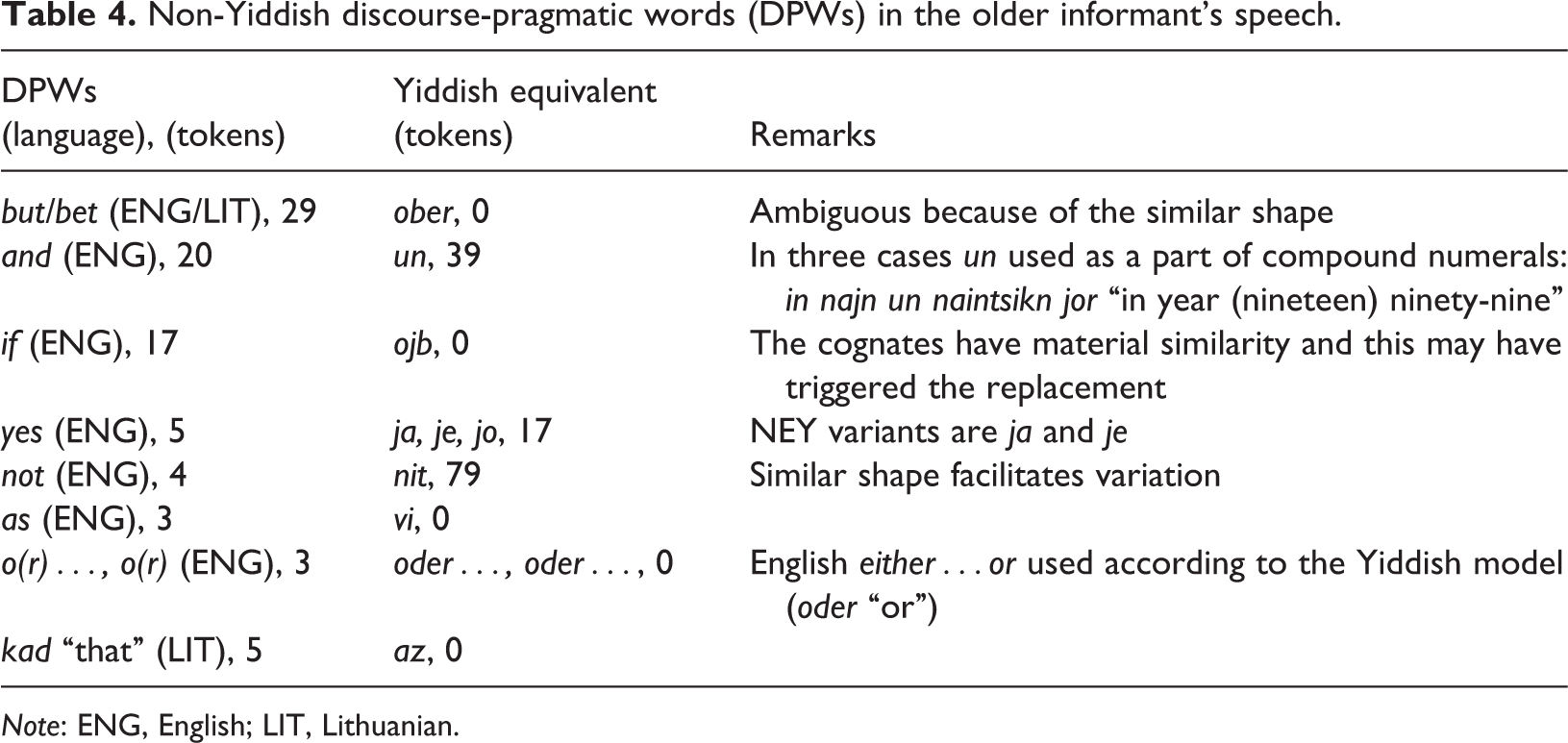
Note: ENG, English; LIT, Lithuanian.
Table 4 shows that some conjunctions do not occur in Yiddish at all (ober “but,” ojb “if,” oder…oder “either…or,” and az “that”) and have been replaced; others co-occur in several languages. Material similarity facilitates use of non-Yiddish DPWs, for instance, not and Yiddish nit, and, and Yiddish un (Clyne 2003, pp. 163–165 on the concept of facilitation). Fluctuation between Lithuanian bet “but” and English but is of the same nature. This is not surprising, given that all three are Indo-European languages and Yiddish and English are both Germanic languages and share a lot of lexicon. Lithuanian and Yiddish, on the other hand, share a lot in morphosyntax and have both changed under the Slavic impact. Unlike in the case of Russian conjunctions in Turkic languages, insertion of Lithuanian/English conjunctions does not affect morphosyntax. Observe (2a) and (2b) for English conjunctions and (3a) and (3b) for Lithuanian ones: (2a)
and mother search: participle (PART) but not can: PART he: accusative case (ACC)
gefinen
find “and mother searched but was unable to find him” (2b) monolingual Yiddish
Un di mame hot gezuxt, ober hot nit gekent im
and definite article mother auxiliary verb (AUX) search: PART but AUX not can: PART he: ACC gefinen
find (3a)
Šraj-t do, shout-3SG here that bad, hard “s/he keeps shouting here that it is bad, it is difficult” (3b) monolingual Yiddish
Šraj-t do, az es iz šlext, šver
shout-3SG here that it iz bad, hard
As we have seen, from the point of view of contact linguistics, borrowing of DPWs is rather common. What is striking in this particular case is the use of English, the language in which the informant is not exactly fluent. At this stage, I have no knowledge about whether any replacement of Yiddish DPWs (by those of Lithuanian or Russian origin) had taken place in the speech of I2’s parents. Whatever kind of input in Yiddish I2 had in his childhood, I find it rather unlikely that English DPWs appeared in his parents’ speech: proficiency in English was not common in Lithuania when I2 was a child. In the interview, he mentioned that he had learned English at school. Thus, English DPWs is something that occurred in his Yiddish later on. It may very well be that the full set of Yiddish DPWs was acquired and then underwent changes. Whether one calls this L1 attrition or contact-induced language change is probably a matter of worldview and choice of research paradigm.
Discussion and conclusions
Nowadays Yiddish is a language spoken by scattered individuals. It is not even a community language. Therefore, I do not doubt that input in Yiddish has been seriously limited for my informants. By that I mean both the quantity of input (opportunities to hear and to use the language) and the quality (registers available and lack of literacy, which restrict access to written text or lack of print media to service these macro-skills).
However, the present case demonstrates possible complexities. First, we are dealing with an autochthonous minority language, which is sociolinguistically a different case from immigrant languages (no zero point, so to say, that marks the onset of the foreign impact; no monolingual speakers). The lack of a clear zero point makes it difficult to decide whether the input the informants received in their early years was more like a variety of NEY in its classical form or already affected by bilingualism.
Second, many features in the informants’ speech are more or less clearly attributable to Lithuanian impact and some have a multiple explanation (vulnerability of auxiliaries in contact situation and Lithuanian present perfect as a model).
Montrul writes about HLSs whose input in L1 was limited: “their grammatical systems show a marked tendency toward simplification and overregularization of complex morphological patterns and restricted word order” (Montrul, 2010, p. 9). Among the domains affected by the majority languages she mentions lexicon, case system, and gender, and notes that possibly many of these effects could be triggered by transfer. But the very same phenomena are studied by contact linguists, and they occur in languages that are maintained and normally transferred (Lithuanian itself has been heavily influenced by Polish and other varieties of Slavic). Also, deletion of categories as such should not be ascribed to limited input (or attrition, in other situations): recall gender in English and case syncretism in NEY. I have elsewhere proposed that deletion of the past tense auxiliary in Lithuanian Yiddish can also be ascribed to impact of Lithuanian, a language acquired simultaneously with Yiddish (Verschik, 2014a).
Probably, changes in a language subsystem per se do not mean L1 attrition. Nor can these changes be automatically attributed to limited input. Imagine we have no knowledge of the sociolinguistic situation of Yiddish in Lithuania and only extracts from the informants’ interviews are at our disposal. Based on this, we can postulate restructuring of the native system, a more or less profound contact-induced change but not more than that. It is only when we learn that Yiddish in general (maybe apart from some ultra-orthodox communities), and in Lithuania in particular, is a highly endangered language that has lost the bulk of its speakers and that is for various reasons not normally transmitted to the next generation that we can speak of limited input. The case of I1’s family (especially of his elder brother who speaks Yiddish to his child), however, shows again that intergenerational transmission of a variety on the one hand and linguistic features of that variety, albeit “reduced” in comparison with the pre-contact version of that variety, on the other hand are not the same thing.
In the case of Yiddish, an endangered language, one may wonder how much morphology or how many structures have survived. Somehow implicitly category deletion or considerable structural changes are associated with language decline or even death; yet I believe that no matter how massive the changes are, these are not diagnostic criteria for language death. It is gradual loss of domains, language shift, and rupture in the intergenerational transmission that may lead to language death; thus, the reasons are of sociolinguistic and sociopsychological nature. As Johanson (2002b) has aptly put it, languages do not die of structuritis, that is, even massive changes in morphosyntax. In other words, whatever contact-induced change may occur, this is not the reason why languages die; languages disappear because speakers abandon them due to several extralinguistic factors such as, for instance, the lack of a wish to transmit the language or pursuing a new ethnolinguistic identity.
The speech of the two informants exhibits similarities (e.g., auxiliary deletion and changes in word order) but also differences. I1’s pronunciation has been affected by Lithuanian to a greater extent; on the other hand, he is more fluent and certain regional features appear consequently. In the case of I2, English DPWs hint at a later replacement because, even if nothing is known about DPWs in his parents’ Yiddish, English would be an unlikely source of borrowing for that generation. Three scenarios are possible: (a) the complete set of Yiddish DPWs was acquired and later partly replaced with English and Lithuanian equivalents; (b) the input had the complete set of Yiddish DPWs but these were not acquired in full and English and Lithuanian equivalents filled the gap later; and (c) Yiddish DPWs had been affected already in the parents’ speech but then Lithuanian and Russian are more probable candidates for the dominant languages—the once affected system underwent changes once more and English came into the picture. Whichever scenario out of these three happened, the question of the relationships between contact-induced change, results of limited quality and quantity of input, and possible attrition remains open at this stage.
Footnotes
Declaration of Conflicting Interests
The author declared no potential conflicts of interest with respect to the research, authorship, and/or publication of this article.
Funding
The author received no financial support for the research, authorship, and/or publication of this article.
