



Abstract
Aims and objectives/purpose/research questions:
Language brokering (LB) is an informal translation experience where bilinguals serve as linguistic and cultural intermediaries for family members. LB may have long-term socio-emotional and cognitive outcomes, yet little is known about its effects on executive functions (EFs). This study examines how first language (L1) proficiency and negative emotions tied to language brokering experiences affect EF performance on a Simon task (ST).
Design/methodology/approach:
Fifty-three Mexican American Spanish–English bilinguals with LB experience performed a ST, and reported their feelings towards LB for their mother.
Data and analysis:
Mean reaction times (RTs) and accuracy rates for correct ST trials were analyzed using linear mixed effects modeling, with trial type, proficiency and negative emotions tied to LB experience as factors and their interactions as additional predictors.
Findings/conclusions:
The L1 proficiency and negative emotions tied to brokering experiences have divergent, but combined effects on EF. Contrary to our hypotheses, low L1 proficiency predicted better performance and the smallest Simon effect was found for brokers with low L1 proficiency and low negative emotional brokering experiences. However, high L1 proficiency predicted better performance (smallest RTs) regardless of negative emotions tied to brokering experiences.
Originality:
This study takes a different perspective on the examination of individual differences among bilinguals, in which we examine how negative emotions tied to brokering experiences coupled with L1 proficiency relates to EF performance.
Significance/implications:
Our results provide support for the need to understand how individual differences in bilingual language experiences, such as L1 proficiency and negative emotions tied to LB, interact with performance on the ST.
Keywords
Introduction
Imagine a bilingual child translating for their non-English speaking Spanish monolingual parent as they apply for a car loan at a bank. The child is translating important information about the financial terms of a new loan between the parent and bank employee. While the linguistic information being translated is only one component, the bilingual child is also negotiating potential loan terms, such as interest rates, monthly payments, and life of the loan. Additionally, the bilingual child broker is mediating potential emotion and stress involved in the car loan process. Obtaining a loan can be stressful even for an adult proficient in the dominant language, and one can only imagine the stress this situation may put on a bilingual child when assisting a non-English speaking parent in this process. This is an example of a phenomenon known as language brokering (LB), an informal translation practice in many immigrant communities, particularly in the United States (US), whereby bilingual children (i.e. language brokers) translate and interpret for their English-limited parents across various domains, including doctor appointments, schools, and government offices (Morales & Hanson, 2005).
Language brokering is a bilingual experience that integrates cognitive, linguistic, and emotional processing (Buriel et al., 1998; López, 2020; Morales & Hanson, 2005; Valdés, 2003). Currently in the bilingualism literature, there are debates concerning the effects of bilingual experiences on executive functions (EFs). Briefly, EFs are a set of cognitive mechanisms (including inhibiting, shifting attention, updating, and maintaining information in the mind) that support humans’ ability to manage and plan behavior (Costa et al., 2009; Lehtonen et al., 2018; Mittal et al., 2015). Given that bilingualism may affect EFs (Lehtonen et al., 2018), and that language brokers are bilinguals, research examining the relationship of brokering experiences, bilingual ability, and emotion on EFs is needed. This paper expands the current knowledge about bilingualism and brokering literature by examining the combined relationship of negative emotions tied to brokering experiences and bilingual abilities, specifically first language (L1) proficiency, on EFs.
Language Brokering and emotion
Language brokering is an experience that requires bilinguals to negotiate and intervene for their parents, most often their mothers (see Orellana et al., 2003), in potentially emotionally difficult situations (e.g. doctor’s office and filling out immigration documents; Anguiano, 2018; Morales & Hanson, 2005). LB requires that bilinguals translate cultural (e.g. American customs/traditions) and linguistic information (e.g. Spanish to English, and vice versa) to help their parents navigate a new country and its socio-cultural structural systems (Kam & Lazarevic, 2014; Valdés, 2003). A language broker’s goal is to translate and repeat conveyed information from one language to another with the intent of supporting their parent/caregiver, but this experience has resulted in contrary outcomes.
Positive outcomes of LB are associated with increased maturity, high self-efficacy, feeling good about brokering experiences, and with a sense of helping the family (Antonini, 2016; Corona et al., 2012; Dorner et al., 2007, 2008; Villanueva & Buriel, 2010). Nevertheless, brokering places stressors on a child to correctly translate important information for their family, which may have long-term psychological outcomes. Negative brokering feelings are associated with higher family-induced stress and acculturative stress, which are attributed to increased depression and substance use (Kam, 2011; Kam & Lazarevic, 2014; Kim et al., 2017). Others find that brokering may be burdensome and creates strained parent–child relationships due to increased adult-like responsibilities (e.g. helping pay bills, household decision-making, and filling out employment forms; Arellano et al., 2018; Kam et al., 2017; Titzmann, 2012;Wu & Kim, 2009). Yet, brokering experiences are affected by parent feedback, age at the time of brokering, and context of brokering experiences (Antonini, 2016; López et al., 2019; Orellana & Phoenix, 2017; Shen et al., 2017), which evoke different emotional responses. However, how might feelings toward brokering experiences (i.e. positive or negative) be modulated by language proficiency?
Theory of language embodiment
Languages learned earlier in life (i.e. L1) are more frequently used to express emotions (Dewaele, 2010). For proficient bilinguals, their L1 may be the language more tied to emotions due to a greater number of social and linguistic experiences in the L1 (Theory of Language Embodiment; Pavlenko, 2005, 2012). Emotional processing relies on the integration of both linguistic (e.g. phonological) and non-linguistic information (e.g. sensory information). Yet, language emotionality (i.e. affect, emotion, and feelings experienced in a language; Pavlenko, 2012) is also modulated by language proficiency. In electrodermal activity or skin conductance studies, bilinguals exhibit decreased physical responses (i.e. less arousal) when tested in their less proficient language, (e.g. L1 or second language (L2); Ayçiçeği & Harris, 2004; Harris et al., 2006). Less proficient L2 bilinguals report greater emotional distance from their L2 than L1 (Dewaele, 2004; Harris et al., 2006). This suggests that proficiency can affect a bilingual’s emotional connection towards a language, which may affect their behavior in a language.
Language brokers experience may evoke high levels of emotion, especially within the L1, as this is the language that brokers often translated into for their family members, particularly their mothers (e.g. L2 to L1; Dewaele, 2004, 2010; Pavlenko, 2012; Rolland et al., 2017). In turn, this may be related to their L1 proficiency. Presumably, brokers interact with their parents (or individuals whom they broker for) in their L1. Therefore, when L1 proficiency is low, more negative emotional experiences may arise between the broker and their parent. Limited vocabulary, comprehension problems, and production errors are reported as reasons contributing to negative brokering experiences (Katz, 2014; López et al., 2019; Weisskirch, 2017a). However, high L1 proficiency may be a safeguard against negative experiences as brokering experiences help maintain L1 proficiency (Buriel et al., 1998; Halgunseth, 2003; Hall & Sham, 2007; Valdés, 2003).
Cognitive effects of Language Brokering
Language brokering experiences support language proficiency, vocabulary knowledge, and metalinguistic abilities (Buriel et al., 1998; Hall & Sham, 2007; Valdés, 2003). López and Vaid (2018a, 2018b), López et al. (2017), and Vaid et al. (2015) find that bilingual brokers show benefits in conceptual representation, semantic access, and divergent thinking in comparison to bilingual non-brokers. LB experience is also associated with greater educational outcomes (e.g. higher standardized test scores and higher grades (Acoach & Webb, 2004; Buriel et al., 1998; Dorner et al., 2007, 2008), which are related to EFs (e.g. Santillán & Khurana, 2018), but the relationship of brokering to EFs has not been examined.
The EFs share a collaborative relationship where thoughts and behaviors regulate emotion and emotion affects action (Carlson & Wang, 2007; see Schmeichel & Tang, 2015, for a discussion; Wolfe & Bell, 2004). LB is an interactional experience that requires bilinguals to maintain multiple sources of information across languages, cultures, and emotion. Given that the L1 is rendered as the more ‘emotional language’ (e.g. Pavlenko, 2005), and brokering experiences yield emotional outcomes (Kam & Lazarevic, 2014; Kam et al., 2017), we examine their interactions on EF using a Simon task (ST), which measures inhibitory control via stimulus-response (Lu & Proctor, 1995).
The Bilingual Adaptation framework (Bialystok, 2017) suggests that bilingual experiences have long-term effects on neurocognitive development, particularly in EF (see also Arredondo et al., 2017, 2019). Specific to the ST, bilinguals often outperform monolinguals (Bialystok, 2006; Bialystok et al., 2005). However, contexts and variability of bilingual experiences (e.g. interactional contexts, dual-language proficiency, etc.) may also affect EF performance (Bak, 2016; Baum & Titone, 2014; Hartanto & Yang, 2018; Valian, 2015; Yang et al., 2016). Relatedly, Babcock and Vallesi (2015) found that for trained and untrained interpreters distinct inhibitory control mechanisms may be implied across different languages (e.g. L1, L2, or third language). High dual-language proficiency also enhances EF abilities (Yow & Li, 2015). These differing effects of bilingual language use and proficiency highlight the need to consider a more in-depth analysis of bilingual experiences on EF. We propose that LB is a particular language experience that provides a different adaptation in the bilingual mind based on L1 proficiency and emotional brokering experiences.
Experiences evoking a high level of [negative] emotions can also affect EF ability (Mittal et al., 2015; Wolfe & Bell, 2004). For instance, adults who recall experiencing harsh or stressful environments during childhood perform worse on EF tasks (Mani et al., 2012; Mittal et al., 2015). Animal models have shown that adversity in early life, especially chronically stressful environments, disrupt the neuro-cognitive development of EF (Liston et al., 2006; Lovic & Fleming, 2004). However, bilingualism studies on emotion and EF have only observed the effects of emotional stimuli (e.g. angry faces and emotion words; Janus & Bialystok, 2018; Kazanas & Altarriba, 2016; Sutton et al., 2007) and not emotional experiences themselves. Given that LB experience relies on both bilingual ability and emotional regulation, we examine these factors in relation to EF performance.
The present study
Bilingual experiences, negative emotional experiences, and negative emotional stimuli affect EF ability (Kazanas & Altarriba, 2016; Mani et al., 2012; Mittal et al., 2015; Sutton et al., 2007; Yang et al., 2016). Here, we examine how proficiency and negative emotional brokering experiences relate to EF performance. We posit that proficiency on its own may not account for EF performance; rather, individual differences in emotional experiences occur when LB and proficiency will both account for variability in EF performance. However, given the literature on emotion and proficiency (see Dewaele, 2004; Pavlenko, 2005, 2012), we predict that L1 proficiency will be a stronger predictor of EF performance than the L2 proficiency. Our study design (Figure 1) illustrates how the level of negative emotional brokering experiences (low–high) and L1 proficiency (low–high) interact and relate to EF ability. We hypothesize that high L1 proficiency (quadrants I and II; Luk et al., 2011; Yow & Li, 2015) will predict better performance than low L1 proficiency (quadrants III and IV). Further, high L1 proficiency will supersede any effect of negative emotions related to brokering experiences. For low L1 proficiency, we hypothesize that the effects of the negative emotions tied to brokering experiences may be more profound; predicting worse performance for brokers with low L1 proficiency on EF. For brokers with low L1 proficiency and high negative emotions related to brokering experiences, we predict worse performance in comparison to the others.

Research design: Language proficiency and negative emotions tied to brokering experiences.
Method
Participants
Fifty-three Mexican-American bilinguals (mean age = 20.98 years; standard deviation (SD) age = 3.07; age range = 18–35; 17 males, 36 females) were recruited from a large southwestern US university. Participants were either language brokers for their mothers during childhood or were still serving as brokers at the time of study participation. Most participants (62.3%, n = 33) were US-born. See Table 1 for more information on the sample’s demographics.
Mean (and standard deviation (SD)) scores of the studied variables.
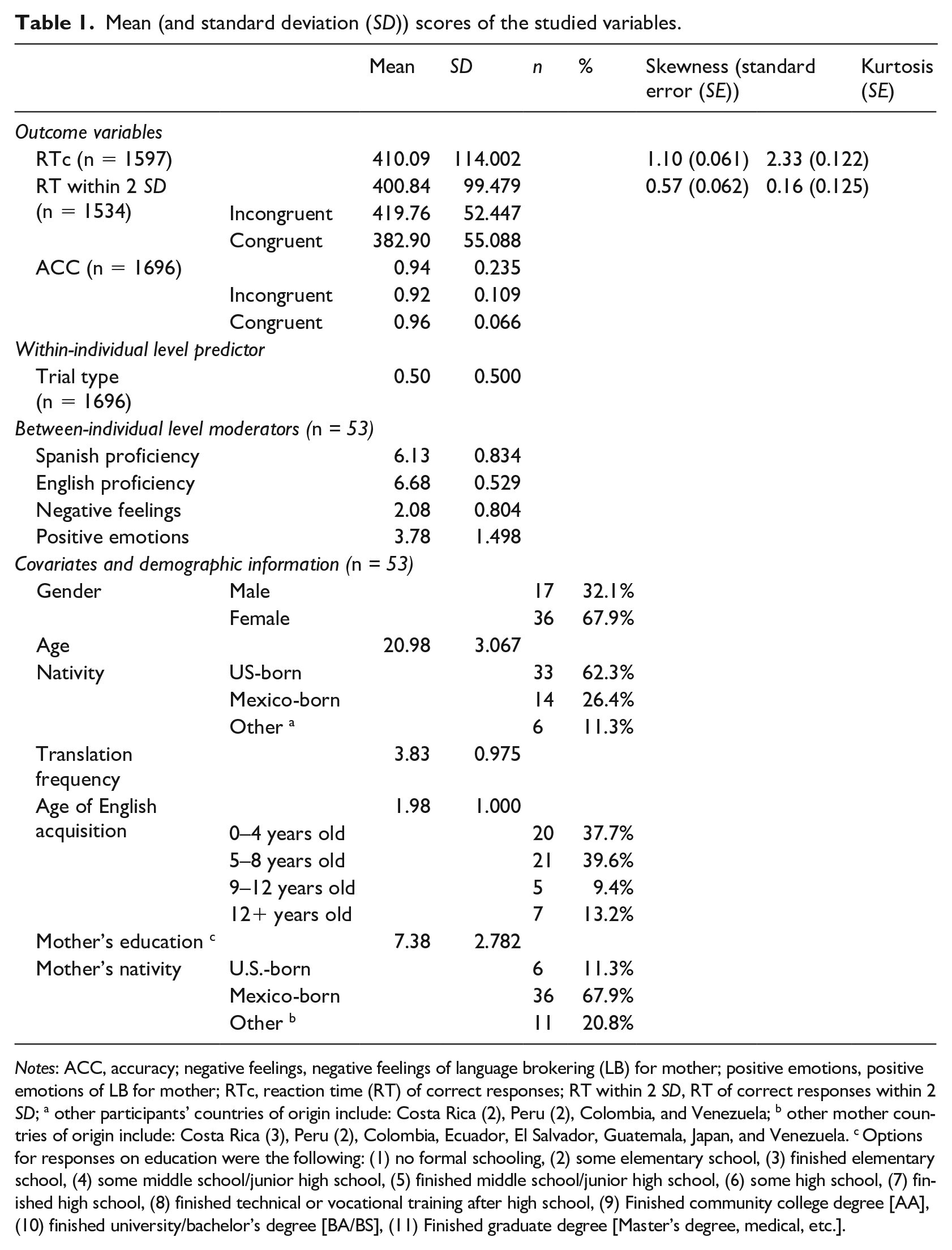
Notes: ACC, accuracy; negative feelings, negative feelings of language brokering (LB) for mother; positive emotions, positive emotions of LB for mother; RTc, reaction time (RT) of correct responses; RT within 2 SD, RT of correct responses within 2 SD; a other participants’ countries of origin include: Costa Rica (2), Peru (2), Colombia, and Venezuela; b other mother countries of origin include: Costa Rica (3), Peru (2), Colombia, Ecuador, El Salvador, Guatemala, Japan, and Venezuela. c Options for responses on education were the following: (1) no formal schooling, (2) some elementary school, (3) finished elementary school, (4) some middle school/junior high school, (5) finished middle school/junior high school, (6) some high school, (7) finished high school, (8) finished technical or vocational training after high school, (9) Finished community college degree [AA], (10) finished university/bachelor’s degree [BA/BS], (11) Finished graduate degree [Master’s degree, medical, etc.].
Materials
Language proficiency
Participants self-reported proficiency in reading, writing, speaking, and understanding of Spanish and English using a seven-point Likert scale (1 = very little knowledge to 7 = like a native speaker). Participants’ Spanish (α = 0.85) and English (α = 0.87) proficiency were measured by calculating the means of these four aspects. Past studies find that self-report measures of language proficiency are correlated with objective measures of language proficiency (Dunn & Tree, 2009).
Language brokering experiences
Participants reported negative and positive feelings regarding their brokering experiences to their mothers. Using a five-point Likert scale ranging from “1 = strongly disagree” to “5 = strongly agree,” participants assessed their negative feelings (α = 0.80) about LB for their mothers (e.g. I become impatient when my mother asks me to translate for her; Kim et al., 2017). Using a seven-point Likert scale ranging from “1 = never” to “7 = always,” participants assessed their positive emotions (α = 0.92) experienced while LB for mothers (e.g. how often do you feel excited when you translate from English to Spanish for your mother?; Weisskirch, 2007).
Participants also reported their age, sex, and nativity and self-reported age of English acquisition (AoA) on a four-point scale (ranging from “1 = 0–4 years” “2 = 5–8” “3 = 9–12” to “4 = 12+ years”). Participants’ current brokering frequency for their mother was assessed utilizing a five-point Likert scale ranging from “1 = never” to “5 = always”. Participants also reported their mother’s nativity and education level.
ST (adapted from Bialystok et al., 2004). Participants were presented with a series of blue and red squares on the computer screen and were instructed to press keyboard keys, as quickly and as accurately as possible. For congruent trials, red squares and blue squares were presented on a corresponding key side of the screen (e.g. red square on the right side; blue square on the left). For incongruent trials, stimuli were presented on the opposite side of the corresponding key (e.g. red square on the left, blue square on the right). Participants placed their right index finger on the “p” key (e.g. blue square), left index finger on the “q” key (e.g. red square), thumbs on the spacebar, and were instructed to press the key corresponding to the square presented on the screen. Each trial began with a fixation cross (+) in the center of the screen, which remained visible for 1000-milliseconds (ms). Next, a red or blue square appeared on the left or the right side of the screen remaining at most for 1000-ms with no response. The task was presented using a desktop computer on a Dell 24 Monitor using E-Prime 2.0 (Schneider et al., 2002). Each participant completed 32 trials, half congruent and half incongruent trials. Trials were presented in a pseudorandomized order, where no same color square would be repeated, varying the positioning of the square (e.g. right vs. left side) so participants would not be able to predict forthcoming trials. Reaction times (RTs) were collected after the onset of the stimulus and at the participant’s response; accuracy (ACC) and RTs in milliseconds were recorded.
Procedure
Participants were tested individually in a laboratory setting. They sat facing a desktop computer. Participants completed four practice trials before proceeding to the experiment, then completed online language background and brokering questionnaires. Participants were entered into a raffle for three US$100 Amazon gift cards (provided by funds from The University of Texas at Austin) for study participation.
Analytical strategy
Generalized linear mixed models were estimated via PROC MIXED in SAS 9.3 (SAS Institute, 2011) to examine ST RTs and ACC by trial predicted by trial type (congruent vs. incongruent), Spanish/English proficiency, LB negative feelings for mother, and the interactions of the three factors. We tested whether the effects of Spanish proficiency and English proficiency interacted with other predictors on ST RTs and ACC in separate models to disentangle the effects of Spanish proficiency and English proficiency in bilinguals. All participants had an ACC greater than 50% (lowest 69%). Analyses used correct response RTs, within ±2 SDs pertaining to each participant (96.1% of total data with correct response trials were within ±2 SD).
The within-individual level modeled the ST RT or ACC of participant i on trial sequence j as a function of intercept and trial type (T) as follows:

The between-individual level estimated the random effects for the within-individual variables and tested whether the effect of T on RT/ACC varied as a function of participant i’s Spanish/English proficiency (LP), LB negative feelings for mother (NF), and the interaction between Spanish/English language proficiency and LB negative feelings:


Covariates
Given prior work (Shen et al., 2017), we suspected potential covariates, including current participants’ age, gender, nativity participant’s mother education, AoA, brokering frequency, proficiency in the other language (English proficiency when Spanish proficiency is a moderator and Spanish proficiency when English proficiency is a moderator), and positive emotions of brokering. We then conducted correlation among the covariates to identify covariates significantly correlated with ST mean performance (i.e. RT/ACC). Only participants’ age was correlated with mean RT difference between incongruent and congruent trials. Due to their theoretical importance, proficiency in the other language and positive emotions to brokering experiences were also included as covariates. We kept age, proficiency in the other language, and positive emotions of brokering as covariates to the final models.
Post-hoc analyses and plots were conducted as there was a significant three-way (cross-level) interaction. As all moderators were continuous variables, post-hoc analyses were conducted with Bonferroni adjustment on four conditions: (1) high Spanish/English proficiency (scores around 67% to the highest (highest 1/3) on corresponding moderators in the sample) and high LB negative feelings (around 67% to the highest (highest 1/3) on corresponding moderators in the sample); (2) high Spanish/English proficiency and low LB negative feelings (those who scored from the lowest around 33%); (3) low Spanish/English proficiency (those who scored from the lowest around 33% (bottom 1/3) and
Results
Linear mixed model results
Descriptive information on study variables are presented in Table 1. All participants presented high levels of ACC (mean ACC = 94.16%; SDacc = 0.07), with the lowest showing 69% ACC. Of the 1696 RTs (32 trials × 53 participants), 90.45% of them were RTs within ±2 SD (mean (M) = 400.84, SD = 99.479). Because the correct RTs follows a normal distribution (skewness = 0.57 (0.062) and kurtosis = 0.16 (0.125)), we did not transform RTs and used the raw data in the analyses.
For the model examining ST RT predicted by trial type, moderated by participants’ Spanish proficiency, LB negative feelings for mother, and the interactions of the three factors, results are presented in Table 2. The within-individual model (Table 2, Model 1) showed that the coefficient for trial type (incongruent as reference) was significant in the negative direction, suggesting that participants took longer to respond during incongruent trials than congruent trials. Compared to the within-individual model (Akaike information criterion (AIC) = 17950.8), the between-level model has the lowest AIC (17888.0), suggesting that the between-level model is preferred. The between-level model revealed that the trial type of ST interacted with participants’ Spanish proficiency and LB negative feelings for mother (Table 2, Model 2).
Within-individual model effect of trial type (congruent vs. incongruent) on Simon task (ST) reaction time (RT) and multilevel random-effects model assessing participants’ language brokering (LB) negative feelings for mother, Spanish proficiency, and trial type on Simon task RT.

Notes: LB negative feelings for mother and Spanish proficiency are grand-mean centered; *p < 0.05, ***p < 0.001.
As depicted in Figure 2, brokers who reported high Spanish proficiency combined with high LB negative feelings for mother had the fastest RTs for incongruent trials (M = 408.52 ms, SD = 11.02 ms), followed by brokers who reported high Spanish proficiency with low LB negative feelings (M = 412.39 ms, SD = 10.24 ms), then brokers who reported low Spanish proficiency with high LB negative feelings (M = 425.88 ms, SD = 9.93 ms) and slowest were bilinguals who reported low LB negative feelings with low Spanish proficiency (M = 429.91 ms, SD = 12.64 ms). For congruent trials, RTs were fastest for brokers who reported high Spanish proficiency with low LB negative feelings (M = 370.78 ms, SD = 12.77 ms), followed by brokers who reported high Spanish proficiency with high LB negative feelings (M = 371.18 ms, SD = 13.90 ms). Then, brokers who reported low Spanish proficiency with high LB negative feelings (M = 390.66 ms, SD = 12.40 ms) and slowest were bilinguals who reported low LB negative feelings with low Spanish proficiency (M = 408.01 ms, SD = 15.90 ms).
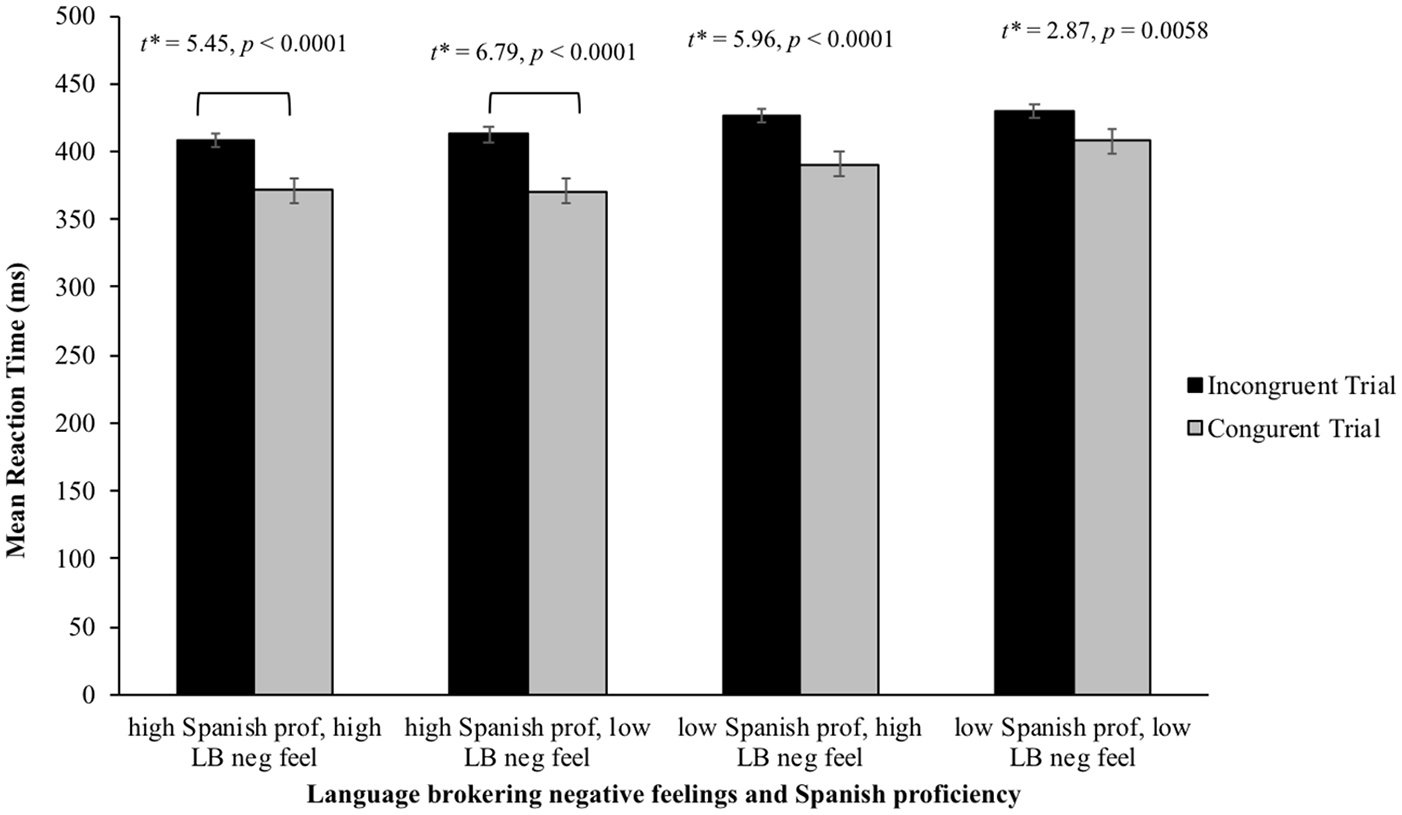
Three-way interaction for the effect of a Simon task trial type on correct reaction time, moderated by participants’ language brokering negative feelings for mother and Spanish proficiency.
A Simon effect is calculated by subtracting the mean of congruent trials from incongruent trials. Figure 3 shows that the largest Simon effect was found for brokers who reported high Spanish proficiency with low LB negative feelings (41.61), then brokers who reported high Spanish proficiency with high LB negative feelings (37.34), followed by brokers who reported low Spanish proficiency with high LB negative feelings (35.22). Smallest Simon effect was found for brokers who reported low Spanish proficiency with low LB negative feelings for mother (21.90).
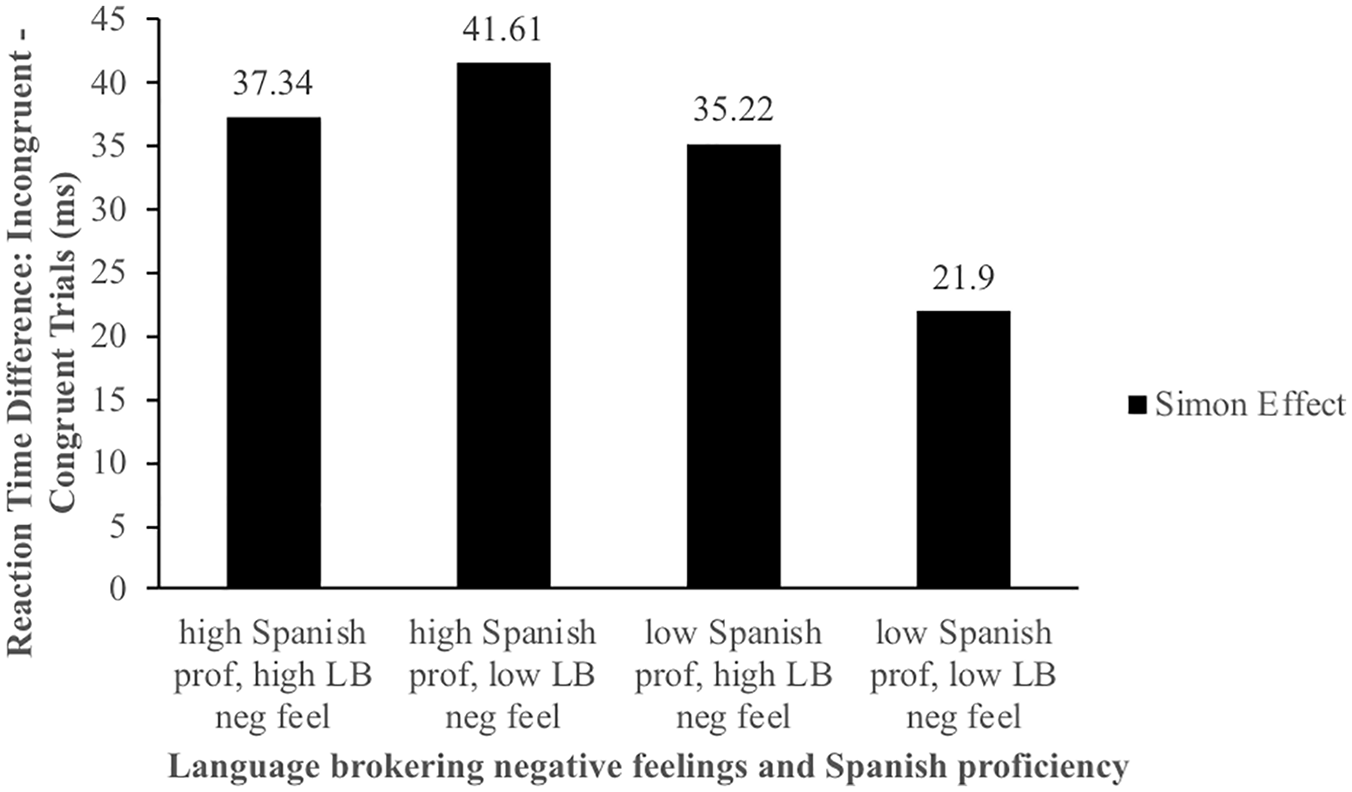
Simon effect.
Post-hoc analysis (Figure 2) showed that the RTs of incongruent trials were significantly longer than the RTs of congruent trials when participants reported high Spanish proficiency combined with high LB negative feelings, t = 5.45, p < 0.0001(Cohen’s d = 2.797). Similar to high Spanish proficiency with low LB negative feelings participants, t = 6.79, p < 0.0001 (Cohen’s d = 3.594), or low Spanish proficiency with high LB negative feelings participants, t = 5.96, p < 0.0001 (Cohen’s d = 3.136), the differences of mean RT between incongruent and congruent trials were significant. Whereas, low LB negative feelings with low Spanish proficiency participants, the mean RT between incongruent trials and congruent trials was still significant, t = 2.87, p = 0.0058, but with the smallest effect size among all four conditions (Cohen’s d = 1.524). However, we did not find similar effects in the model testing ST RT predicted by trial type, participants’ English proficiency, LB negative feelings, and the interactions of the three factors (AIC = 17889.3; Table 3).
Within-individual model effect of trial type (congruent vs. incongruent) on Simon task (ST) reaction time (RT) and multilevel random-effects model assessing participants’ language brokering (LB) negative feelings for mother, English proficiency, and trial type on ST RT.

Notes: LB negative feelings for mother and English proficiency are grand-mean centered; ***p < 0.001.
Results of the within-model of ST ACC as the outcome variable (Tables 4 and 5, Model 1) demonstrated that coefficients for trial type (congruent vs. incongruent as reference) were significant in the positive direction, suggesting that participants have better ACC for congruent than incongruent trials. Yet, the models with between-level moderators have higher Akaike information criteria (model with Spanish proficiency: −112.3; model with English proficiency: −115.5) as compared to the within-model (AIC = −163.5). Both models also demonstrated significant coefficients for LB positive emotions for mother in a positive direction suggesting that greater positive emotions for mother predicts greater ACC on the ST. However, we did not find significant moderating effects of either the main effects of Spanish/English proficiency and LB negative feelings for mother or their interaction on ST trial type on task ACC (Tables 4 and 5).
Within-individual model effect of trial type (congruent vs. incongruent) on Simon task (ST) accuracy (ACC) and multilevel random-effects model assessing participants’ language brokering (LB) negative feelings for mother, Spanish proficiency, and trial type on ST ACC.

Notes: LB negative feelings for mother and Spanish proficiency are grand-mean centered; +p < 0.10, *p < 0.05, ***p < 0.001.
Within-individual model effect of trial type (congruent vs. incongruent) on Simon task (ST) accuracy (ACC) and multilevel random-effects model assessing participants’ language brokering (LB) negative feelings for mother, English proficiency, and trial type on ST ACC.

Notes: LB negative feelings for mother and English proficiency are grand-mean centered; *p < 0.05, ***p < 0.001.
Discussion
This study investigated the role of emotion on LB experiences and language proficiency on EF. We hypothesized that high L1–Spanish proficiency regardless of negative emotions tied to LB experiences would lead to better ST performance. The hypothesis was supported, bilinguals with high L1 proficiency regardless of negative brokering feelings toward brokering had faster RTs for both congruent than incongruent trials. We also hypothesized that low L1 proficiency and high negative emotional brokering experiences would perform worse, but instead we found that brokers with low L1 proficiency and low negative brokering feelings had the slowest RTs across conditions.
Consistent with our hypothesis, language brokers with low L1 proficiency and low negative feelings (Quadrant IV) had the slowest RTs across conditions and groups, but contrary to our hypothesis (Quadrant IV), had the smallest Simon effect. This may reflect disengagement in this group as both emotional and proficiency are low. Alternatively, this may be a reflection of the relationship of emotional brokering experiences and L1 proficiency on non-EF abilities such as speed of processing, not necessarily inhibitory control. Speed of processing differences have been examined in prior brokering research examining figurative meanings (e.g. López & Vaid, 2018b). While our task was non-linguistic, differences in processing of congruent and incongruent trials may be similar to figurative language processing, which may require an additional processing step (e.g. suppressing literal meaning when processing figurative meaning). Future research could examine such possibilities.
While greater bilingual ability affects inhibitory control task performance (Bialystok et al., 2004; Luk et al., 2011), we found no significant main effect of L1 on the Simon effect. Rather, the significant interaction was among negative emotions tied to brokering experiences, L1 proficiency, and trial type. Post-hoc analyses found that four significant Simon effects, and two implications arise from these results. First, L1 proficiency alone cannot explain EFs. Second, while low L1 proficiency and low negative emotional brokering experiences produce the smallest Simon effect, this does not indicate greater inhibitory control as this group had the slowest RTs overall. This is likely driven by the disengagement—low integration of L1 proficiency and negative emotional brokering experiences in this group. Additionally, we found a significant positive effect of LB positive emotions for mother on ACC. This suggests that positive emotions in LB experience may support better performance (ACC) on the ST; however, we had no prior hypotheses on positive emotions, and additional research is warranted to explore this effect further.
Our findings support the Theory of Language Embodiment (Pavlenko, 2002), given that low L1 proficiency coupled with negative feelings towards brokering experiences moderated the Simon effect and no effects of L2 proficiency were found. This finding suggests that how a bilingual language broker feels towards experiences that involve bilingual abilities, such as LB, can be a strong predictor for those with lower L1 proficiency, regardless of L2 proficiency. Brokering experiences may also lead to additional opportunities for bilinguals to integrate their emotional experiences and linguistic information in the L1 as a result of translating for their mother. As no significant effects were found for the L2, the present findings lend support to work by Dewaele (2004, 2010) suggesting that a language acquired earlier in life will have more emotional force for bilinguals. Our findings offer new insight into the effects of bilingual abilities; suggesting that early brokering experiences may bring about lifelong socio-emotional effects, which relate to domain-general EF.
Given the growing immigrant and refugee populations across the world, parents often rely on their young children to translate and interpret for them in their new home country (Weisskirch, 2017b). While some children enjoy teaching and helping their parents learn a language, others report it as a negative laborious experience (Arredondo et al., 2016; Kam & Lazarevic, 2014). LB requires mature cognition including high levels of language fluency and social awareness—all of which are still developing in children and adolescents (Valdés, 2003). LB is a multidimensional experience that provides children with positive bidirectional learning experiences (Arredondo et al., 2016; López, 2020) that support language proficiency (Buriel et al., 1998; Halgunseth, 2003; Hall & Sham, 2007), but may place brokers in stressful situations (Anguiano, 2018; Antonini, 2016; Katz, 2014). These experiences, while unique to bilingual immigrant children, are especially important to consider in terms of their long-term bilingual socio-emotional and cognitive outcomes.
One important limitation is that participants were raised in the US, where English is the majority language and Spanish as the minority language runs a greater risk of losing its proficiency among these speakers (Valdés, 2001). Although near-similar English and Spanish proficiencies were reported, the Simon effect was predicted through Spanish proficiency, not English. In sum, these results suggest that, in the US, L1 proficiency and emotional brokering experiences interact to predict EF performance (Luk & Bialystok, 2013; Luk et al., 2011). Nevertheless, brokers with low L1 proficiency and low negative feelings had the smallest Simon effect. We take these results to suggest that for these brokers there may be a low integration of linguistic and socio-emotional experiences as evidenced by this group having the slowest RTs (across trial type) and smallest Simon effect. Alternatively, negative emotions related to brokering experiences may affect EF as negative brokering experiences may elicit greater emotional regulation processes to assist with brokering. Future studies may decide to measure and examine daily brokering stress in relation to EF and emotional regulation, as we did not measure this. Overall, results suggest that both language and socio-emotional experiences individually and collectively support EF for US bilinguals, which emphasizes that LB practice, regardless of language proficiency, includes socio-emotional experiences that are related to EF.
The EFs operate differently across a range of contexts. During highly emotional situations, affective aspects of self-regulation are necessary, while logical activities rely on cognitive control mechanisms (Poon, 2018; Riggs et al., 2007). However, emotion and cognition are inter-connected in the human mind (Schmeichel & Tang, 2015; Wolfe & Bell, 2004). Further, socio-emotional experiences such as LB moderate EF. Findings provide evidence that lifelong socio-emotional LB experiences permeate EF and impact performance. This study suggests that bilingual abilities are not the only contributor to EF, but socio-emotional and socio-contextual language experiences also influence performance. We encourage future work to examine the impact of language activities on socio-emotional development and all facets of EF.
Implications should be taken with caution as the preliminary evidence is limited in its conclusions by not including a non-broker comparison, the small sample size, and correlational nature of the analysis. Nevertheless, this is the first study to explore the relationship of emotional brokering experiences and L1 proficiency on cognition. Given these limitations, future work should consider an experimental causal design such as priming or inducing positive/negative feelings to examine how EFs are affected by socio-emotional experiences. Future research should explore the effects of language dominance and socio-emotional experiences in other bilingual groups, including bilinguals with and without brokering experiences (e.g. L2 learners, heritage speakers, and formal translators).
Conclusion
With the breadth of findings on bilingualism effects on EF, there is limited knowledge about how specific bilingualism factors influence performance. Recent work (Baum & Titone, 2014; Surrain & Luk, 2017; Takahesu Tabori et al., 2018) encourages bilingual researchers to provide greater details when describing participant sociolinguistic contexts to better understand the root of ‘cognitive differences’ when comparing bilinguals to monolinguals. Our work shows how EF performance is moderated by L1 proficiency and brokering experiences that are emotionally negative. These findings provide evidence on how LB provides an emotional context that can impact EF abilities.
Footnotes
Acknowledgements
The authors are grateful to our research assistant, Gerardo Morales Mendez, for his assistance with data collection.
Declaration of conflicting interests
The author(s) declared the following potential conflicts of interest with respect to the research, authorship, and/or publication of this article: Any opinions, findings, and conclusions or recommendations expressed in this article are those of the authors and do not necessarily reflect the views of The University of Texas at Austin and/or the National Science Foundation.
Funding
The author(s) disclosed receipt of the following financial support for the research, authorship, and/or publication of this article: Support for this research was provided through awards to Belem G. López by The University of Texas at Austin’s (UT Austin) Center for Mexican American Studies, the Office of the Dean in the College of Liberal Arts Summer Research Assignment Award, and a 2019–2020 Ford Foundation Postdoctoral Fellowship. Support also was provided through the National Science Foundation, Division of Behavioral and Cognitive Sciences (NSF-BCS) 1651128 awarded to Su Yeong Kim and Belem G. López, and awards to Su Yeong Kim from: (1) NSF-BCS 0956123; (2) Eunice Kennedy Shriver National Institute of Child Health and Human Development 5R03HD060045-02; (3) Office of the Vice President for Research and Creative Grant and Special Research Grant from UT Austin; and (4) Eunice Kennedy Shriver National Institute of Child Health and Human Development 2P2CHD042849-16 grant awarded to the Population Research Center at UT Austin.
