



Abstract
Aim and questions:
Second language learners are often acquiring a second language (L2) in multilingual and bidialectal sociolinguistic environments. The competing pronunciations can be challenging to language learners. This study aims to determine the effects of language variety—standard variety versus local variety—on L2 vowel learning.
Methodology:
Vowel productions from 55 speakers were analyzed in the study; 10 speakers of Egyptian Arabic were recorded in a reading task producing Greek vowels and their vowel productions were compared to L1 vowel productions produced by 20 Standard Modern Greek and 25 Cypriot Greek speakers from a study by Themistocleous.
Data and analysis:
We conducted linear mixed effects models and tested the effects of language variety, vowel, and stress on the first and second formant frequency and on vowel duration.
Findings:
Egyptian Arabic speakers merge the middle Greek vowels /e/ and /o/ and the high /i/ and /u/ vowels. Also, they did not differentiate phonetically between L2 stressed and unstressed vowels. These findings are arguably an effect of the L1 vowel structure on L2 vowels. The two varieties exercised competing effects on learners’ vowel productions, which suggests that both varieties are influencing vowel learning.
Originality:
There has been substantial research on L2 vowel learning in monolingual environments but not in diglossic environments; this study fills this gap by offering evidence about vowel learning in diglossic environments.
Implications:
In modern societies, communication takes place in multilingual environments. The findings highlight the impact of diglossia on L2 vowel learning and, ultimately, they demonstrate the importance of sociolinguistic factors on L2 learning.
Introduction
Children acquire the vowels of their mother language (L1) quickly, effortlessly, and indistinguishably from the members of their speech community. Most native language vowel categories are acquired during the first 6–12 months of speakers’ lives (Cheour et al., 1998; Grimaldi et al., 2014; Kuhl et al., 1992; Werker & Tees, 1983). Unlike L1 vowel learning, learning the vowels of a second language (L2) is challenging both in terms of effort and naturalness. Often, L2 vowel categories may never be fully acquired by L2 learners and L2 vowels are likely to be identified as non-native (Ferguson & Garnica, 1975; Flege, 1980, 1981; Georgiou, 2019, 2020; Iverson et al., 2003; Krashen, 1981; Scovel, 1969; Stoehr et al., 2017).
One of the most important factors that affects L2 vowel learning is the underlying L1 vowel system (Best & Strange, 1992; Mục Đào & Nguyễn, 2018). Lee et al. (2006) carried out an acoustic analysis of English vowels produced by early and late Korean and Japanese-English bilinguals and concluded that Korean speakers did not produce the distinction between stressed and unstressed vowels. They concluded that English vowel learning was a difficult task for Korean speakers but not for Japanese speakers, who differentiated vowels based on their stress. The differences in vowel production between Korean and Japanese bilingual speakers was attributed to transfer effects from their mother language (Lee et al., 2006). In a more recent study, Yang and Fox (2017) argued that there is a strong effect of L1 vowels on L2 vowels with a transfer of phonetic features from L1 to L2 vowel production. In early stages of L2 acquisition, an L1 sound that was rated as phonetically similar to an L2 sound might be produced fairly well (Flege, 2003). Other factors, such as the time course of language learning, learners’ age, formal instruction of the target language, individual talent, learners’ motivation and learners’ attitude towards the L2, social mobility skills, L2 proficiency level, and language environment influence vowel learning (Bohn & Flege, 1992; Georgiou, 2019, Luk et al., 2011; Oh et al., 2011, Piske et al., 2001; Tsukada, 1999, 2009). For example, younger learners are usually more proficient in L2 than older learners (Flege et al., 1999; Lee et al., 2006).
Accumulating research of language learning addressed social environments as being primarily monolingual and homogeneous. Nevertheless, sociolinguistic environments are often multilingual and multidialectal, as different language varieties (e.g. sociolects, dialects, and accents) of that language co-exist. For instance, in diglossic sociolinguistic environments a formal, more standardized and codified variety coexists with a less formal and unstandardized variety (Baetens, 1986; Ferguson, 1959; Grohmann, 2014; Romaine, 1989; Rowe & Grohmann, 2014; Siegel, 2010; Wardhaugh, 2010). In Egypt, Egyptian Arabic is the vernacular dialect used primarily in verbal communication and in vernacular literature (low variety) and Modern Standard Arabic, which is the standard variety employed in formal circumstances (high variety), such as TV news, documentaries, and formal writing. Modern Standard Arabic functions as a lingua franca (Ferguson, 1959). In Cyprus, Cypriot Greek is a local dialect of Greek spoken in Cyprus and it is used on a regular basis in everyday life occasions (e.g. during conversations between speakers) and Standard Modern Greek is a standard variety employed in conversations with Standard Modern Greek speakers and in formal environments (Grohmann et al., 2017). As people (e.g. students, immigrants, migrants, and foreign workers) move to multilingual and bidialectal environments for education, work, etc., their L2 learning can be influenced by the varieties spoken there. We hypothesize that these co-existing language varieties can have a strong impact on L2 vowel learning (for effects of multilingual environments on L1 acquisition, see Bruner, 1983; Grohmann et al., 2017; Liberman et al., 2017).
This study
The aim of this study is to determine the effects of language environment—standard variety versus local variety—on L2 vowel learning with respect to two main questions: (1) What are the acoustic differences between Greek vowels produced by Egyptian Arabic learnings of Greek and vowels produced by Cypriot Greek and Standard Modern Greek speakers?; (2) Which two language varieties of Greek influence the production of L2 vowels most: the standard or the local variety? We designed a production experiment in which adult speakers of Egyptian Arabic living in Cyprus produced Greek vowels in a reading task. Subsequently, we compared L2 vowel productions to vowel productions from Standard Modern Greek and Cypriot Greek speakers in the study by Themistocleous (2017a). The speakers of these two varieties differ in their pronunciation (e.g. vowels, consonants, and prosody) (Newton, 1972a, 1972b; Themistocleous, 2016a, 2016b, 2017a, 2017b, 2017c). For example, in Cypriot Greek, voiced stops are prenasalized but not in Standard Modern Greek. Palatalization results in postalveolar consonants in Cypriot Greek and in palatal consonants in Standard Modern Greek. Also, there are geminate consonants in Cypriot Greek but not in Standard Modern Greek.
Standard Modern Greek and Cypriot Greek vowels phonemically consist of five vowels /i e a o u/. However, the vowels of the two varieties differ acoustically (Themistocleous, 2017a, 2017c). For instance, the unstressed Athenian Greek /e a o/ vowels are overall higher than the corresponding Cypriot Greek vowels, and the Standard Modern Greek unstressed /i a u/ vowels are more raised than the corresponding Cypriot Greek vowels (see also Themistocleous, 2017a, 2017b, 2017c). Also, the unstressed Standard Modern Greek vowels are more reduced than those of Cypriot Greek. Stressed vowels in both varieties are longer than the unstressed vowels (Fourakis et al., 1999; Themistocleous, 2017a).
In Egyptian Arabic, there are five long vowels (/iː eː aː oː uː/) and three short vowels (/i a u/). The short vowels [e] and [o] exist only as allophones of the short phonemes /i/ and /u/ correspondingly (Gadalla, 2000; Norlin, 1987). Egyptian Arabic speakers are diglossic, as they are speakers of both Egyptian Arabic and Modern Standard Arabic. The vowel inventory of Modern Standard Arabic contains three short /i a u/ and three long vowels /iː aː uː/ (Almbark, 2012; Watson, 2002).
We hypothesize that the differences between the L1 and L2 vowel systems are challenging to L2 learners of Greek. Egyptian Arabic learners of Greek are often having trouble distinguishing /i/-/e/ and /o/-/u/ vowel pairs (Georgiou, 2018). Overall, there no earlier studies that investigate the production of Greek vowels by speakers of Egyptian Arabic and there are only a few studies on the Greek learned as an L2 by speakers of Arabic. For example, Andreou and Mitsis (2005) discussed the difficulties of a group of medical students whose L1 is Arabic and learn Greek as an L2 at the University of Thessaly using questionnaires, but their focus was on other non-phonetic or phonological parameters (see Andreou & Mitsis, 2005).
Methodology
Participants
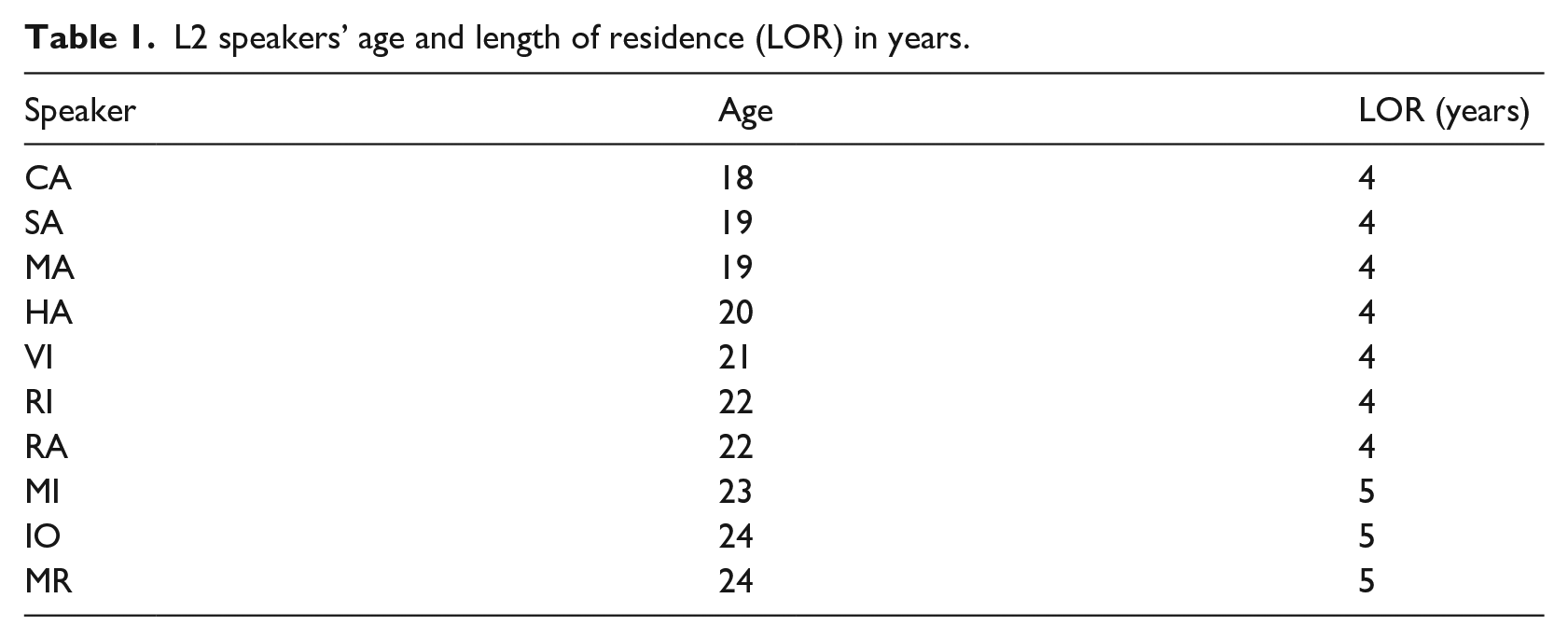
Ten female Egyptian Arabic speakers between 18 and 24 years old, born and raised in Alexandria, Egypt, participated in the study. Table 1 provides information about participants’ name (code word), age, and their length of residence (LOR) in Cyprus. All speakers had been living in Cyprus for 4 to 5 years and had formed a sociolinguistically homogenous group. Speakers had approximately the same socio-economic background, all originated from middle-income families and were high school students or undergraduate students at private universities. Speakers were all female and approximately the same age, which minimized the effects of gender and age on vowel production. We provided a questionnaire to participants to self-evaluate their writing and speaking skills in Greek (using Likert scales from 1 to 5). According to their responses, they had basic writing skills in Greek, poor oral performance, and were employing Greek primarily at school/university (in which they were spending almost half the day) and in other daily activities. They were using Egyptian Arabic at home with their parents.
L2 speakers’ age and length of residence (LOR) in years.
L2 vowel productions were compared to Greek vowel productions produced by 45 Greek female speakers, The 20 Standard Modern Greek speakers born and raised in Athens and 25 Cypriot Greek female speakers born and raised in Nicosia were recruited as part of an earlier study (Themistocleous, 2017a, 2017c). Egyptian Arabic speakers’ sociolinguistic properties matched the sociolinguistic characteristics of speakers in Themistocleous (2017a, 2017c). Greek speakers were between 19 and 29 years old when they participated in the study. They were near/in the third decade of their life, and at the time of the recording they were university students at the University of Athens (Standard Modern Greek speakers) and at the University of Cyprus (Cypriot Greek speakers). Both Egyptian Arabic and Greek speakers spoke English as an L2 (late bilinguals), and they did not report any language or speech disorders.
Stimuli
We replicated Themistocleous (2017a, 2017c)’s elicitation protocol. Figure 1 provides an example of the segmentation process followed by Themistocleous (2017c). The five Greek vowels /i/, /e/, /a/, /o/, and /u/ were embedded in nonsense keywords: ˈsVsa, sVˈsa, ˈVsa, and Vˈsa (V is the target vowel). Vowels were produced in four repetitions in stressed and unstressed positions. We employed nonsense words as keywords instead of real words to avoid effects due to familiarity or non-familiarity of speakers with words. To facilitate vowel segmentation and exclude coarticulatory influences, the vowels were preceded and followed by voiceless fricative alveolar /s/ consonants /ˈipes ˈsVsa/sVˈsa/ˈVsa/Vˈsa ˈpali/. The participants read the materials in random order, in a small, quiet room. The experimenter instructed participants to read the carrier phrases from a computer screen at a normal speaking rate. As Arabic learners were familiar with the Greek alphabet, the stimuli were presented in Greek orthography. There was an optional 5-minute break after each repetition. The participants’ repetitions were recorded on a Zoom H4n audio recorder (sampling rate 44.1 kHz). To avoid influencing speakers’ vowel productions, no explanation about the purpose of the experiment was provided to participants.
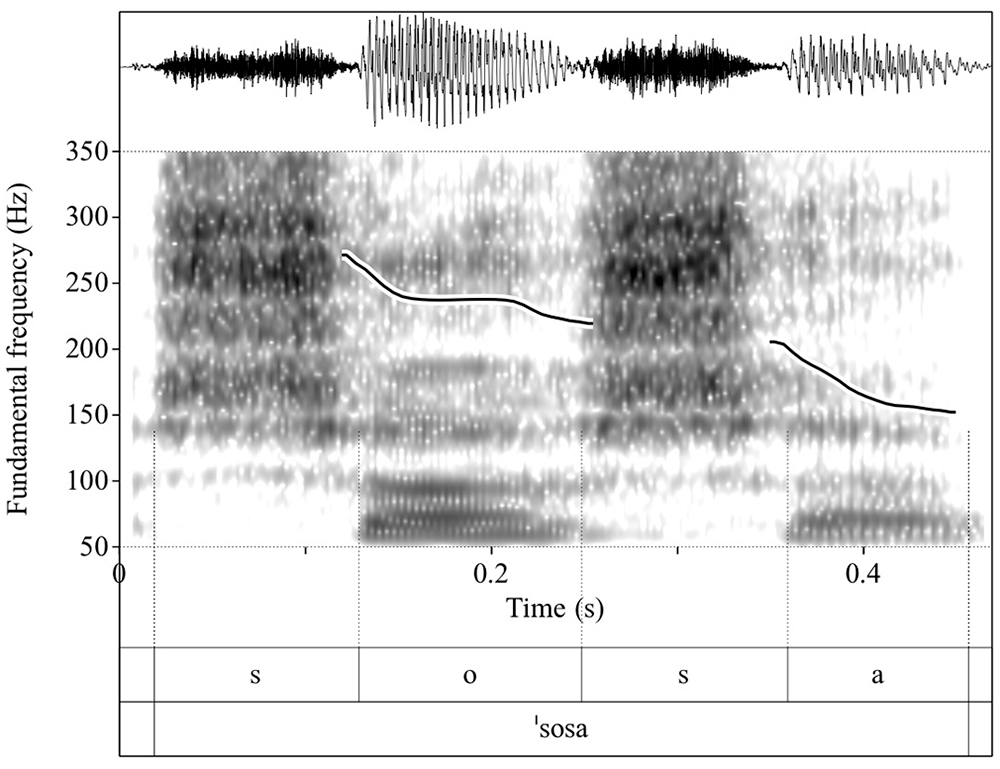
An example illustrating the segmentation of the vowel /o/ uttered in the phrase /ˈipes ˈsosa ˈpali/ from a Standard Modern Greek speaker. The upper tier of the figure shows the waveform; the middle tier shows the spectrogram, and the F0 contour. The middle tier (phone tier) indicates the boundaries of consonants and vowels delimited with vertical thin dashed lines, and the lower tier demarcates words. The ordinate shows the fundamental frequency in Hertz, and the abscissa shows the time in seconds.
Vowels were segmented manually by inspecting the waveform and the spectrogram simultaneously. To identify the onset of the vowel, we traced the beginning of the first formant frequency after the noisy section of the preceding voiceless fricative consonant [s] of the keyword when the vowel is in the CV syllable of the keyword (/sVsa/) or in the CV context formed by the preceding word /ˈipes/ and the beginning of the keyword in stimuli such as /ˈipes ˈVsa ˈpali/ (Themistocleous, 2017a, 2017c). The segmentation marker was set at the zero crossing after the offset of the fricative [s] in the waveform. The offset of the vowel was demarcated by the onset of the following voiceless fricative [s].
Measurements
We measured the first two vowel formant frequencies and vowel duration. Formants are the acoustic resonances of the human vocal tract. The first formant (F1) frequency corresponds to vowel height (high vowels—mid vowels—low vowels) and the second formant (F2) differentiates vowels as front and back. F1 and F2 formant frequencies were measured at vowel midpoint (Jones, 1956; Joos, 1948) and vowel duration was calculated as the distance between vowel onset and vowel offset. The acoustic measurements were conducted in Praat software and formants were estimated using Praat’s standard LPC-based method (Boersma & Weenink, 2017).
Statistics
To evaluate individual differences in L2 vowel production, we conducted linear mixed effects models. F1, F2, and vowel duration were the dependent variables. Formants were not normalized to other units for differences of age and gender, as this was addressed at the level of the experimental design. L1 and L2 speakers had the same gender and age. The fixed effects in the final model were vowel, stress, and their interaction (vowel × stress). Speaker and keyword were modeled as random effects in a linear mixed effect model (Baayen, 2008). To compare vowel spaces of speakers’ L2 vowels and the vowel space of Standard Modern Greek and Cypriot Greek vowels, we provided measures of vowel space areas. The vowel F1 × F2 space area is the area of the polygon that results by connecting vowels in that space and can be employed as a metric of differentiation of L2 vowels from the L1 vowels (Sandoval et al., 2013). Vowel space areas were calculated using the phonR package in R (McCloy, 2016). We conducted linear mixed effects models with variety, vowel, and stress as fixed factors and speaker and item as random intercepts. We provide separate statistics for each contrast: Egyptian Arabic versus Standard Modern Greek, and Egyptian Arabic versus Cypriot Greek. In total, we analyzed 4400 vowel productions: 800 vowel productions produced by Egyptian Arabic speakers, (i.e. 10 speakers × 5 vowels × 2 stress conditions × 2 word positions × 4 repetitions) and of 3600 vowel production produced by 25 Standard Modern Greek speakers and 20 Cypriot Greek speakers (i.e. 45 speakers × 5 vowels × 2 stress conditions × 2 word positions × 4 repetitions) from Themistocleous (2017a). For the statistical analysis, we employed R (R Core Team, 2016) and the lme4 package for fitting generalized linear mixed models (Bates et al., 2014).
Results
L2 vowel productions
Figure 2 shows the production of Greek stressed and unstressed vowels by speakers of Egyptian Arabic. Stressed vowels form a greater vowel triangle encompassing that of the unstressed vowels. The stressed vowels are more peripheral, whereas the unstressed ones are closer to the center of the vowel space. Also, the unstressed vowels are more raised than the stressed vowels. Vowel /a/ had the longest duration followed by /o/, /e/, /u/, and finally /i/, which had the shortest duration (see Table 2).
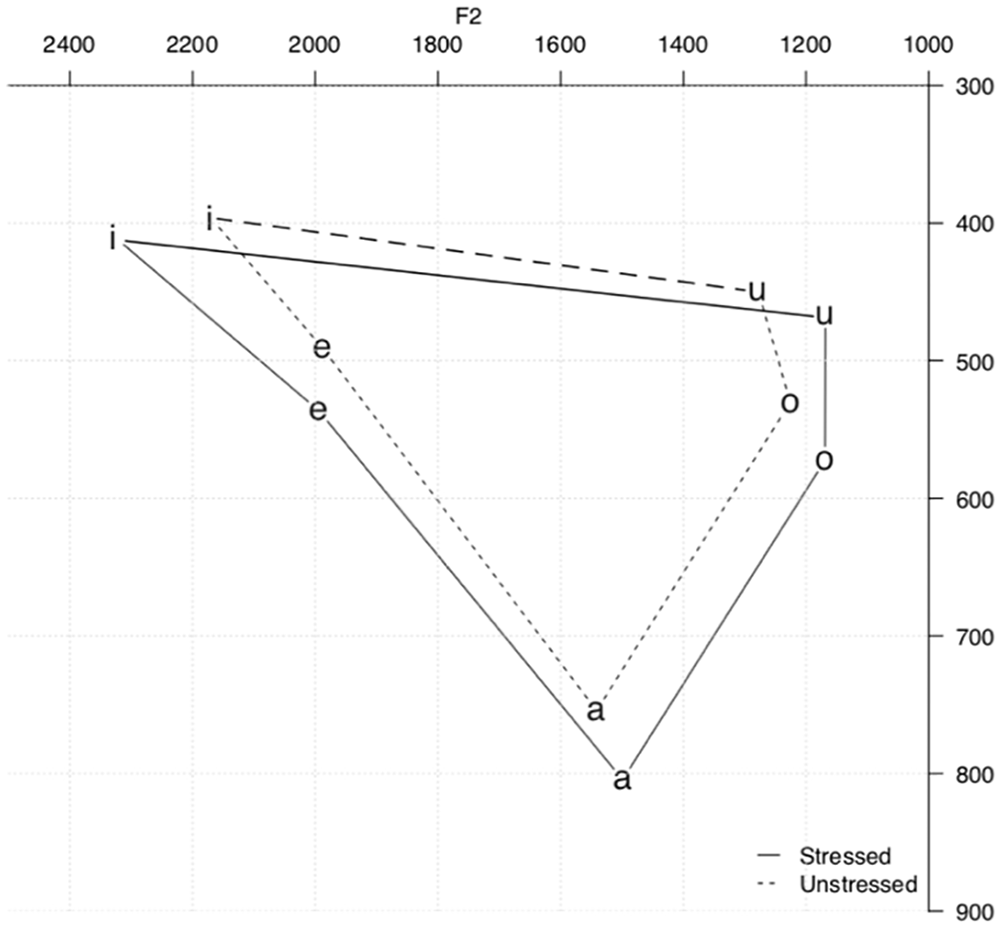
F1 × F2 of Greek stressed and unstressed vowels produced by female Egyptian Arabic speakers (in Hertz). The solid straight line connects the stressed vowels; the dashed line connects the unstressed vowels.
Mean and SD of Duration, F1, and F2 for L2 vowels produced by speakers of Egyptian Arabic.

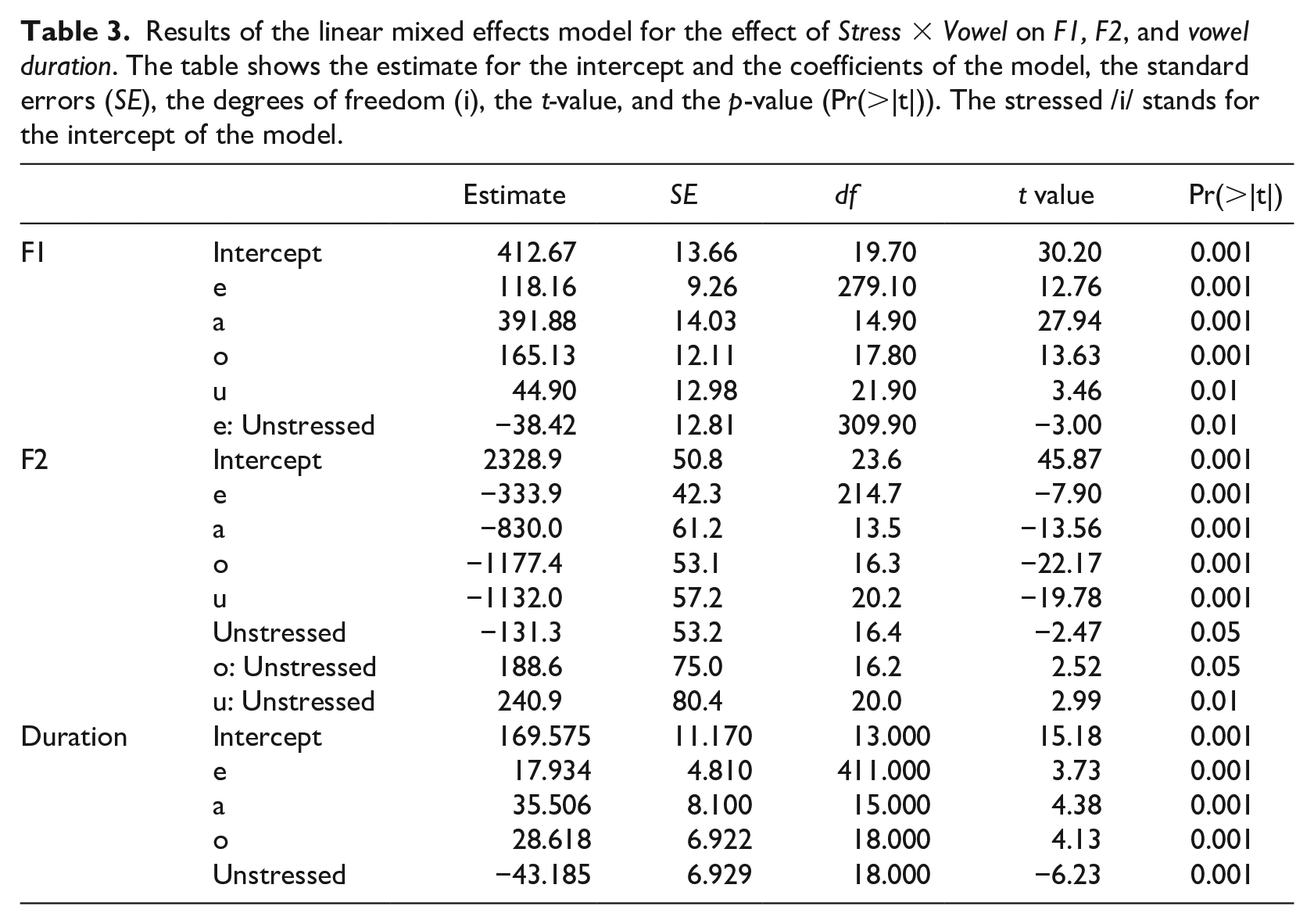
Note: (1) Stress had no significant effects on vowel formants except from the F1 of vowel /e/ and the F2 of vowels /o/ and /u/ (see Table 3); (2) The vowel formants of the mid vowel /e/ approximate those of the high vowel /i/ and the formants of the mid vowel /o/ approximate those of the high vowel /u/; (3) Back vowels /o u/ are overall lower than the corresponding front vowels /i e/.
Results of the linear mixed effects model for the effect of Stress × Vowel on F1, F2, and vowel duration. The table shows the estimate for the intercept and the coefficients of the model, the standard errors (SE), the degrees of freedom (i), the t-value, and the p-value (Pr(>|t|)). The stressed /i/ stands for the intercept of the model.
Individual productions
There is substantial variability in vowel production among L2 speakers. The middle vowel /e/ and /o/ of speakers CA, MA, MR, SA, and VI were approaching the high /i/ and /u/ correspondingly, collapsing the Greek vowel pairs /i/-/e/ and /o/-/u/ into a single category. Figure 3 shows these effects and Table 4 shows the polygon area of learners’ Greek vowel productions.
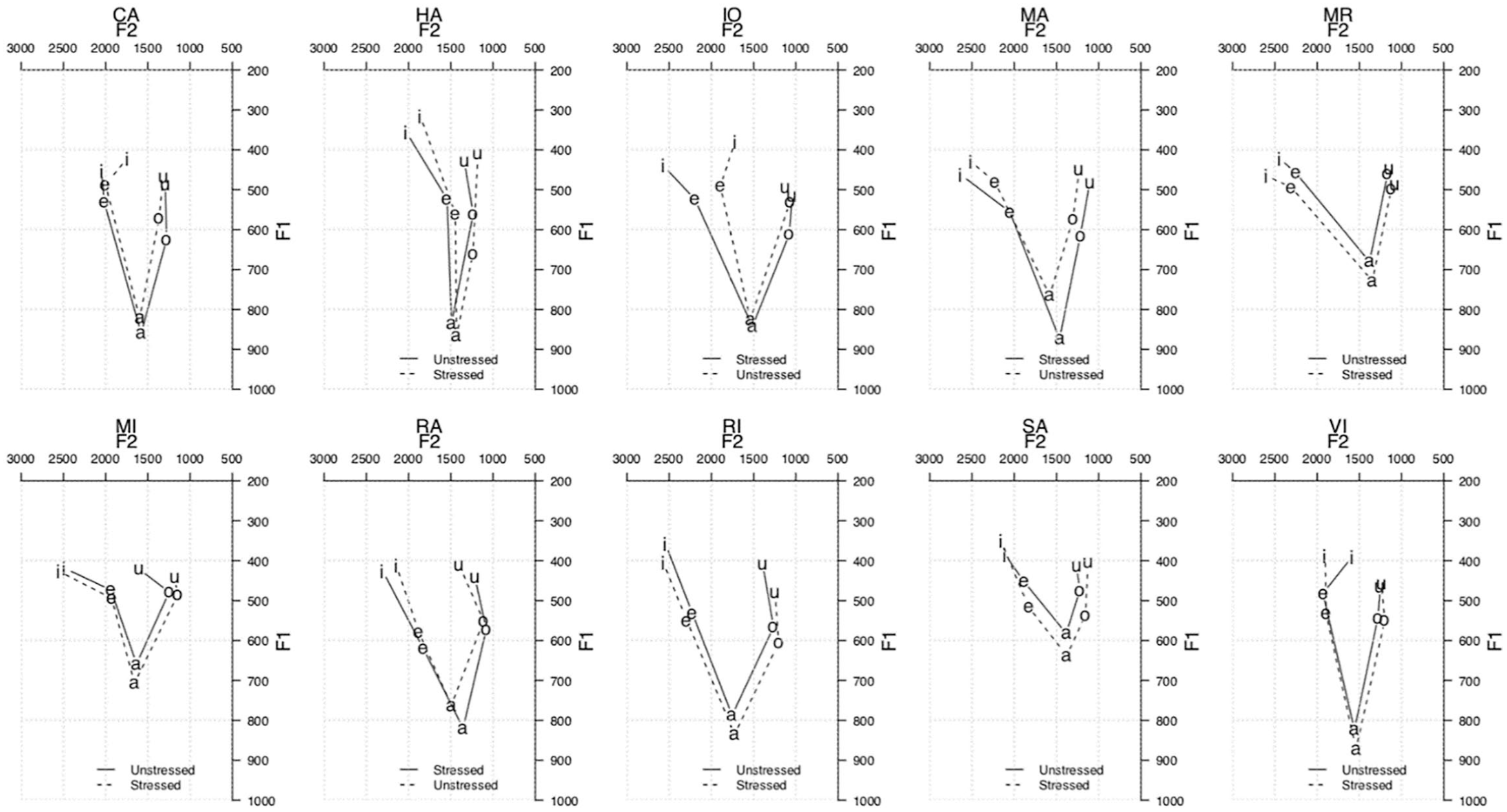
Mean vowel F1 × F2 spaces of the Egyptian Arabic female speakers in stressed (connected with solid lines) and unstressed conditions (connected with dashed lines).
Polygon areas of vowel productions that represent the vowel space area of each L2 speaker (code name).
L2 vowels versus L1 Standard Modern Greek and Cypriot Greek vowels
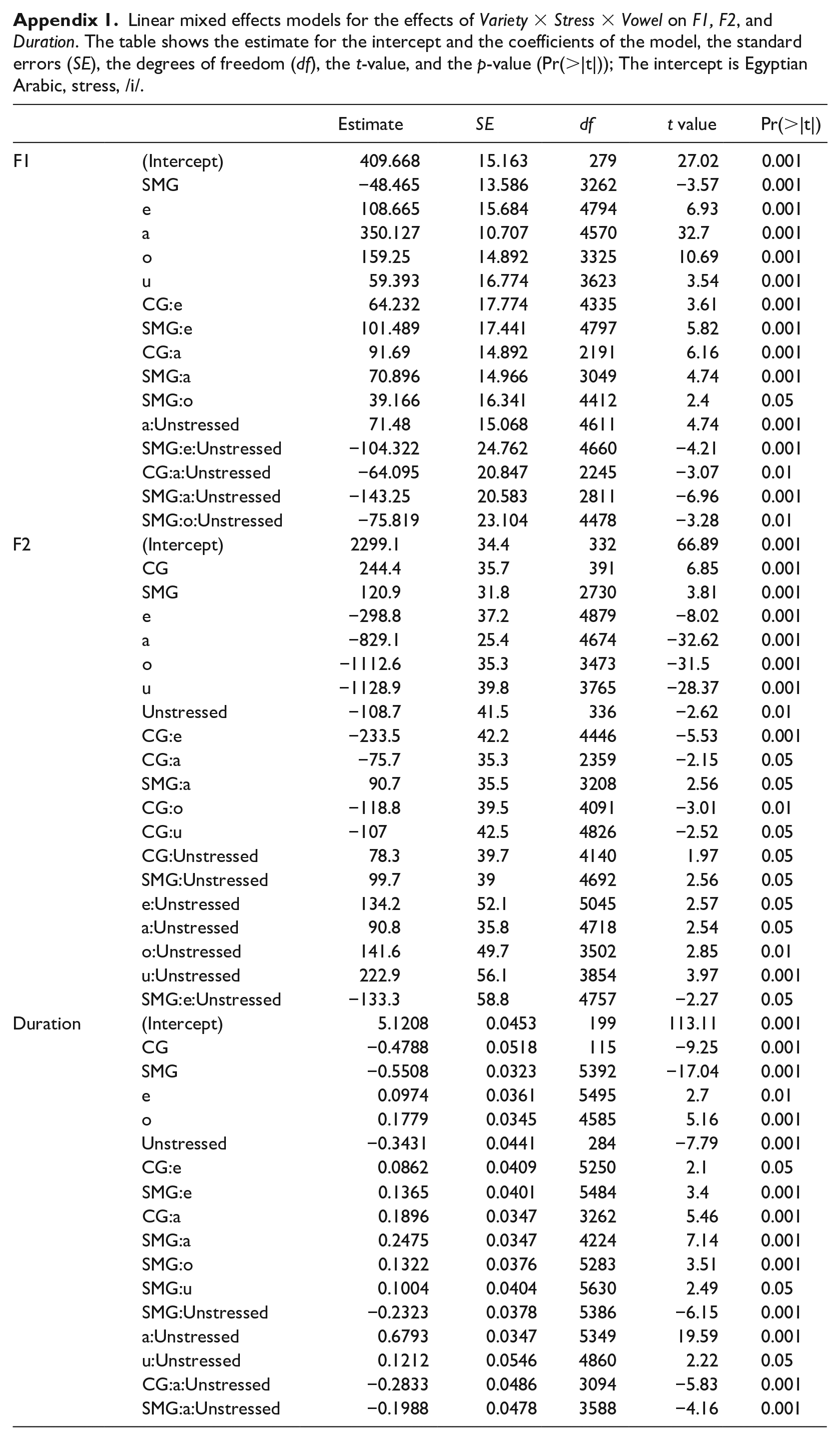
The stressed and unstressed vowels of Standard Modern Greek, Cypriot Greek, and Egyptian Arabic are shown in Figure 4. Egyptian Arabic L2 vowel productions are significantly different from Standard Modern Greek productions with respect to F1 of /i/, /e/, and /a/ vowels (see also Appendix 1). These differences affect all vowels except /u/. Standard Modern Greek productions are different from L2 productions with respect to F2. L2 vowel productions do not differ significantly between stressed and unstressed vowels, unlike L1 Greek vowels that vowel formants and vowel duration differ depending on whether they are stressed or unstressed.
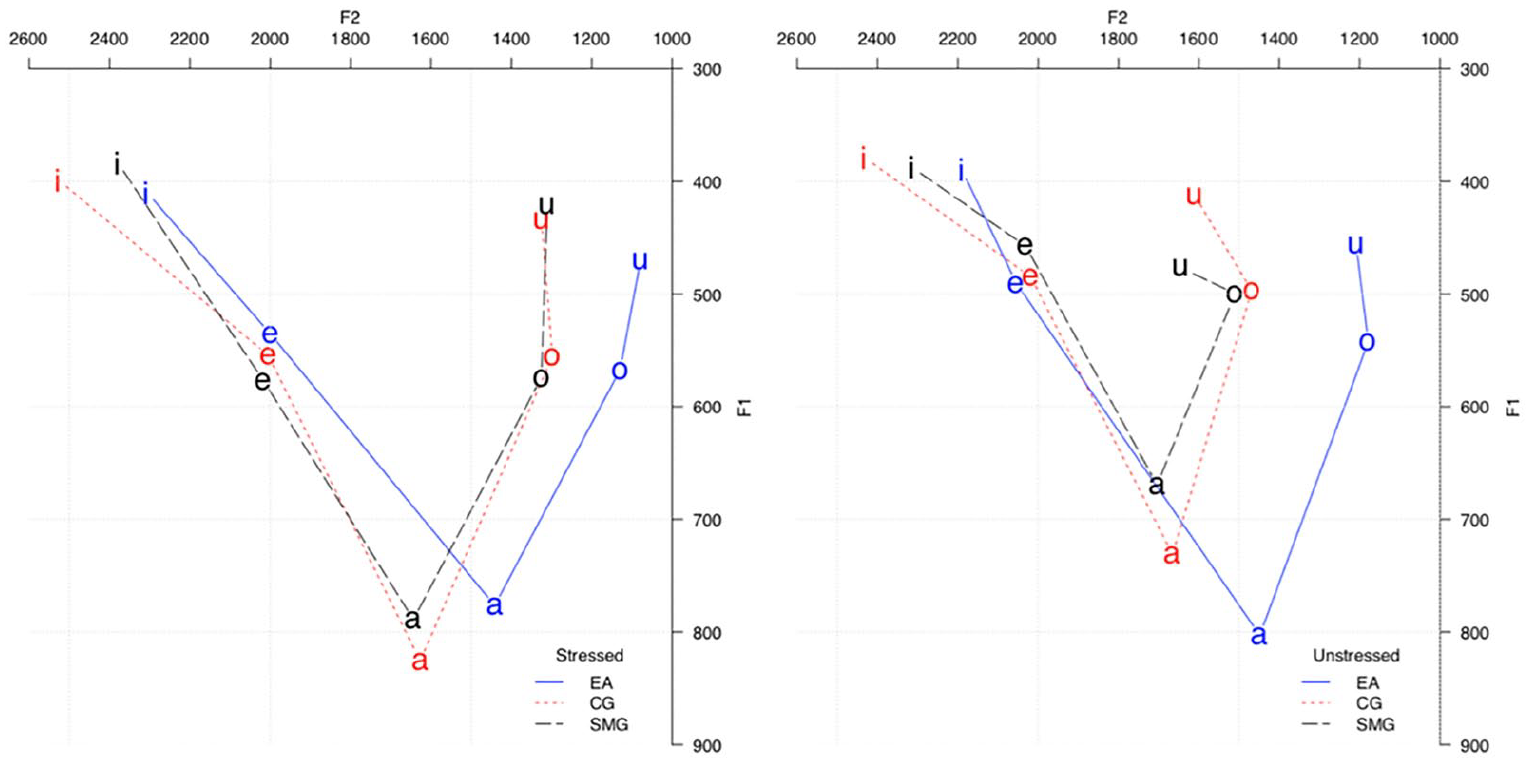
Overlaid Standard Modern Greek (SMG), Cypriot Greek (CG), and Egyptian Arabic (EA) stressed vowels (left panel) and unstressed vowels (right panel).
Discussion
Earlier research on L2 learning in diglossic settings is scarce. The goal of this study was to determine how two dialects of the same language influence L2 vowel learning. The study provided novel findings, which show that standard and local varieties of Greek affect L2 vowel productions. It also showed that the language system of Egyptian Arabic influences the productions of Greek vowels by Egyptian Arabic speakers, corroborating earlier findings, which demonstrate that L2 vowel production is subject to L1 influence (Darcy & Krüger, 2012). L2 learners merged mid vowels and high vowels producing a three-vowel system and did not produce the durational and quality differences between stressed and unstressed vowels that characterize Greek vowels. Speakers’ L1 vowel categories influence L2 vowel production. An important implication of the methods employed in this study is that they quantified differences of L2 and L1 vowel productions, which can facilitate estimations of the progression of vowel learning in L2 learners and ultimately guide personalized teaching methodologies.
L2 productions of Greek vowels
Despite the substantial between-speaker variability in L2 Greek vowel productions, there were consistent differences between native Greek speakers’ vowel productions and Egyptian Arabic speakers’ vowel productions. Egyptian Arabic speakers did not distinguish L2 stressed and unstressed vowels, as vowel formants and vowel duration coincided in both stress conditions. In contrast, L1 Greek stressed vowels are different in their formants and duration from the unstressed ones: stressed vowels are located towards the periphery of the vowel space, whereas unstressed vowels occupy more central positions in the vowel space (Fourakis et al., 1999; Themistocleous, 2017a, 2017c). Also, L1 Greek stressed vowels are longer than unstressed vowels (e.g. see Fourakis et al., 1999; Themistocleous, 2017a, 2017c). Our hypothesis is that Egyptian Arabic learners are pairing Greek stressed and unstressed vowels to the unmarked short-vowel system of their L1, neutralizing stress distinctions of Greek (see the schematic in Figure 5).
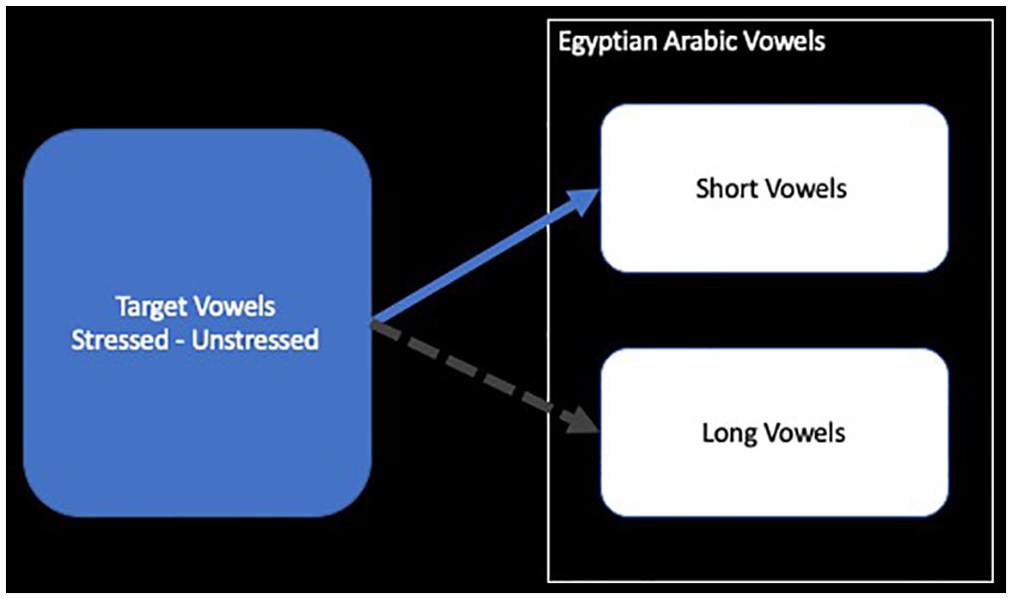
Phonetic lengthening neutralization and matching to the unmarked case of the long-short quantity pair of Egyptian Arabic.
There is significant between-speaker variation in the production of L2 vowels, as some Egyptian Arabic speakers raised the mid /e/ and /o/ vowels closer to /i/ and /u/ correspondingly. For instance, speaker CA merged the mid vowel /e/ and the high /i/; CA also merged the two vowels in both stressed and unstressed conditions. CA raised the mid-unstressed vowel /o/, which approached the vowel /u/. Speaker MR raised all mid vowels and merged them with the corresponding front and back high vowels. Also, she did not distinguish between stressed and unstressed vowels. Vowel raising is often observed in some Greek dialects in northern Greece, yet, it is minimal in the southern varieties of Greek (see Themistocleous, 2017c). Therefore, the vowel raising observed in speakers of Egyptian Arabic cannot be motivated by the two Greek varieties. In particular, our results indicate that the Egyptian Arabic vowel system affects L2 vowel production (see also the perceptual task from Georgiou, 2018). As the Egyptian Arabic vowel inventory contains only three cardinal vowels in the unstressed condition, mid-vowels of Greek that do not coincide with these three vowels are being merged in speakers with the existing categories of Egyptian Arabic (for the acquisition of English vowels by Greek and Japanese speakers, see Lengeris, 2009; Lengeris & Hazan, 2010, and for the acquisition of French vowels by English speakers, see Levy & Strange, 2008). As not all learners are producing mid-Greek vowels as high vowels, the substantial between-speaker variation in mid vowels productions suggests that L1 speakers have not formed new categories for the mid-vowels of Greek in those speakers (Flege, 1995). Therefore, it is possible that through training, experience, and exposure, learners will produce the L2 novel vowel category, i.e. the Greek mid-vowels. (See Figure 6.)
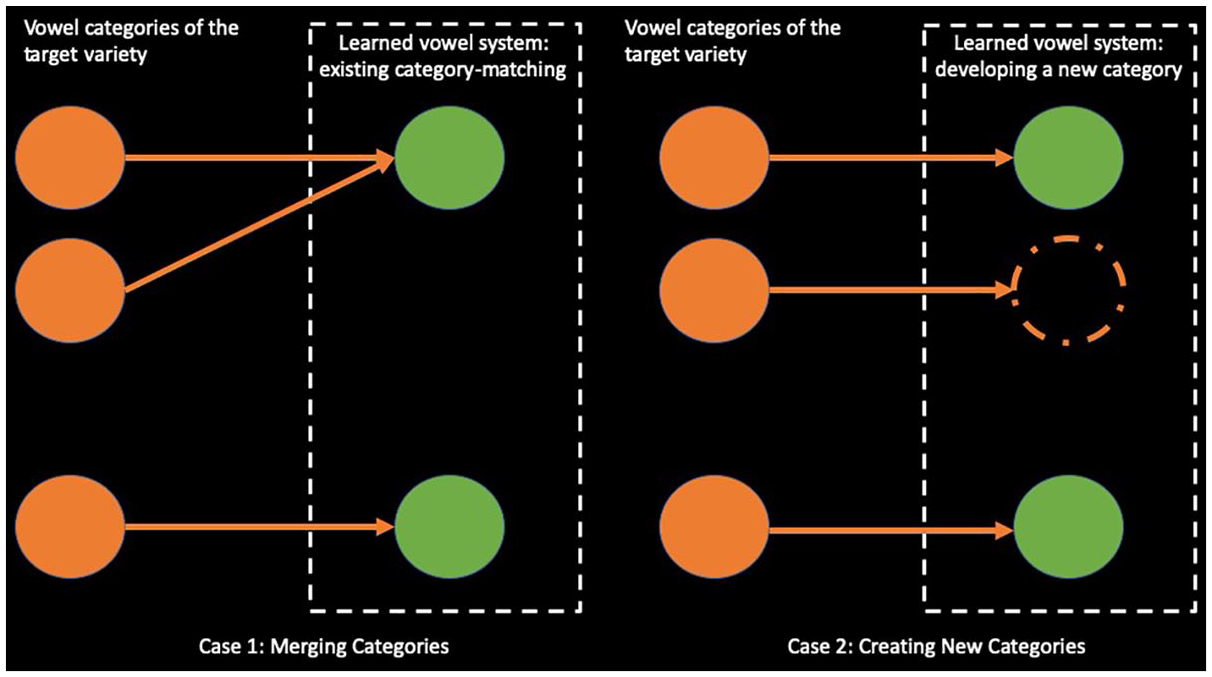
Two learning strategies employed by our speakers. Case 1: speakers match target vowel categories to existing vowels of the unmarked three-vowel short pair of Egyptian Arabic. Case 2: speakers develop a new category that matches the corresponding target vowel category.
Effect of competing dialect pronunciations on language learning
Our findings suggest that both Greek varieties exercise mixed effects on L2 vowel productions with respect to vowel duration and vowel formants. In other words, L2 speakers do not produce vowels using the pronunciation of the standard variety nor the pronunciation of the local variety, but their productions display bidirectional effects from both varieties spoken in Cyprus. This should cause no surprise as learners are exposed in a seemingly chaotic variation of dialectal pronunciations. Upon arriving in Cyprus, L2 learners attended L2 Greek courses in formal educational settings (either at schools or universities). Also, during their everyday life, according to their reports, L2 learners are listening to Greek music and watching Greek TV series which broadcast from Athens. As most of L2 learners are students at universities in Cyprus, they interact with other Cypriot Greek and Standard Modern Greek students and teachers; so, they receive extensive speech input in both varieties. In this way, they get mixed effects from both varieties on their L2 productions. Also, their L2 system is developing and undergoes changes, their L2 vowel production is determined by the interplay between the dynamic and internalized L2 system (see Luk & Bialystok, 2013) and the complex effects of the sociolinguistic environment.
Limitations and future research
The small number of speakers constitutes the main limitation of this study. Also, speakers form a homogeneous group (female speakers, specific age group, etc.), which was desirable for this study as we wanted to avoid confounding factors on the experimental research. Nevertheless, this decision restricted the number of sociophonetic parameters that could have been studied, such as the effect of learners’ gender, age, social class, etc. In our future research, we plan to investigate the effects of sociolinguistic factors on vowel production to determine their interaction with language variety. Furthermore, we will be testing the effects of standard versus local variety on people with long length of residence in areas where dialects are being spoken and/or people who have increased contact with standard varieties.
Footnotes
Appendix
Linear mixed effects models for the effects of Variety × Stress × Vowel on F1, F2, and Duration. The table shows the estimate for the intercept and the coefficients of the model, the standard errors (SE), the degrees of freedom (df), the t-value, and the p-value (Pr(>|t|)); The intercept is Egyptian Arabic, stress, /i/.
| Estimate | SE | df | t value | Pr(>|t|) | ||
|---|---|---|---|---|---|---|
| F1 | (Intercept) | 409.668 | 15.163 | 279 | 27.02 | 0.001 |
| SMG | −48.465 | 13.586 | 3262 | −3.57 | 0.001 | |
| e | 108.665 | 15.684 | 4794 | 6.93 | 0.001 | |
| a | 350.127 | 10.707 | 4570 | 32.7 | 0.001 | |
| o | 159.25 | 14.892 | 3325 | 10.69 | 0.001 | |
| u | 59.393 | 16.774 | 3623 | 3.54 | 0.001 | |
| CG:e | 64.232 | 17.774 | 4335 | 3.61 | 0.001 | |
| SMG:e | 101.489 | 17.441 | 4797 | 5.82 | 0.001 | |
| CG:a | 91.69 | 14.892 | 2191 | 6.16 | 0.001 | |
| SMG:a | 70.896 | 14.966 | 3049 | 4.74 | 0.001 | |
| SMG:o | 39.166 | 16.341 | 4412 | 2.4 | 0.05 | |
| a:Unstressed | 71.48 | 15.068 | 4611 | 4.74 | 0.001 | |
| SMG:e:Unstressed | −104.322 | 24.762 | 4660 | −4.21 | 0.001 | |
| CG:a:Unstressed | −64.095 | 20.847 | 2245 | −3.07 | 0.01 | |
| SMG:a:Unstressed | −143.25 | 20.583 | 2811 | −6.96 | 0.001 | |
| SMG:o:Unstressed | −75.819 | 23.104 | 4478 | −3.28 | 0.01 | |
| F2 | (Intercept) | 2299.1 | 34.4 | 332 | 66.89 | 0.001 |
| CG | 244.4 | 35.7 | 391 | 6.85 | 0.001 | |
| SMG | 120.9 | 31.8 | 2730 | 3.81 | 0.001 | |
| e | −298.8 | 37.2 | 4879 | −8.02 | 0.001 | |
| a | −829.1 | 25.4 | 4674 | −32.62 | 0.001 | |
| o | −1112.6 | 35.3 | 3473 | −31.5 | 0.001 | |
| u | −1128.9 | 39.8 | 3765 | −28.37 | 0.001 | |
| Unstressed | −108.7 | 41.5 | 336 | −2.62 | 0.01 | |
| CG:e | −233.5 | 42.2 | 4446 | −5.53 | 0.001 | |
| CG:a | −75.7 | 35.3 | 2359 | −2.15 | 0.05 | |
| SMG:a | 90.7 | 35.5 | 3208 | 2.56 | 0.05 | |
| CG:o | −118.8 | 39.5 | 4091 | −3.01 | 0.01 | |
| CG:u | −107 | 42.5 | 4826 | −2.52 | 0.05 | |
| CG:Unstressed | 78.3 | 39.7 | 4140 | 1.97 | 0.05 | |
| SMG:Unstressed | 99.7 | 39 | 4692 | 2.56 | 0.05 | |
| e:Unstressed | 134.2 | 52.1 | 5045 | 2.57 | 0.05 | |
| a:Unstressed | 90.8 | 35.8 | 4718 | 2.54 | 0.05 | |
| o:Unstressed | 141.6 | 49.7 | 3502 | 2.85 | 0.01 | |
| u:Unstressed | 222.9 | 56.1 | 3854 | 3.97 | 0.001 | |
| SMG:e:Unstressed | −133.3 | 58.8 | 4757 | −2.27 | 0.05 | |
| Duration | (Intercept) | 5.1208 | 0.0453 | 199 | 113.11 | 0.001 |
| CG | −0.4788 | 0.0518 | 115 | −9.25 | 0.001 | |
| SMG | −0.5508 | 0.0323 | 5392 | −17.04 | 0.001 | |
| e | 0.0974 | 0.0361 | 5495 | 2.7 | 0.01 | |
| o | 0.1779 | 0.0345 | 4585 | 5.16 | 0.001 | |
| Unstressed | −0.3431 | 0.0441 | 284 | −7.79 | 0.001 | |
| CG:e | 0.0862 | 0.0409 | 5250 | 2.1 | 0.05 | |
| SMG:e | 0.1365 | 0.0401 | 5484 | 3.4 | 0.001 | |
| CG:a | 0.1896 | 0.0347 | 3262 | 5.46 | 0.001 | |
| SMG:a | 0.2475 | 0.0347 | 4224 | 7.14 | 0.001 | |
| SMG:o | 0.1322 | 0.0376 | 5283 | 3.51 | 0.001 | |
| SMG:u | 0.1004 | 0.0404 | 5630 | 2.49 | 0.05 | |
| SMG:Unstressed | −0.2323 | 0.0378 | 5386 | −6.15 | 0.001 | |
| a:Unstressed | 0.6793 | 0.0347 | 5349 | 19.59 | 0.001 | |
| u:Unstressed | 0.1212 | 0.0546 | 4860 | 2.22 | 0.05 | |
| CG:a:Unstressed | −0.2833 | 0.0486 | 3094 | −5.83 | 0.001 | |
| SMG:a:Unstressed | −0.1988 | 0.0478 | 3588 | −4.16 | 0.001 |
Declaration of Conflicting Interests
The author(s) declared no potential conflicts of interest with respect to the research, authorship, and/or publication of this article.
Funding
The author(s) received no financial support for the research, authorship, and/or publication of this article.
