




Abstract
Aim:
This paper examines bilinguals’ retention of a television (TV) advertisement in their second language (L2) to test whether L2 competence, liking for the advertisement, and involvement with the advertised product cause a change in L2 retention.
Methodology:
An experiment exposed 304 Chinese–English bilinguals to audio-visual advertisements that were technically (e.g. similar executions) and linguistically alike (e.g. discourse with similar ratios of ‘content words-to-grammatical lexicon’) in their native language (L1; control) and L2 (treatment).
Data and analysis:
Content analysis of four unstructured items operationalised L2 advertisment memory by ranking retention scores from 0 to 4. We performed t-tests (with Cohen’s d) and F-tests to compare retention across the levels of independent variables.
Findings:
L2 proficiency did not facilitate meaning-deduction from within context, but the length of bilinguals’ residence did, indicating that subjects linguistically adapt to their L2 environment in time. Content features (e.g. message clarity) increased liking for the L2 advertisment while execution (e.g. music) increased L2 advertisement memory. Involvement with the advertised product did not affect L2 retention.
Originality:
Print stimuli use has limited the utility of earlier findings from research on advertising to bilinguals for exercising one language skill (i.e. L2 reading). The use of audio-visual stimuli to exercise concurrently L2 listening and reading skills have been rare despite the increased consumption of TV advertisements through online video-sharing platforms.
Implications:
When designing audio-visual inputs for bilinguals, ‘what’ (i.e. content) hardly matters in relative to ‘how’ (i.e. execution) unless bilinguals orient themselves to the natural contexts of their L2 settings. Firms in bilingual markets can optimise their communicative (e.g. belief reinforcement or creating awareness) and behavioural objectives (e.g. sales) by provoking the peripheral processing of their straightforward messages using appeals (e.g. music, emotional, and animated visuals) for longer retention among their non-native-speaker targets.
Introduction
Bilingualism has implications for agent-to-people communications, for example, in advertising, because bilinguals respond to advertising messages differently from monolinguals. Bilingual advertising also has some socio-communicative effects on the lives of bilinguals, aside from the typical roles of advertising (e.g. informative role). It could, for example, improve the comprehension of second language (L2) expressions (Foster et al., 1989; Hornikx & Van Meurs, 2020) and help recognise and rectify intonation issues to better express attitudes and emotions in L2. Thus, language choice is critical when reaching bilingual consumer groups. Translating advertising discourse into multiple languages is a typical operational strategy that a firm adopts to communicate with its linguistically diverse markets (Smartling, 2017). However, decisions on the lingual features of an advertisement are also crucial for an effective reach (Strebinger et al., 2018), such as lexical choices (e.g. using code-switched words) and aural cues (e.g. accent (Morales et al., 2012)), besides language choice (Lin & Wang, 2016). Such social semiotics could increase a message’s persuasiveness (Caldas-Coulthard & van Leeuwen, 2003) among the non-native speakers in a L2 environment (e.g. immigrants) by emphasising ethnic creed (John, 2015) and influencing thoughts and feelings. Accordingly, research in advertising uses linguistics and L2 acquisition models to investigate bilinguals’ processing of and response to advertising messages in their L2.
However, studies on advertising to bilinguals have been limited to designs that facilitate one language skill. The majority of such works require bilingual samples to perform reading comprehension tasks by exposing them to static stimuli, such as text-only advertisements sometimes aided with product images displayed on a paper or computer screen (Alvarez et al., 2017; Gerritsen et al., 2010; Zhang et al., 2017). Studies that employ audio-visual stimuli (e.g. television (TV) or YouTube advertisements) to facilitate L2 reading and listening skills simultaneously have been rare (see Appendix).
Processing a print message is relatively more comfortable than an audio-visual one. In the former, for instance, the static content allows not only skim-reading to grasp the main idea but also targeted revisiting whereas the flowing message in the former allows neither perusal nor control throughout exposure (Lund, 1991). Decoding, a cognitive activity for meaning-extraction, becomes reflexive in time when reading (Willingham, 2018); however, it may still be effortful when listening due to source characteristics (e.g. accent and tempo) even in the native language (L1). Therefore, we believe that examining the retention of televised advertising in L2 could make a valuable contribution to the bilingualism line of the relevant literature. It could inform the commercial sector and educational institutions of bilinguals’ concurrent processing of audial and visual inputs in L2; thus, aiding them in engineering compact contents for such an audience in controlled (e.g. tutorial videos on the classroom/brand companion website) and natural environments (i.e. real-life encounters). We also believe such an inquiry would be timely as the migration of media to the Internet has gained audio-visual advertisements a stronger position through the online consumption of TV broadcasts on video-sharing platforms (International Television Expert Group, 2010; Sridhar & Sriram, 2015).
Next, we provide the background to our predictions, followed by methodological details. Then, we report our test results. A discussion that contemplates the implications of findings concludes the paper.
Bilinguals’ processing of advertising messages in L2: An overview
One of the L2 acquisition models that advertising research uses to investigate message-processing among the bilingual is the revised hierarchical model (RHM). The RHM explains bilinguals’ performance in the processing and translation of words (Kroll & de Groot, 1997; Kroll et al., 2010). The theory suggests that a non-native speaker experiences difficulty in processing words in an L2 stimulus, resulting in weak or partial comprehension of the message. Studies with bilingual samples that expose non-native speakers of English language to text-only and picture aided print advertisements in English have provided support for the RHM. Findings from such works show that content–image congruity not just reinforces comprehension in L2 (Gerritsen et al., 2010; van Hooft et al., 2017) but also encourages retention of L2 advertising messages.
The markedness model (MM) is another theory that has implications for advertising to linguistically diverse markets. It suggests linguistic elements that frequently occur in L2 conversations, texts, and writing are unmarked by the language learner, in comparison to the marked ones that occur rarely (Myers-Scotton, 2002, pp. 184–229). Therefore, comprehension and acquisition in L2 are effortful for marked elements because the language learner can hardly make a connection between meaning and form in their L1. In such a situation, an L2 message offers only limited input for comprehension. Code-switching is an example of MM’s applications in advertising. It refers to mixed language use by inserting a foreign word or expression into the advertising discourse and takes linguistic fluency, level of acculturation, and intensity of ethnic affiliation into account (Luna & Peracchio, 2005a). Studies with bilinguals have shown that advertisements in L2 could lead to higher levels of information processing activities (i.e. cognitive involvement) and persuasion for their language use that encourages the literal processing by attracting attention to message content when they contain code-switched words (Ahn et al., 2017; Bishop & Peterson, 2010; Harris, 2009; Luna & Peracchio, 2005a, 2005b).
Empirical inquiries into bilinguals’ processing of L2 advertising messages have also used VanPatten’s theory of input processing (TIP), which explains comprehension at the sentence level. The TIP suggests that L2 learners typically pay selective attention to lexical cues for meaning and neglect grammatical markers that encode the same meaning when processing sentences. A learner of English language, for instance, tends to pick first the content words in an input that indicate tense (e.g. tomorrow), not the grammatical lexicon (e.g. will (VanPatten, 2004)). Testing this assumption, Zhang et al. (2017) have shown not only that bilinguals perceive L2 advertisements as more informative, but they are more inclined towards a purchase decision as well when content words dominate the message.
Hypothesis development
In summary, theoretical and empirical evidence indicates that message comprehension in L2 is weaker than in L1 (cf. RHM). Advertising research testing theoretical indications has exclusively exercised reading comprehension tasks using print (static) stimuli, which are relatively more effective as memory aids for cognitive processing than their audio-visual counterparts. We, therefore, expect bilinguals to process an L2 TV advertisement poorly.
Messages in L2 that contain rarely encountered linguistic elements, such as idiomatic and metaphorical expressions, make processing and retention more challenging for bilinguals (cf. MM). Similarly, a bilingual – say, an immigrant – is less likely to recognise, for example, a sports celebrity in an L2 advertisement because the input requires familiarity within the L2 context. When exposed to L2 texts, selective attention to content words (e.g. nouns, adjectives, and adverbs) facilitate a bilingual’s comprehension (cf. TIP). An audio-visual stimulus (e.g. a YouTube advertisement) in L2 should induce selective attention to content words for meaning because its auditory component requires quicker recognition as the message flows (Vandergrift, 1999; Weaver, 1972). These cognitive performances conceivably vary with L2 proficiency and involvement with the advertised product, which refers to one’s perceived sense of relevance to a product or its characteristics, and affects their motivation to process advertising messages (Chang, 2004; Kim & Sung, 2009). Additionally, execution elements contained in an L2 advertisement (e.g. images and mixed language use) could affect the degree of liking for the advertisement (Casswell & Zhang, 1998). These supportive content components can help a bilingual break through the marked elements in the advertising discourse, trigger selective attention, and facilitate processing and retention in their L2. Thus, we propose that:
H1. Bilinguals retain more/less of a broadcast advertising message in their L1/L2.
H2. Bilinguals retain more of a broadcast advertisement content in their L2 when their:
(a) L2 competence is high. (b) involvement with the advertised product is high. (c) liking for the advertisement is greater.
Preliminary study
Method
Design, procedures, and instrument
We joined a preliminary brand recognition test that was originally designed for a consumer behaviour experiment – it exposed subjects to the logos of 68 brands representing 34 product categories to determine stimuli for the other experiment, besides ours. Five pairs of sports brands (i.e. clothing, drinks, footwear, swimwear, and wearables) in the test served for determining the advertisement stimuli for our study. We considered sports brands for their casual consumption by the student sample (e.g. sports shoes, and clothing). The test used symbolic (e.g. Air New Zealand and Puma), letter mark (e.g. Chanel and Wilson), emblem (e.g. Starbucks and Under Armour), and a combination of symbolic and wordmark logos (e.g. Mizuno and Red Bull). It did not include brands with a wordmark-only logo (e.g. Garmin and Samsung) and disguised brand names in logos containing an emblem, and a combination of a symbol and a word mark. For instance, the wordmark Mizuno in the logo of the Japanese sports brand was removed, leaving only the graphic emblem. The test asked participants to write brand names that each visual cue represent. Responses were quantified by assigning 1 point to a correct and zero points to an incorrect or no answer. Evaluations with t-tests determined the product category with a pair of homogeneously recognised sports brands for use in the L1 and L2 conditions of the experiment.
Participants
The sample comprised 94 Chinese students at two New Zealand tertiary institutions. Chinese–English bilinguals were selected for their dominance within the body of international students in the country (National Research Bureau, 2016; Ministry of Education, 2017). Males were dominant in the sample (56%). Subjects in their 30s comprised the largest age group (37%), those in their 20s followed (34%); the remainder was split in half by teenagers and those in their 40s or older.
Results
Among the five pairs of sports brands, drinks were the most homogeneously recognised: Powerade (mean (M) = 0.39, standard deviation (SD) = 0.49), and Gatorade (M = 0.34, SD = 0.47, t (93) = 1.518, p = 0.132). The remaining pairwise recognition scores for the brands were either loosely uniform (0.050 < p < 0.100) or heterogeneous. In sum, we used the two sports drink brands in the experiment.
Experiment
Method
Design and procedures
Randomly assigned subjects were exposed to L1 (control) and L2 (treatment) advertisements. The memory test in our design was a direct recall test involving exposure to a target ad (i.e. a sports drink) in a cluttered advertisement-context in controlled (laboratory) environments. Subjects did not receive any retrieval cues. Experiments ran on weekdays from mid-September to the end of October 2019. We obtained participant consents upon briefing them on our study and its procedures. Following the brief, subjects watched three back-to-back advertisements only once. One of the advertisements was the target; others were fillers. Filler stimuli were diaper and toothpaste advertisements. Such clutter was to replicate a near real-life experience, as TV advertisements are usually broadcast successively in belts. In both L1 and L2 groups, the trio of stimuli was in the following order: filler (diaper)–target–filler (toothpaste). The target for the L1/L2 group was the Gatorade/Powerade advertisements.
Immediately after their exposure to the advertisements, participants in the control and treatment groups answered questions on the target advertisement. Benchmarking for Ahn and La Ferle (2008), we assessed retention through four unstructured items (i.e. brand, celebrity – if any, events, and slogan). If a subject correctly identified the brand (1 point) and sports star (1 point), mentioned pre-/post-consumption performance change (1 point), and noted the slogan (1 point), their response received 4 points. A partly correct answer received 1/2 points; incorrect and no-response cases earned no points. The sum of points determined a subject’s overall retention score ranging from 0 to 4. Similar coding schemes operationalised message recall in earlier works on bilingual advertising (e.g. Krishna & Ahluwalia, 2008) by summing the scores on correct responses (Luna & Peracchio, 2002). We allowed subjects to alternate between their L1 and L2 when responding as the freedom to provide code-switched answers increases bilingual respondents’ confidence in reflection (Harzing, 2006).
We sourced advertisement videos from the Internet and optimised between-advertisements similarity for duration, key features (e.g. celebrity use), and lexical composition (i.e. content words vs grammatical markers; cf. TIP). These judgements were partly for the characteristics of brands’ strategy (e.g. sports drink advertisements typically encourage consumption), and partly for design considerations (e.g. the less likelihood of processing metaphoric language use). Each advertisement in the L1 and L2 belts had high attention-getting capability with their 30-second duration (Rossiter & Percy, 2017). A Chinese–English bilingual, who is a senior academic with publications in language teaching and learning, transcribed and identified the content words (CW) and grammatical lexica (GL) in the target advertisements. Then, we checked homogeneity between the CW/GL ratios of control and treatment stimuli. The referee also assisted with the evaluation of code-switched answers that few subjects provided.
Control stimulus
The target for the L1 group was a Gatorade (佳得乐) advertisement, featuring Yao Ming (姚明), a Chinese former basketball player, with the slogan “quench your thirst (解口渴, 更解体渴).” The advertisement shows Yao on an indoor basketball court doing his workout alone. He gets fatigued and cannot dunk unless he drinks Gatorade. As he quenches his thirst, an animated image of his internal body shows how the product powers up Yao. At the same time, the chemical symbols of K (potassium) and NaCl (sodium chloride) appear around his body, and the voiceover delivers product benefits. The final screen shows the Gatorade logo, slogan, and three flavours available. In summary, the advertisement stimulates message-based persuasion through celebrity use.
Treatment stimulus
The target was a Powerade advertisement for the L2 group. It features Steven Adams, a New Zealand basketball player, with the slogan “always forward.” The advertisement shows Steven during a game. An offensive player pacifies his defence with a fake, and he falls. Then, he drinks a bottle of Powerade while the voiceover delivers product benefits. The chemical symbols of the four ingredients (potassium, magnesium, calcium, and sodium) swirl around the Powerade bottle. Back in the game, Steven blocks a jump shot, which leads him to crown a coast-to-coast with a slam. He raises both fists overhead in a gesture of triumph. The final screen shows a Powerade bottle placed in the middle of the two-word slogan. In sum, the advertisement adopts a celebrity-endorsed message-based persuasion strategy.
Filler advertisements
The fillers that all subjects watched were diaper and toothpaste advertisements. The pairs of fillers in the control and treatment groups were similar in their positioning strategy (i.e. a product-based positioning), endorser use (a typical consumer), and persuasion strategy (i.e. through central processing by showing functional benefits such as the products solving nappy rash/tooth sensitivity problems). Both diaper advertisements used emotional (love) and music appeals while emotional (fear) appeal was common among the toothpaste advertisements.
CW/GL ratio in stimuli
We computed the CW/GL ratio for each advertisement in the L1 and L2 belts by grouping the syntactic categories of their respective advertising discourse. Nouns, adjectives, adverbs (verb/sentence modifying), verbs (expressing an action/state), and numerals comprised the CW data. The GL data contained tense markers, auxiliaries, pronouns, determiners, prepositions, and conjunctions. For instance, an excerpt from the content in the control stimulus stated: “不断流汗, 体力会持续下降,” which translates into English as ‘constant sweating will result in your physical strength to decline’. The original discourse is composed of six elements: adverb (不断), noun (流汗), noun (体力), future auxiliary (会), adverb (持续), and verb (下降); five of which we grouped into the CW, and one into the GL category for a CW/GL ratio (5÷1) of 5 for this portion of the advertisement copy. The CW/GL ratio for the control/treatment stimulus was 5.44/4.67; t (303) = 1.608, p = 0.128. For the fillers, these ratios were M (SD)control = 4.72 (0.42), and M (SD)treatment =5.36 (0.50); t (303) = −1.472, p = 0.323. These figures indicating homogeneity suggested that the advertising discourse in control and treatment stimuli would aid processing similarly in the L1 and L2 groups.
Instrument
A filter explored whether participants had seen the target advertisements before. Our tripartite questionnaire had 15 items. In the first part, the afore-mentioned four unstructured questions from Ahn and La Ferle (2008) assessed advertisement memory. Two of the seven items in the second part determined subjects’ liking for the advertisement on a 7-point scale (7 = very much) and explored the reason for dis/liking. We adapted the remaining five from Ahn et al. (2017) to measure involvement with the advertised product on a 7-point scale (7 = strongly agree). The demographics section had four questions; one of which collected overall International English Language Testing System (IELTS) scores. The IELTS ranks English proficiency on a 9-point scale (1 = non-user, 9 = expert) in four competency areas (reading, writing, listening, and speaking) (International English Language Testing System, 2019); test-takers also receive an overall score computed by averaging the disaggregated scores. It is a more objective indicator of L2 capacity than self-evaluation of L2 fluency that was used in earlier studies (e.g. Luna & Peracchio, 2002; Zhang et al., 2017; International English Language Testing System, 2019).
Participants
We recruited 658 Chinese–English bilinguals studying at the same institutions as in the preliminary study. However, nearly half of them did not fit for our design because they either had seen the target advertisements before (182, 28%) or were multilingual or native speakers of a variety of Chinese other than Mandarin (137, 21%). We further eliminated 35 cases due to missing data. These filters set the sample size for our experiment (n = 304, 57% females, 68% <30 years of age, 70% had 6.5⩽ IELTS score <9; see Table 1). Subjects in our sample were Mandarin-dominant bilinguals (i.e. they acquired their L1 from birth in a natural setting and learned their L2 later, conceivably in a formal setting). Based on their characteristics, a typical participant in our experiment was a young adult female Chinese–English bilingual residing in New Zealand for one or more years for academic study. Random sampling formed the control/treatment group for exposure to L1/L2 stimuli.
The bilingual sample.

Notes: some % totals do not equal 100 due to rounding; ps one-tailed.
Data analysis
We computed Cohen’s ds to estimate the language effect on retention. For the comparisons of retention across the levels of liking, involvement, and L2 competency, we partitioned scores on these independent variables by their tertiles. Then, we performed analysis of variance.
Results
Retention in L1/L2
Subjects retained significantly more of the sports drink advertisement in their L1 (M = 3.29, SD = 0.36) than in their L2 (M = 2.11, SD = 0.61), t (150) = −14.641, p < 0.001, d = 1.53 (H1).
Retention in L1/L2 by liking for the advertisement
Subjects across the entire sample expressed that they liked the sports drink advertisements (M = 5.69, SD = 0.92). However, neither in L1 group nor in L2 group likability correlated with retention, rL1 (150) = −.006, p = 0.945, rL2 (150) = −0.107, p = 0.191.
For the L1 advertisement, the tertiles of liking scores determined the extremely (M = 6.56, SD = 0.51), moderately (M = 5.80, SD = 0.40), and slightly-like groups (M = 4.80, SD = 0.40; F (2, 147) = 202.229, p < 0.001). The same process for the L2 advertisement formed the extremely (M = 6.54, SD = 0.50), moderately (M = 5.74, SD = 0.44), and slightly-like groups (M = 4.54, SD = 0.51), F (2, 147) = 216.135, p < 0.001. Depicted in upper Figure 1, the L1 stimulus returned homogeneous retention scores across the three levels of liking, F (2, 147) = 1.093, p = 0.338; however, when the advertisement was in L2, retention significantly differed across the levels liking for the advertisement, F (2, 147) = 3.694, p = 0.027). Those who liked the L2 advertisement the least retained more of the message (M = 2.24, SD = 0.67) than those who expressed moderate (M = 2.05, SD = 0.62) or greater liking for the advertisement (M = 1.88, SD = 0.70) (H2a). Reasons for liking the L2 advertisement provided some insight into this curious observation. More subjects mentioned the emotional appeals in the execution of the advertisement (e.g. feeling of achievement) as the main reason when liking for the advertisement gradually decreased in the treatment group. Conversely, more subjects reported the features of body copy (e.g. message clarity) when their liking for the advertisement increased (see lower Figure 2). There seemed an effect of execution (content) elements on bilinguals’ disliking (liking) for and retaining more (less) of the L2 advertisement message. This suggests that rather than attention to peripheral features for meaning-focus processing (within context), audio-visual advertising in L2 stimulates motivation for selective attention to content features and primes form-focus processing (at the sentence level). Across the sample, however, reasons making subjects enjoy the advertising messages related mostly to peripheral cues (51%, emotional elements and music – together); followed by content features (44%; see upper Figure 2).
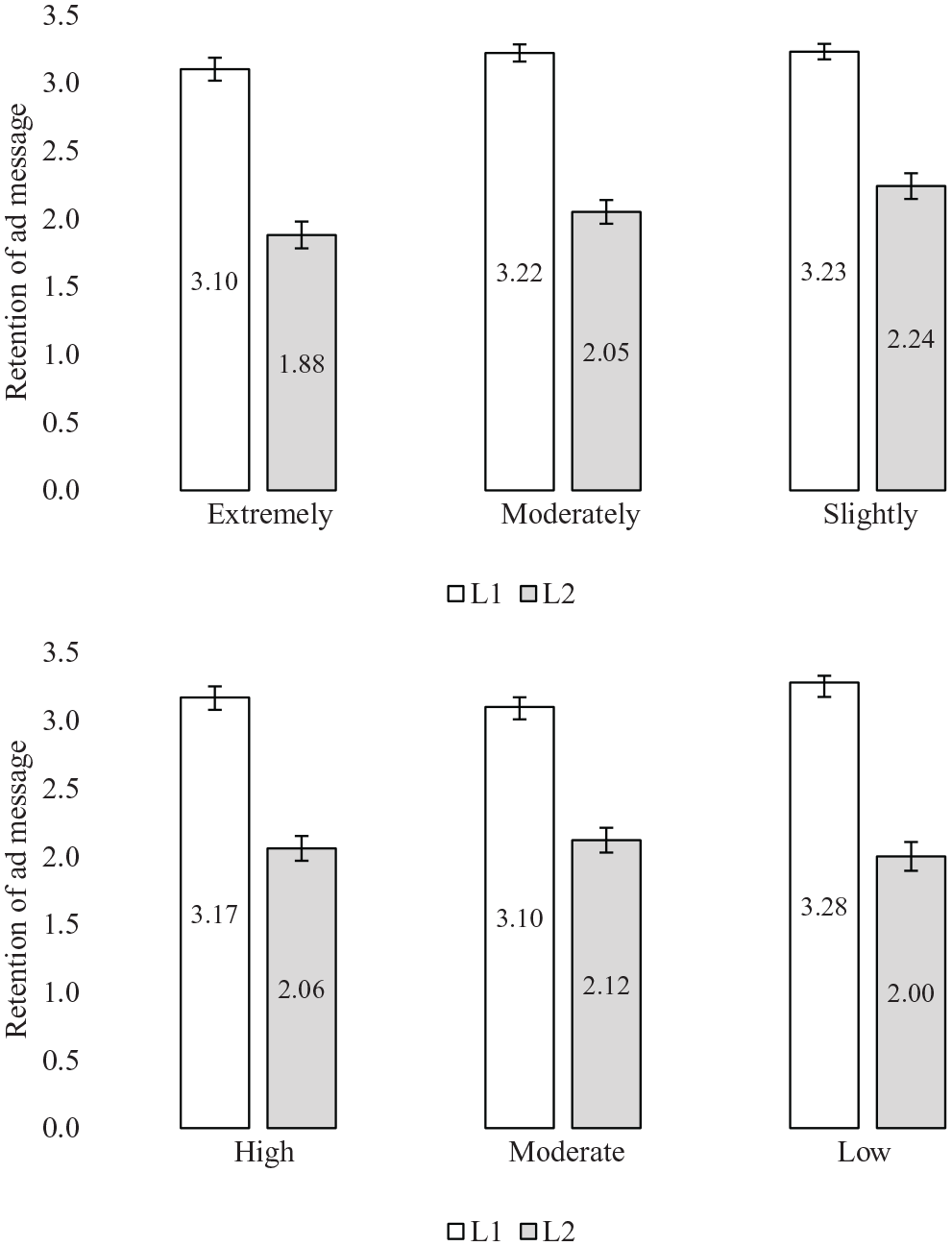
Retention in L1/L2 by the levels of liking for the advertising message (upper) and involvement with the advertised product (lower).

Reason for liking L1/L2 advertising messages across the sample (upper) and the three levels of liking for the L2 ad (lower).
Retention in L1/L2 by involvement with the advertised product
Involvement with the advertised sports drinks ranked high across the sample (M = 5.41, SD = 0.77), but did not correlate with retention in either L1 [rL1 (150) = 0.024] or L2 [rL2 (150) = 0.053, both ps > 0.05].
A tri-partition set the high (M = 6.29, SD = 0.39), moderate (M = 5.40, SD = 0.15), and low involvement (M = 4.64, SD = 0.55) groups for the L1 advertisement, F (2, 147) = 212.889, p < 0.001. For the advertisement in L2, involvement levels were: high (M = 6.16, SD = 0.43); moderate (M = 5.35, SD = 0.13); and low (M = 4.55, SD = 0.72), F (2, 147) = 136.642, p < 0.001. Not only in subjects’ L1 the retention scores were homogeneous across the involvement levels (F (2, 147) = 1.735, p = 0.180), but also in their L2 (F (2, 147) = 0.389, p = 0.679). Lower Figure 1 depicts these results (H2b).
Retention by L2 competency and length of residence
The IELTS score of a bilingual did not correlate with their L2 retention, r (150) = 0.054, p = 0.511. A tri-partition process, determined the three distinct L2 proficiency groups as good (M = 7.29, SD = 0.34), competent (M = 6.61, SD = 0.21), and modest user (M = 6.01, SD = 0.38), F (2, 147) = 190.329, p < 0.001. The retention of the L2 advertisement did not differ by L2 proficiency, F (2, 147) = 0.026, p = 0.974 (H2c). However, the length of a bilingual’s residence at the L2 environment correlated with [r (150) = 0.190, p = 0.019] and predicted L2 retention (F (1, 150) = 5.623, p = 0.019, R2 = 0.036). These results suggest a longitudinal effect of L2 environment on the processing of L2 advertising messages.
Discussion and conclusion
Bilingual populations and subgroups in immigration countries have sociolinguistic implications for advertisers. In this research, we experimented with a sample of Chinese–English bilinguals to examine their retention of a broadcast TV advertisement in their L2. Theoretical evidence suggests that message-processing is hardly natural in L2; forceful instead, for the level of cognitive involvement required. Findings from advertising research with bilinguals converge with such conceptualisations. Nevertheless, it is still unclear whether this holds for audio-visual advertisements due to the prevalent priming for reading in earlier designs that employ print stimuli for the assessment of L2 advertisement memory (see Appendix).
Our experiment proved our expectation correct with its findings being in line with the indications of L2 acquisition theories and earlier advertising research that use print messages. The retention of the TV advertisement in L2 was lower than that in L1 (H1). For more insight into this predictable result (Weijters et al., 2017, p. 123), we looked at retention through L2 proficiency, product involvement, and advertisement likability lenses (H2a, b, and c, respectively). We also assessed retention by the length of residence in the L2 environment. Our results were partly congruous with and partly divergent from the results that past studies report.
A few caveats thwarted our design, however. The scholarly literature from L2 acquisition and advertising domains suggests that there are other covariates of retention, such as motivation (Wyer Jr, 2002), besides the independent variables we observed. While the behaviourism line of the two domains also suggests that repetition (of a stimulus) increases cognitive processing and retention (response) through associative learning (Kargozari & Faravani, 2018), subjects in our sample watched the advertisements only once due to restraints on time and laboratory availability. Additionally, some decisions that we made on internal validity might have limited the utility of our findings; but these could be avenues for future research. For example, we did not observe the memory effect of advertising discourse with different CW/GL ratios, and none of our advertising messages contained a code-switched input. On code-switching, we were informed of the applications of MM in bilingual advertising and its socio-communicative effects on bilinguals but could not resource a sports drink advertisement for either of the two brands we used in our experiment. Studies using print advertisements have shown that motivation and code-switched inputs can result in higher memory levels in L2 regardless of the medium; and that an advertising message with a high CW/GL ratio is more likely to influence behaviour through facilitating message processing (Zhang et al., 2017). Moreover, our experiment nullified the effects of some source related factors as we picked the two sports drink advertisements with identical durations and similar executions (e.g. sports celebrity).
Theoretical contributions
The contributions that our work makes at a theoretical level are twofold. First, it used an informational TV advertisement for a real product that required a bilingual sample to rely on multiple language skills for an L2 memory assessment. However, our results were no different from those of existing studies that test L2 advertisement memory through reading comprehension tasks using informational print manipulations for mock (e.g. Ahn & La Ferle, 2008) or real brands (e.g. Gerritsen et al., 2010). Future research assessing L2 retention using informational or transformational broadcast advertisements might, therefore, consider repeated exposures over time to measure attitudinal change, as well.
Second, we took multiple linguistics and L2 acquisition models into account when determining the stimuli for our experiment. The TV advertisements we used (i.e. Gatorade/Powerade for control/treatment groups) were technically (e.g. similar executions) and linguistically alike (e.g. homogeneous CW/GL ratios). In comparison, seminal advertising research that informed us has typically used one conceptualisation. For instance, Luna and Peracchio (2002)’s design tests the RHM while the authors’ further studies use the MM (Luna & Peracchio, 2005a, 2005b).
Exposure to audio-visual advertisements exercises listening and reading skills, and such messages can reach their audience viscerally by using emotional appeals (e.g. joy and fear) or music (Belch et al., 2019). Thus, we believe considering multiple theories, each of which explains a facet of message-processing in L2, could be an avenue for similar future inquiries. For example, a pair of unlooked-for results we observed indicated that another theory, which neither the present nor earlier studies took into consideration, could underpin research on advertising to bilinguals. We find that not only the Chinese–English bilinguals residing for longer in New Zealand retain more of an English advertisement, but also those who like the English advertisement more report content features (e.g. story uniqueness) as the main reason for their liking. Given that we observed young adult Mandarin-dominant bilinguals who possibly learned English language in formal settings, these findings lend support for the Input Hypothesis (IH) by Stephan Krashen, which is an L2 acquisition theory prioritising meaningful interactions for the acquisition of information. According to the IH, an L2 speaker with a form-focus learning-experience knows the rules of the L2 grammar but is unable to use them, or they stammer in interactions. On the other hand, those with a meaning-focus learning-experience facilitate the rules in practice but are unable to verbalise them (Krashen, 1985). In sum, the theory highlights the importance of the external environment in processing the meaning conveyed in an L2 message. This relates to the acculturation process of foreign-born settlers in L2 environments (e.g. immigrants and those on student or work visa). Therefore, longitudinal designs to observe the effect of acculturation on, for example, bilinguals’ processing and memory of, and attention to message content in L2 advertising can be interesting topics to study.
Practical implications
From a sociolinguistic point of view, ceteris paribus, return on hefty communication investments requires organisations to consider the implications that linguistically diverse consumer groups bear for them. Such implications stem from two recent social developments. The communication-related first of these developments is the media’s expansion to the digital world. Conventional benefits of the tandem use of aural and visual inputs notwithstanding, broadcasts over the Internet bring new advantages to the advertisers of products such as wider reach and immense measurable data for the optimisation of communication strategies. Second, the number of bilinguals travelling overseas to live, work, or study is metamorphosing the socio-cultural composition of populations. For example, one in four New Zealanders is foreign-born (Stats NZ–Tatauranga Aotearoa, 2014), and Samoan and Hindi are the most commonly spoken foreign languages in this bilingual country that officially speaks English and Māori (Education Review Office, 2018, p. 12). In Australia, where one in three is foreign-born (Australian Bureau of Statistics, 2019; Pearlman, 2017), the two predominantly spoken foreign languages are Mandarin and Arabic (Australian Bureau of Statistics, 2017). Rests at the intersection of these two social factors, findings from our research are meaningful; they can aid strategic decision-making for optimising the communication (e.g. belief reinforcement) and behavioural goals (e.g. sales) of the commercial sector.
Televised advertising in a bilingual’s L2 led to lower advertisement memory. Our findings also indicate that reaching a bilingual audience viscerally in their L2 could change that, but in a way contrary to the theoretical and empirical indications. We find bilinguals, who enjoy the L2 advertisement more, report content elements as the main reason for their liking; however, they retained less of the advertisement form and content. Those who stated lesser enjoyment, on the other hand, mentioned emotional and music elements in the execution of the advertisement as their main reason for less liking, but they had significantly high memory levels. It seems, therefore, that enjoying an L2 advertisement does not necessarily yield higher levels of memory. These results necessitate careful reading because we exposed subjects to TV advertisements in their L2 only once. Even so, our findings offer some takeaways for firms on limited budgets that could afford low frequency for their advertisements targeting bilingual markets. Our results show that bilinguals tend to focus on form and have selective attention to content for central processing, rather than peripheral processing. Such processing is effortful in L2, and we found that even when that is achieved, the message was not retained for long. Conversely, execution techniques priming for peripheral processing led to more of the L2 message being retained. Accordingly, aiming for higher audience retention by using concise and straightforward messages that amplify processing through the use of advertising appeals could yield a payoff for such firms’ communication investments. Of course, brands could bypass the implications of advertising to bilinguals by designing their TV or Internet broadcast advertisements with minimal discourse using animated visuals with a complementing music appeal. However, whether this might work for informational (e.g. as in smartphone advertisements) or transformational messages (e.g. as in carbonated drink advertisements) could be revealed by future investigations.
Footnotes
Appendix
Influential research on advertising to bilinguals by stimulus, sample size, and language focus/skill

| Study | Stimulus | Sample size | Language | Cited by | |
|---|---|---|---|---|---|
| Focus | Skill | ||||
| Luna and Peracchio (2001) | Static–Inf. (T, P) | 168 (study 1/2 = 83/85) | Spanish–English | R | 248 |
| Luna and Peracchio (2005a) | Static–Inf. (T)1, 2 | 70 | Spanish–English | R | 223 |
| Krishna and Ahluwalia (2008) | Static–Inf. (T, P) | 320 (study 1/2 = 198/122) | Hindi–English | R | 167 |
| Noriega and Blair (2008) | Static–Tra. (T, P) | 341 (study 1/2 = 82/259) | Speakers of several languages – English (study 1), Spanish–English (study 2) | R | 148 |
| Luna and Peracchio (2005b) | Static–Inf. (T)1,2 | 161 (study 1/2 = 105/56) | Spanish–English | R | 102 |
| Ahn and La Ferle (2008) | Static–Inf. (T, P) | 236 | Korean–English | R | 97 |
| Gerritsen et al. (2010) | Static–Inf. (T, P) | 715 | Speakers of several Western European languages – English | R | 78 |
| Luna and Peracchio (2002) | Static–Inf. (T, P) | 133 (study 1/2 = 46/87) | Spanish–English | R | 63 |
| Bishop and Peterson (2010) | Static–Inf. (T) | 122 | Spanish–English | R | 39 |
| Zhang et al. (2017) | Static–Inf. (T) | 110 (study 2) | Chinese–English | R | 14 |
| Nicholls and Roslow (1996) | Non-static3 | 648 | Spanish–English | R, L | 12 |
| Foster et al. (1989) | Static (T, P)3 | 166 | Spanish–English | R | 10 |
| van Hooft et al. (2017) | Static (T, P) | 130 | Arabic–English | R | 9 |
| The present study | Non-static–Inf. | 304 | Chinese–English | R, L | |
Notes: studies in descending order of Google Scholar citations as of February 2020. Sizes of main studies involving bilinguals’ exposure to advertisement messages are shown; those of pre-test/pilot studies employing non-bilinguals or stimuli other than advertising messages excluded. For example, the appendix excludes 175 monolinguals in Foster et al. (1989)’s comparative study (Σn = 341). Similarly, Zhang and Schmitt (2004)’s study (in Journal of Consumer Research, vol. 31/June, 220–228) with 368 Chinese–English bilinguals is excluded for its stimuli (i.e. brand names; not advertisement messages); Inf., informational message (aims to gradually impart brand benefit beliefs by emphasising product benefits); L, listening; P, picture aid; R, reading; T, text; Tra., transformational message (aims to build positive brand attitude by evaluative conditioning); 1stimuli are brand slogans, not advertising discourse; 2most, not all, messages are Inf.; and 3source provides no information whether the message is Inf. or Tra.
Acknowledgements
During the time of the study, the author was with the Whitireia Community Polytechnic of New Zealand, Auckland Campus, as an English language teacher in the English as a Second or Foreign Language (ESOL) Department and she thanks them for their support and hospitality.The author thanks Dr Yao-Kun Liu (head, ESOL Department) of Whitireia Community Polytechnic, New Zealand (Auckland Campus) for their language assistance in transcribing the advertising discourse in Chinese, identifying the content words and grammatical lexica therein for analyses, and evaluating the code-switched responses few Chinese–English bilingual subjects provided. The author also thank Dr Yalım Özdinç (marketing lecturer, School of Business) of Whitireia Community Polytechnic, New Zealand (Auckland Campus) for his help during the preliminary study.
Declaration of conflicting interests
The author(s) declared no potential conflicts of interest with respect to the research, authorship, and/or publication of this article.
Funding
The author(s) received no financial support for the research, authorship, and/or publication of this article.
