




Abstract
Aims and objectives:
Social factors in language contact are not well understood. This study seeks to establish and explain the role of social entrenchment in the evolution of contact languages. It also aims to contribute to a broader perspective on areality that can account for social and linguistic factors in contact outcomes involving all languages present in multilingual ecologies, including contact languages.
Methodology:
The copula system was singled out for a detailed analysis. A corpus of primary data of the three African English-lexifier contact languages, Pichi, Cameroon Pidgin, and Ghanaian Pidgin, their ancestor Krio, and of their African adstrates (Bube, Mokpe, Akan) and European superstrates (Spanish, English) was investigated and compared.
Data and analysis:
Relevant features were selected for a dissimilarity matrix. A quantitative analysis was done with SplitsTree4. The resulting distance matrix and phylogenetic network were investigated for signals of genealogical transmission and areal diffusion and interpreted on their social background.
Findings/conclusions:
The copula systems of the three contact languages carry a genealogical signal of their ancestor Krio as well as an areal signal from the adstrates and superstrates spoken in their respective ecologies. The amount of areal borrowing increases in the order Pichi < Cameroon Pidgin < Ghanaian Pidgin, reflective of the depth of social entrenchment of each variety from left to right.
Originality:
Previous studies do not describe the copula systems of the English-lexifier contact languages of Africa and the Caribbean at a similar level of granularity and mostly focus on their emergence during creolization. This study attempts to explain their subsequent areal differentiation and links it to differences in social ecologies.
Significance/implications:
Areal borrowing can lead to significant departures from genealogically inherited structures within a short time if social entrenchment is shallow. Conversely, even languages of wider communication can remain remarkably stable if social entrenchment is deep.
Introduction
In the 19th century, speakers of the African English-lexifier contact language (AEC) Krio (Sierra Leone) established communities along the West African coast numbering but a few hundred individuals each. Pichi (spoken in Equatorial Guinea), Cameroon Pidgin (CamP), and Ghanaian Pidgin (GhaP) are three of the varieties that arose from the interaction of Early Krio speakers with local populations. Today, the West African AECs constitute a string of mutually intelligible varieties used by over a hundred million people across the region.
I will propose that social factors can account for varying degrees of differentiation of Pichi, CamP, and GhaP from their Early Krio ancestor. In the AECs with a deeper social entrenchment, genealogically transmitted features predominate. Conversely, in AECs with less social entrenchment, areally acquired features have become predominant. Social entrenchment is shorthand for a bundle of demographic, socio-structural, and socio-linguistic features defined in more specific terms in the sixth section.
The objectives of this study are twofold. The first is to add insights to the role of social factors in language contact and creolization, which are not yet fully understood (Yakpo, 2020). The second objective is to contribute to a more inclusive perspective on African areality that accounts for contact outcomes between all languages present in multilingual ecologies, including contact languages (see Güldemann, 2018, p. 510), and even European colonial languages (see Steien & Yakpo, 2020).
Pichi, CamP, and GhaP are prime candidates for testing the hypothesis of social entrenchment. All three predominantly serve as languages of wider communication in highly multilingual ecologies. At the same time, they are used as primary languages in an increasing number of domains, including in the home (Yakpo, 2016, pp. 224–227). However, there are significant differences in the way and the degree to which the three varieties have been socially entrenched in their respective ecologies (sixth section). This, I argue, has ramifications for the amount of areal borrowing that characterizes each variety.
In order to test this hypothesis, I analyze the copula systems of the three AECs, and their adstrates Akan and Mokpe in some detail (Pichi and Cameroon Pidgin section). The qualitative part is complemented by a quantitative phylogenetic analysis (fifth section), which includes Krio and additional contact strata (Bube, English, Spanish) to reflect a fuller range of possible input structures into the AECs. The results of the qualitative and quantitative analysis show that the presence of areal features in the three contact languages conforms to the ranking GhaP > CamP > Pichi, reflective of a corresponding degree of social entrenchment of each language.
Krio descends at least in part (the amount of which is controversial) from Proto-AECs brought to Freetown, the capital of Sierra Leone, by African-descended Americans at the turn of the 19th century (see Smith, 2017, for a recent overview). I hypothesize that Krio, in turn, passed on much of its copula system (and other parts of the grammar and lexicon) to Pichi, CamP, and GhaP in the course of 19th century migration and commerce on the West African coast driven by Krios. Krio is therefore included in this study to determine the extent of genealogical transmission to Pichi, CamP, and GhaP.
Pichi arrived on the island of Bioko (Equatorial Guinea) with African settlers from Sierra Leone from 1827 onwards (Granda, 1985). Shifters from its main adstrate Bube and multilingual Bubes today constitute the majority of Pichi speakers (Morgades Bessari, 2011). Pichi is the only African AEC to have a non-lexifier superstrate, namely Spanish, the official language of Equatorial Guinea (Yakpo, 2018). Spanish is therefore included in the analysis in order to identify possible superstratal areal diffusion to Pichi (see Labov, 2007, for the terms transmission and diffusion; Yakpo, 2017, for the rationale behind the terms adstrate and (non-lexifier) superstrate).
In all likelihood, CamP also descends from Early Krio (pace Schröder, 2013). Mokpe (Narrow Bantu, Sawabantu) has been spoken alongside CamP since the mid-19th century. It continues to be the main adstrate of CamP in its focus in the north-western littoral zone of Cameroon in complex patterns of multilingualism with CamP, English, and other closely related Sawabantu languages, such as Duala, Bafaw-Balong, and Bubia. Mokpe is included in this study to assess the extent of adstratal areal diffusion.
GhaP probably originated in a Krio-influenced AEC variety brought to Ghana from Nigeria in the course of colonial labor migrations at the turn of the 20th century (Huber, 1999, pp. 88–89). Today, GhaP is increasingly spoken as a lingua franca in the cities of Ghana next to its major adstrate Akan. The latter language is included to assess adstratal areal diffusion to GhaP. Finally, English is included to establish both genealogical transmission (via Krio) and areal diffusion to CamP and GhaP, since it serves as a lexifier superstrate to these two, but not to Pichi.
All examples stem from a corpus of naturalistic and elicited data that I gathered during field research in Equatorial Guinea, Cameroon, and Ghana between 2003 and 2019. I exclusively rely on primary data specifically collected for this study. The only other in-depth study of copulas in an African AEC (Nigerian Pidgin, Mazzoli, 2013) does not always provide data that allows comparison with the various foci of this study, although it contains a wealth of invaluable information on other aspects.
Areal features of West African copula systems
The split into nominal (‘she
The WALS and APiCS features do not, however, reflect the actual complexity of African systems. An English speaker has a lexical or stylistic choice between expressing the future (change of) state in a sentence pair, such as I’m gonna
(1) Gbékɛ̀ nɛ́ child this ‘This child will be(come) somebody one day.’
In Gã, copula suppletion is triggered by an aspectual-temporal change. It is required whenever the state of affairs to be expressed does not tally with the default tense–aspect–mood (TAM) values inherent to copula semantics. This value is best captured by the notion of ‘factative’ tense–aspect–modality (Welmers, 1973, p. 348). In the case of copulas and other stative verbs, +
A second trigger of copula variation in African languages is ‘time stability’ (Givón, 1979), which underwrites the pervasive nominal–locative split, and distinguishes ‘be something’ from ‘be somewhere,’ as in the Akan minimal pair sentences ɛ̀-
A third dimension of copula variation is polarity. Asymmetric copula negation involving suppletive forms is very common in the languages of West Africa and the Sahel (Winkelmann & Miehe, 2009, pp. 169–171). Copulas serve to talk about identifiable, known, often perceptible entities, and communicate the existence and placement of things and concepts in the physical and metaphorical worlds. A
Formal and functional features of the copula systems of the African adstrates and European superstrates are explored in the third section, followed by a comparative analysis of the systems of CamP, Pichi, and GhaP in the fourth section.
Copula systems in the African adstrates and European superstrates
We are interested in contact outcomes in the AECs due to (1) genealogical transmission from the common ancestor Krio, and the lexifier English, and (2) areal diffusion from adstrates and superstrates. This section therefore presents comparative analyses based on field data of the copula systems of Akan (Akan (Ghana) section), Mokpe, and Bube (Mokpe (Cameroon) and Bube (Equatorial Guinea) section). Relevant features of the well-known systems of English and Spanish are summarized in the English and Spanish section.
Akan (Ghana)
The distribution of Akan copulas is given in Figure 1. Henceforth, I use the abbreviations ±
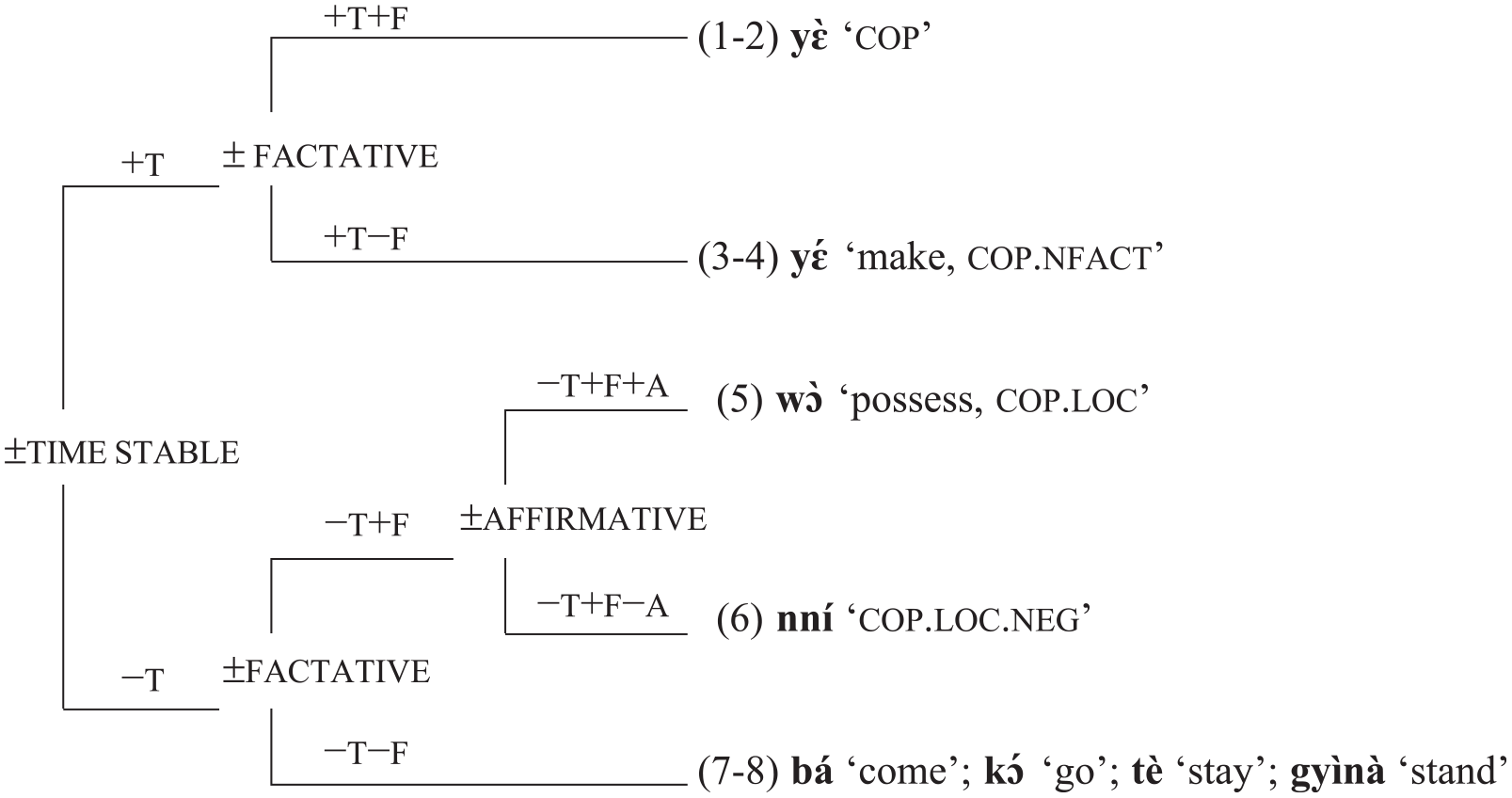
Copula distribution in Akan.
The basic split between nominal (2) Ɔ̀- ‘She’s a teacher.’ (3) Wó mààmé ‘Is your mother home?’
Only the locative copula has a negative suppletive counterpart nní ‘
(4) Dààbí, mé mààmé ‘No, my mother isn’t home.’ (5) Ɔ̀- ‘She’s not the teacher.’
Akan is an aspect-prominent language (Osam, 2008). Most tense readings arise by default via aspect marking. Akan speakers can nevertheless anchor both copulas in the non-present with the clausal particle ná ‘
(6) Ɔ̀kyéná, wó-bɛ́-dúrù Kùmásé nó, tomorrow ‘Tomorrow, (when) you arrive in Kumasi, I’ll be there already.’
When states of affairs are explicitly marked for −
(7) Àfé bààkṍ àkyí nó, mè- year one back ‘In a year’s time, I’ll be a teacher.’
The locative copula wɔ̀ may not be overtly specified for tense or mood categories either. A
(8) ‘I’ll come to [i.e. “be in”] Accra tomorrow.’ (9) Mé- ‘I won’t come to [i.e. “be in”] Accra tomorrow.’
Less central functions that are also expressed by copulas in European languages are equally rendered by semantically rich lexemes in Akan. A notable one is dì ‘eat,’ which expresses the exercise of a function (10), and is found in an areal pattern along the West African littoral (e.g. in Gbe, see Essegbey, 2015).
(10) Ɔ̀-
Lastly, Akan shows functional overlaps between
(11) Ɛ̀- ‘It’s a
Summing up, Akan has a rich system of copula suppletion conditioned by the values ±
Mokpe (Cameroon) and Bube (Equatorial Guinea)
The copula system of Mokpe, adstrate of CamP, corresponds to that of Pichi’s adstrate Bube in all crucial features (compare Figures 2 and 3). The only difference is that Bube alone shares the areal make polysemy found in Akan and GhaP, as I will show (see Appendix 1 for all features). The typological closeness of Mokpe and Bube is reflected in a corresponding proximity in the phylogenetic network in Figure 6. For the sake of expediency, this section therefore only covers Mokpe.
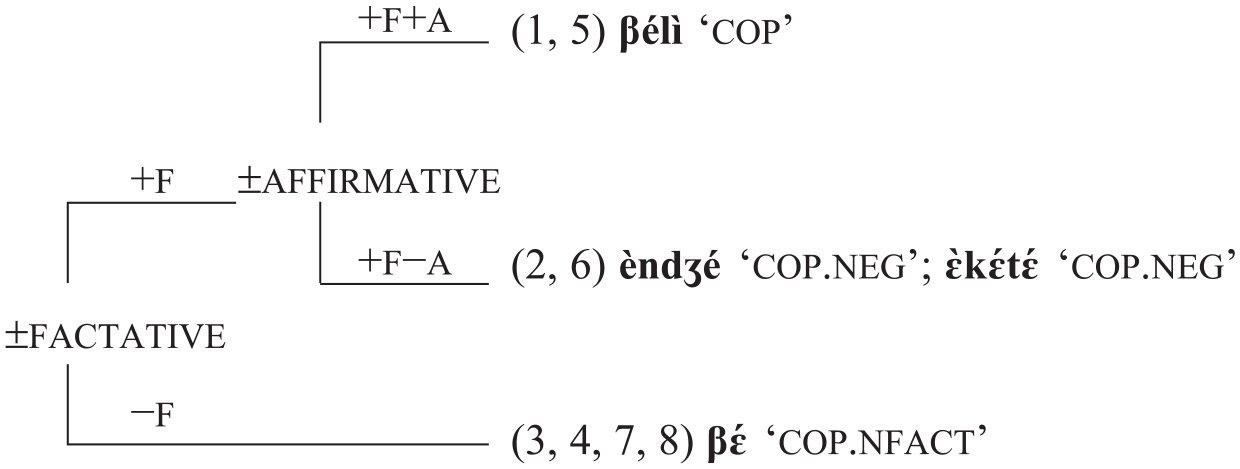
Copula distribution in Mokpe.
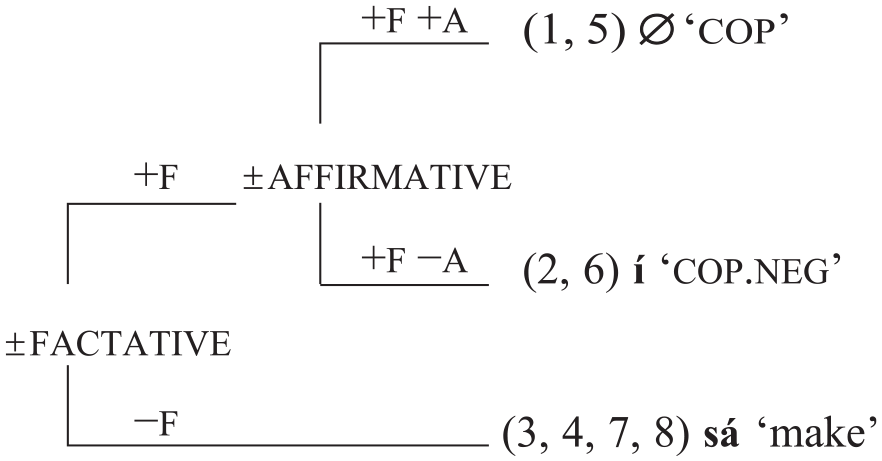
Copula distribution in Bube.
The Mokpe and Bube systems make three functional distinctions. Contrary to Akan, Mokpe and Bube show no ±
(12) À ‘He is a Mokpe person.’ (13) βá ‘They are at home.’
Mokpe nevertheless shows familiar patterns of suppletion. The inherently negative copulas èndʒé or ɛ̀kɛ́tɛ (see Atindogbé, 2013, pp. 129–130) are additionally negated symmetrically by the general negator zrá ‘
(14) À ‘He isn’t a Mokpe person.’ (15) βá ‘They are/aren’t at home.’
Further suppletion is encountered in
(16) βá ‘They’ll be home tomorrow.’ (17) Nà ‘I was a doctor (once).’
No further suppletion is encountered beyond the contexts presented above. The −
(18) Nà kòkí tɛ nà nà ‘When I grow up, I will not be a doctor, I will rather be a farmer.’
Mokpe also shows interactions between
(19) É *( ‘It’s
The compact nature of the copula system concurs with the fact that Mokpe copulas are semantically bleached. Evidence also comes from the wide-ranging functions of Mokpe copulas, for example, as progressive aspect markers and adjectival predicators, that is, à
English and Spanish
Most European languages, including English, have unitary systems with one copula covering nominal and locative predication. The ±
Other than the ±
Copulas in Pichi, Cameroon Pidgin, and Ghanaian Pidgin
Due to their similarity, Pichi and CamP are discussed together (Pichi and Cameroon Pidgin section). GhaP, in turn, differs from Pichi and CamP in numerous ways and is therefore treated separately (Ghanaian Pidgin section). Findings will be discussed further in the fifth and sixth sections.
Pichi and Cameroon Pidgin
Figure 4 shows the distribution of copulas in Pichi and CamP. The italicized form nótò ‘
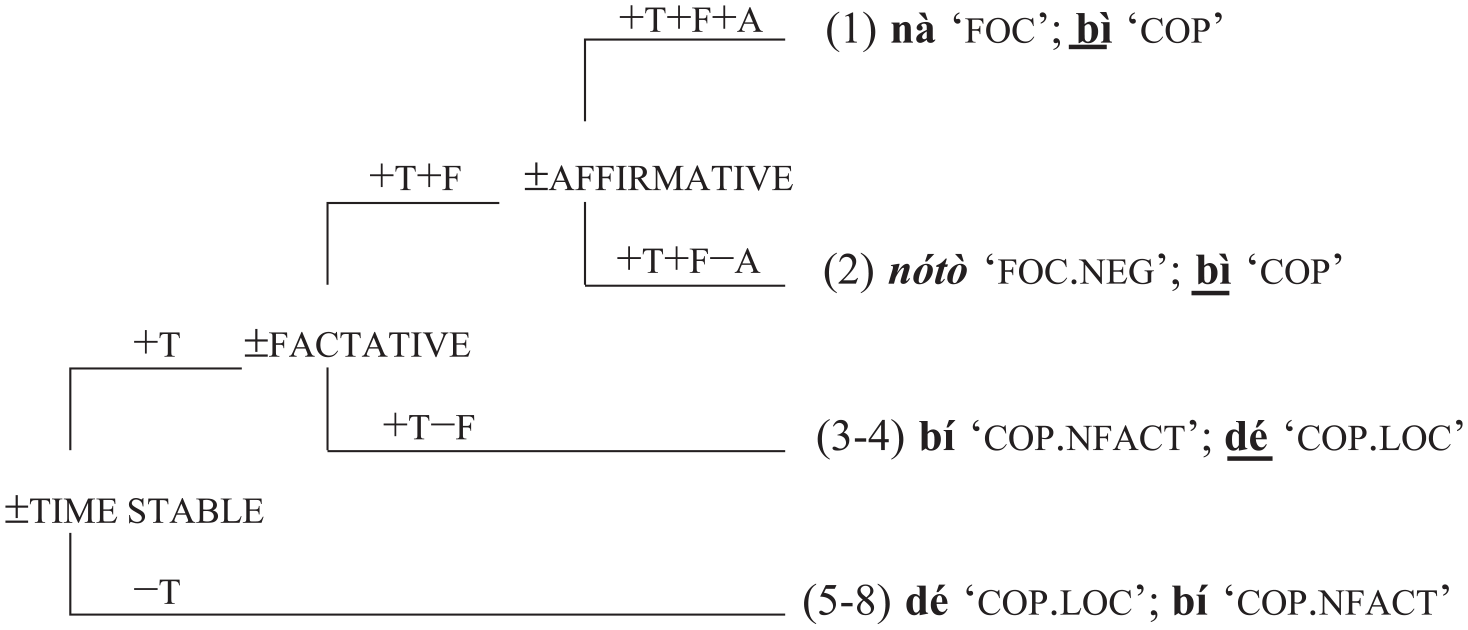
Copula distribution in Pichi and Cameroon Pidgin.
Four categorical distinctions are realized in Pichi and CamP. The default split between
(20) Ìn pàpá ‘His father is Ghanaian.’ (Pichi/CamP) (21) Mí à (nó) ‘As for me, I’m (not) Cameroonian’ (CamP)
CamP speakers negate +
(22) Ìn pàpá 3sg.poss father foc.neg Guinean ‘His father is not Equatorial Guinean.’ (Pichi)
Both nà ‘
(23) ‘That’s (not) my car.’ (Pichi)
On the
(24) Chíè tú chair too ‘A chair too is behind the table.’ (CamP)
The locative copula dé ‘
(25) Wàtá water ‘There’s no water there.’ (CamP) (26) Dì húmàn wé à ‘The woman that I was (with) in Moka (. . .)’ (Pichi)
CamP is the only of the three AECs in which the ±
(27) Ɔ́l dát sìmɔ́ sìmɔ́ stɔ́ dèm wé dèm yústù all that small ‘All those small stores that used to be next to the road.’ (CamP)
When
(28) È ‘She already is/has become a young lady.’ (Pichi)
By contrast, CamP features two distinct (29) Dát mán that man ‘That man was a
The immediate adjacency of a copula bí/dé and the focus marker nà is possible in (29) above because CamP is the only AEC to allow in situ focus. The existence of in situ focus in Mokpe (see (12) and (13)) makes it very probable that the strategy was transferred to CamP from the Sawabantu languages.
In summary, Pichi differs from CamP by retaining the
Ghanaian Pidgin
The copula system of GhaP shown in Figure 5 realizes three basic distinctions. GhaP differs from CamP and Pichi in a number of features summarized at the end of this section.
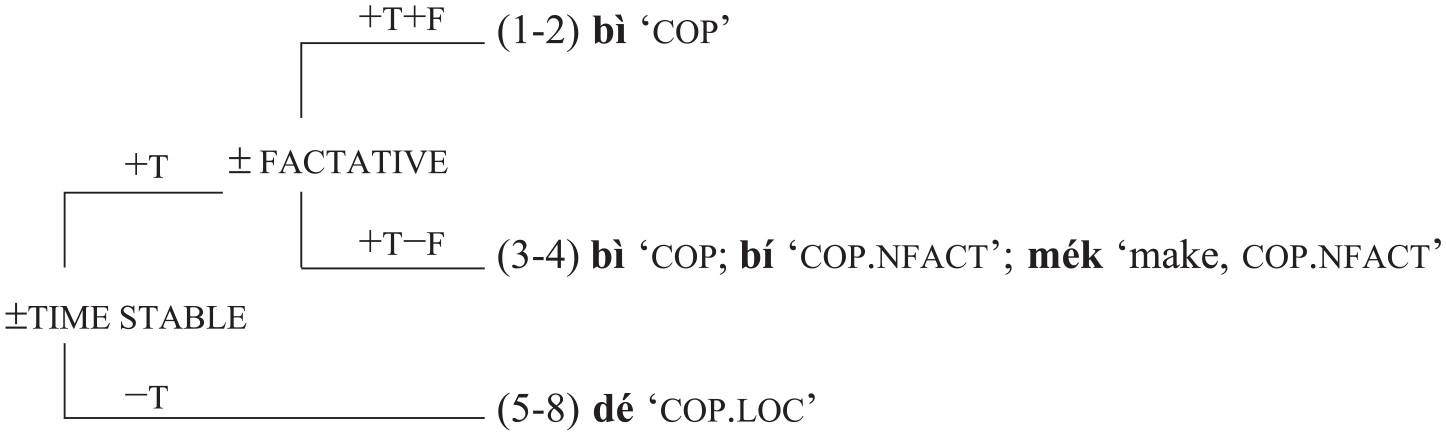
Copula distribution in Ghanaian Pidgin.
GhaP has the usual split system. The basic copula bì ‘
(30) Mà fɛ́s ném (nó) ‘My first name is (not) Thomas.’ (31) Wán dé, à one day ‘One day, I’ll be a lawyer.’
The −
(32) Dɛ̀ chɛ́ (nó) ‘The chair is (not) by the wall.’ (33) Éryà gáy-s, à nó háw à area guy- ‘(As for) the guys from the area, I know how I’ll be [behave] with them.’
GhaP has no dedicated past tense marker, unlike CamP and Pichi (cf. (29)). GhaP is, however, aspect-prominent like the other AECs and Akan. A −
(34) Mék yù nó shívà, ‘Don’t worry, by the time you reach Kumasi, (then) I’ll be there.’
The fuzzy polysemy of Akan yɛ̀ ‘
(35) À ‘I was [i.e. worked as] a carpenter for ten years in Togo.’
A second instance of selective copying from Akan is the use of another suppletive form, namely a high-toned bí ‘ (36) Ì ‘That’s how that guy is (i.e. It’s like that that guy is).’
GhaP also shows the usual functional links between focus and
(37) *(Ì) ‘This is
Further, GhaP has the eat polysemy, which includes ‘exercise a function’ (38). As in Akan, the present state is expressed through use of the completive aspect (see (10)). The office is assumed by the completion of metaphorical ingestion.
(38) Yù ‘You are the boss.’
The GhaP copula system shows a number of interesting innovations with respect to the other two AECs. GhaP has no focus marker cum identity-equative copula nà/ nótò ‘
Phylogenetic analysis of copula systems
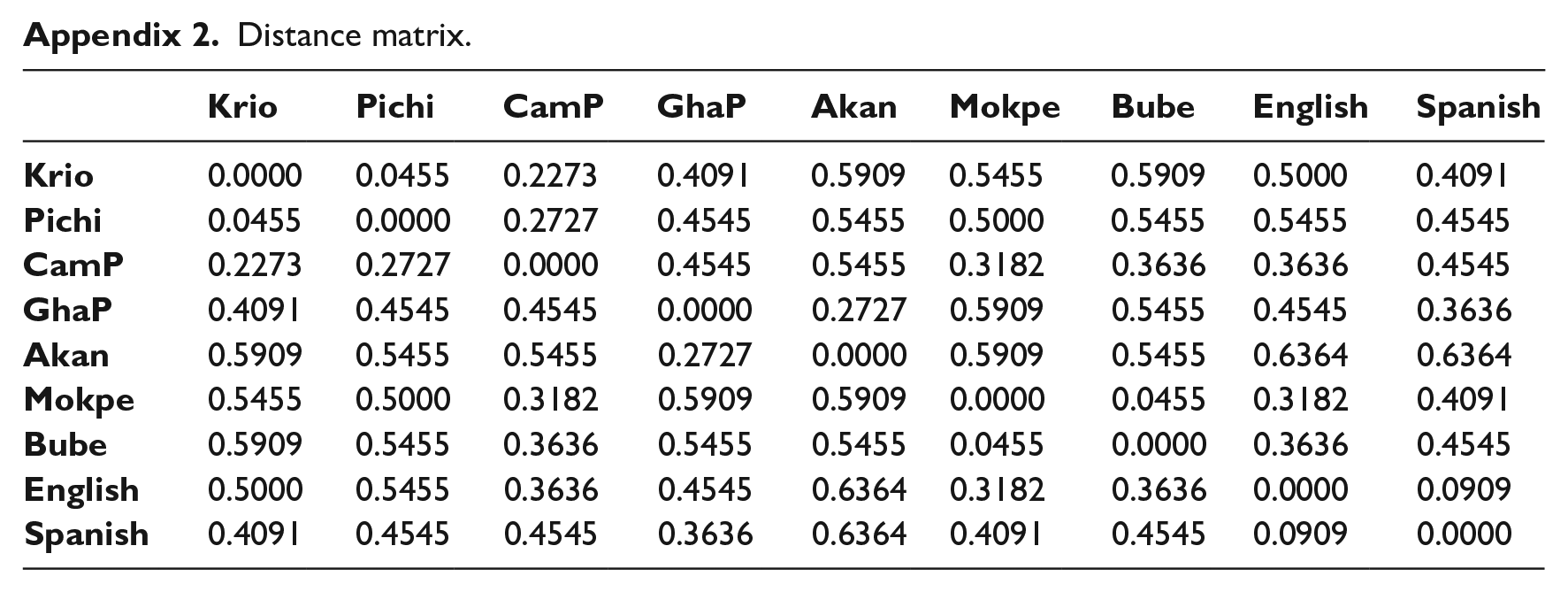
Figure 6 is a computational phylogenetic network analysis of the copula systems of the three AECs and their contact strata in order to determine and interpret their similarity (see Bakker et al., 2017, for previous applications to contact languages). The quantitative analysis was conducted with the Neighbor-Net algorithm contained in the software SplitsTree4 (Huson & Bryant, 2006). The analysis is based on the dissimilarity matrix in the Appendix 1, which contains 22 features discussed in the preceding sections. Features are checked for presence (‘1’) and absence (‘0’). Appendix 2 contains the resulting distance matrix. In order to assess the robustness of the results, a bootstrap with 100,000 replicates was run, that is, subsets of the data were randomly selected by the software and analyzed following the same algorithm. The degree of support for each split is returned as a percentage in Figure 6, so the higher the value, the more likely the split.
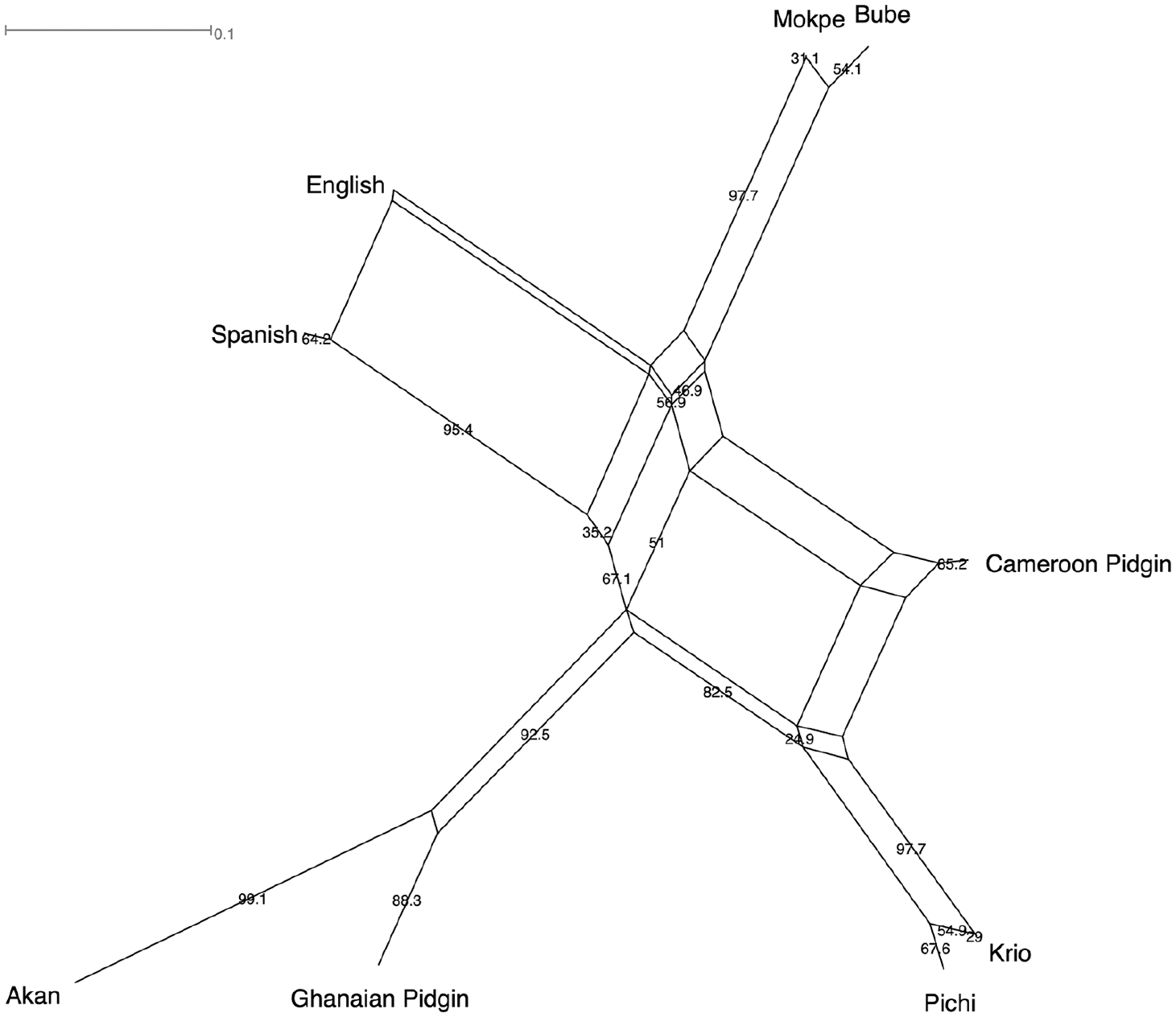
Phylogenetic Network (Neighbor-Net).
The phylogenetic network replicates recognized major genealogical divisions with sufficient confidence, confirming the relevance of the features in Appendix 1. The Bantu adstrates Bube and Mokpe are closely clustered on short terminal nodes. English and Spanish are also grouped together, albeit at some distance due to the absence/presence of a
Figure 6 allows extrapolations with respect to (A) genealogical transmission and (B) areal diffusion. The relevant rankings in Table 1 stem from Appendix 2 and represent the decrease in similarity relative to the leftmost language. Hence, Krio > Pichi > CamP (A1) can be paraphrased as ‘Krio is most similar to Pichi, followed by CamP.’
Genealogical and areal similarities.
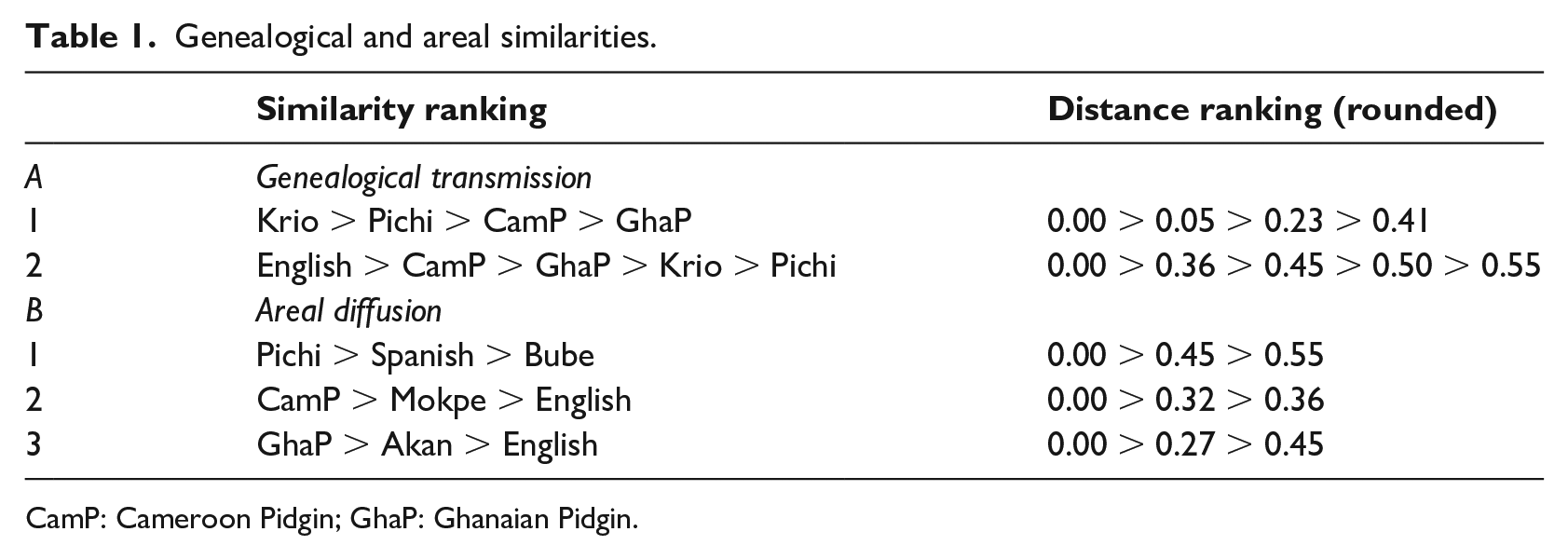
CamP: Cameroon Pidgin; GhaP: Ghanaian Pidgin.
Genealogical transmission
Krio, Pichi, and CamP are more similar to each other (A1) than to any other language through a number of shared genealogical features (1, 7, 9, 17–19 in Appendix 1). Krio is almost five times more similar to Pichi than to CamP, confirming the close relation between Pichi and Krio (cf. Yakpo, 2019, p. 1). CamP sits between Pichi and GhaP with respect to distance to the common ancestor Krio. By contrast, GhaP is an outlier. If we had no lexical (nor historical) evidence, GhaP could be seen as a genealogical relative of Akan. English seems to have left no conspicuous genealogical traces in the AECs (A2). The greater similarity between English and CamP than between English and all other AECs in A2 is due to the erosion of the time stability split in CamP (features 1 and 11). CamP, Pichi, and GhaP are significantly more similar to Krio than to English, despite some probable areal diffusion from English to the AECs (see below).
Areal diffusion
Pichi’s distance with Bube equals that with Akan (B1), although there is no areal relationship with the latter language (see Appendix 2 for distances not contained in Table 1). The absence of discernible areal transmission from Bube and Spanish to Pichi attests to a strong founder signal from Krio in Pichi. On the one hand, the greater similarity of Pichi to Spanish than to Bube therefore stems from the fortuitous typological parallel of a time stability split between the former two (features 1 and 11). On the other hand, the vitality of the time stability split in Pichi despite cohabitation with Bube (which does not have the split) might also be due to its reinforcement through contact with Spanish. With respect to areality, CamP is again on the middle ground. CamP is about equally similar to Mokpe and English (B2), showing partly overlapping areal diffusion from both adstrate and superstrate, manifest in the porousness of its time stability distinction (features 1 and 11) and the presence of in situ focus (feature 16).
GhaP is far more similar to its areal cohabiter Akan than to its most similar relative Krio (B3) due to numerous areal correspondences not shared with the other AECs (features 2, 8, 13, 17, 20, 22). If we take Pichi as the baseline, which has no areal relationship with English, areal diffusion to GhaP from its superstrate English is also significant (features 4, 12, 18), albeit far less so than from Akan. The analysis in this section confirms the split between Pichi with its genealogical profile on the one hand, and CamP and GhaP, with their progressively more areal profiles on the other. I interpret these findings qualitatively within their social ecologies in the sixth section.
Social entrenchment and the outcomes of areal contact
In the first section, I proposed the hypothesis that the degree of ‘social entrenchment’ of an AEC determines how much change it undergoes due to areal diffusion. Table 2 presents socio-structural, and socio-linguistic factors of social entrenchment. The last line shows an important linguistic outcome for the three AECs in question.
Social entrenchment factors and linguistic outcomes.
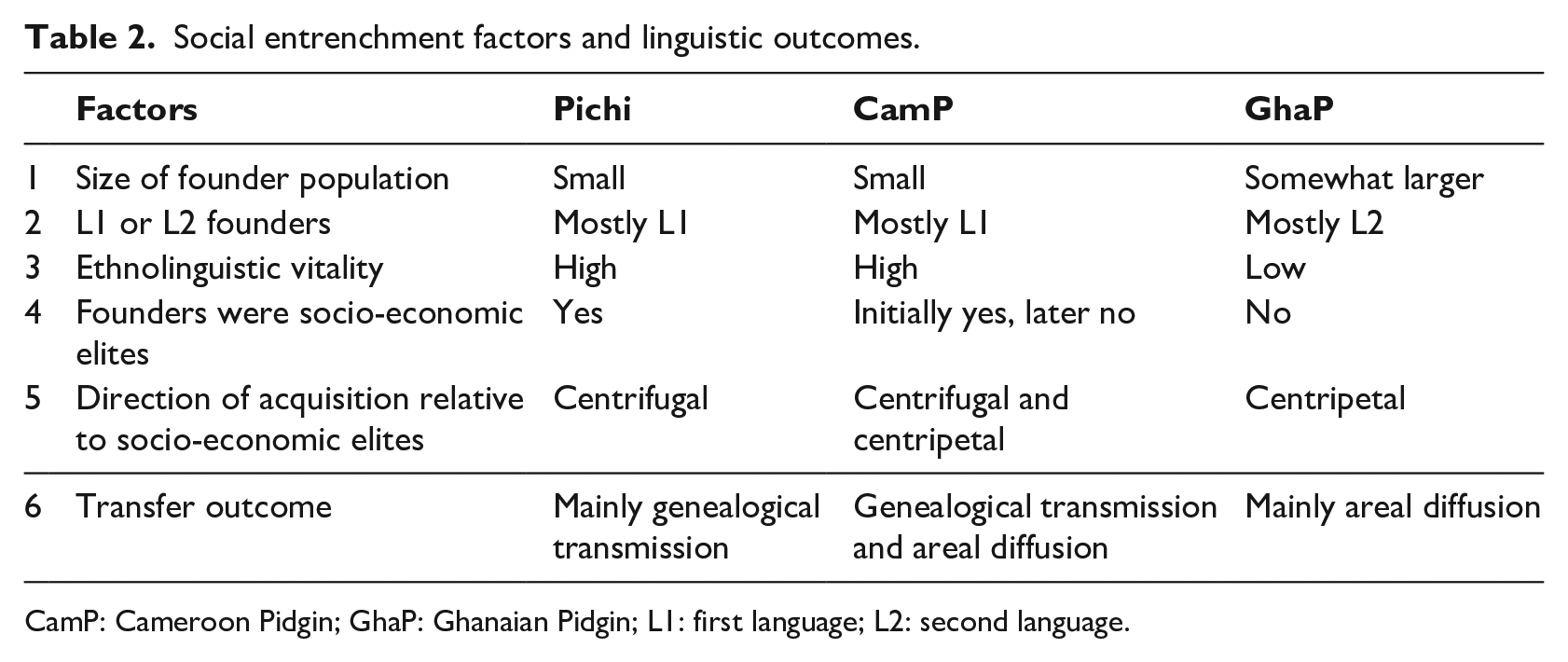
CamP: Cameroon Pidgin; GhaP: Ghanaian Pidgin; L1: first language; L2: second language.
Emanating from Freetown, Sierra Leone, a Krio population of a few hundred souls each settled in the British-occupied coastal trading towns of Port Clarence (Malabo) in Bioko, Equatorial Guinea, Duala, and Victoria (Limbe), Cameroon, in the mid-19th century (see Fyfe, 1962, for the historical background; Hancock, 1987, pp. 273–274) (factors 1-2 in Table 2). The Krio communities had a strong group identity and correspondingly high ethnolinguistic vitality (factor 3). Krio broker communities subsequently rose to prominence as artisans, merchants, planters, Christian missionaries, educators, and administrators in the interstices of European colonialism. The Krio language became associated with the economic and symbolic sphere of European colonial power (factor 4).
Krio concomitantly percolated from its first language (L1) focus to an ever-growing population of second language (L2) users initially through frontline workers of the colonial economy (plantation workers, artisans, foremen, porters, sailors, dockers, drivers, market women, and traders) and colonial auxiliaries (soldiers, police), then to further sections of the population.
The ‘founder’ position (cf. Mufwene, 1996) of the Krio people and the social entrenchment of their language was so strong that the exponential acquisition of new L2 speakers in the 20th–21st centuries has not altered the copula grammar of Pichi at all, and only partially that of CamP. This despite widespread multilingualism in African adstrates and a considerable lexical anglicization of CamP in the course of the last century or so (Sala & Ngefac, 2006). Neither a corresponding Hispanization (Yakpo, 2018) nor large-scale language shift from Bube to Pichi have had any such effect on Pichi either. One can therefore characterize the expansion of Pichi as a centrifugal one, outwards from a numerically small but focused nucleus with a high ‘ethnolinguistic vitality’ (Giles, 1979) to a numerically preponderant socio-economic periphery (factor 5).
In Cameroon, the founder population, however, soon lost its ethnolinguistic vitality and socio-economic pre-eminence. The focus of CamP has today shifted to multilingual non-founder populations in inland urban centers, such as Buea, Kumba, and Bamenda (compare the surveys in Mbangwana, 1983; Schröder, 2003, p. 83ff.). This is why the dynamics of CamP’s expansion may be characterized as centrifugal and centripetal. It is this centripetal expansion that is responsible for the greater adstrate imprint in the copula system of CamP than in Pichi.
The dynamics of GhaP are, in turn, entirely centripetal. A pool of L2 speakers numbering several thousand colonial migrant laborers introduced a Krio-descended Proto-GhaP to Ghana from Nigeria in the early 20th century (Huber, 1999, pp. 126–129). Krio-speaking populations already installed in colonial Ghana at that time did not play as prominent a broker and elite role in the colonial economy as in Equatorial Guinea and Cameroon (Lynn, 1992, p. 424). Only the migrant laborer variety therefore spread to urban workers, the military, and police without the normalizing and focusing influence of Krio elites. In the 1970s, GhaP was adopted by educated adolescents and young adults, hence, members of the socio-economic elites, as a socially restricted urban youth sociolect (see Osei-Tutu, 2014, for a summary of the literature). This Ghanaian Student Pidgin variety is now becoming ‘vernacularized’ (Cheshire et al., 2011; Stell, 2020), thus providing a new focus for contemporary acquirers of GhaP.
The centrifugal and centripetal dynamics of the three AECs are reflected in differing transfer outcomes (see row 6 in Table 2). The centripetal expansion of GhaP has favored copious borrowing from Akan (Osei-Tutu, 2018), typical of ‘emblematic language use’ in multilingual contact settings (Nassenstein & Dimmendaal, 2020). The centrifugal expansion of CamP, followed by a centripetal one, has led to the maintenance of core genealogical features, but areal diffusion from the adstrates and the superstrate English is also evident. In Pichi, the dynamics are entirely centripetal. There is no areal diffusion and the copula system shows an unbroken genealogical continuity with Krio.
In determining the relative importance of the factors listed in Table 2, it is useful to refer to the distinction between I-creoles (innovative idiolects) and E-creoles (accreted I-creole features shared by the speaker population) (DeGraff, 1999). The presence of an early norm-setting population with a high ethnolinguistic vitality (factor 3) and socio-economic capital (factor 4) meant that all too innovative I-creole features of L2 speakers did not enter the E-creole Pichi. Conversely, the absence of such a population in Ghana meant that innovative I-creole features could easily spread to and sediment in the E-creole. CamP represents the middle ground.
Socio-economic stratification (factors 4-5) is therefore a more relevant determinant of social entrenchment than speaker demography (factors 1-2) and group identity (factor 3) (see Yakpo, 2020). Soft social boundaries existed between Krio and resident populations in colonial West Africa (Aranzadi, 2016; Wyse, 1989). Most Krio E-creole features were therefore passed on to the I-creoles of L2 acquirers, irrespective of group size. Predominantly genealogical transmission also obtained in the expansion of other high-contact languages with small and powerful founder populations, yet with somewhat permeable social boundaries (e.g. Hindustani, Dua, 2006; Spanish in the Americas, Sessarego, 2017).
By contrast, social boundaries in the European enslavement colonies of the Caribbean were hard. The demographic preponderance of L1 speakers of African languages during crucial periods and their uses of innovative I-creole features could therefore accrete into a variety (the Creole) with many areal (African substrate) features. Contemporary Krio is therefore typologically more distant from the European lexifier (Krio > English = 0.50 difference) than from its most distant AEC relative GhaP (Krio > GhaP = 0.41 difference).
Given the above, the question arises whether the differences between the three varieties in susceptibility to areal diffusion also reflect the tripartite distinction between Creole (Pichi), Pidgincreole (CamP), and Pidgin (GhaP). In social terms, the absence of a L1 community has indeed characterized GhaP since its beginnings. The Early Krio/Proto-CamP L1 community was also quickly submerged by L2 speakers before regaining L1 speakers anew in the recent past.
However, we have no clear structural evidence for the distinction, at least not in the copula system. The reduction of form inventories is commonly adduced as evidence for Pidgin status (Bakker, 2008, pp. 37–38). At first glance, the GhaP copula system indeed looks leaner than that of Pichi and CamP (Figure 5). However, the absence of the Krio/Pichi forms nà/nótò (Figure 5) in GhaP mirrors the absence of an equivalent
Regular ‘feature selection’ (Aboh, 2015; Mufwene, 1994) through contact with English rather than pidginization-specific reduction is the source of further contraction in GhaP with respect to the Krio base system. Uses of bì/bí as generic nominal copulas in
Detailed studies of additional functional domains are necessary in order to test the validity of the distinction between Creole, Pidgincreole, and Pidgin. Pending this, it is useful to employ the umbrella term ‘(English-lexifier) contact languages,’ as I do in this study.
Concluding remarks
A qualitative and quantitative analysis of the copula systems of the AECs Pichi, CamP, and GhaP shows genealogical continuities with Krio in the order Pichi > CamP > GhaP. Conversely, the three languages show areal correspondences with their respective adstrates and superstrates in the reverse order, GhaP > CamP > Pichi. The AECs have served as a prism for uncovering areal tendencies in the expression of
The findings of this study also underline the limited heuristic value of ‘creole exceptionalism’ (see DeGraff, 2003, for a summary of the debate). If we had no sociohistorical nor lexical evidence of the genealogical relationship of GhaP and CamP with Krio and English, their copula systems would provide little if any indication of the extraneous origins and lingua franca functions of these languages. On the backdrop of such areal dynamics, the very notion of ‘contact language’ becomes elusive.
Abbreviations
- = morpheme boundary;
. = separates different meanings of the same morpheme;
: = separates meanings of a segmental and suprasegmental morpheme;
1/2/3 = 1st/ 2nd/3rd person;
ó = high tone;
ò = low tone;
a = affirmative;
aec = African English-lexifier contact language(s);
CamP = Cameroon Pidgin;
compl = completive aspect;
cop = nominal copula;
def = definite article;
f = factative TAM;
foc = focus (marker);
fut = future tense;
GhaP = Ghanaian Pidgin;
inan = inanimate;
indf = indefinite article;
indp = independent/emphatic personal pronoun;
intj = interjection;
lnk = possessive linker;
loc = locative (preposition);
name = personal name;
neg = negative;
nfact = non-factative;
pfv = perfective aspect ;
pl = plural number;
place = place name;
poss = possessive case;
pot = potential mood;
prep = general associative preposition;
prf = perfect aspect;
prs = present tense;
pst = past tense;
rep = repetition;
sbj = subject case;
sbjv = subjunctive complementizer;
sg = singular number;
sp = (pragmatic) sentence particle;
sub = subordinator;
t = time stable;
then = non-present tense marker.
Footnotes
Appendix
Distance matrix.
| Krio | Pichi | CamP | GhaP | Akan | Mokpe | Bube | English | Spanish | |
|---|---|---|---|---|---|---|---|---|---|
|
|
0.0000 | 0.0455 | 0.2273 | 0.4091 | 0.5909 | 0.5455 | 0.5909 | 0.5000 | 0.4091 |
|
|
0.0455 | 0.0000 | 0.2727 | 0.4545 | 0.5455 | 0.5000 | 0.5455 | 0.5455 | 0.4545 |
|
|
0.2273 | 0.2727 | 0.0000 | 0.4545 | 0.5455 | 0.3182 | 0.3636 | 0.3636 | 0.4545 |
|
|
0.4091 | 0.4545 | 0.4545 | 0.0000 | 0.2727 | 0.5909 | 0.5455 | 0.4545 | 0.3636 |
|
|
0.5909 | 0.5455 | 0.5455 | 0.2727 | 0.0000 | 0.5909 | 0.5455 | 0.6364 | 0.6364 |
|
|
0.5455 | 0.5000 | 0.3182 | 0.5909 | 0.5909 | 0.0000 | 0.0455 | 0.3182 | 0.4091 |
|
|
0.5909 | 0.5455 | 0.3636 | 0.5455 | 0.5455 | 0.0455 | 0.0000 | 0.3636 | 0.4545 |
|
|
0.5000 | 0.5455 | 0.3636 | 0.4545 | 0.6364 | 0.3182 | 0.3636 | 0.0000 | 0.0909 |
|
|
0.4091 | 0.4545 | 0.4545 | 0.3636 | 0.6364 | 0.4091 | 0.4545 | 0.0909 | 0.0000 |
Acknowledgements
I am grateful to Aymeric Daval-Markussen and Pui Yui Szeto for help with the statistics, as well as Viveka Velupillai, Peter Bakker and Yèni Yakpo for critical comments on the manuscript. I am indebted to the following people for their crucial expertise during field work and data collection: Gratien Atindogbé, Levi Ekwa Mokake, Sabinus Chiravira, Senyo Gavu, Derek Asante Abankwa, Ignatius Suglo, Sampson Yeboah, Dorothy Pokua Agyepong, Mark Nartey, Bernard Ogini, and Michael Charles.
Declaration of conflicting interests
The author has no conflicts of interest to declare.
Funding
The author disclosed receipt of the following financial support for the research, authorship, and/or publication of this article: This work was supported by the Research Grants Council of the Government of Hong Kong (grant no. 17608819). The write-up was enabled through a Humboldt Research Fellowship for Experienced Researchers (2020–2021) at the Institute for Asian and African Studies of the Humboldt University of Berlin.
