



Abstract
Aims and objectives:
The goal of the article is to explore the properties of bilingual and multilingual situations with balanced, or non-polyglossic, relationships between languages in the modern Balkans. A comparison with non-balanced, or polyglossic, settings aims at determining the factors that support balanced bilingualism in one Balkan community and result in different dominance configurations in the others.
Methodology:
We focus, on the one hand, on the community’s inner diversity and the variation in linguistic competence among its individual members, showing how the differences of the various groups of speakers contribute to the maintenance of bilingualism in the community across several generations. On the other hand, we consider speech community as a unit of study and see how factors such as geographical location, size, and presence or absence of ties with the surrounding region, contribute to the loss or maintenance of community bilingualism and multilingualism in different parts of the Balkan linguistic area.
Findings:
The main case that is scrutinized is the situation of “balanced language contact” in a small-scale village community of Velja Gorana (Montenegro). Its analysis is based on field observations made in the bilingual families of Velja Gorana in 2013 to 2015. Besides, we overview a range of Balkan bilingual and multilingual communities, based on the existing literature, and analyse the patterns of (socio)linguistic dominance of the languages spoken in each community.
Originality:
The article provides a description of a balanced situation in the modern Balkans and offers a model for understanding of the Balkan bilingualism and multilingualism, taking into consideration several factors interacting at different levels, from individual speaker to the speech community.
Implications:
The proposed model explains the diversity of bilingual and multilingual situations of the modern Balkans. This enables us to make predictions about the ways of development of these situations and suggest how the past Balkan situations could have been organized.
Keywords
Introduction
The Balkans have been always considered an area of linguistic diversity and a significant contact zone, where the present-day condition of the Balkan languages and dialects 1 results from a variety of contact situations with different multilingual settings: “border-area” multilingualism (Matras, 2009, p. 48); language/dialect islands with asymmetrical relations between L1 and L2 2 ; language/dialect shifts, etc.
On the one hand, the multilingual ecologies of Europe and Asia “gave rise to a prominent model of bilingualism based on hierarchical relationships holding between languages and functional differentiations for them” (Lüpke, 2016, p. 41), which can be described in terms of diglossia and polyglossia 3 . Thus, the vast majority of the modern situations of language contact in the Balkans are – to a greater or lesser extent – of polyglossic type.
On the other hand, there is yet another particular type of contact situation, without hierarchical relationships of the languages involved. Situations of this type, referred to as “balanced language contact” in (Aikhenvald, 2007 4 ) and as “small-scale multilingualism” or “egalitarian multilingualism” in recent works (Lüpke, 2016; Singer & Harris, 2016), are widespread in the indigenous communities of Africa, Amazonia, Australia, Melanesia, and Southern Asia. In the Balkans, only a few cases can be found in modern times, but it is assumed by most researchers that in the past balanced, or non-polyglossic, multilingual situations could have particular importance for the emergence of convergent features in the Balkan languages and dialects (see e.g. Friedman & Joseph, 2017; Rusakov, 2007; Sobolev, 2017). The thorough (socio)linguistic descriptions of the present and past situations are nearly absent.
This article aims at exploring the properties of balanced language contact situations in the present-day Balkans. In our approach, we will focus, on the one hand, on the individual speakers, having in mind the objection that “[i]n an ideal world what happens at the micro level of the bilingual community should be the direct consequence of the behaviour of individual bilinguals” (Muysken, 2010, p. 267). On the other hand, we will consider speech community as a unit of study and see how factors such as geographical location, size, and presence or absence of ties with the surrounding area, contribute to the loss or maintenance of bilingualism and multilingualism within the community.
In our description of bilingual competence of the individual speakers, we will refer to the concept of language dominance, which is considered by many authors as crucial for determining types and degrees of bilingualism (Romaine, 1995, p. 15, see also the different possible definitions of this concept in the various studies on bilingualism: Silva-Corvalán and Treffers-Daller (2016); Schmid and Yılmaz (2018), and others). In this article, following Weinreich (1953) and van Coetsem (1988, 1995), we will distinguish between the sociolinguistic (“social” in van Coetsem’s works) and linguistic dominance of languages spoken in the investigated communities. The sociolinguistically dominant language is a language of power and prestige, which in the modern world is associated mainly, although not always, with the notion of the official, or state language. At the speech community level, the sociolinguistic dominance may influence the individual language behaviour of the community’s members. The linguistic dominance is expressed both in the level of mastering the language, or the language proficiency of the speaker, and in the frequency and degree of language use across domains, that is, speakers may be proficient in a language, but use it relatively rarely and scantily. At the level of the individual speaker, the linguistic dominance “. . .being based on language proficiency, is very much subject to variation and change” (van Coetsem, 1995, p. 81). In a bilingual or multilingual speech community, the linguistic dominance may be represented as a sum of individual dominance configurations of the members or as a prevailing tendency among them.
In the second section this framework is used to analyse the case of a small-scale community of Velja Gorana, a village in Montenegro not far from the Albanian–Montenegrin border. All natives of the village speak two languages, BCMS (Bosnian–Croatian–Montenegrin–Serbian) and Albanian, and relate themselves to the larger community of the Mrkovići, which is now almost entirely monolingual in BCMS. Based on the fieldwork data, we study the linguistic competence of individuals and the patterns of language use, both within and outside the village community. In the third section we discuss the place of such situations in the diverse range of the Balkan bilingual and multilingual settings with non-polyglossic and polyglossic relations between languages. We try to determine which extralinguistic factors support the balanced bilingualism à la balkanique or, on the contrary, the development of diglossia or polyglossia and a further shift to monolingualism.
Balanced bilingualism in the Albanian–Montenegrin border: Looking into the community of Velja Gorana
In this section we will scrutinise a balanced language contact situation, which is observed in the village community of Velja Gorana in Montenegro. The data were collected by one of the authors during the three one-week field trips to Velja Gorana in 2013 to 2015 5 .
In the course of the fieldwork, direct observations of community-internal language use were made in five of approximately 20 families (households) of the village. The researcher, who possessed Albanian and BCMS and regularly used both languages in communication with the interviewees, visited the families at home at noon, when the children were back from school, and stayed till the (late) evening, when the men were coming back from work. A speaker’s frequency of L1 and L2 use is assessed on the basis of amount of their use by the speaker throughout the day, in all family talks conducted in the presence of the researcher (not necessarily involved in the conversation). Based on these observations, the “preferred” or most frequently spoken language was defined for each speaker and the exposure of each participant of communication to one or the other language was also evaluated.
Additionally, unstructured interviews concerning the use of languages and the linguistic competence in the earlier periods of life were conducted with bilinguals from these families. The questions were related to L1 and L2 use in the family, in communication with neighbours in Velja Gorana and with relatives living in other villages, at work/school and in public places outside the community. Older speakers were also asked about the “history” of development of their bilingual competencies. As the survey was not supposed to produce the exact quantifiable results, the interviewees were not required to rate their self-reported language proficiency and frequency of L1 and L2 use on any scale. The answers were then interpreted on the basis of the same principles as the direct field observations.
The first subsection below gives the basic information about the geographical position and the population of Velja Gorana 6 , while the following subsections discuss the various components of the sociolinguistic situation in the village. In the second subsection we analyse the linguistic competences of the local bilinguals and propose a technique for description of the development of such competences during the life cycle. The third subsection focuses on communication in the bilingual families of Velja Gorana and considers the issues related to language choice. In the fourth subsection we consider the community’s external relations which also contribute to our model of a balanced bilingual community à la balcanique.
Location and population of Velja Gorana
The village of Velja Gorana (“big Gorana”, where the BCMS dialectal velja stands for “big”), is located in the southernmost part of Montenegro, between the towns of Bar and Ulcinj (see Map 1). The area is adjacent to the Albanian–Montenegrin state border established on the river Bojana (Albanian Bunë) in the aftermath of the Balkan Wars (1912–1913).
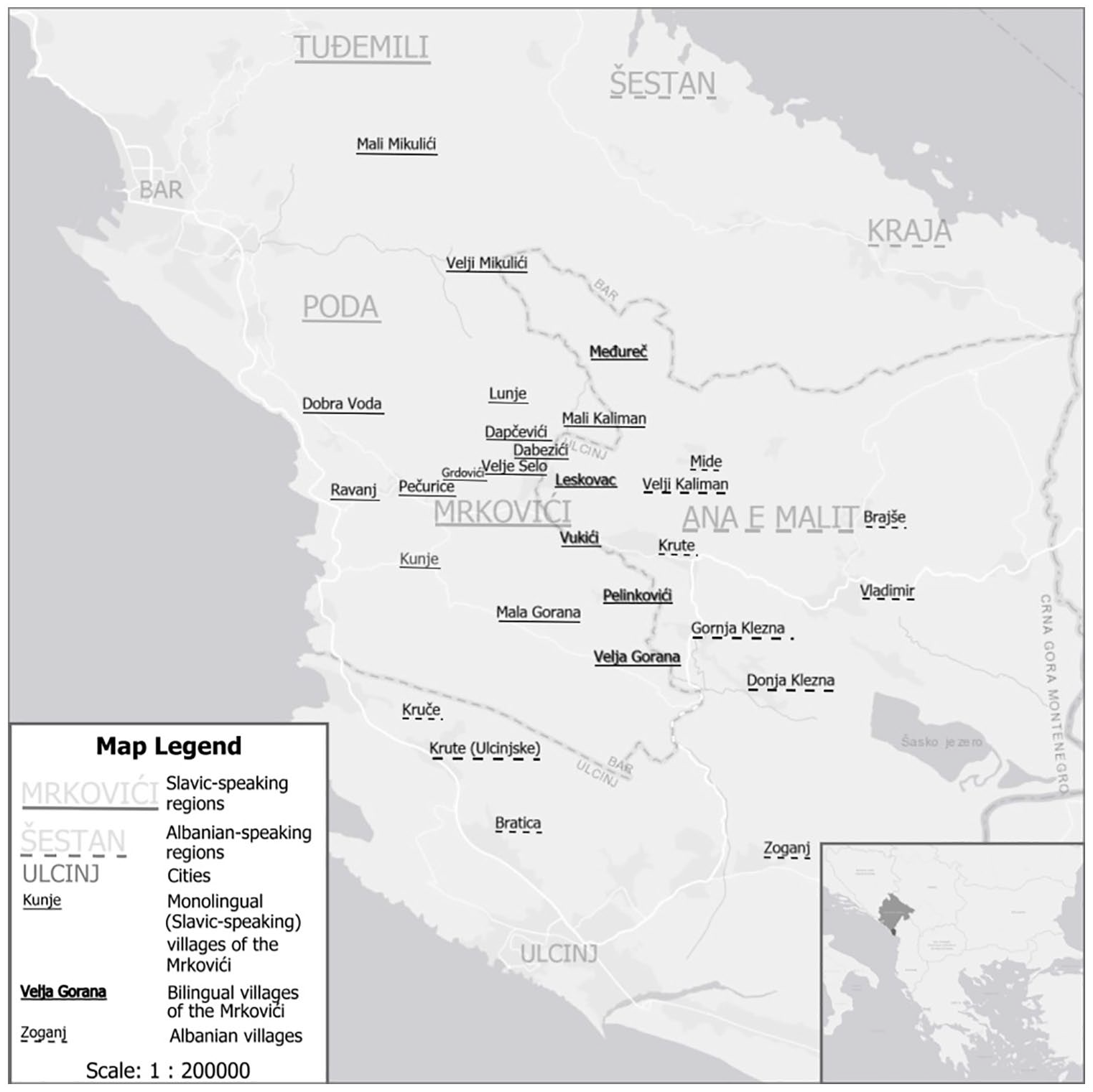
The village of Velja Gorana in southern Montenegro.
Throughout history, the entire zone, on both sides of the border, had a mixed Slavic-, Albanian-, and Romance-speaking population. In the past, it was subject to the dominant influence of the medieval Serbian states and the Venetian Republic who took turns in controlling this territory or its parts (in particular, the seaport towns of Bar and Ulcinj) through the second half of the 14th century to the end of the 16th century. After the arrival of the Ottomans and the retreat of the Venetians, the area became part of the Ottoman Empire and remained so till the end of the 19th century.
The modern Montenegrin districts of Bar and Ulcinj, according to the last census (Monstat, 2011), have a mixed Muslim Slavic, Muslim Albanian, Orthodox Slavic, and Catholic Albanian population. The regions on the southern side of the Lake Skadar (Albanian Shestan and Krajë), the town of Ulcinj, and its neighbourhoods (Albanian Ana e Malit) are inhabited mostly by Albanians. The town of Bar, which is the biggest locality in the area, has a mixed population. Slavic-speaking Muslims (the Mrkovići, Tuđemili, and Poda) mostly live to the south, east, and northeast of Bar, while the Orthodox Montenegrin population is north of the town.
Velja Gorana had 353 inhabitants in 2011, according to the census. Most of them are natives of the village, BCMS goranci “people from Gorana”. During our fieldwork in 2013 to 2015 we observed that all men in Velja Gorana are bilingual and speak the local variety of BCMS and the Northern Albanian subdialect spoken in the south of Montenegro. They often marry Albanian women from Ulcinj, its surroundings, and from the nearby parts of Albania. Consequently, almost all male and female children in Velja Gorana learn Albanian from their mothers and grandmothers. After growing up, girls usually get married outside the community, while men tend to bring wives from outside and stay in the village throughout their lives (Morozova, 2017, p. 67).
The observations made in Velja Gorana by Serbian ethnographers in the first half of the 20th century have much resemblance with the modern situation. In the 1910s to 1920s Jovićević noticed that “the inhabitants of Pelinkovići, Vukići, Klezna, and partly of Gorana, acquired Albanian, because they used to marry women from the villages of Ana e Malit” (Jovićević, 1922, p. 113). Vujović (1969, p. 82) who conducted dialectological research in this area in 1930 to the 1940s also mentioned in his monograph that the population of Velja Gorana extensively used Albanian in everyday communication, along with the local BCMS variety. Sobolev (2015, p. 545) concludes that the multilingual situation in Velja Gorana is “constantly reproduced within generations” and this phenomenon distinguishes the local community from many other (currently and previously) multilingual communities of the Balkans.
As is often the case, we do not have more sufficient information about the sociolinguistic situation and the linguistic competences of bilinguals in the past. However, we may expect that the past situation can be modelled using the data about the micro-situations, or scenarios, which exist in the modern Velja Gorana. Below we will have a closer look at this community, beginning from the individual bilingual competences of the different inhabitants of Velja Gorana and going through the description of their linguistic behaviour inside and outside the village.
Individual bilingual competence: Taking a snapshot of the lifespan
Most interviewees in Velja Gorana reported some changes in their linguistic competence across the lifespan and we tried to represent these changes in a “snapshot”, distinguishing between four periods of an individual’s life cycle: (a) the early childhood (from birth until the age of five years); (b) middle childhood and adolescence (male speakers)/the period from the age of five years till marriage (female speakers); (c) middle age (men)/years in marriage (women); and (d) old age. These periods are defined on the basis of the differences in social position and speech behaviour which are specific to the community and do not fully match the distinctions frequently used in language acquisition studies.
Instead of the distinction made by McLaughlin (1978) that sets age three as a point before which children are regularly exposed either to two languages or only one language, age five serves as an upper limit of the first period in our division. As discussed in the “From the family language use to the maintenance of the community bilingualism” subsection, boys start speaking L2 (Albanian) approximately at that age, unlike their sisters who learn to speak this language at an earlier age, and this difference in the speech behaviour of boys and girls seems to be an important characteristic of the community.
For both male and female children adolescence, that is, age 16 at the very latest, is often defined as the locus of bilingually induced change (Ross, 2013; Yip & Matthews, 2007) and a very important period for full language acquisition, involving active development and shifts in language proficiency and dominance (Schmid & Yılmaz, 2018). In our study this corresponds to the second period in the life of Velja Gorana natives: boys who stay in the community throughout their lives and girls who leave the community after marriage (therefore their competences are not considered in this subsection). For women from outside the community the marrying age, which usually varies from 16 to 25 years, was preferred as a milestone between the second and third periods, because all of them are late bilinguals and a change in their linguistic competence (L2 acquisition) occurs after they come as brides to Velja Gorana.
Adulthood is not considered as a single period in our study. It includes the third and fourth periods delimited approximately at the age of 50. This distinction is associated with the change of the person’s social position, both in his/her family and in the community, which is very relevant for the Balkan society, and (most often) with the upbringing of grandchildren whose linguistic competence is partly dependent on the competences of grandparents.
The resulting “snapshots” look like circles vertically divided to four sections (Figure 1). The sections, from left to right, show the four aforementioned periods in an individual’s lifespan. The two languages spoken by the interviewees, BCMS and Albanian, are shown with light and dark grey colours respectively. The sections of the circle representing the periods when a person possessed both languages are divided in halves by a horizontal line. The upper half shows the (linguistically) dominant language, which is/was used more often within a particular period. The subdominant language, which is/was used rarely during the same period, takes the lower half of the section.
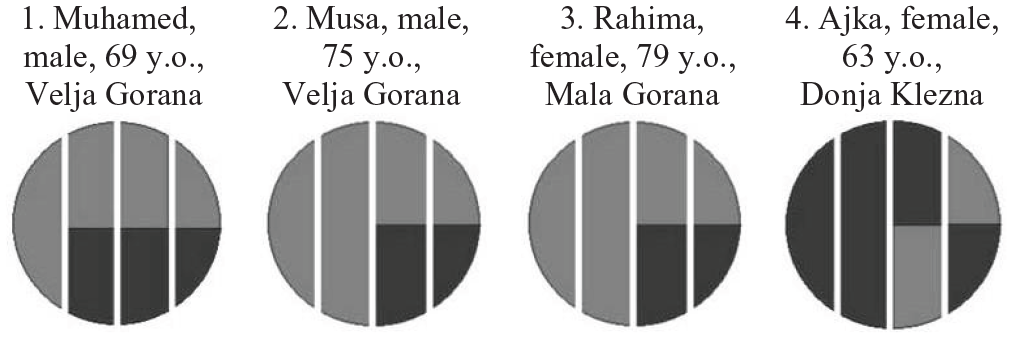
Development of bilingual competence across the lifespan: (1) Muhamed*, male, 69 years old (y.o.); (2) Musa, male, 75 y.o., Velja Gorana; (3) Rahima, female, 79 y.o., Mala Gorana; and (4) Ajka, female, 63 y.o., Donja Klezna.
Figure 1 displays the bilingual competence of the old speakers we met in Velja Gorana. We do not consider here the competences of young and middle-aged interviewees and, apparently, do not analyse the competence of monolinguals. Circles (1) and (2) show the changes of linguistic competence of two male natives of Velja Gorana. Circle (3) displays the competence of a woman born in the monolingual Mala Gorana, circle (4) – of a woman from the Albanian village of Donja Klezna (see Map 1).
The two male interviewees were monolingual in BCMS until the age of five. Later on the development of their linguistic competences followed different scenarios. Muhamed (69 years old (y.o.) in 2015, when most of the interviews were conducted) speaks Albanian as L2 since his childhood, while Musa (75 y.o. at the same time), according to his words, started learning it only in late adolescence, when he grazed his family’s cattle in the pastures together with Albanian boys from the neighbouring villages. What matters here is that the elder female relatives of these men spoke different languages. Muhamed’s grandmother and mother extensively used Albanian at home, because the former was Albanian by origin and the latter learned this language after coming to the house of her parents-in-law. The (bilingual) grandmother of Musa died early and did not take part in his upbringing, while his mother originated from a monolingual village in the Mrkovići region and spoke only BCMS during her lifetime.
At the adult stage and in the old age the two men have been speaking both languages. As is the case with all male natives of Velja Gorana, BCMS can be considered their dominant language (L1) and Albanian is maintained as L2, which is used mainly in the family communication (see the “From the family language use to the maintenance of the community bilingualism” subsection for more detail). It should be noted that the BCMS-speaking wife of Muhamed “did not want” to acquire Albanian after marriage, while the wife of the second was bilingual. This did not cause any significant variation in the bilingual competences of the men, but their now bilingual sons, quite expectedly, acquired BCMS and Albanian in different ways.
Most women who get married in Velja Gorana originate from either Albanian-speaking or BCMS-speaking villages in the surrounding area and are monolingual before marriage age 7 . The L2 is acquired within the community of Velja Gorana, mainly in communication with the mother-in-law and other women. The case of Rahima, a previously monolingual woman born in Mala Gorana (circle 3), demonstrates that if the L1 is BCMS, the person remains BCMS-dominant at all further life stages. Among the Albanian women the configuration of language dominance may change, as seen in the case of Ajka (circle 4). The young women, in their words, speak BCMS “neither well, nor bad” and prefer to address their close ones and neighbours in Albanian. On the contrary, the old women such as Ajka who have lived in Velja Gorana for more than 40 or 50 years say that they are “forgetting” their L1 and now find it easier to use BCMS than Albanian.
Rating themselves as better in L1 and poorer in L2, as the young Albanian women do, is often observed among late bilinguals (see Silva-Corvalán & Treffers-Daller, 2016). The self-assessment by the old Albanian women may refer us to the idea, which was formulated and empirically proven by many authors (Dorian, 1989; Schmid & Yılmaz, 2018; Seliger & Vago, 1991), that the bilingual’s L1 competence may be subject to various changes in adulthood, including, among others, the L1 attrition. However, we did not observe linguistic phenomena of this type in L1 speech of the old women, at least in phonology and morphosyntax. Only several examples of L1 lexical retrieval difficulties were encountered in our fieldwork using linguistic questionnaires. At times the interviewees could not recall an Albanian word (e.g., myk “mould”) and completed the task only after some thinking. We cannot evaluate the real degree of L1 attrition, if it ever occurs, among these speakers. Given that the lack of communication in L1 is one of the reasons for attrition, according to Andersen (1982), their feeling of “forgetting” Albanian (and word-finding difficulties) may be due to the less frequent use of this language at home.
From the family language use to the maintenance of the community bilingualism
The diagrams in Figures 2 and 3 show how BCMS and Albanian are used in the everyday communication of two families in Velja Gorana. The linguistic competence of the speakers is shown by means of circles. The rows of circles roughly correspond to the different generations to which the speakers belong, with older speakers in the top and the youngest speakers in the bottom part of the diagram. The speaker’s age, sex, and place of birth are indicated near the circle. The two halves of the circle stand for different periods of the life cycle. The left semicircle describes the speaker’s linguistic competence before the age of five years and the right one reflects the observations made during the fieldwork in Velja Gorana. For the speakers who are bilingual in BCMS and Albanian and/or were bilingual in the early childhood, the corresponding semicircle is divided into two parts by a horizontal line, with the linguistically dominant language (see the definition in the Introduction) always shown in the upper part.
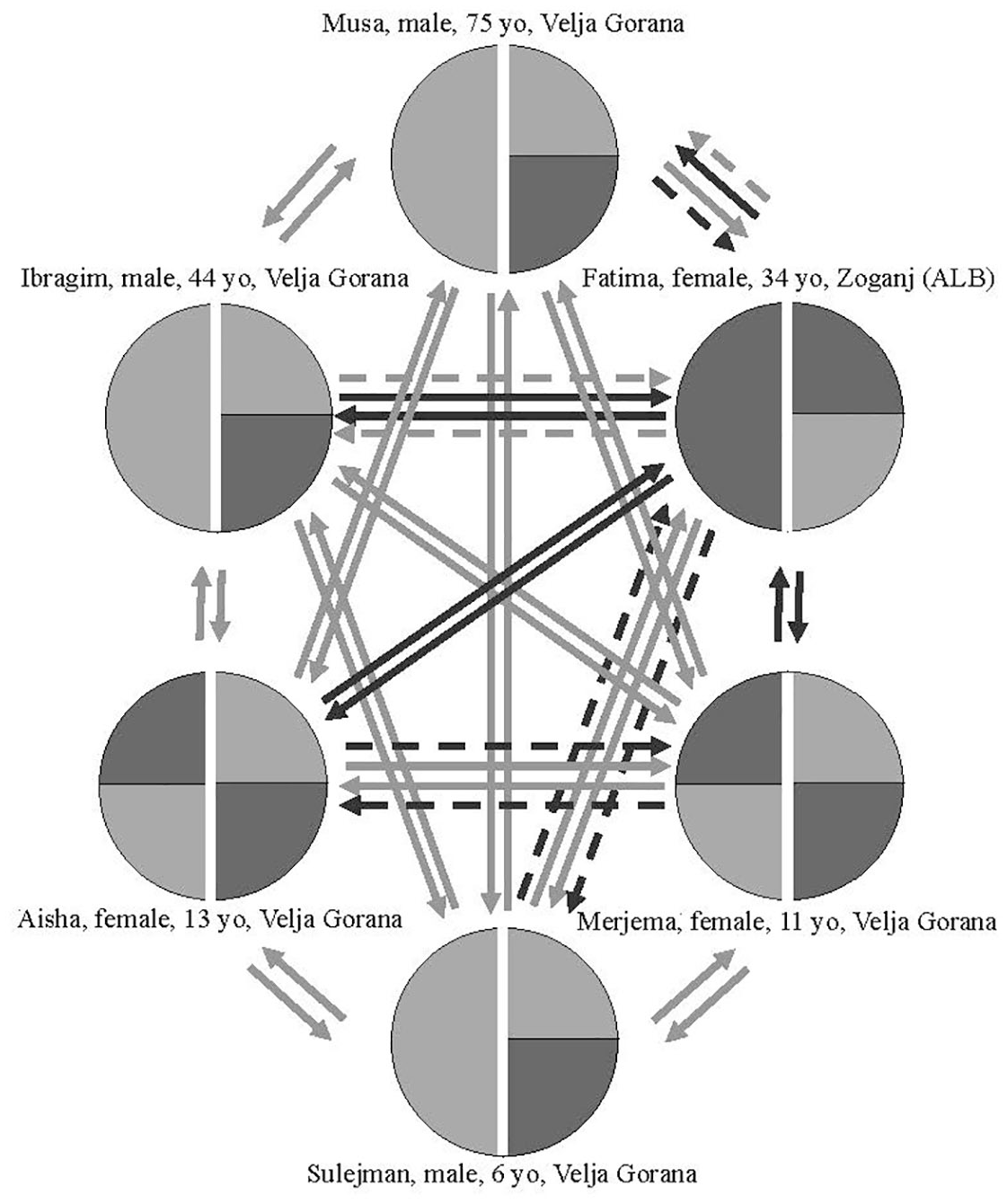
Communication in a bilingual family.

Communication in a partially monolingual family.
The communication within the families is shown by arrows connecting interlocutors. The starting point of the arrow points to the speaker and the head indicates the person to whom (s)he addresses. The dotted arrows mean less frequent use of a given language.
The family shown in Figure 2 consists of a middle-aged couple, Ibragim and Fatima, their three children (two girls and one boy), and the husband’s father Musa. All members are natives of Velja Gorana, except for one woman from the Albanian village of Zoganj near Ulcinj.
The male members of the family are bilingual in Albanian and BCMS, but neither of them speaks Albanian since early childhood. The development of bilingual competence of Musa is described in detail in the “Individual bilingual competence: Taking a snapshot of the lifespan” subsection (circle 2). His little grandson Sulejman, according to field observations made in 2013 to 2014, spoke only BCMS and, in his mother’s words, “did not want to speak Albanian”, even though she attempted to address him in this language. However, in 2015, we observed him speaking Albanian with his mother Fatima and “helping” his father Ibragim to answer our questionnaire and translate stimuli utterances from BCMS into Albanian.
Fatima, an Albanian woman from Zoganj, was monolingual before the age of five years. Albanian was the only home language in her family, and she began to learn BCMS only at school. Her two daughters, Aisha and Merjema, are bilingual since early childhood, as they have been continually exposed to both Albanian and BCMS at home. Albanian probably dominated at the early stage as the mother’s L1. Now the girls learn and use BCMS (“Montenegrin”) at school and, in their mother’s words, they often prefer this language to Albanian at home as well.
The arrows in Figure 2 show that BCMS dominates Albanian in the communication within the family. The adult men and their (grand)children, whose L1 is BCMS, prefer to use this language when speaking to each other. However, Albanian is the L1 of Fatima and remains her main means of communication at home. She speaks Albanian with her husband and daughters and uses it along with BCMS when she addresses her little son. In communication between Fatima and her father-in-law Musa, each speaker chooses his/her L1 in the majority of situations and his/her language choice almost never depends on the L1 of the interlocutor. This strategy is typical for the community of Velja Gorana (see Morozova 2018) 8 . The choice of BCMS by Musa may be also related to the fact that this language marks the local identity of goranci (which is rather Slavic than Albanian, because Velja Gorana pertains to the Slavic-speaking community of the Mrkovići). According to Morozova (2018), such strategy takes a particularly acute form in the presence of “outsiders” and may be neglected when the speakers are not being systematically observed. During our fieldwork in the family shown in Figure 2, we noticed that Fatima could be addressed in her native language by Musa when their communication did not involve the investigator(s).
The tendency to speak (only or predominantly) BCMS with the youngest member of the family, the 6-year-old Sulejman, may be also related to the idea that male members of the community are “responsible” for preserving the local identity. On this basis, male children shall be most often addressed in BCMS, while female children, who will leave Velja Gorana after growing up, may speak and be exposed to both Albanian and BCMS since early childhood.
In Figure 3 we see a partially monolingual family from Velja Gorana. The family includes two older members, their married son, his wife, and two children. The women come from different places and ethnic groups: the older, Ajka, is an Albanian from Donja Klezna; and the younger, Senada, comes from the monolingual village of Mala Gorana (see Map 1).
On the individual level, we may see that the head of the family Osman, his Albanian wife Ajka (see a “snapshot” of her bilingual competence in the circle 4 in the “Individual bilingual competence: Taking a snapshot of the lifespan” subsection), and their 40-year-old son Mustafa were monolingual in the early childhood. Currently they have similar bilingual competence, with BCMS as dominant language. Only these members of the family may use Albanian at times when they communicate with one another. The children Emina and Bajram are monolingual in BCMS, because they have not been regularly exposed to Albanian from their birth. Apparently, the overall tendency towards monolingualism in this family is due to the presence of Senada, a monolingual woman from Mala Gorana, who did not acquire the L2 after marriage. This tendency is supported by the behaviour of her mother-in-law Ajka, whose self-reports about language use indicate a change in linguistic dominance: a drastic decline in the use of Albanian; and a preference to use BCMS at home on a daily basis. Considering the behaviour of the two women and the linguistic situation in the family, we may conclude that the language attitudes of female members play an extremely important role in the maintenance of family bilingualism.
Patterns of language choice in communication between the families belonging to the community of Velja Gorana generally resemble those that we observed within the families. On the one hand, bilingual speakers are able to use both languages, BCMS and Albanian, in one and the same conversation to speak with the different people. On the other hand, there may be particular preferences depending on the speaker’s origin, age, and linguistic competence. In a mixed group of bilingual and monolingual speakers, the local men usually choose BCMS as the main (but not the only) means of communication: old Albanian women tend to switch the codes depending on the L1 of the interlocutor(s); young Albanian women speak in their L1 even in the presence of non-speakers; and bilingual children prefer BCMS to Albanian (Morozova, 2018). It is important to emphasize and conclude at this stage of our analysis that the whole of the situation, which is not equal to the sum of its parts, is the maintenance of bilingualism and the relative balance between the Albanian and BCMS languages within the village community.
What communication patterns occur beyond the community level?
In polyglossic situations bilingualism and multilingualism often remain confined to the family and community, while in all other cases the speakers have to use their L2 (most likely a dominant language). In this subsection we explore what kind of linguistic behaviour is characteristic of the non-polyglossic situation of Velja Gorana when its inhabitants communicate outside the village community. We will take a closer look at which language is used more frequently and across a wider range of sociolinguistic domains, as defined by Fishman (1965), and build sociolinguistic profiles (Adamou, 2012) of the community members, taking sex and age as main social factors and determining the language dominance pattern for each group of speakers. We consider as the most important ones the domains such as school, work, and communication with the in-law relatives that live outside the community. See Morozova and Rusakov (2018) for a more detailed description of the results of this study.
Middle-aged and old men from Velja Gorana are equally proficient in BCMS and Albanian. As a rule, both languages are acquired in childhood and used with family members and neighbours (the 75-year-old man in Figure 1 is an exception, and as shown in the “Individual bilingual competence: Taking a snapshot of the lifespan” subsection, in his case late L2 acquisition is directly related to the lack of exposure to this language in the family during his childhood and early adolescence). Only one of the languages serves for communication with in-laws from another village. Apparently, with relatives from the Mrkovići region the men from Velja Gorana use only BCMS, while with Albanians the Albanian language is the choice.
Men received school education in BCMS (“Serbo-Croatian”, the official language of the Socialist Republic of Montenegro till 1992) and served in the multiethnic Yugoslav army, where this language was the main means of service communication. Currently, representatives of the older generation do not work and practically do not leave Velja Gorana, and the family income is provided by the middle-aged men. The main economic centre of the area is the town of Ulcinj (populated by an Albanian majority), where they work as taxi drivers, rent parasols at the beach during the touristic season, etc. Since the vast majority of residents of Ulcinj and the surrounding villages are Albanians, the Albanian language dominates at work, while BCMS is used rarely, for example with tourists from the former Yugoslav republics and from Russia.
Most middle-aged and old women in Velja Gorana, either from Albanian-speaking or Slavic-speaking villages of the area, also had school education in BCMS (“Serbo-Croatian”). However, almost all Albanian women claim that they learned BCMS sufficiently only in Velja Gorana. For many of them BCMS becomes the dominant language, which is frequently and intensively used in the household (see the “Individual bilingual competence: Taking a snapshot of the lifespan” subsection). In this case the communication with Albanian-speaking relatives from the native village may remain the only significant domain assigned to Albanian. Women from the monolingual villages of the Mrkovići region prefer to communicate with all their relatives and neighbours in BCMS even if they are able to speak Albanian after marriage. Some of them may behave as passive bilinguals who “understand Albanian, but do not want to speak”.
Some women from Velja Gorana work in Ulcinj daily, for example, in a restaurant’s kitchen, or go there on market days to sell homemade dairy products to local residents and tourists. BCMS-speaking women would address their customers and colleagues only in L1. For the Albanian women, their L1 is the main but not the only language of communication.
Children born in fully bilingual families of Velja Gorana begin to acquire two languages in early childhood. As shown in the “From the family language use to the maintenance of the community bilingualism” subsection, young boys go through a silent period during which “one of the languages is understood but not produced by the child” (Yip & Matthews, 2007, p. 81) between ages one and five. Probably this can be explained by the fact that BCMS is prevalent in child-directed speech of all family members, except for the Albanian mother. In preadolescence and adolescence Albanian is extensively used by both male and female children in communication with the Albanian (grand)mothers and their relatives who do not speak BCMS. On the contrary, in families where the (grand)mother comes from a monolingual village of the Mrkovići region and does not know Albanian or does not use it in everyday communication, children speak only BCMS from early childhood and very likely remain monolingual as adolescents and adults.
All children from Velja Gorana receive school education in BCMS (“Montenegrin”, the official language of the Republic of Montenegro since 2007). The school is situated in the neighbouring BCMS-speaking village of Pečurice, and most pupils come from monolingual villages. The teachers are also monolingual and BCMS-speaking. Albanian is not taught at school, and the children from Velja Gorana learn and speak BCMS most of the time. Thus at school age, the shift towards the sociolinguistic dominance of BCMS is inevitable for bilingual children, because they are exposed to Albanian only at home. However, their bilingual competence may remain intact and the pattern of language dominance may fluctuate and change quite naturally in the lifespan.
We may conclude that external communication patterns of the community of Velja Gorana as a whole involve both languages of its bilingual members and thus differ from those typical for polyglossic societies. This is supported by the fact that the village is situated in the ethnically mixed area (see the “Location and population of Velja Gorana” subsection), where Albanian and BCMS are spoken to a greater or lesser degree in virtually every locality. On closer examination, we find some differences between the sociolinguistic profiles of the community members. For example, the linguistic behaviour of women outside Velja Gorana seems to be a projection of the community-internal pattern, according to which female speakers of BCMS may remain monolingual, while Albanians are always bilingual and may be subject to language dominance turnover. Men with high proficiency in Albanian and BCMS, tend to actively use both languages that they have learned within the community. For children, BCMS is of growing importance as the language of external communication, but the need to speak Albanian to the monolingual relatives of (grand)mothers restores the necessary balance.
Velja Gorana in the diversity of the Balkan multilingual settings
Up to the late Ottoman times most of the Balkan linguistic area was largely multiethnic and multilingual. In the last two centuries we may observe a decrease of bilingualism and multilingualism in the Balkans, which is due, in the first place, to the creation of nation-states, where the majority languages became state or official. Nevertheless, some bilingual and (less frequent) multilingual situations are still found in the different parts of the contemporary Balkans and traces of the past contact seen in the Balkan languages and dialects.
In this section we will briefly consider several most remarkable Balkan cases, moving from non-polyglossic (“Balanced bilingualism and multilingualism in the Balkans: The present and the past” subsection) to polyglossic settings (“Non-balanced situations in the contemporary Balkans” subsection), and try to define the place of the situations of the “Velja Gorana type” in this continuum of societal multilingualisms à la balkanique. Our goal here is to determine the factors that may support balanced bilingualism and multilingualism or affect the speech communities shifting from one type of situation to another.
Balanced bilingualism and multilingualism in the Balkans: The present and the past
Historical documents of the late Ottoman period show that in the past bilingualism and multilingualism of the “Velja Gorana type” was characteristic not only of relatively small villages but also of Balkan towns. See, for example, a report by the Austrian consul Friedrich Westermayer about 19th-century Bitola in Macedonia, where “even six-year-olds could speak Vlach (Arumanian), Bulgarian (Macedonian), Greek, Turkish, and Albanian equally well” (Lindstedt, 2016, p. 57). In this list, only Turkish and, to some extent, Greek may be considered sociolinguistically dominant languages. Albanian, Balkan Romance, and Balkan Slavic were largely spoken by the Balkan population as vernaculars and every small community (a quarter within a town, a small village, or a group of villages) could use different combinations of these languages in the same way as do the modern inhabitants of Velja Gorana.
What are the prerequisites that are necessary for the arising of such situations? On the one hand, it seems that the inner linguistic and ethnic heterogeneity of the bilingual or multilingual community is the main condition, and one of the ways to create this heterogeneity is linguistic exogamy and mixed marriages (see, for example, Lüpke, 2016, p. 53). In the Western Balkans, the traditions of ethnic and linguistic exogamy were characteristic of some Montenegrin communities, or “tribes” (BCMS pleme), at least until the end of the 19th century to the beginning of the 20th century. The best-known example in Serbian ethnography is that of the Kuči, initially an Orthodox Slavic pleme, whose members “never intermarried, but took wives from another pleme; therefore, they often married Albanians and gave their girls to Albania” (Rovinskii, 1897, p. 239). The population of the mountainous region inhabited by the Kuči had been bilingual and ethnically mixed (Albanian and Slavic) for a long time. Then Albanians were gradually slavicized by intermarriage and contact with Slavs, mixed marriages became less common, and almost the whole region finally shifted to BCMS.
We may suggest a similar development in the Muslim Slavic pleme of the Mrkovići, to which Velja Gorana belongs. Nowadays the Mrkovići marry both inside and outside of their community, but residential endogamy is also possible, because many families are of migrational origin and not closely related to each other (Morozova, 2019, pp. 313–314). Marriages with Albanians and the resulting bilingualism of village communities now seem to be a prevailing pattern only in the Mrkovići villages which are located near the “boundary” with the Albanian-speaking area. In the pre-Ottoman times such a situation could have existed in the whole territory of the Mrkovići. As a result of Islamization of the southern Montenegrin population in the 17th and 18th centuries, the exogamous marital ties of the Mrkovići with the neighbouring Muslim Slavic communities of Tuđemili and Poda (see Map 1) were established or reinforced (Jovičević, 1922, p. 113). This change, together with the influx of a monolingual Slavic-speaking population from other parts of Montenegro in the 19th century, may have contributed to the decay of the natural bilingualism in most part of the Mrkovići region.
On the other hand, it is likely that mixed marriages are not a necessary condition for the arising of the small-scale bilingual and multilingual situations. Compare, for example, the situation which exists in the village of Arvati of the Lake Prespa region, North Macedonia (see the description provided by Makarova (2021). Arvati has 51 Orthodox Macedonian and 85 Muslim Albanian inhabitants. Both Macedonians and Albanians are bilingual, which is unusual for this region, where most Macedonians are monolingual and Albanians are typically bilingual, with the linguistically dominant Albanian and sociolinguistically dominant Macedonian. Marriages between the Macedonian and Albanian parts of the village are absent, and the emergence of bilingualism may be explained by “the geographical position of the villages of Arvati and neighbour and Krani: the settlements are located higher than other villages of the Prespa basin, and earlier, before the paved road, they had been quite isolated from the main communication routes and from the administrative center of the region” (Makarova, 2021, p. 69).
Non-balanced situations in the contemporary Balkans
Using the parameter of linguistic dominance, we may distinguish two types of the Balkan polyglossic settings depending on which language, L1 or L2, is dominant in the community.
In the situations of the first type, L1 continues to be the linguistically dominant language. Such a situation is observed in Golo Bordo (Macedonian dialectal Golo Bordo “bare mountain” and Albanian Golloborda), a border region in the northeast of Albania. The first evidence of Albanian–Slavic contacts in Golo Bordo comes from the 15th century, when its population consisted mainly of Orthodox Albanians, Slavs, and Vlachs (Sobolev & Novik, 2013, pp. 19–20, 25).
Nowadays Golo Bordo separates into two clearly distinct parts: albanophone and slavophone (approximately 10,000 Slavic speakers). The majority of slavophones are Muslims. They are mostly bilingual and speak the Standard Albanian and the local Slavic variety, with the explicit linguistic dominance for the latter. Albanian is used as the language of (the state) administration, school education, mass media, etc., and as the main language of communication outside the community. Apparently, people who do not leave their villages (elderly women without education and children below school age) do not know Albanian or cannot speak it fluently (Sobolev & Novik, 2013, p. 80). The Slavic variety of Golo Bordo does not have any official status but serves as the sole means of communication within the Slavic community. Consequently, the few non-slavophones, mainly Albanian women who choose to marry in the Golo Bordo villages, inevitably acquire the local variety (Sobolev & Novik, 2013, p. 33; Ylli & Steinke, 2008, p. 29).
In a few words, the situation in Golo Bordo can be described as polyglossic with the linguistic dominance of L1 (Slavic) and sociolinguistic dominance of L2 (Albanian) of the local population (Sobolev et al., 2018, p. 710). Situations of the “Golo Bordo type” are rare in the modern Balkans. As a rule, such dominance configurations are characteristic of relatively large “language islands”, that is, groups of speakers of the L1 living in a geographically distinct region in which they constitute an overwhelming majority and have a kind of economic autonomy from the surrounding speakers of the L2 9 . In this kind of situation bilingualism exists in virtue of the community-external needs and not as an intrinsic property of the community.
Polyglossic situations of the second type are characterized by a turnover of linguistic dominance. The speakers continue to use their L1, but the sociolinguistically dominant L2 becomes also linguistically dominant for them. Nowadays such situations are more widespread in the Balkans, especially among the Balkan Romance (Arumanian and Meglenorumanian) and Romani speaking population. They emerge in relatively small bilingual and multilingual groups existing within the communities of another language’s speakers. For example, in Romani quarters of the Balkan towns or in nearly monoethnic settlements, such as the Arumanian village of Turia in Northern Greece, where Arumanian and Greek are spoken by the local population (Bara et al., 2005).
It is typical for such situations that the language, which is supposed to be the L1 of the community (e.g., Arumanian or Romani), is heavily influenced by the linguistically dominant L2 on all language levels. It may continue to be acquired as L1 by children in early childhood in some Arumanian and Romani communities (see e.g., in Dumitrescu, 2016; Šatava, 2013), but in preadolescence and adolescence, when the children start (pre-)schooling and their social networks expand and diversify, L2 begins to play an increasing role in their linguistic competence. This change of linguistic dominance may happen repeatedly during the life span of each generation, or speaker 10 . Besides community members often have double ethnicity or associate themselves with the majority population. For example, the Arumanians of Turia in the Northern Greece, who continue to use the Arumanian language, have Greek identity and call themselves Βλάχοι “Vlachs” (Bara et al., 2005, p. 17).
In the situations of “Arumanian” type, community members very often cease to transmit their language to the next generation, and the next step in the development of such situations is usually language shift to L2. For example, a considerable part of the Arumanians in the Balkans shifted to the surrounding languages 11 . Nevertheless, language shift is not a necessary consequence of situations with linguistic dominance turnover. In some cases the trend towards shift may be stopped, and the L1 maintenance with dominance of the surrounding language L2 may continue for a long time. So, virtually all groups of the Balkan Romani population are characterized by the growing linguistic dominance of the surrounding languages, but only part of them have undergone the language shift (Adamou, 2012; Rusakov, 2011; see also endnote 12).
From multilingualism to monolingualism: Factors of development 12
We may conclude here that in the Balkans the communities with linguistic dominance of L1 (“Golo Bordo type”) may gradually turn into ones with linguistic dominance of L2 (“Arumanian type”). The proper “polyglossic” traits of the situation erode during this development, and the next step may be the language shift.
The factors which determine the turnover of language dominance (and the further language shift) have mostly “objective” character and do not depend on the preferences and choices of the community members. They are described thoroughly in the literature on language shift and language death (see Thomason (2001, pp. 27–58) and Vakhtin (2001)). Within a historically and geographically consolidated area, the size of the community in relation to the population of the area and its relative economic autonomy, largely depending on its size, may play an important role. For example, the Golo Bordo and Krašovani communities live in a defined area, which includes a group of villages. Community members use their L1 within their home village and in communication with the other villages of the area. The Arumanians, on the contrary, have their villages scattered among the settlements of the surrounding majority population or constitute a minority inside such settlements, and have fewer opportunities to use their L1 outside their family or their standalone village.
In the situations with any such combination of “objective” factors which may further lead to language shift, another group of factors, of “subjective” or individual character, is also involved and gains special importance. These are “language identity” (Adamou, 2012) or “language attitudes” (Thomason, 2001, pp. 32–36), standing behind the deliberate or semi-deliberate language choices of speakers who may decide to maintain their L1 or, on the contrary, to shift to the L2. The cases of Greek Pomak 13 and Romani population in the Greek Thrace described by Adamou (2012) are instructive for a better understanding of these processes. Both groups are trilingual in their L1, Greek, and Turkish. Greek (the state language) and Turkish (the language of religion and, partially, of education) are sociolinguistically dominant. Turkish tends to become also the linguistically dominant language for the Pomaks and (especially) Romani. Nevertheless, only some Pomak and Romani communities shift to Turkish whereas the others do not. Explaining this fact, Adamou supposes that “a shift to Turkish. . . took place through the individual shifts of highly connected individuals” (Adamou, 2012, p. 29). Such a shift, which is “related to identity factors”, may involve the individuals that have “the highest centrality in the community” (Adamou, 2012, p. 30) and then affect the whole language network, pushing other members of the community to shift. We may only add here that a very important factor in such a deliberate shift is the cease of the L1 transmission to children.
The drastic diminishing of the past bilingualism in the small-scale communities of the Balkan towns and the cases of the Mrkovići and Kuči described in “Balanced bilingualism and multilingualism in the Balkans: The present and the past” subsection show us that balanced, or non-polyglossic, situations may also develop into non-balanced ones and end up with a language shift. The factors which may lead to the extinction of balanced bilingualism and multilingualism do not fundamentally differ from those which influence the gradual changes across the range of situations of the polyglossic type. It seems that in this case the “objective” factors also determine the general way of the development towards language shift, while the “subjective” ones may influence the extent and speed of the ongoing change and contribute to variations of the general scenario. For example, the balanced bilingual situation in Velja Gorana is stable at present, but may cease to exist in some not-so-distant future if the local men will not marry Albanian women or if their Albanian wives will not use their L1 at home and transmit it to their children. Both solutions would largely depend on the “objective” circumstances of social, economic and political character, but in essence they would remain the “subjective” choice of individual bilingual speakers.
Conclusion
In this article, we have undertaken an analysis of the two main types of bilingual and multilingual settings in the present-day Balkans and defined the constellations of factors that influence their emergence and maintenance. Our analysis was based on the configurations of linguistic dominance which exist in the Balkan communities. Sociolinguistic dominance was viewed as an additional factor that may enhance the inequality of the languages spoken within a given community.
In general, the tendency towards multilingualism within the Balkan linguistic area is not as strong nowadays as it used to be in the past. However, in a number of small and discrete areas one may observe: (a) bilingual and multilingual situations characterized with non-balanced, or polyglossic, relationships between languages; and (b) rare cases of balanced, or non-polyglossic, communities. The former type is extensively reported in the existing literature, while the examples of the latter type are still to be looked for across the Balkans. In (rare) non-balanced communities of the “Golo Bordo type” we observed the linguistic dominance of L1, while the (more widespread) “Arumanian type” is characterized by linguistic dominance of L2, tendency towards the erosion of the polyglossic character of situations and decline of bilingualism and multilingualism which may further result in a language shift to L2. As for balanced situations, they tend to develop into non-balanced ones and may also end up with a language shift. See, for example, the drastic diminishing of the past bilingualism in the small-scale communities of the Balkan towns and the cases of the Mrkovići and Kuči described in the “Balanced bilingualism and multilingualism in the Balkans: The present and the past” subsection. We may conclude that the factors which may have led to the extinction of balanced bilingualism and multilingualism in the Balkans do not differ in any principled way from those which determine the gradual changes across the range of situations of the non-balanced type.
Based on our observations in a small-scale community of Velja Gorana in Southern Montenegro, we defined the main traits of balanced, or non-polyglossic, bilingual situations à la balkanique. These traits may be salient to some extent for other small-scale bilingual and multilingual communities of the world. In general, for all bilingual speakers the use of and the natural exposure to both languages are possible within and outside the community. The individual language choices depend on a constellation of factors: social characteristics, such as age and sex of speakers (cf. the way male and female adults speak with male and female children); the degree to which they are integrated into bilingual networks; the mother tongue of the previously monolingual adult speakers; and their ethnicity, or rather language identity. Within the community, the fact that the inhabitants of Velja Gorana have a sense of belonging to the Slavic-speaking society of the Mrkovići to some extent determines the active use of BCMS by the local men within the community and supports their desire to pass their L1 on to their (grand)children. At the same time, the constant influx of women who speak Albanian as L1 stimulates the use of this language by a significant part of the community and the acquisition of this language by children as one of many L1s. Outside Velja Gorana, BCMS dominates in the higher domains reserved for the official language, for example, the school education which is relevant only for the youngest generation. In parallel, the economic attraction of Ulcinj with a predominantly Albanian-speaking population expands the scope of use of Albanian by the middle-aged bilinguals.
The case of Velja Gorana clearly demonstrates how the unequal linguistic competencies of individual speakers cause a variety of communication patterns within their families and may bring forth different results in terms of the maintenance or erosion of bilingualism in the community. It is important that despite the unequal relationship between the two languages of the community, both at the level of individual speakers and particular families, the situation observed in Velja Gorana remains stable and may be maintained across several generations. The input differences of the various groups of speakers (sociolinguistic profiles) are balanced out and this balance is achieved due to the community’s inner diversity.
Supplemental Material
sj-rar-1-ijb-10.1177_13670069211023152 – Supplemental material for Societal multilingualism à la balkanique: The Montenegrin Velja Gorana and beyond
Supplemental material, sj-rar-1-ijb-10.1177_13670069211023152 for Societal multilingualism à la balkanique: The Montenegrin Velja Gorana and beyond by Maria S Morozova and Alexander Yu Rusakov in International Journal of Bilingualism
Footnotes
Declaration of conflicting interests
The author(s) declared no potential conflicts of interest with respect to the research, authorship, and/or publication of this article.
Funding
The author(s) disclosed receipt of the following financial support for the research, authorship, and/or publication of this article: The research was supported by the Russian Science Foundation (Grant Number: 19-18-00244 “Balkan bilingualism in dominant and equilibrium contact situation in diatopy, diachrony and diastraty”).

Notes
Author biographies
References
Supplementary Material
Please find the following supplemental material available below.
For Open Access articles published under a Creative Commons License, all supplemental material carries the same license as the article it is associated with.
For non-Open Access articles published, all supplemental material carries a non-exclusive license, and permission requests for re-use of supplemental material or any part of supplemental material shall be sent directly to the copyright owner as specified in the copyright notice associated with the article.
