



Abstract
Aims and objectives:
Language contact in the Yaruman community of Western Australia has led to prevalent bilingual practices between the endangered language Jaru and the creole language Kriol. This study examines ordinary conversations in the community and investigates whether the observable bilingual practices are interactionally relevant, and whether codemixing has led to the emergence of a conventionalised mixed language.
Approach:
The research is based on a qualitative analysis of bilingual speech in natural conversation. The approach combines the methodological framework of interactional linguistics with an analysis of the grammatical structures of conversational data.
Data and analysis:
The analysed data consist of two hours and thirty minutes of transcribed video recordings, comprising 13 casual multi-party conversations involving all generations in the Yaruman community. The recordings were made using lapel microphones and two high-definition cameras.
Findings:
Bilingual Jaru–Kriol speakers use codeswitching as an interactional resource for a range of conversational activities. In many cases, however, speakers’ code choices are not interactionally relevant. Instead, codemixing is often oriented to as a normative way of speaking and participants exploit their full linguistic repertoire by relatively freely combining elements from both languages. There are also signs of morphological fusion in the mixed speech of younger Jaru speakers, who more frequently combine Kriol verb structure and Jaru nominal morphology. However, this morphological split is not fully conventionalised and variation is still substantial.
Originality:
The bilingual speech continuum is supported by the analysis of conversational data in a situation of language shift. This article shows that fusion involving core grammatical categories can occur among a subgroup of speakers without developing into a community-wide mixed language.
Significance:
The study contributes to a better understanding of community bilingualism and bilingual practices in a situation of language shift. It demonstrates how codeswitching, codemixing, and grammatical fusion can co-exist in a bilingual community.
Introduction
Yaruman (Ringer Soak) is a small Aboriginal community with a population of about 165 people (Australian Bureau of Statistics, 2016). The community is located on Jaru country, 166 km southeast of the town of Halls Creek in the East Kimberley region of Western Australia (for a map, see Dahmen et al., 2020, p. 149). The community’s language use for casual social interaction is slowly shifting from the Nyininy dialect of the endangered language Jaru (see Tsunoda, 1981) to the English-lexified creole language Kriol (see, e.g., Schultze-Berndt et al., 2013). The intergenerational transmission of Jaru is in the process of being disrupted and most children at Yaruman nowadays acquire Kriol as their first language. Australian English is used for formal education and in interactions with government institutions and non-Aboriginal people; and many older people also have command of one or more traditional languages from neighbouring groups. All adult residents of Yaruman know at least two languages. The ongoing language contact situation has resulted in a form of Jaru–Kriol community bilingualism, where codeswitching and codemixing 1 are ubiquitous and both lexical items and structural features from both languages get combined.
The juxtaposition of two languages can be systematic and interactionally meaningful (Auer, 1984, 1995; Mushin, 2010; Li & Milroy, 1995). However, the combination of two languages can also be an “action-neutral” (Musk & Cromdal, 2018) bilingual practice. In this case, both languages are freely combined and speakers do not orient to elements from either language as different or interactionally meaningful (Gafaranga & Torras i Calvo, 2001; Musk, 2010). In some Australian Aboriginal communities, sustained bilingual practices have even led to the emergence of a fully conventionalised mixed language (McConvell & Meakins, 2005; O’Shannessy, 2005, 2006). These three language contact phenomena correspond to what Auer (1999, 2014) describes as the three prototypes of bilingual speech, that is, codeswitching, codemixing and “fused lects”. According to Auer (1999, 2014) and Auer and Hakimov (2021), these three bilingual practices form a continuum, and mixed languages can be considered an extreme form of fusion.
The present study is the first exploration of bilingual practices in the Yaruman community. It closely examines the observable linguistic behaviours of Jaru speakers with regards to: (a) when bilingual practices are used as a signal to convey interactional meaning; (b) when they are an action-neutral mode of speech; and (c) if grammatical fusion has occurred and whether Jaru–Kriol codemixing, labelled Mixed Jaru, can be regarded as a stable language variety in its own right. The analysis will illustrate that the patterns of all three prototypes of bilingual speech are present in Jaru–Kriol conversations.
This qualitative approach to bilingual speech draws on the methodological framework of interactional linguistics as well as a grammatical analysis of conversational data. It provides an intergenerational record of language shift, in which two languages exhibit an intermediate stage of grammatical fusion, and where the juxtaposition of both languages may still be used as a meaning-making signal.
Bilingual speech in interaction
Bilingual speech is an observable linguistic behaviour that manifests in conversational interactions between speakers of more than one language. Auer (1995) argues that there are three relatively independent domains of bilingual speech: the grammar; the macro-social context; and the sequential embeddedness of bilingual practices in conversation. In line with Sacks’ (1984) emphasis on the pragmatic relevance of presumed mental activities, Auer highlights the interactional nature of bilingualism by suggesting that bilinguals are constantly “doing being bilingual” (Auer, 1984, p. 7). He shows that conversational codeswitching serves as a contextualisation cue (Gumperz, 1982) for a range of conversational activities. The interactional approach to bilingual speech focuses on the sequential organisation and communicative meaning of bilingual practices in conversation (see Musk & Cromdal, 2018).
Identity-oriented approaches to bilingual speech (Gumperz, 1982; McConvell, 1988; Myers-Scotton, 1993) emphasise the social role that different codes and mixed speech carry in conversations. The close connection between social identity and linguistic behaviour enables speakers to draw on their bi-/multilingual competence to convey social meanings, such as a specific stance or point of view towards a given situation. By examining speech practices by bilinguals who frequently switch between Kriol and Gurindji, McConvell (1988) demonstrates that speakers can choose one language over another to express social meanings by identifying with the social categories related to each language.
While the choice of a particular language can fulfil a social function, the mere occurrence of codeswitching in a conversation may be communicatively more relevant than the social meanings that are associated with the individual languages (Mushin, 2010, p. 477). That is, codeswitching is a meaningful interactional activity independent of the social function of each language. Speakers can utilise switches between languages as a meaningful pragmatic resource to structure a range of speech activities. Auer (1984, 1995, 1998, 1999) notes that bilinguals tend to switch languages for certain discourse-related and participant-related functions. The first includes flagging instances of reported speech, side-comments, reiterations, topic shifts, changes of activity types, topicalisations and puns (Auer, 1995, p. 120). The second deals with participants’ diverging language preferences and competences, including “language negotiation sequences” in which participants codeswitch to a common language-of-interaction (Auer, 1984). Bilingual communities comprising typologically diverse languages across a wide range of sociolinguistic settings use codeswitching practices to structure talk around social activities in interaction (see Auer, 1998). With regards to the Australian context, for instance, Mushin (2010) shows that the primary motivation for codeswitching between Garrwa and Kriol is the structuring of talk around the local contingencies of conversational interaction. It will be shown that this is also the case for the frequent codeswitching in Jaru–Kriol interaction.
According to Musk and Cromdal (2018), one main concern in the sequential analysis of bilingual speech is whether the bilingual practices are action-neutral or whether they are used as a meaning-making signal and thus perform a particular action. Empirical studies on bilingual talk (e.g. Auer, 1984, 1999, 2014; Gafaranga, 1999; Myers-Scotton, 1993) have demonstrated that not all cases where words and structures from two languages are combined convey any additional meaning that interactants orient to. Even though it may be possible for the participants to distinguish which elements originate from which language, codemixing may be treated as normative conduct and speakers may combine the languages as if they were using one single language. In this case, language mixing is the ordinary way of talking, and it does not serve as a discourse-structuring function. This kind of bilingual speech has been described in various studies of community bilingualism across several sociolinguistic settings. Similar bilingual situations have been referred to as “unmarked codeswitching” (Myers-Scotton, 1993), “language mixing” (Auer, 1984, 1999, 2014), “bilingual medium” (Gafaranga, 1999; Gafaranga & Torras i Calvo, 2001), “bilingual mode” (Grosjean, 2001), and “mixed code” (Muysken, 2007). Since the interactional approach takes a participant perspective as a starting point, Gafaranga (1999) adopts the term “bilingual medium” to clarify that bilingual-speakers do not necessarily orient to a language; rather, they orient to a medium, which itself can consist of codemixed speech. Similarly, Musk (2010) demonstrates that the bilinguals in his interactional study of young Welsh–English speakers orient to a mixed code in their informal discussions. It is also worth noting that, more recently, the concept of “translanguaging” (Li, 2018) has been adopted in a growing body of literature to denote “the fluid practices that go beyond […] socially constructed language systems and structures to engage diverse multiple meaning-making systems and subjectivities” (Li, 2018, p. 27). As this study will show, there are many instances in which the lexical and/or morphosyntactic combination of Jaru and Kriol seem not to convey any interactional meaning.
If language mixing is oriented to as normative conduct and the bilingual medium has become the ordinary mode of interaction, it is reasonable to wonder when this mixed code can be considered to be an autonomous language in its own right. Speakers may be orienting towards a conventionalised system of mixed speech with fewer variational options. Borrowed grammatical words and structures from one language may become integral to the grammar of another language, or most of the lexicon of one language may be borrowed from another language. These two processes are known as types of language fusion (Auer, 2014). In extreme cases, the process of language fusion may lead to the emergence of a conventionalised mixed language.
Some mixed languages have been documented where the speakers do no longer speak any of the source languages. Such cases clearly indicate that the mixed code is an autonomous linguistic variety. One such example is the Canadian mixed language Michif, whose speakers are not fluent in either of the source languages: French or Cree (Bakker, 1997). The majority of mixed languages, however, are spoken alongside at least one of the source languages (Bakker, 2003). Auer (1999) suggests that, while codemixed speech and mixed languages may look similar on the surface, the difference is a matter of grammaticality. A mixed language means “structural sedimentation” which manifests itself in “loss of variation and stabilization of function–form relationships” (Auer, 1999, p. 321). The emergence of a mixed language with radical structural changes is one of the possible outcomes or intermediate steps of language shift (McConvell, 2008a; Meakins, 2014). In this case the codemixed speech has become an autonomous and stable linguistic variety with its own grammatical rules. In Australia, mixed languages as a result of language shift have been documented in two communities neighbouring the Jaru community: Gurindji Kriol (McConvell & Meakins, 2005; Meakins, 2012) spoken in the twin communities of Kalkaringi and Daguragu; and Light Warlpiri (O’Shannessy, 2005, 2006) spoken in Lajamanu.
Grammatical fusion has occurred in a number of bilingual communities in Australia, but fusion can have many variables and it does not necessarily result in the emergence of an autonomous mixed language. For example, Modern Tiwi, spoken on Melville Island and Bathurst Island off the north coast of Australia, has developed from contact between English and the polysynthetic language Tiwi with various degrees of fusion among different age groups (Lee, 1987). 2 The contact English variety Wumpurrarni English in Tennant Creek does not only feature lexical insertions, but also a number of case markers from the traditional language Warumungu (Disbray & Simpson, 2005). In the northeast Australian language Dyirbal, fusion with English also occurred but rather than resulting in a new uniform linguistic code across one age group, different in-groups developed different structural patterns (Schmidt, 1985). Although some of the mixed speech at Yaruman has grammatical structures that are similar to patterns found in the mixed languages Gurindji Kriol and Light Warlpiri, Jaru–Kriol language mixing cannot be considered an autonomous language, because of a relatively high degree of linguistic variation and a lack of intergenerational transmission. However, the analysis of bilingual behaviour at Yaruman does lend support to Auer’s (1999, 2014) and Auer and Hakimov’s (2021) proposal for a continuum of bilingual speech, whereby fusion is considered a gradient phenomenon and structures of codemixed speech may show signs of conventionalisation.
Data and methodological approach
This study is based on two hours and thirty minutes of transcribed recordings of natural conversations between family and friends at Yaruman. The recordings are part of a corpus of video-recorded casual interaction between people who self-identify as Jaru. The larger Jaru corpus was built in collaboration with Joe Blythe during field research in 2016, 2018 and 2019, and also includes recordings with participants from Halls Creek, Kururrungku (Billiluna) and Wirrimanu (Balgo). The present study focuses on bilingual practices in the Yaruman community because this is so far the only location of the corpus for which cross-generational data have been collected. However, it is worth pointing out that the recorded adult conversations from other locations show similar bilingual practices.
The analysed recordings from Yaruman consist of 13 different conversations, each of which have been transcribed for a duration of 5 to 20 minutes. The conversations feature a total of 23 Yaruman-based participants: five speakers aged 3 to 14; three speakers aged 15 to 29; four speakers aged 30 to 44; seven speakers aged 45 to 59; and four speakers over the age of 60. As some participants have moved up an age group since the data were collected, the age brackets correspond to the age of participants in 2018, when many of the recordings were made. In addition, the conversations include six Jaru participants who were not regularly living at Yaruman at the time of recording, namely one participant of the age group 3 to 14 from Alice Springs, one participant of the age group 15 to 29 who had recently moved to Lajamanu, as well as three participants aged 45 to 59 and one over 60 who usually live in Halls Creek. Even though their linguistic behaviour is very similar to the Yaruman-based participants, it is not discussed in the examples for the sake of consistency.
The recordings were usually made as part of an excursion to places of interest in the surrounding bushland. The conversations feature both peer and intergenerational interactions. In order to obtain an accurate representation of the linguistic practices of the participants, no instructions regarding language choice or conversation topic were given. The recording equipment was set up and left to record for about one hour at a time.
The transcriptions were carried out in ELAN (ELAN [Computer software], 2004; Wittenburg et al., 2006) in the phonemic Jaru orthography used by the Kimberley Language Resource Centre (e.g., Minga et al., 1993). The Kriol transcriptions take dialectal and individual variation into account and follow the general spelling guidelines outlined by Sandefur (1984). The interlinear examples represented in this article consist of three tiers comprising a conversation-analytic transcription with indicated morpheme boundaries, morpheme-by-morpheme glosses, and free translation. The transcriptions are formatted based on the norms used in conversation analysis (see Jefferson, 2004) with some minor adaptations that are aimed at rendering the bilingual speech patterns more accessible. Kriol words and morphemes, non-lexical vocalisations and proper nouns are represented in regular typeface; Jaru words and morphemes are represented in boldface type.
Ethics approval for the research project was granted by Macquarie University and the recordings were made with the fully informed consent of the participants. In line with the individual wishes of the participants, some names in this paper have been replaced by pseudonyms or subsection (“skin”) names. Moreover, extracts that participants deemed unsuitable for publication have been excluded.
The study aims to investigate the bilingual practices in the Yaruman community, using conversational data as the primary resource. The analytical approach takes several perspectives on language into account. The first point will draw on the framework of interactional linguistics and show how participants use codeswitching to structure their talk. This is achieved by paying close attention to the sequential context in which codeswitching occurs. Further evidence is drawn from the participants’ verbal and embodied behaviour as well as their orientations to what is being said.
The second point will show that, based on the same analytical criteria, the combination of two languages is not always interactionally motivated. This can be demonstrated by examining the sequential context and establishing the absence of any other meaning-making signals such as prosodic or embodied cues, as well as the absence of any noticeable behaviour by the participants such as repair initiation. The analysis will go beyond an interactional approach and narrow down the way in which elements from the two languages are combined in such cases.
The third point will highlight the extent of fusion in mixed Jaru–Kriol speech. As this is a matter of grammar rather than pragmatics, the analysis will focus on the way in which the two languages are combined on a morphosyntactic level. It will draw comparisons to the two mixed languages spoken in neighbouring communities and discuss why mixed Jaru–Kriol speech cannot be considered a conventionalised mixed language. The discussion will also examine the wider social context that has affected the fusion of Jaru and Kriol. This is necessary because macro-sociolinguistic dimensions are directly linked to patterns of bilingual practices (see Auer, 1998).
Finally, a brief discussion of the bilingual speech continuum will illustrate how the different types of bilingual practices are connected. I propose that the bilingual behaviour of speakers from different generations expose how language shift is taking place in the community. As such, the study establishes connections between enchronic (“interactional”; see Enfield, 2014), synchronic and diachronic perspectives on language in order to contribute to a better understanding of community bilingualism in a situation of language shift. Since expansion of the corpus is currently still in progress, the study should be considered as a preliminary exploration of Jaru–Kriol conversations, which may nonetheless lead to an original interpretation of bilingual practices in the community.
Interactionally motivated codeswitching
Bilinguals frequently make use of their extended repertoire to contextualise their talk by switching between different languages or codes. Codeswitching – here defined as the interactionally meaningful juxtaposition of two languages – can be used as a cue for a range of conversational activities. The interactional meaning is realised via the use of a switch between languages in a particular sequential context.
A close observation of interactional sequences in which Jaru–Kriol bilingual practices occur in the corpus reveals that Jaru speakers also regularly use codeswitching in specific situations to signal a shift in the type of conversational activity. Extract (1) illustrates how one Jaru speaker, Nida, switches from Jaru to Kriol to signal a stretch of talk as a side-comment and to separate it in this way from the ongoing interaction. The example comes from a conversation between four older women.
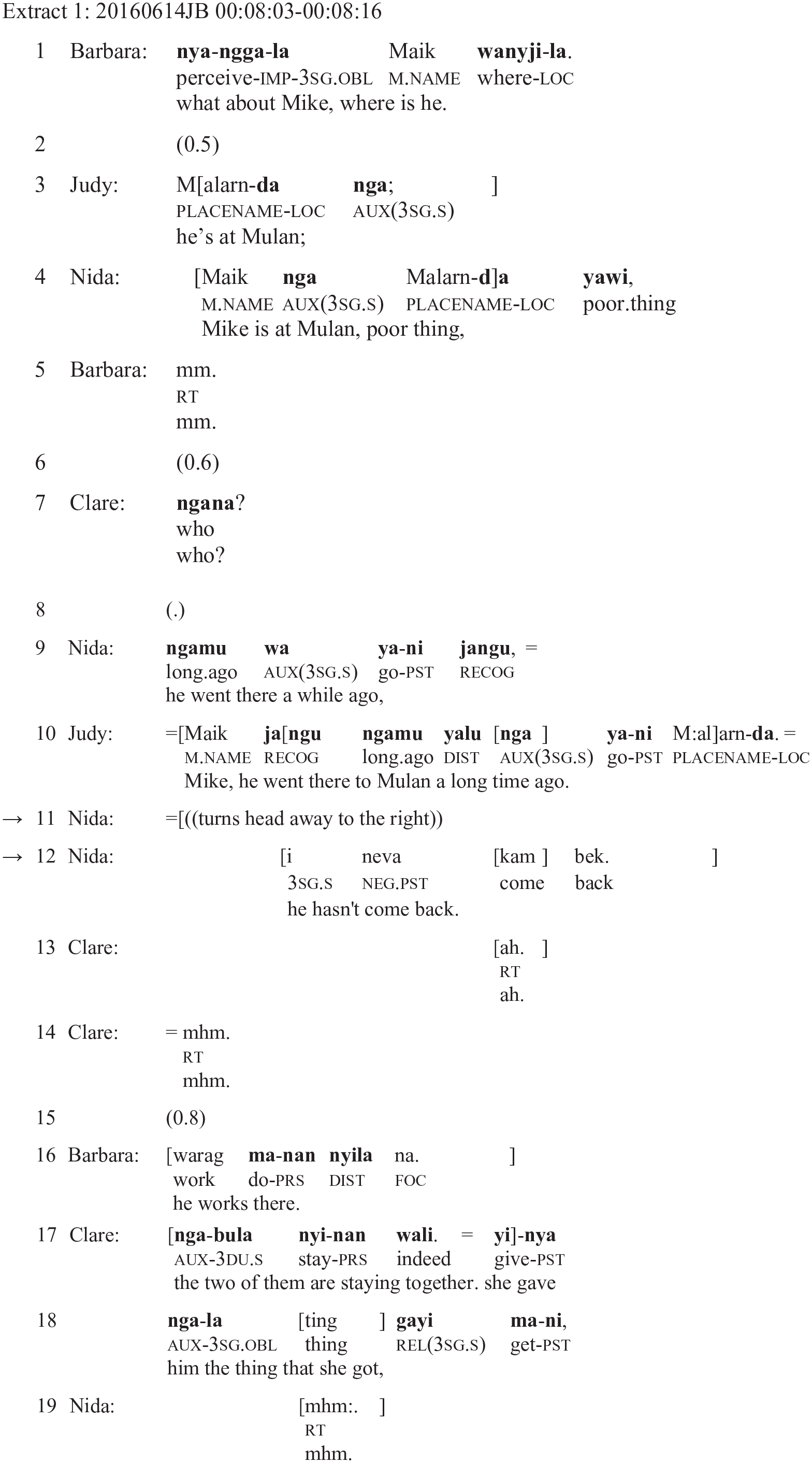
In line 1 Barbara asks where Judy’s adult son Mike is living these days while pointing at her with a stick and thus selecting her to speak (for a discussion of speaker selection in Extract (1), see Blythe et al., 2018, pp. 159–161). Judy provides an answer in overlap with Nida, who is Mike’s aunt and also knows about Mike’s whereabouts. In line 9 Nida continues to explain that Mike left the community to live at Mulan a long time ago. This is then partly repeated by Judy in line 10, who simultaneously addresses Clare’s repair initiation ngana? ‘who?’ (line 7). When Nida continues speaking in line 12, she turns her head to the right and switches to Kriol: i neva kam bek ‘he hasn’t come back’. The interaction then continues in Jaru.
The language choice that Nida makes in line 12 is not demonstratively related to the social role of Kriol or its attributed values. Instead, the codeswitch is used as a signal for the achievement of a conversational task (see also Gumperz, 1982). By switching language, Nida conveys to her co-participants that the conversational activity should be interpreted differently to her previous stretch of talk. Through the departure from Jaru as the language-of-interaction at this particular point in the conversation, Nida contextualises her talk as a side-comment that is not intended to interrupt the progressivity of the conversation. And in fact, none of the coparticipants directly address Nida’s side-comment.
It is worth noting that the codeswitch may not be the only signal that Nida provides to mark an interactional shift. Just before switching to Kriol, she noticeably changes her posture and turns her head and gaze away from the group to the right. It seems likely that Nida’s posture and gaze is oriented to as an additional contextualisation cue. The simultaneous use of several meaning-making signals is a well-established conversational strategy (Auer, 1995, p. 124).
Extract (2) illustrates two further instances of codeswitching being used as a meaningful signal. In this example, Angela is recounting a story she heard about a mysterious dog that recently appeared to two of her acquaintances while they were asleep. Shortly after Angela has started telling her story, she is interrupted by Pauline who is trying to spot an Australian bustard (Ardeotis australis), a large bird also commonly referred to as bush turkey, which the group had seen and spoken about two minutes earlier. Throughout the conversation, Angela and Nanagu use predominantly Jaru, whereas Pauline and Peter use predominantly Kriol. However, at some point Angela switches from Jaru to Kriol to attract her co-participants’ attention and enhance her chances of securing the floor. Pauline, on the other hand, switches from Kriol to Jaru to address Jordan and indirectly teach him a little Jaru.
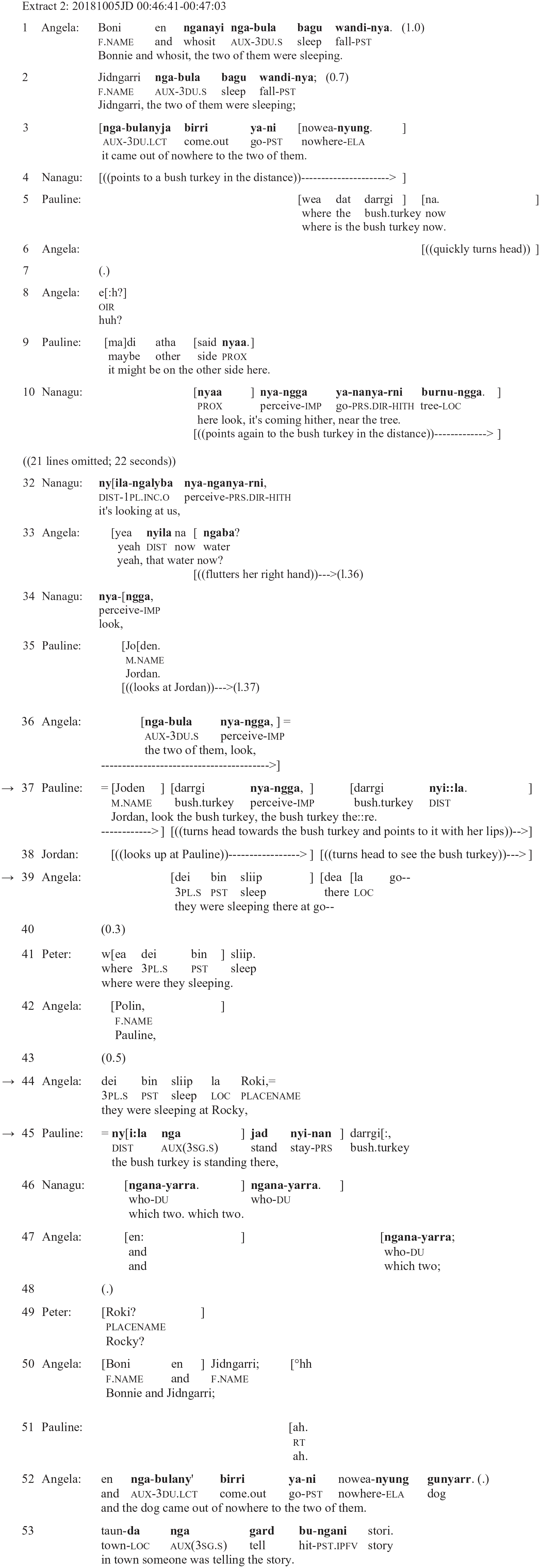
At the beginning of Extract (2), Angela has just started telling her story in Jaru (lines 1–3). The progressivity of the story is interrupted by Pauline, whose unrelated question in Kriol (wea dat darrgi na ‘where is the bush turkey now’, line 5) concerns the whereabouts of the bird the group had been talking about two minutes earlier, probably prompted by Nanagu’s pointing gesture (line 4). In response, Angela initiated repair (e:h? ‘huh?’, line 8) and Nanagu answers Pauline’s question in Jaru, by pointing out the location of the bird in the distance (nyaa nyangga yananyarni burnungga ‘here look, it’s coming hither, near the tree’, line 10). The consistent use of one language by each participant illustrates their preferred language of interaction for this particular participant constellation. Throughout the conversation, Angela and Nanagu use mostly Jaru, while Pauline and Peter use mostly Kriol, without orienting to the language choice of the others as deviant or noticeable. This type of bilingual conversation in which at least one participant consistently uses one language, and at least one participant consistently uses another language, can be referred to as being conducted in “parallel mode” (Gafaranga & Torras i Calvo, 2001, p. 205).
After a brief 22-seconds discussion about the bustard (21 lines omitted from the transcript), 3 Angela tries to gain back the floor to continue telling her story in Jaru, first by reiterating the location of the story (yea nyila na ngaba ‘yeah, that water now’, line 33), then by fluttering her hand (lines 33–36) and by re-referring to the two protagonists of the story (ngabula nyangga ‘the two of them, look’, line 36). Both utterances partly overlap with talk by the other participants and Angela fails to secure the attention of Pauline, who continues to talk about the bird.
In line 39 Angela switches from Jaru to Kriol to reiterate the beginning of her story (dei bin silip dea la go-- ‘they were sleeping there at go--’). By switching to Kriol, Angela now uses Pauline and Peter’s preferred language and thereby emphasises her attempt to secure the floor. This is underlined by Angela’s subsequent use of a term of address, which also serves to secure Pauline’s recipiency (Polin ‘Pauline’, line 42). Once Angela has secured everyone’s attention and the location and protagonists of the story are re-established, she continues with her story in Jaru (lines 52–53). Angela’s shift from Jaru to Kriol is used as an interactional resource to attract attention and secure recipiency from all co-participants. At this particular turn in the conversation, Angela’s codeswitching is designed to attend to the language preference of two of the participants in order to gain her co-participants’ full attention for the forthcoming story. In this instance, codeswitching is instrumentalised to manage recipiency. And Angela’s choice of language is shaped by what is relevant at that very moment of the interaction: it follows the principle of “recipient design” (Sacks et al., 1974, p. 727). It is also worth noting that, in order to secure the floor, Angela does not only use her bilingual competence as a strategic tool to gain attention, she also uses a fluttering hand movement, and she addresses Pauline directly by her first name.
In overlap with Angela’s reiteration of the story beginning, Pauline uses Jaru rather than her preferred language Kriol to point out the bird to Jordan, a child who is playing with some sticks nearby (Joden darrgi nyangga, darrgi nyi::la ‘Jordan, look the bush turkey, the bush turkey the::re’, line 37). By using Jaru at this moment of the interaction, Pauline contextualises her talk and indicates that she is now doing a different type of activity; she is addressing Jordan to show him the bird and to teach him some Jaru at the same time. In addition to Pauline’s shift to Jaru, she also addresses Jordan twice by name (lines 35 and 37) and she changes her gaze in Jordan’s direction, thereby clearly marking a shift in recipiency with other verbal and bodily means. Because Pauline normally uses Kriol when talking to Jordan, her temporary shift to Jaru is noticeable for the participants as a marked language practice. When Pauline calls Jordan’s name, he briefly looks at her and into the distance to see the bird, before he continues playing with the stick in his hand.
Both instances of codeswitching in Extract (2) are designed to be locally meaningful to the interactants, in connection with the sequential context and other verbal and bodily signals. It is important to point out that codeswitching between Jaru and other languages such as English or Ngardi are also common in the corpus. Jaru speakers use their entire linguistic repertoire as a resource for interaction. However, this study focuses on bilingual practices involving Jaru and Kriol, which are ubiquitous in the recorded conversations.
Extracts (1) and (2) illustrate conversational activities that can be flagged by Jaru speakers through bilingual practices. In such cases, codeswitching itself is locally meaningful and the participants orient towards the juxtaposition of Jaru and Kriol by deriving some particular interactional meaning from it. However, due to the high frequency of bilingual practices in the Yaruman community, the combination of Jaru and Kriol may not always be used as, and interpreted as, a marked language practice.
Action-neutral codemixing
The previous section illustrates how codeswitching is used by bilingual Jaru–Kriol speakers as a meaningful interactional tool. In many conversational sequences, however, the combination of the two languages seems not to be oriented to as a cue for contextualisation by the participants. Consider Extract (3), in which Judy explains how two of her young relatives, Jabalyi and Michael, got stuck in the soft sand with their motorbike. The story is predominantly told in Jaru with many Kriol insertions.
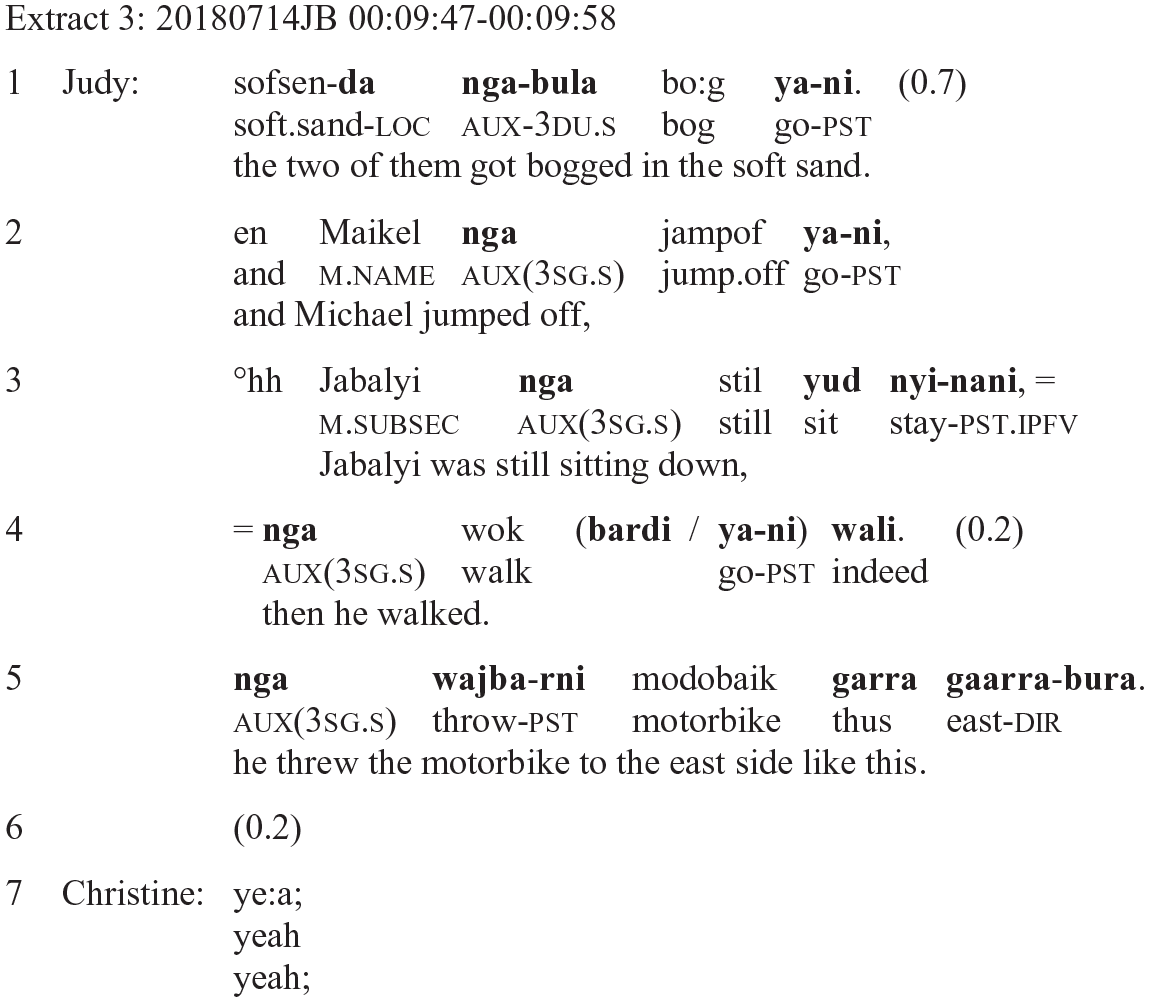
The Kriol insertions in Extract (3) cover all word classes, including nominals (sofsen, modobaik), verbs integrated into Jaru grammar as coverbs (jampof, bog), adverbs (stil), conjunctions (en), and interjections (yea). Inserted Kriol nouns are typically aligned with Jaru morphosyntax and receive Jaru case markers such as the locative (sofsenda ‘in the soft sand’, line 1), while verbs are typically integrated as coverbs into the complex predicate structure (bog yani ‘got bogged’, line 1). Coverbs carry most of the lexical–semantic load and occur before a semantically bleached inflecting verb indicating tense, aspect and mood. The use of Jaru verbal inflection is one of the reasons Jaru can be considered to be the base language of Judy’s utterances in Extract (3). The base language of a clause can be identified on the basis of verbal morphology and tense–aspect–mood (TAM) auxiliaries, according to the criteria used by McConvell and Meakins (2005, p. 19) to identify the matrix language for Gurindji–Kriol codeswitching.
One motivation for using Kriol rather than Jaru terms may be that there are no readily available Jaru equivalents or that the lexical items have become fully established borrowings. For example, there is no Jaru term for modobaik ‘motorbike’ and thus the Kriol term has become the usual term of reference. However, many of the terms that Judy uses in Extract (3) do in fact have equivalents in both languages (e.g., bog, jampof, stil). The fact that she decides to use the Kriol words suggests that the Jaru and Kriol terms can be used interchangeably. In addition to lexical items, Judy also borrows some grammatical structures from Kriol by using the Kriol conjunction en ‘and’ which does not have a direct equivalent in Jaru. Clause-peripheral elements of Kriol grammar such as discourse markers, interjections, and coordinating conjunctions are very frequently inserted into Jaru speech by all speakers. These elements, which are also known as “utterance modifiers” (Matras, 1998), are most prone to contact-induced change. In fact, some of these utterance modifiers are now fully conventionalised in Jaru speech, such as the Kriol conjunction en ‘and’ (Extract 3, line 2), the focus marker na ‘now’ (Extract 1, line 16), the epistemic marker madi ‘maybe’ (Extract 4, line 7), and the tag question indit ‘isn’t it’ (Extract 5, line 4). These Kriol elements can be considered instances of fusion, as they have become an integral part of Jaru grammar. They are fully established regardless of the language of interaction or the base language of an utterance.
Crucially, the Kriol insertions are here embedded in a way that does not affect the flow of speech or prosody, and none of the participants orient towards the Kriol insertions as noticeable. Judy herself does not display any noticeable embodied behaviour and there is no repair initiation by any of the participants. The only reaction to Judy’s ongoing story is a yea ‘yeah’ response from Christine in line 7 of Extract (3), and there is no evidence of problems with intersubjectivity.
Based on these observations, it is reasonable to argue that the bilingual speech patterns do not convey any interactional meaning here, rather this bilingual way of talking is an idiomatic, action-neutral mode. This does not mean that the interlocutors are unable to recognise the origin of individual words, but the insertions are not treated as conveying any additional meaning. The bilingual speech can thus be considered the medium of interaction.
Judy’s codemixing in Extract (3) largely maintains Jaru as a grammatical frame by predominantly inserting lexical and clause-peripheral grammatical elements. Most of the inserted elements are uninflected forms and can be considered instances of “minimal insertions” (Auer, 2014). However, this is not always the case. In many instances, speakers freely combine elements and morphosyntactic structures from both Jaru and Kriol without keeping to one base language. Extract (4) illustrates that even a change in the base language does not necessarily mean that there is an additional interactional meaning. Consider the linguistic choices that Christine makes in lines 8 to 9.
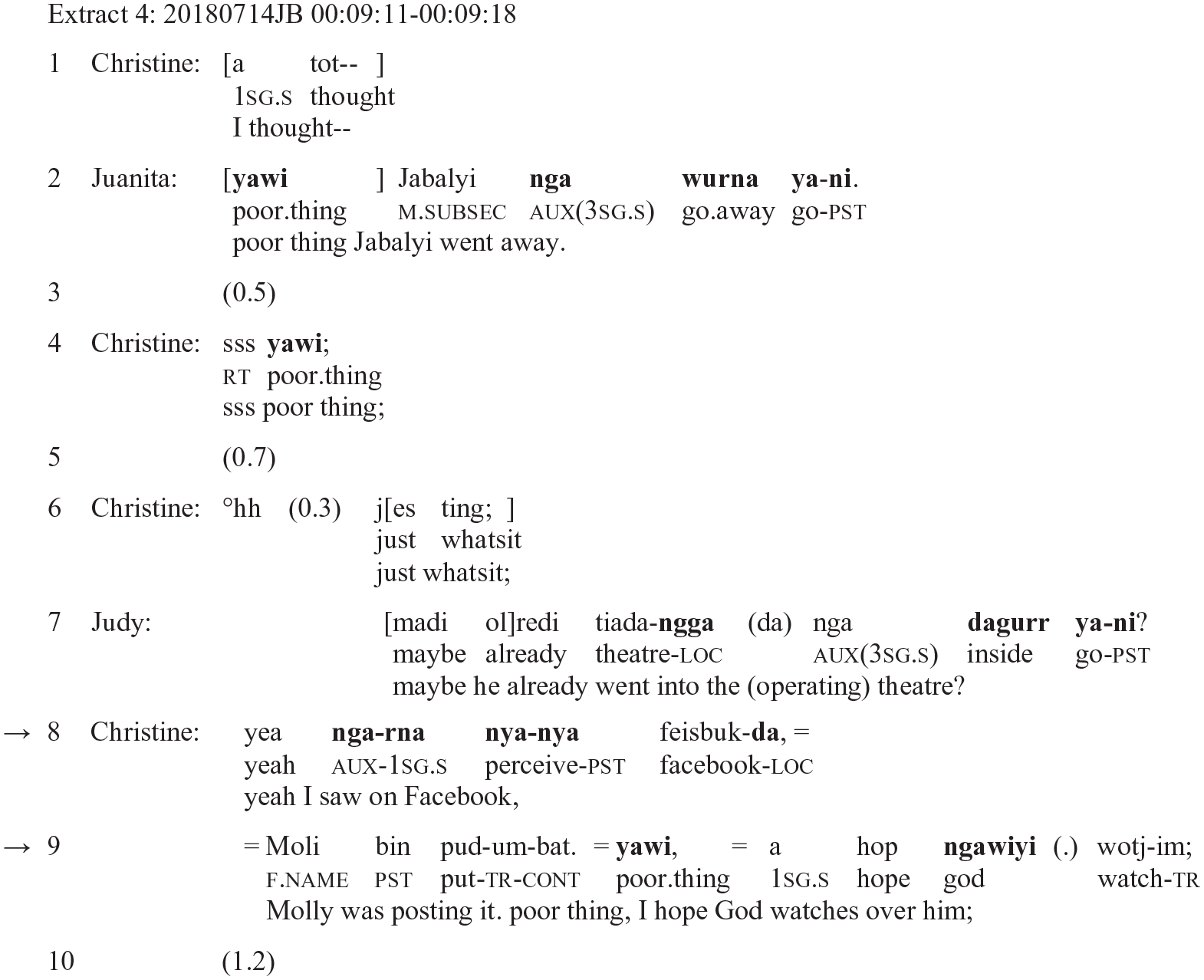
Extract (4) begins with Juanita’s launch of a new conversational topic: Juanita’s nephew who had to go to the hospital. Following a compassionate yawi ‘poor thing’ response from Christine and a brief silence, Judy self-selects as the next speaker (line 7) in overlap with Christine. Judy speculates whether her grandson has already gone into the operating theatre to get surgery. The rising intonation of her speculation seeks confirmation. Christine provides the confirmation using a Kriol response token yea ‘yeah’ (line 8) before explaining that she got the information from a recent Facebook post by Molly. Christine’s explanation ngarna nyanya feisbukda ‘I saw on Facebook’ (line 8) features feisbuk ‘Facebook’ as a syntactically embedded proper noun with locative case marker -da. Christine then goes on to give further details about what she saw on Facebook by producing a latched stretch of talk with Kriol syntax, adding Moli bin pudumbat ‘Molly was posting it’ (line 9). The transition from Jaru to Kriol is seamless with the two sentences being latched and prosodically fluent. Christine goes on to add a Jaru compassionate token yawi ‘poor thing’ and ends her multiple-unit turn in Kriol while using the Jaru word ngawiyi for ‘God’: a hop ngawiyi wotjim ‘I hope God watches over him’ (line 9).
Again, from an interactional perspective that is based on a close observation of the participants’ verbal and embodied behaviour, there are no cues to identify any interactional meaning that might be conveyed by the morphosyntactic and/or lexical switches in Christine’s bilingual talk. Neither Christine nor any of the other participants orient towards any part of the talk as noticeable or deviant in any way. In this part of the conversation, the codemixed medium very much constitutes the normative way of speaking.
Most older Jaru speakers have a general preference for Jaru as the base language, with codemixing occurring most commonly with Kriol lexical elements and utterance modifiers. On the other hand, some younger speakers such as Christine do not have this kind of preference for one language or the other; codemixing is ubiquitous in their speech. In a 1988 survey of the Kimberley languages, McGregor (1988) reported that Jaru was a particularly strong language that was still being acquired by children as a first language. Interestingly, the children referred to in the survey are today aged around 30 to 44. This generation of speakers seem to have developed a bilingual style that is strongly characterised by codemixing. It is worth noting that younger speakers may still use their bilingual competence as an interactional resource to structure their talk, but in many cases the codemixed speech is the medium of interaction.
When speakers are asked about their codemixing style, they usually describe it as miksimap lenggwij ‘mixed up language’ 4 or simply as Jaru. This supports Auer’s (2014) observation that extensive codemixing makes the language shift less dramatic for the speakers, because they may identify their own speech as belonging to the minority language. In order to take both descriptions into account, I will refer to codemixed speech as Mixed Jaru, regardless of the speaker’s age. This helps to differentiate between mixed and more monolingual speech styles when analysing Jaru conversations.
Grammatical fusion in Mixed Jaru
Considering that Jaru–Kriol codemixing is very often oriented to as action-neutral normative conduct in the corpus and the bilingual medium seems to have become the ordinary mode of interaction, it is reasonable to ask to what extent grammatical fusion has occurred and whether we can speak of Mixed Jaru as a language in its own right. Auer (2014) notes that mixed languages arise to serve as a symbol of group identity in situations of language shift. In an analysis of the circumstances that have led to the emergence of mixed languages in the Australian context, Meakins (2014) proposes a number of factors, including: prevalent codeswitching practices in the communities (McConvell & Meakins, 2005); dominance of one single traditional language rather than several traditional languages with similar status in the community (McConvell, 2008a); and significant “identity-marking events” (Meakins, 2008). In fact, these three factors are also true for the linguistic situation of the community at Yaruman. Jaru–Kriol codeswitching is extremely common in all generations except for children and young people under 30; Jaru is the only dominant traditional language in the community; and there have been several identity-marking events for the Yaruman community, such as the eviction from Gordon Downs Station in 1981, where Jaru people used to work and live, followed by a few years of exile at Halls Creek, a fight for land rights, and the establishment of a new Jaru settlement at Yaruman from 1983 onwards (see Bunbury, 2002; McKay, 1996, pp. 124–132; for a map with the mentioned locations, see Dahmen et al., 2020).
In addition to this very similar sociolinguistic situation, Jaru is also typologically closely related to the partly mutually intelligible neighbouring languages Gurindji and Warlpiri, two of the languages that have contributed to mixed languages in Australia. Many of the mixed utterances by younger adults at Yaruman are strikingly similar to the structure of the Australian mixed languages: nouns and pronouns are derived from both Jaru and Kriol; verbal morphology is drawn from Kriol; and nominal morphology is drawn from Jaru. Due to the lack of recordings exclusively involving speakers aged 30–44, the extent to which Mixed Jaru has stabilised among that age bracket is unclear. The following examples highlight some structural similarities between Mixed Jaru and the Australian mixed languages, Gurindji Kriol and Light Warlpiri, and illustrate why Mixed Jaru cannot be regarded as a stable mixed language, in spite of these striking similarities.
Fusion of two morphological systems
Mixed Jaru not only draws lexical items from both Jaru and Kriol, but also structural elements. The base language of this mixed speech can often be identified as Kriol on the basis of Kriol TAM markers. However, the Jaru-derived elements in mixed speech are not merely lexical insertions and utterance modifiers, they also involve core parts of Jaru grammar such as Jaru nominal morphology. In many utterances of younger speakers, the nominal morphology is derived from Jaru while the verbal morphosyntax is derived from Kriol, which is reminiscent of Gurindji Kriol and Light Warlpiri. This means that within the same clause, nominals are often inflected with Jaru case markers (ergative, dative, locative, allative, ablative, etc.; see Tsunoda, 1981), whereas verbs have Kriol morphology (transitive, continuative, and directional/spatial; see Schultze-Berndt et al., 2013), and TAM categories are marked using Kriol auxiliaries. The constituent order of Mixed Jaru tends to be like Kriol’s subject–verb–object (SVO), in contrast to Jaru, which has pragmatically determined constituent order (cf. Hale, 1992).
The composite structure of Mixed Jaru is illustrated in Extract (5), in which Juanita talks about one of her family’s regular fishing spots. She specifies that she and her family usually do not go fishing in the area being talked about, but instead they go to the Ord River on ‘this side’ where there are plenty of black bream to catch. As is common for speakers of Juanita’s generation who are aged 30–44, she combines Jaru case morphology with a Kriol verbal frame.
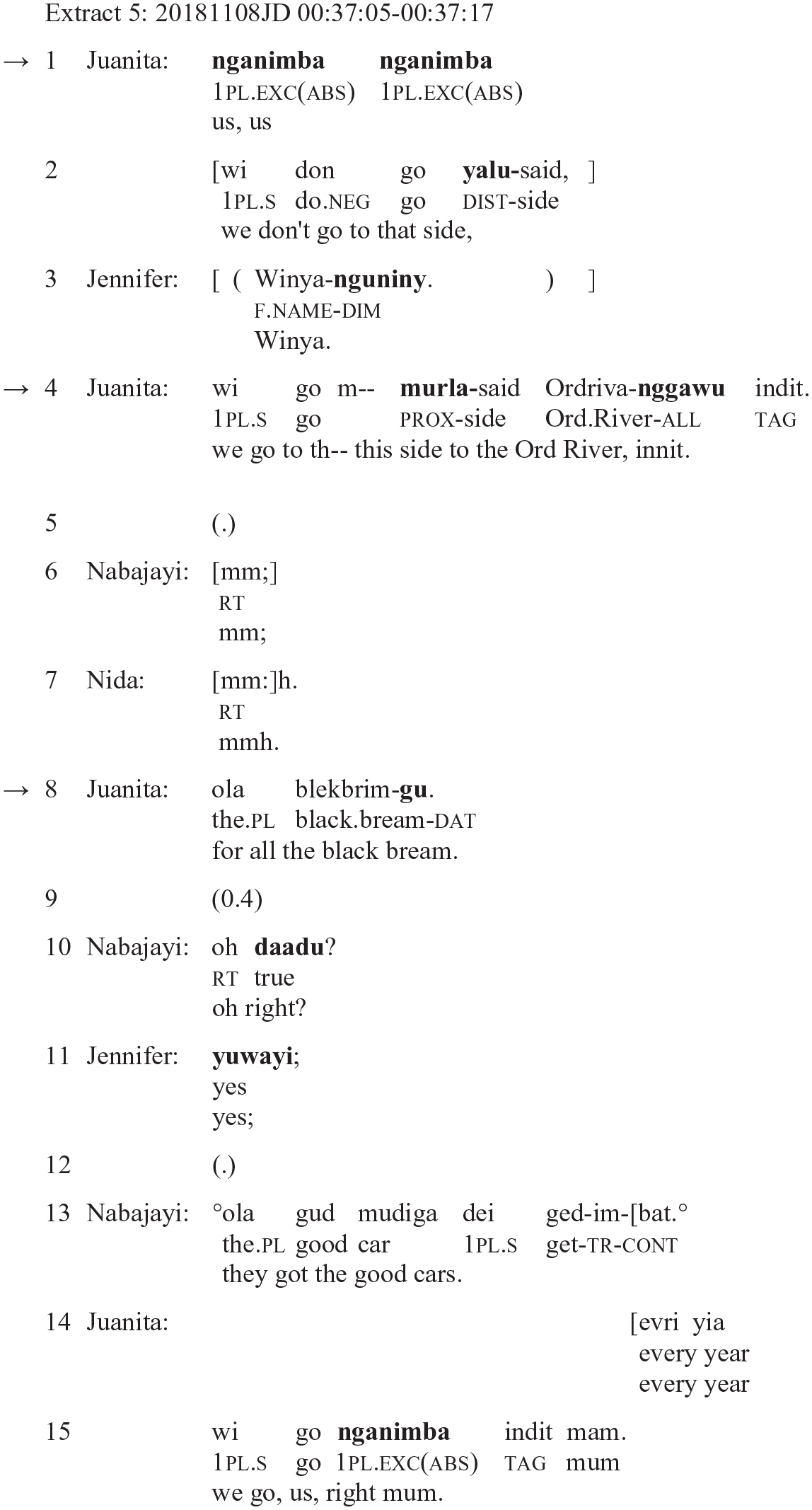
Extract (5) illustrates typical intra-clausal codemixing in Mixed Jaru. Juanita combines both Jaru and Kriol to mark inflectional categories in her speech. The verbal structure is derived from Kriol (wi don go ‘we don’t go’ and wi go ‘we go’, lines 2 and 4) and the nominal case markers are derived from Jaru with allative (Ordriva-nggawu ‘to the Ord River’, line 4) and dative markers (ola blekbrim-gu ‘for all the black bream’, line 8). The combination of structural features from Jaru and Kriol is not interactionally relevant, nor is it oriented to by any of the participants.
At this point, it is worth pointing out that most Jaru speakers at Yaruman use a reduced set of Jaru case allomorphs. For example, the allative marker for a vowel-final multisyllabic stem such as Ordriva (line 4) would be -lawu rather than -nggawu in traditional Jaru (cf. Tsunoda, 1981, p. 54). However, Juanita uses the allative allomorph -nggawu for any vowel-final stem. The reduction of case allomorphy is not only observable in Mixed Jaru; it is a general feature of contact-induced language change also occurring in more monolingual Jaru speech by most speakers to varying extents. Similar morphological changes have been described for a number of other Australian languages undergoing language change (see, e.g., Meakins, 2011; O’Shannessy, 2006; Schmidt, 1985).
The borrowing of case morphology is a rather uncommon outcome of language contact, although it has been attested in a number of contact situations in Australia (e.g., Disbray & Simpson, 2005) and elsewhere (see Thomason, 2015). Meakins (2012) describes the structural fusion of two morphological systems as a distinctive feature of more grammatically fused mixed languages, which contrast with other outcomes of language contact. In fact, while some mixed languages retain a restructured grammatical system of one of the source languages, a small set of well-described mixed languages have in common that they combine the grammatical systems from two languages, often with a grammatical split in respect of the verbal and nominal morphology of the new language (Auer, 2014). According to Meakins (2013) and Auer (2014), these well-described mixed languages include Michif, Mednyj Aleut, Light Warlpiri and Gurindji Kriol.
The Michif language spoken in Canada and the United States, for instance, typically combines verbs and verbal morphology from the Amerindian language Cree with French-derived nouns and nominal morphology (Bakker, 1997). Similarly, the nearly extinct mixed language Mednyj Aleut spoken on the Bering Island in the far east of Russia retains most of the lexicon and the nominal morphology from Aleut, while verbal inflections are derived from Russian, in particular the person, number, tense, and optional gender markers (Golovko, 1994, 1996). And finally, the Australian mixed languages Light Warlpiri and Gurindji Kriol both derive verbal inflections and TAM markers from Kriol, while nominal inflections are retained from the respective traditional languages Warlpiri and Gurindji (Meakins, 2011; O’Shannessy, 2006).
Interestingly, while the combination of two grammatical systems seems to be one of the defining features of one type of mixed language, it has also occurred in at least two language contact situations that served as a precursor for a mixed language: the codemixing of Gurindji and Kriol in adult Gurindji speech in the 1970s (McConvell, 2008b; McConvell & Meakins, 2005); and the codemixing in Warlpiri speakers’ child-directed speech (O’Shannessy, 2012). The structural distribution of morphosyntactic features of the mixed language Gurindji Kriol reflect the patterning in the prevalent codemixing (or “code-switching” in McConvell’s terms) of previous generations (McConvell, 2008b). McConvell and Meakins (2005) argue that Gurindji Kriol emerged when child learners in the 1960s–1980s conventionalised the patterns of their codemixed language input, which resulted in an autonomous system with new grammatical constraints. Similarly, O’Shannessy (2012) argues that Light Warlpiri emerged when children regularised and expanded the structures of codemixing practices they received as input.
Auer (1999, 2014) and Myers-Scotton (2003) suggest that mixed languages are the result of gradual stabilisation of morphosyntactic elements and grammatical constraints. The preference for a split between verbal and nominal morphology in Mixed Jaru, as illustrated in Extract (5), can be considered an example of fusion which has not yet fully conventionalised (see below).
Further evidence for the structural fusion in Mixed Jaru is the use of Jaru-derived emphatic pronouns in contrast to Kriol-derived unmarked pronouns. Consider the opening line from Extract (5), in which Juanita uses the Jaru first person plural exclusive pronoun nganimba ‘we (but not you)’. Here, Juanita makes the point that she and her family do not go fishing on the same riverside as her addressees. The pronoun nganimba is clearly emphasised through repetition and by making a clusivity distinction which Juanita does not make in the Kriol pronoun of the main clause wi ‘we’. A similar use of emphatic pronouns can be found in Gurindji Kriol, which derives emphatic subject pronouns from Gurindji (Meakins, 2012).
Argument-marking in Mixed Jaru
Extract (5) illustrates the use of Jaru-derived emphatic pronouns and semantic case markers in Mixed Jaru speech. It is important to highlight that the use of Jaru nominal morphology in Mixed Jaru is not restricted to semantic case markers. Core cases such as the ergative are frequently marked with Jaru morphology, too. Extract (6) exemplifies the use of an ergative case marker in Mixed Jaru. Christine is talking about a recent event where ‘one of Bella’s boys’ put a firecracker the wrong way around and it went straight into the crowd.
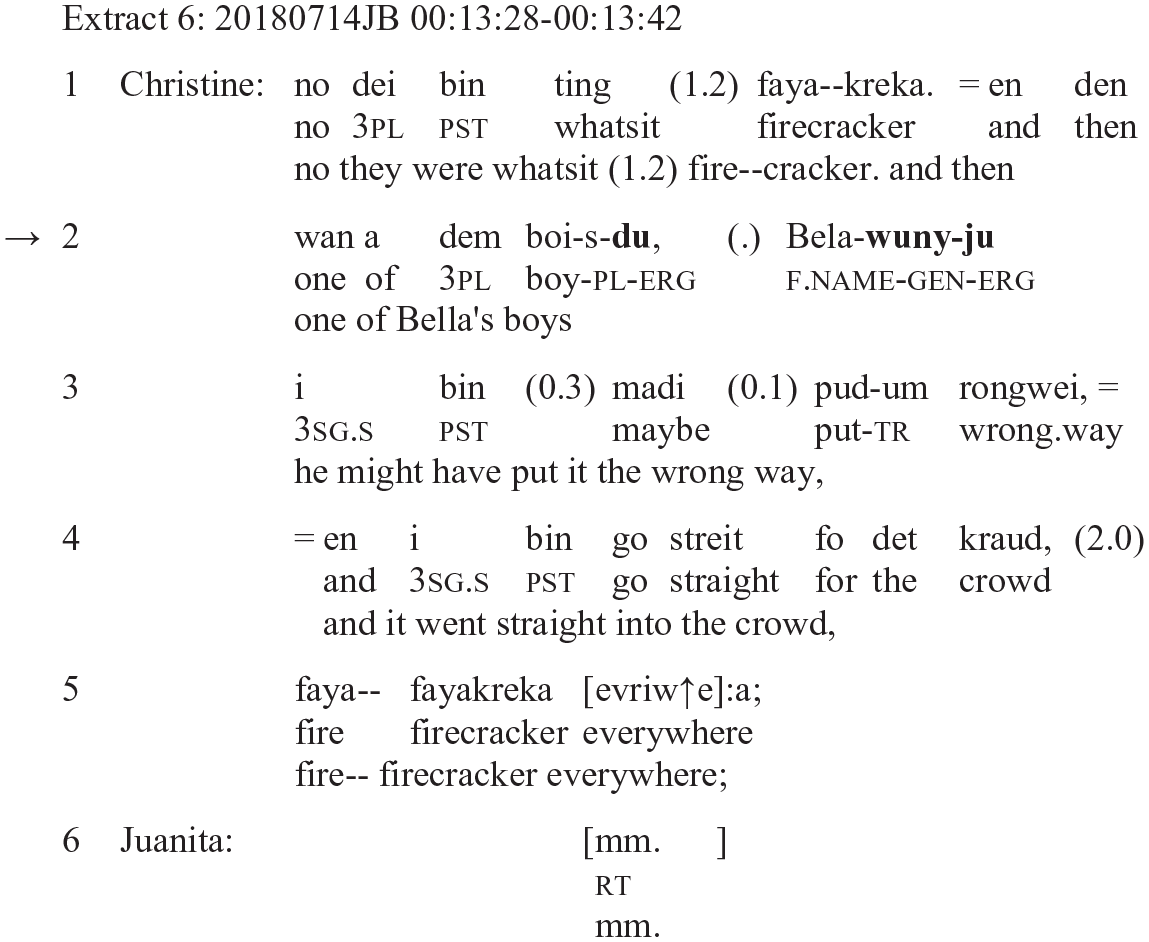
In line 2 of Extract (6), Christine marks the subject with the ergative case, which agrees across the noun phrase. The genitive proper noun Belawuny ‘Bella’s’ agrees with the head by case stacking, also referred to as “suffixaufnahme” (Plank, 1995), and the Jaru ergative marker -du on the head noun is suffixed to the optional Kriol plural marker -s (line 2). The nominal morphology that Christine uses is in line with traditional Jaru grammar, both in terms of case agreement and allomorphic forms (-du, -ju), whereas the verbal structure is entirely derived from Kriol. It is worth noting, however, that the case-marked constituent (wan a dem boisdu Belawunyju ‘one of Bella’s boys’, line 2) is not fully integrated into the predicate–argument structure of the clause. Instead, it cross-references the Kriol third-person pronoun i ‘he’. This structure bears close similarities to the kind of Gurindji–Kriol mixing of the 1980s that has been shown to be the origin of the mixed language Gurindji Kriol (McConvell, 1988; McConvell & Meakins, 2005). In Gurindji Kriol, ergative-marked nominals do not require a coreferential pronoun, but there is still a strong correlation between the presence of a coreferential pronoun and the use of an ergative marker on the subject noun phrase (for a detailed analysis of the ergative case suffix and its shift in Gurindji Kriol, see Meakins, 2009, 2015). It is not yet clear whether the ergative marker in Mixed Jaru can appear without a cross-referencing pronoun, or whether the function of the ergative marker has begun to shift, as has been attested for both Gurindji Kriol and Light Warlpiri (Meakins & O’Shannessy, 2010). However, the data clearly indicate that the ergative marker in Mixed Jaru does occur in similar clausal environments as in Gurindji Kriol and Light Warlpiri. For instance, in Extract (6), the morpho-syntactic frame is provided by Kriol, and arguments in Kriol are expressed through SVO constituent order, so the ergative case is not required for marking agents. This provides the potential for a shift in the function of the ergative marker.
Instances where constituent order is insufficient to determine the thematic relation of nominals include constructions in which the agent is expressed post-verbally and it could be unclear whether it is the patient or right-dislocated agent of the verb. In Extract (7), Christine is speaking about a recent party where some attendees were disguised as superheros. At some point in Christine’s story, a Batman-disguised character joins some other people in an argument. The ergative marker contributes to the correct understanding of the story.
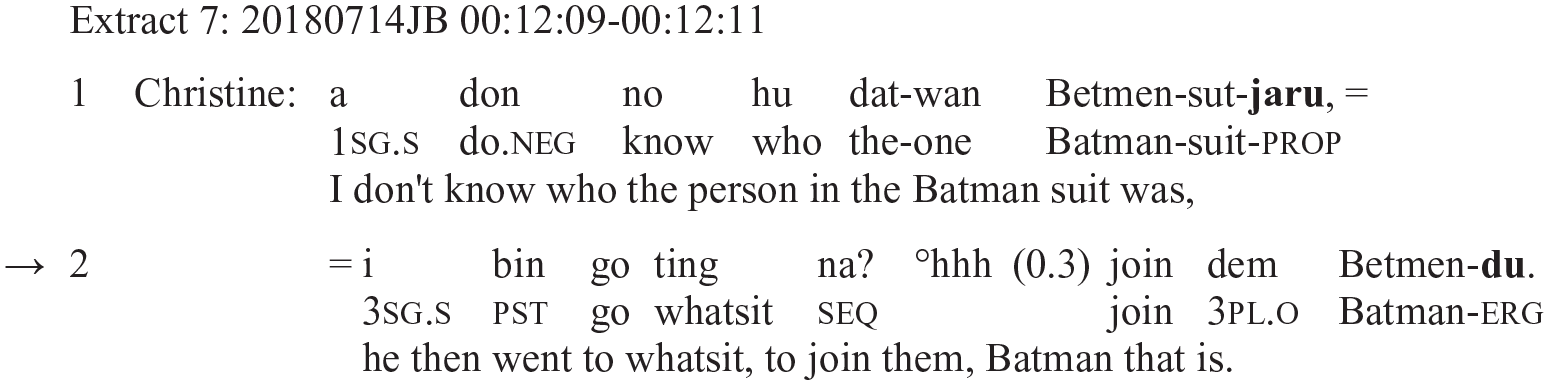
The agent of the transitive verb is Betmen ‘Batman’ (line 2), which is again cross-referenced by the third-person pronoun i ‘he’. There is no doubt that discourse prominence arises because of the dislocation of the noun phrase, but it is not clear whether this has already had an effect on the more general function of the ergative case marker in Mixed Jaru. So far, no intransitive verbs occurring with ergative-marked agents have been identified and ergative markers seem to exclusively attach to noun phrases that have a coreferential pronoun.
While the ergative case marker in mixed speech seems to be more common among younger Jaru speakers, it also occurs in the mixed speech of older people. In Extract (8), Nida explains that she grew up in a family with ten children.
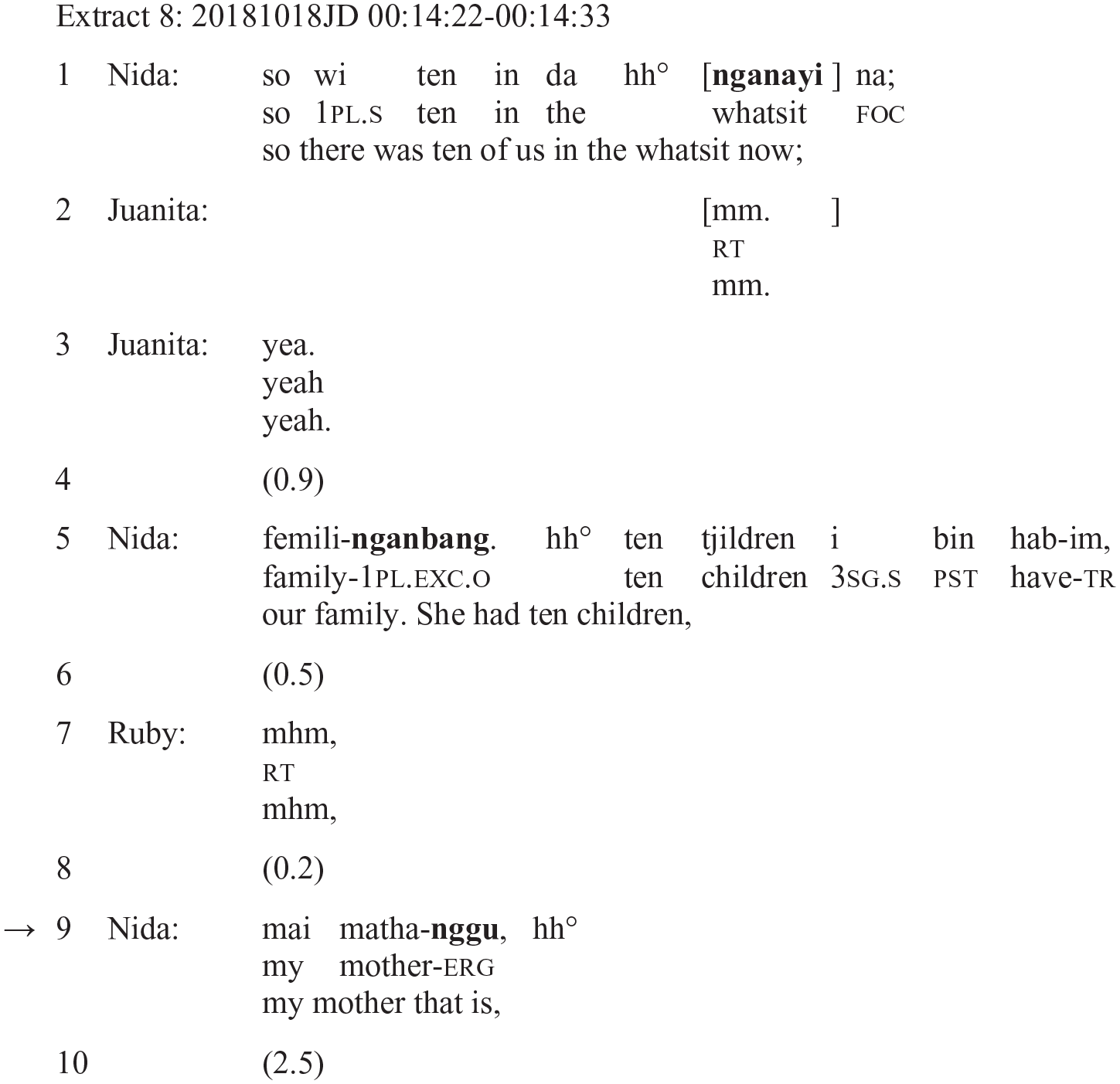
Just before this point in the conversation, Nida had been talking about her mother and siblings. In line 5, Nida explains that her mother had ten children, using the third-person pronoun i ‘she’ to refer to her (ten tjildren i bin habim ‘she had ten children’, line 5). Even though the context makes clear who Nida is talking about, after a brief pause, she adds the ergative-marked subject mai mathanggu ‘my mother’ (line 8) cross-referencing the Kriol third-person pronoun i ‘she’ (line 4). This illustrates that the signs of grammatical fusion involving the combination of two morphological systems also occur in the bilingual speech of older Jaru speakers.
Fusion without full sedimentation
Despite the extent of grammatical fusion in Mixed Jaru and speakers’ orientations towards the mixed code as normative, the codemixed speech cannot be regarded a stable linguistic variety. This is evidenced by considerable inter-speaker and intra-speaker variability and the absence of Jaru nominal morphology in children’s speech.
First, while there is a clear preference for Kriol-derived verbal and Jaru-derived nominal morphology in Mixed Jaru, speakers still also use Jaru inflecting verbs, nominals without case-marking and pronouns from both systems. Accordingly, there is still a considerable amount of variability and the patterns of the codemixed speech are not conventionalised or predictable. This is, for instance, the case in line 8 of Extract (4), where Christine uses Jaru pronominal and verbal morphology by saying ngarna nyanya ‘I saw’ rather than the Kriol equivalent a bin luk ‘I saw’.
The second factor that suggests instability is the lack of intergenerational transmission of the codemixed speech style with morphological split. At Yaruman, most people below the age of 30 speak Kriol with only lexical and clause-peripheral grammatical borrowings from Jaru.
Extract (9) features four Jaru children of the age group 3–14. The children use Kriol morphosyntax with single-word insertions from Jaru. Most insertions are fully established borrowings within the community, and the insertions are typically not interactionally motivated. In this extract, the children are sitting around a waterhole, when Jack sees a crow seemingly waiting to get to the water.
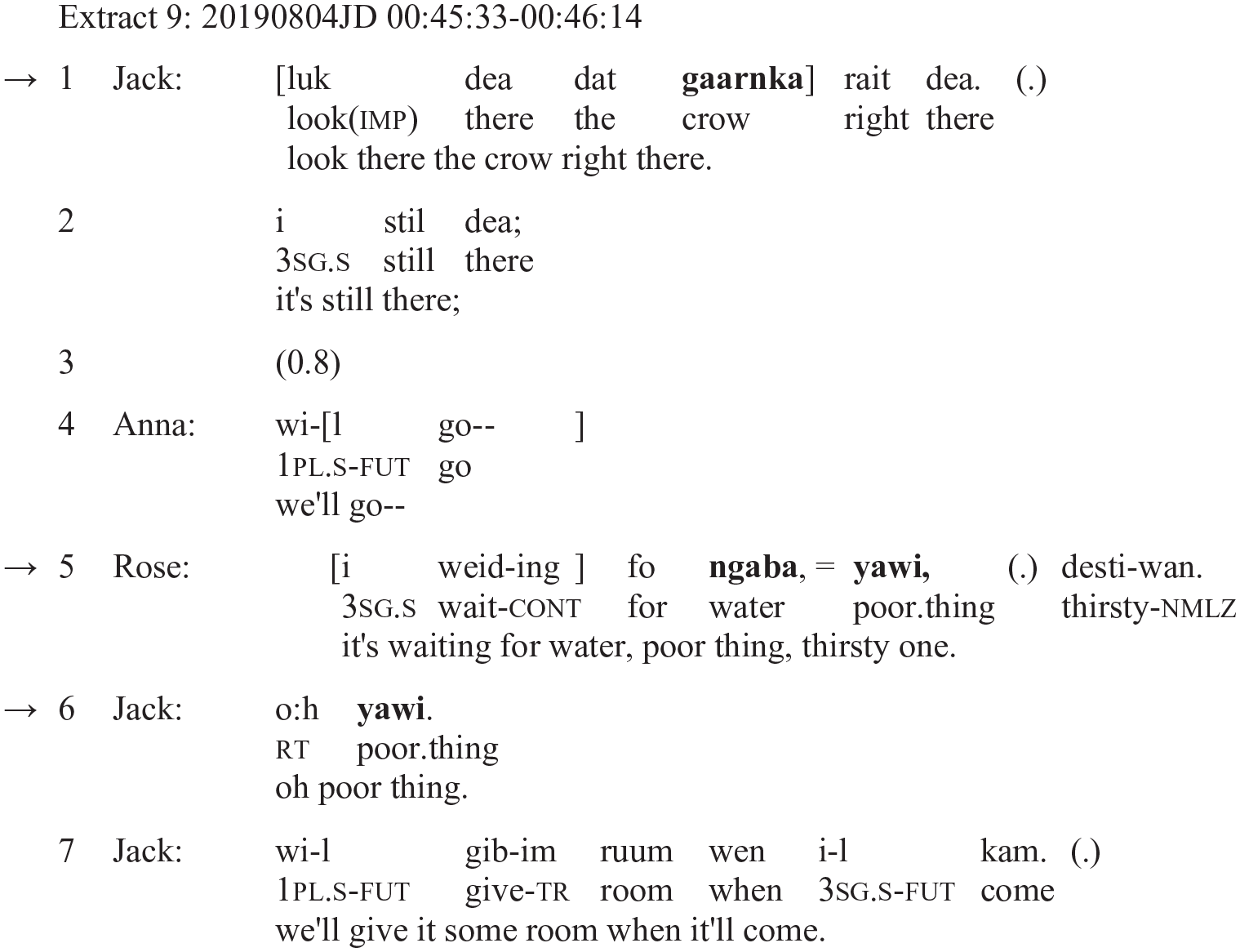
Extract (9) illustrates one of the last stages of the language shift towards Kriol. Jaru children still have passive command of Jaru, but their active language use is mostly restricted to Kriol. The youngest generation at Yaruman do not use any nominal morphology from the traditional language. For instance, in line 5 Rose uses a Kriol preposition fo ‘for’ instead of a Jaru-derived case marker.
Some semantic domains are more resilient to complete language shift. Commonly inserted Jaru words in the Yaruman variety of Kriol belong to kinship terminology, the natural world such as terms for animals and the elements, the supernatural world such as the term for ‘God’, and interjections such as the compassionate token yawi ‘poor thing’. This variety of Kriol with frequent Jaru lexical borrowings can be referred to as Ringer Soak Kriol, in line with the English/Kriol name for Yaruman.
While the youngest generation at Yaruman have shifted to Kriol, it should be noted that there are some innovations in this generation’s speech. One such innovation is the use of a reduced past tense marker -m, which is similar to the second element of the auxiliary cluster in Light Warlpiri (see O’Shannessy, 2005). The -m form is rarely found in the Kriol or mixed speech of older speakers at Yaruman, but often used by young speakers as a past tense marker in conjunction with subject pronouns as an alternative to the past tense marker bin (i.e., am ‘I was’, yum ‘you were’, im ‘he/she/it was’, wim ‘we were’, and dem ‘they were’). The suffix -m is likely to be the result of assimilation and elision of the Kriol past tense marker bin. The phonological process that resulted in the -m form becomes occasionally evident. In the following ghost-chasing story in Extract (10), for instance, Jack realises the auxiliary at first as i-bm (line 1) and all subsequent instances as i-m (lines 2–3). Note that both occurrences of the subject noun phrase dat gugurr ‘the ghost’ in lines 1 and 4 cross-reference a Kriol pronoun.
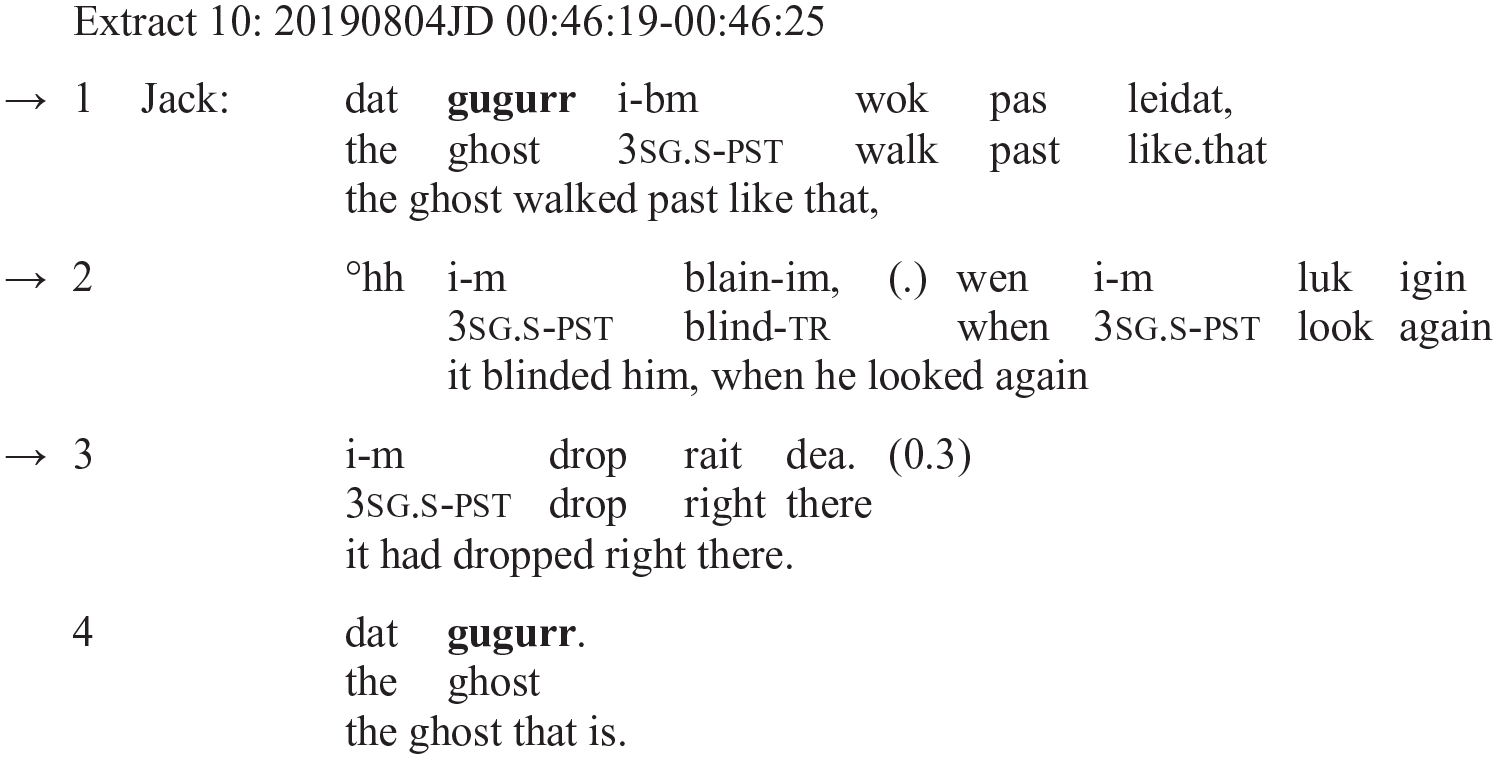
O’Shannessy (2005, 2021) notes that the development of the non-future morpheme -m in Light Warlpiri has been reinforced by a re-analysis of the third person singular pronoun im. Considering the auxiliary suffix -m has been used in Light Warlpiri for an extended period of time, it may have originated in Lajamanu and later spread to Yaruman. The communities are geographically close to each other and residents of both places have frequent contact with one another.
It seems that the sociolinguistic and sociohistorical factors that have led to the emergence of mixed languages at Kalkaringi/Daguragu and Lajamanu, such as prevalent codeswitching, dominance of one traditional language, and identity-marking events, are also the driving force for intense codemixing and grammatical fusion at Yaruman. However, children at Yaruman do not target Mixed Jaru as their language of production. This may be the result of some geographical and demographic factors. For example, the Yaruman community lies in comparatively close proximity (166 km) to a bigger town, Halls Creek, which is predominantly English/Kriol-speaking. Many members of the Yaruman community have family in Halls Creek and spend a considerable amount of time there. Furthermore, the community is much smaller in size compared to Kalkaringi/Daguragu and Lajamanu, and, as a result, the number of Mixed Jaru speakers is comparatively low. The geographical and demographic factors at Yaruman do not seem to be working in favour of the genesis of a stable mixed language, and for this reason, a community-level mixed language is unlikely to ever eventuate.
Continuum of bilingual speech patterns
The recorded conversations between Yaruman-based participants show that patterns of all three prototypes of bilingual speech are present in the community: codeswitching; codemixing; and grammatical fusion. Table 1 summarises the different patterns of bilingual speech that have been observed.
Bilingual speech at Yaruman.
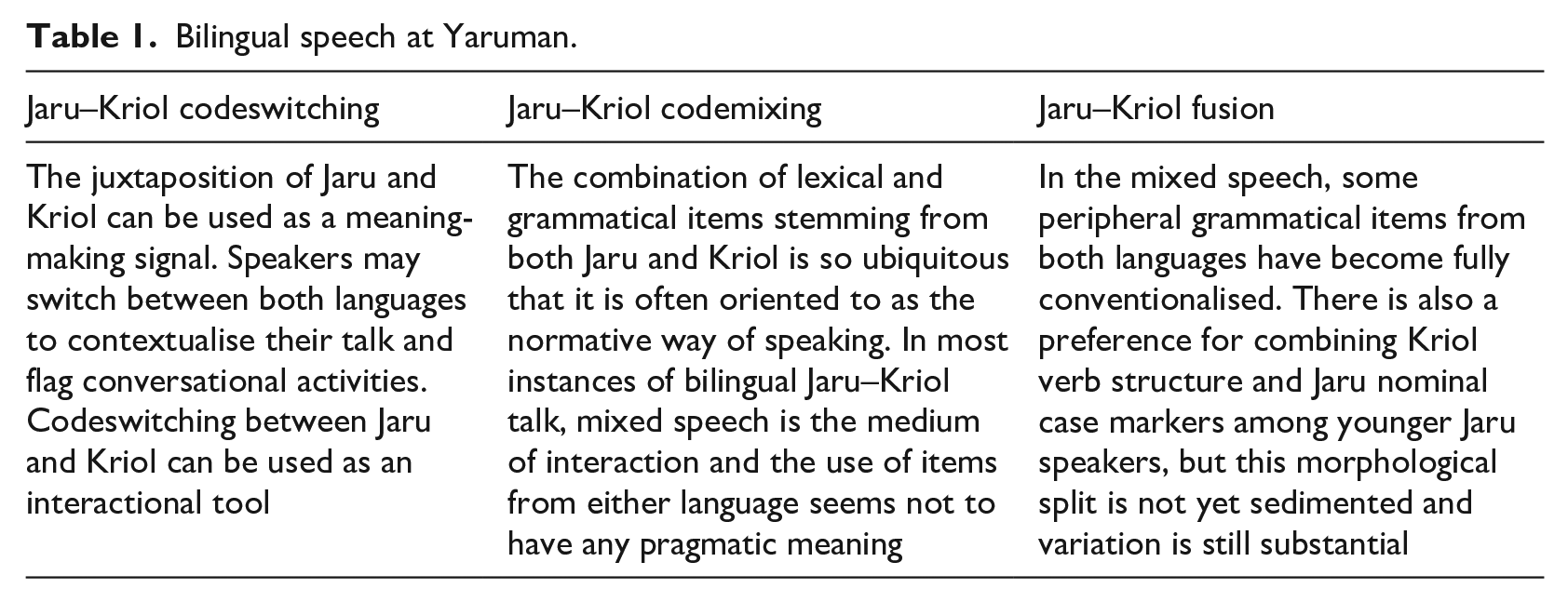
Furthermore, Table 1 provides an overview of the different types of bilingual speech but the categories are not clear-cut. In some cases, it may be unclear whether an instance of codeswitching between Jaru and Kriol is interactionally meaningful, or to what degree a certain linguistic structure of codemixing has become conventionalised. Therefore, it is more accurate to think of bilingual speech patterns and fusion as a gradient phenomenon, as has been proposed by Auer and Hakimov (2021). The linguistic behaviour at Yaruman provides an example of this continuum and illustrates how different types of bilingual speech can be co-present within one bilingual community.
By comparing the bilingual behaviour of speakers from different generations, I propose that the bilingual patterns also expose how language shift is taking place in the community. Many speakers of the older generation (aged approximately 45 and over) use Jaru with frequent lexical and clause-peripheral grammatical elements from Kriol, some of which are fully conventionalised and can thus be considered instances of fusion. In this age group, both interactionally motivated codeswitching and Jaru–Kriol codemixing is common. For younger Jaru speakers (aged approximately 30–44), bilingual talk is generally oriented to as the medium of interaction, though codeswitching to a more monolingual speech style is still used as an interactional resource. This age group exhibits a higher degree of fusion: in their mixed speech, the combination of two inflectional systems involving Kriol verb structure and Jaru case morphology is more common and the fusional processes are starting to regularise.
While similar language contact situations in neighbouring communities have led to the emergence of a conventionalised mixed language, speakers of the youngest generation at Yaruman (under the age of 30) almost exclusively use Kriol. Their frequent lexical insertions from Jaru generally belong to the semantic domains of kinship, the natural world, and the supernatural world. A few peripheral grammatical elements such as the compassionate token yawi are also retained. For this group of speakers, full switches to Jaru are rare but passive knowledge about Jaru is widespread.
Instead of resulting in a conventionalised mixed language or stabilising at a certain point along the continuum, the sustained language contact situation at Yaruman has led to a full shift to Kriol, where only very few patterns of Jaru–Kriol codemixing and fusion are retained. These observations suggest that fusion can be a transitional phenomenon in a language contact situation. That is, structures of codemixing can exhibit signs of grammatical fusion, which may still get lost in the process of language shift.
Conclusion
This paper provides an intergenerational record of community bilingualism and bilingual practices in a situation of language shift. It contributes to a better understanding of the processes of language shift and shows that fusion involving core grammatical categories can occur among a subgroup of speakers without developing into a fully conventionalised mixed language.
Bilingual Jaru–Kriol speakers use codeswitching techniques as an interactional resource for a range of conversational activities. In many cases, however, the bilingual practices are not interactionally relevant and codemixing is often oriented to as a normative way of speaking. Participants exploit their full linguistic repertoire by relatively freely combining elements from both Jaru and Kriol.
The analysis has exposed some tendencies in the bilingual practices among different age groups in the community. Speakers of the older generation use Jaru with frequent lexical and clause-peripheral grammatical insertions from Kriol. Both interactionally motivated codeswitching and Jaru–Kriol codemixing is common in their talk. For younger Jaru speakers, mixed Jaru–Kriol speech, or Mixed Jaru, is ubiquitous and displays a higher degree of fusion by more frequently combining Kriol verb structure and Jaru nominal morphology. The nominal morphology in this mixed speech comprises all Jaru case markers, including the ergative marker, which points to a rather unusual type of mixing also found in the neighbouring mixed languages Gurindji Kriol and Light Warlpiri. The mixed Jaru–Kriol speech can be considered an intermediate stage of fusion where mixing patterns have not fully conventionalised and variation is still substantial. The youngest generation at Yaruman has almost completely shifted to Kriol with mainly lexical Jaru insertions. Considering that the youngest generation use no Jaru morphology in their spontaneous speech, it is rather unlikely that Mixed Jaru will ever stabilise to become a community-wide mixed language.
Footnotes
Acknowledgements
Many thanks to the community members at Yaruman for their support and participation in the Jaru documentation and research project. Special thanks to my language teachers and research assistants Nida Nangari Tchooga, Clara Nanagu Yundi, Judy Nangari Tchooga, Angela Nangari Gordon, Julie Nyaburru Seela, Leslie Jangala Cox, Mary Nyaburru Seela, Bonnie Nyaburru Seela, Clare Nangari Gordon, Peter Janama Wein, and Pauline Nungurrayi Jack for their invaluable help with the transcriptions. I am also grateful to my supervisor Joe Blythe for jointly building the Jaru corpus and for providing me with essential feedback while I was working on this study; and I wish to thank Scott Barnes, Ilana Mushin, and two anonymous reviewers for their insightful comments on earlier versions of this paper. Any remaining errors are my own.
Transcription conventions and glossing abbreviations
The transcriptions in this article are based on the conventions developed by  with some minor adaptations.
regular typeface: Kriol language, non-lexical vocalisations, proper nouns
→ relevant line of transcript
- morpheme boundary
[ ] overlap
= latched (immediate continuation)
°hh / hh° in- / outbreaths
(.) micropause
(0.5) duration of silence in seconds
(( )) transcriber’s comments and descriptions of non-verbal behaviour
: sound prolongation
? final rising pitch to high
, final rising pitch to mid
; final falling pitch to mid
. final falling pitch to low
↑ pitch upstep
° ° markedly soft
-- cut-off
1 first person
3 third person
Data Accessibility Statement
Declaration of conflicting interests
The author(s) declared no potential conflicts of interest with respect to the research, authorship, and/or publication of this article.
Funding
The author(s) disclosed receipt of the following financial support for the research, authorship, and/or publication of this article: This research was supported by an International Macquarie University Research Excellence Scholarship (iMQRES), and the fieldwork was supported by the Australian Government through the Australian Research Council (project DP180100515).