



Abstract
Aims and objectives/purpose/research questions:
How does second dialect acquisition in a second language compare to that in a first language in terms of rates and predictors of second dialect vocabulary use?
Design/methodology/approach:
A lexical preference task was completed by four groups of participants residing in Australia: first language speakers of Australian (L1D1) and American (L1D2) English, and first language speakers of Russian who acquired Australian (L2D1) and American (L2D2) English first. The participants named objects which are denoted by different words in American and Australian English (e.g. bell pepper vs capsicum).
Data and analysis:
The response was coded as either American or Australian, and percentage of use of Australian items was calculated for each group.
Findings/conclusions:
L1D1 used Australian words the most and L1D2 the least. L2D1 and L2D2 fell between the two L1 groups. L1D2 rate of use was predicted by proportion of life spent in Australia. L2D1 were more likely to choose Australian words if they had lived in Australia longer and had positive attitudes toward Australia. L2D2 were less likely to use Australian words the longer they had lived in the USA. Similar, but not identical, factors predict second dialect acquisition in the first and second languages.
Originality:
The research is innovative in considering second dialect acquisition in second language speakers and creates a bridge between second language and second dialect acquisition research.
Significance/implications:
The finding that second language speakers may be more flexible in second dialect acquisition than first language speakers has important implications for our understanding of cognitive and social constraints on acquisition.
Keywords
Introduction
Second dialect acquisition (SDA) is a process whereby a speaker of one dialect acquires features of another dialect; for example, a first language (L1) speaker of American English using the word lolly instead of candy after living in Australia. Second dialect (D2) acquisition in L1 is well-documented in the sociolinguistic literature (e.g. Auer et al., 1998; Chambers, 1992; Nycz, 2015; Tagliamonte & Molfenter, 2007; Walker, 2019), and a number of linguistic and sociolinguistic factors have been shown to affect its outcome: for example, age of acquisition, length of residence, attitudes, and social network composition (see review in Siegel, 2010 and references therein: Bortoni-Ricardo, 1985; Chambers, 1992; Escure, 1997; Kerswill, 1994; Payne, 1980; Rys, 2007; Stanford, 2007). However, second dialect acquisition in a second language (L2) context (for instance, an L1 speaker of Russian moving to Australia after living in the USA) has received much less attention (but see Drummond, 2012), so it is unknown whether SDA in monolinguals and bilinguals is qualitatively different, but it can tell us a lot about constraints on second variety acquisition. This paper focuses on production of lexical items. The broad research questions that this paper asks are:
Do L2 speakers use D2 lexical items in production?
If they do, how do their usage rates compare to those of L1 speakers?
What are the predictors of SDA in L2 and how do they compare to those in L1?
Constraints on second language acquisition
Success in second language acquisition (SLA) is often measured in terms of ultimate attainment, that is, native-like usage of L2 linguistic features. It has been shown to vary widely from study to study, ranging from clear non-native influences in early learners (Flege et al., 1997) to native-like performance in adults (Ioup et al., 1994). A broad range of factors have been shown to affect it. One of the strongest predictors of ultimate attainment in L2 is age of arrival (AoA), that is, speaker age of relocation to the L2 area (e.g. Flege et al., 1999; Johnson & Newport, 1989; Moyer, 2007), giving rise to the critical (sensitive) period hypothesis based on the observation that younger individuals are more successful language learners (Lenneberg, 1967). AoA in adulthood (past the sensitive period) usually has no effect on attainment (Johnson & Newport, 1989). Importantly, different linguistic levels may be affected by such constraints differently. For example, Flege et al. (1999) set the sensitive period for syntax at 12 in terms of AoA and for pronunciation at 9. Vocabulary in particular has been shown, on the one hand, to be an important predictor of speaking proficiency, alongside pronunciation (de Jong et al., 2012), and, on the other hand, to exhibit non-nativelikeness associated with age of acquisition (Marinova-Todd, 2003), though many agree that phonology is most likely to retain non-native features (Bongaerts, 1999).
Another often-considered factor in SLA is length of residence (LoR) in the L2 country, with longer periods associated with higher rates of ultimate attainment (e.g. Derwing & Munro, 2013; Flege & Fletcher, 1992; Moyer, 2007). However, many studies find no independent effect of LoR (Johnson & Newport, 1989; Piske et al., 2001). It is sometimes explained through L2 learners’ tendency to fossilize, that is, plateau in their acquisition after a certain time (Selinker, 1972). At the same time many researchers argue that LoR and AoA are difficult to isolate from other factors (Moyer, 2004) like attitudinal variables such as identification with the L2 community (Johnson & Newport, 1989).
Some of the attitudinal variables that have been linked with SLA are ethnic group affiliation (Gatbonton et al., 2011), feeling of belonging/self-identification (Gluszek et al., 2011), comfort with cultural assimilation, and intention to reside in L2 country long term (Moyer, 2007). Other factors affecting SLA include L1 – L2 typological proximity (Bongaerts et al., 2000), amount of L1 use/degree of L1 activation (Flege et al., 1997), L2 dominance (Flege et al., 2002), and aptitude (Abrahamsson & Hyltenstam, 2008).
Constraints on SDA in L1
Similar variables have been shown to affect SDA in L1 speakers, suggesting that new variety acquisition, be it dialect or language, is constrained by similar factors. AoA often emerges as the most important predictor of native-like performance in the D2 with higher rates of SDA in younger speakers (see review in Siegel, 2010 and references therein: Bortoni-Ricardo, 1985; Chambers, 1992; Payne, 1980). Chambers (1992) demonstrates that D2 vocabulary acquisition rates decrease gradually from early to late learners with the 9-year-old in the study using D2 lexical variants at the rate of 71.4% and the oldest, 17-year-old, at 40%. It is unknown what rates of use would be demonstrated by adults, but they would be expected to be below 40%. Looking at a number of variables, Chambers (1992) goes so far as to conclude that speakers with AoA below 7 will acquire a new dialect and those above 14 will not, which is not unlike the sensitive period claims made in SLA literature (Flege et al., 1999; Johnson & Newport, 1989).
Next, the effect of LoR is rather inconsistent across studies but is sometimes found to predict attainment, especially if AoA is controlled for. A longer LoR is then associated with higher attainment (Foreman, 2003). Foreman (2003) finds both early and late acquisition but argues for a minimum LoR of 5 years necessary for SDA. Conversely, Chambers (1992) argues that most attainment happens in the first 2 years of residence, suggesting a fossilization process similar to that in SLA (Selinker, 1972). Finally, a number of social factors have been found to predict SDA: identification with the D2 group, composition of the social network, and motivation and attitudes (Bortoni-Ricardo, 1985; Escure, 1997; Kerswill, 1994; Rys, 2007; Stanford, 2007). These constraints may operate differently across different linguistic levels with Chambers (1992) finding that lexical variants are acquired faster than phonological ones.
SDA in L2
Most of previous SDA work is based on L1 speaker data, so we know far less about how SDA happens in L2. Some exceptions exist. For example, Drummond (2012) investigated the acquisition of a Manchester variant of the
Importantly, in this study SDA in L2 was conceptualized as acquisition of a regional variety in a naturalistic environment after learning a standard variety as a foreign language in an educational setting. However, we know from SLA literature that naturalistic and classroom settings can result in quite different learning outcomes due to differences in exposure, motivation, and a host of other reasons (e.g. Selinker & Gass, 2008). Thus, a finding of D2 acquisition in a naturalistic environment after D1 acquisition in a classroom setting does not guarantee the same results in cases of D1 acquisition in a naturalistic setting. It is possible that D2 acquisition in a naturalistic environment happens after D1 acquisition in a classroom setting (as in Drummond, 2012) because of the relative psycho-social prominence of the L2 in a naturalistic environment compared to a classroom setting. However, D2 acquisition in a naturalistic environment might not happen after D1 acquisition in a naturalistic environment where the D1 and D2 environments are equal in how prominent the L2 is. It is also possible that L2 speakers retain the flexibility in SDA from one naturalistic environment to another and D2 acquisition will occur even after D1 acquisition in a naturalistic setting. Hence, studies which explore D2 acquisition in an L2 due to relocation between L2 communities can provide insight into SDA processes of L2 learners.
Lexical acquisition
Knowing a word encompasses many different types of information, including production, perception, recognition, etc. (e.g. Nation, 2001), and it is outside the scope of this paper to describe the intricacies involved. In cases where word selection needs to be made from competing entries, bilingual word production models often assume that individual words are indexed for language. For example, the Inhibitory Control Model (Green, 1998) proposes that entries marked for the language unnecessary in the current communicative situation are inhibited during lexical access. It has been argued that similar cognitive control mechanisms operate in bidialectal lexical access (e.g. Kirk et al., 2018). Thus, lexical acquisition is manifested in the use of a contextually appropriate word (e.g. use of a D2 word in a D2 setting) and/or change in preference from a D1 to a D2 word. For the purposes of this study we consider a D2 word acquired if a participant produced it when prompted with a picture representing the word. It does not mean that there are no other words forming their (production and/or perception) repertoire, but it does suggest that this is their preferred word in the given situation, which they choose over all other available options.
Research questions and hypotheses
Because of the scarcity of research on SDA in L2, the first research question that we ask is simply whether L2 speakers will demonstrate SDA by changing their lexical preference in production when moving from one dialectal area to another, with the following hypotheses:
Hypothesis 1a: SDA in L2 does not occur.
Hypothesis 1b: SDA in L2 does occur.
Next, if SDA in L2 does occur (as suggested by Drummond, 2012), without a comparison with SDA in L1 using the same measures, it is impossible to say whether SDA works in the same way in L1 and L2 speakers. Thus the second research question that we ask is whether SDA happens at the same rate in L1 and L2 speakers. There are three possible outcomes in relation to lexical preference of L1 and L2 speakers in SDA:
Hypothesis 2a: L2 speakers use D2 words at the same rate as L1 speakers.
Because of the above-mentioned parallelisms between SLA and SDA, one could assume that adult D2 acquisition would be similar in L1 and L2 due to similar constraints on the two. Thus if social variables like AoA and LoR are kept constant, ultimate attainment would be expected to be the same.
Hypothesis 2b: L2 speakers use D2 words at a lower rate compared to L1 speakers.
It is also possible that SDA in L1 and L2 are fundamentally different, and SDA in L1 will result in higher ultimate attainment than SDA in L2. First, one could argue that D2 acquisition is easier than L2 acquisition because of higher typological similarity between first and second variety, and by extension that would make D2 acquisition in L2 more difficult than D2 acquisition in L1 (cf. Bongaerts et al., 2000). Moreover, fossilization in L2 can preclude non-native speakers from expanding their L2 repertoire (Selinker, 1972), and that can include D2 acquisition. For instance, L2 speakers generally have a smaller vocabulary size than L1 speakers (McMillion & Shaw, 2016). This may include lower rates of acquisition of D2 vocabulary items in SDA. Lastly, D2 acquisition involves a certain degree of sociolinguistic awareness and competence in the target language, which can be a bigger challenge for L2 speakers. For example, L2 speakers are usually worse than L1 speakers at identifying speaker geographical origin (Clopper & Bradlow, 2009). Such lower sociolinguistic awareness and/or competence on the part of L2 speakers may result in lower rates of D2 use.
Hypothesis 2c: L2 speakers use D2 words at a higher rate compared to L1 speakers.
On the other hand, L2 speakers may be more flexible in their use of the L2 than L1 speakers in their use of the L1, resulting in higher rates of D2 feature use in L2 speakers. Despite their non-native background, L2 speakers may be better at SDA than L1 speakers because the constraints on SDA discussed above may be stricter for L1 speakers than for L2 speakers due to cognitive and social differences in D1 acquisition. First, the relative entrenchment of D1 and D2 would be more comparable for L2 speakers than for L1 speakers because of the substantial difference in amount of L1 and L2 use, especially within the sensitive period. Additionally, speakers may be more socially adaptable in their L2 speech because of L1 speakers’ social and psychological pressure to keep D1 features. Lastly, L2 speakers’ lower degree of sociolinguistic awareness (Clopper & Bradlow, 2009) may result in non-differentiation of dialectal features and higher rates of D2 use.
Finally, our third research question asks what social factors affect SDA in L2 and whether they are the same as the ones affecting SDA in the L1:
Hypothesis 3a: Social factors predicting SDA are the same in L1 and L2.
Hypothesis 3b: Social factors predicting SDA are different in L1 and L2.
To answer our research questions and distinguish between their respective hypotheses, we compare SDA in L1 and L2 speakers of English who have moved from North America (D1) to Australia (D2). We also compare them to D1 speakers of Australian English from an L1 and L2 background. For this study we focus on vocabulary acquisition because it has been suggested that lexical variants are among the first to be acquired (Chambers, 1992), so if we were to see SDA, we would expect to see it in the vocabulary the most and/or earliest.
Method
Participants
There were four groups of participants categorized in terms of their relationship with Australian English: 15 native speakers of Australian English (L1D1), 14 native speakers of American English (including 2 Canadian English speakers) for whom Australian English was a second dialect (L1D2), 15 native speakers of Russian for whom Australian English was the first English variety acquired in a naturalistic setting (L2D1), and 13 native speakers of Russian for whom Australian English was the second English variety acquired in a naturalistic setting after American English (L2D2). None of the mobile participants moved to Australia before the age of 18, and none of the L2 speakers had lived in an English-speaking country before the age of 16, so they were indeed adult (or late) acquirers of their L2 and D2. All the L2 speakers had studied English in school before moving to an English-speaking country, and most of them believe they were taught British English specifically, which Australian English is in many cases aligned with in its word choice, but they would have had exposure to both American and British English through instruction materials as well as (social) media and pop culture. We acknowledge that this means that SLA precedes arrival in an English-speaking country for these L2 speakers (something we could call L2D0). Without a group of L2 learners in Russia for comparison, a way to glean their lexical preference before migration would be to consider the usage rates of L2D1 participants with low LoRs (which is about 50/50, see Results). As such, acquisition is reflected in differences between L2 groups and change in their lexical preference over time.
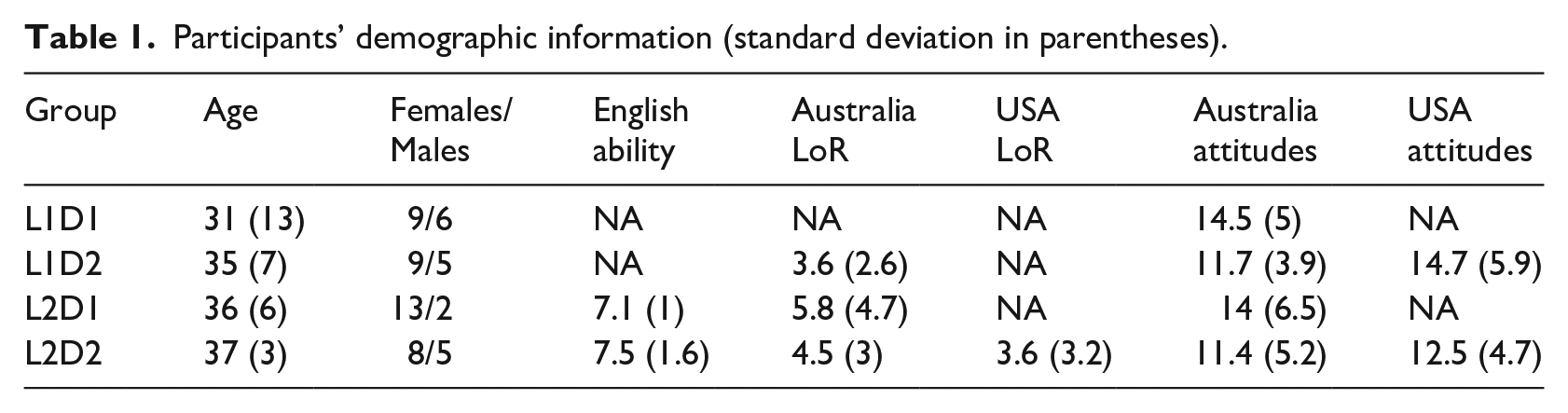
The four groups are comparable in a number of demographic and attitudinal characteristics (Table 1). Their average age is in the thirties, with the L1D1 group being slightly younger and more variable than the three mobile groups. There were about twice as many females recruited as males (39/18). L2 speakers had a relatively high level of English proficiency supported by work or study experience in English. The L2D1 and L2D2 groups rated themselves to be an average of 7.1 and 7.5 on an English speaking ability scale respectively (1 = poor to 10 = native-like). All of the participants were residing in Australia at the time of the study, and none had lived in other English-speaking countries besides those already specified for each group for longer than 3 months (except for one L1D2 and one L2D2 participant who, as we discovered during the end-of-study interview, had lived in the UK for 4 and 6 months respectively). The mobile groups had lived in Australia for at least a year with an average of 3.6, 5.8, and 4.5 years for the L1D2, L2D1, and L2D2 groups. The L2D2 group spent a similar amount of time in both English-speaking countries on average (4.5 in Australia and 3.6 in USA). The four groups also had comparably positive attitudes toward Australia, with the D2 groups exhibiting slightly more positive attitudes (lower numbers mean more positive; see Procedure for details on the attitudes questionnaire). The two D2 groups also had similar scores on the USA attitudes measure.
Participants’ demographic information (standard deviation in parentheses).
Stimuli
A list of 50 word pairs was created to be used as test items because they denote the same object in American and Australian English (e.g. cooler/esky; see Appendix A for a full list of test items). The lexical items were chosen based on dictionaries of American and Australian English (Macquarie Dictionary, n.d.; Merriam-Webster, n.d.) and were piloted with native speakers of both varieties. We acknowledge the variable nature of L1 speech in this respect; for example, both fall/autumn may be used in American English and both elevator/lift in Australian English (cf. Penry Williams, 2007). We chose one of the variants as more prevalent in one variety than in the other (see relative frequencies of items in American and Australian English in GloWbE (Davies & Fuchs, 2015) in Appendix A). In some cases it means that one item in a pair is more frequent in American English and the other in Australian English. In other cases one of the items in a pair may be more frequent than the other in both varieties, but the relative frequency of the items varies between American and Australian English. Using dictionaries and corpora for designating a lexical item as American or Australian is quite crude as dictionaries often do not mention words’ relative frequencies and corpora do not take into consideration different meanings of the same word. Therefore, a re-evaluation of the items is done below, based on the L1D1 group’s results. Additionally, and most importantly, instead of assuming 100% use of Australian items by native speakers of Australian English, we anticipate variable usage by all groups and compare the relative frequency of Australian items across the four participant groups.
In the experiment, the participants were presented with 80 images of objects (five practice items, 25 fillers, and 50 test items; see Stimuli in Supplemental materials). Fifty objects were test items as described above. Twenty-five fillers and five practice items represented objects that are denoted by the same word in American and Australian English (e.g. pizza). Practice items were used at the beginning of the task to explain the procedure to the participants, and fillers were used throughout the task to avoid drawing the participants’ attention to the purpose of the experiment.
Procedure
Each participant was seated in a quiet room in front of a computer with E-Prime 3.0 (Psychology Software Tools, 2016). In the lexical preference task, which constituted a picture-naming task and took about 5 minutes, the participants were instructed to name the objects they were seeing on the screen as fast as they could (cf. Chambers, 1992). First, they were presented with the practice items, at which point they got accustomed with the procedure and could ask for clarification. Then the test items and fillers were presented automatically in random order. Each trial started with a + sign presented in the middle of the screen for 1000 ms. This was followed by an image presented on a white background for 2000 ms. The participants’ response to each trial was audio-recorded.
After the experiment the participants completed a demographic questionnaire, asking them about their age, gender, occupation, etc., and an attitudes questionnaire which was designed to elicit their feelings toward the USA and Australia. Everybody answered questions about their attitudes to Australia as all have had experience living in Australia; only the D2 groups answered questions about their attitudes toward the USA as only they had lived in the USA. The questionnaire included six statements in the form of 7-point Likert scales (Appendix B). The items were based on Drummond (2012). Half of them were positive, and half were negative. The attitudes score for each participant was calculated by summing up their response to the statements with the negative statement scales reversed, so a smaller number means more positive attitudes.
Results
SDA across the participant groups
The audio-recordings were orthographically transcribed, and the fillers and practice items were excluded from analysis. The responses to test items were categorized as (1) Australian, (2) American (see Appendix A), or (3) NA (unexpected response [hair for bangs/fringe] or no response). If a participant responded with both Australian and American words to a picture (which occurred less than 1% of the time, with most instances from one L2 participant), only the first response was counted as the most immediate reaction. Unexpected response is natural when lexical items are elicited through pictures, especially where the denoted concept is quite abstract (for example, we used a picture of a lounge chair on a beach in an attempt to elicit vacation/holiday). No response emerged due to participants’ failure to produce a word under time pressure; it happened for both L1 and L2 speakers of English but was more common in L2 speakers, perhaps, because of more time needed for lexical retrieval in the L2 (e.g. Sullivan et al., 2018). NAs constituted 34% of all responses to test items and were excluded from the analysis below (L1D1 26.2%, L1D2 21.6%, L2D1 47.6%, L2D2 40.4%).
A re-evaluation of the American and Australian lexical item designations was conducted based on the L1D1 group’s responses. Australian English speakers exhibited a more frequent use of what had been designated as an American item for several word pairs: soccer/football, backyard/garden, vacation/holiday, elevator/lift, line/queue, bathroom/toilet, and pants/trousers. These items were excluded from the following analysis.
Figure 1 visualizes the mean percentage of use of Australian items and standard deviation (SD) across the four groups (see raw relative frequencies of American and Australian items in Appendix A). It can be observed that the L1D1 group used the most Australian items (87.45%), followed by the L2D1 group (67.59%), the L2D2 group (45.59%), and finally the L1D2 group (20.93%). The amount of within-group variation also varied: the L1D1 group was the most homogeneous (SD 6.03%), followed by L1D2 (SD 12.84%), L2D2 (SD 17.87%), and L2D1 (SD 18.74%). This preliminary observation suggests that native speakers of Australian English used the most Australian items and native speakers of American English the least; the L2 speaker groups fell between these two extremes, with the group that had lived only in Australia exhibiting behavior most similar to the Australian English group. In terms of variation, the least mobile Australian English group was the most homogeneous, and the mobile groups were less homogeneous, with L2 speakers exhibiting more variation than the L1D2 group. Social factors such as LoR or attitudes may explain some of this variation (see following Section). The following statistical analysis was performed in order to ascertain whether these differences in use of Australian items are significant.
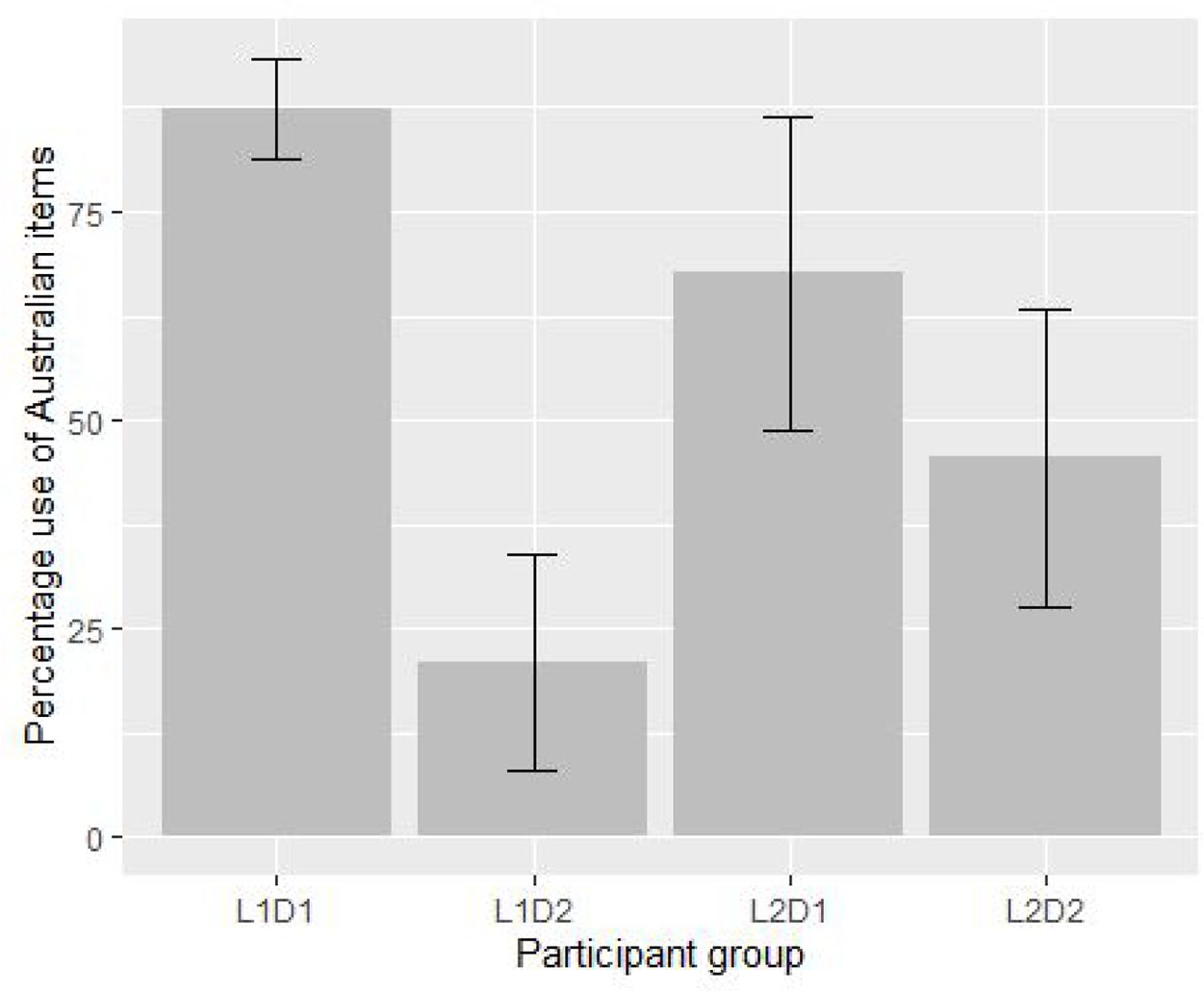
Percentage of Australian items used by the four groups.
A binomial logistic mixed effects model (Baayen et al., 2008) was fitted to the data in R (R Core Team, 2019) using the lmerTest package (Kuznetsova et al., 2017). Variety of response was the dependent variable (Australian vs American), and speaker group was the independent variables (L1D1, L1D2, L2D1, and L2D2). Speaker and word were included as random intercepts. L1D1 was used as the baseline in the first model output (Table S1 in Supplemental material), and L2D2 was used as the baseline level in the second model output (Table S2 in Supplemental material) to allow for a comparison between all levels. The first model indicates that all the other groups were significantly more likely to use American words compared to the L1D1 speakers of Australian English (p < 0.001). When re-leveled to L2D2 being the intercept, statistically significant differences were found between all the remaining levels (p < 0.001). This means that the likelihood of choosing a word of either variety as response was significantly different for each pair-wise comparison.
Factors affecting SDA within participant groups
To investigate the within-group factors affecting the use of Australian items by the participants, we fit four separate binomial mixed effects models to the data by participant group. For the L1D1 group, we used variety of response (Australian vs American) as the dependent variable and attitudes toward Australia as a predictor, as well as speaker and word as random intercepts. Attitudes toward Australia were not found to be significant predictors for the L1D1 participants.
For the L1D2 data, we used variety of response (Australian vs American) as the dependent variable, LoR in Australia, proportion of life spent in Australia as another LoR measure, attitudes toward Australia and USA as predictors, and speaker and word as random intercepts. Proportion of life spent in Australia (Australia/USA) was found to be a significant predictor of variety preference such that Americans who had spent more time in Australia were more likely to use Australian words (p = 0.001; Table S3 in Supplemental material; Figure 2).
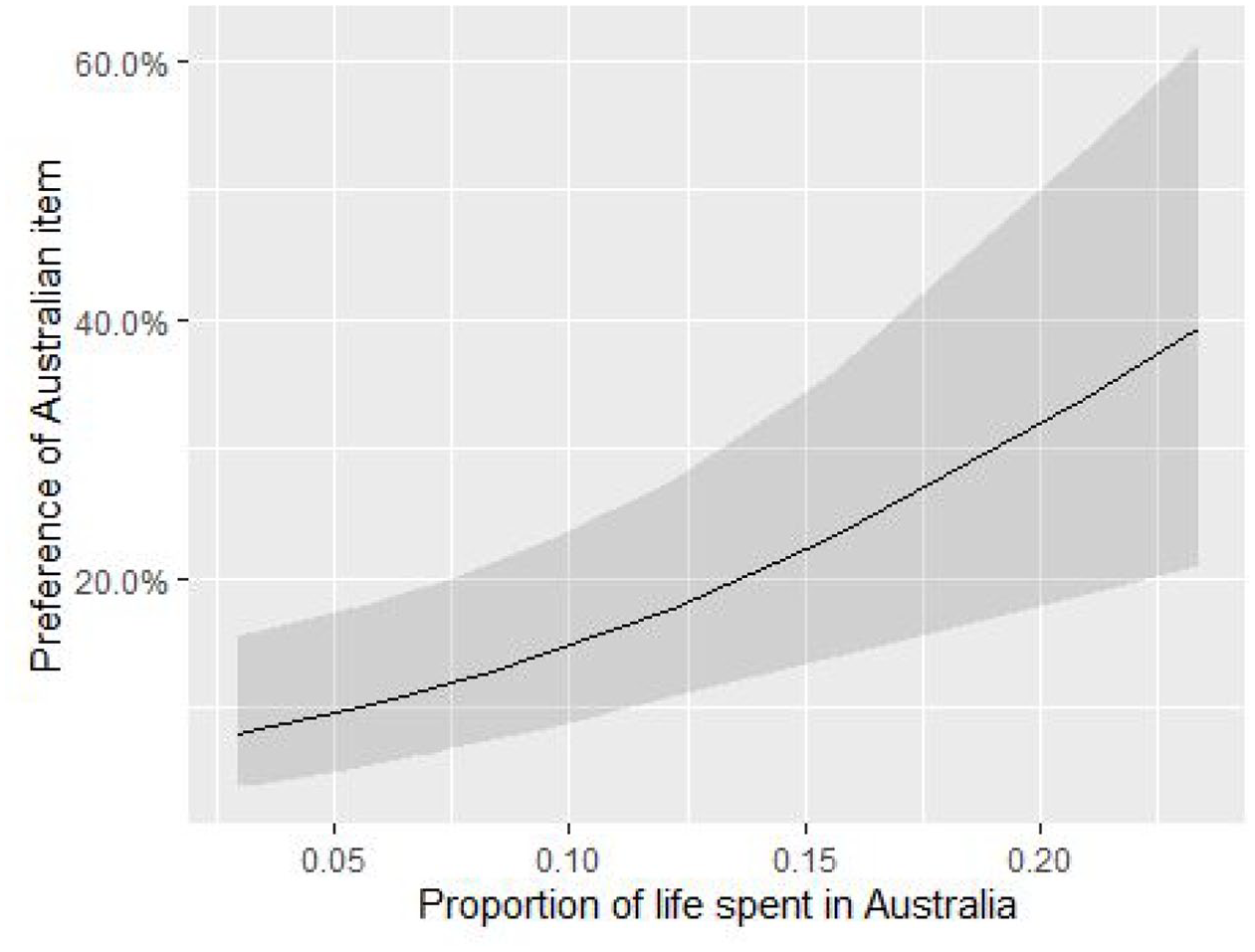
Use of Australian items as predicted by proportion of life spent in Australia in the L1D2 group.
For the L2D1 data, we used variety of response (Australian vs American) as the dependent variable, LoR in Australia and attitudes toward Australia as predictors, and speaker and word as random intercepts. LoR in Australia (p < 0.001) and attitudes to Australia (p = 0.001) were both found to contribute to the model such that L2D1 participants with more positive attitudes toward Australia and those who had spent more time in Australia were more likely to use Australian words (Table S4 in Supplemental material; Figures 3 and 4).
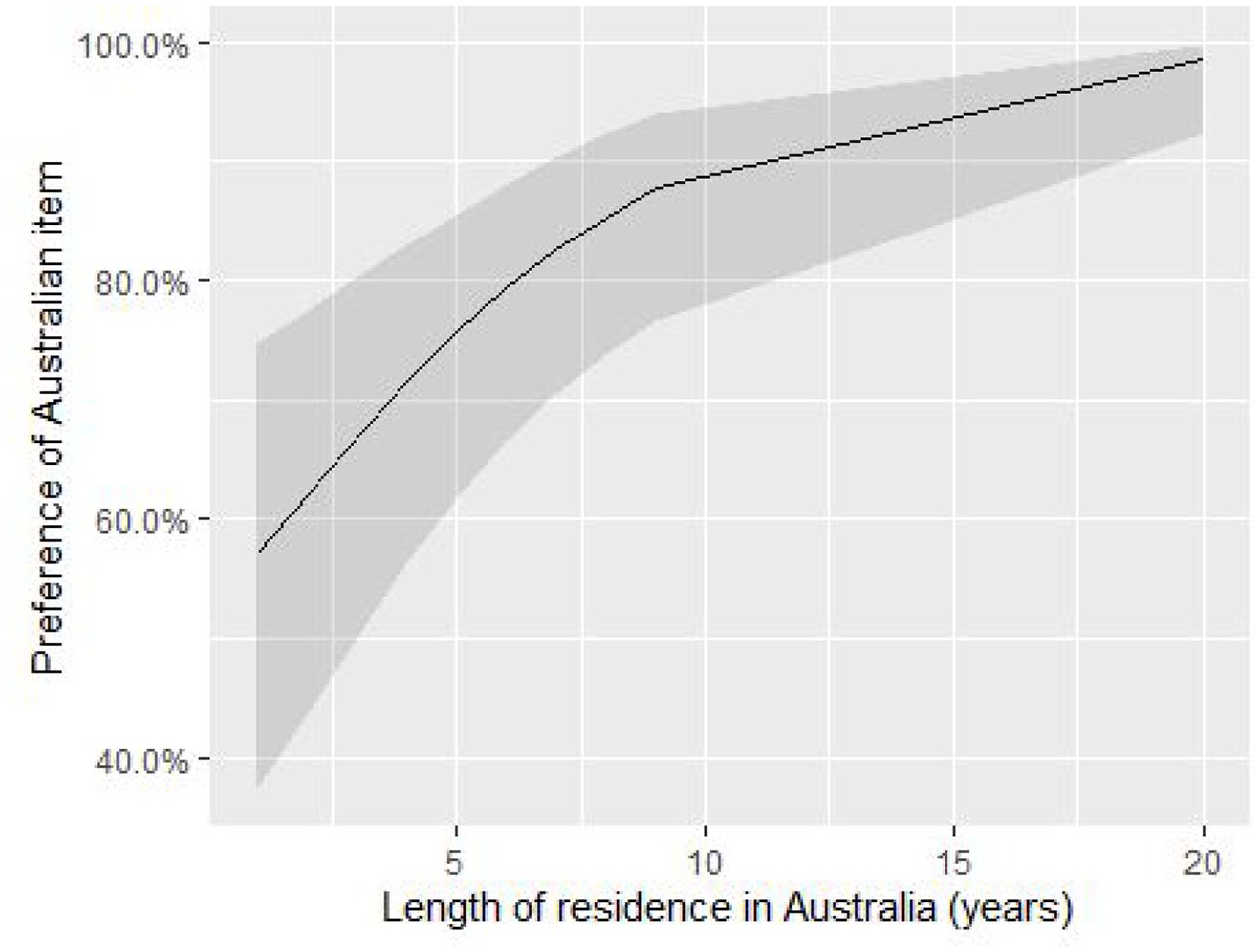
Use of Australian items as predicted by length of residence in Australia (years) in the L2D1 group.
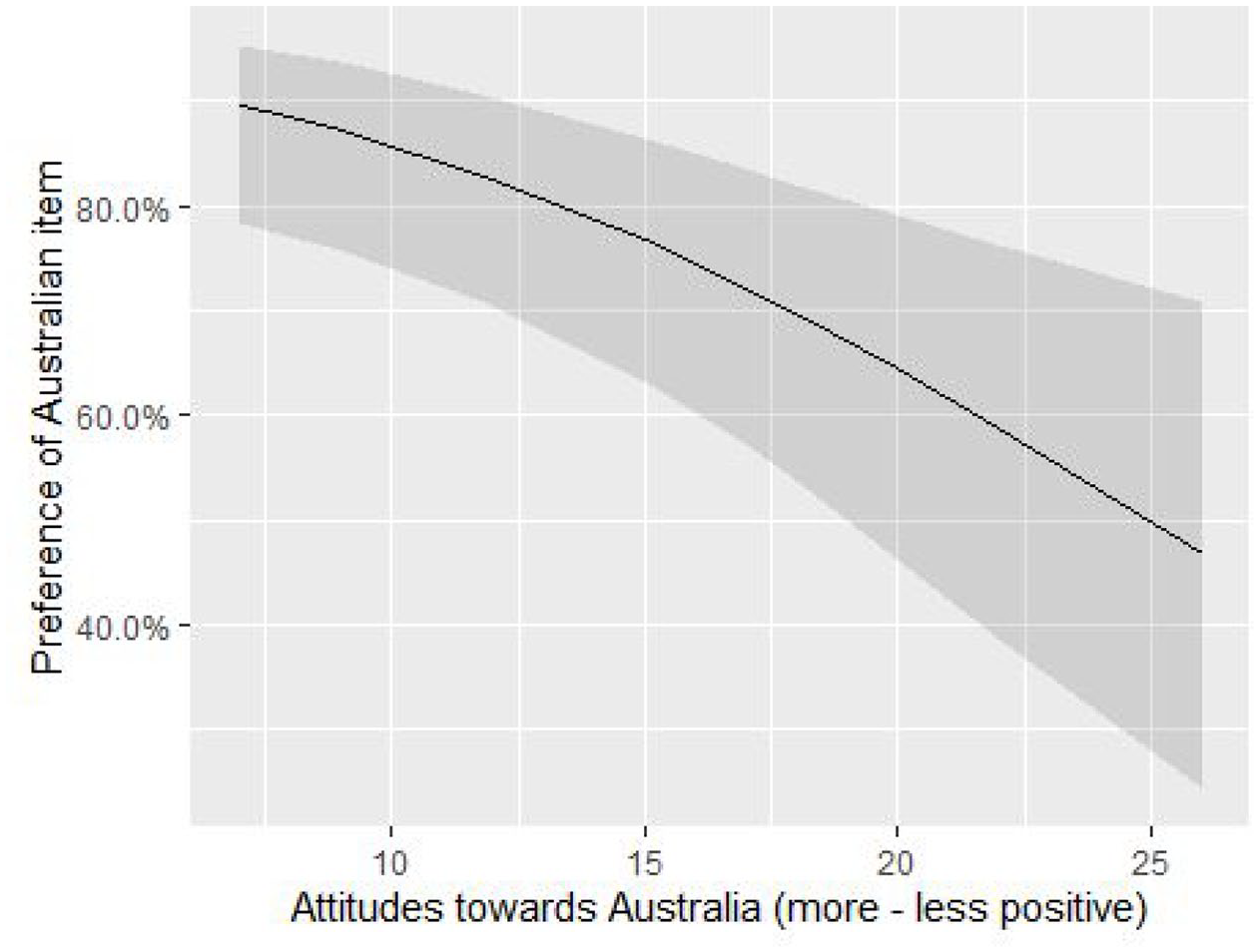
Use of Australian items as predicted by attitudes toward Australia in the L2D1 group.
For the L2D2 data, we used variety of response (Australian vs American) as the dependent variable, LoR in Australia and USA, proportion of English-speaking resident life spent in Australia as another LoR measure, attitudes toward Australia and USA as predictors, and speaker and word as random intercepts. LoR in USA was the only significant predictor such that the longer the participants had lived in the USA the less likely they were to use Australian words (p = 0.003; Table S5 in Supplemental material; Figure 5).
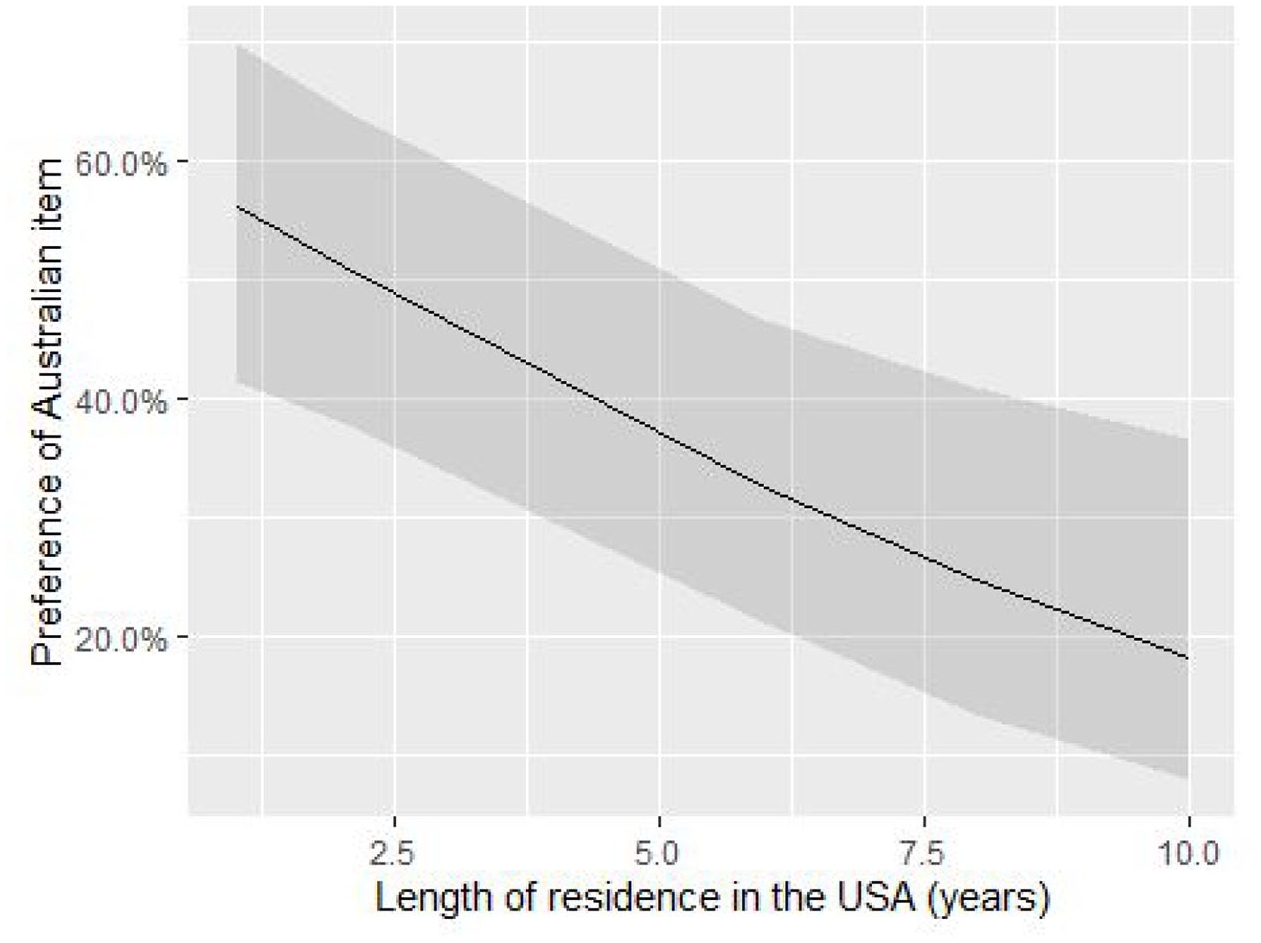
Use of Australian items as predicted by length of residence in the USA in the L2D2 group.
Discussion
In terms of overall rates of use of Australian items, the study found that the L1D1 group chose Australian items the most, the L1D2 the least, and the L2D1 and L2D2 groups fell between them. Out of the two L2 speaker groups, the L2D1 group chose Australian words significantly more often than the L2D2 group. This suggests acquisition of variety-congruous vocabulary in the D1 in a naturalistic setting. Assuming that the L2D2 group had also acquired American English as their D1 at a rate similar to L2D1 group’s use of Australian items (67.59%), their Australian English acquisition rate of 45.59% suggests SDA in L2, thus supporting Hypothesis 1b in relation to Research question 1.
In comparison, L1 speakers of American English displayed the least use of Australian English vocabulary at 20.93%. Their rate of vocabulary acquisition is lower than that attested previously for late SDA: 40% for a 17-year-old Canadian in the UK (Chambers, 1992). The lower rate of acquisition in this study can be explained by the participants’ high AoA and relatively short LoR. Despite a comparable AoA and LoR, the L2D2 group showed much higher rates of D2 vocabulary use (45.59%), with rates similar to what has been observed for teenage SDA in L1 (average of 49% for the five teenagers in Chambers, 1992). The large difference in the use of Australian items between the L2D2 and the L1D2 groups and the larger difference between D2 groups in comparison to D1 groups suggests that L1 and L2 speakers differ in their SDA rates, leading us to reject Hypothesis 2a (Research question 2). The finding that L2D2 participants use more Australian items compared to the L1D2 group supports Hypothesis 2c.
Adult L1 speakers may be less flexible in SDA compared to L2 speakers because of the two groups’ fundamentally different relationship with the D1. For L1D2 speakers American English is their L1 while for the L2 speakers it is their L2. The constraints on D2 acquisition for L1 speakers may be more similar to the constraints experienced by the L2 speakers in their L2 acquisition, irrespective of dialect. Thus, the force of constraints on D2 acquisition may be different for L1 and L2 groups. There may be a cognitive and a social explanation for this difference in SDA in L1 and L2. A cognitive explanation is that the D1 is strongly entrenched for the L1 speakers; although for L2 speakers both L2 dialects are acquired late with a more similar relative amount of use and cognitive entrenchment, making the L2 variety more susceptible to change than the L1 variety. The social explanation posits that L2 speakers may be more adaptable because of a weaker personal and/or social investment in the L2D1, whereas for L1 speakers the D1 would be closer connected to their identity. These accounts need not exclude each other and may apply concurrently.
In relation to the third research question about predictors of SDA, we found significant effects of attitudes and LoR which is in line with some previous SLA (e.g. Derwing & Munro, 2013) and SDA (e.g. Siegel, 2010) work, including SDA in L2 (Drummond, 2012). It is notable to mention here that exposure measures (proportion of life spent in Australia for L1D2, LoR in Australia for L2D1, and LoR in the USA for L2D2) have a consistent effect throughout their depth without a minimum LoR requirement or a fossilization effect at the other extreme (cf. Chambers, 1992; Foreman, 2003). The two D2 groups are similar in that attitude measures did not predict their SDA (see Moyer, 2007 who found no relationship between attitudes toward L2 culture and attainment in SLA), but it is notable that LoR worked slightly differently for the two D2 groups: it was proportion of life spent in Australia for L1D2 and LoR in the USA for L2D2. This difference is probably a reflection of the qualitative difference in the relationship with D1 for the two groups. While proportion of life spent in Australia is a true representation of one’s exposure to D2 for the L1D2 group, proportion of English-speaking resident life spent in Australia does not take into account English exposure and usage outside English-speaking countries for L2D2 participants. LoR in the USA being a significant predictor over LoR in Australia for the L2D2 group suggests the relative prominence of the D1. The non-significance of LoR in Australia for both D2 groups is in line with some SLA (Johnson & Newport, 1989; Piske et al., 2001) and SDA (Shockey, 1984) research and suggests that it is not simply time spent but an interaction between the D1 and D2 that plays a role. The non-importance of attitudes measures and importance of exposure (proportion of life spent in Australia for L1D2 and LoR in the USA for L2D2) highlights the similarity between the two groups and provides support for Hypothesis 3a.
Methodologically, we advocate for more quantitative, experimental work in this area of research. Some of the advantages of the approach illustrated in this paper include a large number of tokens, strict control over extraneous variables, and acknowledgment of the variable nature of language use. The experimental elicitation method allowed for collecting many data points which would have otherwise required many hours of naturally occurring speech, especially for some lower frequency vocabulary items. On the downside, of course, the participants’ behavior in an experiment may be different from their vocabulary choice in a natural communicative situation and their assumptions as to the study goals may affect their preference of lexical items (e.g. L1D2 participants using more American items because their identity is highlighted in the recruitment specifications and accommodation pressures are minimal). Moreover, the study focused on vocabulary, an understudied linguistic level in SDA, but the reader should be careful in generalizing these results to other levels and perception, which would require further exploration in future work (see e.g. Szakay et al., 2019). Additionally, the four groups were comparable in a number of demographic variables, which allows us to be confident that it is in fact group differences that are responsible for the observed effect. Finally, the fact that the L1D1 group did not use Australian items at 100% and showed within-group variation suggests variation in the L1 and highlights the need for accounting for such variation in studies of SLA. Also, the choice of a particular word by a participant does not mean that they are invariable in its use, but rather that they selected it over competing items in a given context, and SDA here is understood to be reflected in differences in relative rather than absolute use.
The study’s biggest limitation is its reliance on assumptions of the mobile participants’ language use patterns. We are assuming individual language change when in fact we do not know what the vocabulary use was like for the L1D2 and L2D2 groups in the USA and the L2D1 and L2D2 groups in Russia. We are basing our assumption of individual language change in variety preference on the differences between the four groups’ rates and the significant effects of exposure variables within groups. Following a mobile individual around and recording their linguistic behavior as they move from country to country would be the most accurate way to observe L2 or D2 acquisition. In reality a longitudinal panel study like this is not feasible to address this limitation because participants would have to be followed for a long time and it is virtually impossible to predict their migration patterns. One way to make more meaningful comparisons in future research is to collect data with native Russian speakers in Russia and the USA to allow for an estimation of their lexical preference in a foreign language environment and in an American English as L2D1 setting.
Conclusion
This paper investigated SDA in L2 and compared it to SDA in L1. The study provides evidence for both but suggests that SDA in L2 may happen at higher rates than SDA in L1, at least for vocabulary acquisition. Measures associated with time spent in the D1 and D2 countries were found to predict acquisition in both L1 and L2 groups. Taken together the results suggest that while the constraints on second variety acquisition, be it SLA or SDA, are similar, their force differs with SDA in L1 being more constrained. These findings have implications for our understanding of constraints in both SLA and SDA and ultimately the mechanisms, both cognitive and social, that are at play in both.
Supplemental Material
sj-docx-1-ijb-10.1177_13670069211036932 – Supplemental material for Lexical preference in second dialect acquisition in a second language
Supplemental material, sj-docx-1-ijb-10.1177_13670069211036932 for Lexical preference in second dialect acquisition in a second language by Ksenia Gnevsheva, Anita Szakay and Sandra Jansen in International Journal of Bilingualism
Supplemental Material
sj-docx-2-ijb-10.1177_13670069211036932 – Supplemental material for Lexical preference in second dialect acquisition in a second language
Supplemental material, sj-docx-2-ijb-10.1177_13670069211036932 for Lexical preference in second dialect acquisition in a second language by Ksenia Gnevsheva, Anita Szakay and Sandra Jansen in International Journal of Bilingualism
Footnotes
Appendices
Acknowledgements
We would like to thank our participants for their time; Kira Rodionov for help in stimulus preparation and data collection; Australian Linguistics Society, ANU College of Arts and Social Sciences, and Macquarie University for financial support; and the Australian Linguistics Society 2018 conference audience, the editor, and two anonymous reviewers for feedback on an earlier version of this work.
Declaration of conflicting interests
The author(s) declared no potential conflicts of interest with respect to the research, authorship, and/or publication of this article.
Funding
The author(s) disclosed receipt of the following financial support for the research, authorship, and/or publication of this article: This research was supported by the Australian Linguistics Society, ANU College of Arts and Social Sciences, and Macquarie University.

Supplemental material
Supplemental material for this article is available online.
Author biographies
References
Supplementary Material
Please find the following supplemental material available below.
For Open Access articles published under a Creative Commons License, all supplemental material carries the same license as the article it is associated with.
For non-Open Access articles published, all supplemental material carries a non-exclusive license, and permission requests for re-use of supplemental material or any part of supplemental material shall be sent directly to the copyright owner as specified in the copyright notice associated with the article.
