



Abstract
Aims and objectives/purpose/research questions:
Previous studies show conflicting findings regarding bilingual processing of target information not instantiated in learners’ first language. The current study addresses this issue by investigating whether Chinese speakers can integrate case-marking information, which is unique to Korean, with locative verb information in their processing of the Korean locative constructions.
Design/methodology/approach:
We conducted an acceptability judgment task to assess Chinese–Korean bilinguals’ explicit knowledge of case-marking constraints on Korean locative constructions, and a self-paced reading task to probe their application of the knowledge to real-time sentence processing.
Data and analysis:
Twenty-four advanced Chinese–Korean bilinguals’ acceptability judgments and reading times were compared with those of 24 Korean monolingual speakers, using mixed-effects regression modeling.
Findings/conclusions:
Results from the offline acceptability judgment task revealed the bilinguals’ native-like judgment patterns. Both Korean monolingual and Chinese–Korean bilinguals rejected sentences with wrong case-marking sequences paired with locative verbs. In the self-paced reading task, both monolingual and bilingual speakers showed increased reading times when a mismatch arose between case-marking and locative verb information, indicating their sensitivity to locative agreement violations.
Originality:
While previous studies have investigated bilinguals’ integration of multiple sources of information, this study adds a new perspective to this issue by testing whether bilinguals can use L2-unique information (i.e., case marking) to integrate it with other types of information (i.e., locative verbs) for sentence processing.
Significance/implications:
Our findings are consistent with the competition model which predicts that L2-unique information presents little processing difficulty for bilinguals. At the same time, the current results lend credence to the idea that increased proficiency allows bilinguals to integrate multiple information sources during processing.
Keywords
Introduction
There is a broad consensus that bilingual or second language (L2) processing diverges from monolingual or first language (L1) processing. Part of the discussion on L1 versus L2 processing mechanisms relates to the issues of whether bilinguals can draw on morphosyntactic information to compute syntactic representations (Clahsen & Felser, 2006, 2018) and how their L1 plays a role in this process (see Lago et al., 2021, for review). Conflicting results have been reported regarding these issues, particularly with regard to the consequence of processing target-specific features that are not directly derivable from a bilingual’s L1. Some studies show that structures operating distinctively across languages present insurmountable challenges for bilinguals (e.g., Jiang, 2004, 2007; Ojima et al., 2005), while others provide evidence that highly proficient bilinguals can successfully exploit morphosyntactic information that is unique to the L2 (Trenkic et al., 2014).
Given the inconclusive findings on the L2 processing of target-specific information untransferable from an L1, the current study explores whether bilinguals can utilize information unique to the L2 (i.e., nontransferable information) for sentence processing. By focusing on Korean—an understudied language in the bilingual processing literature—we add to the flourishing body of literature on L2 sentence processing and the role of L1 information. Furthermore, this study aims to expand previous discussions of the availability of L2-specific information by investigating an integration of multiple types of cues. While previous research on bilingual processing has focused predominantly on a single grammatical feature, we examined the processing of novel constructions at the interface of morphosyntactic and semantic information. In addition, understanding how bilinguals integrate multiple sources of information during processing is crucial for identifying mechanisms underlying bilingual sentence processing. As will be discussed below, although different proposals and empirical evidence have been suggested concerning L2 integration of multiple cues (e.g., Hopp, 2009; Sorace, 2011), less is known about whether integration of multiple information sources can be accomplished when the information is underivable from the bilingual’s L1. To address these issues, we examined highly advanced Chinese–Korean bilinguals’ uses of case-marking and verb-semantic information during the processing of Korean locative constructions. We assessed their online sensitivity to grammatical violations when Korean locative verbs were paired with infelicitous case-marking sequences. Because few studies, to the best of our knowledge, have investigated the bilingual processing of case-marking and semantic information in Korean, our findings are expected to further our understanding of bilingual processing mechanisms.
Characteristics of locative constructions in English, Korean, and Chinese
Locative construction denotes the movement of a figure (content, object, or theme) to a ground (container, goal, or location). Depending on the syntactic status of a figure and a ground, locative constructions are formed largely in two structural frames: one with a figure realizing as the verb’s direct object (figure-oriented frame, 1a), and another with a ground realizing as the verb’s direct object (ground-oriented frame, 1b) (Pinker, 1989).
(1) a. The farmer loaded applesfigure onto the truckground. (Figure-oriented Frame) b. The farmer loaded the truckground with applesfigure. (Ground-oriented Frame)
The relationship between the two locative constructions, figure-oriented (FO) and ground-oriented (GO), is best captured in terms of the locative alternation, which is constrained by a number of semantic rules (Pinker, 1989). Depending on their syntactic environment, English locative verbs are largely categorized into three types: alternating verbs that are compatible with both FO and GO frames (e.g., spray, sprinkle), non-alternating verbs that can only appear in the FO frame (e.g., pour, ladle), and non-alternating verbs that can only appear in the GO frame (e.g., fill, cover).
Notably, English differs from Korean and Chinese in terms of the type and number of subclasses of locative verbs. Unlike English, which instantiates non-alternating verbs appearing either in the FO or GO frame, Korean disallows non-alternating verbs to take the GO frame. Consider (2), for example.
(2) Non-alternating verbs in Korean
1
a. Pam-i cantipath-ey mwul-ul ppwulyesseyo. [FO frame] 팸-이 잔디밭-에 물-을 뿌렸어요 Pam-NOM lawn-LOC water-ACC sprayed “Pam sprayed water on the lawn.” b. *Pam-i mwul-lo cantipath-ul ppwulyesseyo. [GO frame] 팸-이 물-로 잔디밭-을 뿌렸어요 Pam-NOM water-INS lawn-ACC sprayed “Pam sprayed the lawn with water.”
As shown in this example, all non-alternating verbs in Korean (e.g., ppwulita “spray,” hullita “drop,” sitta “load,” ssahta “stock”) are compatible with the FO, but not with the GO frame. Alternating verbs, on the other hand, such as chaywuta “fill,” chilhata “paint,” tephta “cover,” and kamta “coil” can appear either in the FO or GO frame. 2
Locative verbs in (Mandarin) Chinese exhibit the same distribution as their Korean counterparts: Chinese and Korean locative verbs have the same semantic classes of verbs that are allowed and disallowed in individual locative constructions (Pinker, 1989). Like Korean, Chinese bans non-alternating verbs from appearing in the GO frame while allowing alternating verbs to appear in both frames. Note that the Chinese sentences in (3), which correspond to the Korean translation counterparts in (2), show the same grammaticality.
(3) Non-alternating verbs in Chinese a. Pam wang caoping-li sa-le shui. [FO frame] 帕姆 往 草坪-里 洒-了 水 Pam to lawn-in sprayed water. “Pam sprayed water onto the lawn.” b. * Pam yong shui sa-le caoping. [GO frame] 帕姆 用 水 洒-了 草坪 Pam with water sprayed lawn. “Pam sprayed the lawn with water.”
Taken together, English is different from Korean and Chinese in the distribution of locative verbs. Focusing on these cross-linguistic differences, M. Kim et al. (1999) stratified languages into an English-type and a Korean-type group in terms of locative alternation. In their typological distinction, an English-type group (e.g., English, French, Spanish) instantiates alternating verbs, non-alternating verbs in the FO frame, and non-alternating verbs in the GO frame. A Korean-type group (Korean, Japanese, Chinese) also has alternating verbs that appear in both frames but disallows non-alternating verbs in the GO frame.
Cross-linguistic differences between Korean and Chinese locative constructions
Although the type of verbs allowing and disallowing locative alternation coincides across Korean and Chinese, Chinese speakers still need to newly learn the mappings between case-marking and locative verbs in Korean. Each argument of Korean locative verbs is modified by different types of case markers depending on its syntactic and semantic status in a sentence. See (4), for example.
(4) Non-alternating verbs in Korean a. Pam-i cantipath-ey mwul-ul ppwulyesseyo. [FO, canonical] 팸-이 잔디밭-에 물-을 뿌렸어요 Pam-NOM lawn-LOC water-ACC sprayed “Pam sprayed water on the lawn.” b. Pam-i mwul-ul cantipath-ey ppwulyesseyo. [FO, scrambled] 팸-이 물-을 잔디밭-에 뿌렸어요 Pam-NOM water-ACC lawn-LOC sprayed “Pam sprayed water on the lawn.” c. * Pam-i mwul-lo cantipath-ul ppwulyesseyo. [GO, canonical] 팸-이 물-로 잔디밭-을 뿌렸어요 Pam-NOM water-INS lawn-ACC sprayed “Pam sprayed the lawn with water.” d. * Pam-i cantipath-ul mwul-lo ppwulyesseyo. [GO, scrambled] 팸-이 잔디밭-을 물-로 뿌렸어요 Pam-NOM lawn-ACC water-INS sprayed “Pam sprayed the lawn with water.”
In this example, the figure mwul (“water”) in the FO frame is realized as the direct object of the verb and is thus marked by the accusative case -lul, while the ground cantipath (“lawn”) is modified by the locative marker -ey. It should be noted that the arguments in the Korean locative constructions can switch their positions through scrambling within a sentence insofar as they are marked by appropriate case markers. For instance, the FO constructions with non-alternating verbs in Korean allow for both canonical word order where the ground precedes the figure (4a) and non-canonical scrambled word order where the figure precedes the ground (4b). Note that the case markers attached to the arguments remain intact throughout the scrambling operation. The same holds for the sentences in (4c) and (4d), which are ungrammatical regardless of the word order since the non-alternating verb ppwuly (“spray”) does not allow for the GO frame.
In light of these properties, a successful interpretation of Korean locatives relies on the precise integration of case-marking information rather than a linear position of locative arguments, and this may constitute a major problem for Chinese speakers when they simply adopt L1 strategies in their interpretation of the target constructions. Unlike Korean, Chinese lacks a case-marking system, and instead, strictly follows the canonical order in the arrangement of locative arguments in a sentence. For a Chinese non-alternating verb, for instance, the ground should precede the figure, and a change in the order of these two arguments renders the sentence unacceptable, as shown in (5).
(5) Non-alternating verbs in Chinese a. Pam wang caoping-li sa-le shui. [FO frame, canonical] 帕姆 往 草坪-里 洒-了 水 Pam to lawn-in sprayed water. “Pam sprayed water onto the lawn.” b. * Pam shui sa-le wang caoping-li. [FO frame, scrambled] 帕姆 水 洒-了 往 草坪-里 Pam water sprayed to lawn-in “Pam sprayed water onto the garden.” c. * Pam yong shui sa-le caoping. [GO frame, canonical] 帕姆 用 水 洒-了 草坪 Pam with water sprayed lawn. “Pam sprayed the lawn with water.” d. * Pam caoping sa-le yong shui. [GO frame, scrambled] 帕姆 草坪 洒-了 用 水 Pam lawn sprayed with water. “Pam sprayed the lawn with water”
In summary, non-alternating verbs in the Korean FO frame are compatible with both canonical and scrambled word orders, whereas the Chinese counterparts only allow a canonical word order. In other words, the grammaticality of the locative configurations involving non-alternating verbs operates in the same manner between Korean and Chinese in the canonical word order (i.e., allowing the FO frame but rejecting the GO frame). In the non-canonical word order, Korean allows the FO frame, but not the GO frame. In contrast, Chinese disallows both FO and GO frames in the non-canonical word order.
Theoretical approaches to bilingual sentence processing
The main objective of this study is to test whether Chinese speakers can integrate case-marking cues with verb-semantic information to process Korean locative constructions. Because the case-marking information cannot be derivable from Chinese, investigating Chinese speakers’ processing of Korean locative constructions provides a unique insight into whether bilinguals can use L2-specific information for sentence processing. When it comes to the use of L2-specific information, several accounts provide conflicting predictions about its availability. First, the competition model (MacWhinney, 2005, 2013) predicts that target information can be processed more easily when no cross-linguistic conflict arises compared with the case of cross-linguistic differences. Several studies in line with this model have investigated whether L2 processing is affected by cross-linguistic competition. For example, Trenkic et al. (2014) found that Chinese speakers successfully used article information to resolve reference in real-time English sentence comprehension, even though their L1 lacks articles. In this visual-world eye-tracking study, Chinese speakers with intermediate English proficiency oriented their eye-gazes toward a target object (a/the can) in the visual display after hearing indefinite and definite articles in an English sentence (e.g., The pirate will put the cube inside a can/the can), and this gaze shift was faster when the target images were contextually compatible with the definiteness signaled by the article (e.g., “a can” with two visual referents and “the can” with one visual referent) than when the images were inconsistent with the article information (e.g., “a can” with one visual referent and “the can” with two visual referents). The L2 learners’ eye-movement patterns were comparable to those of native speakers, leading the authors to the conclusion that L2 learners are able to use the L2-specific article information during real-time comprehension, consistent with the prediction of the competition model (see also Mitsugi, 2020, for the successful use of L2-specific cues).
Other researchers propose that novel information in an L2 constitutes a major challenge for learners because of their previously established mappings between meanings and structural forms in their L1, which are presumed to block or overshadow the focus on new form–meaning mappings in the L2. This blocking or “learned inattention” (Ellis, 2006, p. 178) effect has been attested by several studies showing the difficulty of exploiting L2 information that cannot be transferable from an L1. For example, L2 learners from an article-lacking language background show a restricted use of definiteness information encoded in English articles in production (e.g., Luk & Shirai, 2009); English speakers are less able than Spanish speakers to use gender information in Spanish articles to predict a following noun (e.g., Grüter et al., 2012; see also Dussias et al., 2013, for similar findings but only among bilinguals with low Spanish proficiency); French-speaking Korean learners, whose L1 lacks a case-marking system, show reduced ability to make online use of case-marking information in Korean to interpret an utterance (e.g., Frenck-Mestre et al., 2019); English-German bilinguals are unable to integrate case-marking and verb-semantic information, relying instead on lexical-semantic information during L2 processing in German (e.g., Hopp, 2015); and L2 learners with an L1 that has no numeral classifiers show difficulty relying on grammatical form–class cues encoded in Chinese numeral classifiers (e.g., Grüter et al., 2020, but see the learners’ processing patterns of the semantically compatible classifiers in their study as evidence of the successful use of semantic cues).
Similarly, Clahsen and Felser’s (2006, 2018) shallow structure hypothesis may predict that Chinese–Korean bilinguals will have difficulty integrating case-marking and verb-semantic information as efficiently as native speakers during online processing. According to this hypothesis, non-native processing in general depends heavily on semantic and pragmatic, rather than syntactic, information, preventing non-native speakers from constructing fully specified syntactic representations during sentence processing. Evidence supporting this hypothesis comes from studies demonstrating L2 learners’ reduced online sensitivity to grammatical violations on various grammatical points, such as tense agreement, number agreement, filler-gap integration, and relative clause attachment (e.g., Clahsen & Felser, 2006; Jiang, 2004, 2007; Marinis et al., 2005).
Finally, the interface hypothesis claims that problems associated with L2 sentence processing arise when a parser attempts to integrate multiple sources of information (Sorace, 2011). Two versions of the hypothesis are recognized depending on the role of learner proficiency. A strong version posits that the parser breaks down when the syntactic-level information needs to be integrated with other domains of representations such as semantics and pragmatics, due to the lack of sufficient processing resources required for the integration (e.g., Hopp, 2009; Sorace, 2011). Supporting evidence for this hypothesis can be found in studies on L2 anaphora processing (e.g., Roberts et al., 2008; Sorace & Filiaci, 2006). In contrast, a weak version of the hypothesis suggests that processing difficulties with multiple interface structures can be alleviated with increasing proficiency since higher proficiency allows for more efficient allocation of resources for the integration (e.g., Herbay et al., 2018; Montrul & Rodriguez Louro, 2006; Pan et al., 2015). For instance, Herbay et al. (2018) found that advanced French–English bilinguals showed identical reading-time patterns in processing English verb-particle constructions under different syntactic and semantic contexts. In a self-paced reading task, both native and bilingual speakers were influenced by syntactic and semantic conditions such as verb-particle transparency, verb-particle separability, and the length of the object. The native-like processing patterns emerged more clearly in the bilinguals who possessed native-like knowledge of the target structures and a higher working memory capacity.
In summary, the competition model predicts convergence between Chinese and Korean speakers in their processing of Korean locative constructions, whereas the blocking account and the shallow structure hypothesis predict Chinese speakers’ processing difficulties. The strong version of the interface hypothesis makes similar predictions, envisaging Chinese speakers’ limited online sensitivity to a mismatch between case markers and locative verbs. In contrast, the weak version of the hypothesis predicts target-like processing with increasing proficiency. Testing these theoretical approaches in the context of the current study will help reach a better understanding of bilingual sentence-processing mechanisms.
The present study
This study tests whether Chinese–Korean bilinguals can arrive at native-like processing of the Korean locative constructions by integrating case-marking information with locative verbs. To this end, we conducted two experiments: an acceptability judgment task that assesses bilinguals’ knowledge of the Korean locative constructions and a self-paced reading experiment that examines their application of the knowledge during online processing. The main research questions addressed in this study are as follows:
Do advanced Chinese–Korean bilinguals possess native-like knowledge of the Korean locative constructions?
Do they integrate case-marking and verb-semantic information to process the target structures?
Methods
Participants
This study involved 24 (Mandarin) Chinese–Korean bilinguals with advanced proficiency (NNS group, mean age = 24.6 years, SD = 2.4) and 24 native speakers of Korean (NS group, mean age = 32.0 years, SD = 6.0), who served as a control group. The bilingual participants were recruited among graduate and undergraduate students from universities in South Korea. They had been living in Korea for an average of 2.1 years at the time of testing and had 3.9 years of Korean studying experience. We attempted to recruit highly advanced bilinguals whose Korean proficiency is more toward the end of the proficiency continuum by including only those who scored within the top two tiers on the Test of Proficiency in Korean (TOPIK), a standardized test of Korean knowledge. When we measured their Korean proficiency using the simplified version of the TOPIK, the average score was 73%, ranging from 60 to 100. Results from self-reported ratings showed an average score of 7.0 on a scale from 1 (lowest proficiency) to 10 (highest proficiency). Although this score was significantly lower than the NS group’s ratings (p < .001), the generally high ratings suggest that the bilinguals considered themselves as fairly proficient speakers of Korean. Throughout the whole experimental procedure, including instruction, testing, and a language-background interview, the researcher interacted with the participants exclusively in Korean, and the participants showed no sign of communication difficulty. Detailed participant information is provided in Table 1.
Participant information.
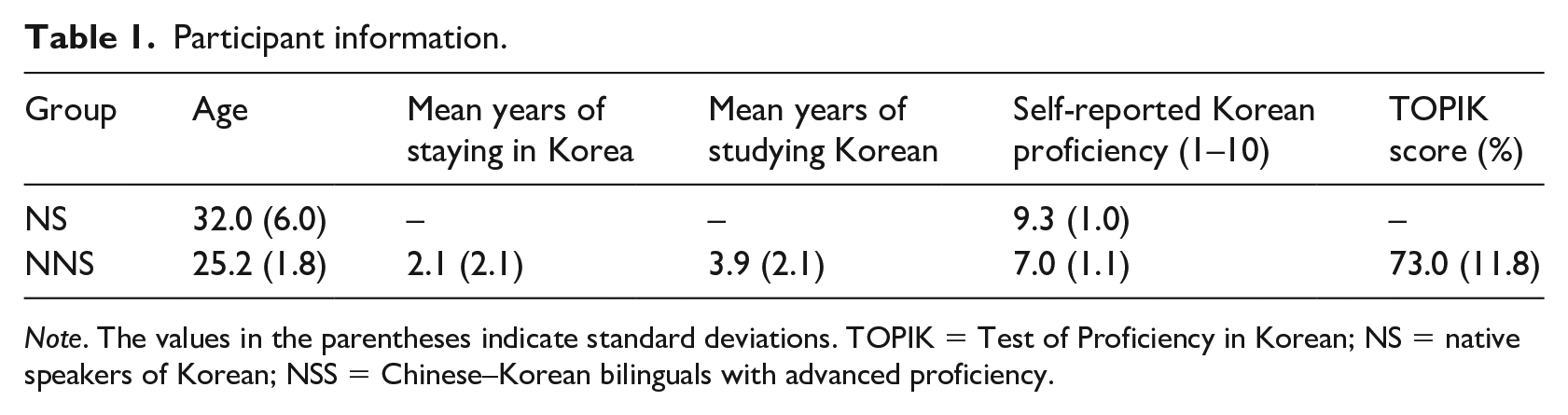
Note. The values in the parentheses indicate standard deviations. TOPIK = Test of Proficiency in Korean; NS = native speakers of Korean; NSS = Chinese–Korean bilinguals with advanced proficiency.
Materials and procedure
Acceptability judgment task
This task was conducted to measure participants’ knowledge of Korean locative constructions. A total of 48 experimental sentences were constructed, all including non-alternating verbs. The items were presented in four conditions by manipulating Construction Type (FO and GO) and Word order (canonical and scrambled). Across the conditions, four non-alternating verbs (chaywuta “fill,” chilhata “paint,” tephta “cover,” and kamta “coil”) were used three times, with different lexical words for each item. To ensure bilinguals’ lexical familiarity with the test items, all words were chosen from vocabulary lists for intermediate-level Korean learners provided by the International Standard Curriculum of Korean Language (J. Kim et al., 2011). Sample experimental items are illustrated in (6).
(6) a. Younghee-ka thulek-ey sakwa-lul silesseyo. [ 영희-가 트럭-에 사과-를 실었어요 Younghee-NOM truck-LOC apple-ACC loaded “Younghee loaded apples onto the truck.” b. Younghee-ka sakwa-lul thulek-ey silesseyo. [ 영희-가 사과-를 트럭-에 실었어요 Younghee-NOM apples-ACC truck-LOC loaded “Younghee loaded apples onto the truck.” c. 영희-가 사과-로 트럭-을 실었어요 Younghee-NOM apples-INS truck-ACC loaded “Younghee loaded the truck with apples.” d. 영희-가 트럭-을 사과-로 실었어요 Younghee-NOM truck-ACC apple-INS loaded “Younghee loaded the truck with apples.”
In order to establish different degrees of acceptability between the Korean and Chinese locative constructions, a norming task was carried out with the Chinese translations of the materials. Three highly proficient Chinese–Korean bilinguals, who were blind to the test purpose, translated the 48 Korean locative sentences into Chinese. The translated sentences were then judged for acceptability by 11 Chinese monolingual speakers who had little knowledge of Korean and did not participate in the main tasks. Results showed that for the FO structures, the Chinese speakers accepted sentences in the canonical word order (Chinese counterparts of 6a) 89% of the time, whereas they accepted sentences in the scrambled word order (Chinese counterparts of 6b) only 7% of the time. For the GO structures, the acceptance rates were 6% in the canonical word order (Chinese counterparts of 6c) and 0% in the scrambled word order (Chinese counterparts of 6d). These results confirm that the Chinese translation counterparts of our experimental sentences are only acceptable when the sentences are structured in the FO frame in the canonical word order.
In addition to the experimental items, 60 sentences (half grammatical and half ungrammatical) were included as fillers, including locative constructions with alternating verbs either in canonical or scrambled word order, simple transitive and causative sentences in canonical and scrambled word order, and sentences containing relative clauses. Ungrammatical fillers consisted of sentences with incongruent case markers attached to a subject or an object and sentences with a mismatch between a noun and a numeral quantifier (e.g., a human-modifying quantifier paired with a non-human referent). The test items were counterbalanced across four lists, ensuring that each participant saw only one version of an item in all conditions.
Participants completed the acceptability judgment task after the self-paced reading task. After providing language-background information, receiving oral and written instruction, and working through two practice items, they started the main task. During each trial, participants were asked to judge the acceptability of each sentence presented on a computer screen on a Likert-type scale from 1 (very unnatural) to 4 (very natural). To avoid the possibility of a random selection of an answer, an additional option of “I don’t know” was provided. Each item was presented on a single page, and participants were disallowed to move back to previous pages and correct their responses. Including the language-background questionnaire, the whole task took approximately 20–30 minutes.
Self-paced reading task
The experimental items for the self-paced reading task were nearly identical to those from the acceptability judgment task, except that the former included an additional clause following the verb to capture spill-over effects. For example, for the sentences in (6), a conjunction –se (“and”) and the clause pokiey cohasseyo/nappasseyo (“it looked good/bad”) were added following the sentence-final verb. As in the acceptability judgment task, the experimental items for each verb type were distributed in a 2 × 2 Latin Square design, manipulating Construction Type (FO vs. GO) and Word Order (Canonical vs. Scrambled).
Each experimental item was divided into six regions for analysis: subject (R1), ground–figure or figure–ground (R2 & R3), verb–and (R4), and the following clause (R5 & R6), as exemplified in (7). The first verb (R4) is the critical part of the analysis since this is the earliest point where the case-marking information is integrated with the verb, and thus, the acceptability of a sentence can potentially be identified. We also analyzed the following region (R5) to accommodate for any delayed spill-over effects from the previous region.
(7) Mira-ka (R1) mwulpyeng-ey (R2) cyusu-lul (R3) chaywue-se (R4) 미라-가 물병-에 주스-를 채워서 Mira-NOM bottle-LOC juice-ACC filled-and pokiey (R5) cohasseyo (R6). 보기에 좋았어요 looking good “Mira filled juice into the bottle, and it looked good.”
The task was run on a web-based interface using the Ibex Farm program (Drummond, 2013). The experimental items were presented in a non-cumulative, word-by-word fashion on a moving-window display (Just et al., 1982). During each trial, the participants encountered a series of dashes on a computer screen, which were replaced by target words by each press of the spacebar. With each press, the previous word was replaced by dashes, and the next set of dashes was replaced by the next word. In this way, participants processed the sentences in a self-paced manner, and the program automatically recorded the reading times in each region. Following each sentence, a comprehension question queried participants’ understanding of the previous sentence, for which they answered by clicking “yes” and “no” on the screen (half of the questions eliciting “yes” and half eliciting “no” responses). The overall task took about 20–30 minutes.
Results
Acceptability judgment task
Participants’ responses were first screened for the choice of “I don’t know.” There was no response for this option in the NS group. This choice accounted for 2.5% of the data in the NNS group, which were removed from further analysis. Data from one participant in the NS group was eliminated due to a high rate of incomplete responses (response rates of less than 50%), leaving 23 participants in this group.
Descriptive statistics (Table 2) show that the NS and NNS groups generally accepted FO while rejecting GO sentences regardless of word order, although the acceptance differences were smaller for the NNS than the NS group.
Mean acceptance rates (standard deviations) in acceptability judgment task.
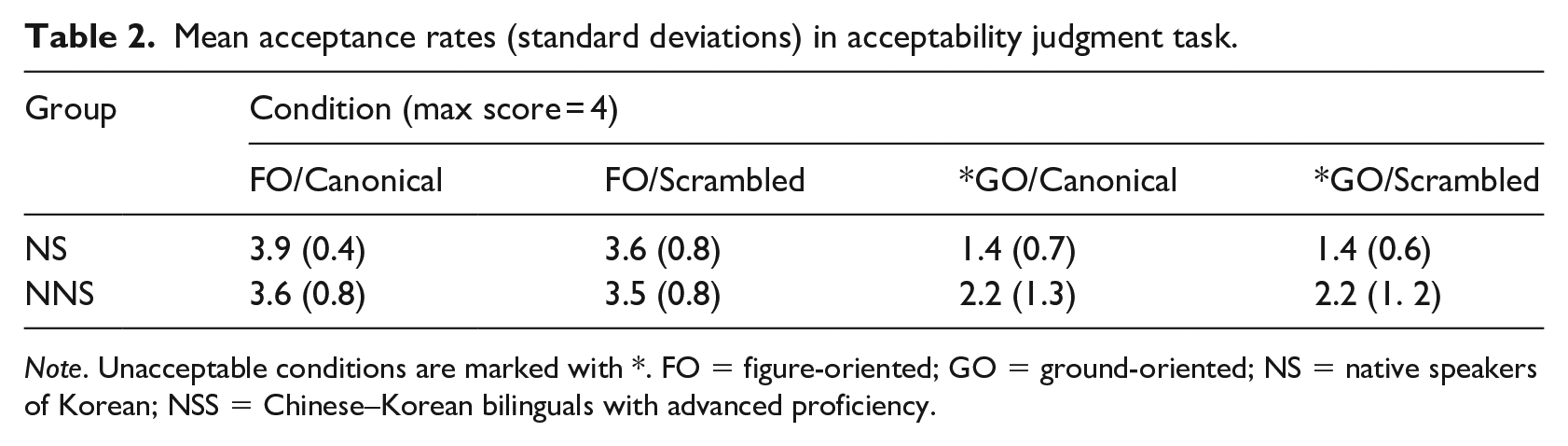
Note. Unacceptable conditions are marked with *. FO = figure-oriented; GO = ground-oriented; NS = native speakers of Korean; NSS = Chinese–Korean bilinguals with advanced proficiency.
We scrutinized the results by statistically comparing the group performance across the conditions using a cumulative link model (Christensen, 2015), an analysis method used to assess ordinal data. The model included fixed effects of Group (NS, NNS), Construction Type (FO vs. GO), and Word Order (Canonical vs. Scrambled), which were contrast-coded (–.5, .5) and centered around the mean. We also created the maximal random-effects structure allowed by the design (Baayen et al., 2008). Because the model did not converge, we eliminated by-participant and by-item random slopes, including only intercepts for participants and items (Barr et al., 2013). Statistical analyses were conducted in R (R Core Team, 2015) using the ordinal package, CLMMs (Christensen, 2015).
Model outcomes are presented in Online Appendix A. Results showed a main effect of Construction Type, driven by higher acceptance rates for FO than GO sentences. There was a significant interaction between Group and Construction Type, indicating that the two groups differed in their acceptance across the FO and GO sentences. We also found a significant interaction between Construction Type and Word Order as well as a three-way interaction among Group, Construction Type, and Word Order. To unpack these interactions—and more crucially, to closely inspect each group’s judgment patterns—post hoc analyses were conducted for each group by using a cumulative link model with Construction Type and Word Order as fixed effects (contrast-coded and centered) and participant and item as random effects with the maximal random-effects structure allowed by the design.
The analysis of the NS group data exhibited a significant effect of Construction Type (β = 9.019, SE = 1.639, t = 5.503, p < .001) with higher acceptance rates for the FO than the GO sentences. This group also tended to accept canonical sentences over scrambled sentences in the FO sentences but not in the GO sentences, as evidenced by the weak interaction of Construction Type and Word Order (β = –6.249, SE = 3.044, t = –2.053, p = .040). The native speakers’ higher acceptance for the canonical than the scrambled sentences in the FO condition may be associated with the frequency of the structure. Because canonical sentences are more frequent than scrambled ones, our native speakers showed sensitivity to this frequency effect. In sum, our results indicate that the native speakers accepted the FO sentences more often than the GO sentences, consistent with the grammaticality of the locative constructions in Korean.
Turning to the results of the NNS group, we found a main effect of Construction Type (β = 3.161, SE = 0.426, t = 7.416, p < .001) with higher acceptance rates for the FO than the GO sentences. There were no main effects of Word Order (β = 0.159, SE = 0.309, t = 0.514, p = .607) or an interaction of Word Order and Construction Type (β = 0.038, SE = 0.657, t = 0.057, p = .954). Unlike the native speakers, the non-native speakers did not show sensitivity to the frequency effect, accepting both canonical and scrambled sentences to the same extent in the FO condition, reflective of their lack of experience with Korean. Nevertheless, these results confirm that the bilingual group accepted the FO sentences more often than the GO sentences both in the canonical and scrambled word-order conditions.
Taken together, the NS and NNS groups patterned alike in the acceptability judgment task: They accepted the FO sentences while rejecting the GO sentences with non-alternating verbs, and this judgment pattern was consistent across the word-order conditions. These findings suggest that the bilinguals successfully acquired knowledge of the target structures, allowing us to test whether they can use this knowledge as efficiently as native speakers during real-time sentence comprehension.
Self-paced reading task
Prior to the analysis of reading-time data, we inspected accuracy scores on the comprehension questions. Both native and bilingual participants demonstrated high accuracy rates (93% for the NS group; 87% for the NNS group), indicating that they generally paid attention to the target-sentence meanings during the task. We removed trials for which participants provided incorrect responses to the comprehension questions (0.8% of the data in the NS group; 1.4% of the data in the NNS group).
Prior to data analysis, we identified and eliminated reading times (RTs) shorter than 100 ms and longer than 4000 ms as outliers, which affected 1.5% of the entire data. We also omitted RTs below two standard deviations of the mean of all regions across trials, corresponding to 2.8% of the data. Mean RTs after data trimming are presented in Figure 1 for the NS group and Figure 2 for the NNS group.

Reading-time profiles of the NS group.
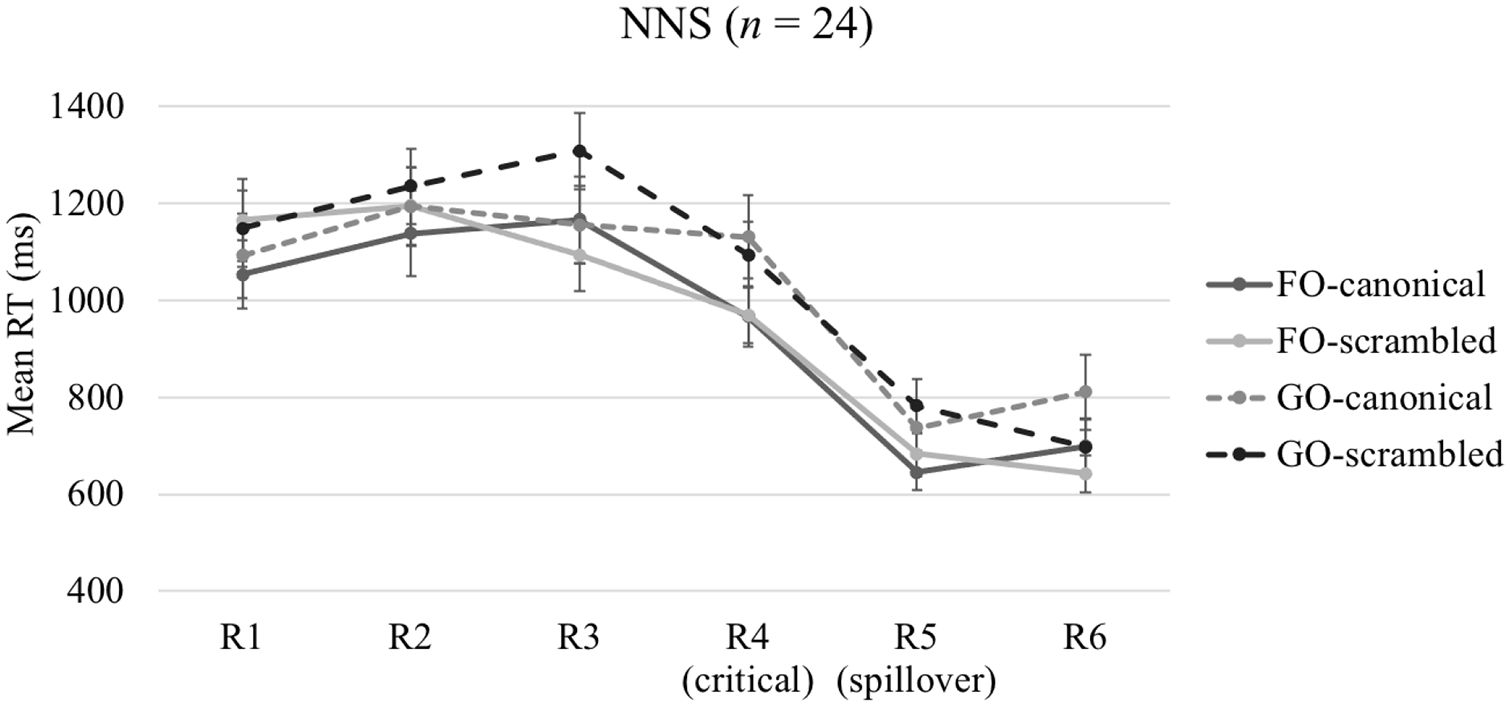
Reading-time profiles of the NNS group.
To statistically compare the two groups’ online sensitivity to the violation of the locative constructions, we created linear mixed-effects models for the two regions of interest: the critical (R4) and spillover (R5) regions. First, each participant’s RTs were converted to log-transformed RTs to approximate a normal distribution of the data (Ratcliff, 1993). A linear mixed-effects model was then fitted to the log-transformed RTs, including Group (NS, NNS), Construction Type (FO, GO), and Word Order (Canonical, Scrambled) as fixed factors (contrast-coded and centered around the mean), and participant and item as random effects, with the maximal random-effects structure allowed by the design. Statistical analyses were conducted in R using the lme4 package (Bates et al., 2014). Since no main effect or interaction was found in other regions than R3 and R4, we only reported results in these two regions.
The model outputs for the critical region are presented in Online Appendix B. The model showed a main effect of Group, with longer RTs in the NNS than the NS group, suggesting increased processing difficulty in an L2. There was also a significant effect of Construction Type, induced by longer RTs in the GO than the FO sentences. Aside from these two effects, there were no other effects or interactions. The main effect of Construction Type without its interaction with Group suggests that both groups spent longer times in the ungrammatical GO sentences than in the grammatical FO sentences. This analysis received further support in part from by-group analyses where the effect of Construction Type was robust in the NS group (β = –0.091, SE = 0.032, t = –2.880, p = .004) and marginal in the NNS group (β = –0.060, SE = 0.032, t = –1.844, p = .066), without its interaction with Word Order (all ps > .1).
Analogous findings were obtained in the analysis of the spillover region (R5). (Model outcomes are presented in Online Appendix C.) The global model returned significant main effects of two factors: the effect of Group with longer RTs in the NNS than the NS group, and the effect of Construction Type with longer RTs in the GO than the FO sentences. There was no main effect of Word Order, nor any other interactions. The main effect of Construction Type was also attested in the by-group analyses, with both groups exhibiting a clear trend toward increased RTs in the GO compared with the FO constructions regardless of the word order conditions (NS: β = –0.098, SE = 0.030, t = –3.272, p = .002; NNS: β = –0.061, SE = 0.025, t = –2.431, p = .015). The analyses of the spillover region suggest that both groups showed sensitivity to the mismatch of case-marking and locative verbs.
Discussion and conclusion
With the aim of assessing bilinguals’ facility in processing L2-specific information during real-time comprehension, this study investigated Chinese speakers’ integration of case-marking and verb-semantic information during online processing of the Korean locative constructions. In the offline acceptability judgment, both native and bilingual speakers accepted the felicitous locative constructions significantly more often than the ungrammatical sentences with an incorrectly paired combination of a case-marking sequence and locative verbs. In the self-paced reading task, the bilinguals showed sensitivity to the locative violation, although the effect was somewhat weaker and emerged later compared with the native speaker group. In this section, we discuss these findings in light of our research questions and the bilingual processing models reviewed previously.
Our first research question concerns whether bilinguals have target-like knowledge of the locative constructions in Korean. In the case of the Korean locative constructions, several pieces of information are involved, including verb semantics, case marking, and word order. Each of them may be individually acquired from different sources. However, integrating all these types of information to correctly comprehend Korean locative constructions may go beyond drawing upon information from learners’ L1, classroom instruction, or exposure to target-language input. The case-marking information in locative arguments cannot be transferred from Chinese since the language lacks a case-marking system. Moreover, the locative constructions are hardly taught in a classroom (Joo, 2003), and the mapping of case-marking information and locative verbs—particularly in the scrambled word order—is difficult to acquire from the input alone. In this regard, the results from the acceptability judgment task confirmed that the bilinguals in our study had overcome the learnability problem associated with the acquisition of the Korean locative constructions. Future work will be needed to generalize the current findings to a broader range of learner groups, including less proficient bilinguals and young learners.
The primary focus of our paper was on the application of the bilinguals’ locative construction knowledge to online sentence processing, which bears on our second research question. In the self-paced reading task, both native and bilingual groups exhibited increased reading times when the case marking attached to the locative arguments was incompatible with the locative verb. Although the effect in the bilingual group was smaller and emerged in a later part in the sentence (i.e., spill-over region) compared with the native speaker group, the bilingual group showed clear evidence of online sensitivity to the grammatical violation. These results lend support to the competition model (MacWhinney, 2005, 2013), which predicts less processing difficulty when target structures do not give rise to a cue competition. Because case-marking information cannot be transferred from Chinese, Chinese speakers could experience little cross-linguistic competition when they compute locative interpretations based on the case-marking information encoded in locative arguments and semantic information from locative verbs. Aligning with this prediction, we did find effects in the bilingual groups’ processing patterns that suggest that they can process L2-specific information as efficiently as native speakers (e.g., Tokowicz & MacWhinney, 2005; Tolentino & Tokowicz, 2011). The bilingual speakers’ target-like processing is noteworthy given that Korean and Chinese have different orthographic systems (Sohn, 1999). The fact that the Chinese speakers successfully detected the locative violations in the absence of cross-script facilitation lends further credence to the competition model. Furthermore, our findings extend the prediction of the competition model beyond the use of a single linguistic feature to the integration of L2-specific information (i.e., case-marking cues) with other types of information (i.e., verb semantics) during processing.
Apparent sensitivity to locative violations in our bilingual participants is also compatible with the claim that highly proficient bilinguals can integrate multiple sources of information during online processing (e.g., Herbay et al., 2018; Pan et al., 2015). This weak version of the interface hypothesis assumes that sufficient levels of proficiency allow bilinguals to devote more cognitive resources to computing multiple information sources. In line with this account, the coordination of case-marking and locative verb information appeared to present little difficulty for our advanced bilingual participants, who presumably had sufficient processing resources to concurrently access the case-marking information encoded in the locative arguments and check their compatibility with the locative verb, ultimately leading to native-like sensitivity to the locative violations.
The bilingual group’s target-like performance also suggests that the same processing mechanisms underlie the native and bilingual processing of the locative construction. Previous research has long debated whether bilingual processing is qualitatively different from L1 processing. Some researchers argue for fundamental differences between the two processing mechanisms, claiming that non-native speakers draw on different parsing routines than native speakers (e.g., Jiang, 2004, 2007; Marinis et al., 2005). These views posit that non-native speakers are restricted in using (morpho)syntactic information to construct detailed syntactic parses during real-time processing. Contrary to this claim, our bilingual participants were able to use the case-marking and locative verb information to detect locative anomalies during processing, supporting the perspective that native and non-native processing are fundamentally similar and guided by the same mechanisms (Hopp, 2018; Omaki & Schulz, 2011; Tokowicz & MacWhinney, 2005; Witzel et al., 2012). Our findings are also consistent with the shallow structure hypothesis (Clahsen & Felser, 2006, 2018), which assumes that “processing reflexes of grammatical information might be delayed in L2 compared to L1 processing, and/or in comparison to processing reflexes of nongrammatical information” (Clahsen & Felser, 2018, p. 11). In line with this assumption, we found that L2 learners showed delayed processing of the locative construction compared with the native speakers. In addition to supporting these theoretical ideas, our study adds new evidence that bilinguals evince fundamentally similar, albeit delayed, processing patterns as native processing even when target structures are unique to the L2 and require integration of different sources of information.
Meanwhile, our results are difficult to reconcile with the blocking account. As previously discussed, the blocking account maintains that learning new form–meaning mappings constitutes a persisting difficulty for non-native speakers as a result of their prior experience with an L1, which may overshadow their attention to novel cues (Ellis, 2006; Ellis et al., 2014). The blocking effect arising from the Chinese speakers’ experience with their L1 could have prevented them from engaging in native-like processing because they had already established the formulation of locatives in Chinese. Although we found different processing patterns between the monolinguals and the bilinguals, those differences were only associated with the timing of grammatical sensitivity. When it comes to the ability to draw on the mappings between case-marking cues and verb information, our bilinguals were not different from the monolinguals, which does not support the prediction of the blocking account. It is possible that the pre-established processing patterns in the L1 also affected the bilingual processing, but it appears that they successfully suppressed the L1 influence, presumably because the target constructions did not cause any cross-linguistic competition, or the bilinguals’ proficiency allowed them more resources to focus on the target morphosyntactic constraints imposed on the locative case markers.
In summary, the current study shows that highly proficient bilinguals can utilize the L2-specific locative case-marking information to check its compatibility with locative verbs in real-time processing. We conclude that bilingual processing is comparable to native processing as long as bilinguals have sufficient target-language proficiency and the target information does not cause cross-linguistic competition. Further research investigating bilingual integration of diverse types of information beyond case-marking and locative verbs, as well as potential effects of individual variability such as working memory, will advance our understanding of how the bilingual processing architecture is similar to or different from the native processing mechanism.
Supplemental Material
sj-docx-1-ijb-10.1177_13670069221110385 – Supplemental material for Bilingual processing of case-marking and locative verbs in Korean: Use of L2-unique information
Supplemental material, sj-docx-1-ijb-10.1177_13670069221110385 for Bilingual processing of case-marking and locative verbs in Korean: Use of L2-unique information by Sun Hee Park and Hyunwoo Kim in International Journal of Bilingualism
Footnotes
Declaration of conflicting interests
The author(s) declared no potential conflicts of interest with respect to the research, authorship, and/or publication of this article.
Funding
The author(s) received no financial support for the research, authorship, and/or publication of this article.

Notes
Supplemental material
Supplemental material for this article is available online.
Author biographies
References
Supplementary Material
Please find the following supplemental material available below.
For Open Access articles published under a Creative Commons License, all supplemental material carries the same license as the article it is associated with.
For non-Open Access articles published, all supplemental material carries a non-exclusive license, and permission requests for re-use of supplemental material or any part of supplemental material shall be sent directly to the copyright owner as specified in the copyright notice associated with the article.
