




Abstract
Aims and objectives:
The aim of this scoping review is to curate and summarize research methodologies used to assess the effects of bilingualism on inhibition and attention in young people.
Methodology:
The methodology of a scoping review was followed. Searches of the literature using inclusive search strings were conducted using PubMed, Scopus, Proquest, and PsyArXiv. Study selection followed the guidance of the PRISMA-ScR checklist with published and unpublished studies included.
Data and analysis:
Extracted data included study authors, year of publication, source format (e.g., journal article, thesis), country in which the study was conducted, sample size, average age of participants in the sample, language combination used by participants in the bilingual sample, task(s) used to assess inhibition, task(s) used to assess attention, and method used for data analysis.
Findings and conclusions:
Studies identified were disproportionately conducted in English-speaking (Western) language environments, based on bilingual samples who were proficient in English and a second language that was typically a related Indo-European language (e.g., English-Spanish). Tasks employed were most often aimed at measuring differences in inhibition compared with attention. Finally, almost all studies were limited to between group designs and fixed-effects analysis methods. Future research can be improved through inclusion of samples from a wider range of language backgrounds that is representative of more diverse language combinations, and underrepresented age groups. Furthermore, within participant mixed-effects analysis methods that account for the diversity of bilingual experience would strengthen the methodological rigor of future studies.
Originality:
This is the first scoping review focused on methods used to investigate bilingual effects in young people.
Significance:
We provide strong evidence that standard methods ignore nontrivial differences in bilingual experience. In addition, Westocentric sampling trends provide an incomplete and biased understanding of the true effects of bilingualism.
Debate continues over whether bilingualism, the use of two or more languages, yields nonlinguistic benefits (Paap, 2019). These benefits are thought to result from the unique linguistic pressures placed on bilinguals in diverse interactional contexts. Because both languages are thought to be simultaneously active (Abutalebi & Green, 2007; Costa et al., 2006; Hermans et al., 1998; Kroll et al., 2012), and because intrusion errors among bilinguals are rare (Gollan & Ferreira, 2009), some underlying inhibitory process must be recruited in order to allow for successful communication (Green & Abutalebi, 2013). Additionally, identification of the appropriate language to use in a given context requires that a bilingual is monitoring and attending to salient linguistic cues in their environment (Costa et al., 2008). Whether the cognitive control demands placed on bilinguals in diverse linguistic environments train a domain-general cognitive ability is at the heart of the bilingual advantage hypothesis.
While some evidence shows that bilingualism can lead to cognitive advantages such as improved executive function (M. Antoniou, 2019; Bialystok, 2017; Hilchey et al., 2015; Privitera et al., 2021; Privitera, Momenian, & Weekes, 2022; Valian, 2015), evidence for reduced performance associated with bilingualism has also been reported (e.g., Dick et al., 2019). To capture the observation that bilingualism is associated with both advantages and disadvantages in executive function, the present review has adopted the term “bilingual effects.” The veracity of positive bilingual effects (i.e., bilingual advantages) has been called into question in light of alternative explanations rooted in the influence of nonlinguistic variables (De Bruin & Della Sala, 2019; De Bruin et al., 2015; Donnelly et al., 2019; Gunnerud et al., 2020; Lehtonen et al., 2018; Naeem et al., 2018; Paap, 2019; Paap et al., 2020). A complementary explanation is that mixed findings may also result from methodological differences between studies including whether between (i.e., bilingual vs monolingual) or within-group (i.e., bilinguals who differ in their degree of bilingualism) designs are used, where those studies are conducted, the behavioral tasks that are used, or how these data are analyzed.
Investigations of bilingual effects typically employ the use of tasks designed to measure executive functions, attentional functions that are goal directed, and composed of multiple, separable abilities including updating, shifting, and inhibition (Miyake et al., 2000). Of these abilities, inhibition, including inhibitory control, is thought to be the most likely candidate for the emergence of bilingual effects, consistent with models of bilingual language processing that assume inhibition of one language when communicating in a bilingual context (Green, 1998; Green & Abutalebi, 2013). Research syntheses draw somewhat conflicting conclusions on the effects of bilingualism on inhibition. In one meta-analysis (Ware et al., 2020), evidence in support of a bilingual advantage in inhibition was found only on certain tasks, including the Simon task (Simon & Rudell, 1967), Stroop task (Stroop, 1935), and Attention Network Test (ANT; Fan et al., 2002). By contrast, Hilchey and Klein (2011) concluded that bilingual advantages were not specific to inhibition, but instead took the form of a bilingual executive processing advantage, manifesting as improved performance across all trial types. This latter view places a heavier emphasis on attentional processes (i.e., monitoring), and aligns with more current ideas on the unified nature of executive functions (Miyake & Friedman, 2012), and more general cognitive benefits associated with bilingualism (Kroll & Bialystok, 2013). While it must be acknowledged that Hilchey and colleagues later reported evidence rebuffing their earlier claim (Hilchey et al., 2015), more recent theoretical syntheses provide support for their earlier finding (Bialystok & Craik, 2022).
A majority of reports in support of a bilingual advantage in executive function come from studies of children, adults, and elders, with fewer positive findings reported in studies using samples of young people, including adolescents (Lowe et al., 2021; Van den Noort et al., 2019; Ware et al., 2020). The lack of reports of bilingual advantages in executive function in young people, defined by the World Health Organization (WHO) as those between 10 and 24 years of age, including adolescents (10–19 years), has fueled debates in the literature over the veracity of the advantage itself (Paap, 2019). Research on young people is particularly relevant in the context of this debate as (1) more studies on the bilingual advantage are conducted in this age group than any other and (2) these studies consistently report null results or smaller effect sizes compared with studies on adults and elders across a range of tasks (Lowe et al., 2021; Ware et al., 2020).
It is not obvious why young people would not show an advantage in comparison to adults and elders. One possibility is a sampling bias between these groups. Young people are typically recruited from an educational institution with one single language of instruction that is necessary for academic achievement and often mandatory, whereas adults and elders are community dwelling. This could result in a higher number of younger samples drawn from single language contexts, conditions under which the positive effects of bilingual language experience on executive function are less likely to emerge (Green & Abutalebi, 2013). Another possibility is that young people are developmentally unique, with peak performance in executive function abilities from middle teens to early 20s (Anderson, 2002). According to at least one author, a bilingual advantage in executive function—including inhibition—is difficult to see in these samples due to peak performance on tasks leading to ceiling effects (Bialystok, 2016). However, there is evidence of improved task performance following multiple testing sessions, suggesting no ceiling in this age group (Paap et al., 2014). It is therefore an open question what the factors underlying the mixed evidence of a bilingual advantage in young people may be.
One neglected methodological issue across all studies of bilingual advantages across age groups and samples is the heterogeneity and multidimensionality of bilingual experience (Gullifer et al., 2021). Most studies categorize bilingual speakers using a dichotomous design based on artificial, dubious, or oversimplified criteria that do not capture this diversity (Luk & Bialystok, 2013), although a diverse range of labels have been used (Surrain & Luk, 2017). This restrictive practice not only limits the range of data for analyses, it has been criticized as artefactual, lacking ecological validity, and conceptually flawed as it is not able to test the main assumption that bilingual language experience leads to an advantage (De Bruin, 2019). Previous studies support the importance of considering differences in separable dimensions of bilingual language experience when testing the bilingual advantage hypothesis including language proficiency (e.g., Novitskiy et al., 2019; Privitera, Momenian, & Weekes, 2022; Xie, 2018; Xie & Pisano, 2019) and dominance (e.g., Yow & Li, 2015). These nontrivial differences are ignored when language status is considered as a categorical variable. Furthermore, a binary classification does not consider other factors such as the linguistic overlap between language pairs that may impact on the emergence of bilingual effects (Coderre & Van Heuven, 2014a; Kuzmina et al., 2019; Weekes, 2020).
While these issues have, in part, been addressed through the collection of detailed language history data (Li et al., 2020; Marian et al., 2007), the potential effects of such variables are not tested due to reliance on fixed-effects methods of statistical analysis that ignore effects of individual differences in bilingual experience. One alternative is to use mixed-effects methods of analysis (e.g., linear mixed-effects modeling; LMEM) to test these effects fully (Linck & Cunnings, 2015). These methods have been widely used to test the effects of bilingualism on language tasks such as picture naming (Baayen et al., 2008). Considering that the effects of bilingualism on executive function are not universal, analysis methods that account for diversity in bilingual language experience are likely more useful in support of identifying the boundary conditions of bilingual effects (Navarro-Torres et al., 2021). While some notable previous studies have employed these methods in the investigation of bilingual effects on executive function (e.g., Gullifer et al., 2018; Gullifer & Titone, 2021; Samuel et al., 2018), it is not yet known whether these methods are widely used, despite calls for their wider application in behavioral sciences (Meteyard & Davies, 2020).
The goal of the present scoping review is to summarize research practices used to test the effects of bilingual language experience on inhibition and attention in young people. The decision to focus on inhibition and attention was influenced by findings from research syntheses supporting more consistent bilingual effects on these two functions (Hilchey & Klein, 2011; Ware et al., 2020). The motivation is to identify methodological trends that may be limiting our ability to draw strong conclusions regarding the true effects of bilingualism on executive function, regardless of whether they are positive, negative, or null. Mapping out factors including sample characteristics such as where studies were conducted, the diversity of languages spoken, and the statistical methods used to analyze the data support this goal. A researcher can then make more informed judgments regarding methodological decisions that may contribute to weaker conclusions drawn in the literature. In addition, one outcome of the review might be to identify methodological gaps in the literature that merit investigation in future studies.
Materials and methods
Methodological framework of a scoping review
The present study utilized the methodology of a scoping review (Arksey & O’Malley, 2005). The decision to adopt this framework over that of a systematic review was made based on the current lack of knowledge on the methodological practices employed in these studies. It is unclear whether a sufficient number of studies utilizing different methodologies are present in the extant literature to support the investigation of research questions appropriate for a systematic review. Accordingly, the present review aims to provide a broad overview of the available research on the effects of bilingualism on inhibition and attention in young people with a focus on previously used methods to identify gaps in the literature and was not concerned with evaluating the quality of available research (Munn et al., 2018). Furthermore, the aim was not to evaluate the evidence in support or not for bilingual advantages in executive function as several research syntheses address this topic (e.g., Giovannoli et al., 2020; Lowe et al., 2021; Ware et al., 2020). The stages of the scoping review are (1) identifying the research question(s); (2) identifying relevant studies; (3) study selection; (4) charting the data; and (5) collating, summarizing, and reporting the results. The protocol was peer-reviewed (Privitera & Weekes, 2021) and pre-registered with the Center for Open Science (DOI 10.17605/OSF.IO/8HQDY).
Identifying the research question
The primary research question of the present scoping review was “what are the current research practices in the investigation of bilingual effects on inhibition and attention in young people?” The research sub-questions were as follows:
Where are studies on bilingual effects conducted?
What language combinations have been reported in bilingual samples?
What tasks are used to assess bilingual effects on inhibition?
What tasks are used to assess bilingual effects on attention?
Which analysis methods are used in the analysis of these data?
Identifying relevant studies
Literature searches were conducted using PubMed, ProQuest, Scopus, and PsyArXiv. The decision to include both peer-reviewed as well as gray literature was agreed to help ensure that the most comprehensive collection of research evidence available was considered for inclusion. Moreover, as the present review was not focused on the quality of the available research, which is one characteristic of peer-reviewed research, the inclusion of unpublished literature was not problematic. Finalized search strings were tailored toward the specific online database used as follows:
Searches of all databases were conducted on 21 July 2021 and included all research matching the search criteria that was published prior to the search date. Search results were exported directly from each database as comma-separated values (CSV) stored as one Microsoft Excel spreadsheet. Because PsyArXiv does not support this option, the results were directly copied and pasted from the search into a Microsoft Excel spreadsheet.
Selection of studies
Selection of studies for inclusion followed the guidance of the Preferred Reporting Items for Systematic Reviews and Meta-Analyses Extension for Scoping Reviews (PRISMA-ScR) checklist (Tricco et al., 2018). Duplicate results were initially removed through automatic detection of duplicate DOIs or study titles in Microsoft Excel, followed by a manual search of remaining data to confirm exclusion of duplicates. All remaining data were initially screened at the level of title and abstract based on the following inclusion and exclusion criteria:
Inclusion criteria
Studies meeting the following criteria were included in the present review:
Conducted using a sample of bilinguals with an average age between 10 and 24 years;
Included at least one task assessing inhibition or attention;
Published prior to July 2021;
Published in English.
Exclusion criteria
Studies meeting the following criteria were excluded from the present review:
Focused on other aspects of executive control;
Only available as conference abstract;
Full text was unavailable.
Selection of studies based on tasks administered was guided by classification from previous research syntheses (Lehtonen et al., 2018). The present review also adopted an inclusive definition of “published” to include articles published in peer-reviewed journals as well as studies “published” on preprint sites, or in the form of conference proceedings and postgraduate theses. The decision not to filter results by language through restriction on search strings during the initial search was agreed to avoid missing relevant studies that were mislabeled as being written in a language other than English. For this reason, results that were not written in English had to be removed manually during the application of inclusion/exclusion criteria. All remaining results were considered as candidates for inclusion and underwent full-text screening. At this stage, the corresponding authors for studies that did not have a full text available were contacted directly. If no response was received from corresponding authors after 2 weeks, those studies were no longer considered for the review. The study screening and selection process was performed twice to assess the reproducibility of results.
Charting the data
Data were extracted from all identified sources using a table built within a Microsoft Excel spreadsheet. Extracted data included (1) study authors, (2) year of publication, (3) source format (e.g., journal article, thesis), (4) country in which study was conducted, (5) sample size, (6) average age of participants in the sample, (7) language combination used by participants in the bilingual sample, (8) task(s) used to assess inhibition, (9) task(s) used to assess attention, and (10) method used for data analysis.
Results
Search, selection, and extraction of data
The results of the study selection process are documented in a PRISMA flow diagram (Page et al., 2021) in Figure 1. After the removal of duplicate records, results not written in English, and the application of inclusion and exclusion criteria, 73 studies were identified for inclusion in the present review. The results of the study selection process were identical when the process was repeated a second time by the first author. The most common reason for a study to be excluded during full-text screening was samples outside of age range (96 studies). Data extracted from included studies are summarized in Table 1. The oldest was published in 2008 and the newest was published in 2021. A breakdown of the included studies by year can be found in Figure 2. 96% of included studies were published in peer-reviewed journals. Four unpublished theses were excluded due to the subsequent publication as a journal article.
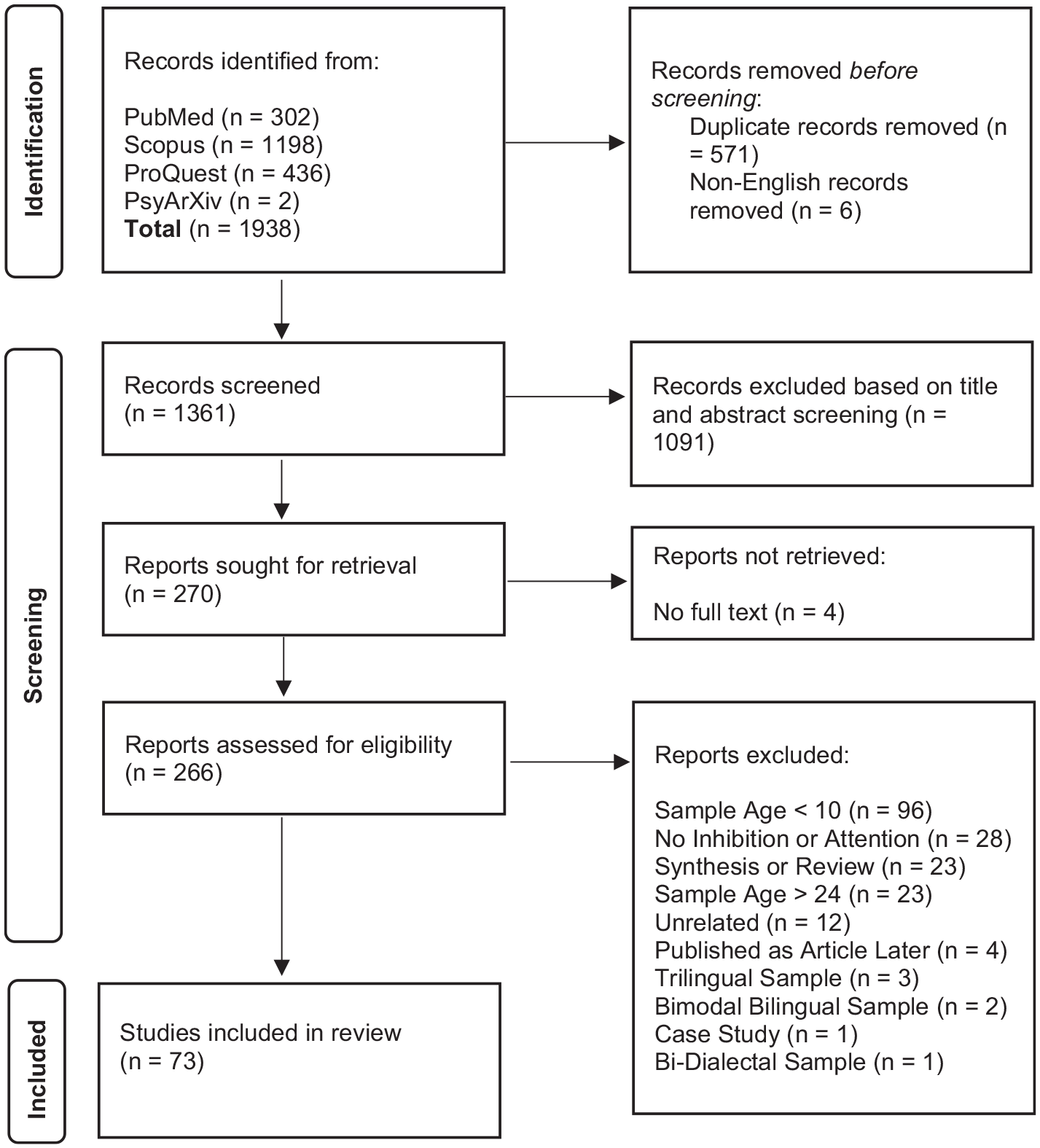
PRISMA flow diagram.
Summary of characteristics of included studies.
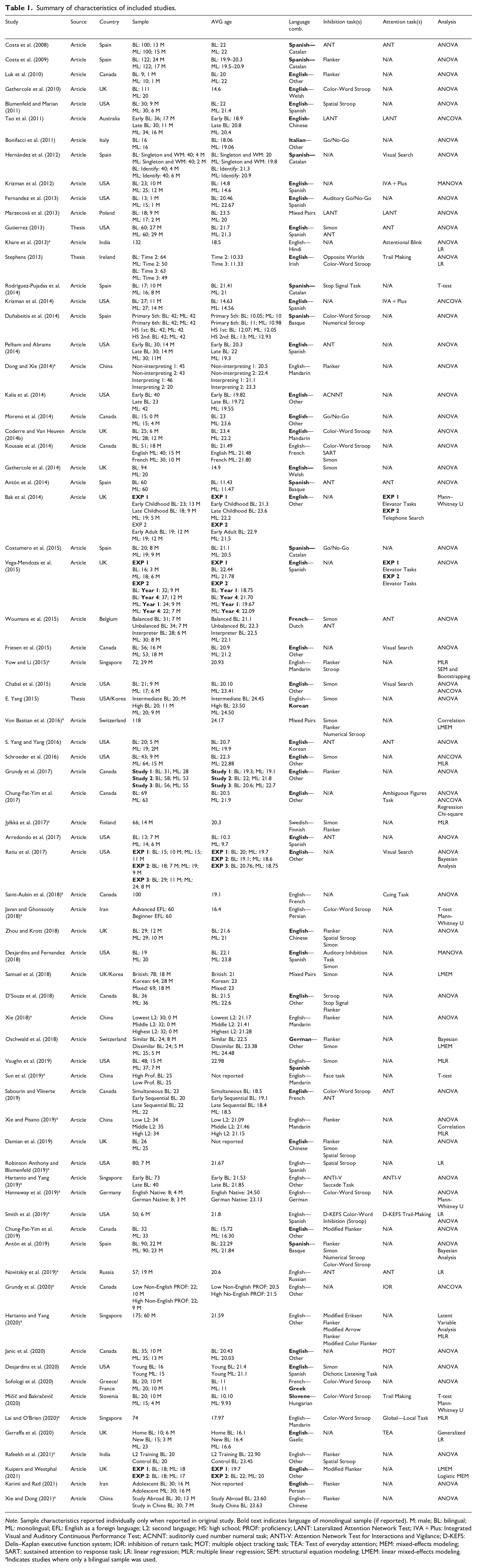
Note. Sample characteristics reported individually only when reported in original study. Bold text indicates language of monolingual sample (if reported). M: male; BL: bilingual; ML: monolingual; EFL: English as a foreign language; L2: second language; HS: high school; PROF: proficiency; LANT: Lateralized Attention Network Test; IVA + Plus: Integrated Visual and Auditory Continuous Performance Test; ACNNT: auditorily cued number numeral task; ANTI-V: Attention Network Test for Interactions and Vigilance; D-KEFS: Delis–Kaplan executive function system; IOR: inhibition of return task; MOT: multiple object tracking task; TEA: Test of everyday attention; MEM: mixed-effects modeling; SART: sustained attention to response task; LR: linear regression; MLR: multiple linear regression; SEM: structural equation modeling; LMEM: linear mixed-effects modeling.
Indicates studies where only a bilingual sample was used.
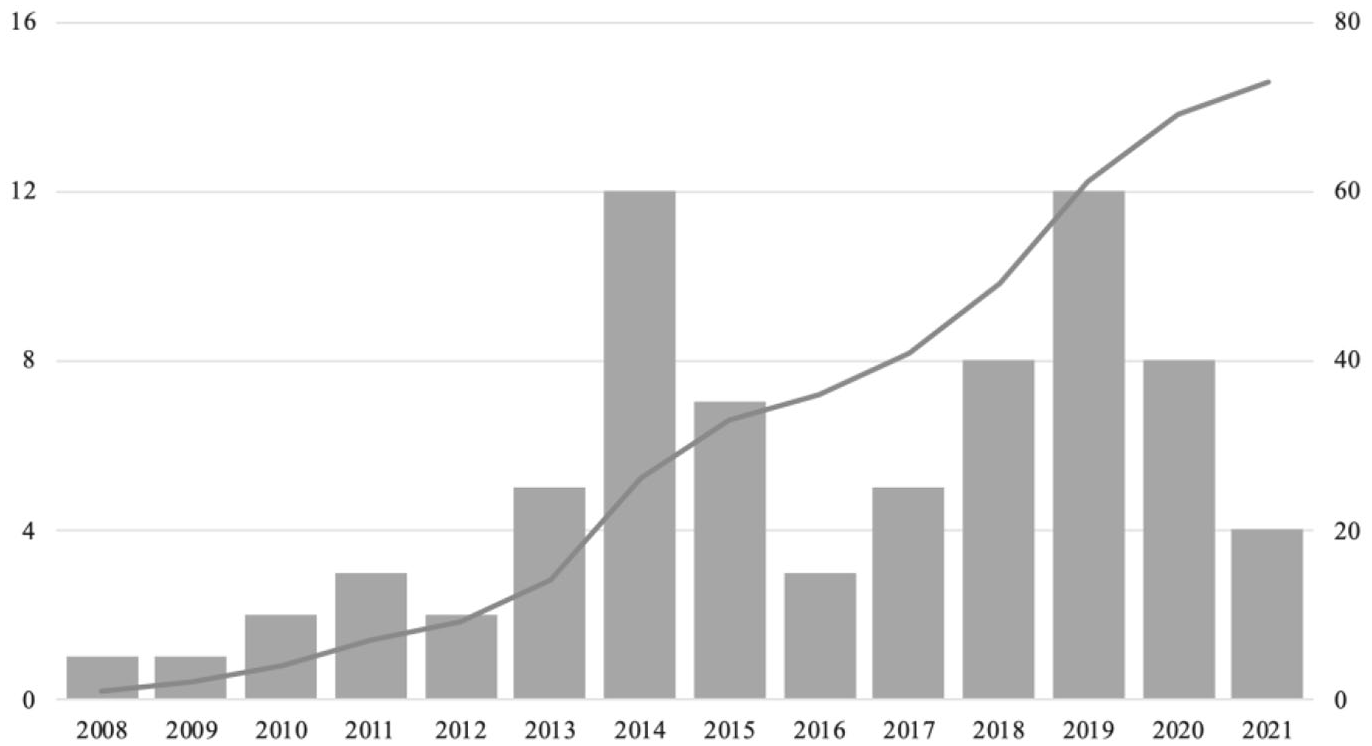
Included studies by year.
Question 1: where are studies on bilingual effects conducted?
Studies investigating the effects of bilingualism on inhibition and attention in young people were most often conducted in the United States (25%). This included one study in which a sample of English–Korean bilinguals in the United States was compared with Korean monolingual participants tested in South Korea (E. Yang, 2015). The recruitment of multi-nation samples was rare (but see Samuel et al., 2018; Sofologi et al., 2020). The next most common research locations were Canada (16%) and the United Kingdom (14%). Together, research conducted in the United States, Canada, and the United Kingdom accounted for over half of all included studies (55%). A complete geographic breakdown of study location with relevant data is provided in Figure 3.

Included studies by country.
Question 2: what language combinations have been reported in bilingual samples?
Studies of English–Spanish bilinguals were the most common samples reported (18%), followed by Chinese–English bilinguals (15%). Among the latter, 64% identified Mandarin as the dominant language, while the remaining studies either reported Mandarin and Cantonese speakers as a single “Chinese language” group, or did not specify different proportions. For samples of bilinguals who were described as equally proficient using the same pair of languages (e.g., all English–Spanish bilinguals), 44% of samples used languages with the same or similar writing systems, while 25% of samples included bi-scriptal bilinguals (e.g., English–Mandarin bilinguals). Finally, heterogeneous samples of bilinguals proficient in any two languages were identified in 32% of included studies. Of these studies, 78% included participants who reported proficiency in English and one additional language. A complete breakdown of language combinations is provided in Table 1.
Question 3: what tasks are used to assess bilingual effects on inhibition?
Before reporting data in detail, it is important to note that 21% of all included studies assessed bilingual effects on inhibition and attention by either administering two separate tasks (60% of studies assessing inhibition and attention) or analyzing data from a single task in a way that allows estimates of both inhibition and attention (e.g., the ANT), identified in 40% of these studies. Two studies using the ANT (Arredondo et al., 2017; Pelham & Abrams, 2014) did not analyze the effects of the different cuing conditions and were therefore categorized as only assessing inhibition. The majority of included studies (82%) tested differences in inhibition only. The most common task was the Stroop task (35% of studies assessing inhibition) including the Color-Word version (Stroop, 1935) as well as nonlinguistic Spatial (Blumenfeld & Marian, 2011) and Numerical Stroop analogs (Besner & Coltheart, 1979). The Flanker task (Eriksen & Eriksen, 1974) was used in 33% of studies assessing inhibition while the Simon task (Simon & Rudell, 1967) was used slightly less frequently (28%). While it was not a common practice, a number of studies (30% of studies assessing inhibition) administered more than one task with 39% of multi-task studies estimating inhibition using three separate tasks. A full list of tasks used to assess inhibition in each included study is shown in Table 1.
Question 4: what tasks are used to assess bilingual effects on attention?
Compared with inhibition, fewer studies investigated bilingual effects on attention (38%). The most commonly used task was the ANT (Fan et al., 2002) used in 25% of studies. Modified versions of the ANT including the Lateralized Attention Network Test (LANT; Greene et al., 2008) and the ANT for Interactions and Vigilance (ANTI-V; Roca et al., 2011) were used in three additional studies, increasing the percentage of studies assessing attention with some form of the ANT to 36%. Visual search tasks (14%) and subtests from the Test of Everyday Attention (TEA; 11%) (Robertson et al., 1994) were the next most used tasks. With the exception of one study administering multiple subtests from the TEA (Garraffa et al., 2020), the use of multiple assessments of attention was not identified in selected studies. The full list of tasks used to assess attention in each included study is reported in Table 1.
Question 5: which analysis methods are used in the analysis of these data?
Fixed-effects methods of analysis were used to test for bilingual effects on inhibition or attention in almost all included studies (95%). The most reported statistical analyses were analysis of variance (ANOVA; 68% of fixed-effects studies), linear regression (19% of fixed-effects studies), and analysis of covariance (ANCOVA; 8% of fixed-effects studies), with 5% of fixed-effects studies analyzed using different methods. Of the studies that utilized fixed-effects methods of analysis, 97% used frequentist methods and two (3%) used Bayesian analysis. Four studies (5% of included studies) used mixed-effects methods and these were limited to investigations of bilingual effects on inhibition (Kuipers & Westphal, 2021; Oschwald et al., 2018; Samuel et al., 2018; Von Bastian et al., 2016). While most studies (73%) compared task performance between bilingual and monolingual samples, 27% of studies included only a bilingual sample that was either divided into groups based on degree of bilingualism (e.g., early vs late bilinguals) and analyzed using between-group designs (50% of bilingual only studies), or analyzed using a within-group design (50% of bilingual only studies). Full study design details are reported in Table 1.
Discussion
The present review identified a number of methodological trends in investigations of bilingual effects on inhibition or attention in young people. First, a majority of studies identified were conducted in countries that are English-language dominant. Second, bilingual samples are typically proficient in English and another language from the same Indo-European family that shares the same writing system. Third, studies most often assessed differences between bilingual and monolingual samples in inhibition, less frequently assessed differences in attention, and almost exclusively analyzed their data using frequentist, fixed-effects methods. Given that gaps identified in the literature need further investigation, we discuss methodological trends that may limit the conclusions that researchers can draw about the impact of bilingualism on inhibition and attention and make recommendations about how to design more rigorous studies with greater impact both conceptually and methodologically.
Increasing study location diversity
Figure 3 highlights geographic trends in research on bilingual effects on inhibition and attention in younger people. Over half of the studies included in the present review were conducted in English-language dominant environments. This is possibly a consequence of the dominance of English used in these locations (by authors and participants), as well as increased resource availability for research studies. In other locations that also have diverse linguistic populations (e.g., India, Hong Kong, Singapore), it is notable that monolingual participants are difficult to recruit in comparison. Inability to recruit appropriate monolingual samples could relate to reported global increases in bilingualism (Grosjean, 2010), or national curricular requirements in a second-language education (e.g., Dong & Xie, 2014). It is also possible that this result reflects the larger number of bilingual young people who migrate to English-speaking countries during their undergraduate and postgraduate studies (Altbach et al., 2019), thus providing large populations of bilingual young people from which to recruit participants. While the number of bilingual young adult international students in these countries could partially explain this trend, it does not explain the dearth of data from other locations, many of them functionally or officially bilingual.
Data from bilinguals in locations outside the United States are important, since the majority of US bilinguals (1) use Spanish in addition to English (Driever & Bagheri, 2020), skewing samples in favor of languages from the same family using one writing system; (2) tend to be of lower socioeconomic status (SES); and (3) are first- or second-generation immigrants (Kohler & Lazarín, 2007). Higher SES is associated with improved executive functions (Hackman et al., 2015) and is thought to partially explain any bilingual advantages on the Simon, Flanker, and related tasks (Morton & Harper, 2007; Naeem et al., 2018; Paap, Johnson, et al., 2015; Van den Noort et al., 2019), a finding that is also identified in ethnically and linguistically homogeneous countries (Xie & Pisano, 2019). Data from a more diverse range of countries would allow additional questions related to the effects of culture to be addressed when investigating bilingual effects on inhibition and attention. While few studies addressed this topic, there is evidence that culture may impact on performance on tasks estimating executive function, and effects may emerge independently of bilingual effects (Samuel et al., 2018). It is presently unclear why differences in culture may impact on executive function, although some speculate that child-rearing practices (Chen et al., 1998), and international experience (Xie & Dong, 2021) may be influential, and that these differences may emerge early in life (Sabbagh et al., 2006). Due to the complications associated with collecting samples from multiple locations, especially during the ongoing global health crisis, future work should consider the use of Internet-based methods (Anwyl-Irvine et al., 2020; Crump et al., 2013; Jylkkä et al., 2017).
Exploring the impact of language combination
Languages differ in a range of dimensions including their morphology, phonology, and writing system (e.g., alphabetic versus non-alphabetic). Linguistic diversity has motivated the design of studies that focus on manipulating spoken languages according to their relative linguistic distance (Nerbonne & Hinrichs, 2006), including attempts to quantify this distance (Gamallo et al., 2017). There are calls to reconsider how bilingualism is conceptualized as bilinguals differ in complex and multidimensional ways that are meaningful in the context of research on bilingual effects (Weekes, 2020). The degree of similarity between a bilingual’s two languages is thought to influence cross-linguistic activation with higher similarity associated with higher levels of activation (Dijkstra & Van Heuven, 2002). As it follows, the use of two similar languages may place heavier cognitive control demands on a bilingual, possibly resulting in more pronounced effects on executive function. To date, few studies have considered linguistic similarities in languages used within a sample and thus whether this variable has any impact on cognitive functions (see Barac & Bialystok, 2012; Coderre & Van Heuven, 2014a; Kuzmina et al., 2019; Olguin et al., 2019; Oschwald et al., 2018), and published results are contentious (Paap, Darrow, et al., 2015). This controversy may have biased the recruitment to samples of bilinguals who are proficient in two languages regardless of linguistic similarity as observed in 32% of included studies. Although the use of samples of bilinguals who are all proficient in the same pair of languages would allow questions about language similarity to be addressed more directly, this methodological decision may come at the expense of generalizability (Friesen et al., 2015). This limit is further complicated by over-reliance on bilinguals who are all proficient in English, possibly limiting the generalizability of findings to a much smaller population of bilinguals. Despite this possible limit, there is a need to further explore the impact of language combination on bilingual effects in the interest of developing an understanding of how this poorly understood variable could influence executive function. Future work should also consider exploring whether proficiency in a dialect within a single language (e.g., Mandarin and Wuhan dialect) influences executive function as little work has explored this interesting topic (K. Antoniou et al., 2016; Oschwald et al., 2018; Privitera & Zhou, 2022; Wu et al., 2016).
Investigating bilingual effects in understudied age groups
The emergence of bilingual effects on inhibition and attention is influenced by the age of participants (Ware et al., 2020). Young people in the age range enrolled in high school (i.e., ~14–18 years of age) are the least sampled among studies included in this review, as identified in previous research syntheses (Giovannoli et al., 2020; Lowe et al., 2021). Rather than reflecting a developmental peak in executive function (Bialystok, 2016), the present review suggests that methodological flaws and limited statistical analyses are viable among alternative explanations (Moradzadeh et al., 2015; Paap, 2019; Paap et al., 2014; Samuel et al., 2018). It may also be the case that high-school students are less likely to be included as research participants due to lack of free time as a consequence of stressful academic preparations associated with high-stakes assessments and high-school “exit exams,” an educational reality for many high-school students globally (Nichols & Berliner, 2007). Finally, the additional ethical considerations associated with research conducted in minors might simply reduce the attractiveness of studying this population, especially when considering that most universities engaged in research of this kind have access to a large population of university-aged bilingual international students (Altbach et al., 2019). Future research conducted in high-school-age samples is crucial for developing a more comprehensive understanding of how bilingual experience influences inhibition and attention across all young people. Additional work should investigate how these differences in executive function impact on real-world outcomes such as academic performance (Privitera, Zhou, & Xie, 2022; Privitera, Zhou, et al., 2022).
Considering nontrivial differences in bilingual experience during analysis
The most important recommendation from the present review is to analyze individual differences in bilingual speakers both within samples and across studies that are reported in the literature. It is clear that a majority of studies use methodological designs that are derived from traditional fixed-effects models and subsequently data have been analyzed according to parametric models that have dominated experimental psycholinguistics for more than half a century. An almost exclusive reliance on fixed-effects methods of analysis was identified in the field of linguistics two decades ago (Lazaraton, 2000). Such methods attempt to reduce the impact of cross-participant heterogeneity by averaging data at the group level (Linck & Cunnings, 2015). To facilitate analysis, participants are assigned to monolingual or bilingual language groups, reducing language experience to an inaccurate and misleading categorical variable (Luk & Bialystok, 2013). This did not matter to previous researchers, but we believe it is a critical consideration conceptually and methodologically. The bilingual advantage hypothesis depends on an assumption that bilingual language experience impacts on the cognitive system (and the brain) because of attention, inhibition, and cognitive control over spoken discourse. As a consequence, meaningful differences in language experience between participants, if they are not taken into consideration in the research design and analysis, will not be revealed and therefore the hypothesis remains viable. This is not appreciated by authors who reject the hypothesis based on outdated models and statistical analyses, resulting in reduced confidence in the veracity of identified bilingual effects. Rapid progress has been made in the development of mixed-effects methods of analysis, but this has been limited to studies of items, such as words or pictures, drawn from larger populations of items (Baayen et al., 2008) rather than individual differences in populations of bilingual speakers.
It is surprising that mixed-effects analysis methods have not been more widely applied in the investigation of bilingual effects on executive function, especially when considering the heterogeneity of bilingual experience (Linck & Cunnings, 2015), as well as behavioral tasks containing dozens if not hundreds of trials. In combination with the collection of detailed data on language experience (De Bruin, 2019; Gullifer et al., 2021; Li et al., 2020; Luk & Bialystok, 2013; Marian et al., 2007) and other nonlinguistic variables (e.g., Bak, 2016; Naeem et al., 2018; Samuel et al., 2018; Van den Noort et al., 2019; Ware et al., 2020), mixed-effects analyses provides an opportunity for meaningful individual differences in bilingual and nonlinguistic experience to be tested in investigation of bilingual effects on executive function before rejecting the hypothesis based on an incomplete test of the hypothesis. One recent investigation found that models that do not consider individual differences in baseline task performance result in the identification of significant bilingual effects that become nonsignificant when these differences are accounted for using mixed-effects models (Privitera et al., in review). Although only four studies using mixed-effects analysis methods were identified during the search for the present review (Kuipers & Westphal, 2021; Oschwald et al., 2018; Samuel et al., 2018; Von Bastian et al., 2016), their alignment with the paradigm shift in experimental methods in psycholinguistics supports these methods are appropriate for use in the investigation of bilingual effects on attention and inhibition.
Limitations of the present review
The present review focused on only two domains of executive function (i.e., inhibition and attention) and did not include research assessing difference in other domains such as updating or shifting. Because of this focus, as well as the application of inclusion and exclusion criteria, additional studies using tasks that partially measure inhibition or attention may have been excluded. Our focus on studies conducted in samples of young people limits our ability to draw conclusions about whether the observed trends are present in the wider literature on bilingual effects. Future syntheses should focus on other age groups and explore whether the identified methodological practices influence their reported findings. Only studies published in English were considered for inclusion, possibly missing relevant studies published in other languages. Included studies were also limited to those using samples of bilinguals only, excluding studies conducted in trilingual, bimodal bilingual, or other multilingual or multi-dialectal samples. In addition, because critical appraisal is not performed during the conduct of a scoping review, there may be issues related to the quality of included research. Finally, although steps were taken to ensure that the results of the present review were reproducible, the use of a single reviewer for study search, selection, and data extraction, even with explicit inclusion and exclusion criteria, does not guarantee that results would be the same had the review been conducted by another person.
Conclusion
Our understanding of bilingual effects on inhibition and attention in young people can be improved through modification of prevailing methods of investigation in future studies. Specifically, inclusion of bilingual samples from a more diverse range of countries who are proficient in language pairs that do not include English would provide a more inclusive and accurate test of the bilingual advantage hypothesis. Further investigation of underrepresented groups within the population of young people, especially high-school-age bilinguals, will further increase this inclusivity, providing a more complete understanding of bilingual effects in this widely studied population. Finally, the adoption of mixed-effects methods will allow for complex and meaningful differences in bilingual experience to be considered during the analysis of data.
Footnotes
Declaration of conflicting interests
The author(s) declared no potential conflicts of interest with respect to the research, authorship, and/or publication of this article.
Funding
The author(s) received no financial support for the research, authorship, and/or publication of this article.
