



Abstract
Aims and Objectives:
The benefits of dual-language immersion (DLI) versus English-only classrooms for minority-language speakers’ acquisition of English have been well documented. However, less is known about the effect(s) of DLI on majority-language speakers’ native English skills. Prior studies largely used accuracy-focused measures to index children’s language skills; it is possible that processing-based tasks are more sensitive to the effects of DLI experience.
Methodology:
Thirty-three monolingual native English-speaking children attending English-only classrooms and thirty-three English-speaking children attending English-Spanish DLI matched in age, gender, nonverbal IQ, and socio-economic status were tested twice, 1 year apart, on standardized and processing-based measures of English vocabulary and morphosyntax.
Analysis:
We ran linear mixed-effects models to examine the extent to which group and time would predict scores on knowledge-based measures of vocabulary and morphosyntactic knowledge, as well as accuracy and reaction times on processing-based measures of English vocabulary and morphosyntax.
Findings:
Results revealed comparable levels of growth in English for both groups. A subtle effect of DLI was observed on a lexical-decision task: bilinguals were slower in Year 1 but both groups were equally efficient in Year 2. These results indicate that DLI programs have minimal impact on majority-language speakers’ native-language skills in the age-range tested.
Originality:
This study is the first to longitudinally examine processing-based native language outcomes in bilingual children in DLI classrooms.
Significance:
We do not find evidence that DLI exposure carries a cost to native language development, even when indexed by processing measures. This should reassure parents, educators, and policymakers in that there are no downsides to DLI.
Keywords
Dual-language immersion (henceforth DLI) programs aim to develop literacy and grade-appropriate content knowledge in two languages (Calderón & Minaya-Rowe, 2003; Cloud et al., 2000). In the current paper, we focus on DLI programs that are also called two-way immersion programs, where native speakers of the majority- and of the minority-language are in class together and instruction is split across both languages. There are many acknowledged benefits to DLI, For instance, through DLI, students show gains in metalinguistic awareness, that is, their knowledge about language itself (Ben-Zeev, 1977; Bialystok et al., 2014; Cummins, 1978). This knowledge transfers to developing reading skills, in turn, supporting academic achievement (Calderón & Minaya-Rowe, 2003). Socio-cultural growth is another benefit of DLI programs: bilingual students understand the cultures attached to the languages they speak and are able to use their languages in different communities, allowing for a broader context of experiences and understanding of diversity. DLI programs also have a positive economic impact on students as a broader array of job opportunities is open to bilingual individuals, who can use their linguistic and intercultural competence to conduct business with different cultures and countries (Calderón & Minaya-Rowe, 2003; Cloud et al., 2000; K. Lindholm-Leary & Genesee, 2014).
In the domain of language development, the main question of interest with respect to DLI programs has been whether they are successful in teaching a second language (L2) (Calderón & Minaya-Rowe, 2003; Cloud et al., 2000), and generally, studies indicate that they are (Campbell et al., 1985; Genesee, 1987; and see Howard et al., 2003 for a review). Less is known about the development and maintenance of native language (L1) skills of children attending DLI programs, although findings that do exist generally agree that DLI programs can also support children’s L1 maintenance (Björklund & Mård-Miettinen, 2011; Bostwick, 2001; Genesee, 1987; Howard & Christian, 1997; for oral skills; Ha, 2001; Lambert et al., 1973; Mehisto & Asser, 2007; Padilla et al., 2013; Serrano & Howard, 2003; for writing skills). In the current study, we evaluated the effect of DLI exposure on native language skills of English-L1-speaking children over the period of 1 year. The novel contribution of this study is its focus on processing-based measures of vocabulary and morphosyntax that emphasize efficiency of processing, in addition to accuracy. The vast majority of prior work that tested the effect of DLI on L1 maintenance in majority-speaking children utilized accuracy-based standardized language measures or classroom observations and samples of class work (Burkhauser et al., 2016; Genesee, 1987; Ha, 2001; Howard & Christian, 1997; Lambert et al., 1973; Lambert & Tucker, 1972; Padilla et al., 2013; Serrano & Howard, 2003; Steele et al., 2017; Swain & Lapkin, 1982; Watzinger-Tharp et al., 2021) that may be less sensitive to dual-language exposure than efficiency-based measures. We investigated both vocabulary and morphosyntactic processing skills because of the possibility that these two linguistic domains may be differentially sensitive to the effects of L2 exposure.
Majority- and minority-language students’ L2 outcomes
A large body of research has found that both majority- and minority-language students typically achieve high proficiency in their respective second languages (L2) in DLI programs (e.g., Burkhauser et al., 2016; Collier & Thomas, 2004; K. Lindholm-Leary & Genesee, 2010; Steele et al., 2017; Watzinger-Tharp et al., 2021). For example, in a review of various DLI programs, K. Lindholm-Leary and Genesee (2014) show that for majority-language students in DLI, across various communities and assessed in different ways (e.g., standardized normed-referenced tests and linguistic analyses; Center for Applied Second Language Studies [CASLS], 2011), L2 outcomes are significantly better than those of L2 learners in traditional L2 instruction. This achievement is observed in all areas of language, and students score similarly to native speakers of the L2 on comprehension tests (K. Lindholm-Leary & Genesee, 2014). Language outcomes in the majority language in society for speakers of the minority language are similarly positive: students develop L2 literacy at the same rate as minority-language peers in conventional programs and attain higher levels of proficiency than their peers in English-only programs (K. Lindholm-Leary & Genesee, 2010).
Similarly positive results of the DLI programs have been found by Esposito and Bauer (2019) in a longitudinal study measuring English vocabulary comprehension in students in traditional and DLI programs over 3 years, controlling for home language (Spanish or English). Results showed that regardless of home language, students in DLI programs had comparable English vocabulary comprehension scores to students in single-language education who had the same home language (Esposito & Bauer, 2019). Overall, these findings show that DLI programs are as successful as traditional classrooms in teaching an L2 minority language to majority-language speakers, and more successful in teaching an L2 majority language to majority-language learners than English-only classrooms.
Although L2 outcomes are positive for both majority- and minority-language students in DLI programs, some differences exist in the rate of learning across groups. In a study on reading and math skills achievement, it was found that performance on a standardized English reading test improved gradually in students in DLI programs compared with students in transitional programs of instruction (bilingual education including minority-language students only) for whom performance remained stable across grades (Marian et al., 2013). This benefit emerged earlier for the majority-language group (approximately in third grade) than for the minority-language group (approximately in fifth grade). The authors argue that this difference could be explained by lower English proficiency for minority-language students, limiting these students’ performance on English-based tests (see also August & Hakuta, 1997). Moreover, the authors report a gap in socio-economic status (SES) between majority-language students (higher SES) and minority-language students (lower SES), suggesting that minority-language students may not have had the same amount and/or quality of resources that majority-language students had to support their learning in two-way immersion.
Majority-language students’ native language outcomes
While L2 learning is successfully achieved in different DLI programs, less is known about the effect of DLI on native language skills. According to Genesee (2004), there can be an early lag in the development of L1 reading, writing, speaking, and listening skills in the initial grades for majority-language students compared with peers in non-immersion programs, although to various levels depending on the skill and the setting. For example, in Lambert et al. (1973), native English speakers learning French in immersion in Canada were followed from Grade 4 through Grade 5 and assessed on measures of receptive and expressive English language skills. In Grade 4, native English speakers in French immersion classrooms demonstrated slightly more difficulty in the realm of punctuation and capitalization rules in English, and composition writing in English, compared with non-immersed native English speaker controls. Padilla et al. (2013) compared performance of students in Mandarin-English immersion to that of their non-immersion peers in the same school. When tested on California mandated tests in English language, the non-immersion students performed better than the immersion students in second and third grade (Padilla et al., 2013). In the upper grades, however, the Mandarin immersion students performed better on English-language measures.
These two studies suggest no adverse effect of DLI on the development of native-language skill, and although a temporary delay has sometimes been observed, it does not seem to persist into the upper grades. It is possible however that the standardized language measures used by these prior studies are not sensitive enough to detect the possible effects of L2 immersion on L1 maintenance and development. As suggested by Ivanova and Costa (2008), processing measures that index efficiency of language access (via Reaction Time [RT]) in addition to accuracy are more sensitive to language proficiency and exposure fluctuations, especially in the native language. Among all the available studies on the effects of DLI exposure, only one study investigated language performance via a processing-based task. Specifically, Bialystok et al. (2014) used a grammaticality judgment task to examine the impact of DLI exposure on children’s language and metalinguistic skills. They tested children’s ability to make grammaticality judgments (GJ) of grammatically correct sentences, grammatically incorrect but meaningful sentences, and semantically nonsensical but grammatical sentences. No difference was found between children who were native English speakers, either in a French immersion program or in a standard English program, from second to fifth grade, on judging whether correct (meaningful) sentences were grammatically incorrect. For nonsensical sentences, however, the immersion children were better able to ignore the lack of meaning and focus on the GJ, but that effect only showed in Grade 5. However, in this study, RTs were not analyzed, and therefore, it is unclear whether the groups also differed (or did not differ) in the efficiency with which they processed grammatical and semantic information.
Together, prior studies indicate that DLI exposure does not disrupt the accuracy with which children process native-language information. However, the general bilingual language development literature suggests that bilingual children can present with a lag in vocabulary and morphosyntax compared with monolinguals (Ben-Zeev, 1977; Bialystok et al., 2010; Bialystok & Feng, 2009; Gathercole, 2007; Goldberg et al., 2008; Hoff et al., 2012; Mahon & Crutchley, 2006; Oller & Eilers, 2002; Oller et al., 2007; Thordardottir, 2011; Verhallen & Schoonen, 1993). It may be that use of largely off-line and/or normative measures of language in these prior studies obscured the possible effects of DLI exposure on bilingual children’s native-language skills.
Lag in vocabulary and morphosyntax development in bilingual children
Previous research has found that bilingual children exposed to their two languages in naturalistic settings acquire a smaller number of words in each language than their monolingual peers (e.g., Ben-Zeev, 1977; Bialystok et al., 2010; Bialystok & Feng, 2009; Goldberg et al., 2008; Mahon & Crutchley, 2006; Oller et al., 2007; Verhallen & Schoonen, 1993). This gap in language-specific vocabulary tends to narrow or disappears as bilingual children get older (Thordardottir, 2011). Furthermore, when both languages are taken into account, bilingual children tend to have similar vocabulary sizes as their monolingual peers (Hoff et al., 2014). Regarding the development of morphosyntactic skills, bilingual children acquiring their two languages in a naturalistic manner similarly demonstrate a slower uptake of some grammatical structures associated with lower exposure to input in each language (Gathercole, 2007; Hoff et al., 2012; Oller & Eilers, 2002). When bilinguals accumulate a sufficient amount of grammatical knowledge in the L2, differences across monolingual and bilingual groups may disappear (Gathercole, 2002a, 2002b, 2002c, 2007). In addition, the development of morphology and syntax may be more robust to fluctuations in exposure than the development of vocabulary (Chondrogianni & Marinis, 2011).
Why do bilingual children present with lags in language-specific lexical and morphosyntactic development, compared with their monolingual peers? The primary explanation is exposure-driven. That is, the development of language-specific vocabulary and morphosyntax is known to be influenced by the overall amount of language input and by parental language input specifically (Blom, 2010; David & Wei, 2008; Genesee, 1989; Hoff & Core, 2013; Hoff et al., 2014; Huttenlocher et al., 1991; Patterson & Pearson, 2004; Pearson et al., 1997; Unsworth, 2016). Since increased exposure to one language invariably leads to reduced exposure to the other language, bilingual children are generally thought to experience less exposure to each of their two languages than monolingual children (Hoff & Core, 2013; Patterson & Pearson, 2004; Pearson et al., 1997), leading to language-specific lags in the development of lexical and morphosyntactic skills. An additional explanation is provided by theories of bilingual language development and processing that posit inhibitory-based processes that mediate the acquisition and activation of the L2 over the L1. For instance, the Inhibitory Control model (Green, 1998) posits that activation of the weaker L2 is accomplished through inhibition of the stronger L1. While this practice could potentially lead to increased practice with inhibitory control, which could, in turn, lead to an inhibitory control advantage in bilinguals (e.g., Bialystok & Martin, 2004; Martin-Rhee and Bialystok, 2008, but see Hilchey & Klein, 2011; Paap & Greenberg, 2013), the result for the linguistic system may be a less agile L1.
In line with this model, a few studies have observed that intensive exposure to a second language (i.e., through immersion) leads to suppression of the native language. For instance, Linck et al. (2009) tested young L1 English adults who were immersed for 3 months in Spain and were exposed to Spanish either both at home and in class, or only in class. Participants completed a comprehension (translation recognition) and a production (verbal fluency) task in Spanish and English. For both comprehension and production measures, fully immersed students showed attenuated access to the L1 English compared with classroom-only immersed students, evidenced by a smaller difference in mean RT between translation-neighbor distractors and matched controls on the translation recognition task, and a smaller number of exemplars produced for the verbal fluency task. This suggests partial inhibition of the L1 during the course of full-language immersion. More broadly, inhibition of the native language when using an L2, was evidenced in a picture naming task (Levy et al., 2007) where native English speakers with 1 year of college Spanish had more difficulty naming a picture in English if they had named that picture in Spanish on previous trials. The effect increased as the amount of previous naming trials increased (from 0 to 10).
With the psycholinguistic literature in mind, one possible hypothesis regarding the effect of DLI on children’s native language skills is that intensive exposure to Spanish in a DLI classroom will limit the efficiency of L1 English access for majority-speaking children. In the present study, this was precisely the question we examined. Beyond the main contribution of this work, its focus on efficiency of processing, one other significant methodological contribution of this approach to studying the impact of L2 exposure on children’s language development is the ability to zero in on the effects of L2 exposure while controlling for a wide range of other variables known to impact language development. One well-known factor in shaping children’s language outcomes is SES—with lower SES associated with slower vocabulary growth (Goldberg et al., 2008). Bilingual/monolingual comparisons that focus on naturalistic bilinguals are often contaminated by SES discrepancies (e.g., Morton & Harper, 2007; Patterson & Pearson, 2004). For instance, in the United States, Spanish-English bilinguals tend to come from lower SES backgrounds than monolingual English speakers (Patterson & Pearson, 2004), and this socio-demographic discrepancy must be taken into account, either statistically or conceptually, when interpreting differences in performance between bilinguals and monolinguals. Other differences that characterize naturalistic bilinguals versus monolinguals, and that may bear on language outcomes, include cultural differences (Cummins, 1989; Patterson & Pearson, 2004), socio-pragmatic differences (Patterson & Pearson, 2004), and so forth. The advantage to testing children acquiring their minority language in DLI programs is that these children are much less likely to differ from monolingual children (i.e., native English-speaking children who attend English-only classrooms) on demographic and other variables than bilingual children acquiring their minority language in the community. This was indeed the case in the present study, where the monolingual children and the children acquiring Spanish in DLI classrooms were indistinguishable with respect to ethnicity, SES, and social-cultural environments they occupied. A comparison of the two groups’ acquisition of English therefore constitutes a rather “pure” test of how exposure to two languages influences language-specific processing outcomes in children.
Current study
Many previous studies of DLI programs focused on whether they are successful in teaching a second language for minority-language students (Howard et al., 2004; Jong & Howard, 2009; Saunders & O’Brien, 2006; Watzinger-Tharp et al., 2018) and majority-language students (Campbell et al., 1985; CASLS, 2011; Howard & Christian, 1997; Howard et al., 2004). The question of L1 development and maintenance has also been examined for both majority-language students (Bialystok et al., 2014; Björklund & Mård-Miettinen, 2011; Bostwick, 2001; Esposito & Bauer, 2019; K. J. Lindholm-Leary, 2001; Howard et al., 2004; Lambert et al., 1973; Mehisto & Asser, 2007; Padilla et al., 2013), and minority-language students (Cazabon et al., 1993; Esposito & Bauer, 2019; Gathercole, 2002a, 2002b, 2002c; Howard et al., 2004; K. J. Lindholm-Leary, 2001; Torres-Karna & De Kanter, 2005). The vast majority of these prior studies however have measured language function through tests that emphasize accuracy, such as tests of verbal and reading comprehension, spelling and written vocabulary (Esposito & Bauer, 2019, and see Genesee, 1987 for a review). Many of these studies have not always rigorously matched samples of monolingual and bilingual students on measures that could affect L1 performance, such as SES (e.g., Goldberg et al., 2008; Patterson & Pearson, 2004) or IQ. SES and IQ can influence performance on language tasks directly (e.g., Cejas et al., 2018; Goldin-Meadow et al., 2014; Hart & Risley, 1995; Piccolo et al., 2016), or through their effects upon executive functioning (Valian, 2015).
In the current study, we examined the progression of native-language lexical and morphosyntactic skills in majority-language children past the initial stages of immersion. Children were 8–12 years old and had been in DLI for an average of 4 years at the start of the study. To better understand the trajectory of L1 development in DLI bilinguals, we took a longitudinal approach by testing children’s language skills twice, 1 year apart, administering measures of lexical and morphosyntactic processing. Our hypotheses were as follows:
Over time (Year 1–Year 2), both DLI bilinguals and monolinguals would demonstrate improvements in L1 English lexical and morphosyntactic skills.
If exposure to L2 Spanish interferes with L1 processing, either through reduced L1 exposure or as the result of cross-linguistic interactions, DLI bilinguals’ L1 lexical and morphosyntactic processing would be less efficient than their monolingual peers.’ This effect might be most pronounced in the lexical domain, in line with work suggesting that vocabulary is especially affected by fluctuations in language exposure (e.g., Kohnert et al., 1999; Schwartz & Kroll, 2006).
Method
Participants
All children were recruited from local schools in Madison, WI, to participate in a larger study on the relationship between language and executive functions. A total of 70 monolingual children from English-only classrooms and 50 bilingual children from DLI classrooms attending the same schools were tested in Year 1, ranging from 8 to 12 years of age. Of those, 60 monolinguals and 41 bilinguals came back for testing in Year 2. DLI program placement was lottery based. Our sampling procedure covered all public schools in Madison, WI and children in both groups came from a variety of schools. The two groups were characterized by very similar educational, cultural, and ethnic profiles.
For the purposes of the present study, children from both groups were pairwise-matched on age (p = .68) and nonverbal IQ (p = .85), indexed by the Wechsler Intelligence Scale for Children, 4th Edition (WISC-IV; Wechsler, 2003), which was normed for children and adolescents aged 6;0–16;11. After these steps, 1 bilingual and 21 monolinguals could not be pairwise-matched, leaving a sample of 49 monolinguals pairwise-matched to 49 bilinguals. In this remaining sample, 7 pairs could not be included because one of the matched participants did not come back in Year 2. In the remaining 42 pairs, a further 9 pairs were removed due to missing language data from participants in one or both of the groups. The resulting groups included 33 monolingual children (17 females) with an average age of 9.17 years (SD = 1.03) and 33 English-Spanish bilingual children (15 females) with an average age of 9.27 years (SD = 0.94).
Monolingual children spoke English as their native language and exposure to another language was considered an exclusionary criterion. Bilingual children spoke English as their native language and were exposed to Spanish at age 4 or 5 through enrollment in DLI programs. The children attended the DLI programs for an average of 4.14 years (SD = 1.09) at the first testing session. DLI programs vary in their proportion of majority-language speakers and minority-language speakers. Programs also vary in admission, placement and assessment practices, proportion of instruction in each language, and parent involvement (Calderón & Minaya-Rowe, 2003). At the time the data were collected, the local DLI programs followed the 90/10 Spanish/English structure, in which 90% of classroom instruction was in Spanish, and the remaining 10% was in English during the first year (Grade 1). English instruction increased by 10% with each grade until 4th grade. In 5th grade, classroom instruction was evenly split between the two languages. This dual-immersion model warrants a strong exposure to Spanish for native English speakers and is thus well suited to the research questions asked here. Monolingual and bilingual children were excluded if they had exposure to a second (for monolinguals) and third (for bilinguals) language (defined as > 5% during the week). Exclusionary criteria for all children included a diagnosis of language impairment, learning disability, psychological or behavioral disorder, neurological impairment or other developmental disabilities. All children passed a hearing screening at 20 dB, at 1000, 2000, and 4000 Hz.
At the first visit, parents of all children were asked to fill out a background questionnaire about the child’s family, medical, and educational histories. This questionnaire also yielded mother’s years of education, which was used as proxy for the child’s SES. The two participant groups did not differ significantly in SES (p = .92). Furthermore, for bilingual children, a comprehensive history of language development, language acquisition, and language exposure was obtained through an interview conducted with the parent. At their first visit, on average and during a typical week, bilingual children were exposed to English 75.34% of the time and exposed to Spanish 24.66% of the time. See Table 1 for background information on all participants and Table 2 for bilingual participants’ characteristics.
Participant characteristics in Year 1.
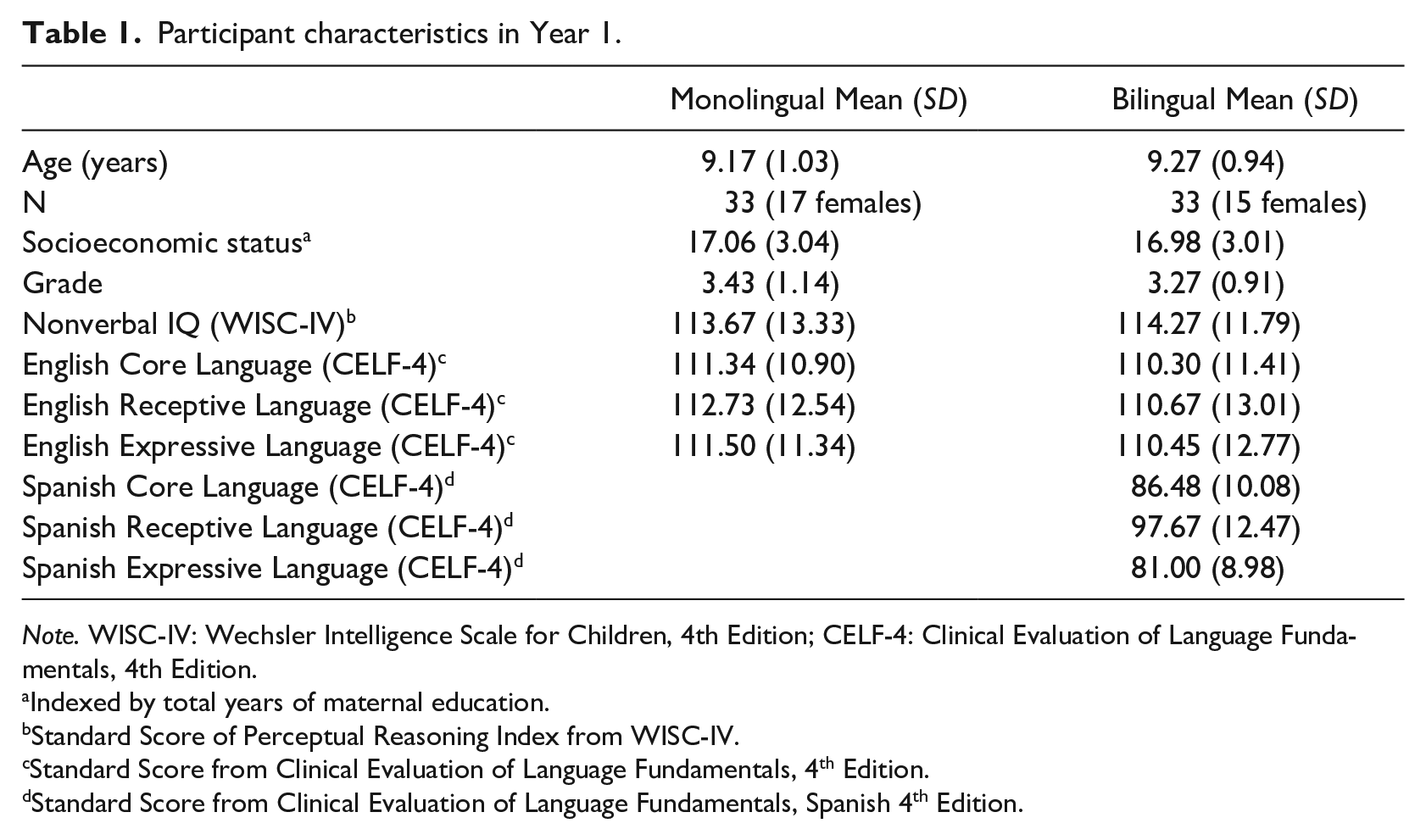
Note. WISC-IV: Wechsler Intelligence Scale for Children, 4th Edition; CELF-4: Clinical Evaluation of Language Fundamentals, 4th Edition.
Indexed by total years of maternal education.
Standard Score of Perceptual Reasoning Index from WISC-IV.
Standard Score from Clinical Evaluation of Language Fundamentals, 4th Edition.
Standard Score from Clinical Evaluation of Language Fundamentals, Spanish 4th Edition.
Bilingual characteristics in Year 1.
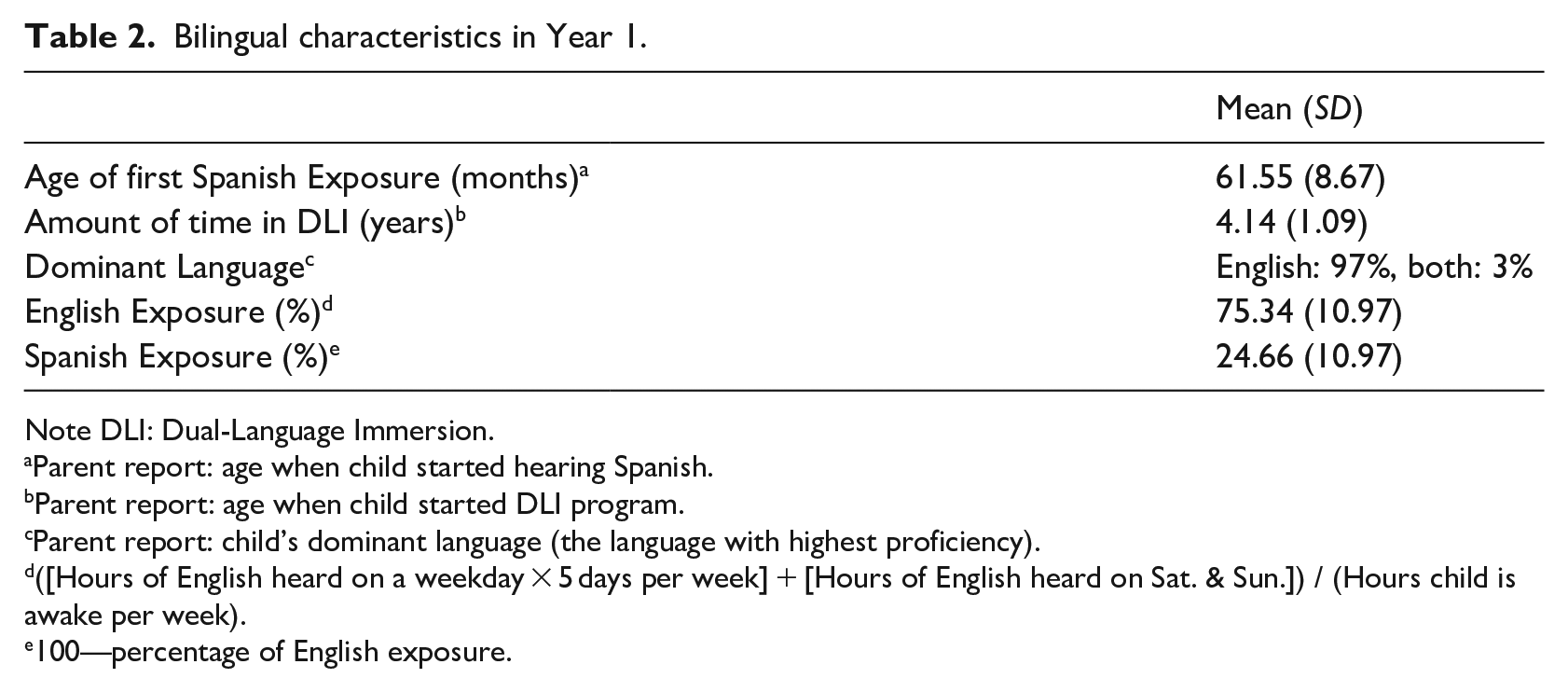
Note DLI: Dual-Language Immersion.
Parent report: age when child started hearing Spanish.
Parent report: age when child started DLI program.
Parent report: child’s dominant language (the language with highest proficiency).
([Hours of English heard on a weekday × 5 days per week] + [Hours of English heard on Sat. & Sun.]) / (Hours child is awake per week).
100—percentage of English exposure.
Independent samples t-tests revealed that the groups did not significantly differ on grade, SES (indexed by total years of maternal education), English Core language, English Receptive, or English Expressive language (indexed by the Clinical Evaluation of Language Fundamentals, 4th Edition [CELF-4; Semel et al., 2003]), normed for ages 5–21.
Procedure
Children were tested over two to three 2-hour long visits to the laboratory each year. Trained bilingual English-Spanish research assistants administered the Spanish standardized assessments to the bilingual children. The standardized measures of English vocabulary and grammar were administered in both Year 1 and Year 2; all other standardized cognitive and language assessments were administered in Year 1 only. All experimental measures were administered in both years.
In Year 1, monolinguals were tested over two sessions, with standardized assessments administered in the first session, and computerized tasks in the second session. Bilinguals were tested over three sessions following the same structure as for monolinguals in Sessions 1 and 2, and Session 3 was for Spanish assessments. All assessments and computerized tasks were administered in English, except for the Spanish CELF-4 (Semel et al., 2003, described below). There was a buffer of at least a week between sessions.
Standardized measures
Nonverbal intelligence was measured by the Perceptual Reasoning Index of the WISC-IV. This index aggregates scores on three subtests of the WISC: Block Design, Picture Concepts and Matrix Reasoning. Overall English language skills were assessed by administering the CELF-4 to both monolingual and bilingual children. The CELF-4 includes several subtests aiming to assess various aspects of language. For the purposes of the present study Core, Receptive and Expressive language skills were measured. The groups did not differ significantly on English Core (p = .71), English Receptive (p = .52), or English Expressive (p = .73) language skills. Bilinguals’ Spanish language skills were assessed by administering the Spanish edition of the CELF-4 in Year 1 (Semel et al., 2003).
Children’s knowledge of English receptive vocabulary was evaluated with the Peabody Picture Vocabulary Test—4th Edition (PPVT-IV; Dunn & Dunn, 2007—Form A in Year 1 and Form B in Year 2—normed for ages 2:6—90 +, reliability and validity scores in 0.9 range). In this test, children are asked to point to the picture named by the examiner. This standardized test is commonly used in clinical and research settings to evaluate the breadth of vocabulary knowledge in children and adults. See Table 3 for children’s scores on the PPVT-IV for each year. Linear regressions revealed no main effect of Group (b = 0.89, SE = 3.05, t = 0.23 p = .77) or Time (b = −0.46, SE = 3.05, t = −0.48, p = .63) on the receptive vocabulary scores. In addition, there was no significant interaction between Group and Time (b = 2.18, SE = 6.10, t = 0.36, p = .72). Refer to Table 3 for scores on the PPVT for each group in each year.
PPVT-IV and TOLD I:4 scores.
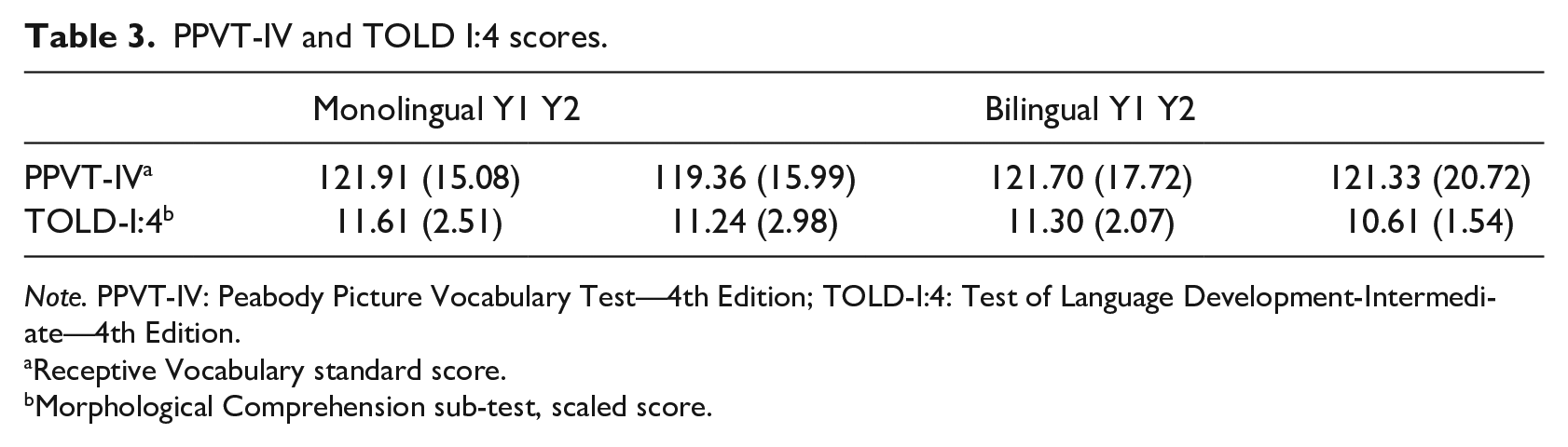
Note. PPVT-IV: Peabody Picture Vocabulary Test—4th Edition; TOLD-I:4: Test of Language Development-Intermediate—4th Edition.
Receptive Vocabulary standard score.
Morphological Comprehension sub-test, scaled score.
Knowledge of English grammatical morphemes use was evaluated with the Morphological Comprehension subtest of the Test of Language Development—Intermediate: 4th Edition (TOLD-I:4; Hammill & Newcomer, 2008), which can be administered to children and young adults aged 8–17 years old. In this test, children must distinguish between grammatical and ungrammatical sentences. See Table 3 for children’s scores on the TOLD for each year. Linear regressions revealed no main effect of Group (b = −0.47, SE = 0.41, t = −1.16, p = .25) or Time (b = −0.53, SE = 0.41, t = −1.30, p = .20) on the TOLD scores. In addition, there was no significant interaction between Group and Time (b = −0.33, SE = 0.81, t = −0.41, p = .68). Refer to Table 3 for scores on the TOLD for each group in each year.
Because both the PPVT-IV and the TOLD-I:4 are standardized measures, the scores in Year 1 and Year 2 are calculated by taking children’s ages into account. It is therefore not surprising that the Year 1 and Year 2 scores for the measures do not differ significantly from each other. It is, however, notable that the scores on these knowledge-based measures of vocabulary and morphosyntactic knowledge did not differ between DLI-bilingual and monolingual children.
Experimental measures of lexical and morphosyntactic processing
Lexical processing
To assess lexical processing, a computerized, auditory lexical decision (LD) task was administered in both years. Children were asked to listen to words and judge whether they were or were not real words in English. The stimuli consisted of forty disyllabic words, normally known by typically developing 5-year-old children (Stadthagen-Gonzalez & Davis, 2006; e.g., toothbrush, mermaid), and 40 disyllabic nonwords, which included only non-cognates (e.g., tressac, locell). All stimuli followed English phonotactic rules and were not real words in Spanish. The words and the nonwords were matched on phonotactic probability and were produced by a native Midwestern female speaker. Stimuli were presented in a semi-randomized order, so that no more than three words or three nonwords followed each other in sequence. A complete list of the stimuli is available in Appendix 1.
During testing, children were presented with the stimuli through computer speakers and responses were collected via a serial response box connected to the desktop computer. Children were instructed to press the “smiling face” button as quickly as possible if the word they heard sounded like a real word in English, or the “frowning face” button if the word did not sound like a real word in English. If the child pressed a button prior to completion of stimulus presentation, the stimulus kept playing until completion. Practice trials were presented at the beginning of the experiment to teach children the procedure and to familiarize them with the button box. None of the practice items were included in the experimental stimulus set. Accuracy and RTs were collected for each trial.
Data were cleaned at the trial level for Year 1 and Year 2 separately. Trials in which the child responded within the first 500 ms were excluded as false starts. Then, proportion correct scores across both years for the two participant groups were reviewed to identify items with consistently poor performance (less than 0.50). As a result, one stimulus item was excluded from the LD task and the final analyses were conducted on 40 words and 39 nonwords. Finally, RT data were analyzed for correct responses only and were trimmed to remove trials that fell beyond 2.5 SD of that child’s mean RT for all items. In total, for accuracy analyses, 3.56% trials in Year 1 (3.26% for monolinguals and 3.86% for bilinguals) and 2.10% trials in Year 2 (2.24% for monolinguals and 1.97% for bilinguals) were eliminated, and for RT analyses, 2.85% trials in Year 1 (2.89% for monolinguals and 2.82% for bilinguals) and 2.54% trials in Year 2 (2.57% for monolinguals and 2.51% for bilinguals) were eliminated. Performance on the LD Task is presented in Table 4.
Performance on the Lexical Decision Task.
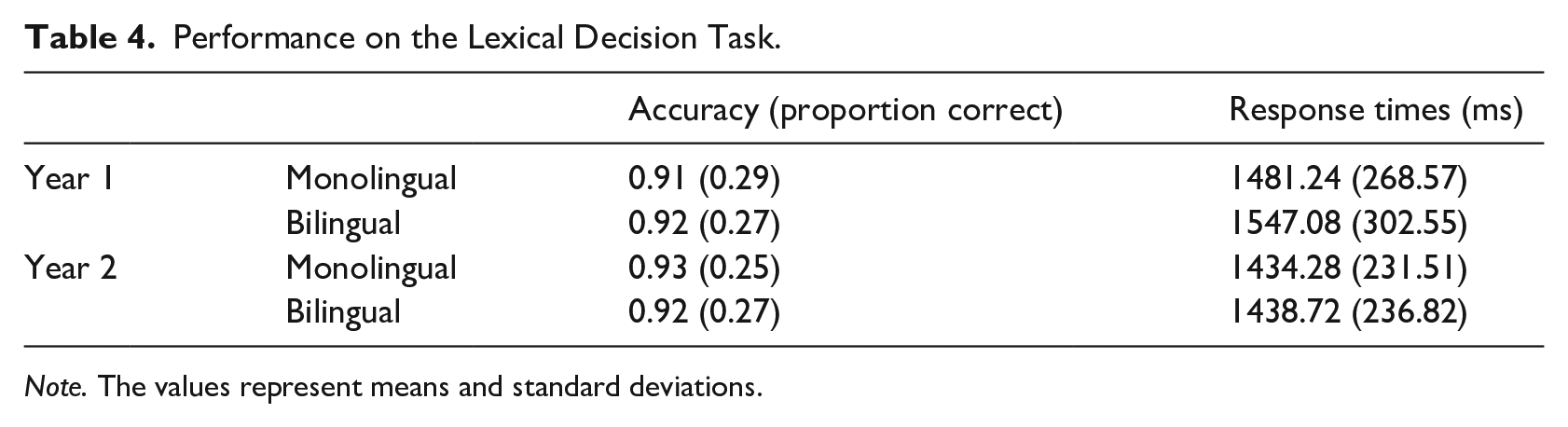
Note. The values represent means and standard deviations.
Morphosyntactic processing
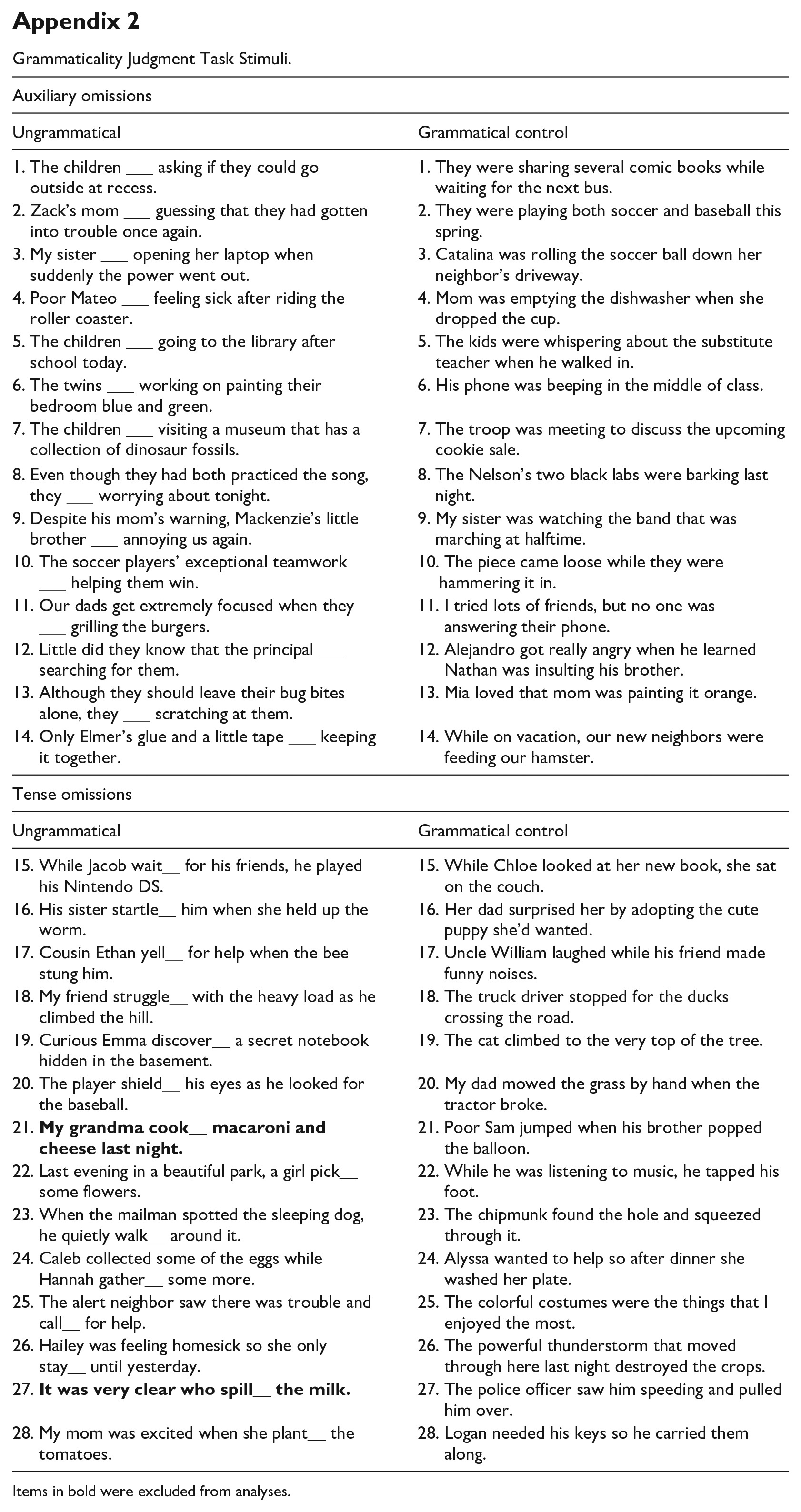
To assess morphosyntactic processing, a computerized, auditory GJ task was administered in both years. Children were asked to listen to sentences and judge whether they were grammatically correct or incorrect. The task was adapted from Wulfeck et al. (2004). The stimuli consisted of 28 grammatical sentences (e.g., “They were sharing several comic books while waiting for the next bus.”) and 28 ungrammatical sentences, for a total of 56 sentences. Ungrammatical sentences involved omissions of auxiliary verbs and tense marker—ed (e.g., “*The children ___ asking if they could go outside at recess”; “*While Jacob wait__ for his friends, he played his Nintendo DS.”). These structures were of interest because bilingual children tend to acquire them a few years later (Paradis, 2005; Paradis & Crago, 2000) compared with monolingual children, and because bilingual children learning a second language tend to omit them (Paradis, 2005; Paradis et al., 2008). Sentences were standardized to have the same amplitude and a 3 second buffer was added at the beginning and end of each sentence. Before the experimental task began, children practiced the task on six sentences and received verbal feedback. A complete list of the stimuli is available in Appendix 2.
The experiment was designed in ePrime Studio 2.0. The stimuli played through computer speakers and responses were collected using a serial response box connected to the desktop computer. Children were instructed to press the “smiling face” button if a sentence “sounded good and like something a person would really say” or the “frowning face” button if a sentence “sounded bad and like something a person would not really say.” They were additionally instructed to press the button as soon as they had made a decision on whether the sentence was grammatically correct or incorrect. Stimuli were produced by a native Midwestern female speaker. Sentences played until completion, regardless of whether a button was pressed. A response had to be provided within 2000 ms after the sentence ended to be included in the analyses. There was a 750 ms inter-stimulus interval between each sentence. Sentences were pseudo-randomized so that the same ungrammatical manipulations never occurred one after the other, and no more than three grammatical or ungrammatical sentences occurred in a sequence. Up to three breaks were allowed during the task. Accuracy and RTs were collected for each trial.
For the GJ task, data were also cleaned at the trial level for Year 1 and Year 2 separately. Trials in which the child responded within the first 500 ms were excluded. Specific items with consistently poor performance (less than 0.50) were identified across both groups and years. As a consequence, two stimulus items were excluded for both years and the final analyses were conducted on 28 grammatical sentences and 26 ungrammatical sentences. For accuracy analyses, 9.37% trials in Year 1 (9.04% for monolinguals and 9.69% for bilinguals) and 7.06% trials in Year 2 (7.47% for monolinguals and 6.66% for bilinguals) were eliminated.
RT analyses were conducted for grammatical and ungrammatical sentences separately, and for correct responses only. This was done because for the ungrammatical sentences, RTs were calculated from the point at which the violation occurred in each sentence. The point of violation was defined as the offset of the word prior to the error (Wulfeck et al., 2004). These points were calculated for all ungrammatical sentences and subtracted from the child’s response time for each of those sentences, yielding true RTs. At the child level, trials were excluded for RTs that fell beyond 2.5 standard deviations of that child’s mean RT. Ungrammatical trials that had RTs of 0 ms or less were eliminated because these RTs indicated responses that occurred prior to the occurrence of the error in the sentence. In total, 2.29% trials in Year 1 (2.03% for monolinguals and 2.55% for bilinguals) and 1.57% trials in Year 2 (1.80% for monolinguals and 1.34% for bilinguals) were eliminated. Performance on the GJ task is indexed in Table 5.
Performance on the Grammaticality Judgment Task.
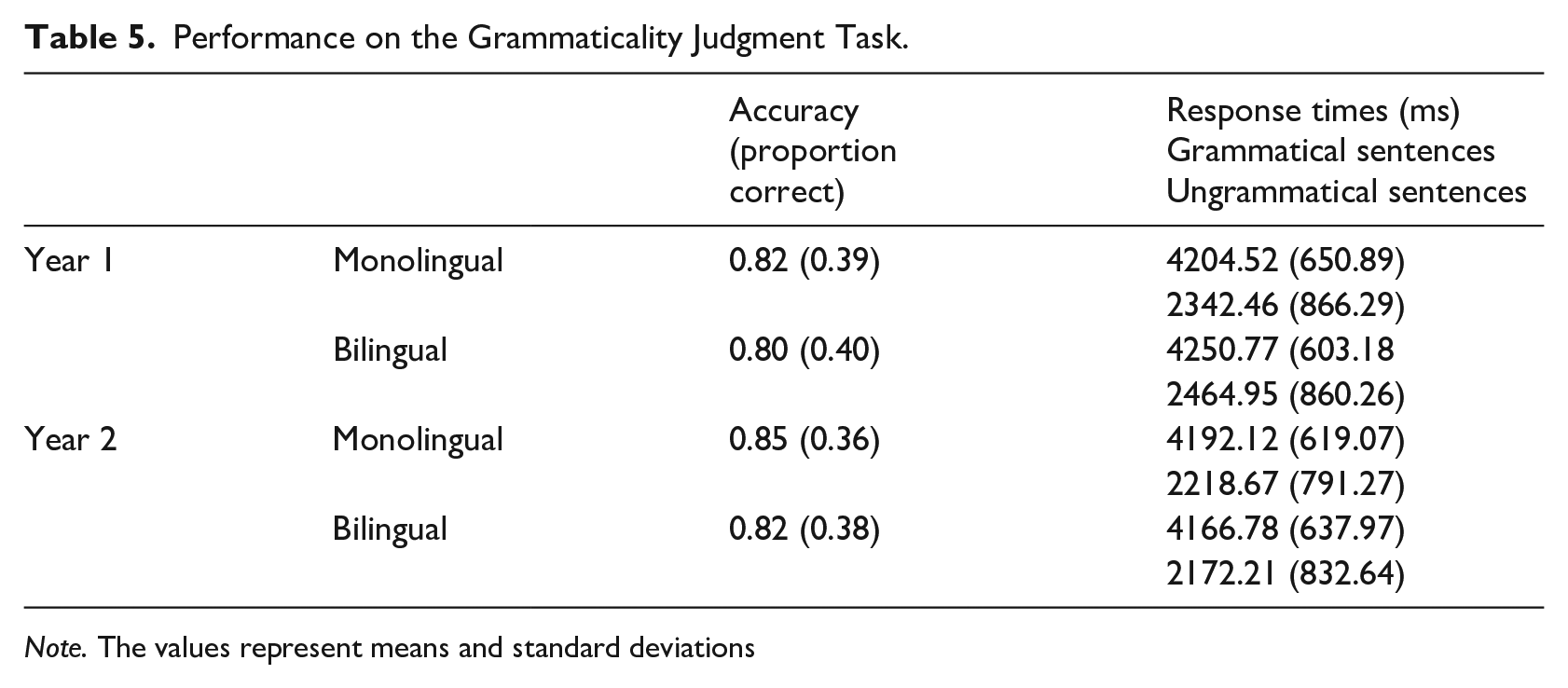
Note. The values represent means and standard deviations
Analyses
A power analysis for each experimental task was conducted using an open-source software (PANGEA, Power Analysis for General Anova Designs, version 0.2; Westfall, 2016). With three predictors (Group, Time, Word, or Sentence Type), the current sample-sizes (33 participants in each language group) and item-level data for each task (LD = 79 items and GJ task = 54 items), using an effect size of 0.45, the power analyses yielded a power of 0.98 for the LD task and 0.97 for the GJ task. Because the analyses utilized item-level data (rather than subject-level data), the models were well powered.
Mixed-effects models were constructed for each of the processing-based measures (LD and GJ tasks) using item-level accuracy and RT data. Models were created in R, version 3.2.2 (R Core Team, 2015) using the lme4 package (Bates et al., 2015). Logistic mixed-effects models were constructed to analyze dichotomous accuracy data to evaluate the extent to which predictors increased or decreased the likelihood (log-odds) of making an accurate response. RTs were log-transformed and linear mixed-effects models were constructed to analyze continuous RT data. Per Barr et al. (2013), all models included random intercepts for both participants and items, random by-participant slopes for within-participant variables, and random by-item slopes for within-item variables. For all analyses, effects with a t-value or z-value greater than 1.96 were considered significant (p < .05).
The effects of Group (monolingual, bilingual), Time (Year 1, Year 2), and Word Type (words, nonwords) were considered for the accuracy and RT analyses of the LD task. Similarly, for the GJ task, the effects of Group, Time and Sentence Type (grammatical, ungrammatical) were considered for accuracy analyses, while only Group and Time were included in the RT analyses. Contrast coding was used for dichotomous predictor variables which resulted in monolinguals, Year 1, words and grammatical sentences being coded as −0.5, and bilinguals, Year 2, nonwords and ungrammatical sentences being coded as 0.5. This type of coding represents main effects of the predictor variables.
Results
Lexical skills
See Table 4 for the raw accuracy and RTs on the LD Task. Logistic mixed-effects models on accuracy data included 10261 observations across 79 stimuli and 66 participants. The model revealed a main effect of Year (b = 0.21, SE = 0.08, z = 2.47, p = .01), where the probability of a correct answer increased for all children from Year 1 to Year 2, and a main effect of Word Type (b = −0.61, SE = 0.22, z = −2.73, p = .006), where the probability of a correct response for words was higher than for nonwords. There was no main effect of Group (b = −0.02, SE = 0.19, z = −0.13, p = .89), with monolinguals and bilinguals demonstrating similar accuracy across both years.
The model revealed an interaction between Group and Time (b = −0.37, SE = 0.17, z = −2.23, p = .03). To investigate this interaction, Group and Time were re-coded (0,1). Within-group analyses revealed that monolinguals were significantly more accurate on the LD task from Year 1 to Year 2 (b = 0.39, SE = 0.12, z = 3.29, p = .001), while bilinguals (b = 0.02, SE = 0.16, z = 0.18, p = .86) performed similarly across both years. Between-group analyses revealed that monolinguals and bilinguals had similar accuracies in Year 1 (b = 0.16, SE = 0.21, z = 0.75, p = .45) and in Year 2 (b = −0.21, SE = 0.22, z = −0.97, p = .33). Therefore, the interaction between Group and Time was a result of monolingual children’s improved performance on the LD task over time (see Figure 1). This finding suggests that while monolingual children’s lexical skills improved, bilingual children’s lexical processing was stable within this time frame. Notably, the absence of group differences at both time points indicates that these differences within groups over time were subtle, and did not result in advantages in lexical processing in one group versus the other. Analyses did not reveal other significant interactions.
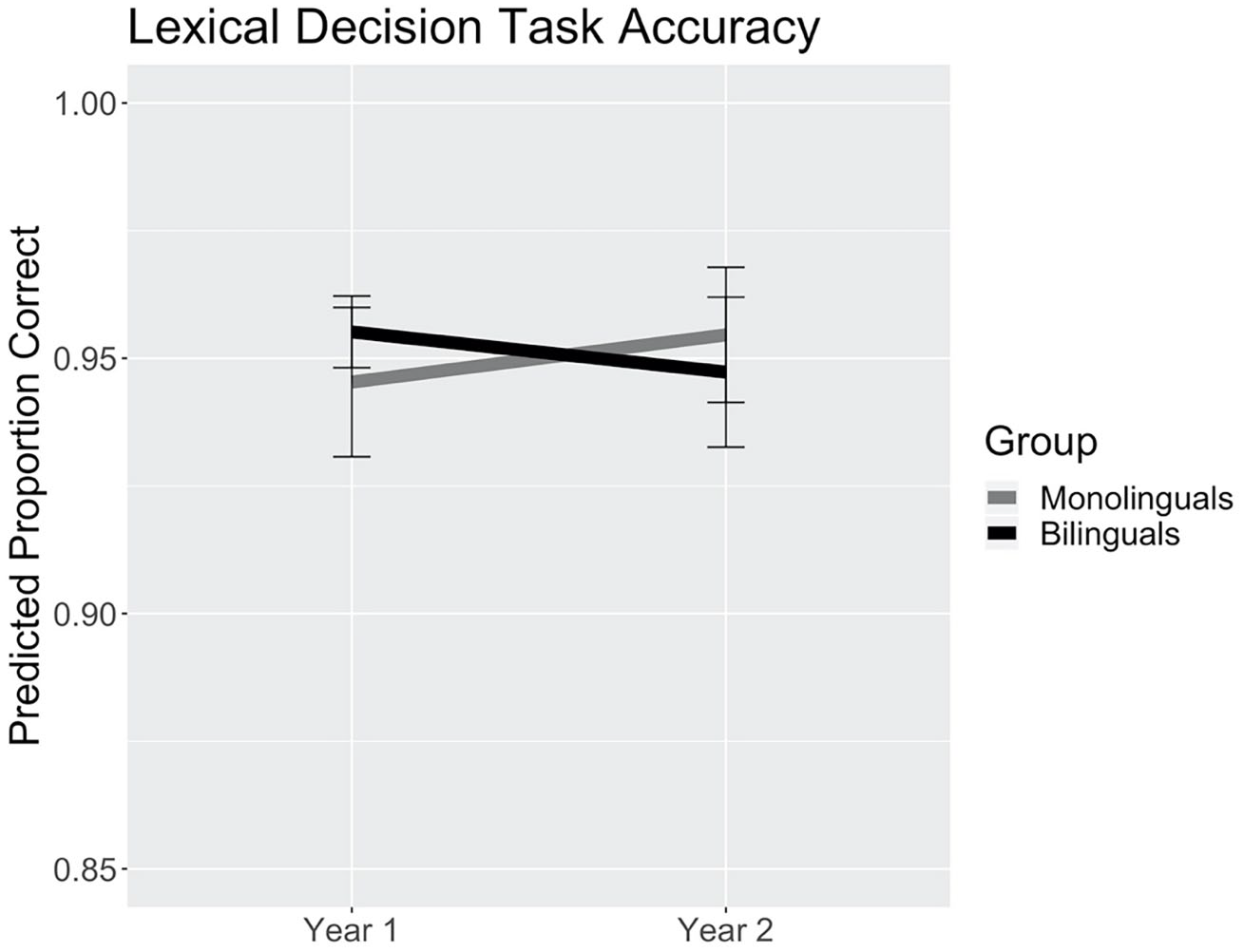
Lexical Decision Task accuracy for each group. The Y axis represents the predicted values of performance (logistic regression) and the error bars represent standard errors.
Linear mixed-effects models on RT data included 9210 observations. The model revealed a main effect of Year (b = −80.04, SE = 4.67, t = −17.14, p < .001), where children were significantly faster at responding in Year 2 than in Year 1, and a main effect of Word Type (b = 92.14, SE = 18.59, t = 4.96, p < .001), where children were significantly faster at responding to words than nonwords across both years. There was no main effect of Group (b = 35.18, SE = 26.82, t = 1.31, p = .19).
The model revealed significant interactions between Group and Time (b = −56.93, SE = 9.34, t = −6.09, p < .001) and between Time and Word Type (b = −41.94, SE = 9.30, t = −4.51, p < .001). Follow-up analyses revealed that in Year 1, monolingual children were significantly faster on the LD task than bilingual children (b = 63.64, SE = 27.23, t = 2.34, p = .02). However, in Year 2, monolingual and bilingual children showed similar RTs (b = 6.71, SE = 27.21, t = 0.25, p = .81). Both monolingual (b = −51.58, SE = 6.56, t = −7.87, p < .001) and bilingual (b = −108.51, SE = 6.65, t = −16.32, p < .001) children were significantly faster at completing the task from Year 1 to Year 2 (see Figure 2). Thus, compared with monolingual children, bilingual children showed an initial lag in speed of processing in Year 1, but were able to catch up to their monolingual peers by Year 2. This suggests that while all children became more efficient at the LD task over time, bilingual children showed a larger growth in lexical processing time than monolingual children. Finally, children demonstrated faster response times for words than nonwords in Year 1 (b = 113.11, SE = 19.18, t = 5.90, p < .001) and in Year 2 (b = 71.17, SE = 19.15, t = 3.72, p < .001). Moreover, from Year 1 to Year 2, children showed faster response times for words (b = −59.07, SE = 6.51, t = −9.07, p < .001) as well as for nonwords (b = −101.01, SE = 18.59, t = −4.96, p < .001). The interaction was driven by a smaller gap in RTs between words and nonwords in Year 2 than in Year 1, suggesting greater improvements in processing of nonwords than words over time. No other interactions were significant in the RT analysis. See Table 6 for the full regression model.

Lexical Decision Task reaction times for each group. The error bars represent standard errors.
Full mixed-effects models for Lexical Decision Task.
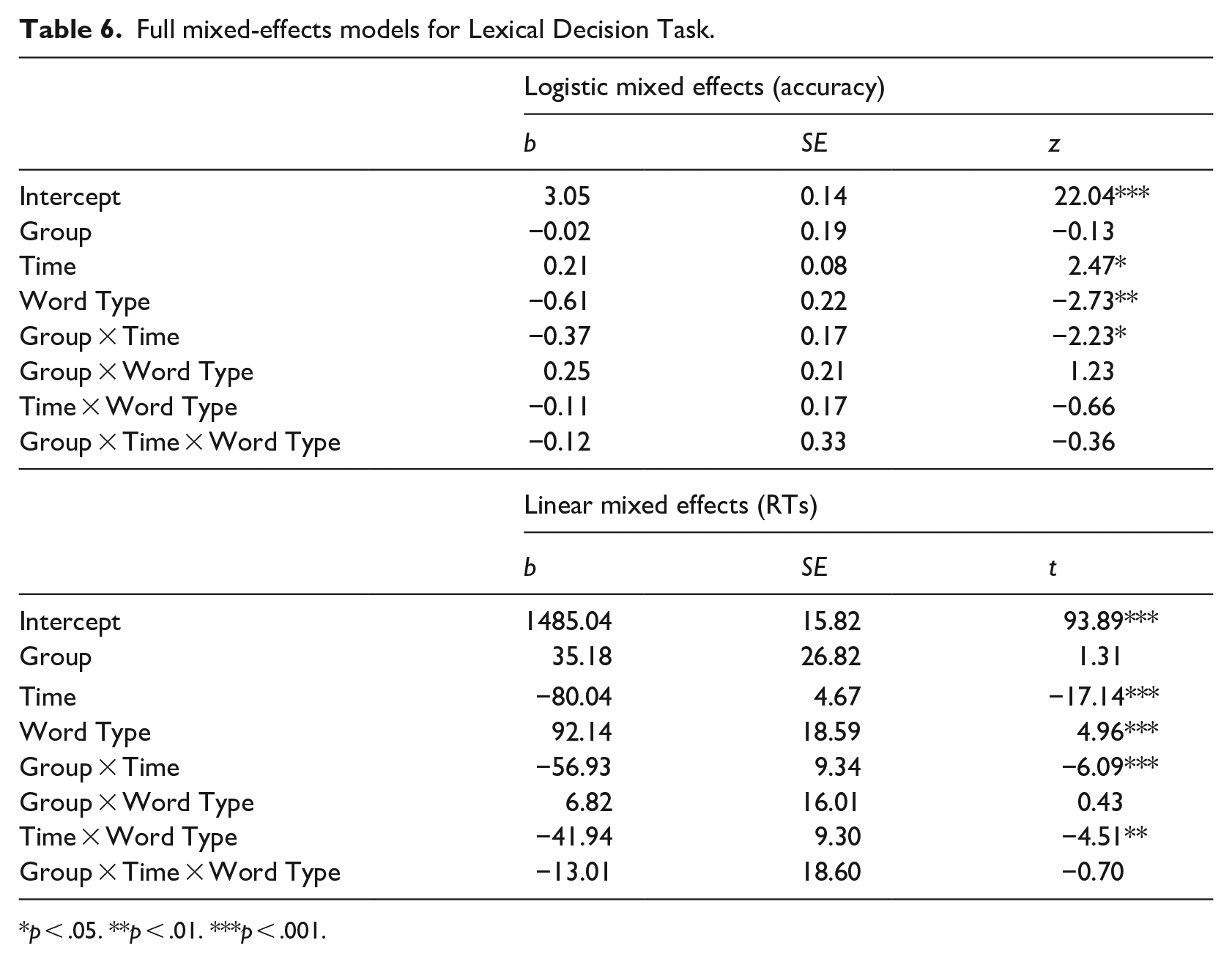
p < .05. **p < .01. ***p < .001.
Morphosyntactic skills
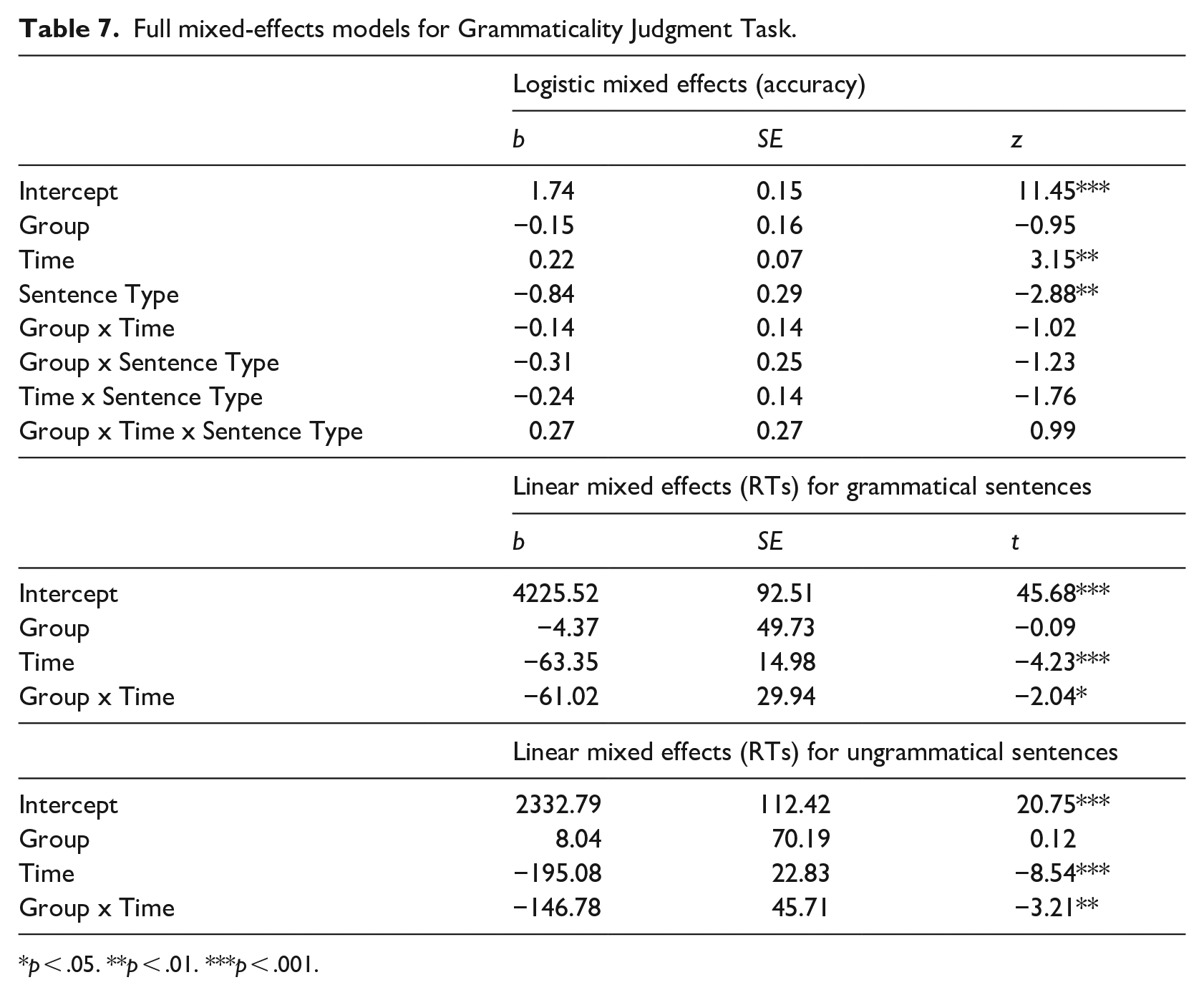
See Table 6 for the raw accuracy and RTs on the GJ task. Logistic mixed-effects models on accuracy data included 6734 observations across 54 stimuli and 66 participants. The model revealed a main effect of Year (b = 0.22, SE = 0.07, z = 3.15, p = .002), where the probability of a correct answer increased for all children from Year 1 to Year 2, and a main effect of Sentence Type (b = −0.84, SE = 0.29, z = −2.88, p = .004), where the probability of a correct answer for grammatical sentences was higher than for ungrammatical sentences. There was no main effect of Group (b = −0.15, SE = 0.16, z = −0.95, p = .34), and monolinguals and bilinguals demonstrated similar accuracy across both years (see Figure 3). Analyses did not reveal other main effects or significant interactions.
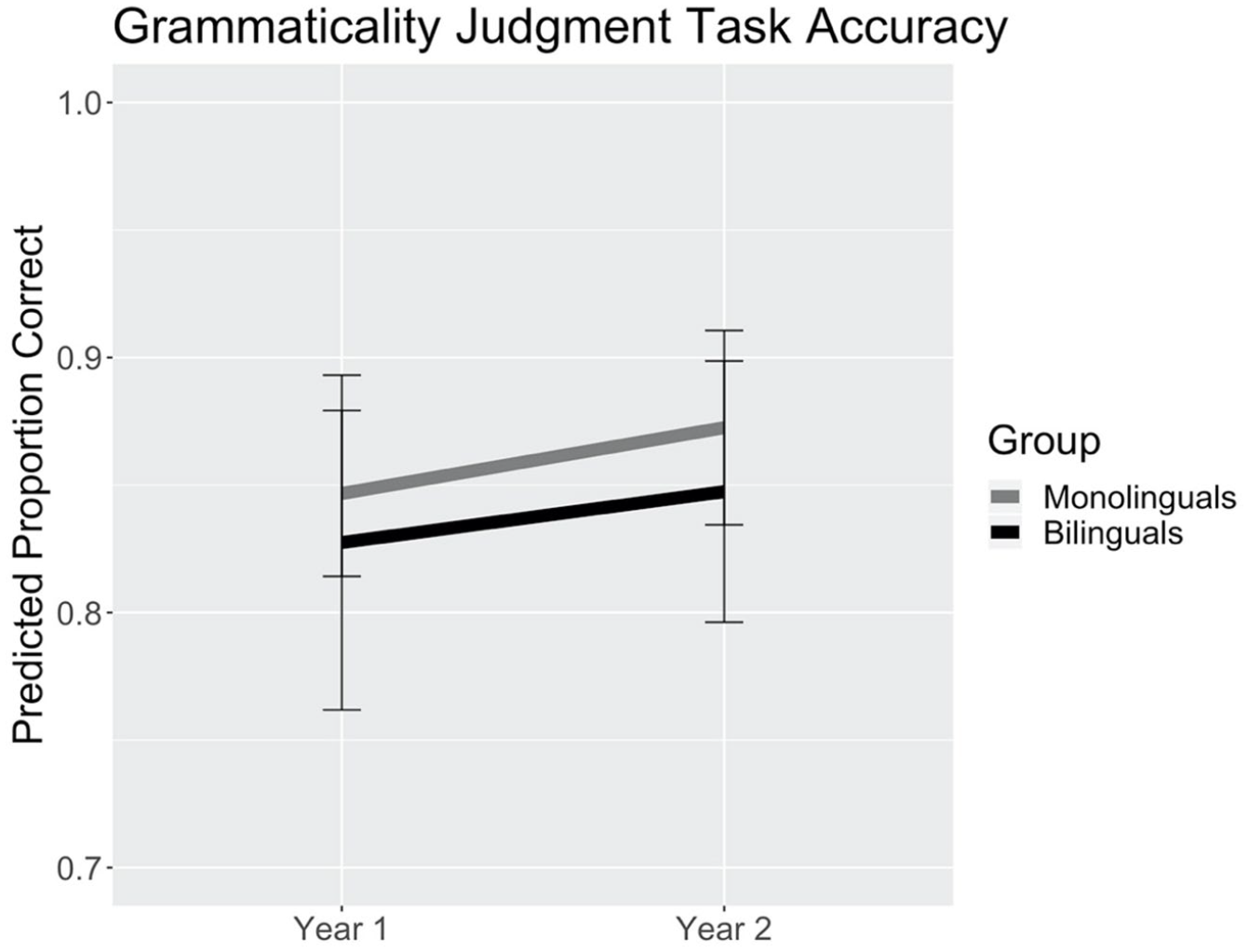
Grammaticality Judgment task accuracy for each group. The Y axis represents the predicted values of performance (logistic regression) and the error bars represent standard errors.
Linear mixed-effects models on RT data for grammatical sentences included 2975 observations. The model revealed a main effect of Year (b = −63.35, SE = 14.98, t = −4.23, p < .001), where children were significantly faster at identifying grammatical sentences as being correct in Year 2 than in Year 1. There was no main effect of Group (b = −4.37, SE = 49.73, t = −0.09, p = .93). The model revealed an interaction between Group and Time (b = −61.02, SE = 29.94, t = −2.04, p = .04). While monolingual children showed similar response times for identifying grammatical sentences from Year 1 to Year 2 (b = −32.85, SE = 21.35, t = −1.54, p = .12), bilingual children showed significantly faster RTs for grammatical sentences over time (b = −93.86, SE = 21.00, t = −4.47, p < .001). Furthermore, the monolingual and bilingual children performed similarly in Year 1 (b = 26.13, SE = 52.18, t = 0.50, p = .62) and in Year 2 (b = −34.88, SE = 51.69, t = −0.68, p = .51).
For ungrammatical sentences, analyses on 2445 observations revealed a main effect of Year (b = −195.08, SE = 22.83, t = −8.54, p < .001) where children were significantly faster at identifying ungrammatical sentences as incorrect in Year 2 than in Year 1. There was no main effect of Group (b = 8.04, SE = 70.19, t = 0.12, p = .91). A significant interaction between Group and Time was observed (b = −146.78, SE = 45.71, t = −3.21, p = .001). Follow-up analyses revealed that monolingual children (b = −121.69, SE = 31.83, t = −3.82, p < .001) as well as bilingual children (b = −268.47, SE = 32.77, t = −8.19, p < .001) had faster RTs for ungrammatical sentences from Year 1 to Year 2. Moreover, monolingual and bilingual children performed similarly in Year 1 (b = 81.43, SE = 74.08, t = 1.10, p = .28) and in Year 2 (b = −65.35, SE = 73.55, t = −0.89, p = .38). The interaction was driven by effect-size differences between groups, with bilingual children showing a larger improvement in RTs in Year 2 than monolingual children (see Figure 4). This yielded a reversal in the direction of differences between groups, with monolinguals showing faster RTs than bilinguals in Year 1, but slower RTs in Year 2. To reiterate, these differences between groups were not significant at either of the time points. See Table 7 for the full regression model.
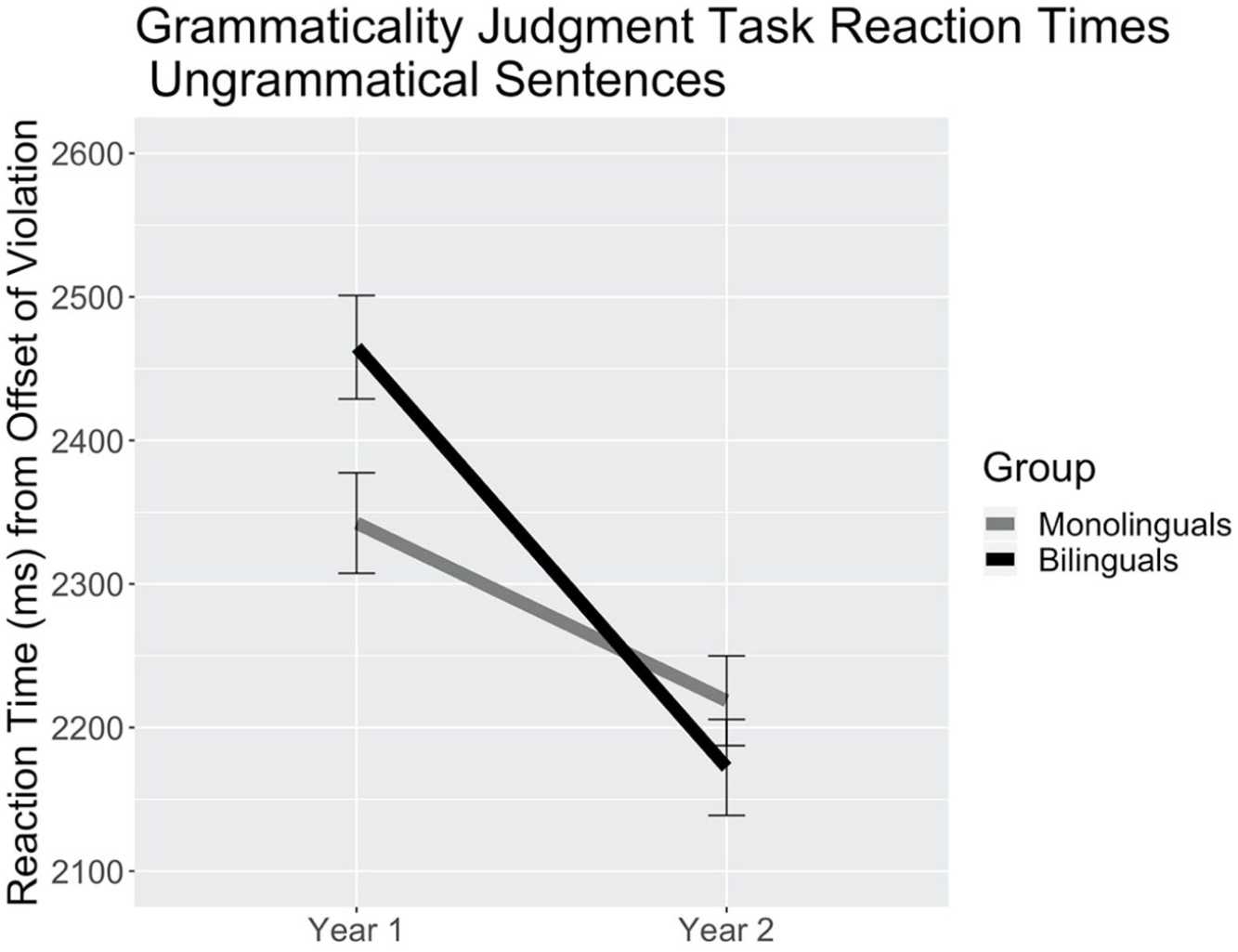
Grammaticality Judgment reaction times for ungrammatical sentences for each group. The error bars represent standard errors.
Full mixed-effects models for Grammaticality Judgment Task.
p < .05. **p < .01. ***p < .001.
Discussion
The goal of the present study was to assess the development and maintenance of native-language lexical and morphosyntactic skills in DLI bilingual and monolingual children over the span of 1 year. We aimed to evaluate whether exposure to L2 Spanish in the DLI classroom setting would affect processing of L1 English over time. We considered two possible reasons behind the effects of L2 exposure on L1 processing: diminished exposure to L1 English and cross-linguistic interference from the L2. Both of these would be associated with reduced efficiency of L1 processing as the result of L2 exposure. We found that all children performed better on both the lexical and the morphosyntactic measures in Year 2. However, we observed only subtle and transient effects of DLI exposure on children’s native-language processing skills. Specifically, we found that bilinguals tended to be slower than monolinguals on both the lexical and the morphosyntactic processing task in Year 1 but were equally efficient in Year 2. That is, bilinguals tended to show steeper improvement in processing skills over time, driven by their lower starting point. It is possible that this improvement was a factor of the 50:50 exposure ratio between English and Spanish in the DLI classroom that maintained from Year 1 to Year 2. This balanced exposure could have triggered stabilization and rapid improvements in the efficiency of both lexical and morphosyntactic processing that enabled the children to catch up to their monolingual peers.
Regarding lexical development, we found that in within-group comparisons, monolingual children significantly improved their accuracy performance on the LD task over time while bilingual’s performance remained the same. This suggests that while monolingual children’s lexical skills might still be maturing, bilingual children’s lexical development may have already stabilized by this time frame. Alternatively, this pattern could be interpreted as suggesting slower growth of the L1 in DLI bilingual children compared with monolingual children (see also Genesee, 2014). Whatever the interpretation, it is crucial to reiterate that groups did not differ from each other at either of the two time points, indicating that these differences in slopes of growth in the accuracies on the LD Tasks did not lead to improved performance in one group versus the other.
The absence of between-group differences between monolinguals and bilinguals on the LD accuracy measure at both time points is partly consistent with Gangopadhyay et al. (2019), who found that at 9 years old, monolinguals outperformed simultaneous bilinguals (who acquired both languages before or at age 3) on an LD task, but groups did not significantly differ when tested again 1 year later. Our result might be explained by children’s age as well as the amount of time they had spent in the DLI programs at the beginning of the study. Bilingual children had been immersed for 4 years (on average) in DLI at the first testing session, and 5 years by the second testing session. It is possible that by the first testing session, any differences in lexical skills as indexed by the accuracy scores have subsided (Genesee, 2004). The RT patterns offer a more nuanced insight into the effects of DLI exposure on L1 lexical skills.
Monolingual children were faster to recognize English words than bilingual children in Year 1 but not in Year 2. This pattern suggests an initial lag in speed of processing in Year 1 in DLI bilinguals. However, they caught up to their monolingual peers by Year 2. That is, while bilingual children’s accuracy on the LD Task remained stable from Year 1 to Year 2, their RTs became more efficient. In fact, while both groups became faster on the LD task over time, bilingual children showed a larger growth in lexical processing time than monolingual children. This effect was not moderated by whether the stimuli were words or nonwords, although the gap in RT to identify words versus nonwords became smaller in Year 2. That is, while nonword processing benefited from a faster growth over time for all children than real-word processing, this improvement in nonwords processing was comparable for bilinguals and monolinguals.
Regarding morphosyntactic development, both groups performed better in Year 2 than in Year 1 on GJ accuracy, but no group differences were found. For RTs, we found that while monolingual children remained stable in their response times when identifying grammatical sentences over time, bilingual children showed significantly faster RTs in Year 2 than in Year 1. Both monolingual and bilingual children became faster at identifying ungrammatical sentences over time, but bilingual children showed a much larger improvement in Year 2 than monolingual children. These results parallel those on the lexical processing measure, indicating a lag in native-language processing for bilinguals that resolves within a single year. Notably, while for lexical processing there were significant differences between bilinguals’ and monolinguals’ performance in Year 1 of testing, for morphosyntactic processing, these group differences never reached significance.
Together, our results suggest a similar pattern in development of lexical and morphosyntactic skills, contrary to findings in Kohnert et al. (1999) and Schwartz and Kroll (2006). In these studies, L1 lexical processing was more sensitive to the effects of L2 exposure than morphosyntactic processing. It is possible that the specifics of DLI exposure in our study had an effect on the pattern of L1 morphosyntactic development. The children in the present study started their exposure to the L2 with a 90:10 immersion structure, and at the time of testing, they were exposed to both languages equally. It is possible that such intensive L2 exposure yielded the initial slower uptake in morphosyntax, as also observed in Gathercole (2007). As exposure to the L2 diminished, bilinguals caught up with their monolingual peers, and DLI bilinguals bridged the gap with monolinguals in morphosyntactic processing. Overall, our findings of subtle and transient effects of DLI exposure on L1 acquisition in majority-language-speaking children are in line with previous studies that did not find consistent group differences between monolinguals and bilinguals in immersion education—including DLI—on native language development (Cummins, 2009; K. Lindholm-Leary & Genesee, 2014).
How does this finding of minimal effects of L2 exposure on L1 align with the Inhibitory Control model (Green, 1998)? It is possible that by the time we tested our DLI bilinguals, their L1/L2 dynamics have stabilized, and, therefore, the suppression of the L1 was no longer necessary, contrary to the students tested in Linck et al.(2009). One crucial difference between our study and the Linck et al. (2009) study concerns language exposure. In their study, students experienced extensive L2 immersion both at home and in the community, while the children in the present study experienced L2 immersion in the classroom setting only. Another notable difference between the Linck et al. study and ours that might explain the discrepant results is that Linck et al. (2009) used a measure of language production to test L1 processing, while we used receptive L1 measures. Typically, language production tasks are more challenging than language comprehension tasks, even more so for bilinguals who experience more tip-of-the-tongue states compared with monolinguals (Gollan & Silverberg, 2001), are slower and less accurate when naming pictures in their most proficient language (Gollan et al., 2005; Ivanova & Costa, 2008), and have lower verbal fluency than monolinguals (Gollan et al., 2002). It is therefore possible that we would have observed more significant effects of the DLI exposure on L1 production tasks in our study. Future work could incorporate both production and comprehension processing-based measures in its assessment of DLI effects upon L1 processing. Crucially, although our measures tested receptive L1 skills, they incorporated highly sensitive RT measures, and still yielded minor and highly transient effects of the DLI exposure.
It must be noted that both the LD and the GJ tasks tap not only into language processing skills but also into metalinguistic awareness. The need to make explicit judgments regarding a word’s lexical status or a sentence’s grammaticality requires children to access their metalinguistic knowledge (Ben-Zeev, 1977; Bialystok et al., 2014; Cummins, 1978). It is possible that our findings regarding the general absence of group differences on the two tasks may reflect bilingual children’s higher levels of metalinguistic awareness. Bialystok et al. (2014), for instance, tested the hypothesis that enhanced metalinguistic skills of bilingual children would enable them to perform especially well on a GJ task that involved ignoring the sentence’s anomalous semantic content. Indeed, they found that bilingual children in DLI outperformed monolingual children on this version of the task, and interpreted that as suggesting that bilingual experience enhances children’s metalinguistic awareness skills. In general, the development of morphosyntactic skills in particular in bilingual children might be affected by heightened metalinguistic awareness (Abu Rabia, 2019; Adesope et al., 2010; Ben-Zeev, 1977; Bialystok, 1987; Cenoz, 2003). It is possible that enhanced metalinguistic awareness, in turn, may support bilingual children’s linguistic performance, perhaps compensating for their language-specific processing lags. Our version of the GJ task did not require children to ignore anomalous semantic context, and, therefore, likely had fairly minimal metalinguistic awareness demands. Nevertheless, future studies incorporating tasks that index metalinguistic processes to various degrees would be helpful in distinguishing the effects of DLI exposure on language processing versus metalinguistic processing.
Conclusion
Both monolingual children in mainstream classrooms and bilingual children in the DLI classrooms demonstrated growth in their native-language lexical and morphosyntactic skills over time. Only subtle differences in L1 growth over time were observed between the two groups. Specifically, monolingual but not DLI bilingual children showed improvements in accuracy on the LD Task from Year 1 to Year 2, which may suggest an earlier plateau in lexical development in DLI bilinguals. Furthermore, DLI bilinguals started with slower RTs on the LD and the GJ tasks in Year 1. This might suggest a brief lag in L1 lexical and morphosyntactic processing resulting from DLI. However, DLI bilinguals also showed a steeper improvement in RTs for both the LD and the GJ tasks from Year 1 to Year 2, and as a result, caught up on their monolingual peers by Year 2.
The present findings suggest that DLI programs may only have a transient effect on the development of native-language lexical and morphosyntactic processing skills in school-aged children. The contribution of the longitudinal design is crucial to the study of how DLI exposure might influence the development of language skills in children because it obviates the stability of the findings. However, the longitudinal design in combination with how DLI was implemented in the school district from which we recruited also adds to the uncertainty as to the roots of differences over time. This is because the ratio of Spanish/English exposure changed over time for the bilingual DLI participants, such that there was a reduction in Spanish exposure over the time period we targeted. Thus, the pattern of initial lag in the LD and GJ tasks RTs for the DLI bilinguals in Year 1 and the quick recovery in Year 2 may have been due to a reduction in the exposure to Spanish in the DLI classrooms. It is also possible that the different trajectories of L1 development over time in the two groups may have been due to general maturation processes, so that the bilingual cognitive/linguistic system and its ability to accommodate dual-language input in the classroom setting stabilized. Future studies would need to examine both earlier and later time points to better understand the reasons behind the different trajectories of L1 processing skills in the DLI bilinguals versus monolinguals.
Future studies of DLI effects should also incorporate larger and more diverse samples of children. While the two groups of children did not differ on SES, it must be noted that both monolingual and bilingual groups in this study came from relatively high SES, and children’s scores on standardized tasks which were almost 1 standard deviation above average. It will be important to recruit children from lower SES and who represent the lower ranges of the language-ability continuum, to examine whether L2 immersion might affect L1 processing differently in children with differing levels of language skill and with different degrees of privilege. Finally, the quasi-experimental design of the present study leaves open a possibility that the lack of differences we have observed in the children’s native language performance is obscured by unaccounted educational and demographic variables that differentiated the two groups. It will also be important for future studies to seriously consider the social, cultural, and educational context within which comparisons between children attending DLI and mainstream classrooms are undertaken, since some contexts may be more likely than others to draw children into the two types of classrooms from demographically similar versus distinct populations.
As they stand, the findings strongly indicate that at the near endpoint of DLI, the bilingual children in the present study were indistinguishable from their monolingual peers in L1 processing. This suggests that DLI exposure, as implemented here, carries no ultimate cost to L1 development, even when indexed via measures emphasizing efficiency of processing.
Footnotes
Appendix
Grammaticality Judgment Task Stimuli.
| Auxiliary omissions | |
|---|---|
| Ungrammatical | Grammatical control |
| 1. The children ___ asking if they could go outside at recess. | 1. They were sharing several comic books while waiting for the next bus. |
| 2. Zack’s mom ___ guessing that they had gotten into trouble once again. | 2. They were playing both soccer and baseball this spring. |
| 3. My sister ___ opening her laptop when suddenly the power went out. | 3. Catalina was rolling the soccer ball down her neighbor’s driveway. |
| 4. Poor Mateo ___ feeling sick after riding the roller coaster. | 4. Mom was emptying the dishwasher when she dropped the cup. |
| 5. The children ___ going to the library after school today. | 5. The kids were whispering about the substitute teacher when he walked in. |
| 6. The twins ___ working on painting their bedroom blue and green. | 6. His phone was beeping in the middle of class. |
| 7. The children ___ visiting a museum that has a collection of dinosaur fossils. | 7. The troop was meeting to discuss the upcoming cookie sale. |
| 8. Even though they had both practiced the song, they ___ worrying about tonight. | 8. The Nelson’s two black labs were barking last night. |
| 9. Despite his mom’s warning, Mackenzie’s little brother ___ annoying us again. | 9. My sister was watching the band that was marching at halftime. |
| 10. The soccer players’ exceptional teamwork ___ helping them win. | 10. The piece came loose while they were hammering it in. |
| 11. Our dads get extremely focused when they ___ grilling the burgers. | 11. I tried lots of friends, but no one was answering their phone. |
| 12. Little did they know that the principal ___ searching for them. | 12. Alejandro got really angry when he learned Nathan was insulting his brother. |
| 13. Although they should leave their bug bites alone, they ___ scratching at them. | 13. Mia loved that mom was painting it orange. |
| 14. Only Elmer’s glue and a little tape ___ keeping it together. | 14. While on vacation, our new neighbors were feeding our hamster. |
| Tense omissions | |
| Ungrammatical | Grammatical control |
| 15. While Jacob wait__ for his friends, he played his Nintendo DS. | 15. While Chloe looked at her new book, she sat on the couch. |
| 16. His sister startle__ him when she held up the worm. | 16. Her dad surprised her by adopting the cute puppy she’d wanted. |
| 17. Cousin Ethan yell__ for help when the bee stung him. | 17. Uncle William laughed while his friend made funny noises. |
| 18. My friend struggle__ with the heavy load as he climbed the hill. | 18. The truck driver stopped for the ducks crossing the road. |
| 19. Curious Emma discover__ a secret notebook hidden in the basement. | 19. The cat climbed to the very top of the tree. |
| 20. The player shield__ his eyes as he looked for the baseball. | 20. My dad mowed the grass by hand when the tractor broke. |
| 21. |
21. Poor Sam jumped when his brother popped the balloon. |
| 22. Last evening in a beautiful park, a girl pick__ some flowers. | 22. While he was listening to music, he tapped his foot. |
| 23. When the mailman spotted the sleeping dog, he quietly walk__ around it. | 23. The chipmunk found the hole and squeezed through it. |
| 24. Caleb collected some of the eggs while Hannah gather__ some more. | 24. Alyssa wanted to help so after dinner she washed her plate. |
| 25. The alert neighbor saw there was trouble and call__ for help. | 25. The colorful costumes were the things that I enjoyed the most. |
| 26. Hailey was feeling homesick so she only stay__ until yesterday. | 26. The powerful thunderstorm that moved through here last night destroyed the crops. |
| 27. |
27. The police officer saw him speeding and pulled him over. |
| 28. My mom was excited when she plant__ the tomatoes. | 28. Logan needed his keys so he carried them along. |
Items in bold were excluded from analyses.
Acknowledgements
The authors would like to thank the families who participated in this study. Particular thanks goes to the Language Acquisition and Bilingualism Lab and the Language Processes Lab members for their assistance with participant recruitment, data collection, data coding, and valuable comments on this paper.
Declaration of conflicting interests
The author(s) declared no potential conflicts of interest with respect to the research, authorship, and/or publication of this article.
Funding
The author(s) disclosed receipt of the following financial support for the research, authorship, and/or publication of this article: This research was supported by NIH grants R01 DC011750, R01 DC016015, and U54 HD090256.
