




Abstract
Aims and Objectives:
Spanish subject pronoun expression (SPE) among Bube speakers in Equatorial Guinea has hardly been examined. Thus, the paper aims to (a) examine the SPE rate (b) and the linguistic and social predictors of SPE in this variety.
Methodology:
The data for the present study were collected using sociolinguistic interviews. These interviews lasted between 45 minutes and an hour.
Data and analysis:
The audio recordings of 18 bilinguals of Bube and Spanish in Equatorial Guinea were transcribed and analyzed using the Rbrul mixed-effects statistical software.
Findings:
The overt SPE rate of these bilingual speakers is 17.9%. This pronoun rate is one of the lowest ever found among bilinguals. The significant factors are grammatical person and number, ambiguity, the lexical content, and gender. The insignificant predictors were reference, reflexivity, and education.
Originality:
This is the first variationist study on Spanish SPE among Bube speakers in Equatorial Guinea. In this study, switch reference, a usually robust predictor, is insignificant among bilingual speakers.
Significance:
This study expands on the scarce research conducted on Equatoguinean Spanish and opens new avenues for exploration.
Introduction
In Spanish, a subject pronoun can be overt or null without changing the basic meaning of the utterance. The following examples are presented by way of illustration.
1. Yo quiero trabajar en el campo. (Speaker 1) I want to work in the farm I want to work in the farm. 2. I need to care for my family I need to take care of my family.
In Example (1), the speaker expresses the overt subject pronoun yo. However, in Example (2), we find the null subject necesito. The ability to vary between null and overt subjects has presented researchers with various possibilities for investigation.
A consistent pattern found in previous subject pronoun expression (SPE) studies is that Caribbean varieties have higher SPE rates than other Spanish varieties (Carvalho et al., 2015). Specifically, the Puerto Rican variety of Spanish has the highest SPE rate (42% found in Cameron’s 1992 study), while Huancayo Spanish in Peru has the lowest rate (16.2% found in Cerrón-Palomino’s 2019, study). Concerning predictors, previous studies have found that linguistic predictors, specifically grammatical person and number, switch reference, ambiguous verb forms, and reflexivity, consistently condition SPE, unlike social factors (e.g., age, sex, education).
The present study thus contributes to this line of investigation by conducting the first SPE study among bilingual speakers of Bube (a language indigenous to the island of Bioko) and Spanish (a colonial language) in Equatorial Guinea (hereafter EG). The research questions that guide the present study are: (a) How are null and overt subject pronouns distributed among bilingual speakers of Bube and Spanish? How does this compare with other bilingual varieties? (b) What linguistic and social factors affect SPE among these speakers?
The linguistic situation in EG
EG is made up of three geographical entities: the mainland which contains Rio Muni, the island of Bioko (which contains the capital Malabo), and the island of Annobon. Each location has a dominant ethnic group and various local languages (Ethnologue, 2022). In Rio Muni, the dominant local language is Fang. The Fang are also the largest ethnic group in EG.
Compared to Rio Muni, the island of Bioko is linguistically more complex. The main ethnic group on the island is the Bube, who speak Bube. However, some Bube speakers also speak Fang because of the forced learning of Fang (between 1968 and 1979) during the dictatorship of Francisco Macias Nguema (Lipski, 2004). In addition to Bube, Pichi, an English-based creole, is also spoken in Bioko. Pichi is the lingua franca on the island (Lipski, 2004). However, because of its low sociolinguistic prestige, it is not used in education or for official purposes. Instead, Pichi is relegated to informal, familiar, and in-group domains (Yakpo, 2013).
On the island of Annobon, the main language spoken is Fá d’Ambô, a Portuguese lexifier creole that is believed to have developed from the Forro creole of São Tomé. Other minority languages spoken in EG are the west Bantu family languages (e.g., Kombe, Benga, Bujeba, among others) spoken on the coast of Rio Muni. Moreover, except for Pichi and Fang, many of the above-mentioned local languages are at risk of endangerment (Gomashie, 2019; Lipski, 2004).
Interestingly, there are three official languages recognized in EG. First, Spanish, the language of education, administration, and government. Second, French, which was added as an official language in 1998 to strengthen bilateral relations with Francophone countries. Third, Portuguese, which was added in 2010. However, unlike Spanish, neither French nor Portuguese are used in official functions nor play a significant role in EG (Yakpo, 2016).
Yakpo (2016) further argues that while European languages are given legal recognition as the languages of government (particularly Spanish), “there is no legally or politically defined role for the education in the African mother tongue of Equatoguinean children” (p. 216). Local languages are not formally recognized nor taught in schools, resulting in a gap in intergenerational transmission (Lipski, 2004). In effect, the linguistic situation of EG is “an overtly exoglossic language policy that uniquely privileges the colonial language Spanish” at the expense of the local languages (Yakpo, 2016, p. 216).
With respect to the linguistic characteristics of Spanish, several studies have focused on the peculiarities of the Equatoguinean variety (Granda Gutiérrez, 1984; Lipski, 2004; Quilis & Casado-Fresnillo, 1995; Steien & Yakpo, 2020). These studies focused on morphosyntax, phonology, and the lexicon of Equatoguinean Spanish. For instance, Steien and Yakpo (2020) examined Central African French and Equatoguinean Spanish and found that they were characterized by two-tone systems, fixed word-tone patterns, tone in function words, and tonal minimal pairs. The study also shows that Equatoguinean Spanish makes use of lexical tones, including for personal pronouns.
Lipski (2004) also pointed out that /l/ and /r/ sounds are routinely distinguished in Equatoguinean Spanish, although Bantu languages hardly distinguish these sounds. Other characteristics Lipski (2004) mentioned are the neutralization of rhotic sounds, the elision of /s/, and the variability of the seseo and ceceo sounds. Furthermore, he described the interchange of tú and usted, the combination of second-person verb conjugations with the usted form, and the fluctuations in subject-verb agreement as some characteristics of Equatoguinean Spanish.
SPE in Spanish in contact with Romance languages
Previous research has examined SPE in Spanish in contact with pro-drop languages such as Catalan (e.g., Prada Pérez, 2015), Italian (e.g., Flege et al., 2002), Greek (e.g., Argyri & Sorace, 2007), Portuguese (e.g., Carvalho & Bessett, 2015), as well as non-null subject languages such as English (Cerrón-Palomino, 2016; Otheguy & Zentella, 2012), and some creoles (De La Rosa Yacomelo, 2020; Rodríguez-Riccelli, 2021). These studies have investigated the linguistic and extra-linguistic factors and shed light on the effect of contact between Spanish and these languages. For instance, in Carvalho and Bessett’s (2015) study on Spanish in contact with Portuguese, the authors found similar constraint rankings for bilinguals and monolingual counterparts. Similarly, in Prada Pérez (2015), the results showed that overall SPE rates were similar for Spanish monolinguals and Spanish Catalan bilinguals (around 20%), and both groups had similar variable rankings. Nonetheless, although ambiguity was significant among Spanish monolinguals, it was not for bilinguals. Likewise, verb type was significant among the bilinguals but not monolinguals.
In the next section, we examine SPE in Bube and Pichi.
SPE in Bube and Pichi
Bube and Pichi are spoken on the island of Bioko. Bube is one of the oldest Bantu languages among the Niger-Congo languages (Bolekia Boleká, 1991). It is also the only language indigenous to the island. Bube distinguishes between tonic and atonic pronouns. Tonic pronouns are only used for emphasis, they do not function as subjects in a sentence. They are used to emphasize the personal pronouns when a verb is conjugated. There are several variants of tonic pronouns depending on the regional variety of Bube spoken. For instance, the tonic pronoun for emphasis in the first person could vary depending on the regional variant of Bube spoken (northern, central eastern, southern). Atonic pronouns, however, are used like subjects or personal pronouns that accompany the conjugated verb. The choice of personal pronoun depends on tense of the verb. They are always separated graphically from the lexical base when written to enable easy identification (Bolekia Boleká, 1991). Table 1 presents the different tonic and atonic pronouns and their variants.
Tonic and Atonic pronouns in Bube.

Comparing Bube and Spanish, we find that both languages have morphemes that designate the number and grammatical person of the verb. However, unlike Spanish, the Bube verb stem is not inflected. Table 2 is presented by way of illustration.
Past tense conjugation of “to eat.”

Source.Bolekia Boleká (1991, p. 127).
Furthermore, unlike Spanish, in which there are formal and informal singular pronouns for the second person (tú “you” and usted “you formal”), in Bube, the second-person pronoun does not distinguish between formal and informal pronouns (ö).
Pichi however, is an English lexifier creole that co-exists with Bube and Spanish, its superstrate (Yakpo, 2016). Pichi is believed to have originated from an earlier version of Krio spoken by Africans who settled in Freetown in Sierra Leone (Yakpo, 2009, 2013). According to Yakpo (2009), “the admixture of Spanish words, phrases and clauses is a typical feature of Pichi discourse” (p. 2). Despite its stigmatized status, Pichi is “vibrant in Bioko and continues expanding at the expense of Bubi” (Yakpo, 2013, p. 278). It is the most spoken language after Spanish on the island of Bioko.
Creoles, in general, are known as non-null-subject languages (McWhorter & Parkvall, 2002). However, there is a long, contentious history of the relationship between the trade-off between pronouns and inflection in creole languages (McWhorter, 2001). Earlier studies have argued that creoles have simpler morphology, rigid word order, and structure than their lexifier (McWhorter, 2001). These claims are contentious and highly subjective. Haspelmath (2018) argues that it is arbitral to define morphological richness orthographically since it may be due to a wide range of diverse properties. Yakpo (2009) also explains that in Pichi, the relationship between subjects, objects, and possessive cases is marked through the relative order of the subject, verb and object, suppletion, and tone as a sign of inflection. Thus, in Pichi, grammatical tones are used for the inflection of personal pronouns for case and in compounding (Yakpo, 2009). By way of illustration, Example (3) is provided.
3. È fiba in bɔ̀kú. 3SG.SBJ resemble 3SG.INDP a lot She resembles him a lot. Yakpo (2013, p. 285)
With respect to Example (3), Yakpo (2013) argues that the expression of the pronominal allomorph in “3SG.INDP” in place of the conventional clitic object pronoun =àn “3SG.OBJ” is a way to avoid a sequence of identical (low) tones across the clitic boundary.
Furthermore, Spanish has considerably impacted the lexicon and grammar of the Pichi language. Yakpo (2013) argues that “Contact with Spanish is responsible for the development of tone-conditioned suppletive allomorphy in the Pichi pronominal system” (p. 285). Example (4) demonstrates how Pichi uses tone to distinguish the possessive object case from the first-person singular pronoun mi.
4. Dɛ̀n tif mi mì sus. They stole my shoes from me
Considering the intense contact between Spanish and these languages, it is expected that the peculiarities in Bube and Pichi’s pronominal system and that of Spanish would be renegotiated in the expression of SPE. However, understanding this contact situation would only be complete with the variationist study on SPE among these bilingual speakers. The following section thus describes the data collection method.
Data collection
The analysis in this paper is from transcribed corpora consisting of 50,000 words collected in May–June 2019 in Malabo. These data were derived from 45 minutes to 1-hour structured sociolinguistic interviews, thus making a total of 18.5 hours of recorded speech. The data collection and recording for the present study took place in May 2019 in Malabo, the capital of EG. An Equatoguinean research assistant who spoke Bube and Spanish, and had sociolinguistic training, conducted the recruitment and interviewing of participants. The choice of this research assistant was to mitigate the distortionary effects of the observer’s paradox (which would have been prominent if the researcher, who is West African, had conducted the interviews), particularly when involving cultural/linguistic/ethnic outsiders.
The recruitment of the participants took two main forms, the snowball and the random sample method. The interviews employing the random sampling method were conducted in a shopping mall. The interviewer was familiar with the setup of the mall and was able to find a quiet spot in the mall to interview participants who expressed interest in the study. Participants were also given financial compensation for their time. The interviews from the snowball method were conducted in the participants’ residences. The study combined these two sampling methods to ensure that the weakness of one method was overcome by the second method.
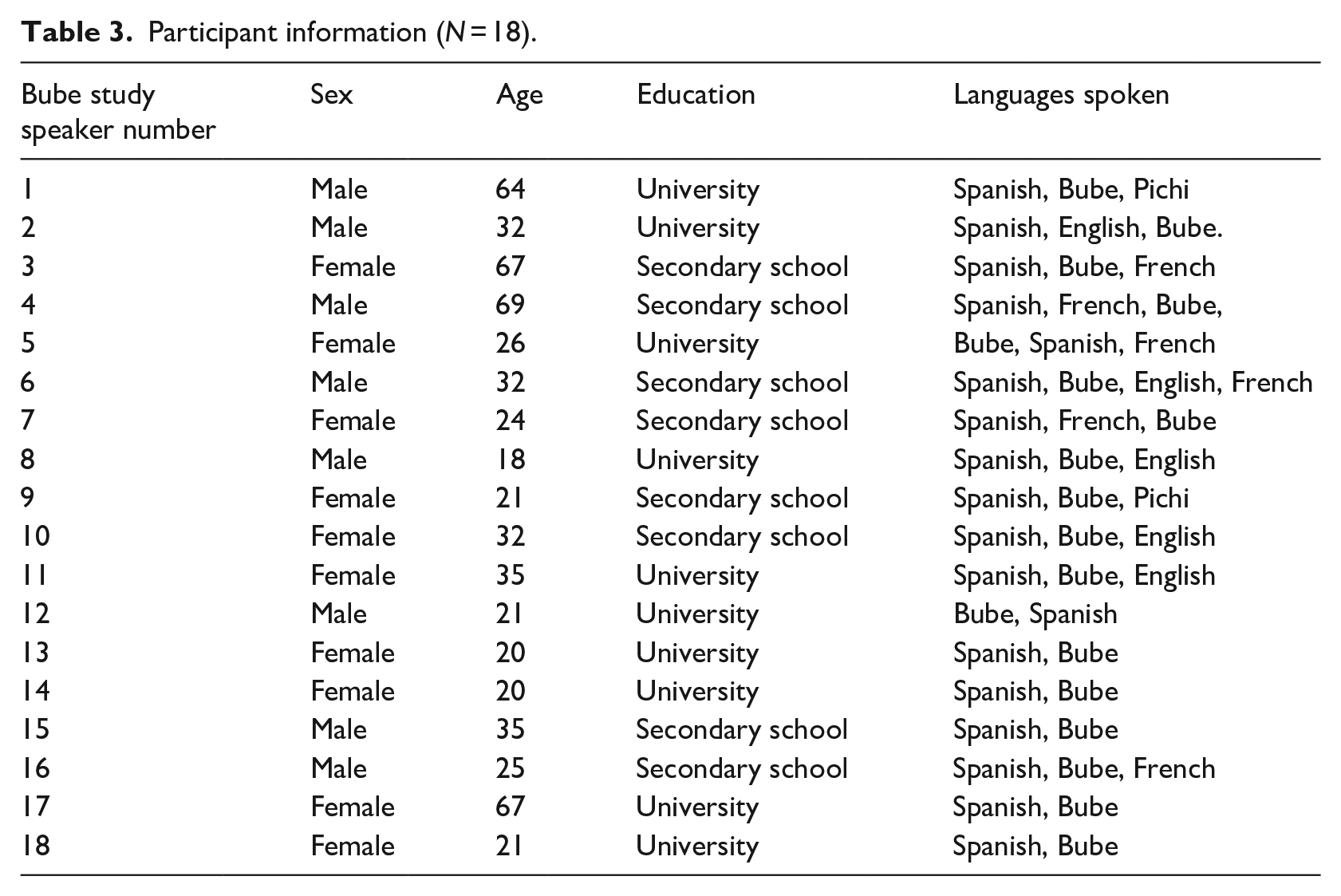
In total, 18 participants were recruited to take part in the study (10 females and 8 males) (Table 3). All the participants had some level of formal education; 10 had university degrees, and 8 had secondary school degrees. Participants’ ages ranged from 21 to 67 years. Before the interview, each participant gave consent to participate in the study. All participants self-reported that they were born in EG and had never left the country. They all resided in Malabo. They also stated that they were proficient speakers of Spanish and Bube. Moreover, in addition to Spanish, some participants said they knew some French, English, and Pichi.
Participant information (N = 18).
Envelope of variation
After the interview, the recordings were transcribed and coded. In line with the study’s goal, all instances of variation between the null and the overt pronoun with finite verbs were extracted from the data. By illustration, Example (5) is an overt subject pronoun, and Example (6) is a null subject pronoun.
5. We go to the school We go to the school. 6. Ø Fueron a la ciudad (Speaker 5) They went to the city They went to the city.
The analysis was limited to expressing subject pronouns with a human subject. The analysis thus excluded sentences with impersonal subjects (7), subject pronouns with emphatic mismo (8), imperatives (9), and infinitives since they do not vary with the subject pronoun (10).
7. One speaks Spanish in the class. Spanish is spoken in class. 8. I myself it saw I myself saw it. 9. Siempre me dijo aprenda el Bube (Speaker 12) Always me he told learn the Bube He always told me learn Bube. 10. To eat is very important Eating is very important.
The hypothesis and predictors analyzed in the study
Like previous studies, the present study coded for linguistic and social variables (Cerrón-Palomino, 2016; Otheguy & Zentella, 2012; Otheguy et al., 2007; among others). The linguistic predictors examined were grammatical person and number, ambiguity, the lexical content of the verb, reference, and reflexivity, whereas the social predictors were gender and education. Each of these predictors is explained in the following sections.
Grammatical person and number
Grammatical person and number have been consistently found to favor SPE in several previous studies (Carvalho et al., 2015). Furthermore, these studies have highlighted that SPE is favored by singular pronouns while disfavored by plural pronouns (Carvalho et al., 2015). The first-person singular form Yo “I” and the second-person singular form tú “you,” for instance, have been found to be the strongest predictors of SPE. The present study hypothesizes that, similar to previous studies, singular verb forms such as yo “I,” tú “you,” él/ella/usted “he or she” will favor SPE whereas plural verb forms such as nosotros “we” and ellos/ellas “them” will disfavor SPE.
Ambiguous verb forms
Previous studies have found morphological ambiguity to condition SPE in some speech communities (Lastra & Butragueño, 2015; Limerick, 2018; Michnowicz, 2015). This is attributed to certain verbs having identical morphological endings in the conditional, imperfect, and subjunctive tense. By way of illustration, the following example is provided.
11. I would say that everyday I have class, I have classes at 9
In the first clause, we find the expression of the overt subject pronoun with the first-person singular conditional mood. The expression of the overt pronoun is because without proper context given, the referent of “diría” could be assumed to be either the first-person (yo) or third-person singular verb form (él/ella/usted). The presence of the overt pronoun yo thus clears this ambiguity by clarifying that it is the first-person singular and not the third-person singular verb form. In the second clause, however, there is no confusion or ambiguity concerning the referent of tengo, hence the absence of the overt subject pronoun.
The present study predicts that ambiguous verb forms would favor SPE while unambiguous verb forms would disfavor SPE.
Lexical content of the verb
Previous studies have examined the lexical content of the verb using categories such as psychological verbs (e.g., pensar “to think,” creer “to believe”), stative verbs (e.g., ser “to be,” estar “to be”), and external activity verbs (cantar “to sing,” caminar “to walk”) (e.g., Carvalho & Child, 2011; Otheguy & Zentella, 2012; among others). These studies have highlighted that psychological and stative verbs favor SPE, whereas external activity verbs disfavor SPE (e.g., Padilla, 2020; Cerrón-Palomino, 2016). Therefore, the present study predicts that, in line with previous studies, psychological and stative verbs would favor SPE while external activity verbs, such as motion verbs would not.
Reflexivity
Reflexivity is a significant predictor in some studies (Bessett, 2018; Michnowicz, 2015; Otheguy et al., 2007; Otheguy & Zentella, 2012) and insignificant in others (Padilla, in press; Cerrón-Palomino, 2019). The consensus is that reflexive verbs do not favor SPE because they already indicate who the referent is, whereas non-reflexive verbs favor SPE. The following example is provided by way of illustration: 12. Me pongo la ropa. (Speaker 1) I wear the attire I put on an attire.
As evident in Example (12), the referent is already indicated by the clitic pronoun “me.” Thus, subject pronouns tend to be unexpressed with reflexive verbs except for contrastive situations. Consequently, in line with the findings of previous studies, the present study predicts that reflexive verbs would not favor SPE, whereas non-reflexive verbs would favor it.
Reference (switch/same reference)
Switch reference implies that the subject of the preceding sentence and the one that follows are not the same, while same reference implies that the subject of the preceding sentence and the one that follows is the same. By way of illustration, the following example is provided.
13. Si Ø podré contestarte, porque Ø estuve en una. (Speaker 4) Yes I will be able to answer you because I was in one. Yes (I) will be able to answer you because I was in one 14. Ø Me desperté porque
I woke up because they were shouting my name. (I) woke up because they were shouting my name
For Example (13), the same referent (first-person singular pronoun) is maintained throughout each sentence’s clauses. Nonetheless, in Example (14), we have a switch in referent; the subject of the first clause is the first-person singular, while the second clause is the third-person plural.
Previous studies have found that a change in the referent of consecutive verbs leads to the expression of more overt pronouns while maintaining the same reference leads to unexpressed pronouns (Alfaraz, 2015; Bessett, 2018; Carvalho & Bessett, 2015; Michnowicz, 2015; Otheguy & Zentella, 2012). Given the importance of reference on SPE, the present study predicts that, in line with previous studies, a switch in reference will favor SPE while the same reference would disfavor SPE.
Gender
Although some previous studies have found no effect for gender (e.g., Lastra & Butragueño, 2015; Michnowicz, 2015), others have found that gender is a significant predictor of SPE (e.g., Alfaraz, 2015; Carvalho & Child, 2011; Otheguy & Zentella, 2012). In the studies in which gender was significant, females were stronger predictors of SPE than males (e.g., Alfaraz, 2015; Carvalho & Child, 2011; Otheguy & Zentella, 2012). Researchers have explained these differences as a change in progress (Otheguy & Zentella, 2012), the culture of the people (Labov, 2001), covert prestige (Michnowicz, 2015), and overt prestige (Alba, 2004). This study predicts that, in line with previous studies which found a gender effect, female gender would be a stronger predictor of SPE than male gender.
Education
Like gender, the effect of education on SPE rates has not been consistent in previous studies. For example, some studies have found education to be a significant predictor of SPE rates (Otheguy & Zentella, 2012), whereas others have found education to be insignificant (Lastra & Butragueño, 2015). Given these conflicting findings, education was included for exploratory reasons.
Results
The results show that out of 2,162 verbs analyzed using the mixed-effects model software Rbrul, 388 (17.9%) subject pronouns were overt and 1,774 (82.1%) were null. These results are presented in Table 4.
The overall distribution of Spanish null and overt subject pronouns among Bube speakers in EG.
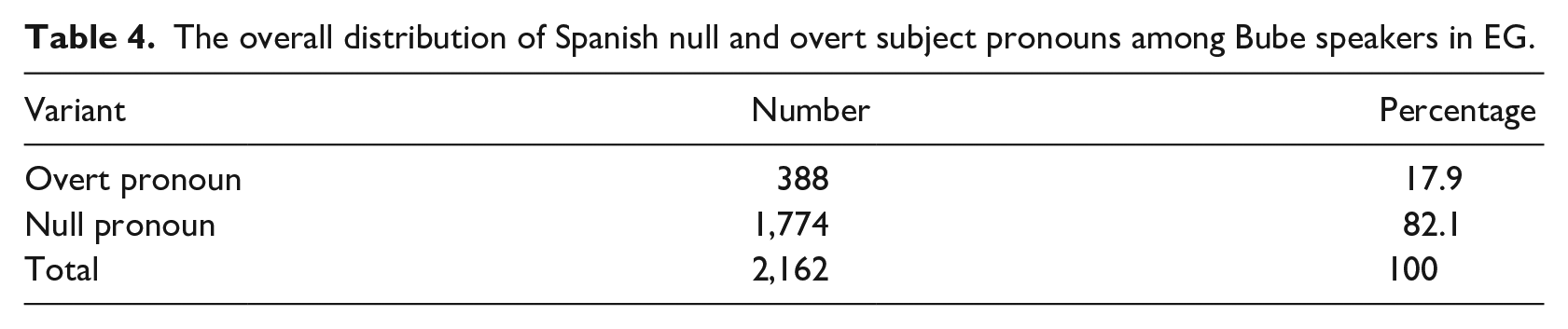
The SPE of 17.9% is low when compared to other bilingual varieties. This rate is almost three times lower than the highest bilingual SPE rate of 49% found in Abreu’s (2012) study. Similarly, when compared to other bilingual studies, such as the 41% rate in Otheguy et al.’s (2007) study of Spanish in New York, the 39% rate found in Otheguy and Zentella’s (2012) study of Spanish in New York, and the 38% rate found in Carvalho and Child’s (2011) study of Spanish in contact with Portuguese, this is a very low rate. The SPE rate of the present study is only higher than the SPE rate of 17.8% and 17.1%, respectively, among the bilinguals in Cerrón-Palomino’s (2016, 2019) study.
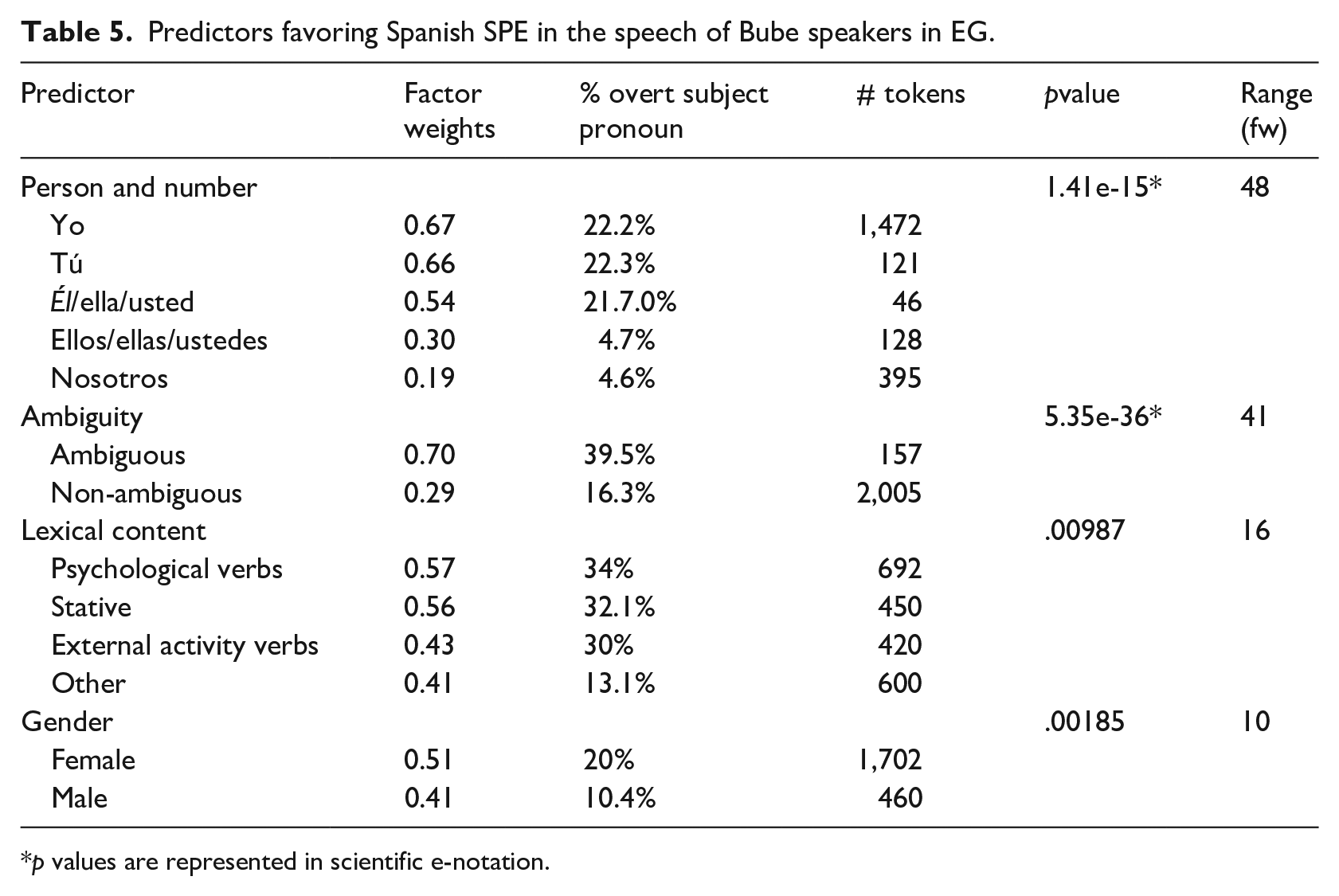
Concerning the significant predictors of SPE among these speakers, four out of the seven factors were selected as significant predictors of SPE in the Rbrul analysis. These factors were grammatical person and number, ambiguity, gender, and the lexical content of the verb. The insignificant predictors were reference, reflexivity, and education. These results are presented in Table 5, starting with the strongest to the weakest effect.
Predictors favoring Spanish SPE in the speech of Bube speakers in EG.
p values are represented in scientific e-notation.
From Table 5, grammatical person affects SPE the most as it is the highest-ranked predictor (a range of 48). The results confirm that singular pronouns favor SPE while plural pronouns disfavor it. For instance, the first-person singular yo “you” has the strongest effect (a factor weight of 0.67). This is then followed by the second-person singular tú “you” (a factor weight of 0.66) and the third-person singular él/ella/usted “he or she/you formal” (a factor weight of 0.54). Considering that participants are often asked questions about their own lives, the first person singular is expressed more often in comparison to other pronouns. Posio (2011) describes this as the egocentric nature of discourse. The disfavoring effect of the plural pronouns is evident in the factor weights of ellos/ellas/ustedes “they/you plural” (a factor weight of 0.30) and nosotros “we” (a factor weight of 0.19).
The second strongest predictor is ambiguity (a range of 41). Ambiguous verb forms favor SPE (a factor weight of 0.70), whereas unambiguous verb forms favor null subjects (a factor weight of 0.29). Like other varieties of Spanish, speakers of this variety express the overt subject pronouns with ambiguous verbs than with non-ambiguous verb forms (Lastra & Butragueño, 2015; Michnowicz, 2015; Orozco & Hurtado, 2021). These results also confirm the predictions of the present study.
The third strongest predictor of SPE is the lexical content of the verb. As predicted, psychological verbs are the strongest predictors (a factor weight of 0.57). This is followed by stative verbs with a factor weight of 0.56. External activity verbs (a factor weight of 0.43) and other verbs (a factor weight of 0.41) do not favor SPE.
The fourth strongest predictor of SPE is gender (a range of 10). These results depict that females favor SPE (a factor weight of 0.51) whereas males disfavor SPE (a factor weight of 0.41). These results are in line with studies where women are stronger predictors of SPE than men. For instance, Alfaraz’s (2015) study in the Dominican Republic, Otheguy and Zentella’s (2012) study in New York, Shin and Otheguy’s (2013) study in New York, and Prada Pérez (2015) study in Spain.
Concerning the insignificant predictors, the study found the linguistic predictors reference and reflexivity and the social predictor education were insignificant. These factors are represented in Table 6.
Rbrul analysis of the insignificant predictors.
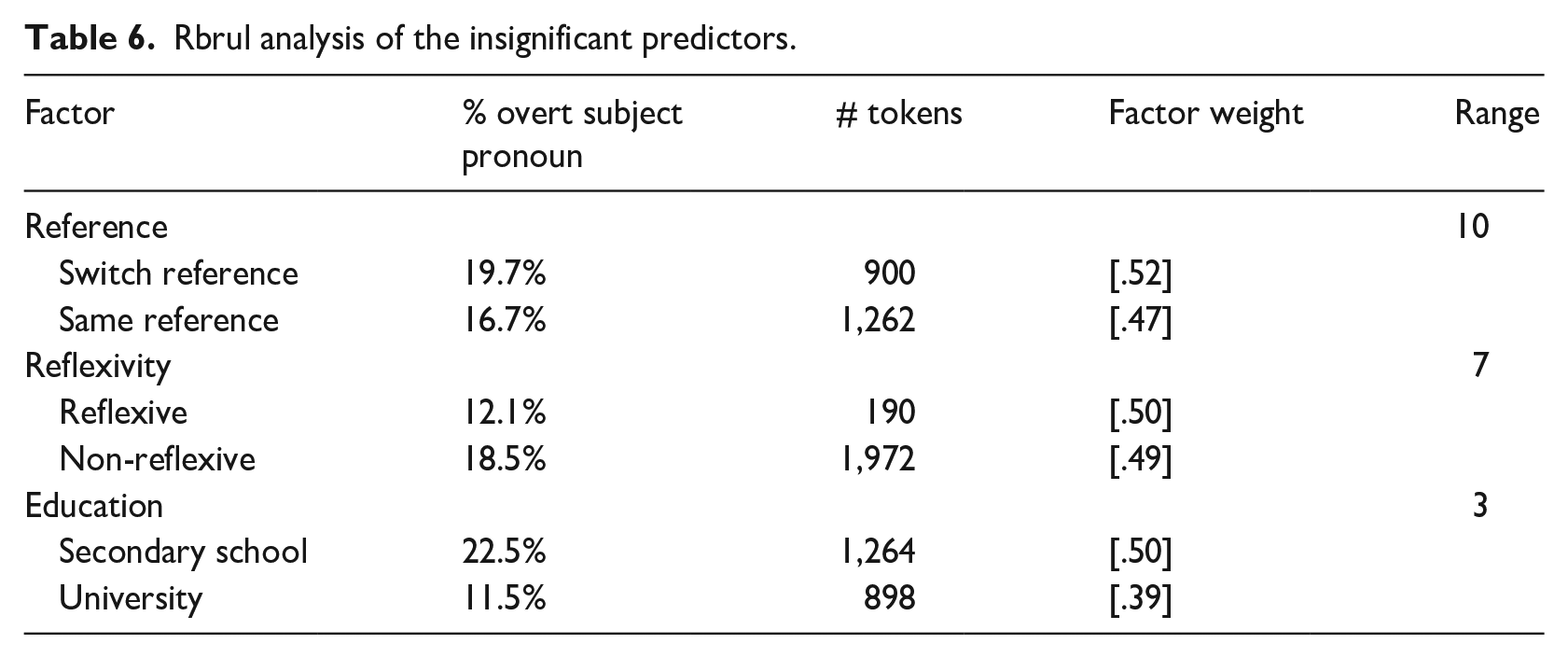
In previous SPE studies, the insignificant predictors, reflexivity and education, have not been consistent predictors of SPE. For instance, reflexivity was found not to condition SPE in Cerrón-Palomino’s (2019) study and the Padilla (2020) study. Similarly, education was found to be insignificant in Lastra and Butragueño’s (2015) study and Shin and Otheguy’s (2013) study. However, the same cannot be said for reference. Although in some bilingual studies, a low ranking of reference has been attested (e.g., Michnowicz, 2015; Shin & Otheguy, 2009), reference has consistently been found to favor SPE in many monolingual and bilingual studies.
Discussion: the effects of bilingualism on SPE
Overall, the Spanish spoken by these bilingual speakers does not differ greatly from the results of previous variationist studies with respect to SPE. However, the insignificance of the reference predictor and the low SPE rate contrasts with the general tendency of expressing overt subject pronouns when there is a change in referent/subject and omitting them when maintaining the same subject. We compare the examples below where the interviewer asks the interviewee about dancing.
15. Entrevistadora:¿Ha gustado bailar o le gusta bailar? Interviewer: Have you liked dancing or do you like dancing? Participante: No, yo no bailo nunca cuando yo no estoy borracho. Participant: No, I don’t ever dance when I am not drunk. 16. Entrevistadora:¿y aquella escuela quedaba cerca o lejos de su casa? Interviewer:¿ and was this school close or far from your house? Participante: Bueno cuando Participant: Well, when I was in the city, yes, we had to walk. Neither were there many cars. From where a sister lived . . . from where they call Santa Cruz, along Anguema, I lived and left from there to arrive at school.
In Example (15), we have an example of the overt pronoun being used even though the subject of the preceding clause is the same as the subsequent clause. However, in Example (16), we find the overt pronoun unexpressed even though there is a switch in reference. This contrasts with the general tendency of expressing overt subjects with a switch in reference and vice versa. Michnowicz (2015) found similar results among Maya-Spanish speakers. Like the present study, the results indicated that Maya-Spanish speakers were not attributing the same level of importance to co-reference as the Spanish monolingual speakers.
Otheguy and Zentella (2012) suggest that the non-appearance of relevant constraints in the bilinguals’ other language can either strengthen or weaken certain predictors depending on the language the bilingual uses the most. Consequently, speakers who find themselves in official settings where Spanish is used are more likely to practice the rules regarding selecting overt Spanish pronouns. However, speakers who find themselves in familiar settings where they use the local language more often than Spanish will not have this practice.
Moreover, the low SPE may be linked to EG’s colonial history, as this rate mirrors that of EG’s former colonizer, Spain. Cerrón-Palomino (2014) suggests that the conservative use of the subject pronoun in some varieties could be attributed to the tight relationship between Spain and some of its former colonies (e.g., Peru, Mexico, EG.). In effect, the parallels in the pronoun rates in Equatoguinean Spanish, and that of Peru (16.2%) and Spain (20%), could be explained in terms of the varieties that teachers use in EG: mainly Northern peninsular. This is the variety that was imposed through colonial education. It is possible that these speakers are using more null than overt pronouns because they learned through formal education that in Spanish, overt subject personal pronouns (SPP)s are used when there is referential ambiguity or emphatic/contrastive contexts, thus leading speakers to use null subjects as a default strategy.
Another possible reason is the issue of prestige. Historically, Spanish has a higher level of prestige than the local languages in EG, as it is associated with power and a higher education level. However, Pichi, unlike Spanish, is stigmatized in EG, despite its dominance. Considering the growing number of Bube speakers gradually shifting to Pichi, one would expect a high pronoun rate from contact with a creole instead of a low pronoun rate. However, the dominance and prestige associated with Spanish as a colonial language plays an important role in the direction of the contact between Spanish and the local languages such as Bube and Pichi (Achel, 2021; Gomashie, 2019).
Moreover, in line with the prestige associated with Spanish, it is important to consider the possible impact on the linguistic structure of a situation involving Spanish as a first- and second-generation minority heritage language (Puerto Ricans in New York City [NYC]), and Spanish as a recent colonial contact language with a time-depth of barely 100 years. The difference is that unlike NYC, Spanish in EG has never lost its prestige nationally nor has it broken contact with Spain for long enough to lead to an interruption in its linguistic structure (except during Macías Nguema’s dictatorship). In addition, in the NYC settings, particularly, Spanish has English as a superstrate, while in EG, Spanish is the superstrate.
Furthermore, Siegel (1999) argues that when there is an attempt by a society to have a common L2, there is adstratal transfer to the L2 (Kouwenberg & Singler, 2009; Yakpo, 2017), which may be a superstrate language, like the case of Spanish in EG. Siegel (1999) further argues that these L2 forms become a part of the variants used in the contact situation. When the community starts to shift from the L1 to the contact variety, the first generation acquires the language as a second language and has second language features. However, after this shift is complete, the adstrate becomes the substrate. The substrate language is eliminated in subsequent generations, although some features may still appear in the superstrate language.
In the case of Spanish in EG, possibly, the forceful imposition of Spanish as a medium of communication during colonial rule and the continuous use of the language as an official language for the 50 years afterward has resulted in a shift in favor of the superstrate. Thus, despite the intense contact between Spanish, Bube, and Pichi, SPE rates and constraints in this variety are similar to varieties of Spanish spoken in central and northern Spain, Mexico, and Peru.
Conclusion
The results of the present study indicate an SPE rate of 17.9%, one of the lowest SPE rates ever recorded. Moreover, the significant predictors are grammatical person and number, ambiguity, the lexical content of the verb, and gender. The results show that, except for the insignificance of the reference constraint, Spanish SPE in the speech of bilingual Bube speakers is similar in terms of rates and underlying constraints to other varieties of Spanish.
Moreover, the paper examined possible causes for the insignificance of the reference predictor and the low pronoun rate. Concerning the insignificance of reference, the study explained that in line with Otheguy and Zentella (2012), the appearance/disappearance of certain constraints is governed by the language the individual uses most. With respect to the present study, these findings suggest a stronger usage of Spanish. Furthermore, with respect to the low pronoun rate, the study mentioned the prestige associated with Spanish versus the local languages, and the superstrate influence on the direction of language contact. Overall, these results provide evidence regarding the status of Spanish in EG.
The present study is not free from limitations; small sample size, extinct research on Bube to compare with Spanish, and the unbalanced educational levels of the participants. For instance, there is no significant educational difference between respondents, all have at least secondary education. The spread might have to be bigger (including primary and no formal education/literacy, for example) in future studies. There is also the possibility that participants could have modified their speech because they were being recorded. Future research should expand the sample size, conduct interviews outside Malabo, and examine speakers with different levels of education to understand the expression of subject pronouns in EG.
Footnotes
Declaration of conflicting interests
The author(s) declared no potential conflicts of interest with respect to the research, authorship, and/or publication of this article.
Funding
The author(s) received no financial support for the research, authorship, and/or publication of this article.
