



Abstract
Purpose:
Multiple dimensions of language dominance, such as language proficiency and demand for language use, can be reflected in bilinguals’ speech-in-speech recognition scores. This paper explores the feasibility of using a novel measure to estimate language dominance for bilinguals: relative speech-in-speech recognition thresholds (SRTs) or the within-person difference in SRTs between their two languages.
Method:
Participants were 25 Spanish/English bilingual adults (Mage = 30 years). SRTs for sentence recognition in a language-matched two-talker masker were measured in English and in Spanish using an adaptive, open-set task. Relative SRTs were calculated by subtracting the Spanish SRT from the English SRT. Language dominance and proficiency were assessed by established measures.
Analysis:
Spearman correlations were used to assess the association between measures.
Findings:
Relative SRTs were correlated with dominance scores derived from both a questionnaire (rs = −.80) and standardized testing (rs = −.80).
Originality:
We tested and validated a novel measure, relative SRTs, to predict language dominance in bilingual adults. This time-efficient method could be used by bilingual researchers interested in assessing language dominance for descriptive or experimental purposes.
Significance:
Relative SRTs show promise as a valid method to assess language dominance in Spanish/English bilingual adults.
Introduction
Language dominance describes the degree to which multiple dimensions of bilingualism, at a minimum the demand for use and language proficiency, vary across a bilingual’s two languages. Other conceptualizations of language dominance include cultural attitudes, language identity, and language history as dimensions of the construct. In bilingual research, describing language dominance is useful because it can account for between-person variability in linguistic behaviors. For instance, estimates of language dominance predict word retrieval latencies during picture naming (e.g., Gollan et al., 2005; Sholl et al., 1995) and masked-speech recognition (e.g., Shi, 2011, 2014, 2015). Language dominance can also be used to characterize bilingual samples, which are critically important given the extensive heterogeneity in language abilities and experiences (e.g., Cowan et al., 2022; von Hapsburg & Peña, 2002). Because language dominance serves multiple purposes, accurately assessing the construct is of interest to researchers. Yet, accurate measurement of language dominance is not a simple task. Common methods rely on self-report using questionnaires (e.g., Birdsong et al., 2012; Dunn & Fox Tree, 2009; Marian et al., 2007), which have known limitations (see Treffers-Daller, 2019). Here we test the feasibility of using one behavioral measure, the within-person differences in SRTs across languages, to assess language dominance in Spanish/English bilingual adults.
Speech-in-speech recognition
Masked-speech recognition refers to the recognition of target speech in the presence of competing background sounds, such as steady noise or competing speech. People recognize masked speech less accurately than speech in quiet because masking interferes with the peripheral representation of sound, making some speech cues inaudible or poorly represented (e.g., Bregman, 1990; Buss et al., 2017; Carhart et al., 1968). However, substantial within- and across-group differences in masked-speech recognition have been observed, and within-groups individual differences in language skills, like receptive vocabulary, have been shown to influence performance (Benard et al., 2014; Braza et al., 2022; Kaandorp et al., 2016).
Understanding speech when there are competing talkers in the background is challenging because the competing speech impacts multiple stages of processing in addition to degrading the peripheral representation of target speech (e.g., Bregman, 1990; Brouwer et al., 2012). For instance, the listener must segregate incoming target speech from the competing talkers. Segregation requires the listener to group incoming speech sounds produced by the target talker, parse that stream from competing streams, and selectively attend to the target while disregarding the masker streams (Bregman, 1990). Speech maskers also present the additional challenge of containing competing linguistic information, like meaningful phrases. Such competing linguistic information strains cognitive resources (like attention) and negatively impacts accurate recognition of target speech relative to other speech recognition contexts (e.g., Brouwer et al., 2012).
Bilingual speech-in-speech recognition
Challenges understanding speech in competing speech are more pronounced for many bilingual adults, who often experience greater susceptibility to speech-in-speech masking in at least one language that they speak, compared to monolinguals (Desjardins et al., 2019; Krizman et al., 2017; Rogers et al., 2006). Within bilingual populations, multiple dimensions of language dominance have been shown to predict speech recognition (Calandruccio & Zhou, 2014; Shi, 2014; Shi & Koenig, 2016; Shi & Sánchez, 2010; Weiss & Dempsey, 2008). How these dimensions influence speech recognition in the presence of competing speech maskers and background noise for bilingual adults is reviewed below.
Dimensions of language dominance, together, account for significant variance in speech-in-speech and speech-in-noise recognition (Regalado et al., 2019; Shi, 2012; Shi & Sánchez, 2010). For instance, Shi and Sánchez (2010) used linear regression models to identify linguistic variables that accounted for significant variance in masked-English word recognition for Spanish/English bilinguals and found that the following variables contributed to individual differences in performance: age of acquisition of English (history), daily use of English (demand for use), length of immersion in both languages (demand for use), and listening proficiency in both languages (proficiency; and see also Regalado et al., 2019; Shi, 2012). In general, bilinguals with better proficiency, younger ages of exposure, and more daily use of the test language have lower thresholds (i.e., better performance; Regalado et al., 2019; Shi, 2012; Shi & Sánchez, 2010). Moreover, preliminary evidence suggests that another dimension of language dominance, attitudes about language use and cultural identification, could influence speech recognition in challenging listening conditions as well (Shi & Farooq, 2012). Looking across studies, speech recognition reflects multiple factors related to dominance, so it could be a good predictor of those factors. If true, then relative SRTs would be an efficient and valid way to estimate language dominance.
Measuring language dominance as a continuous multidimensional variable
Researchers use different methods and tools to measure language dominance, and the selected method depends on how the researcher conceptualizes language dominance. Three common methods to assess language dominance reported in bilingual research are binary methods, unidimensional methods, and multidimensional methods. Below we review each of these approaches to measuring language dominance and discuss the rationale for using each, as well as potential limitations.
One method to assess language dominance as a binary construct is to directly ask respondents to identify their dominant language (e.g., Shi & Koenig, 2016 and see also Marian et al., 2007). This approach is time efficient and may be appropriate when the research question does not directly pertain to the language dominance of participants. However, there are notable limitations in assessing language dominance as a binary construct. Binary classifications of language dominance provide limited information about the degree of variability in dimensions of bilingualism across languages. Imagine assessing the language dominance of two Spanish/English bilingual adults who are both English dominant but differ with respect to the age that they learned English, how often they communicate in English, and their English proficiency 1 . This example illustrates how it would be more informative and accurate to estimate language dominance as a continuous indicator, which characterizes how people vary in their degrees of dominance (Birdsong, 2016; Grosjean, 2010; Treffers-Daller & Silva-Corvalán, 2016).
Unidimensional measures are another type of measure, which assess one dimension of language dominance using questionnaire (e.g., self-ratings of expressive language ability), behavioral tasks (e.g., lexical decision tasks), or language tests and then compare data across languages. The dimensions most commonly assessed are demand for use and proficiency (Argyri & Sorace, 2007; Bedore et al., 2012; Deuchar & Muntz, 2003; Unsworth et al., 2018 and see also Solís-Barroso & Stefanich, 2019 for a review), since these two dimensions are central to the construct of language dominance and are correlated in some groups of bilinguals (Bedore et al., 2016; Unsworth, 2015). While unidimensional measures are used to assess language dominance in bilingual adults, they have notable limitations. One limitation is that unidimensional measures provide limited information about the multidimensional construct of language dominance, and, therefore, may have poor construct validity (Luk & Bialystok, 2013). For example, unidimensional measures are only weakly correlated with multidimensional measures, suggesting that they do not tap into the same linguistic dimensions (Solís-Barroso & Stefanich, 2019).
Multidimensional approaches are considered to have greater validity for use with adult populations compared to unidimensional measures (Birdsong et al., 2012; Grosjean, 2010; Luk & Bialystok, 2013; Montrul, 2016; Treffers-Daller & Silva-Corvalán, 2016). Multidimensional measures of language dominance are typically questionnaires with scales that assess various dimensions. One such multidimensional measure of language dominance is the Bilingual Language Profile ([BLP], Birdsong et al., 2012). The BLP is a questionnaire that contains 19 questions and elicits self-reported demographic information (e.g., highest educational attainment), language history, language proficiency, language attitudes, and demand for language use (Birdsong et al., 2012; Gertken et al., 2014). Another multidimensional questionnaire is the Bilingual Dominance Scale ([BDS], Dunn & Fox Tree, 2009). The BDS has three scales: comfort of language use, amount of daily use, and age of exposure. The BDS quantifies language dominance on a gradient scale. Both questionnaires take approximately 10 to 15 minutes to complete and require literacy for independent completion.
One limitation associated with using multidimensional questionnaires to assess language dominance is the reliance on self-reported data (see Treffers-Daller, 2019). For instance, Vicente et al. (2019) found that some respondents earned strong standardized English proficiency test scores but rated their proficiency as poor, while others earned lower standardized test scores yet rated their English skills as strong. Another limitation is that bilingual adults may rate their language proficiency differently depending upon whether they are rating their dominant or non-dominant language (Tomoschuk et al., 2019). Therefore, while the estimate may be accurate with respect to relative proficiency within person, they can be inaccurate when comparing between people and groups.
To address the limitations of existing tools, de Bruin (2019) recommends using a combination of methods to most accurately index language dominance, such as less subjective measures (i.e., behavioral measures) in addition to self-report (de Bruin, 2019). Incorporating a more objective measure that reflects multiple dimensions of language dominance would enhance the rigor of bilingual research by providing a valid complement to existing multidimensional questionnaires. Here we evaluate the feasibility of using relative SRTs as a single measure that reflects multiple crucial dimensions of language dominance and assesses the degree of dominance along a continuum.
Research questions
This study explored the feasibility of using relative SRTs as a measure of language dominance in a sample of Spanish/English bilingual adults. To test the measure and assess aspects of validity we posed two research questions:
To what extent are SRTs correlated with Spanish and English language proficiency data measured by questionnaires and standardized tests?
Do relative SRTs predict language dominance and language proficiency for Spanish/English bilingual adults?
First, correlations between SRTs in each language and language proficiency measures were assessed. We expected to replicate prior findings and demonstrate that SRTs in each language correlate with language-specific proficiency. Second, correlations between relative SRTs and established measures of language dominance (the BLP and Versant™) were assessed. Based on the robust body of evidence indicating that masked-speech recognition reflects multiple dimensions of language dominance, we predicted that relative SRTs would be correlated with two existing measures of language dominance.
Method
All participants completed speech-in-speech recognition and language testing. SRTs for sentence recognition in a language-matched two-talker masker were measured in English and in Spanish using an adaptive open-set sentence-recognition task. Spanish and English proficiency were also measured using the Versant™ Spanish and English Tests, respectively. Language dominance was assessed using the BLP questionnaire; and by calculating the difference in Spanish and English Versant™ Test scores. Portions of these data were reported in Vicente et al. (2019). The authors assert that all procedures contributing to this work comply with the ethical standards of the relevant national and institutional committees on human experimentation and with the Helsinki Declaration of 1975, as revised in 2008.
Participants
Participants were 25 Spanish/English bilingual adults (Mage = 30 years, range = 19–53). These subjects were recruited for a prior study (Vicente et al., 2019) that focused on two groups: (1) adults whose first language (i.e., L1) was Spanish (L1 Spanish group, n = 15), and (2) adults whose second language (i.e., L2) was Spanish (L2 Spanish group, n = 10). The group of L1 Spanish participants also included two participants who were exposed to both Spanish and English from birth (i.e., simultaneous bilinguals). While the L1 Spanish group learned Spanish through exposure in their home and community, the L2 Spanish group learned through direct instruction (e.g., elective formal coursework). Differences in participant language history facilitated the assessment of language dominance in a heterogenous sample of Spanish/English speaking adults.
Inclusionary criteria were: (1) normal hearing, (2) self-reported conversational fluency in both Spanish and English, and (3) at least 19 years of age at the time of participation. Hearing sensitivity was screened; all participants had air conduction thresholds ⩽ 20 dB HL at octave frequencies from 0.25 to 8 kHz, bilaterally (American National Standards Institute, 2010).
Language testing
The BLP (Birdsong et al., 2012) was administered to assess language dominance using four scales: language history, proficiency, attitudes, and demand for use. Self-ratings on the BLP are used to calculate a Spanish score, an English score, and a Dominance score (see Table 1). Each of the four language scales is weighted equally in the calculation of the Dominance score. Values range from −218 to 218, with scores near 0 indicating “balanced” language dominance, positive values indicating some degree of English dominance, and negative values corresponding to some degree of Spanish dominance.
English and Spanish performance and language dominance (LD) scores by participant group.
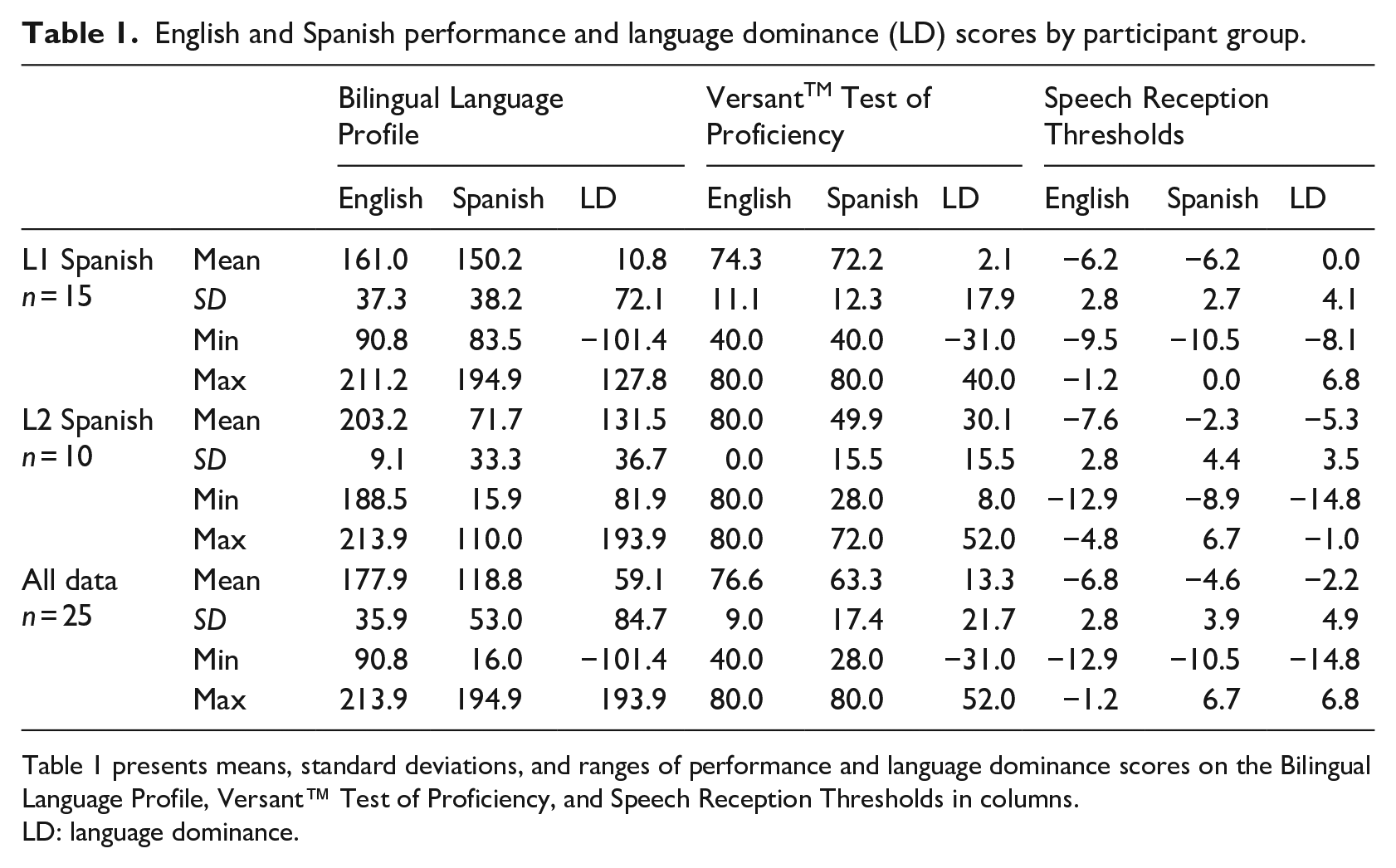
Table 1 presents means, standard deviations, and ranges of performance and language dominance scores on the Bilingual Language Profile, Versant™ Test of Proficiency, and Speech Reception Thresholds in columns.
LD: language dominance.
Participants also completed the Versant™ Test in English and Spanish. The Versant™ is a standardized norm-referenced test that has four scales related to different dimensions of language proficiency: fluency, pronunciation, vocabulary, and sentence mastery. Fluency assesses the rhythm and timing of speech produced during discourse productions and reading samples. Pronunciation evaluates how accented the speech is perceived to be by a rater. The vocabulary scale estimates lexical knowledge. Sentence mastery assesses how the participant comprehends, imitates, and produces grammatical sentences. The test was administered via telephone (the standard administration methodology) and scored automatically. Scores range from 20 to 80, with endpoints characterizing a “Basic User” of a language and a “Proficient User,” respectively. Basic Users are defined as bilinguals who can understand, recall, and produce sentences corresponding to basic competency in the test language. The test is available in a variety of languages that allow for comparison (Pearson Inc., 2017, 2018).
Versant Dominance Scores were calculated using subtractive methods where Spanish composite scores were subtracted from English composite scores. Therefore, values near zero suggest balanced language dominance, positive values indicate English dominance and negative values indicate Spanish dominance. The four subtests that evaluate expressive and receptive language abilities make the Versant™ a more valid choice for assessing language dominance compared to methods that evaluate performance in only one language domain (Luk & Bialystok, 2013).
Three native English speakers (from the L2 Spanish group) completed the English Versant™ test and received the maximum score of 80 on the test. The other native English speakers (ntotal = 9, nL1 Spanish = 2, and nL2 Spanish = 7) did not complete the Versant™ test in English since the purpose of the Versant™ test is to evaluate how effectively someone communicates in their second language. Therefore, it is likely that someone who is exposed to a language from birth and uses the language consistently over their lifespan will earn a score of 80 indicating that they are a “Proficient User”. For this reason, we extrapolated that these participants would have earned the maximum score of 80 in English had they been tested, and calculated correlations using both observed and extrapolated data. We regarded this extrapolation as important since it allowed for a wider range of performance to be incorporated into analyses 2 .
Describing the sample
Descriptive statistics for scores on all measures are shown in Table 1. The sample comprised fifteen bilinguals who were exposed to Spanish from birth and differed in their timing of exposure to English (L1 Spanish; Meanage of exposure to English = 6 years, range = birth–20 years), and 10 participants were exposed to English from birth and were later learners of Spanish (L2 Spanish; Meanage of exposure to Spanish = 11 years, range = 4–20 years). All participants in the L1 Spanish group reported feeling comfortable using both Spanish and English to verbally communicate on the BLP questionnaire. Demand for language use varied between participants. At the group level, participants reported using English more often than Spanish, but most participants in the L1 Spanish group reported using Spanish with their families more often than English. English Versant™ scores spanned a wide range, from Basic User of English to Proficient User. This participant group earned scores corresponding to the category of Proficient User on the Spanish Versant™. Language dominance, as indexed by the BLP questionnaire, also varied across participants.
The L2 Spanish group reported using English more often than Spanish on the BLP. According to Spanish Versant™ test scores, participants earned mean scores corresponding to someone who is generally fluent and comfortable engaging in discourse about familiar topics. The range of scores encompassed Basic through Proficient Users.
Speech recognition testing
Stimuli and conditions
Target stimuli were recordings of sentences from the English and Latin American Spanish Hearing in Noise Tests (HINT; Nilsson et al., 1994; Soli et al., 2002). Both versions of the HINT are clinical tests of sentence recognition in noise used in audiological assessments (Nilsson et al., 1994; Soli et al., 2002). The HINT contains 250 sentences separated into 25 phonetically balanced lists. Sentence length ranges from 4 to 6 words. The Latin American Spanish HINT was created to be an analogous sentence recognition test to the English HINT (Nilsson et al., 1994) to allow for clinical speech-in-noise testing for speakers of Latin American Spanish.
Different talkers produced target sentences for the clinical versions of the English and Latin American Spanish HINT tests. To minimize differences between talker characteristics, new recordings from the same Spanish/English bilingual female talker were developed for the present experiment. This talker was born and lived in Mexico until the age of 12, then moved to the United States where she has lived for over 20 years. She reported using English and Spanish daily for communication on the BLP and earned scores of 80 on the Spanish and English versions of the Versant™ test. Six lists of 20 HINT sentences were recorded in both languages (240 total sentences). Sentences were recorded in a sound-treated booth using a cardioid-condenser microphone (Shure-KSM42) positioned approximately 6 inches from the talker’s mouth.
Target stimuli were presented in a continuous two-talker speech masker, language-matched to the target sentences (i.e., English target sentences in an English two-talker masker and Spanish target sentences in a Spanish two-talker masker). The maskers were created by Calandruccio et al. (2014) based on recordings of two female talkers reading different passages from a familiar children’s book in English or in Spanish. Both talkers were simultaneous Spanish/English bilinguals. Recordings were edited to ensure silent pauses were not longer than 300 ms. For both the English and the Spanish maskers, the two streams were root-mean-square normalized and then added to create a sample of two-talker speech that repeated without any perceptible discontinuities.
Procedure
Participants were tested while seated inside a sound-isolating room. The selection and presentation of stimuli were controlled using custom MATLAB software. Sounds were mixed, routed to a real-time processor (Tucker-Davis Technologies, RP2), played at 24,414 Hz, and presented diotically over supra-aural headphones (Sennheiser HD25). Standard procedures were used to assess and score participant performance. Participants were asked to repeat back target sentences and ignore the competing speech. Participant responses were scored online by a bilingually trained research assistant seated in the adjacent control room. All words in the sentence were scored. An adaptive procedure was used to determine the signal-to-noise ratio (SNR) corresponding to 50% correct recognition of words. The masker level was fixed at 60 dB SPL throughout testing, and target level was adjusted following two interleaved one-down, one-up adaptive tracks. One track used a lax criterion; sentences were scored as correct if ⩾ 1 word was repeated back correctly. The other track used a strict criterion; sentences were scored correct if ⩽ 1 word was repeated back incorrectly. The starting step size for each track was 8 dB, reducing to 4 dB after the first reversal, and to 2 dB after the second reversal. Each run included 60 sentences (30 per track), corresponding to more than 300 scored words. One sentence was presented on each trial, selected randomly without replacement. Participants completed testing in two conditions: (1) English target sentences in English two-talker speech, and (2) Spanish target sentences in Spanish two-talker speech. Condition order and sentence list assignment was counterbalanced across participant. No sentences were repeated for a given participant.
The use of two interleaved adaptive tracks with different criteria yielded data spanning a wide range of speech recognition performance. SRTs corresponding to 50% correct performance were estimated in each condition by fitting the following logit function to the data (scores by word and SNR) from both tracks:

α is the midpoint, β is the slope, x is the SNR, and y is the proportion of words correct. This procedure takes approximately five to ten minutes to complete per run.
Validation
We calculated relative SRTs by subtracting the Spanish SRT from the English SRT. A positive difference value indicates better performance in Spanish relative to English, whereas a negative difference value indicates better performance in English relative to Spanish. Values near zero indicate that the participant performed similarly in both languages. This interpretation of relative SRTs assumes equivalent performance on Spanish and English versions of the HINT for balanced Spanish/English bilinguals (or for bilinguals who earned equivalent scores on the Versant™ or the BLP Dominance Scores). However, this assumption is not necessary to predict dominance based on the relative SRT. One way to assess if the Spanish and English forms are equivalent is to assess the function characterizing relative SRT and both the BLP Dominance Score and the Versant Dominance Score and test if the intercept is significantly different from zero. Intercepts of zero would indicate that balanced bilinguals would earn scores of zero on all three measures of language dominance: the BLP, the Versant™, and relative SRTs. If balanced language dominance does not lie at zero, then future work could determine an appropriate correction factor to impose on relative SRTs. This issue will be revisited in the Discussion section.
We evaluated the feasibility of using relative SRTs to assess language dominance by computing Spearman correlations of SRT with other existing measures. All analyses were conducted in R Studio (R Core Team, 2021) using the package ggpubr (Kassambara, 2020).
Results
Descriptive statistics for BLP scores, Versant™ scores, and SRTs in each language are displayed in Table 1. Spanish performance was subtracted from English performance for all measures of language dominance. For BLP Dominance Scores and Versant™ Dominance Scores, values near zero suggest balanced language dominance, positive values indicate English language dominance, and negative values indicate Spanish language dominance. For Spanish and English SRTs, lower scores indicate better performance. Therefore, in relative SRTs, negative values indicate better performance on the English version of the HINT, while positive values indicate better performance on the Spanish version of the HINT. The L1 Spanish group had scores that suggested comparable performance on the two established measures of language dominance. The L2 Spanish group had scores that suggested English language dominance on the BLP and Versant™.
Spearman correlations assessed the associations between Spanish and English SRTs and BLP and Versant™ composite scores, respectively. Participants with better (i.e., lower) SRTs in Spanish tended to have higher self-ratings on Spanish proficiency on the BLP rs(24) = −.75, p < .0001, and higher Spanish Versant™ composite scores, rs(24) = −.76, p < .0001. Participants with better SRTs in English tended to have higher self-ratings on English language proficiency on the BLP, rs(24) = −.68, p = .01, and higher English Versant™ composite scores, rs(13) = −.48, p = .01.
Relative SRTs
Overall, participants had lower SRTs in English compared to Spanish (M = −2.2, range = −14.8 to 6.8 dB SNR. However, relative SRTs varied by group. The L2 Spanish group had lower SRTs in English relative to Spanish (M = –5.3, range = −14.8 to −1.0), and the L1 Spanish group had similar performance across languages (M = 0.0, range = −8.1 to 6.8, see Figure 1). Given the sample size, we assessed the normality of the distribution prior to conducting any further statistical analyses. The Shapiro–Wilk test of normality did not find evidence of non-normality in the relative SRT scores (W = .96, p = .40).
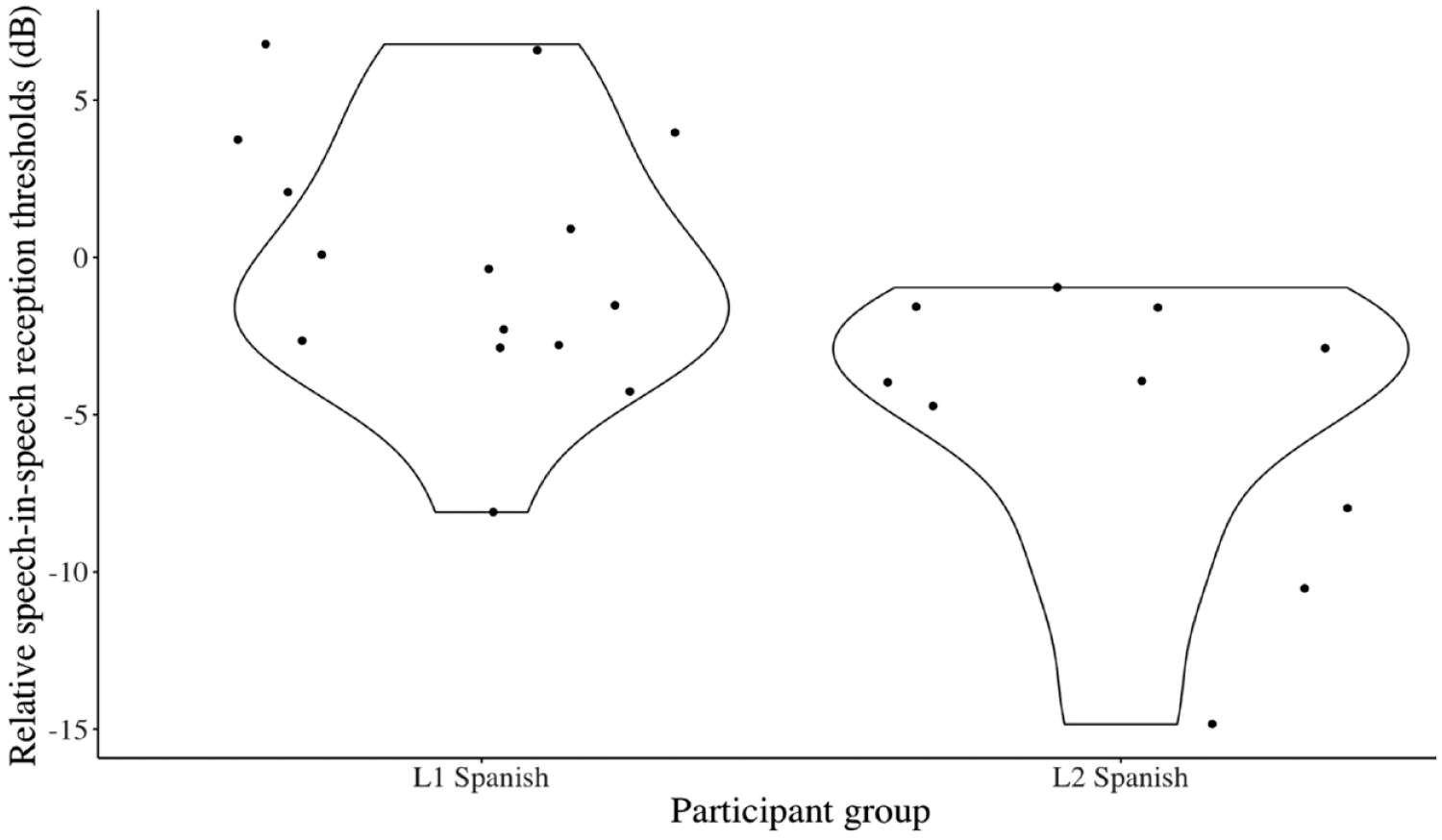
Distribution of relative SRTs by participant group.
We assessed Spearman correlations between relative SRTs and two existing measures of language dominance. Results suggested that as participants’ degree of English dominance increased on the Versant™ Dominance Scores (i.e., higher scores), so did their degree of English dominance on the relative SRT (i.e., lower scores), rs(14), = −.70, p = .002 (see the dotted blue line in Figure 2, panel A). Repeating the correlation analysis after incorporating the extrapolated performance on the English Versant™ Test for the native speakers of English (n = 9), the significant negative correlation between Versant™ Dominance Scores and relative SRTs remained, rs(24) = −.80, p < .001 (see the solid red line in Figure 2, panel A). For BLP Dominance Scores, as participants’ degree of English dominance increased (i.e., higher scores), so did their degree of English dominance on the relative SRT (i.e., lower scores), rs(24) = −.80, p < .001 (see Figure 2, panel B).
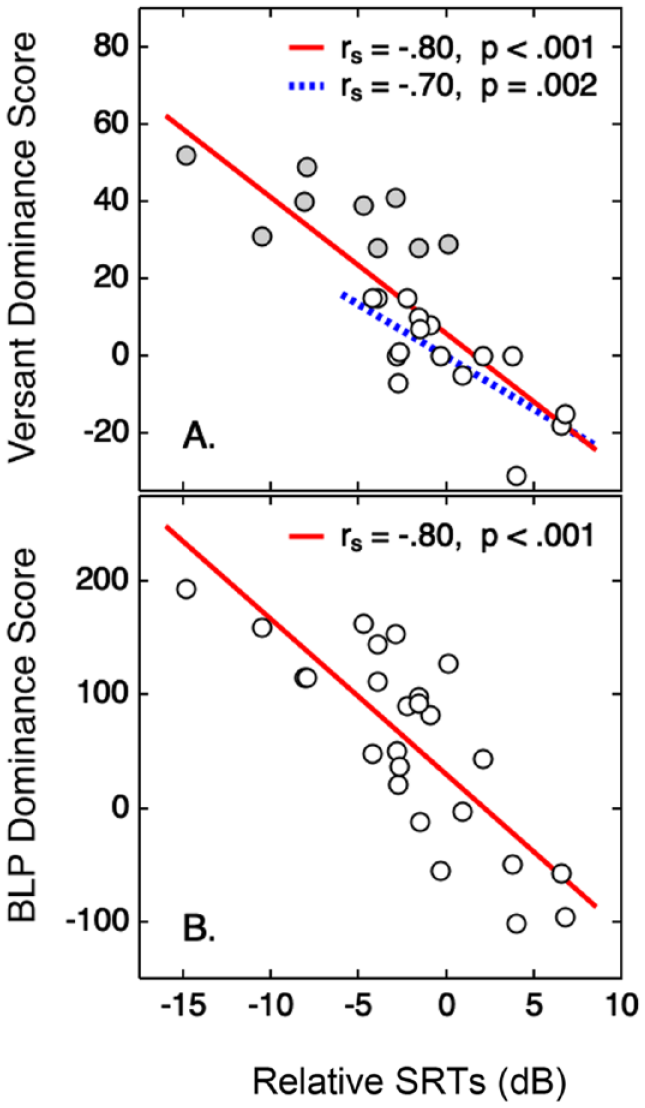
Relative SRTs (dB) in relation to Verasnt™ Dominance and BLP Dominance Scores.
For all measures of language dominance Spanish performance was subtracted from English performance. For BLP Dominance Scores and Versant™ Dominance Scores, negative values correspond to Spanish language dominance, positive values indicate English language dominance, and values near zero suggest balanced language dominance. For relative SRTs, negative values indicate English language dominance, positive values indicate Spanish language dominance, and values near zero correspond to balanced language dominance. The top panel shows Versant Dominance Scores plotted as a function of the relative SRT. Participants with data for the English and the Spanish Versant™ are shown with open circles; filled circles indicate data points for which ceiling performance was assumed for the English Versant™. The solid red line shows the correlation for all data points, and the blue dotted line shows the correlation for just the participants with data in both languages. The bottom panel shows BLP Dominance Score as a function of SRT, following the same plotting conventions.
We also evaluated the correlations between relative SRTs and related measures of language proficiency. Participants with lower relative SRTs (i.e., better performance on the English HINT than the Spanish one) tended to have higher BLP English Proficiency self-ratings, rs(24), = −.72, p < .0001. Moreover, participants with lower relative SRTs had lower BLP Spanish Proficiency self-ratings, rs(24) = .81, p < .0001.
Form equivalency
Form equivalency was evaluated using two linear regression models to test the intercepts of the models. Linear regression calculated how BLP Dominance Scores were predicted by relative SRTs. Relative SRTs significantly predicted BLP Dominance Scores, R2 = .64, F(1, 23) = 40.7, β = −13.7, p < .001. The intercept for the regression model was 29.6 (CI90 = 10.1–49.1).
Linear regression also calculated how Versant™ Dominance Scores were predicted by relative SRTs. Relative SRTs significantly predicted Versant™ Dominance Scores, R2 = .65, F(1, 23) = 42.7, β = −3.5, p < .001. The intercept for the regression model was 5.7 (CI90 = .7–10.6).
Discussion
Research Question 1 asked, “How are speech-in-speech SRTs associated with self-ratings and language proficiency scores in Spanish and English?” We predicted that SRTs would be correlated with existing measures of language proficiency, indicating less susceptibility to masking for participants with greater proficiency in the test language. The findings indicated that Spanish SRTs were negatively correlated with both proficiency self-ratings on the BLP and with Spanish VersantTM composite scores and that English SRTs were significantly correlated with proficiency self-ratings on the BLP and with English Versant™ composite scores. The association between language proficiency and speech-in-speech recognition performance is consistent with prior research findings (e.g., Francis et al., 2018; Krizman et al., 2017) and suggests that language proficiency in the target language influences speech-in-speech thresholds for bilingual adults.
Research Question 2 asked, “How are relative SRTs correlated with measures of language dominance and language proficiency?” All language dominance scores were calculated by subtracting Spanish performance from English performance. For dominance scores derived from the BLP and the Versant™, language dominance values near zero suggest balanced language dominance, positive language dominance values indicate English language dominance, and negative language dominance values correspond to Spanish language dominance. We predicted that relative SRTs would be negatively correlated with BLP Dominance Scores, derived from self-report, and with Versant™ Dominance Scores, derived from standardized language testing. Relative SRTs and the BLP Dominance Scores were strongly correlated, suggesting that differences in speech-in-speech thresholds reflect the same underlying factors as self-reported attitudes, proficiency, history, and demand for use for bilingual Spanish/English adults.
The relative SRTs and the Versant™ Dominance Scores were also strongly correlated. Evaluations of all listeners’ data (i.e., including extrapolated data) and observed data yielded significant correlations between Versant™ Dominance Scores and relative SRTs (as pictured in Figure 2, panel A). We also found significant correlations between language proficiency measures related to the construct of interest, language dominance, and relative SRTs. Together, these correlations support the validity of the proposed measure.
We also assessed the assumption that the Latin American Spanish and American English HINT sentences produced by the same talker were equivalent using linear regression models. Linear regression calculated the intercepts for the function of the line predicting Versant™ and BLP Dominance Scores, respectively, by relative SRTs. If the two HINT forms (using our talker) were equivalent, we would predict intercepts of zero, since bilinguals would exhibit equivalent performance on all measures of language dominance. The intercepts from the regression functions were both significantly greater than zero. This suggests that the Latin American Spanish version of the HINT and the American English versions of the HINT are not equivalent and that the balanced bilinguals on other measures of language dominance have better performance (lower thresholds) on the Latin American Spanish version than the American English one. If true, correction factors could be calculated and applied in future studies to account for the difference in performance across the English and Spanish sentences used in the present experiment. Note also that correction factors might be larger or smaller for the clinically available English and Latin American Spanish recordings, which were produced by two different talkers.
Research implications
Bilinguals are not a monolithic group. Rather, the increased heterogeneity in bilingual populations requires that particular care and attention be given to describing participants across multiple dimensions. A more nuanced understanding of language dominance could help better characterize samples of participants and help account for between-person variability in bilingual speech recognition research.
The reviewed methods for assessing language dominance differ in their conceptualization of the construct and the type of data they yield (e.g., categorical/continuous). Therefore, comparing findings across studies is difficult due to the limited research examining the bilingual experience of participants and how it relates to the observed outcomes. Adding relative SRTs to experimental studies would increase the rigor and reproducibility of designs since the measure provides a more objective assessment than commonly used practices, like questionnaires, for between-person and between-group comparisons. Therefore, shifting to incorporate less subjective behavioral methods into experimental protocols would aid in the comparison of findings between studies.
The potential benefits of using relative SRTs to assess language dominance extend to online research protocols. Online protocols help reduce barriers to participation for groups traditionally underrepresented in research, like individuals from culturally and linguistically diverse backgrounds. Two benefits of online protocols are that they increase scheduling flexibility and reduce geographic barriers to participation (e.g., Carter et al., 2021; Rezlescu et al., 2020). Behavioral tasks, like the relative SRT, would help confirm and characterize participants’ self-reported language proficiency and act as a validation procedure to screen bilingual participants in a time-efficient manner for online studies. Moreover, the relative measure reduces concerns about the calibration of audio hardware, presentation level, and ambient noise levels—since the important metric is a difference score (see Peng et al., 2020).
Limitations
Our results suggest that the English and Latin American HINT sentences may not be equivalent. The present experiment attempted to control differences across corpora by having one talker record both versions of the stimuli (a subset of the English and Latin American HINT sentences). Nonetheless, bilinguals who were identified as balanced by the BLP Dominance Score (i.e., equivalent self-ratings in Spanish and English) and the Versant™ Dominance Score (i.e., equivalent scores in Spanish and English) had relative SRTs significantly greater than zero. Therefore, a correction factor could be calculated and applied in future studies. One approach could be to establish correction factors by assessing performance per stimulus set by simultaneous bilinguals who regularly use both languages (and other bilinguals who are likely to be relatively balanced on other established measures of language dominance).
Another limitation is that there is no “gold standard” or perfectly accurate existing measure of language dominance. While this is a limitation, we intentionally selected established measures that provided a comparison to both self-report and direct assessment as reference standards. Interpretation of the results supports the validity of the relative SRT as a measure of language dominance.
While the present paper found strong correlations between existing measures of language dominance and relative SRTs, these data likely reflect a “best case” since they were collected in a controlled lab setting where adult participants had ample time to complete all tasks. It is possible that other contexts, like asking a caregiver to report on a child’s language proficiency and demand for use, might be more susceptible to reporting bias. Therefore, it is unknown how these associations between measures of language dominance could look if data were collected in different conditions, such as parents reporting language data for preschool-age children.
Clinical and educational implications
Bilinguals have more variability in linguistic skill and experience compared to monolingual populations. This relatively increased variability is associated with greater variability in speech recognition performance compared to monolinguals, which leads to challenges in accurate test interpretation. For instance, linguistic factors and hearing acuity both affect speech-in-speech recognition, making it challenging at times to determine if someone’s elevated speech recognition thresholds are due to limited language exposure or hearing impairment (e.g., Rimikis et al., 2013). Measuring speech-in-speech thresholds in bilinguals’ two languages and calculating relative SRTs could provide a continuous variable proxy for language dominance. Clinically, this could enhance the interpretation of clinical testing, by providing speech-language pathologists and audiologists a dominance score that contextualizes other clinical test performance. Moreover, in speech, language, and hearing science having a measure that reflects both masked-speech recognition performance and language dominance would be beneficial, since it would provide information about speech recognition while simultaneously enhancing understanding of the person’s language dominance.
Another area of future inquiry is to evaluate if relative SRTs could yield reliable language dominance data about bilingual children. In the United States, bilingual children’s language dominance shifts to become English dominant over time, particularly as a result of English-only education models (Blasingame & Bradlow, 2021; Castilla-Earls et al., 2019), and consumption of English-dominant media. Establishing reliable methods to assess language dominance throughout development could provide valuable insight into the time course of language dominance shifts for bilingual children in different educational programs and societal contexts.
Conclusion
Relative SRTs show promise as a valid and efficient way to assess language dominance in experimental research. In the future, this measure could have potential clinical and educational utility; however, future work is needed to further validate relative SRTs for use in these settings.
Footnotes
Declaration of conflicting interests
The author(s) declared no potential conflicts of interest with respect to the research, authorship, and/or publication of this article.
Funding
The author(s) disclosed receipt of the following financial support for the research, authorship, and/or publication of this article: Funding for this project was provided by NIH-NIDCD Grants R01DC015056 and 5T32DC000013-42.
