



Abstract
Aims and objectives:
Profiles of bilinguals vary among studies due to the diversity of intrinsic and extrinsic factors, bilingualism classification and to the discrepancies between measures. Thus, a generalizable index with a defined threshold is needed to capture the linguistic dominance of bilinguals and facilitate comparisons between studies. This study’s objective was to define and examine the validity of a new bilingualism index.
Methodology:
This index was derived from the Language Experience and Proficiency Questionnaire (LEAP-Q) conducted on 100 bilingual Lebanese participants (age = 68.2 ± 9.4 years; education = 12.8 ± 5.2 years).
Data and analysis:
The bilingualism index was based on selected items of the LEAP-Q, optimizing the explained variance on a linear regression using the differential Arabic-French score on the Boston Naming Test as the dependent variable. The validity of the classification was examined using other linguistic (articulatory rate, shortened Token test, Stroop reading subtest) and cognitive screening tests (mini-mental state examination [MMSE]).
Findings and conclusion:
LEAP speaking and oral comprehension scores provided a parsimonious index that accounted for naming variance (R2 = .435, p = .0001) and subdivide our population into three bilingualism subgroups (prominent Arabic, balanced, prominent French). A prominent language advantage was found in the expected direction on linguistic (articulatory rate: p = .03; shortened Token test: p = .026; Stroop reading subtest: p = .0001) and cognitive screening tests (MMSE: p = .08).
Originality and implications:
These results show that a simple index can accurately characterize adult bilingualism subtypes and offers clinicians an easy and fast tool compared with the usual procedure used to determine individuals and patient’s bilingualism subtype. More broadly, the index’s validity in other bilingual populations is warranted for generalizability of the present findings.
Introduction
With the growing bilingual population, bilingualism has become the new norm (Marian & Shook, 2012). Nonetheless, a standard, universal definition of bilingualism may be difficult to implement across a variety of populations and ages. Some widely accepted definitions of bilingualism have been found in the literature; however one seems to be the most relevant for the current study as a theoretical background and defines it as the ability to alternate between two languages, implying that a bilingual person “uses two or more languages in everyday life” (Grosjean, 2010). Numerous parameters and several intrinsic (age of acquisition (AoA), intensity or degree of mastery, learning context . . .) and extrinsic (language practice, context of use, social hierarchy . . .) factors influence bilingual’s skills and determine the type of bilingualism (Geiger-Jaillet, 2005; Rezzoug et al., 2007). Therefore, early bilingualism must be distinguished from late bilingualism: early simultaneous bilingualism, which implies that the individual has acquired two languages simultaneously from birth, and early sequential bilingualism, which is characterized by the acquisition of two languages very early in childhood, but successively (De Houwer, 2021; Hamers & Blanc, 1983, pp. 6–25). Bilingualism is late if the second language (L2) is learned from the age of 12 years (De Houwer, 2021; Heredia & Cieślicka, 2014, pp. 42–52). Moreover, bilingualism can be either prominent (i.e., dominant) or balanced: an individual has prominent (i.e., dominant) bilingualism when he is more proficient in a language compared with the other language, while he would be described as balanced when he is equally proficient in both languages (Birdsong, 2014; Gathercole & Thomas, 2009; Kohnert, 2008). However, in a context of relocation or immigration, where one language is socially privileged, some authors speak of the devaluation of so-called “heritage” languages (Rezzoug et al., 2007), which impacts on the practice and maintenance of this language by participants. Lambert (1974), Houwer and Ortega (2018) make a distinction between additive bilingualism, which is highly valued by the entourage and environment, and subtractive bilingualism, which is little known or devalued by society.
Therefore, today among studies targeting bilingual populations in neuroscience, many tools have been used to determine the type of bilingualism and language dominance. Self-rating questionnaires have occurred as the most applied and commonly used assessment tools. Soares and Grosjean (1984) recommend rating each language modality separately (understanding, speaking, reading, and writing), as these abilities may reveal unequal capacities. Indeed, proficiency levels in these domains are often used to determine language dominance with other factors, such as age, level of education, language acquisition context, language experience, habits, and linguistic and cultural identity (Schmid & Yılmaz, 2018). Thus, it is important to distinguish between language dominance and language proficiency, which refers to the ability to understand, speak, read, and write language (Marian & Hayakawa, 2021) and is assessed using language proficiency scores. Language dominance, however, is a construct that derives from the nature of bilingualism (Grosjean, 1998) where cross-linguistic comparisons of language proficiencies typically show linguistic dominance (where one language is found to be more proficient than the other one) (Gathercole & Thomas, 2009). Paradis (1989) added other factors that are now known to influence and shape a bilingual individual’s performance on linguistic and executive tests, such as the AoA, acquisition manner (formal or informal), form or frequency of use, literacy in each language, and so on. An important variable to consider is the AoA, which is generally used to provide the classification of early, late, or simultaneous acquisition. To quantify bilingualism while taking into consideration all the elements cited above, many questionnaires have been developed such as the Language History Questionnaire (Li et al., 2006), the Language Experience and Proficiency Questionnaire (LEAP-Q) (Marian et al., 2007), Language Background Questionnaire (Sabourin et al., 2016), Language and Social Background Questionnaire (Anderson et al., 2018), Bilingual Language Profile (BLP) (Birdsong et al., 2012), and The Contextual Linguistic Profile Questionnaire (Wigdorowitz et al., 2023). To date, the LEAP-Q exists in 36 different languages (including Modern standard Arabic), has been adapted socially and culturally for bilinguals around the world, and can be easily administered in an oral interview setting, digital or even using paper-and-pencil. It gives the opportunity to provide a full profile for bilingual participants and to determine bilingualism subtypes.
Bilingualism subtype (prominent first language [L1], balanced bilingualism, prominent L2), defined as language dominance in bilingual individuals, is generally determined using self-reported reading proficiency and self-reported speaking proficiency in the LEAP-Q (Marian et al., 2007). A significant number of studies have determined the bilingualism subtype according to raw scores on a self-reported questionnaire (Berkes et al., 2020; Lamar et al., 2019; Raji et al., 2020; Wauters & Marquardt, 2018). As a matter of fact, while using the scores collected from the BLP (Birdsong et al., 2012), Birdsong (2016) has attempted to create an index to better identify bilingualism subtype: he suggested the following formula for establishing language dominance:, (Language A Score—Language B Score) / the greater of the two scores + 1, /2. Multiplying this result by 100 will give scores ranging from 0 to 100, with 50 as the score for perfectly balanced bilingualism. Whereas other studies (Cop et al., 2015; Gasquoine et al., 2019) have calculated the proficiency ratio (L1: L2) based on various aspects of language: numerous standardized language tests to assess oral expression have been used, such as the Expressive Vocabulary Test (Williams & Wang, 1997), the Woodcock-Munoz Language Survey—Revised Picture Vocabulary subtest (Woodcock et al., 2005), the Multilingual Naming Test (MINT) (Gollan et al., 2012), and Boston Naming Test (BNT) (Kaplan et al., 1978). As a matter of fact, the relevance of naming to assess language proficiency, and more specifically the BNT, in particular, derived from the examination of aging, has been demonstrated in numerous studies (Roussel et al., 2016; Tran & Godefroy, 2015) and brain damage (Andriuta et al., 2018). Whereas, for oral comprehension, the Shipley Vocabulary Test (Shipley, 1940), Peabody Picture Vocabulary Test (Dunn & Dunn, 1997), LexTALE (Lemhöfer & Broersma, 2012), and more recently, the Ecological Momentary Assessment (Jylkkä et al., 2020) have been the most used. While other capacities seem to be influenced by language proficiency, such as articulatory rate (Kim et al., 2022) and reading speed (Cop et al., 2015), to our knowledge, no studies have adopted them as a proficiency measure in a bilingual elderly population.
Recently, two studies compared the bilingualism classification based on questionnaires (including self-rating), structured oral proficiency interviews and naming tests notably BNT and the MINT (Gollan et al., 2012; Sheng et al., 2014) and found that these four measures converged in classifying bilinguals into language-dominance groups. However, they specified that the BNT and the MINT (more specifically the BNT) classified bilinguals as more prominent English than self-rating and interview measures in their Spanish-English bilinguals (Gollan et al., 2012) and Mandarin-English bilinguals (Sheng et al., 2014). Therefore, they concluded that to have a full assessment of bilinguals’ language proficiency, a single measure is insufficient (Gollan et al., 2012; Sheng et al., 2014) and a combination of measures appears to be the best way to quantify bilingualism. Consequently, a growing number of recent studies (Cop et al., 2015; Gasquoine et al., 2019; Woumans et al., 2015) have opted for the use of a combination of subjective and objective measures on language tests obtained in both languages to determine bilingualism subtypes of their population but none confronted this combination with another language test to examine the validity of this combination as it was not the aim of their study.
This literature review shows that several factors explain inconsistencies in grouping bilinguals into subtypes such as the absence of a consistent definition of bilingualism (Anderson et al., 2018), the lack of a clear age and cutoff scores to determine the type of bilingualism (early or late; prominent, balanced), and discrepancies between the objective measurements of language performance and questionnaires. Such diversity in bilingualism classification in heterogeneous populations across studies contributes to conflicting results. Furthermore, an agreement on a single measure in the bilingual elderly neuroscience literature does not exist, despite the fact that it is recommended (De Cat et al., 2018). Therefore, a single generalizable index with a defined cutoff based on combination of subjective and objective measure is needed to capture bilingualism dominance. Its creation will facilitate direct comparisons between individuals, as well as between neuroscience research teams (Marian & Hayakawa, 2021) studying elderly population.
As regards the objective of defining an index of bilingualism, a particularly interesting country is Lebanon, as its population is currently immersed from birth in a multilingual environment. Several languages are used in this country in particular Modern Standard Arabic, Lebanese Arabic, French, English, and Armenian (Daccache et al., 2020; Hoteit, 2010; Kanaan, 2011; Makki, 2007; Saliba, 1978). The country’s official language is Modern Standard Arabic, used mainly in writing and the media, while Lebanese Arabic, used for communication purposes between individuals, is spoken by 93.7% of the Lebanese population (Leclerc, 2015). In 2007, a survey showed that 45% of Lebanese spoke French and 40% spoke English (Gingra, 2011). So, today, it is not surprising to hear Lebanese, French, and English in the same sentence (Kotob, 2002). This prevalent bilingualism in Lebanese society, described as early (Zablit & Trudeau, 2008), is also reflected in the education system: at the time of schooling, parents choose either a French-speaking or English-speaking school for their children (Kouba-Hreich & Messarra, 2020, pp. 11–26). Therefore, Lebanese children are simultaneously taught two languages (Arabic and French or Arabic and English) and two distinct alphabetical systems: the Arabic alphabet and the Latin alphabet. In 2005, the majority of pre-university education was provided by establishments following the Lebanese national curriculum, in addition to those following a French curriculum and approved or contracted by the French Ministry of Education. According to the Ministry of Education and Higher Education in Lebanon, the Lebanese national curriculum is characterized by teaching the following subjects in Arabic: Arabic, geography, history, and civic education; and the other subjects are taught in a foreign language (English or French): physics, chemistry, biology, science, foreign language (Byloun, 2015). Lebanese bilingualism (simultaneous or sequential) falls into the category of early bilingualism, which provides the opportunity to compare balanced bilingualism and prominent (i.e., dominant) bilingualism. It is important to note that even though Lebanese people live in a multilingual environment, they usually master two languages (Arabic and French or Arabic and English).
The main objective of this cross-sectional study was to take advantage of Lebanese bilingualism to establish a multidimensional bilingualism index and assess its relationship with a confrontation naming test. The secondary objective was to assess the relationship between the resulting bilingualism subtypes with other measures of language and general cognitive screening. Our hypothesis was that the resulting bilinguals’ subgroups will differ on other linguistic and screening tests.
Materials and methods
Participants
The study group consisted of healthy Lebanese resident participants who fulfilled the following inclusion criteria: (1) must have been exposed before the age of 12 years to at least two languages, Arabic and French, (2) aged between 55 and 92 years, (3) living in Lebanon, (4) free of exclusion criteria (illiteracy, any declared psychiatric or neurological disease affecting cognition, and any auditory or visual or motor deficit precluding cognitive testing) according to an auto-questionnaire adapted for the study (Godefroy et al., 2010), and (5) consenting to participate. We obtained informed consent from all individuals prior to their participation in the study in the preferred language chosen by the individual. The study protocol and procedures were approved by the ethics committee of the Hôtel-Dieu de France Hospital (file CEHDF 1449).
From February to November 2020, 100 bilingual speakers from various regions of Lebanon (South, Beirut, North) were included (Table 2).
Procedure
Given the lack of validated criteria, we reasoned that an appropriate combination of the Arabic translation of LEAP-Q (Marian et al., 2007) items should be able to account for between-language differences in performance on a naming test, such as the BNT (Roussel et al., 2016). Thus, the self-assessment of bilingual abilities was performed first, and we then later explored its association with linguistic abilities assessed in both languages using confrontation naming. This allowed us to select the appropriate LEAP-Q items and define their cutoff scores to determine bilingualism subtype. Finally, we examined the relationship between bilingual subtype and other objective measures of language ability, including articulatory rate, oral comprehension, reading speed, and general cognition.
Self-reported questionnaire
We explored the bilingualism background of our population using the Arabic version of the LEAP-Q (Marian et al., 2007). This questionnaire captures the main factors that determine a bilingual profile, such as age and modes of acquisition, language proficiency and dominance and current use of language. We first focused on Questions 1 and 2 from Part 1 of the LEAP-Q, where our participants were asked to classify their languages first according to their dominance (from their subjective point of view) (prominent Arabic, prominent French, or balanced Arabic-French) and then according to first exposure making it possible to distinguish between simultaneous bilingualism (being exposed to both languages from the moment of birth), early consecutive bilingualism (in which acquisition of both languages occurs very early but successively Hamers & Blanc, 1983), and late bilingualism (in which learning of the L2 occurs after the age of 12 years De Houwer, 2021; Heredia & Cieślicka, 2014, pp. 42–52). Early simultaneous or consecutive bilingualism globally characterizes the linguistic situation in Lebanon (Zablit & Trudeau, 2008).
In Section 2 of the LEAP-Q, we also explored the age at which the participants began to acquire each language, became fluent, began reading, and became fluent in reading Arabic and French, which corresponds to Question 1 and is specifically dedicated to a detailed self-reported exploration of each language spoken by the participant. However, knowing that, self-ratings in each language could also differ depending on the language combinations (Tomoschuk et al., 2019), participants were only asked to rate their L1 and L2, which was in all our population Arabic and French. As Marian et al. (2007) suggested that self-reports reflect language performance and capacities, we further analyzed speaking proficiency (i.e., SpeakLev), understanding (i.e., UndersLev), and reading in each language to maximize the variance of the BNT explained by the LEAP-Q items. This further analysis was based on nine items of the LEAP-Q: Questions 1 and 2 from Section 1 and Questions 1–7 from Section 2. In our further analysis, the difference between the proficiency level in speaking Arabic and French corresponded to SpeakLev Ar-Fr and the difference between the level of understanding Arabic and French corresponded to UndersLev Ar-Fr.
Linguistic abilities
To determine language dominance, it is important to assess language skills, which correspond to the ability to understand, speak, read, and write language (Marian & Hayakawa, 2021). Therefore, we administrated a set of linguistic tests to explore these language skills through the comprehension of spoken instructions, naming task, articulatory rate task, reading speed task and general cognition exploration with important linguistic component. All tests were conducted in both Arabic and French in a counterbalanced order (beginning by tests in the Arabic language for participants with an even prescreening number): 53 participants were first assessed in Arabic and 47, in French. The tests included (1) the 34-item adaptation of the BNT (Roussel et al., 2016) to explore naming abilities, (2) a measure of articulatory rate, (3) the shortened Token test (De Renzi & Faglioni, 1978) to assess the comprehension of spoken instructions, (4) French (Godefroy et al., 2010) and Arabic (performed by our team) adaptations of the Stroop (Stroop, 1935) test, as part of our neuropsychological assessment to assess reading speed in both languages, and (5) French (Kalafat et al., 2003) and Arabic (El-Hayeck et al., 2019) adaptations of the mini-mental state examination (MMSE) to assess general cognition and exclude any cognitive impairment. Since some words in Lebanese Arabic are borrowed from French or English and to avoid a cognate effect, the items chosen in the BNT did not include words where a cognate effect can be observed.
The BNT test was chosen based on its validity in studies of aging (Roussel et al., 2016; Tran & Godefroy, 2015) and brain injury (e.g., Andriuta et al., 2018; Godefroy et al., 2002), its international use in a variety of languages and its practical, easy, and rapid use. As for articulatory rate, it was controlled, as the two languages are spoken at different speeds (Jacewicz et al., 2009). It is important to mention here that we noticed that a significant percentage of the population did not know the month of the year in both languages. Therefore, this test required participants to recite aloud, as fast and clearly as possible, the days of the week in both Arabic and French, which corresponds to 15 and 17 syllables, respectively. Oral production was recorded, and the articulatory rate (number of syllables/sec) computed. As for the shortened Token test (De Renzi & Faglioni, 1978), it was selected for its reliability in detecting comprehension disorders (i.e., the presence of aphasia), which was necessary in our study, and for being easily adaptable to Lebanese Arabic due to its simple structure and non-cultural testing approach (test based on basic knowledge of colors and shapes). Since our population underwent linguistic and executive testing it was convenient to use Stroop reading subtest to assess reading speed. The version of the Stroop reading subtest used, included three color names (red, blue, and green), which are monosyllabic in French and disyllabic in Arabic. For this reason, we analyzed the rate of syllable reading (rate = number of correct syllables produced in 1 s). Finally, the MMSE is a cognitive screening test very frequently used in clinical assessment, characterized by high linguistic demands, including oral comprehension, oral expression, repetition, reading, and writing (Folstein et al., 1975), which makes its use compatible with our objectives.
Analysis
Determination of the self-rated bilingualism index
Regarding our main objective, our hypothesis was that the right combination of the LEAP-Q scores will allow to create a bilingualism index and to trichotomize our population into three bilingualism subtypes that differ on naming abilities. Regarding our secondary objectives, while examining the validity of this bilingualism index on other linguistic tests assessing language skills and screening of cognitive abilities our hypothesis was that bilingualism subtype will interact with the language of assessment (i.e., prominent Arabic would perform better on the Arabic version of the test and prominent French on the French version of the test).
We determined the LEAP scores useful for the classification of bilingualism subtype by examining the relationships between LEAP scores and BNT scores measured in both Arabic and French. In all of our analyses, Ar-Fr scores were calculated. In a first bivariate step, Pearson’s correlation analysis was used to examine the relationship between the differential Arabic-French score on the BNT (Ar-Fr dBNT) (i.e., the score in Arabic—the score in French) and the differential Ar-Fr score on the nine items of the LEAP-Q. Items of the LEAP-Q significantly associated with the Ar-Fr dBNT score were considered for the second multivariate step that determined items useful for the classification of bilingualism subtype. We selected LEAP items optimizing the explained variance (i.e., adjusted R2) of the Ar-Fr dBNT score in a general linear model analysis, with the differential Ar-Fr dBNT score as the dependent variable. This result was checked using combined scores of three oral scores (Ar-Fr dArticulatory rate, Ar-Fr dBNT score, Ar-Fr dToken test score) as dependent variable and it provided exactly the same results (results not shown). The LEAP-Q bilingualism index selected in the linear regression was combined using principal component analysis to create the bilingualism index. The bilingualism index was trichotomized (prominent Arabic, balanced bilingualism, prominent French) with cutoff scores defined using receiver operating characteristic (ROC) curve analysis with the dichotomized Ar-Fr dBNT score (negative, positive) as the state variable.
The three resulting bilingual subtypes were analyzed by comparing their demographic characteristics using chi2 test (sex, handedness, education level, test order) and analyses of variance (ANOVA) (age). The effect of bilingualism subtype on the differential Ar-Fr dBNT score was illustrated by ANOVA with bilingualism subtype (prominent Arabic, balanced bilingualism, prominent French), language (Arabic or French), and completion order (Arabic tests first, French tests first) as between-subject factors. Post hoc analysis was performed using the Ryan Einot Gabriel Welsch test. Relationships between other linguistic abilities and the MMSE score were examined by comparing the Arabic and French scores on articulatory rate, shortened Token test score (oral comprehension), reading speed (Stroop reading subtest), and MMSE. This analysis was performed using four ANOVA (first: articulatory rate; second: shortened Token test score; third: completion time of the Stroop reading subtest; fourth: MMSE score) with bilingual subtypes (prominent Arabic, balanced bilingualism, prominent French) as the between-subject factor and repeated analysis on the factors of language (Arabic, French) and completion order (Arabic tests first, French test first). All statistical analyses were performed using SPSS®. A P value ⩽ 0.05 was considered significant, unless otherwise indicated.
Results
First, we will expose the results of the correlation analysis to establish a multidimensional bilingualism index then we will explore its relationship with a confrontation naming test. Second, we will investigate the relationship between the bilingualism subtype created from the bilingualism index with other linguistic abilities (articulatory rate, oral comprehension, reading) and general cognitive screening.
Bilingualism subtype
The correlation analysis showed that all nine LEAP-Q items (Supplemental Table) were associated with the differential Ar-Fr dBNT score (Table 1). By stepwise linear regression, the best account of the Ar-Fr dBNT score was provided by the LEAP-Q combined score of SpeakLev Ar-Fr and UndersLev Ar-Fr (R2 = .435, p = .0001). Both SpeakLev Ar-Fr and UndersLev Ar-Fr scores were grouped using principal component analysis to create the bilingualism index.
Correlations between the nine LEAP-Q items and Arabic-French differences on Boston Naming Test score (Ar-Fr dBNT score).
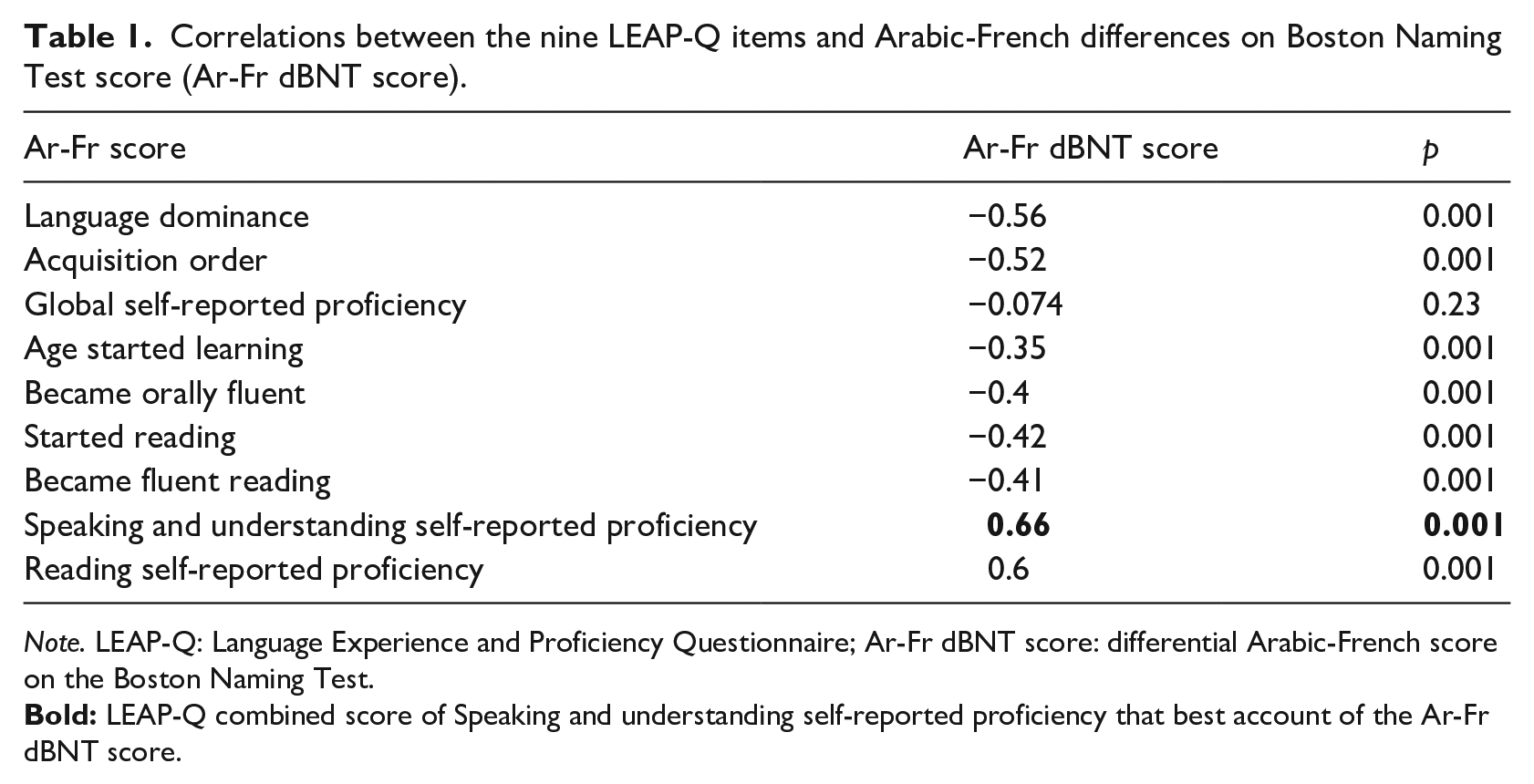
Note. LEAP-Q: Language Experience and Proficiency Questionnaire; Ar-Fr dBNT score: differential Arabic-French score on the Boston Naming Test.
ROC curve analysis of the bilingualism index with the dichotomized Ar-Fr dBNT score as the state variable showed a high area under the curve (0.893, 95% CI = [0.823, 0.962], p = .0001) (Supplemental Figure). The cutoff scores of the bilingualism index were determined (Figure 1): a cutoff score < −2 provided the best discrimination to identify participants with higher naming performance in French (i.e., negative Ar-Fr dBNT score) and therefore they belonged in the prominent French subgroup; a cutoff score > 2, selected participants with higher naming performance in Arabic (i.e., positive Ar-Fr dBNT score) and therefore creating the prominent Arabic subgroup. Finally, participants who scored between −2 and 2 were considered as balanced bilinguals. On this basis, the group was categorized as prominent Arabic (N = 35), balanced bilingualism (N = 58), and prominent French (N = 7) (Table 2). The three subgroups did not differ according to age, education level, sex, handedness, or order of completion (Table 2).
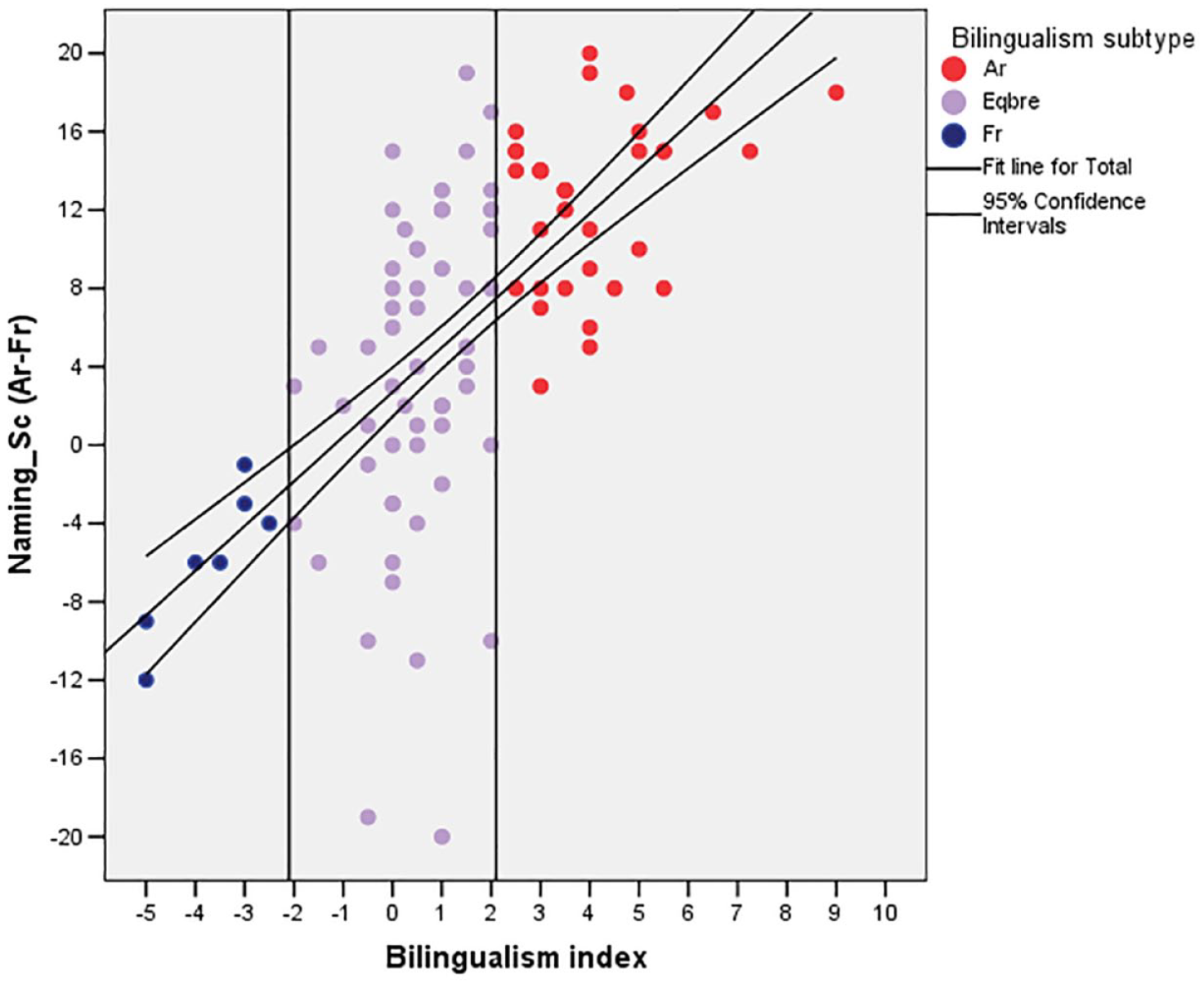
Relationship (linear regression line with 95% confidence interval) between the differential Arabic minus French Boston Naming Test score (Naming_Sc_Ar_Fr) (Y axis) and the bilingualism index (X axis).
Characteristics of the three bilingualism subgroups expressed as the number (n) of participants and the mean ± standard deviation.
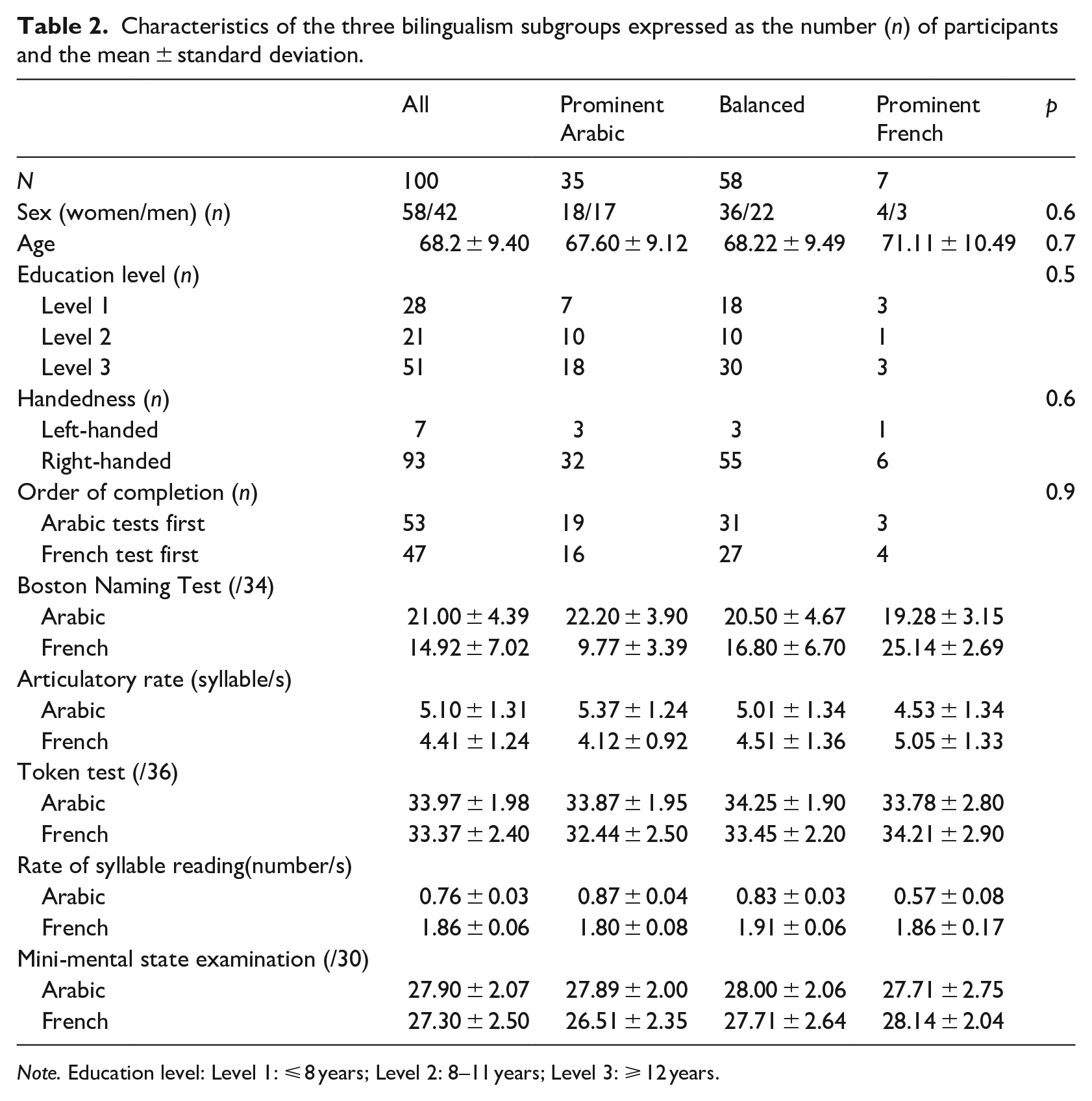
Note. Education level: Level 1: ⩽ 8 years; Level 2: 8–11 years; Level 3: ⩾ 12 years.
As expected, BNT scores differed according to (1) bilingualism subtype (p = .001, η2 = 0.19) due to a better score for the prominent French subgroup (22.4 ± 1.4) than the balanced subgroup (18.7 ± 0.47), which was, in turn, better than that of the prominent Arabic subgroup (16.11 ± 0.6), and (2) according to language (p = .001, η2 = 0.11), due to an overall better score in Arabic than French (completion order: p = .6) (Table 2). Consistent with the method of subgroup determination, the bilingualism subtype × language interaction was significant (p = .0001, η2 = 0.381) due to a higher score in Arabic for the prominent Arabic subgroup and a higher score in French for the prominent French subgroup.
These analyses show that two scores from the LEAP (SpeakLev Ar-Fr and UndersLev Ar-Fr) can provide a bilingualism index that allows us to trichotomize the study population into three bilingualism subtypes consistently with scores on the BNT in both languages. The validity of this index was now examined on other tests assessing language skills and screening of cognitive abilities.
Relationship between bilingualism subtypes, other linguistic abilities, and MMSE score
The articulatory rate did not differ between bilingualism subtypes (p = .9) but did differ between languages (p = .03, η2 = 0.051) due to a faster rate in Arabic than French (completion order: p = .4) (Table 2). As expected, the bilingualism subtype × language interaction (p = .001, η2 = 0.148) was significant, due to a faster articulatory rate in Arabic for the prominent Arabic subgroup and a faster articulatory rate in French for the prominent French subgroup.
The shortened Token test score, which indexes oral comprehension (Table 2), did not differ between bilingualism subtypes (p = .41, η2 = 0.064) but was influenced by language (p = .026, η2 = 0.051) due to better scores in Arabic than French (completion order: p = .4) (Table 2). As expected, the bilingualism subtype × language interaction (p = .042, η2 = 0.064) was significant due to better performance in French for the prominent French subgroup and better performance in Arabic for the prominent Arabic subgroup.
The rate of syllable reading did not differ between bilingualism subtypes (p = .4, η2 = 0.02) but did according to language (p = .0001, η2 = 0.862) due to a faster rate in French (1.86 ± 0.06) than Arabic (0.76 ± 0.03) (completion order: p = .2) (Table 2). In addition, the significant bilingualism subtype × language interaction (p = .009, η2 = 0.096) was due to a disproportionately longer reading time in Arabic for the prominent French subtype (Table 2).
MMSE scores did not differ between bilingualism subtypes (p = .3), language (p = .08), or completion order (p = .64) (Table 2). The bilingualism subtype × language interaction was significant (p = .008, η2 = 0.09) due, as expected, to better MMSE scores in Arabic in the prominent Arabic subgroup and better MMSE scores in French in the prominent French subgroup.
These analyses demonstrate as expected, an advantage in the prominent language of bilingual participants when assessing articulatory rate, oral comprehension, reading speed, and general cognitive abilities as indexed by the MMSE.
Discussion
This study aimed to re-examine the methods of determination of bilingualism subtype by establish a multidimensional bilingualism index and assess its validity with language measures and general cognitive screening. Our results yielded that linguistic abilities of bilinguals defined according to selected indices from the LEAP-Q are influenced by the language of assessment in the expected direction, with an advantage conferred by the prominent language for naming, articulatory rate, oral comprehension, and speed of syllable reading. In addition, performance was, overall, slightly better in Arabic for oral comprehension and articulatory rate, whereas the reverse was observed for reading speed. Finally, the advantage conferred by the prominent language was also observed for the MMSE, a screening test with high linguistic demands. Our findings converge with some authors (Cop et al., 2015; Gollan et al., 2007, 2012; Kim et al., 2022; Marian et al., 2007; Milman et al., 2018; Sheng et al., 2014; Sheppard et al., 2016) and diverges on some points with others (Gollan et al., 2012; Sheng et al., 2014).
Confrontation between self-rating and actual linguistic performance showed that two items of the LEAP-Q, namely the proficiency level in speaking and understanding, were associated with the differential of naming between languages. The high area under the ROC curve indicates a close relationship between self-rated and actual measures of bilingualism on the BNT, thus showing that these two LEAP-Q items capture most of the bilingualism subtype. This is supported by the finding that the addition of other LEAP-Q items in the regression analysis did not meaningfully improve the explained variance. These results indicate that the use of these two LEAP-Q items may be especially relevant to classify bilingualism subtype. The actual measure of linguistic abilities between languages was based on a confrontation naming test performed in both languages; this measure draws on a considerable number of studies showing the relevance of naming for assessing language skills, particularly those derived from the study of aging (Roussel et al., 2016; Tran & Godefroy, 2015) and brain damage (e.g., Andriuta et al., 2018; Godefroy et al., 2002). As a matter of fact, our results are consistent with other findings with different subjective measures. Notable with Gollan et al. (2012) findings in Spanish-English bilinguals on the classification convergence between the BNT and the Language History Questionnaire and with Sheng et al. (2014) in Mandarin-English bilinguals on the classification convergence between the BNT and self-ratings. However, in both studies the MINT indicated higher degree of English dominance compared with other measures and even higher for the BNT in Gollan et al. (2012).
Importantly, our study also showed a close relationship of our bilingualism classification with other linguistic abilities, namely articulatory rate, oral comprehension, reading speed, and cognition, based on a screening test with high linguistic demands (as it includes oral comprehension, oral expression, repetition, reading, and writing subtests). This supports the external validity of our bilingualism classification. Our finding converges with Marian et al. (2007) outcome of a correlation in the expected direction between self-reported understanding, speaking, and reading of the LEAP-Q and performances on tests assessing naming, oral comprehension, reading, written comprehension, and grammaticality judgments. Therefore, we can recommend the use of our bilingualism index to the assessment of bilingual population aged 55 years and over, in the perspective of cognitive testing. By simply calculating the average of SpeakLev Ar-Fr and UndersLev Ar-Fr, authors can quantify the language dominance of their healthy elderly population and pathological older adults with mild to moderate cognitive impairment. This can be very helpful for clinicians opting for linguistic and cognitive assessment in multilinguals countries such as Lebanon.
Our analyses revealed significant differences in BNT scores between bilingual subgroups, with an advantage observed in the prominent language. A higher level of proficiency implies fewer naming errors and a richer lexical stock, which could, in turn, explain the higher scores in Arabic for the prominent Arabic subgroup and inversely in French. Two studies (Gollan et al., 2007; Sheppard et al., 2016) examined performance on the BNT naming test in both languages of bilinguals. Our results support the findings of Gollan et al. (2007) on 29 English-Spanish balanced and unbalanced bilinguals who performed better in their prominent language. Furthermore, in the balanced subgroup, pictures with cognate names were named more easily and accurately across languages (Gollan et al., 2007). It is important to note that the cognate effect, generally observed in naming tests of bilinguals, was not truly relevant in our study, as Lebanese Arabic and French do not have many cognate names and more precisely on the list of words included in the BNT. Moreover, our Arabic-French balanced bilinguals performed numerically better in Arabic than French, a finding also observed by Sheppard et al. (2016), who found better performance in English than French among balanced French-English bilinguals. This finding can be explained by several mechanisms. First, individuals in the balanced subgroup may be more exposed to one language in their daily life. As a matter of fact, our participants were more frequently exposed to Arabic than French in their daily life. Second, the difficulty of BNT items may differ between languages; however, we were not able to control this factor as a frequency dictionary in Lebanese Arabic does not exist yet. Thus, the hypothesis of differences in the difficulty of the BNT between languages is yet to be generally proven, in particular, between Lebanese Arabic and French.
A faster articulatory rate was found in the prominent language. This result converges with the observation of Kim et al. (2022) of a significantly slower speaking rate in L2 English speakers than L1 English speakers and extends it to Arabic-French bilinguals. This finding can be explained by the fact that word production in the L2 is less automatic; therefore, lexical retrieval and articulatory processing require the recruitment of additional neural networks compared with the one involved in the L1 (Liu et al., 2010). The overall faster rate in Arabic was due to the small size of the French prominent subgroup.
The linguistic advantage in the expected direction was also observed for the shortened Token test. This provides an objective measure of the better oral comprehension skills conferred by the prominent language, which has not been previously documented by a sentence comprehension test, in particular, for Arabic-French bilinguals. The overall higher score in Arabic was due to the small size of the prominent French subgroup.
Reading speed differed across bilingualism subtypes, with an advantage in the prominent language. This advantage in the prominent language supports the findings of Cop et al. (2015) who defined L1 and L2 reading patterns in bilinguals: in comparison to L1 readers, L2 readers take 20% more time to read sentences, fixe words 21% longer, engage in 12% shorter saccades, and skip 4.6% less words. This difference in speed between subtypes suggests that language proficiency may play a crucial role on reading outcomes. In addition, reading speed was globally faster in French than Arabic. This is the sole test in which such a pattern was observed and contrasts sharply with the overall faster articulation rate in Arabic. The selected color names are monosyllabic in French and disyllabic in Arabic. However, this is unlikely to explain this difference, as we analyzed the rate of syllable reading. The contribution of different senses of visual scanning (left to right in French, right to left in Arabic) between languages constitutes a potential explanation that would require a specific study.
We found the expected advantage in the prominent language for the MMSE. These findings support those of earlier studies showing an intimate relationship between MMSE scores and language proficiency (reported from standardized tests), with language proficiency accounting for 67% of MMSE variance in a bilingual Spanish–English group and 42% of the variance in a bilingual Asian Indian-English group (Milman et al., 2018). This supports the heavy reliance of the MMSE on language components (Tombaugh & McIntyre, 1992).
Limitations
This study had several limitations. First, we used one naming test as the main measure to assess oral language capacities. Although we adapted it to the Lebanese culture, its use can be debated, as item difficulties (frequency, linguistic characteristics of names, etc.) were not assessed between languages. Therefore, it would be informative to compare different naming tests created specifically for multilinguals on a large sample of an elderly population. However, this test was found to appropriately assess controls and patients from diverse cultures and languages throughout the world (Lo et al., 2019) and, more importantly, to show that naming relies on a common brain mechanism (Weaver et al., 2021). Despite this potential shortcoming, a strength of our study was the large sample of bilinguals assessed in both languages and the variety of native bilingualism subtypes in the Lebanese population. Furthermore, we utilized easily accessible tests for professionals, as well as a user-friendly scale from the LEAP-Q for participants. In particular, the bilingualism index that we created appeared to be associated with performance for both languages in several linguistic tests that assess the main aspects of oral and written language, as well as screening of general cognitive abilities. Second, Marian and Hayakawa (2021) recommended “the use of large, diverse datasets and advanced statistical methods to select and weight attributes to implement flexible methods of administering, weighting, and scoring variable standards of comparison based on demographic characteristics to determine relative bilingualism” and its change over time and to establish norms. In our study, many elements were taken into consideration as we followed Kremin and Byers-Heinlein (2021) suggestion that bilingualism measurement should follow either categorical or continuous models depending on the relation between a study hypothesis and its observable measures: in clinical neuroscience, and more precisely in studies concerning one time measurement, we find categorical model more practical, efficient and best suited for the addressed questions. Therefore, certain requirements proposed by Marian and Hayakawa (2021), such as assessing changes in bilingualism over time could not be taken into consideration in the categorical model in our study. Adding a number of key questions and methods to incorporate all these variables will be highly challenging but necessary.
Finally, our results demonstrated that a simple index can accurately characterize adult bilingualism subtypes and therefore has clinical implications. As a matter of fact, health care professionals increasingly encounter bilingual patients, especially in Lebanon where a majority of the population is bilingual, and a variety of bilingualism subtypes exists, a circumstance that frequently prompts inquiry into the influence of language choice on the assessment of linguistic and cognitive abilities, and consequently, the determination of the cognitive status required for diagnosis. Our index offers clinicians an easy and fast tool compared with the usual procedure used to determine individuals and patient’s bilingualism subtype. More broadly, the index’s validity in other bilingual populations is warranted for generalizability of the present findings.
Supplemental Material
sj-docx-1-ijb-10.1177_13670069231203834 – Supplemental material for Determination of bilingualism subtypes and their relationship with linguistic abilities in Lebanese bilinguals
Supplemental material, sj-docx-1-ijb-10.1177_13670069231203834 for Determination of bilingualism subtypes and their relationship with linguistic abilities in Lebanese bilinguals by Rania Kassir, Halim Abboud and Olivier Godefroy in International Journal of Bilingualism
Footnotes
Acknowledgements
The authors thank all the participants who volunteered for this study for their time and effort in completing their tests.
Declaration of conflicting interests
The author(s) declared the following potential conflicts of interest with respect to the research, authorship, and/or publication of this article: Rania Kassir declare no conflict of interest. Olivier Godefroy has served on scientific advisory boards (Novartis and Astra Zeneca), received funding for travel and meetings from Novartis, Lilly, Genzyme, Astrazeneca, Biogen, Teva, Pfizer, CSL-Behring, GSK, Boehringer-Ingelheim, Ipsen, Covidien, Bristol-Myers Squibb. Halim Abboud received funding for traveling and meetings from Lilly, Genzyme, Biogen, Pfizer, Boehringer-Ingelheim, and Novartis.
Funding
The author(s) disclosed receipt of the following financial support for the research, authorship, and/or publication of this article: This work was supported by the Hubert Curien CEDRE program (file 44416PJ).

Supplemental material
Supplemental material for this article is available online.
Author biographies
References
Supplementary Material
Please find the following supplemental material available below.
For Open Access articles published under a Creative Commons License, all supplemental material carries the same license as the article it is associated with.
For non-Open Access articles published, all supplemental material carries a non-exclusive license, and permission requests for re-use of supplemental material or any part of supplemental material shall be sent directly to the copyright owner as specified in the copyright notice associated with the article.
