



Abstract
Aims and Objectives:
This paper investigates how two Indonesian Muslim families in the United States used digital technology to support their children in learning Qur’anic Arabic in translocal and transnational contexts in which to connect with family, friends, Qur’anic Arabic educators, and voluntary kin (members of a network of people who consider themselves family but have no blood or legal ties).
Methodology:
We analyze the family religious language policy (FRLP) of two families to provide descriptive accounts that illustrate why and how families integrated digital technologies into their repertoire of practices for supporting children’s Qur’anic Arabic learning.
Data and Analysis:
Data were collected through observations and video/audio recordings of naturalistic interaction, semistructured interviews, and the collection of artifacts over the course of 10 months. We applied Strauss and Corbin’s three-step coding procedures to identify patterns in behavior and belief with regard to children’s sacred language learning, particularly in digital spaces.
Findings/Conclusion:
We found that the families adapted the “traditional” FRLP to the context of migration, integrating digital spaces and practices to create a virtual village to support children’s sacred language learning. These adaptations were intertwined with and contributed to the maintenance of relationships with extended family, voluntary kin, co-religionists, and co-nationals.
Originality:
The study examines FRLP in digital contexts, focusing on the use of information and communication technologies (ICTs) to create a community for children’s sacred language learning.
Significance/Implications:
Sacred language learning is an important part of millions of children’s lives. In focusing on digital spaces, the study contributes to the emerging subfield of applied linguistic research focused on religion and language teaching and learning.
Keywords
Introduction
For Muslims, the ability to recite the sacred texts of the Qur’an, from memory and/or by reading the written text, is a foundational element of religious piety. For millions of Muslim children, the Qur’an is written in a language they use only for religious purposes. Thus, the development of their religious practice and the formation of their religious identity entail learning to recite, memorize (in parts or in whole), and understand Qur’anic Arabic as a sacred language. We use the term sacred language to refer to a language variety that is used for liturgical practices, is not used for ordinary communication, and is believed to be linked to divinity and to be capable of connecting believers across space and time (Bennett, 2017). Learning to recite, memorize, and understand Qur’anic Arabic is considered a form of jihad, or “great effort” (Nayan, 2012). For Muslim children growing up in a country where their faith is not widely shared and no variety of Arabic is widely used, this jihad is more challenging. For transnational Muslim families, efforts to promote their children’s Qur’anic Arabic literacy are intertwined with efforts to nurture their children’s connection to the wider Muslim community, as well as the family’s national or ethnic community of origin.
In this article, we examine how two Indonesian Muslim families (this emic term is used to refer to Muslim families from Indonesia who had recently immigrated to the United States) used digital technologies to address the challenge of fostering their children’s Qur’anic Arabic literacy through connections to their religious and ethnic community. Communal support for Muslim children’s Qur’anic Arabic literacy development is expected and readily available in Indonesia, where families have ready access to in-person Qur’an classes, face-to-face (offline) private lessons, and supportive extended family members. Indonesian Muslims in the United States do not have the same access to communal assistance; their population is relatively small (Husin, 2019) and geographically dispersed (Budiman, 2019). Many families, such as those examined in this study, have limited opportunities for offline interactions with larger groups of co-nationals, co-ethnics, and co-religionists. Consequently, these families are obliged to expand their repertoire of practices to support sacred language learning. The Indonesian Muslims in this study developed their children’s Qur’anic Arabic literacy through multilingual practices in digital spaces that enabled them to involve the extended family in Indonesia, other Indonesian Muslim immigrants in the United States, and members of the wider (Indonesian) Muslim community. By leveraging online connections in addition to offline links, families created a “virtual village” to support their children’s learning of Qur’anic Arabic.
Research on sacred language learning is part of the growing body of research on language teaching and learning in religious contexts. Considering the importance of religion in families, communities, and institutions, Han (2018) proposed the establishment of a subfield of applied linguistics dedicated to examining religious traditions and their relation to language learning in both religious and secular contexts. Juzwik et al. (2022) and Sarroub and Schroeder (2023) concur with Han and argue that knowledge of religious traditions is necessary for scholars of language and literacy education because religious practices of meaning-making, identity formation, and community building influence language use, learning, and teaching around the world.
Our study contributes to the building of a subfield focused on religion and language teaching and learning by focusing our attention on families’ use of digital technologies to support children’s sacred language learning. To date, most of the research conducted in religious settings has examined the teaching and learning of languages not considered sacred by the community (e.g., English as a second language classes run by churches). There is a small but growing body of research on children’s apprenticeship into sacred languages and literacies (Avineri, 2015; Avineri & Avni, 2017; Avni, 2011; Fader, 2014; Gregory, 2016; Klein, 2020; Lytra et al., 2016; Moore, 2011, 2013, 2016; Rosowsky, 2006, 2019), and most of these studies were conducted in bi-/multilingual transnational communities. These studies have illuminated how families and religious institutions organize and support children’s learning of sacred language and literacy practices. Researchers have also made visible the active and often transformative role of children in their own sacred language learning and religious education. However, prior research on children’s sacred language learning has focused on traditional offline settings, with only a few studies referring to the use of digital tools and platforms as part of a larger repertoire of practices (e.g., Auleear Owodally, 2016; Fader, 2023).
Digital practices have only recently received substantial attention from family language policy (FLP) researchers, who have examined transnational families’ use of information and communication technologies (ICTs) to promote and shape the development of children’s linguistic repertoires, family connections, and cultural identities (Lexander & Androutsopoulos, 2023; Palviainen & Räisä, 2023). Several studies have documented the use of online games and videos for heritage language development at home (Hatoss, 2020; Little, 2019; Said, 2021). Other research has focused on computer-mediated family communication and the use of social media platforms to maintain heritage language practices and to discuss beliefs about language and literacy (Capstick, 2020; Christiansen, 2017; Cingel et al., 2019; Kędra, 2021; Lanza, 2020; Palviainen & Kędra, 2020). There have been multiple calls for further FLP research in digital spaces (Curdt-Christiansen, 2018, 2020). In their systemic review of FLP research on migrants, Bose et al. (2023) emphasize the importance of digital communication in an era of increased global mobility and corresponding growth in internet use, as well as the challenges these shifts pose to FLP conceptualizations of family and language practice. Curdt-Christiansen and Huang (2020) offer the term “networked FLP” and call for further study of how cross-boundary connections afforded by digital technologies are influencing families’ language practices, ideologies, and management.
Religious education and sacred language learning have not been a focus in studies of transnational families’ online language practices, a gap this study begins to address. We examine the focal families’ practices for providing children with opportunities to learn and use Qur’anic Arabic in translocal and transnational spaces in which they connect with far-flung family, friends, co-national Qur’an educators, and voluntary kin (members of a network of people who consider themselves family but have no blood or legal ties, cf. Braithwaite et al., 2010). Translocal relationships involve “local-to-local connections across national boundaries through local governments (villages, cities, or regions) and migrant organizations” (van Ewijk & Nijenhuis, 2016, p. 127). Transnational relationships involve connections to multiple nations that exist within socially built groups (Levitt & Schiller, 2004). The term “translocal spaces” in this article refers to the spaces of connections among Indonesian Muslims living across North America, due to their strong local-to-local connections that are partially bound by a US Indonesian Muslim organization. In addition, the term “transnational spaces” refers to spaces of connections between Indonesian Muslims in the United States and people in their country of origin and/or in other countries. We present descriptive accounts of the family religious language policy (FRLP) of two families, illustrating how they leverage online linguistic environments to promote young children’s learning of Qur’anic Arabic, adapting “traditional” ways of sacred language teaching and learning and developing new ones. We conclude with a discussion of the importance of research on sacred language learning in digital spaces and how it will enrich our understanding of family (religious) language policy and multilingualism.
Research context and methodology
The data discussed in this article come from a study of US-based Indonesian Muslim families’ use of digital technology to support their children’s Qur’anic Arabic learning. We used language socialization research design; that is, the study was longitudinal, ethnographic, and interactional discourse analytic, with the aim to understand how interactions involving more and less experienced community members are culturally organized, how “they shape the developmental trajectories of individuals, how they fit into larger systems of cultural meaning and practice, and how they are reproduced and transformed over the course of time” (Garrett, 2017, pp. 284–285).
Research site
The Indonesian Muslim community in which this study was conducted was located in a US midwestern city. At the time of data collection, the population was very small, consisting of no more than 10 families comprising US citizens, US permanent residents, and resident aliens (e.g., temporary workers and students). The families’ linguistic repertoire included Bahasa Indonesia, Qur’anic Arabic as a sacred language, and English as a second language. In some families, parents and children also use the native languages of one or both parents. While most of the children could speak or at least understand Bahasa Indonesia as well as the native languages of their parents, they communicated mostly in English. As Muslims, the community members conducted religious rituals using Qur’anic Arabic, which they considered the language of Islam. Although they did not speak Arabic as one of their languages of mundane communication, they often used Arabic expressions such as assalamu’alaikum (peace be upon you) and inshaAllah (if God is willing), which come from classical Arabic and are part of Modern Standard Arabic. Families in the community were visibly active in using online platforms to conduct their language and religious practices.
Focal families
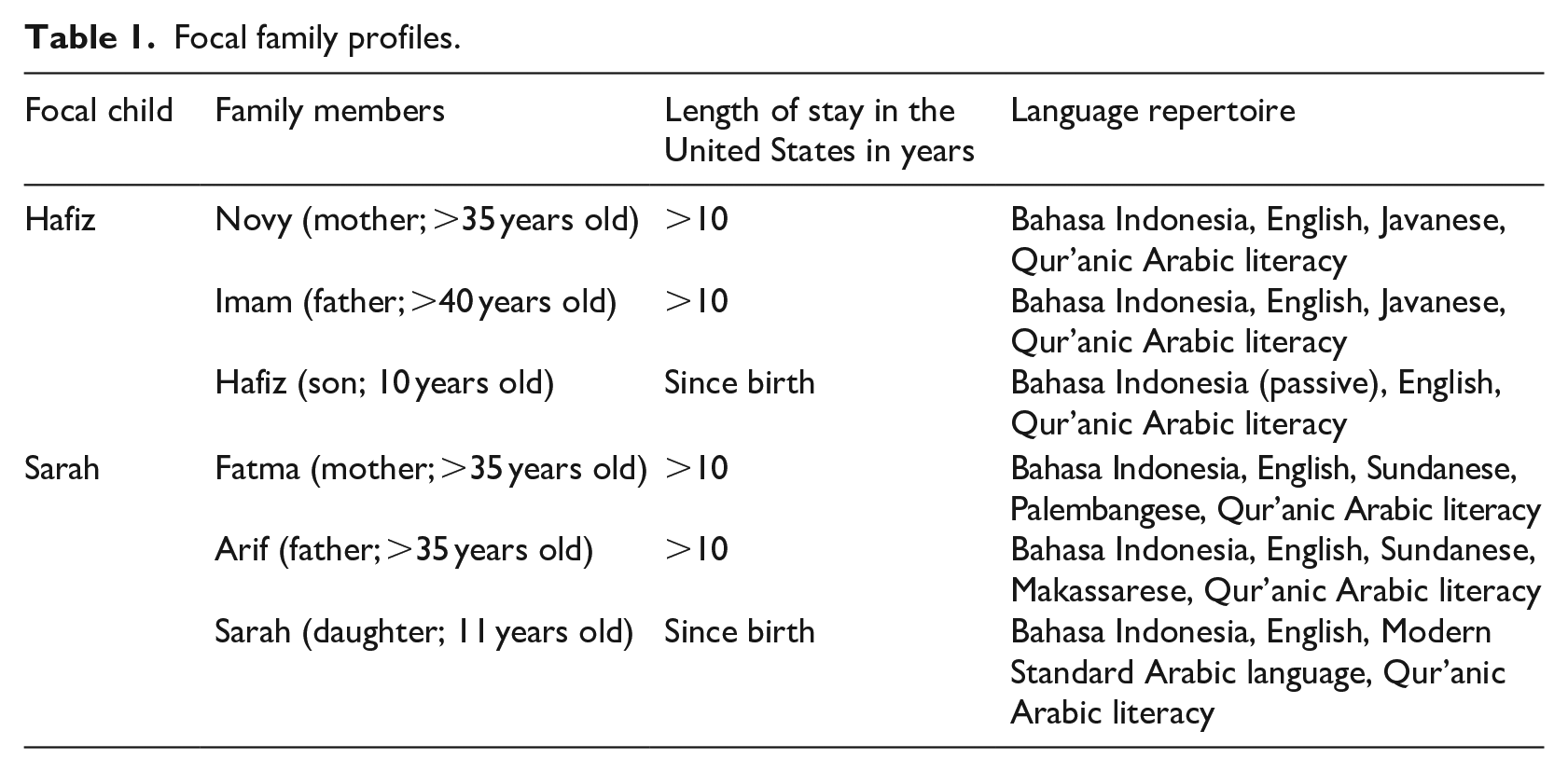
The data in this paper were derived from two focal families who were chosen for their intensive and long-standing use of ICTs for sacred language learning. Table 1 presents the profile of each family, which includes each family member’s pseudonym, length of stay, and language repertoire.
Focal family profiles.
Hafiz’s family
Hafiz was a US-born 10-year-old boy who attended a public elementary school. He was the only child of Imam and Novy, who were naturalized citizens of the United States. Imam immigrated to the country in the 1990s as a young adult to follow his mother, who married a US citizen. Novy moved to the United States after her marriage to Imam in the early 2000s. The family’s language repertoire included English, Bahasa Indonesia, Javanese, and Qur’anic Arabic literacy. Hafiz’s parents mainly spoke Bahasa Indonesia with each other, while with Hafiz they spoke a mix of English and Bahasa Indonesia. Hafiz learned Qur’anic Arabic recitation skills by attending an Islamic Sunday school and taking lessons from an online teacher. In addition, during the holy month of Ramadhan, he participated in online Qur’an recitation groups organized by the Indonesian Muslim translocal organization, comprising Indonesian Muslims in the United States and Canada.
Sarah’s family
Sarah was a US-born 11-year-old girl. She was the only child of Fatma (the mother) and Arif (the father). Sarah’s parents were permanent citizens of the United States. Arif came in 2000 following a job offer, and Fatma joined him a year later. Although the family had a rich linguistic repertoire, they mainly spoke Bahasa Indonesia at home. Outside the home, they mainly spoke English. Sarah acquired some knowledge of spoken and written Modern Standard Arabic when she attended a private Islamic elementary school (a school for which parents must pay tuition and which offers religious education in addition to a curriculum similar to that of a public school). She also acquired some Qur’anic Arabic recitation skills by attending an Islamic Sunday school at the mosque and taking online Qur’an lessons.
Data collection
We collected the data over a period of 10 months through semistructured interviews, collection of digital and non-digital artifacts, and observation and recording of naturalistic interactions. Eighty hours of audio and video recorded observations were made during participant observations (such as interactions on social media platforms) and non-participant observations (such as in weekly online Qur’an lessons and Qur’an group recitations). The semistructured interviews were conducted through in-person and online interactions, and they focused on participants’ experiences and perspectives regarding their languages, literacy, and religious practices. The interviews were done in Bahasa Indonesia and translated by the first author, a native Indonesian speaker. A total of 10 interviews, with an average length of 1 hour and 55 minutes for each interview, were done with the families. Each family member was interviewed either individually or in a group with other family members. The artifacts included printed books, text messages, and video posts on social media platforms, as well as publicly available data concerning community activities.
Data analysis
In our analysis, we sought to identify the organization and meanings of the FRLPs and practices for supporting sacred language learning across multiple online spaces of communication. The first author (an Indonesian speaker) transcribed audio and audio-video recordings of observations and interviews, created notes based on artifacts (i.e., online social media posts, books, and pictures), and created field notes following visits with the families. We applied Strauss and Corbin’s (1998) three-step coding procedures to identify patterns in behavior and belief with respect to children’s Qur’anic language learning. In the first step (open coding), we developed initial codes that described features of instances in which children’s Qur’anic Arabic learning occurred and/or was discussed (e.g., participants, digital technology, instructional focus). In the second step (axial coding), we compared initial codes with respect to similarities and differences to identify relationships across the data set (e.g., role of extended family, emphasis on correct recitation). In the third step (selective coding), we connected overarching categories (e.g., parents’ goals and expectations, translocal and transnational supports).
Findings
We begin by describing parents’ goals and expectations for their children’s sacred language and literacy development. We then trace typical trajectories of Qur’anic Arabic learning in this Indonesian Muslim community. Finally, we present and discuss three examples of how focal families used online connections to involve distant families, religious educators, and voluntary kin in supporting children’s Qur’anic Arabic literacy development.
Parental goals and expectations
The parents in our study expected their children to learn to decode and vocalize the sacred texts of the Qur’an and to memorize some or all of the Qur’an. The development of the Qur’anic Arabic language and literacy were key parts of the larger process of becoming a good Muslim. The families’ context of migration significantly influenced their sacred language policy. Parents recognized that the US context required that they take a more active role in creating contexts for Qur’anic Arabic learning (and religious education more broadly) than they would have back home, and they reported putting considerable energy into searching for resources and engaging directly in their children’s religious education. In an interview, Hafiz’s mother, Novy, expressed the following reasons for her and her husband’s proactive involvement in Hafiz’s sacred language learning: We are Muslims. As Muslims in Indonesia, we must obey the law of Islam. Here, we also obey the law as we did in Indonesia, but here we must be more focused because we are a minority group. So, we must be more active in searching. [Translated from Bahasa Indonesia]
Hafiz’s father, Imam, agreed with the mother that their religious values and practices in Indonesia must be continued in the United States. He expressed his hope that Hafiz would become pious and, to this end, must develop the ability to recite (decode and vocalize) the Qur’an. Sarah’s parents shared similar values, and they invested in her religious education by sending her to a private Islamic elementary school in addition to Qur’an Sunday school at the mosque.
The focal parents expected their children to learn good pronunciation of Qur’anic Arabic and sacred texts. This was consistent with what we observed in the wider Indonesian Muslim community locally and translocally: a primary focus on perfecting children’s vocalization (e.g., correct pronunciation of phonemes and mastery of the Qur’an notations). This emphasis on pronunciation may have been a reflection of shifts in religious literacy education in Indonesia in the mid-1990s when Indonesia experienced an Islamic revitalization movement that emphasized engagement with the Qur’an through memorization, reading, skilled performance, and recitation competitions (Gade, 2004). The movement led to memorization and melodious recitation of Qur’anic texts receiving more attention in religious education, with particular emphasis on eliminating or minimizing the influence of other languages on the pronunciation of Qur’anic Arabic speech sounds, words, and texts. The focal parents’ emphasis on pronunciation in their children’s Qur’anic Arabic learning may (also) have been shaped by experiences they had in their multiethnic Muslim community in the United States that caused them to pay more attention to their own vocalization of Qur’anic texts. For example, Fatma (Sarah’s mother) recounted that she had thought that she knew how to recite the Qur’an correctly until she recited the sacred text aloud in her Qur’an study group (halaqah) at a mosque in the United States. She was surprised and embarrassed when members of the group, which included native speakers of non-sacred varieties of Arabic, pointed out numerous errors in her performance.
In the early 2010s, the US Indonesian Muslim organization started to administer free Qur’an recitation lessons known as tahsin lessons for its adult female members (tahsin means “improve, enhance, enrich” in Arabic). These lessons focused on teaching correct vocalization and were taught voluntarily by several female members of the organization’s ladies department. The women who attended these lessons sought to improve their recitation as well as learn skills for teaching their own children to recite the Qur’an correctly. Fatma participated in these lessons. In 2015, the organization began administering tahsin lessons for girls, in which Sarah took part.
Qur’anic Arabic language and literacy learning trajectories
While each family followed their own particular path in developing their children’s Qur’anic Arabic literacy, the focal children’s trajectories were very similar to one another. The description that follows is based on observations and interviews with the focal families, interviews with non-focal participants, and the first author’s years of direct and vicarious experience as a member of this community. Indonesian Muslim parents in the community started their children’s Qur’anic Arabic literacy instruction at home in early childhood, introducing 4- to 5-year-olds to the Arabic alphabet and teaching them to memorize chapters of the Qur’an. Some parents sent their children to weekly Islamic schools at nearby mosques, and those who were financially able sent their children to a private Islamic elementary school. When children started elementary school (around 6 years old), some parents enrolled them in private online Qur’an lessons. Learning the Qur’an started with training children to recognize letters of the alphabet and to decode short phrases. Children then learned to memorize and recite short chapters. From that point forward, the focus was on perfecting the recitation of Qur’anic texts (tahsin), which included learning the correct Qur’anic Arabic pronunciation (tajweed) and correct positioning of speech organs (makhraj). A few of the children were taught to memorize the whole of the Qur’an in memorization (tahfiz) lessons. As children entered adolescence, some studied the interpretation of the sacred book (tafsir). In children’s religious education, there was a labor division between the parents in most families. Because fathers were employed full-time as salaried workers, mothers were largely in charge of finding resources and opportunities for children’s Qur’anic Arabic language and literacy learning.
In the translocal space, that connects Indonesian Muslims across North America, the focal families availed themselves of resources provided by a US Indonesian Muslim organization to support their children’s Qur’anic Arabic language and literacy learning. The organization offered various activities for children, including small-group Qur’an lessons for girls that emphasized the correct pronunciation of Qur’anic Arabic. During the holy month of Ramadhan, when Muslims commemorate the revelation of the Qur’an by fasting and devoting time to reading the sacred text, the organization administered Qur’an recitation groups for boys and girls in separate classes that focused on recitation fluency. In the transnational space, the families obtained support from extended family members and teachers living outside of the United States. Some of the learning materials used by the families originated in Indonesia. The families’ local, translocal, and transnational social networks of co-religionists and co-nationals became elements in the construction of a virtual “village,” where children learned to recite the Qur’an. In the following sections, we discuss three examples of how the families constructed and maintained their virtual village, using digital technologies to involve the larger community in their children’s sacred language learning.
Extended family
The focal parents took advantage of ICTs to involve far-away extended families in their children’s religious education and sacred language learning. Without extended family members living nearby, Sarah’s family maintained weekly online communication with her grandparents. Through the family’s routine video chats, Sarah became closely attached to her grandfather, with whom she displayed and developed her competence in Qur’anic Arabic, as Excerpt 1 illustrates. Although Sarah’s video chats with her grandparents were intended to maintain family connections while simultaneously aiming to develop Sarah’s ability to speak Bahasa Indonesia, and their conversations were conducted largely in that language (Lines 1, 3, and 4), both Sarah and her grandfather frequently used classical Arabic expressions that are part of Modern Standard Arabic (Line 6).
1. Sarah: Sarah mau baca doa. I want to recite a prayer. 2. Sarah: ((Recites Surah Abasa from the Qur’an)) 3. Grandpa: Sekarang Grandpa baca doa ya? Now I recite a prayer? 4. Sarah: Ya. Please. Yes. Please. 5. Grandpa : ((Recites Surah Al-Zizalah from the Qur’an)) 6. Sarah: جزاك اللهُ خيراً. Jazakallah khoiron May God reward you.
During each video chat, Sarah and her grandfather took turns reciting a surah, a practice they referred to as “doa” (an Indonesian word for “prayer” from the Arabic word “du’a”) (Lines 2 and 5). This was initiated by Sarah’s grandfather as a way to give them something to do and to talk about during calls that sometimes became stilted. Surah recitation developed into a routine in which Sarah took a highly active role, often initiating the turn-taking sequence (as shown in Line 1) and conscientiously engaging in her memorization practice to be able to recite the surahs to her grandfather. This family practice served not only to support Sarah’s sacred language but also as a means for maintaining relationships with a distant family member.
Voluntary kin
Sacred language learning served as a way to maintain relationships beyond the family as well. The focal parents used online connections to engage Indonesian Muslim friends—far-flung and nearby—in their children’s Qur’anic Arabic language learning. Many of their US-based friends became voluntary kin who were called upon to support children’s sacred language learning. Online social media provided an effective and often entertaining means to share new developments in a child’s Qur’anic Arabic knowledge and skills, to which family and friends could respond with affirmation and/or advice.
We see an example of this in Figure 1, a screenshot of a Facebook post by Novy in which she shares a text created by Hafiz. On his own initiative, Hafiz produced a handwritten text intended to assist non-Arabic-speaking Muslims in memorizing Islamic prayers. Hafiz had been learning how to pray from his Qur’an teacher and was asked by the teacher to memorize the words of the prayer. Hafiz decided to transcribe the prayer instructions with transliterations that he found in his Islamic school textbook. Novy explained that, in assigning a monetary value to his creation, Hafiz showed that he saw usefulness and value in his instructions and transliteration for non-Arabic-speaking Muslims. The text was taped on Hafiz’s bedroom wall, and Novy shared on her Facebook page a photo of the multilingual text created by her son with the following caption: It’s not the greatest, but Alhamdullilah (praise God) for a 6 y.o . . . It means something to us. shalah (prayer) instruction by Hafiz and he’s selling it to us for only $10!! “LOL” Anyone wants to have one? 
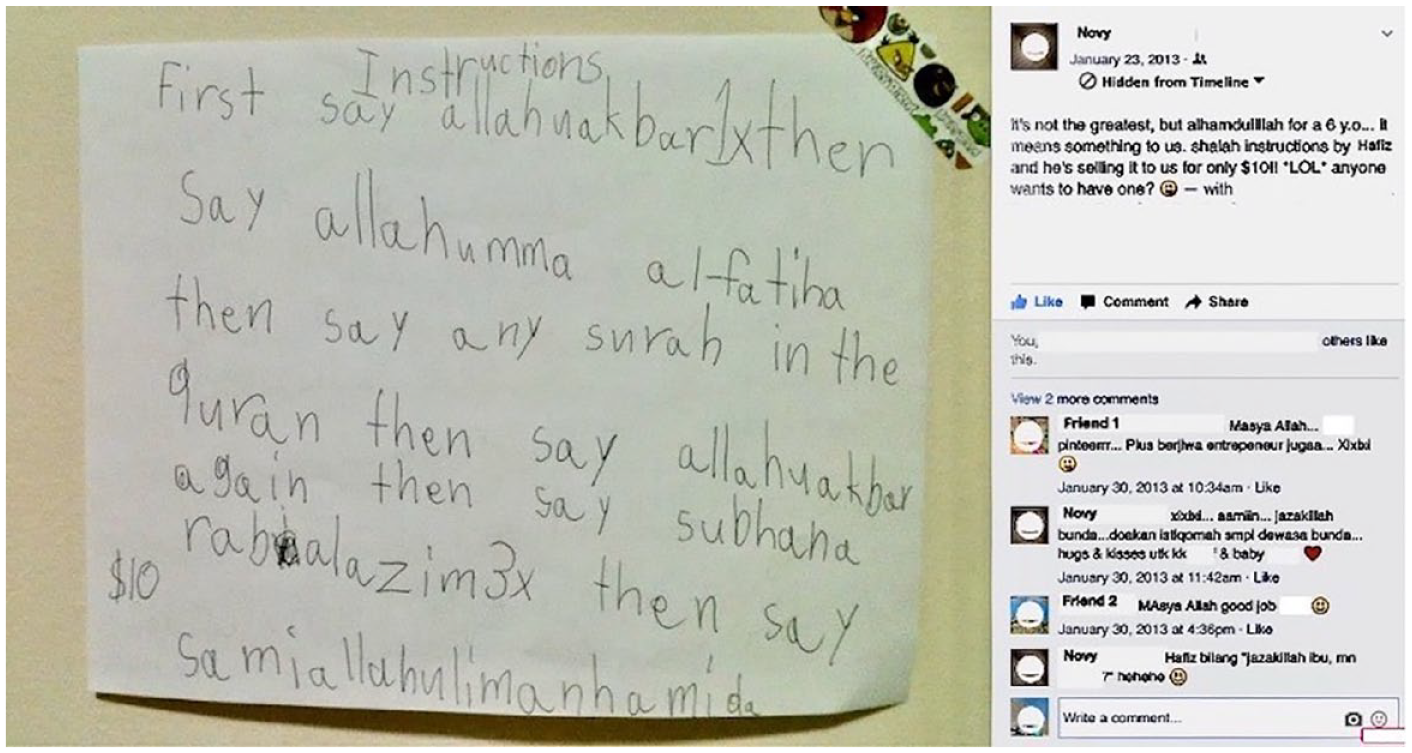
Hafiz written prayer instructions.
The focal parents regularly used Facebook to share with friends and family their children’s efforts to learn and use Qur’anic Arabic. For Novy, Hafiz’s text was something to laugh about, take pride in, and share with people who were involved in his Qur’anic Arabic learning, or would have been had the family not moved to the United States. In her post, she expressed her thankfulness that her son was engaging with Qur’anic Arabic in a way she found meaningful: “It’s not the greatest, but Alhamdullilah (praise God) for a 6 y.o . . . It means something to us.” Following her expression of thanks, she wrote, “shalah (prayer) instruction by Hafiz and he’s selling it to us for only $10!! ‘LOL’ Anyone wants to have one? ” Novy’s caption uses the term “LOL” to mean “laugh out loud,” signaling her humorous interactional intention. A combination of thankfulness and humor was characteristic of social media posts about children’s sacred language learning and use, and such posts consistently elicited positive comments. Novy successfully engaged members of the family’s virtual village in Hafiz’s sacred language learning, and respondents (mostly voluntary kin in the United States) responded with “likes” and praise (e.g., “masya Allah, good job” and “smart boy”). Their supportive responses served to encourage not only Hafiz but also Novy, who oversaw her son’s religious education. Through interactions in the comment section of the Facebook post, members of the virtual village maintained and strengthened relationships while supporting children’s sacred language learning.
Translocal and transnational co-religionist and co-national educators
Another major activity setting in which children learned to recite sacred texts was Qur’an lessons in online translocal or transnational spaces. Sarah participated actively in the translocal tahsin group lessons, while Hafiz attended private tahsin lessons taught by a female teacher in Indonesia. Tahsin lessons were aimed at improving and beautifying Qur’an recitation. Before they attended the group lessons, both Hafiz and Sarah had been taught privately by male teachers who lived in Pakistan. However, when the two mothers learned about the availability of English-speaking Indonesian teachers, they decided to terminate their children’s lessons with the Pakistani teachers due to language barriers. The mothers, who mediated the learning process, preferred teachers who could speak Bahasa Indonesia. Novy stated that “speaking in English exhausts me because, in my mind, I have to translate Bahasa Indonesia into English and vice versa.” In addition, the mothers preferred female teachers, with whom they could speak more comfortably.
In Indonesia, parents are not normally present during Qur’an lessons because children usually attend group lessons with their friends in physical spaces (often in the neighborhood), taught by teachers who have linguistic backgrounds similar to those of the children and their families. Even when children have private lessons at home, parents seldom supervise their children during the lessons (with the exception of very young children). In the United States, due to the online nature of the learning process, parents (especially mothers) were frequently present during the lessons as supervisors, mediators, and, in some cases, co-teachers. Sarah’s learning experiences within her tahsin online group lessons were similar to those of children in Indonesia who learned in group lessons. However, her mother was very active in supervising Sarah during the lessons, and outside the lesson. Fatma also communicated with the teacher about how to support Sarah’s religious education (e.g., how to select supplemental instructional materials, and how to answer questions raised by Sarah). Hafiz’s online lessons were also supervised by his mother, Novy, who frequently acted as a co-teacher to ensure that Qur’anic Arabic learning expectations were met. Excerpt 2 presents one of Hafiz’s Qur’an recitation lessons. The transcript illustrates how Novy mediated the language learning process as a co-teacher. The excerpt starts at a point where Hafiz is not sure how to pronounce a particular Arabic letter.
1. Hafiz: ح اَضُی ::: Yu ((Hafiz stretches the last sound and stops before finishing the sentence, not sure how to pronounce the next letter)) 2. Novy: Ini ء katanya. She said this hamzah. ((Novy reminds Hafiz that the teacher clarified that the letter he is unsure of is “hamzah,” which stands for a glottal stop)) 3. Hafiz: Oh. 4. Teacher: Ehm. ((The teacher expresses an agreement with Novy)) 5. Hafiz: یُضَا ح ::: Yu ((Hafiz is still not sure how to pronounce the next letter)) 6. Teacher: أُو uu ((The teacher models the correct sound)) 7. Hafiz: أُو. یُضَاحِئُونَ. نَ یُضَاحِئُونَ. uu. Yu ((Hafiz recites the sentence correctly and then repeats it inaccurately)) 8. Novy: Eh, yang bener. Hey, recite it correctly. ((Novy reminds Hafiz to stay focused)) 9. Teacher: ((Laugh)) 10. Hafiz: ((Laugh awkwardly)) 11. Teacher: Terbalik. Incorrect order. ((The teacher refers to Hafiz’s reading in Line 7)) 12. Hafiz: یُضَاحِئُونَ. Yu ((Hafiz recites correctly))
The emphasis on proper recitation, including correct pronunciation, was one of Novy’s key expectations for Hafiz’s learning. The excerpt shows evidence of Novy’s effort to meet the expectations by acting as a co-teacher to ensure that Hafiz learned properly and diligently. Her statement, “She said this is hamzah” (Line 2), referred to a notation written on a letter that Hafiz was hesitant to pronounce (Line 1). The teacher expressed her agreement with Novy (Line 4) and, when Hafiz was still hesitant (Line 5), she modeled the correct pronunciation (Line 6). Hafiz imitated the teacher’s pronunciation and proceeded to recite the whole sentence. He first recited the sentence accurately but then repeated it inaccurately (Line 7). Novy teasingly reminded him to stay focused (Line 8), and her reminder was followed by the teacher’s and Hafiz’s laughter (Lines 9 and 10). The teacher then reminded Hafiz that he had pronounced the words in an incorrect order (Line 11), and Hafiz read the sentences correctly (Line 12). Such comfortable compliance was evident in most of the recordings and observations of Hafiz’s Qur’anic Arabic language and literacy learning when his mother was co-teaching. Mothers and children in both focal families were visibly more comfortable with Indonesian teachers for the online Qur’an lessons. The mothers reported being much more at ease interacting with the Indonesian female teachers, with whom they shared a similar linguistic repertoire and interactional style, which both mothers felt enabled them to be more effective co-teachers in their children’s study of the Qur’an.
Discussion
Indonesian Muslim FRLP in the context of migration involved a transformation of the cultural organization of sacred language learning adapted from their society of origin. While parents sought to replicate what was usually done in Indonesia, they also transformed “traditional” practices through innovation and adaptation to conditions in North America. In Indonesia, children’s sacred language learning is supported by a rich variety of resources found within the community’s physical space: extended family members who live in the same house or nearby may contribute to children’s religious education, and children have ample opportunities to learn to recite sacred texts in nearby mosques, public and private schools, and/or private lessons at home. Faced with limited opportunities for co-present sacred language learning in physical spaces, Indonesian Muslim parents in the United States used ICTs to adapt learning traditions from Indonesia, creating a virtual village in which they and their children moved across translocal and transnational spaces to avail themselves of familial and community support for children’s development of sacred language competence and Indonesian Muslim identity.
In the Indonesian Muslim tradition, reciting and memorizing the Qur’an with confidence and proficiency is highly valued as an indicator of religious piety (Rosowsky, 2023). The parents in this study expressed such beliefs and values, and they described digital technologies as essential to creating the conditions for their child to become skilled in and committed to memorization and recitation of the sacred text. The three examples presented above illustrate how the families used digital technologies to obtain and provide the support they believed to be essential to their children’s sacred language education. Parents leveraged their online networks to create contexts in which their children’s Qur’anic Arabic learning could be encouraged and guided by extended family members and voluntary kin. In addition, parents turned to online translocal and transnational spaces to access Qur’an recitation teachers in Indonesia and elsewhere, who provided instructional expertise and support that otherwise would not have been accessible (affordable or physically nearby) to the family. Both mothers in this study enrolled their children in online private lessons with female Indonesian-speaking teachers to feel more comfortable and competent as co-teachers during and between lessons. The finding supports Srhir and Poveda (2022), who assert that parents use strategies such as enrolling children in a particular type of education and choosing caregivers with a particular sociolinguistic background. We extend this idea by demonstrating that transnational Indonesian Muslim mothers’ strategic choice was made possible by ICTs.
We found that family’s use of digital spaces to support children’s sacred language learning was intertwined with and contributed to the maintenance of relationships with extended family members, co-religionists, and co-nationals. In line with a proverb that says, “It takes a village to raise a child,” Indonesian parents do not expect and are not expected to raise their children on their own (Seymour, 2013). Each family in this study created a virtual village that allowed them to maintain family ties and expand their community from local to global and from actual to virtual spaces, (re)producing the community support they needed for their children’s sacred language learning while far from their country of origin and engaging their children in a wider community of religious practice and Qur’anic Arabic learning and use. As Badder and Avni (2024, p.13) show, children’s learning and use of sacred languages can contribute to the “interactional achievement of sharedness and community.” We agree and add that families’ use of digital technologies to support children’s sacred language learning plays an important part in the creation and development of community, as well as the continuation of religious learning traditions.
Conclusion
A growing body of research has illuminated online media influences on FLP (Lanza, 2020; Lanza & Lexander, 2019; Lexander & Androutsopoulos, 2023; Purkarthofer et al., 2022) and shown how ICTs has been used to maintain transnational affiliations and heritage language practices with friends and families (Capstick, 2020; Cingel et al., 2019; Kędra, 2021; Palviainen & Kędra, 2020; Sari, 2022). Our study builds on this work by demonstrating the important role played by social media and ICTs more widely in FRLP. We found that, in addition to using digital technologies to maintain transnational affiliations and heritage languages, families use them to create extensive and strongly connected communities to support children’s sacred language learning.
FLP scholars have called for further research in digital environments (e.g., Bose et al., 2023; Curdt-Christiansen, 2018; Curdt-Christiansen, & Huang, 2020, 2020), and we add our own call for more research on sacred language learning in digital spaces. Sacred language learning is an important part of millions of children’s lives, making it imperative that we learn more about additional language learning for religious purposes (cf. Han, 2018; Juzwik et al., 2022). Furthermore, research on sacred language learning is essential since there is a significant difference between learning a sacred language and a non-sacred language (Bassetti, 2023). Many transnational families face challenges in providing their children with the sacred language education they believe is essential to spiritual and moral development, as well as membership in the family’s religious, ethnic, and/or national community of origin. As more and more families turn to ICTs to achieve sacred language learning goals, we need research that explores the digital and religious dimensions of FLP. Such research will generate new insights into the who, how, and why of family efforts to promote children’s learning of languages that matter to them and their communities.
Footnotes
Appendix
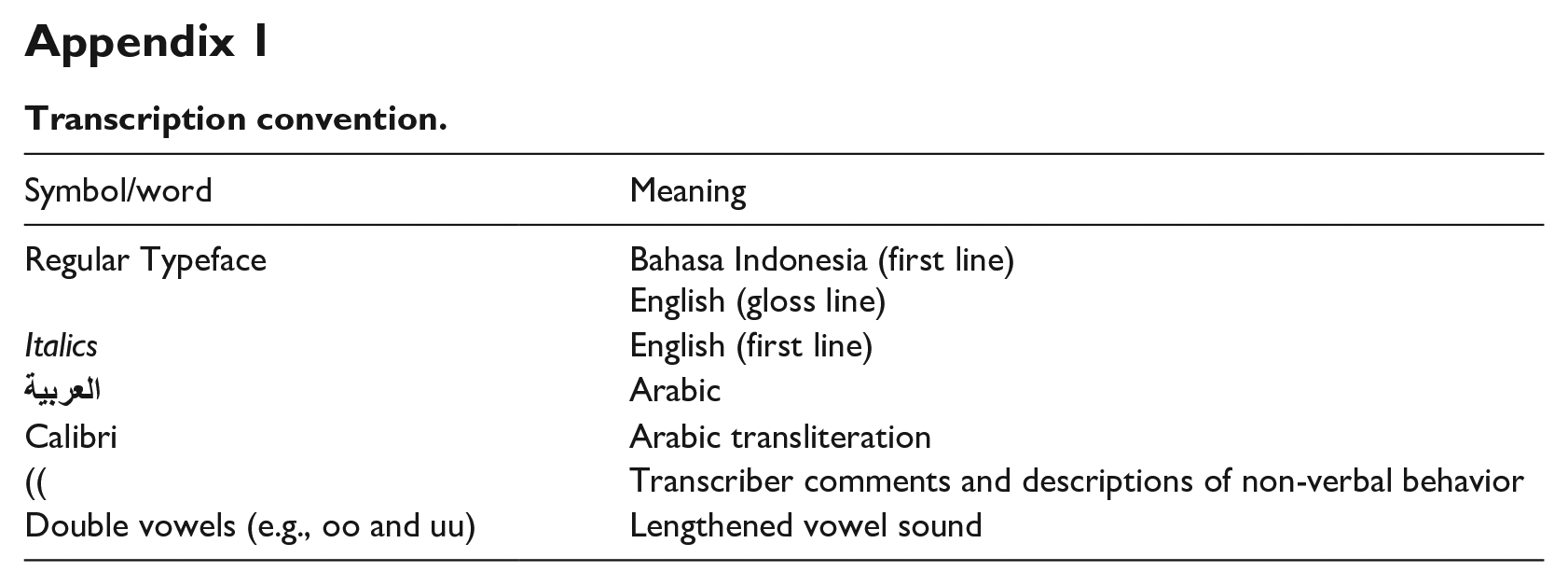
| Symbol/word | Meaning |
|---|---|
| Regular Typeface | Bahasa Indonesia (first line) English (gloss line) |
| Italics | English (first line) |
|
|
Arabic |
| Calibri | Arabic transliteration |
| (( | Transcriber comments and descriptions of non-verbal behavior |
| Double vowels (e.g., oo and uu) | Lengthened vowel sound |
Declaration of conflicting interests
The author(s) declared no potential conflicts of interest with respect to the research, authorship, and/or publication of this article.
Funding
The author(s) received no financial support for the research, authorship, and/or publication of this article.
