



Abstract
Chronic pain in adolescents can be highly impairing. Parental reactions to their child’s pain are important factors influencing pain perception and pain-related impairment in children and adolescents. The present study aimed to examine parental accommodation of pain symptoms using the Inventory of Parent Accommodations of Children’s Symptoms (IPACS) to provide empirical support for the utility of this measure in parents of adolescents with chronic pain. We examined the prevalence, nature, and correlates of accommodation behaviors in 66 adolescents with chronic pain and their parents using the IPACS. All parents reported some level of accommodation of their child’s pain symptoms. After controlling for pain severity, parental accommodation was associated with functional impairment. In addition, parental accommodation mediated the link between parental catastrophizing reactions to pain and child impairment and between child anxiety and depressive symptoms and child impairment. The IPACS appears to be a useful measure of parental accommodation of pain. Parental accommodation should be included as an intervention target when necessary. It is important to educate families about the negative consequences that can be related to excessive accommodation of pain symptoms and to provide effective resources to manage the impact of chronic pain and replace accommodation with more adaptive pain coping strategies.
Introduction
Chronic pain is a debilitating condition defined as recurrent pain that persists longer than three months (Merskey, 1986). If untreated, chronic pain in children and adolescents is associated with daily life impairment, increased risk for psychiatric disorders, and family burden (Fleischman et al., 2011; Forgeron et al., 2010; Kashikar-Zuck et al., 2001; Perquin et al., 2001; Wojtowicz and Banez, 2015). Approximately 13–32% of youths experience chronic pain, with prevalence peaking in adolescence (Lateef et al., 2009; Stanford et al., 2008). These considerations highlight the need to better understand factors that may help manage the impact of chronic pain in adolescents.
Some of the critical factors commonly related to chronic pain in children and adolescents are parental reactions to their offspring’s pain (Asmundson et al., 2012; Palermo et al., 2014). For instance, higher levels of family conflict and lower adolescent autonomy are associated with higher pain-related functional impairment and depression symptoms in adolescents with recurrent headaches (Palermo et al., 2014). Parental distress and catastrophizing reactions to child pain are also associated with increased child pain intensity and disability (Asmundson et al., 2012; Cunningham et al., 2014; Goubert et al., 2006; Sieberg et al., 2011). In addition, parental overprotective and solicitous responses such as giving positive attention or special privileges/permissions because of pain are linked with increased child catastrophizing reactions to pain and disability (Asmundson et al., 2012; Cunningham et al., 2014; Palermo et al., 2014; Sieberg et al., 2011; Simons et al., 2008). Parental overprotection was also found to mediate the relationship between parental distress and child functional impairment (Sieberg et al., 2011) and to increase the association between pain severity and functional impairment (Achiam-Montal and Lipsitz, 2014).
Family accommodation is closely related to parental overprotection and solicitous behaviors. Family accommodation is defined as the ways in which family members engage in behaviors to mitigate the distress their relative may otherwise experience (Lebowitz et al., 2012). This concept has primarily been investigated in children and adolescents with obsessive–compulsive disorder (OCD) and anxiety disorders (Lebowitz et al., 2012). Although accommodating behaviors usually intend to alleviate distress, they may reinforce and help maintain symptoms over time by preventing children from being exposed to corrective learning experiences due to constant avoidance of feared situations (Lebowitz et al., 2013; Storch et al., 2015). Indeed, family accommodation has been associated with increased symptom severity, functional impairment, and psychiatric comorbidities (Lebowitz et al., 2016; Norman et al., 2015; Wu et al., 2016) and has been shown to mediate the links between anxiety/OCD severity and functional impairment (Storch et al., 2007, 2015). Psychiatric symptoms, in particular anxiety and depression, are closely related to chronic pain, and may both precede and result from elevated pain levels (Liossi and Howard, 2016). Indeed, a fear-avoidance model of chronic pain has been suggested to explain the maintenance of disabling chronic pain symptoms in some adults and children (Asmundson et al., 2012). In this model, overly anxious and catastrophic reactions to pain can promote avoidance of potentially pain-provoking situations, and this, in turn, is associated with depression symptoms, increased disability, and maintenance of chronic pain (Asmundson et al., 2012). Hence, investigating the construct of parental accommodation as conceptualized in fear-avoidance models, which are relevant to both chronic pain and psychiatric disorders, may provide novel information regarding the function and impact of parental behaviors in chronic pain.
Recently, Harrison et al. (2016) developed the Inventory of Parent Accommodations of Children’s Symptoms (IPACS) to assess accommodation of child sickness and pain symptoms. The IPACS is a modified version of the Family Accommodation Scale (FAS), which assesses accommodation of OCD symptoms by measuring participation in symptoms (e.g. providing reassurance and assisting in avoidance of symptom-provoking situations) and modification of functioning (e.g. parental absence from work) due to symptoms (Calvocoressi et al., 1995). Unlike measures of parental solicitousness and overprotection commonly employed such as the Adult Responses to Children’s Symptoms (Van Slyke and Walker, 2006) or subscales of the Child Health Questionnaire (Landgraf et al., 1996), the FAS and the IPACS also include questions on distress and consequences (e.g. child anger and abusive behavior) associated with accommodation. Assessing the outcomes of parental accommodation behaviors is important to differentiate normal/adaptive levels of parental accommodation (e.g. providing assistance when really necessary) from problematic levels (e.g. overprotection). Thus, the 12 items of the IPACS provide a quick measure of the frequency and impact of parental accommodation, which may be particularly useful in a clinical context with limited assessment time. This initial validation study revealed that parental accommodation was associated with higher frequency of child complaints and younger child age in healthy children (Harrison et al., 2016).
As suggested by McGuire et al. (2012), there is a shift in psychological and medical practices toward the use of evidence-based assessments, that is, instruments for which empirical support for the assessment of a construct within a given population has been demonstrated. To the best of our knowledge, no studies have used the IPACS with parents of adolescents with chronic pain. Hence, further investigation is needed regarding the utility of the IPACS to measure parental accommodation in such population.
Aim
The present study aimed to examine parental accommodation and provide evidence for the utility of the IPACS in parents of adolescents with chronic pain. First, we examined the incidence and nature of parental accommodation. Next, we assessed potential links between accommodating behaviors and adolescent age, gender, severity of pain, catastrophizing reactions, anxiety and depression symptom severity, and functional impairment.
We hypothesized parental accommodation would: Be highly prevalent. Negatively correlate to age and positively correlate to clinical measures. Predict functional impairment controlling for pain severity. Mediate the relationships between (1) pain severity, (2) parental catastrophizing reactions, (3) child anxiety, and (4) child depression and functional impairment. Moderate the association between pain severity and functional impairment, so that stronger associations would be found in adolescents whose parents are highly accommodating.
Methods
Recruitment and inclusion/exclusion criteria
Participants were recruited from a US outpatient pediatric rehabilitation clinic focused on evaluation and treatment of children experiencing chronic pain to participate in a larger study investigating chronic pain presentation, management, and correlates in children and adolescents. The original objective was to recruit a sample of 150 children and adolescents aged 7–17 years; a sample size of 150 was selected to enable enough power to perform diverse statistical analyses on the multiple variables of interest. To be eligible, participants had to attend a regularly scheduled appointment for the treatment of chronic pain-related concerns, be able to read questionnaires presented in English, and be accompanied by a parent/legal guardian who was also willing to participate in the study. As the present study focused exclusively on adolescents, participants had to be aged 12–17 years; thus only participants within this age-range were selected from the larger sample and included in analyses.
Measures
Pain Catastrophizing Scale for Children–Child and Parent versions
The Pain Catastrophizing Scale for Children–Child and Parent versions (PCS-P/C) are 13-item parent and self-reported measures assessing the child and parent thoughts and feelings when confronted with child pain. Answers are scored on a five-point Likert-type scale ranging from 0 to 4 (total score range 0–52). Both versions of the PCS have been shown to possess good internal consistency and validity for children and adolescents aged 8–16.5 years (Crombez et al., 2003; Goubert et al., 2006).
Pain Numeric Rating Scale
The Pain Numeric Rating Scale (PNRS) is a widely used and well-validated technique (Jensen et al., 1986). The version administered to the sample consisted of one item assessing the intensity of the adolescent’s pain experienced usually during the week on a scale ranging from 0 (no pain) to 10 (worst pain imaginable).
Depressive and Anxiety Symptoms Short Forms–Child version of the Patient-Reported Outcomes Measurement Information System (PROMIS)
The anxiety and depressive symptoms short forms are self-report measures provided by the National Institute of Health with adequate psychometric properties for children and adolescents aged 8–17 years (Irwin et al., 2010). Both scales contain eight items each assessing depressive or anxiety symptoms in the past seven days on a five-point Likert-type scale ranging from 0 to 4 (total score range 0–32).
Functional Disability Inventory–Child version
The Functional Disability Inventory (FDI) is a 15-item self-reported measure that assesses perceived difficulty in performing activities in the domains of school, home, recreation, and social interactions on a five-point Likert-type scale ranging from 0 to 4 (total range 0–60). The FDI has strong reliability and validity for children and adolescents aged 9–17 years (Walker and Greene, 1991).
Inventory of Parent Accommodations of Children’s Symptoms
The IPACS is a 12-item parent-report measure that assesses the frequency of family accommodation of the child’s pain in the past week on a five-point Likert-type scale ranging from 1 to 5. It includes three subscales: Modifications (four items, scoring range 4–20), Assistance (five items, scoring range 5–35), and Supportive Behaviors (three items, scoring range 3–15). An initial validation study indicated high internal consistency for the total scale, and internal consistency was good for the Modifications subscale, acceptable for Assistance, and poor for Supportive Behaviors for children (mean age = 6.5 (5.0)) (Harrison et al., 2016).
Procedures
The Johns Hopkins School of Medicine Institutional Review Board approved all study procedures. Written child assent and parent consent were obtained before completion of the study measures, which were collected in a single session before or after one of the adolescent’s appointments at the clinic. No compensation was provided.
Analytic plan
All statistical analyses were conducted using SPSS 24. Descriptive statistics were used to examine demographic and clinical data. Patterns of missing values were examined; within each measure, mean substitution was used if less than 20% of the scale items were used. Responses were coded as missing if more than 20% of items were missing. We performed logarithmic transformations to reach normality when needed. Internal consistency was computed for each measure. We used Fischer’s exact tests to compare participants who were included in main analyses (n = 66) and those who were excluded from analyses due to complete missing IPACS data (n = 21) on categorical variables; summary statistics were computed for continuous variables. We next examined demographic and clinical correlates of the IPACS total scores using Pearson’s bivariate correlations. We conducted hierarchical regression analyses to assess whether parental accommodation (a) predicted functional impairment, controlling for pain severity, and (b) moderated the association between pain severity and functional impairment. We next performed mediation analyses to assess whether parental accommodation mediated the relationship between pain severity/parental catastrophizing reactions/child anxiety/child depression and functional impairment. We used the INDIRECT macro in SPSS (Preacher and Hayes, 2008) setting the number of bootstrap resamples at 5000 (see Field (2009) for details on this technique) and considered the mediator as statistically significant if criteria for mediation defined by Baron and Kenny (1986) and if the bias-corrected 95% confidence interval excluded 0.
Results
Participants
A total of 87 adolescents aged 12–17 years (77 females; M = 15.5, SD = 1.6) and their parents provided consent to participate in the study. Of the initial sample, 21 participants (24.1%) were excluded from analyses as they did not complete the IPACS/failed to return the questionnaire. Thus, the final sample consisted of 66 participants and was predominantly female (92.4%). Information on medication was missing for one participant. The other adolescents (98.5%) were all on medication and 71.2% were taking two or more different medications (Mdn = 2, IQR = 1–2). In addition, 80.3% of the sample was involved in other forms of treatment for pain and 28.7% had a history of hospitalization due to their pain for at least two days (Mdn = .0, IQR = 0–3). The number of missed school days during the year due to pain varied from 0 to 100, with a median of 10 days (IQR = 3–25). See Table 1 for other clinical and treatment details of the sample.
Clinical characteristics of the sample (n = 66).
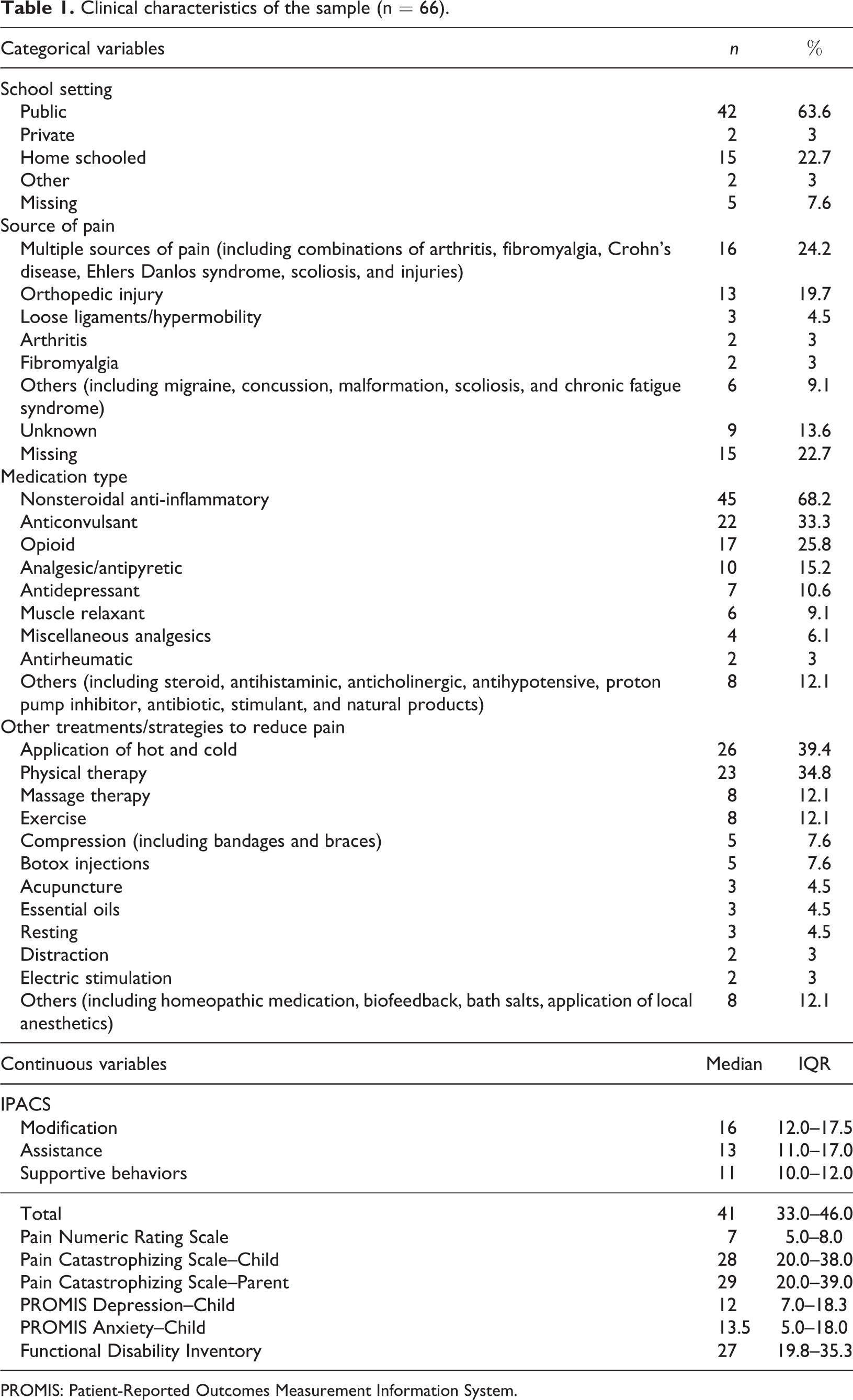
PROMIS: Patient-Reported Outcomes Measurement Information System.
Missing data
Data was missing for 1.5% of the sample for the parent and child PCS, 3.0% of the sample for the FDI, and 4.0% of the sample for the PNRS.
Internal consistency of the measures
Internal consistency was excellent for the child (α = .93) and for the parent (α = .91) versions of the PCS-P/C as well as for the Depressive (α = .94) and Anxiety (α = .93) Symptoms Short Forms of the PROMIS and the FDI (α = .92). Regarding the IPACS, internal consistency was good for the total scale (α = .86), excellent for the Modification subscale (α = .90), acceptable for the Assistance subscale (α = .76), and poor for the Supportive Behavior subscale (α = .50), paralleling previous findings (Harrison et al., 2016).
Comparisons between participants included in main analyses and those excluded due to missing IPACS data
A greater proportion of boys was found in excluded (23.8%) relative to included (7.6%) adolescents (p = .021). There were no significant differences regarding school setting, source of pain, medication types, and strategies used to reduce pain (all ps > .05). Regarding continuous variables, descriptive statistics for excluded adolescents were visually similar to those for included adolescents regarding age (M = 15.6, SD = 1.5), number of missed school days (Mdn = 18, IQR = 2–31.3), number of days of hospitalization due to pain (Mdn = .0, IQR = .0–.5), severity of pain (Mdn = 7, IQR = 5–7.5), and number of medications (Mdn = 2, IQR = 1.5–3).
Rates of parental accommodation
All parents reported some level of accommodation to adolescents’ symptoms. Specifically, 98.5% of the parents reported some modification of functioning and endorsing some supportive behaviors and 100% provided some assistance to their children. See Table 1 for medians for each subscale of the IPACS. See Supplementary Table 1 for medians and frequencies of endorsement of each possible answer for individual items.
Correlations between study variables
Due to the small number of boys in the sample, we did not include gender as a variable of interest in correlation and regression analyses. IPACS total score significantly correlated with parent catastrophizing of pain, as well as adolescent depression and anxiety symptoms and functional impairment. In addition, most study variables (except age) were inter-correlated. Correlations between different variables were below .75, indicating low risk of multicollinearity for regression analyses. See Table 2 for correlation matrix of all study variables.
Correlations between study variables.

Note: Significant results are in bold. IPACS: Inventory of Parental Accommodations of Children’s Symptoms, PNRS: Pain Numeric Rating Scale, PCS: Pain Catastrophizing Scale, C: child, P: parent, PROMIS: Patient Reported Outcomes Measurement Information System, D: depression, A: anxiety, FDI: Functional Disability Inventory.
*p < .05; *p < .01; ***p < .001.
Regression analyses
Prediction of functional impairment by parental accommodation and moderation of the association between pain severity and functional impairment by parental accommodation.
The first step of a hierarchical regression analysis revealed pain severity predicted functional impairment. The second step showed parental accommodation predicted functional impairment, controlling for pain severity. The third step revealed the interaction term was nonsignificant, indicating an absence of moderation relationship between variables. See Table 3 for detailed results.
Summary of hierarchical multiple regression analysis.

IPACS: Inventory of Parental Accommodations of Children’s Symptoms, PNRS: Pain Numeric Rating Scale.
Mediation of the association between pain severity and functional impairment by parental accommodation
Given that parental accommodation was not significantly correlated with pain severity, we did not conduct this mediation analysis, as basic criteria for mediation were not met.
Mediation of the association between parental catastrophizing reactions and functional impairment by parental accommodation
Parental catastrophizing reactions and accommodation were positively associated, β = .31, SE = .08, p < .001 (a path), and parental accommodation was positively associated with functional impairment (b path), β = .38, SE = .17 p = .03. In addition, the c path (i.e. total effect of parental catastrophizing reactions on functional impairment) was statistically significant, β = .51, SE = .11, p < .001, and so was the c′ path (direct effect of catastrophizing on functional impairment), β = .39, SE = .12, p = .002. The significant indirect effect, β = .12, 95% CI = .04–.25, as well as the fact that the direct effect remained significant but reduced in strength, suggest parental accommodation partially mediated the relationship between parental catastrophizing reactions and functional impairment (see Figure 1(a)) for an illustration of mediation associations).
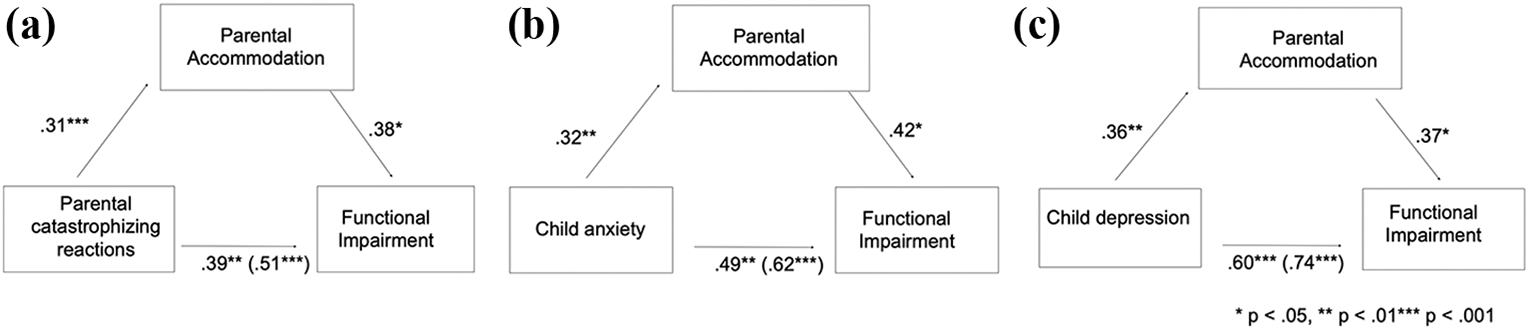
Mediation relationships between (a) parent catastrophizing reactions, parental accommodation, and child functional impairment; (b) child anxiety, parental accommodation, and child functional impairment; and (c) child depression, parental accommodation, and child functional impairment.
Mediation of the association between adolescent anxiety and functional impairment by parental accommodation
Parental accommodation was positively associated to adolescent anxiety, β = .32, SE = .11, p = .005 (a path), and to functional impairment (b path), β = .42, SE = .17, p = .010. The c path (i.e. total effect of adolescent anxiety on functional impairment) was also significant β = .62, SE = .14, p < .001 as well as the c′ path (direct effect of adolescent anxiety on functional impairment), β = .49, SE = .15, p = .002. The indirect effect was significant, β = .13, 95% CI = .04–.29 and the direct effect remained significant but reduced in strength, suggesting that parental accommodation partially mediates the association between adolescent anxiety and functional impairment (see Figure 1(b)) for an illustration of mediation associations).
Mediation of the association between adolescent depression and functional impairment by parental accommodation
Regarding adolescent depression, there was a positive association between depressive symptoms and parental accommodation, β = .36, SE = .12, p < .003 (a path). Parental accommodation was also positively related to functional impairment (b path), β = .37, SE = .15, p = .018. The total effect of adolescent depression on functional impairment (c path), β = .74, SE = .15, p < .0001, the direct effect (c′ path) β = .60, SE = .15, p < .0001, and the indirect effect β = .14, SE = .06 95% CI = .04–.31 were also statistically significant. These results suggest parental accommodation partially mediates the association between adolescent depression and functional impairment (see Figure 1(c)) for an illustration of mediation associations).
Discussion
We report on parental accommodation of pain symptoms in a sample of adolescents with chronic pain. We found elevated prevalence rates, which were generally similar to those reported in children and adolescents with anxiety disorders and OCD (Lebowitz et al., 2012, 2013; Thompson-Hollands et al., 2014). All parents reported assisting their offspring, while 98.5% also reported some modification of functioning and endorsing some supportive behaviors. The most common manifestations of accommodation consisted of reassuring the adolescent and providing comfort items, with over 70% of the parents endorsing these behaviors often or always. Additionally, over 50% of the parents reported often or always assisting their offspring in avoiding certain situations and modifying their routine and/or work schedule because of their adolescent’s symptoms and needs. These latter findings underscore the significant familial burden associated with chronic pain (Walker et al., 2006) and family accommodation (Norman et al., 2015; Thompson-Hollands et al., 2014).
Paralleling research in anxiety and OCD (La Buissonnière-Ariza et al., 2018; Lebowitz et al., 2016; Norman et al., 2015; Storch et al., 2015), parental accommodation significantly predicted functional impairment, controlling for perceived pain severity, suggesting accommodation may contribute to functional impairment over and above physical symptoms. It may be that severe adolescent disability elicits increased accommodation behaviors in parents. However, previous research indicates that lower occurrence of autonomy promoting behaviors by highly accommodating parents may also explain the increased functional impairment in the offspring (Lebowitz et al., 2016; Norman et al., 2015), underscoring the bidirectional nature of the association. Indeed, parent solicitousness and reassurance, as well as child avoidance of potentially pain-provoking activities and lower levels of autonomy, have all been linked to increased pain-related impairment in children and adolescents with chronic pain (Asmundson et al., 2012; Palermo et al., 2014).
Parental accommodation was also positively associated with adolescent depression and anxiety symptoms, which is consistent with research in psychiatric populations (La Buissonnière-Ariza et al., 2018; Lebowitz et al., 2013, 2016; Storch et al., 2015; Wu et al., 2016). One explanation may be that parents may perceive highly depressed/anxious adolescents as more vulnerable, and therefore, may be more willing to accommodate pain symptoms. Indeed, adolescent emotional symptoms also positively correlated with functional impairment, pain severity, and catastrophizing of pain—indicating a more severe overall clinical presentation in anxious and depressed adolescents, consistent with previous studies (e.g. Crandall et al., 2009). On the other hand, parental accommodation may also exacerbate their offspring’s emotional distress. In a randomized controlled trial, children whose parents provided greater reassurance during painful medical procedures reported higher levels of distress relative to children who engaged in distracting activities (Manimala et al., 2000). By allowing children and adolescents to avoid certain situations, parents may prevent them from corrective learning experiences that could reduce anxiety over time (Storch et al., 2015). For example, constantly removing adolescents from situations that could potentially increase pain may increase feelings of anxiety about the prospect of engaging in these activities. This, in turn, is associated with increased functional impairment and depression (Asmundson et al., 2012). Indeed, consistent with findings in psychiatric populations (La Buissonnière-Ariza et al., 2018; Storch et al., 2007, 2015), our results also showed that parental accommodation partially mediated the association between adolescent anxiety and depression symptoms and functional impairment so that the more anxious and depressed were the participants, the more likely were the parents to adopt excessive accommodation behaviors, which were in turn associated with elevated functional impairment.
Interestingly, parent catastrophizing reactions to pain were associated with parental accommodation, while adolescent catastrophizing reactions were not. This suggests that parent excessive worries and distress about their offspring’s pain may lead them to accommodate pain symptoms and that parental perceptions are more closely related to accommodation behaviors than the adolescent’s own experience of pain. In addition, accommodation partially mediated the link between parental catastrophizing reactions and adolescent functional impairment, suggesting that as catastrophizing increases, the use of accommodation behaviors increases, which, in turn, is related to increased functional impairment. This is consistent with previous studies demonstrating the mediational role of parental overprotection in the association between parental distress and child disability (Sieberg et al., 2011) and again highlights the importance of considering accommodating behaviors as potential treatment targets.
Contrary to our expectations, parental accommodation was not associated with pain severity or child age. Harrison et al. (2016) found associations between parental accommodation and the frequency of pain complaints in healthy children; they suggested that accommodation reinforces complaining behaviors and may thus favor their maintenance and increase their frequency. However, accommodation behaviors may not be associated with severity of pain, which may be related to other factors (e.g. child and parent catastrophizing reactions to pain, psychiatric symptoms). Harrison’s team also found increased accommodation in parents of younger children for one of the subscales. However, our sample was substantially older relative to Harrison’s, as we only included adolescents. Hence, the associations between child age and pain severity and parental accommodation may vary depending on the age and nature of the population.
Study limitations
The present study has several limitations. First, our sample was relatively small and contained mostly female participants, which may be explained, at least in part, by a greater prevalence of pain in females relative to males (Bartley and Fillingim, 2013). This limits generalization of findings to males. Although this is not consistent across the literature, some authors have found greater accommodation behaviors in families of females (Lebowitz et al., 2013), which may be in part accountable for the elevated levels of accommodation found in our sample. Second, we did not collect information on the number of potential participants approached about the study, or participants’ race, ethnicity, and socioeconomic status; this limits our ability to assess the generalizability of our findings. Third, pain severity was assessed with a single item, which limits variability, and no information was collected on the frequency of pain complaints. Fourth, although the associations between the IPACS and parental catastrophizing behaviors, child anxiety and depression symptoms, and functional impairment were statistically significant, correlations were only small to moderate. Other factors may better account for the variance in parental accommodation behaviors and/or may moderate these associations. For instance, it is possible that accommodation differs as a function of the nature of pain in terms of type of condition as well as more observable versus more covert injuries. Indeed, there is evidence that parental attribution of their child’s pain to a physical relative to a psychological cause is associated with increased functional disability and to a greater frequency of pain-promoting behaviors including overprotection, allowing avoidance of pain-provoking situations, and giving extra attention or privileges due to pain (Guite et al., 2009; Keating et al., 2017). Finally, we used a cross-sectional approach to collect data; this limits our ability to infer directionality in the relationships between study variables.
Future studies should use larger samples to be able to examine the contribution of sociodemographic and clinical variables to outcomes, collect data on demographic variables such as ethnicity and socioeconomic status, and prioritize longitudinal designs. Future studies should also investigate parental accommodation of pain in male adolescents and explore potential gender differences. Additionally, whereas this was not explored in the present study due to the limited number of adolescents with pain of “psychological” source, whether the origin of pain is associated with parental accommodation as measured by the IPACS also needs further examination. Finally, it is important to note that accommodating behaviors likely stem from caregivers’ love for the affected individual with the goal of reducing pain and distress, as well as functional disability. Parents of children with chronic pain experience significant emotional distress, helplessness, and loss of “normal parenting” role (i.e. comforting, nurturing, and protecting) when confronted with their offspring’s suffering (Maciver et al., 2010; Palermo et al., 2014). They may feel they have the responsibility to alleviate their child’s pain and engaging in child care and pain-oriented behaviors, including accommodation behaviors, may comfort them in their role as parents (Dahav and Sjostrom-Strand, 2018). The prospective course of accommodation of pain remains unclear and warrants study. It is quite possible that accommodation is very adaptive for the injured adolescents in the short-term. We would expect that accommodating behaviors would wane over time as the injury stabilizes but it would be important to investigate instances in which this is not the case.
Implications for practice
Findings from the present study suggest parental accommodation of pain symptoms is positively related to adolescents’ psychological distress and pain-related functional impairment. The potential risks associated with accommodation behaviors should thus be discussed with families of adolescents suffering from chronic pain. Interventions in adolescents with chronic pain whose parents highly accommodate their symptoms should include accommodation as a treatment target and should aim to replace these behaviors with adaptive methods of coping such as distraction from pain or alternative pain reduction strategies such as relaxation and exercising.
Conclusion
The present study examined for the first time the presentation, prevalence, and correlates of parental accommodation of symptoms in a sample of adolescents with chronic pain using the IPACS. Our findings partially replicate those of previous studies employing measures of parental overprotection and solicitousness and indicate a high internal consistency for the IPACS total scale, providing empirical support for its use in parents of adolescents with chronic pain. Differences between our findings and previous ones also suggest parental accommodation represents a slightly different construct from overprotection and solicitousness. Accommodating behaviors were extremely prevalent and were associated with functional impairment over and above pain severity. Parental accommodation was also associated with comorbid psychiatric symptoms and parental catastrophizing reactions to pain and partially mediated the associations of adolescent functional impairment with parent catastrophizing reactions and adolescent anxiety and depression symptoms. These findings underline the need to educate families about the potential negative consequences of excessive accommodation of chronic pain symptoms and to include excessive accommodation as part of the intervention targets.
Supplemental material
Supplementary_material - Parental accommodation of symptoms in adolescents with chronic pain
Supplementary_material for Parental accommodation of symptoms in adolescents with chronic pain by Valérie La Buissonnière-Ariza, Sophie C Schneider, Nicole M McBride, Sandra L Cepeda, Dennis Hart, Brandon Haney and Eric A Storch in Journal of Child Health Care
Footnotes
Funding
The author(s) disclosed receipt of the following financial support for the research, authorship, and/or publication of this article: EAS received research support from NIH, International OCD Foundation, and All Children s Hospital Research Foundation. He has received royalties from Elsevier Publications, Springer Publications, American Psychological Association, Wiley, Inc., and Lawrence Erlbaum. VLB-A received a postdoctoral research scholarship from the Canadian Institutes of Health Research (CIHR).

Supplemental material
Supplemental material for this article is available online.
References
Supplementary Material
Please find the following supplemental material available below.
For Open Access articles published under a Creative Commons License, all supplemental material carries the same license as the article it is associated with.
For non-Open Access articles published, all supplemental material carries a non-exclusive license, and permission requests for re-use of supplemental material or any part of supplemental material shall be sent directly to the copyright owner as specified in the copyright notice associated with the article.
