



Abstract
Hypermobile Ehlers-Danlos syndrome (hEDS) is a common disorder in children and adolescents that negatively impacts health-related quality of life (HRQOL). It can include chronic pain, fatigue, autonomic dysfunction, and mood problems. The objective of this study was to examine levels of agreement between children and parents in the setting of hEDS and HRQOL. Individuals with hEDS, ages 10-20 years, and their parents were recruited to complete a series of surveys. Instruments included pediatric quality of life generic and multidimensional fatigue scales, Functional Disability Index, Pain-Frequency-Severity-Duration scale, Brief Illness Perception Questionnaire, and Herth Hope Index. Agreement on each measure was evaluated using statistical calculations. Thirty-six parent-child dyads completed the surveys. There were no significant differences between the means of parent and child scores. There was moderate to strong agreement on all survey scores. However, the proportion of dyads with disagreement was relatively high for each individual score. Eighteen dyads disagreed on at least half of the surveys. Body mass index centile and child perception of cognitive fatigue most strongly predicted disagreement in total HRQOL score. Proxy-reporters for children and adolescents with hEDS may agree with their child on average. However, due to significant frequency of clinically important disagreement, information from both children and their parents should be sought whenever possible.
Introduction
Hypermobile Ehlers-Danlos syndrome (hEDS) and joint hypermobility syndrome (JHS) represent a spectrum of disease that is common and a frequent reason for referral to many specialties (Castori, 2020). Many of the symptoms of EDS/JHS, including chronic widespread pain, chronic fatigue, joint subluxations/dislocations, temporomandibular joint dysfunction, functional bowel disorders, orthostatic intolerance, and others, may lead to poor health-related quality of life (HRQOL) (Hakim et al., 2017; Pacey et al., 2015; Mu et al., 2019; Tran et al., 2020). Healthcare systems are placing an increasing emphasis on optimizing HRQOL (Elias, 2020). Since children with EDS/JHS have decreased HRQOL, an important goal of the research community is identifying the best way to assess and identify children at higher risk for poor HRQOL.
While self-assessment of HRQOL is generally preferred (Cremeens et al., 2006), it is not always possible in a clinical setting. This has led to investigation of parent-proxy reporting in many pediatric settings (Galloway and Newman, 2017; Bess et al., 2020). Consideration of the validity of parent-proxy reports is important because there may be different frames of reference for children and adolescents in comparison to their parents (Eiser and Morse, 2001). Parents may not have adequate knowledge of their child’s internal experience leading to different impressions of social and emotional problems (Verhey et al., 2009), but also may have better cognitive abilities and more life experience implying they have significant complementary information to offer (De Civita et al., 2005). The literature is inconsistent regarding parent-child agreement across various settings (Eiser and Morse, 2001; Quitmann et al., 2016). This may depend on what factors are being measured: external versus internal (Verhey et al., 2009), the type of condition (chronic disease may lead to more agreement), age of the child, and the parent’s own health (Quitmann et al., 2016). Obtaining both child self- and parent-proxy reports of HRQOL or having parents and children answer together may be useful depending on the setting (Eiser and Morse, 2001; Ungar et al., 2012).
Agreement between the parent-proxy and self-reported HRQOL in children with hypermobile EDS has been analyzed once before in the literature (Pacey et al., 2015). This study evaluates parent-child agreement in 36 dyads from a cohort of children and adolescents with hypermobile EDS (Mu et al., 2019) on a variety of survey measures. The measures include HRQOL, functional disability, illness perception, fatigue, pain, and hope. The strength of agreement for each survey outcome, trends of the level of disagreement across disease severity, and number of individual dyads that disagree by the minimum clinically significant difference are all assessed, as well as factors that lead to disagreement in assessment of HRQOL.
Currently we know that children with EDS have low HRQOL (Mu et al.), and that Self-assessment of pediatric HRQOL is preferred. However, it is not always feasible in the clinical setting. Parent-proxy assessments are commonly used, but parent-child agreement may vary by both clinical and demographic factors, and how well the parental assessment agrees with the child assessment remains to be explored in a pediatric hEDS population.
Aim
To assess how closely parental assessment of several dimensions of their child’s HRQOL agreed with the self-assessment by the child with hEDS.
Methods
Participant recruitment and study population
As described in Mu et al. (Mu et al., 2019), potential participants were identified through retrospective chart review of patients seen in the Genetics Clinics at Johns Hopkins University (JHU) and Greater Baltimore Medical Center (GBMC) from February 2014 through February 2017. Inclusion criteria were: individuals between the ages of 10-18 years at time of evaluation (up to age 20 years by 28 February 2017), with a Beighton score of 4/9 or higher evaluated by clinicians at GBMC (which establishes hypermobility of thumbs, fifth fingers, elbows, knees and ability to place hands flat on the ground), and who met clinical diagnostic criteria at that time for classical and/or hypermobile EDS. Exclusion criteria were: other unrelated co-morbid diagnoses suggesting a separate genetic etiology for which joint hypermobility could be one component, such as multiple congenital anomalies, intellectual disability or autism. The Beighton score is a brief 9-item screening examination maneuver that assigns one point on each side for greater than 90 degrees of hyperextension of the 5th finger, passive apposition of the thumb to the flexor aspect of the forearm, greater than 190 degrees of elbow extension, and greater than 190 degrees of knee extension, along with a point for placing the palms flat on the floor while bending over at the waist, with the knees straight. The Beighton score has been validated in children (Smits-Engelsman et al., 2011). In this manuscript, “child” refers to the participants with a diagnosis of EDS aged 12-20 years, and “parent” refers to the parent or guardian of these individuals that completed the survey. The participants recruitment process is described in detail in Mu et al. (Mu et al., 2019), but, in brief, a letter was mailed to the families whose child met the criteria, and if interested, they were directed to complete an on-line Qualtrics survey. All procedures performed in studies involving human participants were in accordance with the ethical standards of the institutional and/or national research committee and with the 1964 Helsinki declaration and its later amendments or comparable ethical standards. Informed consent was obtained from all individual participants included in the study.
Symptom severity, functional impairment, and quality of life measures
Functional impairment was estimated cross-sectionally using the Functional Disability Inventory (FDI) and retrospectively using the Karnofsky performance status (KPS) scale. Quality of life was estimated using the corresponding Pediatric Quality of Life index (PedsQLTM) for individuals 10-12 years, 13-17 years, and 18-20 years—subcomponents analyzed included physical, emotional, social, school, and psychosocial functioning. Fatigue was measured using the PedsQL Multidimentional Fatigue Scale (PedsQL MFS), pain using the Pain Frequency Severity and Duration Scale (PFSD), hope using the Herth Hope Index, and illness perception using the Brief Illness Perception Questionnaire (BIPQ). To assess anxiety and depression, 6 questions were selected from a pool of 14 questions, using the Delphi approach. The authors of this paper with clinical training (WM, CS, PR, JB, CF, AK, MM) chose their top 3 questions for anxiety and depression and then discussed as a group until consensus was reached. The following three top final questions for anxiety (A) and depression (D) were combined into a proxy score respectively for each condition: (A1) I get very frightened or have panic feelings for apparently no reason at all, (A2) Worrying thoughts constantly go through my mind, (A3) I feel anxious when I go out of the house on my own, (D1) I feel life is not worth living, (D2) I feel miserable and sad, (D3) I have lost interest in things. Patients answered questions on a 4-point Likert scale, and responses are added to get a total number representing each category (maximum 9) with higher scores indicating more severe anxiety or depression (Supplemental Table 1).
Clinical genetics evaluation
All participants were previously evaluated by clinical geneticists including full medical history, physical and dysmorphology exams, with results documented in the electronic health record. A diagnosis of hypermobile Ehlers-Danlos syndrome was confirmed clinically using the Brighton criteria for joint hypermobility syndrome (Grahame et al., 2000) and the Villefranche criteria for hypermobile Ehlers-Danlos syndrome (Beighton et al., 1998). Detailed evaluation methods are described in in Mu et al. (Mu et al., 2019).
Statistical methods
Demographic and clinical characteristics of the 36 children.
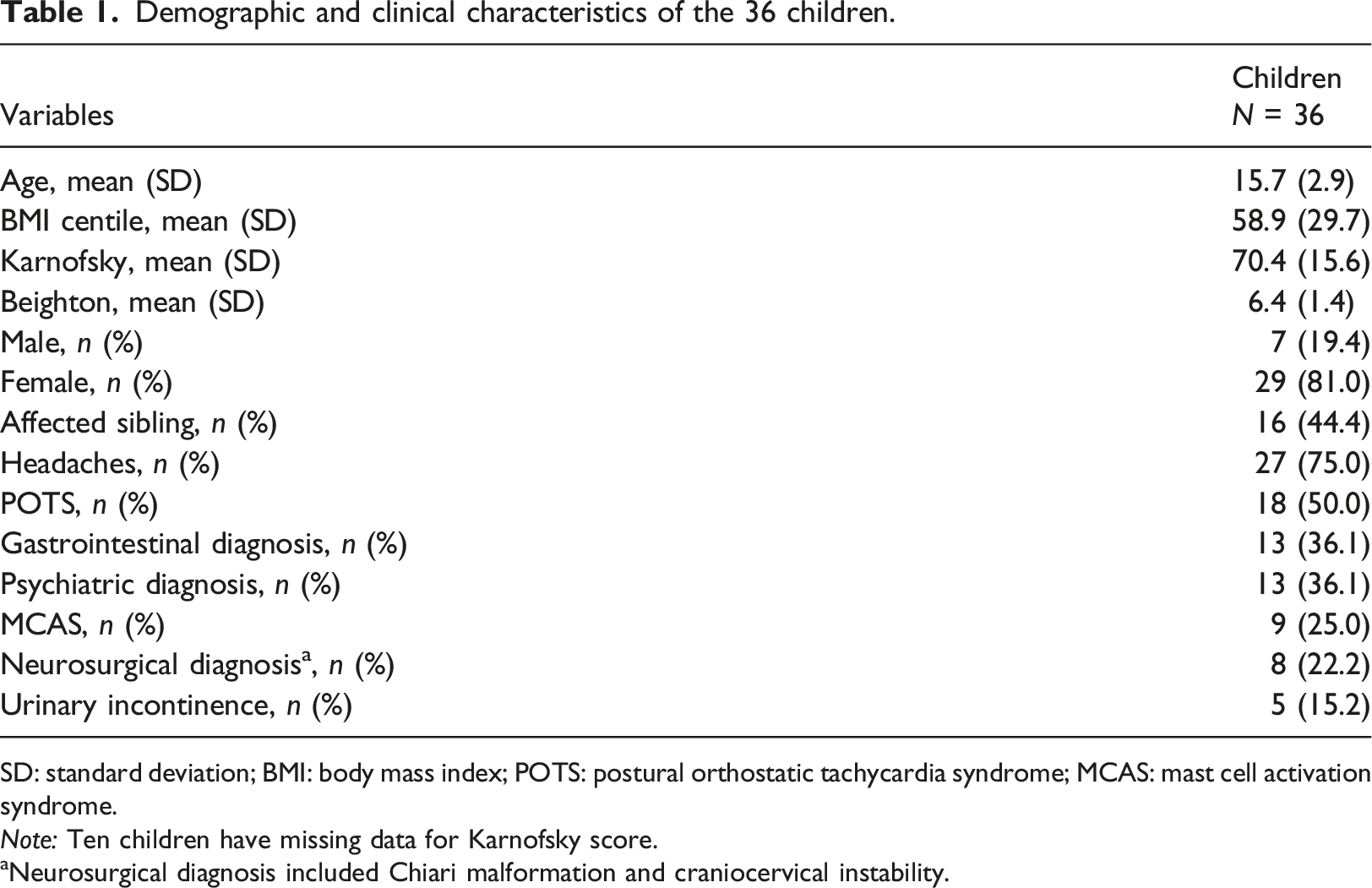
SD: standard deviation; BMI: body mass index; POTS: postural orthostatic tachycardia syndrome; MCAS: mast cell activation syndrome.
Note: Ten children have missing data for Karnofsky score.
aNeurosurgical diagnosis included Chiari malformation and craniocervical instability.
Results
Of the 68 children who had either a parent or a child complete the surveys, there were 36 dyads where both parent and child completed the surveys. Clinical features of these patients are presented in Table 1. There was no significant difference between these dyads and the individuals in the larger study group where only the child or only the parent completed the response in any demographic, clinical, or outcome measure except that fewer of the dyads (n = 7 (19%)) had an affected sibling versus non-dyad (n = 16 (48%)). Like the larger study group, the only difference between dyads from the two different institutions (GBMC vs JHU) was the number with affected siblings (13/22 vs 3/14) and the number with mast cell activation syndrome (9/22 vs 1/14).
Comparison of the parent and child responses for symptom severity, functional impairment and quality of life.

PFSD: pain frequency severity and duration; PedsQL: pediatric quality of life; MCID: minimal clinically important difference.
Difference was calculated as child score – parent score.
There was no significance between the child and parent means of any score (paired t-test or Wilcoxon sign-rank test for non-normal distribution). All ICC values reached significance (p < 0.0001). %MCID is the number of dyads with a difference of at least 0.5 SD of the child mean for each score. All Pearson’s r values were significant (p < 0.01), and all except for Illness perception, Anxiety, and Depression were highly significant (p < 0.0001).
* Variables with child or parent responses with p-value<0.05 in the Shapiro-Wilk normality test. Median with IQR and Wilcoxon Rank test were used for variables with p-value<0.05; mean with SD and Paired t-test were used for variables with p-value≥0.05.
Note: Five dyads have missing data for Illness Perception Questionnaire, Herth Hope Index Total, Anxiety Score and Depression Score; four dyads have missing data for PFSD Pain Score. MCID% was derived from the number of child-parent dyads at or above MCID, divided by the total number of dyads for each specific score.

Directional discrepancies between parent-child dyads. The left box is agreement, the middle box is parent score worse than child, and bottom box is child score worse than parent. Agreement is defined by the difference between parent and child score of less than 0.5 SD from the mean difference of the whole group. FDI: Functional Disability Index; IP: Brief Illness Perception questionnaire; Herth: Herth Hope Index total score; PFSD: Pain Frequency Severity and Duration scale.
The Bland-Altman (BA) plots (Figure 2) confirm that the mean difference between parent and child scores is not significant for any level of any score (the 95% CI band of regression line always overlaps the 0 line of perfect agreement) but also show large and likely clinically significant limits of agreement. For example, while the mean difference is very small for the total QOL score (0.34, 95%CI = −3.8-4.99), the SD is 12.24 points on a 100-point scale, suggesting that the variation in the mean difference is large and clinically significant. The BA plots also show no significant bias toward more or less disagreement in either direction for any score. One exception may be the FDI BA plot (Figure 2), which seems to indicate that when functional disability is worse, the parent tends to rate worse disability than the child. At better levels of functional disability there is more agreement. See supplemental figure 1 for additional BA-plots. Bland-Altman plots of parent versus child responses for functional disability, fatigue, and HRQOL. The x axis shows the mean of the parent and child responses, the y axis shows the difference between the child and parent responses. The horizontal dashed line represents the mean of the child-parent difference, the top and bottom lines represent +/-2 SD from the mean of the child-parent difference. The diagonal gray line represents the best fit line for the distribution, with the surrounding gray band as the standard errors. Additional plots are available in Supplemental figure 1.
We performed an exploratory analysis using elastic net logistic regression to find predictors of disagreement on the PedsQL total score by at least the MCID. All clinical diagnoses, several demographic variables (BMI, age, sex) and survey scores (both parent and child) were included as independent variables. Higher BMI and worse child perception of cognitive fatigue were strongest predictors of disagreement (standardized regression (β) coefficients 0.03 and 0.01, respectively). These variables were selected when only child survey scores or only parent survey scores were included; additional variables selected in these follow up analyses included the child’s Herth score, and the parent’s Herth, FDI, and anxiety scores.
Discussion
Our original aim was to assess how closely parental assessments of their child’s HRQOL agreed with the child’s self-assessment in a group of children and adolescents with hypermobile Ehlers-Danlos syndrome (hEDS). We analyzed parent-child agreement on a variety of factors including HRQOL, fatigue, illness perception, pain, hope, and functional disability. When taken as a group, we found moderate to strong agreement between parent and child on overall survey scores. However, despite the overall agreement on all measures, on an individual level, almost half of dyads disagree on each measure clinically. Interestingly, only anxiety had less than half of parent-child dyads agreed (n = 8 (38.7%)). This is consistent with prior studies of disagreement in other conditions, which typically find that there is more agreement for external, observable variables than for internal variables (Eiser and Morse, 2001; Verhey et al., 2009). In general, parent-child agreement about HRQOL has been reported as low to moderate, decreasing as children age on longitudinal assessment (Rajmil et al., 2013).
Parent-child agreement about HRQOL is an important consideration when weighing parent-reports and child-reports in clinic and can vary widely in depending on the population studied. To our knowledge only one other study by Pacey et al. (2015) (Pacey et al., 2015) has investigated agreement between children with hEDS and their parents on a measure of HRQOL and fatigue. Similar to our results, Pacey et al. found strong positive linear correlations on all measures between parents and children with hEDS. However, in contrast to our results, they also found that in comparison to their children, parents reported worse fatigue, physical and emotional function, and overall HRQOL with small effect sizes by Cohen’s d for each. Healthy populations can have moderate agreement on physical (ICC = 0.59, range = 0.53-0.65) and psychological (ICC = 0.46, range = 0.38-0.53) measures of HRQOL (Rajmil et al., 2013). Children with other musculoskeletal conditions and their parent-proxies that have been studied vary widely in level of agreement: any chronic health conditions (Physical well-being: baseline ICC = 0.62, 6-months ICC = 0.48; Psychological well-being: baseline ICC = 0.32, 6 months ICC = 0.67; autonomy and parent relations: baseline ICC = F0.53 0.31, 6-months ICC = 0.40; social support and peers: baseline ICC = 0.34, 6-months ICC = 0.51; school environment: baseline ICC = 0.25, 6 months ICC = 0.44)) (Qadeer and Ferro, 2018); juvenile rheumatoid arthritis (high ICC for gross motor function ICC = 0.62, 95%CI = 0.42-0.77, psychosocial function ICC = 0.61, 95%CI = 0.41-0.76, systemic symptoms ICC = 0.70, 95%CI = 0.52-0.82, and pain ICC = 0.60, 95%CI = 0.38-0.75, but low ICC for the fine motor function ICC = 0.35, 95%CI = 0.08-0.57; ICC is also higher for psychosocial among younger children, and higher overall QOL for those who had their disease longer) (April et al., 2006); asthma (ICC = 0.48, 95%CI = 0.31-0.63 for PedsQL core, and asthma symptoms ICC = 0.63, 95%CI = 0.49-0.74, asthma treatment ICC = 0.37, 95%CI = 0.18-0.53) (Ungar et al., 2012); and general chronic musculoskeletal conditions (ICC = 0.43 on the global health utility index) (Brunner et al., 2003).
The ICCs for survey measures in our study with the lowest ICC = 0.54 (95% CI = 0.31-0.71) for anxiety score and the highest ICC = 0.87 (95% CI = 0.78-0.92) for Functional Disability Index are relatively high in comparison to other chronic health conditions. Though the effect size indicated by Cohens’ d was small, data suggest that parents tended to report greater pain-related disability, less overall pain, less anxiety, and less cognitive fatigue than their children. This is consistent with generally accepted norms that parents tend to overrate the severity of external, observable aspects of their child’s HRQOL, while underrating internal, unobservable measures such as subjective pain and emotional distress (Verhey et al., 2009; De Civita et al., 2005; Sneeuw et al., 2002). When taken together, the dyads in our study agreed on average regarding the severity of pain, fatigue, disability, HRQOL, and level of hope. However, at an individual level a significant portion of dyads disagreed on each measure. This finding suggests that if only parent-proxy assessment of any of these outcomes is available, the average parent report will be an adequate assessment of what the child would report. However, we found that for each outcome half of individual dyads disagreed, and that 18 of 36 dyads disagreed on at least half of the outcomes. Thus, clinicians should be aware of this possible parent-child discrepancy in responses and use both self-reported and parent-proxy measures when caring for children with hEDS. To identify which dyads in clinic would be the most important to obtain both parent and child assessments, we performed an exploratory multivariate regression analysis.
With the importance of obtaining accurate information in clinical practice, understanding factors that predict which families are more likely to disagree may be helpful. Additionally, discrepancy between parent and child perceptions can predict dysfunctional behavior and functional outcomes (Gaultney et al., 2017). Disagreement about HRQOL was predicted by higher BMI centile and worse child perception of cognitive fatigue. The significance of BMI as a predictor of disagreement on HRQOL in pediatric hypermobile EDS is unclear. Studies have found that obesity is associated with lower HRQOL (Ul-Haq et al., 2013), negatively impacts family functioning (Halliday et al., 2013), and is associated with disagreement between parent-proxies and children in reporting dietary behaviors and physical activity (Collins et al., 2009). However, weight status has been found to have no effect on parent-child agreement on health-related behaviors in at least one study (Koning et al., 2018). While some studies have found that age of the child is related to agreement about HRQOL (Quitmann et al., 2016; Rajmil et al., 2013), it was eliminated from the final model in our analysis. Chronic fatigue is a well-known problem in children with hEDS and has been found in our cohort to be the main predictor of HRQOL along with pain (Mu et al., 2019), similar to the findings of others (Pacey et al., 2015). To our knowledge, no other study has specifically identified cognitive fatigue as a predictor of parent-child disagreement on measures of HRQOL. Given the relatively low number of participants in our study, the findings of this exploratory analysis should be interpreted with caution and follow up studies are needed to confirm the results.
There were several limitations of this study. The sample size was small and limits the statistical power. We did not have information about which parent was completing the survey or about parent’s health status, specifically whether they were also affected by symptoms of hypermobile EDS. We did not have information about several factors that have been shown to impact parent-child disagreement including parental perception of caregiving burden (Quitmann et al., 2016; Silva et al., 2015), parental stress, perceptions of familial relationships (Quitmann et al., 2016), parent’s perception of their own health status, and the amount of time since initial diagnosis (Qadeer and Ferro, 2018). An inherent potential problem is that the surveys were completed at home, and therefore the possibility of parents impacting the child’s responses or vice versa cannot be ruled out.
Implications for practice
Our results have implications for care and management of children and adolescents with hypermobile Ehlers-Danlos syndrome. The statistically significant differences identified by the surveys suggest that impressions of various aspects of morbidity should be obtained from both the patient (independently if possible) and the parent(s) especially quality of life, fatigue, hope, mood, functional disability and pain. Because we found discrepancy between the reporting by the parent(s) and by the patient, caution should be made in accepting either as definitive. It is important for clinicians to recognize that patients may have differing perceptions of emotional and physical needs as compared to their parents, as this may help to further engage pediatric/young adult patients in their ongoing care. While this should be studied in other populations, our result may have bearing on other parent-child dyads in the clinical setting, including other genetic conditions that involve significant pain, functional disability and psychologic distress.
Conclusion
Despite its limitations this study has important implications for assessing HRQOL in children and adolescents with hEDS. Information from both children and parents should be obtained when possible, as significant disagreement occurs frequently in measures of both general HRQOL, fatigue, hope, mood, functional disability, and pain. Future work is needed to develop efficient clinical tools using both self- and proxy-reports to identify children and adolescents with hEDS at higher risk for poor HRQOL outcomes.
Supplemental Material
Supplemental Material - Agreement between parent-proxy and child self-report in pediatric hypermobile Ehlers-Danlos syndrome
Supplemental Material for Agreement between parent-proxy and child self-report in pediatric hypermobile Ehlers-Danlos syndrome by Michael Muriello, You Wang, Julia L Clemens, Weiyi Mu, Christy H Smith, Phuong T Tran, Peter C Rowe, Clair Francomano, Antonie D Kline and Joann Bodurtha in Journal of Child Health Care
Footnotes
Acknowledgements
We thank our patients and their families for participating. We would also like to thank Dimitri Avramopoulis for statistical analysis assistance. Its contents are solely the responsibility of the authors and do not necessarily represent the official view of the Johns Hopkins ICTR, NCATS or NIH.
Declaration of Conflicting Interests
The author(s) declared no potential conflicts of interest with respect to the research, authorship, and/or publication of this article.
Funding
The author(s) disclosed receipt of the following financial support for the research, authorship, and/or publication of this article: This study was supported by National Center for Advancing Translational Sciences, UL1 TR001079, Research Accelerator and Mentorship Program (RAMP), Johns Hopkins Clinical Research Network (JHCRN).
Ethical approval
All procedures performed in studies involving human participants were in accordance with the ethical standards of the institutional and/or national research committee and with the 1964 Helsinki declaration and its later amendments or comparable ethical standards.
Informed consent
Informed consent was obtained from all individual participants included in the study. This study was approved by the Institutional Review Boards of the Johns Hopkins University School of Medicine (IRB00123375) and Greater Baltimore Medical Center

Supplemental Material
Supplemental material for this article is available online.
References
Supplementary Material
Please find the following supplemental material available below.
For Open Access articles published under a Creative Commons License, all supplemental material carries the same license as the article it is associated with.
For non-Open Access articles published, all supplemental material carries a non-exclusive license, and permission requests for re-use of supplemental material or any part of supplemental material shall be sent directly to the copyright owner as specified in the copyright notice associated with the article.
