



Abstract
Hypermobile Ehlers–Danlos syndrome (hEDS) includes physical symptoms of chronic pain, fatigue, gastrointestinal dysfunction, and joint subluxations/dislocations. This study aims to fill a research gap regarding the psychosocial well-being in pediatric hEDS by assessing relationships between functional disability, social support, and mental health. Increased functional disability is hypothesized to be associated with increased mental health challenges, specifically anxiety and depression, and general social support is hypothesized to moderate this relationship, such that higher perceived social support will mitigate the negative psychological impacts of functional disability. Gender’s influence on mental health in pediatric hEDS is also explored. Thirty-four youth with pediatric hEDS recruited from a United States Midwest multidisciplinary genetics clinic completed self-report questionnaires. Results demonstrate associations between functional disability and mental health, and social support and mental health independently; however, moderation was not found. Functional disability and social support each have a unique influence on the mental health of children with pediatric hEDS and should each receive clinical attention. Exploratory analyses into the influence of gender provide a groundwork for future studies.
Keywords
Introduction
Of the Ehlers–Danlos syndromes (EDS), pediatric Hypermobile Ehlers–Danlos syndrome (hEDS) is the most common (U.S. National Library of Medicine, 2020). Variation in symptom severity and frequency across individuals makes hEDS complex. Broadly speaking, EDS impacts a person’s connective tissues such as skin and joints (Malfait et al., 2017). Hypermobile joints are characteristic of hEDS resulting from dysfunctional connective tissue, frequently causing chronic pain (Malfait et al., 2017; Syx et al., 2017). Chronic pain associated with hEDS typically becomes more widespread throughout the body with age (Syx et al., 2017).
Chronic pain is frequent in hEDS, thus chronic pain research is often referenced when trying to understand life with hEDS. Worldwide, 20 and 40% of children experience chronic pain (Stanford et al., 2008; Friedrichsdorf et al., 2016). Females experience higher rates of chronic pain (King et al., 2011; Cederlöf et al., 2016) and hEDS than males (Castori et al., 2010). Estimates of hEDS prevalence vary, but it may be the most common heritable connective tissue disorder (Levy, 2018; Tinkle et al., 2017). Levy (2018) estimates hEDS prevalence as high as 1 in 5,000, noting that it is likely much more frequent, which is furthered by Tinkle et al. (2017), who find prevalence rates as high as 1–3%.
Attaining a hEDS diagnosis remains challenging. There is no biomarker for hEDS, and individuals frequently encounter providers who misunderstand the condition (Anderson and Lane, 2022). Physical symptoms of hEDS include fatigue, joint dislocations, bruising of the skin, gastrointestinal dysfunction, cardiovascular issues, postural orthostatic tachycardia syndrome, headaches and migraines, sleep disturbances, and dysautonomia (Tinkle, et al., 2017). Furthermore, medical systems emphasize these specific concerns (e.g. gastrointestinal challenges) rather than consider the implications of the individual’s full range of symptoms, and there are socioeconomic barriers to accessing providers who specialize in joint hypermobility syndromes (See Anderson and Lane for a detailed review, 2022).
One common challenge resulting from hEDS symptoms is functional disability, such as difficulty engaging in daily tasks like showering, playing at recess, or walking upstairs (Murray et al., 2013; Voermans et al., 2010). Functional abilities of those with pediatric hEDS are strongly related to pain intensity (Voermans et al., 2010; Simons et al., 2012), which is concerning as pain is the most frequently reported difficulty of hEDS (Tran et al., 2020; Bieniak et al., 2022).
Another challenge of hEDS observed in adult populations is psychological distress, primarily anxiety and depression (Hershenfeld et al., 2016; Bulbena et al., 2017; Cederlöf et al., 2016; Murray et al., 2013). Minimal research exists regarding the psychological well-being in pediatric hEDS. Given that worse psychological outcomes are seen in those with chronic pain (Vinall et al., 2016; Pavlova et al., 2017), regardless of age or chronic pain condition (Fishbain et al., 1997), one would expect youth with hEDS to experience similar challenges.
Functional disability, psychological challenges, and range of symptoms possible in hEDS do not exist independently, but rather have complex direct or indirect relationships with one another (Simons et al., 2012; Von Korff and Simon, 1996). Research demonstrates a relationship between functional disability and mental health outcomes in individuals with chronic pain, but it is unclear whether mental health difficulties in individuals with hEDS are the direct consequence of functional disability or of a combination of factors (Simons et al., 2012; Von Korff and Simon, 1996).
Associations between functional disability and mental health in pediatric hEDS may also be influenced by social support. Social challenges are observed in youth with hEDS and chronic pain (Bieniak et al., 2022; Kashikar-Zuck et al., 2008; Mu et al., 2019). A lack of social support for adults with hEDS (Murray et al., 2013) suggests that the social challenges experienced by those with pediatric hEDS are not simply a product of typical challenges associated with social development in youth, but rather a long-term impact of hEDS.
This study proposes a model of the relationships between functional disability, mental health, and social support to add nuance to our current knowledge of these variables in life with pediatric hEDS. With this model, we aim to improve our knowledge in a way that may guide the promotion of mental wellness in individuals with pediatric hEDS.
The Buffering Hypothesis (Cohen and Wills, 1985) and the Disability-Stress-Coping Model (Wallander and Varni, 1992; 1989) contributed to our model. Social support is a buffer against the negative impacts of chronic stress on well-being in the Buffering Hypothesis’s moderation model (Cohen and Wills, 1985). However, functional disability, our independent variable, is not typically conceptualized as a stressor—thus, the Cohen and Wills model was not sufficient alone. The Disability-Stress-Coping Model better captures the nature of functional disability as a risk factor to well-being and biopsychosocial adaptations, and resistance factors, including social factors, that mitigate the impact of risk factors (Wallander and Varni, 1992; 1989). As social support can have a beneficial impact on mental health (Chu et al., 2010), but is not associated with functional disability (López-Martínez et al., 2008), we followed the Buffering Hypothesis’s moderation model. Thus, our model proposes a relationship between functional disability, a risk factor, per the Disability-Stress-Coping Model, and mental health outcomes, a well-being outcome per the Buffering Hypothesis and adaptation per the Disability-Stress-Coping Model, is buffered by social support, per the Buffering Hypothesis (Figure 1). Proposed moderation model. Note. The proposed model, based on the Cohen and Wills Buffering Hypothesis (1985) and the Wallander and Varni (1992, 1989) Disability-Stress-Coping Model; Functional disability is the risk factor, mental health is the wellness outcome, and social support is the buffer that moderates the negative impact of functional disability on mental health.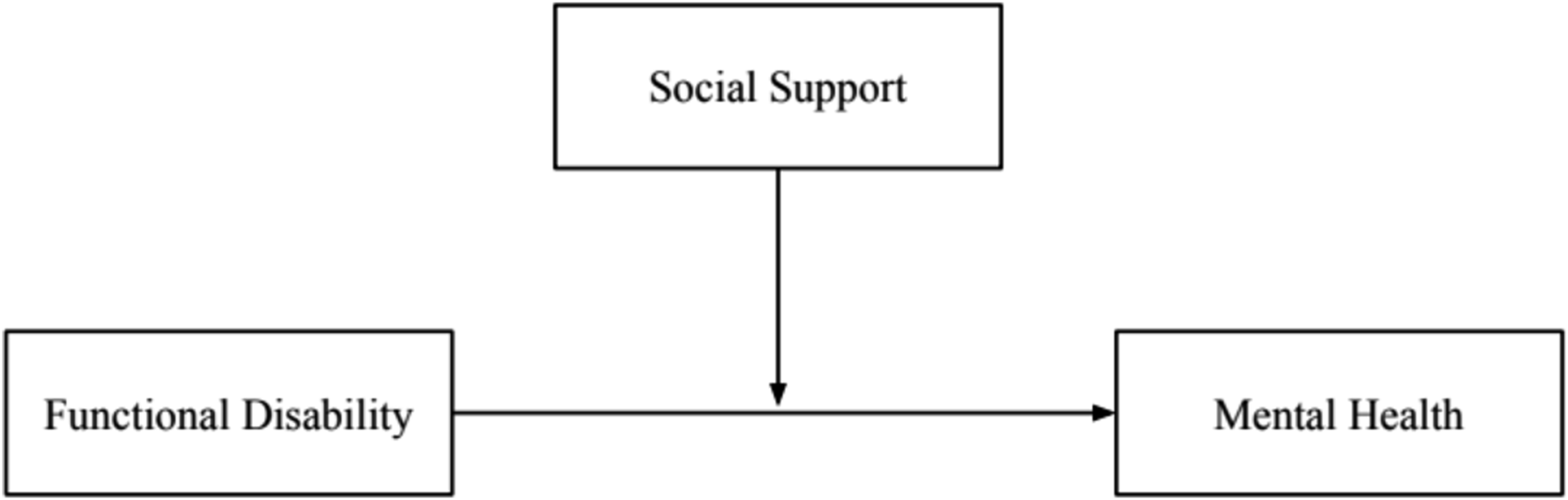
Given gender differences in the frequency of diagnosis (Cederlöf et al., 2016), pain reporting (King et al., 2011; Keogh and Eccleston, 2006), and more female utilization of social support and internalizing pain coping behaviors (Keogh and Eccleston, 2006), it is important to understand if gender differences are observed in pediatric hEDS experiences within our model. Some gender differences have been observed between anxiety and chronic pain associations, with adolescent females reporting more anxiety in relation to chronic pain than males (Pavlova et al., 2017). No information is currently available as to how gender may be related to mental health outcomes for individuals with hEDS. In exploring this relationship, we will begin to understand if different genders will experience hEDS in different ways, allowing future work to understand how gender may influence the psychological outcomes of individuals with the condition.
The present study
This study aims to improve our understanding of the relationships between functional disability, perceived social support, and mental health (anxiety and depression) in children with hEDS. Hypothesis I is that increased functional disability will be associated with worse psychological outcomes. Hypothesis II, which considers our proposed model, is that social support acts as a moderator on this relationship, such that higher levels of perceived social support will mitigate the negative impact of functional disability on mental health. Exploratory analyses will build from Hypothesis II, examining the role of gender in these relationships. Hypothesis III is that the correlations between functional disability and mental health will be significant for females and males, such that increased functional disability is expected to relate to increased mental health concerns. However, when considering our moderation model, we expect correlations between functional disability and mental health will be stronger for females, who tend to utilize social support as a coping mechanism more frequently (Keogh and Eccleston, 2006).
Aim
To increase understanding regarding the psychosocial well-being of youth with pediatric hEDS by assessing relationships between functional disability, social support, and mental health outcomes.
Materials and methods
Procedure
Approval from the DePaul University and Advocate Children's Hospital Institutional Review Boards was received. Data was gathered between August 2016 and June 2017. Following an appointment at a Midwestern US area children’s hospital multidisciplinary genetics clinic, families were invited to participate, and caregiver(s) who volunteered to provided informed consent from and assent was given from their children. Caregivers and children each completed their respective pen and paper forms at the clinic or returned them later, with the option to mail back responses with pre-paid postage. Participants were included if they had hEDS confirmed by the study geneticist, author B.T.T. were between 8 and 18 years old, and English speaking. Individuals with a developmental delay or intellectual disability that would interfere with their ability to assent and answer questionnaires were excluded. Measures assessed physical, psychological, and social functioning. At present, child-reported functional disability, social support, mental health, pain, and gender are analyzed. Additional studies have been published from this dataset including Tran et al. (2020) and Bieniak et al. (2022); however, the present study is the first to explore the role of social support in this sample.
Materials
Demographic information
Information was gathered from both child and caregiver about the child’s age, gender, race, and ethnicity. Child gender was collected via self-report demographic questionnaire. Options provided for gender identification included female, male, and other.
Functional disability
Functional disability was measured using the Functional Disability Inventory (FDI). Developed for use in youth with chronic pain, the FDI consists of 15 questions, each rated on a 5-point Likert scale (0 = “No trouble” and 4 = “Impossible”), that measure the physical difficulty of daily activities (Walker, and Greene, 1991). Questions cover different domains: home, school, recreation, and social. Example items include “Doing chores at home,” “Being at school all day,” “Doing activities in gym class (or playing sports),” and “Doing something with a friend (for example, playing a game)”. Scores include summed participant responses, with higher scores indicating higher levels of functional disability. Clinical utility of the FDI has been validated for use in children with chronic pain conditions (Kashikar-Zuck, et al., 2011) and its reliability in our sample was excellent (α = .911).
Mental health
Mental health was measured using the Pediatric Reported Outcomes Measurement Information System (PROMIS), Pediatric Anxiety Symptoms and Depressive Symptoms short forms. Each PROMIS measure has been validated for pediatric chronic pain populations as being accurate and precise measures of anxiety and depression symptoms (Irwin et al., 2010). PROMIS pediatric forms are for ages 8 to 18 (Varni et al., 2014). Each short form included eight questions on a 5-point Likert scale (0 = “Never”, 4 = “Almost always”) to rate the child’s frequency of anxiety and depression symptoms over the last week. On both forms, total response scores ranged from 0 (not having experienced any of the symptoms over the past week) to 32 (having frequently experienced all of the symptoms over the past week). PROMIS Anxiety Short Form questions include “I felt like something awful might happen” and “I felt worried.” PROMIS Depression Short Form questions include “I felt worthless” and “I felt like a failure.” Total scores for each form were converted to T scores for analysis, where the T score represents a general population of children (M = 50, SD = 10). The reliability scores in our sample were excellent for both the anxiety (α = .941) and depression (α = .973) questionnaires.
Social support
Social support was measured using the People in My Life (PIML) questionnaire, which characterizes social support as how much an individual perceives that others care about their feelings and experiences, listen to and understand them, and treat them like a person (Ridenour et al., 2006; Harter, 2012). Four social support domains exist on the PIML: parents, friends, classmates, and teachers. Participants choose one of two phrases which best matched their experience. For example, a participant would choose one of the following phrases: “Some kids have parents who don’t really understand them” and “Other kids have parents who really do understand them.” After selecting the most appropriate phrase, participants then rate the selected phrase as being “Really true for me” or “Sort of true for me.” Appropriate questions were reverse scored and then responses were summed to create domain scores and an overall score. The PIML consisted of 24 questions, six in each domain, with overall scores ranging from 24 to 96 and domain scores ranging from 6 to 24, with higher scores indicating more perceived social support. Reliability in our sample for overall perceived social support was excellent (α = .909). This measure has been deemed valid and reliable in the assessment of social support for individuals in late childhood, ages 10–12 years (Ridenour et al., 2006).
Pain
Pain intensity was assessed by asking “On days that you have had pain, what has been your usual level of pain in the last 2 weeks?” Responses were provided on an 11-point numeric rating scale, with higher values representing more intense pain (0 = “No Pain at All”, 10 = “Worst Pain I Can Imagine”). This question has been deemed a valid and reliable measure in pediatric populations (Castarlenas et al., 2017).
Statistical analysis
All data analysis was conducted with SPSS (Version 24.0) excluding Fisher’s Z, which was conducted with publicly available, online software (Lowry, 2021). Significance throughout this manuscript refers to statistical significance where the probability (p) is less than or equal to 0.05. Median values of central tendency and associated interquartile ranges (IQR) were calculated for all study variables.
As chronic pain is a common symptom of hEDS (Malfait et al., 2017) and given that pain impacts all areas of an individual’s life, correlations between pain and each variable in the model were conducted to determine if it should be a covariate in the subsequent analyses.
To examine Hypothesis I, Pearson correlations were conducted between functional disability and psychological outcomes.
To determine the sample size necessary for a moderated regression, a power analysis was conducted. At 80% power, with a moderate to large effect size (R2 = 0.3), a minimum sample of 30 participants would be needed. As the present sample meets this threshold (n = 34), and as past research has found a moderate to strong relationship between functional disability and mental health (Hershenfeld et al., 2016; Bulbena et al., 2017), a moderated regression analysis was utilized.
To examine Hypothesis II, moderated regression analyses were conducted. Two different moderated regressions were run, one looking at depression as an outcome and the other looking at anxiety. For each regression, the FDI and PIML variables were centered. Centered FDI and PIML scores were entered in the first step of the regression and their interaction in the second step. The same process was followed for each of the four domains of social support, resulting in eight moderations (four with anxiety as the outcome and four with depression as the outcome).
There were 24 females (70.6%) and eight males (23.5%). To analyze if gender differences exist in the relationships between variables and outcomes, variable means were compared between genders using Welch’s t-test for unequal samples. To analyze differences in relationships between variables, Pearson correlations between FDI, PIML, anxiety, and depression were conducted for males and females independently. Then, the strength of relationships for each gender were compared using Fisher’s z transformation.
For all correlations and subsequent analyses, only participants who had fully completed the relevant measures were included.
Results
Participants
Descriptive gender and race data (N = 34).

Correlations
Descriptive statistics for study variables (N = 34).

Note: FDI: Functional Disability Index. Depression: PROMIS Depression. Anxiety: PROMIS Anxiety. PIML: People in My Life questionnaire. Parent, Class, Teacher, and Friend are each a subscale of the PIML measure. IQR: Interquartile Range.
Correlations between model variables and pain
Pain had a significant relationship with functional disability (r = 0.68, 95% CI [0.44, 0.83]), anxiety (r = 0.50, 95% CI [0.19, 0.72]), and depression (r = 0.48, 95% CI [0.17, 0.71]). Pain and overall social support did not have a significant relationship. Pain and the social support domain of class were significantly related (r = −0.41, 95% CI [−0.67, −0.06]), but no other domains had a significant relationship with pain.
Given the relationships between pain and functional disability, anxiety, and depression, a hierarchical regression was run to determine if the proposed model would be better prepared to predict mental health outcomes if pain were included as a covariate. Hierarchical regressions were run for both anxiety and depression, with pain as the first step (model 1) and functional disability as the second step (model 2). For both mental health outcomes, model 2 was not a significant improvement from model 1. Further analysis of model 2 demonstrated that neither pain nor functional disability were significant within the model for predicting anxiety or depression outcomes. These results suggest that while pain and functional disability are both significantly related to mental health, neither variable is better suited to predict outcomes. Our original study model was retained given these findings as well as past literature that demonstrates that pain and functional disability are closely related (Voermans et al., 2010; Simons et al., 2012).
Moderated regression
Moderated regression: Depression.

Note: FDI: Functional Disability Index. B: Beta coefficient. SE: Standard error. Depression: PROMIS Depression. Anxiety: PROMIS Anxiety. PIML: People in My Life questionnaire. Parent, Class, Teacher, and Friend are each a subscale of the PIML measure. 95% CI: 95% Confidence Interval.
Moderated regression: Anxiety.

Note: FDI: Functional Disability Index. B: Beta coefficient. SE: Standard error. Depression: PROMIS Depression. Anxiety: PROMIS Anxiety. PIML: People in My Life questionnaire. Parent, Class, Teacher, and Friend are each a subscale of the PIML measure. 95% CI: 95% Confidence Interval.
Gender differences
First, Welch’s t-test found a significant gender difference for pain and for two social support domains (parent and class). No other variables differed significantly between genders (Supplemental Material 2).
Second, Pearson correlations between functional disability and mental health by gender (Supplementary Material 3) found that for males in the study (n = 8, 24%), there was a significant correlation between functional disability and depression, which was very strong and positive. For females (n = 22, 64.71%), there was a significant correlation between functional disability and anxiety, which was moderately strong and positive.
Pearson correlations between social support and mental health outcomes found no significant correlations for males. For females (n = 21, 61.76%), social support had a significant, moderately strong, negative correlation with anxiety and a significant, strong, negative correlation with depression. Social support domains of parent, class, and teacher were all significantly correlated with both mental health outcomes.
Third, Fisher’s Z comparison of correlations between genders (Supplementary Material 3) demonstrated that genders differed significantly on their correlations between functional disability and depression and social support and depression. The relationship between functional disability and depression was significant for males but not for females while the relationship between social support and depression was significant for females but not for males. No significant differences were seen between functional disability and anxiety or social support and anxiety.
Discussion
This study aimed to analyze if social support moderated the relationship between functional disability and mental health in individuals with pediatric hEDS as well as potential gender differences in experiences with hEDS. The Buffering Hypothesis (Cohen and Wills, 1985) and the Disability-Stress-Coping Model (Wallander and Varni, 1992; 1989) were blended to propose a model in which functional disability acts as risk factor, mental health as a wellness outcome, and social support acts as a buffer. While support was found for Hypothesis I—as functional disability increased, so did symptoms of anxiety and depression—support was not found for Hypothesis II—social support did not act as a moderator on between functional disability and mental health. Mixed results were found for Hypothesis III—there were no significantly different means between genders, males only demonstrated a significant correlation between functional disability and depression while females demonstrated significant correlations between social support and both anxiety and depression. Genders differed significantly on the correlations between functional disability and depression and social support and depression.
Findings that as functional disability increased so did anxiety and depression were consistent with past research in pediatric chronic pain samples (Vinall et al., 2016; Pavlova et al., 2017). This is concerning for the psychological wellness of those with the syndrome given that high levels of functional disability are frequent in hEDS (Voermans et al., 2010; Syx et al., 2017
Findings that functional disability was not significantly associated with social support are similar to those in adult chronic pain populations (López-Martínez et al., 2008). Social support being significantly associated with anxiety and depression reinforces previous findings that have demonstrated that increased social support is related to better mental health outcomes in children (Chu et al., 2010) and that lower social support is related to worse mental health outcomes generally (Baeza-Velasco, et al., 2018; Rubin and Burgess, 2001; López-Martínez, et al., 2008).
Results demonstrate that for this sample, functional disability and social support are both independently related with mental health outcomes, but social support does not buffer functional disability’s impact on mental health. Consequently, we find that functional disability is related to more frequent symptoms of anxiety and depression, regardless of social support.
Although social support is generally thought to have a buffering effect, there are situations in which social support poses a threat to well-being, potentially explaining these results. Miscarried helping is an example of this phenomenon, in which a caregiver of a child with a disability attempts to assist their child in coping; however, this helping inadvertently harms the child’s self-efficacy or yields frustration with the parent’s actions, thus damaging the efficacy of the parental support (Fales et al., 2014; Harris et al., 2008). Counter to the parent’s goal of helping ease the burden of daily tasks, the child may feel frustrated that their parent sees them as incapable, eventually expecting the parent to step in to assist so they avoid the task altogether. Disability is related to perceived miscarried helping (Fales et al., 2014), which is concerning given the high levels of functional disability in individuals with hEDS (Voermans et al., 2010).
Exploratory gender analyses presented differences between males and females, furthering evidence that gender may influence chronic pain experiences (Keogh and Eccleston, 2006). Despite our small sample, results may be reflective of differences in lived experience of hEDS across genders. First, in contrast to our hypothesis, only males demonstrated a significant correlation between functional disability and depression. This relationship was significantly different from that for females. Second, only females demonstrated significant correlations between social support and both mental health variables; however, a significant gender difference was only seen between social support and depression. Similar to our findings, current literature demonstrates that social support plays a larger role for females with chronic pain than for their male counterparts (Keogh and Eccleston, 2006; Chu et al., 2010; Zhang et al., 2015).
A possible explanation for these gender differences in the relationship between functional disability and depression is that masculine behavioral expectations for boys in Western culture pressure males to be independent with minimal reliance on social support (Pollack, 2006). This pressure may yield feelings of loneliness and the need to act tough (Pollack, 2006). Feelings of isolation, hopelessness, and poor self-esteem may arise from being unable to meet societal expectations of toughness when managing pain and functional disability from hEDS—increasing their risk of depression. Additionally, pressure to not engage in social support like females may partially explain why a significant relationship between social support and depression in females exists, but not males. Findings reaffirm gender should be examined as we continue to study the impacts of and interventions for pediatric hEDS.
Limitations
First, these findings only represent a small subset of individuals with hEDS who identified as being white, middle to upper class, with private insurance, and who shared their experiences in the years 2016 and 2017. Consequently, there is little understanding of the role of functional disability and social support in children with hEDS who are experiencing marginalization or minoritization, nor how life with hEDS may have been influenced by the COVID-19 pandemic. Further, as no information was gathered on participant response rate, it is unclear how representative the current sample is of individuals with access to this clinic.
Second, the FDI, PIML, and PROMIS overlap chronologically. Thus, other potential modes of interaction between these variables are possible. Further, reports of anxiety and depression in childhood chronic pain are associated with worse pain outcomes (Pavlova et al., 2017), which may create a feedback system in which the negative impacts of functional disability contribute to continued functional challenges. For example, anxiety about risk of injury could result in withdrawal from activities, increasing feelings of social isolation, while depression could result in feelings of hopelessness that make even the thought of beneficial treatments, such as physical therapy (Levy, 2018), feel pointless.
Third, results of gender analyses should be interpreted with caution given that the sample only included eight males and 24 females. Finally, these results represent experiences across a wide age range; however, age differences in experiences with hEDS may exist. Further, as the PIML is validated for youth between 10 and 12 years, there may be measures that are better suited for future assessment of social support in youth outside of this age range.
Implications for practice and research
In considering the clinical implications of this study, associations between variables and the absence of moderation must be considered. Lower level of functional disability in children with hEDS may be associated with fewer mental health difficulties. To address functional disability in youth with hEDS, children and families should have access to learning pain coping skills as well as to interventions such as physical therapy (Bulbena et al., 2017; Simmonds and Keer, 2007). Social support does not appear to buffer functional disability’s impact on mental health, despite findings that perceptions of having sufficient quality, overall social support is related to fewer mental health difficulties. From a clinical viewpoint, the lack of moderation highlights the need to attend to these variables independently in terms of resources and interventions in the promotion of psychological well-being in youth with pediatric hEDS, while recognizing that improved social support will not mitigate the relationship between functional disability and mental health. To facilitate social well-being, care providers can educate patients and families on the importance of social support, work with families to ensure that they are best equipped to support the child and one another, and facilitate conversations with children about how to maintain healthy relationships. Findings reassert that care should be coordinated across multiple physical (e.g., scheduled medication usage) and psychosocial (e.g., psychological counseling) modalities (Tinkle et al., 2017).
There are several future directions for research in this area. Future research should include longitudinal analyses, represent more diverse identities of youth with hEDS, and utilize measures and methods to better assess the complex relationships between variables in relation to life with hEDS. Sampling from more diverse settings, such as from clinics that serve a broader range of socioeconomic privilege, would elucidate relationships between lived experiences with hEDS and identity variables. Consideration of the temporal onset of chronic pain and psychological symptoms is necessary given that a portion of adolescents report having mental health disorders prior to experiencing chronic pain (Tegethoff et al., 2015). Longitudinal work would also allow for assessment of variable directionality and potential bidirectional or reciprocal relationships between variables, which would provide a more thorough understanding of the complex condition. Finally, assessment of different age groups, such as children, pre-adolescents, and adolescents, would allow for a more in-depth conceptualization of how hEDS impacts life at different developmental phases.
Conclusion
The present study demonstrates the complexity of life with pediatric hypermobile Ehlers–Danlos Syndrome. Results emphasize the need for illness management to be multidisciplinary, such that those with the condition are able to find ways to cope with the physical and psychosocial consequences of the syndrome. As the symptomology of hEDS varies between individuals, it is crucial to continue to investigate potential individual differences or factors as they relate to mental health outcomes. Early intervention should promote skills related to coping, social support, and psychological wellbeing.
Supplemental Material
Supplemental Material - The role of functional disability and social support in psychological outcomes for individuals with pediatric hypermobile ehlers–danlos syndrome
Supplemental Material for The role of functional disability and social support in psychological outcomes for individuals with pediatric hypermobile ehlers–danlos syndrome by Keely H Bieniak, Brad T Tinkle, Susan T Tran in Journal of Child Health Care
Footnotes
Acknowledgements
We would like to thank Dr Jocelyn Carter for her feedback, mentoring, and support of this project.
Declaration of conflicting interests
The author(s) declared no potential conflicts of interest with respect to the research, authorship, and/or publication of this article.
Funding
The author(s) disclosed receipt of the following financial support for the research, authorship, and/or publication of this article: This work was supported by the College of Science and Health Faculty Summer Research Grant (2016).

Supplemental Material
Supplemental material for this article is available online.
References
Supplementary Material
Please find the following supplemental material available below.
For Open Access articles published under a Creative Commons License, all supplemental material carries the same license as the article it is associated with.
For non-Open Access articles published, all supplemental material carries a non-exclusive license, and permission requests for re-use of supplemental material or any part of supplemental material shall be sent directly to the copyright owner as specified in the copyright notice associated with the article.
