



Abstract
This article analyses the image of the waste picker in contemporary visual art in order to test the extent to which urban modernity can be viewed as a unified critical concept. Focusing on works by Surasi Kusolwong and Santiago Sierra, it examines confrontations between ‘modern’ and ‘non-modern’ sociological, economic and artistic practices within the urban environment. The analysis is located in the context of Bernard Yack’s The Fetishism of Modernities, in which the author teases apart different sociological, political, philosophical and aesthetic developments that are typically homogenised to support a globally coherent vision of modernity. Linking depictions of waste pickers to representations of the chiffonnier in 19th-century painting and literature, the article shows how Kusolwong and Sierra prompt reflection on the relationships between urban dwelling, cleanliness and global economic justice, while undermining a critical tradition that posits the 19th-century western metropolis as the embodiment of a unified concept of modernity.
The aim of this article is to analyse ways in which contemporary art’s representation of waste production and its management can be used to support or undermine a unified concept of urban modernity. While large-scale waste is a familiar and accepted by-product of industrial development in densely populated cities, I shall argue that certain types of labour associated with the disposal or recycling of waste disturb any straightforward association of urban dwelling with a set of values that supports a coherent notion of modernity.
In her classic study of taboos connected with filth, Mary Douglas argues that the efficient processing of waste products is not necessarily associated with attempts to control the spread of disease, but rather with efforts to maintain order: ‘Dirt offends against order. Eliminating it is not a negative movement, but a positive effort to organize the environment’ (2003: 2). The relation between waste management and the maintenance of spatial and social order within cities has contributed to discourses about the visible characteristics of urban modernity, including its infrastructure: typically a ‘modern’ city is understood to be a clean city (Marcus, 1999; Pisani, 2011). The following discussion is concerned with the ways in which two contemporary artists prompt reflection on the connections between waste management and urban modernity, by focusing on forms of unofficial labour that trouble the relationship between cleanliness and the spatial order of cities.
While critical literature typically has identified 19th-century Paris, New York and London as cities that witnessed the birth of urban modernity, I shall explore inconsistencies within this critical tradition and its extension into a contemporary, global context. I shall do so by tracing links between depictions of the contemporary waste picker and those featuring his or her 19th-century counterpart, the rag picker (le chiffonnier), and by identifying the various ways in which these two figures serve as a provocation to the organisation of social spaces and labour markets within self-consciously ‘modern’ cities. For this purpose I shall reference works by the Thai artist Surasi Kusolwong and the Spanish artist Santiago Sierra. My contention is that while these artists examine certain taboos and social tensions surrounding the production of waste by juxtaposing its management in cities located in different countries, the antagonisms that they reveal are indicative of inconsistencies within familiar histories of ‘urban modernity’ that seek to express the development of cities such as Paris, New York or London.
Whose modernity?
In his insightful book, The Fetishism of Modernities, Bernard Yack (1997) identifies a range of inconsistencies in the use of the term ‘modernity’ and points to the difficulty of identifying a consistent set of ‘modern’ values that correlate with a distinct historical period. Yack points out that modernity has been associated with, among other things, the advent of Enlightenment rationalism, the political transformations effected by the French Revolution, changes in social organisation brought about by industrialisation and capitalism, and the aesthetic projects of various European writers and painters active in the mid- to late 19th century. For Yack, attempts to determine the characteristics of modernity based on projects conducted within these fields ‘focus our attention in different directions’ (1997: 34) and, more worryingly, diverge in their understanding of when the modern project commences.
Similar problems beset attempts to define the characteristics and structures of a modern urban environment. For example, in Sharon Marcus’s discussion of the changes made to the design of 19th-century Paris, various architectural, social and economic features of urban modernity are described as becoming visible in different decades of the century: Many of the aspects of urban modernity that marked Second Empire and fin-de-siècle Paris were already in place by the 1820s, including a culture based on commodification, spectacle and speculation and a legible urban space easily mapped and navigated by the upwardly mobile. (1999: 17–18)
While Marcus has no difficulty in identifying the practices and ideas that seem to mark Parisian urban life as distinctively modern, the concept of urban modernity becomes unstable in this description, as it eludes any precise temporal definition: did Paris become modern in the 1820s or at the end of the century (two periods that differed in terms of the personal freedoms accorded to French citizens and, therefore, do not support a consistent ideal of political modernity)? If we are forced to admit that modern values arise in different periods, what weight can modernity carry as a term that seeks to distinguish one historical epoch from another by virtue of the social, political and cultural features that it possesses?
Arguing against attempts to correlate substantive and temporal notions of modernity, Yack (1997) adopts an alternative approach by teasing apart various sociological, political, philosophical and aesthetic developments that often are homogenised in the critical literature to suggest a unified notion of modernity and a ‘totalising’ conception of modern experience. In support of his view, he draws attention to the ways in which both modern and non-modern practices and institutions have continued to exist simultaneously during a period that extends from the European Enlightenment to the present. Yack summarises the problem as follows: Modernity, the modern condition, the spirit of modern life, these are intellectual inventions inspired by our need to come to grips with the unprecedented social and cultural transformations of recent centuries. We come up with these ideas by focussing [sic] our attention on the most distinctive features of recent social experience and by consciously abstracting from the great range of ideas and institutions that do not share these features. But by treating modernity as a coherent and integrated whole we turn these distinguishing features of modern life and thought into a condition that shapes all aspects of modern experience. In this way, our own intellectual inventions come back to haunt us as an omnipresent force in our lives. (1997: 7; emphasis in original)
Rather than trying to impose a single, and falsely consistent, concept of modernity on the diverse social, political and aesthetic currents of a period that stretches from the 18th century to the present, Yack encourages critical attention on the uneven development of different modernities, and on the ways in which continuities with the past shape the practices of societies which consciously seek to effect social, political and cultural changes that break with their histories. He does not suggest the impossibility of identifying modern values and practices, but argues that these may arise in different areas of thought, social organisation and cultural production at different periods and for different purposes. By moving away from a totalising conception of modernity, Yack offers a more densely textured view of how we might imagine the sociocultural practices of a so-called modern age, thereby bringing to light ‘what is most unexpected, incongruous and just plain interesting in our experience’ (1997: 13).
Yack’s multifaceted approach is the one that I shall adopt when considering the notion of urban modernity in the following discussion. Furthermore, I shall argue that such an approach is warranted by the artworks that form the core of this analysis. In their different ways, Kusolwong and Sierra undermine a coherent vision of what it is for a city to be an exemplar of urban modernity, by pointing to inconsistent but concurrent values and social practices that shape urban life, and by raising questions about what modernity means when understood in a global context. By suggesting links between contemporary waste picking and the activities of the 19th-century chiffonnier, the works on which I shall focus alert the viewer to the internal complexities and inconsistencies that shape a concept of modernity on both national and international scales.
The work that best introduces the issues with which I am concerned is Kusolwong’s participatory piece, Golden Ghost (The Future Belongs to Ghosts). The work has been staged at a range of venues around the world, but the one on which I shall focus is the installation at MoMA PS1, New York in 2011. Golden Ghost consists of a room filled with colourful thread waste, a by-product of fabric manufacture that typically is recycled for use in industrial cleaning processes (Figure 1). Hidden in the midst of this waste are some pieces of expensive jewellery. Participants in the work are invited to enter the room and to forage through the materials in search of these prizes (if found, they can be retained by participants).
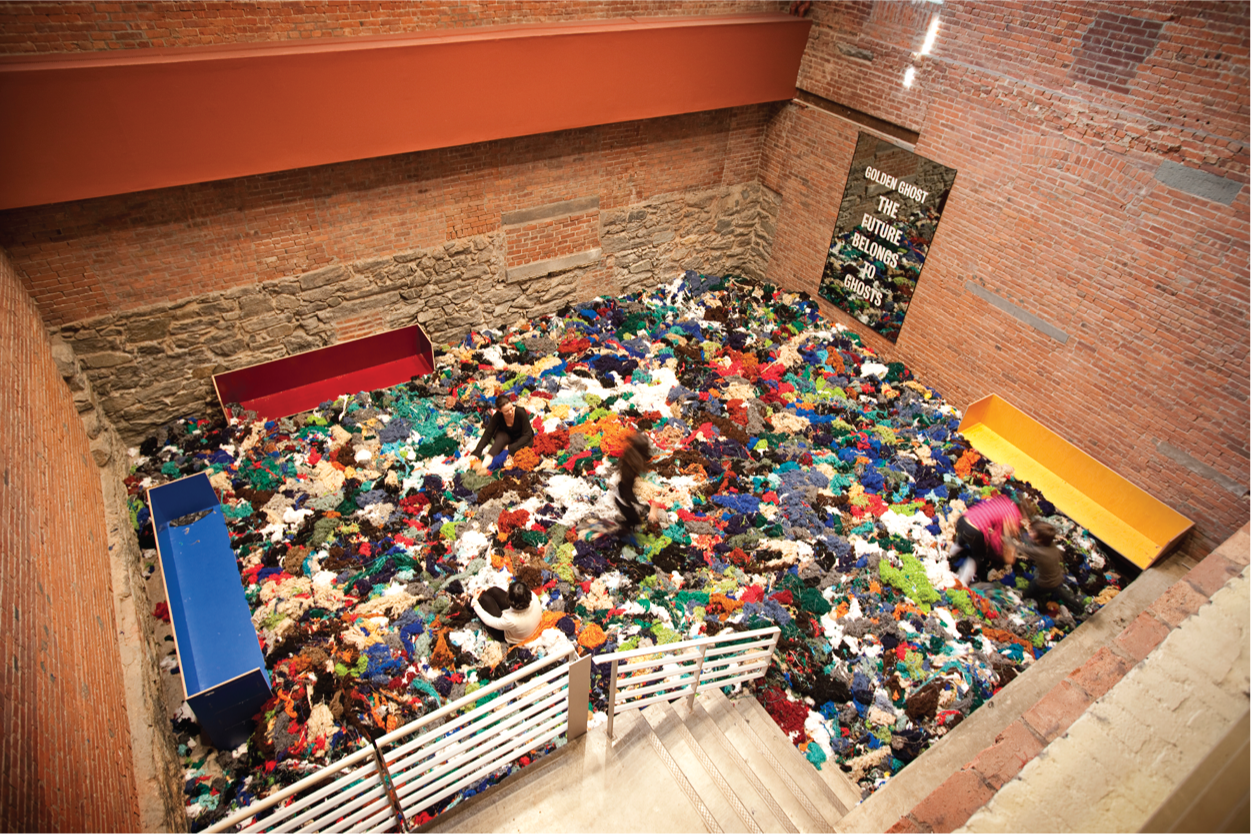
Installation view of Surasi Kusolwong’s Golden Ghost (The Future Belongs to Ghosts) at MoMA PS1, 2011.
The work engages the sensory experience of participants in numerous ways. Triggering a range of visual encounters (looking, searching and being made subject to the gaze of others), the installation also physically engulfs its participants. Individuals are surrounded by a sea of thread waste and are asked to touch, examine and sift through the material in search of items of tradeable value. Countering the habitual ways in which art audiences navigate an exhibition space, each participant’s range of movement is altered, as he or she stumbles through an unfamiliar physical environment.
Like many contemporary artworks that incorporate participatory practices into their vocabulary, Golden Ghost engages its audience both physically and imaginatively in order to express a social theme. The work references the inevitable creation of waste as a by-product of industry; however, more importantly, it invokes a form of urban labour associated with the management of that waste. In one of the wealthiest cities in the West, Kusolwong asks his audience to enact the experience of some of the poorest inhabitants of the world, who comb rubbish heaps in the hope of finding food, clothing, or materials that can be used, recycled or sold.
By inviting participants to adopt the aims, posture and gestures of waste pickers, Kusolwong’s work does not simply evoke the labour and lifestyle of a community whose freedoms and opportunities differ markedly from those of a western art audience. It asks participants to reflect on what it might be like to be a member of that community. In this regard, Golden Ghost can be said to foster a form of self-reflection on the part of participants, as they enact an unfamiliar perspective on urban life while remaining within the clean and safe environment of the art institution. As Richard Moran has argued in a different context, imaginatively adopting a perspective on something can say more about a person by involving a type of ‘dramatic rehearsal’ (1994: 105) of an emotion or a point of view, insofar as the person determines what it is like to inhabit that viewpoint. Golden Ghost gives Moran’s metaphor of rehearsal a particularly forceful effect, by transforming the cognitive experience of an artwork into an imaginary experience of the physical labour undertaken by individuals whose daily lives are far removed from the institutional frameworks of the international art world.
In many contemporary urban centres (particularly in South-East Asia, South America and Africa), waste pickers fulfil an important role: they make up for an absence of waste collection infrastructure, thereby contributing informally (and at no cost) to local improvements in public health (Dias, 2012). In addition, they sort recyclable from non-recyclable materials for onward processing: an activity that complements the formal measures undertaken on a much wider scale to combat climate change. However, waste pickers are also subject to social stigma, disease and exploitation (George, 2011; Samson, 2009).
By inviting his audience to enact the labour of the waste picker, Kusolwong unites two starkly contrasting experiences of contemporary urban life. Being part of a privileged audience for an avant-garde artwork in one city renders visible the lives of marginalised and displaced communities in other rapidly growing cities in the world – a visibility that is often absent in the environments where such labour takes place (George, 2011; Samson, 2009). In cities such as Delhi, which have witnessed exponential growth in terms of industry, technology and infrastructure over recent decades, many aspects of waste management devolve to individuals who work for no pay, beyond the boundaries of officially recognised labour markets, and who remain excluded from the rights and obligations that structure such markets.
By drawing together privileged leisure with outsider labour, Golden Ghost prompts consideration of the values that identify an urban environment as a modern space. The work asks whether the existence of forms of labour and social organisation that radically restrict the personal freedoms and opportunities afforded to individuals whose lives are associated with waste (i.e. the ongoing existence of non-modern sociological conditions) compromise a city’s claim to urban modernity, notwithstanding the fact that it shares other infrastructural, economic or cultural features that have been typically used to mark out other urban centres as modern spaces.
Santiago Sierra’s 21 Anthropocentric Modules Made from Human Faeces by the People of Sulabh International, India (Lisson Gallery, London, 2007–2008) explores similar contradictions by incorporating the labour of contemporary waste pickers into the actual production of an artwork. Sierra’s work displaces the activity of waste picking from labour sites in India to an exhibition space in a foreign city (London). Whereas Kusolwong’s installation invited participants to re-enact the labour of waste pickers, Sierra’s work involves the displacement of one product of waste picking (in this case, human excrement) and its transformation into an object of aesthetic contemplation. In this regard, the labour of the artist is linked symbolically to that of the waste picker.
Anthropocentric Modules is a sculpture designed to highlight the lives and social status of workers in India who deal directly with the disposal of human waste. The work is monumental in size and consists of 21 slabs (each measuring 215 × 75 × 20cm) made of human faeces hand-collected by waste pickers in Delhi and Jaipur in 2005–2006. Having been left to decompose and then mixed with a liquid plastic, the processed faeces is transformed into sculptures that fill three rooms, through which the viewer is invited to wander (Doyle, 2008). The rectangular blocks are monochrome and repetitious. This diminution of spectacle, combined with formal iteration, invites focus on the materials comprising the work and, more specifically, on the type of labour from which it is derived.
Research has shown that in India, most waste collection involving the handling of human excrement is carried out by waste pickers (typically women) from the lowest caste of Indian society (George, 2011). The organisation with which Sierra worked to produce Anthropocentric Modules, Sulabh International Social Service Organisation, is a non-governmental organisation whose published mission is to remove ‘untouchability and social discrimination against scavengers’ (Sulabh International Social Service Organisation, 2013). Its methods for achieving this range from the introduction of sanitation facilities to the organisation of literacy and education programmes for the children of waste pickers, vocational training and ‘social adoption’ programmes designed to integrate individuals traditionally considered ‘untouchable’ into mainstream Indian society.
Both Anthropocentric Modules and Golden Ghost draw attention to social conditions that severely limit the personal freedoms of individuals who are restricted to particular forms of labour associated with waste produced within their society. In this regard they illustrate a conflict discussed by Amartya Sen in Development as Freedom (2001[1999]). Sen argues that the development of a society consists in ‘the removal of various types of unfreedoms that leave people with little choice and little opportunity of exercising their reasoned agency’ (2001[1999]: xii). However, his examination of 20th and 21st-century advances in the recognition of human rights and the safeguarding of basic liberties is tempered by examples of ongoing economic deprivation, and the persistence of oppressions that prevent individuals from exercising such ‘freedom of agency’ (2001[1999]: xi). Sen’s account of uneven sociopolitical development, both within and across a range of societies, mirrors the discrepancies which, as discussed previously, are inherent in narratives of modernity that seek to homogenise conflicting social, cultural and political currents.
By focusing on forms of labour that represent radical limitations on personal freedoms, Kusolwong and Sierra invite their audiences to consider which social groups are included in, or excluded from, narratives of urban modernity (or to use Sen’s phrase, social ‘development’) in local and international contexts. The transposition of such labour practices to cities that have been viewed as quintessential sites of urban modernity (New York and London) prompts reflection not only on the political and economic discrepancies in the societies within which such labour takes place, but also on the conflicting narratives that have informed the history of modernity itself. Mike Davis has argued that the ‘dynamics of Third World urbanization both recapitulate and confound the precedents of nineteenth- and early-twentieth-century Europe and North America’ (2007[2006]: 11). In contrast with the rise of the capital-intensive metropolis of the 19th century, migration from the countryside to the city in many Asian, West African and South-East Asian countries contributes to a cycle of negative economic growth characterised by a lack of jobs, urban de-industrialisation and a rise in slum dwelling (Davis, 2007[2006]). While Kusolwong and Sierra’s works use geographical juxtaposition to illustrate a type of underground labour that forms part of the contemporary narrative of urbanisation described by Davis, my contention is that the tensions revealed by these works are also indicative of inconsistencies in the longer history of modernity. Parallels between the depiction of contemporary waste picking and the labour of the 19th-century rag picker form part of the recapitulation of 19th-century western precedents described by Davis, and it is to this aspect of the works that I shall now turn.
From 19th-century rag picker to contemporary waste picker
Writing in the late 1930s, Walter Benjamin described the 19th-century rag picker as ‘the most provocative figure of human misery’ (2003: 349). The question that I shall explore in this section concerns why the rag picker should be construed as ‘provocative’ in this context, and how this provocation can be understood to impact on the concept of urban modernity.
Benjamin’s comment arises in the context of his discussion of poetry and prose works by Charles Baudelaire that feature the image of the rag picker. As a poet who grappled with the notion of modernity, Baudelaire repeatedly sought to define and convey what he thought were the distinctive features of contemporary life in 19th-century Paris, and to demonstrate how the visual and literary artworks produced within this dynamic urban space differed from earlier styles of cultural production. In his famous essay, ‘The Painter of Modern Life’ published in 1863, he described the quest of the artist as a search for ‘that which we might permit ourselves to call modernity’; it is the artist’s task to ‘distill from current fashion that which is poetic in the historical, to draw out the eternal from the transitory’ (Baudelaire, 1975–1976[1863], vol. 2: 694; emphasis in original; author’s translation).
Running throughout Baudelaire’s poetry are images of the swift turnover of information in the metropolis, the speed of architectural change, the intoxication of losing oneself in the anonymity of the crowd, the mixing of social classes on the streets and the inauguration of a self-conscious break with older forms of aesthetic and political authority. One of the key (and most famous) figures through whom these experiences of the 19th-century city were mediated in Baudelaire’s poetry was the sophisticated individual who wandered the streets and absorbed its various stimuli: the flâneur. However, detailed critical focus on the unique consciousness of the flâneur often has obscured the role of another figure who, in both the literature and visual art of the period, was important in articulating the burgeoning urban environment: namely, the rag picker. In a passage written in 1851 that could apply equally to the works of Kusolwong and Sierra discussed above, Baudelaire describes the activities of the rag picker as follows: Let us think about one of those mysterious beings who live, so as to speak, off the detritus of large cities … Here is a man charged with the task of collecting all of the daily rubbish of the capital. Everything that the large city has rejected, everything it has lost, everything it has disdained, everything it has broken, he catalogues it, collects it. He consults archives of excess, a jumble of scraps … just as a greedy man collects treasure, so too he collects the garbage that, having been spat out by divine Industry, is transformed into objects of utility or pleasure. (1975–1976[1851], vol. 1: 381; author’s translation)
In Baudelaire’s description, industry is ironically termed ‘divine’, recognised as the driving force behind the exponential growth of the metropolis. Yet the functioning of that divinity also illuminates the density of conflicting urban narratives: rapid industrialisation produces waste and contributes to the creation of a marginalised underclass that is integral to the processing of that waste. To frame this in terms of Yack’s thesis, just as the industrial momentum of the city powers it forward to create what Baudelaire characterises as a modern urban environment, so too it produces and feeds off a set of non-modern, socio-economic practices in order to sustain that progress. Although, as Richard Sennett has noted, the urban changes to which Paris was subjected under the architectural programme of Baron Haussmann promoted a spatial order in which individual neighborhoods became ‘homogeneous economic units’ (Sennett, 1992: 134–135), designed to reduce the mixing of social classes, the peripatetic rag picker collected waste from all over the city, sifting through and ‘archiving’ the rubbish of both rich and poor. Like the accusing look of the poor in Baudelaire’s prose poem, ‘Les Yeux des pauvres’ (1975–1976, vol. 1), the ‘penetrating gaze of the chiffonnier’ described by Isidore Ducasse in Les Chants de Maldoror (Lautréamont, 2001[1868]: 137) offended the spatial order to which the self-consciously modern capital aspired.
In her book, The Global City, Saskia Sassen (2001) analyses the features of urban development that have led to the creation of ‘global cities’: namely, agglomerations that play a key role in transnational networks designed to promote and sustain a world economy. In Sassen’s account, the emergence of a global economic network has had a transformative effect on the organisation of cities such as New York, Tokyo and London, which are now home to ‘specialized service firms’ (2001: xx–xii) embedded in dense information networks, staffed by a cadre of highly paid professionals, and that form part of an international network of affiliates. In examining the structures of labour and economic activity that underpin the growth of such urban centres, Sassen (2001) draws attention to attendant increases in the polarisation of income and shifts in job distribution: ‘high-income gentrification’ stimulates the proliferation of low-wage jobs, and various industries (in particular, the manufacturing sector) have undergone a downgrading from unionised work environments to sweatshops and outsourced home industry.
On the one hand, Sassen’s picture of economic polarisation in highly developed urban centres captures a feature of the waste management process as described by Baudelaire in the mid-19th century: an increasingly densely populated urban environment produces low-income (or no-income) labour that is undertaken by individuals who are excluded from the principal industries that sustain the economic growth of the city. On the other hand, the activities of the rag picker (like those of the contemporary waste picker) differ from the type of economic polarisation described by Sassen, as they represent a form of labour that exists beyond the boundaries of organised production, distribution and consumption. In this regard, waste picking resembles the kind of informal work associated with casual employment in the ‘underground economies’ that Sassen (2001) identified as being subject to increases in contemporary New York, London and Tokyo.
Viewed against this background, Benjamin’s description of the rag picker as a ‘provocative figure of human misery’ is not only an expression of empathy with individuals who are subject to extremes of poverty, but also a recognition of those types of work that have been cast as disruptive to the organisation of labour within the social order (Cohen, 1993; Marx and Engels, 1998[1848]; Skinner, 2004). It was precisely this outsider status that made the rag picker such a powerful figure in 19th-century painting and literature. Like other artists of the period, such as Édouard Manet or Lautréamont among others, Baudelaire employed images of social outcasts such as rag pickers for the purpose of figuring contemporary social inequalities and mirroring the status of the vanguard artist as a social outcast (Baudelaire, 1975–1976; Benjamin, 2003; Wilson, 1991).
In his taxonomy of different professions published in 1887, Joseph Barberet described Paris as the ‘commercial centre of rags’ (1887: 60), and examined the development of the trade of rag picking as it had evolved since the 18th century. His discussion of this form of outsider labour came at a time when Parisian council officials were implementing a formal system of waste management, thereby severely reducing the opportunities for rag pickers to continue their trade. A public letter dated 16 January 1884, that was allegedly written by a rag picker (signed ‘Chevalier de la Hotte’) and addressed to the Prefect of the Seine, Eugène-René Poubelle, criticised these reforms, pointing out that around 30,000 men would be reduced to beggary once the new procedures were implemented: ‘We are a class of citizens, poor but honest; you do not have the right to take the bread from our mouths’ (de la Hotte, 1884: 1). Illustrating the point with which I began this article, the management and disposal of waste was viewed by 19th-century urban reformers as a key means of imposing spatial order on the city and of controlling its demographic, thereby effecting a visible break with the past and presenting an image of the city as a modern space. The result of such urban reform was that the trade of rag picking needed to be officially phased out.
The image and symbolic status of the rag picker in 19th-century Paris captures many of the tensions inherent in advancing a unified notion of modernity. Nevertheless, a figure that came to epitomise non-modern sociological and economic structures of the city is a key element in the expression of aesthetic modernity in the works of, for example, Baudelaire and Lautréamont. Illustrating Yack’s thesis, the presence of the rag picker demonstrates the coexistence of modern and non-modern labour practices and forms of social organisation that prevailed in the mid-19th century. However, in an extension of this argument, the rag picker also illuminates the different symbolic values that attach to a particular image of labour: a figure that threatens modernity when viewed in a sociological context becomes central to the construction of that concept in an aesthetic context.
Thus, 19th-century rag pickers can be described as ‘provocative’ in a sense that goes beyond that of Benjamin, insofar as they symbolise the appropriation of modernity by competing social, aesthetic and economic discourses. I argued above that Kusolwong and Sierra’s works confront the viewer with such disjunctive aspects of urban modernity by metaphorically displacing the unofficial management of waste from one urban site to another. By translating the 19th-century chiffonnier into the figure of the contemporary waste-picker, these artists ask viewers to question the constituent elements of urban modernity from both a local and a supranational perspective. However, by placing Kusolwong and Sierra’s works in the context of a longer western art historical tradition, we also find a continuation of tensions inherent in the concept of modernity as it developed in the swiftly changing environment of the 19th-century city.
Waste in a transnational art world
I have argued that Golden Ghost and Anthropocentric Modules are socially engaged artworks that use the symbolism of waste for the purpose of commenting on extremes of poverty and wealth both within and across contrasting urban environments. However, the question arises as to how the producers of these works can maintain a position, in good faith, that is critical of global economic injustice while relying on the infrastructure of a sophisticated transnational art market. This is also a question that affects individuals who view or participate in the works. In addition to thematising waste picking, for example, Golden Ghost offers its audiences an opportunity for play and enjoyment. The bright colours of the materials, the physical freedoms permitted by the installation space and the promise of a ‘treasure hunt’ (as described in the exhibition’s promotional material) encourage individuals to delight in the broad sensory and imaginative possibilities of this immersive environment. Similarly, Sierra’s Anthropocentric Modules asks viewers to interpret a work made of excrement not just as a narrative of social inequality, but as a piece of sculpture designed to elicit aesthetic appreciation. The question arises as to how Kusolwong and Sierra invite their audiences to reconcile the experiences of play and aesthetic pleasure with the uncomfortable social realities to which the works point.
This, too, is a problem with which Baudelaire grappled in his poems that dealt with rag pickers, the urban poor, prostitutes and the homeless. Ross Chambers sums up Baudelaire’s dilemma as the following: ‘art … can be diagnostic in relation to the modern social formation, but its diagnostic stance doesn’t prevent it from being itself part of the deplorable social conditions it diagnoses’ (2005: 114). In Chambers’ reading of Baudelaire’s poetry, this complicity between the form and theme of socio-critical art leads to narrative instability, the ‘undecidability’ of a critical stance that is ‘at least half in love with its object: the city’ (2005: 114).
It may be argued that there is a similar ‘undecidability’ in the aesthetic stance of Kusolwong and Sierra, insofar as each artist is simultaneously critical of, and a contributor to, the transnational networks and capital flows that comprise the contemporary art world. In my view, these two artists are very much aware of art’s reliance on international flows of capital and information, and their strategy is to ironise such exchanges or to incorporate them critically into their works.
In the case of Golden Ghost, activities that constitute the experience of waste picking in one context generate a form of leisure when transposed to a different environment. It is important to note that this experience of play is neither an accident nor a misuse of the work. Instead, it serves to highlight the socio-economic juxtaposition of two forms of urban experience, and becomes an integral component of the work’s reflection on the networks of social and monetary exchange within which the work itself is embedded.
This aspect of Golden Ghost develops a theme in one of Kusolwong’s earlier installations, entitled One Pound Turbo Market (You’ll Have a Good Time): a work that was staged in the Turbine Hall of Tate Modern, London in 2006. The piece was a makeshift marketplace that involved the display and sale of cheap plastic toys, clothing and household items, each priced at £1. At once a satire on the museum souvenir industry and a questioning of the materials used to constitute a work of art, the focus of One Pound Turbo Market is not on the objects used in the artwork, but on the staging of the economic transaction by which those objects are acquired: as money changes hands, the physical artwork disintegrates. If London and its art market form part of a much larger, transnational economic network, Kusolwong interrogates the benchmark prices for goods in different economic centres, and contrasts the values ascribed to artworks and to everyday household items. Like Golden Ghost, One Pound Turbo Market draws together different economic orders within the space of a single art gallery. It does not directly represent the urban environment; rather, echoing Sassen’s discussion of the role played by global cities in a world economy, it interrogates the contribution of the city and its art institutions to broader social and economic networks.
Sierra also reflects on the value of objects and labour involved in maintaining the contemporary art world by drawing people into voluntary and involuntary economic exchanges. While his segregation of an art audience according to individual income levels structured both the placement of participants and their point of entry to a symposium held in Berlin in 2010 (Kunstakademie, Institute Cervantes), his Workers Paid to Remain Inside Cardboard Boxes (staged in various locations and in different formats since 1999) is a more dramatic reference to the iniquities of underground labour of the kind described by Sassen and, more provocatively, to the invisible labour that takes place within museum spaces. For example, Sierra has drawn an analogy between the task of sitting in a cardboard box for nine hours, or being hidden behind a wall for 360 consecutive hours and fulfilling the role of museum guard (Margolles, 2004).
Commentators have rightly drawn attention to the ethical controversies surrounding Sierra’s replication and integration of inhumane and exploitative labour practices into his art, even where such strategies are intended to draw attention to social inequality (Schmidt-Linsenhoff, 2010). The point I wish to make for the purposes of the present discussion is that Sierra, like Kusolwong, does not shy away from acknowledging art’s complicity with the economic networks and labour structures of which it is critical. Furthermore, he makes this complicity (and that of his audience) an integral part of the themes and structures of his works. Therefore, informing the ‘diagnostic stance’ (to use Chambers’ term) of both Kusolwong and Sierra is an acknowledgement by these artists of their reliance on transnational exchanges between artistic centres, and on the presence of shared interpretive frameworks that, as Noël Carroll (2007) has argued, are required in order to make artworks intelligible to diverse audiences.
By shifting the imagery and symbolism of outsider labour between contrasting urban geographies and drawing attention to the social identity of individuals who spend their lives in the presence of waste, Kusolwong and Sierra surreptitiously interrogate the specific contribution that art makes to the maintenance of spatial order within cities. Sharon Zukin has argued that ‘culture is a powerful means of controlling cities. As a source of images and memories, it symbolises “who belongs” in specific places’ (1995: 1). Zukin’s point is well taken, but Golden Ghost and Anthropocentric Modules may be said to link cultural production to a more potent economic question by using culture to interrogate who is excluded from specific areas of the city. Zukin continues: The look and feel of cities reflect decisions about what – and who – should be visible and what should not, on concepts of order and disorder and on uses of aesthetic power. In this primal sense, the city has always had a symbolic economy. (1995: 7)
The purpose of this article has been to show how Kusolwong and Sierra reflect on this ‘symbolic economy’ of cities by exploring the relationship between urban order and narratives of modernity. In the artworks discussed, waste pickers (like their 19th-century counterparts) are shown to play a disruptive role within the spatial organisation of modern urban environments by virtue of their association with filth. While art renders such labour visible, it simultaneously alerts the viewer to the contribution made by cultural institutions to the social and symbolic order of cities. I have argued that Golden Ghost and Anthropocentric Modules undermine a coherent sense of urban modernity, because they question the possibility of drawing together different social, political, cultural and economic practices under a consistent set of specifically modern values and ideas. In drawing parallels between contemporary waste picking and 19th-century rag picking, my purpose has not been to construct an historical narrative. Rather, I have attempted to show that inconsistencies inherent in the concept of urban modernity as it developed in the 19th century still prevail today, particularly when that concept is analysed in a global context. In their different ways, Kusolwong and Sierra question any easy equivalence between the look and feel of a modern city and the social ideas and practices that inform and sustain it.
Footnotes
Funding
This research received no specific grant from any funding agency in the public, commercial or not-for-profit sectors.