



Abstract
This article uses the conceptual constructs of ‘public’ and ‘counterpublic’ to examine the collective singing of ‘Red Songs’, a state-approved, ideology-laden popular culture, in the city of Guangzhou, China. It approaches these two concepts from actions, practices and shared meanings which render the public/counterpublic visible and concrete. In Guangzhou, the interplays between hegemonic ideas expressed in the red songs and ordinary singers’ agency of re-interpreting and re-reading have shaped the fluidity and complexity of the cultural meanings and political discourses in which this grassroots public dwells. Singers do not simply re-assert the post-reform party-state’s political legitimacy by expressing political allegiance via red songs, but also creatively reconstruct and re-appropriate the meanings woven into red songs to critically reflect upon the social, cultural and moral transformations, as well as new cultural and ethical zeitgeists in the post-reform context. In the meantime, red song singing is also appropriated by New Leftist activists for cultivating new counterpublic political potentials.
Introduction
Constructing the public and counterpublic
This article attempts to situate the concept of ‘public’ into the sphere of everyday social life, and examine how political identities are performed and communicated in the formation of grassroots publics. According to the mainstream theories in political philosophy, the notion of ‘public’ can be conceived of in two different ways. In the first place, it can be traced back to the writings of Habermas (1989) and Arendt (1958, 1973) on the formation of modern public sphere. According to these two theorists, public sphere is principally an arena where citizens are free to participate in collective deliberation and negotiation for common political projects. Communicative expression helps to build up reciprocal understanding between social and political subjects (Habermas, 1984, 1987). To Arendt (1958, 1973), communicative action requires a sphere where expressive actions can appear to and ideas be shared with others (Benhabib, 1996). For Habermas (1974, 1989), on the other hand, the public sphere is a political intermediary between the state and the bourgeois civil society, and its reciprocal and interactive nature is premised on the rational-critical debates among members of the bourgeois class.
There is a second approach towards the conception of public which departs radically from the focus on universal participation and consensus building. Fraser (1990) rejects the idea that public sphere arises out of concerted activities of a plurality of agents for purposes of rational debate and consensus building. On the contrary, Fraser proposes that public sphere is a realm of contestation and even confrontation between competing publics. Fraser also contends that to conceive of the civil society as an internally homogeneous public sphere built on consensus forecloses alternative voices and expressions which do not necessarily fit with the mainstream. Thus, Fraser proposes the concept of counterpublics – a multitude of social and political collectives which contests the exclusionary nature of the bourgeois public sphere and celebrates alternative political behaviors and discourses. Counterpublic spheres provide underrepresented social groups with opportunities to speak out in one’s own voice to enact and express diverse social positions and political identities.
In one sense, the ideas of public and counterpublic seem to be mutually antithetical. On the one hand, the public is frequently criticized on the ground that in pursuing shared attitudes and consensus, it often reproduces hegemonic discourses and forecloses marginal voices. As Benhabib (1996) has noted, both Arendt and Habermas focused on the universality and unity of the public, but neglected how imagined unity of the public realm might be crosscut by competing identities and lines of difference. The counterpublic sphere, therefore, is taken as intrinsically the antipode to hegemonic regimes. The logic underlying this dichotomy of public/counterpublic is that as a classic liberal-democratic lexicon, the public is seen as a universal sphere which reifies collective consensus in the form of authoritative views and voices, despite the distinct social and cultural positions in which social members are located (Marston, 1990; Staeheli, 1996; Warner, 2002a, 2002b). The counterpublic, in Fraser’s (1990) terms, is seen as the part of the society which is nominally included in the public but nonetheless possesses no position to speak its own voice. Therefore, it can be anchored in nowhere but the opposite end to the public.
This article, however, aligns itself with a radically different imagination of political association and public life. In accordance with Fraser’s (1990) important theoretical intervention, it concurs that the public is not a pre-established and universal social space, but rendered concrete and meaningful through shared meanings, discourses, practices and actions from below. Habermas’ (1992, 1996) later works, for example, have already extended the discussion on public sphere to public actions built upon particular social groups’ collective concerns and claims, rather than a universal class position. The Arendtian and Habermasian theories of idea exchange, common interests and communicative actions are useful for us to understand inter-subjective mutuality in the formation of the public as a shared political community, but such a conception of the public does not need to be understood in terms of a universal and homogeneous totality.
More recently, the literature on cultural public sphere has argued that the Habermasian theory of communicative mutuality can be used not only to elucidate rational political projects. Affective, emotional and ‘unofficially political’ dimensions are also important to the construction of reflective dialogicality and mutual engagement (McGuigan, 2005). As McKee (2005) has noted, particular groups’ distinctive cultures can be important elements of a sphere of public expression and communication. Thus, any group or social collective can build up their own public on the basis of shared identities, ideas and cultural meanings (Hartley and Green, 2006; McGuigan, 2005). As Warner (2002a, 2002b) argues, the public is a self-organized collective of strangers which is addressed by and responds to reflectively circulated discourses. Following this point of view, this article conceptualizes the public as any assemblage of social members who construct a physical or discursive space in which ideas and meanings are exchanged and shared. The counterpublic, on the other hand, refers to the counter-hegemonic and resistant potentials that the public engenders. The public and the counterpublic are not mutually exclusive domains. Counterpublic is implicated in the production of active publics; and any public, while potentially reproducing hegemonic discourses, is also radically open to non-conformist identities and ideas.
The empirical research in this article employs ‘public’ and ‘counterpublic’ as the conceptual points of entry to understand the non-government-led, spontaneously organized singing of ‘Red Songs’ in urban public spaces of the city of Guangzhou, China, set in the context of both the country’s history of Communist revolution and its more recent post-reform social, cultural and economic transformations. This article analyzes the ways in which political attitudes and identities are constructed and performed through the public singing of red songs. It argues that the space of song singing constitutes an urban public, as it consolidates shared political identities and facilitates the formation of political solidarity. Often, it reproduces discourses and identities which conform to the political leadership of the current Chinese party-state. But in the meantime red song singing also contributes to the ongoing construction of a counterpublic sphere, as narratives and meanings that red song singing engenders often counteract and put into question the dominant discourses in contemporary China which deify market-oriented economic relations as the only and inevitable end of social progress.
Public space and popular culture: two analytical registers
The hypothesis in this research is that through red song singing, we may snapshoot the construction of a public built upon the communication of ideas and sharing of identities. But in what ways is this public performed and reproduced through practices and the circulation of discourses (Warner, 2002b)? Why are the identities and meanings which this public breeds potentially diverse and unfixed? How can the public and counterpublic coexist and constitute each other? To answer these questions, this article engages with two registers of analysis. First, this article spotlights the role that public space and spatial practices play in constituting political meanings and identities. As the empirical analyses in this article will show, it is through red song singers’ use and appropriation of public urban space as well as their performative displays of identities in space that a pro-socialist cultural ambience is constructed, practiced and lived. Also, it is in responding to this pro-socialist ambience that red song singers negotiate their political identities and produce political narratives.
Undoubtedly, scholars have long been making efforts to locate the public sphere in urban spaces. The Speaker’s Corner and the English coffeehouse are two examples of the ideal of political expression being concretized in the spatialized form (Cooper, 2006; Laurier and Philo, 2007). Other studies have followed Fraser’s appeal for contestatory and confrontational politics, and examined the ways in which dominant power can be questioned and challenged through public demonstrations, protests and other forms of collective claim-making (Lee, 2009; McCann, 1999; Mitchell, 2000; Salmenkari, 2009). Those collective political actions, as D’Arcus (2003) has argued, disrupt established relations of power by giving previously marginalized social groups a consolidated position to speak, and by presenting these groups’ values and political claims to an audience (Mitchell and Staeheli, 2005; Pile and Keith, 1997).
However, much of the extant research on politicized public space tends to view political identity as pre-given, fixated and simply transported to established public forums. It neglects the potential of public space as the social terrain in which political meanings, attitudes and identities can be intimately experienced, re-negotiated and reproduced through complex cultural experiences, including but not limited to acts of political expression. If the public emerges, at least partly, from practices and actions, there is an ongoing dialectic between political meanings and the immediate socio-spatial settings in which these meanings are played out. Therefore, this article focuses on the ways in which social subjects actively engage with cultural experiences of public social life, and construct discourses and narratives to configure and negotiate their political identifications.
Second, this article presents and analyzes the various political discourses which shape, but are also shaped by, the public singing of red songs (Warner, 2002b). These political discourses are the cohesive forces of the grassroots public examined in this article. In the case of red song singing, the formation of political discourses in which this grassroots public dwells depends on the diverse ways in which social members interpret and respond to meanings and symbols which red songs bear. Singing red songs is not simply a collective activity which brings people together. More importantly, red songs are active agents which navigate and shape political narratives. Ideologies and meanings contained in red songs constitute the discursive terrain for the ongoing construction of grassroots publics. Also, as Warner (2002b) argues, a public is addressed by discourses but also produces responding discourses, according to its own positions and interests. A counterpublic is implicated in the formation of the public precisely because social members can employ cultural and discursive resources in red songs in radically heterogeneous ways.
In China, the ‘Red Song’ is a ‘politically correct’ popular culture endorsed by the post-reform Communist party-state. The primary purpose of the red songs, apparently, is to ensure and sustain the people’s political allegiance to the party-state regime. As Hall (1996b) and Althusser (1971) have both argued, dominant ideology is inextricably interwoven into the production of popular cultural meanings, and naturalizes the assumedly only and eternal foundation of our way of life. But dominant ideologies are not simply imposed from above. On the contrary, it is experienced, negotiated and lived by active social members. Ideological meanings can be understood only historically in relation to various social structurations, struggles and negotiations (Gruneau, 1988; Hall, 1982). The Gramscian conceptions of ideology and hegemony, for example, foreground the cultural and political agencies of both dominant and dominated social groups, and underline the possibility of articulating popular cultural meanings with various lines of social and political forces, as well as the struggles between them (Gramsci, 1971; Hall, 1996b). Popular culture is far from unified expression of fixed ideologies and interests, and it is plausible for the consumers of popular culture to perform ‘unruly’ elements in opposition to authorial discourses (Hall, 1996a). This perspective also allows some space for non-hegemonic, alternative meanings and expressions, which endows popular culture with potentially enormous spectrums of possibilities for re-constructing cultural and political discourses (Bennett, 1986; Hebdige, 1986).
As this article unfolds gradually, we will see that red song singers do not simply re-assert the post-reform state’s political legitimacy by performing discourses and symbols encoded in the red songs. More significantly, they creatively reconstruct and re-appropriate the meanings woven into red songs to critically reflect upon the social and economic transformations, as well as the new cultural and ethical zeitgeists in the post-reform Chinese society. The dichotomization between the pre-reform and post-reform eras is corporeally and discursively practiced through engagements with red songs. Singing of red songs constitutes a space in which the leadership of the post-reform Chinese state is asserted and simultaneously contested.
Setting the scene: introducing red songs
This article is based on a field research lasting from September 2011 to January 2012. During that period, the author visited four sites of collective red song singing in Guangzhou, respectively, Yuexiu Park, Tianhe Park, Baiyun Mountain Park and Liuhuahu Park (Figure 1). ‘Red Song’ is the name given to a unique political culture situated in the context of China’s communist/socialist party-state regime. Although themes in the red songs are diverse, at the heart of this popular culture is the state’s political initiative to win the collective consent and conformity of the people to the party, under the overarching banner of socialism. In the post-reform Chinese society, ‘socialism’ is a highly ambiguous term; and many of its authentic meanings and connotations cannot find anchor in the social and economic realities any longer. Yet, China is still officially a ‘socialist’ state; and socialism is a signification, a discursive contour which is supposed to support political legitimacy even in the post-Mao era. It is part and parcel of a sophisticated system of ‘red culture’ supporting the ideological superstructure of the Chinese state. For ordinary folks in China, the red culture is a taken-for-granted element in the cultural fabric of the Chinese society, although it has become increasingly dissociated from many people’s everyday life in the post-reform era since 1978.
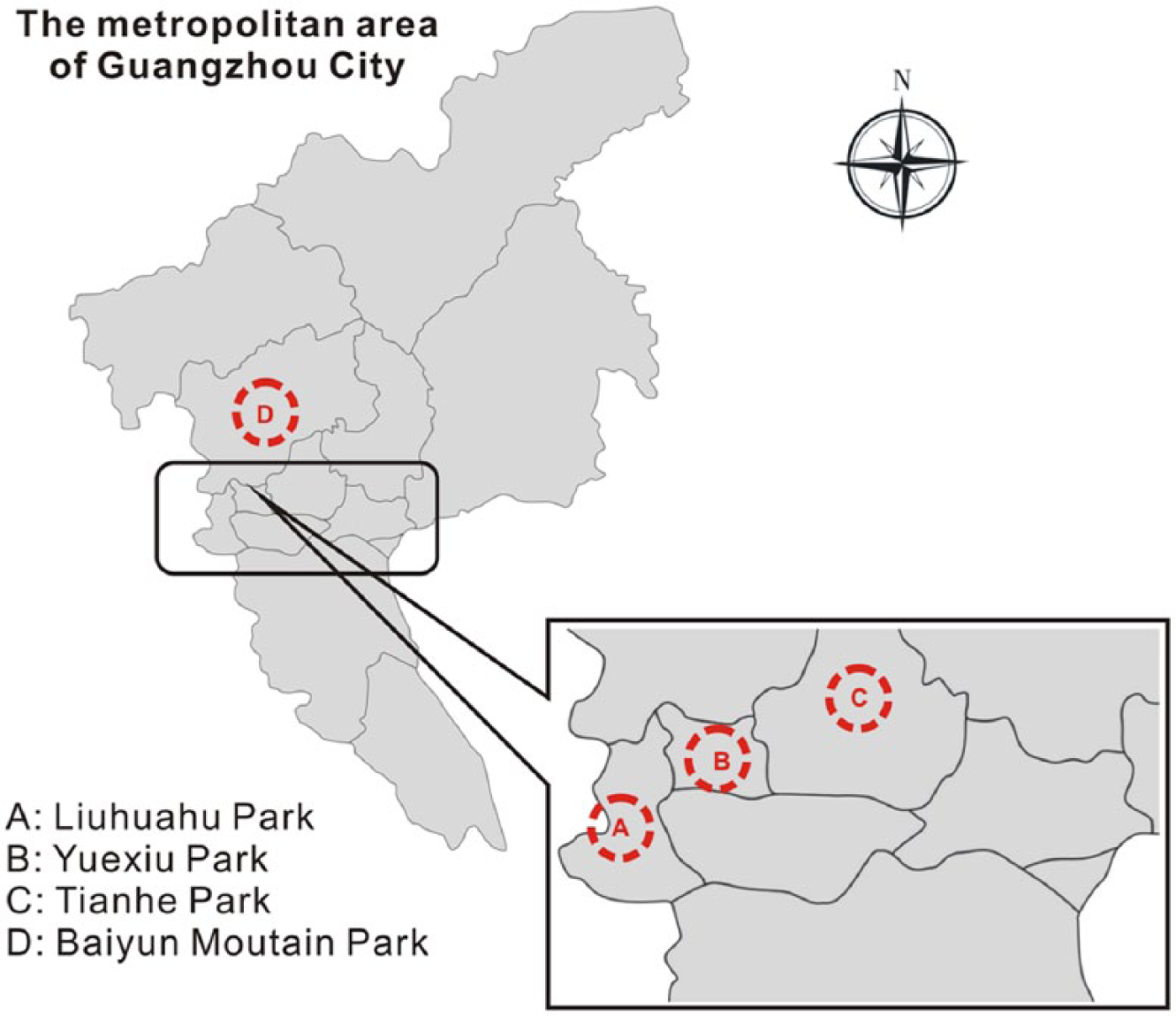
The locations of the four sites of red song singing in Guangzhou.
In the Western representations, the red culture is almost unanimously portrayed as a product of the state’s campaign for manipulating the ‘spirits’ of the people through ideological brainwashing and propaganda (Chang, 2011; Richburgh, 2011). Especially after China’s three decades of reform and economic liberalization, the red culture appears to represent the state’s desperate efforts to maintain a hegemonic framework of beliefs and values, and instill a sense of national pride and common purpose in an increasingly consumerist and fragmented society. It recounts from time to time the founding myth of the socialist China to restore the unity of a quickly diversifying populace (Moore, 2011). Meanwhile, red songs, and the red culture as a whole, are continuously haunted by the national traumas of the Great Cultural Revolution, making the red culture a highly contested terrain even among the political elites of the post-Mao party-state (FlorCruz, 2011).
In the accounts published by domestic Chinese scholars, however, red songs are often celebrated as the expression of Chinese people’s wholehearted support for the leadership of the state (Liu, 2011). They are defined as the historical records of national independence, socialist liberation and national progress. Red songs signify the ‘splendid history of the Revolution’, and instill politically correct views of life, value and the world. Nationalism, socialist/communist revolution, and the building of a prosperous and promising socialist country are the predominant themes in the red songs (Liu, 2011).
But as popular culture produced top-down by the state, yet lived and practiced by the ordinary people, the red song is far from an abstract pedagogical device. On the contrary, it is rich in narratives and meanings, and relates dominant ideologies and values to concrete historical moments and collective experiences. It also speaks to many political and social processes central to the formation and evolution of the party-state regime. To provide a sketchy introduction of red songs and a broad context of red song singing, I develop an explorative content analysis of 557 songs collected from two of the four sites of singing: Tianhe Park and Yuexiu Park (528 from Tianhe and 202 from Yuexiu, with 173 songs known to both sites). Since public singing of red songs in Guangzhou is also used as leisure activity accommodating red song singers’ demands for outdoor relaxation, not all the songs sung in those sites can be categorized as ‘red songs’. It also appears that most of the red songs are ‘old songs’ whose composition and circulation dated back to the pre-reform era. In the meantime, most non-red songs were produced in the post-reform era. Therefore, I develop a dual-track coding framework for categorizing all the songs I have collected. On the one hand, the year 1978, which is the start of China’s economic and political reform, is defaulted as the watershed to categorize each song as either ‘old’ or ‘new’. On the other hand, 296 songs in total have been categorized as ‘red songs’; and the criteria for this categorization are: (1) red songs speak to national social, economic or political processes under the overarching framework of socialism or post-reform development; or (2) red songs serve to secure the political legitimacy of the party-state regime through applauding the party’s leadership and advocating party-endorsed values and ideologies; or (3) red songs extol social and economic progress and development led by the party-state.
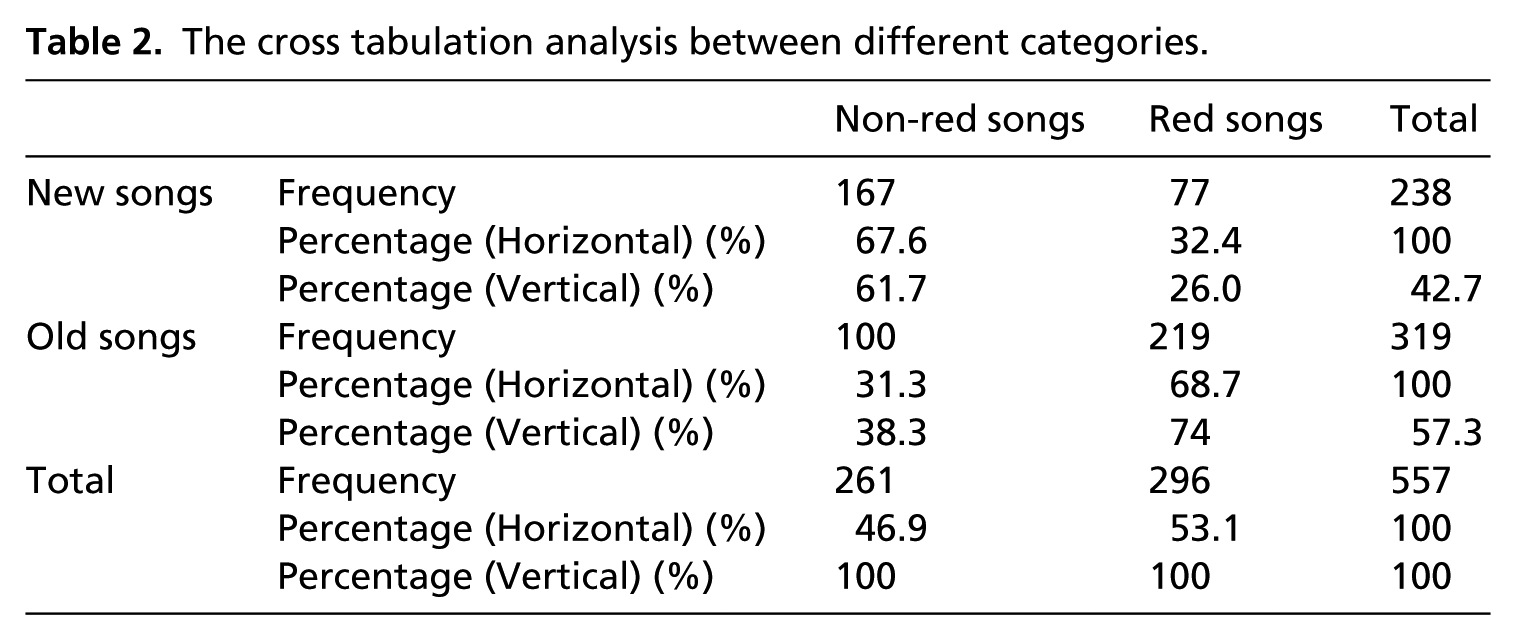
Table 1 presents the distribution of all the songs across different categorizations. Among these songs, 53.1 percent can be categorized as ‘Red Songs’ and 57.3 percent were songs produced in the pre-reform era. The percentage of red songs is not significantly high, indicating that outside a strict, state-led framework of enforced ideological education, the sites of public singing enjoy certain flexibility in determining how ‘red’ they should be. Yet, for the singers themselves, red songs are viewed as the ‘essence’ of singing events, which determines its intrinsic nature and core meanings. Red songs are commonly described as an aesthetically more sophisticated culture saturated with dense emotional investment and rich social meanings. Red songs invite extensive sentimental and emotional responses, and are distinct from ‘commodified, fast-food-style popular culture’.
The percentages of old and new songs and red and non-red songs.

A cross tabulation analysis provides some further insights. As we can see from Table 2, among all the red songs, 74 percent are ‘old’ songs produced in the pre-reform era. Among the ‘new’ songs, only 32.4 percent can be categorized as ‘red songs’, while among the ‘old’ songs, the percentage is 68.7 percent. The predominance of the pre-reform era in the production of red songs is apparent through these statistics. Cultural discontinuity between the pre-reform and the post-reform eras can also be glanced here. The pre-reform era played a much more active role in producing and circulating socialist ideologies and cultural symbols.
The cross tabulation analysis between different categories.
The importance of different themes in those songs also varies significantly between the pre-reform and post-reform eras. I have sorted out the themes displayed in each red song, and Table 3 lists the percentages of old and new red songs which exhibit these different themes. Throughout the two periods, only the Party (represented as the pillar of the state) and the Liberation Army/Red Army (represented as the backbone of military struggle and national defense) have enjoyed relatively stable significance despite rapid social and cultural changes. Chairman Mao Tse-Tung was the major character in 35.6 percent of all red songs produced in the pre-reform era. This figure declined drastically to zero among red songs produced in post-reform era. Here, the decline of Mao as a national symbol of socialism and political unity in the post-reform era is most telling. In a similar way, the themes of ‘Liberation’ (9.6%), ‘Revolution’ (11.4%), ‘Liberation of ethnic minorities’ (13.2%) and ‘Socialism/Marxism’ (5.9%) were significant in the pre-reform era but have been fundamentally downplayed in the post-reform time. Besides, anti-Japanese and anti-USA struggles (9.6%) in which the Communist Party played an active or even decisive role were also highlighted in red songs produced in the pre-reform era, but largely absent in new red songs. Among red songs produced in the post-reform era, direct semantic referents to revolution, liberation and socialism have faded in an impressive way. Instead, national identity or patriotism has surfaced as the most significant theme in new red songs (36.4%). Another important theme, unsurprisingly, speaks to national economic and industrial development under the leadership of the post-Mao party-state since the economic reform. Given that economic development has become one of quintessential sources of the party’s political legitimacy and hegemonies in the post-reform era (Su, 2011), stress on economic development underscores the Communist Party’s transition from a revolutionary to a governing and managerial state regime.
Distributions of different themes in old and new red songs.

Several conclusions can be drawn to elucidate the different ways in which political legitimacy of the party-state were/are played out, as shown in the changing representational portfolios displayed in red songs. In earlier days of the People’s Republic, the Communist Party’s political legitimacy was discursively upheld through (1) the promotion of Mao as the personification of socialism as well as the national leader under whom the people were mobilized and unified; (2) the rhetoric of liberation and revolution, signifying a fundamental change in the economic relations and social structure, and the erection of a socialist system of economic and social organization; (3) the emphasis on nationalism and the role that the Party played in winning victory over external imperial forces. In a radically different way, in the post-reform era, the party-state regime seems to be less interested in propagating overtly ‘Marxist’ or ‘socialist’ ideologies in the production of hegemonic cultural representations. Instead, it tends to depict itself as the guardian of a coherent, bounded national space and national identity, as well as the engine of national economic development.
With these historically differentiated sources of legitimacy as analytical points of entry, this study is interested in the multifarious and contradictory political attitudes to which significations in red songs give rise. It needs to be noted that due to the profound ideological re-orientation and policy change in the post-reform era, the current party-state can hardly be viewed as the same as the one in the Maoist past. In the meantime, the post-Mao party-state is far from a monolithic entity expressing uniform ideological commitment. Within the party, pro-development and pro-socialist voices continuously compete for hegemonic positions. Hence, the questions I engage with in this study are concerned with how various strands of political norms and ideas come into mutual play, and how Maoist past feeds into or counteracts the political legitimacy of the current party-state. At the center of this political dynamic, as Guo (2010) has noted, is the shifting balance or imbalance between developmentalism and efficiency on the one hand, and socialist ideals and social equity on the other.
The empirical study in this article suggests that on the one hand, the red song singers’ positive perceptions of socialist values and Maoist revolutions, expressed mainly in the old red songs, do contribute to political allegiance to the post-reform party-state. This also seems to echo the official stance of the Chinese state toward Maoist red songs. In those state-organized events of red song singing, old red songs have been enthusiastically performed, and rarely seen to be at odds with the state’s political legitimacy in the post-reform era. Several reasons may explain this continuity. First, even in the post-Mao era, Maoism and socialism are still fundamental to the party’s official ideologies. Indeed, as Chen (1995) argues, even though socialism is now disarticulated from many aspects of political economic realities, the party-state needs it to sustain self-claimed authority to define truth and reality, and more importantly, legitimate the one-party rule. In official state propagandas, the social life and political relations portrayed and extolled in the old red songs are not simply viewed as collective memories, but rather imagined to be the foundation of life-world in which contemporary Chinese people continue to dwell. Second, certain elements of the Maoist political legitimacy, such as nationalism and anti-imperialist struggle, are still enthusiastically embraced and propagandized by the post-Mao party-state. Moreover, the post-reform party-state has adopted a number of institutional reforms to optimize structures of governance and enhance its ability of meeting the society’s diverse demands, needs and interests (Gilley and Holbig, 2009; Holbig and Gilley, 2010). This has resulted in the generally strong support to the current Chinese state (Heberer and Schubert, 2006; Holbig and Gilley, 2010; Shue, 2004). Therefore, it seems to be reasonable for ordinary people to re-appropriate officially approved, albeit socioeconomically outdated, symbols to articulate political allegiance (Perry, 2007). Finally, in the post-Mao period, socialist values have by no means been relegated to thorough oblivion in the practices of statecraft. Other than the pro-socialist factions within the party, the Hu-Wen administration, which took over power in 2002, has made attempts to re-introduce certain socialist values, such as people-centered policy making and social equality, into the philosophies of governance (Holbig, 2006; LaLiberté and Lanteigne, 2008; Xing, 2009).
On the other hand, however, many of the orthodox socialist ideologies are no longer anchored in socioeconomic realities of the post-reform China. Thus, political legitimacy constructed on the basis of signifiers disarticulated from everyday experiences is radically open to deconstruction and unruly interpretations. Various studies have observed that in the post-reform period, the Chinese state draws its political legitimacy mainly from economic development, social stability and nationalism, while official socialist ideologies are in a precarious and declining situation (LaLiberté and Lanteigne, 2008). As Chen (1995, 1997) has trenchantly pointed out, if pro-capital economic practices are reified to be ‘inevitable’ to China’s national development, then how is an officially communist regime still superior to other forms of statehood? Indeed, China’s drastic transition towards market economy in the post-reform era is the axis around which much of singers’ interpretation of red songs is organized, articulated and comprehended, as I will discuss later.
Public space as an experiential construct: performativity in the singing sites
Yuexiu Park, Tianhe Park, Baiyun Mountain Park and Liuhuahu Park are four important urban parks in Guangzhou, and located respectively in the urban districts of Yuexiu, Tinahe, Baiyun and Liwan. Conveniently accessible via public transport, all the four parks are renowned urban public spaces for organizing grassroots leisure and cultural activities. In each park, the site of red song singing occupies a relatively small space, and is used exclusively for collective singing. Most participants in the singing of red songs are no longer economically active. A large part of them are retired workers or cadres who once ‘fought at the frontline of the socialist cause’ and now live on state-funded pensions. Besides, many singers are workers laid-off from state enterprises in the 1990s, during the height of China’s economic reform. Some went through the difficulty of living with meager incomes for many years, and have now become officially retired workers and are thus eligible for state pension. Others, however, still suffer economic deprivation due to unemployment. For laid-off workers, red song singing is in the same time a channel for expressing grievances over material deprivation and the nostalgia for Maoist egalitarianism.
Economically inactive singers afford plenty of leisure time, and participate in singing almost on a daily basis. On weekends, there are also numerous economically active, young and middle-aged participants. Younger singers, some of whom are rural migrants, are usually workers employed in state or private enterprises. As members of the working class in the increasingly neoliberalizing Chinese society, they are not only economically disadvantaged, but culturally marginalized, since the working class is no longer viewed as the pillar of Chinese socialism. It seems to explain many younger singers’ emotional closeness to Maoist red songs. In sum, singers generally come from a working-class or lower-middle-class social background. Moreover, in Tianhe Park activists allied with China’s New Left Movement frequently visit the singing site to take advantage of the pro-socialist cultural ambience for disseminating anti-capitalist political ideas.
Certainly, the revival of red culture, much of which bears legacies of the Maoist era, in China is closely related to the charismatic, but now disgraced, political figure Bo Xilai, who advocated the singing of red songs in the city of Chongqing to stir up yearnings for Maoist values and thereby advance his political career. In Guangzhou’s neighboring city of Shenzhen, for example, some large-scale singing events are firmly controlled in the hands of pro-socialist activists. However, singing events in Guangzhou are normally initiated, organized and managed by senior participants, and material resources supporting collective singing mainly come from participants themselves. Indeed, red song singing in all the four parks has lasted more than 10 years, much longer than campaigns supervised by Bo in Chongqing, partly because in addition to expressing cultural identities, singing was practiced simply as leisure. In Guangzhou, there is no involvement of the state or any pro-socialist political actors in the organization of red song singing. During my fieldwork, singers also firmly rejected the assumption that the singing activities were deliberately politicized by the state or related to factional politics within the party.
The local state of Guangzhou, though not involved in its organization, has adopted a generally supportive stance towards red songs singing. It also provided funding to improve the physical conditions of the four singing sites. This is because generally red song singing in Guangzhou is not organized or exploited by any political faction, and viewed as a benign activity for spreading officially correct ideologies. Indeed, this supportive stance is widely shared by local states in China, and not necessarily related to Bo’s political endeavors. From 2009 to 2012 there was a rush for red song singing across Chinese cities, and local states mobilized large-scale events of collective singing as part and parcel of the projects of political education. Even after Bo was deposed from power, red song singing galas continued to be broadcasted on TV. This has further testified to the ambivalence between post-Mao socioeconomic realities and orthodox socialist ideologies, which characterizes contemporary Chinese culture and society.
Elderly people, who constitute the majority of all the singers, tend to describe themselves as the ‘older generation’ whose mindset is deeply imprinted with the orthodox ideologies of revolution, socialism and Maoism. Yet, most of them suggest that in the post-reform era the experience of a socialist cultural identity becomes increasingly attenuated in everyday life; and family members – especially their children – are emotionally distanced from the ‘red culture’. In their narratives, the intrinsic cultural meanings of red songs sit uncomfortably with predominant logics of economic development and money-making in the post-reform Chinese society, and are often devalued in everyday spaces of home and leisure. It is not to say that one cannot sing red songs in private spaces, but singers in the parks believe that it is only through collective singing in a public space that red songs can be intensively experienced. In the sites of public singing, individuals’ cultural identity intersects and overlaps with that of others through collective experiences of authentic cultural symbols of socialism, creating a shared turf of cultural orientation and identification. During the singing of red songs, the notions of the Party and socialist China constitute the core around which cultural meanings are articulated and expressed. More often than not, this pro-socialist cultural identity is anchored in symbols and representations inherited from the Maoist time. A pro-socialist cultural ambience is staged through both bodily and discursive practices.
The physical conditions of the space are upgraded to fit with the purpose of collective singing. Each of the four singing sites is equipped with rows of stone seats and also a stand for a singing leader, 1 both funded by managerial authorities of the parks. The singing leader’s stand faces directly to the stone seats, creating a stage-like, theatrical atmosphere. The singing space is also carefully decorated by the singers. Colorful flags, red lanterns and trinkets are hung all over the singing site to create an ambience of festivity and celebration. Sometimes political symbols of socialism, such as China’s national flag and red banners reading ‘Long live the Communist Party, long live Chairman Mao’ or ‘Chairman Mao is the red sun in our hearts’, are displayed (Figure 2).

The decorated space of red song singing in Baiyun Mountain Park.
Yet, cultural identity is not stable or fixed. It is continuously re-negotiated and reproduced through performances in particular social and cultural milieus. During a singing event, it is through the interactive engagements between the singing leaders, ordinary singers and red songs that a socialist cultural identity is performed and experienced. The role played by the singing leader is pivotal in arousing a socialist cultural atmosphere. The singing leader is responsible for keeping singers focused on the songs by controlling the rhythms of singing and making bodily movements to attract singers’ attention. Sometimes the singing leaders also invite other singers to make bodily movements after them. They may sing themselves, often with a microphone and in a passionate and self-obsessed manner. Often, they imitate the moments of public political propaganda in the Maoist era by making exaggerated gestures and bodily movements. Si-Ge, one of the singing leaders in Baiyun Mountain Park, always wears a Red Scarf
2
and a typical soldier’s cap in the 1960s and 1970s, and holds in hand a copy of Quotations from Chairman Mao when leading a singing event. Such a style makes his appearance resemble a typical Red Guard in the Cultural Revolution. Si-Ge himself seems to be fairly fascinated with performing this cultural image and often reiterates political slogans dating back to the Maoist time, such as, Every word said by Chairman Mao is truth, and one of his words is equivalent to ten thousand words! Unite! All the people of the world! And together we will uproot capitalism and imperialism! Understood, Chairman Mao’s orders should be executed; not understood, Chairman Mao’s orders should be executed as well! Comrades of the proletariat class, Chairman Mao’s Red Guards make salutation to you!
The singing leaders also enhance the socialist cultural atmosphere by directly linking singing to broader historical contexts of socialism and revolution. During the singing event, the singing leaders often express their own attitudes on some key themes in red songs, and inspire the singers to reflect upon the cultural meanings in them. They would also present their own interpretations of red songs and elicit responses among the singers. Key historical figures and events in the history of Chinese socialism are often recalled to connect red songs to concrete historical moments and dominant historical rhetoric. In this way, a huge amount of historical narratives, discourses and symbols are brought back by actively experiencing and interpreting red songs.
Ordinary singers, on the other hand, are not passive in this public drama of singing. Every red song in the singing space is sung collectively by all the participants. When it comes to a renowned or historically important song, singers often stand up and make some bodily movements according to its rhythm. Often, singing leaders would invite different sections of singers to make different bodily movements, all coordinated in harmony with a coherent rhythm. Those collective acts reinforce the sense of collective cultural identification. The space of singing also carves out a participatory ambience for the ordinary singers. They are often encouraged to present a small performance or show, often in the form of dancing according to one particular red song, or simply repeating a piece of dancing previously performed in the Maoist era. Those performances remind red song singers of the mass cultural activities in the Maoist time and bring them into intensive interactions with red songs as assemblages of memories and meanings (Figure 3).
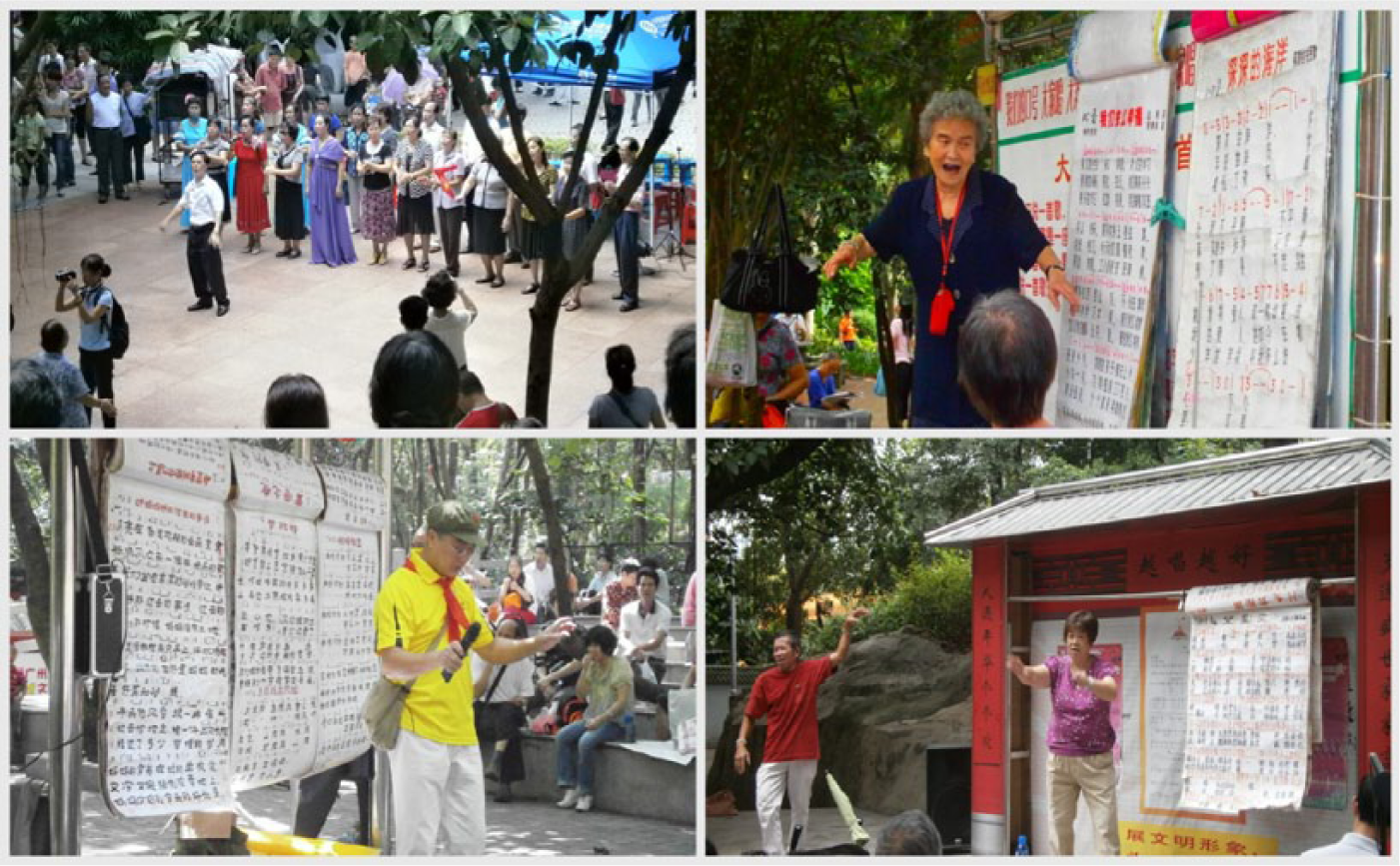
Performativity at the sites of red song singing.
Through these interactive and performative processes, the sites of red songs singing create a dense ambience of socialism through active participation and playful performance of red song singers. The above description also suggests that red song singers are still more inclined to draw cultural symbols and discursive resources from the Maoism era, the ‘most socialist’ period in the Chinese history, despite rapid cultural and ideological changes in the post-reform time. How the orthodox, authentic ideas, values and ideologies of socialism/Maoism are negotiated in relation to different historical epochs and political processes, especially in the context of relentless cultural and social transformation in post-reform Chinese society, is indeed the focal point around which cultural meanings in red songs are interpreted, reproduced and negotiated in the formation of the singers’ political attitudes and identities.
Political discourses in space: political allegiance and critical reflection
The dialectics of space, popular culture and political identities
The performance of red song singing is not only a playful public drama. It also creates a space for the singers to re-negotiate their cultural and political identities. The pro-socialist cultural ambience instills into the grassroots public new cultural and political energies. It sustains, confirms and simultaneously enhances red song singers’ identification to the meanings and symbols of socialism. To some extent, the singing of red songs is for the expression and experience of pre-established political identities. Many pioneering participants’ attachment to socialist culture was prior to collective singing. But red song singing also works to educate new and younger participants. Mutual communications among the singers enrich their understandings of socialism, and the performative displays of socialist culture also affirm from time to time their cultural identifications. A sense of communal solidarity emerging from collective social engagements also shapes and consolidates common identities. Also, the pro-socialist cultural ambience leads the red song singers to believe that a ‘red’ cultural identity is shared by many and not necessarily ‘out of date’ (Interview 11102011A, in Tianhe Park, 2011). One question that the red song singers need to answer, however, is why such a socialist cultural space remains important even in the post-reform Chinese society. To justify the pro-socialist cultural identity and the cultural ambience in the singing sites, the singers have developed sophisticated narratives and discourses by linking red songs to their lived experiences. Hence, the space of public singing provides an arena in which new and reconstructed understandings of important social and historical processes are assembled and narrated against the backdrop of post-reform transformations, thus contributing to the formation of new political attitudes and narratives.
Red songs, in the meantime, provide a proper cultural terrain for this process of re-imagination and re-negotiation. As I have argued earlier, the red songs constitute the discursive terrain for the construction of the grassroots public. This public is founded on shared discourses and meanings, which, in the cases of many singers, are also embedded in claims to material interests. On the one hand, the meanings and narratives which red songs bear echo the singers’ political identities. Thus, red song singing is employed as a mechanism of expression which is essential to the consolidation of any public. On the other hand, red songs also regulate political identities and delineate the discursive boundaries of them. It is the discursive contours established in red songs that make political attitudes and identities concrete and intelligible. Singers construct their own narratives of various historical epochs by drawing cultural resources from red songs. As the content analysis has shown, red songs are not inert containers of abstract ideological ideas. Rather, they feature concrete themes, speak to historical realities and are thus subject to productive interpretations against particular social and historical contexts. Hence, red songs can be productively used and appropriated to reproduce and reframe the singers’ pro-socialist political identities, which in turn consolidates the socialist cultural ambience in the space of singing.
Red song singing as space of political allegiance
As I have suggested earlier, pro-socialist ambience in public singing both re-asserts and questions the legitimacy of the post-reform Chinese state. In the first place, the spectacle of collective singing is mobilized by the singers to showcase the singers’ conformity to political leadership of the current party-state regime through actively and cordially performing a state-approved popular culture. Indeed, this sense of heartfelt political allegiance to the state is the foremost cultural message which singers are keen to convey to the outsiders: This space is for us to express our loyalty to the country and to the Party. What we want to display here is the ‘mainstream’ ideologies and political ideas in a China led by the Communist Party. Socialism is the foundation of the Party and the singing of red songs should certainly be interpreted as the manifestation of the people’s support for the Party. (Interview 22102011A, in Baiyun Moutain, 2011)
Red song singers’ emphasis on socialism as ‘mainstream’ ideology, at the first glance, appears to be anachronistic in the post-reform context. Yet, China’s ambivalent position between pro-capital economic practices and socialist ideologies allows some space to use seemingly outdated symbols for articulating political conformity. Due to the survival of socialism in official political discourses and the continued leadership of the Party without fundamental political reforms, socialist values, most of which are articulated in the old red songs, may still serve the political legitimacy of the post-Mao party-state. A pre-established identity as socialist people is the primary force which prompted the singers to produce and maintain a pro-socialist cultural ambience in the sites of red song singing. This socialist cultural identity, in the cases of most red song singers, dates back to the intensive, almost ceaseless mass ideological education in the Maoist era. It constitutes the principal orientational framework for them to articulate political discourses and narratives even in face of rapid cultural changes in the post-reform era. Red songs singing works to further consolidate the singers’ pro-socialist identity. Old red songs are re-interpreted in contemporary social contexts. Recently produced red songs are juxtaposed with older ideological meanings, extending the registers of political legitimacy and political allegiance to new frontiers of meaning-making. Red songs as a popular culture actively lived and encountered possess potential powers to regulate and discipline the discourses and knowledge produced by their practitioners.
To some extent, the continuous practice and renewal of pro-socialist identity emerges out of the red song singers’ collective inability to articulate alternative cultural affiliations. Their reluctance in developing alternative ideological frameworks for the constitution of cultural identities prompts the singers to actively build up the narratives of their own life experiences and connect them to the meanings contained in red songs to render their political allegiance concrete and understandable. The pro-socialist cultural space is thus justified by configuring a politically ‘correct and secure’ identity: Most people who sing here are between the ages of 50 and 80. We went through that period when everything was about Chairman Mao and socialism. That is the way we lived out a large part of our life. Now at my age, I have no interest to change this mentality. What other mental attachment can I develop anyway? (Interview 15102011B, in Baiyun Moutain, 2011)
For most singers, Maoist red songs are not necessarily interpreted to be ‘out of date’ or ‘out of place’. Themes such as communist revolution, liberation and anti-imperial struggles in red songs are elicited from time to time by the singers to confirm the political legitimacy of the Communist Party in the present. Those red songs almost exclusively date back to the Maoist era, and highlight the establishment of a socialist political and economic system as a radical break with the regimes of imperialism, feudalism and capitalism previously dominating the Chinese society before the founding of the People’s Republic. What those red songs speak to is the institutionalization of socialism, socialist command economy and a sophisticated collective welfare system. By drawing from meanings and narratives in the red songs, the Maoist party-state is portrayed as both the defender of national independence and a political hero who built up a socialist political, social and economic structure on the ruins of an oppressive and exploitative regime.
But the political legitimacy of socialism is not merely confirmed by abstract ideological ideas contained in the red songs. On the contrary, it is always connected to concrete social and economic transformations in the material domains. The cultural symbols drawn from the red songs are made concrete and intelligible only when linked to the singers’ lived experiences. In their recollections of the Maoist era, the earlier decades of the People’s Republic are viewed as a time when a hierarchy of class was replaced by socialist egalitarianism, and an exploitative mode of production gave place to a from-cradle-to-grave socialist welfare system. Red songs which feature socialism, Maoism and liberation highlight this egalitarian ideal and the relative economic equality among social members. Also, the egalitarian ideal was often expressed in red songs through the rhetoric referring to all social members as equally ‘masters of the country’. Many red song singers, especially those who personally experienced the transition to socialism, recalled the experiences of their families which were previously subordinated, but gained access to substantial social welfare under the leadership of the party-regime.
Yet, the singers’ affectively charged recollections of the Maoist era are not at all coherent and one-dimensional. In the sites of red song singing, it is not uncommon to hear the singers critically commenting on the economic stagnancy and frugality in the Maoist time, as well as the citizens’ inability to question and contest dominant political ideas. Many singers mock at themselves from time to time as ‘foolish’, ‘mindless’ and ‘unnecessarily nostalgic’. The catastrophic Cultural Revolution, unsurprisingly, is also a collective trauma intrinsically woven into the negotiation of a socialist cultural identity.
Ironically, the red song singers’ critical reflection of the Maoist time helps to assert, rather than challenge, the political legitimacy of the party-state in the post-reform era. The revolutionary struggles led by Mao and other early communist leaders, in the red song singers’ narratives, paved the way for later communist leaders to bring economic prosperity to the people in a post-reform context. In the post-reform era, the political legitimacy of the party-state emerges out of its timely correction of the political extremism in the Cultural Revolution and its success in restructuring economic relations to boost unprecedented economic growth. It is no wonder, in this sense, that the singers also practice enthusiastically, without any reluctance, the ‘new’ red songs which place their focuses largely on themes of economic development and a national space which effectively accommodates the ‘new and good life’ of its people.
This image of ‘good life’, interestingly, also bears certain legacies of the Maoist welfare system. Despite the noticeable presence of laid-off workers in red song singing, many other singers are retirees who receive a satisfactory amount of pension welfare from the state which supports their life after retirement. China’s retirement pension system was initially established in the Maoist era and fortunately has not been abandoned by the post-reform state. The security endowed by the socialist-style pension system, combined with the enriched material life in the post-reform period, significantly contributed to the political allegiance of many singers, which is further confirmed by red songs featuring the Party’s good leadership, socialism and economic development. As many singers suggest, it is a high degree of financial security which allows them the leisurely time in the Park. They, in turn, feel keenly a moral responsibility to use the red songs to express their genuine support to the current party-state regime.
Red song singing as space of critical reflection
Political loyalty, however, is not the only cultural meaning played out in the space of singing. After all, the bulk of red songs are representative of the most socialist period under the rule of Mao and at odds with many prevalent cultural values and beliefs in the post-reform era. The cultural symbols of liberation, socialist egalitarianism and non-exploitative collective economy sit rather uneasily with ascending logics of market, commodity and profit-making in the post-reform context. For many outsiders, red song singing constitutes a space of weird nostalgia fundamentally distanced from cultural zeitgeists of younger generations. Given that in post-reform China people are less and less interested in publicly expressing either socialist ideas or political allegiance, the space of red song singing appears to be culturally ‘out of place’ in many aspects. Indeed, even the red song singers depict themselves as the ‘culturally marginal’ in the post-socialist era: Our singing events actually attract many younger passers-by to linger a while. But surely most of them just view it as a spectacular show and do not understand why socialism is important to us. They often laugh at us. Some others show good respect for our taste but obviously cannot understand us. It is not surprising: the Cultural Revolution has destroyed the image of Chairman Mao and people nowadays do not like ‘red culture’. (Interview 18102011A, in Tianhe Park, 2011)
How to discursively legitimatize this pro-socialist cultural ambience in a not-so-receptive social milieu is a task that red song singers continuously face. Interestingly, the singers re-assert their attachment to orthodox socialist ideologies by critically reflecting, if not directly challenging, hegemonic political discourses endorsed by the post-reform Chinese state and also by questioning prevalent cultural beliefs and logics in the post-reform Chinese society. Red songs are abstracted as the symbol of a Maoist past which inspires collective remembrance and reflective thinking. In doing so, red song singers counter the official discourses which depict market-oriented commodity relations as the only possible entry into social and economic development. As a result, the state-endorsed ideologies of market, economic growth and development are forcefully questioned and contested. To use a past Communist Party to criticize a present Communist Party, eventually, consolidates the singers’ perception of the radical cultural and ideological discontinuity between the pre-reform and post-reform eras. It is through questioning and contesting the post-reform party-state that this pro-socialist grassroots public incubates counterpublic potentialities.
The focal point around which the red song singers’ critical thinking of the present develops is the ascendance of the logic of money in an increasingly marketized society. In their narratives, money has become the principal axis around which social relations and social moralities are defined in a post-reform context. It is money which now determines one’s social status and place in a social structure. The merit of work and economically productive time is now measured by the exchange value they can generate. The old red songs, therefore, provide a proper discursive space from which the singers can draw cultural symbols and narratives to discursively counter the prevalent logic of money. Again, the cultural symbols of the egalitarian ideal, the end of economic exploitation and socialism are employed to support this discursive reconstruction.
In this formulation, the Maoist era is described almost unanimously as a time when there was no economic inequality and every social member enjoyed basically the same degree of well-being. A state-commanded network of wealth distribution determined that individuals were not personally involved in games for social resources, and the difference between the rich and the poor could be minimized through the working of state mechanisms. Unsurprisingly, laid-off workers who have no access to generous pensions and are thereby afflicted by economic deprivation are more likely to express positive attitudes towards the Maoist ideal of egalitarianism. During my interviews, it was not uncommon to hear laid-off workers lamenting the termination of social protection secured by the state and their exclusion from sharing the fruits of economic growth. In a sharp contrast, the Maoist China, in the singers’ narratives, appeared to be a utopia-like place in which there was no theft, no robbery and no political corruption. Social members were not keen on pursuing personal wealth, and it was a time when people did not need to lock their door even when sleeping.
Also, the pursuit for personal interests was not the primary force which encouraged people to act or work in the Maoist era. It was a time when ‘the hospital would take good care of you even when you had no money to pay your treatment’ (Interview 07012012A, in Yuexiu Park, 2012). Due to the lack of the money logic, the value of human labor and devotion was not measured according to the exchange value they could generate. Many singers recalled heart-warming moments of mutual help or mutual support between social members, always without paybacks in the form of money: Once some friends and I, all young girls, walked by a crop field and found the peasants were too busy to finish their work. We then joined those peasants without any hesitation. No one asked why we should. We worked till late at night. That was the spirit of that remote time. I can promise what I tell you now are all truth: that was exactly the emotional bonding between people at that time. (Interview 16102011B, in Tianhe Park, 2011)
The lack of passion for personal interests was also related to the spirit of voluntarism, expressed and applauded in many old red songs. In those representations, socialist workers always devoted all their energies for the collective well-being of the country and people, without any consideration for personal gains. Those songs resonate strongly among the singers, especially those who previously worked as socialist industrial workers. In their narratives, the stereotypical image of a socialist worker in the Maoist era was one who was fully devoted to his/her work without ever comparing his or her workload with others or calculating the economic rewards he or she deserved in proportion to his/her output. People worked together for the common purpose of building up a prosperous socialist country which could benefit every social member.
As a result, many singers tend to interpret the Maoist era as a time when people enjoyed a high level of mental satisfaction and happiness, despite notable material shortages. It is not read as a hopeless time with nothing but desperate economic stagnancy and naïve political radicalism, as some post-Mao state discourses describe. Rather, it was a time during which authentic community life was sustained and human productivity was inspired. The singers highlight the potential of this socialist spirit to motivate human agency to contribute to national development. They also tend to interpret the economic stagnancy in the Maoist time as the outcome of ceaseless political mobilizations and movements, rather than intrinsic structural inability to foster economic vitality.
To highlight these utopian imaginaries, the singers certainly need to reconcile the reconstruction of the Maoist time with these ‘darker’ sides of economic underperformance and political frenzy. Although those ‘bad’ aspects of the Maoist era are never denied by the singers, they have nonetheless adopted a fairly passive stance in actually engaging with these issues. In their narratives, the past is past – it can be forgotten and it can be forgiven. After all, the current party-state has revised its political doctrines; and the past, therefore, should not be viewed as a counterproductive cultural burden for the present. It seems that many red song singers tend to deliberately sidestep the memories of economic frugality and political oppression in the Maoist time and instead romanticize that period to reconstruct and reflect upon the present. The utopian image of the Maoist time constructed by them, therefore, cannot be taken as absolute ‘realities’. However, the ways in which the singers appropriate the meanings and symbols contained in the red songs to counter the cultural hegemony of discourses undergirding China’s transition to market economy are still telling.
Cultivating new counterpublic? Grassroots Leftist activism
Although the singers’ overt expressions to the outsiders are rare, the site of red song singing is certainly not an enclosed space. The pro-socialist cultural ambience also encourages outsider viewers and passers-by to reflect upon the Maoist past as well as the appropriate place of orthodox socialism in contemporary Chinese society. In Tianhe Park, the nostalgic ambience of socialism has attracted a number of grassroots New Leftist activists to the site of singing for disseminating anti-capitalist political ideas and encouraging the singers to boycott Genetically Modified (GM) Food. Those Leftist activists are aligned with two websites: ‘Mao Flag’ (Mao Zedong qizhi wang) and ‘Utopia’ (wuyou zhixiang), 3 both of which are established for propagating orthodox ideologies of Marxism, socialism and Maoism. These two websites are run by public intellectuals, university-based scholars and even retired government officials who advocate China’s return to Maoist political economy. They also play an important role in the rise of the so-called New Left in China’s political and intellectual landscapes. The long-term aim of those activists is to end the market economy in China and revive the authentic socialist economic and social organization to address pressing issues such as social inequality and the dominance of money logic. Most of those activists are from working-class or lower-middle-class backgrounds and many of them tend to portray themselves as the ‘losers’ in the post-reform market economy.
The ages of these activists range from early 20s to early 40s. For most of them, personal memory of the Maoist era is at best thin and fragmented. Hence, for many activists, the ideal of socialism is anchored only in the old red songs. The sites of spontaneous red song singing are described by them as the only places in contemporary China in which they can imagine and experience ‘a return to the authentic socialist thoughts and ethics’ (Interview 07012012B, in Tianhe Park, 2012). It is a space outside official discourses of the contemporary party-state and serves as a political forum in which grassroots social members’ dissatisfaction with market-oriented social and economic relations can be expressed.
The red song singers who actively live and practice a pro-socialist cultural ambience are automatically seen by the activists as the perfect targets for preaching anti-capitalist political ideas. Those singers, as the activists describe, are firmly attached to orthodox socialist ideals and more responsive to Leftist political claims. They are thought to be less subsumed under the cultural hegemony of market economy and possess the agency to envisage alternative political possibilities. In the activists’ words, their campaign is a process of ‘enlightenment’ – an educative project for further inspiring people’s reflective thinking when a radical return to Maoist socialism is still less than feasible: Red songs reflect the Maoist time in the 1950s and 1960s. By comparing that period with the present, we can find out what are actually the problems nowadays and inspire the people to change their supportive attitudes towards market economy. All should start with singing red songs. In contemporary conditions it is still not very possible to mobilize a large-scale revolution or something alike. (Interview 07012012B, in Tianhe Park, 2012)
The space of red song singing, on the other hand, creates an opportunity for the activists to re-vision the Maoist China as a historical epoch which was ‘real’, ‘energetic’ and ‘lively’. In the first place, the activists have actively adopted the narratives reconstructed by the singers, which counter the official discourses of the inability of Maoist socialism to foster social and economic progress. On the other hand, the red song singers’ rich recollections of the Maoist time further affirm the activists’ belief that a socialist political economy and a socialist societal organization are not merely romantic political ideals. The lived experiences allow younger activists to actually envisage possibilities of alternative futures and non-capitalist social relations: We intend to excavate the images of the Maoist time from those red songs. Many singers here are old, retired people. They went through that period and they have attachment to that time. They know it was real, and they know a socialist world was once realized in China. (Interview 07012012B, in Tianhe Park, 2012)
On the other hand, the red songs also provide a discursive space in which this newly emergent counterpublic can be anchored. Thus, many activists express a romantic emotional attachment to the cultural ambience in the singing sites. The sites of red song singing, as they describe, are the places in which they can both find a receptive audience and be educated by authentic socialist culture. Leftist activism in Tianhe Park is mainly in the form of leafleting and propagating for the boycott of GM food. The dichotomization of socialism/capitalism is a pivotal dimension in the activists’ interpretation of the proliferation of GM food in China. The red songs, on the other hand, provide a comprehensive representational repertoire with which both socialism and GM food can be understood and discursively constructed. It is not to say that the activists’ political attitudes are formed solely through drawing from red songs. Nonetheless, the activists’ representations of GM food echo well standard Maoist worldviews expressed in the songs. Most notably, the introduction of GM foods into China is described as the manifestation of US capitalism’s ambition to dominate the market of China. Drawing from the Maoist representations of American capitalism and imperialism, the activists contend that GM food is introduced to China in favor of American business interests, and for controlling economic resources of China and eventually exterminating the Chinese nation with foods which are potentially harmful to health. Certainly, for these activists, the dominance of US-led global capitalism can be realized only by allying with corrupted Chinese politicians and officials who maneuver marketized economic relations to maintain monopolistic control over economic resources and social wealth. Similar to red song singers, the Leftist activists also consider market economy and private property as the primary factors which account for the ascendancy of the logic of money.
The activists’ anti-capitalist political attitudes motivate them to envision the ways in which the dominant power relations in contemporary China can be contested and subverted. For example, according to these activists, one solution to the dominance of market economy and privatization is Mao-style mass political mobilization. The pro-market and pro-capital party-state, in this sense, must be radically restructured through revolutionary acts of the people. In the spaces of red song singing, there is a small amount of songs which emerged from the mass political movements in the Cultural Revolution; and most of these songs featured Mao as the mentor who would lead the people to fight for the ultimate emancipation. Although most ordinary singers deliberately ignore the immediate historical context of those songs, the cultural symbols in them are highly favored by the activists and often employed to configure the image of a collective past which can be used as the orientational framework for present actions. Allied with these ideologically radical red songs, the activists also tend to romanticize and extol the Cultural Revolution. The Cultural Revolution is re-imagined as a time when Mao led the people to fight heroically against the clandestine sects in the state which aimed to establish a bureaucratic government and to secure privileged access to social wealth. In this representation, Mao is romantically depicted as the ‘people’s leader’ who attempted to crush down the government that he established himself to challenge the entrenched structure of power. The Cultural Revolution created such a time-space that it was the rule for the powerless, the grassroots to challenge and even destroy bureaucrats and politicians in power.
It is not the aim of this article to discuss in detail whether the activists’ accounts of the Cultural Revolution are right or wrong, accurate or distorted. Obviously, the activists exaggerated the grassroots people’s political agency in the Cultural Revolution and ignored that for most ordinary Chinese people, collective memories of the Cultural Revolution are more about draconic political persecution rather than grassroots empowerment. As a result, even most red song singers feel uneasy about the activists’ reconstructed accounts of the Cultural Revolution. What is noteworthy here, on the contrary, is that the activists’ political attitudes and political claims resonate so well with the hegemonic cultural representations of the Maoist era in red songs. Red songs, in turn, provide certain orientational frameworks for activists to understand the present and envisage alternative political possibilities. For the activists, red song singing appears to a taken-for-granted space in which their political identity can be affirmed and their political attitudes expressed. It is in the case of the Leftist activism that we can snapshoot the potential of the space of red song singing for the expression of overtly confrontational political claims and the imagination of alternative political futures.
Conclusion
In this article, I have first employed a re-conceptualization of public to characterize grassroots social spaces of political expression and shared identity. Drawing from the classic theorizations of Habermas (1984, 1987, 1989) and Arendt (1958, 1973), this article views the public as a material or discursive space built upon shared discourses, meanings and identities. But in the meantime, it is also argued that the notion of public does not need to be understood in terms of a universal sphere which forecloses marginal or alternative voices. Instead, this article argues that any public is a social collective rendered concrete by shared meanings and bottom-up practices. Armed with this perspective, this article has charted a different course from classic political philosophies (Arendt, 1973; Habermas, 1989) to examine the ways in which a grassroots public is performed, practiced and reproduced. On the one hand, it has analyzed spaces and spatial practices through which political ideas, identities and attitudes are performed, negotiated and reproduced. On the other hand, it has also presented a detailed discussion of the political identities and discourses which are the cohesive forces of the grassroots public.
It needs to be noted that this grassroots public is not created by red song singing: many of the pro-socialist sentiments might be extant well before the singers’ participation in collective singing. In other words, this public/counterpublic sphere existed, albeit dispersedly, prior to the production of collective cultural spaces. Yet, collective singing does contribute to its ongoing construction. On the one hand, it adds to group consensus and cohesiveness. On the other, political ideas, identities and attitudes in which this public dwells are not pre-given or fixated, but lived, experienced and, above all, reproduced through mutual communication and interpretation of red songs in a shared social space. The cultural and social energies which ordinary red song singers have accumulated are manifested in their agency to mobilize red songs as cultural and discursive resources. Without doubt, red songs express hegemonic cultural meanings which aim at the collective conformity of Chinese people to the party-state regime. Red songs have constituted a field of dominant ideas and knowledge which social members’ cultural and political dispositions are always contingent on (Bourdieu, 1993, 1996). But as Fiske (1989) and Grossberg (1997) have argued, popular cultural elements and cultural practices activate formations of identities by utilizing proliferating cultural resources that emerge with the de-centering of official and hegemonic discourses. The singers develop their own structures of feelings (Williams, 1961) according to the social and historical conditions of both the present and the past. They transformed the sites of singing into meaningful social spaces written with both political allegiance and counter-hegemonic political identities.
The grassroots public examined in this article is deeply situated in heterogeneous, ambiguous social identities and cultural discourses of the post-reform Chinese society. The space of red song singing opens up a window through which we can capture both the continuity and discontinuity between the pre-reform and post-reform Chinese societies (Dirik and Zhang, 1997; Su, 2011). On the one hand, the site of red song singing is a spatial anchor with which singers’ cultural identity inherited from Maoist mass ideological education can be reaffirmed, performed and re-negotiated. On the other, in defining sites of red song singing as unconventional, unorthodox cultural spaces in post-reform China, red song singers discursively position the Maoist past in opposition to the present, and depict it as a time-space of definite moral superiority.
Yet, the political potential of collective red song singing is at best ambivalent. Since this grassroots public is built upon shared identities and cultural meanings rather than well-planned political projects, the space of red song singing creates certain political momentum but in the meantime does not really encourage explicit political expressions. Red song singing should not be seen as a radical political space which is expected to contribute to drastic cultural or political changes. Outsider viewers and passers-by are rarely preached explicitly by the singers. For most outsiders, the public event of red song singing is simply a public spectacle performing the cultural imaginaries of another time-space. The state, on the other hand, is also less interested in policing sites of red song singing, as the juxtaposition of both ‘old’ and ‘new’ red songs seems to confirm the taken-for-granted continuity of political legitimacy between pre-reform and post-reform eras, while concealing largely the multiplicity and complexity in the singers’ discursive productions. Yet, red song singing is a space saturated with rich political symbols, representations and meanings. It can be seen as a vast depository of identities, attitudes, symbols and discourses which social subjects can draw from to frame new political meanings and create new political possibilities. The presence of New Leftist activists in red song singing, for example, provides a vivid example of its potential to inspire new political thinking and reflections.
Footnotes
Funding
Financial support for this study comes from the University of Edinburgh, where it was undertaken as part of the author’s PhD research, and the National Science Foundation of China (NSFC Refs: 41171125, 41130747).