



Abstract
In Western societies, punk represented a benchmark for rupture towards the existing social structure while providing a soundtrack for it. So, it is in this context that we will approach the Portuguese punk considering its importance in a society engaged in relatively recent processes of democratization and modernization. Thus, we propose here to take a look at the punk from its protagonists’ discourses and the text that they form. We will consider the words used by the bands in two ways: when they name themselves and their lyrics. In each case, we will deal with the self-representation issues in the light of the polarity between identity and difference: who we are, how we position ourselves, how we distinguish ourselves, what we have to say about ourselves, our time and our world; what are our values and what we have to say regarding the dominant social values; which causes move us, how we want to act, how we want the world to be. As in any other discursive self-representation, the content is not independent of the forms of expression. Therefore, the identification and dialogue questions (who is speaking, who is he or she speaking to) and the language questions (how does the speaker express, with which codes, in which forms) are also examined. Our analysis suggests that the punk discourse on identity tends to be structured by three main axes: a) cosmopolitanism, b) the radical assumption of an irreducible difference regarding social order and c) an ambivalent attitude towards politics and the political action.
The importance of bands’ names and lyrics
Any band that sees itself a little bit punk will always avoid songs without specific content or with no content at all. Whether it’s a broader thing or talking about love, they always want to deliver a message. The main function of a punk band or a punk influenced band … their lyrics will always try to deliver a message; will always try to say something …
These words belong to F…, a 42-year-old punk musician who attended university and is living in Lisbon. The quotation is from an interview made for a research project on punk and the Portuguese contemporaneity. They serve here as an ignition to this article that intends to understand, in the bands’ names and lyrics, what they are ‘trying to say’. Of course, whoever expresses will always ‘try to say something’, even if it is through songs ‘with no content at all’. But this emphatic expression the quoted musician claims for ‘his’ punk has an explicit communicational purpose: words (along with music, corporal hexis, ornaments, stage or audience performances and so on) are used as indispensable tools in order to build and transmit a meaning. This meaning is a statement about the world and a personal and group standing within it.
Punk is one of the contemporary social and artistic movements that took further the logic of social and political positioning: the confrontation between the individual or group identity and the ‘dominant order’; the dissidence and opposition towards such order; and the celebration of self-initiative and will when acting or speaking, as the do-it-yourself philosophy (Laing, 1978; Moran, 2010; Phillipov, 2006; Worley, 2012).
Therefore, it may be useful to look at punk through the discourses its protagonists produce and the text formed by them. Here, we will consider as a clue to those discourses the words used by the bands, in two ways: when they name themselves and in their lyrics. In each case, we will deal with the self-representation issues in the light of the polarity between identity and difference: who we are, how we position ourselves, how we distinguish ourselves from others, what we have to say about ourselves, our time and our world; what are our values and what we have to say about the dominant social values; which causes move us, how we want to act, how we want the world to be.
As in any other discursive self-representation, content is not independent of the chosen form of expression. Therefore, the identification and dialogue questions (who is speaking, who is he or she speaking to) and the language questions (how does the speaker express, with which codes, in which forms) are also the subjects of examination.
The already mentioned research project that led to this article is the first one comprehensively dealing with the Portuguese punk movement. Unlike other artistic movements arising from more erudite spheres, punk emerged in Portugal more or less simultaneously with punk in the United Kingdom or the United States. The first groups appeared in the late 1970s, and were somewhat linked to the emergence of alternative rock in Portugal. The country was still experiencing the structural effects of the democratic revolution that, in 1974, had put an end to one of the longest dictatorships of Western Europe. The new political and cultural atmosphere, characterized by a new sense of openness and empowerment, as well as an acute criticism towards social hierarchies and moral conventions, influenced significantly the emergence of punk. Throughout the 1980s and 1990s, this new movement, beginning in the urban area of Lisbon, spread through the Portuguese territory, and became one relevant component of youth culture. Corresponding to a period of deep social change (the Portuguese colonial empire ended in 1975, the country adhered to the European Community in 1986, and there was progress made in the country in such key domains as education, health, infrastructures and economic modernization), punk consolidated as an artistic and cultural expression of the values, beliefs and expectations of youngsters of the working and middle classes. In the 21st century, when first the economic stagnation and then the huge crisis of 2008 onwards occurred, punk also served as a powerful grid to organize and communicate the sentiments and orientations of a youth caught in the very eye of that hurricane.
Therefore, tracing the sociological portrait of punk helps to understand the nature and scope of the transformation of Portuguese society in the last three decades, and the reaction it motivated among youth groups. But this implies to listen to these groups, and the analysis of the materials produced by punk bands and fans is a very productive way of doing it. These are a very wide range of materials, from records to fanzines, from shows to press news, from the dress codes to props and other identifying objects. In the Portuguese as in other cases, these materials are in a large part yet to be collected and systematized. And the logic that enhances the underground perspective, the do-it-yourself system and the small, informal scale, so important in the movement, reinforces that latency and incompleteness the research has to face.
Thus, our research project includes, as one of its major axes, the collection, treatment and preservation of the materials produced by Portuguese punk, throughout its history, that is, from 1977 onwards. This specific dimension is based, on the one hand, on the survey of several sources, such as the media news and reports, the records and fanzines filed in public and private libraries, the sites and social networking on the Internet, and the ongoing shows, tours and record publishing, and it is based, on the other hand, on the information and documents provided by many of the 160 participants in the punk movement (active or retired, and musicians, producers, agents or fans) that were already interviewed by the research team.
This is an ongoing process, since the research project will extend until the end of 2015. This article will draw from the volume of information gathered in the first semester of 2013, regarding bands, records and songs. In these terms, 496 punk bands were surveyed. The criterion for selection was their auto-definition (given the basic rule: who sees him/herself as a punk is treated sociologically as a punk). Of those 496 bands, 155 are active, 218 are extinct or have suspended their activity, and 123 bands remain yet to know whether they are still active or not. Additionally, we shall consider the lyrics of 264 songs – those which have already been transcribed for the inventorial purpose of our project.
Technically, it would be impossible to build at this stage a representative sample for content analysis, since we do not have the complete list of bands, records and songs. And, considering the extreme dynamism and volatility of the punk movement, in Portugal and elsewhere, and its underground and informal features, it is hard to envisage the possibility of defining exhaustively such a universe. Nevertheless, at further stages of the research project, a larger group of records and lyrics will be available, for all researchers. The expected added value of this article, based on a sample of 496 bands and 264 lyrics of the Portuguese punk, is (a) to propose and test a grid for the content analysis of the punk discourse and (b) to construct a set of hypotheses concerning the punk approach to identity and difference, that can be eventually applicable to this one and other music scenes. 1
The name as identity
These restrictions should not obscure the scope and richness of the material collected so far. Based on it, it is possible to formulate some hypotheses of characterization and interpretation of the Portuguese punk, from the point of view of its social and artistic discourses.
The use of the English language is one feature standing out right away. Half of the 453 relevant bands to this effect (the remaining 43 make use of numbers or acronyms to name themselves) have chosen a Portuguese name, while the other half makes use of a foreign name and, within this half, the majority (all but 15 of them) has preferred an English name. The proportion of the use of English in the lyrics drops naturally, but is still present in 22 percent of them. 2
A second observation concerns the intertextual games present in almost one-third (32%) of the bands’ names. Sometimes, the name mentions and appropriates another name, acronym or term established in the current language. For example, the band Boca Doce (Sweet Mouth) (a name taken from a well-known Portuguese baby food brand) or the band CDS (the same acronym as a Portuguese political party), or even the band DNA (a biomedical term). This technique is present in 26 percent of the 156 cases of intertextual play.
In other cases, the names not only cite but also deconstruct the current acronym, expression or designation. For example, the band C.I.A.neto (C.I.A.nide) blends in the North-American espionage agency and the lethal poison, or the Disastro-Sapiens (Disaster-Sapiens) show, by the use of such name, what they think about the attraction of the abyss shown by the human species. This deconstruction is rather frequent: we could see it in 43 percent of the cases in which the bands’ names echo an intertextual game (that is, 14% of the total surveyed bands).
It may happen, also, that the names are composed by a wordplay (with no intention of deconstructing established names) and/or by the invention of new lexical terms. For instance, the Peste & Sida (Plague & Aids), formed in 1986, referred, with their name, to one of the most important contemporary issues, AIDS, while stating clearly their underground purpose (in Portuguese, ‘Peste & Sida’ is phonetically equal to ‘pesticida’ (pesticide), the chemical agent that deters pests). We found this type of wordplay and creation in 39 percent of the bands with intertextual references.
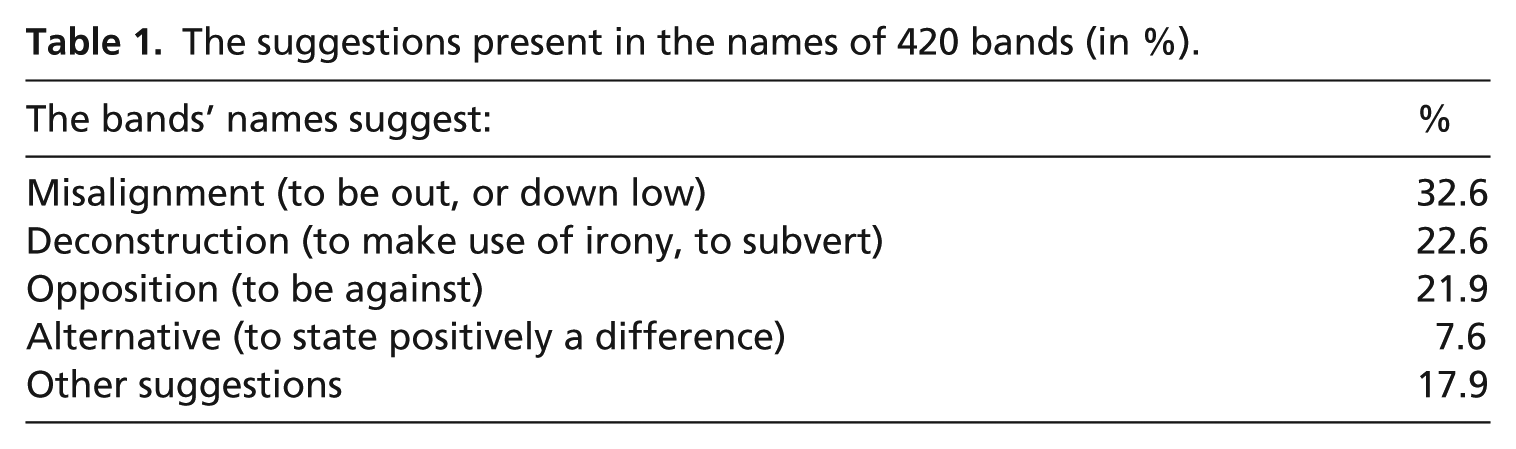
This means that a punk band’s name may suggest, for itself, a certain tone or inclination. Pay attention to the data presented in Table 1. It concerns the 420 bands of which the name may suggest a stance about the social environment, regardless of the accounted environment aspect. A total of 420 bands of the surveyed bands, that is, 85 percent do so – a number that means something right away because it points out that, in the majority of the cases, the bands ‘say something’ (to make use of F…’s words in the opening citation) with their name alone. But this is not only a matter of tone, or positioning – of how you say from where you are. It may as well be a content issue – of what you say, of the ‘message you have to deliver’ (once again, in the words of F …). Table 2 presents a thematic categorization for the 422 names in which we could see a possible message delivered.
The suggestions present in the names of 420 bands (in %).
The messages present in the names of 422 bands (in %). 3

In general, the idea is one of criticism and misalignment. Considering the messages associated with the names chosen for its bands, punk seems to have little interest in presenting alternatives, other possibilities, positive ones. Nonetheless, there is an idea of demarcation towards the existent and/or an invite to its denial, inversion or destruction. There is more of a dark ambience, one filled with images of depression, escape or chaos, than it is one of sunlight, hope, call-to-action or change. Punk seems subterranean, out of the order because it is away from it, placed beneath the surface of conventions, institutions and established habits.
It may be worth demonstrating this with some bands’ names, not only to give meaning to formal categories but also to allude to some additional interpretation topics. Therefore, the deconstruction tone, present in some of the bands’ names as the Anti Anti, the Cabeça de Martelo (Hammerhead), the Fina Flor do Entulho (Crème of the Garbage), the Foragidos da Placenta (The Placenta Escapees) or the Os Cães, a Morte e o Desejo (The Dogs, Death and Desire), represents one in each five of the surveyed bands (Table 1). And so to speak, this deconstruction is extended or deepened in 15 percent of the cases (Table 2), in a strong message of world’s inversion, placing the world upside down (in line with the great carnivalesque tradition of the popular culture, as seen by Mikhail Bakhtin (1970)): see, for example, the bands Amen Sacristi (Most Sacred), Bastardos do Cardeal (Cardinal Bastards) or Santa Vulva (Saint Vulva) (see Langman, 2008).
In the second place, stating the opposition towards the social order presents multiple nuances. It may carry mainly a critique to the normative order – to conventions, common sense, the cultural and artistic mainstream (e.g. Asfixia (Asphyxia), Fora de Sintonia (Out Of Tune), Geração Rasca (Shit Generation), Konsumo Obrigatório (Consumption Required), Tédio Boys (Boredom Boys)). It may also carry a specific critique of the institutions and political, religious or economic practices (Dissidentes do Projecto Estatal (State Project Dissidents), I.A.C. – Inconformidade Anti-Constitucional (A.C.I. – Anti-Constitutional Inconformity), Jesus Cristas (Jesus Christ)). In the 25 percent of the cases in which this criticism message is present (Table 2), the first nuance represents 14 percent and the second 11 percent.
The opposition towards social order is also made clear through derision and nonsense (15% of the cases, in Table 2). And it is made also by the self-exclusion of the order, which tends to be expressed through contamination (21% of the cases). It is somewhat interesting to notice that the references used to signal that differentiation can be extreme, as a drive to outlive the ‘normal’ social world and the ‘daily bonhomie’ that Thomas Mann rightly told us about in Death In Venice. Let us consider the following names: Abandalhados (Fuckups), Acorrentados do Canil (Chained of the Kennel), Alkaóticos (Alchaotics), Barafunda Total (Total Mess), Borderline Insane, Cães Vadios (Stray Dogs), Cagalhões (Turds), Cape of no Hope, Crepúsculo Maldito (Damned Twilight), Crime Loucura (Madness Crime), Ervas Daninhas (Weeds), Escorraçados (Chased), Eskizofrénicos (Schizophrenics), Excremento (Poop), Excumalha (Scum), Gatos Pingados (Souls Watching), Gratos Leprosos (Grateful Lepers), Human Beans, Mad Rats, Mentes Podres (Rotten Minds), Miscarriage, N.A.M. – Núcleo de Atrasados Mentais (T.R.N. – The Retarded Nucleus), Refugiados do Urinol (Urinal Refugees), Um Trinco no Mamilo (A Bite in the Nipple).
These are good examples of a clear statement of no submission to any integration – sometimes in a defiant tone, others in despair. But these youngsters who say they belong to the underworld and disorder, embracing the filthiness and the shit, or the dependency, madness or delinquency, do manipulate the categorizations of the normative and technical order. While these official categories classify them in terms of social deviation, they, by turning the terms upside down, state their radical contraposition, and independence, from that normative order.
This independence can as well be stated positively as an exit that, in Hirschman’s (1970) concept, may be simultaneously a word taking (voice). As one band’s name claims, Another Day Will Come, change can be close, and so the renovation, the possibility to act, to intervene, to do things, to fight (more names: Gazua (Picklock), Liberation, M.A.D. – Movimento de Acção Directa (M.A.D. – Movement of Direct Action), No Fears, Not for Sale, Seize the Day, Worth the Fight). This can be found in 8 percent of the names of bands considered in Table 2, under the liberation category.
In some cases (7%) that exit vis-à-vis social order happens through the explicit affirmation of belonging to the musical in-group – and in particular to this ‘street music’, underground and based on the do-it-yourself system. For instance, the band Aqui D’El-Rock plays around at the same time with the Portuguese popular expression used to ask for help (‘aqui d’el-rei’ (Here, O’King)) and the vast common denominator that rock is. Not less powerful – and certainly not irrelevant in our universe (13% according to Table 2) – is the shift of opposition towards social order to a pole of destruction: hate, horror, death, rioting … Some bands’ names are All Against The World, Brigada do Caos (Chaos Brigade), Death Will Come, Love You Dead, Ódio (Hate); or PISS!!, or Raiva!! (Rage!!), said just like that, with the aid of emphatic capital letters or exclamation marks. It is the radical expression of opposition as (not only a statement of dissidence but also) a will to destroy (see Laing, 1985).
We take the concept of identity in the sociological sense. Identity is a discourse, auto or hetero-produced, by which social actors reflexively present and locate themselves in the social order, while being subject to social identification and classification (see Bourdieu, 1978; Giddens, 1991; Goffman, 1959). As a component of self-presentation – that is, as we talk about us – identity is not necessarily what we (‘really’) are, but what we say we are. Even better: it is what we are also because we say it. Identity – what we are to ourselves and to the others – is not independent from the discourses we produce and interchange about it. Many of these discourses are narratives, that is, they tell our identity by telling our history. They are also bindings, as they define our identity by specifying to what and whom we belong to, and what and whom we separate from.
That is why the name is one of the first and most important features of identity. The name given to us, the name we give ourselves. Mainly for the youngsters that choose punk as their preferred form of expression, the name is an initiation rite, a breakthrough mark that indicates a stance, a position, and a possible trajectory (a path to uncover). From this point of view, the names of the Portuguese punk bands surveyed by our project suggest a modal positioning of critical misalignment: we are ours because we are not yours, because we are others; we are not, nor do we want to be, the accommodated to society, the ones defined by the convenience towards conventions and by the obedience to the norms; and we are others, we are – as one of the most influential Portuguese punk bands concisely says – Renegados 4 (Renegades).
Non-conformity is often expressed as inconformity. And immediately inconformity, defiance, provocation with words. Until the most extreme radicalization, which may be present in the name of the band: Cães Danados (Reservoir Dogs), Defying Control, Osso Duro de Roer (Tough Nut To Crack), Assassinos do Papa (Pope’s Murderers), Fucklore, Vai-te Foder (Fuck You). What the bands’ names also tell us is this: our place is the underworld; our speech knows no rules; our place and speech, once critical, other sarcastic, once prophetic, other hopeful, other despaired, are ours, only ours. We are the ones doing it, in the music and society’s underworld. The name of a band formed in 2011 from Viseu, a small countryside Portuguese city, can be regarded as the bastion of this state-of-mind: No No. No, many times no: that is the claimed identity, and that aims to be punk’s difference.
Speech and dialogue
Judging by our non-representative sample, the punk song tends to incorporate a speech enunciated in the first person. Of the 248 pertinent lyrics, 63 percent are written and stated in the first person singular – it is an I that speaks; 21 percent are written and said in the first person plural – We speak; and 9 percent combine singular and plural – I, Us. The sum of these cases makes up for 93 percent of the total. On the other hand, in the majority (145, i.e. 59%) of the analysable lyrics (260 in total), the singers address directly interlocutors. 5 When they do it, they address mostly a singular You: another person, individually considered (79%). But the cases in which they address several people are not insignificant (21%).
An emotional relationship between the speaker and the listener is observable in 10 percent of the 145 lyrics. In 28 percent of the cases, the liaison is the group solidarity (they are peers, friends, or members of the same generational cohort). Still, the most often seen relationship is one of hostility, whatever may be its intensity, making up for 37 percent of the cases. 6 A hostile tone prevails when the singer addresses several interlocutors, whereas the affection or solidarity relationship prevails when the interlocutor is only one person. 7
It is clear what these results suggest. The songs’ embodied speech tends to be built around a contraposition between, on the one hand, an I (or an Us) that represents himself or herself in the lyrical subject, and on the other hand, interlocutors that either belong to the in-group of the affections and youth/musical solidarities, or that tend to be treated as antagonists and subject of hostility. That reinforces the idea of punk as difference and opposition towards social order, either looked at in a more individualistic fashion or in group logic (see O’Hara, 2004).
The rude language used is easily understandable as it is one of the most powerful tools in order to promote ruptures and antagonisms, as well as showing inconformity and rebellion. We use the word ‘rude’ in an analytical sense, not normative. For this effect, it is, according to the Lisbon Sciences Academy Dictionary, ‘the one who doesn’t respect the social and moral conveniences’. A total of 36 percent of the 264 considered songs use, in any way, rude and/or insulting language, mostly with a sexual or scatological connotation, 64 percent do not.
Feelings, topics and causes
When we listen to, or read, punk songs’ lyrics, it is common to perceive the subject that affirms him/herself by contraposition to an order, a world, a norm that is profusely questioned. This questioning does not take into consideration ‘social and moral conveniences’ and frequently uses rude words, evoking evil, dirty, subterranean properties, considered as closer to nature than to culture, closer to bestiality than to humanity, closer to the Id than to the Superego – referring to elements like raw sex, animal ingestions or secretions. The name of a certain band from Sintra (formed in 1994 and soon extinguished) almost resumes this questioning in a quite derisory way: Feijão Freud (Freud Beans). 8
Therefore, one should not be surprised if the feelings within the punk songs’ lyrics are polarized around accusation, protest and revolt. Table 3 proposes a possible classification of the feelings we thought to be conveyed in the 264 songs we analysed.
Feelings expressed in the lyrics of 264 songs (in %). 9
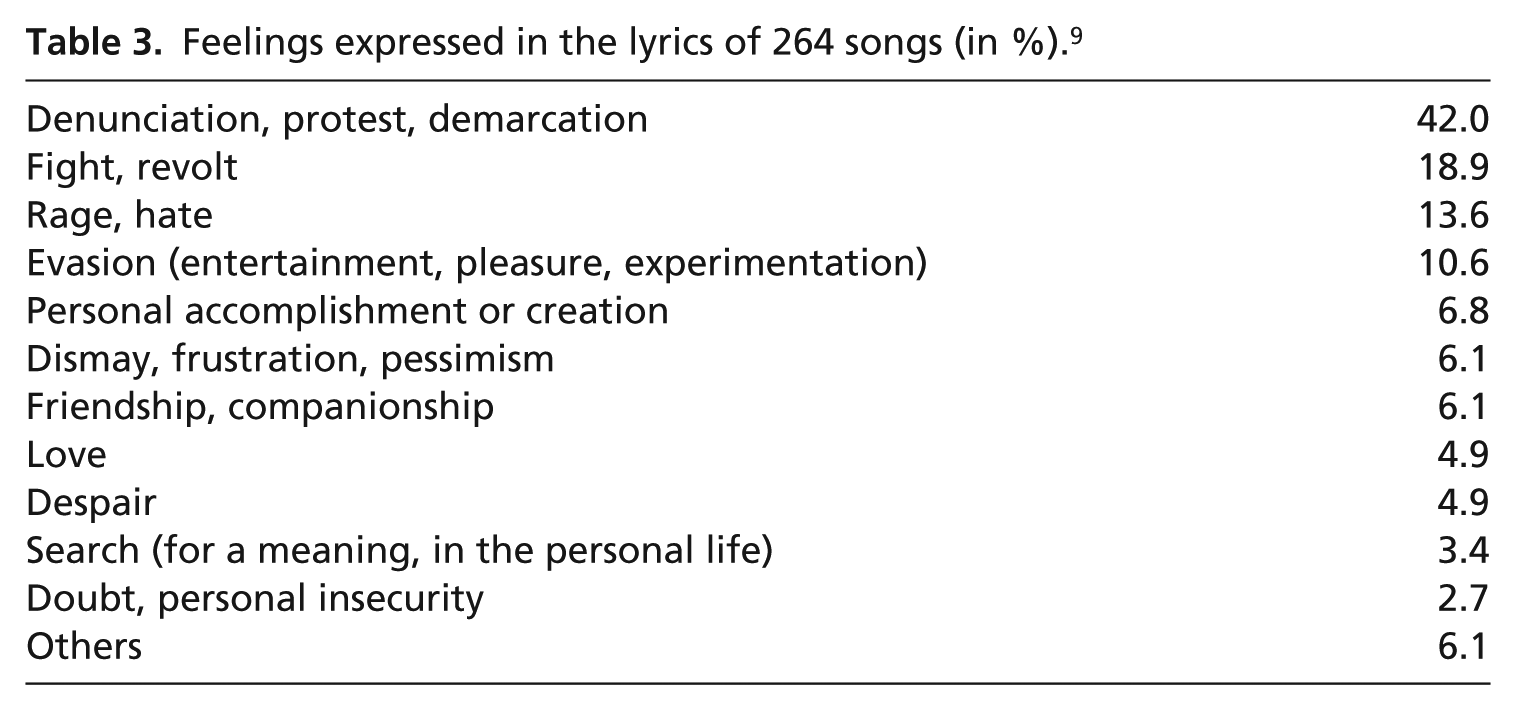
It seems reasonable to note four fundamental orientations. The first is the critical stance (whatever is the focus, as we see in the topics). We can distribute it in three degrees of increasing intensity: protest, rebellion, rage. ‘When the Dokuga defended in 2010 in their song “Desculpas para odiar” (Excuses to Hate) – the law is an order/followed without thinking/revolt is an obligation’. In the limit, as the Opinião Pública (Public Opinion) said in 1982 in their song ‘Puto da Rua’ (Street Kid), ‘The knife is about to explode/so we can communicate’. It is by far the most frequent orientation: we got it in three-quarters of the songs.
The second is, so to speak, a negative orientation, a self-questioning expressed in displays of doubt, dismay or even despair (‘Sometimes I have rage, sometimes I have fear’, in the song ‘Vida Maldita’ (Damned Life), of 2012, by the Clockwork Boys). The third is an orientation towards evasion, occasionally– but not necessarily – associated with personal accomplishment (‘Look for your own way out/don’t let yourself get caught’, a powerful formula presented in a 1993 song by the Censurados (Censored), ‘Sentado ao balcão’ (Sitting at the counter)). And the last one is an orientation towards affection – may it be between friends and peers or between lovers. Each one of these orientations appears in one-seventh to one-tenth of the songs.
Let us now move to another issue: how often the songs display some form of social critique. Table 4 considers their topics. Please note that the distribution of songs by thematic categories is not a technical exercise as comfortable as, for instance, the classification of a group of individuals by categories that have well-delimited contours, as educational qualifications or place of residence – or as the use of variables whose values can have a simple definition, as for example the distribution of songs by language. Even though the thematic classification of Table 4 meets the criteria for exhaustiveness (given the insignificant dimension of the ‘other topics’ category), it is much harder to ensure mutual exclusivity of the categories, as it depends on the judgement, case by case, of the coders–researchers.
The topics of the 264 songs (in %). 10

So, the pattern outlined in Table 4 must be read as an approximation to the reality and not an exact description. Still, the proposed ordering – by the decreasing of frequency of the cases, as it has been the norm in this article – is rather interesting, and very much consistent with the approach focussed on the expressed feelings, summarized in Table 3. Therefore, as we already observed, it is to highlight the critical dimension of protest or complaint (sometimes even in a prophetical way 11 ) of the punk song towards its social and normative environment. This dimension is lacking in only two-fifths of the analysed songs.
The demarcation of the subject (the individual I or the in-group) may assume – and does it in one-quarter of the songs – a proclaiming tone, emphatically celebrating the difference, the dissidence and/or the radical individuality (of the person or group) towards the social environment and its ordination. As Albert Fish sang in 2012, in their ‘City Rats’ song, ‘We are city rats/immune to your disease/we are city rats/living our lives just [the way] we want./Adjustment, compliance/you’ll never bend our will’. Or in the Cães Vadios (Stray Dogs) anthem: ‘I’m a stray dog/and I’ll bite whoever steps on my tail’ (in the 1987 song ‘Cão Vadio’ (Stray Dog)).
Implicitly or explicitly, there is also a critical tone here (and when explicit, the fact is revealed by its inclusion in the first major thematic category of social critique). However, treating separately the topic we named ‘Proclamation of revolt from the I towards the society’, what we want to show is that, in this circumstance, the identity, stance and affirmation of the I becomes the main point of the song (whereas in the songs belonging to the former category, the focus was the ‘system’, the criticized hegemonic way of life). As the Renegados de Boliqueime (Boliqueime Renegades) said in their 1995 ‘Do lado de ninguém’ (Anybody’s side) song, ‘We people take no orders/from anybody’s side./We make our own order/without anybody’s help’ (see Worley, 2012).
One must also point out the specific forms of celebrating the difference (towards ‘society’) by means of the subject immersion in the in-group, or his investment in the affections or in finding a way out through evasion (the ‘tanning’, of such a high symbolic and ritual strength in the youth cultures; 12 see Pais, 2003). The presence of this thematic core is not despicable, as it is present in one-quarter of the songs.
By contrast, it is possible to notice a much less frequent explicit search for social alternatives in punk songs (only mentioned in one-eighth of the songs, which does mean that there are not many anthems like the one named ‘Alternativa’ (Alternative), of the demo with the same title recorded by the band Inkisição (Inkisition) in 1992). This falls in line with one of the characteristics sociology has been noting in the international punk movement (Lentini, 2003). And also note the reduced references (either critical or propositional) to the specific reality of Portugal (see O’Connor, 2002).
One last manner of highlighting this imbalance between the critical aspect (more developed) and the propositional one (less developed) – that we have already seen in the bands’ names analysis (see Table 1) – is by searching in the lyrics the expression of reasons to act or mobilize, that is, causes. Only in 110 of the 264 considered lyrics – that is, 42 percent, less than half – it is possible to determine a cause. Even so, it may be worth taking a look at Table 5 to find which causes.
The causes displayed in 110 songs (in %).

There seems to be a clear conclusion: even though the expression of causes is not the rule, when it happens the guiding lines are evident. These are causes with a high tendency to the political side – mobilization, action, intervention. ‘Force the stream’, the Xutos & Pontapés (Kicks & Shots) sang in their 1984 song ‘Remar, remar’ (Paddle, paddle). ‘Clench your fists/go to action/shout out loud/Hey! Revolution/This is the sound of the streets’, seems to replicate the Grito! (Shout!) in their 2012 song ‘Som das Ruas’ (Street Sound).
The human rights language has an undeniable relevance, as it does the political–ideological link to left-wing radicalism (direct action, anarchism, ‘anarchic way of life’, in the Estado de Sítio (State of Siege) verse 13 ). The strength of political ideals coming from the right-wing, observed frequently in other punk scenes, is not that present in Portugal. The explanation is simple: it was only in 1974 that the 48-year right-wing dictatorship ended.
More surprising may be the scarcity of the environmentalist topics (observed in only two songs), especially when compared, for example, with the attention drawn to the animals’ cause. Only further research will tell us if this is a specificity of the current sample. Regarding the gender issue and its almost inexistency (only in three of the songs were women’s rights or gender equality referred to), it seems to be in line with the overwhelming predominance of the masculine and the language associated with it in the punk bands’ universe (Gomes, 2012; Hebdige, 1979).
Music, difference and identity
To observe the punk movement from its songs’ lyrics has, without a doubt, a limited range. Neither can punk music be reduced to its lyrics nor may the punk movement be reduced to its music. However, it is a beginning, an entrance the sociological research cannot avoid to look at, if the aim is to perceive the multidimensional complexity of its object.
Unfortunately, as far as we know, the sociological research on punk is not paying much attention to all the possibilities of the content analysis of bands’ names and lyrics (for a qualitative approach of some emblematic lyrics, see James, 2009, 2010). Hence, it is not practicable to undertake a systemic comparison between the main themes and sentiments conveyed by the songs generated in the Portuguese punk scene, and the ones generated in other scenes. Apparently, the richness of the discourse expressed in punk lyrics has not yet been fully apprehended by research, and it is a key goal of this article to show the relevance of such a subject and material.
Nevertheless, as we pointed out, at the successive stages of the argument, the topics revealed by the content analysis of a sample of Portuguese bands’ names and lyrics are congruent with the ones highlighted by other methodological approaches to punk, based on fieldwork, written sources or interviews. And this is an additional reason to undertake and provide a systematic approach to the language and content of the main product of any music scene: songs. Content analysis is an adequate method for that, and we hope to have demonstrated its potential regarding the social attitudes of punk culture. Let us move now to some concluding remarks.
The actors involved in the Portuguese movement we already interviewed generally emphasize the embracing, almost ‘totalizing’ nature of the punk culture. It is not about making music (only or mainly) – ‘this is not only about music!’ the Zootic sang (‘Lifetime war’, 2011). Through music (listened, played, recorded); through the self-presentation (dress code, ornaments, gestures); through the occupation of garages, concert halls, public spaces; through communication, fanzines, posters, manifests; through the organization of the neighbourhood, crew, peer group; through all of this is possible to state an ethos, a vision of the world, a position in and towards the world. The inconformity towards the involving normative structure; the radical statement of difference – lived individually or in the in-group; the vindication and living by the do-it-yourself philosophy and all that is associated with it – opting for the underground and fighting the musical–industrial mainstream: this whole picture is what makes up for a culture highly oriented to countering the hegemony, that is, calling intensively into question the cultural establishment and its powers (see Guerra, 2014a; James, 2009).
Without this assumption as a way of life, as a way of being, punk would be dead – ‘it would turn out to be a joke’ as emblematically said a rather young (29 years), well-educated music publisher from Lisbon (Guerra, 2014a). That is, moreover, the topic of some of the songs and its importance deserves an independent look. To escape from degradation, punk requires, among other things, the appeal with which we started this article: that its songs are not ‘empty’; instead, they should ‘say something’, ‘delivering a message’ (again we are citing the words of F …, the musician).
The analysis of the ‘messages’ delivered by the bands, associated with their names and lyrics, shows well the importance of the pivotal properties which punk culture was built around. First of all, the cosmopolitanism, the immediate and direct linkage to an international movement with whom the Portuguese scene has a close relationship without jeopardizing its local roots (Guerra, 2014b). It is worth remembering, in order to understand this relationship, that almost half of the bands had chosen an English name and one-fifth of the lyrics are written in English.
This first identity axis that is the reference to an international (Anglo-American) discourse and artistic practice, combines with a second axis, that is the radical statement of the difference, of a difference towards the social ‘system’ – in particular towards its dominant structure of values and norms. We know the identity construction is made through two parallel routes: it is at the same time a process of identification (that highlights what unites the group we refer to) and a process of identization (that separates ourselves or our group from the others; cf. Pinto, 1991, drawing from Pierre Tap). For the punk culture, identization is absolutely key: one is to be, clearly, part of a youth culture, musical, modern and international, but one is mainly to be someone who prefers the misalignment instead of the comfort of conventions and conveniences, who prefers to be in the underground, in the untameable place of non-belonging and non-integration. As if the entrance in the punk culture was made at the cost of a disruption with the social norm and the mainstream (Thompson, 2004).
Maybe this way makes it easy to understand the oscillation, in the punk’s identity narratives, between what Ryan Moore (2004) called the ‘contestation culture’ and the ‘authenticity culture’. Both can be lived – and many lyrics suggest so – radically, by somehow reducing things to the individual singularity (of the person or group). I, or Us, face the norm: either that relationship assumes a confrontation tone or a way out, what gives strength to the underground is precisely its marginal or peripheral nature – underneath, below or out of the order – and its rootedness in the value that the individual, as a lay person, may indeed create something, by himself, with his resources, its networks, with his friends and peers (McNeil and McCain, 2006). There is a rudeness in punk that the rude language, the scatological connotation and the poorness of the creative grammar show, that is not only provocation, ‘a deliberately rude infraction of the social and aesthetics norms’ (James, 1989: 35). That rudeness is also sobriety. It is not only the Ginsbergian poetry of the Howl, or the carnivalesque and Dada inversion of the taken for granted; it is also the poetry of the basics, of what is just underneath the skin, home-made, self-generated, that belongs to each one because it was made by himself or herself.
And this leads us to the third identity axis that the lyrics’ analysis made possible to apprehend. Punk’s discourse is hyper-political, because it puts directly into question the power structures of the surrounding society and has special predilection for the ‘inconvenient’ problematization, with no limits nor conditions, of some of the most untouchable values (such as the military and religious institutions, and the national symbols, 14 etc.), and because it often promises nothing less than the violent, total destruction of that order, regardless of how democratic it can be. But, at the same time, the punk discourse is sub-political; it remains just below politics, due to the fact that it is regularly crossed by what one may name, without irony, as the conformist expression of the non-conformist, or the conformist absence of an alternative statement. Indeed, reducing the alternative to the accusation could be seen, by others, as surrendering to the complaint.
Footnotes
Acknowledgements
We would like to thank the participants in this research for their valuable time and insights.
Funding
This article was possible with the funding by European Regional Development Fund (ERDF) – through the COMPETE Operational Program from the Foundation for Science and Technology (FCT) – and is part of the project ‘Keep it simple, make it fast! Prolegomena and punk scenes, a way for Portuguese contemporaneity’, (PTDC/CS-SOC/118830/2010), lead by the Institute of Sociology of The University of Porto (IS-UP), and developed in partnership with the Griffith Centre for Cultural Research (GCCR) and Lleida University (UdL). The following institutions are also participants: Faculty of Economics of University of Porto (FEP), Faculty of Psychology and Educational Sciences of the University of Porto (FPCEUP), Faculty of Economics of the University of Coimbra (FEUC), Centre for Social Studies of University of Coimbra (CES) and the Lisbon Municipal Libraries (BLX). The underlying research materials related to our article (data, samples or models) can be accessed at 
Notes
Biographical notes
.
.