



Abstract
Forceful debate has erupted in the Netherlands over the celebration of Sinterklaas in the 2010s. Sinterklaas festivities revolve around December 5 and the giving of presents, mostly to children. The debate centres around the figure of Sinterklaas’s helper Zwarte Piet (Black Pete). While an object of criticism for its implied racism (Zwarte Piet sports an Afro hairdo, blackface, full red lips and big golden hoops) for over half a century, the current actions and demonstrations by a group of protesters have led to rivalling Facebook groups endorsed by some 2 million Dutch, partly in response to an intervention led by United Nations expert Verene Shepherd. This article focuses on the main Facebook page, using ‘passion’ as a key analytical term for the suffering the mostly White Dutch commenters bear witness to. Against a backdrop of increased right-wing populist presence, nationalism has become acceptable again, manifesting itself as the forceful exclusion of the sentiments of non-White Dutch. The passionate defence of national heritage appears to be built on a sense of (White) suffering, which simultaneously excludes the possibility of non-White suffering. The article uses qualitative research methodology to analyse a vast number of posts, and provides more insight into the nature of meaningmaking in and around social network sites by referring to Jenkins, Ford and Green’s term everyday curation.
Keywords
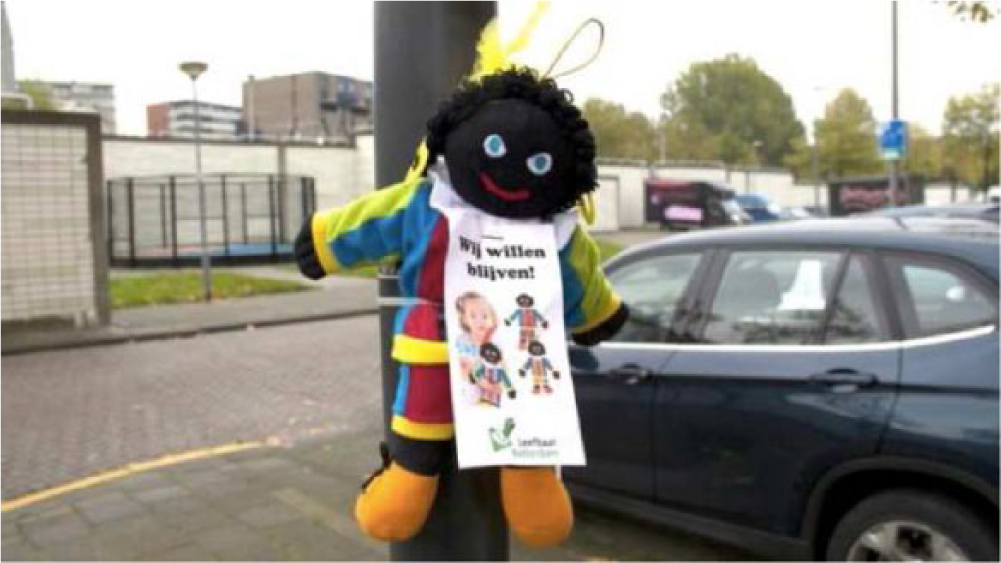
Halfway through November 2014, the leaders of the right-wing populist Leefbaar Rotterdam party headed out at night to strap black dolls to lantern posts and trees. The dolls sported dark skin, caricaturesque red lips and golden earrings, reminiscent of golliwogs. Notes on their bellies read, ‘We want to stay’. Rotterdam’s biggest political party hoped to contribute to the ongoing debate on Zwarte Piet (Black Pete). In line with the philosophy of its founding leader, right-wing populist politician Pim Fortuyn, who was murdered in 2002, Leefbaar Rotterdam defended above all ‘Dutch custom’. The current leader of the party deemed criticisms of the figure in blackface ‘hypercorrect’ and ‘confused’ (Leefbaar hangt stad vol met pieten, 2014). Many denounced the action as insensitive and hurtful. Satirical right-wing website GeenStijl unexpectedly headed ‘Leefbaar lynches negro dolls in the streets’ (Quid, 2014). Leefbaar Rotterdam did not see similarities with lynchings in the United States in the 20th century or other painful chapters of history, calling such criticism ‘ridiculous and disgusting’; ‘if you have these associations, you should go see a psychiatrist’ (Kooyman, 2014).
Source: Leefbaar Rotterdam (http://www.rijnmond.nl/nieuws/121209/Leefbaar-hangt-Rotterdam-vol-met-zwarte-pieten?).
Every October, November and early December of the past few years, the Dutch have heatedly debated Zwarte Piet (Black Pete). Zwarte Piet, since the mid-19th century has been depicted as the helper of Sinterklaas. Sinterklaas is dressed as a Roman Catholic prelate and arrives each year in November from Spain where he purportedly lives to celebrate his birthday on December 5 by presenting gifts to all the children. The Sint travels the country on horseback, climbing over roofs on December 5. His helpers go down the chimneys to deliver the presents. This, the story suggests, explains the complexion of Black Pete: his face is covered with chimney soot. Anti-Black Pete activists protest that this by no means explains the swollen, red lips, the frizzy hair or the golden earrings – all analogous to the colonial stereotypes of Black slaves. Could the current Black Petes not be exchanged for Rainbow Petes, they ask, or blackface exchanged with two smears of chimney soot?
After half a century of intermittent, local and fairly marginal protests against the racist stereotype that Black Pete presents, the past few years have seen an explosion of emotions and debate (Helsloot, 2009, 2012). The catalyst was an intervention by poet and activist Quinsy Gario. Gario attended the Sinterklaas festivities wearing a shirt that read ‘Zwarte Piet is racisme’ (‘Black Pete is racism’) and was forcefully arrested. A video of Gario, held down by several policemen, screaming that he was being kicked and struck, found its way to YouTube. Afterwards, events sped up and garnered national and international news coverage:
In early October Mr Gario appeared on the Netherlands’ most popular television talk-show to make his case again. The following week, the mayor of Amsterdam met with dozens of residents who had submitted a complaint asking that Zwarte Piet be removed from the city’s Sinterklaas parade. (Is Zwarte Piet racism?, 2013)
In 2013, the United Nations (UN) intervened and installed a research group to establish whether Black Pete was indeed a racist figure. Group leader Verene Shepherd expressed that the Sinterklaas holiday was ‘a return to slavery’ (Fontein, 2013). Two young men from the south of the Netherlands responded by starting the online Pietitie (Pete-ition), calling for preservation of the holiday in its current form. The Pietitie gathered over 2 million signatures in mere days (Fontein, 2013). Critics continue to claim that the figure in blackface is a hurtful, racist remnant of slavery, a ‘colonial hangover’ (Bergman, 2014). Others fiercely defend what they see as an essential element of their culture. As novelist Arnon Grunberg (2013) put it in the New York Times: ‘To my utter amazement, at least two million Dutch people have taken the stance: “Black Pete, c’est moi”’.
At first glance, it seems curious that emotions run so high concerning something that is described by both sides as a celebration for children. This article takes its point of departure in our own amazement at and disappointment in this passionate controversy. How might we understand these passionate discourses on the preservation of Zwarte Piet? And how might a framework of passion help us interpret what appears to be an outburst of unadulterated colonialism and racism? To this end, we study statements posted on the pro-Pete Pietitie Facebook page after key events in the Zwarte Piet–debate. Using Ahmed’s theorization of passion, we argue that the passion of the pro-Pieten, as they have come to be known, is substantiated by narratives of suffering and intensified by attributing the capacity to suffer solely to white bodies.
Methodology
Facebook continues to play a central role in the rallying of supporters on both sides, most crucially when it served to galvanize support for the Pietitie. The social medium is used both to argue in favour of Zwarte Piet in its current form, as to criticize the tradition as it is now celebrated. There are several Facebook pages opposing Zwarte Piet, which, although not nearly as popular as the Pietitie, are important for the development of strategies in the anti-Piet camp. A rather diverting example is provided in the documentary Our Colonial Hangover (Bergman, 2014). One of the leaders of Zwarte Piet Niet, a platform for Zwarte Piet–criticism, mentions that they receive a lot of death threats through social media. Because of Facebook’s demand that its users use their full name, the personal details (often including jobs, family members and place of residence) of the aggressors are well known to the Zwarte Piet Niet–group. The group decided to offer those that threaten them a choice: either you change your profile picture to an image denouncing Zwarte Piet, or we inform your mother of the death threats you have been sending us. In the documentary, a protester gleefully shows a profile of a pro-Pete who changed his picture. In addition, the central Facebook pages keep those who subscribe to it (those who have ‘liked’ it) up to date regarding new developments on Zwarte Piet. The followers can respond and debate the developments and negotiate their individual and collective position. The various pages encourage such discussions: they will post a link, along with a question such as ‘So, what do we think of this?’
As a forum for audience research, Facebook is special, and its characteristic qualities need to be taken into account. Doing so also points to the way in which our understanding of media may develop. Currently, we still tend to understand media communication as a logic of senders and receivers. While clearly platform media are different from broadcast media, no completely satisfactory terms are as yet widely used to describe the new type of media interactions that take place. While such notions as produser and prosumer (Burns, 2007; Toffler, 1980) mark the fact that the media landscape has changed, they suggest a great deal of activity and control on the part of those ‘formerly known as the audience’ (Rosen, 2006) – more than often seems to be the case. Jenkins et al. (2013) offer interesting alternatives to ‘active audiencehood’. They suggest we think of everyday hybrid media practices that mix and mash broadcast and platform media content in terms of affordance, appraisal, curation and conversation. All of these will help get us away from sizing up individual people or groups of people. After all, the outspoken reactions to Pietitie as well as the likes are clearly ‘afforded’ by Facebook. As a meshed network of friends groups, it is a digital space that invites you to speak your mind and especially to express your feelings: you are among friends. Those spreading images and jokes, and even those who simply liked Pietitie or the anti-Piet pages, appraised available options, valued them and sent them on: an everyday act of curation rather than evidence of what psychologists would call attitudes or personality structures. Appraisal and curation come much closer to the language of passion and affect that is used and underline that the sentiments expressed, however hurtful, may also be fleeting. Grossberg (1992) likened our investment (as fans) in specific media texts to a portfolio that will change over time: enthusiasms wane, others replace earlier texts, both those loved and hated. This, in all likelihood, is also what will happen with the Piet controversy.
Digital media can offer the audience researcher a unique glimpse into such practices. It allows us a peek at the discourses employed by both sides. Given Facebook’s function as a platform for the pro-Piet faction to express its sorrow and outrage, as well as the great quantity of comments available, this case is especially well suited for a digital ethnography. It follows what Miller and Horst (2012: 3) call their ‘prospectus for digital anthropology’ in that it seeks to understand ‘particularity and difference’ in digital communication in order to better understand ‘the framed nature of analogue […] life as culture’ (p. 4). It is a holistic and culturally relativistic undertaking that accepts the ambiguity of the digital with regard to its ‘increasing openness and closure’. While on the one hand, Facebook discussions are easily visible, along with the full names and details of those that participate, outsiders are sometimes forcibly removed or do not find their way to the page to begin with. Last but not least, we understand the digital as part of material culture including the remarkable capacity of digital communication to (re)impose normativity (Miller and Horst, 2012: 4).
We study roughly a thousand comments on the Pietitie, after three key events, which include: (1) the comments of Verene Shepherd (chair of the UN committee that investigated Zwarte Piet) and subsequent founding of the Pietitie in 2013, (2) the judicial ruling in Amsterdam maintaining Zwarte Piet is a hurtful stereotype in July 2014 and finally (3) the start of the festivities (with again many protesters arrested) in November 2014. The choice of these events is underscored by an Economist article (Is Zwarte Piet racism?, 2013), noting the heightening of tensions around Zwarte Piet in the year leading up to the founding of the Pietitie: ‘For many, even if a year ago he was not a symbol of Dutch racism, he is now’. We aim to identify common narratives and forms of reasoning and analyse these in a framework that understands these utterances as passion, rather than reason or emotion per se. Concretely, we looked for recurring terms, phrases and themes. These included ‘innocence’, ‘children’s festivity’, ‘magic’, ‘tradition’, ‘whining’ and ‘go back to your own country’. Quotes containing these key words were then clustered under broad themes, resulting in five main narratives discussed below. In addition, we collected relevant articles from the Dutch national and international press. National coverage tended to be descriptive and event-based. International quality press reported on Zwarte Piet in line with their ‘signature’. 1 All show themselves to be somewhat perplexed at the continuance of this Dutch tradition – sometimes noting the otherwise progressive and liberal image of the Netherlands.
This also integrates the current research project in the tradition of qualitative audience research in cultural and media studies. Rather than seek to generalize across populations, we want to understand underlying cultural patterns and logics. Such logics cannot be identified with individuals. Wetherell and Potter (1988) in their study of racist talk, point to the variability of discourse. They show how, in long interviews, speakers may offer very different types of repertoires to make themselves understood, varying indeed from outright racist to concerned and inequality-conscious (Wetherell and Potter, 1988: 172). While the Pietitie harbours posts that qualify as racist, we see little merit in defining the Pietitie as racist in its entirety: such a stance might close the door to further investigation. The same argument holds for those offering their views. Rather than characterize them as racist or not racist, we discuss the worldviews referenced in the comments. As we have studied hundreds of Facebook posts on a page liked by almost 2 million Dutch (out of a population of 16 million) we feel safe in assuming we are reconstructing a dominant way of thinking about Zwarte Piet.
Passion rather than emotion
While passion, especially in the context of popular culture research, may connote strong feelings, excitement and lust, this is not how philosophers have understood it. Passion according to Ahmed (2004) like passivity derives from the Latin passio, which means suffering. While passion presents itself as strong language and even stronger feelings, there is a sense that all those engaged feel driven by forces outside of themselves. Passion is what Spinoza called an ‘affect’. It should be understood as outward directed. While passion is derived from passio, it is not suffering itself but rather what may come out of that suffering (Ahmed, 2013: 2–3). While all parties in the Black Pete standoff refer to hurt and suffering, theirs is not a passive suffering but a passionate going to battle. This is passion as commitment and as denial – related to a deeply nostalgic sense of loss versus an equally deep sense of hurt and exclusion. Ahmed (2004) argues that we must not see passion as something we ‘have’ inside us, as a property of the body, but rather as different forces that shape and reshape individuals and communities. Those that share an affect (or mutually feel they do) become part of a collectivity. Affects, thus, are political forces to be reckoned with. Ahmed (2004) uses the example of White supremacist groups:
The ordinary white subject is a fantasy that comes into being through the mobilization of hate, as a passionate attachment tied closely to love. The emotion of hate works to animate the ordinary subject, to bring that fantasy to life, precisely by constituting the ordinary as in crisis, and the ordinary person as the real victim. (p. 114)
In assessing the significance of passion we might look at which identities are formed by this sense of suffering. How does affect delineate groups and distribute power? Put differently, ‘we need to consider how [affects] work, in concrete and particular ways, to mediate the relationship between the psychic and the social, and between the individual and the collective’ (Ahmed, 2004: 119).
Results of the analysis
Following Ahmed (2004), we analyse the affects of the pro-Pieten and which narratives and identities their affects create. Reading the three selected discussions on the Pietitie, several narratives stand out. Some phrases are repeated verbatim and many jokes are recycled in slightly different forms. Although there are dissenting opinions, on the whole the comments portray a consensus. A key phrase is children’s festivity (kinderfeest), invoked to defend a range of positions. Other responses focus on the alleged racism of Zwarte Piet (a misconception), the ungratefulness of the accusers (all implied to come from migrant backgrounds) and the importance of tradition. Many comments mention several of the key words and might fall in several categories.
Innocence of children
Most referenced is the idea that Sinterklaas is a celebration for children. It is often accompanied by references to innocence, magic and times past. All debate on Zwarte Piet is misguided, as the feast is per definition innocent. Cees 2 says, ‘I would like to see my children experience the magic of Sinterklaas the way I did when I was young. Is that too much to ask, a children’s feast for the children?’ Children are portrayed as innocent. Several commenters point out that children are untainted by racism and discrimination. The ‘so-called grownups’ are imposing these notions on the children. This is the basis of a frequent joke: one would expect adults to be the responsible ones, but children are much wiser (in seeing the celebration for the magic thing it is). Some directly tie the innocence of children to the danger of The Other. Brenda writes, ‘How will I explain to my kids, that I let some foreigners take their celebration away?’
Interestingly, the imagery of children is not exclusively employed by the pro-Petes but also by opponents, or more moderate supporters of Zwarte Piet on the Pietitie page. Such commenters accept the premise that Sinterklaas is a children’s feast and that the happiness of the children must come first. Then they ask, does it matter to children which colour the Pieten are? Arguably, not Piet’s appearance but the gifts, candy and celebration are essential to children. Some mention that it is likely their own nostalgia that makes them think of Piet as a figure in blackface. (In response to which other commenters detail the horror of their own children at various alternatives: ‘Those clown Pieten, they are terrifying’.) Some of the Black Pete opponents take it a step further, when the pro-Pieten mention children, they are only thinking of White children. If the well-being of children is so important, perhaps the festivities should be adapted in such a way that all children can enjoy them.
Categorical imperative
Other commenters tackle the accusation of racism. There are two responses as to what it might mean to modify Zwarte Piet. One is often put jokingly: if this is racism, then so is such and such. Any number of everyday foods and products are given as example. This is not just an inability to make out what is and is not racist; it is to glorify such an inability. The commenters mockingly employ a categorical imperative of sorts: if an exaggerated depiction of skin tone is unacceptable, then it must be so in all cases a skin tone is named, even if this is done in a totally different context and has nothing to do with human beings.
‘Everyone is talking about Zwarte Piet but I would like to talk about the snowman for a bit … yes you heard me right, the snowman […] it is really hurtful to me as a white person’, states Leo. Another very popular comment, in a similar vein, is provided by Siem: ‘Our cat does not get angry when we eat a Tom Puss pastry’. Others continue the joke, asking if it is perhaps a black cat? The joke can be (and is) repeated many times in different forms: white custard (‘blanke vla’), white Christmas, anything white must be unacceptable as well. Another popular form is a reversal of roles. Ed writes: ‘The only one who is actually discriminating is mrs Shepherd, she prefers white Pieten over black ones!’ Yet there is also some seemingly genuine confusion: ‘I find it so odd that the Zwarte Piet protesters do use the term black people. I find that more racist than all the Pieten combined …’. This narrative relates to the narrative of innocence in that it is a celebration of ignorance. To be unable to recognize racism is not a flaw, these comments imply, but rather a mark of purity.
Domino theory
The second form categorical argumentation takes, is a variation upon this narrative. It holds that if we allow the modification of Zwarte Piet, all sorts of other things will be ‘taken from us’ as well. Frank writes,
Tomorrow the cross on the miter Then the whole of Sinterklaas Then Christmas becomes ‘winter feast’ Then Christmas is cancelled completely Then serving alcohol at festivals Then serving alcohol on terraces Then alcohol in cafes Then a complete prohibition Then no more pork in university cafeterias Then no more pork in government buildings Then … This is where I draw the line
This post is exceptional in how detailed and explicit it is in its outline of the consequences of altering Zwarte Piet. Yet, many others, too, link a modification of Zwarte Piet with a variety of demands that will surely follow. A domino effect is feared, in which Others, present in our society already, will take over. Yvonne is clear on what will happen next: ‘Dear people, soon enough we will not be allowed to celebrate christmas because this country has been ruined by the islamic people!!its too late …’. Jaap, too, is pessimistic, ‘I signed, because if we give in to this they will come up with something else, we have adapted enough’. Although Dutch Muslim communities have not been particularly vocal about the issue of Zwarte Piet, one way or another, 3 they often come up in the comments. According to such comments, they too have forced ‘The Dutch’ to adapt. Both Muslims and anti-Piet protesters are taken to be a hostile outsider, an Other out to destroy Dutch values.
Ungratefulness
Mass immigration is significant in various narratives. There is a sense that the Dutch people have been nothing but welcoming and bounteous to immigrants and foreigners (conveniently forgetting that Surinam and the Antilles have been part of the Kingdom of the Netherlands for centuries and that labour migration was encouraged out of Dutch economic interest rather than international solidarity). ‘With open arms we accept these people to give them a better future, and as a thanks we get a slap in the face’, writes Amanda. Not only immigrants, but all sorts of people in need benefit from our kindness; Bea writes,
We Dutch are being called rascist (sic), but we are good enough to help the ebola patients (don’t get me wrong, we do it gladly) but I don’t understand, why must we always be first to help others and why must we constantly let them kick us down and say yes and amen.
This sense of ungratefulness is amplified by the fact that the critics of Zwarte Piet are not concerned with other problems, which, contrary to Piet, are relevant to the Dutch nation. There are any number of variations on ‘why do you not concern yourself with things that actually matter’, invoking anything from unemployment to elderly care. The narrative of ungratefulness takes a particularly xenophobic turn when people of colour, who raise objections, are told to go back to Africa. Antony states, ‘If the zwarte piet haters do not like our culture, they can just go back to africa right, couldnt be simpler!’ Especially when this point is playfully made, it is sure to be met with a lot of approval on the Pietitie page. Ester rhymes: ‘Pieten are black, smurfs are blue. If you don’t like it, Holland isn’t for you’. A small group, it is believed, is whining and complaining. The Dutch have given and have given in enough: anyone who complains from here on out, can find another country of residence.
Tradition
Closely related to the previous point, there is a glorification of Dutch tradition. Sinterklaas and Zwarte Piet are ‘hundreds of years old’. Dates and facts, despite being readily available, are not interesting. With ancientness, a form of purity has been bestowed upon the tradition of Sinterklaas. Outsiders cannot and will not understand, as this is a truly Dutch matter. Prete writes, ‘At the UN they think: welcome to the Netherlands, home to all cultures EXCEPT the Dutch’. It is a great riddle, that the Netherlands attracts so many outsiders, yet is also ‘relentlessly criticised’ by them. ‘Oh oh oh, they all want to be Dutch but if we can kill a Dutch tradition …’says Eelco. These ‘foreigners’ never have to adapt and if they do, they complain about discrimination. Even when international organizations such as the UN back such complain, or especially then, they are dismissed.
Any opposition from outside appears to strengthen a sense of Dutch idiosyncrasy. The US civil rights movement provides an interesting contrast. Spence (2011) underlines the importance of the outside world to the civil rights struggle in the United States. In the civil rights era, there was a sense that the world was watching. Even proud segregationists pragmatically endorsed integration in order to save face (p. 551). In the Netherlands, the opposite seems to be true. The outside world is not seen as a lucrative partner, but as an enemy. Because there is nothing to gain from the outside world, there is no reason to please or placate it. Of course they would not understand our traditions, the commenters say, they are not Dutch. ‘Lets abolish the UN and keep Zwarte Piet!’, write many.
Not all the commenters mentioned thus far have typical Dutch names. While all non-White traditions are painted as somewhat dubious, pro-Pete Black contributions are very much valued. Dutch people with Surinamese or Antillese roots that take to the discussion and express their support are embraced. Often, they are contrasted with their peers, who lack ‘such a fine understanding’.
Piet and passion
The narratives employed by the pro-Pieten deal with innocence and loss, real or anticipated. Despite being at least 2 million in number – and likely much more – the commenters say that they have been passed over time and again. The narrative is of a country that has given more than it can afford. Usually, what ‘we’ have given up is not specified (nor who this ‘we’ might be). When it is, it relates to the labour migration of Turkish and Moroccan people to the Netherlands in the 1960s, the reunification of families 20 years later and the subsequent presence of Islam. Despite our great effort to accommodate these people, it is believed, they continue to disrespect our norms and values. 4 Greater still than the sacrifices that have already been made are the envisioned sacrifices to come. As per the domino effect described above, it is feared that a modification of Zwarte Piet will result in a complete ban of Christmas, alcohol or pork. It is felt to be in line with a long history of the Dutch giving up their traditions in favour of those of others.
Anti-Piet stances follow the logic of what Laclau (2005) terms a chain of equivalence. Populism, according to Laclau, is not an ideology but a logic of articulation (p. 33). The social space is dichotomized in an ‘us’ and a ‘them’ and unrelated issues are linked by the notion that ‘the people’ are being treated unfairly. Zwarte Piet, in this sense, is just the tip of the iceberg: it comes to signify all that White, stereotypical Dutch have had to swallow (whether felt or actual). By virtue of being ignored in favour of the Zwarte Piet–debate, issues ranging from gas prices to street crime are related to Piet. The protesters against Zwarte Piet are seen to be morally at fault because they are more concerned with Zwarte Piet than the ‘real issues’ the unspecified ‘we’ have had to deal with. The commenters on the Pietitie page reference high taxes, substandard elderly and health care and ritual slaughter in Islam, all in reference to Zwarte Piet. While the opponents of Zwarte Piet ‘whine’, these people have to deal with real troubles. The innocent Dutch nation is being abused and disrespected. The ultimate signifier of this abuse of innocence is the (White) child that just wants to enjoy the Sinterklaas festivities. The possible hurt of the Black child, on the other hand, is not taken into account.
In line with Ahmed (2004), the passion in the case of Zwarte Piet is deeply tied to suffering. Zwarte Piet has come to stand for all ways in which ‘the Dutch’ suffer. Following Ahmed (2004), this sense of suffering is not an emotion that a body ‘possesses’. Rather, it is a political force that shapes and reshapes communities. The sense of shared suffering creates a ‘we’ that can be leveraged for a variety of causes. The passion of the pro-Pieten seems to stem from precisely this affect, the passion that springs from shared suffering. Crucially, any other groups are denied the ability to suffer. A populist dimension is present, too: we are the people, we should be an unmistakable force, yet we, the ordinary people, are denied time and again: ‘The ordinary or normative subject is reproduced as the injured party: the one “hurt” or even damaged by the “invasion” of others. The bodies of others are hence transformed into “the hated” through a discourse of pain’ (Ahmed, 2004: 114).
Denial
The Pietitie states early on that it opposes any racism and the comments rarely seem to imply a categorical hatred of people of colour. Rather, Black people who champion Zwarte Piet in its current form are applauded. This, however, does not mean there are no racist elements in the Pietitie posts. Solomos and Back’s (1994) suggestion to speak of racisms rather than racism is therefore a useful one here. While Black Pete is both a racist caricature and gives rise to all kinds of everyday racist remarks (Essed, 1991), this is a racism that insults in its denial to consider the merit of other people’s wish to be included.
Racism, discrimination based on ethnicity and/or skin tone, can, according to Solomos and Back (1994: 151) be coded as culture. The qualities of social groups can be fixed and naturalized in hidden racial narratives in the language of culture and nation (Solomos and Back, 1994). Those championing a particular racism can do so by claiming that ‘they are protecting their way of life and that the issue of colour […] is irrelevant’ (Solomos and Back, 1994: 156). Eventually this racism-as-culture, too, meshes with the powers of the state: protesters have been roughly arrested at peaceful protests in 2011 and 2014, in one case leading to a revocation of a protester’s right to continue working as a security guard (Beltman, 2015).
Such occurrences may be at odds with the right to free speech and equality before the law and with Pietitie’s own claim to be against any form of racism. Yet this injustice and suffering is not recognized by the Pietitie crowd, otherwise so keen to identify wrongdoings. The passion they celebrate among themselves is experienced as aggression when experienced by the critics of Zwarte Piet: a group of peaceful protesters who get to be described as ‘dangerous idiots’. Black people are accepted when they celebrate ‘Dutch values’, but they are not allowed to suffer, least of all at the hands of (supposedly) well-meaning Dutch. Because the suffering is not recognized, neither is the passion that it gives rise to. As a result, calm complaints are coded as whining, calls to action as aggressive and dangerous. (Or, in the case of children of colour being hurt indirectly due to Zwarte Piet and the continuing existence of stereotypes, the suffering is flat-out ignored. 5 ) Whining and being aggressive are widely accepted as moral flaws. By categorizing all complaints voiced by people of colour as either whiney or aggressive, so-called defenders of Dutch culture have given themselves a justification for opposing or silencing people of colour, without having to invoke their ethnicity. Rather, they can say, this is about defending their culture from immoral opponents. Herein lies the racism of the pro-Pieten: in disallowing Dutch people of colour to suffer, pro-Pieten are denying them an independent and full emotional life. That is to say, they deny the anti-Pieten their full humanity.
Denial has several meanings, and the Pietitie comments signify a denial of reality (and the reality of others) on many levels. The third definition of denial according to the Oxford dictionary is ‘Refusal to acknowledge an unacceptable truth or emotion or to admit it into consciousness, used as a defence mechanism’ (Denial [def 3], n.d.). The unacceptable truth of globalization is not allowed into consciousness here. This requires a refusal to admit to such historical realities as colonialism or the Dutch involvement in the slave trade (while slavery is sufficiently long ago to be irrelevant, Sinterklaas has been around forever). The Facebook likes and comments are appraisal, undertaken to curate content in which 2 million Dutch express a wish for a world of innocence. They have inspected the options, weighed the possibilities and have decided that this is a children’s festive event. While they, as grown-ups, may have fallen from paradise, there is no need for their children to do so as well. The claim that this is racism simply has no place in the idealized world of Sinterklaas (a complete stranger after all who brings gifts and often the very things you have asked for). As several comments claim, children know no racism. This is patently untrue but that cannot be the criterion when trying to understand everyday media interaction.
Related to the wish to salvage Sinterklaas as a domain of innocence, joy and togetherness are the angry complaints that say: ‘this is our tradition, keep your hands off!’. These comments and others also suggest a deep sense of loss: ‘We have given up so much’. It is as if 2 million Dutch just woke up to the fact of globalization. The Netherlands saw two political murders of anti-Islamic populist figures in the 2000s. Somehow a make-over of Zwarte Piet pushes home the fact of globalization more still than did the murder of Theo van Gogh. ‘We have become foreigners in our own country’ was the phrase used at the time (Buruma, 2006: 1, quoting a witness account in the NRC Handelsblad) and it is reused in the context of Zwarte Piet. Writing about the murder of Van Gogh, Buruma (2006) concludes his book with an account of a Dutch soccer victory over the Germans, that to him has all the hallmarks of a traditional feast: ‘I saw people in clogs, dancing to an old-fashioned brass band. Like all carnevals, this patriotic feast with shades of a Brueghel painting, was a fantasy, the celebration of an imagined community, rural, joyous, traditional, and white’ (p. 262). Sinterklaas, likewise, until recently offered a return to this ‘invented country’ (Buruma, 2006). According to Buruma (2006), such a patriotic fantasy contains the seeds of destruction. There is no such thing anymore as an unproblematically Dutch piece of the world. Others come there, feel they co-own the Netherlands, and suggest that ‘we’ accord to ‘their’ rules. The outrage over a make-over of Zwarte Piet is disenchantment and shared grief over a double idolization or reification (of childhood as paradise and the nation state as a sovereign entity that can be owned) that plays into this particular racism. The fantasy of an enclosed the Netherlands, dearly held by current Dutch anti-European populism, at the very least temporarily splinters in the conflict over Zwarte Piet.
By way of conclusion
This exercise in digital anthropology, the audience research for this new era, is predicated on the idea that there is no need to assume meaningfulness in all online utterances. These are not, in a literary sense, ‘authored’ texts. These are acts of everyday curation. Utterances may simply be a sign of allegiance, a confirmation of a friendship bond, or a reference to a shared memory. There is no pre-given political premium on productivity occurring in everyday life when studying media-related practices, nor is there a problem with mere consumption, with merely liking or not further circulating the texts one has appraised. This is not only a theoretical and methodological point of departure, it is also a political one.
In interpreting the Facebook behaviour with regard to Zwarte Piet as everyday curation, and more specifically as declaring allegiance, we can see the outlines of a community on the basis of a shared affect. The social space in Netherlands becomes divided into opposing factions. You are either for or against Zwarte Piet. The mere posing of the question whether and how Pieititie can be considered to be racist, is to take up a position in the debate and to declare one’s sympathies. The aggressive nationalist rhetoric that has come to accompany the defence of Zwarte Piet ‘as is’ allows no room for reflection. To question Zwarte Piet or suggest the merest recoding is read as denouncing Zwarte Piet and an accusation of those who want to defend what they want to define as tradition and as innocent children’s festivities. The ethnologist Helsloot, writing about Zwarte Piet, finds himself confessing to his sympathies for one of the camps. He is surprised to find himself stepping out of his usual more guarded and neutral academic role (Helsloot, 2009: 83–84, 2012: 14). Cultural studies as a field has always been more open to a reflexive mode of writing. Our sympathies, that will have been clear, are with the critics of Zwarte Piet.
Nonetheless, the theoretical framework of passion offers us the option to go beyond dichotomies of racist/not racist or good/bad. The Pietitie is more usefully understood as a discourse of pain, given consequence in the passion of the Pietitie commenters. At the same time, it is a highly problematic discourse. The sense of suffering it denotes excludes the possibility of the suffering of others. Following Ahmed, affect is less a personal possession (‘I have this feeling’) than a force to align the individual with the group (‘we suffer’). It is a demarcation into us and them sufficiently strong to deny others their full humanity. This is often a demarcation along ethnic lines. Zwarte Piet is the umpteenth issue that saw the ‘native Dutch’ – who, in the Pietitie narrative, have been nothing but good – losing power, influence and authenticity. This myth of innocence allows the commenters to disregard history, context and outside perspectives as corrupting influences on the magic of the festivities. A truly Dutch past – whatever that may mean – is imagined that has not been tainted by mass immigration, globalization or simply growing up. This fantasy of innocence likens the Dutch nation to an innocent (White child), fiercely to be protected. This is denial of the realities of a multicultural, globalized world.
Nor does holding on to Zwarte Piet in its current form resolve the other issues in the chain of equivalence, the various miseries befalling the Dutch nation: it will not lead to better care for the elderly or instant emancipation of Dutch Muslim women. Ironically, if the pro-Pieten could accept the possible hurt of Dutch people of colour, they could find new allies to address the social issues so crucial to them. In allowing others to feel the same emotions as oneself, new affective communities could be wrought. Of course, a warm friendship seems like an unrealistic possibility. Nonetheless, accepting that others, all others, are capable of feeling the full spectrum of emotions may allow the pro-Pieten and the Dutch nation as a whole to settle on a form of courteousness: a courtesy not based on the suppression or hiding of animosity, but upon the acceptance that others, too, are fully human and capable of hurt. Dutch intellectual, writer and mediamaker Anil Ramdas suggested in 1997 in a public lecture that anger and radicalization are difficult to wield as tools. They, moreover, may hardly benefit those on whose behalf they are used. Ramdas gave his lecture in a period of debate that led up to the conclusion that multiculturalism had failed, a period that initiated a sharp right-wing populist swing in politics. The resultant polarization in the Dutch political landscape and public debate is marked by the two political murders that were to follow: of the right-wing populist politician Fortuyn (in 2002) and filmmaker Van Gogh (in 2004). The Piet controversy echoes this long trajectory of the becoming ordinary of populism and its inherent denial of colonialism and globalization. It is as if the Dutch in this debate are waking up to a new and utterly changed world that they do not much like. Ramdas’s suggestion bears repeating as much for its balanced reasoning and for its marking of the extent to which the Zwarte Piet controversy and the holding on to the stereotypical traits given to this figure signify how empathy, respect and generally everyday courtesy have come to be in short supply. Let us end with Ramdas’ quote. Courtesy, argues Ramdas (1997),
is the first building block of civilization. It does not suffice on its own but it is a necessary start. I am prepared to make do with courtesy when sincere respect or sympathy proves impossible. V.S. Naipaul, the writer, recounts a story how he once entered a drinking establishment in the south in the United States where whites were singing racist songs about Negroes. It fell silent when he entered and remained silent for as long as he was there, the singing was continued the moment he left. In these parts, the author mused, courtesy might well be the best one can get and it may also be enough. Courtesy is more than an outward show, more than embellishment or superfluous ceremonial behavior. It is a means to prevent hurt, a ritual to exorcise hurt, a technique to prevent humiliation. (p. 10)
Footnotes
Declaration of Conflicting Interests
The author(s) declared no potential conflicts of interest with respect to the research, authorship, and/or publication of this article.
Funding
The author(s) received no financial support for the research, authorship and/or publication of this article.
Notes
Biographical notes
Email:
Email: