



Abstract
One component in the generational experience strongly related to media is the intimate and often passionate relation that is developed towards media technologies and content from one’s formative youth period: musical genres and stars, as well as reproduction technologies such as the vinyl record, music cassette tapes, comics and other now dead media forms. Passion, however, is a dialectic concept that not only refers to the joyful desire and intense emotional engagement of cherished objects but also includes its dialectic opposite in the form of pain and suffering. This passion, it is argued in the article, is activated by the nostalgic relationships to past media experiences, the bittersweet remembrances of media habits connected to earlier life phases of one’s own. Taking its point of departure in generational theory of Mannheim and others, this article analyses a series of focus group interviews with Swedish and Estonian media users tentatively belonging to four different generations. Based on the analysis of these interviews, it is suggested that passion and nostalgia are produced, first, in relation to old technologies, second, in relation to childhood memories and, third, at the limits of shared intergenerational experience, that is, at the moment when one realises that one’s own experiences of past media forms cannot be shared by younger generations, and especially one’s own children.
Introduction
One component in the generational experience strongly related to media is the intimate and often passionate relation that is developed towards media technologies and content from one’s formative youth period. Especially, this goes for musical genres and stars, as well as reproduction technologies such as the vinyl record, but also for music cassette tapes, comics and other now dead or near-dead media forms. Such passion can take many forms, and in audience studies, a large body of work concerns fans and other media users who are passionately engaged, seeking pleasure in and receiving empowerment from their object of desire (e.g. Harrington and Bielby, 1995; Harris and Alexander, 1998; Hills, 2002; Jenkins, 2006; Pearson, 2009). The objects of passionate desire naturally vary with the times, and some stars, idols and celebrities stay longer in the limelight than others, which means that they might become the object of desire for different generations.
This passionate relationship to stars, genres and even technologies, one could argue, becomes defining for the experience of certain generations. Passion, however, is a dialectic concept that not only refers to the joyful desire and intense emotional engagement of cherished objects but also includes its dialectic opposite in the form of pain and suffering. Although passion is most often connected to desire and intense emotional engagement today, the reference to pain and suffering stems from its origins in Christianity. Etymologically, it comes from the Greek verb πάσχω (paschō) and from classical Latin passiōn, passiō – to suffer. Here, passion refers to the last hours in the life of Jesus Christ, from his entering of the temple in Jerusalem, to his betrayal, the last supper, the garden of Gethsemane, imprisonment, his flogging by the guards, his dragging the cross to Golgotha, crucifixion and death – events that are accounted for in the four Gospels of Matthew, Mark, Luke and John in the New Testament. This part of passion is absent from the fan and audience literature.
Another concept that shares the dual quality of bliss and pain with passion is the concept of nostalgia. In fact, one could argue that nostalgia is a specific form of passion, directed towards past passionate moments, or at least past moments of significance in a person’s life course. Clearly, nostalgia can take many forms, ranging from the everyday conception where it often simply connotes cultural preference for something from the past, a ‘universal catchword for looking back’ as David Lowenthal (1985: 4) phrases it, to its origins in clinical diagnoses. 1 The concept first appears in medicine in the late 17th century, in a dissertation by the Swiss doctor Johannes Hofer, where it is described as ‘the desire to return to one’s native homeland’ (quoted in Boym, 2001: 3). Hofer derived it from the combination of the Greek words νόστος (nóstos), meaning ‘homecoming’, and ἄλγος (álgos), meaning ‘pain’ or ‘ache’.
As James Philips (1985) has pointed out, the ‘homesickness’ described in the clinical literature from 1688 and onwards soon gave way for another meaning of the concept, that was more related to time than to space: where nostalgia as homesickness deals with the actual separation of a person from his or her home(land), present-day nostalgia refers to a displacement in time – the yearning for ‘lost time’, to cite the person perhaps most associated with nostalgia (Marcel Proust [1913], 1996). Philips (1985), then, contrasts the exile and homesickness of Odysseus with the internalised, symbolic homesickness of nostalgia and points out that the main difference is that ‘space is retraversable, while time is not, the return is possible for the homesick exile in a way that it is not for the nostalgic’ (p. 65). In fact, Philips (1985) holds, one can read the fate of Odysseus both ways. Odysseus does indeed return to Ithaka after 20 years, but Odysseus does not fully return, as he finds his home but not his youth. And even his home has been altered by time. The temporal loss is thus more profound, always encroaching on the spatial sphere. (p. 65)
Being nostalgic, then, is ultimately tragic, as time is irrecoverably lost. But it also brings joyful memories. Nostalgia in this sense aims to capture the kind of bittersweet remembrance of something past, something that one longs back for at the same time as one knows that this moment is impossible to regain. In Svetlana Boym’s (2001) phrasing, it is the ‘hypochondria of the heart’ (p. 1), it is the trigger of ‘involuntary memory’ (Proust), activated by, for example, the taste of a madeleine cake – or a prompting question in a focus group interview.
In a similar way to Philips, Svetlana Boym also distinguishes between two types or ‘tendencies’ of nostalgia, which each emphasises either time or space, respectively. Restorative nostalgia deals more with nóstos than with álgos and seeks to reconstruct the old home and ‘patch up the memory gaps’, whereas reflective nostalgia is more about álgos, about ‘longing and loss’ (Boym, 2001: 41). Restorative nostalgics, argues Boym, do not consider their approach nostalgic, but about truth, and can be found in diverse national movements in the contemporary: while restorative nostalgia ‘manifests itself in total reconstructions of monuments of the past, reflective nostalgia lingers on ruins’ (p. 41).
The aim of this article is to discuss passion and nostalgia as components in the formation of generational experience. It will do so against findings from a series of focus group interviews with Swedish and Estonian media users of different ages and generations, read through the theoretical lens of reflective nostalgia and passion, in order to understand its role in the formation of a generational experience. The section ‘Generation as an analytic category’ accounts for the theoretical points of departure in generational theory. The next section ‘Swedish and Estonian media users’ describes the empirical basis for the analysis in the series of focus group interviews in Sweden and Estonia. The following section ‘Passionate and nostalgic moments’ analyses the points in these interviews when passion and nostalgia appear and also which kinds of passion and nostalgia. The article then ends with a short discussion of the theoretical implications of the empirical findings. Passion, it will be argued, is activated by the nostalgic relationships to past media experiences, the bittersweet remembrances of media habits connected to earlier points in life.
Generation as an analytic category
During the inter-war period, Karl Mannheim ([1928] 1952) developed a theory of generation in order to explain why and how societies did change. He launched this theory as an alternative to the Marxist explanation of societal change, where he sought to exchange Marx’s concept of class with that of generation – an attempt at capturing the ‘rhythm of ages’ as his Spanish contemporary José Ortega y Gasset ([1923] 1931: 15) poetically described it. Thus, Mannheim theorised the generational concept as consisting of the duality of generation as locality and as actuality in analogy with Marx’s concept of class in itself and class for itself. Generation as locality was the term given for those individuals who were situated at the same location (Lagerung) in the historical process, for example, by being born around the same time, and hence confronted with societal events in a similar manner. To be situated in the same historical situation, however, is not enough, but would reduce generation to birth cohort (Kertzer, 1983). In order for this externally defined (by, for example, a researcher) generation to come into being, a generational consciousness would have to be developed. The generation should also recognise itself as a generation in order to become ‘actual’; it should recognise as a generation for itself, not only in itself. In the words of Michael Corsten (1999), the generational group should develop a ‘we-sense’, founded in experience.
That all persons experience the same dramatic societal events, or are affected by dominant stars or celebrities (e.g. Elvis, the Beatles), does not mean that all respond to these events or these cultural phenomena in the same way. In Mannheim’s ([1928] 1952) words, there are developed different responses, which in turn produce ‘generation units’ (p. 304). To Mannheim, the ‘formative years’ of youth (between 17 and 25 years) are also crucial in forming the generational experiences: since young people lack in experience compared to adults, they are more sensitive to ‘fresh contact’ with new phenomena. When an individual has been confronted with a novelty of some sorts, ‘[a]ll later experience then tend to receive their meaning from this original set, whether they appear as that set’s verification and fulfilment or as its negation and antithesis’ (p. 298). Experience, then, appears in the form of a ‘dialectical articulation, which is potentially present whenever we act, think or feel’ (p. 298).
Mannheim ([1928] 1952: 300) built the analogy between the formation of the generational experience on language formation, where research had shown that the spoken dialect seldom changes after the age of 25 years. Accordingly, the experiences we make, and the phenomena with which we have ‘fresh contact’ with before the age of 25 years, when our generational identity becomes established, will have a formative impact on all our later experience, and we will ‘read’ all new phenomena through the lens of these experiences. Situating the formative years to the ages 17–25 years is also congruent with memory research, where it is pointed to the fact that people remember more clearly events from ‘adolescence and early adulthood’ (Steiner et al., 2014).
Now, Mannheim did not specifically think of media experiences, but others have. Gary Gumpert and Robert Cathcart (1985) have argued that we tend to read the world through the lens of the media experiences we have in youth: Even when a person learns several spoken/written languages in a lifetime, the person will generally tend to interact with the world through the bias of the native language. It is our position that the early acquisition of a particular media consciousness continues to shape peoples’ world view even though later they acquire literacy in new media./…/ For example, those born into the age of radio perceive the world differently from those born into the age of television. (p. 29)
We could therefore expect to find differences in these experiences as expressed by people who have grown up in different media and socio-political landscapes, as has also been pointed out theoretically as well as empirically in recent media research (Bolin and Skogerbø, 2013; Colombo and Fortunati, 2011; Loos et al., 2012; Siibak and Vittadini, 2012). The next section describes such an ‘objective’ structure that can be supposed to impact the generational experience.
Swedish and Estonian media users
The variation in the formation of the generational experience among media users in Sweden and Estonia needs to be understood in relation to the objective structures of the media landscapes in the respective country. The different historical trajectories of the two countries have also produced differences in the media systems. And although the media technologies have not differed much in these systems, content has and the organisational principles for its distribution. One might thus expect that individuals born around the same time, and in the same geo-cultural, political and media landscape, should develop similar relationships to the media as technologies and content. This was the basis for the construction of a series of focus group interviews conducted in late 2011/early 2012 with Estonian and Swedish media users. The reason for the cross-cultural comparison is that the large international events occur at the same time, but they are interpreted by media audiences in different geo-political and cultural environments. The groups were thus composed of people born around certain years in both countries, with a special concern to the transformations in society and the arrival of new media. 2
Each of these tentative generations was born into a different media landscape. If we think of societal and media development in linear terms, we can construct a timeline where media technologies appear successively over the years. Each generation also enter into the historical process at certain points in this timeline, where some media technologies are already present, while others arrive during their lifetime. This ‘objective’ structure of the media landscape is outlined in Figure 1.
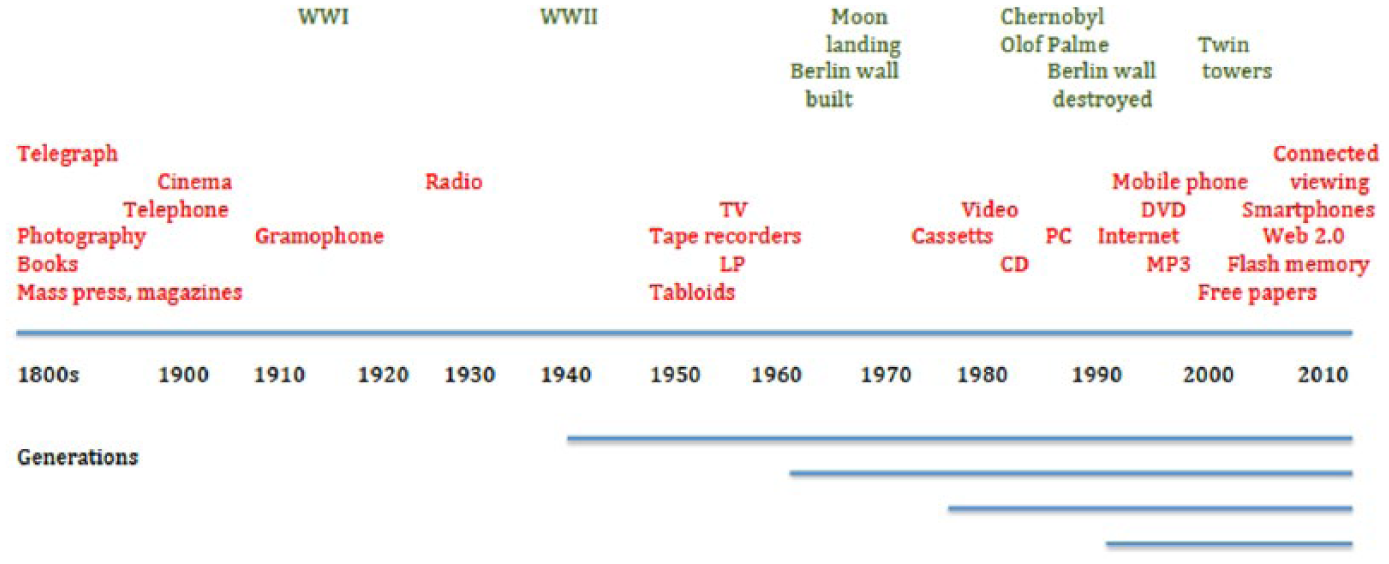
‘Objective’ media landscape 1800s to the present and the trajectory through it by the four generations – based on events and media developments in Sweden and Estonia.
The oldest focus group consisted of people born in the beginning of the 1940s, in the midst of the Second World War, and growing up in postwar Soviet Estonia and postwar Sweden. 3 This ‘postwar generation’ was at the occasion of the interviews in early retirement, many of them had children as well as grandchildren. They had a mixed work–life experience and originally were brought up in different parts of the two countries. This (tentative) generation had grown up in a media landscape that was dominated by the mass media cinema, literature, press and radio. During their formative years, they saw the arrival of television, tape recorders, tabloid press and the long play (LP) record. It should be noted, though, that even if television and music media technologically were the same in Sweden and Estonia, the content was dramatically different (which of course also goes for the press, cinema, etc.). They were still very young at the end of Second World War, but they grew up during the Cold War, the erection of the Berlin Wall and the murder of John F. Kennedy.
The second focus group consisted of people born in the early 1960s. This generation had their formative years during the Cold War, the arms race and, ultimately, the early phase of perestroika under Mikhail Gorbachev. They were in their mid-20s when Olof Palme was murdered. This was the pre-digital era, but this generation experienced the arrival of cassette tape recorders, video and the CD record during their formative years. 4 Most of them had children, who were in their teens or early 20s (i.e. in their formative years). They were all working and had as yet no grandchildren.
The members of the third focus group were born in the late 1970s. 5 Tape recorders, video and CD records and portable Walkman had always been there for them, and they saw the introduction of free daily newspapers (e.g. Metro), the mobile phone, DVDs, MP3s and computers during their formative years. Some were still studying, while others were working. Most of them did not have children. They were in their early teens at the time of the fall of the Berlin Wall and at the time of Estonian independence and had their formative years shortly afterwards.
The members of the fourth focus group were born in the early 1990s. 6 They were all in their formative years at the time of the interview. The media landscape they were born into was more diverse than any of the older generational groups, although they also saw new media technologies such as the smartphone, the interactive web and connected viewing being introduced. They were all studying, either in high school (gymnasium) or in early undergraduate studies. None of them had children.
The oldest generational group have travelled 50 years longer through the media landscape, and over the course of years they have seen it shift in character quite dramatically. They also have 50 years longer first-hand experiences of historical events, although these experiences also vary depending on from which geo-political position they were experienced. That is, the fall of the Berlin wall has had a global impact, but the meaning of it supposedly varies depending on whether you were living in Sweden or Estonia by then.
The specific way in which the focus groups were triggered in the interview situation was expected to produce nostalgic remembrances among the interviewees. All interviews started with the same prompting question: ‘What media did you have in your home as a child? Can you tell us about your earliest media memories?’ Furthermore, it was presupposed that the oldest generation would be the one that would be most nostalgic in relation to their media memories – both when it comes to the media landscape as technological structure and as symbolic environment. Supposedly, the affectionate relationships to the media of one’s youth would gradually develop as generations grew older; an age component that was expected to produce a nostalgic dimension to the generational experience, activated by the focus group situation. In the next section, this nostalgic and passionate dimension will be discussed.
Passionate and nostalgic moments
There are at least three types of nostalgic modes that appear in the focus group material – technostalgia, nostalgia as loss of childhood and nostalgia as the (im)possibility of intergenerational experience. They are not mutually exclusive, but while there are overlaps, there are also distinct qualities that separate them as specific forms of experience. Where technostalgia, for example, has tactile dimensions that to a certain extent can be reproduced (i.e. re-experienced), the other two aspects are more related to irrecoverable loss.
Technostalgia
Technostalgia as a concept has been used in the analyses of sound media, such as valve amplifiers, vintage musical instruments and so on, and refers to the preference for old, often analogue, technologies (Pinch and Reinecke, 2009). It is, however, in previous analysis (cf. several chapters in Bijsterveld and Van Dijck, 2009), somewhat under-theorised. In relation to the interviews analysed for this article, it relates, on one hand, to first-hand experiences of the use of media technologies (rather than content) and, on the other, to media that evokes social relations and situations.
First, technostalgia is directed towards now ‘outdated’ communication forms such as letter writing (the phenomenon of ‘pen-pals’) – a yearning for a kind of pre-digital connectedness that precedes contemporary social networking media such as Facebook (that the younger generations engage in). But it is also directed towards other media technologies such as comics, cassette tapes and vinyl records, some of which have been replaced by digital alternatives. It is partly a mourning of dead media technologies in themselves, but it is also about the gradual disappearing tangible materiality of the media that produces nostalgic remembrance, an emotional attachment to the ‘rustly’ sounds when reading the print newspaper, the memories triggered by LP album covers, the mix tapes. This nostalgia is clearly social, as when the respondents turn to each other to ask ‘Do you remember …?’, where they seek social confirmation on their bygone, shared tangible experiences.
Nostalgia in this form is seldom connected to content in itself since content today obviously lives on and can re-appear on many platforms of consumption, whereas the technologies disappear or become more difficult to use (e.g. where do you buy cassette tapes nowadays?). Several respondents report on having exchanged their record collections several times over the years, from vinyl discs over to CDs, MP3s and then hard-drives and streaming services. The old media are not thrown away, however, but stored away in attics and cellars as an archive of bygone events and feelings. It is not any version of a certain song or album, but the specific copy of a specific record (the vinyl copy with the original cover) that is the trigger of memories and emotional states: As I see it, today you lose the value in it … my children would think I am silly now, I know, but … because, when you went and bought a vinyl record with a cover. You do remember the covers of certain records still, don’t you? And you remember the feeling when you bought it, and what it stood for. (Focus group, Sweden, born 1962–1964)
Technostalgia is, as seen from the quote, not only about the unique quality of the medium but also clearly connected to a specific emotional state of the individual.
Second, technostalgia is also related to labour investment. Some of the media discussed in the focus groups were already approaching their ‘best before’ date during the formative years of the respondents, such as the cassette tapes for the youngest generation of 15- to 20-year-olds, born in the early 1990s when cassette tapes successively became replaced by digital recording technology. At this time, the vinyl record was already exchanged for CDs and soon MP3 players, iPods and so on. However, the labour invested in creating mix tapes on cassette had imprinted their memories, in the same way as it has for older generations:
I recorded mix-tapes on cassette. Tried to avoid the commercials and mix songs together.
I see, and then you recorded from the radio?
Yes, exactly. You have to stay alert so you don’t record the commercials, and try to make a good mix.
Do you still have those tapes?
Yes, in fact I do.
Cool!
There is so much hard work behind it. They are still there in the drawer. (Focus group, Sweden, born 1991–1995)
For the youngest generation in Sweden, this resembles the ‘analogue nostalgia’ theorised by Laura Marks (2002: 152ff), but is more connected to the investment in labour in producing them. Analogue nostalgia, as Marks theorises it, deals less with the emotional labour invested in compiling mix tapes and has more to do with the ‘indexical’ quality of the sound, ‘a retrospective fondness for the “problems” of decay and generational loss that analog video posed’ (p. 152). Her analysis is, however, made against a specific educational setting of media production, where she finds that ‘analog nostalgia seems especially prevalent among works by students who started learning video production when it was fully digital’ (p. 153). The question is, however, if this really is nostalgia at all: Can one long for a home where one has never lived? Is this not rather a phantom pain caused by a more general fascination of preforms to the present technologies? In terms of home, this means longing for someone else’s home – a specific kind of nostalgic envy of the home one never had.
Music has always had a prominent place in the analysis of nostalgia, already from the clinical diagnosis of Hofer, to the more individualised memories of today: ‘The music of home, whether a rustic cantilena or a pop song, is the permanent accompaniment to nostalgia’ (Boym, 2001: 4; cf. Van Dijck, 2009). Music has the ability to trigger memory, which leads to nostalgic contemplation of the past: ‘Yes, yes, indeed … I can remember everything very clearly. I can even hear this particular song [in my head]’, as one male informant exclaimed in relation to the main theme for a children’s television programme (Focus group, Estonia, born 1959–1966).
If music holds a prominent place in memory studies, the mix tape has indeed become one of the paradigmatic triggers of memory (e.g. Jansen, 2009). The labour laid down in producing a mix tape, either for oneself or aiming at a cherished or loved other, obviously produces a cultural value that is bound to the individual (Bolin, 2011). Although it seldom was produced in order to trigger memories later in life, it receives this function and becomes a ‘frozen mirror’ that makes it possible to be ‘encountering a previous self’ (Jansen, 2009: 44). Mix taping as a practice was at its peak between the late 1970s and early 1990s, up until the point when the possibility for burning CDs became widespread. Although it was also possible to burn music mixes on CDs, this practice does not seem to have produced either the emotions or the labour intensity that the mix tapes did. It is less labour intensive, less personal and hence has less value.
Nostalgia as loss of childhood
Nostalgic remembrances directed to childhood media use appear in all generations, even among those who were in their formative years at the time of being interviewed. Vinyl records are connected to childhood memories, but the memories are not technostalgic, that is, directed towards the technology but rather towards the content – for the youngest Estonian generation, traditional childhood favourites such as the characters Toots and Kiir from the cult classics Kevade (‘Spring’) and Suvi (‘Summer’), based on the novels by Estonian author Oskar Luts from 1912 and onwards. These were released on LP records in 1969 and 1971, respectively, and have been immensely popular among generations of Estonian children. 7 Toots and Kiir could never have been experienced first-hand by this generation since the records arrived several years before they were born, but are rather remembered as ‘classics’. But it is also clear that it is the quality of the stories as laid down on vinyl that is the trigger of nostalgia and a social loss of family life in childhood.
Among the Swedish generations, childhood memories are most often connected to children’s radio programmes (for the postwar generation) and children’s television shows (for the generation born in the early 1960s, late 1970s and early 1990s). For the postwar generation, however, this seems not to be connected with nostalgic remembrances. But for especially the Estonian generation born in the early 1960s, there are several children’s programmes mentioned, such as Telepoiss, Entel-Tentel or Tipp ja Täpp.
Sometimes, the memories are related to important life history events, such as spending time in hospital. Mare, born 1940, vividly remembers when she was in hospital for diphtheria at the age of 4 years and how she received Hans Christian Andersen’s tale of Thumbelina, written 1835 and published in 1956 in Estonia as Pöial-Liisi, with characteristic drawings by Estonian illustrator Siima Škop (see reproduction in Bolin, 2014). This was clearly an important life event for Mare, being so young and hospitalised. However, this is also a distorted memory since at the age of 4 years, the Thumbelina tale was not yet published in Estonia. Mare retrospectively adjusts her media memory to include Pöial-Liisi. No doubt she was hospitalised at that age (she hardly mistakes her 4-year-old self for her 16-year-old), and most likely she received a book from her aunt, but she replaces that gift with Pöial-Liisi, which is a very famous and cherished book among Estonian children. Mare simply reinforces, or potentiates, her memory with this well-known book according to the principle that nostalgia is rarely about ‘the past as actually experienced’ but rather ‘the past as imagined, as idealized through memory […] by desire’s distortions and reorganizations’ (Hutcheon, 2000: 195).
Nostalgia as the (im)possibility of intergenerational experience
A third type of nostalgia is that which concerns intergenerational experiences or the lack thereof. The example with Toots and Kiir above illustrates the intergenerational transfer that appears when children pick up the records of their parents’ generation. This example, then, has a double meaning where, apart from the loss of childhood, it also points to the successful sharing of generational experience. There are several such examples in the interviews, where children discover their parents’ old mix-tapes and want to ‘inherit’ these:
Well, now, I had thrown most of them away, but I did save some. And then my son bought an old car with a cassette player in it. And he said ‘What’s this?’, and then we took one of my old tapes. And he almost fell over laughing, and then I had recorded … rapping … and a lot of such stuff. And he thought it was dead fun … plus a lot of old corny music, and he thought that was really great. He kept the tape. He sold the car eventually, and kept the tape. Thought that, ‘I’ll keep this’ (laughter).
And that was your son, right?
Yes, he bought an old car and there was a cassette player in it, and he, like, wanted to exchange it, and I said, no – keep it and I’ll give you some tapes, and you can play them instead.
But was that because it was your cassette tape or was it because it was a cassette tape?
A cassette tape. And then because I had added talk, and stuff. Mixed it together with songs and acted DJ in-between (laughter). (Focus group, Sweden, born 1962–1964)
Similar examples of the sharing of experience between generations are also found elsewhere in the literature on memory and media, for example, concerning the intergenerational transfer of musical taste. Typically, this transfer builds on children exploring their parents’ old record collections and then picking up the same taste as their parents (cf. Van Dijck, 2009: 111). This intergenerational transfer relates to reproduction, but not in the technical sense of the ability for reproducing songs endlessly, contributing to the multiplication of choice, but with reproduction of taste.
The type of nostalgia and passion referred to above leans towards the more joyful. There are, however, more painful moments in the intergenerational relationships revealed in the interviews. To Marie, the extended communication opportunities that exist today have also brought with them a generation gap and a loss of value in communication: But, it’s like this has to do with quantity. I mean, sometimes you lose the value in … As I see it, today you lose the value in it, because when I went and bought a vinyl record with a cover. You do remember the covers of certain records still, don’t you? And you remember the feeling when you bought it, and what it stood for. Today they just sit online, and on Spotify, and I get totally confused, because I’m there myself, and I think … God, I can download anything and listen to it. And that stresses me out, because you somehow lose your grip on … And there they are online all the time, and all of this with three hundred friends on Facebook, or you have a whole world on your computer, and what not. It has to do with quantity, and you somehow lose the value in it. In everything from friendship to the music. (Focus group, Sweden, born 1962–1964)
This is a loss of value that has to do with the technological capacity of reproduction and the impossibility of reproduction of taste and preference. To Marie, the youth of today – including her own children in the formative ages of 21 and 23 years – can never understand how it felt for Marie when she bought that specific record with that specific cover or when she produced her own, specific and unique, mix tapes. Nor can they understand what it meant to read the comics that Marie and her generation did: My children never read comics much. In fact, I didn’t get the sense that it was such a strong influence in their childhood as it was for me.
This generation gap can also be illustrated by the account of Mats in the same interview, who slightly disappointedly describes how his old comic magazines were not appreciated by his children: Well, I know because I have saved all my comic magazines, so they [the children] got quite a strong dose anyway. What was a bit disappointing was that Agent X9 and Fantomen, and the others, they were in black and white, and then it wasn’t much fun. (Focus group, Sweden, born 1962–1964)
What Marie and Mats are trying to express is the generational difference between themselves and their children, and the realisation that their children can never appreciate comics the same way they did when they were the same age. This is a loss of intergenerational knowledge transfer caused by changes in the (‘objective’) media landscape. It is a mourning of the ability to pass on media practices and communication experiences to one’s own children, as they now are close to leaving their formative years.
This is also where the combination of generational experience with life course and life situation enters. The generational experience can naturally be shared within one’s own generation, with those who have similar experiences. But it cannot always be passed on to the next generation, and this is why this type of nostalgia is triggered at the time when the generation faces their children being at the end of their formative years, having developed an own, autonomous identity. This is the moment when one realises that one’s children have developed their own relation to the world independent of their parents, and the impossibility of intergenerationally shared experience is manifested. This fact produces nostalgia for times that will never return and for feelings not possible to transfer between generations.
The three types of relationships to media memories referred to above are examples of intense, most often passionate encounters with technologies and content. Technostalgia, however, partly stands out from the other two as less about loss and more about cherished memories. Some of the memories of past experiences can in fact easily be re-enacted, such as the ‘rustly’ quality of print newspapers, old analogue instruments or vinyl records (even shellac records, although these are not mentioned in the interviews). This loss – if that is indeed the right word – is of a suspended kind and is easily remedied. The records stowed away in the attic can indeed be revisited, and their function is rather as an archive of past emotional states.
The two other types – loss of childhood and loss of intergenerational experience – are more profound and deal with time irrecoverably lost. They are thus more painful, and the passion they are loaded with is also nostalgic in meaning that they cannot be revived, as that specific home which they represent is forever changed by cosmic time. This nostalgia is also the nostalgia of generational experience in a double sense: it both binds together those who have made the same experiences in the past, and it also binds the generation together in the present through the shared feeling of loss. It becomes a specific generational value that ties people who appreciate this value together.
Conclusion
We can conclude from the analysis above that there are three types of nostalgia related to the generational experience. The first of these – technostalgia – on one hand concerns the longing for (often) analogue technologies such as letter writing, traditional newspapers, vinyl records, and on the other, the labour investment related to old media technologies. Technostalgia is highly collective and represents a shared media experience of people who have similar experiences of bygone or outdated media technologies. To the contrary of the subsequent two nostalgic modes, however, technostalgia can be ‘cured’, as it is possible to successfully revisit old technologies (although one, just as Odysseus, revisits this ‘home’ as a different self).
The second type of nostalgia identified concerns the loss of childhood and revealed in early memories of media uses – often connected to important life history moments such as being hospitalised but also towards cherished media moments in the form of children’s radio and television programmes, representing a bygone era of childhood innocence. This type of nostalgia is highly individual and does not trigger large discussions in the focus groups. They can, nonetheless, be said to be part of the generational experience since these nostalgic remembrances are homologous to other childhood memories. But they are not specifically related to the media experience nor to the historical and contextual time, but rather to childhood per se.
Third, there is a nostalgia related to the (im)possibility of intergenerational experience. This type deals with experiences from the formative years and is triggered by one’s children coming towards the end of their formative years, where the separation from parents is completed. This type of nostalgia is collective and shared among the parents in the focus groups.
All these three forms of nostalgia are reflexive, in Boym’s terminology, as they deal more with loss and longing than with ‘truth’. They are all triggered by media memories (as prompted in the interview situation), although they could in principle also have been activated by non-media prompts. These are most probably not the only three modes of passionate media memories and nostalgic remembrances. They have been identified in a limited material and in the two specific cultural contexts of Sweden and Estonia. Most certainly, there can be found other modes, related to other cultural contexts, and possibly also to other generations, as each generation is confronted with their own ‘objective’ structures in the form of specific media and societal landscapes. However, the increased abilities to revisit media content via digital archives should make media-related analysis of passion and nostalgia as dialectical concepts that encompass the duality of blissful suffering an interesting field for future research, as that which seems irrecoverably lost today, might be, or at least appear to be, less so in the future.
Footnotes
Acknowledgements
I wish to extend my deep thanks to Signe Opermann, who not only conducted the Estonian focus group interviews but also helped with translations and discussions on analytic topics relating to these.
Declaration of Conflicting Interests
The author(s) declared no potential conflicts of interest with respect to the research, authorship, and/or publication of this article.
Funding
The author(s) received no financial support for the research, authorship and/or publication of this article.