



Abstract
Currently missing from critical literature on public engagement with academic research is a public-centric analysis of the wider contemporary context of developments in the field of public engagement and participation. Drawing on three differently useful strands of the existing theoretical literature on the public, this article compares a diverse sample of 100 participatory public engagement initiatives in order to first, analyse a selection of the myriad ways that the public is being constituted and supported across this contemporary field and second, identify what socio-cultural researchers might learn from these developments. Emerging from this research is a preliminary map of the field of public engagement and participation. This map highlights relationships and divergences that exist among diverse forms of practice and brings into clearer view a set of tensions between different contemporary approaches to public engagement and participation. Two ‘frontiers’ of participatory public engagement that socio-cultural researchers should attend are also identified. At the first, scholars need to be critical regarding the particular versions of the public that their preferred approach to engagement and participation supports and concerning how their specific identifications with the public relate to those being addressed across the wider field. At the second frontier, researchers need to consider the possibilities for political intervention that public engagement and participation practice could open out, both in the settings they are already working and also in the much broader, rapidly developing and increasingly complicated contemporary field of public engagement and participation that this article explores.
Keywords
Introduction
Serious ‘engagement’ […] means a drastic decentering of our own habits of discourse […] it also requires us to go beyond the style of enquiry so common in cultural studies (theory-laden deconstructive criticism) and inventing modes of positive, reconstructive intervention. (Ang, 2006: 195)
In response to Ang’s and other calls for more publicly engaged socio-cultural research, this article presents an approach to negotiating engagement in the contemporary context that is particularly attentive to the public in public engagement. The current growth of interest in publicly engaged and participatory research is driven by a range of pressures, including those for more publicly accountable and impactful research in higher education (Facer et al., 2012; Holmwood, 2010) and calls for more collaborative and worldly approaches to socio-cultural scholarship that eschew academic isolation, individualism and vanguardism (e.g. Grossberg, 2010). Debates about engagement, the democratisation of knowledge generation and societal participation in decision-making are not new of course; Raymond Williams (2011), for example, articulated the call for a ‘long revolution’ to extend possibilities for critical learning and self-governance to non-elite groups over five decades ago (see also Mills, 1959). However, in recent years, there has been an explosion of literature that specifically calls for public engagement with academic research, prompting the development of sub-disciplines such as ‘public anthropology’ (Vannini, 2012), ‘engaged cultural research’ (Ang, 2006) and ‘engaged geography’ (Pain, 2014). Long-standing debates about ‘public sociology’ (Brewer, 2013; Burawoy, 2005) have also been added to recently by calls for a more ‘live’ sociology (Back and Puwar, 2012) and debates about the performativity of socio-cultural methods (Law and Urry, 2004; Ruppert et al., 2013; Savage, 2013).
Currently missing from this growing body of literature on public engagement with socio-cultural research is an analysis that encompasses contemporary practice-based developments in public engagement and participation beyond academia. In this article, we begin to address this gap by focusing our analytical gaze on the myriad ways that the public is being constituted and supported across this wider field. As is well-documented, recent years have been characterised by a ‘participatory turn’ in a number of domains, including higher education (Weller, 2011), science and technology (Chilvers, 2008), environment (Cook et al., 2013), urban regeneration (Lipietz, 2008), arts (Jackson, 2011) and policy making (Saurugger, 2010), to name a few. This wider field of practices is of central importance to this article because our interest is in more clearly identifying ways that ‘the public’ is being constituted across different settings of engagement and participation. This field is complicated, as it is characterised by a multiplicity of projects and processes aimed at engaging different versions of the public. However, by investigating a broad range of such initiatives we are able not just to begin to map a field of participatory public engagement, 1 but also to start to analyse the significance that these emerging developments may have for socio-cultural researchers who are interested in planning forms of engagement and participation as part of their own practice.
Our preliminary map of this field highlights patterns, relationships and divergences among diverse forms of practice and brings into view tensions between different approaches to resourcing public action. In doing so, it also allows us to discern two ‘frontiers’ that socio-cultural researchers who wish to relate their own thinking and practice to these wider developments should attend to. At the first of these, researchers need to reflect on their own ideas about the public and how these relate to those circulating in the wider field; the second requires consideration of different possibilities for political intervention in this field.
Just as the field that we are looking at here is complicated, the concept of the public is a multi-faceted and capacious term too. It is emblematic of ideals such as those of co-operation, sharing, equality – and their continued re-negotiation in different contexts (Barnett, 2014). The public is also highly disputed in the literature and notoriously difficult to pin down. As entities, publics are said to be part imagined, part real (Warner, 2002); their status in the polity and in relation to institutions is relentlessly contested (Newman and Clarke, 2009); publics can change their character through processes of interaction (Mahony et al., 2010); they are also entities that have material (as well as discursive) qualities (Marres, 2012; Marres and Lezaun, 2011).
Recognising the existence of different and competing understandings, this article approaches the theoretical literature on the public as a resource for analysing the ‘public’ in public engagement, using a framework that articulates three traditions. The aim here is to illuminate the idea of the public from several perspectives and move beyond the limitations of working in any one of these traditions alone. This is a deliberately syncretic approach; our primary aim is to contribute to current debates about public scholarship through a selective engagement with the academic literature on the public – a substantive theoretical contribution to this literature is beyond the scope of this article.
We present findings from a comparative analysis of 100 participatory public engagement initiatives, drawn from diverse domains, that focus specifically on how such initiatives are set up and how publics are being constituted across diverse settings. Through this comparison, we start to map the varied ways that practices of engagement, collective meaning making and the making of publics are being resourced across diverse contemporary contexts, in order to highlight some of what is at stake in these processes and more clearly understand what socio-cultural researchers who are interested in public engagement can learn from these developments.
Methodological approach
The collection of participatory public engagement initiatives that forms the basis for our analysis was created as part of Participation Now, a project that sought to facilitate learning, research and debate about participation and public engagement. Itself an experiment in participatory public engagement, Participation Now operated through an online platform that comprised two core features: a searchable collection of participatory public engagement initiatives from diverse domains, intended to illustrate a diversity of emerging developments and support interactive exploration; and a ‘comments, debate and analysis’ section, convened in partnership with OpenDemocracy.net. 2 A key aim of the project was to support public debate and innovation in the field of participatory public engagement. For an account of this process, see Mahony and Stephansen (forthcoming); here, we concentrate on developing an analysis of the field of participatory public engagement that the Participation Now project brought into view.
The sample of 100 initiatives analysed here was created over a period of 10 months (April 2013–January 2014) using a combination of data collection strategies. We drew on Mahony’s previous work in this area, 3 conducted further desk research, solicited suggestions for initiatives via social media and professional networks and asked organisers of initiatives added to the collection to identify further examples. Adopting a purposive sampling approach, we developed a basic typology to categorise the initiatives, organised around four axes: what (issues addressed), who (actors behind the initiative, how (mode of organisation) and geographical scale. Each containing a number of subcategories, these axes were used as guidance to ensure our sample included as broad a range of initiatives as possible.
The examples of participatory public engagement initiatives in this collection addressed issues ranging from anti-discrimination to environmental sustainability, social justice and democracy itself. Actors behind these initiatives included academics, governmental officials, artists, designers and campaigners. Initiatives adopted a variety of modes of organisation, from online platforms to public assemblies, forms of direct action and special events. They operated at different geographical scales, from local to regional, national, transnational and global. Deliberately adopting a broad definition of ‘participatory public engagement’ – initiatives were collected on the basis that they should seek to involve either the ‘general public’ or specific publics, and involve some degree of active participation – our objective was to include not only well-established forms of participatory public engagement but also more marginal and idiosyncratic initiatives that may bring new and emergent ways of being public into clearer view. While recognising that any archive is a constituted and necessarily incomplete entity (Hall, 2001), our goals were to animate this range of practices as a field in an attempt to ‘see it whole’ (Toscano, 2012).
The analysis we report here is limited to how the initiatives in our sample were publicised and set up to address publics; we did not examine the myriad contexts in which the initiatives are situated or the effects of participation on their realisation, nor did we investigate whether the publics they addressed were actualised. Rather than conducting the detailed ethnographic work that such research would require, our approach allowed us to undertake a relatively large-scale comparison. Our aim was to begin to map a field to develop insights into how contemporary publics are being constituted and resourced by different actors working across varied contexts.
The map we outline is a work in progress and requires further development. In addition to the limitations just described, we have only surveyed initiatives with an online presence, as we lacked the resources to undertake the detailed ethnographic work needed to uncover more ‘subterranean’ initiatives. Because of this – and our own geographical, cultural and linguistic location – our sample is also biased towards the United Kingdom, Western Europe and the United States. This limits our analysis to participatory public engagement initiatives that have developed predominantly within an advanced capitalist, liberal democratic context where access to communication technologies is widespread. Within these parameters, however, our approach has nevertheless enabled us to investigate a highly varied and reasonably extensive sample.
Conceptual framework
The analysis we have undertaken makes use of a conceptual framework that draws, pragmatically and syncretically, on the extensive literature on the topic of the public. Developed during the initial phase of the Participation Now project (see Mahony, 2013), this conceptual framework utilises three different perspectives on ‘the public’, each of which offers a distinct vantage point. When it comes to exploring how the public is constituted and supported in concrete settings, these three understandings are differently useful.
The first perspective is drawn from literature on the public that is normative in orientation. This work is useful because it offers resources for thinking about how publics should be constituted, including a history of debates about the capacities or virtues of public actors and institutions; accounts of the democratic role of publics and counterpublics and insights into the conditions that are required for publics to come into being, be recognised and play an effective role in the polity. Along with the work of Arendt (1998) and Dewey (1927), a key reference point in this tradition has been Habermas’ (1989) model of the public sphere as a realm of rational debate oriented towards consensus-formation. Others have highlighted the exclusionary tendencies of this model and the importance of counterpublics (Fraser, 1990; Negt and Kluge, 1993), emphasised the inadequacies of deliberative public sphere theory and instead proposed a model based on agonistic pluralism (Dahlberg, 2007; Mouffe, 2002) and pointed to the Eurocentric underpinnings of the public sphere concept (Santos, 2012). Normative perspectives figure prominently in the literature on public engagement with research, which has debated the relative merit of different models of democratic life (Biegelbauer and Hansen, 2011; Chilvers, 2008) and sought to establish normative frameworks, drawing on such models, for evaluating public engagement projects (Rowe et al., 2008; Rowe and Frewer, 2000).
The second perspective that we draw on here views the public as a real and pre-existing entity that can be represented and understood through calculative techniques (e.g. Herbst, 1993; Igo, 2008). These techniques include the surveys, polls or segmentations (Barnett and Mahony, 2012; Barnett and Mahony, in press) that are used in governmental research and decision-making as well as in contemporary marketing, campaigning or behaviour change programmes. What these have in common is an understanding of the public as a concrete, real entity that can be known, represented and ‘spoken for’, and which pre-exists any attempt at ‘public engagement’. This rather positivist perspective is arguably what underpins mainstream discourses of public engagement, in which the ‘public’ commonly refers to the concrete group of people who are the target of engagement activities (e.g. Facer et al., 2012).
The third perspective derives from what we refer to as emergence-oriented accounts of the public. This work is distinct because of the emphasis it places on the mediated, reflexive and indeterminate qualities that publics can have, and – by contrast to calculative perspectives – it proceeds from the assumption that the public is ‘not best thought of as a pre-existing collective subject that straightforwardly expresses itself or offers itself up to be represented’ (Mahony et al., 2010: 2). Rather, the interest is in how publics, in the plural are called into existence, constituted or resourced and in how the processes that work to mediate publics draw on the agency of multiple social subjects variously affected by issues at hand (Warner, 2002). Michael Warner (2002), for example, has focused attention on how publics are formed through a combination of the promise of self-organisation, the circulation of discourses and the processes of participation through which these discourses are interacted with. Shannon Jackson (2011), meanwhile, has investigated the supporting role that the ‘material substrate’ of institutions and other infrastructures can play in the formation of publics. The role of affect (Berlant, 2011), social movement activism (Pell, 2014), citizen media practices (Stephansen, 2016) and interactive technologies (Kelty, 2008) in the configuration and emergence of publics has also been the subject of attention by scholars working in this tradition. Emergence-oriented perspectives on the public have so far been more marginal in debates about public engagement, although they are discernible within a growing literature on co-production and other experimental forms of participatory research that emphasises the need to decentre the authority of researchers, embrace serendipity and indeterminacy and recognise the value of unintended outcomes (e.g. Martin, 2010; Orr and Bennett, 2009; Robinson and Tansey, 2006).
While we recognise that there are overlaps between the three perspectives that have been differentiated here, we want to show that drawing a distinction between them is useful – particularly when it comes to conceptualising the work involved in setting up different kinds of participatory public engagement initiatives (see Table 1). We also recognise that there are differences in the epistemological and ontological assumptions that underpin each perspective – for example, calculative perspectives hinge on an understanding of publics as real, empirical entities, whereas emergence-oriented perspectives operate with an understanding of publics as constructed. Our aim here is not to resolve such theoretical debates, or to find empirical instances that exemplify each perspective perfectly, but rather to show how our theoretically syncretic framework can be used in a pragmatic way to highlight key differences in how participatory public engagement initiatives are set up. We contend that all such initiatives can (and indeed should) be viewed from each of the three perspectives outlined above.
Three perspectives on the public and their value for the analyst of public engagement.
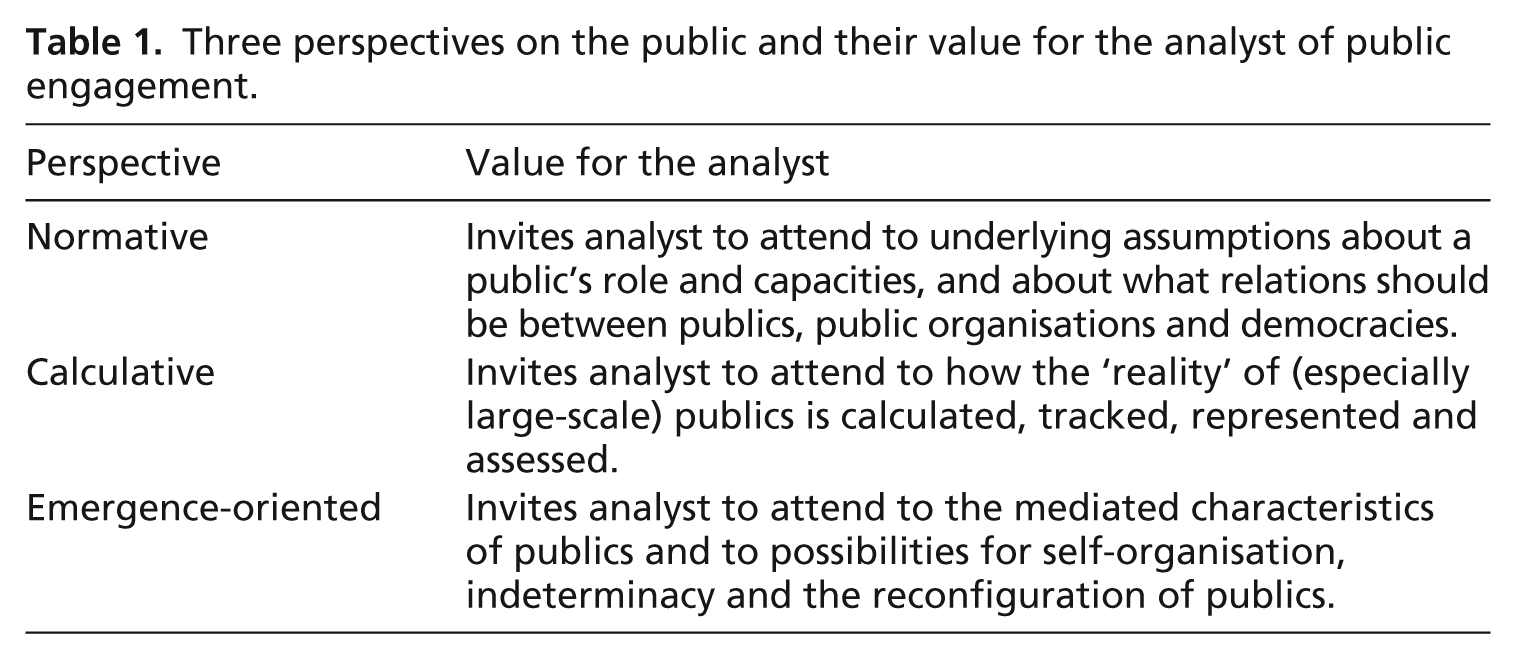
When conducting our empirical analysis, this framework prompted us to ask three key questions about our data. First, what normative versions of the public did the 100 initiatives aim to support? Second, how did the 100 initiatives work to calculate and represent the reality of the public they were set up to convene? Third, how were the 100 initiatives set up to resource collective self-organisation and emergence? After completing these three tranches of analysis, we then compared the material generated in order to identify patterns and ‘family resemblances’. We found that each of the three perspectives provides a lens through which key differences in normative orientations, modes of representation and approaches to emergence can be brought into view. In brief, our analytical framework allows us to trace many different approaches to constituting and supporting the engagement of publics. Our findings therefore begin to map what Barnett (2014) has called ‘the social life’ of the idea of ‘the public’; in this case, as it is being negotiated by those setting up participatory public engagement initiatives across this contemporary field.
Research findings: possibilities, patterns and politics
Normative orientations: constituting and resourcing public roles
We now turn to the results of our analysis using the framework introduced above, beginning with the different normative understandings of public-ness that we discovered among our sample of participatory public engagement initiatives. We found significant variations in the public roles that these initiatives offered people as well as in how they were calibrated in relation to public institutions and more established forms of politics. Distinguishing between three sets of normative orientations helps to map this variation.
The first normative orientation hinges on offering participants the public role of the engaged citizen. Reminiscent of the ideal-typical public sphere participant envisaged by Habermas, this is a figure that is assumed to already be committed to the ideals of liberal democracy and participation in public life; whether this is through contributing to public debates, taking an active role in their community or doing voluntary work. Working in the public role of an engaged citizen often involves being enlisted in projects concerned with opening up established institutions or processes so that these are more able to integrate public participation as part of their day-to-day work and providing information or opinions that can be used to improve efficacy and efficiency. Examples of initiatives in this category include citizen science projects such as Treezilla, 4 which open up the scientific research process by inviting members of the public to help create an online database of all trees in Britain. Here, participants are asked to take on the role of engaged citizen by providing data about trees in their local area, thus resourcing the work of university scientists and at the same time contributing to the creation of public knowledge.
The second normative orientation involves offering people the public role of activist. Initiatives in this category are set up to appeal to people who oppose and/or identify as being marginalised from aspects of the status quo and set out to challenge prevailing public discourses or dominant social groups in some way. Initiatives in this category adopt an explicitly counterpublic orientation (Fraser, 1990), positioning themselves in opposition to established authorities and mainstream political processes. Such initiatives seek to hold powerful actors (such as government and corporations) to account and force alternative perspectives or proposals onto the public agenda – whether through petitioning, campaigning or other forms of civil society action. Examples of initiatives offering the public role of activist include UK Uncut, a direct action network that protests against austerity cuts and works to raise awareness of tax avoidance through sit-ins, occupations and other forms of civil disobedience. 5
There was, finally, a third normative orientation towards creative citizenship and resourcing alternative forms of public action. The public role of creative citizen is offered by initiatives that support public expression through participatory ‘experiences’, events or arts projects. Some of these set out, quite deliberately, to detach themselves from established public institutions and more familiar forms of public organisation – valuing alternative forms of action in their own right because of their potential to pre-figure new forms of social organisation, knowledge generation or experiences of collectivity (Jackson, 2011). An example of initiatives in this category is Complaints Choir, a project conceived by two Finnish artists that invites people to participate in the collective process of writing and performing a song based on participants’ complaints. 6 The primary aim is not to influence public debate or formal political processes through rational discourse, but to create a collective experience involving creative expression, listening and collaboration.
These differences in the public roles offered by the initiatives in our collection are made visible through the lens provided by normative perspectives on the public, which invite the analyst to consider underlying assumptions about a public’s role, capacities and relationship to established institutions. We next turn to calculative perspectives, which focus attention on how publics are represented.
Representing the public
Calculative perspectives on the public, which operate with an understanding of publics as pre-existing empirical entities, encourage us to explore how initiatives propose to make visible manifestations of ‘real’ publics. In this section, therefore, we focus on how the initiatives are set up to represent the publics that they seek to engage. Here, it is useful to distinguish between two broad approaches to public representation that may be placed at different ends of a spectrum.
At one end are initiatives that claim to offer people opportunities to represent themselves in the (mediated) public sphere. Such modes of self-representation can be found among initiatives that in different ways enable people’s ideas or opinions to be counted (Herbst, 1993; Igo, 2008). Examples of this approach include the global activist network Avaaz.org, which uses online petitions to aggregate and make visible their members’ opinions on a wide range of issues. 7 Other initiatives seek to facilitate self-representation by offering to give voice to hitherto marginalised people, perspectives or histories. These include citizen media initiatives such as Global Voices, whose members curate, report on and translate citizen media stories from around the world, thus providing a platform for ‘stories coming from marginalized and misrepresented communities’. There are also initiatives that seek to support public self-representation by encouraging people to assemble or act in public space. Typical of such initiatives are protest camps such as Climate Camp, which invite people to represent themselves by assembling in public space and in this way make publics and public issues visible.
At the other end of the spectrum are initiatives that enact representation in the sense of representing or speaking on behalf of a public. Two very different approaches were discernible within this broad category. One involved the provision of toolkits or methods for aggregating and synthesising ideas or opinions – with the aim of distilling ‘solutions’, ‘recommendations’ or ‘consensus’. Here, representation is understood in procedural terms, as involving the use of techniques that make public participation processes more efficient or enable the identification of ‘better’ solutions (see Barnett and Mahony, 2011). Examples of this approach include Connected Citizen, a ‘collaborative forecasting game’ that utilised an elaborate methodology to gather people’s ideas for how to improve public services and extract solutions from the data collected. 8 Another, and rather more traditional, approach to representation involved the provision of structures for participation in an organised collectivity, such as a membership organisation. Here, people are invited to delegate the task of representing their opinions to a collectivity, which will provide strength in numbers and, it is assumed, represent their members’ interests. Examples include trade union-led initiatives such as Unite Community Membership, a scheme that offers non-working people the opportunity to organise collectively on issues such as benefit cuts, housing and debt by becoming members of the Unite union. 9
These diverse approaches to representation are all brought into view by adopting a calculative perspective, which hinges on an understanding of publics as real, empirical entities that pre-exist any attempt at ‘public engagement’. From this perspective, what is brought to the fore is the way that initiatives seek to make their publics visible. In contrast, emergence-oriented perspectives – which operate with an understanding of publics as mediated and constructed – focus attention on how initiatives might facilitate the emergence of a public (or publics) through the varied ways in which they seek to resource and support processes of public self-organisation.
Offering and managing public self-organisation and emergence
We can identify two main axes that highlight key differences in the ways that initiatives support processes of public self-organisation. The first axis related to the extent to which initiatives seek to manage the process of public participation. While some provide highly structured and managed processes of public participation, others are primarily oriented towards the provision of platforms, tools or action repertoires, with minimal efforts to manage or prescribe how these are used. Examples of the former include Udecide, Newcastle City Council’s participatory budgeting programme, which has clearly defined procedures for participation and provides a high level of support. 10 Each Udecide project follows a structured process that involves inviting community groups to bid for funding, publicising the proposals and organising community events at which members of the public debate and vote on their preferred bids. Examples of the latter include (PARK)ing Day, ‘an annual worldwide event where artists, designers and citizens transform metered parking spots into temporary public parks’. 11 Initiated by a San Francisco–based art studio in 2005, (PARK)ing Day has since become an ‘open-source’ event premised on the provision of a recipe for public action that people around the world are invited to use in an autonomous manner.
The second axis of difference – which overlapped with but did not completely map onto the first – was discernible between initiatives that are oriented towards the achievement of some final outcome and initiatives that are more open-ended. Among the former are initiatives that aim to in some way produce consensus about a given issue or topic, such as Citizens Pact for European Democracy. 12 This was a project launched in December 2012, which aimed to create a bottom–up Citizens’ Manifesto for Europe ahead of the European Parliament elections in May 2014. The project involved organising a series of participatory consultations in different European countries, during which participants elaborated proposals for change; these were then brought together for discussion in transnational forums, and finally translated by researchers with relevant expertise into concrete policy proposals. At the other end of this axis are initiatives where the emphasis is primarily on facilitating discussion, exchange and mutual learning, without the expectation of arriving at consensus or a single solution. Examples include activist gatherings such as the Occupy camps, which are primarily oriented towards the provision of a space where people can gather and talk.
In brief, emergence-oriented perspectives bring into view a range of approaches to supporting the emergence of a public or publics. In contrast to calculative perspectives, which highlight different approaches to representing ‘real’, pre-existing publics, emergence-oriented perspectives enable us to attend to different ways in which publics might be brought into being through processes of engagement, and the varying degrees to which initiatives seek to manage and control such processes.
Discussion
The findings outlined above offer a glimpse of the wide variety of settings in which participatory public engagement initiatives are now being set up and enacted. Drawing on different theoretical perspectives on the public, our tripartite analytical framework has allowed us to highlight some of the diverse versions of the public being constituted, addressed and resourced by such initiatives; bringing into view a range of different normative orientations, forms of public representation and approaches to supporting public emergence. It has been possible to detect patterns in the versions of the public being supported by the initiatives we analysed. The findings reported here can therefore be seen as offering a preliminary conceptual map of the contemporary field of participatory public engagement, which we suggest provides a valuable resource for socio-cultural scholars interested in thinking about or experimenting with public engagement in their own settings.
For example, echoing findings from other recent studies, our map provides new insights into some of the crosscutting and contradictory logics that are always at work in settings of public engagement (Lee, 2014; see also Mahony, 2010). These relate to competing pressures that call on public engagement, on one hand, to be more democratic, empowering, inclusive and creative; and, on the other, to be rationalised, efficient, predictable and aligned with the needs of established actors. By mapping different normative orientations, forms of public representations and approaches to supporting public emergence, our analysis highlights that there is a range of possible approaches to negotiating these tensions. Rather than attempting to highlight a singular ‘best practice’ or theory of publicly engaged and participatory research in the abstract, our aim here has been to illuminate some of the concrete dynamics of this field, and by doing so broaden the horizons of possibility for thinking and practice in this area. The map is therefore offered as a resource that can be used to reflect on trade-offs and choices between different possible approaches and the associated formations of the public that they work to support.
Following Lee (2014), we suggest that the map can be used by researchers to reflect on the specific politicising or depoliticising effects that different approaches to public engagement may have. Our research highlights how public engagement initiatives can be set up to challenge and therefore politicise certain aspects of the status quo, whether by opening up access to new groups, reconfiguring relations of power between organisers and participants, broadening the range of topics that might be addressed or experimenting with new forms of reflexive practice. However, also evident among the initiatives we analysed was a tendency to depoliticise public engagement, by operating with a rather procedural and instrumental conception of the engagement process that leaves certain aspects unchallenged or out of bounds. These politicising and depoliticising dynamics are co-present in different ways in the settings we investigated.
Overall, our analysis suggests that the way publics are constituted by participatory public engagement initiatives can significantly shape the possibilities, horizons and ways of relating that people are offered in such settings. By tracing some of the concrete ways that the futures of public engagement are now being contested (see also Mahony and Clarke, 2013), our preliminary map broadens the range of ideas and practices of the public in relation to which academics may position themselves, opening up possibilities for new conversations about the conduct and politics of publicly engaged and participatory research.
Beyond demonstrating the diversity of perspectives and practices of the public that are at play across the contemporary field of participatory public engagement, our research brings into view distinct frontiers at which scholars may find themselves when conceptualising and negotiating their own engaged research.
Frontiers of participatory public engagement
At the first of these frontiers, researchers need to reflect on their own pre-existing identifications and commitments to the public, how these may contribute to the constitution and resourcing of publics in their own engaged research practice and how these ideas about the public may relate to versions of the public circulating across the wider field.
Adding to the long line of pre-existing literature (e.g. Bourdieu and Wacquant, 1992; May and Perry, 2010) that calls on researchers to engage reflexively with the assumptions that underpin their methodological approach, the map can be used in at least three ways. First, it prompts researchers to consider how their own normative commitments to the public may, or may not, intersect with normative understandings circulating more widely. Here, the map encourages consideration of the public roles and relationships that researchers wish to support, whether this involves offering research participants the role of engaged citizen working with established institutions, supporting the development of a more activist public that challenges the status quo, or resourcing more creative or alternative forms of public expression. Second, the map also invites researchers to attend to the form of public representation they will seek to enact. Will they support forms of public self-representation by enabling people’s opinions or ideas to be aggregated, counted or more publicly voiced or forms of public representation enabled, for example, through the development of toolkits or methods that distil ‘solutions’ to a public problem? Third, this map encourages researchers to reflect on the type of public emergence they aim to support, including the extent to which they wish to manage the interaction among participants; and whether their initiative is oriented towards the achievement of a final outcome (such as a policy proposal) or a more open-ended process (of exchange and mutual learning).
The second frontier that emerges from this research is the frontier of politics, for the map and analytical framework presented here can be used by researchers to consider different possibilities for situating their work within and intervening in this wider field. For example, these resources can help researchers reflect on different possible ways of aligning their work with practices and versions of the public already being cultivated in this field. By highlighting the potential politicising or depoliticising effects of particular engagement designs, the map and analytical framework could also assist scholars wishing to critique or support particular versions of the public already in circulation. A political intervention could, furthermore, entail experimentation with different combinations of the normative roles, forms of public representation or types of public self-organisation outlined here. Finally, these resources can help researchers explore how the design of a new engagement initiative might impact on power relations between researchers and publics, and the micro-political effects that engagement activities may have on the research contexts involved. Our map is a resource that is therefore specifically designed to help cultural studies scholars and others respond to the calls made by Ang (2006), Grossberg (2010) and others for more inventive, politically interventionist and collaborative forms of publicly engaged scholarship that involve knowledge producers from beyond the academy.
Conclusion
Foregrounding some of the contemporary frontiers at which the constitution and enactment of publics may be negotiated reflexively, the aim of this article has been to support efforts to move beyond managerial, overly abstract or discipline-specific understandings of engaged scholarship by inviting socio-cultural researchers to engage actively with the complexity and mutability of ‘the public’ in public engagement today.
By showing that public engagement will always position the researcher in relation to pre-existing or emergent versions of the public – those found in the literature, those circulating in a researcher’s own setting and those being enacted within the wider field of participatory public engagement – this article speaks to perennial debates in the socio-cultural literature about the tensions between the professional and public responsibilities of researchers (Back, 2012; Brewer, 2013; Smith et al., 2011). Rather than resolve such tensions, the analytical approach and preliminary conceptual map presented here can help researchers navigate them and thereby also help address the question of what is, and should be, meant by ‘the public’ in public engagement today.
There are several areas where more work is needed to build on what has been presented here. Alongside the work of further mapping the field of participatory public engagement (especially in settings beyond the Euro-American contexts we have given most attention to here), the most pressing is the need for research that investigates how those enrolled as participants in engagement initiatives negotiate – and thereby reproduce, ignore, resist or elaborate – different possible understandings and ways of enacting the public. Such research is required to explore in more detail how different kinds of engagement initiatives work to distribute responsibility and agency among those involved and the contextually specific effects of these practices. This research will be vital if the wider resonance and efficacy of different approaches to opening up research are to be further assessed. In addition to ever-closer scholarly enquiry, the on-going development of this field may also require that engagement and participation practices are subjected to increasingly public forms of scrutiny. As this happens, new frontiers for participatory and engaged forms of scholarship and practice will continue to emerge.
Footnotes
Funding
The author(s) disclosed receipt of the following financial support for the research, authorship, and/or publication of this article: The authors received financial support for the research discussed in this article from The Open University and from the RCUK-funded Public Engagement with Research Catalyst project (Grant Number EP/J020087/1).