



Abstract
In this article, we will use autoethnographic accounts of our use of the Apple Watch to analyse a new type of ludic labour that has emerged in recent years, in which leisure activities are redefined in terms of work and quantifiable data. Wearable devices like the Apple Watch encourage us to share data about ourselves and our activities, dividing our attention in everyday contexts as ‘quasi-objects’ that need our input to hybridise work and play, offering opportunities to merge leisure and labour, and also the possibility for resistant practices in the interstices between function and failure. We combine perspectives from Science and Technology studies, media studies and play studies, including the ‘quantified self’ and the ‘Internet of Things’, to argue that while the Apple Watch moves us closer to merging with the machine, its inability to provide what it promises offers a way out – a more positive understanding of intimate, wearable computing technology.
Introduction
Dance, train, date, skate. Move, sprinkle, play, ride. Style, sing, cycle, kiss. Travel. Introducing Apple Watch.
The opening quote comes from a series of videos on the Apple Watch webpage that sketch out a vision for the future of wearable technologies. Apple’s short advertisements tell stories of imagined daily life in which the Watch has become an interface to connect and hybridise activities in new, playful ways: a kiss interrupted by a message from a friend, playing the piano while bidding on an auction for a piano, buying an ice cream for one child while holding another and playing with your partner while checking on the babysitter. Performative and informal play (Sutton-Smith, 1997) merge seamlessly with chores, work and other labour, everyday experiences fuse with our digital being – or so the ads entice us to believe. Whether we are mothers, artists, dancers or professional musicians, the Apple Watch (or the Watch), so the advertising campaign tells us, will support – even enhance – our everyday lives by making it possible to switch between work, romance, shopping and socialising, between material and virtual, embodiment and interface, mobile and situated (see Figure 1).

Welcome message from Apple upon syncing the Apple Watch with the iPhone 5.
Historian of technology Carolyn Marvin (1990) recounts how the development of cinema, wireless radio, household electricity and telephony produced both hopeful and dystopian responses, shaping public discourse beyond marketing, advertising and philosophy, especially with regard to what we consider labour and play. The fascination with ‘new’ media forms emerges again with the advent of digital and mobile communications technologies – spanning modern computing and the Internet age through to the development of the mobile phone. Digital technologies have prompted discourses of utopianism. This can be seen from prognoses of the Internet, bereaving us of ourselves while giving us new ways of being through virtuality (Turkle, 1997), changing our brains (Hayles, 2012) or making us less profound thinkers (Carr, 2011). Google Glass, for instance, vied for an omnipresence (Tuters, 2015) that was never delivered because it was soon removed from the market due to negative public perceptions; meanwhile, digital games are debated as a threat for humanity or a means for revolution (Rushkoff, 2013).
This is the field in which we encounter the Apple Watch – a material, digital, mobile, hybrid, wearable device – imbued with all the attraction of something new that allows us to do new things in new ways. Considering its predecessors like the Newton, or the Casio calculator watch, we can see how such imaginaries are predicated on a masculine hyper-functionality that privileges labour over play and spectacle over critique. For instance, an advertisement from the 1980s shows a husband leaving for work while wearing a Casio Watch, as his wife stresses that the Watch means that he will never have to remember anything again (Casio, 1986). In 1993, Apple released the Newton, a still somewhat cumbersome personal device that delivered a specifically personal promise: women, children, men and people from different ethnicities depicted in Apple’s advertising showed that the Newton is ‘digital’, ‘personal’, ‘magic’ and ‘intelligent’. The potential for the quantified self (Gilmore, 2015; Swan, 2013) – in which the self becomes subject to processes of quantification and calculation – lies in these devices and the messages with which they are sold: they are designed to make work and play more efficient.
This article introduces play as a heuristic lens to reveal the moments in which the diversity of wearable technology practices surface, drawing attention to how we, as users and researchers, gather and present data to others and ourselves, as well as the operation of that data in everyday contexts. These practices are situated and embodied, blurring, disrupting and reinterpreting the boundaries between work and play. Play, as we understand it, can be defined as a set of cultural engagements with a plethora of activities that give users pleasure and stimulate creative thinking (Starbuck and Webster, 1991). In terms of wearable interfaces like the Apple Watch, using play as a heuristic lens for analysis also offers ways to challenge, situate and reconsider the emergence of the quantified self via playful activities such as competition, performance, dating, gamification, and also cheating, hacking, failure and accident. These activities can, in turn, challenge the narrative of the Watch as a functional labour-saving device.
In this article, we consider the propagation of mobile wearable devices for self-monitoring and self-sensing in this light. Wearable sensing technologies, at first glance, seem to be a simple step towards personal-data positivity, inviting users to acquire ambient data and other forms of measurable knowledge about their performance, bodies and well-being. Self-data collection, marketed by wearable technologies, merges the discourses surrounding the ‘quantified self’ (Swan, 2013) and the emerging field of ‘critical data studies’ (Dalton and Thatcher, 2014), in which the social, ethical and philosophical ‘neutrality’ of data, especially big data, is called into question (Kitchin and Lauriault, 2014).
On the intimate end of data networks, we find wearable technologies, collecting and collating personal data while restructuring our everyday practices of work and labour. Wearable technologies invite big data into an increasingly close physical encounter; the Apple Watch rests against our skin, monitoring our heartbeats, tracing our fingertips, counting our footsteps and tracking our location. Big data becomes personalised, and the personal becomes big data – auguring new anxieties of control (Leszczynski, 2015) over how, where and by whom these data are gathered and managed.
Yet, play and work crucially situate the role played by wearable technologies in the data cycle (boyd and Crawford, 2012) between the quantified self and big data. The wearability of the Apple Watch means that as much as it is a data-based epistemological intervention (Kitchin and Lauriault, 2014), the Watch is also experienced on a hybrid plane between digitality and materiality that is (or has the potential to be) profoundly playful. Emerging practices surrounding personal-data gathering and wearable technologies are not homogenous. Certainly, users can be reduced to data, quantified into a mass of numbers, gamified to the point of inertia; but they can also, as we argue, reflect upon, appropriate and moderate their data as it emerges, particularly through play (Lupton, 2014; Nafus and Sherman, 2014; Ruckenstein, 2014).
The ‘ludification of culture’ (Raessens, 2006, 2014) is intricately bound up with digital media, which allow us to share and manage our activities in playful and ambient ways. Playfulness has become an important aspect of many ‘serious’ daily activities that were once considered time consuming, competitive and laborious. In an age of digital media, play has become the steam engine (cf. Dibbell, 2006: 297) of contemporary life (Deterding, 2015), and this phenomenon has altered the socio-cultural fabric of our everyday experience – with mixed effects. On one hand, mobile technologies can provide the opportunity for freer forms of play in physical space and offer generally positive experiences for users (e.g. De Souza e Silva and Sutko, 2008). On the other hand, the negative impact of the gamification of everyday life (also described as ‘ludefaction’ by Kirkpatrick (2015)) stifles the creation of alternative possibilities by merging logics of work and play together. It is no longer clear where play begins and work ends.
Autoethnographic methodology
Our autoethnographic approach serves as a method to provide data for analysis. This is presented in the form of self-reflexive vignettes that describe our experiences using the Watch in order to ‘critically investigate the discourses that have constituted that experience’ (Saukko, 2003: 85), while presenting a form of creative research practice. This mode of practice addresses the challenges posed by wearable technologies and data accumulation through reshaping narratives about wearable computing and emphasising the range of lived and embodied experiences offered by emerging technologies. A ‘co/autoethnography’ (Taylor and Coia, 2009) supports not only multiple positionalities but also multiple intimacies and, vitally, a variety of critical frames and critical selves, understood through the complex object that is the Apple Watch.
As a wearable device intended for a single user, the Apple Watch is a source of everyday experiences. It is a hybrid device that operates as map, toy, game, tool and fashion accessory. It mediates everyday life from personal style to health and wellbeing (Lupton, 2014), from sleep management to interpersonal communication. It hybridises not only the ‘real’ and the ‘virtual’ but also elements of everyday experience that might previously have appeared quite separate (work and leisure are two primary examples). As an interface, the Apple Watch not only connects us to others but it also requires us to interact with it (through touch, heartbeat, movement and voice) in order to gather and generate data to be in touch with the world. Such a personal relationship between the individual, their body and their device structures is an encounter that is unique to each user. It is shaped by situated elements like place and location (Wilken, 2014), as well as touch, tactility and other sensed interactions between user and technology (Cranny-Francis, 2007). As our personal accounts show, wearable devices that rely on skin contact, haptics and close physical proximity shape a particular narrative and generate a particular experience that is informed by prior technologies, and also provide novel modes of encounter or resistance.
As such, autoethnography allows for a self-reflexive and creative response to lived experience. However, according to Saukko (2002), in offering alternative positionalities, it should also resist or shape the discourses that govern our lives. Autoethnography complements analyses of wearable or otherwise intimate technologies because these devices are intrinsically linked to identity and everyday life (Frissen et al., 2015). Our lived encounters can provide insight into the impact of the Apple Watch (and related technologies) by highlighting the specific moments in which dynamics of play or labour break down, where notions of the quantified self are reinforced or can be troubled through ludic performances that take shape via the watch as a wearable, haptic and dermal interface.
Both play and autoethnography offer productive lenses that allow us to see our small interfaces differently and to move away from an understanding of the quantified self as a phenomenon that makes users into ‘body-machines’ that produce big data (Lupton, 2013). The critique offered here moves towards a more reflexive encounter with the possibilities that wearable technologies can offer, which – to hark back to Haraway’s (1991) ground-breaking manifesto – can make us more critical Cyborgs.
In the following section, the three authors expose the ‘lived realities’ behind the newness of the technology through re-enactments of their labouring, working and playing with the Apple Watch.
You, love, technology and games: An autoethnography from labour to play
The watches have arrived! After weeks of anticipation, the parcel has been delivered, and Clancy and I are sitting at our desks, using scissors and hands to unbox the devices. The packaging is rather large for such small items, but after removing it from the bigger cardboard box it arrived in, we come to a white rectangular box which contains yet another plastic box. In it rests ‘the’ watch, complete with two straps and a charger. (Sybille)
Play starts as you unbox, opening the packaging and the watches, wrapping them around your wrist, pairing them with your phone – pushing buttons randomly and laughing in surprise at the tiny icons on the display. Some of these icons are familiar – like the iTunes and email logos – a cognitive link between one media and another. Other icons are less recognisable: an orange circle icon with a mini alarm clock in the centre or three mysterious circles that represent ‘activity’. Play may be hidden in mystery, as much as in surprise:
A clock in a watch? I swipe left and see my appointments in the calendar, moving forward day by day with each movement. Then, swiping from top to bottom, I see the latest email messages, BBC News, updates, and other stuff that has been fed to the Watch via my phone. Then, when I touch the device differently, it shows my heart rate: 69 BPM. Is that high or low? Better to Google that on my computer … And then I push the other button on the side … ‘Look at this Clancy, I can add you as a user and draw pictures to send to you!’ (Sybille)
The screen interface affords a mode of haptic drawing using colourful squiggles. Pressing on the screen, Sybille tries to write a small text to Clancy using her finger as a pen, but the new technology proves more difficult than expected, as Sybille’s fingers are relatively large for such a small interface. After several attempts, she manages to send Clancy a drawing of a heart, and Clancy draws some flowers to send back. The images appear on the screen and then fade away quickly, highlighting the immediacy and ephemerality of the authors’ contact (see Figure 2):
I see a camera icon and tap on it. To my surprise I can see my own wrist with the Watch on it. My mind goes haywire: this is stranger than fiction. How can the Watch see itself? Calmly, Clancy points to my phone, sticking out of my bag with the camera pointed in the direction of my wrist. It turns out that the Watch is transmitting the image back to the phone. Ha! We laugh. It’s all so new, but also so silly. (Sybille)
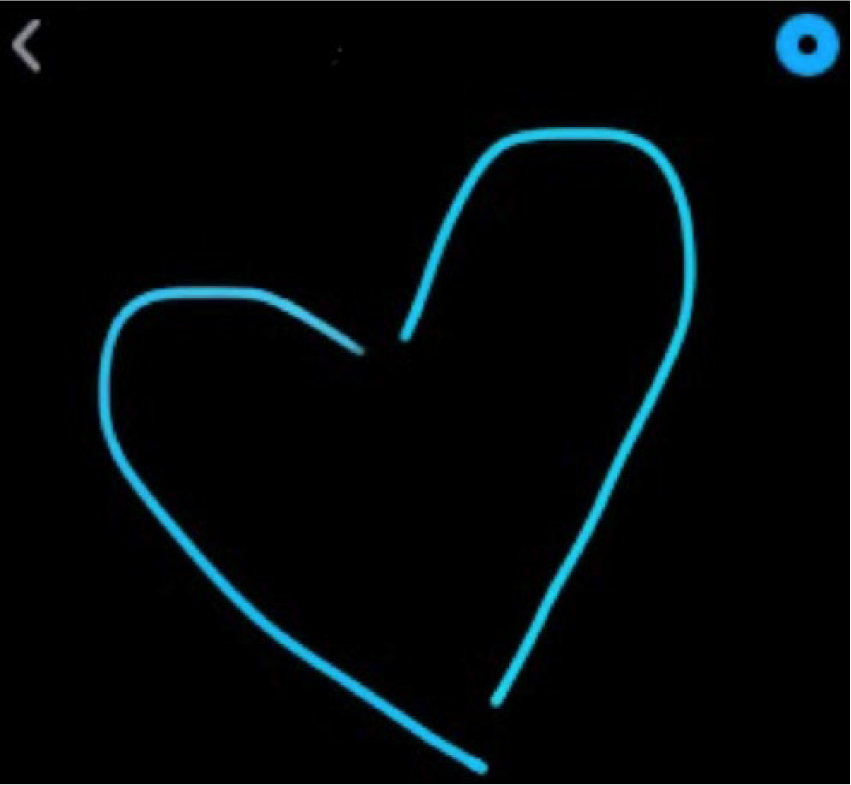
This is fun! Sybille’s finger drawing of a heart, screenshot from Clancy’s Apple Watch as it disappears.
Suddenly, it seems that there this thing on your wrist that mediates, transmits and measures what you do, what others do, and makes it possible to share all this data. The Watch changes how you think (or do not think), accelerating connectivity between self and watch as a bodily technique (Parisi, 2012), like game interfaces that move with us and create new bodily habits. In the early moments of use, you do not know precisely how it will work as a reciprocal interface intimately acquainted with your body – what it will do to you, and what to do with it. It makes you feel conspicuous, a performative and wearable interface that signals to others from your wrist, just as it feeds back into your bodily, habitual activities:
The Watch is a public statement that triggers reactions like, ‘hey you’ve got an Apple Watch, so cool, can I try it?’ or ‘why are you wearing that thing?’ – to which I duly reply that it is for research reasons only, that it’s for work. After a while, Clancy takes hers off, but I wear it to the airport later that day. I feel a buzz at my wrist, stating that I have completed my exercise by walking to the gate. I am surprised. I had never thought of that in terms of exercise before, but will from now on. An itinerary from A to B has become ‘sports’. (Sybille)
The excitement and confusion the Apple Watch brought us upon arrival – so often a YouTube-celebrated moment of unpacking – are the result of the newness and unfamiliarity of the technology. Such novelty brings with it a level of imagination and play, the thrill of an apparently distinct experience. However, it also brings disappointment as, of course, it partly remediates previous computer technologies that have been domesticated and become mundane (Burgess, 2012: 30–31), building on what came before through our prior engagements with earlier technologies. The perception that the Watch can do more than it actually can (and is more open and customisable than its predecessors) was observable as Sybille tried to figure out the camera function. Playing with technologies – the act of randomly pushing buttons and drawing pictures – creates friction when those pictures do not turn out as we imagined (due, in part, to a small interface).
What happens at the moment of our first encounter with a new interface is in essence very similar to what seems to be a recurring pattern when any new technologies emerge, when we are promised (by clever campaigns and media attention) that such technologies will change our lives profoundly. The Watch is, as Apple modestly claims on its webpage ‘the watch reimagined’ – it will become as ‘individual as you are’ and ‘[t]o wear it is to love it’. Apple thus gives us the impression that the Watch will give buyers a tailored experience that hybridises you, ‘love’ and a new technology. When we unpack the box, we are expecting something very special, housed in a tiny watch: a new experience, a new interface, a new bodily relationship between self and machine. Yet, as Haraway (1991) warned, ‘[i]t is not clear who makes and who is made in the relation between human and machine. It is not clear what is mind and what is body in machines that resolve into coding practices’ (p. 189):
The Apple Watch wants to transform me into a string of numbers – recording inputs, beats, degrees and latitude. A data set – driven by code – it wants my mind and body to move one step closer to becoming one with the machine. The experience is akin to a cyborgian dream: ‘Me. The Watch. Together at last’. (Emma)
This, at least, is the early promise of the device, the latest iteration of personal computing rhetoric – that this machine will make you a better person, augment your self-control, count up your words/hours/minutes/tracks/bytes/kilometres/calories. It is reminiscent of personal organisers from the 1980s, whose two-tone screens demanded input, records for safekeeping, data to justify their presence in the world. As Haraway also warned us, in knowing the machine, we are no longer fundamentally ontologically separate from it:
Even in my scepticism, the Watch succeeds in defining me – its key goal, to keep me thinking of my being through it, works (at least initially) because of the subtle insistence of its constant demands, vibrating lightly at my wrist, suggesting a delicate human touch. A shiver. An urgent stroke. Am I standing as often as I should? Have I taken enough steps today? Why doesn’t it ask how much I’m eating? When will the Watch (which feels like a mess of plastic, silicone, and aluminium, full of mystery algorithms and acrobatic loops of colour) recognise my achievements with a message of approval, marking – quantifying – my movement as a measure of my self worth? No longer my own muscles, my own flesh – my sore feet or racing pulse are the property of Apple Inc. (Emma)
As Emma observes, the device’s haptic buzz upon her skin, and little *bink bink* notifications, makes her think of her first Tamagotchi – a ludic interface (Fuchs et al., 2013) that transformed into a labour of half-attention demanding repetitive, apparently nurturing inputs, and which became less and less playful and more like a chore over time. For her, the Watch appears to share a media ancestry with (among other things), the virtual pet phenomenon:
I used to have a Pikachu Virtual Pet, which the Watch resembles to such an extent that in my mind they appear genealogically related – mobile-screen cousins. A more sophisticated iteration of the Tamagotchi, the Pikachu slept onscreen as I slept in my bed; got cranky and threatening when I ignored it, and ran away for days at a time, leaving behind an empty pixel landscape. Like the Watch, it demanded constant tactility – one of the first consumer devices to monitor physical movement (and marketed as an exercise toy) the in-game currency, in ‘watts’, was generated by footsteps. As the Watch now counts my steps, I wonder about the lost data on my (long discarded) Pikachu toy – how many of my steps were counted up by the pedometer over those years? What to make of the labour I put in just to feed the watts into the slot machine mini-game? Even my muscle memory links the two devices – because the pedometer was badly designed, and the steps undervalued, a more efficient method of amassing watts on the Pikachu required holding it in my hand and using repetitive movements to activate the internal pendulum. I spent hours shaking it in an action that now I find myself auto-replicating with the Watch (the urge to aggressively tilt the face to magically display the time happens almost without me noticing it). (Emma)
The Watch, sold as a tool (or toy) to ‘track’, ‘control’, ‘pay’ and so on (as Apple’s short films tell us), is really just another repetitive mindless task ‘in ultramodern getup’ (Benjamin, 1999: 116), extracting a surplus labour of leisure with every touch or tap, in an ‘instant’ that mimics the reduction of labour to gestures and digits in time (Benjamin, 2003) for little real gain:
I won a badge. Not a plastic or metal one that I can pin on my shirt, but a brightly-coloured one that glows on my Apple watch, and can now be found safely stored in a digital vault between my arm and my phone (where I can return and see what I own). Achievements, my watch and my phone tells me in the health settings, are things that I have earned ambiently through doing and moving, speeding up and slowing down my steps, raising and lowering my heart rate. (Clancy, p. 331)
After a time, when you complete the tasks set by the health app, or when you have moved sufficiently to warrant special recognition, you may reach a state of achievement, a euphoric reward for your effort and attention in playing throughout the day. This achievement is measured in numbers, little strings of data algorithmically restructured to resemble information (boyd and Crawford, 2012). This strange kind of play has arisen in the scramble to transform Boy Scout badges into Apple Watch badges (Deterding, 2015), to gamify motivation and make it contingent upon intangible rewards. Work becomes playful labour – and then playful labour suddenly requires no work at all:
The best thing about my badge is that I did nothing to earn it. This is a special kind of achievement without achievement, less an achievement than an accident. The badge came as a surprise. Sitting down on a chair, waiting patiently for a rendezvous, I felt the ever-more familiar *bink bink* of something happening. Heartbeats and strange tracings from Sybille, appearing and dissolving, something to ponder, to occupy my time, to return in kind. But I look down and it is not the familiar blue of Sybille’s hand, or the warbled messages from Emma’s Siri (who refuses to understand her), but a bright, orange badge, edged with solid silver tracings marking out the number ‘200’. ‘Congratulations!’, it says, ‘You have reached 200% of your daily move goal’. A rush of emotion hits me as I realise I’ve won something. In the back of my mind, pushed farther and farther away as I regard my new acquisition, I know that this reward is a curious oddity to receive after sitting still for 15 minutes. But this moment of sensibility is pushed away under an irrational rationalisation: without knowing it, I played the system and it caved in; it broke and I won a badge. (Clancy, see Figure 3)

Clancy’s badge.
Some, like Witkowski (2013) in her autoethnography of the location-based running game Zombie Run (ZR), enjoy the challenge set by these apps to go a distance, at some speed, and see it playfully resurrected on the screen in ‘real life’, as Zombies march the streets, and the gender relations of embodied material landscapes are inverted. Yet, secretly, Clancy enjoys the other kind of achievement – where the numbers are restructured by mystical forces and not by sweat and strain driven by a competitive edge:
The taste of victory is flavoured by beating the system, by renegotiating the relationship between me and my watch beyond the Heideggerian question of technology being a human activity (Heidegger, 1977) – the Watch becomes its own activity that gives me badges whether I have worked for them or not. Not me and my watch, not humans and technology, but hybrid networks drawn by systems of relations, interfaces that can afford all manner of playful retaliations. (Clancy)
It is true, as Haraway warned, that we are no longer ontologically separate from the machine – Clancy takes her badge as a representation of her own subjectivity. Yet, the information that the machine gives us about ourselves, and the subjective tours and detours it constructs with its data collections, aggregations and visualisations, tell us more about how technology has always been a part of us and how we may engage with it, rather than the knowledge it obscures. It is both funny and fun when it fails. Playful affordances are embedded in the potential of the device itself. The surveillance networks, drawn over our bodies, are flipped for the briefest moment, when the technologies that uphold them offer a humorous glimpse at their data spectacles and gamified webs.
Whatever the dystopian and utopian imaginings are for wearable technologies, in our excitement we seem to forget that technologies do not just make us do things – we also have agency and can make them work for us in specific ways. They respond to our individual bodies and material practices: our touch and our voice. The Watch does far more than just tell the time, it is a ‘quasi-object’ (Serres, 2007), only coming into being when picked up and switched on, and when becoming a hybrid between user(s) and other things. As soon as worn, switched on and touched, it starts processing information from an assemblage of technologies, space-times and bodies. Just as Michel Serres describes a ball as a quasi-object, which serves no purpose without interaction, the Watch is ‘not an ordinary object, for it is what it is only if a subject holds it. Over there […] it is nothing; it is stupid; it has no meaning, no function and no value’ (Serres, 2007: 252). In the box, or left to charge at night, the Watch is nothing, it only becomes something when we wrap it around our wrists.
Wearable interfaces invite us to engage, to mix work with play. In doing so, the interactive transformability of digital user interfaces (whose affordances invite users to play with them) ‘absorb’ our actions into the interface. When a runner, for example, interacts with an app on her phone-screen, this has an effect on how this app looks and how it displays data to her and others (Witkowski, 2013). This is a reciprocal relationship – where the thing becomes us and we become the thing – in ever-expanding facets of our lives. Thus, the digital has also brought play into the distributed and networked space-times of the interface (Cermak-Sassenrath, 2015; Fuchs, 2007)
Where is my watch, where is my attention? From play to labour
The new generation of tiny wearables has arrived, resized for our wrists. For now – as the newest thing – they fascinate and entice us. We can wonder if they will take over our lives or make our daily routines easier. Or we can also ask if they will just make us work even harder, encouraging us to multi-task at an even higher speed (Till, 2014). These devices will continue to prompt such questions, at least until they are no longer conceived as ‘new’, and have become a normalised parts of our daily life, black-boxed (Latour, 1999) and embedded in less exciting domestic practices (cf. Burgess, 2012).
Yet what remains is a push for an increasingly intimate and hybridised connection between work, home and leisure. As Sybille recently experienced during a holiday in France, the Watch constantly alerted her to updates of a book she was co-editing for work, prompting her to send e-mails instead of admiring the views. It only stopped when she went off the grid, too deep into the mountains to be connected, forcing her to disengage from work through its failure. In this sense, the Watch, when working, is ‘just the latest in a range of always-on devices offering ample opportunity for work to follow us out of the office’ (Gregg, 2011: 18). Play, indeed, has become less important once the newness has succumbed and the device has become another ‘normalised’ actant in an assemblage in which data and bodies constantly and intimately produce each other.
When the excitement of unpacking the device ceases and discourses of novelty transform into the mundane (or even boring), the ways in which the Watch as quasi-object infiltrates our daily lives become more obvious. Our everyday practices generate stories (to echo Serres). Nothing so grand as the dystopian and utopian visions of mechanised labour forces, or even so ambitious as the eternal memory of the quantified self (Hoskins, 2013), these stories come partly into being through a lack – or devaluation – of play (utility, futility, boredom and irritation) in which the everywhere becomes the everyware (Gilmore, 2015).
Our earlier autoethnographic accounts described playful interlocutions with the Apple Watch, demonstrating how hybrid relations between labour and play can emerge through haptic wearable interfaces. However, as we have argued, these relations can and do shift over space and time – particularly in the distance from the excitement of play to the banality of daily life (Burgess, 2012). Here, beyond the fetish of the new, the realm of ludification creeps upon us as ludefaction (Kirkpatrick, 2015), in which labour processes infiltrate the everyday. Ludefaction denies the possibility of play by shaping technological potential away from a mode of emergent creativity and critical affordances towards routinised data collection, whereupon our agency begins to be dissolved (Ash, 2015).
The following section considers what happens when a wearable technology becomes mundane and reveals itself partly as an echo and accumulation of technologies we already know (Burgess, 2012), triggering a continual labour-intensive rendition of the desire to quantify ourselves. On the other side of play, when a new object becomes familiar, we can find that, much as wearable technologies afford playful interaction, they also generate work – as space and time are segmented into minute tasks (Ash, 2015), designed to keep our data moving and the machine running (Whitson, 2013).
The Watch engenders a haptic labour of learning and precision, recombined with the embodiment of wearing, touching and feeling the interface. Richardson (2012) argues that technologies mediate and shape our understanding of space through the centrality of embodiment. Using the iPhone as an example, she argues that to locate ourselves is to tour and map through mobile media to ‘corporeally realize’ a space of networked interaction – in what Graeme Kirkpatrick describes as ‘matter-form’, and Richardson has termed ‘intercorporealization’ (both terms also resonate with Serre’s understanding of a quasi-object). The tactility of the iPhone, Richardson argues further, is complicit in the ludification of experience – generating ‘a-space-of-one’s-own’ (Richardson, 2012: 139) through touch and the hapticity of the screen, embedded in hybrid experience between virtual and physical planes (cf. De Souza e Silva and Sutko, 2008). Through its hybridity, the experience of the Watch counters Huizinga’s concept of the magic circle (cf. Huizinga, 1938), in that attentiveness towards the device is ‘sticky’, messy rather than encompassing and clearly delineated.
The embodied location of oneself in space, through a device (Richardson’s intercorporealisation) takes on a particular, and slightly different, tactile matter form with wearable interfaces like the Apple Watch. The Watch is therefore more than recombinations and remediations (cf. Bolter and Grusin, 2000) of older interface technologies, it also introduces new affordances that go beyond how the haptic has previously been theorised, namely in terms of hand–eye relations and as part of an occular-centric regime (cf. Verhoeff, 2012). As touchscreens become re-iterative through skin contact, they become more compact – the author’s devices are the ‘women’s’ design, produced to fit smaller, ‘feminine wrists’. Through touch, the Watch now affords all manner of vibrations, pulsations and rhythms which combine with sounds, alerts, alarms, that increasingly familiar *bink bink*, and the Siri voice software adapted from the iPhone.
Where smartphones may locate us within complex networks through intercorporealisation, the Watch also shapes the way we locate within ourselves: from eye to finger, from heart to skin, from ears to arm. Through intercorporealisation – self, device, space, tactility – we can see how Sybille experienced disorientation when the camera from the phone meant that she could view herself from a third perspective; Emma describes the Proustian familiarity of repeatedly shaking a digital device and Clancy, the pleasure of receiving a reward based on an embodiment that did not actually take place. This partial data flow produces a ‘digital double’ (Ruckenstein, 2014), which in the experience of Clancy is not only distanced from the total self but also contains false data, constructed by labour or action that the represented subject did not actually complete. The data double, here, is encountered playfully, and the fun can be found in the deviation between the data depicted and the actuality of the labour undertaken (or lack thereof).
Embedded in the haptic interface are distractions that, while once affording fun through labour, can also funnel leisure back into work, the stickiness of the interface attracting constant attention and playful interaction. However, even playfulness can become laborious once this stickiness becomes frustrating and distracting. Clancy has fingers too wide to properly use the screen – constantly inputting the wrong passcode into the tiny touch interface. Heartbeats and disappearing finger strokes are all well in play, but tapping on tiny buttons can also be a tedious and aggravating task that seems interminable in failure and is forgotten when finally accomplished. Emma finds the repetition of input and the constant vibration on the wrist to be a labour of attention, the demand for interaction ceases to feel like play (as the colourful candy-like widgets might suggest it should be), and increasingly comes to resemble work. Play and work are closely linked: both in repetition and tactility, and in the transience of a touch that lasts only as long as it is embodied.
The Watch is a hybrid object that does everything and nothing, hyper-connected to the multitude of forces that is the Internet of Things (Swan, 2012), highly suggestive of ludic interactions, but ultimately – in the cyclical ‘drudgery of labour’ it demands (Benjamin, 2003) – it ‘has no connection with the preceding gesture’ (p. 330). In industrial factory work, ‘the process of continually starting all over again exemplifies the regulative idea of gambling’ (Benjamin, 2003: 331). The stickiness of the watch, demanding attention through its haptic interface and intercorporealisation, turns the user into the isolated ‘worker at his machine’. This worker mechanically inputs by reflexive action, but never sees the final output, the traces that appear on someone else’s wrist, the mechanics that lie invisibly within the interface or data that disappears to someone else’s server. Less players, or even workers, and more like the mindless gamblers ‘who live their lives as automatons … who have completely liquidated their memories’ (Benjamin, 2003: 330–331), play can be transformed into labour as we tap, swipe, move and stroke. Benjamin and Adorno both talk of the labour of play (Fuchs, 2014), except that here, between the watch and the user, labour and the machine are not just producing but also liquidating recollections that do not belong to the canon of digital memory (Frith and Kalin, 2015), embodied actions that leave no after image (Jameson, 1992: 76) – just the emptiness of repetitive labour.
At the same time, play has not completely disappeared in the expansion of labour to the everyday. As the screen becomes smaller, embodiment extends in new ways, particularly compared to the smartphone. For example, the Watch affords play beyond hapticity in its curious rejection of touch and the emphasis on voice-activated commands. Introduced after the Watch’s release to counteract the impracticality of the tiny screen, Siri has become a key feature in writing messages and taking notes using the Watch. The timbre of a voice box is now registered on the wrist, where the Watch becomes an intimate limpet, touching the skin, with sonic pitches and quavering sounds transformed into tiny digital text that vibrates on another wrist and trills to announce its arrival. Just as there is something playful about touching the Watch, and it touching back (Parisi, 2012), there is a playful aspect in talking to the Watch, as a non-haptic gesture, and the Watch responding, as this experience between two authors attests:
I’m waiting outside for Clancy, who seems to be running late. Raising my wrist, I enter a few taps, then utter a short message into the Watch to send as text: ‘I am here’. Nothing happens. Trying again, this time more loudly, ‘I am here’. Again, nothing seems to happen, everything vanishes from the screen. It would have been better to just use my phone at this point, but I want fulfilment from this distracting hitchhiker catching a free ride on my wrist. Frustrated – both by the Watch and the delay – I say: ‘ Clancy sucks’ (Emma) Inside the building, my phone vibrates. Once, twice, thrice. On silent, it rumbles the desk, falling still as I pick it up – a biomechanical platform (Cranny-Francis, 2007) that is calmed by touch interaction. Three rumbles, one swipe and I have received the warped cryptograms sent by Emma: ‘I am he. I am he. Siri rules’. (see Figure 4) Emma is here, but her data double says otherwise (Ruckenstein, 2014) – at some point embodiment itself has become playful and laborious, surprising and frustrating, all at once. (Clancy)
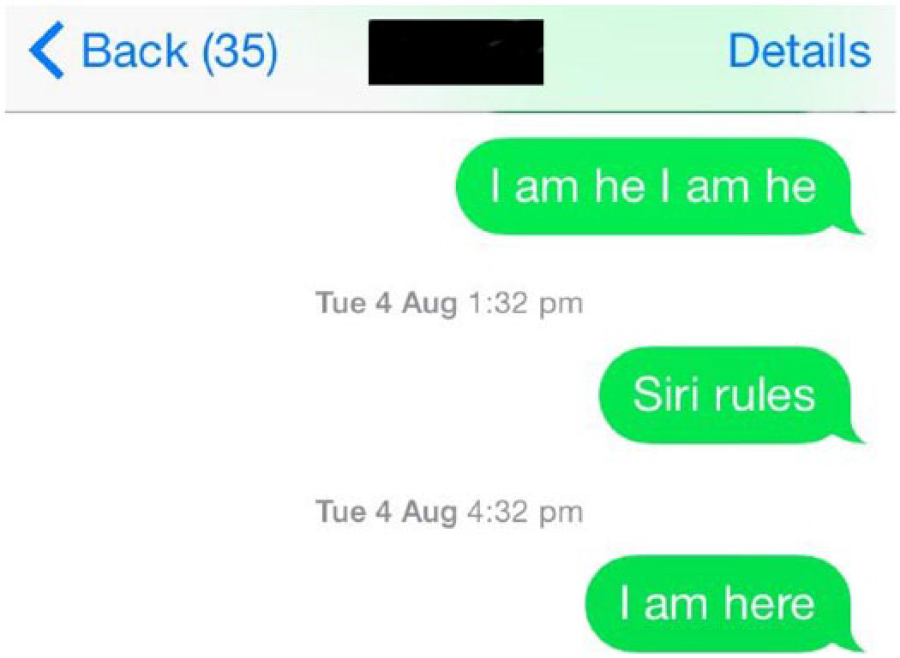
‘I am he I am he. Siri rules’ message sent from Emma to Clancy, as seen on Clancy’s phone – with the correct message arriving 3 hours later.
Conclusion
In a way, Apple gave us what was promised: the ability to merge different activities to a greater extent and in novel ways. However, to return to Serres’ notion of the quasi-object, we sometimes regretted having picked it up and put it on – as the interrelationality between ourselves and the Watch demanded constant attentiveness to justify the existence of the Watch in the first place. Clancy sometimes wears the Watch when she is travelling to and fro, Emma took it off once and for all (reducing it to nothing again) and Sybille wears it all the time, managing its interruptions and playing with its possibilities. In that sense, Burgess’ (2012) analysis of the iPhone, and how such technologies become quickly mundane and ingrained in everyday life, still holds for the Apple Watch: as the autoethnographies show, the watch quickly became domesticated, part of our particular daily routines – it is not so much a question of what a wearable technology can do but whether we want it to do the things that it does.
Even if the Watch does not provide all that it promises (and, in fact, frequently fails or becomes a burden defined by drudgery and boredom), this may be more of a failure of the marketing than the machine. Although it may not accurately convey a message or provide reliable data, its hybrid form suggests possibilities beyond the limited quantification of daily life. When the Apple Watch fails, the play in the assemblage of technologies, bodies and other materialities comes to the fore, and the possibilities for resistance within such networks of control (Galloway, 2010) are revealed – in our experience, the failures became opportunities to make personal interventions, to find fun within labour, to achieve victory without work and to reflect critically on wearable technologies themselves.
Wearable technologies such as the Apple Watch invite us to merge work and activities of leisure with an even greater enthusiasm and scope than our mobiles, tablets and computers combined. Increasingly, such devices extend beyond the haptic and the occular-centric qualities of older devices, enabling us to locate ourselves through intimate engagements with wearable interfaces. As we tap the Watch, it taps back, hybridising our hands-free vocal commands, our heartbeats, our steps, our Global Positioning System (GPS) coordinates and our temporalities; our digital, virtual and material experiences. Furthermore, wearables (whether the Apple Watch, Fitbit, Jawbone or other personally attached devices) override distinctions between leisure and work, as well as distinctions between different kinds of leisure (e.g. play, relaxation, hobbies and sensory stimulation (Stebbins, 1992, 1997)), enabling us to combine a range of activities in ever-changing ways, facilitated by the correspondence between device, self and world.
As our autoethnographies have shown, the relation between the user and the Apple Watch continuously shifts the distinctions between play and labour, and our stories demonstrate that the understanding of these technologies is increasingly ambiguous. Exercise, for instance, can be interpreted as deconstructing traditional boundaries of gender, space and embodiment (Witkowski, 2013), or as a ludefaction (Kirkpatrick, 2015) permeating everyday life, turning exercise into labour (Till, 2014). In this way, play can maintain a role in the hybridisation of work and leisure, but can also disappear, as the novelty wanes. That is not to say that play is merely a subset of novelty, but rather that the affordances that uphold play – creativity, surprise, accident, experimentation, possibility – can also be increasingly undermined by overemphasising the Watch’s role in regulating and quantifying our everyday lives, making us work for it rather than making it work for us.
Footnotes
Funding
The author(s) disclosed receipt of the following financial support for the research, authorship, and/or publication of this article: The research leading to these results has received funding from the European Research Council under the European Community’s Seventh Framework Programme (FP7/2007-2013) / ERC Grant agreement n° 283464.