




Abstract
‘Successful ageing’ has been a controversial concept in cultural gerontology, prompting critiques of its inherent individualism, neglect of structural inequalities and promotion of neoliberal strategies of self-care. This article aims at developing the critique of its heteronormative underpinnings. Drawing on cultural gerontology, feminist theory and queer theory, a critique of the rhetoric and visual representation of ‘successful ageing’ is developed that demonstrates the extent to which ‘success’ is equated with enactments of normative, gendered heterosexuality. The intent is not to simply map the exclusion or marginalization of queer representations but to make visible the ways in which assumptions of heterosexuality organize the visual field of ‘successful ageing’. Using examples from ‘lifestyle’ magazines and health promotion materials aimed at mid-to-later life adults, I demonstrate how the promise of ‘heterohappiness’ shapes visions of anticipatory ageing. This article forms part of ‘Media and the Ageing Body’ Special Issue.
Keywords
Introduction
One of the most striking developments in contemporary Western media cultures must certainly be the proliferation of images of happy, active, healthy and vibrant older adults. Once relatively invisible or prone to depiction in demeaning and stigmatizing ways that underscored age-related decline, representations of older people in the imagery of the ‘new’ ageing reflect a broader cultural emphasis on ‘successful’ ageing. Silke Van Dyk (2014) has termed the corollary in the field of ageing studies ‘Happy Gerontology’, which promotes ‘positive views on old age by neglecting frailty, dementia, and hardship while stressing continuities between midlife and independent/active later life’ (Van Dyk, 2014: 93)
The concept of ‘successful ageing’ (along with kindred terms like ‘positive ageing’, ‘active ageing’ and ‘healthy ageing’) has ‘animated a controversial space’ in cultural gerontology (Katz and Calasanti, 2015: 6). In the critical literature that has developed around this concept, particular concern has been raised around its commodification, consonance with neoliberal modes of governance, overemphasis on the individual and individual action as the basis of success, neglect of structural inequalities and dividing practices that produce some bodies as unsuccessfully aged (Bülow and Söderqvist, 2014; Cardona, 2008; Katz, 2001/2002, 2013; Martinson and Berridge, 2015; Ranzijn, 2010; Rubinstein and de Medeiros, 2015; Timonen, 2016; Van Dyk, 2014). Of particular relevance to this article is work which has drawn attention to the extent to which the continuing performance of heterosexuality has been promoted as an indicator of success in ageing (Katz and Marshall, 2003).
Critiques of the heteronormative focus of the discourse of successful ageing are only beginning to emerge (Fabbre, 2015; Port, 2012; Sandberg, 2008, 2015). These interventions are particularly important in challenging gerontology’s dominant and heteronormative measures of ‘success’ and in queering notions of the life course and temporality. Sandberg (2015) suggests that it is not enough to queer age studies by focusing on LGBTQ elders, arguing that we must ‘explore the production and maintenance of normativity on relationships, embodiment, intimacy and what constitutes the good (later) life’ (p. 19). It is to the latter project that this article is intended to contribute. My interest here is not just to map the exclusion or marginalization of LGBTQ representations (though this is an important task) but to illuminate the ways that heterosexuality organizes the visual field of successful ageing and how particular representations of ageing bodies are used to secure the heterosexual imaginary.
I adapt the concept of the heterosexual imaginary from feminist sociologist Chrys Ingraham, who first developed it in an important critique of feminist theories of gender (Ingraham, 1994), and then used it to analyse ‘white wedding’ culture (Ingraham, 1999, 2008). In the latter, it is the heterosexual imaginary that links notions of ‘sacred’ and naturalized heterosexuality to expectations of well-being and happiness. While Ingraham pushes feminist sociology to subject heterosexuality to the same level of critical scrutiny that it has focused on gender, my argument here is twofold. First, I contend that feminist critiques of the representation of ageing women’s bodies must also expose and critique the ways that these valorize and naturalize heterosexuality. Second, I argue that critical cultural gerontology must take on board insights from both critical feminist and queer studies to attend more thoroughly to (and avoid replicating) the concealment of institutionalized, gendered heterosexuality in its theories and agendas for social change. While Ingraham uses the imagery of white weddings as the context to make her argument, I use the imagery of ‘successful ageing’ and its association with what I term ‘heterohappiness’.
I will first review work which establishes the importance of mediatized consumer culture in the construction of successful ‘third age’ 1 lifestyles and existing research on the representation of ageing, gender and sexuality in a range of media products. I will then look more specifically at the close association constructed between successful ageing and (hetero)sexuality in examples from third-age media. My primary empirical example is the Canadian magazine Zoomer, 2 a glossy lifestyle magazine aimed at older adults, but the sort of images described here are so widely circulated that they can be found in the media, marketing materials and even health promotion literature of most Western countries. Conclusions reflect on the potential for further alliances between critical ageing studies and feminist studies in the project of queering ageing futures.
Producing the ‘third age’: media and consumer culture
Stephen Katz (2005) has described contemporary postmodern life courses as ‘characterized by a number of overlapping, often disparate conditions associated with the blurring of traditional chronological boundaries’ (p. 32). In other words, life courses are not the chronologically demarcated stages they once were but are now seen as more individualized, flexible and open to reconstruction through choices about work, leisure and consumption. Associated with both demographic shifts and generational cultures, the language of the ‘third age’ has become common in describing a positive and activity-filled view of later life, understood not so much as a stage of life but as a ‘cultural field’ (Gilleard and Higgs, 2011) or ‘generationally saturated social terrain on which ageing occurs’ (Higgs and Jones, 2008: 26). Linked to, though not entirely defined by, the ‘generational habitus’ of the post-war baby boom, this terrain has become defined by rejection of that which is identified as ‘old’, with its connotations of infirmity, dependency and lack of agency (Gilleard and Higgs, 2005). Midlife now appears as a field of aspiration to successful later life lifestyles, shifting the view of ageing from a negative one shaped by loss to a buoyantly positive one, which – subject to the right choices – is full of possibilities and, above all, agency. This represents, as other analysts have noted, a ‘staggering presumption of voluntarism’ where ‘age is framed as a matter of personal volition, with little attention to any structural and cultural barriers’ (Raisborough et al., 2014: 1074). As Katz notes in his review of the concept of ‘lifestyle’ as it has been taken up in the literature of critical gerontology, ‘lifestyles are implicated in life worlds that accumulate advantages and disadvantages over time’ (Katz, 2013: 38). Important work in this vein has drawn attention to inequalities of class, gender and place, among other things, as producing hierarchies of ‘successful’ ageing (Calasanti and King, 2011; Dannefer, 2003).
One thing that studies of the third age agree on is the importance of consumer culture in defining this ‘cultural field’ (Gilleard and Higgs, 2011). More than 20 years ago, Kim Sawchuk identified this trend, noting that marketing discourses, with their discovery of the investment opportunities that ageing populations presented, were connecting the biological and the historical as they addressed products to the changing bodies of potential consumers (Sawchuk, 1995). Patricia Cohen (2012) describes the structural-economic context for the third age as the ‘midlife industrial complex’ (p. 165). Lying at the ‘intersection of self-improvement and mass consumption’, it incorporates ‘a massive industrial network that manufactures and sells products and procedures’ and also produces anxiety about midlife decline. Its products and services include cosmetic procedures, pharmaceuticals, films and television programmes, websites, financial and real estate enterprises, and a host of related ‘lifestyle’ accoutrements. If the third age is one largely shaped by consumption, it is also one ‘saturated with images’ (Woodward, 1999: xix). Magazines aimed at this demographic, such as Zoomer (Canada), AARP Magazine (United States), Saga (United Kingdom) and others elsewhere, form an important component, particularly since they are key in disseminating visual representations of later life.
It is hardly contentious, in contemporary media and cultural studies, to claim that consumer-media culture has ‘established itself as one of the most powerful influences over identity formation for children and young people’, providing important and influential resources for self-fashioning (Brookes and Kelly, 2009: 599). In comparison, relatively little attention has been paid to exploring similar themes in the genre of media aimed at older adults. Some time ago, Blaikie (1999) noted that ‘Research is only beginning to map the field of older peoples’ magazines in ways similar to that done for, say, those directed at teenage girls’ (p. 101). The same statement could be made today. Given that theoretical constructions of the third age are, in part, intended to capture the continuing capacity for reflexive self-fashioning into later life, it seems appropriate that more attention be directed towards the cultural resources on offer to older adults. We might see the mediatized third ager as similar to other constructions of consumer culture – such as ‘tweenies’ (Brookes and Kelly, 2009) – in that it represents a particular way of configuring both possibilities and limits for imagining the self, body and sexuality at a particular stage in the life course, and linking these to potential futures.
Hepworth and Featherstone’s (1982) Surviving Middle Age was the first academic study to explore in a sustained way the important role of the media in generating new images of ageing, promoting the value of ‘looking good’ and ‘aging slowly’ to a mass audience, and focusing attention on midlife as a critical cultural stage. In subsequent work (Featherstone and Hepworth, 1995), they focused on Retirement Choice magazine, following it through a crucial shift in the mid-1970s when the magazine became commercial, changed its name (to Choice), went from monochrome to glossy and began to feature close-ups of celebrities on the cover. Celebrities were chosen for their success in presenting an ‘anti-ageist image in the crucial areas of personal appearance and lifestyle’ (Featherstone and Hepworth, 1995: 35). The few studies following up on this line of analysis, specifically examining media products aimed at older adults include Blaikie’s (1999) study of Ageing and Popular Culture, which included a chapter on magazines developed for an ageing market; Lumme-Sandt’s (2011) analysis of the Finnish 50+ magazine, ET; Garde-Hansen’s (2012) analysis of the UK magazine Saga; Twigg’s (2012, 2013) work on fashion and ageing, which includes coverage of the construction of ‘aging style’ in three UK magazines aimed at older adults; and Marshall and Rahman’s (2015) analysis of the use of ageing celebrities on magazine covers as ways of mediating some of the contradictions of anti-ageism and anti-ageing. These studies confirm that since Featherstone and Hepworth’s original analysis, there has been a further shift to a ‘pro-active third age awareness’ and representation of ‘midlifestyles’ (Blaikie, 1999: 101), focusing on midlife as a time of agency, choice and reinvention, and presenting a pedagogy of aspirational ageing.
This resonates with the midlife industrial complex’s presumption of postmodern timelessness where individuals are charged with responsibility for self-care and optimization, and ‘success’ is demonstrated by growing older without appearing to age. Paradoxically, it seems that the increase in life expectancy in Western societies has been accompanied by intensified anxiety about ageing, with ‘middle age’ as a ‘floating signifier, floating youthward’ (Gullette, 2011: 126). In 2005, Stephen Katz noted that the so-called ‘ageless’ seniors market was pegged at 55-plus. However, as the work of not becoming old has intensified, this has shifted downward. An example of this is the changing demographic that Zoomer magazine has targeted. In the first 2 years of publication (2008–2009), the masthead identified the magazine as aimed at ‘men and women 45+’. By 2010, it changed to ‘for 40s 50s 60s 70s 80s plus’ and by 2013 reference to age was dropped from the cover altogether. Presumably, one is never too young to aspire to successful ageing.
(Hetero)sexualizing the third age
While a key trope of feminist critiques of ageing and popular culture has been the lack of visibility of older women, and negative representations when they do appear, a number of writers have noted a proliferation of representations of ‘sexiness’ as associated with healthy and successful ageing (Dolan and Tincknell, 2012; Garde-Hansen, 2012; Gott, 2005; Hinchliff, 2014; Tincknell, 2011; Vares, 2009; Wearing, 2012). Garde-Hansen (2012) describes a ‘new pornography’ of old age, where the focus is on representing ageing women’s bodies as sexualized (p. 163). Successful ageing here appears to be the continuing performance of a sort of heterosexual desirability common to youthful representations. In particular, the heightened sexual visibility of women into midlife and later has been linked to ‘postfeminist representational culture’, where, as Negra (2009) puts it, ‘the expansion of teenage litmus tests for “hotness” into middle age is one manifestation of the way that sexual freedom can be a smokescreen for how far we haven’t come’ (p. 72, see also Gill, 2007).
Despite this growing literature critically analysing intersections of age and gender as these figure in representations of successful ageing, there is little in the way of attention to its heteronormative frame. It is not difficult to establish the heteronormative bias in coverage of ageing and sexuality. In Lumme-Sandt and Uotila’s (2012) study of ET, the increased coverage of sexuality was focused on the importance of intimate relations as a ‘superior’ way to age, whether these be life-long marriages or romantic partnerships formed later in life. A positively romantic view of relationships was presented, focusing on ‘true love’, togetherness and companionship. However, ‘needless to say’, they concluded, ‘all sex mentioned was traditional heterosexual sex’ (Lumme-Sandt and Uotila, 2012: 80). In a study of mainstream media, Wada et al. (2015) also note the exclusive focus on heterosexuality in an analysis of constructions of later life sexuality in coverage of online dating in a selection of Canadian newspapers and magazines, even as these challenged stereotypes of older people as non-sexual. As others have argued, being single in later life has frequently been constructed as negative and stigmatized (Timonen and Doyle, 2014), although most research examining this has assumed the heterosexual couple/family as the norm.
Heterosexuality in representations of mid-to-later life is, as always, notable by its unremarkability. It is the sexuality which never needs to be noted or declared as such. However, Rossi (2011: 9), drawing on Butler, reminds us that ‘the simultaneously naturalizing and normative idea of heterosexuality also conceals that its maintenance is based largely on its performativity: endless and continuous reiteration, repetitive representation, doing gender and sexuality over and over again’ (emphasis in the original). Visual representations take on particular significance in reiterations of the association between heterosexuality and successful ageing. Much of the cultural meaning-making in magazines is tied to their ‘visual persuasiveness’, and it has been argued that images are ‘many times more effective than textual communication’ in accomplishing this (Burri, 2012: 53; see also Twigg, 2012).
Linn Sandberg has recently drawn attention to the popular imagery of ‘positive ageing’ as illustrating ‘a heteronormative mode of belonging’ that encapsulates what constitutes ‘a desirable and good (later) life’ (Sandberg, 2015: 20). In an analysis closely aligned to the argument that I make here, she examines the imagery of a website and magazine associated with a ‘senior’s fair’. Using the slogan ‘Senior: the Good Life’, these provide several examples of the romantic imagery of the third age, with attractive, happy older couples depicted holding hands in appealing settings (such as the ever-popular walk on the beach). It is here where we can clearly see the parallels with Ingraham’s (1999, 2008) analysis of the heterosexual imaginary of white wedding culture.
Drawing on Althusser’s use of the Lacanian ‘imaginary’ as a representation which obscures the historical and material conditions that produce and make it intelligible, Ingraham defines the ‘heterosexual imaginary’ as ‘that way of thinking that relies on romantic and sacred notions of heterosexuality in order to create and maintain the illusion of well-being and oneness’ (Ingraham, 2008: 26). Ingraham taps into the affective politics of the heterosexual imaginary, noting that visual media are especially evocative in cloaking a particular way of organizing sexuality in the idealized trappings of romance, morality and happiness. The culture of successful ageing is as replete with the imagery of romantic love as is white wedding culture, replicating its illusion of monogamous coupling as the promise of well-being – ‘the preferred manifestation of love relationships’, trading on the familiar romantic tropes of ‘from now until forever’ or ‘til death do us part’ (Ingraham, 2008: 124). In the next section, I present some empirical examples of how this is represented – through both text and visuals – in third-age media.
Visualizing heterohappiness
In an ongoing study of Zoomer magazine, I have collected and analysed 54 issues, published between October 2008 and December 2014. Editorials and features directly related to sexuality, along with their accompanying visuals, comprised one strand of examples collected. Other images were collected as they appeared on Zoomer covers (see Marshall and Rahman, 2015) and still others as illustrations accompanying advertising or features not directly about sexuality (such as food and travel) but which implied sexual activity. Both text and images were analysed with the assistance of NVivo, a well-known software package which facilitates qualitative analysis. Examples provided here are typical of the overwhelmingly homogeneous representations of sexuality in Zoomer across the 6 -year run of issues analysed.
In Marshall (2014), I identified three themes that frame Zoomer’s representations of sexuality in mid-to-later life. One is the attribution of a particularly enthusiastic attitude towards sexuality to those who came of age in the 1960s. Sex, as is stressed, is important to the generational Zoomer identity, ‘part and parcel of keeping the zoom in Zoomer’ (Znaimer, 2009: 17). A second theme is reiteration of the presumed association between continued sexual activity and continued health in later life, reinforcing what Kristina Gupta has more generally referred to as the ‘sex for health’ discourse (Gupta, 2011; see also Gupta, 2015; Gupta and Cacchioni, 2013). As Gupta notes, with respect to a wide range of popular press articles promoting ‘sex for health’, the text of articles may ‘endorse some non-normative sexual activities’ but most of the images that may accompany them act to assuage readers’ potential anxiety by depicting ‘a happy, attractive, young, white heterosexual couple in an intimate position. Almost invariably, the couple is wearing white clothing and is surrounded by a white background (ie. white sheets)’ (Gupta, 2011: 44). Remove the word ‘young’ (or replace it with ‘youngish-looking gray or white-haired’), and it is a rather accurate description of the images that almost always accompany stories about the relationship between sexuality and healthy ageing, right down to the white sheets. It also underscores the third theme that frames the coverage of ageing and sexuality – the anchoring location of sexuality in gendered, heterosexual relations.
Zoomer demonstrates a focus on heterosexuality consistently through the choice of cover celebrities, feature interviews, coverage of health news and relationship advice. While references are occasionally made to the acceptance – and even hints of the celebration – of non-heterosexual sex as part of a liberated generational attitude towards sexuality, this has not shifted the heteronormative centre. 3 For example, in a comic strip depicting the extent to which ‘Zoomers created the sexual revolution!’, one panel explaining that ‘traditional roles are continuing to change’ included drawings of a heterosexual couple, a male same-sex couple and a female same-sex couple, each set of partners holding hands. By the final panel, however, only naked heterosexual couples were cavorting in the ‘garden of zoomin’ (Tyrell, 2014).
All three themes are well illustrated by the sex-focused April 2014 issue of Zoomer (Figure 1). The cover celebrity was film star Andie MacDowell, described as ‘smokin’ haute at 56’, and the issue promised ‘216 mojo-boosting passion igniting ideas’. From the ode to ‘sexual liberation 2.0’ of that month’s installment of the Zoomer Philosophy 4 through the update on the impact of hip-replacement surgery on patients’ sex lives to the travel advice column recommending the world’s ‘sexiest hotels’, it was an issue devoted to hammering home the message that the generation that ‘invented’ sexual liberation was now ‘taking the 60s into our 60s’ (Znaimer, 2014: 11), and that doing so was central to their continuing health and vitality.
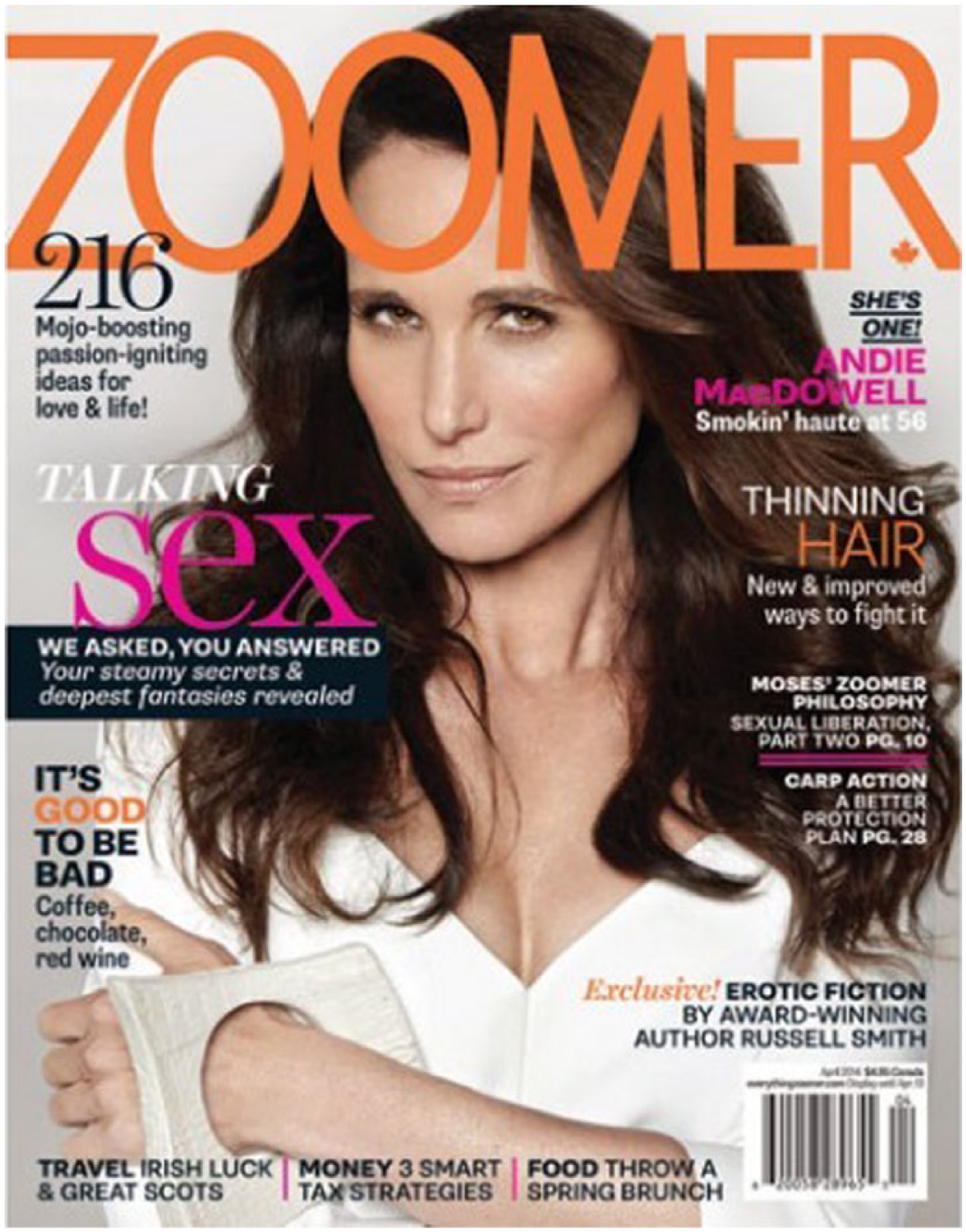
Zoomer magazine, April 2014.
One of the main features of the issue was the report of Zoomer’s sex survey – an online survey of 1310 Canadians aged 45 or older conducted by a marketing firm. 5 Unsurprisingly, those surveyed were mostly ‘heterosexuals in married relationships’ who ‘enjoy sex, want sex and are actively engaging in sexual activities’ (Zoomer, 2014: 58). The visual images that accompanied the 8-page spread reporting on the survey included not just the usual pie charts and bar graphs summarizing findings but also multiple images of a heterosexual couple in a variety of intimate poses. The couple depicted looked to be in their 50s, conventionally attractive with fit, toned bodies and lots of flesh on display amidst the white sheets and undergarments. Several of the shots were explicit and highly erotic – for example, the man shot naked from the waist up, with the woman visible only from belly to knees, wearing white bikini panties. He is caressing the woman’s thigh, while gazing at her crotch. If the text did not get the message across, the visuals certainly do – when ‘we’ say ‘we’re still having sex’, we mean it, and it is heterosexual intercourse that defines sex.
In sharp contrast to these highly sexualized visuals is the imagery that has accompanied the scant handful of articles to date in Zoomer which have acknowledged non-heterosexual relationships. 6 The most explicit acknowledgement of these (‘Same sex sizzle’, Winter 2009) established in its introduction that gays and lesbians, like everyone else, ‘can find love at any age’, but then takes a sharp turn to suggest that ‘we’ (meaning heterosexuals) can ‘learn a thing or two from the LGBT set’ (p.75). It then reiterates some tired stereotypes of gay hedonism and what tips it offers to straight folks (go to the gym to get buff, use sex toys, act out fantasies, try a threesome …). The only visual image accompanying this piece is – wait for it – a photograph depicting a section of a tree trunk. It is certainly the trunk of an old tree but it is not entirely clear whether or not it is a living tree. If you use your imagination, it is possible to see in the image part of the trunk as bent over with the other part of the trunk, appearing to penetrate it from behind. It was apparently so impossible to visually represent non-heterosexual sex in the framework for intimacy constructed that non-human (and perhaps even non-living) imagery was the only recourse. Another piece, in the spring of 2015, tackled the important issue of housing options for LGBT elders. The small photograph used to illustrate this was a couple, presumably male from the dark arm hair on one individual, shot from the back and showing only their torsos, arms around each other’s waists, clad in almost identical beige trousers and shirts. The lack of faces (not to mention the un-sexiness of the photo) is another way marking off these ageing bodies from others that populate the magazine.
Representations of sexuality, though, while important, are not the primary visual imagery of the heterosexual imaginary of successful ageing. As Sandberg (2015) contends, it is not ‘… sex as such that is celebrated as part of the good later life, but rather heterosexual intimacy’ (p. 26, see also Sandberg, 2013). 7 It is this happy heterosexual intimacy – that certainly includes but is not limited to sexual activity – that dominates the imagery of successful ageing. These are the same images that market the goods and services pitched to the third-age market, whether these be pharmaceuticals, hearing aids, travel packages, financial products 8 or retirement communities. They pepper the pages of Zoomer and other magazines, and are repeated over and over across websites, advertising flyers, and mainstream media stories about the ‘new ageing’. Their monotony is easy to demonstrate by doing a simple image search on a phrase like ‘successful ageing’, ‘healthy ageing’ or even something as vague as ‘a happy old age’ (Figure 2). The majority of images generated depict heterosexual couples smiling, laughing, riding bicycles, walking on beaches, swimming, dancing and embracing.

Google search on \‘a happy old age\’, May 2016.
Linn Sandberg notes, drawing from Ahmed’s (2006) Queer Phenomenology, that even in non-sexual situations, older male and female bodies depicted together are oriented towards one another – through their posture, proximity, glances – in ways that establish their heterosexuality. This is common in advertising visuals in Zoomer, and if not depicted in couples, then older people are likely to be positioned in some version of a familial tableau, with children and/or grandchildren establishing their reproductive success. However, women depicted on their own – especially the new, sexualized midlife woman – are often firmly positioned as heterosexual in other ways, such as through the frequent use of classic ‘pinup poses’ or other conventional markers of heterosexual desirability (Figure 3).
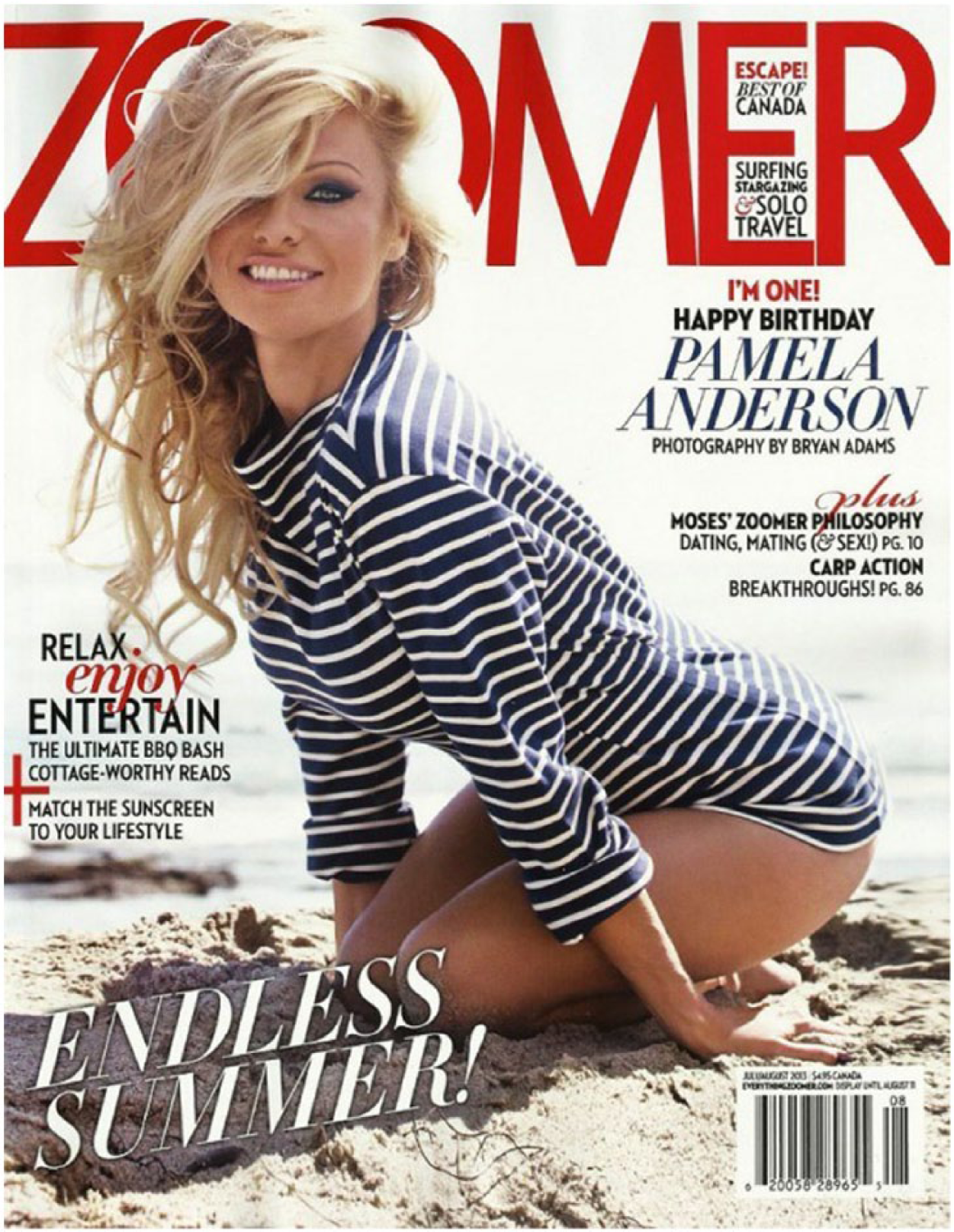
Zoomer magazine, July/August 2013.
Even the redoubtable Betty White, at 92, had her cover photo (December 2014) embellished with a thought bubble declaring ‘I may be 92, but so what? I’m still hot!’
The heterosexual imaginary that frames consumer marketing in the midlife industrial complex, for which Zoomer stands as a signal example, has extended its reach out of the commercial realm and into the broader public through health promotion campaigns. ‘Health’ has become the ‘cultural/discursive home’ for sex (Segal, 2012: 376), particularly where older people are concerned, and here the absence of older LGBTQ people, as well as heterosexuals who do not fit the cultural ideal, is particularly noticeable in celebratory images of ‘healthy’ ageing. Given the close association between ageing and health concerns, performing heterosexuality has unsurprisingly become almost a metaphor for health itself in later life. Illustrating what has now become doxa, Entre Nous, the World Health Organization’s European magazine on sexual and reproductive health, devoted an entire issue in 2013 to ageing and sexual health (Figure 4), arguing that ‘sexuality and sexual health are an intrinsic part of, if not a core indicator for, health and wellbeing in older age’ (Beard, 2013).

Entre Nous, 2013.
Demonstrating again that it’s not just sexuality, but the promise of heterohappiness that’s at stake, a final example is a public service video produced by the Health and Stroke Foundation of Canada. 9 Entitled ‘Make Health Last’, it asks viewers to imagine what their last 10 years of life will look like, and presents the same older man in two possible future scenarios, portrayed through a split screen. In one, he enjoys life with his wife and family, in the other, he lives in a care facility. In one, he laces up running shoes, bicycles, plays with grandchildren and celebrates with his wife. In the other, the running shoes are replaced by slippers, the bicycle by a wheelchair, the grandchild’s playful offering of a juice box by a cup and straw held by a health care aid, the necktie by an oxygen tube, the watch by a hospital band and so on. The closing – and lasting – image is of his face in the middle, on one screen being kissed by his smiling wife as they celebrate what is presumably an anniversary, on the other, her face held against his cheek as she weeps in despair (Figure 5). The emotional power of the video rests on the ways in which his poor health (pitched here as due to poor choices) has resulted in the denial of late-life heterohappiness.
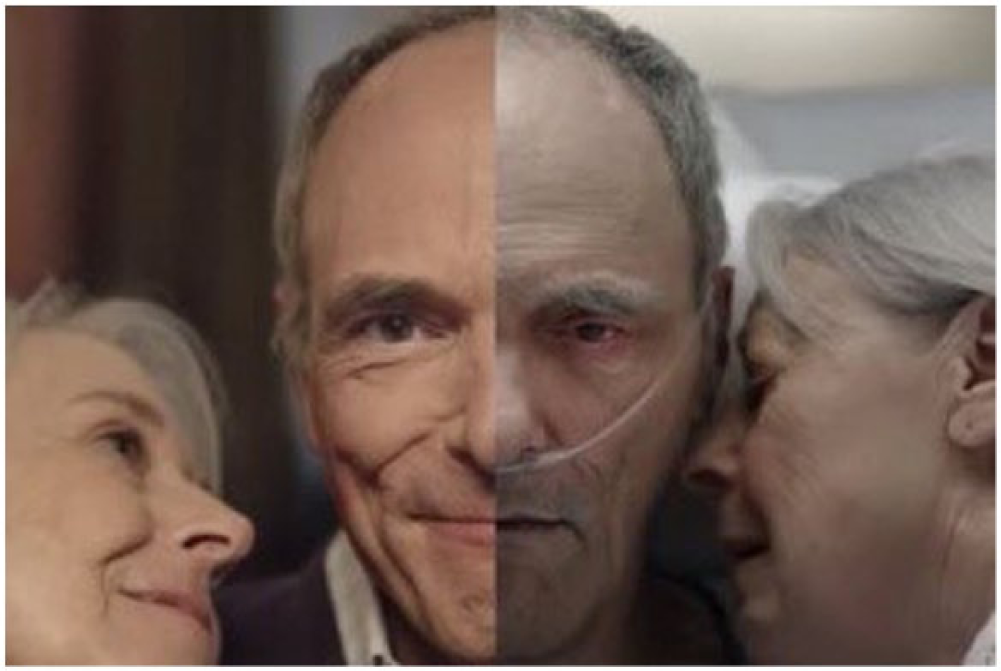
‘Make Health Last’.
Queering anticipated futures?
… so much of heterosexual privilege lies in heterosexual culture’s exclusive ability to interpret itself as society. Even when coupled with a toleration of minority sexualities, heteronormativity has a totalizing tendency that can only be overcome by actively imagining a necessarily and desirably queer world. (Warner, 1991: 8)
What are the implications of the foregoing analysis for thinking about ageing futures? As the research reviewed has suggested, visual media like magazines which are targeted at a third-age market play an important role in envisioning ageing futures. In ways not entirely unlike the media culture of makeovers and ‘becoming’ pitched at the young, the future has to be continually produced (Coleman, 2014). But the future-better-self of youth culture is replaced here, for the middle-aged, by the continuation of the present into a romantic ageless future. The ever-downward expansion of entry into the Zoomer years transforms midlife into a seamless model of ‘not-becoming’ old, disabled, dependent or marginalized. As Halberstam (2011) puts it in The Queer Art of Failure, ‘success in a heteronormative, capitalist society equates too easily to specific forms of reproductive maturity combined with wealth accumulation’ (p. 2).
I have suggested that the visions of bliss that represent the heterosexual imaginary of successful ageing are as important in producing anticipatory futures as the ‘happily ever after’ promises of White wedding culture. And, as Ingraham notes of the latter, consumer culture’s embrace of gay marriage and re-marriage further legitimizes this imaginary, extending what she terms the ‘tyranny of coupling’ (Ingraham, 2008: 228). Just as it might be argued that the notion of the ‘biological clock’ has been deployed to shape young women’s reproductive and relationship strategies (Weigel, 2016) the promise of heterohappiness (or the threat of its denial) may intensify particular sorts of successful ageing strategies. Indeed, as the state retreats from the provision of care for the ageing, downloading responsibility to individual families, aspiring to secure later life domesticity seems downright rational.
Angela McRobbie’s (2015) elaboration of the notion of ‘the perfect’ as shaping contemporary femininity and aspirations to the ‘good life’ is instructive here. She defines aspirations to ‘the perfect’ as resting on constant calculations against aspirational benchmarks for care of self and others, measuring one’s success in eating well, exercising, working on one’s relationships, creating a pleasant home environment and so on. It is ‘… a kind of neoliberal spreadsheet, a constant benchmarking of the self, a highly standardized mode of self-assessment, a calculation of one’s assets, a fear of possible losses’ (p. 10). Ideas of the perfect encapsulate the ‘good life’ in representations which conjoin sexuality and domesticity, heterosexual or otherwise, so that ‘new arrangements of queer familialism will also hopefully fall into line’ (p. 7). If this rendering of the ‘perfect’ is, as I suggest, integral to the representation of successful ageing lifestyles in third-age media, then it seems far more likely that queer relationships will continue to be heterosexualized to be deemed successful.
So what happens when aspirational agency is thwarted or negated by failure to ‘age successfully’? Perhaps, it is being beyond the reach of the aspirations to the perfect, as envisioned by contemporary consumer culture, that marks a key boundary between the third and fourth ages. Sandberg, for example, draws our attention to the signifiers of ‘happiness’ and ‘unhappiness’ in the ‘positive ageing assemblage’. At the same time as pathways to success are created, so too are representations of failure in the form of those deemed ‘too poor, too disabled, too queer to be active and engage in life in prescribed ways’ (Sandberg, 2015: 37). How uneasily this acknowledgement – and the lack of visual imagery of diverse ways to age ‘successfully’ – sits beside the contention that contemporary Western life courses have become diversified, variable and individualized (Jones, 2011: 249).
Conclusions
I have argued in this article that the visual culture of successful ageing is dominated by a heterosexual imaginary, shaped by imagery which is ‘culturally persuasive, symbolically prolific and rarely questioned or examined’ (Ingraham, 2008: 4). The contemporary association of heterosexiness with successful ageing has offered new forms of cultural imagery around which consumer marketing has rallied and which health promotion has embraced.
I have suggested that midlife is a particularly critical period in the cultural shaping of later life. In addition to the emphasis on midlife choices as crucial to the boundary work that delineates the third age and the management of anticipatory ageing that is so central to the midlife industrial complex, the intense interest, in particular expressions of sexuality as part of successful ageing, provides an important context for the continuing naturalization of gendered heterosexuality. The parallels in representations of the ‘third age’ culture of successful ageing with the images of white wedding culture are striking: the naturalization of heterosexuality, the binding together of gender and heterosexuality, the importance of an industrial/commercial complex which supports it and the affective work of visual culture in producing and maintaining dominant meanings. Romancing ‘successful ageing’ begins to look a lot like romancing heterosexual culture.
Harrington et al. (2011) argue that, ‘… market constructions of adulthood and late life are increasingly important to how it is that adults negotiate 21st century ageing’. While certainly the pedagogical function of popular media and their representations is never uniformly successful nor uncontested, it is not insignificant. Feminist research has shown, for example, that the increasing cultural visibility – in both positive and negative ways – of older women has revised expectations of ageing femininity (Dolan and Tincknell, 2012; Swinnen and Stotesbury, 2011; Whelehan and Gwynne, 2014). Empirical studies with older women suggest that they frequently draw on these representations in evaluating their own appearance, sexual activity or relationship success in relation to what these suggest as normative and/or possible (Fileborn et al., 2015; Hine, 2011). One study with queer youth suggested that the extent to which they could anticipate positive ageing futures was related to their anticipated access to heteronormative conventions like marriage and children (Goltz, 2009), while another with a broader age range of bisexuals, suggested an ability to imagine happy, non-normative later lives (Jones, 2011). Clearly more research is required to better understand how the cultural resources on offer may shape ageing identities.
However, it is clear that, despite the appealing and positive discourse on empowerment and agency that has recently surrounded successful ageing, ageing bodies have become selectively sexualized in ways that anticipate varying futures. Because the ‘heterosexual imaginary’, as a theoretical construct, directs attention to the historical and material conditions that produce it, it might also help to illuminate the ways that the heteronormative imagery of successful ageing is bound up with the political economy of ageing societies, including the embodied, gendered, classed and racialized inequalities that are rendered invisible. Neither ‘age’ nor heterosexuality is as homogenous as the visual landscape of successful ageing suggests. There is a productive point of interface here for scholars working in ageing studies, disability studies, queer studies and feminist studies in critiquing the monolithic portrayal of gendered heterosexuality as conterminous with successful ageing. Only then we can perhaps make good on the promise of celebrating a diversity of ways to grow old.
Footnotes
Acknowledgements
An earlier version of the article was presented at the Women Ageing Media (WAM) summer school at the University of Gloucestershire in the summer of 2015, and I would like to thank participants for their generous and insightful feedback. Finally, I am grateful for inspiring conversations with Linn Sandberg.
Funding
The author(s) disclosed receipt of the following financial support for the research, authorship, and/or publication of this article: Research for this article was supported by a grant from the Social Science and Humanities Research Council of Canada (SSHRC).