



Abstract
In a contemporary neoliberal landscape, young women are subject to intensified requirements to demonstrate resilient individuality while also enacting a pleasing, approachable femininity, in domains of life including bodily appearance, education, employment and personal productivity in general. Following Arlie Hochschild’s work on emotional labour, I suggest normative youthful femininity is lived, not simply as a set of life regulations, but as a set of ‘feeling rules’ through which young women affectively manage such contradictions. Feeling rules shape how young women may feel in relation to gendered regulation, limiting their articulation of managing this burden to humorous, upbeat quips in the genre of safe, funny, ‘girlfriendly’ material. I examine a set of self-representative blogs authored by young women on the platform Tumblr to explore how these rules are navigated. Converting the frustrations of postfeminist regulation into funny, bite-sized moments, the blogs produce selves amenable to circulation in a gendered, digital economy of relatability.
Not taking the self seriously: a feeling rule framework
In early 2012, an anonymous Tumblr blog, used by two young female law students on opposite coasts of the United States to keep in touch, suddenly found a measure of online fame (Casserly, 2012). Named WhatShouldWeCallMe (‘WSWCM’), the blog’s humorous narration of everyday, ‘relatable’ moments through GIFs and captions attracted coverage in popular press on sites such as The Huffington Post (2012) and USA Today (Eckerle, 2012), and it was described as articulating a ‘popular collective subconscious’ for young women in Forbes online (Casserly, 2012). Indeed, the corresponding creation of dozens of ‘follower’ blogs on Tumblr (Shifman, 2014), whereby other young women authored their own versions of WSWCM, demonstrated a palpable sense of shared feminine experience. These blogs together expressed common ‘reactions’, feelings and struggles of youthful middle class life, such as the anxiety felt when ‘writing papers at midnight’ or the self-consciousness ‘when I’m trying to avoid being seen at a pool party’. When the original or ‘founder’ WSWCM bloggers were interviewed about their winning formula for humour, one blogger responded,
Definitely self-deprecating humor. That’s where [my friend] and I really get going. Neither one of us takes the other or ourselves seriously and we’re constantly talking about what wastes of lives we are. I mean, we’re kidding obviously, we’re in school to be attorneys, but that’s the funniest part of the site to me. (Casserly, 2012)
In an increasingly regulatory social, economic and media environment where women’s bodies, life trajectories and ‘choices’ are intensely monitored and appraised, young women are increasingly exhorted to be ‘normal’, carefree and confident (Gill and Orgad, 2015). The seemingly anodyne, humorous claim to be ‘wastes of lives’ despite being ‘in school to be attorneys’ highlights the affective complexities of youthful femininity which must be navigated, balanced and managed. A social landscape deemed ‘postfeminist’ (Gill, 2007; McRobbie, 2009) poses intensified presumptions of young women’s resilient individuality in keeping with expectations of contemporary neoliberal citizens, and yet it also requires that a reassuring femininity be simultaneously performed. Young women must fulfil the space of power that has been allocated to them, but - importantly – while not transgressing gendered expectations of being approachable and pleasing (McRobbie, 2009).
In such an environment, this article suggests that youthful femininity is regulated via ‘feeling rules’ (Hochschild, 2003 [1983]) through which young women are expected to manage their lives. Feeling rules stipulate that one must have the right feelings for the right context, and if these feelings diverge from the appropriate ones, they must be worked on to make them ‘fit’. I argue that there is a heightened requirement of young women to invest emotional or affective labour in producing selves that are agreeable for others, converting their regulation into humorous, relatable struggles. Such affective expectations are typified within the structures of digital spaces in which young women are asked to demonstrate both independence and likeability in their self-production (Dobson, 2015).
This article examines the affective negotiations visible in WSWCM and five of its follower blogs on Tumblr, also authored by young, female university students located in the United States, in relation to feeling rules regulating the management of the body, work and study, and idleness. I explore how in these domains, young women adhere to obligations to convert both small and large life trials into funny, upbeat moments of value for a wider digital audience. These follower blogs were selected as representative of the personalised, self-representative adaptations of the founder blog, and as such, I consider how the blogs collectively articulate shared ‘girlfriend-based’ (Winch, 2013) understandings of how young women ought to manage. While resistance and acts of transgression are articulated, I examine how feeling rules shape the manner in which young women speak of the burdens of life regulation, limiting their expression to upbeat, punchy quips. The ability to individually bear gendered struggles with good humour produces resilient, pleasing femininities that fit into the logic of digital attention economies where further circulation is equated with value.
The affective terrain of postfeminist individuality
Significant scholarship on contemporary femininities has drawn attention to a Western cultural sensibility deemed ‘postfeminist’, privileging gendered subjectivities in which certain second wave, liberal feminist ideas are incorporated in order to disavow feminism’s continuing necessity (Gill, 2007). While earlier contestations around the term ‘postfeminism’ related to its varying constructions as epistemology, historical shift or backlash (Gill, 2007), more recent debates have centred on its ability to accurately describe a context combining both rapid cultural change and continuity with predecessor feminisms. In such a context, Nash and Grant (2015) argue, young women may not straightforwardly accept postfeminist cultural values, positioning themselves between second wave feminism and postfeminism. Whelehan (2010) argues, alternatively, that current generations of young women simply do not recognise the feminism before the ‘post’. However, the term ‘postfeminism’, I suggest, remains useful for engaging with the substantive literature theorising the intensified expectations of girls’ and young women’s capacity to thrive in neoliberal economies (Dobson and Harris, 2015), and the forms of subjectivity that are privileged under these circumstances. McRobbie (2009) notes that the postfeminist ‘top girl’ is a prominent figure in the contemporary imagination, balancing the performance of normatively comforting feminine traits, such as beauty and (hetero)sexual attractiveness, with the drive for achievement within education and employment sectors. In this vein, I attend to the affective dimensions of such gendered regulation.
Feminist scholars have highlighted the affective difficulties of postfeminist individuality, requiring the selective acceptance of certain forms of social value while disavowing their influence in personal decision-making (Dobson, 2015; Gill, 2007; Harvey and Gill, 2011; McRobbie, 2009; Ringrose, 2013). In their study of school-age girls’ negotiations of identity in online profiles, Ringrose and Barajas (2011) show the compulsion felt by girls to perform confidence and freedom in ‘pornified’ mainstream hetero-sexualised representations in their profiles, even while they suffered restrictions and double standards in relation to their sexuality at school. In a discussion of the management of similar contradictions, Negra (2008) similarly observes that beauty practices, public sphere ‘retreatism’ and disproportionate domestic labour must be justified in terms of individual choice, without bitterness or resentment. Winch (2013) further explores the affective nature of postfeminist regulation by showing how ‘girlfriendship’ itself - homosocial bonds between women - becomes both a vehicle for mutual discipline and a means of demonstrating feminine normativity. Girlfriends assist each other in maintaining disciplinary requirements on the body as well as simultaneously providing outlets for the frustrations of femininity that cannot be taken out on men (Winch, 2013). As such, this scholarship has shown postfeminist regulation to operate in entangled discursive and affective ways. Young women must not only engage in regulatory practices in relation to life planning, careers, their bodies and their (hetero)sexual relationships, but additionally, I suggest, in an intensified layer of regulation, they must manage their feelings in relation to such practices.
Feminist scholars have long been at the forefront of theoretical engagements with feeling, given its deep entanglement within gendered, but also sexualised, racialised and classed formations of power (Pedwell and Whitehead, 2012). In the wake of the theoretical legacy of Hochschild’s (2003 [1983]) germinal work, The Managed Heart, feminist scholars have emphasised how feeling is implicated not simply within the operation of capitalist economies, but within the regulation and maintenance of unequal social relations more generally (Ahmed, 2004; Hemmings, 2005; Skeggs and Wood, 2013; Tyler, 2008). Situating the ‘me’ versus the ‘you’, Hochschild argues that feeling rules are integral to orienting individuals in relation to others and their due role in social settings. As such, she importantly highlights emotion as the expression of highly gendered and classed social relations, implicated within public and private sphere economies. The inducement, sustenance and suppression of emotion can accordingly be understood as a form of labour which, in service industries in particular, may be sold for a wage and hold exchange value.
Drawing on this rich feminist scholarship, I focus on affect as it appears in the blogs in the articulation of ‘relatable’ feelings, paying close attention to how they delineate gendered relations of power and value, entangled within conditions of postfeminist discursive legibility. I draw on the view that emotion is not ontologically distinct from affect, but may be understood as its crystallisation or intensification (Sullivan, 2015). In seeking to understand the posts that young women have crafted to make their feelings intelligible, and legible, to certain others, I have found it more useful here to view affective practices as part of the formations of meaning making (Wetherell, 2012) that are produced to sustain feelings of connection. For this reason, I employ Wetherell’s (2012) concept of ‘affective-discursive’ analysis. The affective articulations here show the negotiation of feminine subjectivity and the communication of this negotiation to others in ways that, following Hochschild’s (2003 [1983]) analysis, observe social rules of what is ‘due’ or ‘normal’ in the emotional register of gendered life.
This article is drawn from the textual analysis of approximately 800 blog posts across the period of 3 years from 2013–2015, sampling a range of posts from the beginning of the blogs to the most recent. The blogs include the founder blog, and five follower blogs inspired by the founder, also authored by young women who were at university at the commencement of research. The follower blogs were chosen for their engagement with the founder blog, in their similar self-representative narration of humorous everyday moments, feelings and reactions. An affective-discursive analysis was conducted to understand how the self was related to others as a feeling subject in the blogs, focusing on two luminous domains identified by McRobbie (2009) as significant sites of postfeminist regulation: (1) beauty and appearance and (2) education and employment. Accordingly, this article examines not only how postfeminist regulation involves self-government, but also relationally orients the self to others in shared acknowledgement of feeling rules relating to appearance, work and education, and idleness.
Attention economies, Tumblr and relatability
In The Managed Heart, Hochschild (2003 [1983]) differentiates between private sphere ‘emotion work’ and public waged ‘emotional labour’. However, I suggest that distinctions between these affective economies are now blurred by the broader postfeminist, neoliberal emphasis on a highly entrepreneurial sense of individuality, in which the self, in private and in public, must be ceaselessly worked on to make a claim of personal worth. This blurring is also shaped by the architecture of ‘context collapse’ (Marwick and boyd, 2011a) of many social media platforms, in which private subjects are ‘always public’ (Chun, 2016).
Research by feminist scholars on girls’ and young women’s use of digital media indicates that even when not performed in a commercial or employment-based context, the affective self-management that young women engage in is still understood to have exchange value (see, for example, Banet-Weiser, 2012; Dobson, 2015; Kanai, 2015b; Ringrose, 2013). Young women’s personal lives are understood to be available for public scrutiny and evaluation, with quantification through ‘likes’ and circulation demonstrating value (Brandes and Levin, 2013). For girls and young women, digital social spaces extend the affective requirements of the postfeminist luminosity of education and employment (McRobbie, 2009) into personal and social life. Online, Banet-Weiser (2011, 2012) argues that the postfeminist subject finds parallels with the ideal ‘interactive subject’ who adapts her brand through the architectures of gendered online feedback, producing a feminine self suitable for digital circulation. Young women are at the forefront of converting personal experience into exchange value through digital circulation, whether it be through maintaining and curating their profiles on social network sites (Brandes and Levin, 2013), or fashion, craft and lifestyle blogs (Abidin and Thompson, 2012; Duffy and Hund, 2015). As with celebrity culture where women, in particular, promote relationships with their audiences through making aspects of intimate life available (Marwick and boyd, 2011b; Nunn and Biressi, 2010), affective everyday experiences produced and captured through digital media now may be used to accrue value in its ‘attention economies’ (Fairchild, 2007).
Marwick (2015) explains that in an attention economy, value is assigned to an artefact or thing based on the ‘eyeballs’ or attention it can attract in an environment of media saturation. So far, Tumblr, the microblogging platform hosting the WSWCM blogs, has attracted little analysis in terms of this marketised perspective. Tumblr, the platform where the blogs I examine are hosted, has been noted to constitute a space of relative freedom and exploration for queer and trans users (Cho, 2011; Fink and Miller, 2014) and for youth more broadly (Ash, 2015; Hart, 2015; Renninger, 2015). In the context of this scholarship, Tumblr does not appear to be a platform that prima facie fosters the practices of subjectivity most privileged in postfeminist culture. Notwithstanding this, this article discusses the culture of feeling built around WSWCM, the founder blog I discuss here, which has found a large following on Tumblr – 50,000 followers within its first month (Casserly, 2012) – as well as inspiring the creation of follower blogs that ‘connected’ to its affective expression. As such, my discussion of attention economies here reflects the sociality at play in the culture of these blogs, and may not be generalised to reflect Tumblr as a whole, a move that would essentialise Tumblr as a platform itself.
An attention economy on Tumblr operates in relation to Tumblr’s norms of anonymity. In contrast to name-based social platforms such as Facebook and Twitter whose architectures have been argued to reinforce norms of self-branding and the quantification of worth (Brandes and Levin, 2013; Bucher, 2012; Marwick and boyd, 2011a, 2011b; Van Dijck, 2013), Tumblr’s norms of anonymity have been credited with creating spaces of introspection and freedom (Cho, 2011; Fink and Miller, 2014). The number or names of followers on one’s blog is not shown automatically. Yet, it may still be argued that Tumblr provides an architecture whereby attention, through circulation, is quantified and measured. Posts on Tumblr indicate the number of interactions or ‘notes’ at the top of the post, showing how many users have liked or reblogged the post. Reblogging a post works to recirculate the post, as well as making it part of one’s own blog.
I suggest that Tumblr’s norms of anonymity shape the cultures of identity production seen in the founder and follower blogs, in which a personalised affective relatability becomes of prime importance. In contrast to a platform such as Facebook which is predicated on maintaining existing networks of one’s contacts, on Tumblr, blog posts are addressed to unknown groups defined by their imagined commonality with the individual blogger. Social knowledges and experiences such as those pertaining to the regulation of youthful femininity, that I term ‘girlfriend’ knowledges here drawing on the work of Alison Winch (2013), may be boiled down into imagined commonalities with people that one may not personally know. Tumblr, then, provides a space through which the affective experiences of living in a postfeminist regulatory landscape may be circulated according to the logic of relatable value, making humour a necessary ingredient in the blogs I discuss here.
It is important to note that commonality itself, however, is not necessarily enough to catalyse the re-circulation of posts. I contend that posts expressing such commonalities are more likely to be reblogged if they are deemed to reflect the thoughts or experiences of others in a pleasing, or at least, non-compromising way. Accordingly, the WSWCM blogs translate problems of gendered regulation of the body, work and educational achievement, and productivity, into funny, bite-sized moments. Self-deprecating humour in the blogs is a means of amplifying the relatability of a post (see also Ash, 2015) and thus its potential attention value through circulation. Personal negotiations of postfeminist demands on the self are articulated in such a way to convert these demands into things that both bloggers and readers, as ‘girlfriends’, can recognise, laugh about and circulate. The use of humour creates value from unpalatable feelings which can then be circulated in this feminine economy, and is key to defusing the perception that one may be overly impacted by the feelings of frustration, weakness or shame unbefitting a strong, neoliberal subject.
Relatable problems: the body and food consumption
I begin with documenting how feeling rules regulating food consumption structure the telling of self in the blogs. Food intake and its relation to the body has been argued to be a highly relatable feminine problem, reflected in media ranging from self-help literature to women’s magazines (Winch, 2013). Yet, while the burden of body and food regulation as a central struggle in managing femininity is assumed knowledge, food is discussed in such a way that it cannot explicitly be articulated as a source anxiety. While a blogger might voice some discontentment, she cannot show that the regulatory matrix governing food consumption overly impacts her, as the feeling rules surrounding the articulation of self-regulation require the blogger to make light of unattractive feelings, presenting herself for the amusement of the reader.
In this affective framework of agreeability, young women’s labour reworks the bitterness of intimate body regulation into humorous, relatable moments demonstrating the capacity to manage. Consider, for example, the below post on the situation ‘when there’s too many hot guys by where I’m laying out and I instantly regret eating this week’ (Figure 1). The scenario suggests that the body of the blogger is stretched out for potential viewing and evaluation by the ‘hot guys’, producing a terrified shaking captured in the GIF.

My Body isn’t Ready. WhatShouldBetchesCallMe.
Ringrose and Walkerdine (2008) and Tincknell (2011) suggest makeover discourses promise affective redemption through the transformation of the body into a slimmer, more youthful looking version of itself, making the non-normative body abject. By suturing discourses of body transformation into discourses of self-care, this burden of abjection is borne by the individual. Indeed, much of the rhetoric of ‘body perfectionism’ carefully reassures women of their own competency in self-management (Negra, 2008). As such, the problem presented is neither the ‘male gaze’ nor the blogger’s subjection to it, but rather, the blogger’s own failure to manage her food intake. In the above post, I suggest that the humour is partly derived from the sheer exaggeration of the sentiment of unreadiness. The way that the undesirability of one’s body after eating is expressed, is telling of the way that bodily appearance is deeply entangled within neoliberal understandings of the self. Rather than using more direct physical descriptions such as ‘ugly’ or ‘fat’, the horror of a non-normative body is expressed through the more sophisticated psychic expression of (a lack of) ‘readiness’. Expression in terms of ‘readiness’ eschews the obvious labelling of the ‘right’ weight or body shape; rather, it orients attention to how one feels, as an individual.
However, across the blogs, given the chagrin in relation to bodily inadequacy and purportedly excessive eating habits, there is curiously little explicit reference to dieting. Indeed, posts tend to concentrate on the love of food, such as in the below post documenting the dismissive reaction ‘when a new friend tells me she doesn’t eat carbs’ (Figure 2).
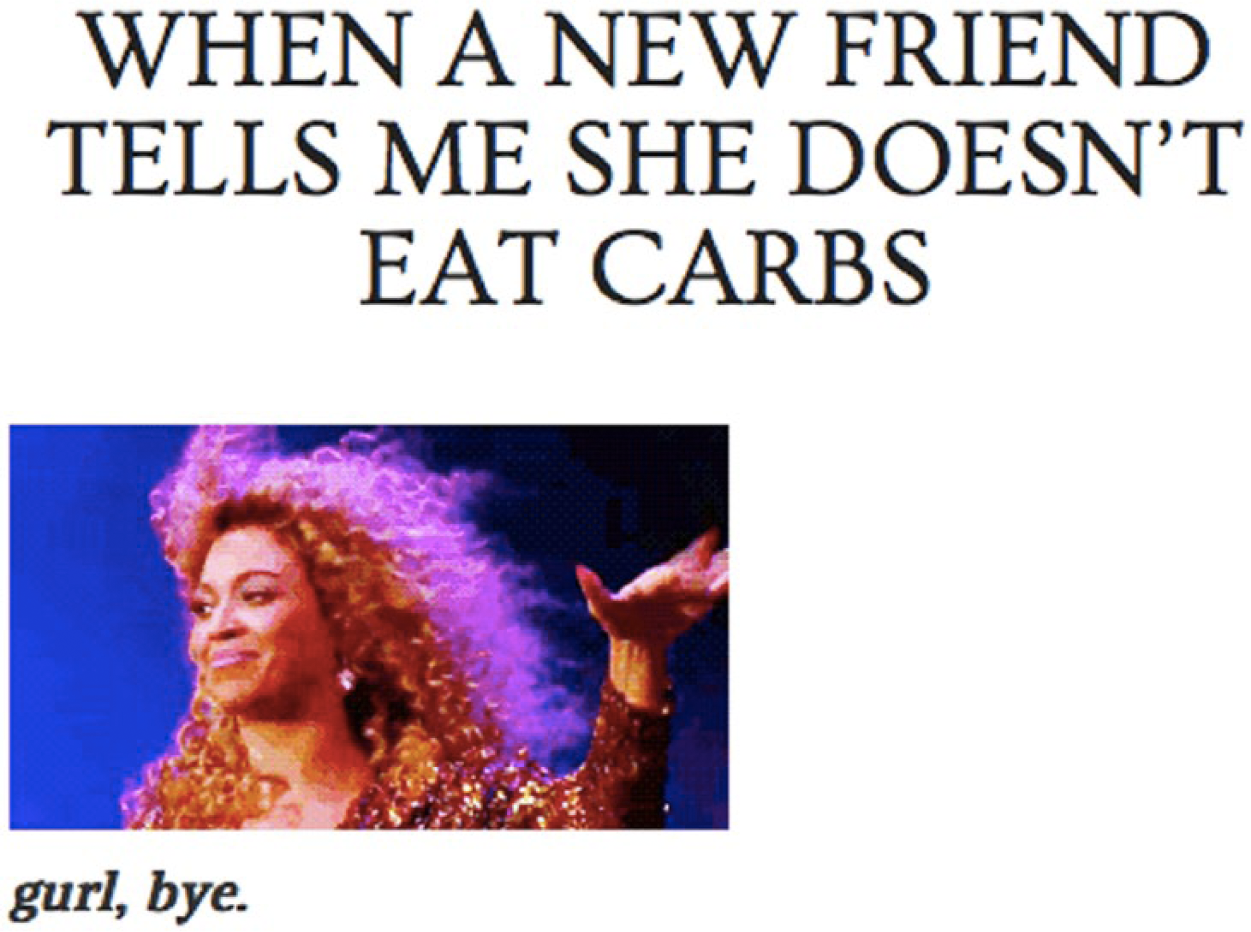
Doesn’t eat carbs. WSWCM.
Other similar posts across the blogs document how pizza is consumed ‘literally every time I have people at my apartment’, or the anger ‘when I catch someone eating my food’. This humorous discussion of food would prima facie suggest that a love for food, and in particular, unhealthy food, is being declared. Yet, the structuring absence of reference to dieting, in the context of a continual stream of self-deprecating jokes about bodily size and anxiety about ‘getting into shape’, suggests there are certain rules about what may be articulated.
Seemingly, under these rules, diet talk is not funny. Indeed, confessing the actual regulation of one’s food intake could transgress affective rules of resilience, strength and individuality. It may be conjectured that dieting, or other work on the body, smacks of a capitulation to outside pressures to change the self, implying one is impacted by societal standards of feminine slimness – a position that is unspeakable in this upbeat, resilient-but-relatable affective framework. As such, when a love of food is avowed, it is done defensively, such as in the post ‘my level of excitement for every single meal I eat’ (Figure 3).

Every single meal. WSWCM.
The post is essentially a joke about looking forward to consuming food all the time, and the way such gluttony detracts from conventions of feminine elegance and restraint. The female glutton is suggestive of non-normative bodily traits associated with the female ‘grotesque’ (Rowe, 1995), which has a history of being played for laughs. Indeed, the post mobilises assumptions around the chubbiness of the young man, as a way of demonstrating an unbridled, unfeminine delight in food consumption (see also Kanai, 2016 on the way incongruous bodies are transacted in the GIFs). In general, the bloggers tend to draw attention to food deemed unhealthy, or to the volume of the food consumed, in citation of the norms of healthism discussed by Rose (1999). Healthism, Rose observes, is a form of governmentality that has particular resonance in middle-class cultures, where ‘health’ becomes a catch-all justification for food and body regulation, and is equated with thinness for women in particular (Winch, 2013). As such, the confession of gluttony is a recurring genre in the way the love of food is expressed in these blogs.
As Dejmanee (2016) suggests, postfeminist narratives have taken a turn in moving from the representation of free, frivolous and choice-based consumption, to that of physical consumption, as economic troubles increasingly remove self-determining adult privileges and responsibilities from the postfeminist ‘girl’. Food assumes a more central role in delineating the boundaries of feminine individuality, with over-reliance on it understood as an increasingly abject quality. Food, accordingly, is recurringly politicised in the blogs. Even holding up excessive eating as a form of proud transgression can be seen as the visible effect of the compulsion to take a stance in relation to food. Thus, any quip more serious than a light-hearted acknowledgement of bodily ‘imperfection’ is not speakable. What is made evident is a certain legitimacy of body regulation standards, coupled with the ability to articulate one’s individual management of these standards in good humour.
Flouting the rules: having the wrong attitude in work and study
Feeling rules also play a central role in the way young women may relate the labour of self-management in the space of employment and education (McRobbie, 2009), in which the young woman is set out as the new, meritocratic figure of achievement (Dobson and Harris, 2015). Here, contradictory postfeminist imperatives are evident: the obligation to fit in with an institutionalised mass mode of compulsory progression and professional development, and the injunction to perform a strong individuation which makes a young woman stand out. My affective-discursive analysis finds an overt antagonism across the blogs towards the compulsoriness of achievement in relation to university and paid work. This defiance additionally takes as its object the emotional zeal for work which feeling rules require. Yet, this resistance is also entangled with humorous confessions of struggle, and the sense that one is ‘just getting by’, softening the rebellious affect and indicating the need to facilitate an agreeable commonality.
It must be noted, first, that the ‘can do’ attitude (Harris, 2004) channelled by the ideal ambitious top girl that smashes through obstacles is eschewed across the blogs. Industriousness and effort are never matched with achieving goals; study usually occurs when hopelessly behind schedule. ‘Writing papers after midnight’, on one follower blog, is summed up by incompetent office manager Michael Scott from the American version of comedy series The Office (NBC Universal Television Distribution, 2005–2013). He says blithely, ‘Sometimes I’ll start a sentence and I don’t even know where it’s going. I just hope I find it along the way’. Michael Scott’s slowness is used again by another blog in the post ‘When I sit front row in engineering’ (Figure 4). Scott begins saying, in a slow measured way, ‘I … understand …’. The camera then rapidly zooms into his face, accentuating the blankness of his gaze. He finishes his phrase: ‘Nothing’.

When I’m sitting front row in engineering. Pitchin’ Hissy Fits.
I note that the repudiation of work and achievement that is done here may only be speakable in the context of having already demonstrated value within a middle-class framework by virtue of being accepted into university. Given that it is the aspirational middle-class subject (Skeggs, 2004; Skeggs and Loveday, 2012) that best exemplifies the feeling rules associated with life progression, articulating discontentment through being uninterested, or ‘stupid’, may be the most viable affective means of managing the compulsoriness of university achievement. The declared unwillingness or inability to make diligent efforts may be situated within normative predeterminations of university as a life stage. This inability may also make the self more ‘relatable’ in avowing minor dissatisfactions.
The need to maintain a sense of commonality plays into the way in which these feelings of difficulty are articulated. Though postfeminist feeling rules ostensibly mandate that the blogger demonstrate ambition and a positive attitude, cultivating a sense of connection in this intimate space of readership requires that the blogger show that she manages or makes do, rather than sailing through. Managing in the university context requires the blogger to relate experiences of wasted effort, toil and struggle, but importantly, without articulating a complete sense of alienation from the university. Relating these problems as part of an ongoing attempt to manage one’s university experience is useful in building commonality, enhancing the ‘relatable’ value of the posts and their further potential circulation. Such struggles still adhere to the rules of moderation which I have discussed in relation to food; indeed, the incidents of failing to meet standards are relatively minor and are still funny. Unamusing topics such as dropping out of university, failing a subject or critiquing the over-supply of graduates are not to be found in the circulation of posts. The character Michael Scott from The Office is used to signal pure incompetency but in a knowing and playful way. Through the colourful GIFs, acts of defiance and incomprehension are performed as excessive to signal knowledge of the appropriate navigation of undergraduate experience.
Paid work is featured as another problem to manage across the blogs, though not in all, as some focus uniquely on managing the undergraduate experience. This site of management is treated similarly to university, acknowledging the rules while emphasising affective non-adherence. On the follower blog TwoDumbGirls, reluctance to do paid work is played up. ‘When my boss asks me to work a double’, this request to engage in more labour is met with the reaction of kooky Phoebe Buffay from the sitcom Friends (Crane and Kauffman, 1994). Phoebe says, ‘Oh, I wish I could, but I don’t want to’ in a comedically lacklustre attempt to provide an excuse for not working. The expected attitude of industriousness is implicitly acknowledged, given that the bold statement of indifference to work is delivered as a punchline, incongruous with the expected response to one’s boss.
Being situated within postfeminist matrices of work and value is not easy. Despite the resistance articulated towards work discussed above, the importance of professional progression is not easily dismissed, particularly given the entrenchment of the blogs within middle-class cultures of value. Posts about school articulate stress, cynicism and an inability to properly manage one’s workload. Pleasure in doing well in an exam is only shared on the odd occasion. Yet, it must be understood that humorous articulation of these moments extracts girlfriendship value from otherwise unpalatable emotions. The articulation of disappointment and struggle becomes a way of citing understood norms and demonstrating management of them.
One post in the founder blog exemplifies this point, where a car in traffic on a highway is used to demonstrate ‘every time I start to catch up on my reading’. The car in the GIF starts to speed up – but then crashes into a barrier on the side of the road. Evidently the blogger’s positive start to managing her reading results in spectacular failure. However, the blogger is still attempting to catch up on her reading; she is still imbricated within the assumptions and motivations of the world of work. A similar post on another blog documents ‘how I feel when brainstorming thesis topics’, articulated by Adam Levine, a singer and judge on reality talent show The Voice (Warner Bros. Television, 2011). Levine states deadpan – ‘I’m a stupid person with bad ideas’. The commitment to writing a thesis and brainstorming ideas surely counteracts Levine’s harsh words to some extent. However, this mixture of responsibilisation and inadequacy can be located within the intersections of youthful, middle-class (White) femininity in this public, in which academic achievement is both normative and taken for granted.
A certain humorous cynicism and weariness can be observed in describing the transition to the workforce. On the feeling when ‘graduating college and entering the real world’, the founder blog uses the GIF of a baby using a mobile walker, with wheels, who suddenly falls – epitomising the sudden shock of a relatively inexperienced person entering the race for employment. Once having fulfilled the accepted pathway of finishing university, the young person is immediately subject to exacting, disciplinary pressures to engage in economically ‘productive’ activity. Exclusion from this system can be demoralising. ‘Life as an unemployed college graduate’, according to TwoDumbGirls, is expressed through the deadpan response of middle-aged father Bob Pinciotti from the television comedy That ‘70s Show (Brazill et al., 1998): ‘I got a lot of free time. I mainly use it to nap and cry’.
What is palpable in the blogs is the sense that, while paid work might be unrewarding, failure in obtaining employment speaks more profoundly to a failure of the (neoliberal) self. Yet, the dejection related to these difficulties is narrated in such a way that it does not overpower the good-humoured mix of affective moments circulated. The blogger extracts what value she can from perceived failures by articulating them humorously. Humour provides the distance required to minimise the disappointment, resentment and disaffection articulated in posts, rendering them amenable to further circulation. Though such expressions of downbeat inadequacy might rub against the feeling rules associated with enterprising and ambitious postfeminist subject, I suggest that they maintain the normative affective framework within which the self may be viewed as valuable. Expressing these feelings of failure in a comical fashion preserves the status of these neoliberal life regulations as rules that ought to be observed, while attempting to demonstrate a pleasing commonality in the struggle to adhere to them.
Celebrating and undercutting idleness
Idleness and apathy, beyond the system of university and employment, constitute significant themes in the blogs through which social demands on young women to be productive are negotiated. This theme is enacted via expressions of delight in leisure, such as the exaggerated drinking of beer like a WWE wrestler featured in a post entitled ‘Friday at 5pm after it’s been a stressful week’. This may also be performed as a stubborn desire to be left alone: on one follower blog, the will to take time to relax is channelled in the post ‘When someone tells me to stop watching so much TV over break’. The GIF features three adolescent boys lying on their stomachs watching television in a lounge room, sending accusatory looks to an authority figure off camera, interrupting their leisure time. Such time is precious and treasured. A similar post on the founder blog uses a GIF of two baby ferrets rolling around on a wooden floor to perform ‘Me and my roommate on Sundays’. The affect of glorious indulgence in rest, by being horizontal on the floor and moving only to suit oneself, is circulated in the movements of these small animal bodies.
However, this idleness, when it is celebrated, is relatable precisely under the terms that the blogger acknowledges the postfeminist feeling rule related to productivity. For example, on the follower blog 2ndhandEmbarrassment, a post constructs what happens on ‘Sundays. Also any other day’ (Figure 5). The situation is articulated by actress Jennifer Lawrence, laughing while she confesses ‘if I don’t have anything to do all day, I might not even put my pants on’. The purported afterthought of ‘also any other day’ is suggestive of a rebelliousness of the blogger in not caring about standards of grooming and togetherness. Yet, such a rebellion is performed through a ‘fun, feminine conspiratorial whisper’ (Kanai, 2015a: 11), demonstrating both a pleasing transgression under the sign of individuality, while acknowledging the legitimacy of such standards through the need to confess this idleness. The post simultaneously invites judgment through the confession of weakness but undercuts any possible disciplinary viewing in virtue of its humorous avowal. In being self-deprecating, the blogger beats others to the pronouncement of judgment.

Sunday, also any other day. 2ndhandembarrassment.
Consequently, this rebellion against norms of postfeminist demeanour and attire may also be part of this girlish play: the offering up to readers of what might be otherwise deemed as a fault, but not a serious one, as it is redeemed through self-deprecating humour. The post cites a broader awareness of the publicness of highly personal feminine practices and the intensity with which they are regulated. As with Heat magazine’s collective, conspiratorial address to a female audience in the discussion of female celebrities’ weight gain (Winch, 2013), women’s practices around their bodies are understood as open for discussion.
Winch (2013) observes how women who occupy positions of authority within girlfriendship culture employ a mixture of affects to enact intimate discipline, veering among cruelty, humour, irony and warmth. This mixture of sisterly intimacy and normative judgment shows how postfeminist regulatory frameworks incorporate and permeate forms of feminine relationality. There is the sense that the blogger should not be too comfortable with her idleness; she responsibly reports (and makes use of) her laziness by confessing it in girlfriend-friendly terms for a broader readership. In this way, the blogger is able to access the recognition of the girlfriend reader as a not too unruly subject. The blogger provides an account of her foibles, errors and moderately embarrassing mistakes, which are then available for circulation on the basis that these mild, funny transgressions offer a sense of warmth and connection. Yet, these accounts of minor transgression also serve to shore up the centrality of regulation as part of how young women may relate to and find commonality with each other.
Positioning the celebration of idleness within this regulatory context, the confession of apathy can be seen as a response to postfeminist expectations of productivity. These posts are only available to be read as humorous within the interpretive girlfriend premise that this type of work is expected. This attention to one’s idleness, then, could also potentially be understood as the product of anxieties related to meeting such requirements, defused/diffused through humour. Even while antagonism to the governmentality of university, work and bodily maintenance might be felt, such feelings in the blogs can only be articulated in humorous, bite-sized moments. As the founder bloggers avow to their Forbes interviewer, ‘neither one of us takes the other or ourselves seriously’ (Casserly, 2012).
As I have suggested throughout this article, a sense of moderation is used to carve out a space of relatability, but this moderation requires that discomfort be downplayed. We see, then, how minor transgressions that are confessed in a consumable, entertaining form for others, while ostensibly rebelling from these feeling rules, require these very rules for their recognisability. These regulatory strictures are deeply and intimately entwined within not only self-management but also in cultures of sociality built around them. What becomes evident through the affective-discursive analysis I have undertaken is a contemporary femininity that articulates a contestation of postfeminist standards of productivity and success in relation to work, demeanour and appearance, but in an ultimately benign way. This inoffensive resistance is shown in the way practices of idleness and enjoyment of ‘doing nothing’ still constitute an item worthy of (humorous) confession, or ‘performative shamelessness’ (Dobson, 2014), similar to the way in which the generous consumption of food is something considered worthy of note. As with a young woman’s relation to food, idleness in her own home is described through a curiously upbeat, theatrical disaffection with postfeminist compulsions. Humour becomes a means of managing the standards of zealousness and industriousness bound up in self-monitoring and measuring. Accordingly, in relation to the most ‘private’ practices of the self, like getting dressed in one’s home, this resistance can only be articulated with a metaphorical smile.
Concluding thoughts: regulation and humorous resilience
Emotion, as Hochschild (2003 [1983]) has argued, is a key means of feeling the self into place. In advanced capitalist economies, certain affects must constantly be worked on to facilitate exchange, often requiring women to perform gratitude, care and a sunny disposition (Hochschild, 2003 [1983]). We can accordingly observe that positivity, as Van Dijck (2013) notes, is an affect that enables further circulation in social media, given that circulation is programmed to generate economic value. While humour has often been associated with ‘unruly women’ (Rowe, 1995), in this gendered, digital formation, here, a humorous affective orientation works to maintain rather than disrupt the legibility and relatability of the self within postfeminist terms. One’s lack of fit as a ‘top girl’ (McRobbie, 2009) in a neoliberal environment is confessed but smoothed over through the display of an agreeable resilience. One’s errors, small failures and transgressions are made funny for consumption by others, shoring up the importance of a common postfeminist regulatory standard, but in a therapeutic fashion, signalling that such regulation is shared and not really ‘a big deal’. Rather, such regulation helps to bring young women closer together, on the condition they are able to leave behind displeasing obstacles such as race, class, ability and other forms of difference.
We can observe the understood importance of relatability in the transformation of politicised concerns like food consumption and idleness into shareable, humorous moments suitable for digital circulation - here, sustaining a relationship between unknown bloggers and readers. The articulation of problems that are likely to be seen as relatable under the terms of feminine normativity offers a sense of resilient togetherness: of ‘disappointment, but not disenchantment’ (Berlant, 2008: 2). A certain social collectivity of young women is constructed through knowledge of postfeminist rules and the emotional labour of their negotiation, a collectivity bound by struggles, not necessarily to get ahead, but in Hochschild’s (2003 [1983]) words, to manage.
Footnotes
Acknowledgements
I would like to sincerely thank the Faculty of Arts at Monash University for its institutional support of me as a PhD candidate, and in particular, express my gratitude for the insight and care shown by my supervisors, Associate Professor JaneMaree Maher and Dr Amy Dobson, without whom this article, and the PhD thesis upon which it is based, would not have eventuated. Examples of the data from my research sample of the Tumblr blogs have been included in my manuscript as figures. Tumblr does not claim a proprietary interest in material uploaded to Tumblr but rather operates on the basis of a licence to ‘share’ users’ material. After obtaining ethics approval from Monash University (CF13/3717 – 2013001914F), I then obtained permissions to reproduce these data from the creators of the blogs prior to conducting research.
Funding
The author(s) received no financial support for the research, authorship, and/or publication of this article.