



Abstract
This article focuses on the discourses in support of refugees as developed in Greece by local grassroots groups. The article theorises the public debate of the refugee issue as taking place in a hybrid media system, in which elites and policy makers, mainstream media, large non-governmental organisations and smaller solidarity groups as well as everyday people participate in unequal ways in constructing this debate and its parameters. In focusing on the solidarity discourses emerging from the grassroots, this article hopes to show how these groups seek to re-politicise the question of refugees, directly countering the (post)humanitarian and charity discourses of non-governmental organisations as well as the racist and security frames found in the mass media and policy discourses. In focusing on Greece, this article shows how two crises, the refugee and austerity crises – both symptoms of an underlying deep structural crisis of capitalism – may be dealt with in ways that overcome dilemmas of belongingness and otherness. In empirically supporting such arguments, the article posits the issue of solidarity to refugees as a research question: what kinds of solidarity do refugee support groups in Greece mobilise? This is addressed through focusing on the Facebook pages of 12 local solidarity initiatives. The analysis concludes that their alternative discourse is not based on spectacle and pity, nor on irony, but on togetherness and solidarity. This solidarity takes three forms, human, social and class solidarity, all feeding into the creation of a political project revolving around ideas of autonomy and self-organisation, freedom, equality and justice.
The refugee issue, the challenges it poses and their future resolution constitute a crucial political crossroads for Europe. This article is focusing on a relatively neglected part of the debate, looking at the discourses of solidarity of grassroots activist groups helping refugees in Greece. Most existing research has focused on mainstream media and usefully highlighted the racist and xenophobic rhetoric encountered therein (e.g. Berry et al., 2016). In parallel, research has critically examined the discourses of large humanitarian non-governmental organisations (NGOs; Chouliaraki, 2014), but media-oriented research has tended to neglect the discourses of small, grassroots refugee support groups, primarily because their discourses are unlikely to scale or reach the mainstream media. We argue here that examining these discourses may offer further insights and may help address the impasse of the current refugee debate, which is caught between the sensationalist and often racist reporting of mainstream media, and the post-humanitarianism of the non-governmental and charity sector.
This article focuses on this evolving discourse in support of refugees as developed in Greece by local grassroots groups. The article theorises the public debate of the refugee issue as taking place in a hybrid media system, in which elites and policy makers, mainstream media, large NGOs and smaller solidarity groups as well as everyday people participate in unequal ways in constructing this debate and its parameters. In focusing on the solidarity discourses emerging from the grassroots, this article shows how these groups seek to re-politicise the question of refugees, directly countering the humanitarian/charity discourses of NGOs as well as the racist and security frames found in the mass media and policy discourses. In focusing on Greece, this article shows how two issues, which are often framed as crises, the refugee and austerity issues – both symptoms of underlying deep structural problems of capitalism – may be dealt with in ways that overcome dilemmas of belongingness and otherness.
In pursuing these arguments, this article is divided into two main sections. The theoretical section develops an argument regarding the complex mediation of the refugee issue in a hybrid media system. The empirical section posits the issue of solidarity to refugees as an empirical question: what kinds of solidarity do refugee support groups in Greece mobilise? The analysis concludes that their alternative discourse is not based on spectacle and pity, nor on irony, but on togetherness and solidarity. This solidarity takes three forms, human, social and class solidarity, which together feed into the creation of a political project revolving around ideas of autonomy and self-organisation, freedom, equality and justice.
Refugees in the hybrid media system
A hybrid media system is understood as consisting of a variety of technologies of communication, organisations and individuals that participate in communication and the norms, regulations and practices that not only emerge out of the mutual accommodations but also conflict between these elements (Chadwick, 2013). For Chadwick, mainstream news media, political bloggers, professional political communicators, emerging players and engaged citizens are all part of the dynamic media system of political communication, which is to an extent displacing or destabilising the concentration of media or communication power from elites and distributing it in a wider albeit unpredictable manner.
Chadwick’s arguments are crucial in understanding that, notwithstanding the central role played by legacy news media in framing the refugee debate in specific ways, they do not have total power over the system. While understandings of audiences as active have already disputed linear versions of media power, the activity of those audiences took place in their minds as interpretation or in their homes/immediate social circles as discussion. In the hybrid media system, user activities take place in public, through posting and commenting in social media platforms. In this manner, the formal political discourses carried by legacy news media are a component in the media system, but by no means the only one.
Looking at the legacy or mainstream media discourses on refugees, two things emerge: first that such discourses follow a time honoured tradition of being negative and sceptical towards refugees, and second that such coverage is occasionally disrupted by unexpected media events. Research has highlighted the negative discourses congealing around refugees/migrants/asylum seekers since at least the 1980s. In his well-known work, Teun van Dijk (1988) examined the press discourses on Tamil refugees in the 1980s 1 in the Netherlands, who were seen as ‘invaders’ ‘flooding the country’ in order to ‘steal’ from social welfare. Any resistance by the refugees, who were generally constructed as passive and reactive, was seen as ungratefulness.
Thirty years later, not much seems to have changed, with the media demonising migrants and asylum seekers, leading Clarke and Garner (2005) to note that asylum seekers or migrants have become the contemporary ‘folk devils’ in the United Kingdom. In a report to the United Nations, Berry et al. (2016) analysed mainstream media coverage of the refugee crisis in five countries: the United Kingdom, Germany, Italy, Spain and Sweden. The report analysed media reports in the spring of 2015, and hence before the big rise in numbers later that year. Overall, the report found variation in the coverage, with the British press being most aggressive towards refugees and Sweden focusing more on humanitarian issues. However, across all the sample countries, the top sources were still politicians, political institutions and experts, even if now-NGO actors were part of the media arsenal of sources. Although there were differences between the five, coverage tended to focus on the pull factor, that is, the reasons Europe is found an attractive destination, rather than the push factor, that is, the situation in the refugees’ home countries.
Writing before the peak in refugee arrivals in late 2015, Philo et al. (2013) showed that in the UK media are in effect ‘making’ a crisis through producing almost exclusively negative stories, often using unreliable statistics and hostile politicians. Zaborowski and Georgiou (2016) looked at the coverage during 2015 and noted a gradual shift from humanitarian discourses and pity towards security concerns. Similarly, Vidal and Elkhouri (2016) analysed French media and found both humanitarianism and security fears, alongside an emphasis on the ‘management’ of the crisis. In a study on Hungarian media, there is a similar focus on security, violence coming from refugees and the use of dehumanising language focusing on ‘illegal immigrants’ and ‘illegal border crossing’ (Lakner, 2016). In Germany, Holmes and Castaneda (2016) reflect that the German media make divisions between deserving refugees and undeserving migrants, and while there are humanitarian discourses in the media, these are within a moral context in which refugees must always show gratitude while Germans/Europeans are constructed as humanitarian heroes. The question of deservedness and gratitude is posed by Gillespie et al. (2016) in their study on smartphones and refugees; they found that media often deployed narratives of affluent refugees using expensive smartphones. In the wake of the Paris attacks, there were references to ‘smartphone-wielding’ refugees, lending a militaristic overtone that corresponds to the shift towards security traced in the studies above (Gillespie et al., 2016: 23). Overall, mainstream media appear to construct a negative and problematic narrative of the refugee issue, in which the figure of the refugee appears as an object of pity or an object of fear.
But an important finding of these studies was that media coverage tended to vary on the basis of the events described: for example, in the Berry et al. study, while their first sample was a generic, cross-media one, the second followed the event of a boat full of refugees sunk in the Mediterranean. Coverage of the first period tended to revolve around themes such as war and humanitarian crisis, and the second period revolved around themes such as illegal trafficking. The role of events in shaping or skewing the coverage cannot be underestimated. In 2015, a pivotal event in the refugee crisis was the photograph of the dead body of Aylan Kurdi, a 3-year-old boy who drowned attempting to cross over from Turkey to Greece, an event credited with shifting the discourse by putting a human face in the crisis (Berry et al., 2016). Vis and Goriunova (2015) found that as the image became viral, the terminology shifted from talking about migrants to talking about refugees; from talking about ‘dead children’ to talking about a named person, Aylan Kurdi; from talking about security to talking about policy change to allow for refugees to come in. The virality and the cross-media circulation of the photograph, which dominated social media, as reported by Vis and Goriunova (2015), but which also made it in the front page of dozens of mainstream newspapers across Europe, can be understood as part of a ‘polymedia’ event (Madianou, 2013).
Madianou (2013) defines polymedia events as media-based events that trigger reactions across all media platforms. Such events tend to be ‘unplanned, transnational and decentralized in the sense that there is no shared official or central narrative; polymedia events are marked by parallel or clashing narratives’ (Madianou, 2013: 261). The refugee crisis in the context of a hybrid media system and from a polymedia frame manifests as a fragmented and decentralised narrative which cannot be controlled by any single actor, although, as Madianou (2013: 262) is quick to point out, polymedia events are asymmetrically structured: communication power is not equally distributed across all communicators, and communicating does not mean one will be heard.
For Madianou, the importance of polymedia events lies in their promise to create a different moral position for those exposed to them. Madianou draws on the work of Lilie Chouliaraki (2006a, 2014), who has written extensively on the question of the mediation of distant suffering and the positions constructed for spectators of this suffering. Chouliaraki’s work has detailed how distant suffering has become more and more in line with neoliberal narratives of the self, which prioritise entrepreneurship and consumer sovereignty (McGuigan, 2014). Although Chouliaraki points to shifting contexts of spectatorship/engagement, which she terms ‘post-humanitarian’, her work primarily addresses the discourses found in the news and in the sleek campaigns of global NGOs and celebrities.
In this context, we may pose an empirical question: if this new ‘post-humanitarian’ situation is encapsulated in the sleek campaigns of global NGOs and their celebrity spokespersons, what kind of discourses are created at the grassroots, by those actually offering help to refugees while actively seeking to engage others in the process? What kind of solidarity are they constructing? Before embarking on an empirical discussion of the grassroots solidarity discourses, it is necessary to unpack the notion of solidarity and what this entails.
Conceptualising solidarity
The question of solidarity has been central in sociology, where the concept has been used in order to explain and account for the creation of social bonds. But solidarity has also been seen as an important political goal: in Marx’s writings, the question of developing a class consciousness and recognising the similarity of experiences of the working class across borders is a question of solidarity. In Marxian terms, political solidarity is the recognition of the connectedness of struggles for emancipation. 2 In classic sociology, Durkheim understood solidarity as that which holds societies together and famously traced the transition from the mechanical solidarity of shared beliefs to the organic solidarity of mutual interdependence (Durkheim, 2014 [1893]). For Durkheim, individuals are either together because of their shared beliefs and commonalities or because they depend on one another in complex societies with a highly differentiated division of labour. To this, Weber (1947) added an understanding of solidarity as emerging out of affective bonds and solidarity emerging out of common goals, which may be taken to correspond to social and political solidarity, respectively.
In positing solidarity as the bonds which hold society together, Durkheim and Weber construct a posteriori explanations for social bonds, looking at the bonds after they were formed. But this implies a stage when these social bonds did not yet exist; in these terms, bringing them to existence must be thought of as a political project (Karagiannis, 2007a; 2007b), as we can see in Marx. At the same time, Marx’s view of the solidarity that the international working class has to build is explicitly oriented towards the social: workers must construct the kinds of social bonds that will allow them to emancipate. Solidarity is therefore at once social and political. Similarly, Karagiannis (2007a) argues that the social and political aspects of solidarity co-exist and are inseparable whenever solidarity is articulated. In this, we see both the political solidarity of formulating and pursuing common goals, and the social solidarity of forming social bonds. Karagiannis (2007b) therefore proposes a definition of solidarity as the ‘recurrent specification of social bonds with a political view’ (p. 5). The conceptual flexibility of the concept is therefore located in its ability to re-specify bonds on the basis of (different) political goals. This is why, argues Karagiannis, we can see solidarity used both for sustaining and for disrupting social order, both generally (e.g. human solidarity) and specifically (e.g. the solidarity of citizens of a given state). These different articulations of solidarity reveal its politics, or the political projects assumed whenever solidarity is mobilised. This is precisely why this article is focusing on the solidarity discourses of refugee support groups: examined closely, these discourses may reveal a political project that is distinct both from the securitisation politics of the European Union and its various nations and from the entrepreneurialism of the various large NGOs.
It is precisely because of the increasingly significant role of NGOs in managing the refugee crisis that it is necessary that we specify the differences between solidarity and charity. In Hannah Arendt’s (1990: 88) famous formulation, pity is the opposite of solidarity. Indeed, this is a recurrent criticism in Chouliaraki’s (2006a, 2010, 2014) work. Drawing on the work of Boltanski (1999) on distant suffering, Chouliaraki’s analysis of the media portrayals of suffering found that they mobilise a politics of pity that cancels any distance between those that suffer and those that watch the suffering. Pity and the mobilisation of sentiment and affect are central to such representations, and in this manner move the spectator towards charity, which may be seen as a short-term alleviation of suffering but without touching the conditions that created this suffering in the first place.
However, Chouliaraki (2010, 2014) further shows the ambiguities and tensions involved in moving beyond pity and towards a more empathetic position in the discourses of the more recent humanitarian campaigns. Specifically, Chouliaraki (2014) has shown that humanitarian campaigns by global NGOs and celebrities have stopped appealing to grand emotions, and instead highlight the great differences between the lives of those who suffer and those who watch the suffering in their screens, focusing on small gestures that require little effort. Whether or not spectators will act depends on their degree of empathy towards what they are shown, and the degree of reflection upon their own identities. Chouliaraki terms this moral position ‘ironic spectatorship’. This is no longer about others and our bonds to them, but about the self and its pleasures: it ‘renders the emotions of the self the measure of our understanding of the sufferings of the world at large’ (Chouliaraki, 2010: 121). It is clear that this position of ‘ironic spectatorship’, or what we may also term ‘narcissistic empathy’, is distinct from solidarity to others. It is part of a broader movement towards individualisation and the turn towards the self rather than reflecting worldiness – as Arendt would put it – that is, the purposeful engagement with the social world.
Chouliaraki (2014) then moves on to suggest a new moral position, that of agonistic solidarity, relying on Arendt’s work on agonism. Agonistic solidarity has two components: one of judgement and one of imagination. The first component calls on people to think of the global injustices that led to the suffering of others, through, for example, presenting the necessary background to current crises. The second component invites people to identify with the perspective of the other through, for example, including the voices of others. Confronted with distant suffering, this position requires that we dig deeper and that we try to hear the voices of those suffering. Chouliaraki (2011, 2014) recognises the importance of communication technologies and genres in contributing or conversely in hindering agonistic solidarity. The advertising genre within which most high profile NGO campaigns take place may not be conducive to agonistic solidarity. In contrast, formats such as those found in new media may allow for agonistic solidarity because they bring together the many voices involved in humanitarian crises. As Chouliaraki (2011) put it, ‘Far from requiring a fundamental transformation of the economic relations of global capitalism, then, agonistic solidarity resides instead in subtle but crucial re-articulations of current representational practices of distant suffering, which break with corporate genres of persuasion’ (p. 373).
Chouliaraki’s work has undoubtedly illuminated the complexities and shifts in how we are called to relate to others who suffer. Nonetheless, her account of agonistic solidarity appears more proscriptive than empirical: it is something that she proposes as an ethical project that needs to underpin communicative efforts rather than something that emerges out of struggles that inform the representation of otherness and suffering. Chouliaraki has turned to ethics because of her ambivalence towards universalist political projects. However, this entails the danger of missing out on the role of politics in shaping solidarity on the ground. If we take ethics to refer to questions of how we ought to live our lives, and politics to questions of how our lives are governed and how power is distributed, then by focusing only on the former, it is likely that we miss the ways in which solidarity as the building of bonds is determined by an asymmetrical power distribution that renders some as the objects of solidarity and some as the subjects. It may be necessary to return to the explicitly political dimension of solidarity – the common political project of building bonds between specific groups of people for specific purposes – and the struggles that inform this. What may be the technologies with which solidarity is articulated? Chouliaraki clearly identified some problematic technological and media forms, such as advertising. Others, most notably Felix Stalder (2013), identified a new culture of solidarity characterised by the core values of ‘sharing, co-operation, individuality, participation and diversity’ (p. 52). There are certainly grounds to argue that these values have been co-opted by the dominant digital platforms and used to add value to their products and generate profit (cf. van Dijck, 2013). Nevertheless, in the hybrid media system, digital platforms represent a different form of communication compared to mainstream media, though these too operate with their own logic, comprised of rules and ways of ordering visibility through algorithms (Bucher, 2012). At the same time, this logic cannot be seen as determining the substance of the communication: rather, users and technologies evolve together in an environment shaped by certain political economic factors (Van Dijck, 2013). Ultimately, therefore, the extent to which new media forms support different forms of solidarity remains an empirical question, depending on the specific users or groups of users, their position vis-à-vis the refugee issue, on how they adapt to and socialise the technology (cf. Berker et al., 2005) and on the abilities/affordances of the technology itself.
Returning to the question of solidarity, while Chouliaraki proposes a particular kind of solidarity, relying on ethics rather than politics, Karagiannis conceptualises solidarity in more political terms as the establishment of social bonds with others for specific political goals. As with Chouliaraki’s agonistic solidarity, it is distinct both from charity, which relies on pity, and from narcissistic empathy, which is turned towards the self; however, it is motivated by politics rather than ethics. In this article, solidarity becomes an empirical question: what kinds of bonds do the groups under study posit between themselves and refugees and what is their political goal? Moreover, taking into account the question of technology and media forms, we examine the ways in which new media forms may support different kinds of solidarity. These questions are addressed next, preceded by a discussion of the methodology employed.
Methodology
Drawing once more upon Chouliaraki (2006b) and her work on the analytics of mediation, the methodology employed here is concerned, on one hand, with recognising the forms, and functional dimensions of communication, and, on the other, with identifying its ethical and political implications, by focusing more closely on the meanings conveyed. While, however, Chouliaraki focuses on the formal and conventional language of television, the present discourse looks at the more informal discourses of Facebook pages.
The analysis relies on an ethnographic participant observation on Facebook, which began in August 2015 following the publicity that accompanied the arrival of Syrian refugees to Greek islands. The focus on Facebook is justified by its diffusion among the Greek public, which at 55.2 percent makes it the most popular of all social media platforms (Kassimi, 2015). This project began as part of the author’s own support for initiatives that cared for refugees and is still ongoing at the time of writing. In this manner, it began as participation rather than observation, and the author’s active involvement informs the interpretation and analysis of these initiatives and their discourses. In systematising the approach for writing up an academic article, the author relied on the work of Pink et al. (2015) and their principles of multiplicity, non-digital-centric-ness, openness, reflexivity and unorthodox-y. These principles led to an understanding that evolved out of regular interaction with pages and individuals that engaged with the refugee issue in Greece, including through posting, commenting and sharing on the topic. When the notion of solidarity began to emerge as a crucial parameter for understanding the ways in which small, grassroots initiatives related to refugees, and for the purposes of the write up, the focus shifted to particular initiatives, detailed below.
Overall, a regular observation of the activities of various solidarity groups dealing with the refugee crisis in Greece identified three types of pages: (1) Greek versions of global NGOs, such as Amnesty or MSF, and Greek NGOs, which are among the most visible pages in terms of likes; (2) pages run by foreign volunteers, such as the ‘Dirty Girls of Lesvos’, ‘Volunteers coordination team’ or ‘Information point for Lesvos volunteers’; and (3) pages of small scale, local initiatives, run by volunteers with no formal structure and no funding. In this article, we decided to focus on the latter pages, which are the least studied.
The groups under study operate through loosely connected pages and groups, posting similar kinds of posts, showing that in terms of structure, they form a very loose network with few hubs, connected in a lateral manner, that is, side by side, through people liking more than one page, often reposting and sharing materials between pages and groups. To capture the variety of the discourses of these groups, the qualitative analysis focused on the communications of 12 pages on the basis of their location, size and activity. In terms of location, the pages include the main locations where the refugee drama unfolds, the Eastern Aegean islands, the port in Piraeus and Athens; Idomeni, the border town between Greece and Macedonia; and Thessaloniki, the northern Greek city to which many refugees have eventually drifted. Regarding size, the focus was on the more visible pages in terms of likes, and those that are consistently active, with regular posts. In terms of activity, we sought to include not only those pages that post regularly but also two initiatives that are important in symbolic terms: the first is Refugee TV, a page developed and managed by refugees who were initially in Idomeni and subsequently evacuated to nearby camps and, second, the page of City Plaza Hotel, an abandoned hotel occupied in April 2016 by its former workers, who along with other volunteers and refugees themselves have turned the hotel into a self-organised accommodation and cultural centre for refugees – City Plaza is currently hosting 400 refugees, including 180 children. The pages/groups analysed are tabulated in Table 1. 3
Pages/groups under study and their visibility.

The main part of analysis took place in spring and summer of 2016, following the European Union (EU)–Turkey deal. Using Facebook’s ‘save’ function and occasionally going back tracing the pages’ past posts, the analysis looked at the forms of the communications posted on these pages – what they communicate and how – along with the communicative function they seek to serve. This made use of a grounded theory, inductive approach of reading and re-reading the posts across the selected pages, identifying similarities and differences and creating categories. The focus on the communicative function is important because it positions or requires that the recipients of this communication respond in specific ways. In a parallel step, and following the earlier discussion on solidarity, the analysis sought to identify the bonds (re)created between those who are actively involved in these groups, those who merely liked the pages and/or the broader publics who may have come across these posts, and finally refugees themselves. In writing up the findings, following the Association of Internet Researchers (AoIR) ethical guidelines, we have not used any identifying information for any individual users, quoting posts that are made publicly available by the pages and which form part of their communications to the public. Often, these pages openly call for publicity and shares, because they want to diffuse their understanding of the refugee issue more widely and as a direct response to the mainstream media framing of the issue.
Results: solidarity and its discourses
The discussion here consists of two parts. The first part focuses on the communicative format and associated function of the various posts, and aims to understand what the pages seek to accomplish through these posts. Posts here were categorised in five distinct categories, and each of these is further interrogated on the basis of the kind of solidarity constructed. The second part looks more closely on solidarity as it is articulated and invoked in these pages, and in their actions and interventions, in order to identify its political project. In terms of the theoretical approach to solidarity, the first part corresponds to the formation of bonds and the second part corresponds to the pursuit of a political project.
Solidarity and communicative formats: establishing bonds
Going through the posts time and again across all pages, we identified five distinct categories: (1) news and announcements, (2) instrumental communication on practical matters, (3) posts about refugees and their stories, (4) posts about actions undertaken by the groups or by other groups and (5) political commentary and opinion about refugees. The variety of these communicative functions shows that these solidarity groups focus on the here and now, the pragmatic aspects of dealing with the realities of the refugee crisis, while also involving a broader awareness of the political and social issues surrounding refugees and at the same time being sensitive to the specific histories and traumas suffered by refugees.
News and announcements: common concerns
News and announcements are very common in the pages under study. In fact, the most popular page, Refugees Welcome Gr – news/announcements, is almost wholly dedicated to news and announcements concerning the refugee crisis. News can range from new policies or information about the processing of asylum applications to news that refugee children have now enrolled in local schools, or how to install solar power charging units for mobile phones. Such news and announcements appear in different languages, including English and Greek, as well as Arabic.
The role of such hubs, and the reposting and recirculation of news across the refugee support pages, extends beyond the provision of information; it formulates an agenda, highlights the relevant issues and helps connect the various parts of the communities of refugees and volunteers. These posts address and, in this manner, create a community brought together by a common concern with the refugee issue. The regular posting of news sustains the community and reinforces the bonds between its various parts across Greece and abroad. While not directly talking about solidarity, these kinds of posts are crucial in actually creating and maintaining solidarity understood as forming bonds and connections between, in the first instance, those already involved in the refugee ‘crisis’.
2. Instrumental/practical communication: responsiveness and reciprocity
The second type of post is much more focused on practical aspects and often included specific and detailed instructions about things that nee to be done. Consider this exchange: ATTENTION! URGENT! If you know where to find Mrs [name redacted], who stayed in E1, please notify her to call urgently for important medical reasons the 3rd Gynaecological Clinic of the Attica Hospital where she had a baby girl on 6/5/2016. If anyone knows her please call [name redacted] on [number redacted].
This post was immediately answered just as other posts along these lines received immediate replies. Such posts, often written both in English and Greek, address pressing and immediate needs and in so doing called upon readers to act in order to meet these. The urgency and immediacy are clearly conveyed both through lack of attention to spelling and style as well as through sharing mobile numbers. We can see here the role of Facebook’s affordances of immediacy and sharedness, enabling posts to reach large numbers of users relatively quickly either directly or through shares.
This kind of communication demands reciprocity, which is crucial for solidarity bonds to be build. Requesting and meeting needs regularly helps build trust and reliance upon others which in turn contribute to the formation of reciprocal bonds among participants. This reciprocity is crucial because it gets things done; at the same time, because it gets things done, it establishes bonds of trust and consolidates solidarity.
3. Refugee stories and testimonials: dialogue
Posts about refugees and their stories are important communications that speak to not only the immediate community of volunteers, who constitute the first public of these pages, but also to the broader Greek and European publics who are among those that have ‘liked’ these pages. These posts offer details about refugees as they arrive, their reception, the role of the various agencies and some of the locals. This incident, posted along with photographs by the Platanos Refugee Solidarity Group on 30 May 2016 details some of the tensions involved in recent refugee arrivals: Last night we were informed of a boat approaching skala accompanied by Frontex and Proactiva. The dinghy carrying around 50 people was stopped by the maltesian frontex 200 m from the harbour.[…] Despite the fact that many people were wet and travelling with young children, police deprived them of any form of support, even denying access to the UNHCR officer present. […] It’s the first time we witness the police keeping refugees at sea for so long in order to exclude the front line support, it’s the first time we witness violence against doctors, it’s the first time we see authorities remembering so passionately that these people are ‘illegal’ and therefore they only need police ‘treatment’. Shame.
This was published in both Greek and English, and is one of the most widely shared posts, with 731 shares. From the point of view of solidarity, this kind of story evokes bonds on the basis of shared humanity, which prioritises human needs over legal status. The cries of ‘shame’ echoed in the comments point to this betrayal of humanity by institutional forces representing the police and the EU. Other posts in this category focus on the personal level, and in many instances, refugees are heard themselves talking and telling their stories. The most impressive initiative is Refugee TV, in which refugees tell their own stories. This is an extract from their first post (29 April 2016): It is important for us to let our voices, and those of the other Syrian refugees, be heard by the world. […]. We have created a Facebook page with the help of our friend S…r who owns a laptop, and together we have become a team of 4 people […] One group of lovely people from Germany have donated a camera to us, enabling us to record for real, and post refugee messages and tragedy on our Facebook page. We can now show the world how we are living, and that the politics shown on the news are not helping us.[…]Please follow us and support us with your voice.
Similarly, the page of Platanos, based in Lesvos, further shares videos produced by Voices from the Road, an MSF-supported initiative with refugee stories. Having refugees speak directly about their experiences places people in a dialogical relationship, which seeks to elicit a direct response; in reciting these stories, it is as if refugees are asking of their audiences ‘what are you going to do about it?’ Here, there are clear divisions between refugees and non-refugees, and solidarity is summoned in order to connect and bring these two categories together.
4. Activist posts: planned actions and accomplishments – togetherness
Posts about actions undertaken are important in showing what has been done and what remains to be done about refugees. Three kinds of actions are commonly posted: actions about fundraisers and fundraising activities; actions that constitute political interventions, for example, street protests and actions that are directed at improving the life of refugees. To begin with the latter, an important accomplishment of refugee support groups was to enable refugee children to enrol to schools. The City Plaza Hotel page reposted a post talking about this: Yesterday was a very special day. We are proud that we, members of the teachers’ union ‘Aristotle’ along with all the other teachers of our schools, contributed significantly in getting 45 children currently living at City Plaza to register in the infant and primary schools of the neighbourhood. No bureaucracies and no bureaucrats managed to stop us […]A hive of people, parents and children, teachers, translators from City Plaza, sweets and fruits to welcome everyone, and the children with a great smile on their lips.
4
(18 June 2016)
Fundraising actions are quite common, and range from parties to film screenings. For example, the ‘Housing Squat for Immigrants’ page uploaded posters for two parties organised at the university campus in Thessaloniki in order to fundraise for the squat, while City Plaza organised a street party at Victoria Square in Athens in aid of the hotel, and ‘Solidarity with Refugees in Greece’ organised a cocktail party.
Finally, actions with an overt political character include organising and participating in protests about the status and living conditions of refugees. For example, the ‘Housing Squat for Immigrants’ uploaded a poster for a demonstration in Thessaloniki, with two central demands: ‘We want to live together with immigrants in our neighbourhoods’, against the internment of refugees into camps outside the city, and ‘We demand life with dignity and papers for everyone’ against the bureaucratic regime that governs the normalisation of refugees. Both demands are written in four languages: Greek, English, Arabic and Turkish. Several refugee support groups and squats in Athens organised a demonstration, posting about it before and after the event. A post on the No Borders page included photographs from the demo with the caption ‘We live together. We fight together. Refugee squats and solidarity groups demonstration in Athens’ (16 June 2016).
The focus and emphasis of these posts are on togetherness: either explicitly or implicitly used, togetherness binds refugees, volunteers and wider society in the context of everyday life and in the context of constructing a future together. Solidarity here is understood as togetherness. Slogans such as ‘We live together. We fight together’, ‘We live together. We learn together’ or ‘We live together. We celebrate together’ used across the pages for street demos, for schooling and for fundraising parties, respectively, are a clear indication of how bonds are actively constructed and constantly reconstituted through these activities and through communicating about these to others, inviting them to join in. These posts are primarily oriented towards the community of refugees and their supporters and to those that may join this community. Most of the actions and activities here take the form of events open to all, while photos and comments after these events show what has been accomplished and the rewards involved – these can be as simple as the smile of children or a fun evening with friends and music. Here, solidarity is viewed as an accomplishment, the outcome of such actions of togetherness and intrinsically rewarding.
5. Opinions, commentaries and politics: commonality
This category refers to reposts of relevant articles or videos from the media or other sources with commentary and opinion. For example, the No Borders page posted a video from AJ+ with footage from rescue operations in the Mediterranean. The video, posted on 27 June was accompanied by this caption ‘Some didn’t make it. Some made it. They won. They are here, next to us. Let’s support them. Let’s stand up and let’s stand strong. Let’s live together’. 5 Political and policy developments are posted, mainly through links to news media, commented and discussed. The increasing securitisation of the refugee issue is criticised heavily, especially given the large numbers of vulnerable refugees.
Most of the pages under study are clearly politically aligned with left-wing politics, and especially autonomist politics, that revolve around ideas of federalism and self-management (e.g. Bookchin, 2015; Castoriadis, 1992). For example, the ‘about’ section of the No Borders page consists of a single phrase in English: ‘No human being is illegal’. A post on the City Plaza website, which is linked to the ‘about’ section of their Facebook page, reads, ‘An autonomous and self-managed initiative, proving every day that refugees and locals can live together inside our cities, can struggle together for our rights, can win together in the common struggle against racism and exploitation’. 6
It should be noted that in reflecting on the solidarity they offer, the City Plaza page and website often refer to it as ‘solidarity in deeds’ (‘έμπρακτη αλληλεγγύη’) to distinguish it from the empty words of many mainstream politicians. It is this anti-nationalist and anti-capitalist political position that underlies the solidarity frames found in many of these pages and their posts. In this politics, ‘them’ is understood as the mainstream politicians and centre-liberal-right political positions, and ‘us’ refers to the workers, to the displaced, to the ‘losers’ of the latest iteration of capitalist politics found in neoliberalism. In many political posts, the war in Syria is connected to the immiseration of Greece through neoliberal austerity policies. Volunteers and those actively involved in supporting refugees do not understand themselves as ‘affluent Westerners’ but as being only marginally in a better position than the refugees, as they, too, have lost a lot in the last 8 years of crisis and austerity in Greece. These political posts point to the political project involved in invocations and constructions of solidarity by pointing to the commonalities of the experiences of Greeks under the austerity regime and refugees.
Solidarity discourses and politics: the political project
Looking at solidarity more closely, as articulated in posts such as the above, but also in actions and interventions, we can observe a very different socio-political project in operation to the politics expressed by humanitarian NGOs, as analysed by Chouliaraki (2014), and to the divisive politics of the mainstream media, as discussed above. The positioning of these groups and their solidarity is explicitly against both the NGO ‘lifestyle’ humanitarianism and their ‘managerial’ approach 7 as well as against state repressive policies.
The disdain for the lifestyle approach to refugees is also clear in the picture in Figure 1, taken from the No Borders page – first posted on 27 April 2016.
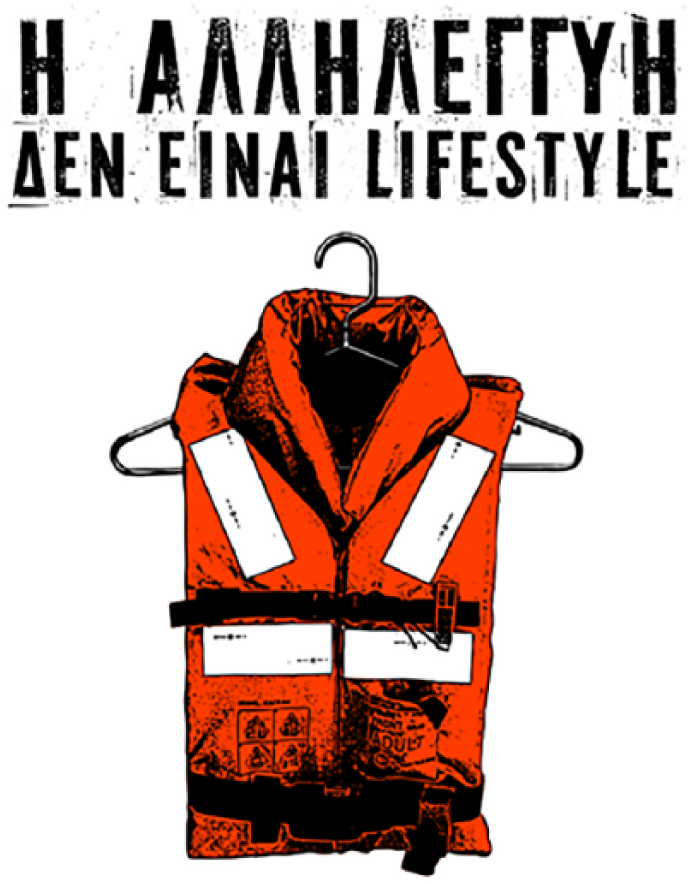
‘Solidarity is not lifestyle’ – No Borders page.
In many of these pages, the political role of solidarity is clearly articulated in the slogan ‘solidarity is our weapon’, and this in turn expresses the political project of solidarity as the connection of various people subjected to different but equally devastating crises, in order to come together as political subjects. The politics of solidarity as struggle is clear in the picture below, that is, the logo of the Platanos solidarity group in Lesvos. The picture in Figure 2 simultaneously shows the platanos (sycamore) tree – which in Greece is known for providing shade and shelter – and a raised fist, pointing to an understanding of their work as a struggle and in common with other political struggles for freedom, justice and equality.
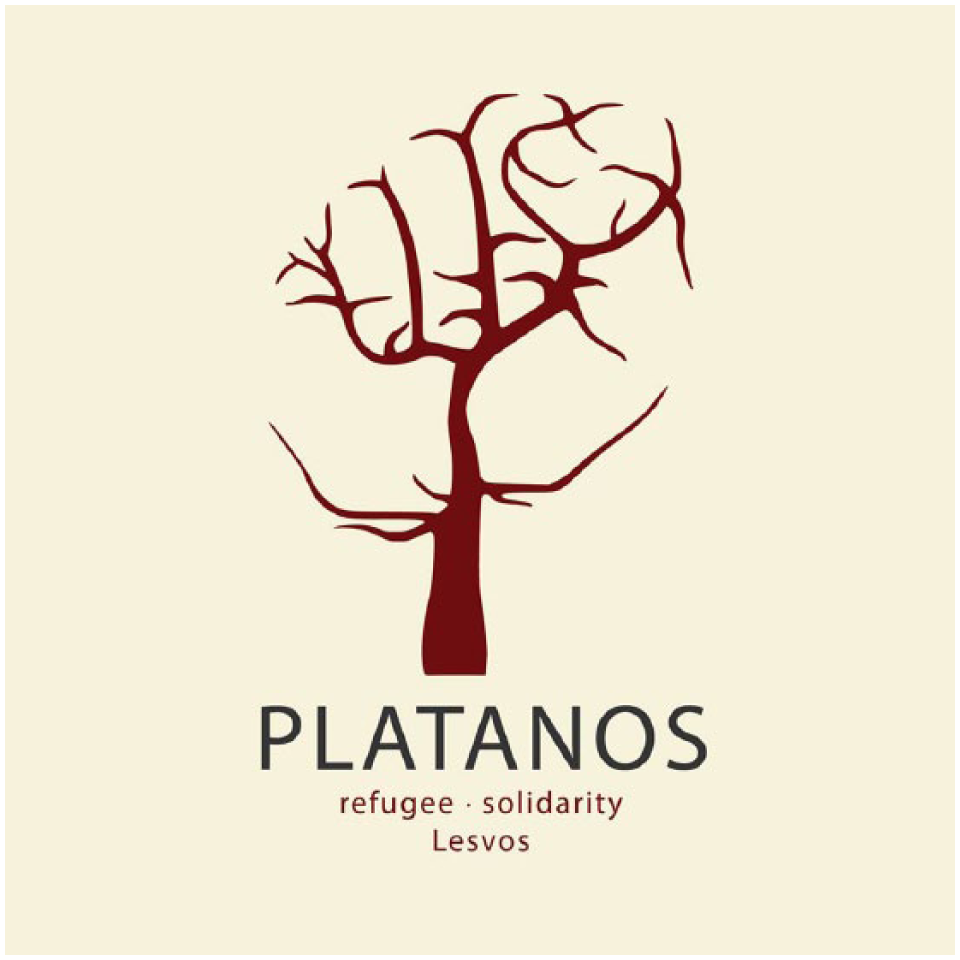
Logo of the Platanos (sycamore) refugee solidarity group in Lesvos.
Solidarity is therefore invoked in the first instance as solidarity with displaced people who arrived in Greece seeking refuge. This can be understood as human solidarity, based on an understanding of refugees as fellow human beings. In her work on European solidarity, Karagiannis (2007b) distinguishes between human solidarity as solidarity in the name of humanity, and social solidarity, which refers to social bonds within a given society. In the EU treaties and policy documents, Karagiannis found that human solidarity is expressed towards the ‘rest of the world’ and social solidarity is expressed towards the ‘inside’ of Europe. For Karagiannis (2007b), both human and social solidarity have to be co-articulated and rendered concrete: ‘Only when solidarity with “the rest of the world” will be a social solidarity […] will it have any serious impact both on the weaker areas of the world and on the self-definition of Europe’ (p. 17).
However, the refugee crisis has in many respects complicated further the two solidarities and their articulation. As the EU–Turkey deal and increasing securitisation of the borders, and the hostile mainstream media coverage show, Europe seems to forego human solidarity. It is significant here that this stance is often juxtaposed with social solidarity, found in the welfare policies of many European countries. We cannot have social solidarity, the argument goes, if we are to have human solidarity: if everybody comes in, then our social solidarity, our welfare and cohesion will be lost. 8 Human solidarity is therefore diminished, and in an even more pernicious move, the very humanity of refugees is questioned. Khiabany (2016) documents the various ways in which policy and media discourses across Europe coupled with the rise of racist populist political parties conspire to de-humanise refugees and migrants and justify the brutal policies against them. In this respect, the first move of the solidarity support groups is to restore to them their lost humanity, and reassert the principle of human solidarity, but this time mobilised as a political aim: to reclaim the humanity of refugees from the dehumanising policies of the EU and Frontex. This takes the form of the various refugee stories told, the re-telling of the humiliations and injustices inflicted upon refugees by the Greek police and Frontex, and through insisting on the principle of human dignity. But this kind of solidarity on its own is not sufficient. Moreover, there is a danger that it may collapse to the self-indulgent ‘ironic’ position identified by not only Chouliaraki (2014) but also by Karagiannis (2007b), who was warning about the vague ‘human solidarity’ alluded to in some EU policy documents.
In a second move, therefore, such solidarity is seeking to build connections between the volunteers, the refugees and Greek society. This is a kind of social solidarity directed towards the building and sustaining of community: the posts examined in the previous section help accomplish this, alongside actions such as cooking, celebrating, running schools and, in general, ‘living together’, as some of the solidarity initiatives put it. This social solidarity comes to fill in the gaps left by the lack of any state help but, more so, it creates trust and makes conviviality possible. It is important here to note that such local initiatives and the social solidarity they build differ significantly from the actions and discourses associated with the large organised NGOs. Local volunteers often write critical posts regarding the detachment of these NGOs and their workers from the local communities, accusing them of a bureaucratic stance and inefficiency. 9 This kind of social solidarity by local communities insists on the closure of camps and the integration of refugees within the cities and towns where they are found. Significantly, there are many references to refugees as family, and as part of ‘us’: for example, this reference in the No Borders page: ‘we feel them as family. And they are [family]’, and in a post about a terminally ill refugee: ‘One of us. It is us lying in this bed’.
Social solidarity as the building and sustaining of community hinges on creating commonalities between refugees and the local community that go deeper than merely claiming a common humanity. In a third move, therefore, solidarity initiatives are concerned with connecting the various parts of society that are suffering. While a number of these initiatives and their pages emerged in recent months, they borrowed know how, and often relied on the labour of people already involved in solidarity initiatives in Greece, that sought to provide for the needs of those hit by austerity. Solidarity clinics, housing, food provision and so on were already in operation when the refugees started coming in. These were then extended to include refugees. But in doing so, they explicitly acknowledge that refugees (and economic migrants) are also the victims of capitalist crises that take the form of accumulation by dispossession through war or through austerity policies (see Harvey, 2007 10 ). In linking the austerity crisis in Greece with the war and general destabilisation of the Middle East and with the neo-imperialist advances in African countries, the solidarity initiatives are explicitly articulating a kind of class solidarity that operates beyond the national level and beyond commonalities of language and culture. Standing with refugees and with the ‘losers’ of Greece’s imposed austerity, the unemployed, the homeless, the impoverished pensioners and the precarious workers, these groups question and undermine the divisions imposed and the literal and metaphorical borders erected between Europeans and ‘others’. Slogans found in some of the pages such as ‘Migrants are the wretched of the earth, in the world of bosses we are all foreigners’ and ‘common struggles of locals and refugees against bosses and fascists’ or ‘In Greece-Turkey-Syria and France, the enemy is the banks’ point to the politicisation of the refugee crisis and the attempt to build a political, class-based solidarity. This kind of class solidarity is crucial because, as Khiabany (2016) argued, drawing on Marx, refugees are part of a global labour reserve, used and mobilised in order to control and regulate the demands of workers. Repositioning refugees and migrants alongside rather than against indigenous workers, the unemployed and those hit by the crisis, is therefore a crucial component in the political project in which such solidarity groups are involved.
But this project is not only formulated in demands towards the state and/or the EU. It is also manifested in concrete actions from below that bring communities together in self-organisation and mutual empowerment. For example, the housing squats are not merely demanding housing for refugees but they are actively creating social housing, and in doing so, they create a community and practise self-organisation from below, including decision making via weekly assemblies, with refugees actively participating in the day-to-day activities, work rotas and in the decision-making processes. Alliances with refugees through these and many other solidarity initiatives can be understood as part of a broader political project of autonomy and self-management, which looks to create an alternative, social economy, and to redress some of the injustices inflicted by neoliberal capitalism. This is explicitly stated in some of the pages and their associated websites, and implied in the actions and communications on Facebook and elsewhere. For example, the website of City Plaza Hotel explains its goal as ‘the realization of a conception of everyday life that aims to emancipate from below, and ultimately to create a space of freedom that shows in practice the kind of society that we envision’. 11
These varieties of human, social and class solidarity can be seen as directly addressing and dealing with the various segregations and divisions imposed by the borders erected between Europe and its south and east, between indigenous and foreigners, between ‘our’ culture and ‘theirs’, and between economic migrants and war refugees. A solidarity that begins in togetherness, proceeds through building and sustaining commonalities and conviviality and ends in the formulation of a new politics resisting the violence of neoliberal capitalism and the relentless and constant competition it imposes, is at the heart of the work undertaken by these groups.
Conclusion
This article began with a discussion of the notion of a hybrid media system, in which mainstream media are a focal and central part, but not the only one. Although we need to avoid understating the role and power of mainstream media, it is also important to acknowledge the complex media environment that has emerged since the advent of social media. Thus, while studies on mainstream media representations and discourses on refugees and migrants have been relentlessly negative, they are not the only ones circulating in this complex media system.
In this context, the present article sought to interrogate the social media pages of grassroots, local groups formed in solidarity with refugees in Greece.
The analysis of the posts identified three different kinds of solidarity which are all combined: human solidarity, which seeks to restore the humanity of refugees lost in the brutal policies and in the negative mainstream media coverage; social solidarity, which seeks to position refugees within society, and to extend full social and civic rights and because, finally, social and political rights in the context of Greece have been eroded in recent years, there is another necessary solidarity, class or political solidarity that repositions refugees alongside the indigenous victims of neoliberal crisis and dispossession. Solidarity to refugees emerges, therefore, as a political project that extends beyond the offer of immediate help towards a reconstruction of society along lines of autonomy, equality and justice. In this sense, these forms of solidarity collapse the distinction between cosmopolitanism and communitarianism discussed by Chouliaraki, as they extend communitarianism to specific others, and in this manner, they politicise solidarity, calling for political action in common alongside others in a similar position. Ethics, in this manner, is replaced by politics, and the refugee crisis is framed as an integral part of capitalist crisis. Chouliaraki’s agonistic solidarity as a question of judgement and imagination shifts to the practical political project of building connections pointing to commonalities of experience and the connectedness of struggles with a view to emancipate. This solidarity owes more to Marx and less to an ethical positioning towards the Other.
The existence and circulation of these discourses in the hybrid media system forms a much-needed counter-discourse to the often overtly racist mainstream media and the liberal humanitarian ‘feel good’ responses to the refugee crisis. This does not imply that these discourses have the same power as the mainstream media and the organised global NGOs. However, ignoring them would ignore an important rising politics from below, which, at least in Greece, has succeeded in finding resonance and support in local communities. Their considerable successes in maintaining good relations with refugees in a context of protracted crisis and scarce resources point to the relative success of the solidarity discourses even when Greek mainstream media have actively tried to undermine the work of such groups. 12 As these groups themselves have argued, they constitute the only plausible response to securitisation, racism and liberal humanitarianism currently available.
Footnotes
Funding
The author(s) disclosed receipt of the following financial support for the research, authorship, and/ or publication of this article: Research leading to this publication has been funded by the consortium Humanities in the European Research Area for the collaborative research project “The debt: historicising Europe’s relations with the ‘South’” within the Joint Research Programme “Uses of the Past”.
Notes
Biographical note
Eugenia Siapera is a Professor of Information and Communication Studies at University College Dublin. Her research interests are in the field of digital and social media, cultural diversity, journalism and the digital public sphere. Her most recent book is the second and revised edition of Understanding New Media (Sage, 2018).