




Abstract
This study analyzes social media representations of refugees in Turkey and discusses their role in shaping public opinion. The influx of millions of Syrian refugees in Turkey has created heated debates about their presence and future in the country. One of these debates was triggered by President Erdoğan’s statement that Turkey would issue citizenship rights to Syrians in July 2016. Due to a lack of critical voices about refugee issues in Turkey’s mass media sphere, social media has become a key platform for citizens to voice their opinions. Through a discourse analysis of tweets about the issue of refugees’ citizenship, I will map different perceptions of refugees in Turkey. I argue that despite contesting discourses about Syrians, the debate on social media reinforces nationalism and an ethnocentric understanding of citizenship in Turkey. As the number of refugees and migrants increases rapidly worldwide, they become the new ‘others’ of national imagined communities. Social media becomes a key communication space where the nation is discursively constructed in a bottom-up manner through manifestations of ‘us’ and ‘them’. The analysis shows that social media contributes to trivialization and normalization of discrimination and hatred against Syrian refugees through disseminating overt discourses of ‘Othering’. Social media also enables more covert forms of discrimination through ‘rationalized’ arguments that are used to justify discrimination through the basis of false/non-verified information. Thus, Twitter becomes a space for critical, bottom-up, yet nationalistic and discriminatory statements about refugees.
Introduction
By circulating representations of social reality and giving people a space for expressing and informing themselves, social media plays an important role today in shaping public opinion. Hence, social media representations are key to understanding perceptions of refugees and immigrants across different contexts. Although there is a large body of literature focusing on mass media representations of refugees (Caviedes, 2015; Chouliaraki and Stolic, 2017; Harrison, 2016), research on social media representations is still developing. In this article, I aim to contribute to this emerging field by analyzing social media debates on refugees in Turkey, which also constitutes a new geographical focus for the research field of media and migration.
Since 2014, Turkey hosts the largest population of refugees worldwide, with 3.6 million currently registered Syrians (Mülteciler ve Siginmacilar Yardimlasma ve Dayanisma Dernegi, 2019) and around 350,000 additional refugees from countries other than Syria (Erdoğan, 2017: 9). Only around 8 percent of Syrians in Turkey are recognized officially as refugees and live in refugee camps. Approximately 92 percent of Syrians (2.8 million) live as ‘guests’ under ‘temporary protection’ in different cities in Turkey (Erdoğan, 2017). Many refugees in Turkey still do not have access to the social welfare system, education or job market in Turkey (Baban et al., 2017: 53). Hence, most Syrians live and work in precarious situations or are driven to illegality (Baban et al., 2017: 53).
Being able to obtain citizenship rights constitutes a key issue for the integration of refugees (Koser Akcapar and Simsek, 2018: 177–179). On 2 July 2016, Turkish President Recep Tayyip Erdoğan made a statement about giving qualified refugees citizenship rights in his talk at an iftar dinner in Kilis, a small city in Turkey’s Syrian border: I tell my Syrian brothers/sisters
1
that we see you as brothers/sisters. If you also see us as brothers/sisters, you are not away from your homeland, you are only away from your homes. [. . ..] Turkey is also a homeland for those coming from Syria [. . .] I believe that among our brothers/sisters there are those who would like to be citizens of the Republic of Turkey. Our Interior Ministry has taken some steps toward this. They will do what they can by tracking this through an office that our ministry built, and we will provide this support and help to our brother/sisters with the citizenship opportunity.
2
Erdoğan’s statement started a heated public debate about the issue of Turkish citizenship, which has always been a problematic issue in Turkey due to tensions between the state and existing religious and ethnic minorities. One of the main platforms of this debate has been social media, which has become a primary source of information for many users who are skeptical of the mass media environment in Turkey given government pressure and increasing (self-)censorship of reporters. 3 Furthermore, although refugees have entered the everyday lives of many people, issues related to refugees appear rather seldom in the national and local mass media (Erdoğan et al., 2017: 21–24).
Discussions about issuing citizenship rights to refugees constitute an interesting case study as they reveal conflicting imaginaries of citizenship and different positions about the refugee issue in Turkey. The questioning of the boundaries of citizenship rights is critical not only for shaping Syrians’ future in Turkey but also for reshaping the understanding of citizenship in general. Furthermore, analyzing this debate on Twitter can help us understand what kind of representations of refugees are available on social media and how these relate to dominant frames in mass media representations.
In this article, I address these issues on the basis of a qualitative discourse analysis of tweets about issuing Turkish citizenship rights to Syrians. Most existing research on Twitter adopts quantitative approaches and analyzes large numbers of tweets. I will argue that the discursive elements of tweets, which are key to understanding the patterns of representation of social issues on social media, can be better understood through a closer analysis of a small number of tweets.
Before presenting the methods and findings of the research in detail, I will discuss the issue of citizenship, nationalism and media and the characteristics of Twitter as a public communication space in the next sections.
Citizenship, nationalism and media
Citizenship is, in the simplest terms, a contract-like membership to a territorial community, today mostly a nation-state, which issues certain rights to its members (Brubaker, 1990: 380). Citizenship rights can be issued-based on the principle of jus soli (French model), assuming everyone living in a certain territory is a member of that state, or on the principle of sanguinis (German model), taking ethno-cultural origin as the basis of state membership (Brubaker, 1990: 370, 379).
Since the foundation of the Turkish Republic, citizenship is seen as one of the key elements of nation-building in a highly multi-cultural and multi-ethnic society (Içduygu et al., 1999: 187). Therefore, the Turkish citizenship law adopted the more inclusive French model, which emphasizes territoriality over ethnicity and defines the Turkish nation as a political community (Kirişci, 2000: 1). However, the actual practice of Turkish citizenship rights has always been quite ethnocentric, taking Turkish ethnic origin and Sunni Muslim identity as its basis (Kirişci, 2000: 1; Yeğen, 2004: 55).
Similar to its citizenship policies, Turkey’s immigration policies have also been based in relation to religion and ethnicity. Throughout its history, Turkey faced different types of immigration flows from various countries (for an overview, see Erdoğan and Kaya, 2015). However, citizenship through immigration and asylum has been issued mainly to individuals of ‘Turkish descent and culture’ 4 (Kirişci, 2000: 14). Turkish citizens’ understanding of the notion of citizenship is also influenced by its ethnocentric practice. A considerable part of the population believes that Turkish citizens should have a Turkish ethnic (38%) and Muslim religious background (41%) (Kadioglu et al., 2016: 19).
Shortly after Erdoğan’s speech in Kilis, two laws related to migration were changed (Koser Akcapar and Simsek, 2018: 179). The first change in August 2016 concerned new regulations for the integration of the international labor force through a point-based and employer-led system. It introduced the Turquoise Card, which enabled permanent work permits for people considered of strategic importance in relation to their level of education, professional experience and investments in Turkey (Koser Akcapar and Simsek, 2018). The second change was made in the citizenship law through an amendment in December 2016, which included exceptional citizenship criteria on the basis of investments in Turkey and contribution to science, economy, social and cultural life, sports and arts in Turkey (Koser Akcapar and Simsek, 2018: 180).
The perception of citizenship is closely linked to the idea of the nation as an ‘imagined community’ (Anderson, 2006). A nation as an imagined community is not only shaped by top-down discourses by politicians, media institutions, laws and education, and through internalization of these discourses but also through bottom-up language use in the everyday lives of the members of the nation-state (KhosraviNik and Zia, 2014: 760). The imagination of the nation is not a conscious process but is rather embedded in the banal practices of everyday life (Billig, 1995: 95). The nation is discursively constructed in everyday contexts as it is manifested in an implicit and banal manner through recurrent representations of ‘us’ and ‘them’ as taken-for-granted groups (Billig, 1995).
Mass media plays a crucial role in the daily reproduction of nationhood by using overt and covert forms of flagging the nation (Yumul and Özkirimli, 2000: 801). Today, social media also contributes to the reproduction of the nation by not only reverberating top-down discourses about nationhood but also opening up a space for discourses to wider publics (Iveson, 2017: 65; KhosraviNik and Zia, 2014: 776). As the Internet allows for a more decentralized, diversified and pluralized form of content production, it also enables a more bottom-up production of banal nationalism (Szulc, 2017: 66).
Twitter as a public communication space
Social media has transformed public communication by adding new layers to ‘publicness’ as larger groups of people than ever before have access to broadcast media on an everyday basis, creating multiple and diverse kinds of publics, counter-publics and other forms of social arrangements (Baym and boyd, 2012: 321–322). Social media is designed to facilitate social interaction, exchange of digital content and collaboration (Murthy, 2012: 1061). Twitter is a specific type of social media that is mostly used for public communication, allowing users to have a public profile, share messages (limited to 140 characters originally, expanded to 280 characters in November 2017) publicly, follow others and be followed by them (Murthy, 2012: 1061).
Twitter users can engage and interact with other users (likes, mentions, retweets, comments and replies) and connect through themes (hashtags) as they are tweeting. Hashtags serve as ‘framing devices’ rendering crowds into publics (Papacharissi, 2016: 308). ‘Networked publics’ (boyd, 2010) on social media emerge in an ad hoc manner around certain issues and hashtags (Bruns and Burgess, 2011). These networked publics can turn into ‘affective publics’ that are united, identified or disconnected through the public display of affect and mediated through social media (Papacharissi, 2016: 308). Networked platforms like Twitter can be used to mobilize people for ‘connective action’ that emerges out of personal frames on current affairs using the expressive and connective communication opportunities that these platforms offer (Bennett and Segerberg, 2013). They can also be used to support and organize collective action and more organized forms of (online and offline) protest movements (Varnali and Gorgulu, 2015: 4).
Social media has brought about new dimensions of public communication, allowing networked communication among a larger group of people (boyd 2010: 39), giving visibility and voice to their concerns and opinions (Papacharissi, 2016: 309–310) and shifting power in the media system (Chadwick, 2013: 207). Social media also serves as a backchannel for traditional media, especially television (Harrington et al., 2013: 405). It can also open up a space for bottom-up discourses that are not visible elsewhere (Iveson, 2017: 65; KhosraviNik and Zia, 2014: 776; Papacharissi, 2016: 309). However, public communication on social media is not completely isolated from traditional media. New and old forms of media intertwine in several ways, creating an interdependent hybrid media system (Chadwick, 2013: 4). Many journalists use social media as a news source, and online news stories shared through Twitter constitute important information sources for online publics (Ojala et al., 2018: 4).
Although Twitter is a good source for studying perceptions about social issues, it is also limited. First of all, not everyone is represented on Twitter. Twitter users have a certain bias toward younger, better-educated and male users (Barberá and Rivero, 2015: 712; Yegen et al., 2016: 66). 5 Only about 36 percent of the population of Turkey (81 Million) uses Twitter, according to the ‘We are social Western Asia report 2018’. Furthermore, the character limit per tweet on Twitter does not allow users to articulate differentiated and detailed argumentations and favors more clear-cut and evaluated arguments (KhosraviNik and Zia, 2014: 766). Thus, users with clear ideological leaning generate most of the content on Twitter, leading to overrepresentation of polarized positions (Barberá and Rivero, 2015: 714). Although only a minority of the population produces discourses on Twitter, the platform reaches a larger group of people as many users remain silent and/or engage with Twitter content through different forms of listening (Crawford, 2009). Twitter content, therefore, constitutes an important source for shaping public opinion about social issues.
Methods
Social media has become an agora for the reflection and representation of social reality. Hence, it has become an important but limited source for studying social issues. Since social media offers the possibility of archiving and analyzing big portions of data, it has become an attractive source for quantitative (big data) analysis. Thus, most research on Twitter adopts a quantitative approach (Marwick, 2014: 110). However, having access to large amounts of data neither means that the analysis and sampling of the data will be less challenging nor that it will be more accurate (boyd and Crawford, 2012: 667–670). A closer and contextualized study of smaller amounts of data can still provide us information that cannot be extracted from the (automated) analysis of big data sets (boyd and Crawford, 2012: 670).
Whereas several studies focus on the representation of refugees in mainstream media, social media representations of refugees and immigrants are still an understudied field. Existing research especially focuses on visual representations (Guidry et al., 2018; Mortensen, 2017; Vis and Goriunova, 2015), certain hashtags (Barisione et al., 2019; Kreis, 2017) or certain actors (Marwick and boyd, 2011; Lee et al., 2014). Departing from these studies, I focus on the analysis of representations of Syrians that are available on Twitter in Turkey. Although it cannot claim to provide a detailed analysis of all users’ perspectives, the study of Twitter debates provides an access point for understanding the resonance of Erdoğan’s statements and citizens’ perceptions of Syrian refugees in Turkey. Within a week following Erdoğan’s statements, 2562 tweets including both of the words ‘Syrian’ and ‘citizenship’ 6 were posted on Twitter. There are two research questions guiding this study. First, how are Syrian refugees represented in social media debates in Turkey? Second, how is possibly issuing citizenship rights to Syrian refugees perceived in society?
The analytical methods used in this study vary from thematic content analysis (Lee et al., 2014; Eriksson, 2016), Grounded Theory (Murthy, 2017), critical or historical discourse analysis (Iveson, 2017; Kreis, 2017) to (online) interviews (Marwick and boyd, 2011). This research adopts critical discourse analysis (CDA), which promises a fruitful approach for studying social media (Iveson, 2017; KhosraviNik and Unger, 2015; Kreis, 2017). CDA of media texts can help us reveal how the world, identities and relationships are represented in this media (Fairclough, 1995: 5). Moreover, these representations are socially shaped, and they also shape our understanding of social reality (Fairclough, 1995: 55).
CDA distinguishes itself from linguistic analysis with its emphasis on the contextualization of the language (KhosraviNik and Unger, 2015: 208) and its focus on the issues of power, inequality and domination (Van Dijk, 2008: 85). At the macro level, CDA examines language within the societal context rather than within the discourse on technology. (KhosraviNik and Unger, 2015: 208). The communicative practices on social media are a combination of texts, visuals and user interactions including likes, replies, retweets and comments (KhosraviNik and Unger, 2015: 213). In this sense, the CDA of social media platforms should also consider the genre-specific aspects of communication on the specific platform that is being studied (KhosraviNik and Unger, 2015). For the case of Twitter, these include pictures and videos, links embedded in tweets and the number of likes and retweets, which were all included in this analysis. Mentions and replies also constitute part of the discourse on Twitter. These elements were included in the analysis if the selected tweet was a reply to another tweet; however, it was not possible to track the replies to the selected tweets and the analysis of the interaction among users.
The shortness of the tweets and the lack of context was one of the major challenges in the analysis. In order to be able to interpret the tweets, the analysis also included information about the broader contexts referenced in the tweets. Therefore, I collected general information about the analyzed period and the citizenship debate through newspaper articles, politicians’ statements and links from archived tweets. Specific information about certain users and events was collected in cases where tweets were unclear. This information was used for interpreting users’ tweets and was not coded systematically. For example, on 6 July 2016 many users made reference to the death of two Syrians without giving detailed explanations. The search in the newspaper archives revealed that two Syrians died that day as they were building a bomb at home and the bomb accidentally exploded in their hands. 7 In this case, some of the tweets could only be understood with further reference to the users’ political positions and previous tweets. The political positions of the users were identified in relation to their previous tweets about Turkish/Kurdish nationalism, secularism and Islam, and political parties. The contextualization of the analyzed material proved to be one of the strengths of CDA for social media analysis, especially given the lack of available information.
The presented research focuses on the period between 2 July 2016 and 8 July 2016 when the discussion of Syrians and citizenship peaked on Twitter. All tweets including the keywords ‘Syrians’ and ‘citizenship’ (in Turkish) between these dates were searched through Twitter’s advanced search function and downloaded through the software DataMiner. First, 462 tweets (mostly on the first day) that only quoted newspaper articles with links without stating an opinion about the refugee issue (e.g. ‘Erdogan: We will give citizenship opportunity to our Syrian brothers/sisters’) were deleted from the data corpus. In order to downscale the remaining data to make it manageable for a detailed qualitative textual analysis (KhosraviNik and Zia, 2014: 764), all the collected tweets were listed in Microsoft Excel in chronological order, and every fifth tweet was chosen and copied to a new sheet. A total number of 420 tweets remained. From these, 10 were posted by the same user and were deleted. The remaining 410 tweets constitute the material corpus of the CDA that will be discussed here. Almost all tweets included meaningful statements about the issue of citizenship. The use of keywords instead of hashtags seemed to reduce the number of irrelevant tweets in the data.
Although hashtags are one of the most characteristic elements of Twitter, the majority of the analyzed tweets did not include any hashtags. One of the few hashtags that was used by 21 users was #ÜlkemdeSuriyeliIstemiyorum, 8 meaning ‘I don’t want Syrians in my country’. Most of the analyzed tweets included external references to websites, news articles, videos and images, which were also used to interpret some tweets. Some tweets included Twitter polls about the issue or gave links to open polls in websites like Politico. There were also 10 tweets that were linked to different change.org campaigns against issuing citizenship rights to Syrians. 9
The method of data collection used in this study runs the risk of including bots or fake accounts. However, all of the randomly selected 410 tweets (including those by bots) contribute to the ways in which the refugee issue is being debated and represented on Twitter and are therefore included in the analysis. The analysis of the tweets was conducted through Microsoft Excel using a code scheme (see Table 1) of inductive and deductive codes.
Analysis categories.
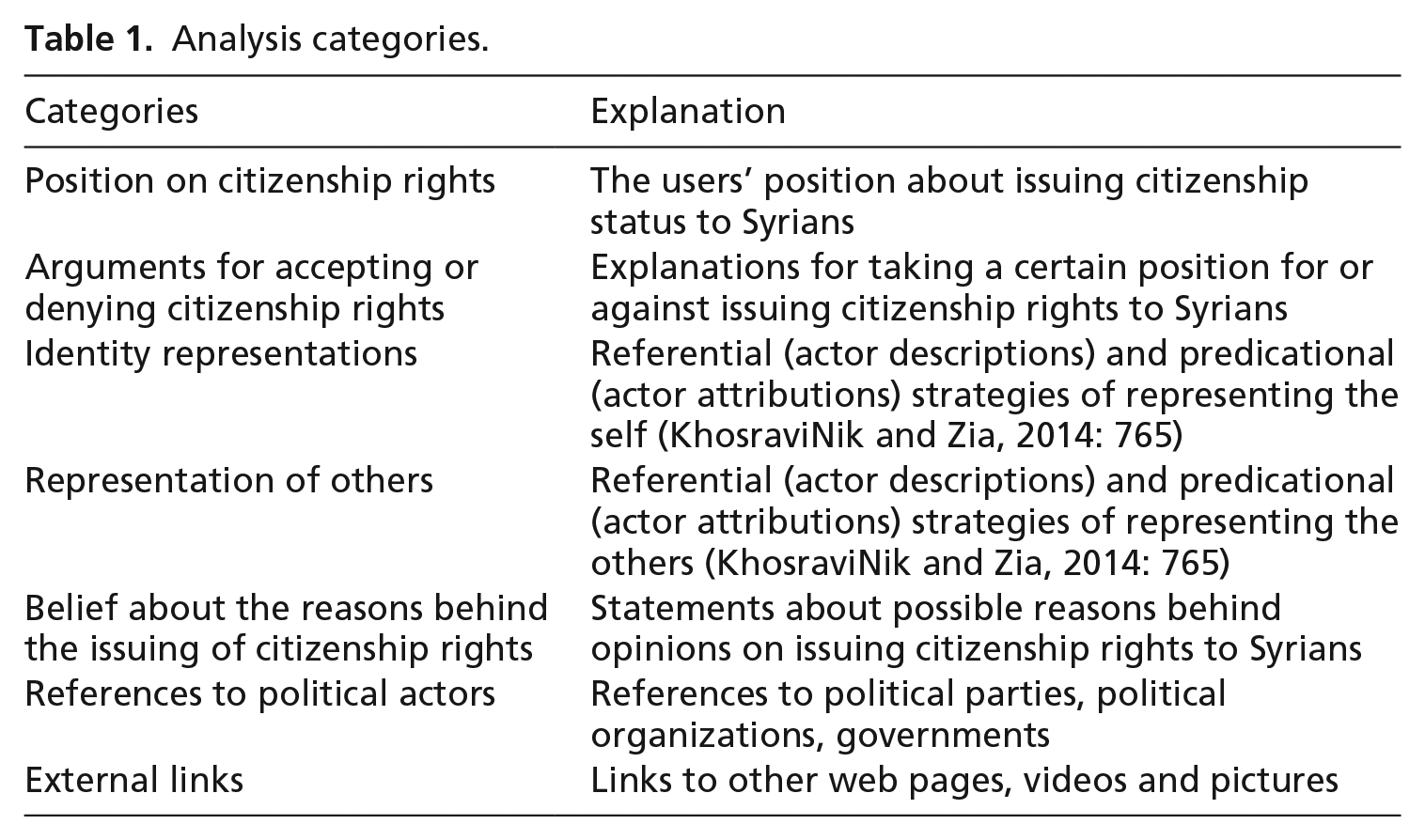
The analysis categories were used to map different positions and discourses about Syrian refugees and issuing citizenship rights to them. They also helped to understand the argumentation patterns of different positions on the issue, for example, the common reasons people gave for opposing or favoring citizenship rights for Syrian refugees or common patterns of depicting the dichotomy of ‘us’ and ‘them’.
Mapping discursive positions about the refugee issue on Twitter
Based on the analysis, four commonly shared positions on the citizenship issue were identified: (1) those supporting the citizenship issue on the basis of the imagination of a Islamic brotherhood/sisterhood (45 tweets); (2) those who perceive the issue from an anti-AKP perspective, arguing that the AKP and the president are instrumentalizing Syrian refugees for raising their voter share (40 tweets); (3) those who either despise Syrians or argued that only people of Turkish ethnic descent can receive citizenship rights in Turkey (111 tweets); (4) those who rationalize opposing issuing citizenship rights to Syrians by pointing to economic, political, and cultural threats and giving (non-verified) statistics (60 tweets). There were few tweets in which different positions overlapped, for example, those that combined racist positions and anti-AKP positions. The majority of the analyzed tweets only expressed one of these positions. In total, 324 of the 410 tweets were clearly against issuing citizenship rights to Syrians. Forty-one tweets did not indicate a clear position about the issue (e.g. they asked questions such as ‘Do you support issuing citizenship rights to Syrians?’). Seventy-eight users stated that were against issuing citizenship rights, but their tweets could not be categorized under these four positions due to lack of further information. There were almost no users supporting Syrians’ citizenship rights that did not refer to the brotherhood/sisterhood reference used by the president. Thirty-five users stated that they conditionally supported Syrians being in Turkey and receiving help, but they were against issuing citizenship rights. A few tweets gave links to commentaries in leftist newspapers that offered a differentiated analysis of the citizenship issue and partly supported it.
In the following sections, users’ four most common positions on issuing Syrians’ citizenship will be discussed on the basis of different discursive patterns of representing their positions (positive or negative portrayals of ‘us’ and ‘them’) as well as the common reasons users gave for taking a certain position.
Arguments for (Islamic) brotherhood/sisterhood
The imagined brotherhood/sisterhood emphasized in President Erdoğan’s speech is based on Turks’ shared Muslim background with Syrians. During his speech, the president also claimed that Turkey is a ‘homeland’ for ‘those coming from Syria’. Among the 410 tweets analyzed, 45 evoked the sentiment of brotherhood/sisterhood in sharing the president’s position toward issuing citizenship rights to Syrians. One example of this is seen in the following tweet: Syrian refugees would be more useful to the country than those who are disturbed by them. Those Syrians who pass a security investigation should be given citizenship.
10
The tweet implies that the most important ideal here is protecting ‘the country’, that is, Turkey, and argues that Syrians might contribute to this. At the same time, the user distances himself or herself from those who are ‘disturbed by [Syrians]’, implying that they are not useful for the country.
Another tweet mentions people who oppose issuing citizenship rights to Syrians and argues that they are ‘[probably] Greek or Bulgarian migrants’. Implicitly, the user is arguing that those who are themselves migrants are not the ones who will decide whether Syrians should gain citizenship rights in Turkey. The negative portrayal of those who are against the president’s statements and issuing citizenship rights to Syrians is a strategy utilized by users who are in favor of citizenship rights. This can again be seen in the following example: The citizenship of our Syrian brothers/sisters is a strategic Ummah project. You will understand this if you look at those who oppose [this project], you fool [link to the nationalist/secularist newspaper Sözcü’s website].
The user above is not only distancing himself or herself from others but also arguing that issuing citizenship to Syrians is part of a ‘strategic Ummah project’. As the word Ummah indicates, the tweet projects an ideal of a global Muslim community. Another tweet that was retweeted 58 times and liked 156 times goes even further and argues, ‘as we are giving citizenship to our Syrian brothers, we should also denationalize those Byzantine remnants’. The user is referring to the former Christian Byzantine Empire that ruled before the Ottoman Muslim conquest, which is often used by nationalists in Turkey as a historical reference to depict others as ‘enemies and threats’ within society. The user further argues that while Syrians are receiving citizenship rights, those who are enemies of Turkish society should also be denationalized. The user adds, ‘It is not so cheap to carry the identity of the moon and the star (ayyıldiz, symbolizing the Turkish flag)’, implying the issue of ‘deserved-ness’ of citizenship rights.
Anti-AKP discourses: ‘citizenship rights for votes’
Another common position found in the analyzed data is the perception that the government issues citizenship rights to Syrians as a strategic act of the AKP to raise its voter share. This was particularly argued by users who are generally critical of the AKP government and the president. Two examples of this group of tweets are as follows: RTE, who saw that he is losing votes, is making three million Syrians citizens. Throw out citizenship to catch votes. So give Syrians citizenship, get the votes, and then look for peace and stability in the country . . . Most of the Syrians here are in line with ISIS mentality . . .
The users claim that the AKP only intends to issue citizenship rights to Syrians in order to raise its voter share. The latter also indicates that the AKP is risking the country’s stability and peace. The user makes a generalized argument saying that all Syrians share ISIS mentality, depicting them as a threat to Turkey’s security.
Some other users again frame the AKP’s decision to issue citizenship rights to Syrians as merely a strategic act that complies with the European Union (EU)–Turkey refugee deal. The EU–Turkey refugee deal was signed in 28 March 2016. With this deal, Turkey and the EU agreed, ‘all new irregular migrants crossing from Turkey to the Greek islands as of 20 March 2016 will be returned to Turkey’; Turkey will ‘take any necessary measures to prevent new sea or land routes for irregular migration opening from Turkey to the EU’; and ‘the EU will mobilize additional funding for the Facility up to an additional €3 billion to the end of 2018’.
11
The user below interprets the issuing of citizenship rights to Syrians as a step taken to keep Syrians in Turkey based on the EU–Turkey refugee deal: I assert that the only reason for giving Syrians citizenship rights is the deal with the EU. With this, Syrians will stay in Turkey. You will see.
The EU here is depicted in this tweet as complicit with the AKP in trying to keep Syrians in Turkey and away from the EU. This kind of conspiracy thinking is present in several tweets that oppose issuing citizenship rights to Syrians. These users are mostly looking for deeper intentions and blame the AKP for its hypocrisy. For instance, this tweet implies that the AKP’s intention is not to build solidarity among Syrians and Turks: Every Syrian who is issued citizenship rights in the country means one vote for the AKP. If the aim was solidarity, it would have been okay; it is just about gaining advantage.
The user is not directly against issuing citizenship rights to Syrians, as he or she states in the above-quoted tweet, but is opposed to the AKP’s pragmatic politics. The examples above show that several users seem to oppose citizenship rights for Syrians based on their critical position about the government. Thus, the existing fault lines between government supporters and opponents influence the perception of Syrians in Turkey.
Racist accounts: ‘I am a fascist, I am a racist. I don’t want Syrians’
Among the analyzed tweets, those that leaned toward hate speech and (self-declared) racism constituted the largest group (111 out of 410). These employ negative and generalizing portrayals of Syrians as ‘Others’ and positive portrayals of ‘Turks’ as ‘us’. Many of these types of tweets also include threats, hate speech and slander, some of which will not be quoted here. Two examples of this group of tweets are as follows: [If] I am a racist because I am against issuing citizenship rights to Syrian creepers, then I am a RACIST. [If] I am a fascist, then I am a FASCIST. (Emphasis in the original tweet) Syrians. Whoever says that citizenship should be given to Syrians does not have any Syrians close to them. I am a fascist, I am a racist. I don’t want Syrians.
The interesting point in both tweets is that users self-identify as racists. Such a statement is not necessarily a sincere recognition of one’s racist acts but a rhetorical statement about how much one distances himself or herself from the other despised group. Both users present Syrians negatively in their tweets, the first one explicitly by referring to them as ‘creepers’, the second one more implicitly by arguing that anyone who knows Syrians and lives close to them would not say that they should be given citizenship. A similar expression of hatred can be found in other tweets as well: Instead of giving citizenship to Syrians, let’s give citizenship to Africans. Wherever I get to know an African person, they are a thousand times better and cleaner. They wouldn’t steal.
By comparing Syrians to Africans, who would not steal and are claimed to be ‘better’ and ‘cleaner’, the user indicates that Syrians are the opposite of ‘good’ or ‘clean’. Such a generalization and attribution of negative characteristics to an ethnic group is a typical practice of racist discourse (Wodak, 2015: 370). Intensification/mitigation (Wodak, 2015: 371) is another discriminatory strategy that is used to argue against issuing citizenship rights to Syrians, as it can be seen in the following tweet: It is stupid to give citizenship to four million Syrians for the four qualified [people] among them. If not stupid then it is baseness.
The tweet exaggerates the number of Syrians in Turkey and assumes that they will all be given citizenship. Furthermore, it mitigates the number of qualified people among Syrians by drastically lowering the ‘exact’ number to four.
The racist discourse among this group of tweets is limited not only to the negative portrayals of others (mainly Syrians) but also to the positive and glorified portrayal of ‘us’ (Turks) in this case. Similar strategies of intensification and generalization are also employed in these portrayals. One example of this is quoted below: As our 20-year-old youngsters become martyrs, these 20-year-old bastards sell their homelands and run away to our country. And now you will give citizenship to these sons of bitches.
The user blames young Syrians for coming to Turkey instead of fighting for their homeland, making a comparison with Turkish youngsters who become martyrs for their homeland. The tweets cited above all point out commonly despised characteristics of Syrians, because of which they should not be given citizenship. Besides the emphasis on shared characteristics, there is also an emphasis on ‘Turkishness’, which is depicted in a positive light and seen as a natural precondition of becoming a Turkish citizen.
Rationalized arguments against citizenship rights
The fourth position that will be discussed here is of those who rationalize opposition to issuing citizenship rights to Syrians. This group does not oppose Syrians’ citizenship rights because they oppose the AKP government or because they despise Syrians. Instead, they indicate that the issuing of citizenship rights would harm Turkey. One user, for example, argues, ‘the demography of Turkey would change’ if Syrians are issued Turkish citizenship. Another user points out the sheer number of Syrians in Turkey to illustrate his point: The almighty is going to give Syrians citizenship. Who did they ask about this? Three million new citizens means five percent [increase in the population of Turkey] [link to an online newspaper].
The change in Turkey’s demographics is one of the most common arguments against issuing citizenship to Syrians because, it is argued, issuing citizenship rights would lead to the creation of a ‘Syrian minority’ in Turkey. Having unsolved problems with its existing minorities, many users perceive the emergence of a new minority group in Turkey as a serious threat. As one user explains, ‘giving citizenship rights to Syrians would mean that you are bringing civil war to this country’.
In addition to the argument against the changing composition of Turkey’s population, users also point to economic challenges as a reason for not accepting Syrians as Turkish citizens. One of the users made a comparison to Germany: A country like Germany, which has a very strong economy, has not given citizenship rights to two million Turks in 50 years. Where do you [the Turkish government] get the right to give citizenship to Syrians?
The above-cited tweet claims that even Germany, as a country with a strong economy, has not issued citizenship rights to Turks in Germany, implying that they did not do this because of economic challenges. However, the tweet includes misinformation about the number and the citizenship status of Turks in Germany. As the refugee issue constitutes a highly politicized matter, there is a high number of fake news reports about refugees which is influencing public opinion about them (Roozenbeek and Van der Linden, 2019; Schäfer and Schadauer, 2018) In other tweets in this category, we observe the use of non-verified/false information about Syrians, such as Syrians ‘receiving different types of social help from the state’, ‘not paying taxes’, or ‘receiving free housing’, in order to rationalize arguments against issuing citizenship rights to Syrians. The users who rationalize excluding Syrians from citizenship do not explicitly use racist discourse; they do not despise Syrians as a group or glorify the ‘Turks’. However, they still tend to generalize and exaggerate the status of Syrians in Turkey, which is a covert form of racist discourse.
There are some users who are an exception to this. These users empathize with Syrians and argue that we should show solidarity with them, but they are still against issuing citizenship rights for different reasons. One example of this is the following tweet: Saying ‘I don’t want Syrians’ implies a lack of conscience. But this should not be mixed with the issue of giving citizenship #ÜlkemdeSuriyeliİstemiyorum
The above-cited user is using the hashtag ‘I don’t want Syrians in my country’ to criticize it and describes not wanting Syrians in the country as a ‘lack of conscience’. However, he or she at the same time implies that citizenship is another matter. A similar tweet states, ‘We showed our humanity and opened our doors, but let’s not go too far’. Both users imply that although helping Syrians is a good deed, citizenship rights would be crossing the line.
Discussion and conclusion
Erdoğan’s statement about giving Syrian refugees citizenship rights on 2 July 2016 marked a turning point in the debates about the status of Syrians in Turkey. According to a recent report by the newspaper Sözcü, a total of 79,820 Syrians were issued Turkish citizenship between 2011 and 2019. 12 Although the actual number of people who have been officially considered for Turkish citizenship is quite low, the citizenship debate continues to influence the perception of Syrians in Turkey.
The analysis shows that the majority of the randomly selected tweets (324 out of 410) included statements against issuing citizenship rights to Syrians. These tweets employed different styles and discursive patterns in the ways in which they picture Syrians as a group. The positions varied from racist accounts and anti-AKP discourses to rationalized arguments against citizenship. Although Twitter debates might overrepresent critical positions about this issue, other research about the perception of Syrian refugees also presents evidence of the fact that a clear majority (75.8%) of the population sees citizenship rights as a red line 13 (Erdoğan, 2017: 29–30).
Some issues are especially prevalent among the analyzed tweets. One of them is related to perceiving refugees as economic threats (see also Erdoğan, 2014: 26). 14 Among the tweets, there are several references to the possible negative economic consequences of Syrians becoming Turkish citizens, on the one hand. On the other hand, tweets include widely shared myths about Syrians receiving different types of social and economic assistance. Reference to Syrians as security threats is another prominent topic in the analyzed data. Even those who were in favor of issuing citizenship rights emphasized the importance of security investigations for Syrians considered for citizenship.
Similar to other national contexts (especially in Europe), the perception of refugees as threats in relation to cultural values, economy, and security of the nation-state is a widely shared perspective among Turkish Twitter users. Such negative portrayals not only denote Syrians and other immigrants as ‘outsiders’ of the imagined community of the nation but also develop negative and discriminatory connotations about them as dangerous people and/or as free riders (see also Kreis, 2017: 498). Similar to Europe, a ‘culture of fearism’ was established in Turkey with the help of mass media discourses and social media as the fear of outsiders became more widespread (Harrison, 2016: 6). Furthermore, despite the discourses of (Islamic) brotherhood/sisterhood that are commonly used by politicians in power to legitimize Syrians’ bonds to Turkey, this study shows that Syrians are largely perceived as ‘Others’ of the nation. The negative portrayals of Syrians and positive depictions of ‘us’ on social media (e.g. the imagination of a generous Turkish nation that is helping those in need) reinforce nationalist discourses.
The analysis also shows that rather than transforming the understanding of citizenship, the debate on Twitter reasserts preexisting ethnocentric perception of citizenship in Turkey. These ethnocentric articulations of the imagined nation at the same time create discourses of discrimination as they ‘underpin the justification/legitimization of inclusion/exclusion’ (Wodak, 2015: 370). There is a similar resurgence of nationalist discourses in the European context against increasing refugee and immigrant flows (Wodak and Boukala, 2015). One interesting point here is the issue of ‘deserving-ness’ of citizenship rights in contrast to citizenship rights by birth, which was emphasized by several users and should be addressed in future studies on citizenship.
The focus on the citizenship issue highlights the overall negative perceptions of refugees in Turkey. Studies about social media representations in Turkey and in Europe focusing on different periods of the Syrian refugee crisis (e.g. debates after the release of the iconic picture of Alan Kurdi, a Syrian child whose dead body washed ashore on a beach in Bodrum, Turkey, after trying to migrate to Greece) also point to positive portrayals of refugees and immigrants, which are dominated by the victimization perspective (Harrison, 2016; Vis and Goriunova, 2015; Bozdag and Smets, 2017). There are certain contextual differences in Turkey that need to be considered when analyzing the framing of refugees. First of all, political polarization in Turkey influences perceptions of refugees. For example, government opponents are convinced there is a hidden agenda behind planning to give Syrians citizenship rights that will benefit the ruling party. Government supporters, however, do not seem convinced by the government’s attitude toward Syrians either. Second, opponents assume that Syrians are strong supporters of the government. Therefore, the strong dislike for the government seems to be translated into creating a social distance from Syrians. Finally, whereas in Europe citizens’ attitudes or fear of refugees drives policies toward closing borders to refugees, there is a discrepancy between the government’s asylum and integration policies and citizens’ perceptions.
One of the main questions I deal with in this article concerns the way social media representations impact perceptions of immigrants and refugees. The findings support previous scholarship on the hybrid media system (Chadwick, 2013), in which social media and traditional mass media go hand-in-hand in shaping public opinion. First, the analyzed patterns of the representation of refugees show similar patterns to mass media representations in terms of stereotyping and depicting refugees as economic burdens or security threats (Chouliaraki and Stolic, 2017: 1164; Harrison, 2016: 5–8). Second, similar to mass media (Yumul and Özkirimli, 2000), the analysis shows that social media users also often do not question the role or existence of the nation, flagging the national community in their tweets. Thus, social media becomes a site of nation-building through banal manifestations of the nation (Billig, 1995). Third, social media serves as a backchannel for the negotiation of top-down discourses that are provided by politicians, state institutions, education, laws and the media (Eriksson, 2016: 376). In this regard, social media cannot be considered as a completely separate space from mass media. However, the analysis also points out specific characteristics of social media that influence the formation and representation of public opinion.
The most significant difference between mass media and social media is that social media opens up a space for bottom-up discourses about the nation (Iveson, 2017: 65; KhosraviNik and Zia, 2014: 776). Although this bottom-up space is also used for the dissemination of alternative discourses and for organizing bottom-up networks (Papacharissi, 2016), it is also more prone to vulgar forms of communication. The largest tweet volume of the four categories discussed above is from racist and discriminatory statements about Syrian refugees (111 out of 410 tweets). Whereas mass media representations emerge from within the boundaries of professional and ethical conventions, social media users are not bound to such conventions and are more reckless in their expressions. The limited space and time that users have on social media, especially Twitter, leads to ‘brief and quick expressions of often highly evaluated opinions’ (KhosraviNik and Zia, 2014: 766). Hence, the social media space is also open to overt forms of discrimination and hate speech. The discourse analysis of the tweets shows how explicit forms of racism, nationalism, and discrimination are trivialized on social media. In addition, the analysis also shows how social media can contribute to the distribution of conspiracies and myths about refugees and immigrants that are presented as information that is concealed by mainstream media and politicians. These claims to truth are supported by false, or at least non-verified, information 15 and statistics such as ‘Syrians not paying taxes’ and ‘Syrians receive 800 TL per month’. As these claims are repeatedly shared on social media, they contribute to the perception of social reality about refugees and their living conditions.
In contrast to studies that provide automated analyses of millions of tweets, this study provides an in-depth and contextualized analysis of a small number of tweets in a specific period. I argue that qualitative research methods such as CDA can help us understand what kind of language is being used on social media to narrate and represent the social reality about refugees as well as how the nation is being discursively constructed through bottom-up discourses about ‘us’ and ‘them’. Looking at the case of Turkey, I argue that social media simultaneously provides a controversial communication space as it enables critical discussions about the government’s actions and policies as well as hate speech and discrimination toward refugees. Future studies in other contexts should address this controversy and possibilities for preventing discriminatory discourse and misinformation on social media while keeping social media’s open and bottom-up nature intact.
Footnotes
Author’s note
Çiğdem Bozdağ is now affiliated with the University of Groningen as an assistant professor of Media and Journalism Studies and with the University of Bremen as a Marie-Sklodowska-Curie Fellow.
Funding
The author(s) received no financial support for the research, authorship and/or publication of this article.
