



Abstract
What is the opposite of home? Is it necessarily something ‘negative’? Similar questions, far from having a self-evident answer, make for a fruitful entry point for research into the social experience of home. Central to this article is a novel conceptualization of non-home, against the background of the pre-existing criticisms of the normative, romanticized and depoliticized understandings of home. This article draws from fieldwork on the everyday dwelling experience of migrants and asylum seekers to illustrate the volitional dimension of non-home. Not attaching a sense of home to a dwelling place or set of relationships is not merely a consequence of poor housing conditions. It may also involve an active choice – at least at some points of the life course, in certain household conditions. In this sense, non-home is more than a matter of absence, dispossession, reconfiguration or implosion of home. In questioning the normative view of home as inherently positive and desirable, this conceptualization highlights the reciprocal interaction between home and non-home as mutually interdependent constructs.
Introduction
Home is generally constructed, in common sense as much as in social sciences, as an inherently positive and desirable state of things. If someone has no home or does not feel at home, this is typically seen as a consequence of some biographical disruption, after unsettling circumstances: eviction, forced migration, social marginalization or the experience of one’s domestic space as unhomely, that is, inhospitable, oppressive or violent. For sure, there is no dearth of critical literature on the morally and emotionally warm aura around home as a deceptively romantic construction, and possibly as an ideological device. However, most critiques of home do not necessarily question the underlying cognitive frame: the assumption that attaching a sense of home to a given place is a positive value in itself; a question of being, rather than an active choice. From this optic, the key issue is how to make home accessible to all those who do not enjoy it – how to reframe home as a universal human right (Young, 1997).
Over the last few years, in the scope of the HOMInG project, we had several opportunities to conduct fieldwork on what home means to migrant people, particularly in disadvantaged housing conditions, against the background of their broader life experiences. Our study was informed by a theoretical and ethical urgency to foreground migrant resilience in cultivating a positive sense of home even under marginalized circumstances (cf. Veness, 1993). Yet, we encountered a somewhat unanticipated development. While positive imaginaries of, and aspirations for, home did exist and resist among our migrant informants, they did not tell the whole story of what home meant to them. Some of those who did not feel at home there and then, did not simply rescale a sense of home in time (towards an idealized past or an aspired future), and/or in space (towards other places and people). Rather, they tended to discard the typical meanings attached to home – unless, perhaps, the basic access to housing – as a question of little or no relevance. This unusual (de)construction of home, we realized, was not just a reaction to the remarkable gap between the positive imaginaries of home and their actual housing conditions. Rather, these informants expressed a strong detachment from the very notion of home as a material dwelling infused with connotations of familiarity, security and control, as well as a refusal to cultivate a sense of home. They were visibly unwilling to accept their present dwelling place as home in a ‘positive’ sense, and possibly to feel or make themselves at home at all.
This refusal calls for more elaboration from those who investigate home, particularly among people on the move. With a view to this, we first give a theoretical overview of the literature dealing with the antitheses of home and then develop our own argument, based on the HOMInG research. More specifically, we present two case studies on everyday life in shared flats and in asylum centres, as exemplary of what non-home means and of how it operates in practice. As we eventually claim, non-home deserves to be acknowledged as a concept and as a social condition (transitory or not) in itself. As an analytical category, non-home invites us to a relational and dialectic understanding of home as a multifaceted experience at best, rather than a necessarily positive one. It also illuminates the circumstances under which turning a dwelling place into a home by cultivating a sense of home appears irrelevant, or even undesirable. This attitude leads us to further question the normative subtexts of home in general, as a starting point for empirical research.
Conceptualizing non-home
Definitions of home abound all over social sciences. While embracing a number of different aspects, they retain a core of consistence (Blunt and Dowling, 2006; Boccagni and Kusenbach, 2020; Mallett, 2004). The same cannot be said for the opposites, antonyms and antitheses of home – in short, for non-home. Different notions, conditions, places or environments can perform this function, depending on the contingent meaning of home as a word in use. To elaborate on them and on the circumstances in which they are used is a more promising research strategy, we believe, than assume home as an autonomous and self-explanatory concept.
Contesting home vs. approaching its antitheses
There is certainly no paucity of criticisms, in the interdisciplinary literature on home, of the often loose or utterly ideological ways in which this notion is used (e.g. Bowlby et al., 1997; Brickell, 2012; Longhurst, 2012). Home may well be dismissed as too overburdened with normative stances to operate as a concept (Price, 2002), although it is unclear what notion(s) should replace it – and how the burgeoning literature that uses it anyway should be considered. One of the most recurrent criticisms involves the analytical consequences of the emotional and moral positive halo that is embedded in the word home, at least in its ordinary usage in English (Atkinson and Jacobs, 2016; Kaika, 2004). If home is such a positive and inherently desirable thing, who could ever be against it? This moral and even cognitive frame of home as something ‘good’ risks obscuring the fact that many people’s experience of home does not meet such positive standards, even in places in which they sometimes feel at home. In fact, it contradicts them. More fundamentally, it is not self-evident that all people identify themselves with a normative definition of home and wish to make themselves at home accordingly. This is rather an empirical question. A number of qualitative case studies, including our own research, suggest that this need not be always the case.
Social researchers investigating home, using this term as a category of analysis, critique the habit of thinking of home in romantic, gender-blind and depoliticized ways. This perspective encourages a more dynamic and practice-based approach to home, reframing it as a matter of homemaking (Blunt and Dowling, 2006; Duyvendak, 2011; Kusenbach and Paulsen, 2013), and possibly of lifelong endeavours at homing (Boccagni, 2017; Fortier, 2001). Home in this optic is more a verb than a noun – not just a place, but also an ongoing and reversible process of place attachment and appropriation. Such a conceptual transition is not without merits. It acknowledges that the social constitution and experience of home is a lifelong work in progress with its ebbs and flows, rather than a fixed or permanent condition (Moore, 2007). In itself, however, this shift of perspective towards processual approaches to homemaking does not question the implicit view of cultivating a sense of home as an inherently desirable state of things – as something that one would tend towards, if only one could.
A further step ahead in critical self-awareness was marked by the conceptualization of home unmaking (Baxter and Brickell, 2014). This approach highlights that homemaking processes have a life course of their own, which makes them potentially reversible, up to the (forced) loss of any sense of home. It also reminds us that any claim over a particular place as home has an exclusionary side, as it entails some boundary to be built between it and the outer environment. In a relational optic, homemaking is a process that operates as home unmaking towards someone else (Boccagni et al., 2020). Developing a sense of home in much of the public space, and sometimes even in a household, may well be a zero-sum game that depends on the presence of some as much as on the absence of others, or anyway on them feeling not at home (Duyvendak, 2011). Furthermore, the same places, objects or social relationships may be experienced as homelike and then as unhomely in different moments in time, at different stages of the life course, possibly depending on external circumstances such as moving home, being evicted, splitting up or being bereaved (Kaika, 2004; Nowicki, 2014; Wardhaugh, 1999). Approaching home as a process of unmaking opens up some conceptual space for the core purpose of this article: advancing the reflection on home through its opposites and then through the relationships between home and non-home.
It is probably easier for most of us to say what home is not, or where (and when) we do not feel at home, than articulate a positive definition of it. For most (well-housed) people, home is a given circumstance that already exists. There is no need to question or define it. Whenever a definitional effort is made, home tends to be appreciated, or at least aspired to, as a place or a social circumstance that is special, qualitatively different and hence separate from the rest. Following this definition, the field of non-home is highly heterogeneous and potentially boundless. All that is less than special, private, ‘ours’ or that does not evoke a distinctive sense of security, familiarity and control might fall into it.
Nevertheless, exploring such a field is analytically fruitful, as we aim to show, in two ways: to explore different societal configurations that can be understood as ‘non-home’ and to move beyond a merely spatialized view of dwelling place, in which home and what-is-not-home operate as distinct fields. Such a view tends to inform the literature on domesticity and dwelling. Chapman (1999), for instance, uses the idea of non-home to refer to the outside environment of a home – in essence, the extra-domestic. Prior to that, Porteous (1976: 390) demarcated a similar distinction between home and non-home as ‘the fundamental divide between the small area of controllable space and the outer world of less-controllable space’. Both definitions are informed by a spatialized understanding of home and, as a consequence, of non-home. Home in this optic is an intimate and personal environment (or a ‘region’ – Terkenli, 1995) that is distinct from what lies outside it, and arguably should be protected from it.
However, if home is revisited – in fact, experienced – as more than a spatially demarcated place, it takes up a far richer set of meanings and an equally stronger analytical purchase. The same holds for non-home, as we illustrate by exploring the social embodiments of the distance between the normative value underlying the ideal of home and people’s lived dwelling experience. Rather than subscribing to a binary, almost ontological division of social reality between home and non-home, we are interested in their mutual imbrications. There is promise in exploring the antonyms of home from within this concept and experience: as part and parcel of its social functioning (i.e. of the ways of engaging in enthusiastic or reluctant homemaking), rather than its external antitheses.
Modes of non-home: an overview
Aside from the geographical meaning of non-home discussed above, there are at least four different sets of empirical circumstances that can be understood as manifestations of non-home. We categorize them, ideal-typically, as the absence, dispossession, reconfiguration and implosion of home. It is worth discussing each of them prior to advancing our conception of non-home, which includes a volitional aspect.
The first and apparently most obvious antithesis of home refers to its very absence as a place, after a more or less protracted condition of homelessness. This has been understandably the topic of a wealth of literature on the meanings, desires and frustrations about home that are made apparent only through its non-existence (e.g. McCarthy, 2018; Parsell, 2012; Wardhaugh, 1999). Whether among those without a roof or in a range of sub-standard and highly precarious housing solutions, this form of non-home takes place as long as people have no right, resources or opportunities to attach a minimal sense of security, familiarity and control to the place, if any, where they happen to dwell.
While homelessness, literal or symbolic (Baydar, 2005), involves the non-existence of a place to call home in a given time-space, a different mode of non-home occurs whenever a place or a condition that used to be home is destroyed by some external force or actor. Non-home as dispossession includes forms of ‘domicide’ (Porteous and Smith, 2001) ranging from the literal destruction of a home (or even a homeland – Basso et al., 2020) to the expulsion of its residents after a war, a catastrophe or particularly critical events such as evictions. As a result, the home that is lost is ‘left behind in another time’ (Jansen and Lofving, 2009: 15). It is present in one’s memories, as a background for a more or less extended biographical segment, and yet inaccessible – in practice, irrelevant – as of now. While losing home is neither an irreversible nor a definitive process, it still leaves people in a more or less protracted social condition of non-home.
There is, however, a less drastic and more ambiguous variant of non-home, typically associated with extended and protracted mobilities. It involves the dispersion and redistribution of home, as a special place and as attachment to it, both in space and time – from one fixed place to a variety of locations, real or imaginary, over time. This is a rather ordinary experience among first-generation migrants (Boccagni, 2017) and then, in a more symbolic and ritualized way, in the ancestral imaginaries of diasporas (Brah, 1996; Cohen, 2007). It is not uncommon to encounter, in fieldwork with immigrant newcomers, some coexistence between an instrumental adaptation to the country of settlement as a new, or ‘practical’, home; and an affective identification with the country of origin as ‘cultural-spiritual home’ (Graham and Khosravi, 1997), with the emphasis that shifts from the latter to the former over time. Along the process, some research has been done on the ways in which home – or at least a sense of it – may be ‘portable’, thanks to ongoing connections with dear ones located elsewhere, but also through the re-enactment of ‘homing tactics’ (Winther, 2009) based on specific sets of practices and material artefacts (Andersen and Pedersen, 2018; Nowicka, 2007).
In all these instances, a positive experience of home – or at least, the possibility to enjoy it – is disrupted by some factors external to the domestic space. However, we can distinguish another mode of non-home that, unlike the previous ones, overlaps with the very space one is used to calling home. All forms of domestic violence and gender oppression within the home entail, for those concerned, an implosion from within of a place-based sense of home. In fact, while such experiences are patently at odds with the positive imaginaries of home, they may end up in a strongly ambivalent stance. Much literature on the intimate experience of victimized women and children reveals a paradoxical coexistence between contrasting stances: ongoing attachment to the home (and the household in it) and a sense of uncanniness – the unheimlich, that is non-home within the home – shaped by histories of problematic family relationships within that place (Price, 2002; Veness, 1993; Wardhaugh, 1999). Due precisely to its intimacy, and to its embeddedness in family moral and affective economies, non-home as implosion is no less hard to negotiate than the most visible, ‘external’ ones sketched out above. As important, a comparable sense of estrangement (Ahmed, 1999) can be experienced, to some degrees, on larger scales. These include one’s homeland (Brickell, 2012), to the eyes of some of those who migrate away from it, but also, sometimes, the ‘homecoming’ of returning migrants – their encounter with a social environment that is radically different from what it used to be (Anghel et al., 2019; Constable, 1999).
Still another meaning of non-home, we argue, cuts across the conditions sketched above, but has been relatively neglected thus far. We might label it as a volitional mode of non-home – one that may inform all sorts of housing and household circumstances. It fundamentally reflects an active unwillingness to cultivate a sense of home in the place in which one lives or from which one comes. Reframed as a matter of agency, rather than an imposition from unfavourable circumstances, non-home opens new perspectives for understanding home, as we illustrate through two empirical cases.
Non-home as constraint and choice: examples from fieldwork with migrants and refugees
People may feel not at home, or construct their domestic spaces as unhomely, under a variety of circumstances. More radically, some people, at some point of their life course, may refuse to attach a sense of home to a dwelling place or any other location. Researching into the ‘why’ and ‘how’ of this particular experience of home, by looking at the everyday lives of immigrants and refugees, is what we aim to do in this section. For the purpose of illustration, we selected two case studies out of the broader comparative research of HOMInG. This aimed to explore how migrants and refugees, under different legal, housing and biographical conditions, struggle to cultivate and attach a sense of home on multiple scales, by combining relational, sensorial and infrastructural resources (Miranda Nieto et al., 2020). While these cases talk about particular individual biographies, they are societally significant in revealing the conditions under which non-home is constructed less as a failure than as a conscious claim.
Non-home in practice (1): immigrant flat sharing in Madrid
Many migrants living ‘at the margins of home’ (Brickell, 2012) opt for flat-sharing arrangements as a way of coping with the shortage of affordable housing in large cities (Parutis, 2011). Living in households of multiple occupation has been suggested as one of the many forms of housing precariousness (Garvie, 2001; Veness, 1993), and even as a type of homelessness (Richardson, 2019). While it may be an effective strategy for many to access affordable accommodation or combat loneliness, there are innumerable difficulties regarding the control of specific areas within their domestic space. Flat sharing requires a subtle, often unspoken negotiation of physical spaces such as the kitchen, bathroom or living room, which become compartmentalized and temporalized in the sense of being used by certain people at certain times. This organization of domestic activities in space-time significantly differs from what the literature, research participants and we as researchers commonly categorize as homely control (Douglas, 1991; Miranda Nieto, 2020). Still, for some others, it is a convenient form of accommodation that circumvents normative stances towards homemaking.
Ricardo 1 has been living in households of multiple occupation since he moved from his native Lima to Madrid in 2006. He arrived in his early 30s after a swift divorce, looking to improve his living conditions after working as a field service technician in Peru for almost 5 years. He did not struggle to find a job in the eastern side of Madrid, a region in which he has moved from flat to flat, first sharing rented apartments with Latin Americans, then with migrants and non-migrants alike.
Flat sharing is very common in a large city like Madrid, especially among economically vulnerable people, such as international migrants (Pérez and González, 2018). While conducting fieldwork, I, Miranda Nieto, met several South Americans who share flats with strangers because they cannot afford to rent a flat for themselves and their families. There are some others who purposefully seek the provisional character of flat sharing in the hope of returning to their place of origin. Home in this case is somewhere else, placed high in a hierarchy of personal values, constructed through emotional and material connections with the family and meaningful relationships left behind (Boccagni, 2017). Still others simply do not cultivate a sense of home and relegate such an ‘investment’ in the ranking of their personal priorities because home appears unimportant compared with other pressing issues, such as earning, saving or remitting money, or studying and developing their professional career.
Ricardo’s experience reflects a search for a hierarchy in personal priorities that categorizes a sense of home as a rather trivial affair. He recognizes that flat sharing sometimes implies not being able to store his groceries safely, as his housemates occasionally pick some of his pasta from the cupboard or a can of beer from his side of the fridge. He also accepts having to wait from time to time for the shower to be free when he needs to get ready for work. He equally tolerates stark differences in cleaning habits. For sharing a flat with strangers is, after all, a way of fulfilling basic needs in a domestic environment that will be there when he returns from work. But this refusal to cultivate a home-like environment has brought certain difficulties, especially when he needed to find an intimate space with female partners.
In his first cohousing experiences, he had occasional frictions with the housemates responsible for the lease who happened to sublet a single bedroom to him. Since, under this type of arrangement, single bedrooms are rented ‘for one person only’, spending the night with somebody else would imply that the bedroom is occasionally used by two. After moving to different flats and facing several discordances, he chose to rent a bedroom explicitly advertised ‘for couples’, which tended to be slightly more expensive, but larger. The people subletting these bedrooms were more tolerant to his episodic visitors, and Ricardo spent several years in this type of arrangement.
He was living in the district of San Blas when I first met him. We usually gathered along with other Peruvians in Madrid, as we were part of an online group interested in going out for eating, drinking and dancing. I also joined some gatherings that his housemates organized in his flat. It was there that I noticed that his way of dwelling in that flat made for a distinct form of non-home. While he was interested in having a good time in the company of others, he always treated and referred to his place as a sort of temporary accommodation, just as one would refer to a hotel. His relationship with his housemates was cordial, but when we talked about his experiences of domestic life, he referred to them in a detached manner. ‘The important thing is to do well at work, and with friends and family’, he used to say confidentially. His bedroom was replaceable, while work, family or friends (either in Spain or Peru) were not. This indifference towards his dwelling place did not constitute an obstacle for finding ways to spend time with people for whom he cared. If their relationship happened to be friendly, he on occasion spent time with his housemates and even posted selfies with them on social media (Figure 1). Yet, sharing a flat entailed a rather pragmatic stance to fulfil basic housing necessities while focusing on things that he deemed more relevant.
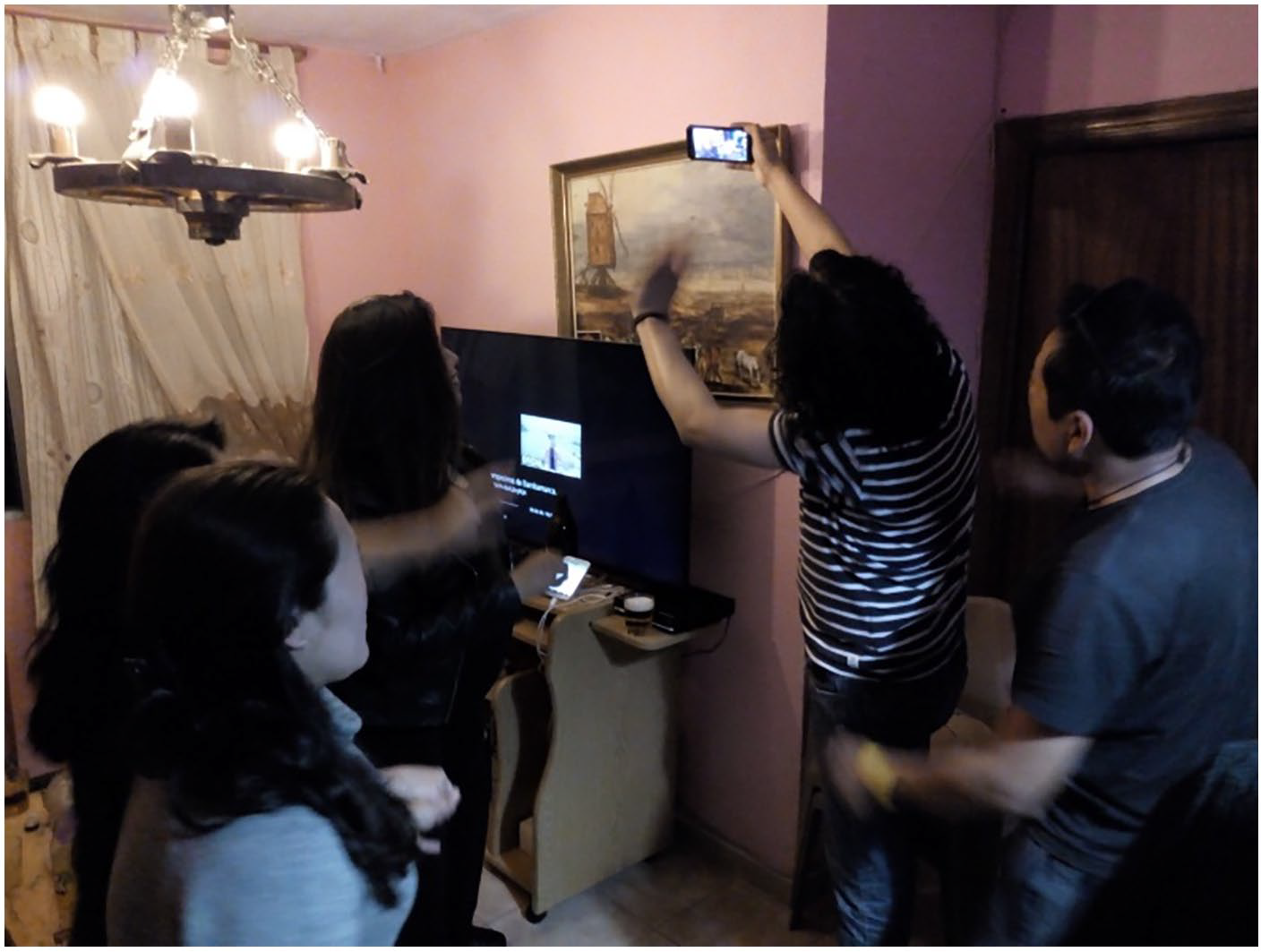
Ricardo and his housemates taking a selfie in their flat.
Ricardo’s domestic life radically changed when his daughter, a young woman in her 20s who grew up in Lima, moved to Madrid seeking work. In one of the occasions in which I met them, his daughter showed me photos of their new flat in the eastern district of Moratalaz. Half empty, with carton boxes scattered around the living room, the photos showed a small but bright two-bedroom apartment that contrasted with Ricardo’s former accommodation I knew well. His daughter complained that, despite having moved in few months before, he was still reluctant to buy furniture, decorate the place and seek ways to make it more comfortable. ‘What for?’, Ricardo told me privately, on another occasion. To him, this flat is just another provisional housing arrangement because, he thinks, his daughter may move to a new place once she has made enough friends and found a stable job in Madrid. By then, she was doing the training required to become a cashier in a supermarket. Through our conversations, I knew about Ricardo’s job as technician and noticed that he did not have economic difficulties (so far he has not been unemployed in Spain, not even during the economic crisis of 2008). This particular relationship with his current and previous domestic places is not conditioned by economic hardship or lack of homemaking abilities. It rather stems from a deep detachment from normative meanings of home as a place that requires being cultivated, guarded from the outside or cherished. In this case, home figures as a matter of choice rather than necessity. Thus, non-home is far from a mere estrangement from or disenchantment with domestic environments. It is an attunement with parts of one’s life that become significant while leaving home outside.
In contrast to the cosiness and warmth described in some ethnographies of domestic atmospheres (e.g. Daniels, 2015), including on immigrant households (e.g. Dibbits, 2009), the flat-sharing arrangements in Madrid among the predominantly Latin Americans that I met do not display an aura of cosiness, but functionality. Second-hand furniture and arrangements of decorative objects that belong to those who lease the flat and sublet bedrooms, or to those who lived there before, make for an eclectic collection of materials that evoke the impersonal and distant. In this sense, a shared flat has more to do with the kind of negotiations of space that people have in public, rather than in private and intimate settings. A shared flat can be an impersonal living area that evokes the non-places described by Augé (1995; cf. Lukasiuk and Jewdokimow, 2014) more than an idyllic haven. Along these lines, cohousing among many South American migrants in Madrid takes the form of non-home in the sense of being a space of rest and privacy that resembles a hotel (Douglas, 1991) – one that is not and is not meant to be home in the normative sense of the term.
Ricardo’s choice to avoid making himself at home is not exceptional. It resonates with those of a number of immigrant newcomers, particularly under shared flat or precarious dwelling arrangements. Particularly when living with no stable partner or other family members, people like Ricardo are likely interested only in the bare minimum for their domestic needs, whereas their core concerns and relationships lie outside of the domestic environment. Rather than sticking to the mainstream ideology of domesticity, they articulate little or no emotional or material engagement towards the place where they live – their non-home. However, such a liminal condition is not necessarily irreversible, nor constant over time – just like all feelings associated with home. New developments in the life course (e.g. a stable partner, or reunification with kin), as well as the persistence of significant ties with the country of origin, may still result in some forms of ‘reluctant homemaking’ even for those, like Ricardo, who perceive their dwelling place as a temporary shelter. No wonder that similar feelings and stances are even more salient within an asylum centre, as in the example below. Yet, both cases speak to a question of broader significance, as we argue in the subsequent section.
Non-home in practice (2): dwelling in an asylum centre in Northern Italy
Reception centres for asylum seekers are another instance of accommodations that provide basic shelter but are not meant to be home-like spaces, either in the aims of service providers or in the lived experience of residents (Boccagni, 2021; Gronseth and Thorshaug, 2018). Their raison d’etre lies in giving temporary hospitality, parallel to the legal assessment of asylum applications. That the ‘temporary’ may eventually be a matter of several years does not affect their rationale as transitory housing solutions for people kept ‘on hold’ (Thorshaug, 2019). A case in point is a medium-sized asylum centre in Northern Italy (about 70 male residents, mostly West Africans in their early 20s) in which I, Boccagni, explored the everyday experience of home among young asylum seekers.
Olusola, 22, from Nigeria, spent 2 years in the centre, during which time I was lucky enough to gain his confidence and become an ordinary ‘guest’ in the room he shared with another asylum seeker, in a relationship of mutual detachment and respect. Upon entering the room, I was systematically puzzled by one thing. Contrary to my own expectations, and to what I had observed in other (but not in most) rooms, there was nothing personal in Olusola’s personal space – his bed-place, the surrounding walls and window, a desk and a wardrobe (Figure 2). The latter had even a rule sheet, stuck on the door, for ‘university students’ – the residents in that building up to its ‘conversion’ into an asylum centre, 4 years before. In fact, Olusola’s own space was clearly marked from that of his flatmate. One chair for each of them, half a metre away from their respective beds, was there to mark a rather unequivocal boundary. However, there was no decoration or detail in particular – a way of arranging the bed or his visible belongings, or a special object of some sort – to ‘tell’ that this was the room of Olusola and not of any other resident. One visit after another, I got familiar with his way of allocating objects in the room, which articulated a routine and a logic of its own. Yet, the room as such remained as impersonal as the adjacent kitchen, which was a communal space indeed, where questions of control over each other’s groceries and of (unattended) responsibilities for cleaning up, did emerge every now and then.
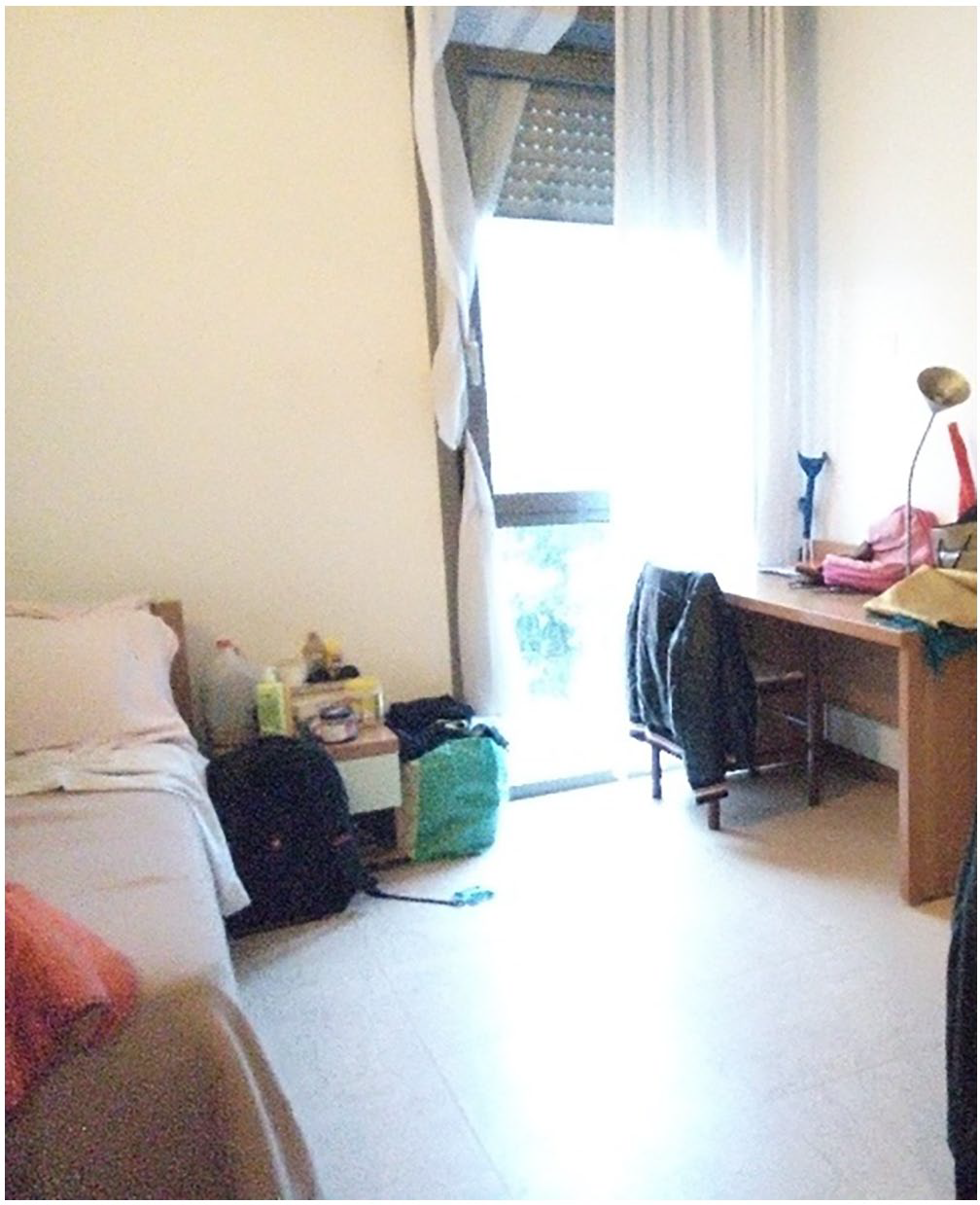
Olusola’s ‘personal space’ in his room.
‘This is the place where I’m sleeping!’, exclaimed Olusola one day, as I was trying to make sense of what that room meant to him. ‘What has home to do with it?’. To him, home was synonymous with the country of origin, and hopefully with a better housing arrangement – living alone, or with his girlfriend – to be achieved in the future. ‘This is a place where they help us to make our way – not home’, he repeated. On the day in which Olusola had to leave the centre, as we said ‘farewell’ together to his former room, he didn’t show much of an emotional engagement. Worrying that he might leave things behind was visibly his main concern. ‘What was in that place that was yours?’, I bluntly asked him at last, as we were walking out of the centre. ‘I mean – how could I tell that it was Olusola’s room – not the one of someone else?’ Somewhat mockingly, Olusola replied, ‘Haven’t you ever noticed my black rucksack? It’s a gift from my girlfriend – I always carry it with me. That’s what matters for me’.
Having access to decent housing would arguably matter as much and is still not obvious for Olusola and for a number of refugees like him. Ironically, all of my interlocutors claimed they couldn’t wait to leave the centre behind as soon as they got the papers – only to realize, then, that finding accommodation on their own was difficult and expensive and that there was no reason to leave until the service provider kicked them out. That said, living in a particular refugee centre for 1 or 2 years, or even longer, did not make the place any closer to home – not on the surface of it, at least.
Overall, the centre residents had their own cooking facilities and were allowed to invite friends in, at least before the Covid-19 emergency. However, they also had to stick to a certain timetable for going out and coming back. They were expected to clean the entire building, on shifts, besides their own rooms. Even within the rooms, they could be visited by the caseworkers with no notice for any reason of security or control. While some rooms, unlike Olusola’s, did display some decoration and personalization, both the inner and external landscape of the centre looked impersonal, decaying and neglected. The whole built environment emanated a sense of both coldness and carelessness to my eyes and to those of the residents. Bad lighting, mould, damp and a pervasive fustiness, all of this did not simply come from this being a place ‘for the poor’. It was also the outcome of an existential condition connected to that place, where everybody, including the caseworkers, perceived themselves to be ‘in transit’ and nobody had particular reasons to care for the interiors and the infrastructures, other than at the most basic level (Van der Horst, 2004).
In fact, temporariness did not eliminate the need for people to attend to domestic chores – it rather made them urgent and paradoxical at the same time. Cleaning, which often ended up being the main topic of conversation inside the centre, was a compulsory domestic chore that was a telling example of residents’ perceived scale of attachment – put differently, the reach of their sense of home – towards the place in which they lived. This could range from the common space, including shared kitchenettes, down to the inner space of their rooms, sometimes to their bed places, or even only their own bodies. Different residents enacted their cleaning practices on different scales, depending on their own personal histories, lifestyles and motivations to ‘invest’ into that place as a proxy of Italy as a whole. Such an investment tended to decline over time, as their waiting condition was protracted, almost no jobs were available and no or bad news came about their legal status.
No wonder, then, that residents dismissed any idea of looking at this dwelling space as home, or the project of attaching a sense of home to the centre. This setting was simply the place where they happened to stay at present. All across their conversations with me, people used ‘home’ as a normatively positive construct only to refer to their own country or local community of origin. This was an interesting thing in itself, since their asylum applications were based on the claim that they had been forced to leave their countries behind and that returning there would endanger their lives.
Home as a ‘positive’ idea or emotion was hardly more relevant to the lived experience of the residents’ own rooms. The bulk of it followed precisely the pragmatic approach of Olusola – little or no visible decoration or personalization of interiors, and a fundamentally functional organization of space. Such a construction of place as non-home resounds with the findings of research on asylum seekers’ resistance to recognizing a centre as a long-term home (Thorshaug and Brun, 2019).
In short, non-home was the self-evident appearance of the refugee centre from within, not less than from outside. It was also the dominant cognitive and emotional register of its residents. Yet, it was not an uncontested one – as a matter of practice, if not of ideas and desires. The active claim not to make oneself at home encountered some unconscious resistance among people themselves. While the centre was not expected to be home, it still enacted by default, if only for a lack of alternatives, many of the functions we would analytically connect to a home-like place, beyond mere sheltering (Brun, 2012). As unpretentious and basic as the centre was, it still gave residents an unprecedented degree of privacy, ‘normality’ (Schielke, 2019) and protection from the stigmatizing gaze of the white mainstream. Living there was as much a ghetto-like experience as one of co-ethnic sociability and informal support.
More fundamentally, waiting there for years was unsettling in many ways, and yet it also made a radically ‘unhoming’ stance hard to retain. Once again, there was some form of ‘reluctant homemaking’ (Gronseth and Thorshaug, 2018) even there, which revealed how contradictory and hard is to sustain a condition of non-home in practice.
From coping with an unhomely place to experiencing it as non-home
There is little peculiar or distinctive, aside from their intimate biographies, in stories of non-home such as those of Ricardo or Olusola. For sure, their ways to approach the domestic sphere (but not necessarily the public one) as non-home, and even their degrees of freedom in doing so, are differentially shaped by their position in changing hierarchies of class, legal status and race or ethnicity. Nevertheless, we can see at least three patterns that structure their everyday domesticity and make it comparable with a whole gamut of sub-standard housing arrangements: first of all, the use and accessibility of common spaces such as kitchens or bathrooms as a temporalized and negotiated process, where the boundaries for appropriating different ‘turfs’ of space (e.g. in a fridge) are continuously made and transgressed; secondly, the visible predominance of the functional bases and needs of dwelling over any aesthetical and affective concerns, up to annihilating the latter, at least in the here and now; and last, and underlying these ways of home (un)making, the provisional character of one’s presence in a place, or the construction of housing as a very secondary concern – a matter of basic protection – relative to work, family life, or friends and partners located elsewhere.
Seeing a shared flat, or even more an asylum centre, as not home may be all too obvious. Less obvious, though, is that this is not only an external constraint. There are cases in which agency manifests in the form of people’s disengagement with place. Both case studies report stories of people who are not interested in cultivating a sense of home for a range of motivations that are not fully reducible to deficient or disadvantaged infrastructural conditions. Their refusal is more of a personal choice, which asserts the priority of other life needs and interests over cultivating ordinary forms of domesticity. In similar circumstances, the normative value of a good home is not just put aside because people cannot afford it. Rather, it is actively dismissed, at least in a specific moment of one’s life, family and migration course.
Seeing one’s dwelling as non-home in the sense that it is a secondary concern – rather than an opposite of home and, therefore, an inherently ‘negative’ place – may be a commonality between otherwise very different social groups, such as students and youth at the outset of their autonomous housing careers (Back, 2007; Thomsen, 2007). Having said this, our own fieldwork suggests another counter-intuitive development. No matter how people feel detached, some micro and elementary form of homemaking, out of habituation or of opportunity (for instance, to host a partner), may well take place nonetheless.
Based on our fieldwork and on a critical revisit of the literature, we can then reframe non-home as an autonomous concept, rather than an antonym in which the opposite to home, or that which lies outside of it, should fit. This enables us to acknowledge that the positive imaginaries associated with home, and primarily cultivated through one’s domestic space, are no major concern for a certain number of people, including some of our informants. To that extent, non-home operates as a category of practice, as a mirror of what some people enact, feel and say.
At the same time, the concept of non-home critically unpacks the normative imaginary of a positive home with which people, including a number of researchers, tend to approach their relationship with dwelling. In this sense, non-home is also a category of analysis, as it illuminates the emergence of a relationship with place that is more nuanced, and possibly unsettling, than simply not-feeling-at-home in place itself. For sure, such a construction is contingent and time-dependent, as much as any other relationship with place (Massey, 1992). It is a question for further empirical investigation to trace, along longer biographical trajectories, how far – and depending on what – people rescale a more positive sense of home elsewhere, develop it anew, or deem it irrelevant. How the dialectic between home and non-home evolves over time, against the background of one’s housing trajectories, is a key research question ahead for home studies, in a ‘homing’ perspective (Boccagni, 2017; Kellett and Moore, 2003).
Conclusion: non-home as a choice
Throughout this article, we have sought to address the discrepancy between the normative value that pervades the idea of home and the actual, mundane everyday practices of homemaking in contexts that detach from such an ideal. This discrepancy offers a window into a more complex and nuanced view of non-home as a matter of agency. Furthermore, it enables the use of home as a concept, that is, as an analytical term to explain social phenomena (explicans), ‘domestic’ or not, rather than only as an object of analysis (explicandum). In this optic, non-home is more than an all-encompassing category for the multiple ways in which the material, emotional and relational bases of home are missing. It is above all a concept that invites us to explore people’s reactions to their unsatisfactory housing conditions and their (dis)alignments with the predominant normative views about home.
Enquiring about the multiple forms that a sense of home can take, including the negation of it, is not simply a way of dealing with the distance between the ideal home and the experienced one. Nor is it only a way to highlight the ambivalence whereby the same place is source of homely and unhomely feelings, or the coexistence of enthusiastic and reluctant homemaking in space (i.e. in group relations) or time (within the life trajectory of the same individuals or groups). A wealth of studies is already available, and not by chance, on each of these questions. Yet, the bulk of them tends to see home as a relatively stable and well-defined condition – although, in practice, people may well refuse to assume it as an inherently positive and desirable one.
Based on our research, instead, we argue that not attaching a sense of home to a place and set of relationships does not simply stem from what is missing or absent there. It is not only a matter of infrastructural deficiencies or unsettling circumstances, such as poor housing infrastructure, overcrowding, isolation or lack of privacy. More fundamentally, it mirrors people’s purposeful choice not to make themselves at home in a particular domestic space. In practice, this may entail projecting a sense of home elsewhere (e.g. through online relationships), or simply giving up to it. If people do not feel their present living and dwelling circumstances as homelike at all, they may consciously decide not to indulge in any form of homemaking – namely, decorating a place or undertaking functional improvements – which would entail some acceptance of that place as theirs. In such circumstances, a sense of home ends up being deliberately refused, turning it into non-home – rather than being lost, missed or longed for. All the normatively positive connotation of the domestic space ends up being a secondary concern, relative to one’s needs and interests in the (extra-domestic) domains of work, sociability and leisure, among others.
In essence, home as the place of origin (i.e. the ascribed home) is fixed and relatively uncontroversial. One may leave it behind, but cannot deny its existence. Home as a social construction over time, instead, is no destiny. Developing a sense of home as an open-ended struggle (Fortier, 2001; Tucker, 1994) may also result in the negation of home itself – that is, in articulating an explicit desire not to be at home, instead of simply not feeling at home under disadvantaged circumstances. Following our previous typology, most conditions of non-home clearly stem from violations of humans’ need, aspiration and, arguably, right to home. Yet, that is not the whole story. True, ‘not being able to call any place “home” is implicitly considered to be a handicap for being a complete human being’, as Van der Horst (2004: 36) pointed out, referring precisely to asylum seekers. Nonetheless, delimiting the field of non-home to inability would not be empirically correct – nor respectful of those, including some of our informants, who articulate a contrasting stance.
Claiming non-home may well be a more pervasive circumstance than one would expect. It need not be the prerogative of those intellectuals who, possibly out of critical self-reflection or their cosmopolitan backgrounds, would hardly call home any place (and certainly not the one they live in) for, as Adorno (2006 (1951)) famously put it, ‘it is part of morality not to be at home in one’s home’ (p. 39). If a ‘morality’ is there, it is no prerogative of intellectuals, or of societal elites. A number of ordinary people also cultivate a propensity not just not to feel at home, which is nothing new, but do not to want to – given the ‘home’ accessible to them at a particular moment in their lives. This opens up a novel and promising, if somewhat unpredictable, way ahead for the critical social study of home. At the core of it lies a decoupling by choice, rather than by necessity, between the instrumental and the normatively positive functions of a dwelling. This need not lead to discarding either the significance of home or the right to it. It powerfully reminds us, however, that the relative freedom and well-being we can exercise in most dwellings encompasses the possibility of detaching from any meaningful investment in them – to elude, at least for the time being, the ‘tyrannical’ side that, as Heller (1995: 18) put it, is inherent in ‘all homes’.
Footnotes
Funding
The author(s) disclosed receipt of the following financial support for the research, authorship, and/or publication of this article: Research for this article was funded by the European Research Council (ERC) under the EU Horizon 2020 research and innovation programme (grant no. 678456 - HOMInG).
