




Abstract
Past research shows that intermediaries exercise a significant amount of authority and power in cultural fields. In this article, I investigate the case of cultural intermediaries who might appear to have a deficit of power and authority. Stylists and visual merchandisers in luxury fashion cater to elite clients who possess high levels of cultural and economic capital. How do these cultural intermediaries mobilize their cultural capital and expertise to bridge the social boundaries between themselves and their elite clients? Drawing on 17 in-depth interviews and 30 site visits, I find that stylists and visual merchandisers rely on a set of place-based and affective techniques for mobilizing their capital. The case of luxury fashion highlights the role of place in cultural intermediary work and the variation in how intermediaries generate and deploy authority and expertise to bridge social boundaries with consumers of fashion.
Introduction
In 1990, Victoria Roberts, a cartoonist for The New Yorker, insisted that she wanted her ashes scattered over one of the world’s most celebrated fashion retailers. Had she been north of the border, she might have selected Toronto’s Saks Fifth Avenue store. Located in the heart of the city, Saks Fifth Avenue is home to international brands such as Oscar de la Renta and Vera Wang. The 170,000 square foot store offers ‘one-of-a-kind shopping experiences’ for the world’s most discerning clientele (Saks Fifth Avenue, 2022) and a window into the world of luxury fashion and the conspicuous consumption that takes place therein. Key to its production are associates like in-house stylists and visual merchandisers who coordinate clients’ shopping and facilitate the stores’ burgeoning sales.
Stylists and visual merchandisers in the luxury fashion market play an important role as cultural intermediaries and arbiters of taste (Clarke, 2020). Cultural intermediaries are a conceptual category of cultural worker. Their work involves a ‘multiplicity of activities and relationships’ organized around both practical and discursive goals (Childress, 2012, 2017; Molloy and Larner, 2010: 362). Practically, they are involved in the distribution of cultural products, connecting consumers to producers and shaping the reception of their wares (Maguire and Matthews, 2012). Discursively, they work to symbolically define and position cultural products for consumers. Food writers, for example, act as intermediaries in the world of haute cuisine, distinguishing between the ‘intelligent’ and the ‘vulgar’ consumption of foodstuffs (Ferguson, 1998), as well as the appropriate mixture of culinary styles (Leschziner, 2015). Art critics and dealers play a similar role in the field of cultural production, evaluating and explaining art for would-be consumers (Velthuis, 2006).
Relationships between intermediaries and consumers reflect the varying amounts of power and forms of capital that different workers hold within the consumer landscape (Baker, 2012; Bourdieu, 1984; Cervellon and Coudriet, 2013; Pettinger, 2004). How does that power work in situations in which consumers also hold a great deal of capital, as in the fashion landscape, where consumers’ economic and cultural resources often, though by no means always, outstrip those of the intermediaries they shop with, and, where the purchase of fashion goods routinely intersects with status concerns and class-based anxieties? (Johnston et al., 2012; Rafferty, 2011; Zukin and Maguire, 2004). To speak with authority within this field requires that intermediaries negotiate several class-based social boundaries. Yet, fashion intermediaries are not often equipped with the economic capital that might make this boundary work possible.
Fashion intermediaries, then, provide a revealing look at the ways in which boundaries in the consumer landscape are bridged, as well how these boundaries reinforce and challenge established notions of capital, class, and status (Blumer, 1969; Bourdieu, 1984; Simmel, 1957; Veblen, 2005 [1899]). Drawing on an established body of literature surrounding fashion consumption, boundary work and what has been called ‘aesthetic labour’ (Boyle and De Keere, 2019; Cutcher and Achtel, 2017; Holla, 2015; Warhurst and Nickson, 2007), I map the relationship between consumers and intermediaries – the boundaries and bridges between them – and evaluate the ways in which this relationship is shaped within the luxury retail place. I extend these complimentary literatures by attending more closely to the micro- and symbolic mechanisms through which social boundaries are bridged in the consumer landscape including the taken-for-granted ways through which intermediaries leverage their own fashion knowledge and corporeal appearance to connect with clients, and the ‘aesthetic work’ that this entails (Böhme, 2003). Specifically, I explore the discursive process of romancing and explain its significance aside a range of place-based and affective techniques through which cultural intermediaries mobilize capital to foster aspiration, bridge boundaries, and connect with clients.
Looking to the work of cultural intermediaries in the luxury fashion landscape is important for at least two reasons. First, to the extent that luxury fashion functions as a vehicle for the performance and signification of wealth and status, this landscape sheds an important light on the production and maintenance of class-based inequalities and their insidious distinctions. Second, and relatedly, attending more closely to the place-based and affective techniques through which intermediaries accomplish their work can tell us a great deal about the ‘causal pathways and cultural processes’ through which boundaries between individuals and groups are bridged and blurred (Lamont et al., 2014). Attending to these processes is especially necessary now as the luxury fashion market continues to grow in scope and scale aside shifting currents in the global distribution of wealth and debt (Roberts, 2019).
Cultural intermediaries, aesthetic labour and boundary work in fashion
Cultural intermediaries in the consumer landscape position goods for consumers, commenting on which of these should be purchased, why and for exactly how much. In this way, they play an important role in establishing value and in communicating said value to a broader public of consumers (Baker, 2012; Lonergan et al., 2018; Maguire and Matthews, 2012; Velthuis, 2006). Models, for example, ‘lend their image to sell products’, styling looks in ways that make their meaning more glamorous for and among a wide body of consumers (Wissinger, 2009: 274). In luxury fashion, stylists likewise position goods for their clients (Clarke, 2020; Lynge-Jorlén, 2020), stoking desire as they select garments and assist others in putting together outfits or deciding between purchases. Visual merchandisers, meanwhile, help to curate the dimensions of place itself, ‘mediating’ interactions between products, purchasers and stylists on the sales floor (Sommerlund, 2008). They do this in ways that speak to fashion’s exclusivity and that reinforce its symbolic and aesthetic value (Cervellon and Coudriet, 2013; Lonergan et al., 2018).
The extant literature on cultural intermediaries has shed an important light on these figures, drawing our attention to the ways in which intermediaries navigate between the realms of production and consumption (Mensitieri, 2020; Molloy and Larner, 2010), ‘helping to create for others the experience of particular goods and activities’ (Maguire, 2008: 225). In her work on production and consumption, for example, Joanne Entwistle (2006) traces the processes through which fashion buyers mediate interactions with suppliers and consumers to qualify products and produce sales. Like other scholars in this area, Entwistle builds on and refines Bourdieu’s (1984) original (p. 362) conception of the cultural intermediary; imagining a cultural worker ‘well-armed’ with capital and a distinct ‘social flair’ (p. 362). These cultural workers navigate social space with ease, establishing likeness with those around them. That is, Bourdieu’s (1984) cultural intermediaries are generally imagined to be ‘of the class of consumer to whom they direct their work’ (Maguire and Matthews, 2010: 408), and thus share a certain amount of power with them.
Of course, this need not always be so. In fashion, for example, cultural intermediaries such as stylists or visual merchandisers often hold less power and economic capital than the clients they interact with (Boyle and De Keere, 2019; Cutcher and Achtel, 2017). This owes at least in part to the positioning of these cultural workers within the broader field of fashion (Entwistle, 2006; Mensitieri, 2020) and to the service dynamics that typify this landscape (Pettinger, 2004; see also Sherman, 2005, 2007). While in recent years styling has become a recognized (and symbolically prestigious) profession within some segments of the fashion circuit (Lifter, 2018), this work remains precarious, poorly paid and often de-valued (Clarke, 2020; Lynge-Jorlén, 2020). Unlike fashion buyers or art critics, stylists and visual merchandisers may not hold a recognized credential or extensive training in their field, raising questions about how they accomplish their work and what boundaries this work might entail (Lamont, 1992; Lamont and Molnár, 2002). In the luxury fashion landscape, class-based social boundaries may present an especially pernicious obstacle for stylists and intermediaries who work with clients known to possess a significant amount of economic capital.
It is possible that fashion goods – or our knowledge of these – might be used to bridge boundaries and establish ‘sameness’ (Pugh, 2011: 7; Zukin, 2004; Foster, 2021), affording intermediaries and consumers an opportunity to connect with one another. Alternatively, appearances might be mobilized to communicate one’s authority in fashion or else, to align oneself more closely to brand images and fashion labels with a public reputation for prestige. This is true for fashion intermediaries who make use of their stylish sensibilities and corporeal appearance to connect with clients and accomplish what has been called aesthetic labour (Holla, 2015). By now, it is well understood that brands, including and especially fashion brands, invest in acquiring, cultivating and commodifying intermediaries who ‘look good and sound right’ (Holla, 2015; Williams and Connell, 2010). Owing to their good looks and stylish appearance, these figures are thought to connect more easily with clients and help to embody the class-based aspirations (and anxieties) brands so often speak to (Boyle and De Keere, 2019; Cutcher and Achtel, 2017; Hanser, 2012; Warhurst and Nickson, 2007).
In this respect, the labour of stylists and visual merchandisers is emotionally demanding (Hochschild, 1983). It requires that effortful attention be paid to ‘keeping up appearances’ (Entwistle and Wissinger, 2006), stoking desire and managing client interactions (and reactions) on the sales floor (Pettinger, 2005). But it requires something more too. Stylists and visual merchandisers’ labour extends to include the ‘aesthetic work’ of styling place or the management of fixtures and ‘the atmospheres they radiate’ (Böhme, 2003: 20). Managing the elements of place, as I will show, is crucial to the success of stylists and visual merchandisers in fashion who must ‘put into the hands of the purchaser both [. . .] material goods and the dreams that accompany them’ (Mensitieri, 2020: 88, emphasis added).
Still, little has been said about the place-based and affective techniques through which intermediaries accomplish boundary work. Indeed, the role that place plays in shaping the work of cultural intermediaries is often missing from these literatures (Sommerlund, 2008), representing what Maguire and Matthews (2012: 553) have elsewhere described as a failure to ‘put context (back) into considerations of cultural intermediaries’. In what follows, I offer a closer look at how retail places are constructed and the ways in which these constructions intersect with social boundaries to inform the work of cultural intermediaries in fashion. I argue that the symbolic dimensions of the luxury retail place imbue cultural intermediaries such as stylists and visual merchandisers with significant capital. It is, at least in part, this capital that assists cultural intermediaries in bridging boundaries in luxury fashion.
Retail places
Boundaries intersect with elements of place in the consumer landscape. They are, to borrow from Johnston et al. (2012), ‘concretized in physical and material relationships’ (p. 46). That is, place separates (often quite literally) low- and high-income consumers from one another as well as from consumer goods (Gieryn, 2000; Johnston et al., 2012). Luxury fashion retailers, for example, are often located in neighbourhoods awash with wealth, reinforcing and reproducing notions of the brand’s ‘exclusivity and prestige’, (Crewe and Martin, 2016: 327) while limiting consumers’ access to and understanding of the material goods offered therein. This ‘spatial clustering’, as Entwistle (2010: 8) has elsewhere pointed out, tends to attract a uniquely fashionable clientele who share similar backgrounds and class-based tastes. In Toronto, where I collected the data for this article, luxury retailers, including Louis Vuitton, Hermès and Chanel are concentrated within the Bloor-Yorkville area, adjacent to some of the city’s most affluent neighbourhoods – a shopping strip sometimes referred to as the ‘Mink Mile’.
As ‘places for the display and consumption of hyper-visible opulence’, luxury fashion retailers pronounce their symbolic capital through the artful display of material goods and through elements of visual design and spatial arrangement (Crewe and Martin, 2016: 322). This includes the selection of furniture and in-store fixtures, as well as the arrangement of distinct boutiques and shopping zones. The design of these shopping zones provides a unique social context for interaction (Sommerlund, 2008), and status display. Within each, status is performed for others to see (Potvin, 2013). It is performed by consumers whose visual appearance and in-store purchases are part and parcel of the brand’s mystique. And, importantly, it is performed in and through interactions with luxury sales associates and stylists. Together, these performances communicate ‘a sense of one’s place’ in the consumer landscape, reinforcing and reproducing existing status hierarchies between clusters of consumers and the intermediaries they shop with (Bourdieu, 1984: 466; see also Richer, 2015). These status hierarchies are shaped both by consumers’ class status and by ‘local’ cultures such as brand cultures and the affordances that they provide (Fine, 2010: 356).
Where these affordances are concerned, consider that luxury retail places often position their products as ‘works of art’ (Crewe and Martin, 2016: 326) or as aspirational goods to be purchased. Positioning products in this way and within storefronts that are carefully crafted to evoke feelings of ‘awe and adoration’ (Cervellon and Coudriet, 2013:8 72; see also Thrift, 2008) serves to legitimate the cost of luxury goods, and is a means through which to give fashion objects ‘meaningful shape, volume, and form’ (Potvin, 2013: 7). That is, these objects and their positioning shape how we respond to and understand fashion and our proper place within its decorative folds.
The positioning of products in the luxury fashion landscape, and their cost specifically, reinforces existing distinctions between consumers while lending significant capital to the sales associates who populate these spaces. That is, sales associates within the luxury retail place exercise a certain amount of power over their clients. They are, to borrow from Cervellon and Coudriet (2013: 139), imbued with the capital that brands imply and thus appear ‘to pertain to the same world’ as their clients. Sherman (2005: 139) makes a similar observation in her work on the luxury hotel scene, suggesting that these upscale places ‘allowed workers to constitute themselves as superior to others by “borrowing prestige”’.
Data and methods
To better understand how cultural intermediaries bridge social boundaries in the luxury fashion landscape, I performed a mixed methods analysis, combining one-on-one interviews with in-store observations and visual ethnography. Interviews were conducted with 17 sales associates including stylists and visual merchandisers employed across a range of luxury and entry-level luxury retailers in the greater Toronto area (GTA). Interviews were semi-structured and took place both in-person at coffee shops and restaurants in the GTA as well over the phone and via video calls with stylists and merchandisers. All interviews were recorded using an audio-recording device, transcribed and inductively coded for analysis.
Interviews provide a revealing window into the production and reproduction of social boundaries. In part, this is because interviews allow us to access meaning-making processes and widely shared cultural scripts, including those surrounding class-based beliefs and processes of boundary work (Lamont, 1992; Lamont and Swidler, 2014). And, because interviews provide an opportunity to situate actions within the contexts in which they unfold, they shed light on how interpretive processes and interviewees’ day-to-day actions reflect and refract across our cultural landscape (Pugh, 2013: 46). Where the present study is concerned, my interviewees reflected candidly on their experiences working in fashion. They shared their personal interests and reflected on their relationship with clients; how they connected with these clients and how they evaluated them. Evaluations included remarks about their clients’ own sense of style, their tastes and preferences, as well as their class status. Where class is concerned, it is worth noting that my interviewees insisted – on more than one occasion – that their clients were undeniably ‘rich’. When asked how stylists and visual merchandisers knew this, clients’ dress, spending patterns and even their mannerisms in-store were offered as evidence suggesting, however unstable these suggestions may be, that the intermediaries interviewed here treated their clients as necessarily well-armed with economic capital.
The sales associates featured here drew from their experience across at least five luxury and entry-level luxury retailers including Burberry, Saks Fifth Avenue, Dolce & Gabbana, and Sandro. To locate and recruit these associates, I used a respondent-driven procedure, drawing from within my interviewees’ connections and social networks to collect a sample of 17 stylists and visual merchandisers (Guest et al., 2006). This is consistent with existing methodological recommendations for interview sample size (Kvale and Brinkman, 2009) and mirrors closely the samples drawn by other researchers working in this area (see, for example, Williams and Connell, 2010, or Cutcher and Achtel, 2017). Interview participants ranged in age between 21 and 37 years, with the average age of participants falling at 25 years. Of the 17 participants, 9 were women and 8 were men; 7 participants self-identified as non-White, including Chinese, Latin American, South and West Asian, and 10 as White. Of these, 3 participants held salaried positions, 4 worked on commission and 10 were assigned sales targets at minimum wage. Consistent with existing work on intermediaries in fashion (Mensitieri, 2020), the stylists I spoke with were not especially well paid, often making no more than CAD12 or CAD14 an hour selling products with 3-, 4- and 5-figure price tags. All but two interviewees had completed some college or university at the time of our meeting; only one held an advanced degree.
In addition to these interviews, 30 site visits were made to three retail locations in the GTA between August of 2018 and October of 2019. During these site visits, I attended to the elements of the store’s visual design and display as well as to clients’ interactions with intermediaries. This includes a look towards textual materials such as promotional material and in-store displays, as well as to everyday and taken-for-granted interactions – or ‘fashion’s social processes’ (Blumer, 1969) – on the sales floor. Attending to these materials allowed me to situate both shoppers and sales associates within the broader context in which client interactions took place and to draw connections between the broader contours of place and boundary work (Johnston et al., 2012).
The luxury and entry-level luxury retailers I observed share a number of features in common with one another. For instance, each described themselves and their products as ‘classic’ or ‘timeless’ with elaborate brand stories and fashionable histories that spoke to these descriptors. They marketed their goods as ‘lifestyle’ products and sold these at price points that ranged from CAD298 to well over CAD5000 for something like a woman’s motto jacket, or between CAD329 and CAD3500 for a cashmere sweater. In addition, each retailer invested quite heavily in their stores’ layout and design, with nearly every retailer featured here hiring an independent visual staff to arrange products and execute in-store changes. Across these retailers, staff were never referred to as workers or employees, but as stylists, consultants or brand ambassadors. This is consistent with Pettinger’s (2004: 178) previous study of fashion retailers and speaks to the orientation of these retailers ‘towards the upper end of the mass market’.
Intermediaries in luxury fashion
My analysis unfolds in two steps. First, I provide a detailed account of the retail places in which stylists and visual merchandisers perform aesthetic work. I do this to highlight the significance of place and its affective dimensions, as well as its role in shaping boundary work among cultural intermediaries. Second, I turn to a discussion on the micro-mechanisms or every day and taken-for-granted means through which intermediaries in the fashion landscape mobilize capital to bridge boundaries in the luxury fashion landscape. Here, I attend to intermediaries’ appearance and cultural knowledge of fashion, as well as to the discursive strategies they deploy in-store, namely, to the strategy of romancing and to the visions and dreams that this strategy stokes.
Selling aspiration, styling place and appropriating capital
Retail places play an important role in communicating brand identities and in selling aspirational visions for consumers to see (Crewe and Martin, 2016). They do this through a number of place-based and affective techniques including the arrangement of in-store fixtures and through subtle distinctions in their products’ feel. When asked about how the retail place shaped their clients’ in-store experiences, the stylists and visual merchandisers included here explained that each stores’ finishing, including vintage hangers, antique rugs and ‘pony-hair’ upholstery ‘elevated’ the client experience. These fixtures and in-store features were designed to stoke a set of class-based visions and anxieties, encouraging consumers to make aspirational purchases while rationalizing the price they were expected to pay for products in-store. They also lent a significant amount of authority to the stylists and visual merchandisers who worked around and alongside them, imbuing these cultural intermediaries with the symbolic capital the store’s fixtures communicated. And while we take for granted that luxury retail stores look and feel ‘elevated’, ‘exclusive’ or ‘expensive’, these places must be produced and maintained; they are the result of coordinated efforts and precise aesthetic work (Böhme, 2003).
Holly, a visual merchandiser in Toronto, provided a particularly powerful reflection on her store’s fixtures and their affective dimensions. With her clients in mind, she explained, ‘You have to feel it. It [the store’s design] has to be emotional because it’s the whole thing, together, that gives you that high-end experience’. With this in mind, Holly and her team paid careful attention to the store’s appearance and regularly rotated its products. When done effectively, stylists confirmed, ‘small moves, like bringing something forward or folding something a different way, seriously impacted whether or not it [the product] moved’. For this reason, the visual merchandisers included here reviewed the store’s layout weekly, ‘analyzing business and making moves’. This included re-organizing the store’s colour palette, adjusting product placement and highlighting focal units for clients. Visual merchandisers, might, for example, bring products nearer freshly bought flowers or ornamental objects and ‘nesting-sets’ (Figure 1). These moves or place-based techniques are calculated to allure and enchant clients, animating in-store products ‘to engage the imagination’ and produce visions and dreams of aspiration and glamour (Thrift, 2008: 297).
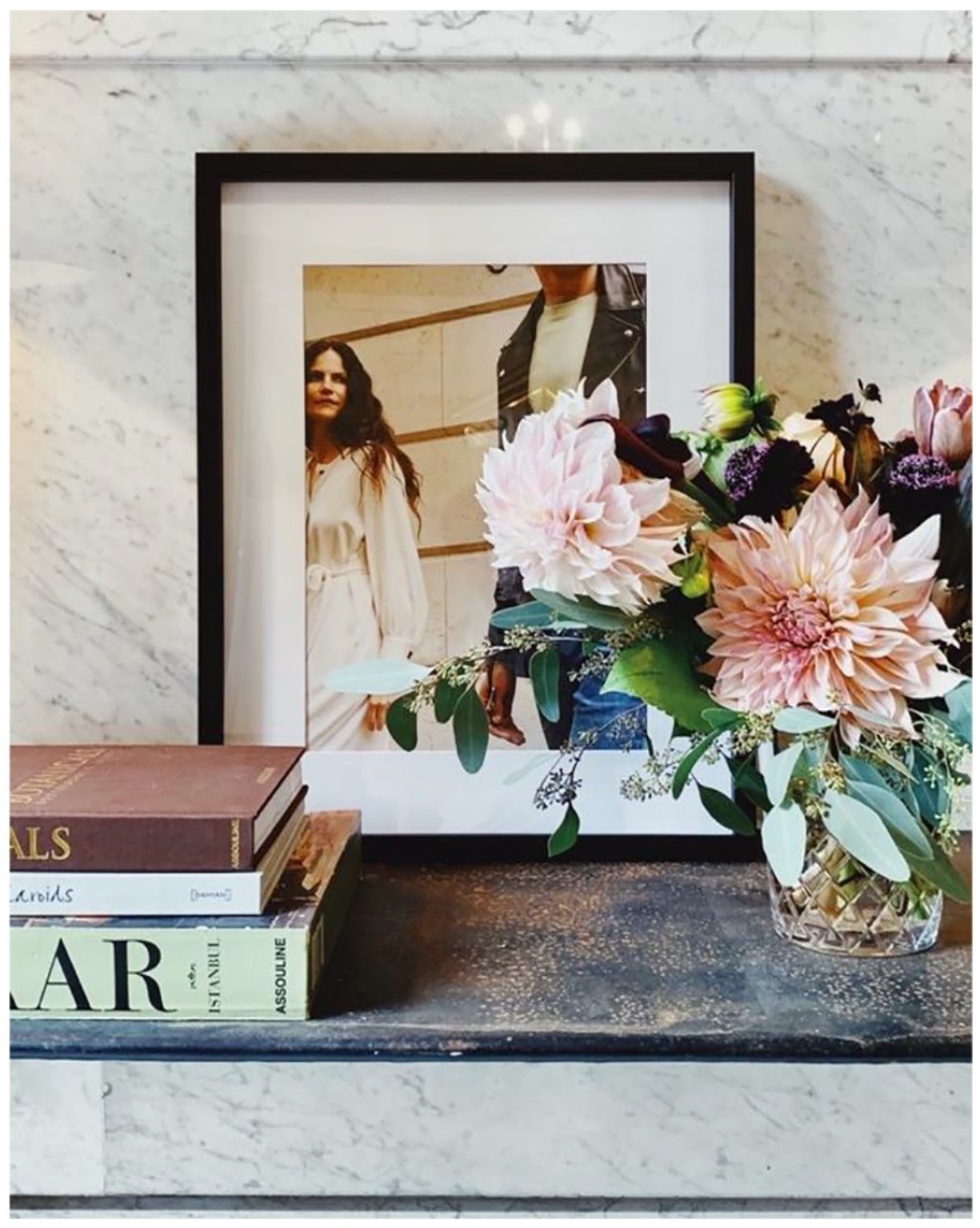
Fresh flowers and coffee-table books on Bloor Street.
Caleb, a second visual staff member and now-branding and experience manager in Manhattan offered a similar reflection on the importance of his store’s appearance and his work within it. Caleb’s work was not just about dressing a mannequin or putting pieces on display; these pieces had to be styled to ‘convey a certain mood’ and in a way that was, to borrow Caleb’s own words, ‘aspirational’. Given clients’ own cultural and economic capital, we might expect that aspirational visions of consumption are of little importance. But this would be a mistake. As Blumer (1969: 273) observed some time ago, elites are especially interested ‘in the vanguard of proper fashion’ and ‘wish not to be out of step with [it]’. Clients’ elite status does itself require effortful attention (Entwistle, 2000; Rafferty, 2011), leisure time and careful practice to maintain and reproduce – a practice that can be performed within luxury places aside intermediaries and the symbolic elements that surround them.
Together, these elements combined to produce what Jackson, a national visual manager with experience across a range of luxury and entry-level luxury retailers, described as ‘an extremely emotional experience’. From beginning to end, he explained, ‘the customer’s emotions’ were wrapped up in the store’s design; in its layout, product story, and in-store details. With only ‘eight seconds to really capture somebody’, it was important that these design elements and in-store details changed regularly, with updated mannequin looks, new product folds and fresh colour options rotating around the store. My own observations suggest that the arrangement of products played an important part in shaping the luxury experience and in ‘mediating’ interactions between stylists and their clients (Sommerlund, 2008). Entry-level luxury retailers, for example, placed an emphasis on touch or, as one merchandiser explained, the products’ ‘feel-appeal’. This was done, for example, when plush sweaters were folded on focal tables, when cashmere scarves and mittens were bundled high for consumers to see and when delicately embroidered garments were placed within reach of passers-by. Clients were invited to touch these garments, to feel their composition and to look more closely at their design qualities and careful tailoring. As I often recorded stylists say, ‘isn’t this stunning, you have to try it on’.
Within each store and without exception, the luxury retailers featured here arranged goods in ways that communicated exclusivity, that inspired feelings of aspiration and that nodded to a set of class-based anxieties around the importance of appearance and its maintenance. This included techniques like keeping a limited size run of products on the floor, placing products atop decorative pedestals or aside key articles of promotional text, and centring mannequins on table-tops to draw consumers’ eyes upwards (Figure 2). One such assembly of mannequins, I observed, had been dressed in furs and sparkling dresses. Prepped for the holidays, they had been placed aside Jimmy Choo platform wedges and a studded crystal McQueen clutch, completed by a sign that read: ‘Greatness is Everywhere’. Looking over these products and their signage, the suggestion was clear. Greatness could be acquired or achieved through one’s presence and subsequent purchase in-store.

Gold mannequins aside a pear tree.
Alternatively, products in-store might be placed alongside third-party brands or other designer goods to elevate their appearance and symbolic prestige. One retailer observed here went to great lengths to elevate their products aside other (arguably more noteworthy) brands. Within their flagship store, for example, consumers might come across a glass ‘vintage case’. This vintage case housed quilted Chanel bags, gold-plated bracelets and silk-scarves screen-printed and hand-rolled by Hermés. The price of these bags ranged between CAD3500 and CAD5000 (CAD), and the scarves, between CAD500 and CAD650. In placing their own goods alongside these prestigious brand labels, this entry-level luxury retailer borrowed their symbolic capital, and painted for consumers a portrait of who they were and more importantly, who they could be.
Stylists used their respective stores’ finishing and elements of its spatial arrangement to their advantage. Wendy, a stylist on Bloor Street, for example, drew from the store’s design elements to highlight connections between its products and her clients’ purchases. Pointing towards ornamental bottles of Whiskey in the store’s men’s department, she would ask clients to imagine themselves with a drink in hand. In her own words, ‘you have a whiskey . . . and there is a fireplace, and you are sitting down, and I don’t know, if you smoke cigars, you have a cigar going on’. In doing so, Wendy draws on the affective dimensions of place, inviting her clients to step-into what Thrift (2008: 14) has elsewhere called, ‘alternative’ visions of who purchasers could (or should) be. But Wendy does something else too; Wendy asserts her own symbolic and cultural capital when she communicates her mastery of fashion’s material dimensions and her understanding of their proper placement in the decorative world of elites. As she later emphasized to me, you must ‘paint the picture so they can see themselves wearing it’. That is, of course, if they can afford to.
A handful of stylists reported that their store’s visual design and their products’ price point served as an important boundary between consumers with cash (or credit) to spend and those without. ‘I would hear people walking past the store . . . they would say things like, “Oh, I can’t shop there, it’s too expensive” . . . you’d hear a lot of comments about the price’, said one Toronto stylist. Holly too confessed that ‘it [the store] can be intimidating . . . just the prices alone’. And Jessica, reflecting on the ‘fuss’ involved in caring for the store’s products including combing cashmere sweaters to prevent pilling and regular dry-cleaning was simply not something everyone had the leisure time or economic means to do. Yet, stylists who were paid minimum wage and, in some cases, a small commission were expected to keep up with their stores’ latest trends and to make routine purchases lest they experience what Miller-Davenport (2008: 22) once described as ‘shame over being trespasser, a class tourist in a rich-person’s department store’.
Leveraging dress and communicating capital
Amid each stores’ fixtures and finishes, stylists set about their work. Dressed in branded products, they embody and appropriate each retailers’ culture and carry with them the symbolic capital that these cultures communicate (Cutcher and Achtel, 2017; Peretz, 1995; Pettinger, 2004; Williams and Connell, 2010). 1 By leveraging their branded appearance, stylists and visual merchandisers can connect with their clients, bridge boundaries on the sales floor and sell consumers an aspirational vision of who they could be. This vision was key for elite clients whose own status depended on a careful attention to dress.
With no single exception, the luxury retailers featured here provided a set of guidelines that governed their stylists’ appearances and helped stylists to communicate authority on the sales floor. Many encouraged their stylists to wear the brands’ own products and offered generous discounts to make this possible.
2
Products from the current season were especially encouraged and provided clients with a visual illustration of how these products could or should be worn; sweaters tucked into skirts, pants layered with popovers, pinstripes and a belt paired with brass buckled shoes. Some of the retailers provided stylists with ‘look-books’ and product guides to assist them in understanding the seasons’ key pieces; others, a set of pre-approved outfits to wear each month. Evan described his store’s dress policy like this: So, we were always expected to wear three pieces. So, what three pieces means is that, if I’m wearing a pant and a shirt, I have to wear a blazer or jacket or something over it. I’m also not allowed to wear sneakers or jeans for example, this is too casual. I’m only allowed to wear a T-shirt if I wear a shoe, I can’t wear a T-shirt and a sneaker. So, it’s very strict as to how I can present myself. But within that you have the ability to still express yourself. So, I like to have fun with the dress code and still, I’m being authentic to myself.
While Evan was able to negotiate his store’s dress policy in a way that felt consistent with his personal style, it is clear that this policy involves a rather keen eye for fashion and an ability to discern between exactly what pieces pair with which others and what effect this pairing will produce. Randol shared a similar, albeit less detailed reflection, insisting that his store’s policy reflected a ‘clean’ and ‘fitted’ aesthetic. This aesthetic was adopted by stylists and visual merchandisers and mirrored the store’s current collection.
Management at each store surveyed stylists’ appearances and provided coaching to ensure that stylists were dressed in ways that were consistent with the store’s vision and brand story. 3 Coaching extended to include one-on-one ‘check-ins’ and coercive fitting sessions in which stylists would be wardrobed in pieces from the new collection and subsequently encouraged to purchase them. Should coaching fail, and stylists come dressed inappropriately to work they might be sent home. As Kevin explained to me, management would pull inappropriately dressed stylists aside, have them stand against the store’s mannequins and compare them to one another to highlight just how out of place they appeared that day.
Dressing the part was fundamental to stylists’ success on the sales floor and to their ability to bridge social boundaries in the luxury fashion landscape. As Kyrstin explained to me, ‘if I’m wearing something, there’s a chance I will sell it, maybe twice in that day . . . at a minimum’. Others too suggested that clients would shop from their own bodies, purchasing what stylists wore to work that same day. Anna, a former model turned stylist, was even asked to try clothes on to help her clients see how they might look or else, what to pair pieces with. In dressing in prestigious brand labels, stylists were able to connect with clients and make sales, converting their appearance and authority in fashion into economic capital in the form of sales for their employers and commission for themselves.
When I inquired further, all the stylists suggested that yes, when it came to their own appearance and presentation, what they wore mattered. Indeed, it mattered a lot. When I asked Evan to tell me more about what he might wear to work, he described pairing his Balmain blazer with a t-shirt and pants, sneakers and an off-white belt, the combined cost of which would have run in excess of CAD3000 (USD) sans discount – a detail Evan left out. Other stylists took pride in their appearance too, providing a great deal of information about what they would wear to work and why what they wore mattered. Wendy would pull pieces from across departments and style these depending on her mood. Doing so allowed her to communicate new looks to her clients and to help clients decode how to mix and match key pieces such as a man’s turtleneck or a woman’s trench coat. Krystin insisted that when it came to getting dressed for work wearing something current was most important, and Kevin, while laughing aloud, shared that he had never been dressed better in his ‘entire life’ than when he was dressed for work in luxury retail.
Stylists’ dress and appearance communicated an important message to consumers. This message was not just about their store or its symbolic prestige, but also about stylists’ own cultural authority and their concomitant ability to help clients negotiate their appearances. Clients in turn, came to trust stylists’ judgement and regularly asked for their feedback. With stylists’ own appearance as confirmation of their authority in fashion, clients felt confident that they could return to their stylists again and again. But stylists’ appearance wasn’t all that was on offer in-store, nor was it the most important dimension of their work with clients. Rather, intermediaries’ appearance was combined with cultural knowledge of fashion and the use of romancing to bridge boundaries on the sales floor.
Bridging boundaries, romancing clients, and converting sales
Stylists play an important role in organizing the shopping experience and fostering a sense of aspiration and ‘awe’ among consumers in-store (Dion and Arnould, 2011). They do this by leveraging their knowledge of luxury brands and in-store products, through their own congeniality, as well as through a discursive strategy known as romancing. Across the retailers sampled here, for example, stylists were careful to draw their clients’ attention to product details such as fabric composition and tailoring, walking alongside them throughout the course of their visit to assist in identifying their needs, communicating feedback, and ‘converting’ sales. Others wove richly detailed stories for their clients, inviting each to step into ‘a dream of fashion’ that both intermediaries and their clients can share (Mensitieri, 2020: 92). Together, these practices communicate stylists’ cultural capital and authority within the fashion landscape, allowing intermediaries to bridge whatever social boundaries separate them and their clients.
For some stylists, romancing meant spending an hour or more with clients. As one stylist explained, ‘the entire process could take about two maybe even three hours . . . it really depends on the client [and] their appetite for that level of service’. Others too reported that their clients expected one-on-one attention during their in-store visits or what one stylist called, a ‘hip-to-hip’ shopping experience. While time spent with a client did not guarantee a sale, the stylists I interviewed, with some exceptions, agreed that time spent with a client assisted in establishing trust, in building their personal client books, and bridging boundaries.
Wendy, who lacked neither in personal style nor knowledge of fashion, practised romancing often, making careful references to other designers and fashion history, while ‘weaving stories’ and ‘painting pictures’ for clients. In Wendy’s own words, ‘I always reference either current influencers, know what celebrities are wearing, designers, current designers or past designers, and different styles . . . Coco Chanel did this in 1939 . . . and Yves Saint Laurent does this’. These references communicated Wendy’s cultural capital and authority in fashion, allowing her to bridge boundaries in store and establish a sense of trust with her clients. What is more, they were key to stylists’ success. As Melanie explained to me, her clients expected that this knowledge would be relayed to them because, in her own words, they ‘had a very elevated kind of talent for fashion’. They ‘were able to understand a lot of references’ including nods to designers such as ‘Robert Geller, Our Legacy, like really niche brands and Engineered Garments that only a select few people would know’.
Others drew on their knowledge of the products’ composition or manufacturing, telling clients, for example, that the silk they were purchasing had been sourced from Japan or that the cashmere blend the brand had crafted was water-wicking and temperature regulating. And still others leveraged more elaborate stories for their clients. Kevin, a women’s stylist turned floor director in Toronto, would go to great lengths to help clients understand where they would be wearing their purchases and all that this implied. As he explained to me, romancing clients was all about ‘where the destination is, and less about the product itself’. So, he continued, you might talk about the setting – a show or an upscale event – and what he or she will look and feel like when they are there. In drawing clients’ attention to ‘the destination’ and to the feelings that destination might engender, Kevin highlights the affective qualities of fashion purchases and the visions and dreams these purchases promise. Others, as I observed, might describe cashmere sweaters worn on Christmas morning or emphasize the importance and appropriateness of dressing-up for gatherings, occasions or vacations abroad. Throughout, stylists constructed visions imbued with emphatic connotations towards wealth and leisure, nodding to their clients’ perceived class status or else, to clients’ aspirations and desires. In leveraging these visions, stylists connect to clients, offering a dream of objects and people transformed by fashionable purchases and all that they imply.
Krystin enjoyed ‘romancing’ clients too, and would regularly set aside products for her favourites. As a rule of thumb, she explained to me, romancing required a little imagination including some imagination around what clients might be willing to spend. In her own words, ‘shop with your client’s wallet, not your own’. Krystin’s own wallet, she clarified, limited what she could reasonably afford to purchase and likewise, the scenes she might find herself in. But her clients’ wallets were more expansive, with shopping budgets that stretched to thousand dollar ‘spends’ and that included impromptu purchases of the store’s most expensive furs. Like Kevin, Krystin connected with her clients, however temporarily, by stepping into and so, sharing a dream of fashion made available for purchase. Reflecting on the importance of romancing clients, Brianna added that without an in-store experience to pair alongside her store’s price point, clients were sure to lose interest. In her own words, ‘if you can’t even get the chance to make that connection [with clients], then all that’s left is a high price’.
My own observations in store captured some additional, often unspoken, elements of romancing on the sales floor. This included the artful arrangement of clients’ pieces in the fitting room, and the slow and sometimes exaggerated wrapping of purchases for clients. Stylists, for example, would carefully fold and package purchases in tissue and ribbons, adorning boxes and bags with decorative finishes that reinforced the symbolic value of luxury fashion goods. In the fitting room, stylists spent significant time arranging their clients’ pieces, ensuring that these had been suggestively styled as outfits or folded in ways that reproduced the stores’ symbolic feel. In these ways, stylists ritualize the shopping experience, animating branded products and purchases with visions and dreams of distinction.
Of course, romancing was not always an effective strategy on the sales floor. As stylists explained, some clients were less amenable to drawn out conversations or fashionable visions and dreams of purchases soon to be made. These clients were less interested in hearing their stylists’ suggestions and did not ask for their feedback. Stylists in turn described them as incredibly challenging to work with or as ‘stiff’, ‘boring’ and, worst of all, ‘basic’. In critiquing their clients’ ‘basic’ tastes, stylists drew a sharp boundary around themselves and others, elevating their own cultural knowledge and authority in fashion against those who did not recognize or legitimate it. 4
Conclusion
Cultural intermediaries in fashion provide an illuminating set of subjects for study. In shaping the selection of consumers’ goods, and in styling the bodies of elite consumers, these intermediaries play an important role in connecting consumers to the symbolic markers of class and so, in reproducing class-based social boundaries. The stylists and visual merchandisers featured here, for example, connected consumers with luxury goods, made recommendations and provided personalized selling services. To do this, they had to bridge the divide between themselves and their clients, leveraging their appearance and expertise in fashion to endear them (however temporarily) to shoppers, and as my research shows, establish trust and a meaningful relationship with their clients.
Bridging boundaries in the luxury fashion landscape requires that stylists and visual merchandisers devote considerable time and attention not just to clients on the sales floor, but also to style and fashion more broadly. Outside of work, stylists spent their free time pursuing freelance projects and following through with their creative interests in photography and fashion. They read up on the latest trends, produced look-books and portfolios, and learned through observation and practice how to discern between fashion’s bad and best. In doing so, stylists and visual merchandisers cultivated and acquired cultural capital that could be mobilized to communicate authority within the luxury fashion landscape.
Unlike Bourdieu’s intermediaries, the stylists and visual merchandisers I interviewed are not necessarily of the class of consumers which they help. Nor are they armed with the economic capital Bourdieu might have imagined would be most important to their work with clients. Nevertheless, intermediaries’ cultural and aesthetic capital can be leveraged to great effect or else, borrowed and acquired to bridge boundaries and connect with their clients. Aesthetic capital can, for example, be borrowed by dressing in brand labels and cultivating style. But this appropriation is most effective in-store where the symbolic and affective dimensions of place further reinforce the significance of stylists’ appearance and the authority that it provides (Pettinger, 2004; Potvin, 2013; Williams and Connell, 2010).
This suggests that we reconsider how we conceptualize cultural intermediaries and how we evaluate their work across cultural landscapes. As my analysis shows, intermediaries in fashion need not be from the same or even similar class status as their clients. Rather, looking as though they are makes all the difference (Pettinger, 2004). In this case, dressing the part and being in the right place is of critical importance to bridging boundaries and connecting with clients in the consumer landscape. Where place is concerned, my observations in-store and my interviews with stylists and visual merchandisers suggests that the symbolic and affective dimensions of place lend significant capital to cultural workers who, however temporarily, leverage these dimensions to their own advantage. They do, for example, use place to stoke desire on the sales floor, communicating class-based visions and dreams of who clients could (or should) be.
That intermediaries leverage the symbolic and affective dimensions of place to connect with their clients demonstrates that place ‘is both the medium and, in certain respects, the means through which social hierarchies are produced and legitimated’ (Richer, 2015: 348). But place, as I have shown, may also serve as a medium through which boundaries are bridged and social hierarchies, forgotten. This is true, when, for example, cultural workers ‘borrow the prestige’ of the branded spaces in which they work to bridge whatever distance separates them and their clients (Sherman, 2005: 139). Or when intermediaries make use of place to romance clients, sharing aspirational visions and dreams of fashionable people and their lavish purchases.
Building on what has been presented here, future research should continue to investigate how the symbolic dimensions of place shape existing distinctions between consumers and intermediaries in the fashion landscape. This research should, as I have done, attend more closely to the ways in which these dimensions can be appropriated and leveraged, under what circumstances and with what effect. Mears (2015, 2020) and Sherman (2007) provide a useful starting point for conducting research of this kind, highlighting the processes that allow individuals to appropriate or borrow capital, invert status hierarchies and navigate contexts of privilege. Although these authors focus on the importance of appearance and on workers’ ability to draw boundaries around their peers, their insights can be applied more broadly to understand how boundaries might be bridged and blurred (Lamont and Molnár, 2002). Work of this kind will continue to be important as the luxury fashion landscape grows and changes. To be sure, it is unlikely that consumers will abandon ‘dreams of commodities’ or the places and people who bring these dreams to life (Zukin, 2007: 1).
Footnotes
Funding
The author(s) disclosed receipt of the following financial support for the research, authorship, and/or publication of this article: This research was funded by a department level grant at the University of Toronto.
