




Abstract
This research focuses on the stories of two small yet unique settlements in Transylvania, Romania: the town of Petrila and the village of Roșia Montană, former mining settlements, currently deemed disadvantaged. Our research inquires about the relevance of their industrial heritage for inhabitants’ place attachment during a long-term process of resistance to neoliberal development and change that caused the partial loss of material and immaterial heritage. We used qualitative discourse analysis to process inhabitants’ accounts in two documentaries: Planeta Petrila and Roșia Montană, a Place on the Brink. Our findings show that place attachment is very strong and painful with many of the locals and is closely connected to industrial heritage and the past. Both industrial heritage and inhabitants’ place attachment based on this heritage are crucial resources for any future strategy that considers territorial and people-centered approaches to development, within a paradigm of sustainability and inclusiveness.
Introduction: research question and purpose of the study
The impact of open borders following the 2007 accession of Romania to the European Union, corroborated with the abandonment of the planned communist economy, which focused primarily on extraction and heavy industry, weighed heavily on many small mono-industrial settlements that were suddenly faced with huge unemployment, massive emigration of the younger generation and overall lack of support from the central authorities. Romania is one of the countries most heavily impacted by this emigration trend. This, coupled with low birth rates, meant that its resident population decreased by 17% (from 23.16 in 1989 to 19.18 million in 2021) (Institutul National de Statistica (INS), 2021).
In this context, the worst-hit settlements were invariably the former communist industrial settlements. Mono-functional and inflexible, these towns and villages provided little opportunity for personal self-growth and were rarely able to adapt to the free market economy (Ilovan, 2006). Ecological regulations in the EU also meant that their main industries became obsolete and foreclosed (Toderaş et al., 2019), which meant that younger inhabitants, who were more prone to relocate and find better opportunities elsewhere, left for a better life, eventually leading to rapid decrease and massive aging of the population, a general lower appeal and quality of life (Pascaru, 2013). Abandoned and derelict industrial buildings were the image of deindustrialization.
This article focuses on two special settlements that fit into these general criteria: the town of Petrila and the village of Roșia Montană, both in Transylvania, Romania (Figure 1). While their historical evolution and background are different, they share a lot of common aspects. Both settlements are clear cases of mining and industrial decline, with painful place attachment (Mah, 2009), and foreground the appearance of economically marginalized groups, where the locals and miners argue for continuing traditional mining, based on their established labor identities, as well as for the preservation of ‘in situ’ mining heritage (archeological or contemporary). Therefore, they share similar representations of their place/territorial identities, which are relevant for present and future development (Banini and Ilovan, 2021), as well as subjective dimensions and attitudes to modernization, where the technological and cultural value of heritage is part of their personal and collective identity.
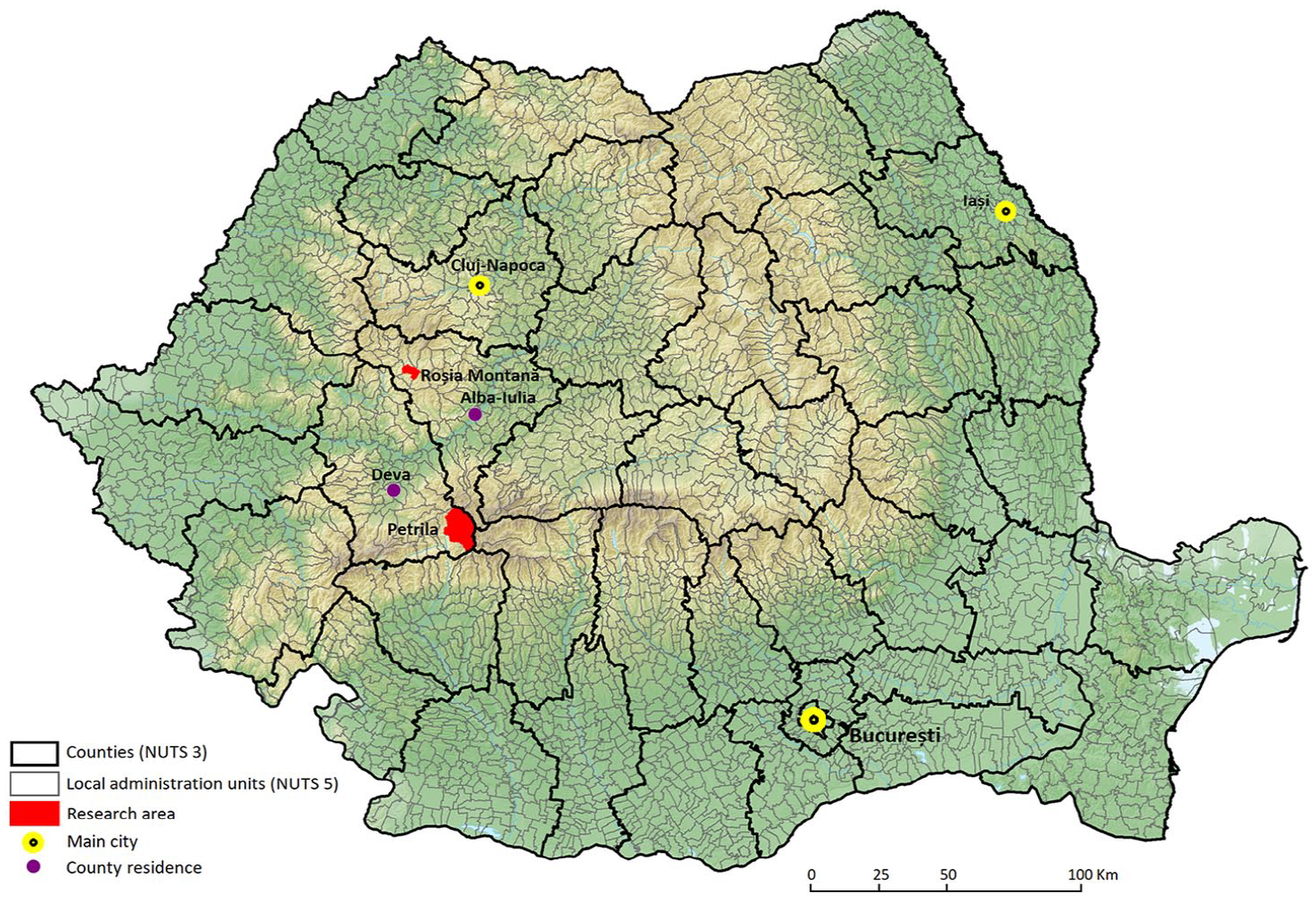
Location of research areas.
Moreover spatial stigma, foregrounded in a discourse of decline supporting accumulation by dispossession (Crookes, 2017: 88) and misrepresenting places as having serious problems that need urgent and radical solutions, were processes characteristic of both settlements. Development representations insisted on ‘untapped potential’ in Roşia Montană and on the coal mine as a ‘problem’ space in Petrila. Thus, legitimizing intervention was presented as moral and the right thing to do (i.e. destruction of a village or town mining community and of vernacular and industrial heritage for creating new jobs, and/or for escaping poverty and stigma) (cf. Kallin, 2017; Zhang, 2017). These were part of a denigrated present, where poverty was stigmatized, but for some initiated the stronger development of a fierce sense of place, attachment to place, and community identity.
The destruction was authorized by the central establishment but deemed unacceptable by Romanians and international cultural forums (Haiduc, 2012; Mutică, 2017; Păun Constantinescu et al., 2017). Civic resistance movements proposed an alternative development and used art and culture in their fight against drastic changes in their home settlements and livelihoods (Pop-Curşeu, 2017). Both settlements became famous and were the subject of two documentaries that depicted the inhabitants’ struggle against the destruction of their heritage (Daub, 2012; Dăscălescu, 2016). This struggle became widely acclaimed internationally and both obtained cultural recognition of their built environment, and a ban on further demolitions (the mine complex in Petrila was included on the protected monuments list of the Ministry of Culture in 2015 and Roșia Montană was accepted in the UNESCO Heritage Fund in July 2021).
We aim to assess the sources of place attachment in these two case studies and the relevance of their industrial heritage for engendering the feeling of belonging to place and people. The empirical and theoretical gap we wanted to cover refers to research on place attachment in relation to industrial heritage. To reach this aim, we considered the following objectives: to identify the theoretical background discussing the sources of place attachment, place attachment and loss, and place attachment in connection with industrial heritage; to present concisely the geographic and historical background for both settlements at the moment when the two documentaries were created; finally, to apply a theoretical model for analyzing place attachment to the contents of the two documentaries.
Methodology
The primary sources of information are two documentaries depicting the two case studies: Roșia Montană. A Place on the Brink (2012, directed by Fabian Daub) and Planeta Petrila (2016, directed by Andrei Dăscălescu). These documentaries were based on a variety of research methods themselves. They include interviews, conversations, narratives of the locals and participant observation that we processed through descriptive analysis and qualitative discourse analysis by identifying key topics and perspectives, and analyzing them in connection with the political, social, and economic context (cf. Mattissek, 2018). Qualitative methodology is more appropriate to explicate the meanings of attachments when applying a theoretical model and complementing it. In these documentaries, place identity and attachments are constructed discursively, hence our choice of research method. Secondary sources consisted of scientific literature on the two settlements. Finally, we relied on a theoretical background on place attachment and industrial heritage, but found it seldom combined in existing works. This enabled us to explore, for the two case studies, the connection between mining heritage and inhabitants’ attachment to places, people and things in their communities, according to Low’s (1992) approach.
Results and discussion
Roşia Montană and Petrila differ in size and historical background but share many similarities. Petrila was a mining town for most of its history; place attachment and industrial heritage have been deeply connected to this activity for almost two centuries. The government approved the foreclosure by December 2015 and ensuing demolition of the coal mine and related buildings. Locals organized strong resistance and offered a cultural alternative to demolition of what they perceived to be the built heart of the town (Păun Constantinescu et al., 2017).
Roșia Montană (Alburnus Maior, in Latin) has a much deeper history and was built atop one of the largest gold deposits in Europe, continuously exploited since prehistoric times (Merciu et al., 2015; Piso, 2012). It is the scene of a nationwide power struggle between the promoters of an aggressive mining plan based on cyanides that would result in huge ecological distress and destruction of built heritage and the general populace and most of the locals that strongly oppose it. The local community was strongly divided, some hoping that the mining project would yield employment opportunities and others who found it dangerous (Vesalon and Creţan, 2013).
In the following subsections, we prioritize our three research objectives. First, we identify the theoretical background discussing the sources of place attachment, its connection with industrial heritage, and the relevance of loss. Second, we present concisely the geographic and historical background for both settlements at the moment when the two documentaries were created. Third, we apply a theoretical model for analyzing place attachment to the contents of the two documentaries.
Place attachment, industrial heritage, and loss
The emotional quality of life experiences imbue space so that an affective bond with place is produced (Devine-Wright, 2014; Low, 1992; Rubinstein and Parmelee, 1992; Tuan, 1974, 1980). This bond is lived either through memories or currently, it exists within people’s life course by influencing how they interpret events and construct a coherent identity for themselves. Therefore, place identity is part of people’s identity (Rubinstein and Parmelee, 1992: 139, 147).
This cognitive and emotional link of individuals to place reflects material, sociocultural, and ideological components of life; it has multifaceted connections (Brown and Perkins, 1992; Low, 1992). Place attachment is significant because of memories and feelings (i.e. landmarks of one’s life), because it may act as a buffer that enables inhabitants to keep a positive self-image, and because attachment may be a way of representing and enacting continued competence and independence. Attachment can be strong/weak, positive/negative, narrow/wide, or diffuse (Rubinstein and Parmelee, 1992), and it can focus on primary and secondary territories (e.g. home or village/town, workplace) (Altman, 1975).
Place attachment is defined culturally by implying that place is a piece of territory that has acquired personal significance during time (Rubinstein and Parmelee, 1992), where place can take on a collective or a personal definition, becoming ‘a culturally meaningful and shared symbol’ (Low, 1992: 166). This symbolic relationship, besides evoking a culturally valued experience, may have other sources of deriving meaning: historical, cultural, and socio-political (Low, 1992).
Low (1992: 166) identifies six kinds of symbolic linkages between people and land: genealogical (family lineage, history), through loss of land or destruction of material and immaterial components of a community, economic (ownership, inheritance), cosmological (mythological, spiritual, or religious relationships), through pilgrimage (religious and secular cultural events, celebrations), and narrative (naming places and storytelling). Out of these linkages, loss and destruction can lead to a painful relationship between people and their place, but place attachment is a value of place in itself – it is an asset vouching for people’s well-being under any circumstances (Zhang, 2017). However, short-term disruptions are stressful (Brown and Perkins, 1992: 288) and this is the case for displacement. As opposed to voluntary moves, forced displacement induces trauma (Lewicka, 2008; Thompson Fullilove, 2014). It can trigger root shock, defined as ‘the traumatic stress reaction to the loss of all or part of one’s emotional ecosystem’ (Thompson Fullilove, 2014: 142). The painful experience of relocation, of general change and of insecurity were documented in previous research on the impact of mining closure (Bora and Voiculescu, 2021; Frantál, 2016).
Recent research underlines the relationship between place attachment and industrial heritage, their role in redevelopment, and planning policy implications of considering the relationship between them (Xie et al., 2020; Yuan et al., 2019). In addition, research advocates for more societal reflexivity that could enable regional territorial processes supported by industrial culture and place attachment (Bora and Voiculescu, 2021; Glorius and Manz, 2018; Marais et al., 2021). In fact, the outlooks of local communities should shape development policies in mining areas affected by dramatic changes, such as deindustrialization or new mining investments (Frantál, 2016).
Setting the scene
For Petrila
Petrila is one of the oldest coal mines in Romania, dating back to 1840 (settlement attested in 1493) (Jujan and Svoboda, 2009: 11, 16). One of the six mining towns along the Jiu Valley, it underwent deindustrialization after 1989 and serious shrinkage, from 29,000 inhabitants in 1992 to roughly 22,000 in 2021, but is still seeking development alternatives (Păun Constantinescu et al., 2017; Ionică et al., 2020; Toderaş et al., 2019).
As part of an agreement with the EU, the coal mine was to be closed and all associated buildings would have been demolished by 2016. A couple of local activists organized a group to safeguard the industrial buildings and to turn them into cultural venues. These are Ion Barbu – former topography engineer and now renowned caricature artist and professor at the University of Bucharest, and Cătălin Cenuşă – miner foreman. Other notable people involved were Andrei Dăscălescu, director of Planet Petrila, and architects Johannes Dumpe and Ilinca Păun Constantinescu. Together they raised awareness and resistance among the locals who wanted to safeguard the industrial buildings.
As part of the Industrial Heritage year of 2015, Petrila opened its Pompadou Centre (a cultural center and underground theater venue in the former Pump Building of the mine, now regularly housing theater and educational events) where the documentary Planet Petrila first aired in 2016. Due to media publicity and public pressure, the Ministry of Culture included the site on the Protected Monuments List in 2015, safeguarding it from further demolitions.
For Roșia Montană
Roșia Montană is one of the oldest documented gold mines in Europe, dating back to pre-Roman times and was attested in the 2nd century AD (Piso, 2012: 24). After the Aurelian retreat from Dacia, gold exploitation declined. It resumed at an industrial scale after the Hungarian conquest of Transylvania, continued during the Austro-Hungarian Empire (i.e. underground and gold mining from river alluvia), and during communism it took place in quarries.
The village is known for its vernacular architecture, unique landscape, mining heritage, and archeological remains of the Roman period. The underground galleries stretch for 15 kilometers (Merciu et al., 2015). Following 1999, the mining rights were transferred to a Canadian company subsidiary called Roșia Montană Gold Company (RMGC) (Iorgulescu, 2012: 68). The RMGC project intended to churn up the entire Cârnic Mountain and turn it into fine grind dust, which would then be mixed with sodium cyanide to extract the gold. Public discussions focused on the flooding of a village and water pollution. The settlement of Roșia Montană would have been surrounded by a tailing lake and poisonous debris deposits and most probably would have collapsed entirely due to extensive dynamite use that would have made life impossible. There are estimates of 300 tons of gold and 1,600 tons of silver along with other rare metals that were targeted by RMGC (Sântimbrean, 2012: 21).
In 2005, the implementation of the project was supposed to start, but it was heavily disputed mainly because of the catastrophic ecological and cultural impact, and of the dubious arrangement which did not benefit the Romanian state; the Romanian Academy formulated a negative point of view on the matter (Haiduc, 2012: 10–11). Following heavy protests nationwide, the government postponed the project and subsequently filed for the site to be included in the UNESCO World Heritage Fund in January 2017. Now UNESCO protected, any further mining activities are forbidden. The cultural industrial landscape, including the galleries inside the Cârnic Mountain and the artificial lakes (RO, tăuri), used to power the traditional gold rock grinding mills (RO, șteampuri), stretches for miles around, testifying a very rich history of mining and metal working.
In the aftermath of the political struggle, many inhabitants were relocated (over 100 families), and many houses deliberately left derelict by the RMGC. The local population has declined, accounting now for 600 inhabitants. According to the documentary (Daub, 2012), the once prosperous community was divided by the aggressive intervention of RMGC and their attempt to seize their homes and land by any means. Some were convinced to leave and relocated to the Recea neighborhood in nearby Alba Iulia, others were convinced to join RMGC through financial incentives, while the rest were constantly under pressure to sell and leave their homes. Many experienced loss of homes, relatives, and friends besides loneliness and hardship.
The following section will discuss the accounts from locals and miners in the two documentaries according to the six categories of place attachment determined by Low (1992: 166).
Digging for place attachment in two former mining settlements
The documentaries show that residents’ life in Petrila and Roșia Montană, according to their words, resembled guerrilla warfare against adversities. Both documentaries were filmed while disruptions were taking place. We identified all six kinds of symbolic linkage of people to their land: genealogy, destruction or loss, economics, cosmology, pilgrimage, and narrative (Low, 1992: 166). To these, our theoretical contribution consists of adding one more source of place attachment: activism and leadership. Locals opposed sacrificing people and their material and immaterial heritage for economic purposes. This seventh symbolic linkage appeared during a process of locals’ contesting neoliberal approaches to development paths in their former mining communities.
Genealogy
Genealogy consists of historical identification: family through lineage, community, and house, as ‘places are experienced as an extension of the self’ (Low, 1992: 282). Genealogical linkage to land (cf. also Tuan, 1980) is strong in small communities because land used to pass from generation to generation. In addition, place attachment is created through people’s experiential familiarity due to repeated use and autobiographical and social insideness (Rubinstein and Parmelee, 1992: 146–147). We perceive a stronger connection to land in Roșia Montană because of alternative agricultural activities, whereas in Petrila, a lot of the miners are only first- or second-generation incomers during the communist period. In Roșia Montană, farmers consider agriculture a safer and more sustainable activity than gold mining (Daub, 2012, min. 12), but most residents confess a strong attachment to the industrial heritage of the village as well.
We see a strong attachment of the miners to their mine in Petrila, and a reticence to be moved to another mine, even though conditions would be similar: ‘This is the end of mining in Petrila. You can’t force people to understand even if you spell it out to them’. / ‘I really like it here’ / ‘You don’t want to leave?’ / ‘You bet! Same as Dopey here’/ ‘We could’ve earned another day’s bread here’ (Dăscălescu, 2016, min. 66).
Arguably this could also be defined as economic-based place attachment, which is stronger in Petrila. However, despite the heavy workload and the dangers, the miners like it there because of the social ties they developed among themselves, ties that would have to be rebuilt if they moved elsewhere, despite similar economic conditions.
Destruction and loss
These wounded communities are perceived as homes where personal and social identity is at risk or people are deprived of them. Locals were deprived of their status, because the symbolic relevance of their settlements was threatened. They shared the experience of losing their jobs as miners, working-class pride, and status. They experience loss when the physical and social fabrics are changed in a process that they perceive as a violent one (demolitions, displacements, quarrels within family concerning selling their property, neighbors’ movement). Loss accounts for the ‘breakdown of social and family ties’ (Low, 1992: 169), of community structures. Destruction and loss are strongly experienced in connections with both their primary territories (home and personal possessions) and secondary (the settlement itself, the workplace) (cf. Altman, 1975), as people had to struggle to survive and were in danger of their mining heritage and livelihoods being destroyed, with the initial acceptance of the central government. We can clearly see the life of the miner, his problems, his fears and hopes through the eyes of Cătălin Cenușă, the miner foreman: It’s true. I founded a trade union in 2012 to fight for the future of this mine and of these people. We wanted those retiring after 2018 to be transferred to a viable mine. The miners were fearless once. The fewer we are, the easier we are to destroy. Politics has always been like this: divide and conquer (Dăscălescu, 2016, min. 40).
Cenușă and Barbu further elaborate on their fight against the public administration: It was decided in secret. There was no public announcement. That was the mayor’s fault. He should have called for a public debate, a referendum. That’s what the project stated, and they stated that there were public consultations. Eventually everyone left Petrila mine. Initially we were 4,500 employees, then we were 400, 300 and then 100. Now there will only be 20 out of more than 4,000 (Dăscălescu, 2016, min. 56).
Loss is exhibited through artistic articulations – a coping mechanism. Barbu uncovers a Wailing Wall with the names of all the miners that lost their lives during work there. The number is staggering, and the atmosphere is pious: This wall was supposed to be outside. The society for the closing of the mines wants to wipe out every single trace of this mine. They don’t care that people died for this coal, so they forbid any outside paintings. So, we decided to paint this Wailing Wall on the inside of our building and the inside of our souls (Dăscălescu, 2016, min. 55).
Through Barbu’s art, the Wailing Wall – a symbolic gesture acknowledging loss – initiates a ritual that commemorates those deaths and gives them meaning, alluding to a religious practice of place consecration. However, loss is especially connected to closing the mine, a mortuary ritual being filmed, when miners symbolically bury their mine and all mining activities. In addition, demolition of the industrial heritage is vividly discussed and filmed, underlying the protagonists’ feelings of helplessness, loss, rage, and decision to act.
In Roșia Montană, loss and destruction were strongly connected to RMGC. Widows whose husbands died of silicosis ended up in asylums after their adult children sold houses to RMGC. Some of them came back only to be taken out from their homes by the police. The documentary shows that women leave for improved opportunities for their children (education and jobs) or are displaced by their children who need the money from RMGC. This might be considered proof of a gendered impact of change (Boudewijn, 2022).
Displacement and loss were experienced by those people from Petrila who moved for work due to demolition and emigration, because mines were closed. Displacement played a surprising role, however, in uniting the community against exterior adversities and fostered resilience in those who chose to stay. People inevitably recount their community being torn over the RMGC mining project and some even mention the company attempting all sorts of techniques to turn ‘brother against brother’, including but not limited to intimidation, misinformation, family blackmail, and corruption. Loss means losing familiarity, self-esteem, security, and stability (Brown and Perkins, 1992: 280) and a disruption of place and time (Boudewijn, 2022).
In an interview with a woman that agreed to sell and was given a new house in Recea, we see her sharing mixed feelings and the constructed atmosphere of unspeakable sadness and homesickness: We like it here in Recea. But the company has instilled a deep hatred among brothers and neighbors. I cannot say I am not sorry cause that’s my birthplace and I am connected to it. And I cry as I hear they are tearing our house down. You cannot be insensible to that, and it hurts. I haven’t been there. There was a tough period with neighbors leaving and all that. I couldn’t sleep for a while (Daub, 2012, min. 22).
Locals cited the post war Sarajevo aspect of the village and how it negatively impacted their daily lives as neighbors and passers-by during that time. Still, collapsing places are not abandoned (Thompson Fullilove, 2014: 146). Dereliction and abandonment were promoted by those introducing change, but documentaries show that the Petrila mine and Roşia Montană village are humanized and lively places, represented more authentically through locals’ representations of their lived experiences.
Economics
Economic linkage shows a utilitarian relationship between people and their settlement (land, workplace) (Low, 1992: 169–170). Work- and competence-related identity (Brown and Perkins, 1992: 296) is strong in Petrila. This was a support settlement for the coal mine until its closure in 2015. Economic place attachment is thus strongest, with those who worked there being the most firmly attached to space and each other. There used to be thousands of employees connected through this activity.
In Roșia Montană, gold mining was a traditional activity, handed down from generation to generation, with few people still being licensed to do manual prospections and gold milling. Now, the settlement is more agriculturally based, with subsistence farming and some tourism being the main livelihoods of the remaining villagers. The documentary depicts some dramatic cases where elders were put into senior centers by their young in order to sell their houses. Some older women, faced with this situation, chose to flee the centers and return to their village, only to find their homes now had a different owner. Some of the elderly also recollect their childhood memories with their own parents being dispossessed following World War II by the communist state which took over their land, properties and particularly their private right to mine gold. These elders wish that the state would safeguard their confiscated property, hoping that the state and the Romanian people will benefit from gold exploitation instead of a private company.
In the end, it seems the main reason the RMGC mining project failed was not only because of the public opinion and international cultural pressure to preserve the site, but moreover because some people chose to defy all odds and remain there to safeguard their inherited land and homes (cf. also Alexander et al., 2018; Rîșteiu et al., 2022). Attachment to land and homes is very strong with some of those that stayed put.
In Petrila, some women worked in mines: actioning machinery and lifts, taking care of mining equipment, keeping track of production. One of these women said it was necessary to always be supportive of miners, as they did dangerous work, not knowing if they would ever come back.
Cosmology
This ideological linkage refers to the ‘religious and mythological conceptions of the world’ and their correspondence with the landscape (Low, 1992: 170). The cosmological aspect is deeply present for some elderly people in Roșia Montană. Supernatural forces like Vâlva Bună and Vâlva Rea (spirits depicting the good and bad aspects of the deity governing gold mining) are described. A story is recounted of a local who encountered Vâlva Bună and convinced her of his pure intentions if he were to find gold in the mountain. Legend has it that the spirit guided him to a huge gold deposit. He showed his gratitude to God by erecting several churches and a school in the village.
Another elder shows deep commitment to the built heritage of Roșia, particularly the religious sites: If the project was to succeed, all these churches would be buried, similarly to the one in Geamăna. We were born here, and it is here where we want to die. You know the biblical tale of David and Goliath. Even though we are small, and we have no money, we have a deep love for our ancestral land, and we will never let Roșia Montană be destroyed (Daub, 2012, min. 6).
A reformed pastor mentions doing his duty toward God and his flock, and even performing the service in an empty church. He mentions that some of his former parishioners (close to 120) chose to escape the harsh conditions of life there only to die of alienation within two years of their departure (Daub, 2012, min. 20).
For the miners in Petrila, the activity of mining is seen in cosmological terms. The miner is in union with the earth he lives in, spending most of his years underground: The miner’s life is eternal. 25 years in the darkness, then 5 years in the light if he’s lucky and then he’s back under again for eternity (Dăscălescu, 2016, min. 65).
The consecration of the mine is being done through art. The Pompadou Centre is housed in the former Pump Room of the mine and other places connected to the mine have received a new commemorative function (cf. also Pop-Curşeu, 2017, for a discussion about the role of art in connecting community structures and creating civic awareness in Roşia Montană; a similar path is demonstrated by Barbu in Petrila, but also with added transformative participatory and creative cultural functions, as detailed at Activism and leadership below).
Pilgrimage
Pilgrimage creates another type of ideological linkage through traveling and experiencing (Low, 1992: 283). Celebrations, routines and changing environments through art are attachment processes. Pilgrimage is a new source of place attachment developed in both settlements through the publicity they received. Both have become renowned beacons of resistance in the face of adversities (cf. Păun Constantinescu et al., 2017; Pop-Curşeu, 2017; Vesalon and Creţan, 2013). While Roșia Montană enjoys a beautiful natural setting and a rich cultural industrial heritage dating back two millennia, Petrila mine is also impressive, being the deepest coal mine in Europe (Ionică et al., 2020: 5), and has large cultural venues, albeit temporary, in the former mine buildings.
People have shown interest in its fate and Fânfest folk festival has been organized in Roşia Montană yearly since 2004, bringing national and foreign musicians and spectators. While many locals support the festival for the popularity and money it brings, some have shown reticence, like the local dentist, who points out: We must really develop a culture of mining, but a real culture, not pollution with Fânfest produced by those opposing the project. We cannot let this area be polluted by all kinds of individuals from all over Europe who come here to have fun for a few days and leave behind heaps of syringes for drugs or bottles and other stuff. Locals are very displeased with these manifestations called cultural by the opponents (Daub, 2012, min. 62).
Other manifestations that can account for an influx of interested people include the Adopt a house movement, designed by architect Ștefan Bâlici to set up an architectural restoration workshop with the purpose of preserving the most endangered and beautiful buildings, or the Pachamama Marathon and Roșia Montană Scouts, both envisioning the pristine natural scenery surrounding the village.
Similarly, Petrila has been popularized through a series of cultural events, involving the locals in raising people’s awareness of the value of industrial heritage and the need for a fair, uncorrupted society. These are vividly depicted in the documentary. Artistic performances are held in front of locals and guests, such as in the case of the National Festival of Underground Theater, when locals co-create costumes from secondhand clothes, together with Barbu, and they practice marching and happenings directed by him, with ‘coal dry humor’, as local writer Sîrbu used to say (Dăscălescu, 2016, min. 70). One also sees children, adults and local craftsmen working with Barbu to stage cultural events or make the necessary objects.
Narrative
Stories are what make for good memories and the two depicted cases are no exception to this rule. At the very beginning of the documentary on Roșia Montană, a young man is presented giving a tour guide by driving the cameraman through the village. The narrative is about places and things seen as symbols of the self that point out significant experiences from his life: Here dwells a woman that sold the first house in Roșia. After she spent the money, she returned and now stays in a small cabin. Here is the well renowned pub, here, to the left, is “The Misinformation Centre” of the mining company. Here to the left I spent my childhood years, on this hill – the Citadel it was called, and in the quarry. So, I know about mining, I grew up in the quarry. Many of those I grew up with are now working for RMGC and many of them ask me why am I stupid? Why am I against the project? And I answer them: you have your opinions and I have mine. We should agree to disagree and respect each other. There are still people living here, albeit fewer, but they still need to be taken into consideration (Daub, 2012, min. 8).
Through their stories, one can see the old days come back to life and they are testaments of the atmosphere and lifestyle of old. They also narrate about their divided community, about the displacement of friends, relatives, of homes and ideals, the loneliness, and the homesickness for those who left.
Petrila is similar in this respect as the coal miners have their own stories. The mine is a source of identity and purpose. Barbu shares his conviction that the industrial heritage can be preserved through cultural activities. In addition, together with other locals, using their generosity and creativity, he created the Memorial House I. D. Sîrbu, The Mother’s Museum, and The Museum of the Romanian Plumber, besides the Pompadou Center. Moreover, they are involved in The Museum of the Mining Saviour, managed by Cenuşă. Barbu’s initiatives include caricature, theater, and street art that depict the story of the place and its importance to the people: For three years we have been fighting to save Petrila Mine, at least for the sake of culture. Yes, to preserve it. In these three years not once have we been asked by the decision makers, for instance, “what do you guys propose?” It was all guerrilla warfare, they didn’t care at all (Dăscălescu, 2016, min. 72).
Material and immaterial heritage is reiterated by many in these documentaries; they emphasize how their life course is united with the mines. Place attachment occurs through narrating because people and events are spatially anchored during narratives (Low, 1992: 174). From narratives, we see that the primary source of attachment is the environment (land and mines) with its community sacred places (Low, 1992: 153).
Activism and leadership
Activism and leadership create present place attachment. People’s rootedness (i.e. long habitation in one’s settlement), during the process of resistance, is transformed into sense of place (they start to consciously appreciate their place; cf. Tuan, 1980). In this process of developing their sense of place, their affective attachment to place develops. Upon analyzing Planet Petrila and other sources, we realized that most people living in Petrila were in one way or another connected to the mine at some point in their lives, making it the centerpiece of the community. The term community makes sense in a small enough settlement where all inhabitants know each other and are connected by a common struggle, to survive in the harsh conditions imposed by manual mining and drilling.
The documentary starts with a discussion between Barbu, the most fervent defender of the mine complex, and a woman. He is known to be the leader of the initiative to save the industrial buildings from demolition, and a catalyst in these efforts: ‘Madam, I was hired here at Petrila Mine back in 1978. . . and I worked here for 15 years’ / ‘So you have a good memory of the place?’ / ‘Yes, I am the number one relic of Petrila’ (Dăscălescu, 2016, min. 4). ‘Were you a good miner?’ / ‘No, I was a good topographer. Well moderately good’ / ‘And what was your motivation for becoming an artist?’ / ‘I probably felt the mine was going to be demolished and it was my calling to be its savior. I believe the only chance Petrila has is through culture’ (Dăscălescu, 2016, min. 38).
Social capital and activism contribute to the active process of creating place attachment or of strengthening an existing attachment. Both settlements show how locals understand the stages of response to place change: ‘becoming aware, interpreting, evaluating, coping, and acting’ (Devine-Wright, 2014: 171). Fear of the unexpected and the struggle to survive hardships and reconnect to beloved places and communities are rendered in the documentaries. Threat can lead to ‘place-enhancing outcomes, depending upon how it is interpreted and evaluated by those experiencing change’ (Devine-Wright, 2014: 169). Both settlements are represented as territories in resistance, using agency from below to fight adversities (Husseini de Araújo and Batista da Costa, 2017). Their resistance created new and positive place meanings, underlining alternative sustainable and inclusive variants to development, which value and capitalize on industrial heritage.
For instance, Cenuşă, as one of the community leaders, wants to safeguard the mining heritage: Most of us are still in Petrila. We could all get mobilized for this. If not, what will a retired miner see when he looks at his town? There’ll be nothing left (Dăscălescu, 2016, min. 56).
In the same vein, in a meeting with locals and NGOs, architect Ilinca Păun Constantinescu asks: ‘So, the local community can change this?’ / ‘Well said! First, we need initiative. The local community can reject the demolition and propose to open a museum instead’ (Dăscălescu, 2016, min. 17).
During an artistic performance in Barbu’s yard, locals march carrying placards with messages for resistance: Ask not what Petrila has done for you. Ask what you can do for Petrila; We must keep Petrila whole and safe and unspoiled; Petrila dies, it does not surrender (Dăscălescu, 2016, min. 24).
Moreover, in Petrila, the walls of the mine buildings speak through art: ‘2/3 din lumină este mină’ [RO.] [2/3 of light is the mine] or ‘The mine is the sleeping beauty of Petrila’ (Dăscălescu, 2016, min. 28).
Leadership is more diffuse in Roşia than in Petrila. More voices are heard, foregrounding different perspectives on acting and resisting hardships. For instance, women stay or return because they need to be home. They insist that the gold belongs to the Romanian state. An old woman, who wrote a petition to the Ministry of Economy to oppose the mining project, points this out: [Politicians] cry out loud that our country is in crisis, and they give away tons of gold to others! We will not leave this place; we’d rather die than leave. [. . .] We will fight them until the last drop of blood (Daub, 2012, min. 66).
Not leaving is residents’ work of resistance, as a local man emphasizes: The main problem of the company is the people who won’t leave. This is my work in Alburnus Maior, or that of Călin, and of all others here: to stay and defend our homes (Daub, 2012, min. 68). I have a very well-developed sense of property and I am ready to do anything to defend it. This is all I’m saying: anything . . . (Daub, 2012, min. 75).
Through activism, people renegotiate their place attachment; attachment is regenerated, it is ‘a community practice of love’ (Thompson Fullilove, 2014: 147). Keeping the mine alive by preserving its physical remnants and by performing artistic activities that raised public awareness about its value could be considered community practices of love for that place. Such practices showcase locals helping to create events and products used in Barbu’s cultural activities. Their creative expressions (museums, performances in industrial heritage buildings, in the streets, etc.) are forms of subversive political action (Serafini, 2020: 292). Activism is expressed as a participatory creative practice, engendering empowerment, and fortifying place attachment. Barbu, during the National Festival of Underground Theater at the Pompadou Center, highlights this idea: A round of applause, please, for architect Ilinca Păun, from Bucharest. We offer her our best wishes and support, so she’ll save more of our mining heritage, and we’ll transform it, with your help, into cultural hubs (Dăscălescu, 2016, min. 47).
Similarly, locals of Roşia say that their resistance is a practice of love for their settlement.
The locals channeled their shared identity, either as miners or as worthy inhabitants of esteemed settlements, into recovery actions. Activism developed as a sense of belonging to a community sharing the same values, understandings, and attitudes. It increased people’s topophilia (Tuan, 1974). Activism and leadership are represented as coping mechanisms, again bonding people with the places affected by disruption and perceived negative change. Due to their active and meaningful involvement in coping and recovery actions, these communities are sources of both cultural and civic pride.
Conclusions
The analyzed documentaries show that place attachment is shaped by one’s life course, environment, and social processes. This relationship is reciprocal. Both examples feature a very powerful commitment by the local population to safeguard its values and depict a strong place attachment in the face of adversities. Territorial identity is a source of attachment to ordinary places (nature, home, workplace), and to shared references and contexts (i.e. the mines). Attachments help people construct identity. This is why it is important to maintain a sense of the past and the industrial heritage that is an inseparable part of it.
The mines and related industrial buildings and installations are public symbols of miners’ lives, of attachment to place and a particular period. They are the economic and spiritual center. Symbolically, they represent the town and the village – and their identification as miners or an ancient mining community. Industrial and mining heritage are forms of territorial identity display because heritage is connected with practices that define the evolution of these communities. It is a source of place attachment that becomes even more central when that heritage is in danger.
In addition, as evidenced in the two case studies, activism and leadership feed on place attachment and construct it at the same time. The authors’ contribution of activism and leadership to Low’s theoretical model on place attachment (Low, 1992) is rooted in the Romanian reality of the two documentaries: a politically hostile climate for grassroots movements concerning the preservation of industrial heritage. Therefore, our theoretical contribution can be further used to explain the Romanian reality of industrial heritage preservation. At the same time, it can be successfully transferred to other countries featuring similar political environments.
Even though it has been documented that sometimes policies encouraging place attachment can generate financial lock-ins, damaging the population when mining decline installs (Marais et al., 2021), our research shows the contrary. More specifically, the locals perceive relocation, changes to the settlement and the local landscape, and social disruption in general, as having stronger negative effects than economic decline. Thus, in both cases, maintaining and further constructing place attachment (where the industrial and mining heritage is a powerful source) form a successful coping strategy in the face of economic decline and abrupt changes.
This research, an insight from Eastern Europe, brings a valuable contribution to the industrial heritage and place attachment literature, being one of the first studies to focus on their connection and resistance movements against neoliberal capitalist development. Its limitation consists in using only one type of research material: documentaries. Future research could emphasize how industrial heritage and subsequent place attachment constitute crucial resources for any strategy that considers territorial and people-centered approaches to development, within a paradigm of sustainability and inclusiveness.
Footnotes
Authors’ Note
All translations from Romanian are by the authors.
Funding
The author(s) received no financial support for the research, authorship, and/or publication of this article.
