




Abstract
This article explores intersectional discourses of migration and gender in the social media environments of three different European countries – Belgium, Greece, and Italy. Through a discursive analysis, we identify (1) an inclusionary discourse providing constructions of gender that welcome migrants in European societies, articulated around the nodal points of empathy and care, visibility, equality and the acknowledgement of societal relevance, and (2) an exclusionary discourse providing constructions of gender that prohibit the inclusion of migrants in European societies, articulated through the nodal points of threat, burden, radical difference and irrelevance or invisibility. For the analysis, we retrieved a dataset of 1000 posts per country about migration from Facebook and Twitter (now X) and we selected posts with a gender dimension. The article shows how the discursive struggle over migration and gender takes shape across inclusionary and exclusionary discourses that relate to the left/right-wing political spectrum in Europe.
Introduction
The article looks at the representations of migration and gender in the social media debates of three European countries – Belgium, Greece, and Italy. There is a considerable amount of research about how traditional media, such as the press and audiovisual media, report on migration in Europe, and research on the role of social media in representing migration in Europe has also caught up. Less is known about how the (online) representation of migration intersects with other issues of relevance to 21st-century Europe, such as gender equality. To address this concern, we focus on the intersection of migration and gender in these countries and, more particularly, on the ways that gender is activated in discourses about migration. The aim is to look at migration and gender together and analyse the ways that the two dimensions interweave and mutually shape each other in public debate. We do so through a discourse-theoretical analysis, which allows for linking the textual analysis to the macro-dimensions of human action (Carpentier and De Cleen, 2007, 277), while keeping in mind the tensions around the ways that ‘online discourse relates to the offline’ (Bouvier, 2015: 155).
We approach national identities from a cultural studies perspective, understanding them as cultural categories sustained by representational practices of difference (Brand et al., 2024). Our focus is on how the digital public sphere becomes a site of contestation, where conflicting discourses negotiate these categories. In this context, we contribute to debates on European identity as a cultural process grounded in discursive–material realities, examining how boundaries of inclusion and exclusion are continuously redrawn between Europe and ‘the rest’ (Hall, 1992). Our analysis maps how migration debates articulate these shifting boundaries through gendered signifying practices that intersect with ideologies of nation and ethnicity in the European digital public sphere.
In the first two sections, we discuss our approach and theoretical framework. We deploy discourse theory, which aligns well with the cultural studies approach to national identity. In discourse theory, discourses are seen to provide coherent yet always contestable frameworks of intelligibility, for navigating social reality, and combine this with the theoretical framework of intersectionality. In the next section, we discuss the methodology we used for this research, carefully selecting social media posts for each of the three countries, from Facebook and Twitter (now X) between 1 September and 30 November 2021. After briefly describing the three national contexts, we analyse the two discourses on migration (inclusionary and exclusionary) that we identified in our research, and the ways they intersect with gender but also with broader political struggles. Finally, we address some concluding reflections concerning the societal-ideological embeddedness of the identified discourses in the three countries, and more broadly, in Europe.
Discursive constructionism and intersectionality
Following Laclau and Mouffe’s (2001 [1985]) discourse theory, discourses are seen as constitutive elements of the social fabric, that provide us with frameworks of intelligibility (Carpentier, 2017). In this approach, discourse is a way of representing, or producing knowledge about, social reality (through language and other signifying practices), which specifies social practices. In Laclau and Mouffe’s work, discourse is defined as ‘a structure in which meaning is constantly negotiated and constructed’ (Laclau, 1988: 254), with nodal points as its privileged (discursive) elements. Laclau and Mouffe thus see discourses as unstable entities that can only be temporarily fixed through the process of articulation. Contingency and instability are emphasized repeatedly; representation is constituted ‘not as a definite type of relation; but as the field of an unstable oscillation’ (Laclau and Mouffe, 2001 [1985]): 121). Discourse theory allows us to understand contingency in these negotiations over the articulation of social reality or in struggles between different discourses in their quest to constitute their hegemonic positions.
For the analysis we will carry out, discourse theory’s definition of discourse as macro-textual and macro-contextual (Carpentier and De Cleen, 2007, p. 277) is particularly relevant. This type of approach does not locate discourse at the level of the individual, or based on verbal action, but allows us to look at how discourses are constructed and circulate within the social, thus conceding scope for much broader analysis (Carpentier, 2017). For instance, concerning how gender identity (Butler, 1990) or migrant and diasporic identity (Hall, 1992) are articulated and constructed (in our case, on social media). In this respect, Hall (1992) writes about how the West, symbolized by (neo-)colonial Europe, developed a formative discourse of cultural dominance, which he called ‘the West and the Rest’, emphasizing the role of otherness in these constructions:
. . . this discourse continues to inflect the language of the West, its image of itself and ‘others’, its sense of ‘us’ and ‘them’, its practices and relations of power towards the Rest. It is especially important for the languages of racial inferiority and ethnic superiority which still operate so powerfully across the globe today. (p. 318)
This illustrates that the social relations inscribed in discourses can become sites of antagonism(s) since they are often constructed as relations of subordination (e.g. to white Western patriarchy). These dynamics can be detected, among others, in how migration is discursively constructed. For example, a discourse on immigration can represent migration as a problem and crisis, or as a success and benefit. Discourses can welcome the inclusion of migrants into the society where they arrive, or define migrants as unwelcome, and argue for their exclusion. Discourses can emphasize the legal status of the migrant – labelling migrants as refugees, asylum seekers or illegal immigrants (Faustino, 2021), or articulate them as humans or citizens. Or they may neglect to provide information about the context or situations of the migrants in their country of origin (Georgiou and Zaborowski, 2017) and omit information about migrants’ journeys, while emphasizing landing areas. Migrant cultures can also be depicted as incompatible with European values (Vochocová, 2021: 335).
Discourses on immigration can intersect with other discourses such as gender (Gianettoni and Roux, 2010; Schaper et al., 2020). For example, migration is often constructed as a male project (King and Zontini, 2000) and migrant men are represented typically as a threat, in association to war, rebellion (in their home country), and crime, or simply socially deviant. Migrant women then become represented either as passive appendices of migrant men (Riaño, 2005), as a burden to the host society, often vulnerable and victimized, or as ‘women moving on their own’ and labelled as ‘single’ and ‘transgressors’ (Schmoll, 2007) in relation to their male counterparts. When female migrants are not represented in relation to male migrants, they tend to become invisible (Anthias, 2001: 146). This is an example of intersectionality – a term coined by Crenshaw (1989), which refers to the idea of crossing different systems of power, marginalization and inequality. Intersectional thinking is relational and constructionist, as Prins (2006) reminds us: ‘Categories like gender, ethnicity and class co-construct each other, and they do so in myriad ways, dependent on social, historical and symbolic factors’ (p. 279). Intersectionality does not have to be exclusively limited to race, gender and class, but can take into consideration other categories such as religion, nationality and ethnicity (Phoenix, 2024: 22). In our analysis we specifically focus on how gender becomes intersectionally activated in discourses of exclusion and inclusion in relation to migrants.
Discursive struggles over inclusion and exclusion
As the previous section illustrates, the discursive constructions of migration – in intersection with gender – are not neutral, but deeply political. This also implies that different discourses, each with their particular truth claims, engage in discursive struggles, attempting to re-articulate and discredit each other, with the (ultimate) objective of establishing (discursive) hegemonies. As Marchart (2007) put it, ‘hegemonic success’ (p. 139) occurs when a hegemonic order is established, resulting in the forgetting of its constructed nature and its articulation as natural and objective. In this scenario, a social imaginary is created, which pushes other meanings beyond the horizon, threatening them with oblivion. But as Mouffe (2005) wrote, ‘Every hegemonic order is susceptible of being challenged by counter-hegemonic practices, i.e. practices which will attempt to disarticulate the existing order so as to install another form of hegemony.’ (p. 18)
When zooming in on the discourses of the inclusion or exclusion of migrants, these discursive struggles are embedded in diverging approaches to identity. Essentialist approaches see identity as natural, homogeneous, invariable and unitary (Kondo, 1990; Storrs, 1999), which also implies a rejection of intersectionality. Such approaches, whether they concern nationality, gender or other aspects of identity, consider the latter as fixed and unmodified, bearing a set of given essences which make it authentic (Wodak et al., 2009). These ideal, ‘pure’ identities are considered to be in need of protection from impurities and re-articulations. They are thus largely structured around the importance of stability and through an antagonistic relation towards the Other, where the pure/authentic Self is constructed against the impure/threatening/enemy Other. This means that there is no space for difference, plurality and co-existence of multiple identities (either one is a biologically determined man or a woman; a first- or second-generation migrant in Greece is not a ‘real’ Greek, etc.). Reversely, non-essentialist approaches to identity see the latter as socially constructed, dynamic and not fixed, which also allows for the validation of intersectionality. One important recognition in these non-essentialist approaches is that identities ‘are constructed through, not outside, difference’ (Hall, 1996: 4), through the relation to the Other, which takes shape as a multitude of constitutive outsides (Hall, 1996: 4–5; Laclau, 1990). This opens up the possibility of multiple identities which undermine the logic of the pure, self-contained, stable and unitary identity of the essentialist phantasies.
These diverging approaches to identity drive the discursive struggles over inclusion/exclusion of people, societal groups, ethnic groups and nation states in the social realm, generating a multitude of positions, ranging from radical-inclusionary to radical-exclusionary positions. Arguably, as we also established in our analysis, two main and distinct discourses can still be distinguished, namely an inclusionary discourse (aiming to maximize inclusion), and an exclusionary discourse (aiming to limit inclusion), which provide a ground for the multitude of positions that circulate in society.
Key to the exclusionary position is the discursive construction of in-groups and out-groups, in processes of positive self-presentation and negative other-presentation, that justify and legitimate the exclusionary practices (Reisigl and Wodak, 2006 (2001); Wodak, 2011: 57, 2015). The exclusion of people and groups from the social realm is enabled through a series of discursive strategies that, in more radical cases, activate racist, xenophobic, homophobic or misogynist discourses, constructing the Other-enemy. One of these strategies is symbolic annihilation (Tuchman, 1978: 17), articulated through the signifying practices of omission, condemnation and trivialisation. Practices of symbolic annihilation lead also to people’s and groups’ dehumanization, depriving them of human qualities (e.g. xenophobic representations of migrants as swarms of flies – see e.g. Carpentier and Doudaki, 2023, p.185). Another strategy is moralization, evoking moral codes and values (Doudaki, 2018, p. 152 ), ‘aimed at creating positive or negative moral connotations for people, actions, and decisions’ (Doudaki and Boubouka, 2020, p. 58). Exclusionary practices use moralizing strategies to stigmatize the behaviour (or ‘culture’) of those defined as out-groups – for instance, migrants, migrant women or LGBTQIA+ members – as unethical and problematic (e.g. Cohen, 2011; Hall et al., 1978). These groups are critiqued for deviating from ‘the prevalent moral order of society’ (Van Dijk, 1998: 256), and for thus threatening it (Rojo and Van Dijk, 1997). One other strategy used is that of exceptionalism, through which the unique essences of the in-group. that make it exceptional or superior, are emphasized, in explicit or implicit contrast to the inferior out-group. All these strategies are often supported by a fear-driven language (Wodak, 2015), in which elementary dichotomies of victim-perpetrator, good-evil, innocent-guilty, civilized-barbaric, normal-abnormal, ethical-unethical (Carpentier, 2015; Tsagarousianou, 1997) abound.
In contrast, the inclusionary discourse exposes and critiques the discriminatory and exclusionary rhetoric and practices of its opponent in the discursive struggle. The inclusionary discourse also uses a moralizing strategy, although it is different, as it articulates exclusionary practices as unethical for not acknowledging the humanity of the Other. In a similar way to exclusionary strategies, another inclusionary strategy is granting visibility to marginalized, discredited and stigmatized social groups by paying attention to their systematic discrimination, and raising public awareness about these issues. Moreover, the exclusionary discourse’s exceptionalism is countered by universalism, a strategy which drives rehumanization practices, through which the negated human qualities of these groups are reallocated, and where their expertise, talents, knowledge become visible. This strategy is also related to a reattribution of ordinariness and extraordinariness. On the one hand, these groups are de-stigmatized from the over-imposing single (extraordinary) identity of the out-group – ‘the’ migrant, ‘the’ homosexual, ‘the’ Muslim woman – that sees them as a homogenized category, and on the other, their extraordinariness is articulated in relation to their skills and talents, and to the uniqueness of their multiple identities.
Methodology
In order to organize the analysis of the inclusionary and exclusionary discourse in a selection of social media postings, we focused on Facebook and Twitter (now X, but at the time of data collection, Twitter) postings in three countries, namely, Italy, Greece and Belgium. We chose these social media platforms due to their high user engagement as, at the time that this research was conducted, they were the most popular platforms 1 for news consumption in Europe (that is in 2021, before the exponential rise of visual-based media like TikTok, which allow for more vernacular contents). We chose these countries because Italy and Greece are both considered to be first points of contact for migrants in Europe, and Belgium as a more distant destination in the journey of migrants. Brussels is also the heart of the legislative body of Europe and its institutions. We opted for a qualitative discourse-theoretical analysis (or DTA, see Carpentier, 2007), relating the latent meanings of texts to the discursive construction of reality; specifically – inspired by earlier work on intersectionality and media (Van Bauwel and Krijnen, 2021) – we focused on how gender intervened in social media postings on migration. In practice, this means that we analysed a selection of social media postings, as an entry point to understand the connections between the macro and meso levels of communication on social media (Marwick, 2014) and in European society at large.
The selection of data – Facebook posts and Twitter tweets – was grounded in a two-stage selection process, where in a first stage, these postings were extracted from Facebook (using Crowdtangle) and Twitter (using Twitter bulk downloader API v2). We first defined a set of keywords specific to the topic of migration, which were then translated (and if necessary adapted) to each specific language, namely, Italian, Greek and Dutch (not including French or German for Belgium). In all cases, all posts were retrieved between 1 September and 30 November 2021, but only posts with actual topic-related keywords in their content field were retained, still resulting in several thousand postings for each country. After an initial cleaning of this dataset, the 200 postings with the highest number of interactions were selected for coding, which had the consequence that many of the postings originated from political actors. The engagement-based sampling method has resulted in a dataset largely composed of content curated by digital communication agencies (Miconi, Cannizzaro & Risi, 2024). This has limited the impact of so-called citizen journalism (Baker and Blaagaard, 2016) on both the visibility and promotion of alternative discursive constructions of gendered migration in Europe.
Two researchers per country performed a manual screening of the posts to select, among the migration posts, all those also containing a gender dimension, which was the second selection stage. We devised a list of criteria describing how a post was considered gendered, referring (1) to grammatically expressed gender, which is more explicitly marked in the original language of the post, that is, Italian or Greek, than in the English translation; (2) to gender in association to feminism, women’s rights, sexual identity; (3) to gender being mentioned in isolation from or in association to other gender(s) (e.g. asylum seekers as single men, OR, asylum seekers as males and females) and conveyed through significant omissions; and (4) generally, including any reference to gender (either male, female, LGBTQ etc.) that is marked with social meaning. These postings were subjected to a DTA, using regular qualitative open and axial coding methods (Saldaña, 2013). All country teams used a coding scheme that consisted of inductive and deductive codes extracted from the literature, which were eventually grouped under the dimensions of ‘the inclusivity discourse’ and ‘the exclusivity discourse’. A first series of rounds of coding with this coding scheme helped us to identify micro-categories relevant to gendered migration, which were then – for each country separately – structured in coding trees, creating hierarchies that allowed us to identify the nodal points. These nodal points provided the narrative structure of this article, with a selection of quotes (from the much larger pool of relevant fragments) that we use to illustrate the analysis.
The three national contexts
Our analysis is situated in three European countries, which all have their own specificities. Greece has been at the epicentre of European migratory movements as the country is one of the main access points for undocumented Middle Eastern and African migrants (Park, 2015). These movements occur especially via the sea routes from the East, aiming to reach the islands of the eastern Aegean, and the South, as well as via land from the Northern region of Evros, which borders Turkey (Grigoriadis and Dilek, 2019). It is reported that 18,780 refugees and migrants arrived in Greece in 2022 (ECRE, 2023). The country’s border has been heavily securitized, including the construction of a fence along the Greece-Turkey border, and the patrolling of the EU Frontex police (Kostopoulos and Mylonas, 2022). The migrants entering the country commonly end up in camps and hot spots, where they face squalid conditions while waiting for their asylum applications to be processed.
Like Greece, Italy also lies at the epicentre of European migratory movements: on the one hand, the well-organized and often autonomous communities of people from China, Pakistan, Bangladesh, or the Philippines; on the other, the more chaotic routes across the Sicilian Mediterranean channel and the Balkans. In 2022, it was estimated that 105,129 migrants arrived by sea in Italy (Statista, 2023). Italians believe that most immigrants come from Arab countries, but the flow of people without papers, even across the southern and eastern shores of the Mediterranean, includes migration from several continents (Monzini, 2007). Italy is not necessarily the final destination, but part of a wider route that includes Italy and other Western countries in Europe (Pastore et al., 2004).
Finally, Belgium is not at the epicentre of the migratory movements in a material sense, but is situated at the legislative centre of the European Union as the European commission is stationed in Brussels, the capital of Belgium. In 2022, official figures (Statbel, 2025) point out that 116.544 migrants entered Belgium, which is often perceived as a large number of asylum applications. In recent Belgian history, there is a discourse on a so-called ‘migration crisis’, which coexists with the European discourse on migration. Beyond the 2021 peak following the Red Kite evacuation from Afghanistan, several events have sparked public controversy, including debates over hijab legislation, restrictions on asylum for single male applicants, and shortages in shelter capacity. The border legislations and the hijab are the two main migration-related topics represented on social media (Ingebretsen Carlson et al., 2023), around which there is political polarization, as far-right Vlaams Belang and right-nationalist N-VA advocate stricter controls, while left-wing parties and activist groups stress rights to movement and protection.
The inclusionary discourse in the three countries
The inclusionary discourse on the gender-migration intersection has four nodal points: encouraging empathy and care, offering visibility, defending equality and acknowledging societal relevance (Figure 1). The first nodal point, the encouragement of empathy and care, has two discursive elements: victimization and vulnerability. While these discursive elements often interweave, they are different insofar as victimization refers to the condition of having been a victim of violence and exploitation, while vulnerability refers to the (increased) potential of becoming a victim because of the migrants’ disadvantaged status. In an example of the former case, the feminist group Not One Less Pavia writes an Italian language post about the tragic victimization of a female migrant:
. . . she fled her country as a victim of trafficking. . . . Adelina was a woman, a migrant woman, a woman suffering from cancer and therefore unable to have a job, a woman who led a precarious existence living on just over 200 euros a month and who paid a rent of over 400 euros, a woman for whom it had become difficult and painful even just to climb the stairs of her own home and walk along the same road that would take her to the police headquarters for the renewal of that bloody permit. (Facebook, Italy, Feminist Group) (emphasis added)
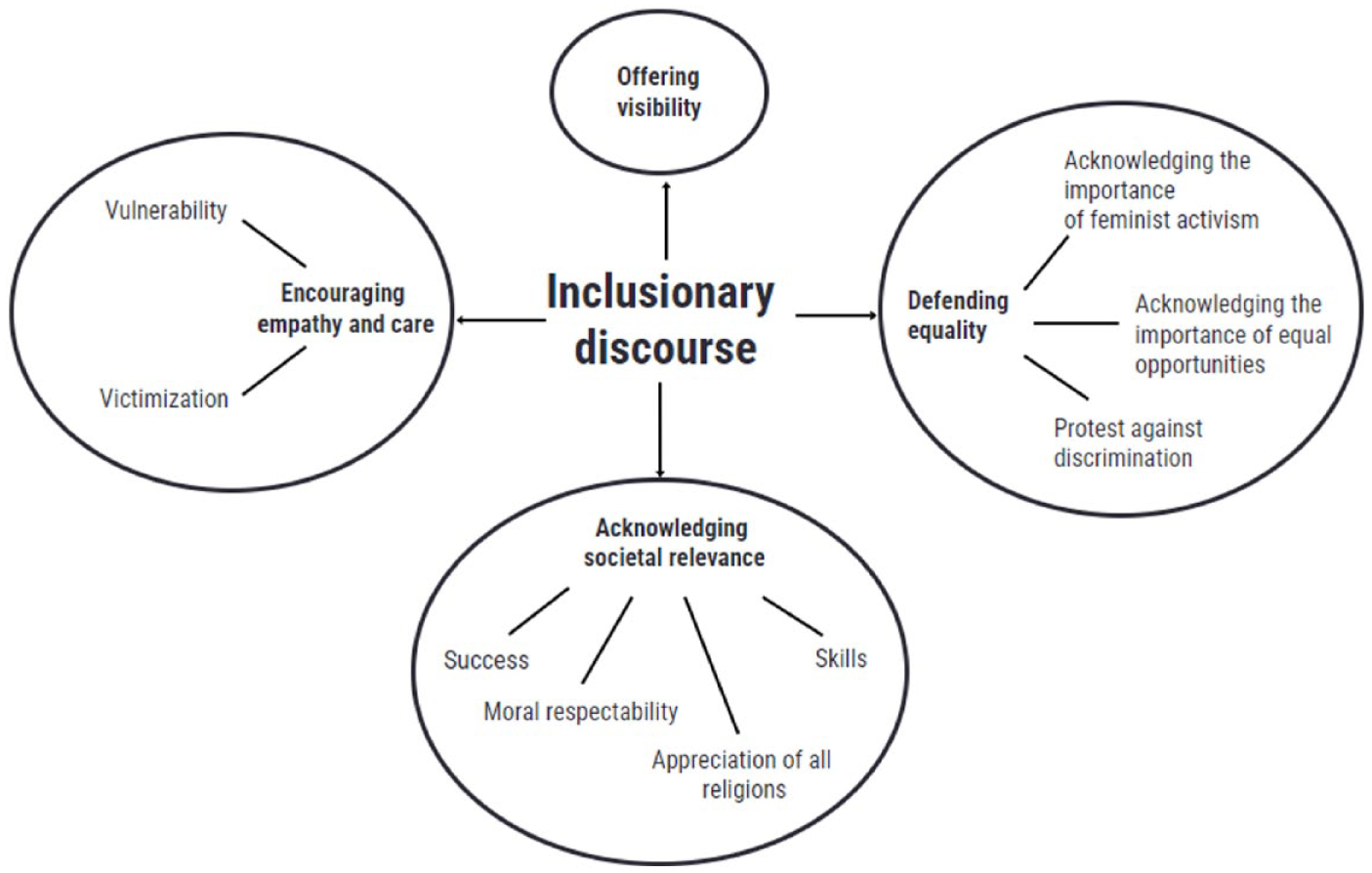
The inclusionary discourse.
Here, the gendered dimension accentuates the victimization of Adelina, who had to endure the physical torment of having to periodically renew her permit to remain in Italy, making her feel unsettled, perhaps unwanted – the kind of stressful condition that presumably contributed to her decision to die by suicide. Victimhood (‘cancer patient’ and ‘victim of trafficking’) is accompanied by a claim to universal human values that involve showing empathy and care to the weak instead of adopting a bureaucratic and insensitive attitude towards their problems. Europe, in terms of victimization, can be constructed in idealistic terms as a caring space for victimized and vulnerable migrants:
Sexual and gender-based violence (especially domestic violence, sexual exploitation, forced marriages, genital mutilation, human trafficking, legislation that institutionalizes gender discrimination, disowning by spouses, cutting off children) drives many women, girls and LGBTQIA+ people to leave their countries and seek asylum in Europe. (Facebook, Greece, Feminist Group)
This statement by a Greek anarcho-queer organization constructs Europe as the reverse of ‘gender-based violence’.
In turn, vulnerability, as mentioned above, refers to the hardships that migrants went through, but also to their potentially victimized status in their countries of origin and the countries to which they migrated. For instance, in a Facebook post taken from a speech of a member of a Greek centre-left-wing party, we read,
Despite the crocodile tears about what awaits the women of Afghanistan, the New Democracy party [the right-wing party in government] does not suspend the returns (of asylum seekers) to Afghanistan, as other countries in Europe have done, and insists on considering Turkey a safe third country. (Facebook, Greece, Politician) (emphasis added)
Here, the women of Afghanistan are expected to face grave consequences if they are not provided with asylum, as they will be forced to return to their home country, Afghanistan, a journey that would involve crossing through Turkey, which the Greek politician understands as an unsafe passage. The vulnerable figure of the female-gendered migrant is accompanied by an appeal to humanistic values of solidarity and empathy, values to which other countries already have subscribed, according to the politician. The subscription to humanistic values by ‘other countries’ discursively positions these countries as morally superior to Greece, making a claim to the importance of upholding the humanist legacy as an indication of social progress. The statements that attempt to raise empathy and care often either hold Europe accountable for failing to uphold its reputation and self-declared values vis-à-vis migrant groups, or regard it as a safe space to protect vulnerable migrants.
Second, the nodal point of offering visibility refers to statements that attempt to shed light on the migrant’s way of life and everyday encounters, which for the most part remain invisible in European public spheres. The strategy of visibility includes giving migrants a voice to tell their own stories and experiences and, in this sense, it opens a more profound discussion regarding the material and discursive conditions permeating migrant lifeworlds. A case in point is a post from the Belgian data, which opens with the question: ‘Why does a migrant son become a rebel in school?’ (Facebook, Belgium, News and Media). The post refers to a television programme that gives insight into how second-generation migrants live and experience life in Belgium. This post in particular gives voice to a migrant son, in which he talks about his negative experiences with the police and how he was discriminated against. While the goal of the post does not seem to be entirely achieved, as the comments are still very negative towards people of colour who live in Belgium, the TV series is an example of how mainstream media can give a voice and a sense of agency to migrants and their children. The discursive element of visibility then refers to the (inclusionary) need to make migrants present, and to include their voices in a country’s public debates.
Third, the nodal point of defending equality includes discursive elements on the importance of feminist activism, the protest against discrimination and the significance of equal opportunities. In this category of statements, equality is something that needs to be a priori defended as a sort of common sense embracing of the whole of humanity. For example, in an Italian language post about migration and integration in the city of Pesaro we read: ‘Pesaro teaches Brussels: The good practices of Pesaro, in terms of gender inclusion, as told to the international audience of Connection, the Eurocities meeting that has just ended in Brussels’ (Facebook, Italy, News and Media). The post then celebrates the efforts of the local government in favouring the inclusion of female migrants. The ‘good practices’ for actors generating inclusionary discourses then harbour a commitment to universal humanist values of equality, which should be ideally reflected in European policy. A Belgian post stressing the importance of feminist protest and activism writes that ‘after ongoing racist and misogynist harassment on social media, Zelfa Madhloum quits as national spokesperson for Open VLD [a center-right liberal party]. Women, especially women from migrant backgrounds, face disproportionate online harassment. This is unacceptable’ (Facebook, Belgium, Feminist Group). Here, protesting against unequal treatment on the basis of ethnicity and gender appears as a form of civic duty. In this category of statements then, equality is a universal value that has to be actively defended either through ‘positive’ measures and policies that aim to provide equal opportunities, or through resistant practices against inequality, including activist feminism and protest.
Fourth, the nodal point acknowledging societal relevance also has several discursive elements, which highlight the (1) success, (2) skills and (3) moral respectability of migrants.
2
A fourth (particular) discursive element is appreciation for the moral qualities and strengths of all religions, including migrant religions. Discourses underscoring societal relevance show how migrants manage, despite their underprivileged status, to accomplish feats that are considered morally good and respectable by the host society and Europe in general, which allows for their rehumanization and destigmatisation. In our data, this category of statements does not overtly emphasize gender but the presence of gender in these statements articulates a chain of signifiers that mirrors (and co-shapes) mainstream representations of gender. For instance, in a post titled ‘A Syrian migrant, despite the difficult financial situation he is in, did not hesitate to hand over the wallet he found’, we read,
A manual worker, the 30-year-old immigrant from Syria did not think twice when he found a wallet with 1500 euros inside. He followed the moral path and handed it over to the police to be returned to its owner. Poverty did not affect his decision, even though his needs are much greater than the amount he found, as he has a family of four children to support! (Facebook, Greece, News and Media)
The post illustrates that although the migrant had to feed his family with limited resources, he did not hesitate to enact the moral good, as the image of the ‘respectable migrant’ is here constructed in terms of the ‘decent breadwinner’. This example illustrates a common trope for articulating positive masculinity, particularly apt for underprivileged people who are expected by dominant society to be prudent instead of unscrupulous, or who are, in other words, expected to satisfy orthodox expectations (and not the unorthodox expectations of longing to see migrants ‘fail’ their quest). Despite its inclusive intent, this articulation of migration suggests that migrants may be welcome in Western society only on specific conditions. By aligning with respectability politics, the narrative invites readers to identify with the migrant who ‘did not think twice’ before returning the wallet, as if from innate goodness.
The construction of the ‘respectable migrant’ is also reflected in a post by a left-wing Belgian politician who presents Ali, a diligent migrant who managed to learn Dutch within 1 year of staying in the country. Based on these skills, Ali, who was ‘undoubtedly one of the sweetest people I have ever met’, according to the author of the post, wanted ‘to volunteer as an interpreter’ but had no permission to work in Belgium (Facebook, Belgium, Politician). Here, Ali appears as the reverse of ‘troublemaking masculinity’, especially associated in exclusionary discourses with Arab youth in Europe (Wojnicka and Nowicka, 2022: 240–241), as he shows the exceptional capacity to learn a foreign language in a year, and an unprecedented willingness to integrate and be a respectful member of the host society (which eventually turns him down). While supportive of inclusionary approaches to migration overall, the constructions of the respectable migrant, which are generally rehumanizing and destigmatizing, can also be thought of as exclusionary in the sense that they implicitly create a hierarchy of desirable and non-desirable migrants in the European space.
Finally, the discursive element of all religions as the moral foundation of society uses an ecumenical approach to religion and thus acknowledges the societal relevance of migrants based on their cultural backgrounds (and in this sense, they are the opposite of the radical difference nodal point that we will discuss in the next section). For instance, a post from the Belgian data presents religious faith, in general, as a positive moral constituency:
Last Sunday was World Migrant and Refugee Day. On that occasion, Bishop Hoogmartens invited some refugee families to his residence. Faith and the local church community played a great role for them to find the courage to keep going. Moreover, from their deeply rooted faith, they also took up a task themselves in our Church community. (Facebook, Belgium, Catholic Church)
Here, faith not only gives migrant people the strength to go on, but encourages them to take up responsibilities and tasks in the church community, in which they are welcomed. While appearing inclusive, the post also signifies that migrants’ acceptance is conditional on their integration into local cultural practices, as retaining cultural or religious autonomy risks exclusion. This again reflects a subtle form of exclusion that prioritizes uniformity over unconditional acceptance of diversity. The cultural background of the migrants, which in exclusive discourses, as we shall see below, is always loaded with negative significations, here becomes an opportunity for connecting further with local communities and the host society at large.
Exclusionary discourses in the three countries
The exclusionary discourse has four nodal points, articulating migrants as a threat, as a burden, as radically different and as irrelevant or invisible (Figure 2). While threat focuses on the danger posed by migrants, burden is an economic argument for exclusion, radical difference is a cultural argument for exclusion and irrelevance is a ghosting strategy that aims to make migrants invisible. As noted above, the exclusionary discourse constructs in-groups and out-groups so as to legitimize exclusionary practices (Wodak, 2011), appealing, for instance, to fear, aversion and incomprehension, and is condescending in representations of (gendered) migrant people.
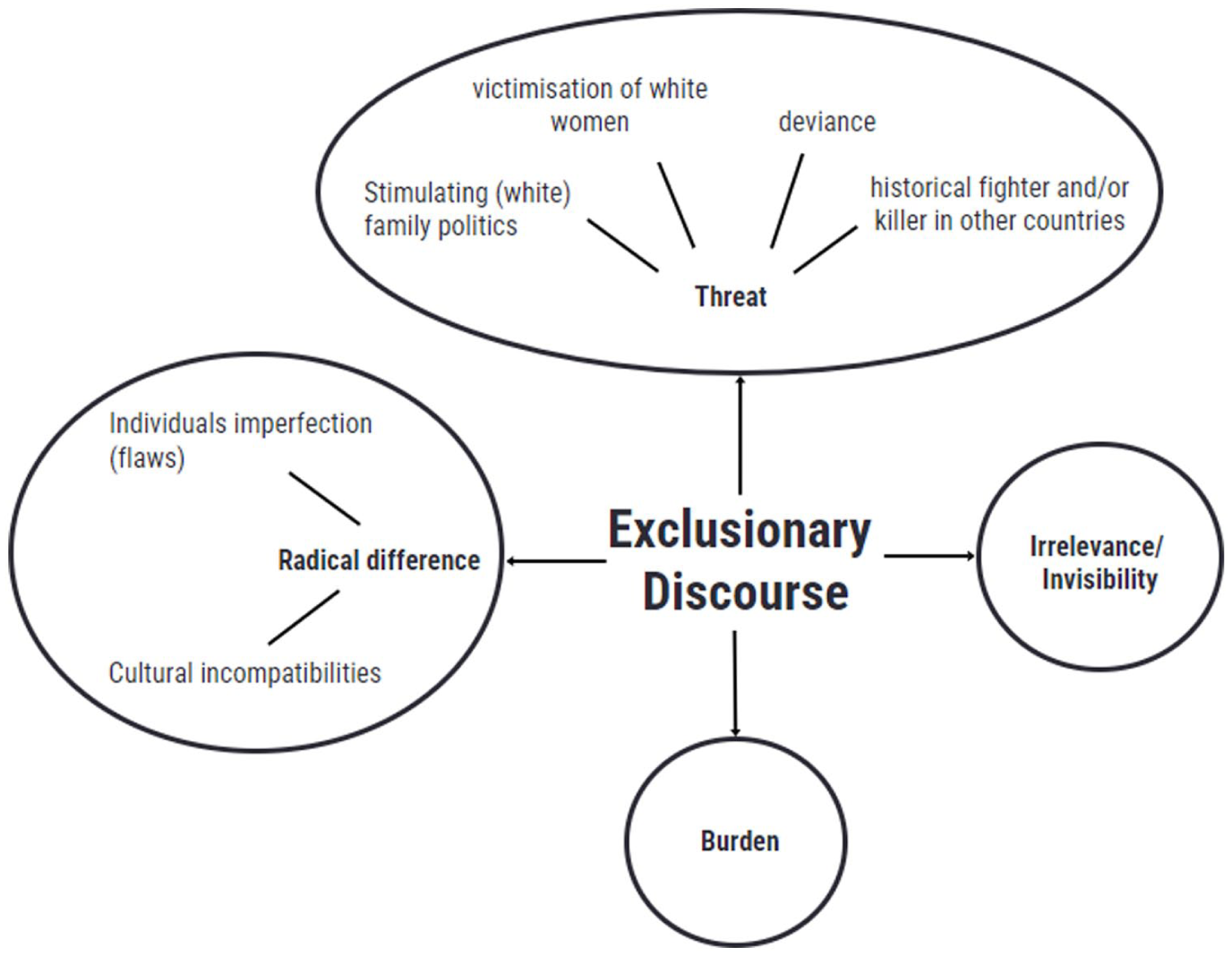
The exclusionary discourse.
The first nodal point of the exclusionary discourse paints asylum seekers, and especially male asylum seekers, as a threat. A characteristic example is a Twitter post by a Greek right-wing account sharing 10 photographs of different men with dark skin tones and arguing that
Some of those who massacred European citizens, men and women, passed through Greece as “refugees and migrants”. The point of invasion was Leros [a Greek island close to the Turkish coast]. None of the “hosts”, state officials, NGOs, “solidarity” paid for this crime [photo of male immigrants]. (Twitter, Greece, Individual User)
In this typical exclusionary portrayal, the migrant men are seen as not only alien to European values and identity, but as actively trying to undermine its existence by ‘invading’ Europe. This threat is expanded to the ‘solidarity’ activists and non-governmental organizations (NGOs) who assist the out-group with its ‘invasion’ of Europe, as they are represented as traitors.
A further articulation of this nodal point is also present in monolithic and essentialist portrayals of migrant men as being historically fighters and/or killers in other countries. For example, this post gives a detailed account of the life of a notable fighter man: ‘On Sept. 18, 1921 – a century ago – Mohammed Abdelkrim El Khattabi proclaimed the independence of the Riffin Republic in northern Morocco. Who was this Abdelkrim, considered the “inventor” of guerrilla warfare?’, the post asks, before concluding that ‘Abdelkrim’s legacy lives on among northern Moroccans. . .’, linking this legacy to contemporary migration in Europe: ‘Their ancestors emigrated en masse to Belgium . . . At the time, the Moroccan government was only too happy to see those – poor and often rebellious – Berbers leave’ (Facebook, Belgium, News and Media). This link suggests that the danger has now certainly arrived in Europe too, in the form of male migrants, while the nature of this danger – revolution, poverty, war – is left open. Thus, exploiting the strength that a chronological historical account can provide and detailing ‘facts’ as unarguable evidence without consideration of how facts are extracted, who extracted them and to tell which story, and for whom, this post allows male migrants to look like a threat due to seemingly unarguable historical evidence.
Then, there is the nodal point representing male migrants as a starkly deviant element of society. A post from the Italian data presents the behaviour of a migrant who was subject to police checks as he ‘began to have an uncooperative and impatient attitude towards those who were controlling him’ as socially unacceptable. The post concludes with a series of facts ‘. . . among A.K’.s clothing, a substantial quantity of narcotic substances of various kinds was retrieved . . . Additionally, [police found] a small precision scale, a few hundred Euros in cash carefully hidden among clothing, the proceeds of drug dealing’ (Facebook, Italy, Government Organization). Aided by the authoritative institutional voice of the narration, the facts are presented as undisputable evidence of criminal activity. Similarly, in the context of exclusionary discourses, the post ultimately serves the function of unequivocally demonstrating the link between male migrants and social deviance. It achieves this by strategically omitting that resisting public force is not an uncommon reaction for people who are stopped by the police, regardless of their migration status.
A particular articulation of this nodal point, which represents migrants as a threat, posits and denounces the victimization of white women. This articulation can be found in a Greek post talking about a teenage girl named Myrto who was sexually assaulted by an ‘illegal immigrant monster of Pakistani origin’. This post particularly stresses the idea that the Greek state treats Greek men unequally (‘If you were abused by a Greek, NGOs would riot in Europe’) in comparison to ‘illegal immigrants’ and ‘refugees’ (who can allegedly do whatever they want without many consequences) (Facebook, Greece, News Organization). In this context, the post also constructs another type of idealization of Europe, namely, had the girl ‘been born in another European country’ (one that does not discriminate between migrants and locals, as Greece presumably does in favour of the migrants) she allegedly would have had better medical treatment. Here, we have an appeal to the ideal of Europe but from an exclusionary perspective, with Europe being presented as more sensitive to its ‘native citizens’ than Greece.
Another articulation of the same nodal point is grounded in the attempt to stimulate (largely white) family politics:
We have too much unwanted migration. Millions try to enter our homelands illegally, then pretend to be asylum seekers and finally have the whole family come over. . . . This is untenable. But the political elite in Europe is apparently more concerned with the so-called human rights of these asylum-cheaters than with the security and future of our own people. (FB, Belgium, Politician, emphasis added)
In this post, a right-wing nationalist politician accuses the government of prioritizing migrants’ families instead of the future of people born in Belgium. This post also articulates the Belgian family as normal and migrants’ families as radically different (see later).
Apart from portraying migrants as threats to security and to European values, a second articulation of exclusionary discourse represents migrants as scroungers and a burden. This nodal point presents an economic argument for the exclusion of migrants and principally focuses on vulnerable migrant figures, such as women, pregnant or not, and children. In a post about migrant pregnant women and children entering Italy on a boat, an Italian news website shares the quote of a high-level, right-wing Italian politician:
A German ship is about to release more than 800 illegal immigrants in Sicily. I have a question: have the ministers for domestic and foreign policy asked Berlin and Brussels to take responsibility for these immigrants or is that okay for them [as it is]? (Facebook, Italy, News and Media)
The idea here is that pregnant women and children will be an extra burden for the host society as they belong to a more ‘weak’ and vulnerable category than the men who can be productive breadwinners. In presenting this idea, this exclusionary nodal point trivializes migrants’ femininity and motherhood and thus creates a paradox: while focusing on a seemingly different portion of society, in fact it enforces a fundamentally traditional version of society through a gendered perspective in which patriarchy is continuously reasserted and normalized.
Similarly, a Greek post by a right-wing local news website gives voice to the views of Mette Frederiksen, then Prime Minister of Denmark, claiming that ‘6 in 10 women from the Middle East, North Africa, and Turkey are not working’ and that the migrants have been using Denmark and its benefits system for years. The post’s exclusionary statements also appeal to common sense, emphasizing that ‘no one disagrees with’ Mette Frederikson on this (Facebook, Greece, News and Media).
Besides being portrayed as a threat or burden, stressing migrants as being radically different is the third nodal point of the exclusionary discourse that we have identified. This discursive strategy is a cultural argument for exclusion, and it works by either representing migrants as individuals with imperfections or flaws, or by focusing, in general cultural terms, on radical irreconcilable cultural differences or incompatibilities between asylum seekers and current citizens of a country or Europe as a whole. An example of the nodal point that positions migrants’ culture as radically different in general, can be found in a post by a Belgian politician from the Flemish far-right party, Vlaams Belang, about a protest against Covid-19 measures. The protest was perceived by many as a right-wing protest; however, the author of the post argues that people from diverse backgrounds participated, and ‘even Muslim women wearing headscarves’ (Facebook, Belgium, Politician). The surprise embedded in the ‘even’, referring to veiled Muslim women, implicitly denies their autonomy, as they are supposed not to make their own decisions, let alone have the agency to engage in political protest.
The fourth nodal point of the exclusionary discourse, ‘irrelevance’, makes migrants invisible by representing them as a faceless, abstract mass, devoid of individuality. This nodal point is grounded in the strategy of omission – simply denying a voice to migrants, and migrant women in particular, by not featuring their opinion as individuals, and their first-person experience in the post, and featuring instead migrants as an abstract social category. Omission is reinforced by the inclusion of authoritative figures commenting on migration (e.g. politicians), and the exclusion of the migrants’ own voices. By not showing the ‘face of the other’, this nodal point performs a massification exercise which articulates migrants as irrelevant and invisible. For this reason, this is a ghost category (it is difficult to comment on what is not there) and will be discussed more in the conclusion.
While the inclusionary and exclusionary discourses are often well-separated, there is a small minority of statements in our data that combine these two discourses. For instance, statements that are supportive towards migrants may still construct Islam as an oppressive entity, particularly towards ‘their women’, hence effectively strengthening social and cultural otherness. Another example is the inclusive statements we already discussed on moral respectability or statements that highlight the skills and successes of migrants, which may implicitly create hierarchies between the respectful/unrespectful, skilled/unskilled, and successful/unsuccessful migrant – whereby a typically successful migrant is one who embodies capitalist ideals of growth, or is made to fit western ideas of gender empowerment. These archetypal constructions of migrants-paragons, which, as discussed above, always assume gendered qualities, can then, at a second reading, articulate a mixed discourse in relation to the intersection of migration and gender.
Conclusion
We identified two main discourses through which the debate over migration appears in public, an inclusionary and an exclusionary discourse. The underlying theoretical assumption, grounded in Laclau and Mouffe’s (2001 [1985]) work, is that the construction of reality is a conflictual and never-ending process, and ‘no discursive formation is a sutured totality’ (p. 93). As discourses rather crystallize into temporary assemblages, or nodal points (Laclau and Mouffe, 2001 [1985]: 172), we could break down the two narratives into a series of those nodal points, which articulate different moments of inclusion and exclusion. The inclusionary discourse has four nodal points, namely, empathy and care, visibility, equality and the acknowledgement of societal relevance, which provide constructions of gender that welcome migrants in European societies. In turn, the exclusionary discourse has four nodal points, namely, constructing migrants as a threat, as a burden, as radically different and as irrelevant or invisible, which provide constructions of gender that prohibit the inclusion of migrants in European societies.
The analysis of the social media postings, in three different counties (with three different migration and political contexts), generated remarkable similarities when looking at how gender and migration intersected. The analysis did not start from a pre-given idea that inclusion and exclusion would structure the online signifying practices in relation to migration to this extent, that these two discourses would be so distinctly different from each other in their articulation, and that they would be so omnipresent. Still, the analysis demonstrates exactly the prominence of these two discourses, their juxtaposition and their omnipresence, in the three countries we studied.
These discourses reflect the intensity of the struggle over migration, whereby gender is continually activated. Even when statements do not directly address opposing views, they remain embedded in this highly politized field, constantly negotiating the meaning of the (gendered) migrating Other. At the same time, these discourses construct the European self – either as resistant to otherness, framed as structurally different, or as embracing diversity and inclusion.
Finally, our analysis does show the connections between the left/right-wing political spectrum and the discourses of inclusion and exclusion, but this relationship is not linear and straightforward, first, because statements may exhibit ambivalent or even contradictory positions, being inclusionary at one level but grounded into exclusionary views of society at another level; second, because this left/right-wing spectrum is composed of multiple dimensions, different (discursive) alliances are possible. The usual alignment of exclusionary discourse with the right and inclusionary discourse with the left is increasingly unstable anyhow. The rise of ‘anti-woke’ politics has shifted much of the spectrum rightwards, with even social-democratic parties adopting exclusionary rhetoric on migration – for example, the UK Labour Party under Keir Starmer or the Danish Social Democrats. From a cultural studies perspective, this underscores how othering has become central to contemporary articulations of national identity in Europe, especially in public debates on migration. Here, the instability of political signifiers is most visible, as competing discourses struggle to define ‘Europeanness’. In this conjuncture, exclusionary discourses have gained more hegemonic force precisely because they are adaptable and cross traditional ideological boundaries.
Footnotes

Funding
The authors disclosed receipt of the following financial support for the research, authorship, and/or publication of this article: This article is part of a project that has received funding from the European Union’s Horizon 2020 Research and Innovation Programme under Grant Agreement No. 101004488.
Declaration of conflicting interests
The authors declared no potential conflicts of interest with respect to the research, authorship and/or publication of this article.